
Realme 7 Pro review: A mid-range phone chock-full of features
The newest sub $500 phone on the block has a lot to offer. Could this be an ideal all-round Android smartphone for you instead of the Pixel 4a?

Note: This article was first published on 7th December 2020.
Realme’s on a roll like a Pro
Realme seems to be on a roll. In April this year, the Chinese smartphone company released the Realme 6 and 6 Pro. Just seven months later, they announced the latest Realme 7 Pro. Since this is the first Realme phone that we are reviewing, let us start with an overview of the entire Realme series lineup.
Realme has its phones broadly classified into three different tiers:
- X series (X50 Pro): the flagship, top-of-the-line tier
- Numeral series (7 Pro, 7): The affordable, mid-range tier
- C series (C15): the low-cost, budget phones
Within Realme’s digit-based series, there are the Pro and the non-Pro variants. The differences between both seem minimal but still substantial, with the Pro having a slightly bumped-up processor and camera specs. Realme’s feature phones across all tiers compete within the entry-level to mid-range space, since the brand does not use flagship-tier processors for its devices.
In Singapore, only the Realme 7 Pro is distributed and sold. The 7 Pro uses the same Qualcomm Snapdragon 720G processor as the 6 Pro, but with different camera specs and added features. The Realme 7 Pro sold in Singapore comes with 8GB RAM and 128GB storage, as well as NFC. In fact, the top line specs even match the S$899 Oppo Reno4 Pro. With a short duration in between the launch of 6 Pro and 7 Pro, how different is the S$499 Realme 7 Pro compared to its predecessor and the competition? Let’s find out.
Design & Handling
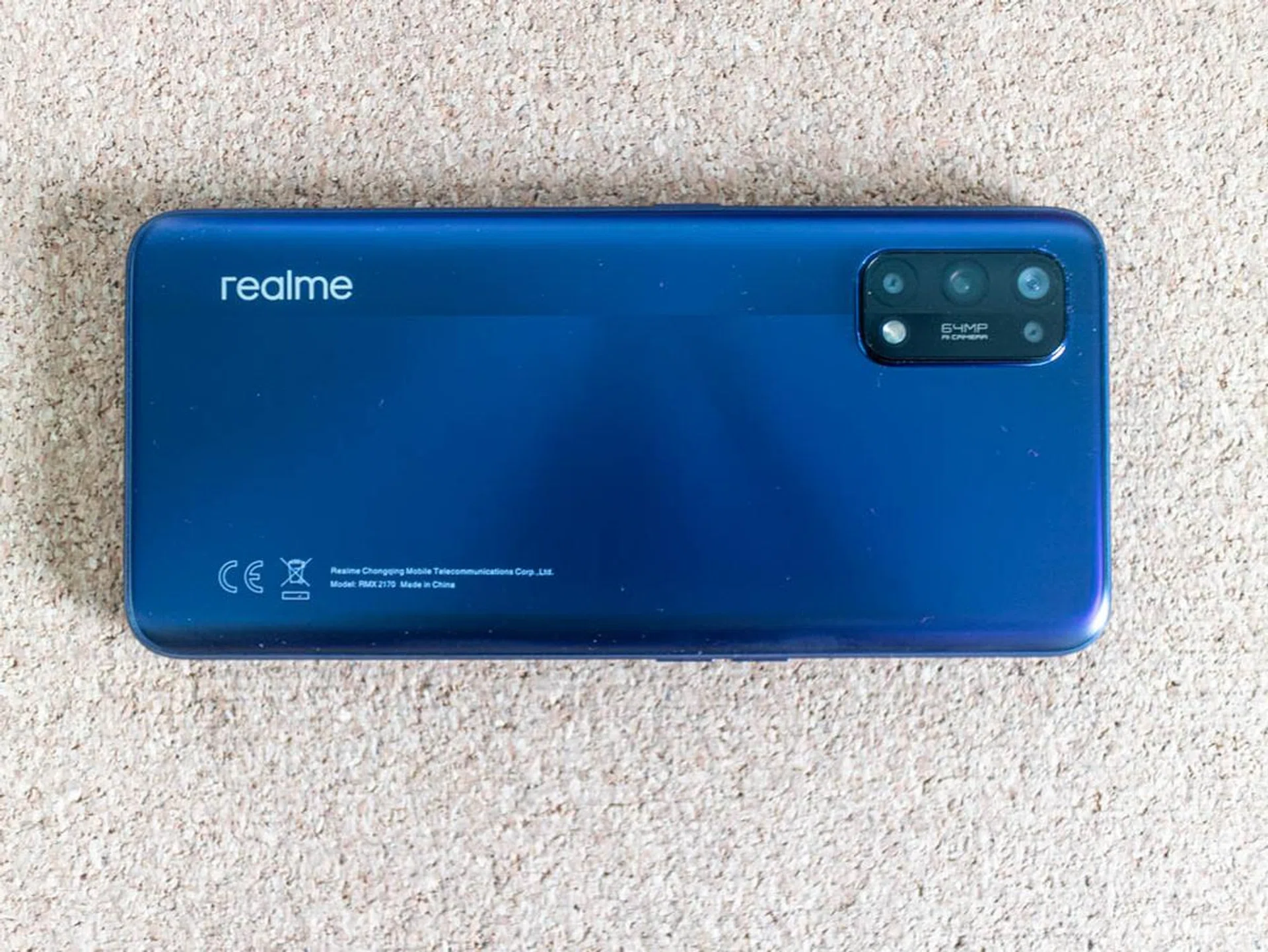
When we first unboxed the phone and held it in our hands, the phone felt bulky. With a thickset body (at 160.9 x 74.3 x 8.7mm) and a weight of 182g, it was somewhat hefty, even though this is typical for a mid-range phone. Comparatively, the Google Pixel 4a is slim for a mid-range device at just 8.2mm, while the premium-mid-range Vivo X50 Pro was merely 8.04mm.
The Realme 7 Pro features a matte finish on its back. Two colour options are available with the Realme 7 Pro: Mirror Blue and Mirror White. The review unit I got is of the Mirror Blue variant.
The volume rocker is on the left side of the phone, while the power button sits to the right. The phone supports Dual SIM and additional external storage, so the dual-SIM and microSD three-card slot can be found beside the volume rocker while the USB-C port and 3.5mm audio jack is located at the bottom.
Display & Audio
The display is a 6.4-inch Super AMOLED display, a step-up from its predecessor's IPS LCD panel, with 2,400 x 1,080 pixels resolution.
Just like its predecessor, the display is nearly bezel-less with 90.8% screen-to-body ratio. The change to Super AMOLED seems to come with a sacrifice, however, as it does not come with the smooth 90Hz refresh rate that its predecessor had.
The one and only speaker grille is located at the bottom right of the phone. Audio quality, in its raw form, is comparable to that of other mid-range phones, such as the Pixel 4a. While there is Dolby Atmos support, and it seems to work well, it is best not to place the speakers at max volume, as the phone will aggressively soften audio clipping, resulting in audio distortion.
UI & Features
Realme 7 Pro runs on Android 10, and running on top of it is Realme’s take on Android, aptly named Realme UI. It sits at Version 1.0, since previous Realme phones ran on ColorOS, which is the Android reskin used by Oppo phones.
Despite the UI’s name, Realme UI 1.0 looks almost exactly like ColorOS 7 that I had previously experienced on the Oppo Reno4 Pro. There are exceptions: app icons are circular instead of squares. Our other observations on ColorOS can be applied to Realme UI 1.0.
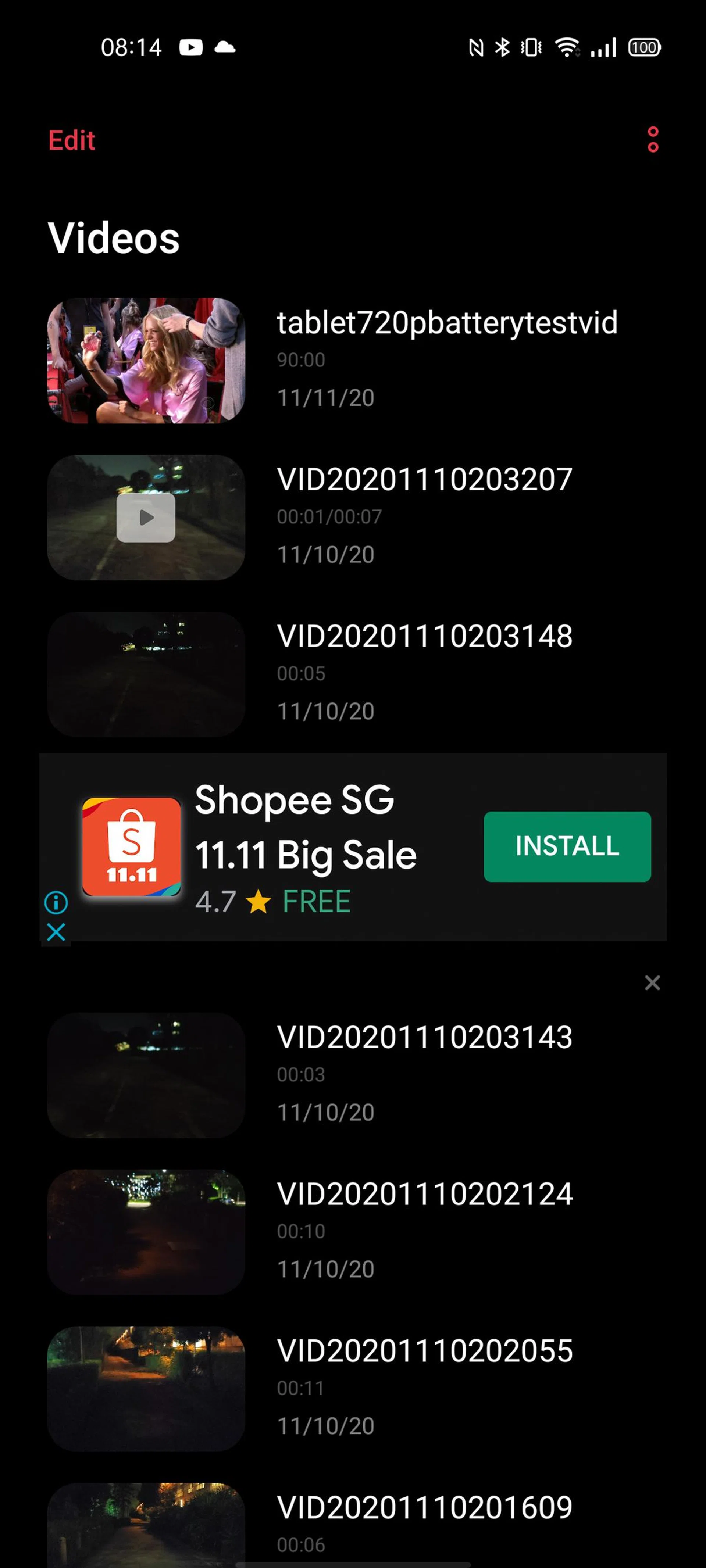
That being said, Realme UI has a major, irritating, and disturbing “feature”. Advertising plagues various system apps and default apps, including the Videos app. While they don't immediately appear, ads start showing up on the second or third usage of the app onwards. Fortunately, this feature can be disabled, though it is well hidden under Additional Settings -> Get Recommendations; the nomenclature used does not directly point the user towards enabling or disabling the display of ads.
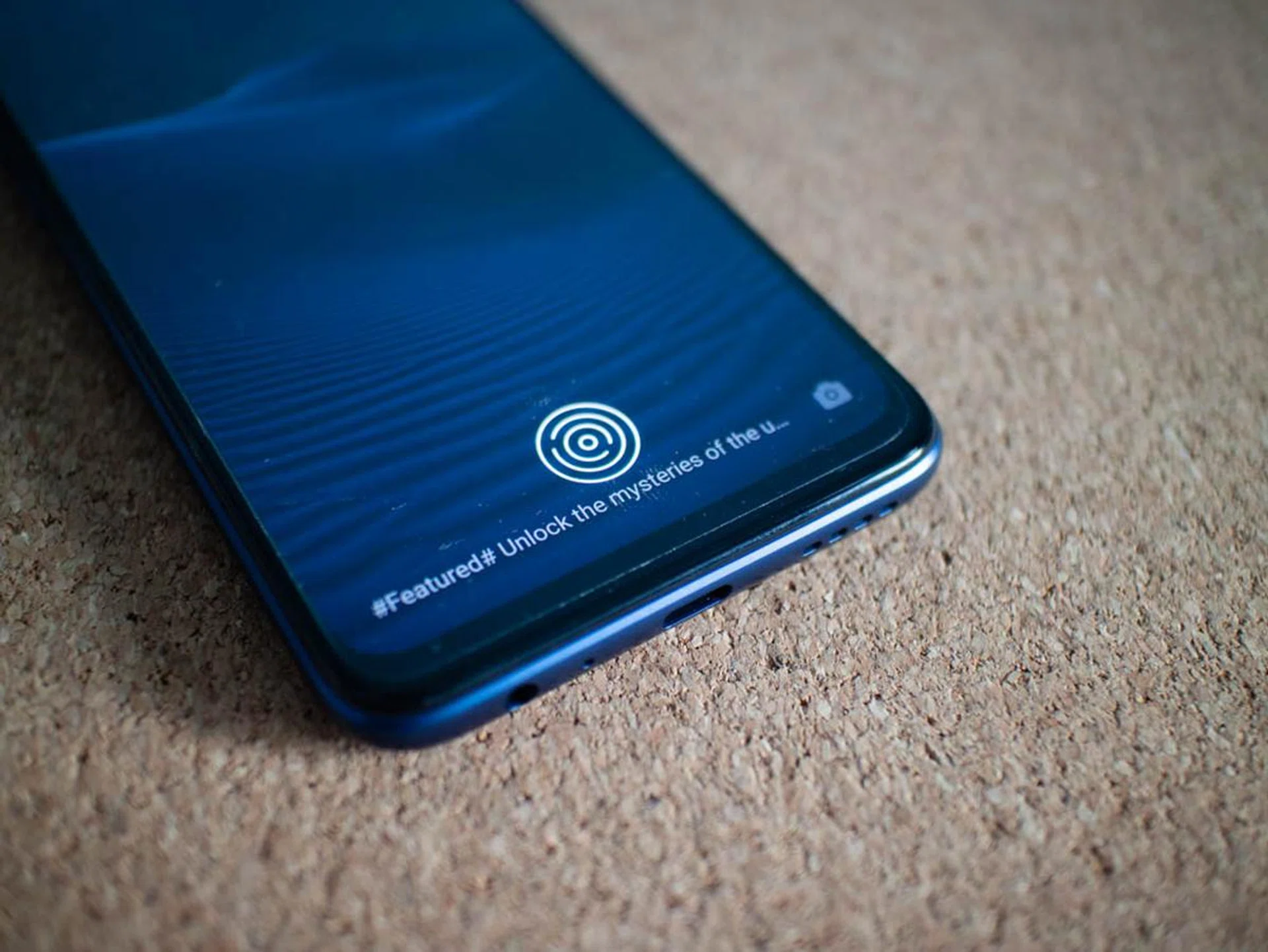
The Realme 7 Pro incorporates an in-display fingerprint scanner, which is a step-up from its predecessor that used the power button as a fingerprint reader. We found the in-screen fingerprint scanner to be quite responsive, and it swiftly unlocks the phone. Not bad for an affordable mid-range phone.
Imaging Performance
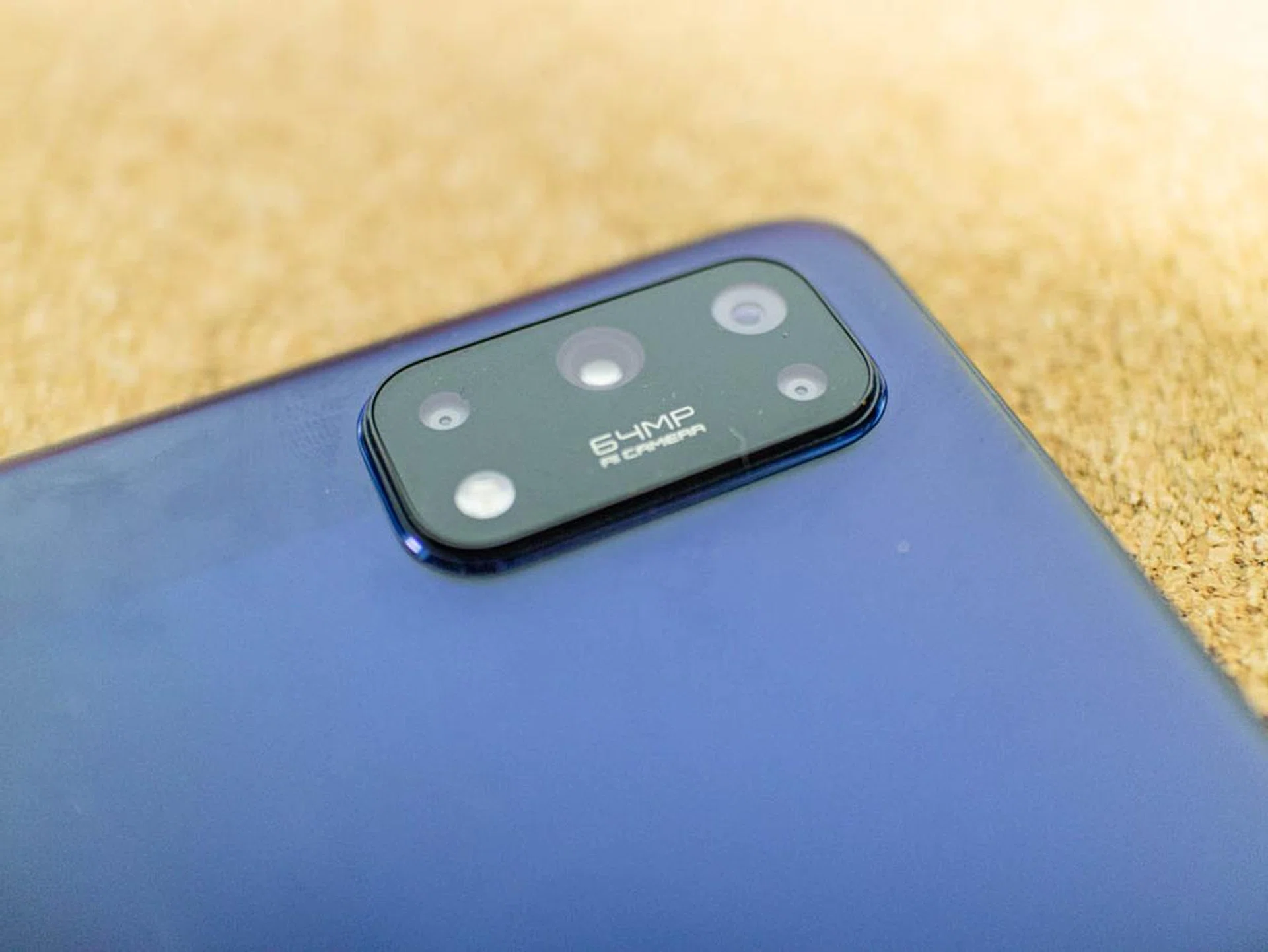
Similar to the Realme 6 Pro, the Realme 7 Pro’s back camera system consists of four camera modules. It is however laid out in a rectangular block. The housing protrudes much like the Note 20 Ultra’s, so the phone is not able to lie flat on the surface. This is easily resolved by putting the TPU cover provided in the box.
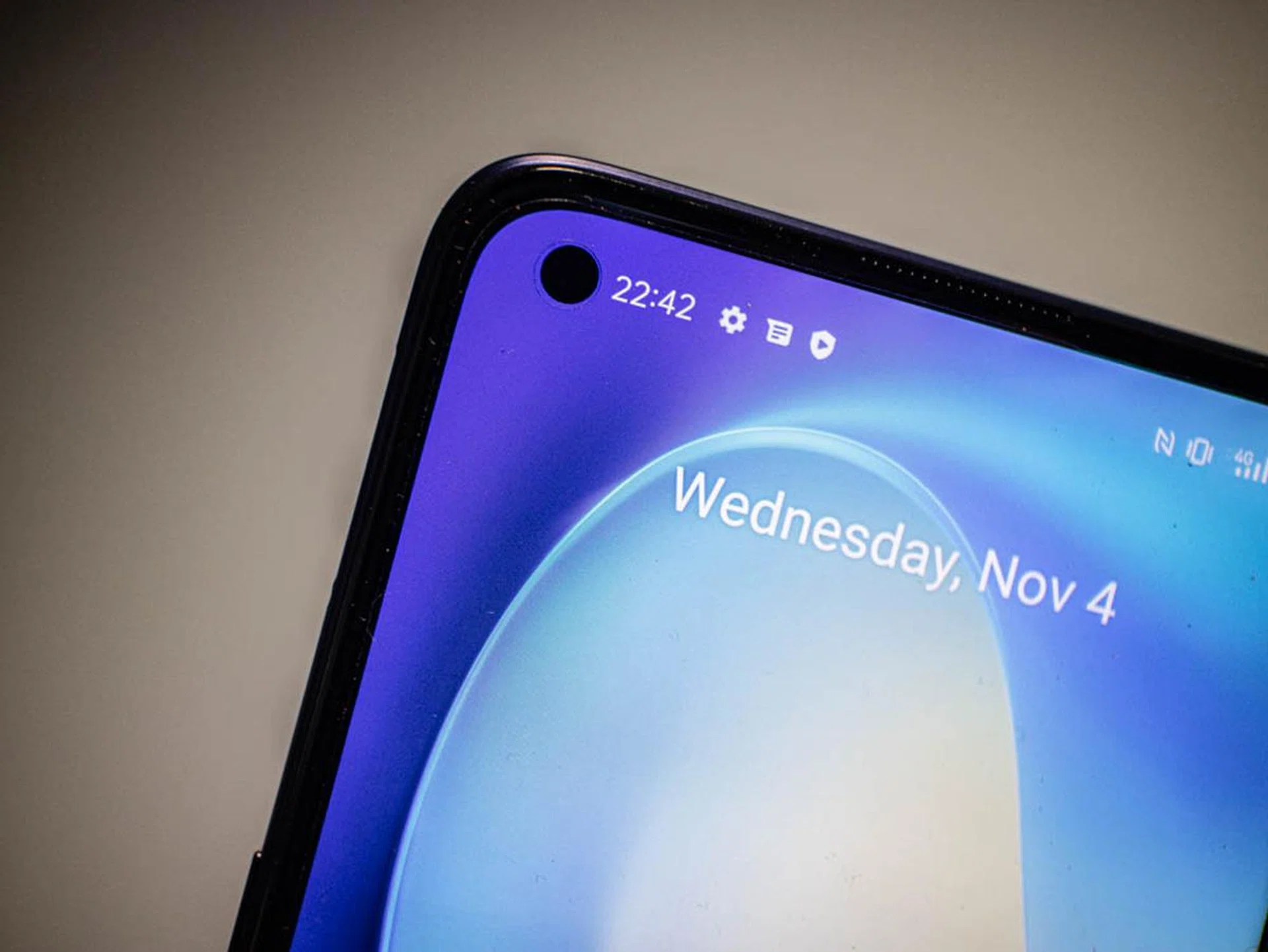
The front camera also sees some changes with the Realme 7 Pro touting a single 32MP camera, located within the tiny punch hole in the top left-hand corner of the display.
Here’s a rundown on Realme 7 Pro’s rear camera array:
- 64MP, Sony IMX682, 1/1.73-inch sensor size, f/1.8, 6P lens (main camera)
- 8MP, Ultra-wide-angle, 119-degree FOV, f/2.3 5P lens
- 2MP, Monochrome Portrait, f/2.4 3P lens
- 2MP, Macro lens, 4cm focus, f/2.4, 3P lens
One notable difference between the 7 Pro and the 6 Pro is that monochrome portraiture lens was used in favour of a telephoto lens. According to Realme, this choice allows for better and creative photos. We shall explore that claim later. Interestingly, we see a trend of phone manufacturers doing away with the telephoto lens in non-flagship phones launched this year. This was done in favour of incorporating other types of lenses or, even reducing the total number of cameras altogether. Presumably, advances in image processing saw improvements in digital zooming, so there’s a lower priority for dedicated telephoto hardware outside of flagship-tier handsets.
The main rear camera module uses Quad Bayer pixel-binning technology to process photos. As such, photos output at 12MP resolution by default, with an option to take 64MP photos without pixel-binning.
Day Photos
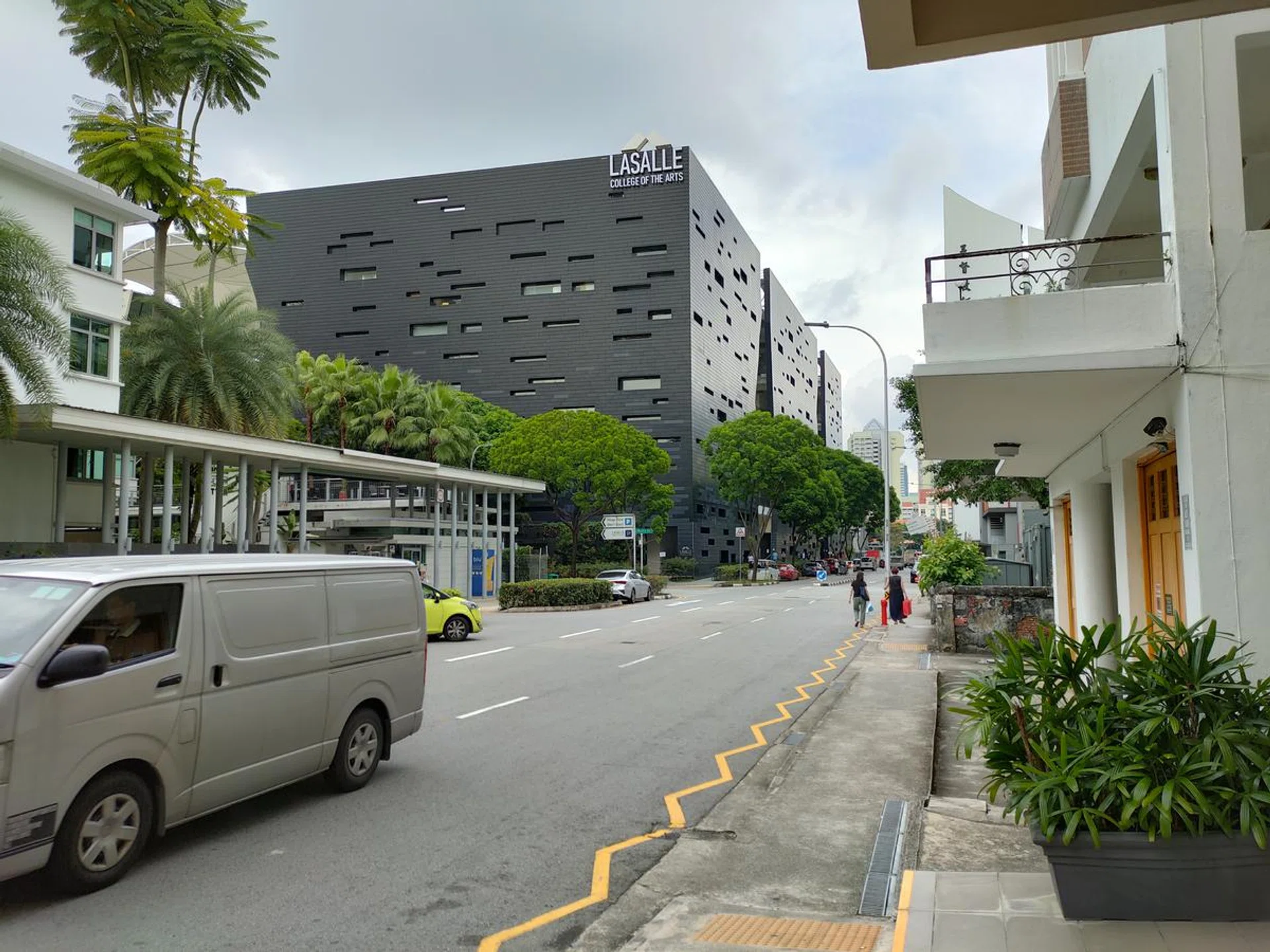
The image quality offered feels slightly above expectations of what we’d typically expect from a mid-range phone. The photos are clear. However, zooming in will reveal slight over-sharpening near the edges in the photo. There is negligible grain. We deem the photo quality 'good enough' for social media sharing and casual photo printing.
Shooting at its native 64MP resolution (click to view this 19MP original image) yields slightly sharper photos at the cost of slightly increased graininess with the Realme 7 Pro. You can see that text is indeed sharper, but the photo in 64MP had more noise.
The Realme Pro 7 can take up to 10x digital zoom shots. There’s some fuzziness, but there are also fewer photo artefacts caused by zooming in during photo-taking. Overall, the performance is not bad for digital zooming (at 10x no-less) and it certainly feels usable when needed. Here's the cropped image for reference:-

To add some snazziness to your photos, Realme 7 Pro’s camera offers AI Dazzle Color. You can compare the difference between a normal shot, and a shot taken with AI Dazzle Color on:-

Portraits

The Realme 7 Pro can take beautiful bokeh shots. Perhaps it has something to do with the dedicated black and white lens, which usually helps phone cameras supply depth information. The phone, however, does remind users that such portrait shots work best with only one subject.
Night Mode
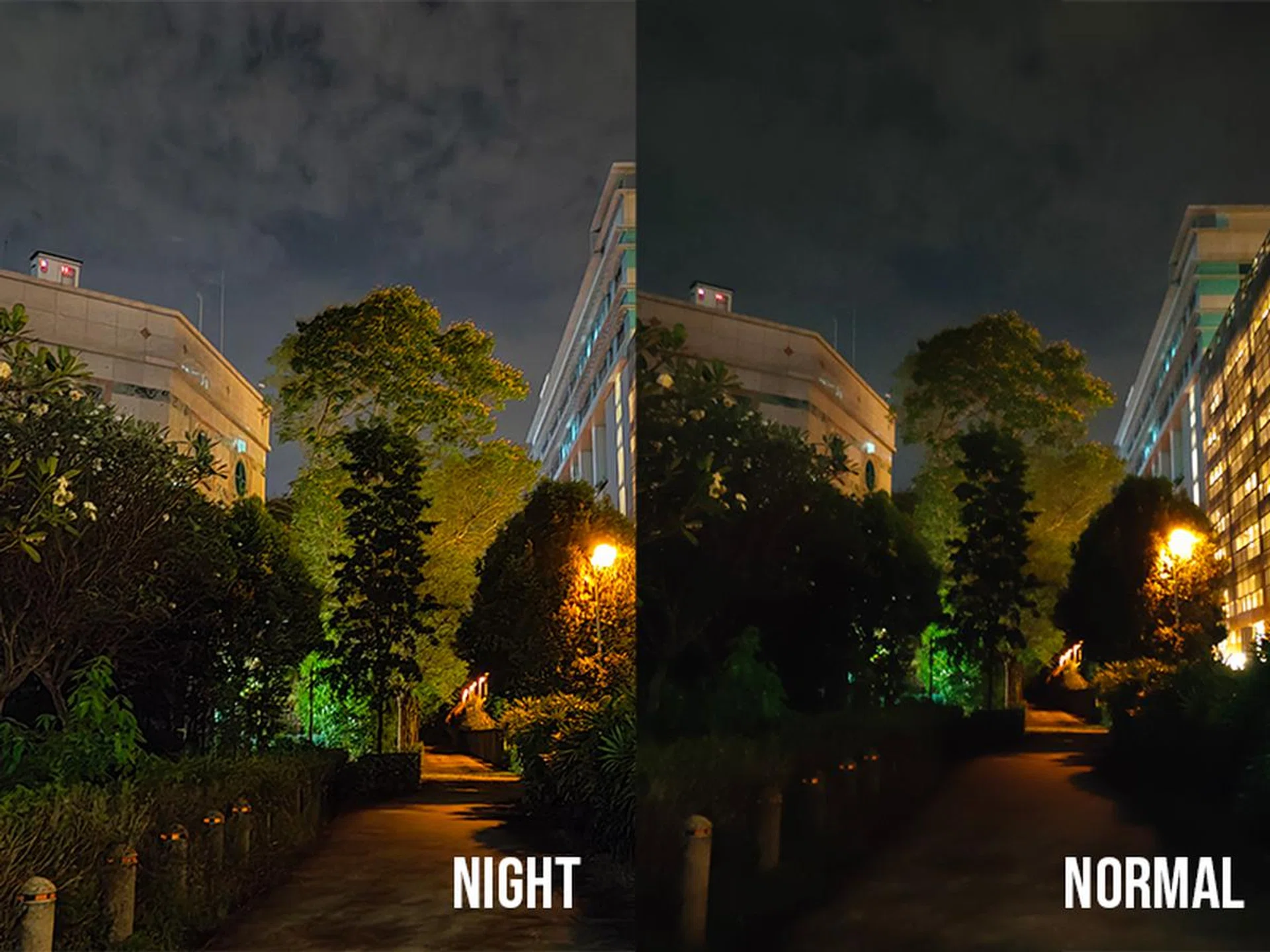
Despite being a mid-range phone, the Realme 7 Pro performs better than expected when it comes to night mode. For night shots with some ambient light available, the quality is decent, as long as you don’t zoom in.
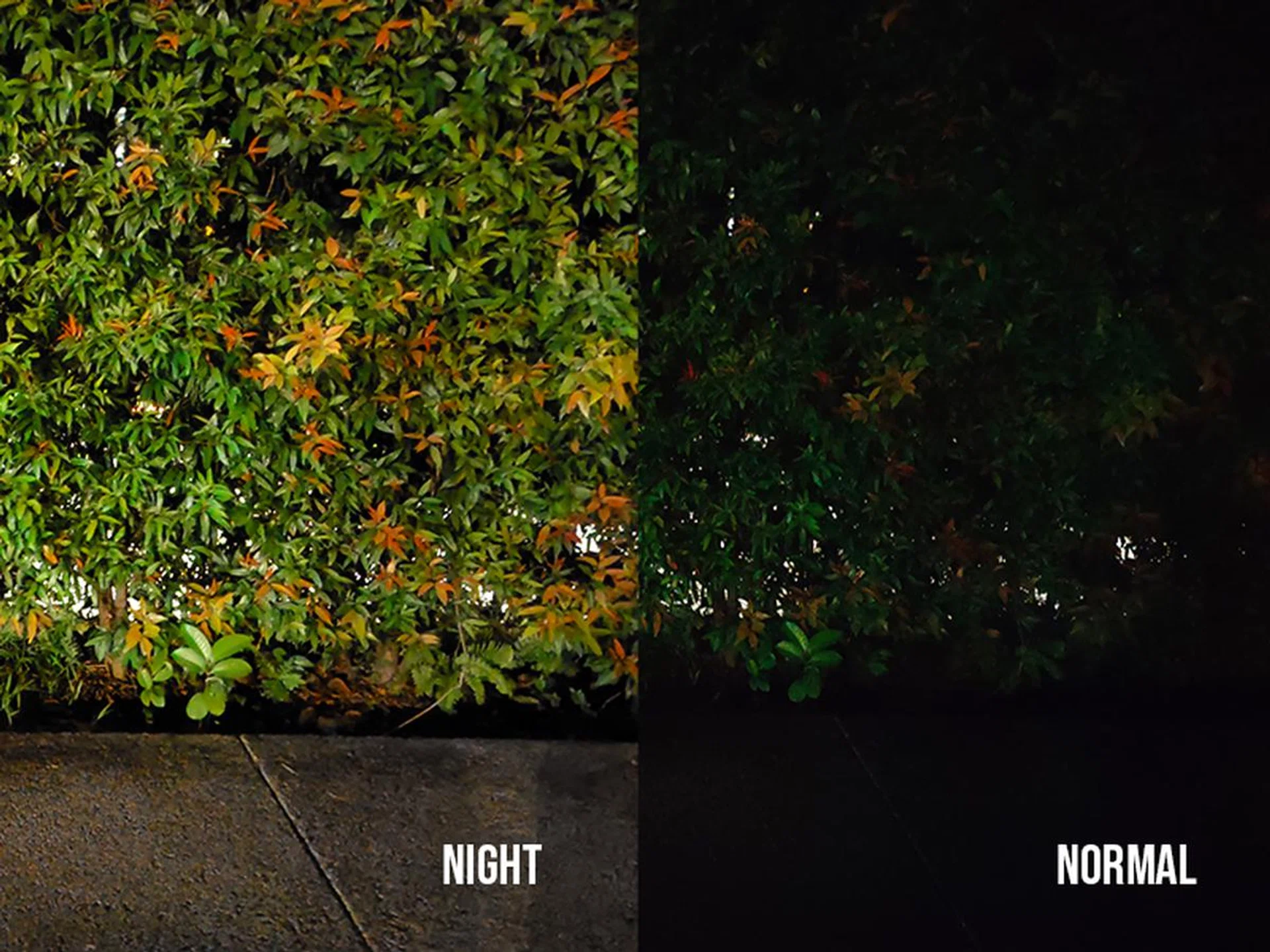
At even darker shots though, you must stand really completely still to capture a decent night shot. Even then, the quality is barely good enough for social media consumption.
AI Colour Portrait Videos

The Realme 7 Pro comes with a few surprises for videography, one of which is AI Colour Portrait Video. Simply put, the phone can colourise the subject while rendering everything else black and white.
This leaves an artistic effect on your videos and it works on both rear and front camera, though there is obvious lag and loss of quality if you choose to use this effect on the front camera.
The one perplexing question arising from this feature is: if it can be implemented for videography, why is this feature not available for photo-taking? It’s an enjoyable shooting option, and we sorely miss it in photography.
Bokeh Video
The bokeh effect can also be applied to videos. It also works for both front and rear cameras, though the resulting video from using front cameras has a much lower quality, and there was a faint hue surrounding the subject. For both cameras, the bokeh video effect exhibits some stutter and some loss of frames, presumably the processor unable to catch-up with the real-time processing needs.
Note that by including both AI Colour Portrait and Bokeh effects into videography, the resulting video’s resolution would be drastically reduced to 1,280 x 720 pixels, regardless of original video selection.
UIS Video (and Max Video) Stabilisation
UIS Video is Realme’s take on EIS, and there is even a Max Video Stabilization mode in Realme 7 Pro. We took the phone for a brief run in various modes and even attached a Zhiyun Smooth X gimbal as baseline comparison of image stabilisation.
With normal stabilisation, the phone struggles to contain longitudinal shifts. In contrast, lateral shifts are somewhat well contained – thus yielding a rather unnatural video of the phone being shifted to and fro sideways. Max Video stabilisation seems to stabilise somewhat better – but at a huge cost of video quality. Conclusion: don’t bother turning on video stabilisation.
Benchmark Performance
Similar to its predecessor (Realme 6 Pro), the Realme 7 Pro features a Qualcomm Snapdragon 720G, a mid-range SoC powered by two core clusters: a cluster consisting six Kryo 465 Silver @ 1.8GHz, and another cluster containing two Kryo 465 Gold @ 2.3GHz. It also features an Adreno 618 graphics processor. The unit we have (and also the only variant sold in Singapore) has 8GB RAM. This places the S$499 Realme 7 Pro quite squarely amongst other mid-range phones hovering around the $500 range. How does Realme 7 Pro fare against them in benchmark comparison? Let’s find out.
As a matter of curiosity, as the Oppo Reno4 Pro has almost similar raw specs as the Realme 7 Pro, hence, the Oppo Reno4 Pro is also included in the comparison chart, despite having a recommended retail price of S$899 which is substantially out of typical mid-range phone price points.
Geekbench 5
Geekbench CPU is a cross-platform processor benchmark that tests both single-core and multi-core performance with workloads that simulate real-world usage. Geekbench 5 scores are calibrated against a baseline score of 1000, which is the score of an Intel Core i3-8100.
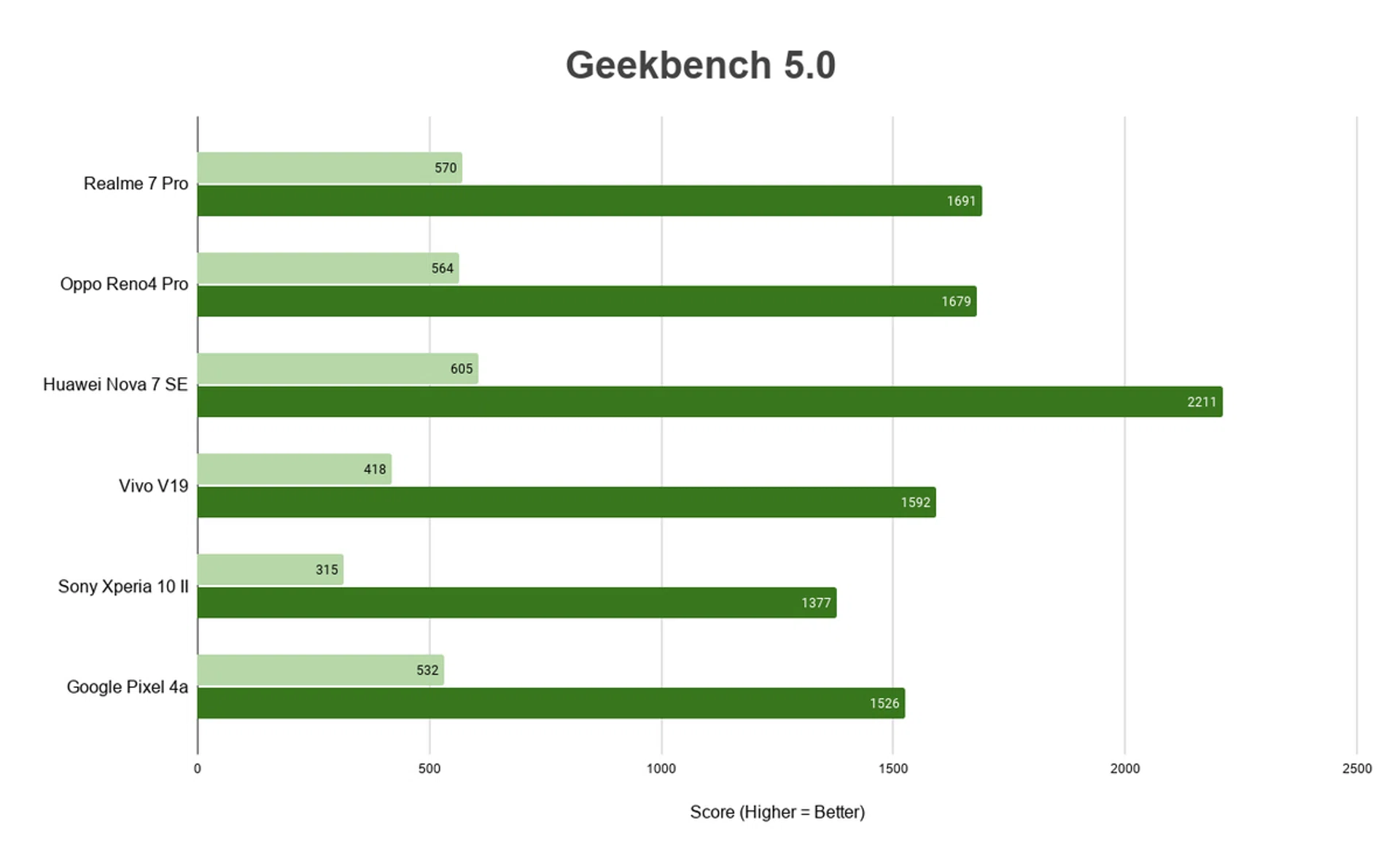
The Realme 7 Pro performs well against other mid-range phones, have similar scores to the Oppo Reno4 Pro, but falls behind the Huawei Nova 7 SE that's equipped with a more powerful processor.
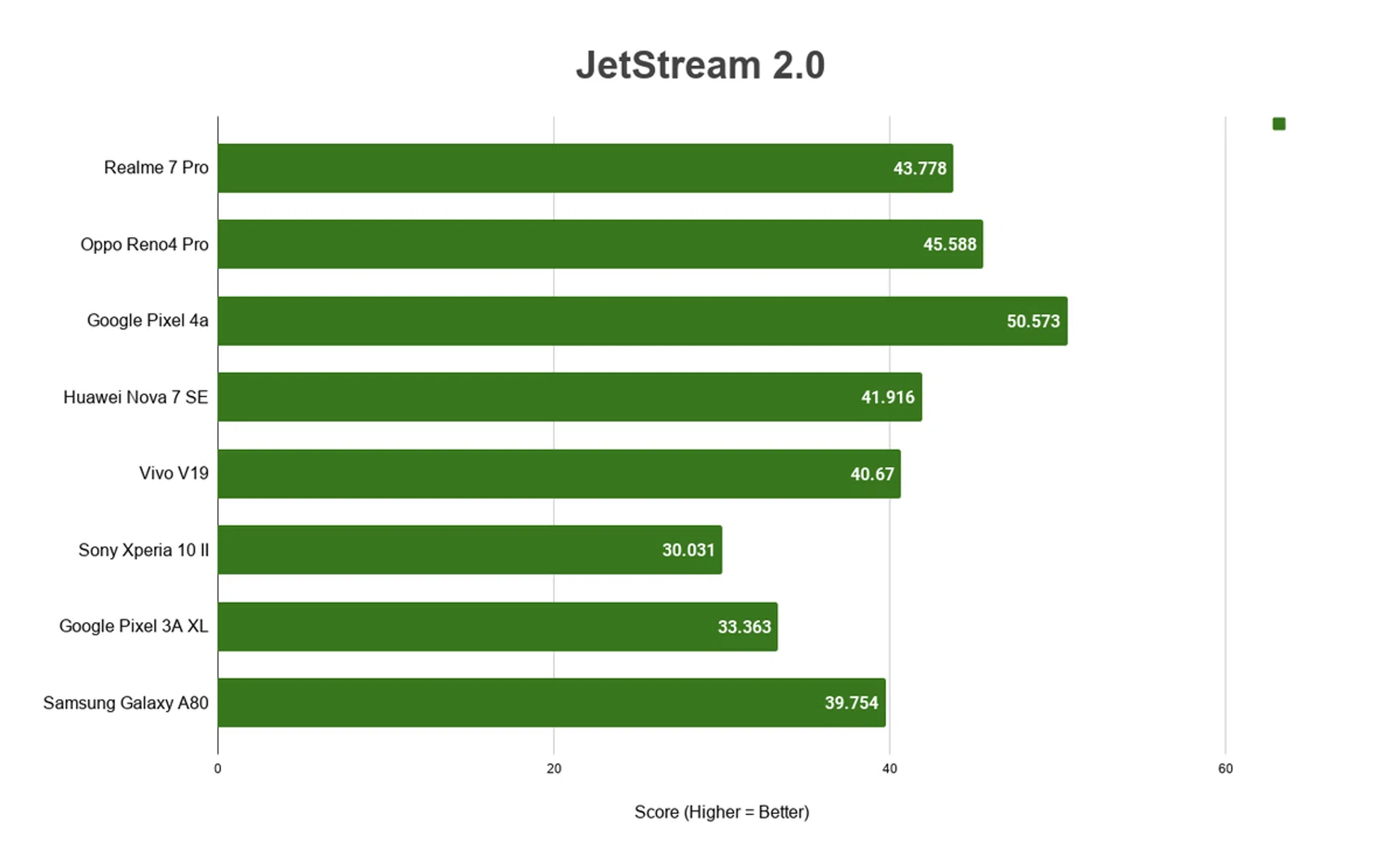
Jetstream 2
JetStream 2 is a combination of a variety of JavaScript and Web Assembly benchmarks, including benchmarks that came before like SunSpider and Octane. It primarily tests for a system’s and browser’s ability in delivering a good web experience. We found the Jetstream score to also be comparable to other mid-range phones.
3DMark Sling Shot Extreme
3DMark Sling Shot is an advanced 3D graphics benchmark that tests the full range of OpenGL ES 3.1 and ES 3.0 API features including multiple render targets, instanced rendering, uniform buffers and transform feedback. The test also includes impressive volumetric lighting and post-processing effects.
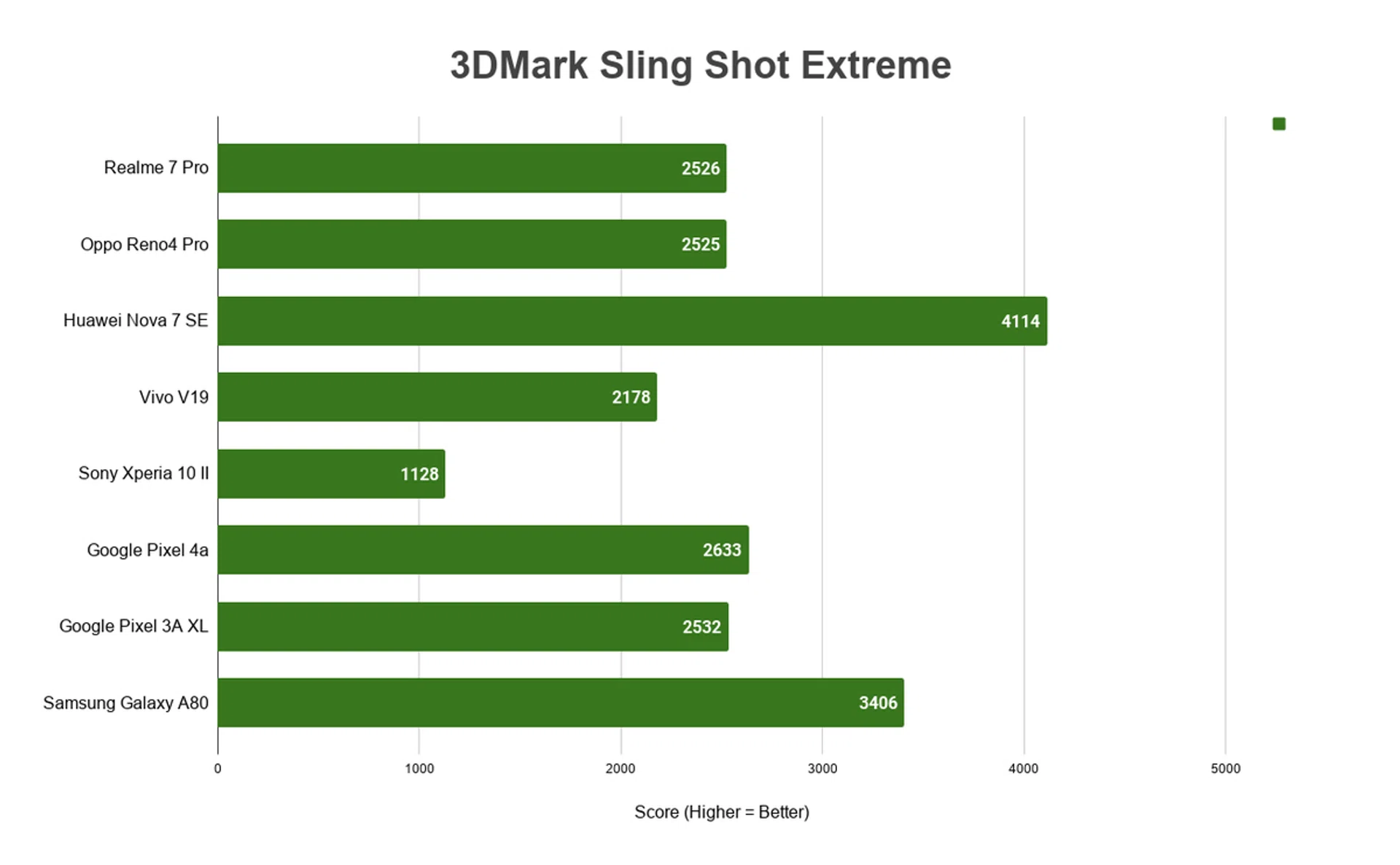
Both Realme 7 Pro and Oppo Reno4 Pro have similar scores, but the Realme phone lagged behind the Huawei Nova 7 SE once again. This was to be expected as Huawei stuffed a near-flagship performance chipset into its mid-range phone. Most other phones, as seen in the graph above, are mostly similarly matched (save for the Sony Xperia 10 II, which was literally underperforming for its class).
Battery Life
Our standard battery test for mobile phones has the following parameters:
- Looping a 720p video with screen brightness and volume at 100%
- Wi-Fi and Bluetooth connectivity turned on
- Constant data streaming through email and Twitter
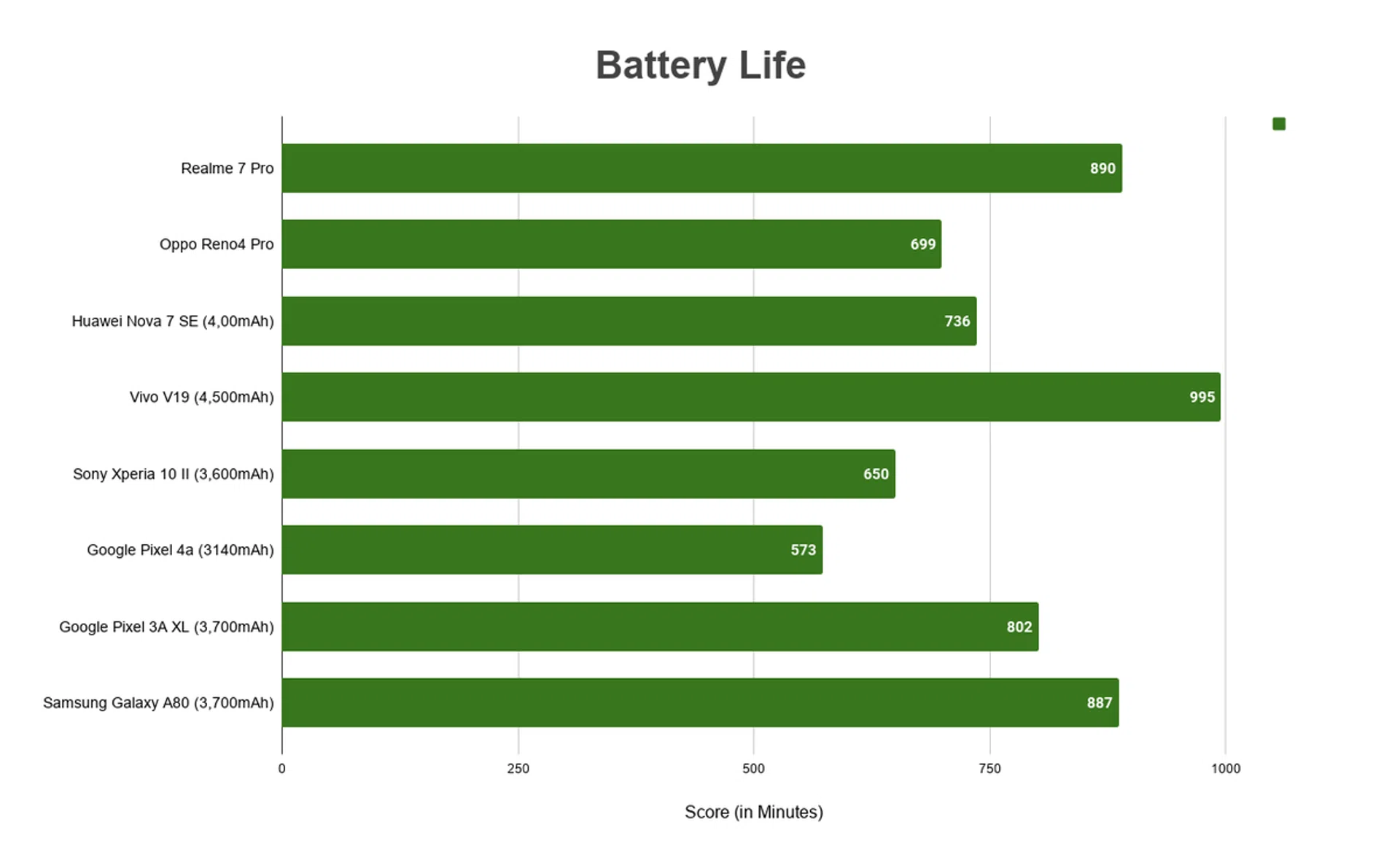
The Realme 7 Pro is packed with a 4,500mAh battery – slightly bigger than Realme 6 Pro’s 4,300mAh battery. The benchmark yields a rather mind-blowing battery uptime of 890 minutes, which gives about close to 15 hours of battery life. Apart from Vivo V19, it recorded one of the longest battery uptimes in this benchmark test in recent times.
Interestingly though, in real-life usage, i.e. with substantial 4G connection, battery drains off just like an ordinary mid-range phone. It lasts throughout the day comfortably, though it’s a must to charge the phone at the end of the day for a piece of mind for the next day. Even if one forgets to do so, the SuperDart charger ensures a full charge in a bit.
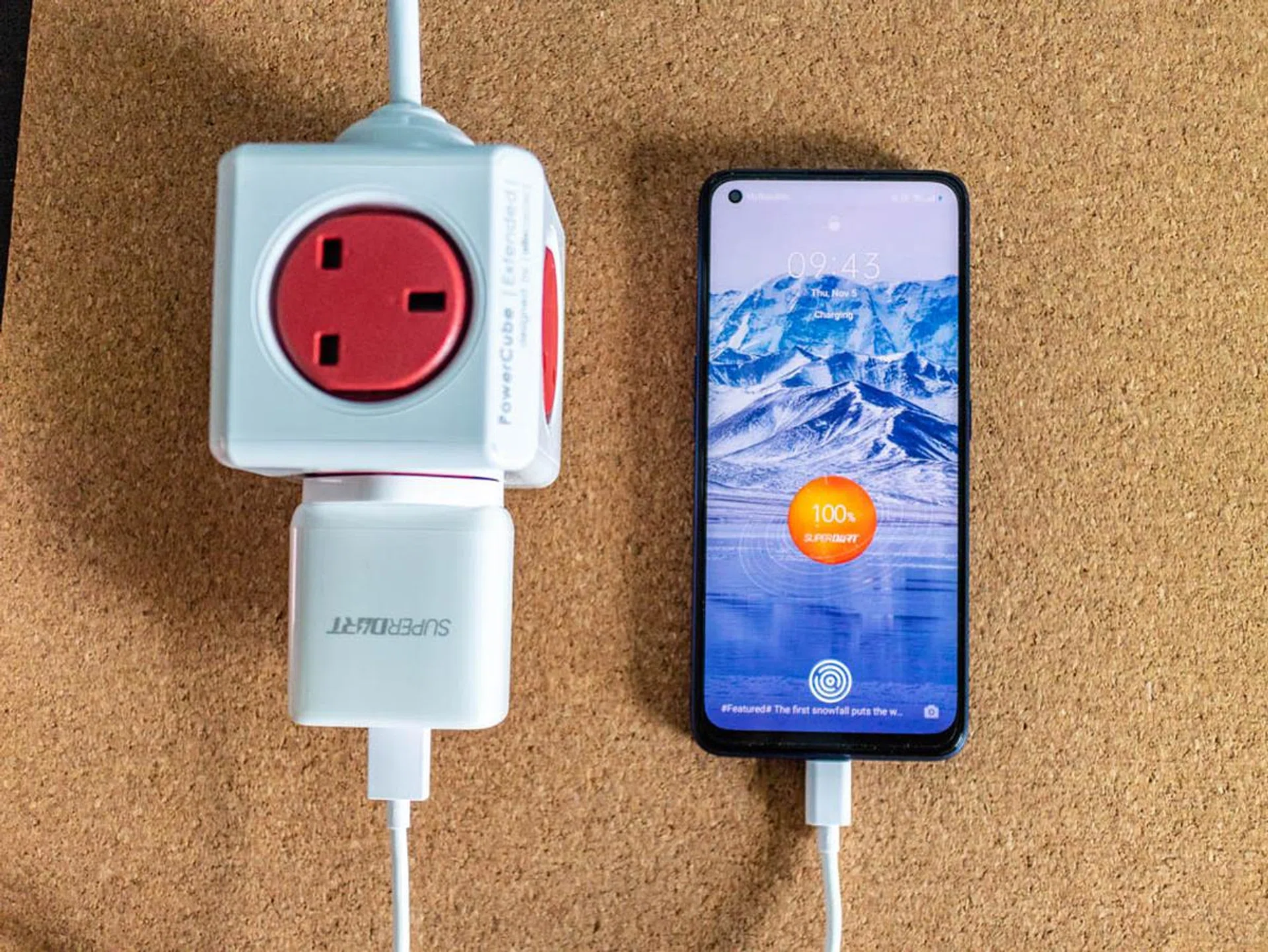
Just like its parent company Oppo and many other China-based phone brands, super fast-charging support seems to be a priority feature. Beyond adopting fast-charging profiles like QuickCharge and Power Delivery, they’ve also developed proprietary fast-charging technologies and these mechanisms centre around ‘pumping’ more amperage to the device.
With the Realme 7 Pro, Realme introduced its new SuperDart charging technology. It charges the phone with 6.5A current at 10V, offering 65W wired fast-charging. It likely leverages SuperVOOC standard created by parent company Oppo that also supports the same level of charging. Realme claims that it can charge an empty Realme 7 Pro’s 4,500mAh battery to 100% in just 34 minutes. Just like my previous Oppo Reno4 Pro review, I was sceptical of this claim. So we’ve tested the charger after the battery test run, and with the screen on, the phone charged to full within 39 minutes – just off by a few minutes!
With 65W SuperDart, the Realme 7 Pro is probably one of the first few sub-S$500 mid-range phones in Singapore to adopt super-fast charging technology of these speeds, making it a stand-out feature for this handset.
Conclusion
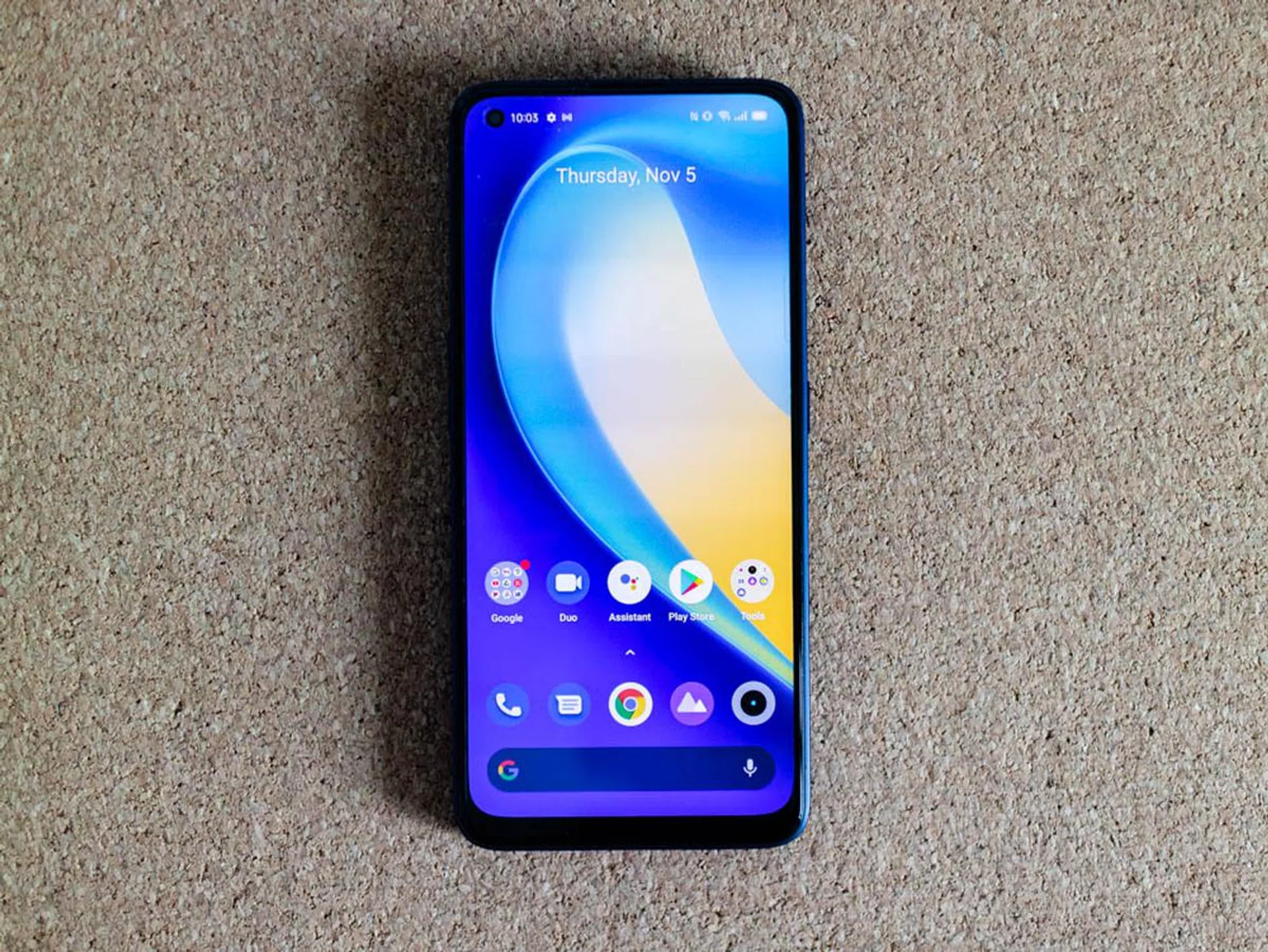
In the face of uncertainty that is 2020, many phone manufacturers are making a strong showing with their mid-range phones, with a wide variety of expectations and price points to please just about anyone. Many are producing competent mid-range phones with a huge number of camera lenses at the rear, such as Xiaomi’s Poco X3 NFC, Vivo V19, and of course, Realme’s 7 Pro. Even Google is putting more effort into pushing Pixel 4a for wider availability and visibility, and Samsung likewise, with their Galaxy M and Galaxy A series as well.
With that understanding, it would seem that Realme 7 Pro, at S$499, brings decent value thanks to all features packed inside the phone. To recap, they are:
- Super AMOLED 6.4-inch FHD+ screen
- Good under-display fingerprint sensor
- TUV Rheinland Smartphone Reliability Verification
- 65W SuperDart charging that brings the empty tank to full in around half an hour
- 128GB storage with expandable storage
- 64MP Rear camera array + 32MP front camera, supports 4K recording
Despite its impressive feature set, Realme 7 Pro's hardware parts felt thrown together, at best. Software-based enhancements like Video stabilisation are barely usable, and the AI Colour Portrait feature is not available for photography but is present for videography. Interestingly, its ‘closest' cousin, the Oppo Reno4 Pro, has AI Colour Portrait for photography, but not for videography (as mentioned in our review).
The Realme 7 Pro also comes with ads inside system apps, in which we have uncovered one of them while using the default video app; we are unsure whether there are any more system apps featuring ads. While ads can be turned off, it is never communicated to users, and the settings option to turn off ads are well-hidden. This could be a deal-breaker for some users, but worse yet, some customers may not even realise its presence until after buying the device, and finally learn that it’s not apparent upfront that those ads can be turned off.
With everything considered, S$499 seems like a fair price for the feature-filled Realme 7 Pro, especially when compared to its closest cousin, the Oppo Reno4 Pro, which was released two months earlier, but at a higher price point of $899, though the Oppo Reno4 Pro comes with flagship design language, 90Hz display, and double the internal storage. Nevertheless, It still faces tough competition from other Chinese manufacturers, and recently even Samsung, with similar offerings at a nice price point. On another front, it also faces the onslaught of devices offering great software integration and capabilities like the Google Pixel 4a, or flagship performance that sacrifice of camera quality, such as Apple iPhone SE 2020.
Tough landscape, we know. So to make things easier, if you're set on getting an Android phone with Google Mobile Services (GMS) intact and particularly like a phone with a good in-display fingerprint sensor along with charging speeds unrivalled by any at its price point, the Realme 7 Pro offers a compelling all-round device for your consideration.
Interested to get one? Besides your preferred authorised reseller, you can get the Realme 7 Pro online at the brand's LazMall Flagship Store, or at Shoppe's preferred partner stores.
Update as of 12th February 2021:-
Having reviewed all the mid-range phone options and what they offer, we've decided to re-evaluate the standalone ratings we've previously accorded to the Realme 7 Pro smartphone to better match its value proposition. These are the adjustments we've made:-
- Performance score revised to 8.5 (previously 7.5)
- Features score revised to 9.0 (previously 8.0)
- Value score revised to 9.0 (previously 8.0)
- Overall score revised to 8.5 (previously 8.0)
These changes are mainly due to its excellent feature set which is hard to turn down for its price point. Performance is also commendable since it has good battery performance, can charge up really fast and has pretty decent raw benchmark scores. Not to mention reasonable imaging performance that you can't really ask for more at the sub-S$500 price point.
Our articles may contain affiliate links. If you buy through these links, we may earn a small commission.