
Need for Speed: A shootout of fast charging standards
We find out which charging scheme charges the phone from 0 to 100% the quickest.
Overview
One of the most common complaints we hear today is how smartphone batteries never seem to last through the whole day. Bigger screens and more powerful processors have all led to higher power consumption, and as manufacturers keep shaving millimeters off their phones, battery sizes haven't really increased much in size to compensate.
The next best thing seems to be having a phone that can recharge quickly to get you going again. However, there's a number of fast charging standards out there competing for your attention. In this article, we'll be taking a look at and comparing some of the most popular charging standards out there.
Fast charging explained
Before we begin, a quick note on how chargers work in general. How fast a battery charges is determined by how much power it receives from the power source (normally a wall outlet), through the charger, to your phone. Your phone also includes built-in regulators to prevent pumping too much power into the battery and frying it. The actual amount of power output from the charger is determined by the voltage (measured in volts) and current (measured in amps) that it is rated for safe use.
Not all chargers output the same volts and amps. A standard phone charger will output around 5V at 1A for a total of 5W of power. If you charge your phone by connecting it to a USB port on your laptop, you're looking at 0.5A at 5V for 2.5W of power on a USB 2.0 port, or 0.9A at 5V for 4.5W of power on a USB 3.0 port, which basically means that if your phone can handle anything above 0.9 amps (it almost certainly can), a typical computer's USB port will charge it more slowly than the charger that came with the device.
Basics aside, let's take a look at the various fast charging standards available:
Qualcomm Quick Charge
Source: Qualcomm
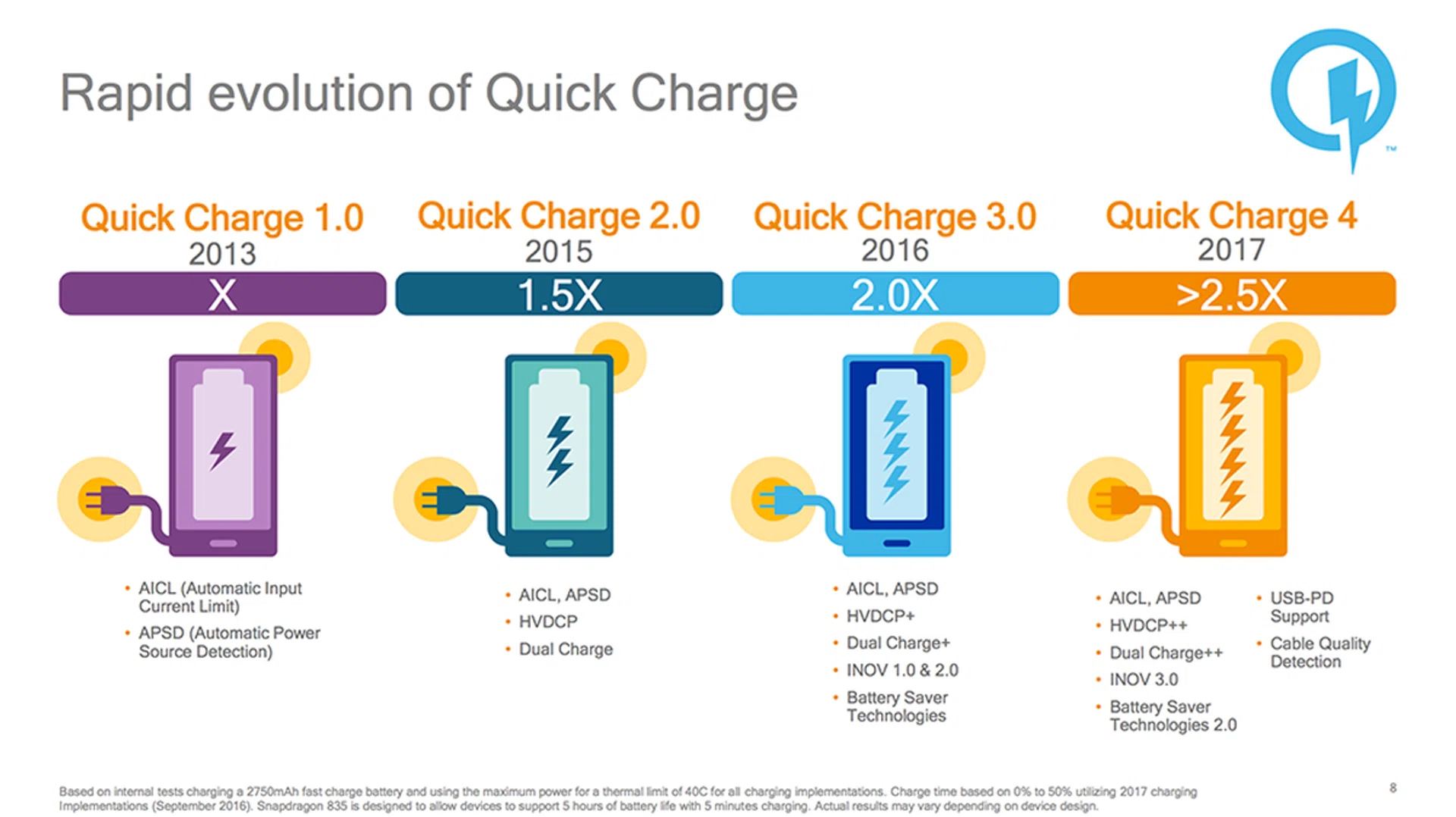
Qualcomm's Quick Charge technology is one of the first fast charging solutions on the market and has been around since 2012 when Qualcomm acquired Summit Microelectronics.
Qualcomm's technology is designed to maximize charging efficiency by delivering a higher voltage to the phone's battery. There have been five versions of Quick Charge, with most current flagship smartphones utilizing either Quick Charge 4.0 or 4+. However, many smartphones still use Quick Charge 3.0. Quick Charge 3.0 is able to dynamically boost voltage across a 3.6V to 20V range and operate at a maximum current of 2.5A or 4.6A, but like Quick Charge 2.0, it has a peak power of 18W. Qualcomm uses an Intelligent Negotiation for Optimum Voltage (INOV) to identify the most efficient voltage at any giving point during charging.
The newer Quick Charge 4.0 and 4+ are both able to deliver up to 28W of power. Both can dynamically adjust across a variety of voltage ranges and deliver power in as little as 20mV increments, and both play nice with USB-C and USB Power Delivery. Notable features on QC4+ include Dual Charge, which divides the charge current to achieve lower thermal dissipation and reduced charge time; intelligent thermal balancing that dynamically reduces overall heat; and a battery saving tech designed to prolong battery performance over time.
Oppo VOOC Flash Charge & OnePlus Dash Charge
Source: Oppo
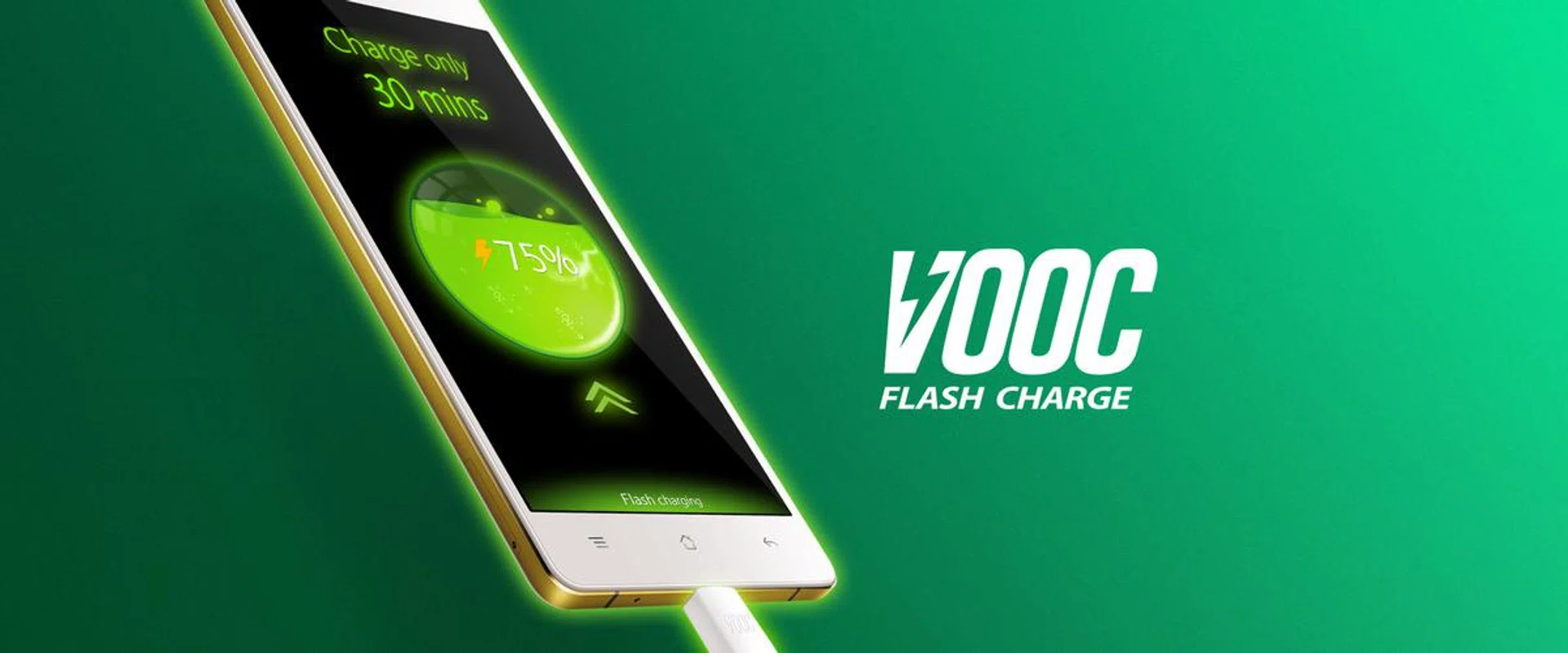
While Oppo uses Qualcomm's chips in its phones, it has its own quick charging technology called VOOC Flash Charging, which stands for Voltage Open Loop Multi-Step Constant-Current Charging.
Oppo takes a slightly different approach than Qualcomm, increasing current instead of voltage to deliver higher charging rates. VOOC charges at up to 5V @ 5A for 25W max charging power.
To safely control the increased amperage, Oppo uses a special charging adapter that modulates the amperage in real time, while a microcontroller monitors charge level and syncs with the phone’s circuitry to regulate voltage and current. Oppo also uses a different battery structure in each of its phones consisting of several individual battery cells, and the high 5A current is split among those. Due to this, the battery has a higher number of contacts than usual, with each cell charged simultaneously.
One disadvantage of VOOC charging is that due to the much higher current, VOOC requires a special insulated USB VOOC charging cable, as well as the VOOC charger.
OnePlus licenses Oppo's VOOC technology for its own phones and re-brands it as Dash Charge, however the two standards are essentially the same. Internally, OnePlus also uses a slightly different battery structure for its phones.
Samsung Adaptive Fast Charge
Source: Samsung
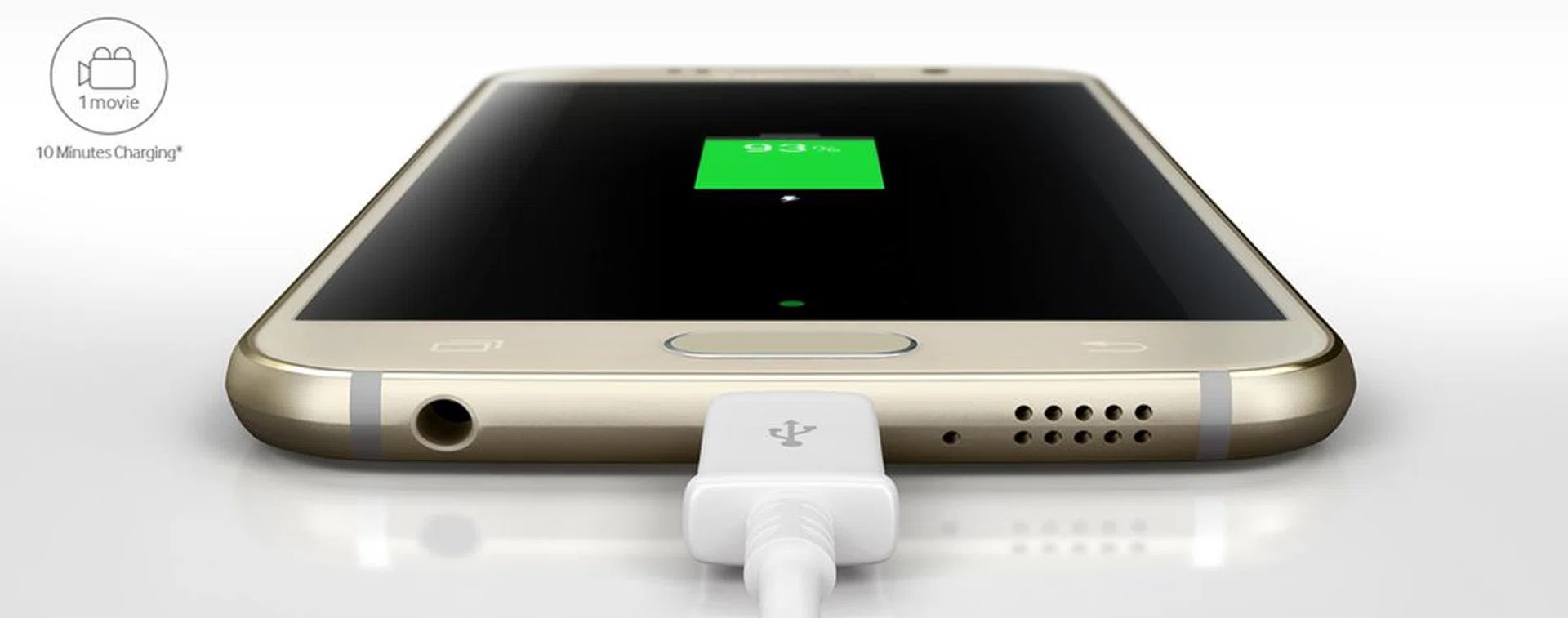
Samsung's fast charging standard is called Adaptive Fast Charging, and is available in most of its smartphones and tablets, from the top-end Samsung Galaxy S9, all the way down to the entry-level Samsung J4.
Samsung’s Adaptive Fast Charging operates at up to 5V/3A or 9V/2A for a max 18W of power. Interestingly, most Samsung devices are also compatible with Qualcomm Quick Charge accessories, even those powered by Samsung's own Exynos chips.
ASUS BoostMaster Technology
Source: ASUS
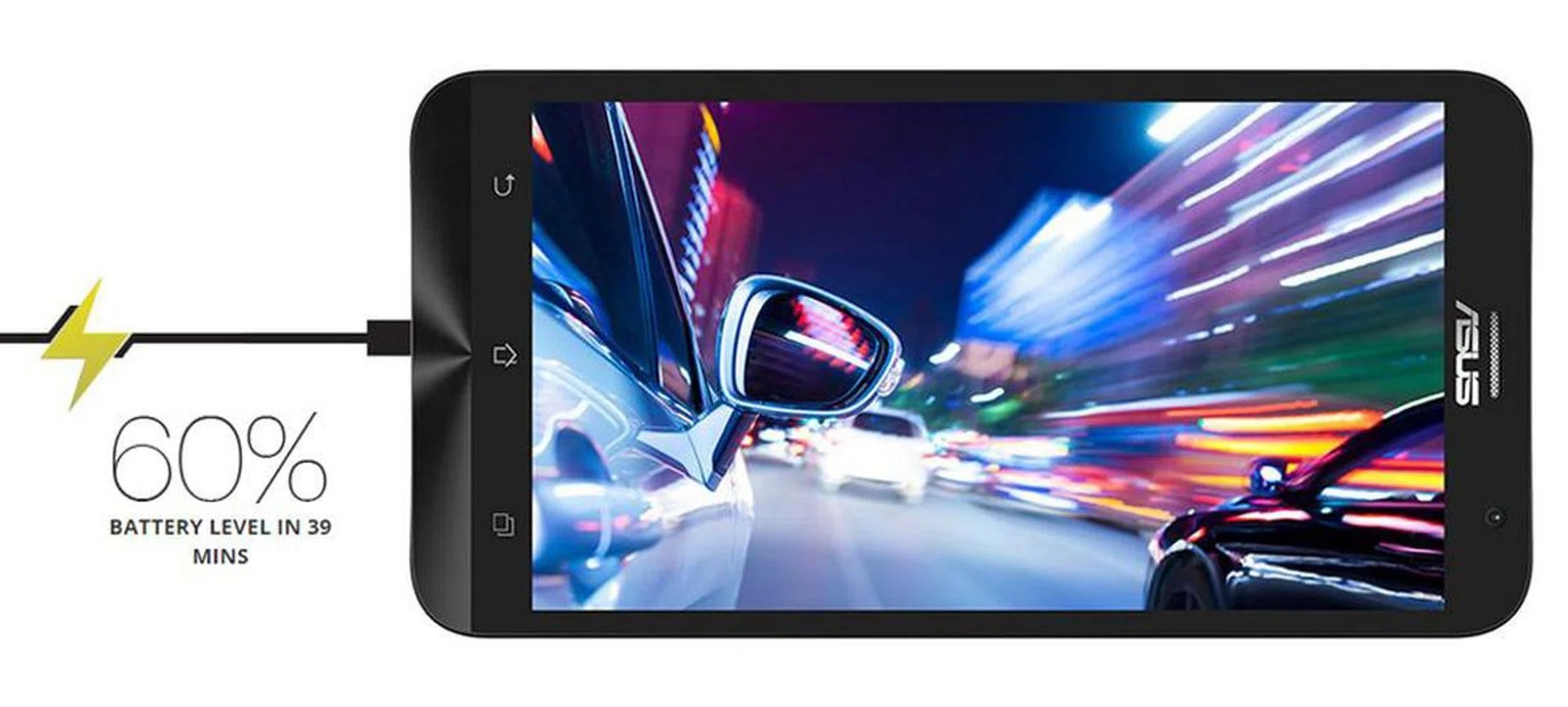
ASUS' BoostMaster technology, found in its ZenFone smartphones, uses a similar technology to Qualcomm's Quick Charge, increasing charging speed by delivering a higher voltage. The charger supplied with the ZenFone 5 is rated at 9V/2A, supplying a maximum of 18W of power. Interestingly, the phone is also compatible with a Qualcomm Quick Charge charger or even a Samsung Adaptive Fast Charger.
Huawei SuperCharge
Source: Huawei
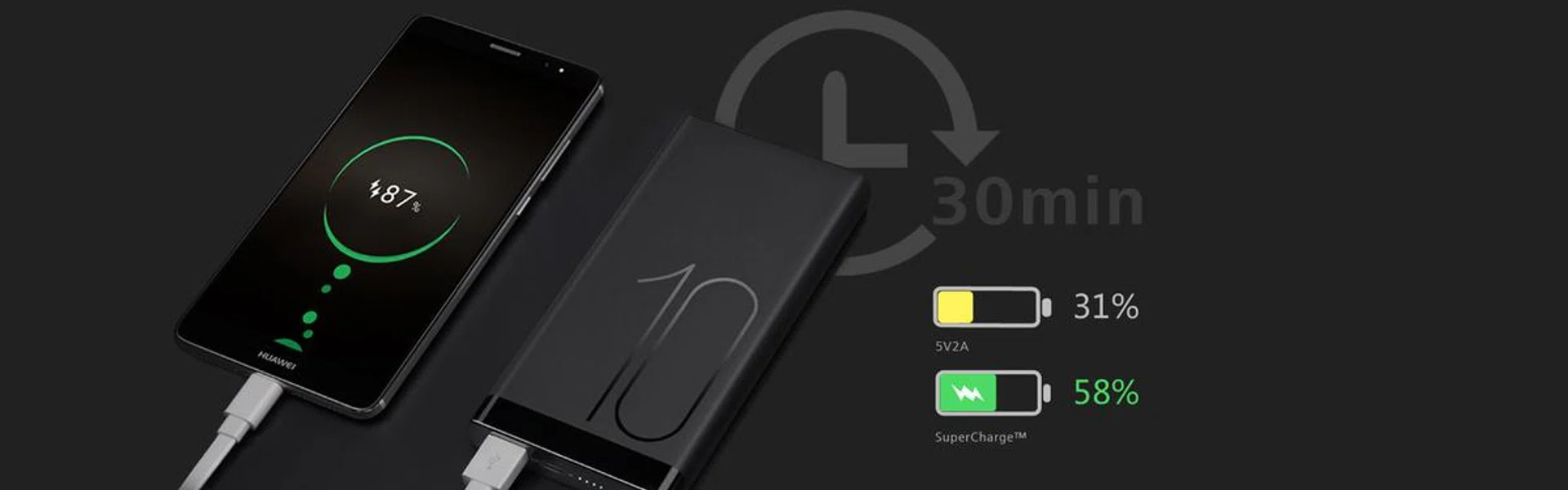
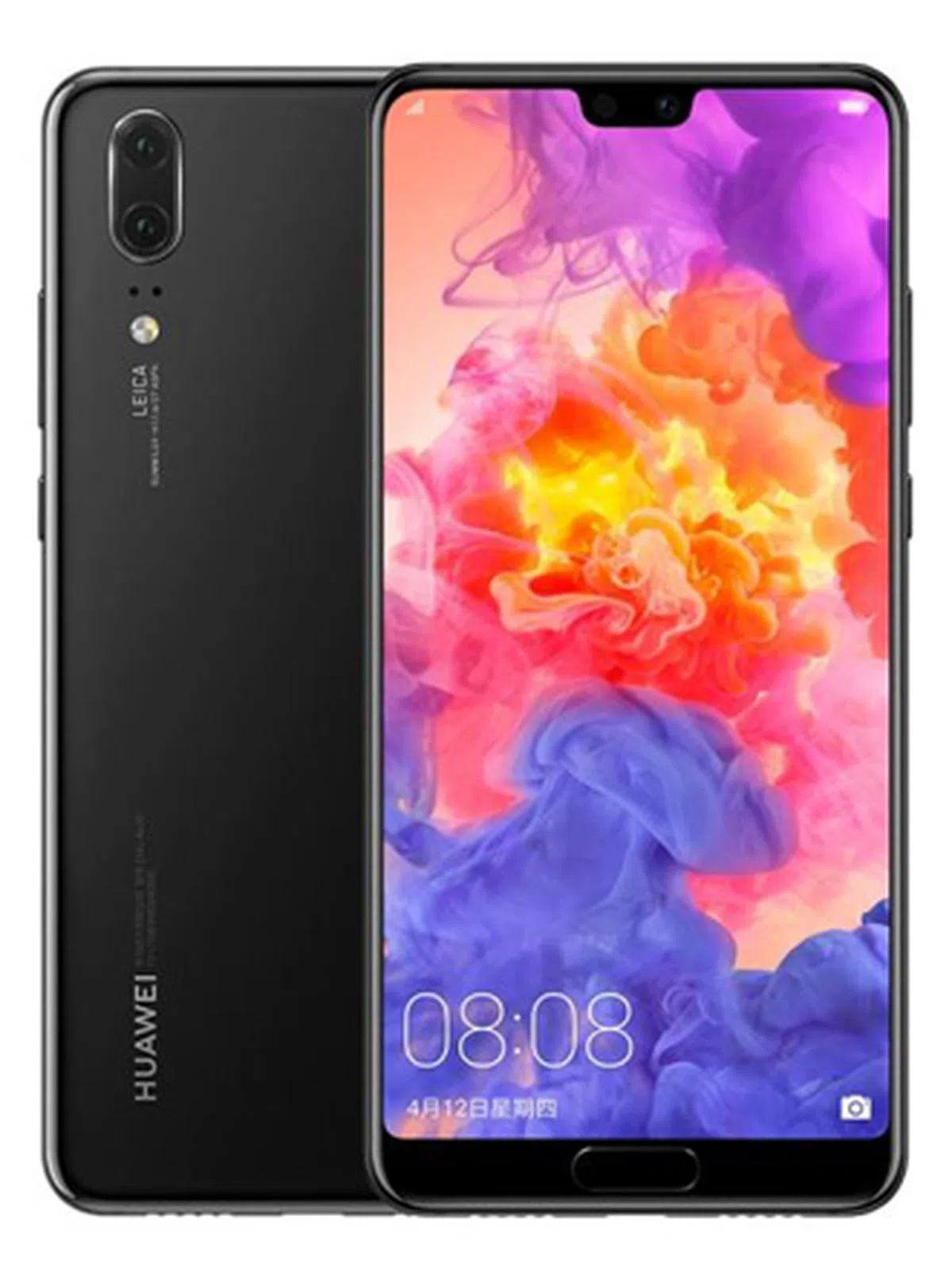
Huawei's SuperCharge standard is fairly similar to Quick Charge in that it uses higher-than-average voltages to achieve faster charging, however, there are a few differences. SuperCharge automatically adapts the incoming wall voltage and current based on the condition of the phone’s battery and the phone’s internal temperature. SuperCharge-compatible wall adapters and car chargers can support a variety of charging modes, including 5V/2A, 9V/2A, 4.5V/5A, and 5V/4.5A (for up to 22.5W), and use an in-charger chipset to regulate voltage accordingly.
USB Power Delivery
Source: Apple
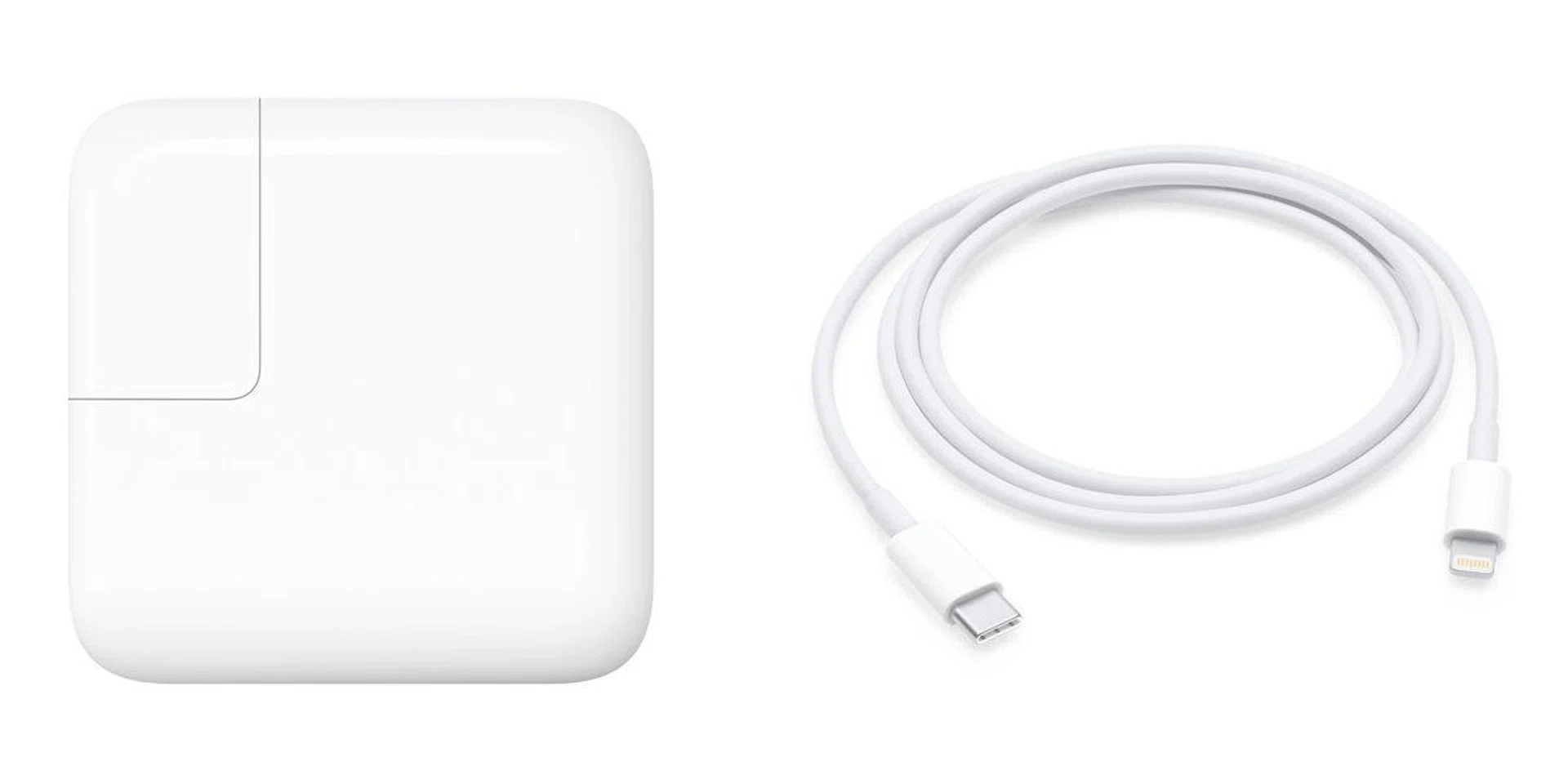
Apple traditionally has two fast charging schemes: 5V at 2.1A and 5V at 2.4A. But the iPhone maker has started to adopt USB Power Delivery for some of its recent products. The Apple iPhone X, iPhone 8, and iPhone 8 Plus are all capable of fast charging through USB Power Delivery, an industry standard that's also used by the iPad Pro, the 12-inch MacBook, and also championed by Google on the Google Pixel 2, Pixel 2 XL and Google Chromebook. However, to take advantage of USB Power Delivery on your iPhone, you'll have to purchase some extra accessories as the standard wall adapter and Lightning cable supplied in the box aren't compatible.
You'll need both a USB-C to Lightning cable, as well as a USB-C charger that supports USB Power Delivery such as the 30W power adapter that comes with the 12-inch MacBook, or the 61W or 87W adapter that comes with the MacBook Pro.
N.B. Using a USB-C to USB-A adapter with a standard USB-A to Lightning cable won't work. It will restrict you to the lowest power delivery.
The advantage of USB PD is that any device compatible with the standard can use any charger that supports USB PD. Depending on the power rules supported on the USB PD charger and compatible device, USB PD can delivery up to 20V at 5A (100W of power).
Fast charging standards compared
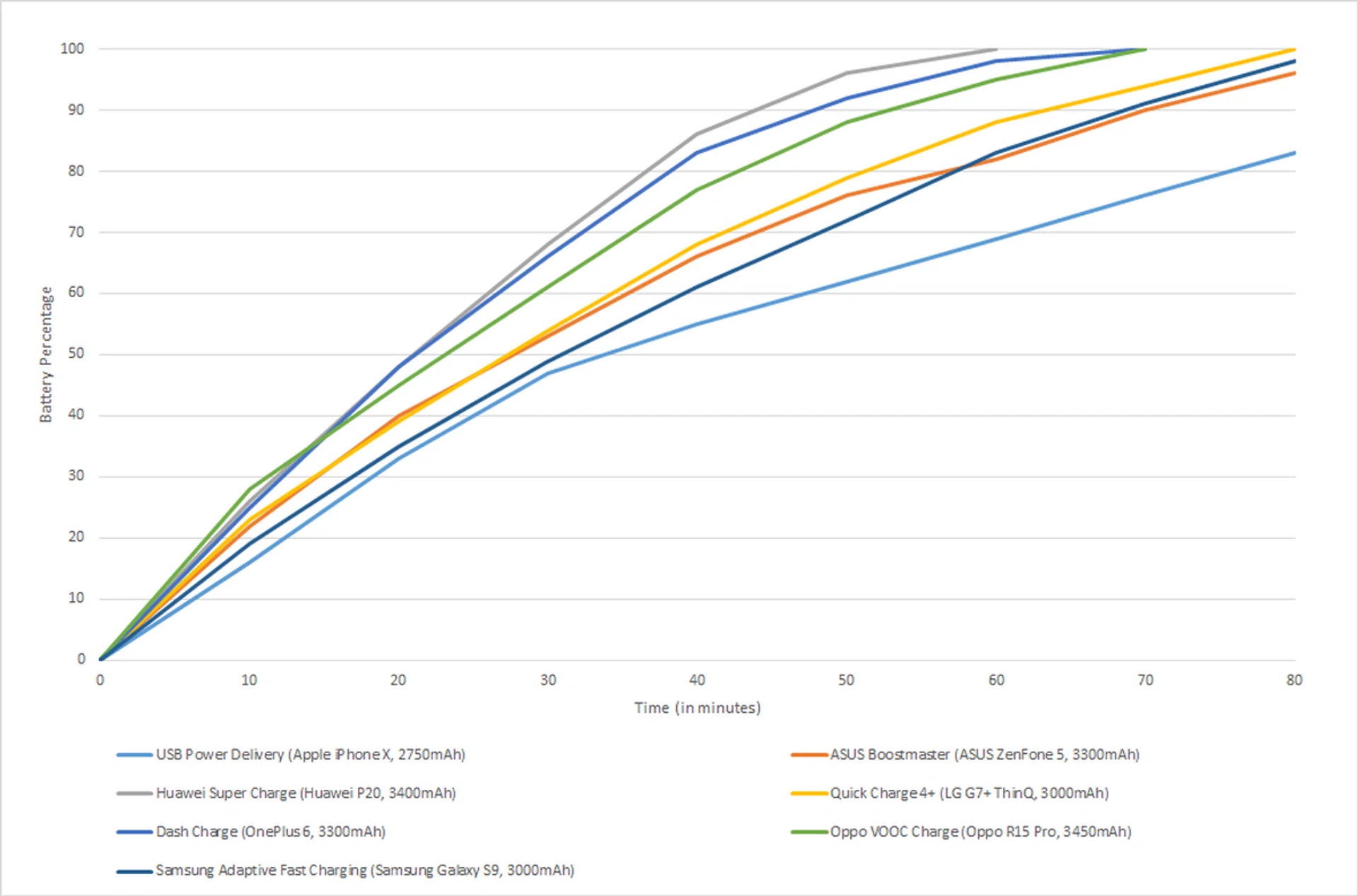
To test our array of fast charging phones, we selected devices with reasonably similar battery sizes - they're all around 3,000mAh. We fully drained the batteries of each phone, then plugged them one-by-one into the same wall socket, taking power recordings every ten minutes. Our office is air conditioned, so the environmental temperature is fairly constant. All phones remained off for the duration of the charging.
Performance findings
The three fast charging standards that stood out from the rest were Oppo's VOOC Charge, OnePlus' Dash Charge, and Huawei's Super Charge. The Oppo R15 Pro had the most charge at ten minutes, with an amazing 28 percent charge, with the P20 just behind at 26 percent and the OnePlus 6 at 25 percent. At the 30 minute mark, all three phones were over 60 percent charge, with the P20 in the lead at 68 percent.
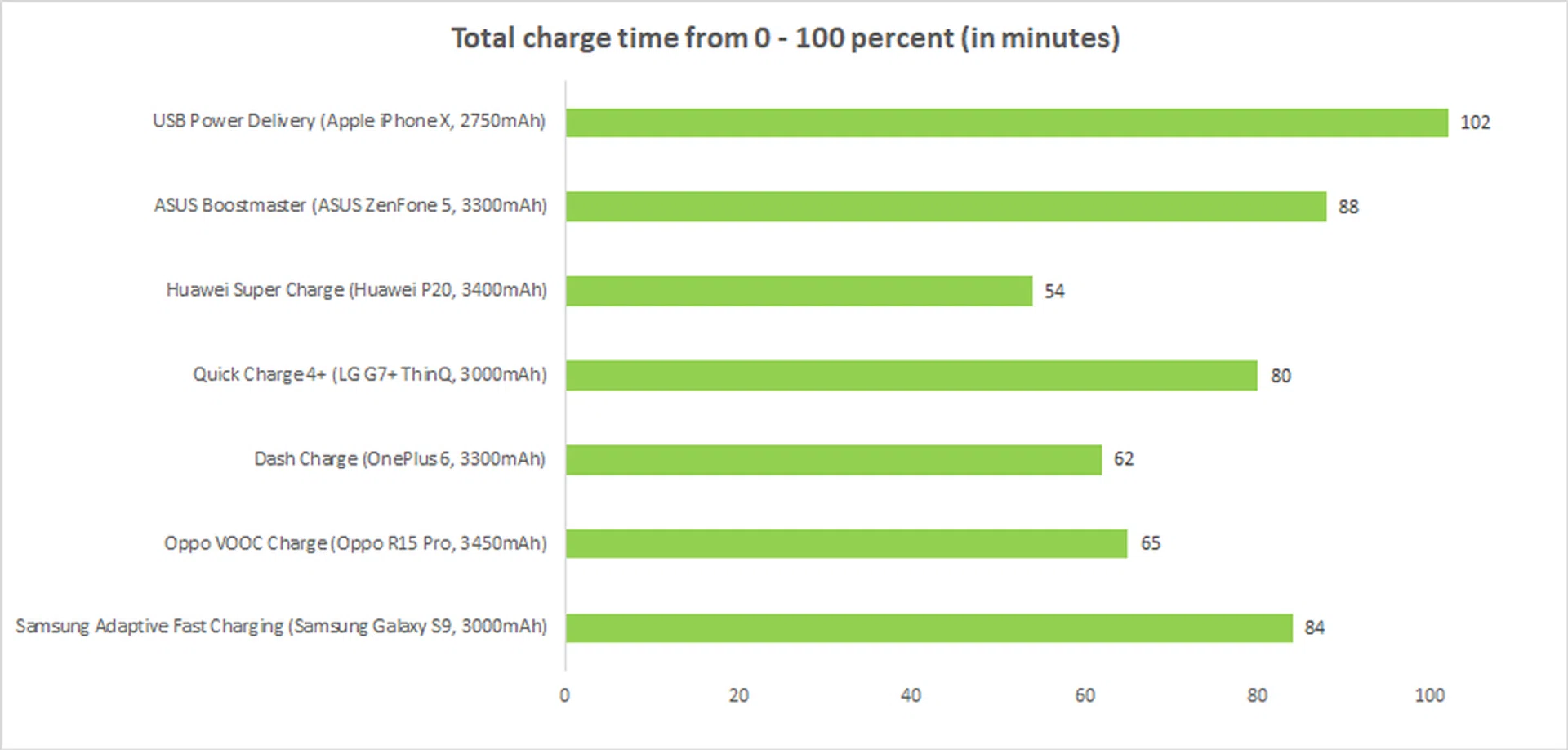
The first phone to reach 100 percent charge was the Huawei P20, doing it in just 54 minutes. It was closely followed by the OnePlus 6 at 62 minutes, and the Oppo R15 Pro at 65 minutes. The iPhone X charged the slowest, taking 102 minutes to reach full charge, and that's despite having the smallest battery in this shootout. To cut the story short, we don't think Apple's charging goal at this point is to get the iPhone's battery from 0 to 100 percent in the shortest amount of time. Rather, we observed the charger delivering more power at the early stages of charging, with the aim to get the phone to a 50 percent charge in 30 minutes. As such, if you aren't using the iPhone 8 Plus, the more affordable iPad 12W charger is actually good enough to quick charge the iPhone X and 8.
Conclusion
With battery capacities getting larger and larger, fast charging is now almost a requirement on a modern smartphone. Fortunately, fast charging standards are constantly improving and most phones with fast charging will now give you at least 50 percent charge in just 30 minutes.
Compared to three years ago, we can see how fast charging has improved, and there's significantly less drop off in charging speed now, with most phones maintaining a fairly fast charge throughout the entire charge process. Previously, we saw a big drop off in charging speed after about 40 percent or so.
The next big breakthrough in fast charging looks to be Oppo's Super VOOC charging standard, which was first teased back in 2016, but is only now reaching smartphones, and is currently only available on the 256GB Oppo Find X, which will be released in Singapore later this year, and the limited edition Lamborghini edition Find X, which unfortunately won't be available here. However it promises to deliver a full charge in just 15 minutes of charging. We'll update this feature when we can test it out for ourselves.
Finally, a quick note on wireless charging. Wireless charging is always slower than a wired fast charger, however, we've also seen improvements here. Samsung's wireless fast charger will charge the S9 from 0 to 100 percent in 139 minutes, which, while notably slower than the standard wired connection, is still quite fast. If you want the fastest possible charge time though, stick to your wired connection.
In this shootout however, the winner is the Huawei SuperCharge, which managed to top up the Huawei P20's sizeable 3,400mAh battery in just 54 minutes.
 |

Our articles may contain affiliate links. If you buy through these links, we may earn a small commission.