
MSI GTX 650 Ti Boost Twin Frozr III OC - Game for Another Mid-Range Kepler?
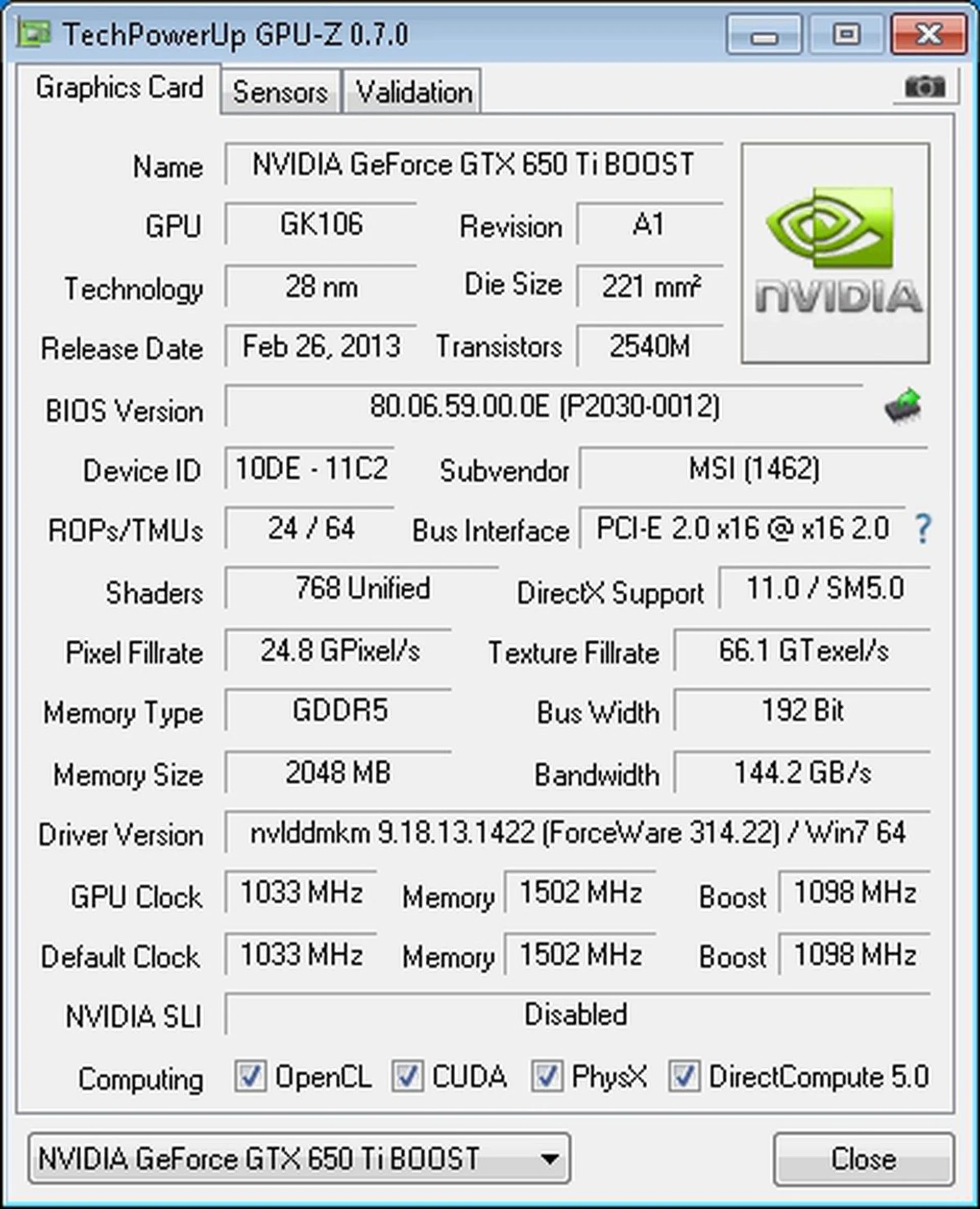
Hailing from its Gaming series, the MSI GTX 650 Ti Boost Twin Frozr III OC card features an overclocked GK106 core at 1,033MHz, with a turbo clock of 1,098MHz to match. Can this dethrone other GeForce GTX 650 Ti Boost cards in the market? We find out in this review.

MSI's Mid-Range Kepler Gaming Card
The MSI GTX 650 Ti Boost Twin Frozr III OC is one of the pair of NVIDIA GeForce GTX 650 Ti Boost cards from the new MSI Gaming series. Its other counterpart is the non-OC edition which isn't factory overclocked. It appears add-on card partners of NVIDIA have been quick to flesh out the product range based on the NVIDIA GeForce GTX 650 Ti Boost, which was released late in March. This mid-range series of graphics cards are targeted at the budget-conscious gamers who are not willing to spend more than S$300 for a single discrete graphics card. In terms of direct competition, the NVIDIA GeForce GTX 650 Ti Boost cards were also seen going head-to-head with those based on the AMD Radeon HD 7790 (Bonaire) core.
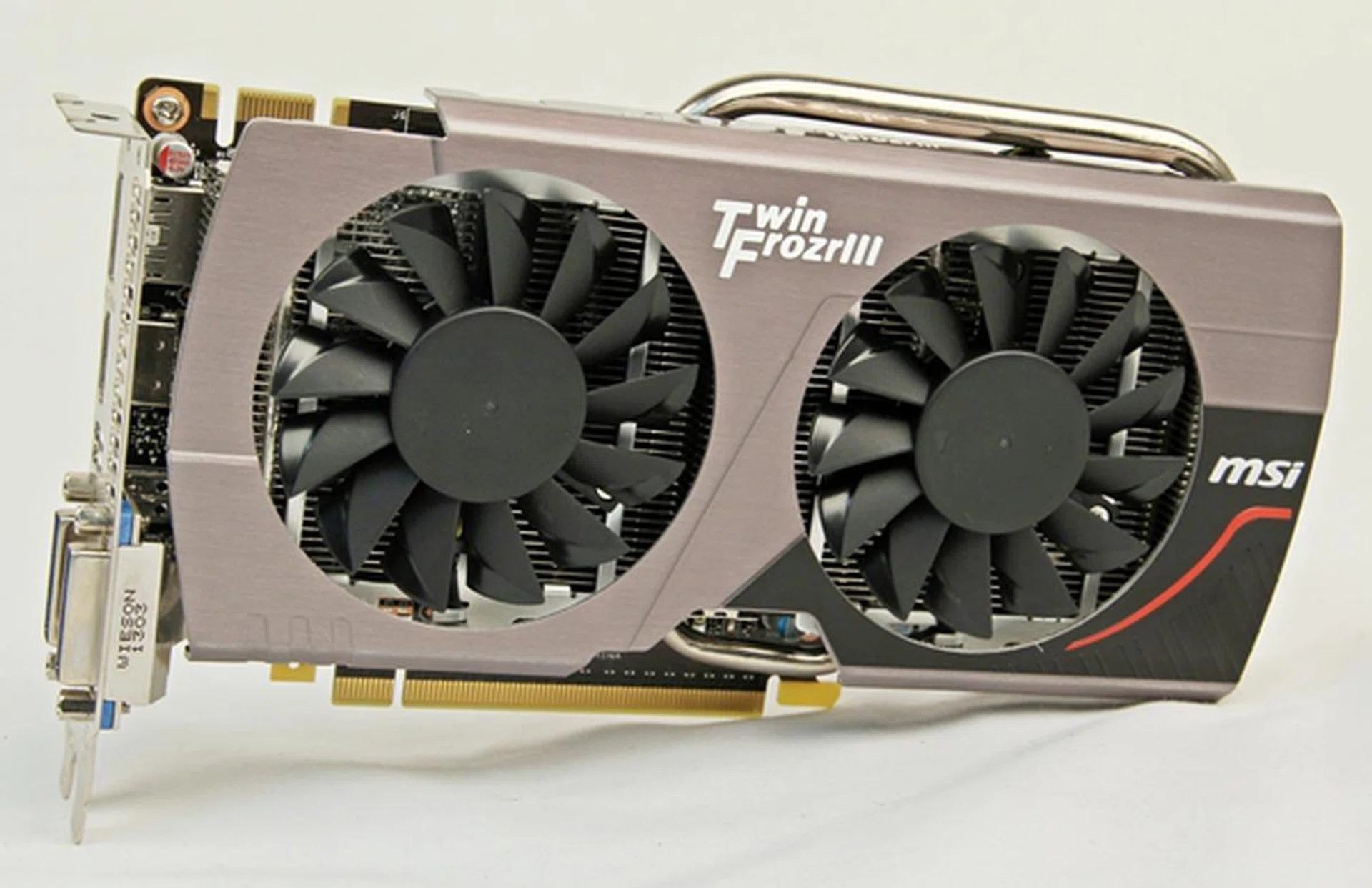
The MSI GTX 650 Ti Boost Twin Frozr III OC sports an overclocked GK104 GPU operating at a base clock of 1033MHz that is slightly higher than similar cards. Coupled with its Gaming series brand, MSI is clearly attempting to distinguish the card amid the noise faced by such mid-range ones. Sadly, it doesn't look any different as we expected a pro-gamer centric cooler styling.
Hailing from its Gaming series, the factory overclocked MSI card has a 1,033 MHz base clock with a boost clock of 1,098MHz, but its 2GB of memory chips have not been overclocked as they are rated to operate collectively at 6,008MHz (which is the same as the memory on a reference card). The card features high-end components like its solid capacitors as well as its Twin Frozr III cooling system that consists of 80mm dual fans and SuperPipe technology for better heat dissipation.
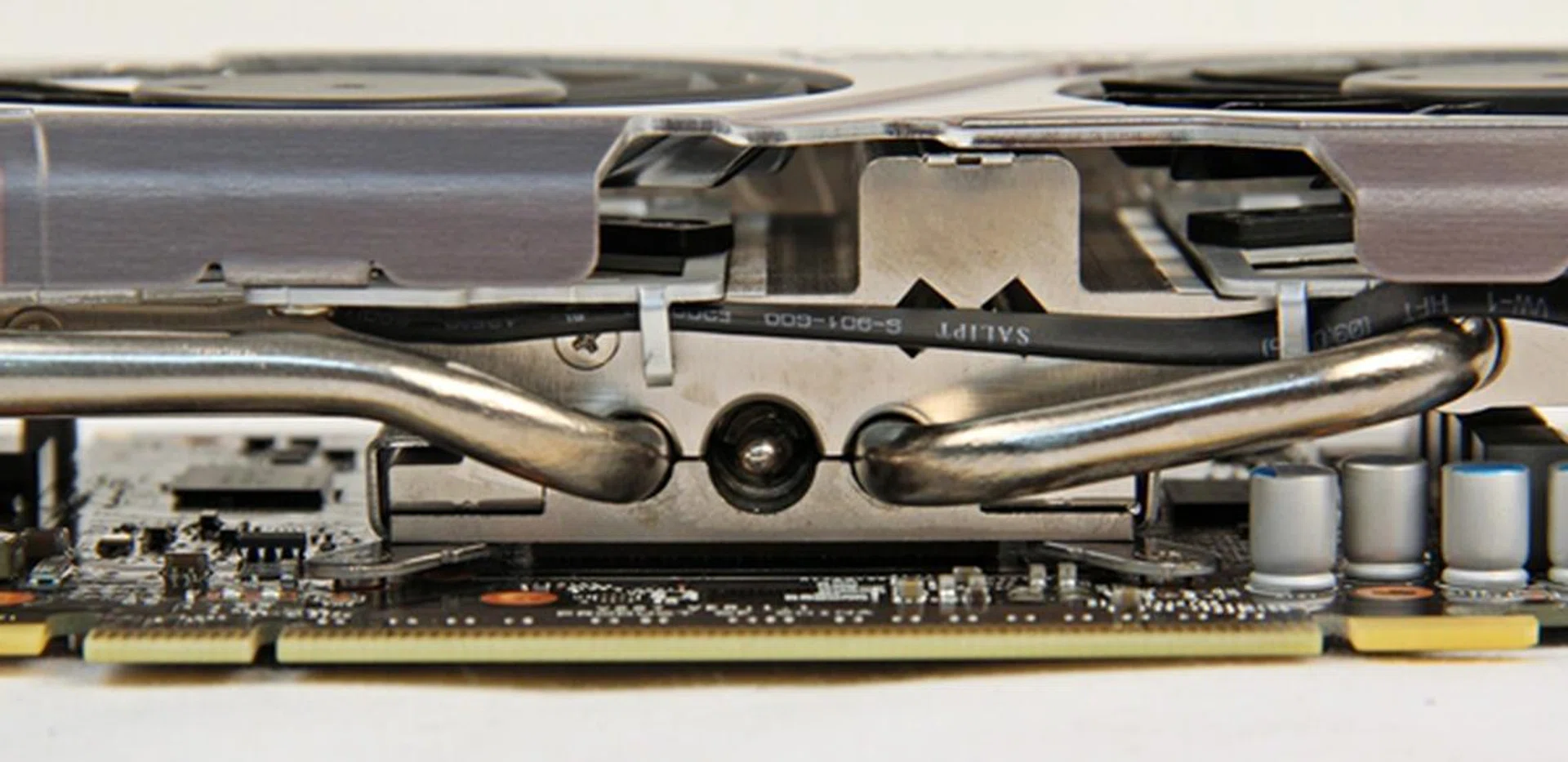
The GPU cooler sits directly on the GK106 core, and from this perspective, near the edge of the PCIe interface, we could see two of the three heatpipes that lead to the heatsink.
From its rear, we can see four Hynix memory chips (with another four facing the side of the cooler), as well as the third heatpipe that extends beyond the PCB of the card. The card measures approximately 9.3-inch (23.5 cm) in length, with a height of roughly 5-inch (12.5 cm) and a thickness of 1.4-inch (3.6 cm). It's a dual-slot card and we recommend the neighboring third slot to be kept empty for better air flow (as with all dual-slot graphics cards).
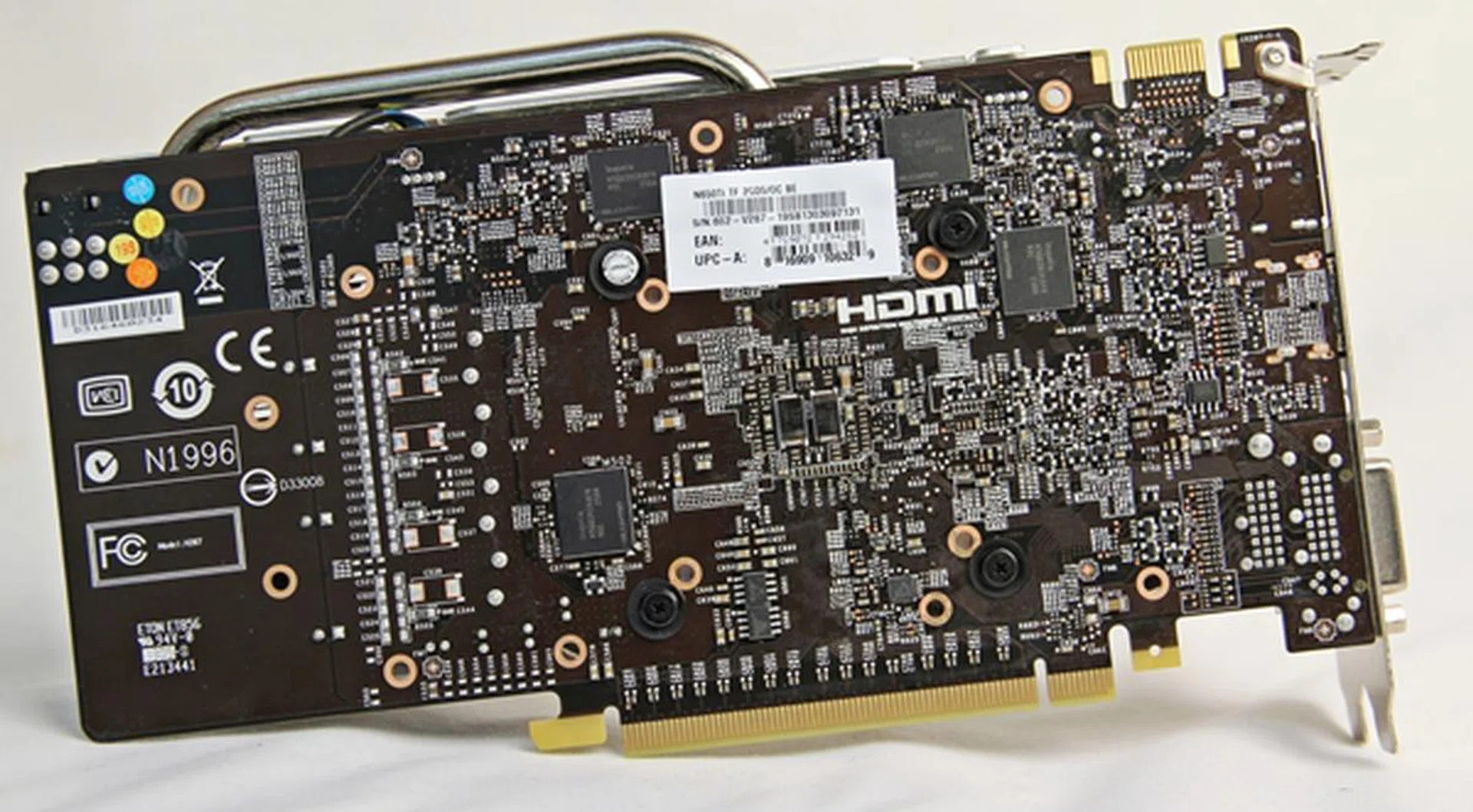
The rear of the MSI GTX 650 Ti Boost Twin Frozr III OC graphics card.
The video connectivity options of the card consists of one full-size DisplayPort (version 1.2), a HDMI port (version 1.4a), one dual-link DVI-D port and one dual-link DVI-I port. The maximum supported resolution of the card is 2560 x 1600 pixels.

The video connectivity options on the card. Perhaps for the more high-end cards from the MSI Gaming Series, we hope to see customized metal blackplates with Dragoon Army motifs.
It is evident that MSI has spared no expense at product differentiation as such mid-range cards tend to get drowned out in such a crowded product segment. The card retails for S$289 that makes it an attractively priced alternative among other cards using this GPU and against the AMD Radeon HD 7850 2GB GDDR5. Customized overclocked cards based on this AMD Radeon HD GPU are currently in this price range too. Within the NVIDIA front, this card is priced about 22 per cent higher than the lower ranked NVIDIA GeForce GTX 650 Ti as such cards are usually priced below S$250.
[hwzcompare]
[products=388180,381815,381819,381612,380323,380340]
[width=175]
[caption=NVIDIA GeForce GTX 650 Ti Boost Custom Cards and competitive SKUs compared]
[showprices=0]
[/hwzcompare]
Test Setup
These are the hardware specifications of our recently updated graphics card test rig:
- Intel Core i7-3960X (3.3GHz)
- ASUS P9X79 Pro (Intel X79 chipset) Motherboard
- 4 x 2GB DDR3-1600 G.Skill Ripjaws Memory
- Seagate 7200.10 200GB SATA hard drive (OS)
- Western Digital Caviar Black 7200 RPM 1TB SATA hard drive (Benchmarks + Games)
- Windows 7 Ultimate 64-bit
Here's the list of cards we'll be testing and the drivers used.
- MSI GTX 650 Ti Boost Twin Frozr III OC 2GB GDDR5 (NVIDIA ForceWare 314.22 / 314.21)
- ASUS GeForce GTX 650 Ti Boost DirectCU II OC 2GB GDDR5 (NVIDIA ForceWare 314.21 Beta)
- Palit GeForce GTX 650 Ti Boost OC 2GB GDDR5 (NVIDIA ForceWare 314.21 Beta)
- NVIDIA GeForce GTX 650 Ti Boost 2GB GDDR5 (NVIDIA ForceWare 314.21 Beta)
- NVIDIA GeForce GTX 650 Ti 1GB GDDR5 (NVIDIA ForceWare 310.90)
- NVIDIA GeForce GTX 660 2GB GDDR5 (NVIDIA ForceWare 314.14)
- ASUS Radeon HD 7790 DirectCU2 1GB GDDR5 (AMD Catalyst 13.3 Beta)
- AMD Radeon HD 7850 2GB GDDR5 (AMD Catalyst 13.2 Beta)
We tested the MSI Gaming card with the latest NVIDIA Foreceware drivers version 314.22 as well as its previous version of 314.21 so that its results can be fairly compared with its two main competitors, which are the ASUS GeForce GTX 650 Ti Boost DirectCU II OC 2GB GDDR5 and the Palit GeForce GTX 650 Ti Boost OC 2GB GDDR5.
Benchmarks
As we had mentioned earlier, the MSI Gaming card, when compared to the custom overclocked ASUS and Palit GeForce GTX 650 Ti Boost ones, is slightly overclocked beyond their specifications, so we naturally expect it to turn in better performance levels. As such, we will be paying more attention to the MSI Gaming card's overclocking potential, temperature and power consumption. For this, we've chosen to streamline our results reporting to a very select set of benchmarks as outlined below. For a full set of comparison results with more benchmarks, you may tune in to our older GeForce GTX 650 Ti Boost article, and at the same time, gain a better understanding of the GK106 Kepler core on which these overclocked graphics cards are based on.
- Futuremark 3DMark 11
- Crysis 3
- Overclocking (Futuremark 3DMark 11)
- Temperature
- Power Consumption
3DMark 11 Results
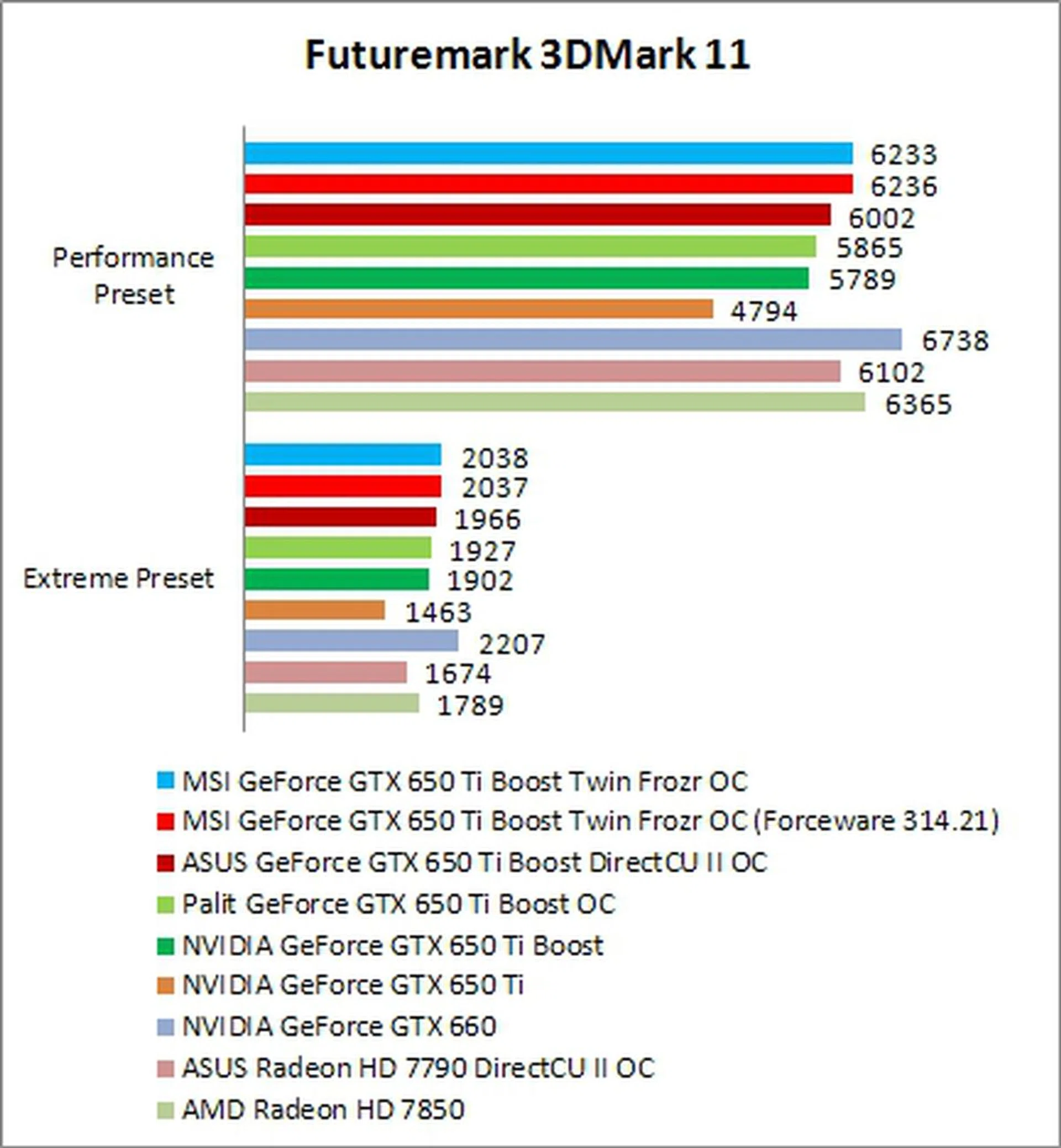
We put the overclocked MSI Gaming card through its paces with 3DMark 11 that is designed to test the card's performance at various aspects of DirectX 11 such as tessellation and DirectCompute. As expected, due to its slightly higher overclocked GK104 core, the card pulled ahead of the other two custom cards from ASUS and Palit with winning margins in the range of approximately 4 to 6 per cent at both presets of the synthetic benchmark.
The scores for the MSI gaming card were very similar despite the two versions of the NVIDIA ForceWare drivers we used to test. This observation was consistent for the most of the benchmarks. The only difference it made was the newer ForceWare drivers dispelled the technical issue we faced when we operated Fraps and Crysis 3 together. The MSI card was bested by the NVIDIA GeForce GTX 660 and the AMD Radeon HD 7850 at the Performance preset; while at the Extreme preset, only the GeForce GTX 660 card proved triumphant over the rest of the cards.
Crysis 3 Results
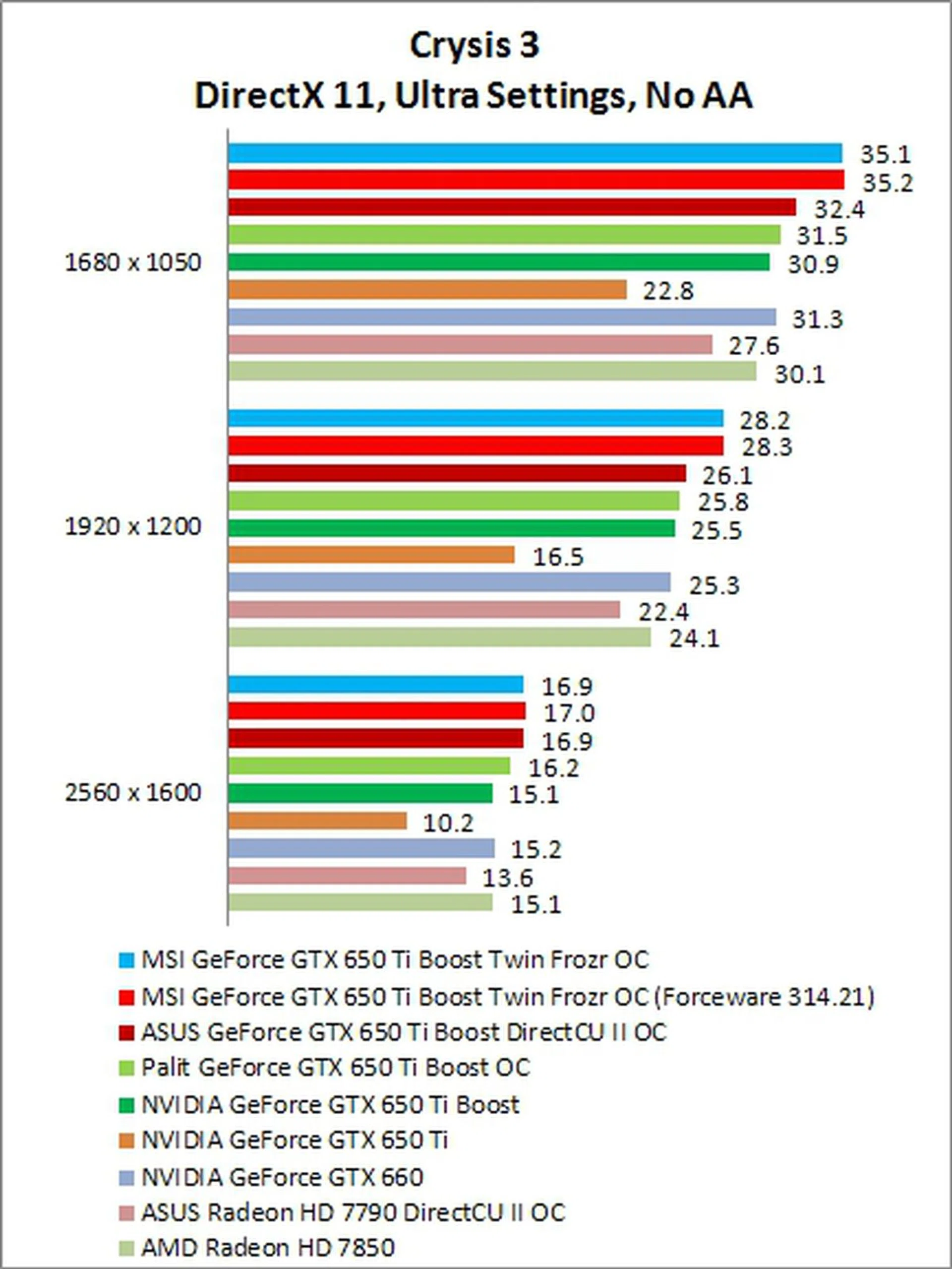
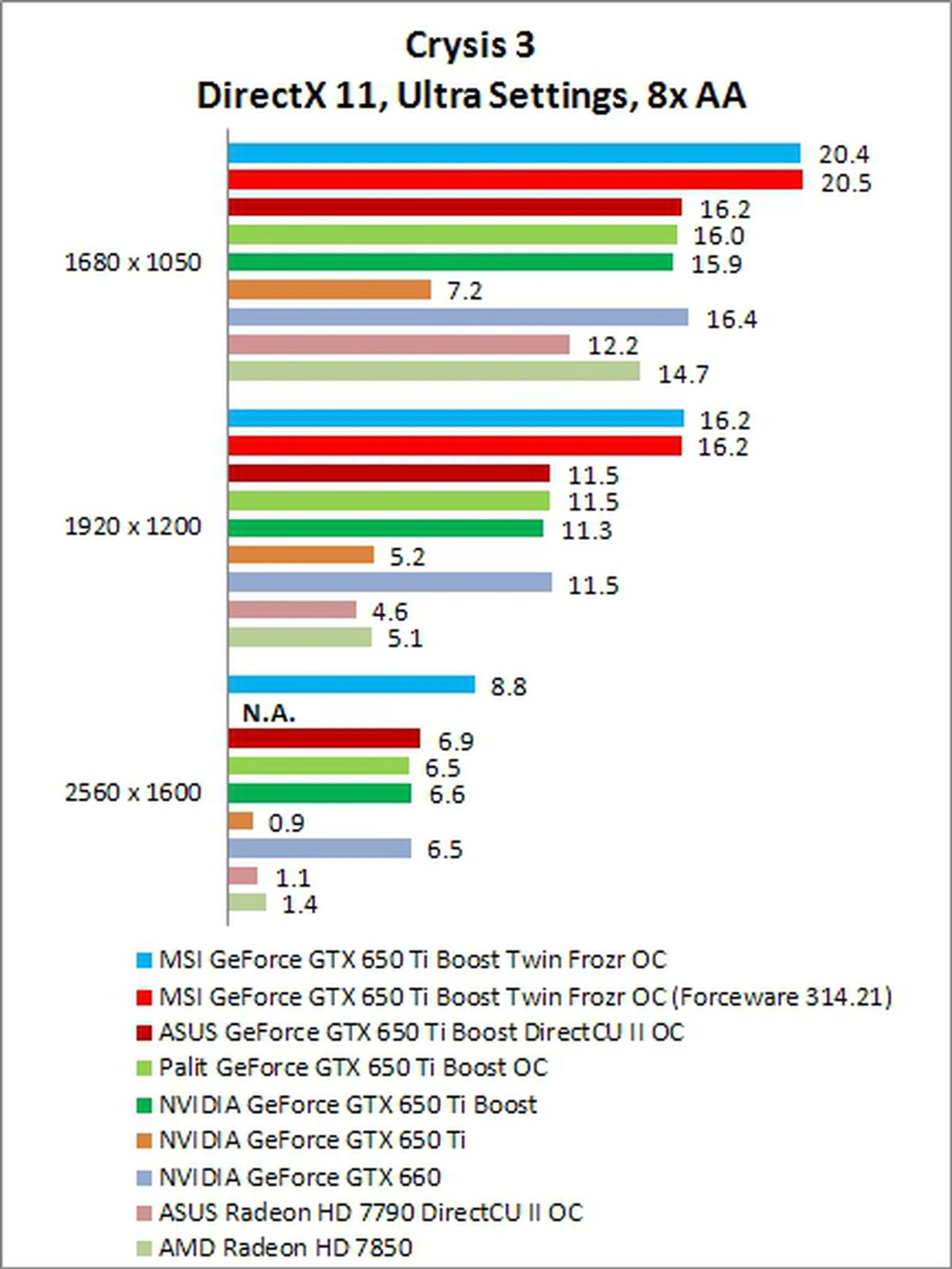
The MSI GTX 650 Ti Boost Twin Frozr III OC card continued to dominate other custom overclocked GeForce GTX 650 Ti cards. Although it was the best performing card on all fronts, it is evident the card is not powerful enough to handle Crysis 3, one of our toughest gaming benchmark due to its extreme amounts of tessellation, per-pixel per-object motion blur, Bokeh Depth of Field, displacement mapping, particle and volumetric lighting and fog shadows.
At the highest detail settings, with anti-aliasing disabled, the MSI Gaming card managed to churn out an average frame rate of roughly 35 at the video resolution of 1680 by 1050 pixels. The card, as well as the rest of the competitive SKUs, failed to generate frame rates above thirty frames per second (fps) for the rest of the resolutions tested. When anti-aliasing was turned on, the MSI Gaming card failed to complete its run at the resolution of 2560 x 1600 when its drivers were of version 314.21. After an update to version 314.22, it only managed to churn out a paltry 8.8fps. Clearly, this range of cards are meant to tackle games in full HD resolution at medium quality settings or less than full HD resolution at high quality settings.
Overclocking Results
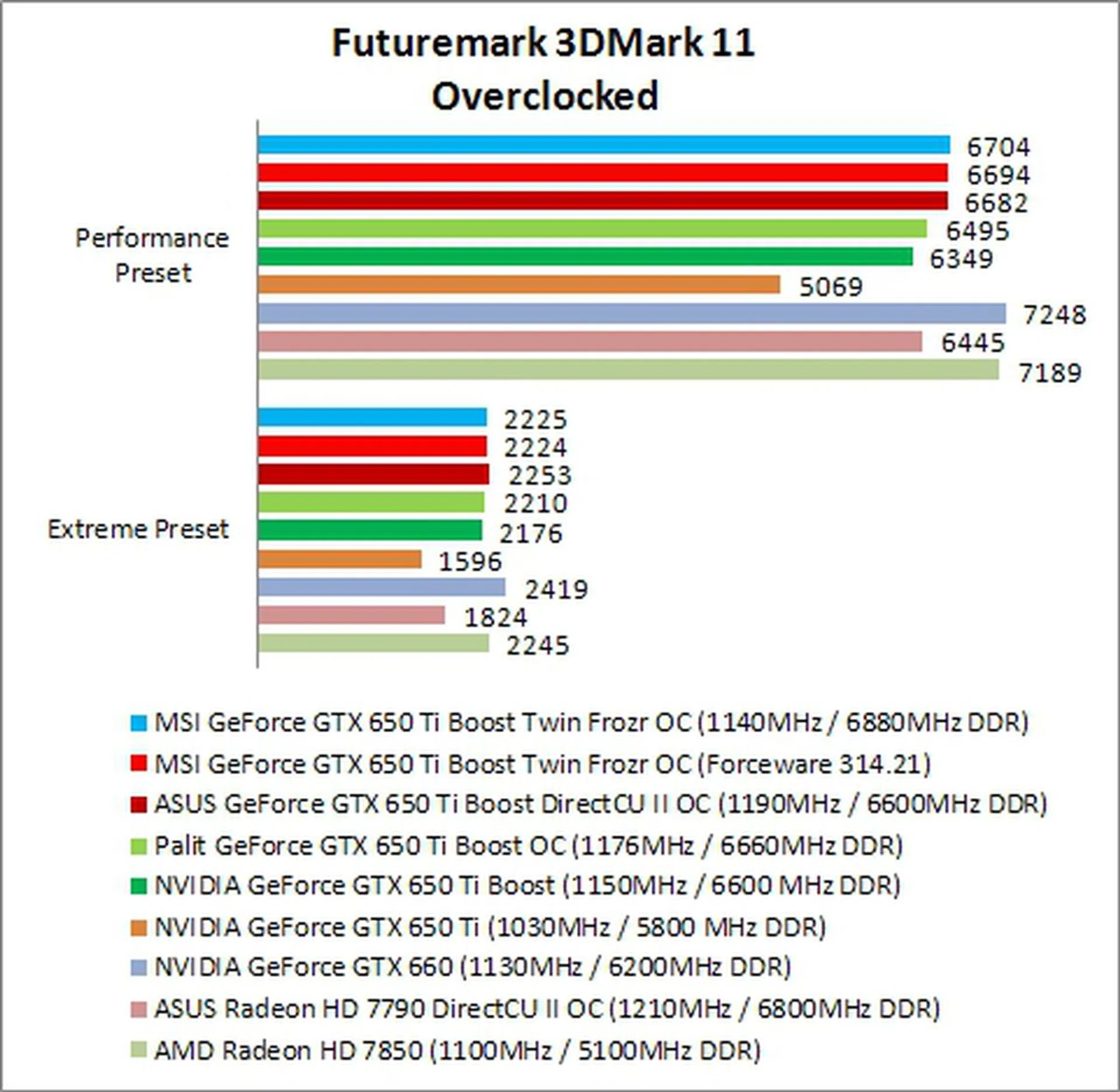
We managed to boost the MSI GTX 650 Ti Boost Twin Frozr III OC to 1140MHz, with its memory overclocked to 6880MHz GDDR5. We expected the card to reach similar clockspeeds exhibited by the custom GeForce GTX 650 Ti cards from ASUS and Palit; however, the MSI Gaming card was about 4.3 per cent lower than the ASUS GeForce GTX 650 Ti Boost DirectCU II OC.
In terms of actual performance against the top custom OC GTX 650 Ti Boost card, the MSI GTX 650 Ti Boost Twin Frozr III OC pulled ahead by a thin margin of 0.2 per cent at Performance preset while losing by about 1.3 per cent at the Extreme preset. On the whole, the MSI Gaming card experienced performance gains in the range of approximately 8- to 9 per cent increments when it was overclocked compared to its out-of-the box capability.
Temperature Results
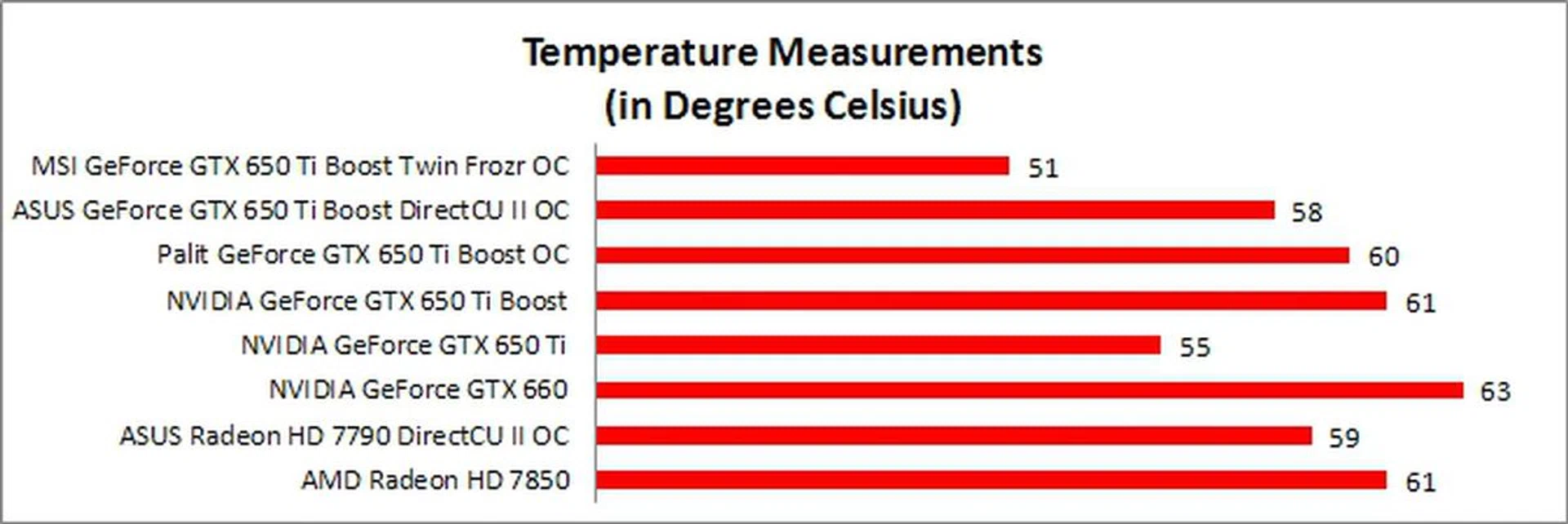
The Twin Frozr III cooling system proved to be extremely efficient as the MSI GeForce GTX 650 Ti Boost OC card was kept coolest during our temperature tests!
Power Consumption Results
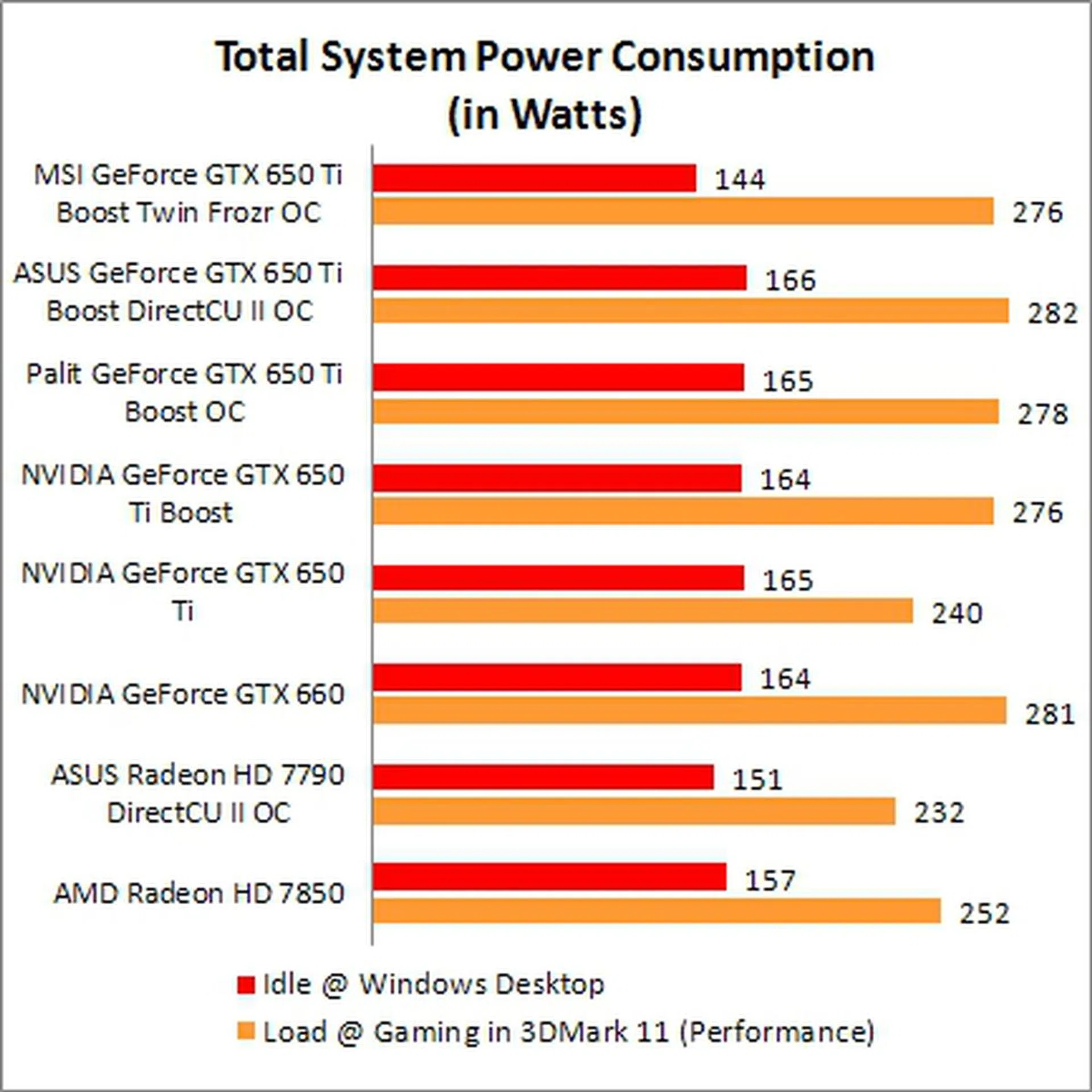
The MSI card had the lowest idle power consumption level and while during operation, its power consumption level was similar to our reference NVIDIA GeForce GTX 650 Ti Boost card.
Conclusion
The MSI GTX 650 Ti Boost Twin Frozr III OC is a competent card with an excellent cooling system in the form MSI's proprietary Twin Frozr III technology. Its gaming performance levels were good and it was leading the competition by a small degree, courtesy of its overclocked NVIDIA GeForce GTX 650 Ti Boost core. It also managed to beat the AMD Radeon HD 7790 by a wide margin, and even outshone the Radeon HD 7850 in our Crysis 3 gaming benchmark.
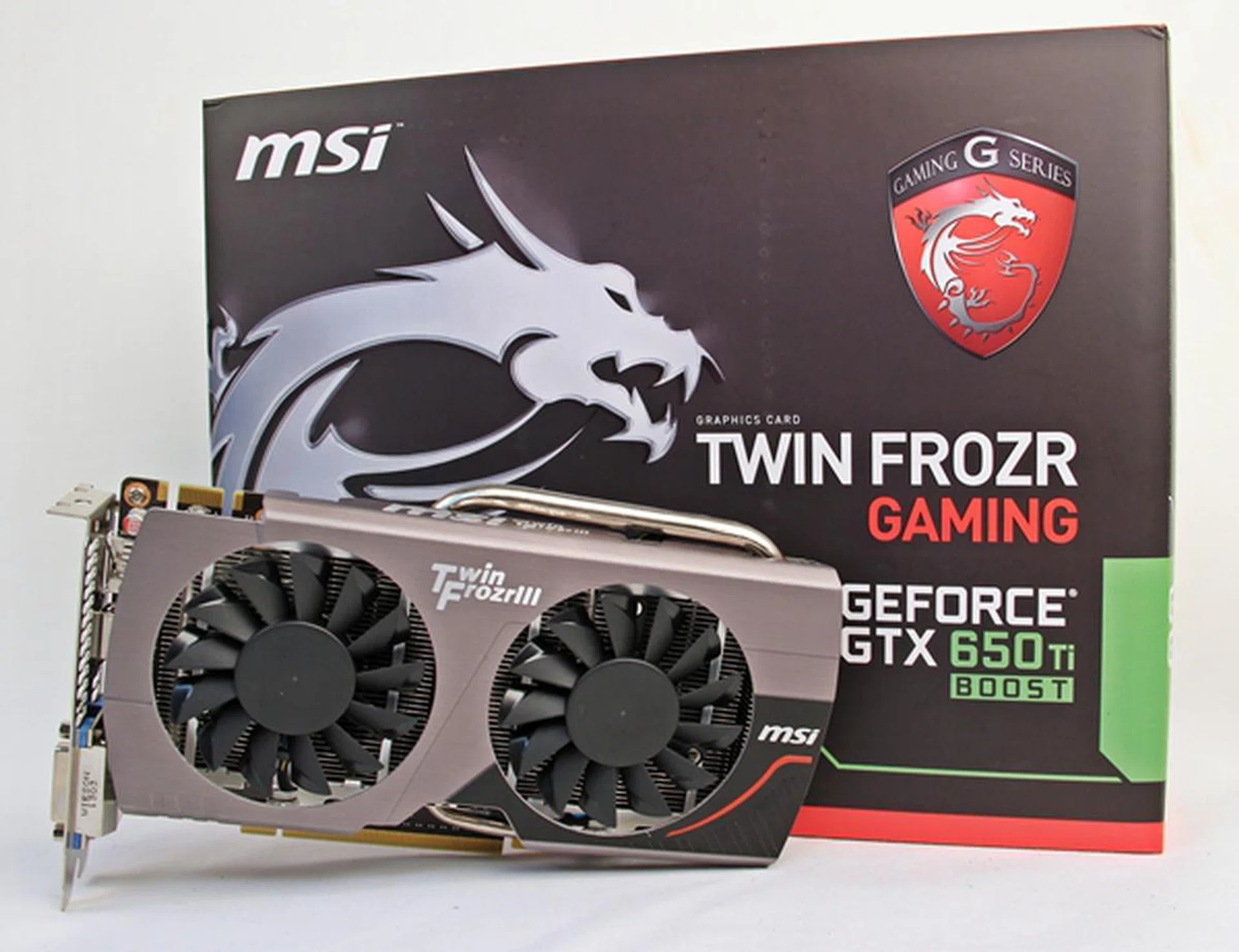
The MSI GTX 650 Ti Boost Twin Frozr III OC is a card with competent performance and managed to outclass its direct AMD Radeon HD 7790 competitor by a wide margin while giving the Radeon HD 7850 a tough fight. Against other brands with the same GPU SKU, the MSI card has its strengths, but not enough to make it stand out as a true gamer card.
The card's overclocked performance level was on par with its peers; however, its GK104 core failed to reach the same overclocked rate as the two competing cards from ASUS and Palit. Apart from that, there weren't any major flaws with the card given its performance right out-of-the-box.
If we had to nitpick, we wish to see the metal fan shroud of subsequent cards get the Gaming series treatment, i.e., the shroud and cooler design should have the red and black color scheme of the Dragoon Army Gaming series. That would at least help make the card stand out from the usual series of cards and make it special since it doesn't have any other tricks or customization such as those on the MSI Z77A-GD65 Gaming motherboard of the same league. At the same time, in line with its Gaming series heritage, a major game title should have been bundled to further differentiate from the competition and emphasize its intentions.
Priced at S$289, it's priced reasonably against the ASUS and Palit cards respectively, though Palit has been in the market for a longer time and has since compressed its price to just $259. Naturally, if you're not really concerned with other matters besides raw performance and price, the Palit card is a better proposition. For those who would prefer to enjoy a longer warranty period, a cooler operating graphics card and a card with more personality, the the MSI GTX 650 Ti Boost Twin Frozr III OC is a better choice for a small premium.
Our articles may contain affiliate links. If you buy through these links, we may earn a small commission.