
The most feature-packed AMD X570 motherboards announced so far
Some of these boards might interest you if you're looking to upgrade your rig in a big way.
AMD resurgent
AMD was one of the big winners of Computex 2019. The company announced its new Ryzen 3000-series processors, based off the Zen 2 architecture and 7nm process node. In many ways, it seemed like AMD was marching resolutely forward, while Intel was still muddling along and talking about low-power mobile chips, with no clear word as to when 10nm desktops chips might debut.
It's great news for sure that we're finally seeing the 10nm Ice Lake chips from Intel after multiple delays, but AMD's Ryzen 3000-series look like they're set to really give Intel's 9th-generation chips a run for their money. While reviews aren't out yet, AMD's own benchmarks – which understandably have to be taken with a pinch of salt – show the Ryzen 3000 chips slightly ahead of their Intel counterparts both in terms of IPC and multi-threaded performance. That's pretty impressive, considering that it wasn't too long ago that AMD was struggling in terms of single-threaded performance.
In other words, if you're looking to upgrade your rig, Ryzen 3000 is shaping up to be a very attractive option. It's made even more attractive by their new X570 chipset, which adds support for the next-generation PCIe 4.0 standard, a clear first-mover advantage for AMD and another point in its favor against Intel. While there aren't any graphics cards that can take advantage of PCIe 4.0 at the moment, companies like Gigabyte and Corsair have already announced PCIe 4.0 SSDs, so storage will be one of the first areas to benefit from the shift to PCIe 4.0.
To put things in perspective, the Aorus NVMe Gen4 SSD can reportedly hit up to 5,000MB/s read and 4,400MB/s write speeds. That amounts to 56 per cent better read performance and double the write speeds of the Samsung 970 EVO, already one of the fastest NVMe drives you can buy today.
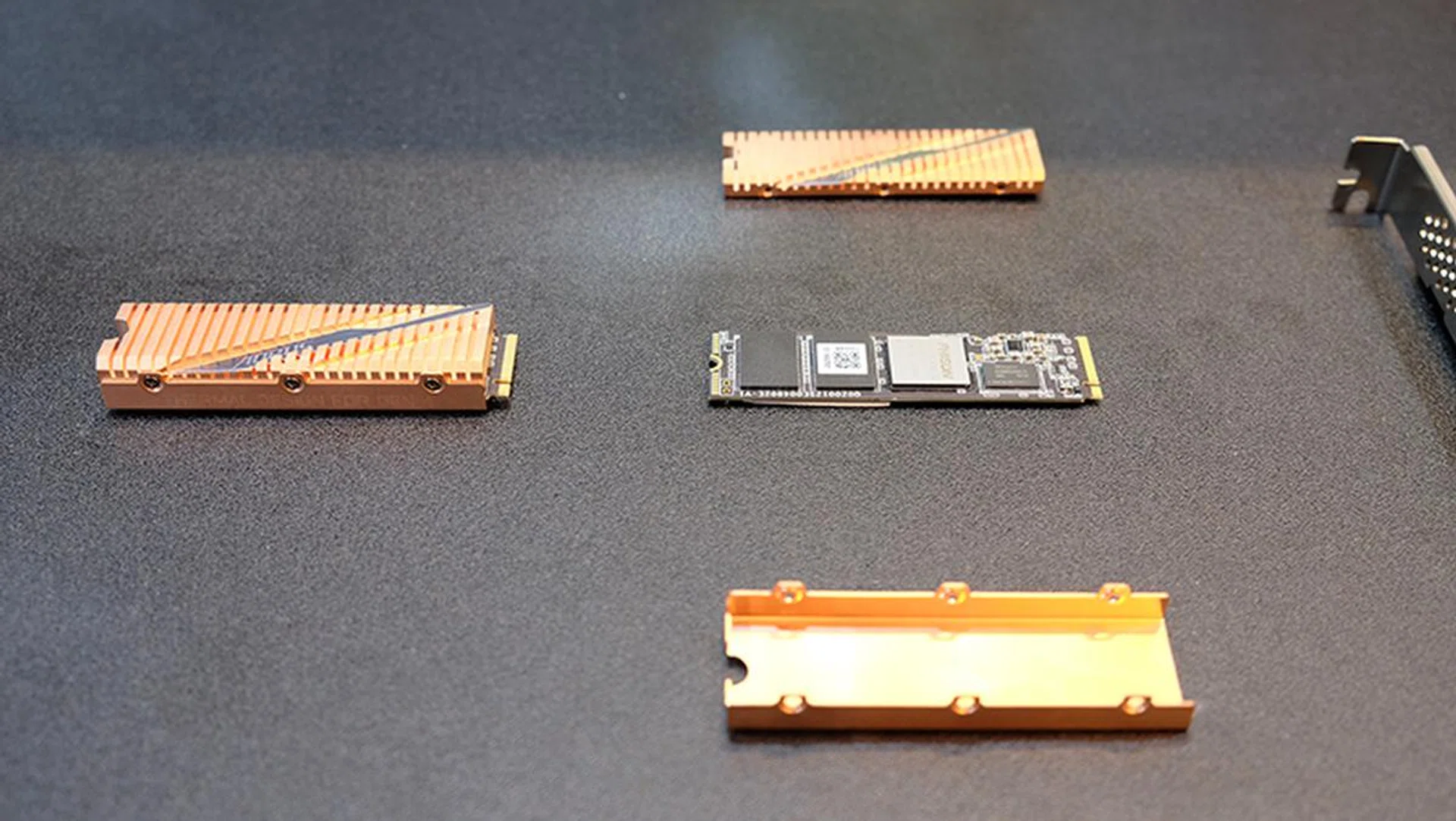
Gigabyte is clearly expecting the Aorus NVMe Gen4 SSD to get hot.
However, despite initial rumors that it would be possible to enable PCIe 4.0 on older chipsets like X470, X370, and B450 – at least from the CPU – via a firmware update, AMD has snuffed out that idea. PCIe 4.0 will not be coming to older motherboards, and you'll need to get an X570 board or newer if you want the feature.
There are a few notes on backward compatibility as well. While AMD has committed to supporting the AM4 socket till 2020, which supposedly means full compatibility as long as both CPU and motherboard use the same socket, that's not entirely the case with this generation of products.
Firstly, X570 will not support any first-generation Ryzen Summit Ridge or Raven Ridge chips, so you're out of luck if you own one of those. Furthermore, AMD is leaving support for Ryzen 3000 on X370 and B350 to the discretion of manufacturers, while A320 will not be getting any BIOS updates for the new chips at all. To put things simply, you're good if you have an X470 or B450 board, but you'd best check the support page for your specific 300-series motherboard to see if the Ryzen 3000-series is supported. Here's a consolidated table on processor support:-

Having said that, there's no doubt that everyone is super excited about Ryzen's third iteration and the new X570 chipset. Now more than ever, manufacturers are throwing a lot behind their X570 boards, such that they now match the best of what they offer for Intel's chipsets. There's clearly an expectation that Ryzen 3000 will be quite the force to be reckoned with, and you can expect more robust VRM designs, better cooling solutions, and enhanced signal traces.
Here's a look at some of the most luxurious boards we saw at Computex 2019.
ASRock X570 Aqua
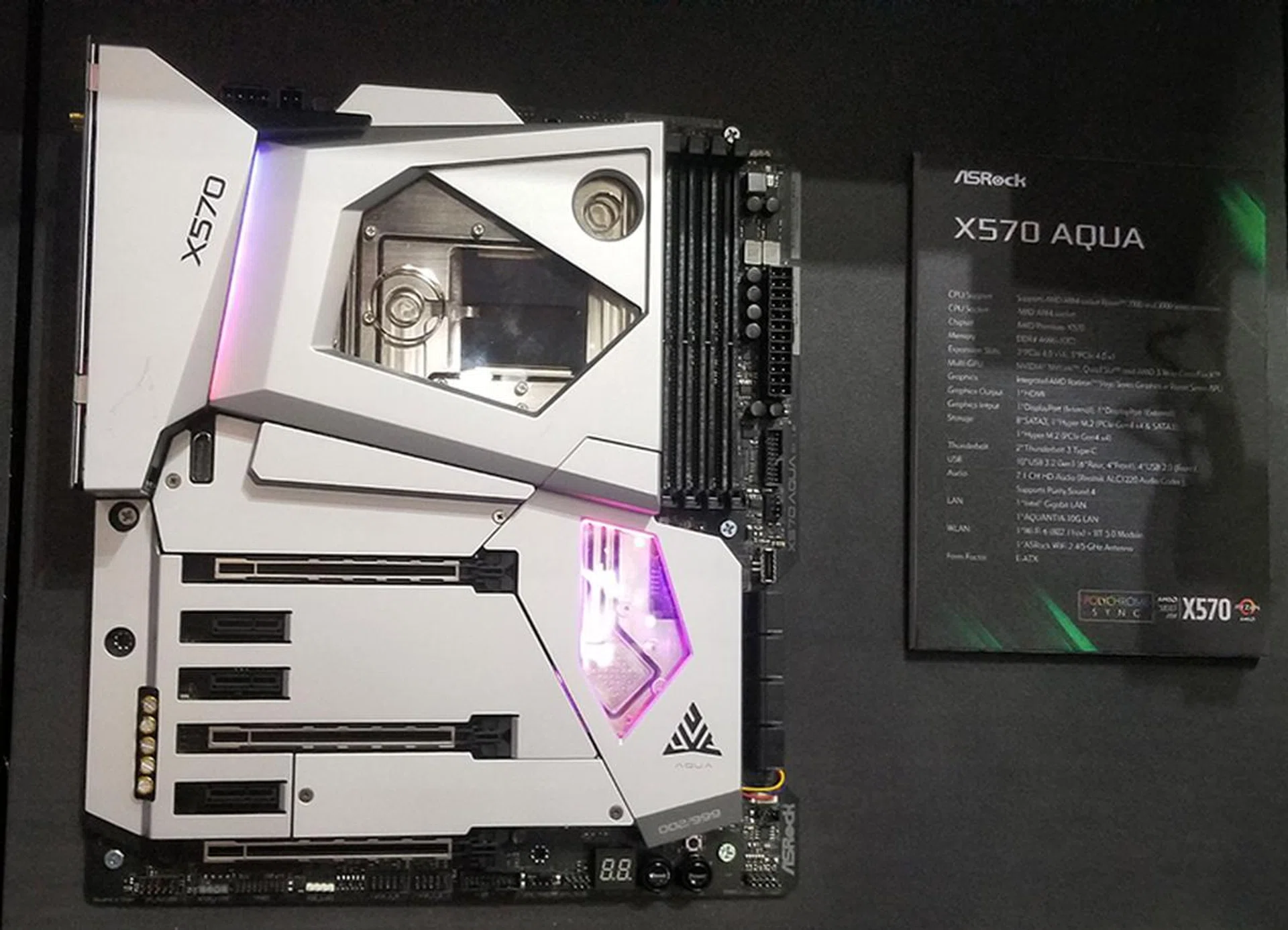
ASRock's boards have generally been known for providing great bang for your buck, as opposed to a raft of premium features. However, the ASRock X570 Aqua bucks that trend as a limited edition model created expressly for liquid cooling. There will only be 999 units of this made, and each will bear a unique marking.
This is also a completely new board from ASRock, and there aren't really similar models from past chipsets. It's quite telling that the company is using AMD's X570 chipset to debut the Aqua, which speaks volumes about how it thinks Ryzen 3000 is going to be received by enthusiasts.
This is an E-ATX motherboard with a black PCB, nickel-plated copper water block and aluminum shielding slapped on top of it. The water block cools the CPU, in addition to the X570 chipset and the power delivery subsystem. For power, the CPU can rely on one 8-pin connector and an optional 4-pin connector. The 16-phase VRM looks set up for overclocking as well, and the board seems like it is plenty capable of pushing your Ryzen 3000 chip to its limits.
The board supports up to DDR4-4666 memory and features three PCIe 4.0 x16 and three PCIe 4.0 x1 slots. In terms of storage, you get eight SATA 6Gbps and two M.2 sockets, one of which will support both PCIe and SATA devices.
The X570 Aqua also boasts similarly robust networking capabilities, including an Aquantia AQC107 10G LAN port and a second Intel Gigabit Ethernet connector powered by an Intel i211-AT controller. There is support for Wi-Fi 6 and Bluetooth 5 as well, in the form of the Killer Wi-Fi 6 AX1650 chip.
The rear I/O panel houses two Thunderbolt 3 ports, but that takes away some bandwidth from the board's other USB capabilities. As a result, there are just six USB 3.1 (Gen 1) Type-A ports on the rear panel and no Gen 2 headers. Separately, the board has two USB 3.1 (Gen 1) headers that can link up to four front panel connectors, in addition to further support for four front-panel USB 2.0 ports.
ASUS Crosshair VIII Formula
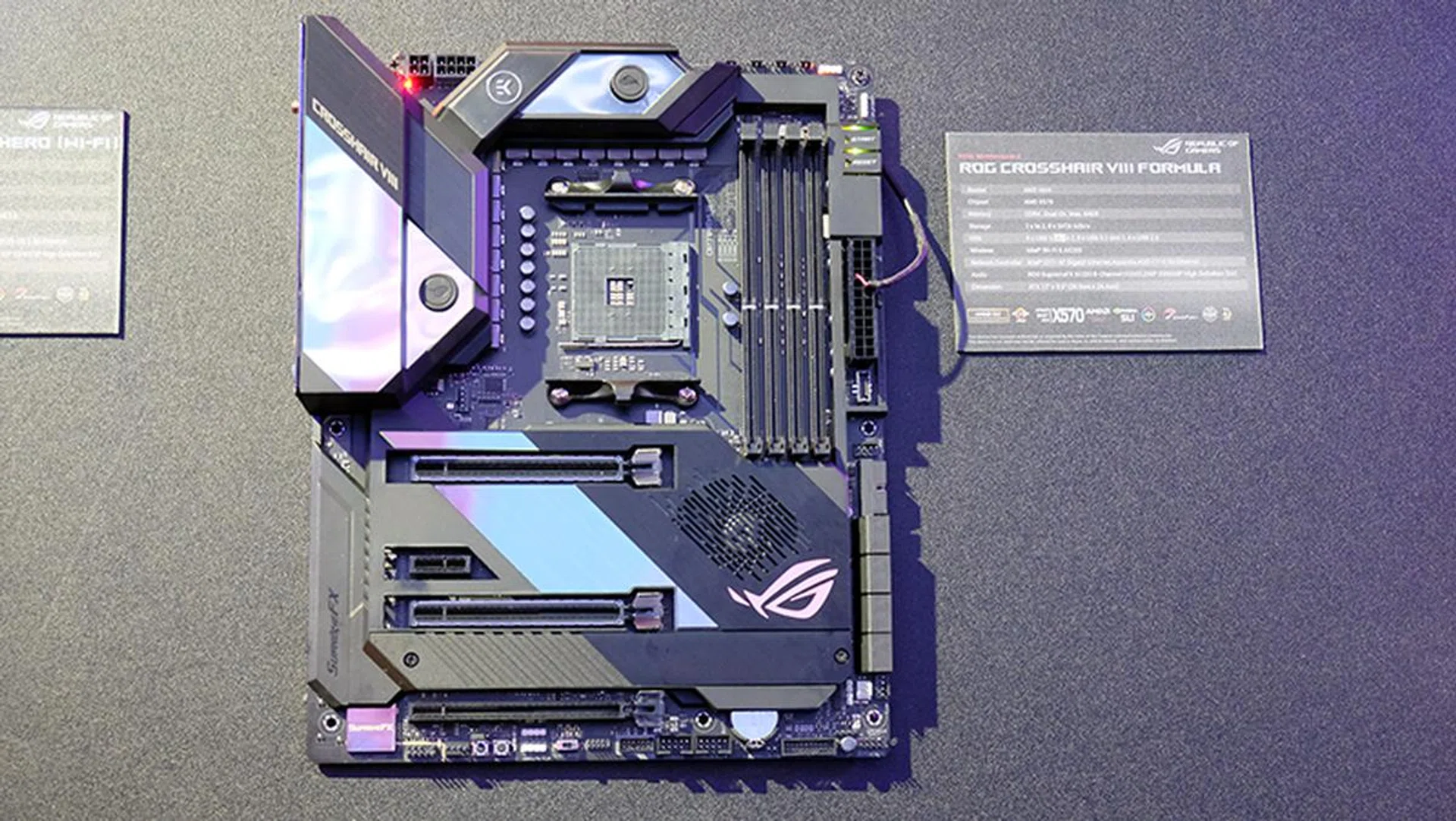
The Crosshair VIII Formula is ASUS' flagship X570 board.
Like the ASRock X570 Aqua, the ASUS Crosshair VIII Formula thinks that liquid cooling is the way to go. It features EK's CrossChill EK III hybrid cooler that covers the VRM with a combined water block and heat sink. This means you can either connect it to a custom liquid cooling loop or use it as-is with an air cooling solution. According to ASUS, the new design also offers wider copper channels than before and a large copper surface area for heat transfer. This is ASUS' flagship X570 offering and it comes jam-packed with features to appeal to enthusiasts hankering after performance.
One thing to note is that there isn't even a Crosshair VII Formula board to draw comparisons with. The highest-end X470 board from ASUS is probably the ROG Crosshair VII Hero (Wi-Fi), and this year's spread of X570 motherboards comprises a far wider selection than before and includes more premium models. This shift is seemingly indicative of ASUS' confidence in AMD and its Ryzen 3000 chips. More importantly, it's not just ASUS that is creating far more impressive AM4 boards than before, and you'll see the same from the other major manufacturers as well.
But the hybrid water block aside, the Crosshair VIII Formula is equipped with a raft of familiar features more commonly found on ASUS' Intel-based motherboards. This includes the LiveDash OLED display, a solid steel backplate for extra structural rigidity, ROG armor protecting the PCB, a ton of independent RGB lighting zones, and even an integrated fan in the chipset heat sink.
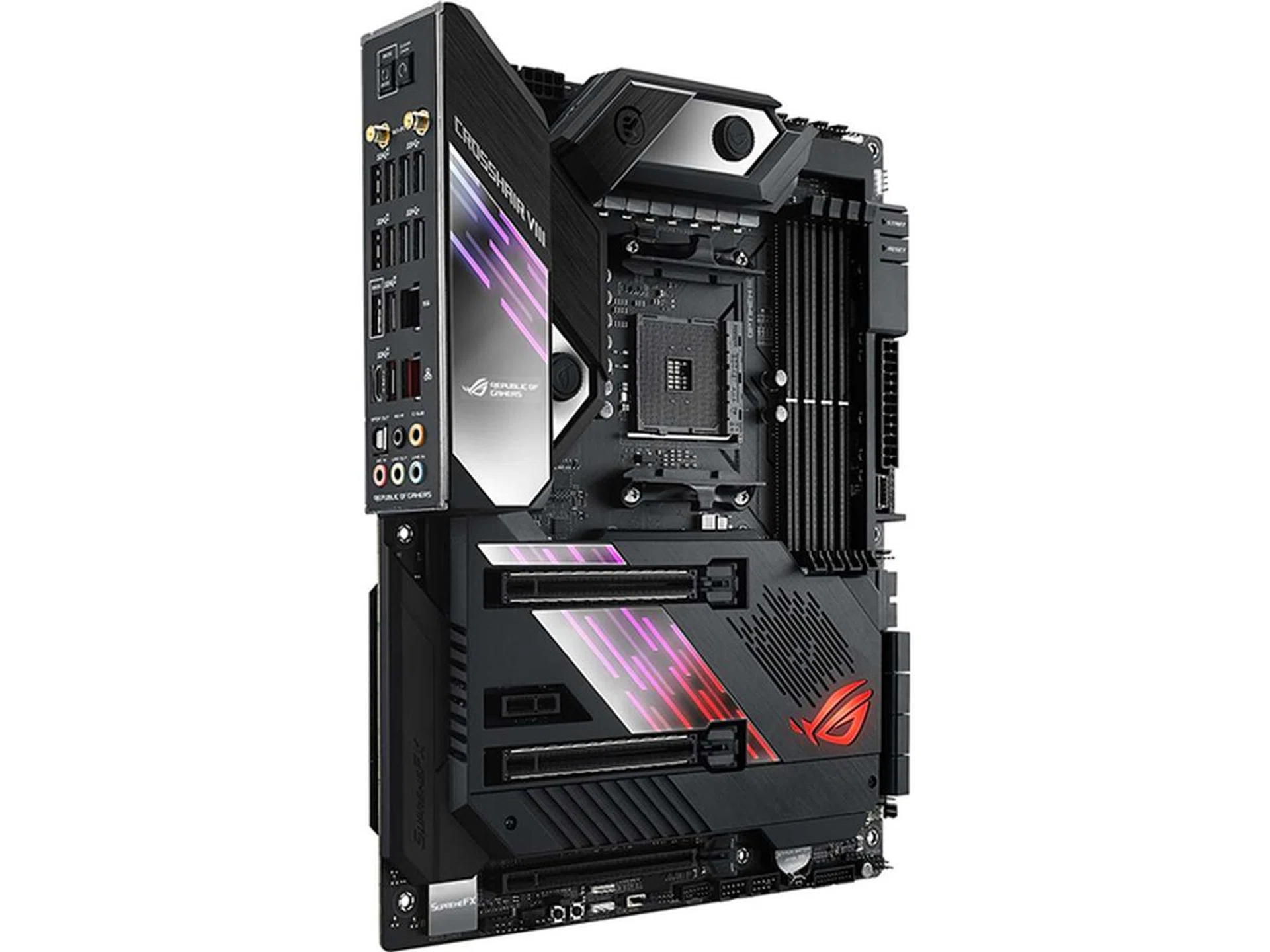
Image Source: ASUS
In terms of expansion slots, it has three PCIe 4.0 x16 and a single PCIe 4.0 x1 slot. Only the first two x16 slots come directly from the CPU though, and the third draws on lanes from the X570 chipset.
For storage, you get eight SATA 6Gbps and two M.2 sockets, both of which will support PCIe and SATA drives. Networking options take the form of one Aquantia AQC111C 5G LAN port and a second Gigabit Ethernet port provided by an Intel I211-AT controller. Of course, there's Wi-Fi 6 support as well via the new 2x2 Intel Wi-Fi 6 AX200 adapter.
The rear I/O, which also uses a pre-mounted I/O shield for easier installation, houses four USB 3.1 (Gen 1) Type-A, seven USB 3.1 (Gen 2) Type-A ports, and one USB 3.1 (Gen 2) Type-C, in addition to USB BIOS Flashback and Clear CMOS buttons.
The onboard audio solution has been beefed up as well, featuring a SupremeFX S1220 codec and an ESS ES9023P DAC.
Finally, given that this is a board for overclockers, the VRM is comprised of 16 IR3555 PowlRstages, each rated to handle up to 60A. Each PowlRstage is accompanied by a high-permeability alloy-core choke rated for 45A, and paired with solid-polymer capacitors that generally last longer than their electrolytic counterparts.
Gigabyte X570 Aorus Xtreme
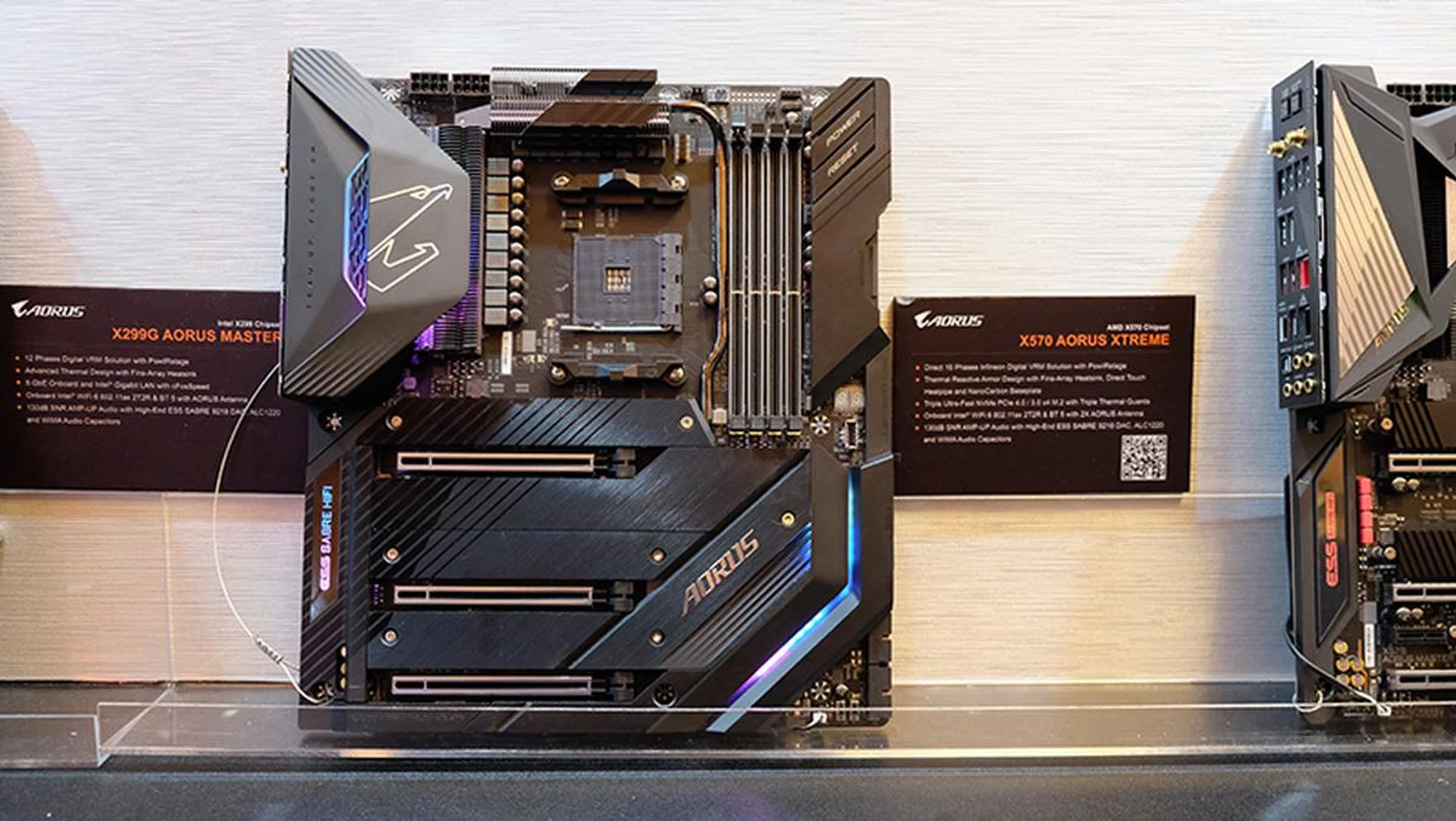
The X570 Aorus Xtreme was built for top-end performance.
Gigabyte's top X570 motherboard certainly looks the part, with beefy heatsinks, snaking heat pipes, and shielding for the majority of the PCB. Like the other boards featured here, the X570 Aorus Xtreme was designed around overclocking, and it features a 16-phase power delivery subsystem to provide smoother and cleaner power to your Ryzen 3000 processor.
The VRM design has really been the focus of the X570 Aorus Xtreme. In fact, Gigabyte says it is using 16 true phases, none of which are wired in parallel and also without the use of any phase doublers. This direct VRM implementation straight from the Infineon PWM controller is still quite rare today, with many high-end boards still opting for phase doublers to turn an 8-phase VRM into a 16-phase one.
As a simple rule of thumb, the more VRM phases on a motherboard, the more stable the supply of power to the CPU. Each phase produces a burst of power, or pulse, that is staggered from the last, so the higher number of phases ensure that there are fewer troughs in between pulses and a smoother supply of power for the processor. This is particularly vital when you're trying to push a chip to its limits, which is why the X570 Aorus Xtreme looks like it could possibly be the board to get for serious overclockers. Not to mention, the same basics of why more power phases exist is to reduce the power loading levels on each VRM and MOSFET, and lower operating temps for higher efficiency to increase your chances for a successful extreme overclock.
The motherboard uses Infineon TDA21472 PowlRstage MOSFETs that are capable of providing at least 70A of power, for a total of up to 1,120A. Gigabyte says it's trying to ensure that power design will never be a bottleneck for the X570 Aorus Xtreme, and it's pairing its souped-up VRM with dual 8-pin CPU connectors and a 2x copper PCB that supposedly provides additional power trace paths between components to handle higher power loads.
In addition, there's an extra 6-pin PCIe power connector for the graphics card as well.
But with overclocking comes plenty of heat, which is where Gigabyte's so-called Thermal Reactive Armor comes in. One surprising thing to note is that the X570 chipset is only passively cooled on this board. However, while it may lack the integrated fan found on other boards, it tries to make up for that with a multi-layered chipset heatsink that is connected by a heat pipe to the extensive heat sink fin array that cools the VRM.
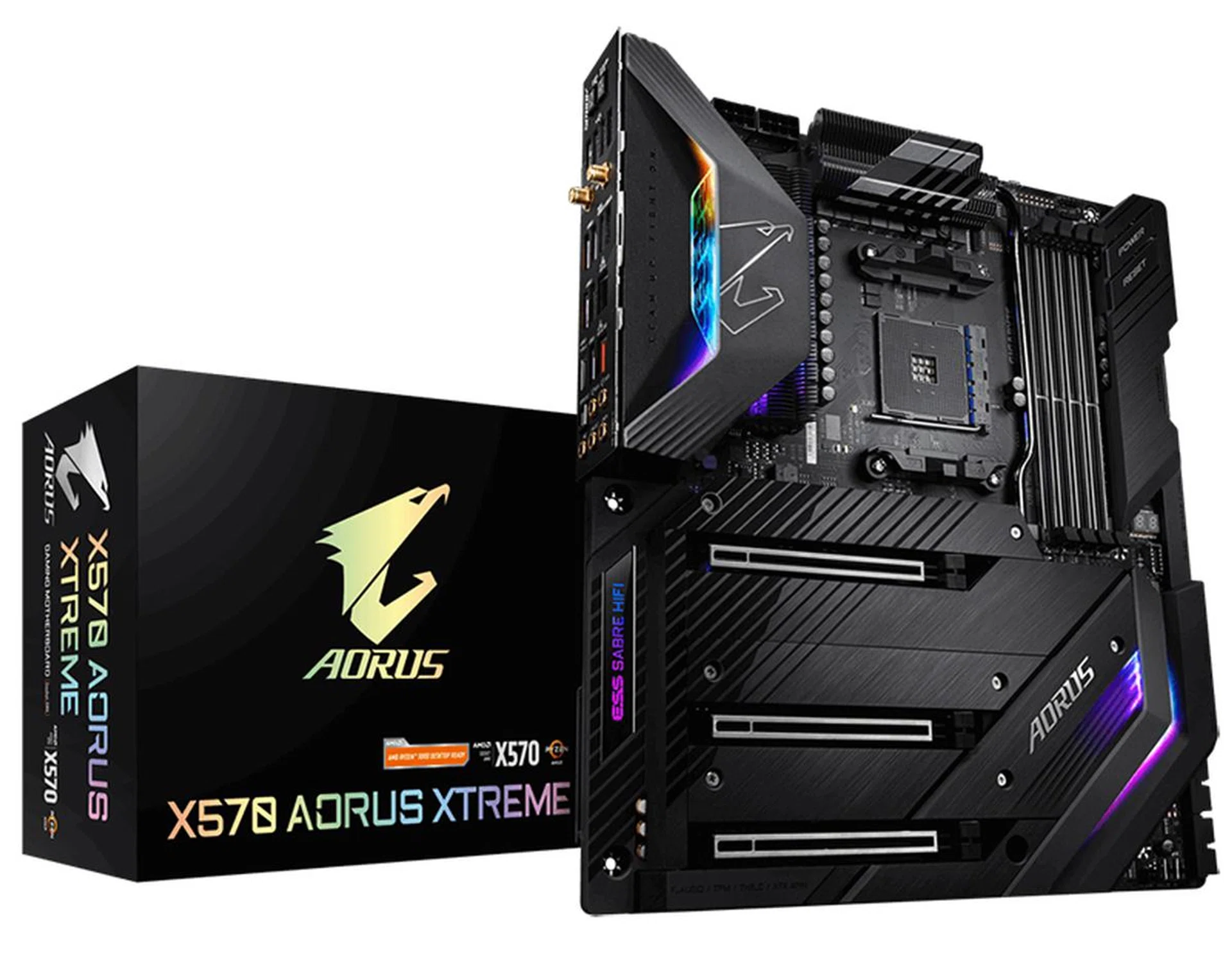
Image Source: Gigabyte
This fin array reportedly increases the surface area available for heat dissipation by 300 per cent, compared to traditional heat sinks of the same size. Heat pipes also come into direct contact with the MOSFETs, which further helps with heat transfer. Elsewhere, Gigabyte employs thicker Laird thermal pads, which boast improved thermal conductivity as well.
The back of the board also features an aluminum base plate that also acts as a heat sink for the rear of the PCB. A thin layer of what Gigabyte refers to as NanoCarbon is further coated on the base plate through electrostatic adhesion to improve thermal radiation. In fact, the company says this can lower the temperatures of PWM components on the motherboard's back by up to 10 per cent.
One of the reasons why Gigabyte chose to omit any integrated fans in the I/O cover or chipset heat sink is noise. As it turns out, the company is so concerned about staying quiet that it's bundling a noise detection cable with the board to help you monitor your overall system noise and adjust fan speeds accordingly. You don't need to worry about privacy though, as the cable doesn't record any sound and only detects sound pressure.
In terms of expansion slots, the X570 Aorus Xtreme has three PCIe 4.0 x16 slots and three M.2 sockets. Each of the latter has its own Thermal Guard heat sink to reduce throttling. In addition, the motherboard also supports DDR4-4400 memory and beyond, an important point considering how sensitive to memory frequencies Ryzen can be.
To cap things off, the rear I/O panel features an Aquantia AQC107 controller for 10G network connectivity and a second Intel Gigabit LAN port, in addition to support for Wi-Fi 6 and Bluetooth 5. You'll also find one USB 3.1 (Gen 2) Type-C, five USB 3.1 (Gen 2) Type-A, two USB 3.1 (Gen 1), and four USB 2.0 ports round the back.
MSI MEG X570 Godlike
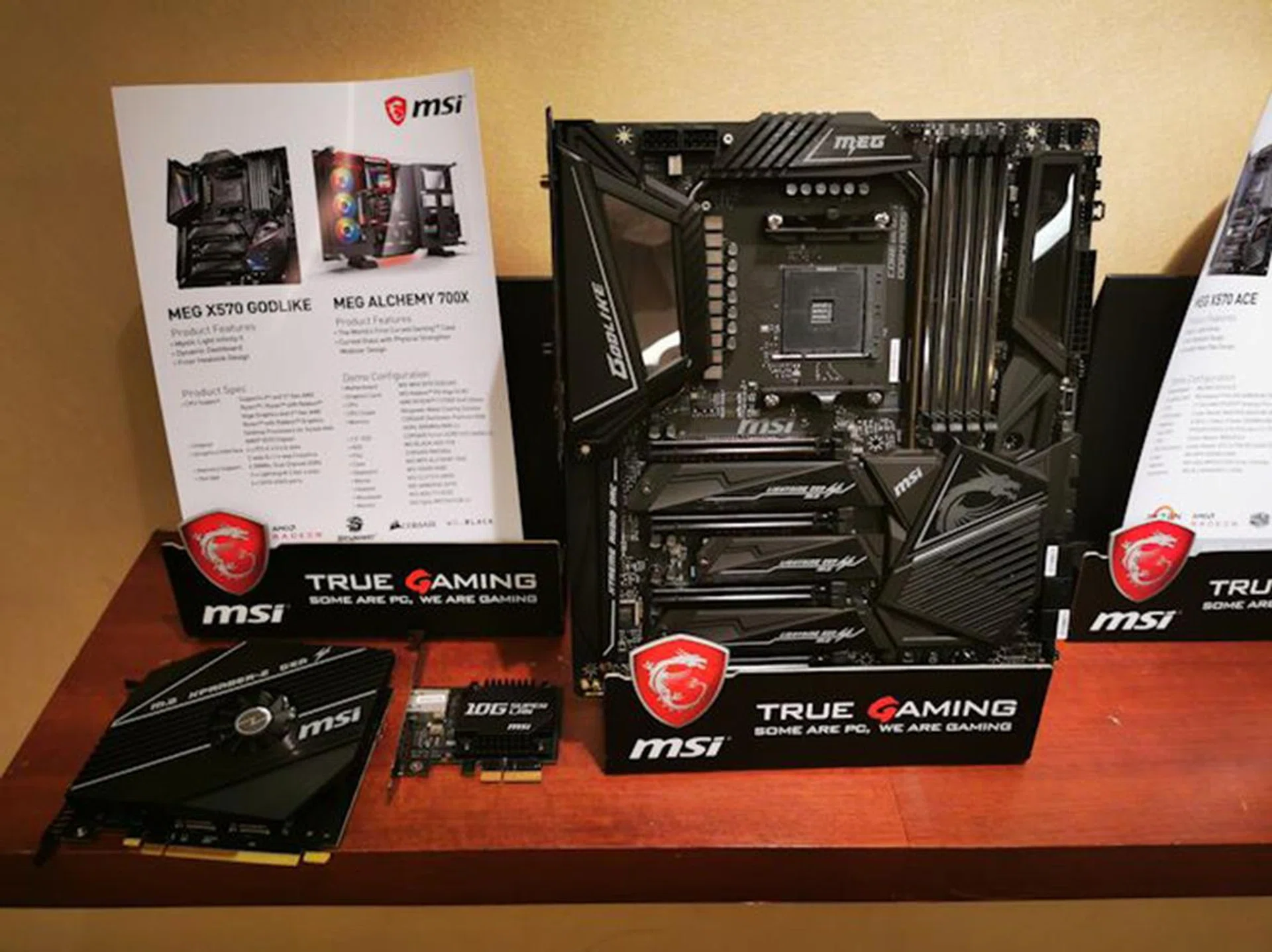
This is the first time MSI made a Godlike board for the AM4 chipset.
Just like the other motherboard manufacturers, MSI is stepping up its game in terms of its X570 offerings. It's shooting higher than ever before, and the MEG X570 Godlike marks the first time that it's bringing its flagship Godlike model to an AMD Ryzen chipset.
For starters, the Godlike features a 14+4-phase power design, comprising an IR Digital PWM controller, DrMOS power stages, and titanium chokes. It has a 14-phase power delivery system for the CPU's VCore, but it only features 7 true phases and relies on phase doublers.
In addition, it is equipped with dual 8-pin CPU power connectors and an eight-layer PCB, the latter of which helps accommodate the additional trace paths required to sustain the greater amount of power. According to MSI, it's actually using a server-grade PCB here in order to ensure PCIe 4.0 performance and better stability.
The X570 chipset is also expected to generate more heat and pull more power than its predecessor, to the tune of 11W compared to roughly 6W on X470. That's a big part of why you're suddenly seeing fans integrated into the chipset heat sinks of so many high-end X570 motherboards, and the MEG X570 Godlike is no different. Its integrated double ball-bearing fan works to keep to chipset cool, and it is also linked to the VRM heat sink via a single heat pipe to increase the surface area available for heat dissipation.
And speaking of cooling, one potentially useful feature is MSI's Zero Frozr technology, which you may recognize from the company's graphics cards. This is a smart tuning system that can automatically adjust fan speeds based on the chipset temperature, but it can also completely turn down the fans when system loads are low.
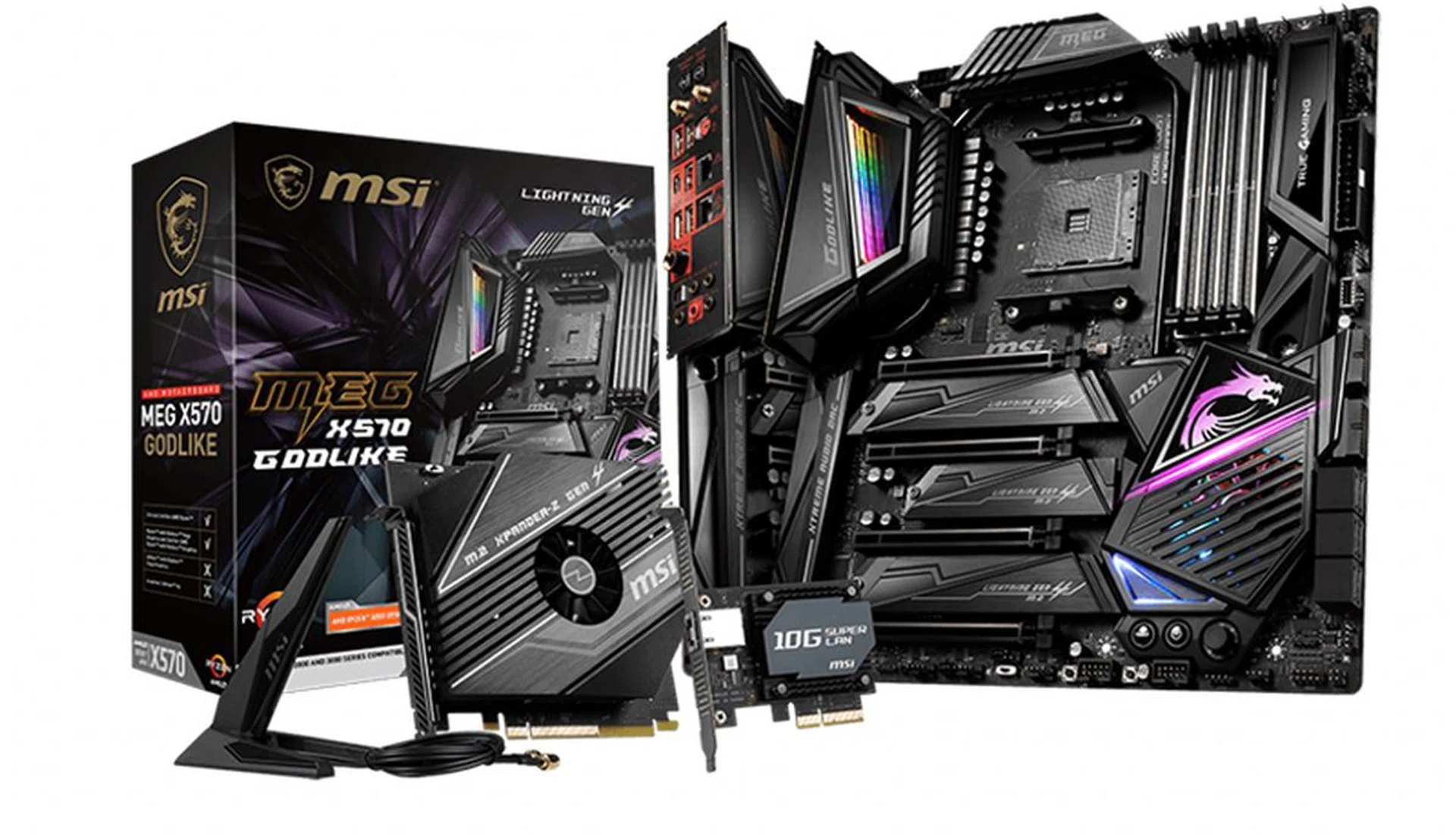
Image Source: MSI
That aside, it feels like a big focus of the Godlike's design is on expandability. It features four PCIe 4.0 x16 slots, three M.2 sockets, and six SATA 6Gbps. On top of that, it also ships with a couple of expansion cards, including a 10G Super LAN card for ultra-fast connections if your network supports it and an M.2 Xpander-Z Gen 4 card that can hold two more M.2 PCIe 4.0 drives. The latter even has its own heat sink and fan to keep your drives running cool. Each of the motherboard's built-in M.2 sockets have MSI's Shield Frozr heat sinks as well to reduce thermal throttling.
Another nifty feature is the Dynamic Dashboard OLED display on the right. This can display system information like CPU temperature or be set to show off your own custom GIFs.
The I/O shield is pre-mounted for easier installation, and the 10G Super LAN card aside, the board still has dual Ethernet ports, powered by a Killer E3000 2.5G and an E2600 Gigabit LAN controller. There is also support for Wi-Fi 6, courtesy of a Killer Wi-Fi 6 AX1650 chip. Round the back, you'll find one USB 3.1 (Gen 2) Type-C, three USB 3.1 (Gen 2) Type-A, and two USB 3.1 (Gen 1) Type-A ports.
The audio solution comprises an ESS DAC and dual audio processors, paired with a 6.3mm audio jack at the rear so you don't need an adapter to plug in a high-end set of cans.
Our articles may contain affiliate links. If you buy through these links, we may earn a small commission.