
AMD Ryzen 9 9950X3D2 review: Is this Team Red’s magnum opus?
When the best becomes even better.
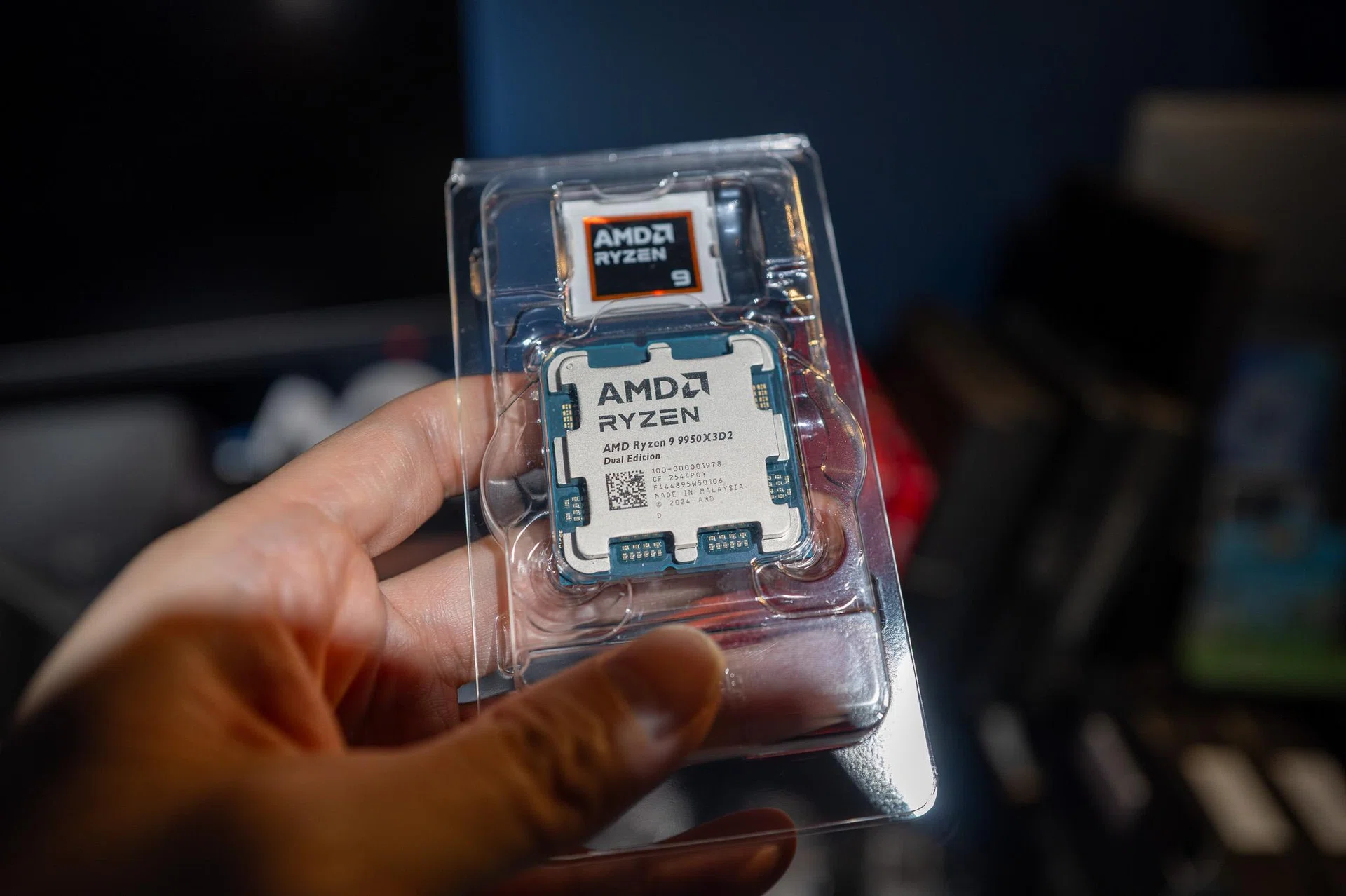
Note: This review was first published on 21 April 2026.
AMD’s hardened grip on the consumer desktop space right now isn’t hard to explain. The Ryzen 9000 series has done what it set out to do against Intel’s Arrow Lake in this generation’s CPU battle – push ahead on power efficiency, hold its ground in productivity and content creation tasks, and, more importantly, tighten its lead in gaming with the X3D lineup. The Ryzen 9 9950X3D, in particular, already felt like AMD closing the loop on what an almost “perfect” high-end desktop CPU should look like today: efficient with thermal and power, quick with daily workloads and fast at gaming. It’s not a stretch to call it the best CPU to buy right now.
So it’s a bit surprising that AMD isn’t done.
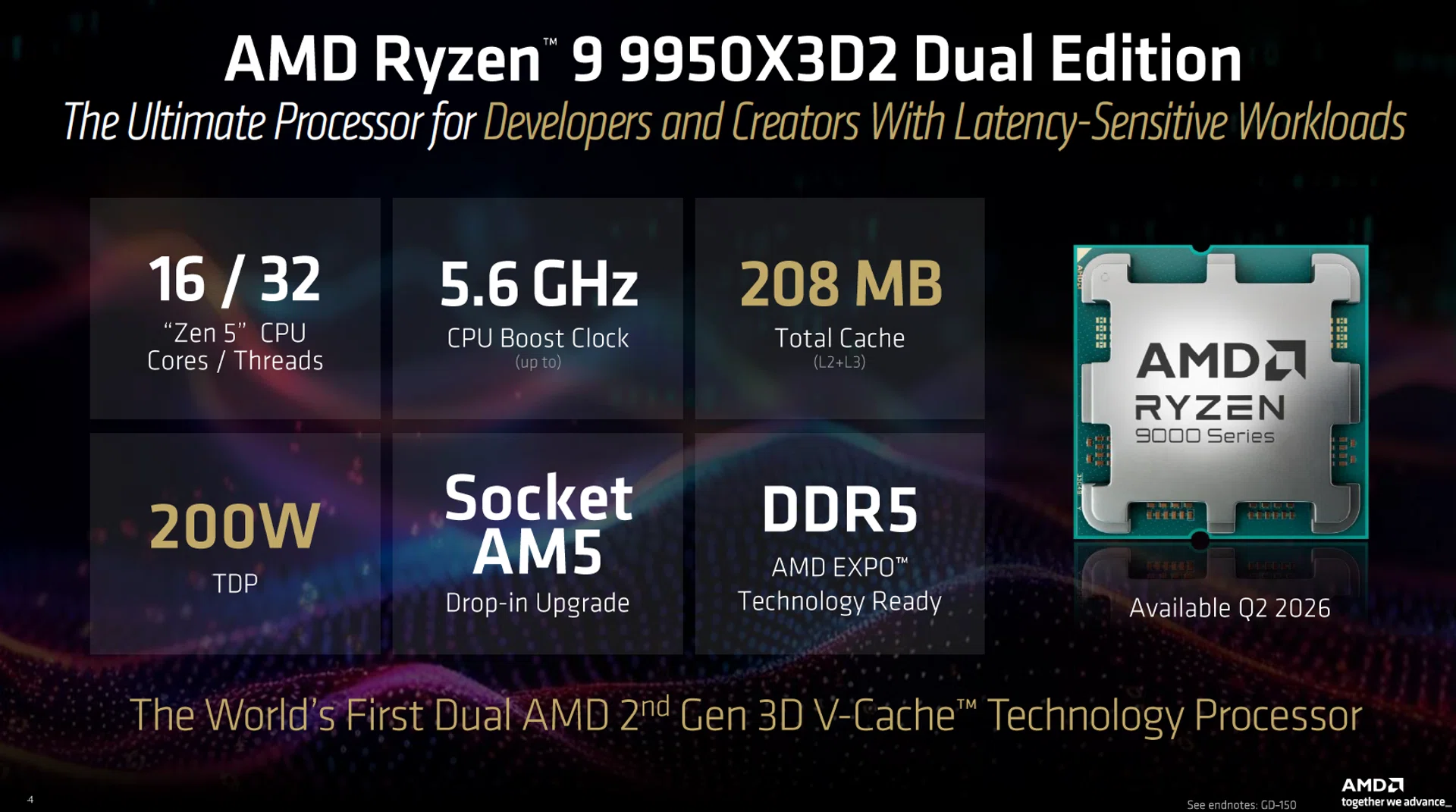
The Ryzen 9 9950X3D2 is very likely the finishing line for AMD’s Ryzen 9000 series.
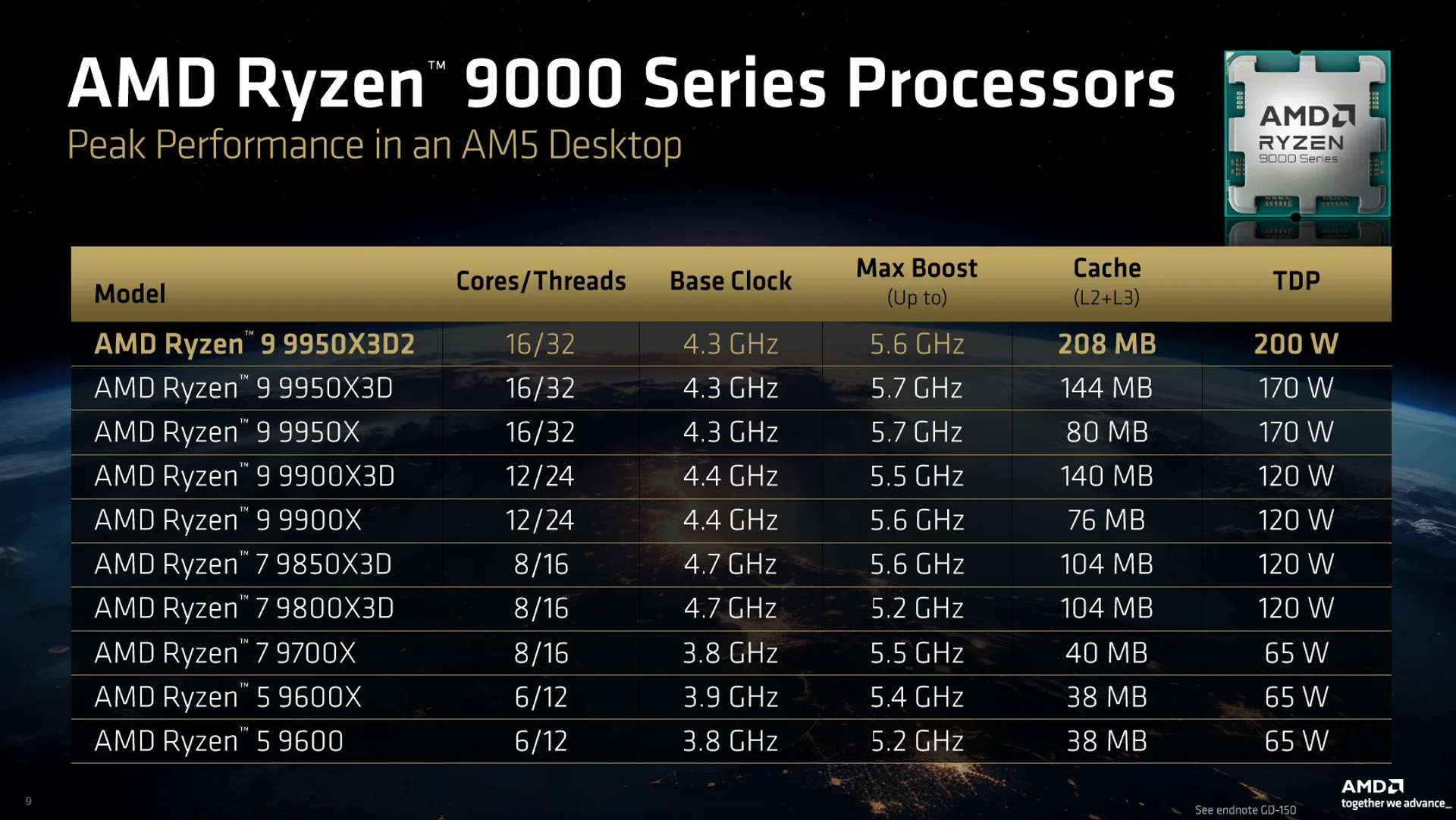
Here’s a complete stack of the Ryzen 9000 series.
Because instead of letting the 9950X3D sit comfortably at the top, AMD has decided to go one step further with the new Ryzen 9 9950X3D2 – a chip that, at least as far as specs go, feels like it’s trying to remove one of the last quirks of the X3D design. No more splitting duties between cache-heavy and non-cache CCDs, no more second-guessing whether the scheduler is putting workloads in the “right” place. This time, both chiplets get the full 3D V-Cache treatment.
That sounds like a very logical solution. But does doubling down on cache actually translate into real-world performance, or is this AMD pushing an already good formula just a little too far?
Which is where things get interesting, because this isn’t just a simple spec bump. In fact, it’s a change that could reshape how the chip behaves under different workloads – thermals, boost behaviour, and even how consistent performance benefit games and productivity tasks.
But before getting into numbers, it’s worth taking a step back and looking at what AMD has actually changed here. Because on the surface, the 9950X3D2 might look like a simple follow-up to the 9950X3D, but under the hood, it’s doing something quite different.
Tell me more about X3D2
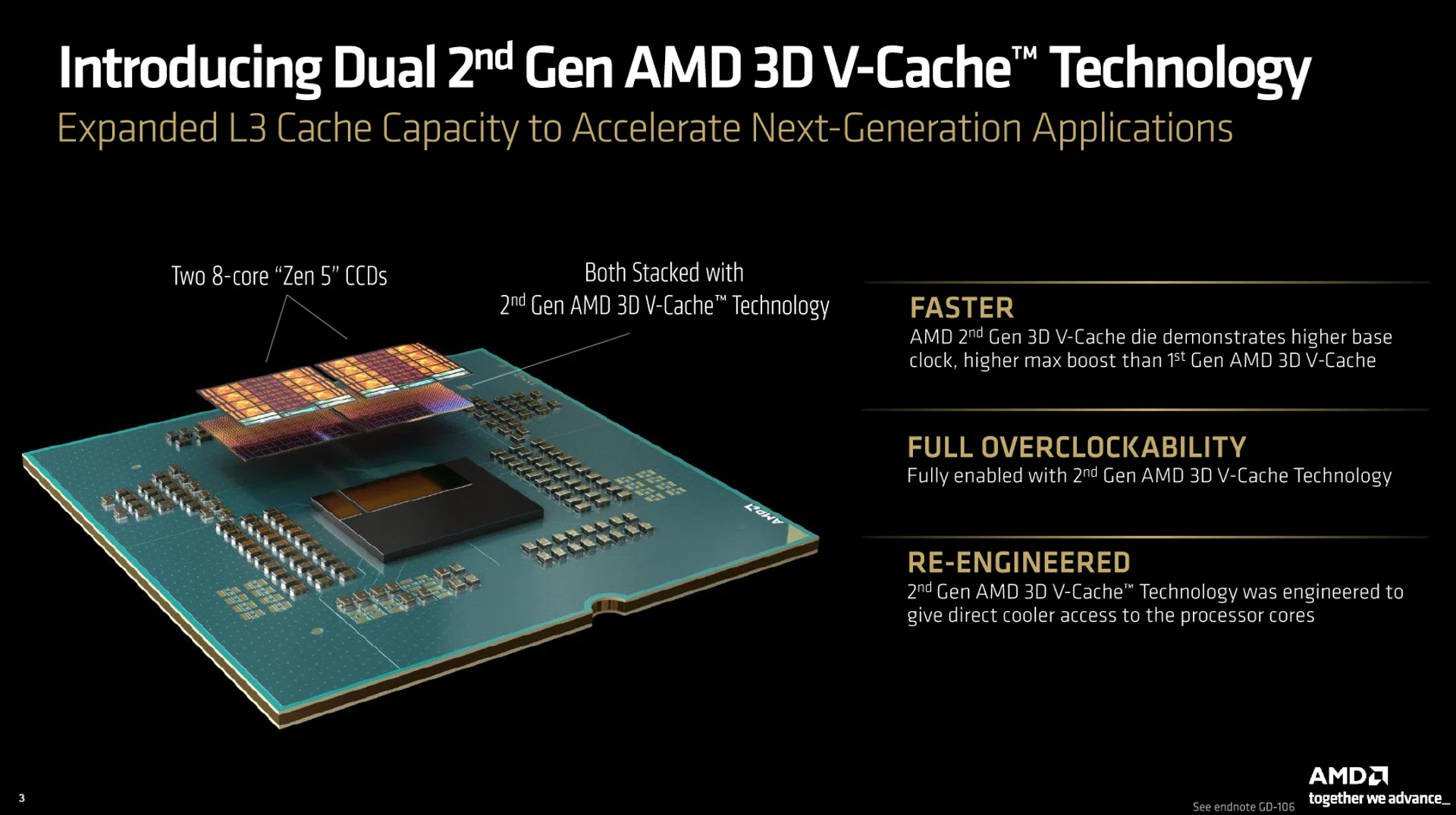
The Ryzen 9 9950X3D2 is the first Ryzen 9000 series chip to come with two 8-cores CCDs that are stacked with 3D V-cache each.
If you’ve used or read my review of the Ryzen 9 9950X3D, you’ll already have a rough idea of how AMD approached its X3D chips up to this point. The design was clever, but also a little awkward under the hood. One of the two 8-core Zen 5 CCDs came stacked with 3D V-Cache, effectively acting as the “gaming” half of the processor, while the other CCD was left untouched to handle higher-frequency workloads. It worked more often than not, but it also meant the chip was constantly juggling between two different personalities, relying on Windows and AMD’s own scheduling logic to decide which cores should handle what at any given time.
The Ryzen 9 9950X3D2 moves away from that balancing act entirely, and in a way that feels both obvious and, in my opinion, slightly overkill. Instead of splitting responsibilities across two different types of CCDs, AMD has now stacked both 8-core Zen 5 chiplets with its second-generation 3D V-Cache. That means all 16 cores now have access to that enlarged L3 cache pool instead of just half of them. This effectively removes the whole “which cores are better for this task?” question from the equation.
Logic dictates that this should make the chip behave more predictably than its predecessor. There’s less reliance on scheduling quirks, fewer edge cases where performance might swing depending on how workloads are assigned, and a stronger baseline for applications that care about memory latency or cache access. But at the same time, this isn’t the kind of change that automatically translates into obvious gains everywhere, especially not in gaming (we’ll see in our gaming benchmarks below).
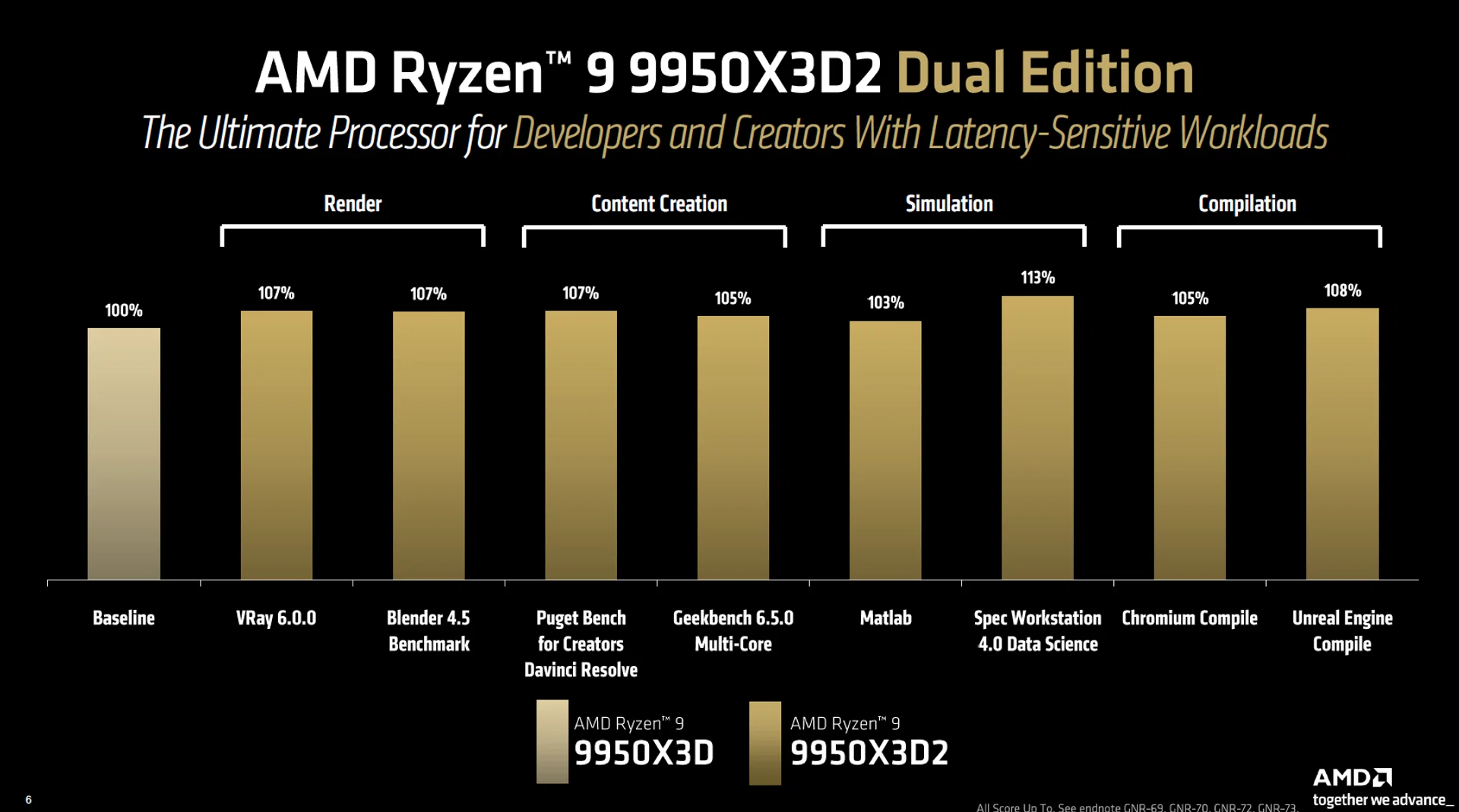
AMD says developers and creators with latency-sensitive workloads will see benefits from the Ryzen 9 9950X3D2 over the 9950X3D.
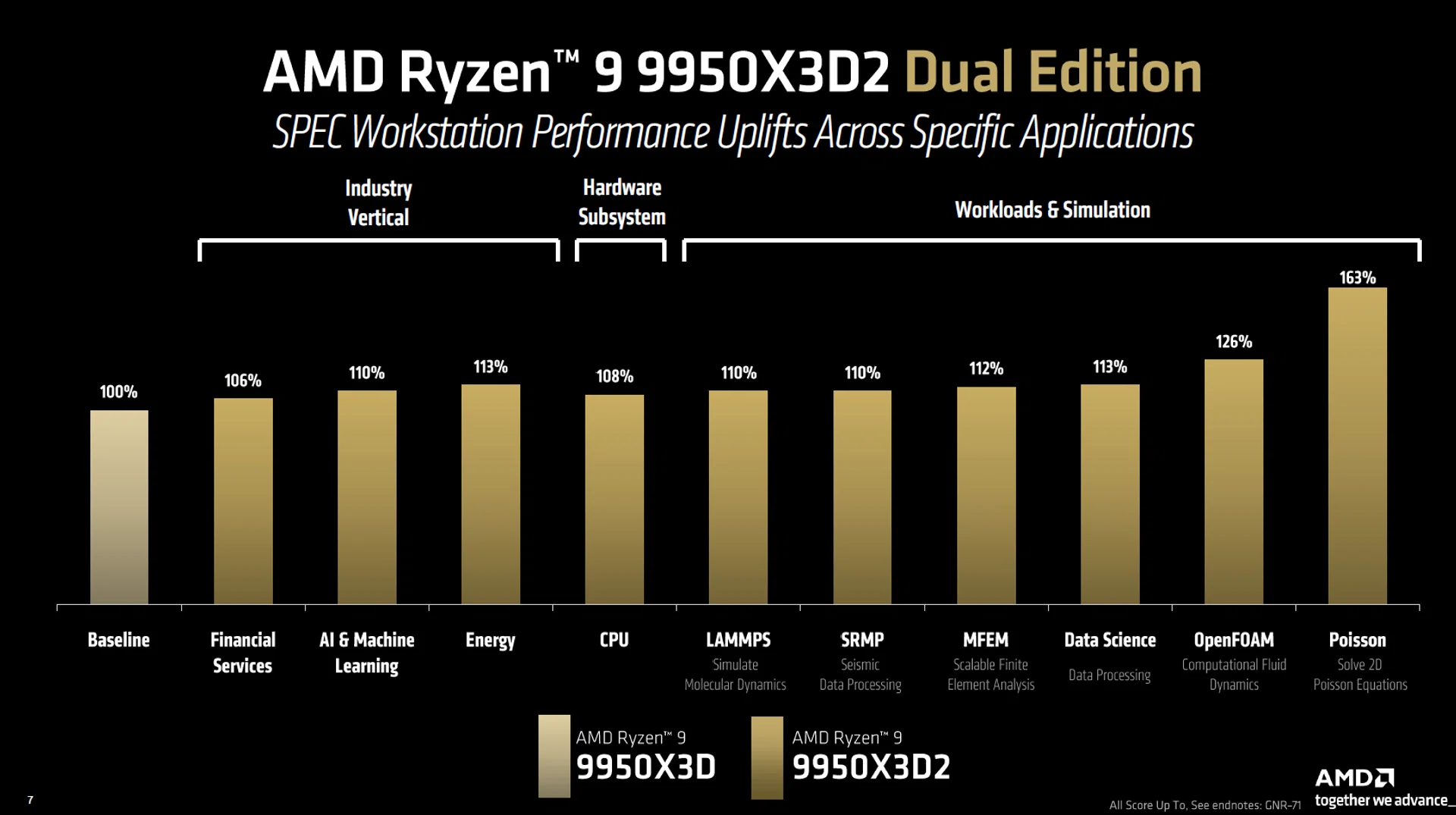
Here’s a look at SPEC workstation performance uplifts across applications, as tested by AMD.
In fact, based on AMD’s own figures, gaming performance between the 9950X3D and the 9950X3D2 is largely unchanged on average. That might sound underwhelming at first, but it also makes sense. Games were already benefiting from having one cache-stacked CCD, so doubling that up doesn’t suddenly unlock another tier of performance. Where the newer chip starts to pull ahead is in workloads that can actually make use of all 16 cores more evenly, particularly rendering, AI simulations, and certain productivity applications, where AMD is quoting gains in the region of 3% to 7% depending on the scenario.
That shift in focus also shows up in the specs. Total cache has increased to 208MB, which is a noticeable jump over the 9950X3D’s 128MB, but it comes with a corresponding increase in power draw, with TDP now sitting at 200W compared to 170W on the 9950X3D. It’s a reminder that while stacking cache across both CCDs simplifies things from a performance perspective, it doesn’t come for free. Thermals and power management are more important than ever.
Taken together, the 9950X3D2 doesn’t really feel like a direct replacement for the 9950X3D, at least not in the traditional sense. It’s more like AMD taking an existing blueprint and pushing it to its logical extreme, removing one of the last compromises in the original design and seeing what happens when every core is given equal access to that extra cache. The result isn’t a dramatic leap in gaming performance, but something a bit more nuanced – a chip that’s less about chasing higher peak numbers in a single scenario, and more about delivering a more consistent experience across a wider range of workloads, especially once you step outside of games and into heavier, more parallel tasks.
All of which sounds good on paper, but it also raises an interesting question. If the bar for gaming performance isn’t expected to move much, and the gains are mostly in heavier workloads, then where does the 9950X3D2 actually land in day-to-day use?
That’s exactly what I wanted to find out once I got the 9950X3D2 onto my test bench.
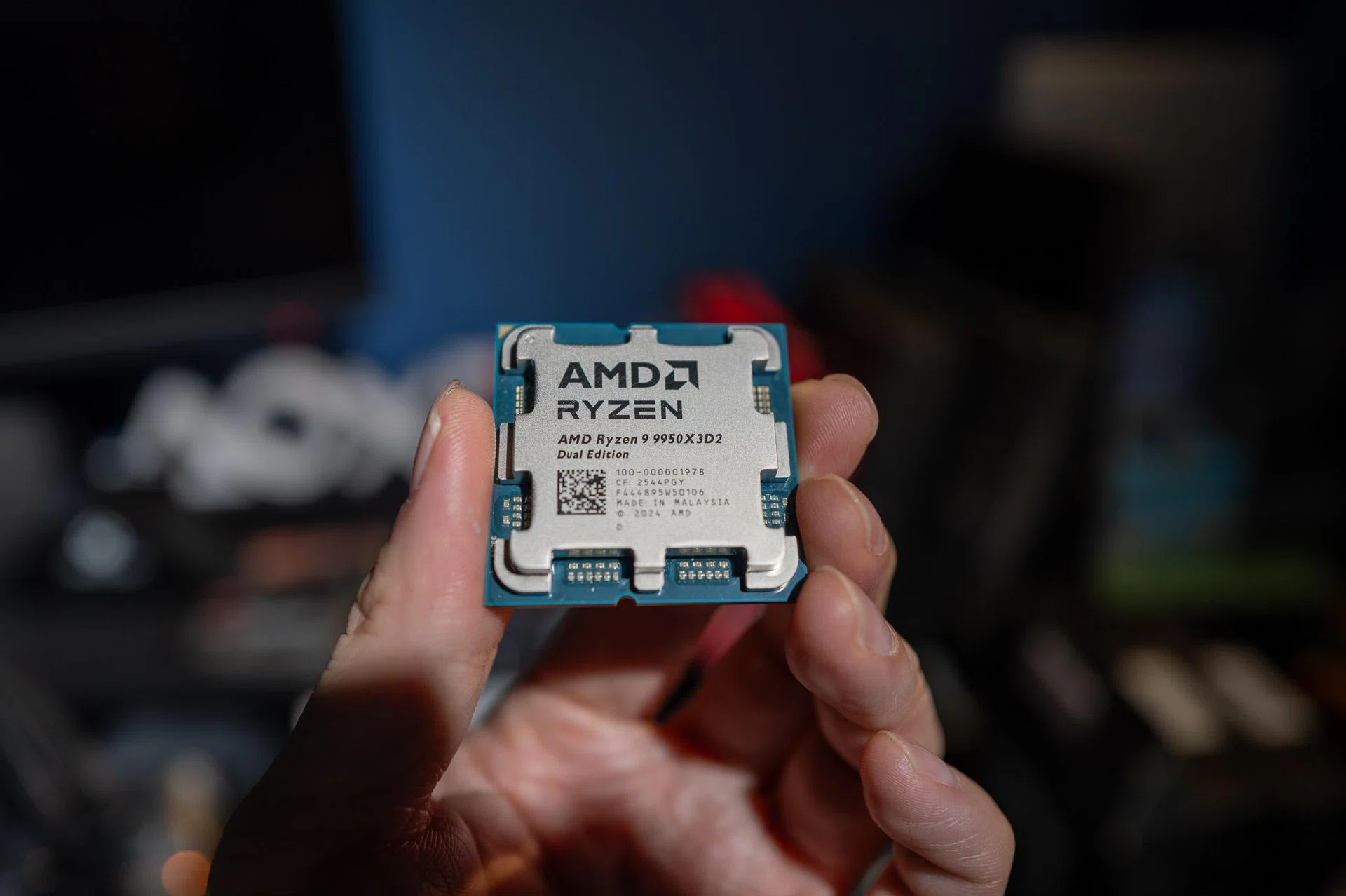
Meet the new Ryzen 9000 series flagship.
My AM5-based test platform for the Ryzen 9 9950X3D2 remains the same as the one used to review the recent NVIDIA and AMD graphics cards, although this time I have switched to a different motherboard.
- Gigabyte X870E Aorus Xtreme X3D AI Top
- Samsung 990 Pro 1TB SSD
- G.Skill Trident Z5 Neo RGB 32GB DDR5 memory
- NVIDIA GeForce RTX 5090 Founders Edition
- Windows 11 OS
Gaming performance
My game list includes a mixture of old and recent games to test these processors’ performance, and while the list isn’t exhaustive by any measure there are enough different game engines and APIs variety to give us an idea of broader performance trends.
1080p benchmarking is a great measure of a CPU’s prowess because at lower resolutions, the GPU can process and transfer data much quicker than at higher resolutions. A CPU bottleneck happens here because the processor cannot keep up with the processing speed of the graphics card. The CPU, after all, is responsible for processing real-time game actions, physics, UI, audio and other complex CPU-bound processes.
While it’s unlikely a Ryzen 9 9950X3D2 will be used for playing games at 1080p, the results at this resolution can clue us in the chip’s the raw power when it comes to gaming.
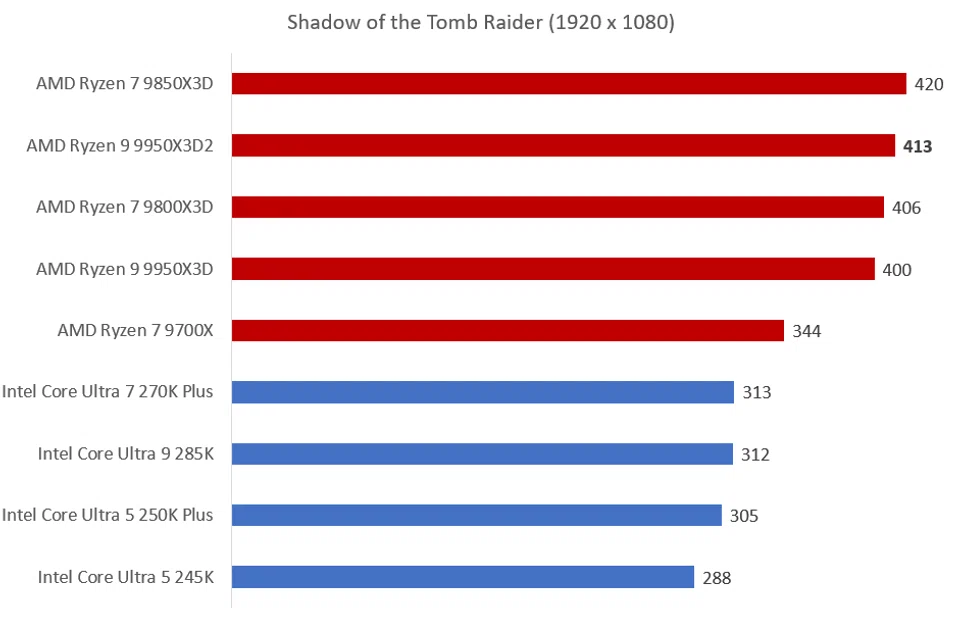
The higher the frame rate, the better.
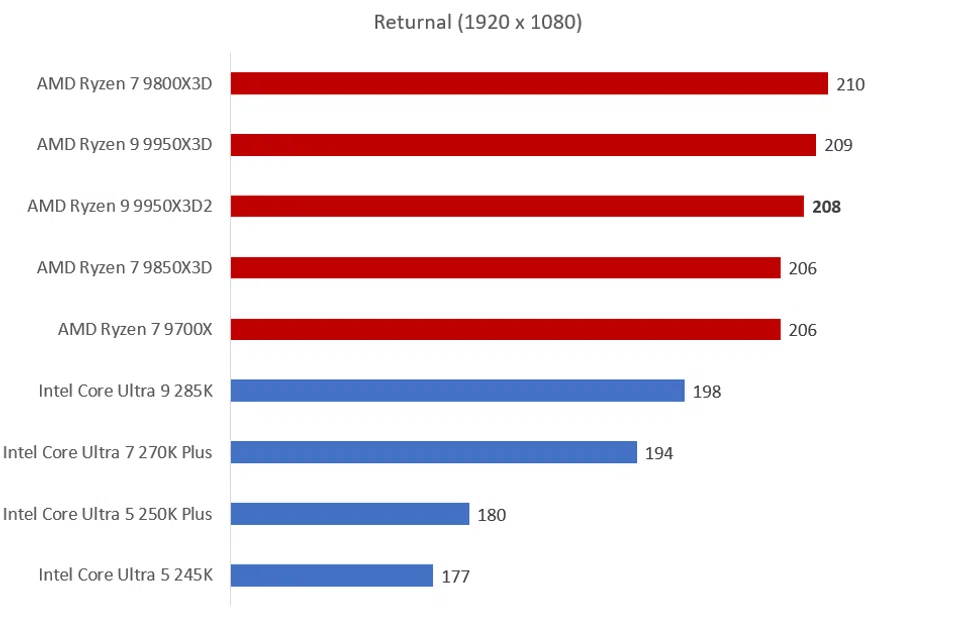
The higher the frame rate, the better.
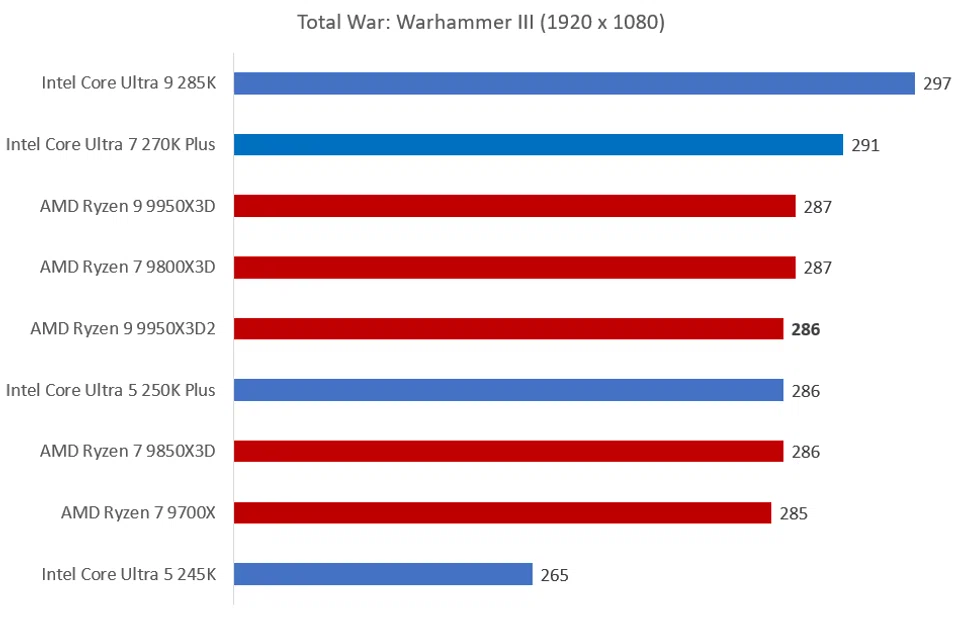
The higher the frame rate, the better.
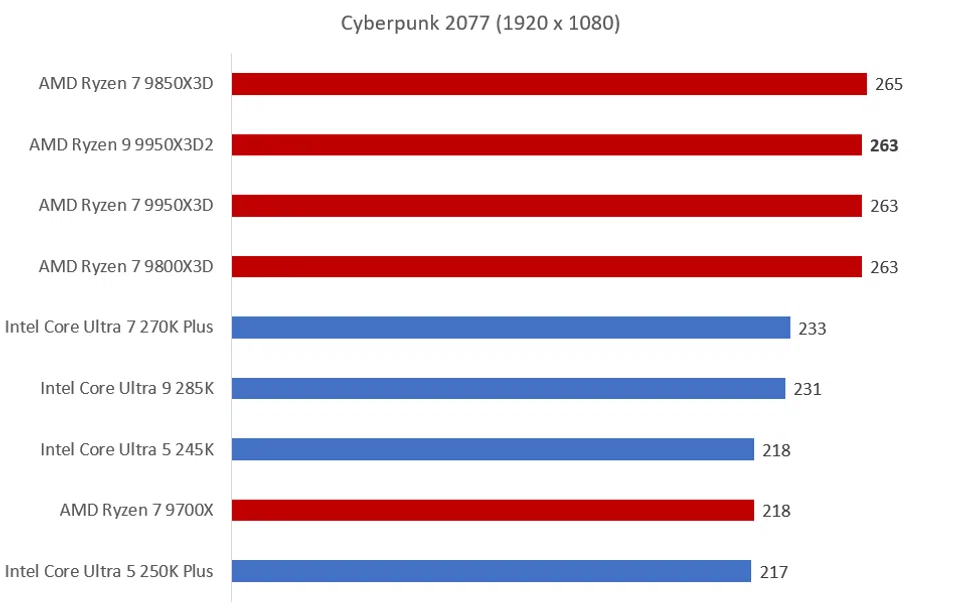
The higher the frame rate, the better.
Looking at these results, I kept coming back to the same thought I had with my 9950X3D review – this all feels very familiar. Which isn’t necessarily a bad thing, but it does mean the 9950X3D2 doesn’t really push gaming performance any further than what AMD had already set expectations for.
Put it side by side with the 9950X3D, and the two are basically trading punches more than anything else. Cyberpunk 2077 has them both sitting at 263fps, Returnal is separated by a frame at most, and even in Shadow of the Tomb Raider, where there’s a bit more breathing room, you’re looking at 413fps versus 400fps. Total War: Warhammer III doesn’t really help either, since they end up clustered together again. None of this is the kind of gap you’re going to notice outside of a chart, and it lines up with what we’ve been seeing for a while now – adding more V-Cache doesn’t automatically translate into better gaming performance once you’ve already hit a certain threshold.
Where it gets a bit more interesting is when the Ryzen 7 9850X3D comes into the picture. Even with fewer cores, it still manages to edge ahead in a couple of these titles, especially in Cyberpunk and Tomb Raider. It’s not by much, but there’s a reason for that. Part of it comes down to clocks – the 9850X3D runs higher at base and tends to hold those speeds more consistently under load, which matters in games that don’t really stretch across all cores. But I think the bigger factor is that it’s still a single-CCD chip. There’s no hopping between chiplets, no added latency, and no scheduler trying to decide where things should go. Everything just sits in one place with direct access to cache, and in gaming, that seems to matter most.
Against Intel’s flagship, the Core Ultra 9 285K, AMD’s reign as the best gaming CPU is still intact. In Cyberpunk and Returnal, the gap is obvious, with AMD’s chips sitting comfortably ahead. Shadow of the Tomb Raider tells a similar story. The only real exception here is Total War: Warhammer III, where Intel pulls ahead quite convincingly. But that’s less about AMD doing anything wrong, and more about Warhammer III being the kind of game that still rewards raw per-core speed over everything else – which just happens to line up a bit better with Intel’s strengths.
Taken together, the 9950X3D2 ends up in a slightly awkward, but also fairly predictable position. It’s not really a gaming upgrade over the 9950X3D, and in some cases, it doesn’t even beat the cheaper 9850X3D.
Productivity and Content Creation performances
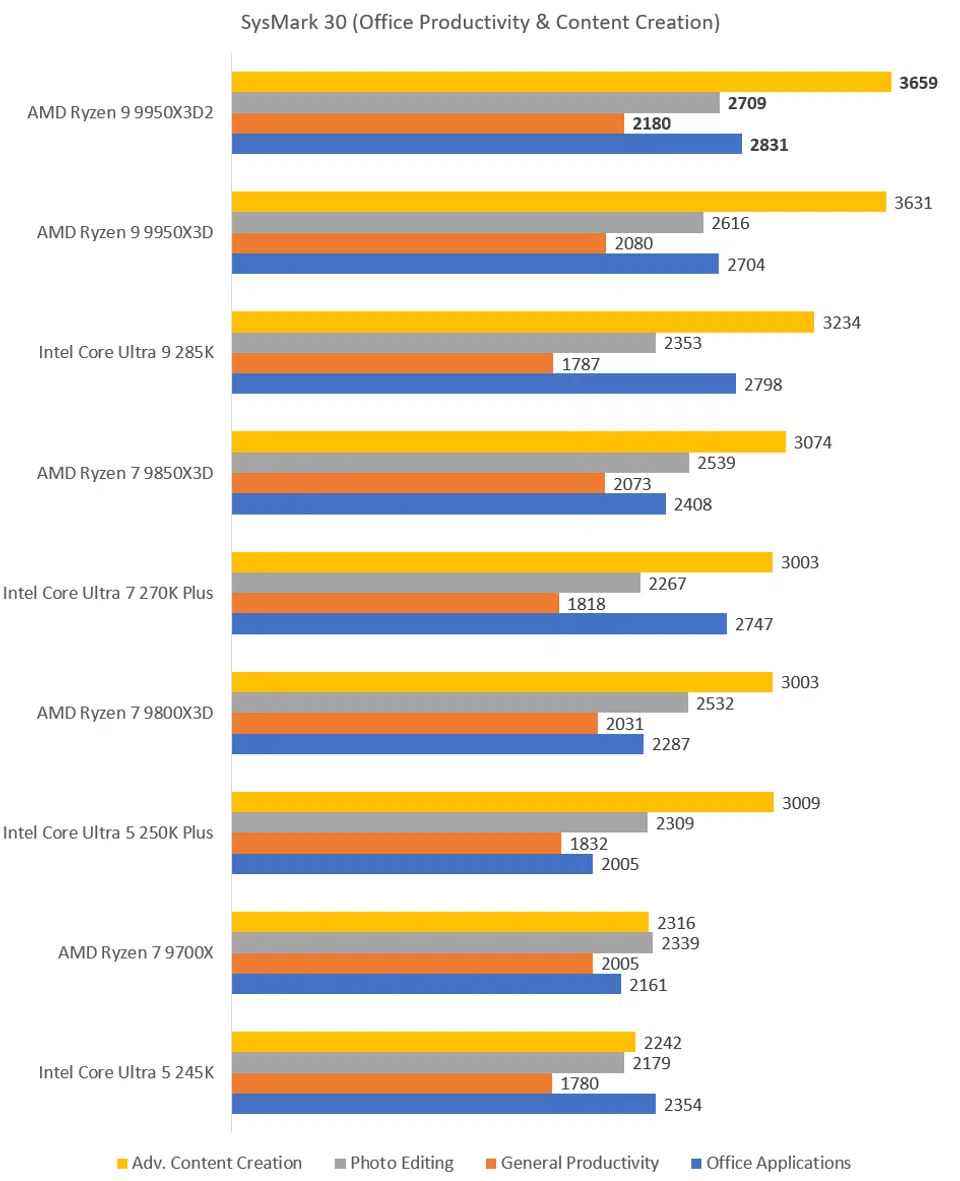
The higher the score, the better
If the gaming results felt a bit underwhelming, SysMark 30 is where the 9950X3D2 starts to make more sense. Because unlike synthetic benchmarks, SysMark runs on real-world applications – Office workloads, photo editing, file compression, and content creation – essentially measuring how a system behaves in everyday use rather than chasing peak performance.
And here, the difference between the 9950X3D2 and the 9950X3D becomes clearer, even if it’s still relatively modest.
Across the different workloads, the newer chip consistently comes out slightly ahead. It may not seem like a dramatic jump in any one area, but there’s a noticeable pattern of small gains stacking up across content creation, photo editing, and general productivity. It’s the kind of improvement you’re more likely to feel as overall responsiveness rather than in a single standout task.
What’s happening here isn’t a brute-force leap in performance, but a shift in how the chip behaves under mixed workloads. SysMark tends to bounce between lightly threaded tasks, background activity, and short bursts of heavier processing, just like the kind of real-world usage that doesn’t neatly sit in one category. In that kind of environment, having both CCDs backed by 3D V-Cache helps keep latency in check across all cores, instead of relying on one half of the chip to do most of the heavy lifting.
That also helps explain why the gains show up more clearly here than in games. With the 9950X3D, part of the performance still depended on how workloads were distributed between the cached and non-cached CCD. The 9950X3D2 removes that variable entirely, because every core behaves the same way, and in a mixed workload like this, that consistency matters.
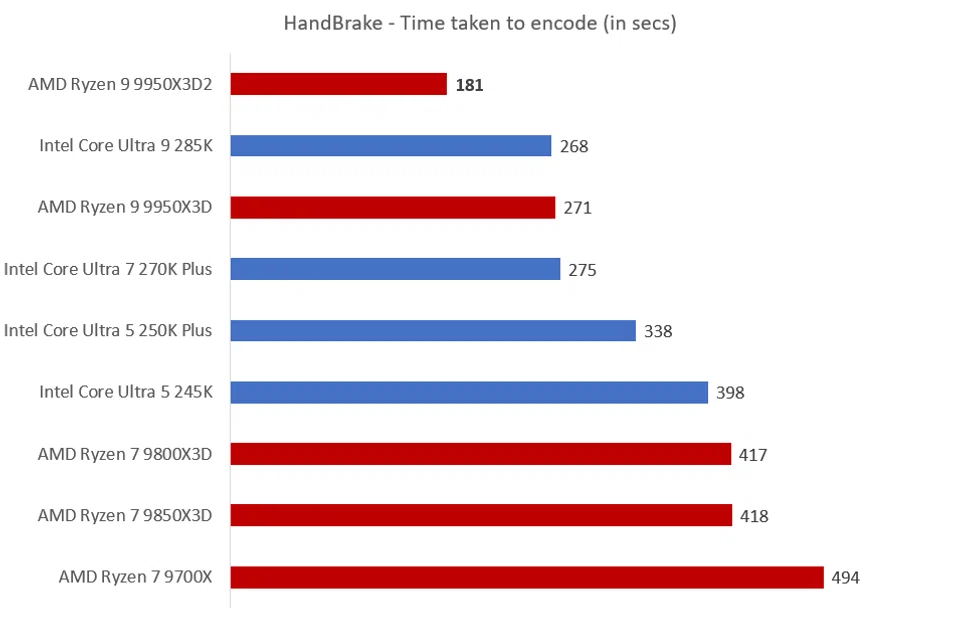
The lower the time, the better.
HandBrake tells a much clearer story, and this is where the 9950X3D2 starts to separate itself in a more meaningful way. Unlike simpler tasks like gaming, video encoding is a heavily multi-threaded workload, and that plays directly into what AMD is trying to achieve with this chip.
Compared to the 9950X3D, the improvement here is immediately noticeable. The 9950X3D2 finishes its encode significantly faster, which lines up with the idea of both CCDs now having access to 3D V-Cache. There’s no longer any dependency on how workloads are split between cached and non-cached cores, and in a task like this where all cores are being pushed, that consistency pays off.
Against Intel’s Core Ultra 9 285K and Core Ultra 7 270K Plus, AMD is clearly ahead. Both leading Intel chips take noticeably longer to complete the same encode, which reinforces to me how well the Ryzen chips scale in sustained, multi-core workloads like this. It’s less about short bursts of performance, and more about how efficiently the CPU can keep all its cores working over time – and this is where both of AMD’s Ryzen 9 chips have the edge.
And I think this is really where the 9950X3D2 starts to make the most sense. For developers, content creators, or anyone doing regular video work, these aren’t just benchmark numbers – they translate directly into time saved. Shorter exports and faster video encodings. If this is the kind of workload you deal with on a daily basis, then the 9950X3D2 might be a meaningful upgrade – even over the 9950X3D.
Power and thermal efficiency
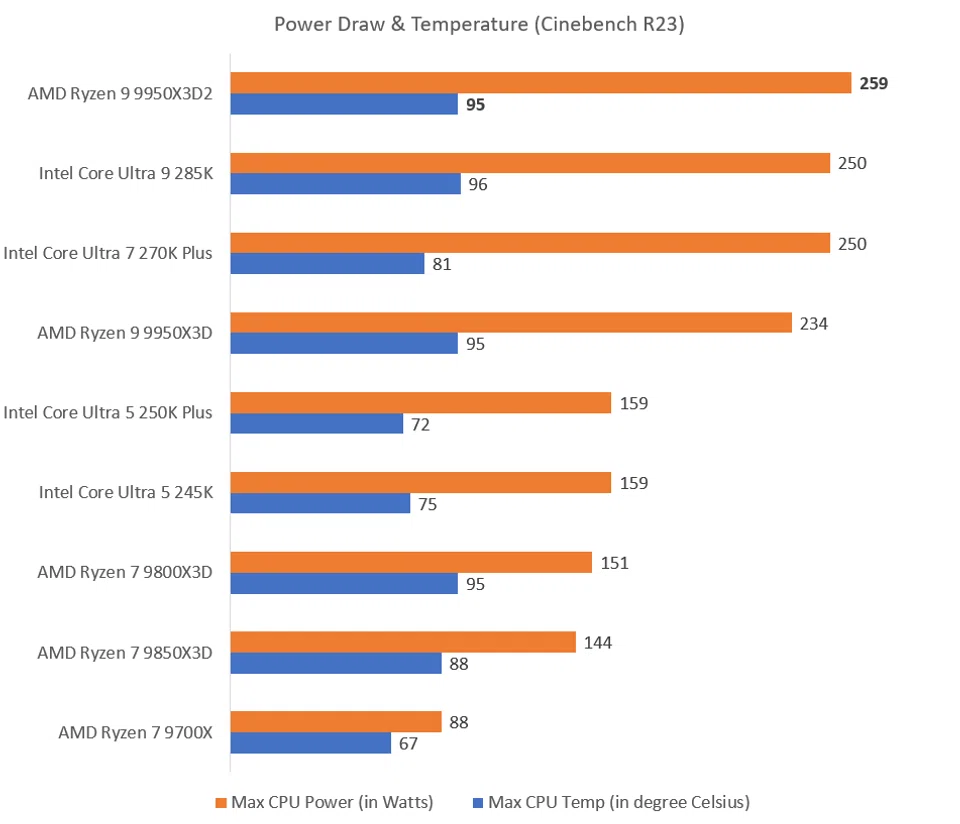
The lower the watts and temperature, the better
The last piece of the puzzle is power and thermals, and this is where the 9950X3D2’s design starts to show its trade-offs a bit more clearly.
With a higher 200W TDP (compared to 170W on the 9950X3D), it’s not surprising to see the 9950X3D2 pulling more power under load than the 9950X3D. In Cinebench R23, it peaks noticeably higher, putting it closer to Intel’s Core Ultra 9 285K and 270K Plus in terms of overall power draw. This isn’t the more restrained, efficiency-leaning behaviour we’ve seen from previous X3D chips, but a more aggressive tuning that’s clearly aimed at extracting more performance when all cores are engaged.
What’s interesting, though, is how that translates to thermals. Despite the higher power draw, the 9950X3D2’s temperatures still sit very close to the 9950X3D and even the 285K. It does suggest AMD hasn’t completely let things run wild here, and there’s still some level of control in how the chip manages its thermal envelope, even while pushing more power through it.
But it does tell you what AMD is prioritising this time around. While the 9950X3D felt like a relatively balanced X3D chip, the 9950X3D2 leans more towards outright performance. You’re getting faster results in sustained productivity and content creation workloads, but you’re also paying for it with higher power consumption. And I think that’s really the trade-off here. This isn’t about being the most efficient X3D chip anymore – it’s about being the more capable one when it’s under full load.
Final thoughts - This is peak Ryzen 9000 series
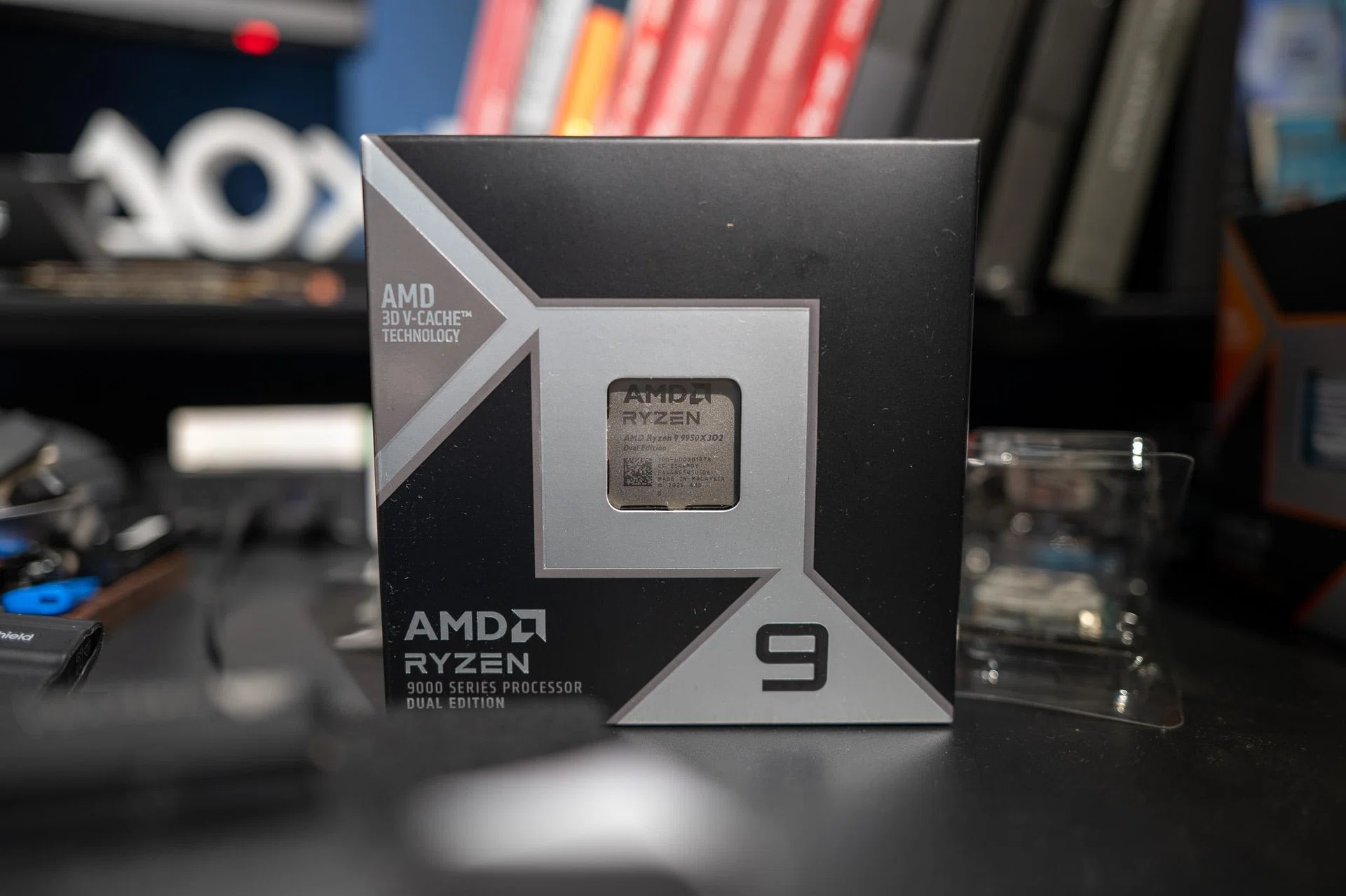
The Ryzen 9 9950X3D2 will be available from 22 April onwards.
So apart from PC enthusiasts who want the latest and greatest, who is the Ryzen 9 9950X3D2 made for?
Gamers? Not quite. As my gaming benchmarks (even if it’s only a small pool) show, you’re not really getting a big jump here, and in some cases, you’re not getting one at all. The numbers look almost too like-for-like as the Ryzen 9 9950X3D.
And then there’s the price. At US$899, you’re paying a US$200 premium over the 9950X3D, and that’s where things start to get a bit harder to justify if you’re just looking at gaming numbers.
I think that’s really what it comes down to. This isn’t the chip you buy if all you care about is gaming – AMD already has that covered elsewhere in the Ryzen 9000 lineup, and usually for less (like the excellent Ryzen 7 9800X3D and 9850X3D). To me, the 9950X3D2 is aimed at those who are doing a bit of everything on their system. Gaming, sure, but also editing, rendering, compiling, or just having a bunch of heavier tasks running at the same time. To be fair, the 9950X3D already does all of these well. But if you want to go into “very well” territory, then the 9950X3D2 is your answer.
It is without a doubt the most complete high-end desktop CPUs you can buy right now, especially if your system isn’t just built for games.
The Ryzen 9 9950X3D2 will be available from 22 April 2026 onwards for US$899.