
DJI's smallest and lightest drone weighs less than a smartphone
It weighs even less than an iPhone 13 mini.
#dji #neo #drone
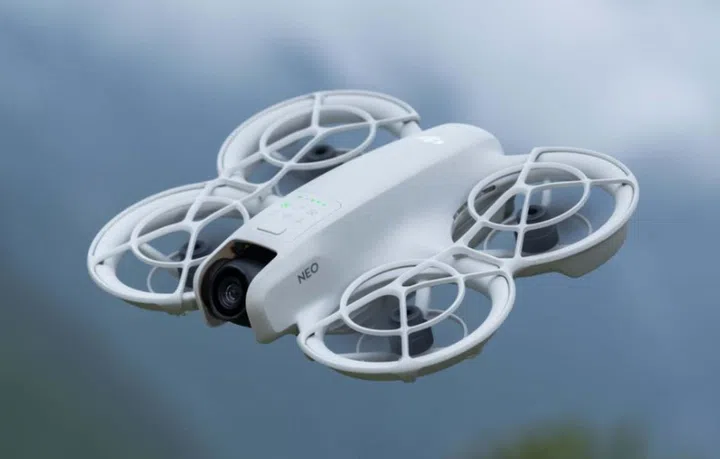
DJI says the Neo is its lightest, smallest, safest and easiest-to-use aerial drone.
DJI announced its lightest and smallest drone, the Neo at IFA 2024.
Weighing a mere 135g, the DJI Neo is truly palm-sized and even lighter than most smartphones. To put this into perspective, the iPhone SE is heavier at 144g. Within DJI's own lineup, the Neo is nearly half the weight of the 249g Mavic Mini and Mini 4 Pro.
Furthermore, because of its low weight, there is no need to register the DJI Neo since local regulations only require drones with weights above 250g to be registered before they can be flown in Singapore.
DJI also says the Neo is its easiest-to-use drone. Users just need to press the Mode button on the top of the drone to switch between the 6 intelligent shooting modes:
- Expanse where the Neo flies backwards and ascends, with the camera locked on the subject and records a video
- Circle where the Neo will circle around the subject
- Rocket where the Neo ascends with the camera pointing downwards
- Spotlight where the Neo rotates while keeping the subject or object of interest within the frame
- Helix where the Neo ascends and spirals around the subject
- Boomerang where the Neo flies around the subject in an oval path, ascending as it flies away from the starting point, and descending as it flies back
Once you select the shooting mode, the Neo will lift off from your palm and execute the video recording. When it's done, the Neo will land back in your palm. The full-coverage propeller guards ensure a safe flying experience.
The Neo can also be piloted using voice control from the paired smartphone – you give the drone the "Hey Fly" command. The DJI Fly app's virtual joysticks and Wi-Fi connection give you a control range of up to 50m.
For consumers who prefer the manual controller, DJI offers its RC-N3 remote controller as part of its Fly More Combo.
DJI had to make certain trade-offs for the Neo. First, it only has a single-axis mechanical gimbal while the more expensive DJI drones have 6-axis gimbals. Even the DJI Mini 2 SE comes with a three-axis gimbal.
Camera shake could be an issue for the DJI Neo even though the company claims the drone can handle high speeds or flights with lots of manoeuvres. The Neo also has RockSteady (electronic image stabilisation) to minimise the issue.
One downside to its low weight is that it has a smaller battery. The Neo's battery can offer a flight time of only up to 18 minutes. This makes it better suited for low-altitude flight and close-range shots.
There's also no obstacle avoidance technology on the Neo. DJI recommends users fly the Neo in an open area and with a visual line of sight.
Other specs of the DJI Neo include a 12MP 1/2-inch image sensor, 4K video recording at 30fps, Level-4 wind resistance, 22GB internal storage space (good for about 55 minutes of 1080p video) and support for automatic Return to Home (RTH) feature.
Local Pricing and Availability
The DJI Neo is now available for purchase from DJI's website, and its official stores on Lazada and Shopee.
DJI offers the Neo in two configurations:
- S$249 Neo with 1 x battery, 1 x pair of propller guard, 1 x spare pair of propeller guard, 1 x gimbal protector, 1 x USB-C to USB-CP D cable, 1 x screwdriver, 4 x spare propeller screws
- S$439 Neo Fly More Combo that has everything above with the additional items of 1 x DJI RC-N3 remote controller, 1 X RC USB-C cable, and 1 x two-way charging hub.
Our articles may contain affiliate links. If you buy through these links, we may earn a small commission.