
NVIDIA GeForce GTX 650 Ti - The Budget Kepler With A Bite
Rounding out NVIDIA's Kepler lineup, the GeForce GTX 650 Ti is aimed at gamers looking for an affordable Kepler-based graphics solution with a bit more bite than what's offered with NVIDIA's previous GTX 650. We took it for a test drive and also had a look at a custom edition from ASUS.
NVIDIA GeForce GTX 650 Ti - The Budget Kepler With A Bite
Two weeks ago, NVIDIA released its most affordable Kepler graphics card to date, the GeForce GTX 650. Priced at just US$109, the GeForce GTX 650 was designed to provide a Kepler-based entry-level graphics solution for DX11 gaming at full HD 1080p resolution.
While we were generally satisfied with the GTX 650's performance, its GK107 core with just a single GPC (Graphics Processing Cluster) and two SMXs (Streaming Multiprocessor) resulted in a few lackluster scores and, ultimately, we recommended that gamers opting for the GTX 650 may want to compromise on some settings to achieve better frame rates.
Today, NVIDIA is completing its Kepler lineup with the GTX 650 Ti, an affordable Kepler-based card that promises more power than the GTX 650. Priced slightly higher than the GTX 650 at US$149, the GTX 650 Ti looks to be aimed at gamers prepared to pay a bit more than the GTX 650 for some much needed extra firepower.
Meet the NVIDIA GeForce GTX 650 Ti
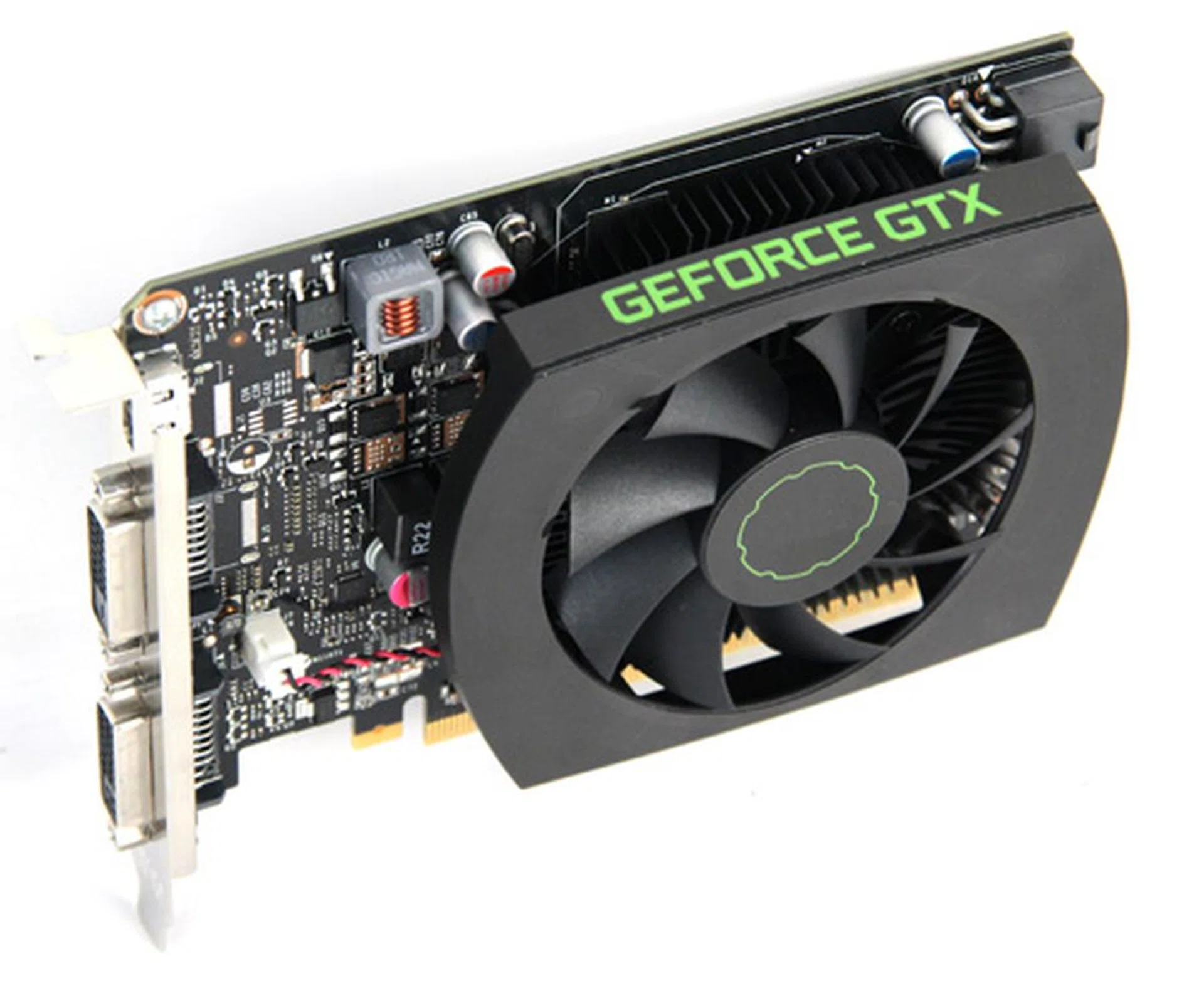
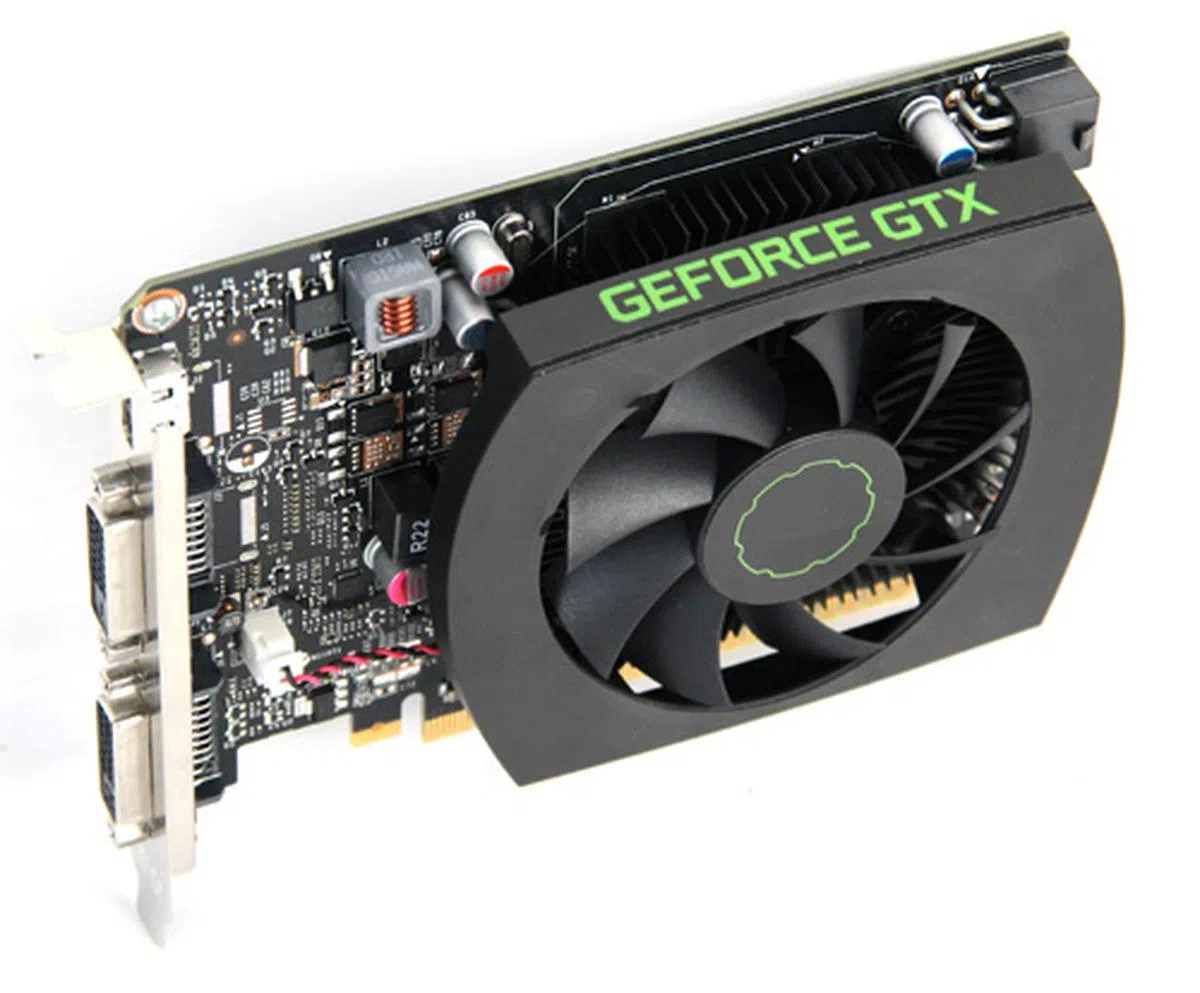
The reference design GTX 650 Ti has a similar build to NVIDIA's GTX 650, but utilizes a larger fan. Overall, the card is still compact.
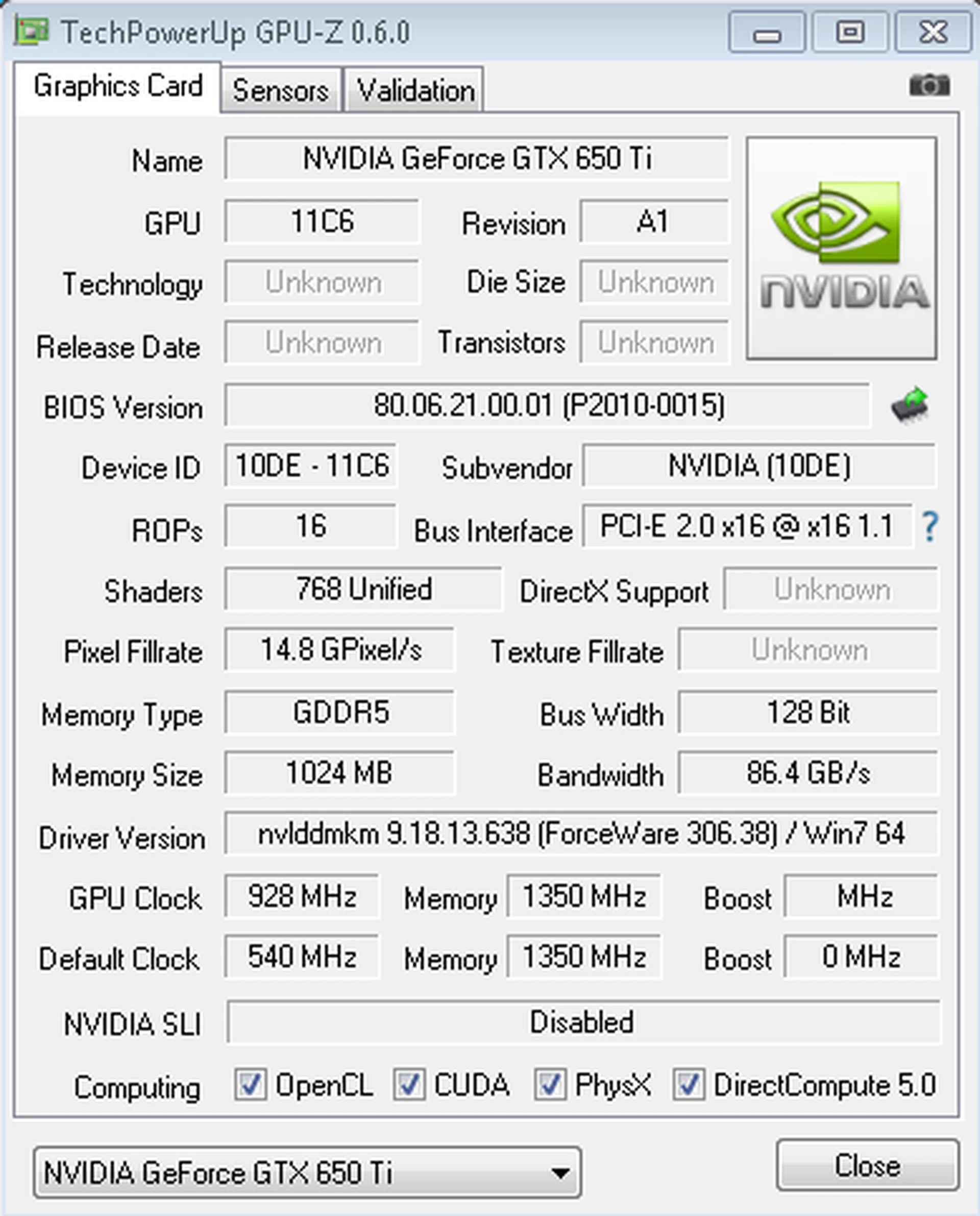
Despite its '650' moniker, the GTX 650 Ti is actually closer in specification to NVIDIA's GTX 660 card. Instead of the GK107 core found in the GTX 650, the GTX 650 Ti utilizes the same GK106 core found on the GTX 660. As such, it uses two GPCs compared to the GTX 650's single unit, and four SMXs compared to the 650's two.
As a result, the GTX 650 Ti utilizes 2.54 billion transistors, with 768 CUDA cores and 64 texture units, all twice that found on the GTX 650. However, like the GTX 650, it still uses 16 raster operating units. Core clock speeds are set at 925MHz.
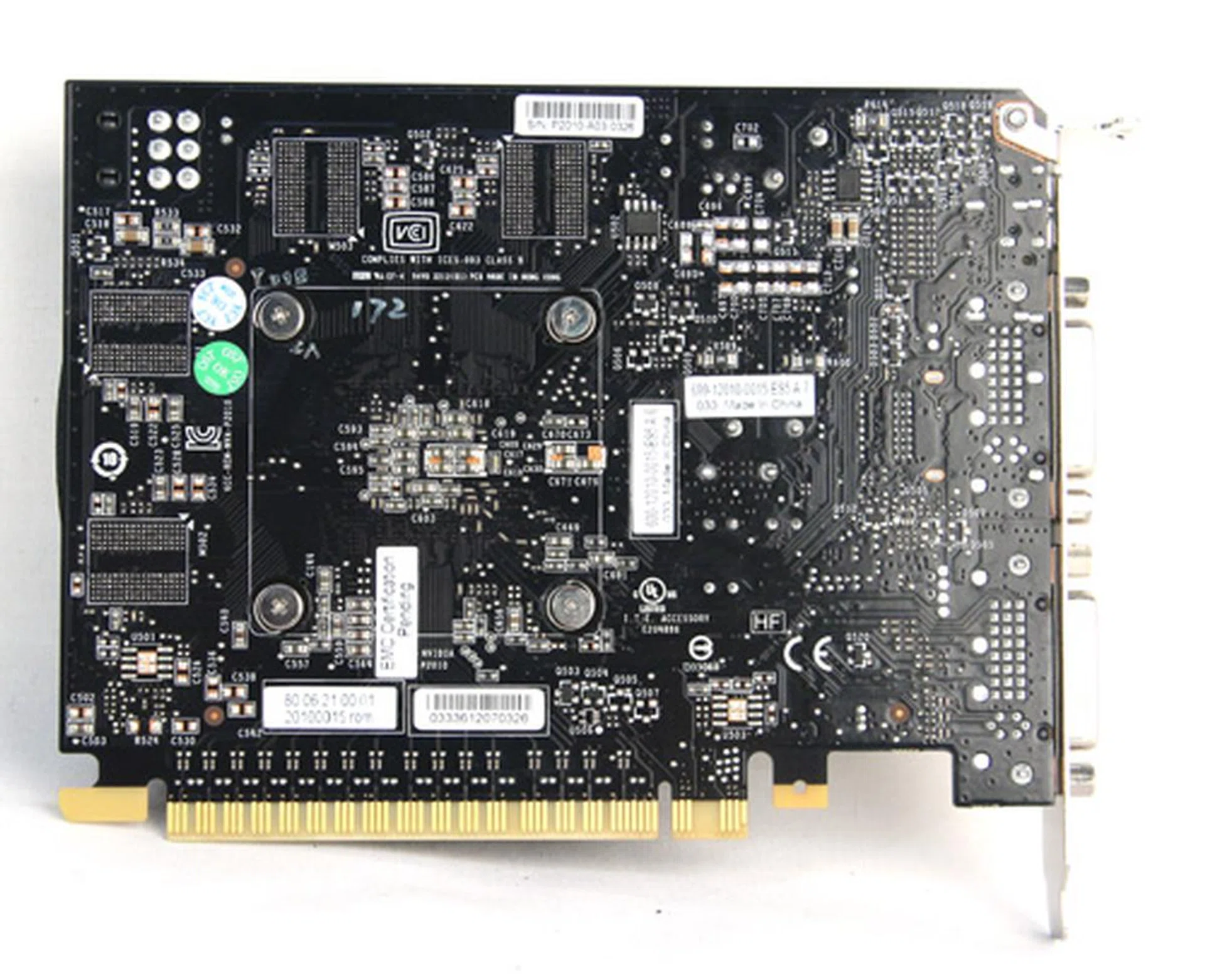
NVIDIA's reference PCB is very compact and should fit in almost any case.
In terms of memory, the GTX 650 Ti uses the same 128-bit memory bus interface as the GTX 650, but has slightly higher clock speeds (5400MHz DDR), which raises memory bandwidth from 80GB/s to 86.4GB/s.
Unfortunately, like the GTX 650, the GTX 650 Ti lacks both GPU Boost (NVIDIA's dynamic overclocking technology), and multi-GPU SLI support. We tabulate how NVIDIA's latest SKU stacks up against the competition right after the photo break:-
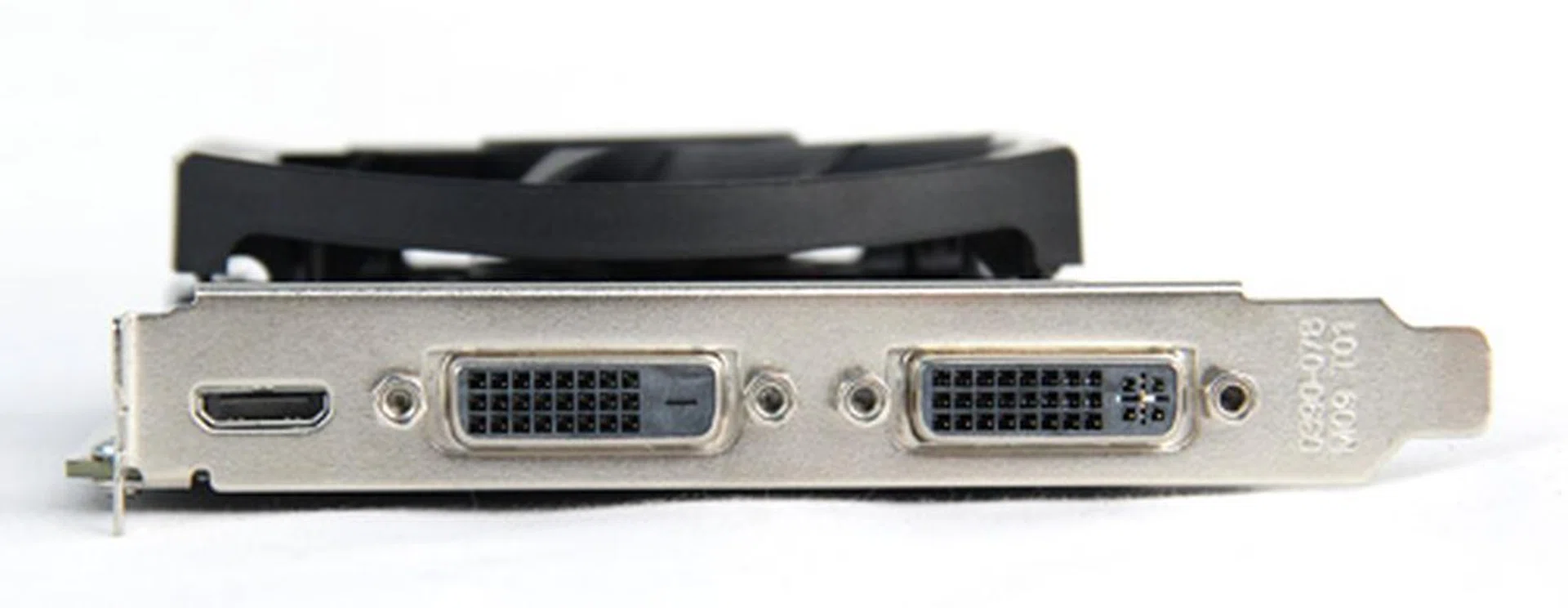
NVIDIA's reference design GTX 650 Ti sports one HDMI port, one DVI-D port, and one DVI-I port.
Model | NVIDIAGeForce GTX 650 Ti | NVIDIAGeForce GTX 650 | NVIDIA GeForce GTX 660 | NVIDIA GeForce GTX 660 Ti | AMDRadeon HD 7750 | AMDRadeon HD 7770 | AMD Radeon HD 7850 | AMDRadeon HD 7870 | NVIDIA GeForce GTX 560 Ti |
Core Code | GK106 | GK107 | GK106 | GK104 | Cape Verde Pro | Cape Verde | Pitcairn Pro | Pitcairn XT | GF104 |
Transistor Count | 2.54 Billion | 1.3 Billion | 2.54 Billion | 3.54 Billion | 1.5 Billion | 1.5 Billion | 2.8 Billion | 2.8 Billion | 1.95 Billion |
Manufacturing Process | 28nm | 28nm | 28nm | 28nm | 28nm | 28nm | 28nm | 28nm | 40nm |
Core Clock | 925MHz | 1058MHz | 980MHz | 915MHz | 800MHz | 1000MHz | 860MHz | 1000MHz | 822MHz |
Stream Processors | 768 Stream processing units | 384 Stream processing units | 960 Stream processing units | 1344 Stream processing units | 512 Stream processing units | 640 Stream processing units | 1024 Stream processing units | 1280 Stream processing units | 384Stream processing units |
Stream Processor Clock | 925MHz | 1058MHz | 980MHz | 915MHz | 800MHz | 1000MHz | 860MHz | 1000MHz | 1644MHz |
Texture Mapping Units (TMU) or Texture Filtering (TF) units | 64 | 32 | 80 | 112 | 32 | 40 | 64 | 80 | 64 |
Raster Operator units (ROP) | 16 | 16 | 24 | 24 | 16 | 16 | 32 | 32 | 32 |
Memory Clock | 5400MHz GDDR5 | 5000MHz GDDR5 | 6008MHz GDDR5 | 6008MHz GDDR5 | 4500MHz GDDR5 | 4500MHz GDDR5 | 4800MHz GDDR5 | 4800MHz GDDR5 | 4008MHz GDDR5 |
DDR Memory Bus | 128-bit | 128-bit | 192-bit | 192-bit | 128-bit | 128-bit | 256-bit | 256-bit | 256-bit |
Memory Bandwidth | 86.4GB/s | 80GB/s | 144.2GB/s | 144.2GB/s | 72GB/s | 72GB/s | 153.6GB/s | 153.6GB/s | 128GB/s |
PCI Express Interface | PCIe ver 3.0 x16 | PCIe ver 3.0 x16 | PCIe ver 3.0 x16 | PCIe ver 3.0 x16 | PCIe ver 3.0 x16 | PCIe ver 3.0 x16 | PCIe ver 3.0 x16 | PCIe ver 3.0 x16 | PCIe ver 2.0 x16 |
Molex Power Connectors | 1 x 6-pin | 1 x 6-pin | 1 x 6-pin | 2 x 6-pin | None | 1 x 6-pin | 1 x 6-pin | 2 x 6-pin | 2 x 6-pin |
Multi GPU Technology | No | No | SLI | SLI | No | CrossFireX | CrossFireX | CrossFireX | SLI |
DVI Output Support | 2 x Dual-Link | 2 x Dual-Link | 2 x Dual-Link | 2 x Dual-Link | 1 x Dual-Link | 1 x Dual-Link | 1 x Dual-Link | 1 x Dual-Link | 2 x Dual-Link |
HDMI | 1 | 1 (mini-HDMI) | 1 | 1 | 1 | 1 | 1 | 1 | 1 (mini-HDMI) |
DisplayPort | None | None | 1 (version 1.2) | 1(version 1.2) | 1 (version 1.2 HBR2) | 2 (version 1.2 HBR2) | 1 (version 1.2 HBR2) | 1 (version 1.2 HBR2) | None |
HDCP Output Support | Yes | Yes | Yes | Yes | Yes | Yes | Yes | Yes | Yes |
Street Price | Launch price: US$149 | Launch price: US$109 | Launch Price: US$229 | Launch Price: US$299 | Current Price: US$99 | Current Price: US$119 | Current Price: US$239 | Current Price: US$299 | Current Price: US$199 |
Meet the ASUS GeForce GTX 650 Ti DirectCU II TOP
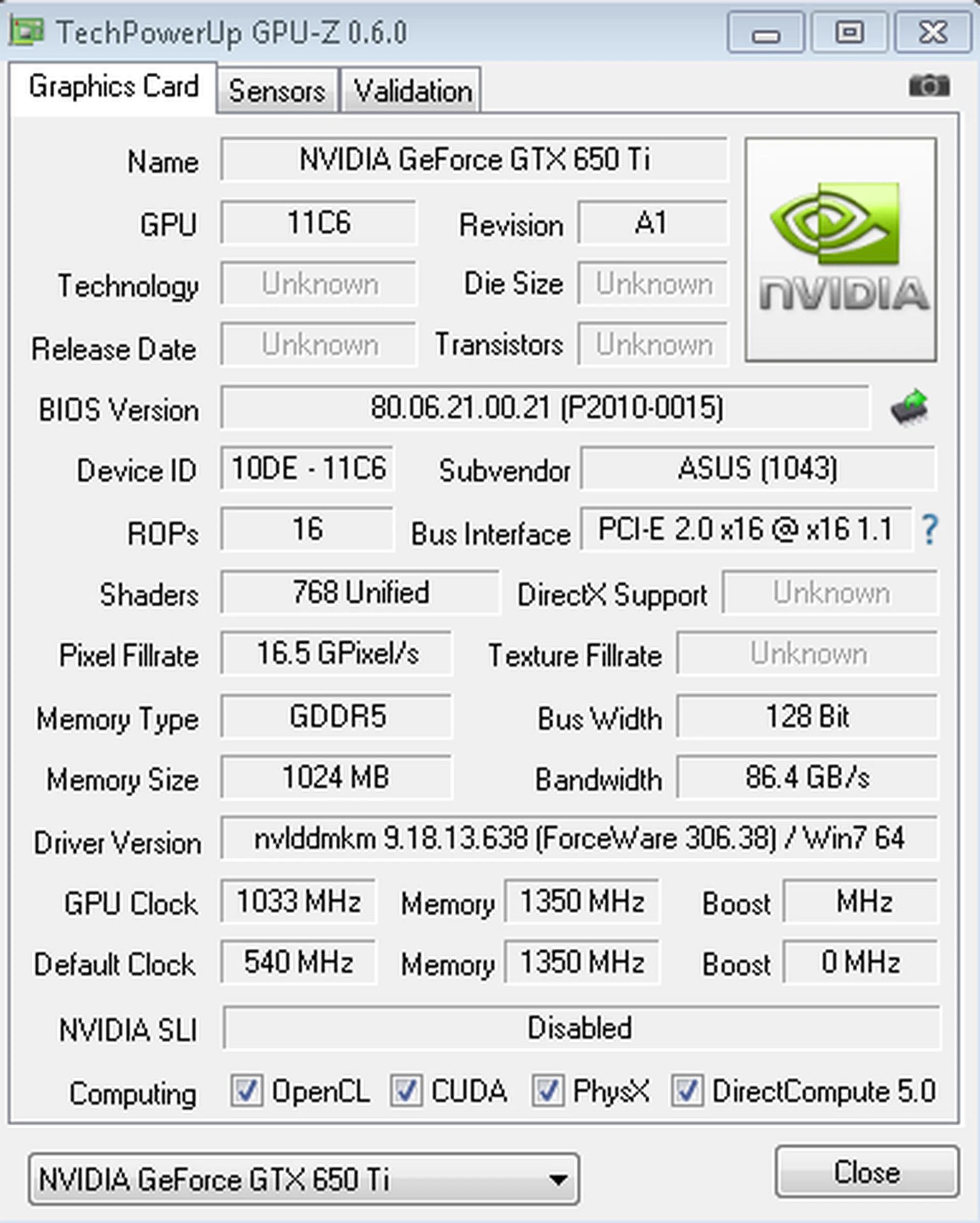
Besides the reference GeForce GTX 650 Ti, our other test card will be ASUS' GeForce GTX 650 Ti DirectCU II TOP, which as usual with ASUS' TOP edition cards, boasts a sizeable core clock boost of 105MHz from 925MHz to 1033MHz, which translates to around 11% improvement. This is probably the most you will see actual game performance improve over the reference card.
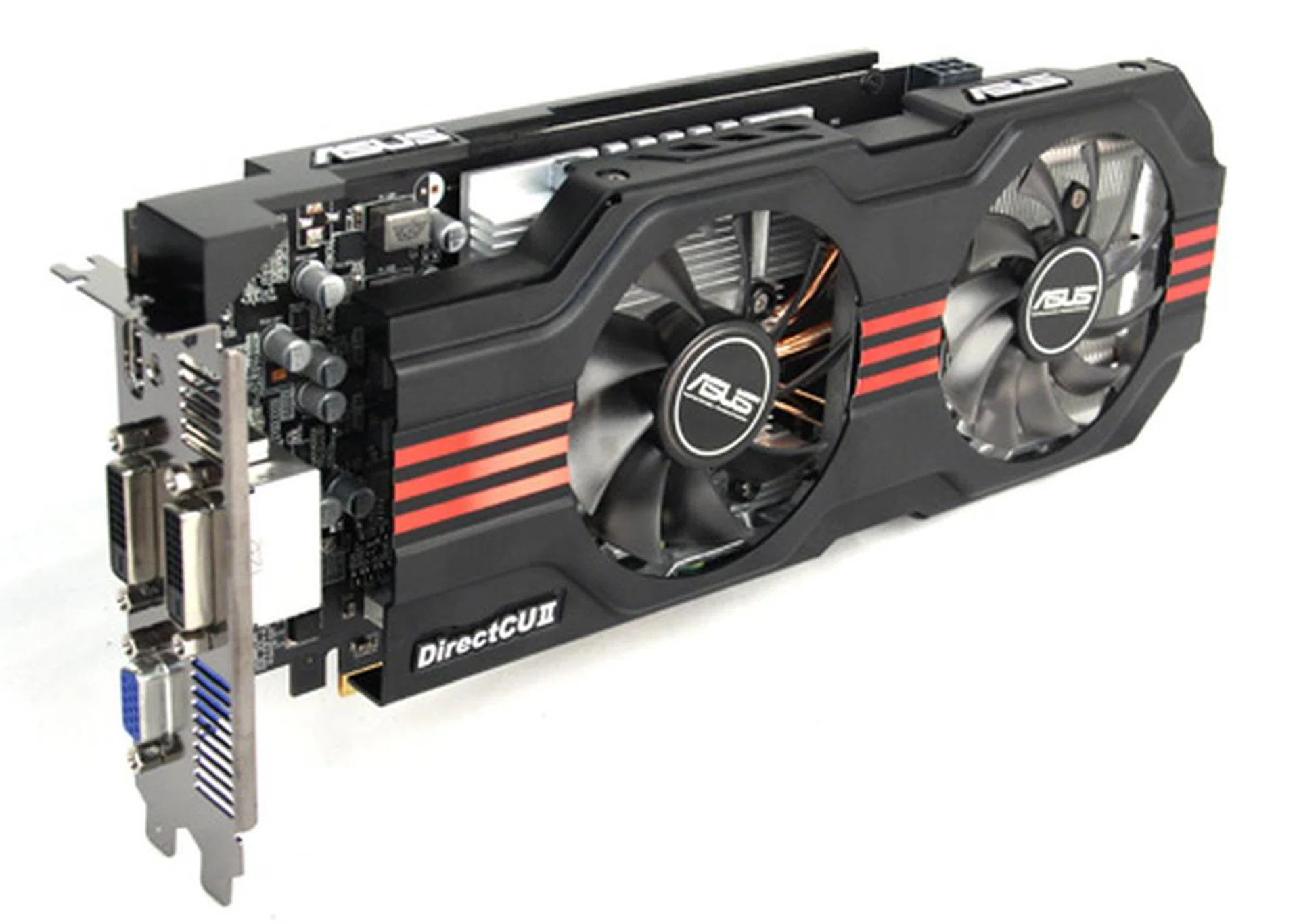
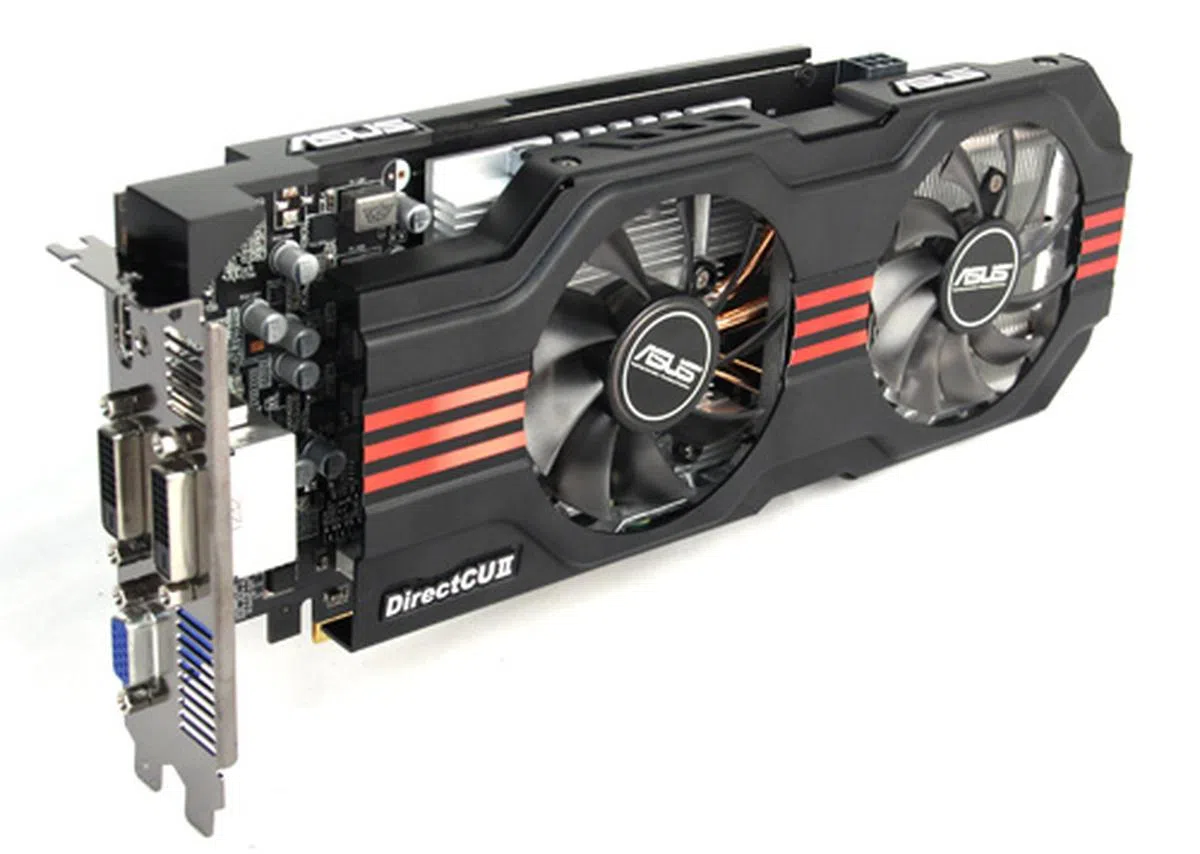
ASUS' custom 650 Ti looks nothing like NVIDIA's reference design, utilizing dual fans and a much, much longer body.
If you didn't know any better, you might have guessed that the card you're looking at is a GeForce GTX 680. This card looks anything unlike the compact NVIDIA GeForce GTX 650 Ti graphics card, but ASUS' GTX 650 Ti is indeed an oversized version of the reference counterpart. ASUS has opted for its traditional DirectCU II cooler, comprising of dual fans mounted on an array of cooling fins connected to three copper heatpipes in direct contact with the GPU.
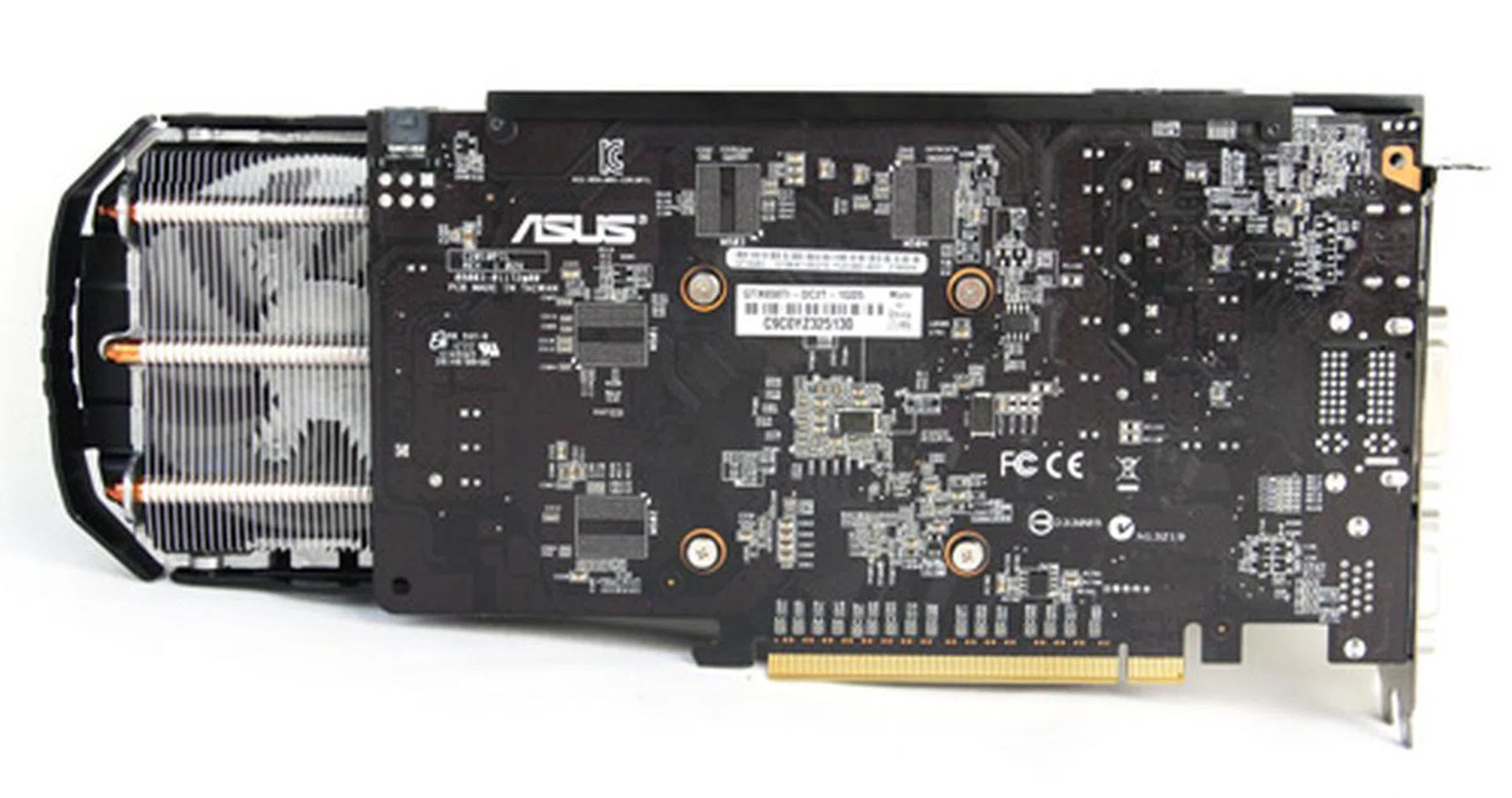
ASUS uses an extended custom PCB with upgraded components on its GTX 650 Ti.
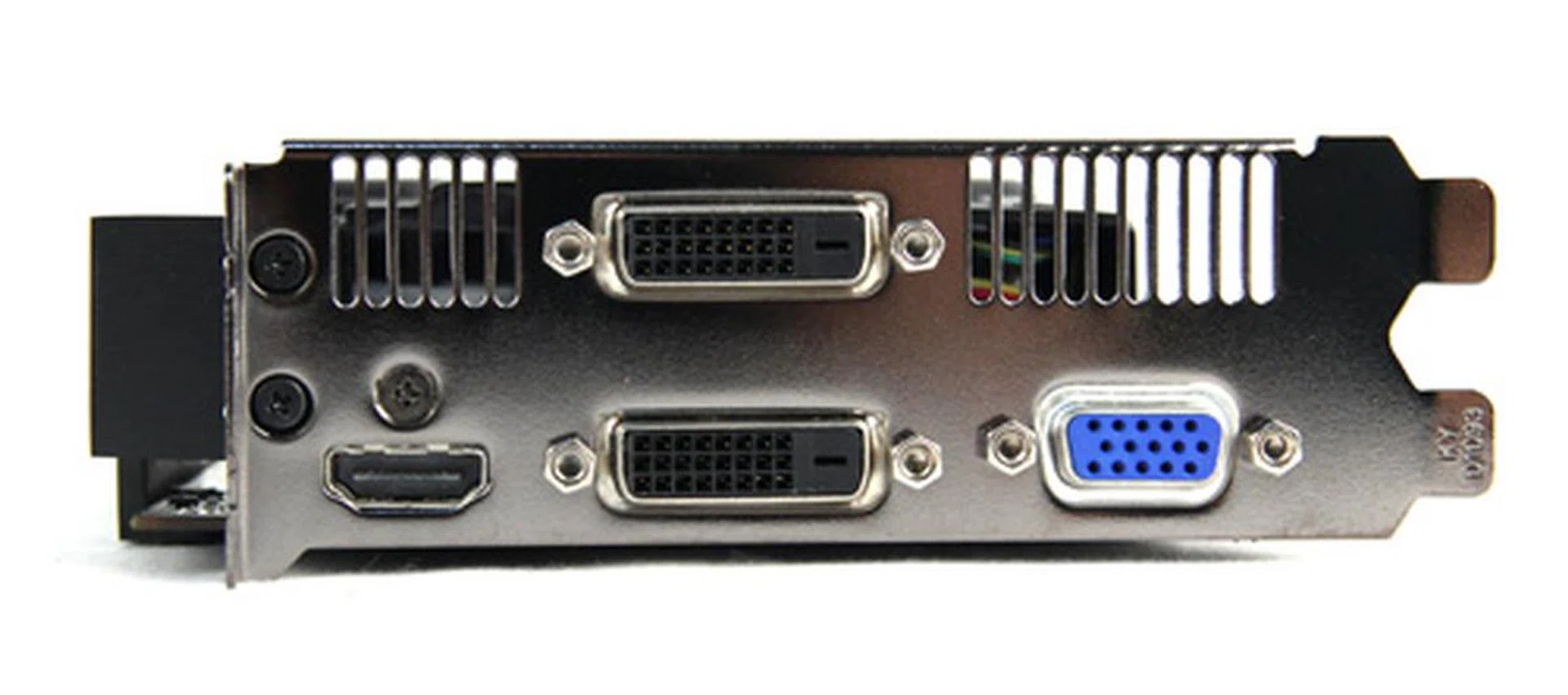
A VGA port has been added to the reference design's HDMI, DVI-D and DVI-I ports.
While the big cooler does give the card a more premium look, which many gamers may prefer due to its similarity to high-end graphics cards, it does of course mean that ASUS's design is not as compact as NVIDIA's. At a sizable 274 x 120 x 35mm, and requiring two slots (compared to one for NVIDIA), it's definitely not a good choice if space is a premium in your rig. Of course with such a huge cooler, one would expect ASUS to perform wonders in its operating temperatures. Unfortunately, that's not quite the case as you'll see in our respective test results page.
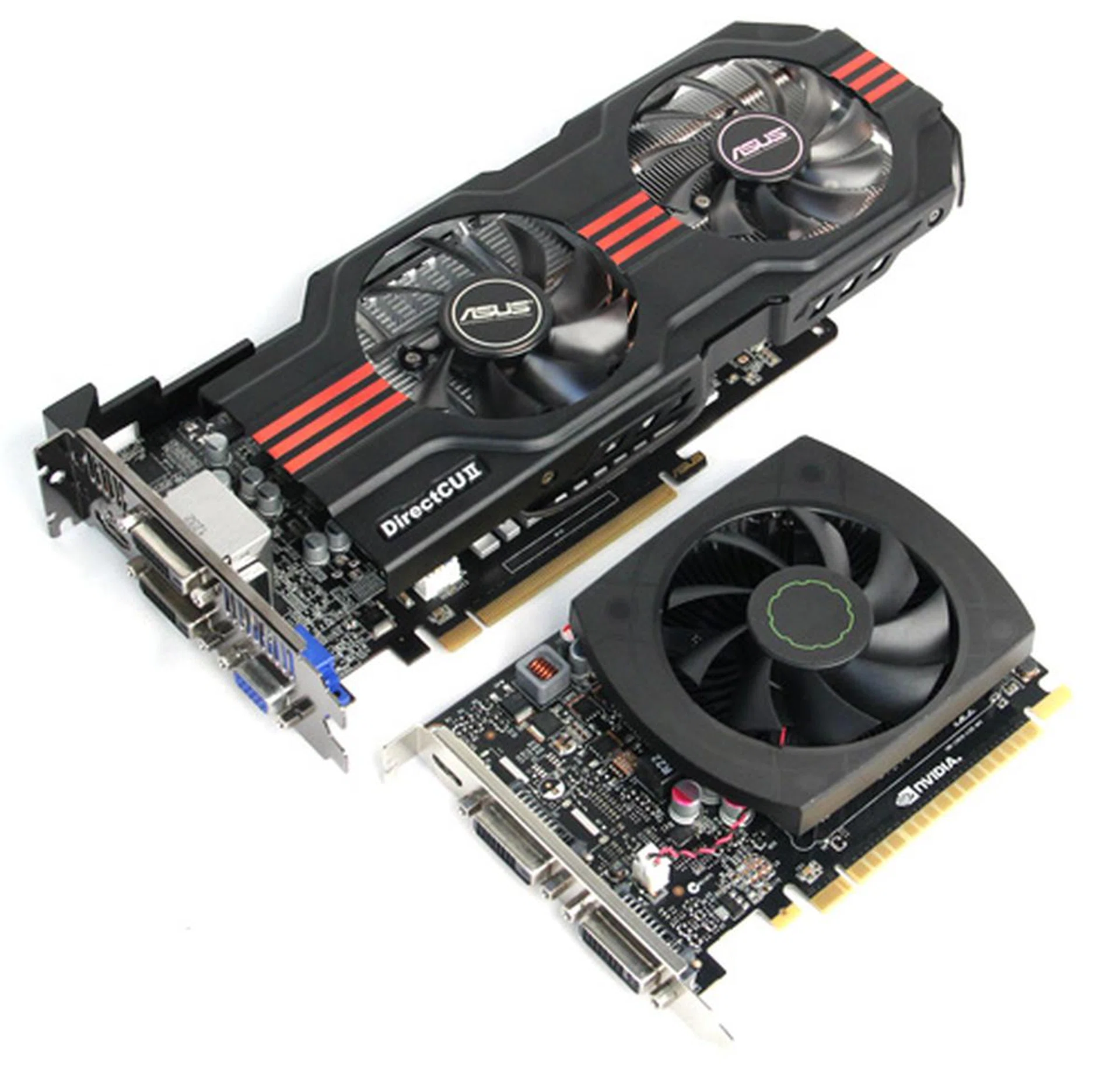
As you can see, ASUS's GTX 650 Ti is almost twice the size of NVIDIA's.
The ASUS GeForce GTX 650 Ti DirectCU II TOP retails for S$299 and comes with a three-year warranty. A much less mildly overclocked edition (denoted by the "OC" moniker instead of "TOP") whose core clock is set at 954MHz has its price listed as S$279.
Test Setup
As usual, the following are the specs of our trusty graphics card test bed system:
- Intel Core i7-975 (3.33GHz)
- Gigabyte GA-EX58-UD4P motherboard
- 3 x 1GB DDR3-1333 G.Skill memory in triple channel mode
- Seagate 7200.10 200GB SATA hard drive
- Windows 7 Ultimate 64-bit
Test Notes:
NVIDIA has announced that the GeForce GTX 650 Ti will be pitted squarely against AMD's Radeon HD 7770, which currently retails for US$119, $30 less than the GTX 650 Ti's launch price.
Aside from comparisons against the competition, we'll be very interested to see where the GTX 650 Ti falls in relation to the GTX 650 and GTX 660, the two cards immediately below and above its SKU. Its GK106 core suggests it might be close to the GTX 660, but its weaker memory interface bus and subsequently lower memory bandwidth might hold it back.
We'll also be very interested in seeing if ASUS' custom cooler is worth the extra money and chassis space, or if designs more similar to NVIDIA's compact reference design will be sufficient.
Since the target group of users for these cards aren't likely to game at very high resolutions or with multiple monitors, we've also tested the GTX 650 Ti, GTX 650 and Radeon HD 7770 cards at the resolution of 1680 x 1050 pixels to give an idea of how they would fare. We didn't have time to test the speedier cards at this mainstream resolution, but it's sufficient to say that they are much more powerful and won't face issues addressing game play at this resolution.
NVIDIA has actually highlighted 1920 x 1200 pixels as the resolution of choice for the GTX 650 Ti and as such, we'll be looking very closely at how the GTX 650 Ti performs there.
The list of cards tested and driver versions used:
- ASUS GeForce GTX 650 Ti DirectCU II TOP (ForceWare 306.38)
- NVIDIA GeForce GTX 650 Ti (ForceWare 306.38)
- NVIDIA GeForce GTX 650 (ForceWare 306.23)
- NVIDIA GeForce GTX 660 (ForceWare 306.23)
- AMD Radeon HD 7750 (Catalyst 12.8)
- AMD Radeon HD 7770 (Catalyst 12.8)
- AMD Radeon HD 7870 2GB GDDR5 (AMD Catalyst 12.8)
- NVIDIA GeForce GTX 560 Ti 1GB GDDR5 (ForceWare 305.37)
- NVIDIA GeForce GTX 460 Ti 1GB GDDR5 (ForceWare 305.37)
The list of benchmarks used:
- Futuremark 3DMark 11
- Unigine v2.1 "Heaven"
- Far Cry 2
- Crysis Warhead
- Battlefield: Bad Company 2
- Crysis 2
- Batman: Arkham City
- Dirt 3
- S.T.A.L.K.E.R.: Call of Pripyat
3DMark 11 Results
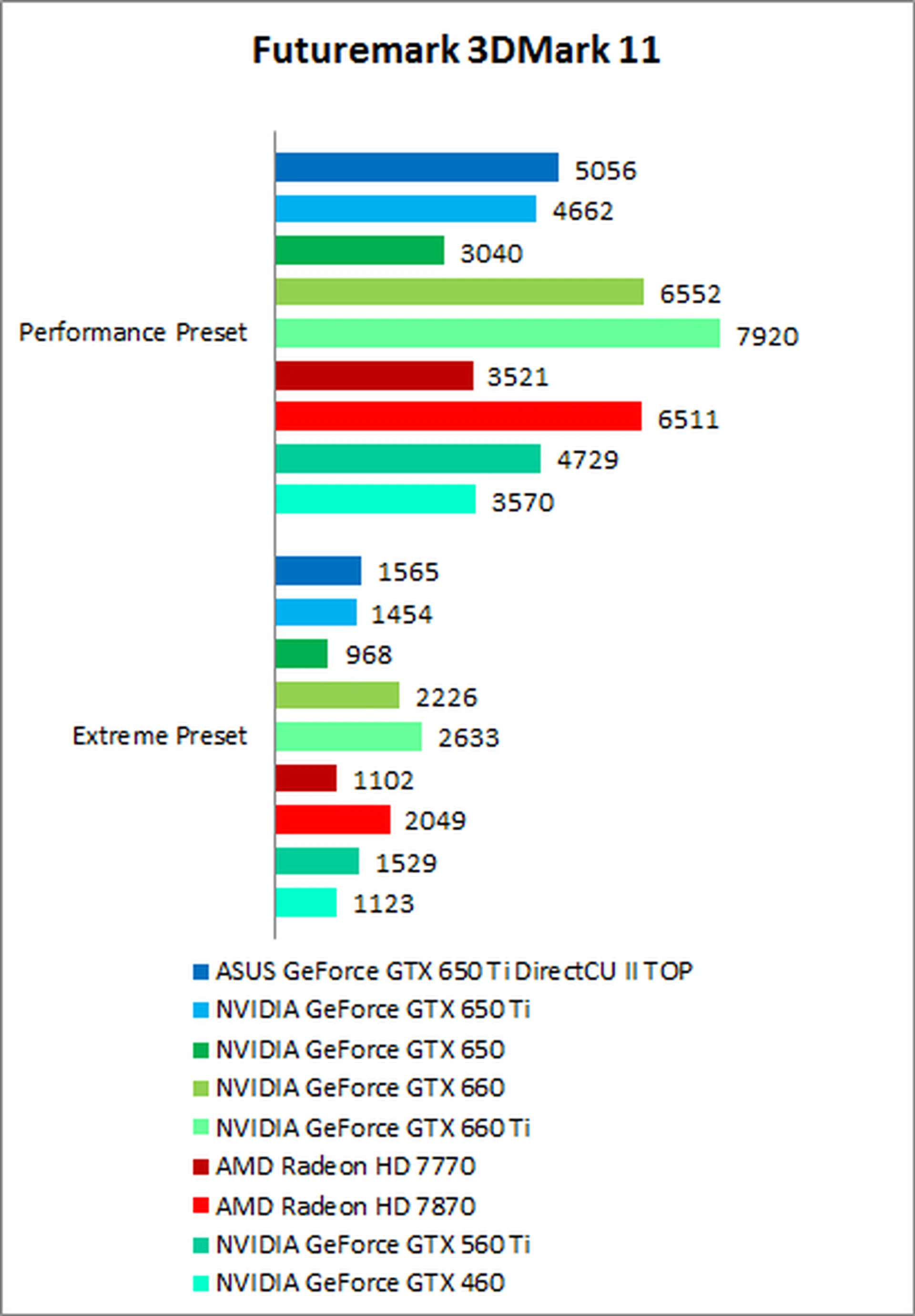
As usual, we start our tests with a few synthetic benchmarks before launching into actual games. First up, 3DMark 11, which tests a variety of DirectX 11 functions including tessellation, compute shaders and multi-threading, making it a good indication of a card's overall performance.
Starting off strong, the GTX 650 Ti showed a whopping 50% increase on the GTX 650, and was also able to fend off its direct competition from AMD, the Radeon HD 7770 with a resounding 32% victory on the Performance preset which extended to 35% at Extreme. On the other hand, there was just too much ground to make up against the GTX 660, which outperformed the GTX 650 Ti by about 40% on Performance and 50% on Extreme.
ASUS' custom GTX 650 Ti performed about 8% better than the reference design.
Unigine 2.1 "Heaven" Results
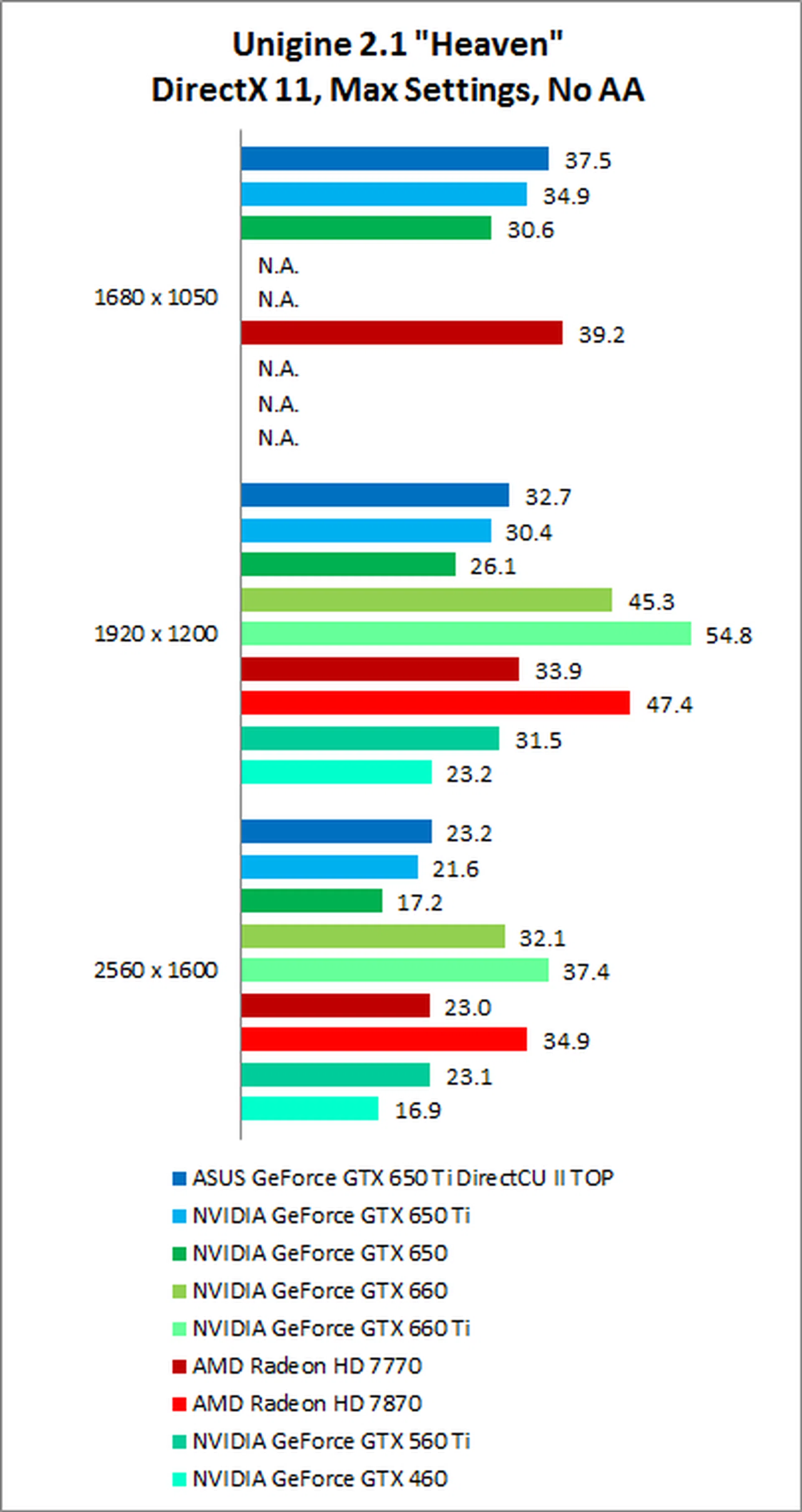
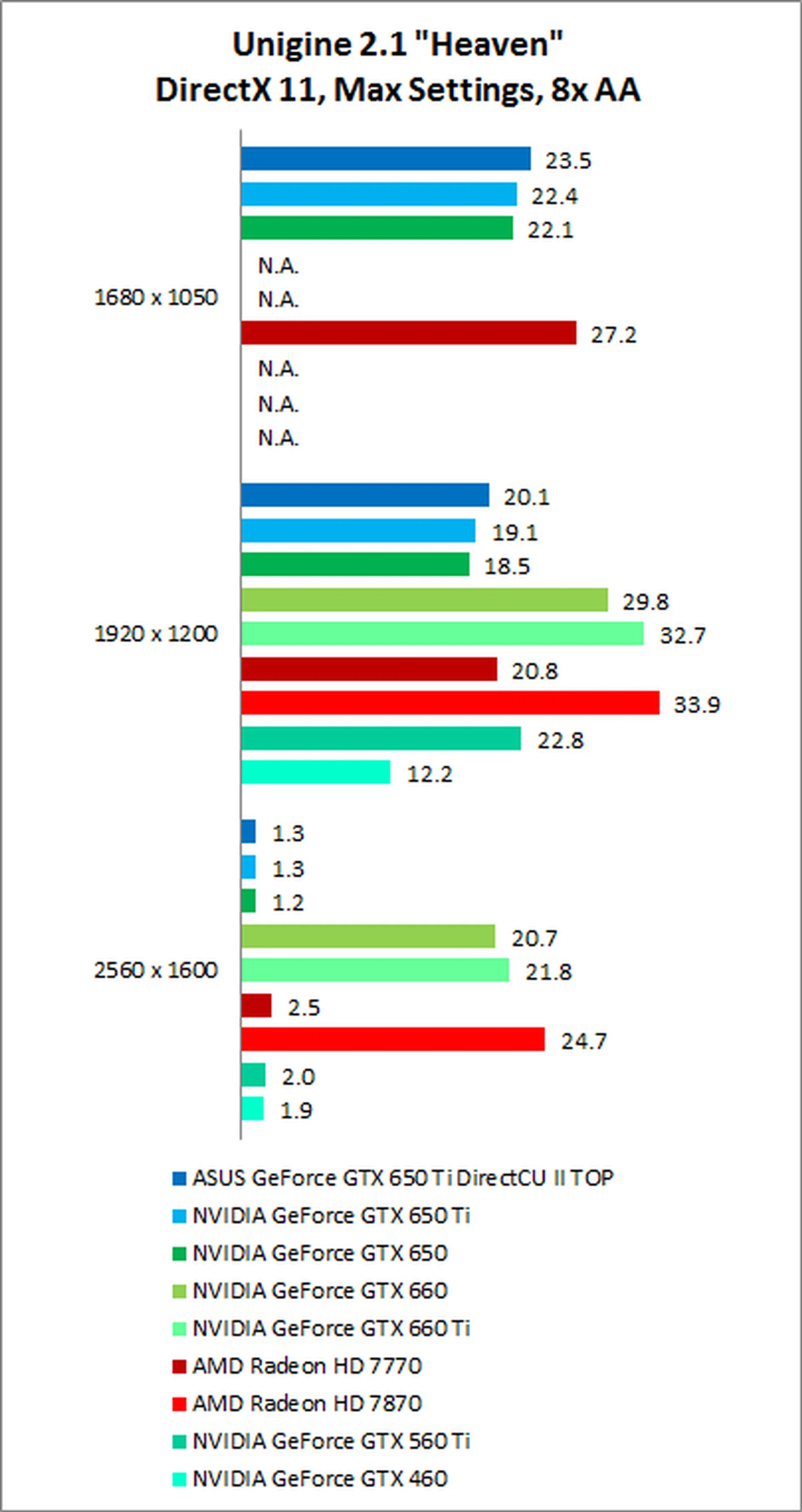
Unigine’s “Heaven” benchmark is an extremely tessellation-intensive benchmark which, when combined with a high resolution and 8x AA was just too much for the GTX 650 Ti. Do note that AMD's Radeon HD 7770 was also unable to run the benchmark at these settings. In short, most of these severely underperforming cards are deprived of adequate video memory.
Looking instead at results in the middle resolution bracket of 1920 x 1200 pixels, the GTX 650 Ti was about 8% better than the GTX 650 with AA turned off and about 3% better with AA set to 8x. As for the competition, AMD's HD 7770 was the clear winner in this test, pulling ahead of the GTX 650 Ti by 11% with AA turned off and by about 8% with AA set to 8x. Looking at the lower 1680 x 1050 resolution, you can see that these results are repeated there too.
These results were not all that surprising, as we have seen from our past reviews of the GTX 660 and GTX 650 that heavy tessellation is not the strong point of NVIDIA's more affordable Kepler cards, and AMD's somewhat superior hardware was able to provide it with enough extra firepower to claim the victory in this case. We will see if these results are repeated later in the more tessellation heavy games.
ASUS was again about 5-8% better than the reference card throughout.
Battlefield: Bad Company 2 Results
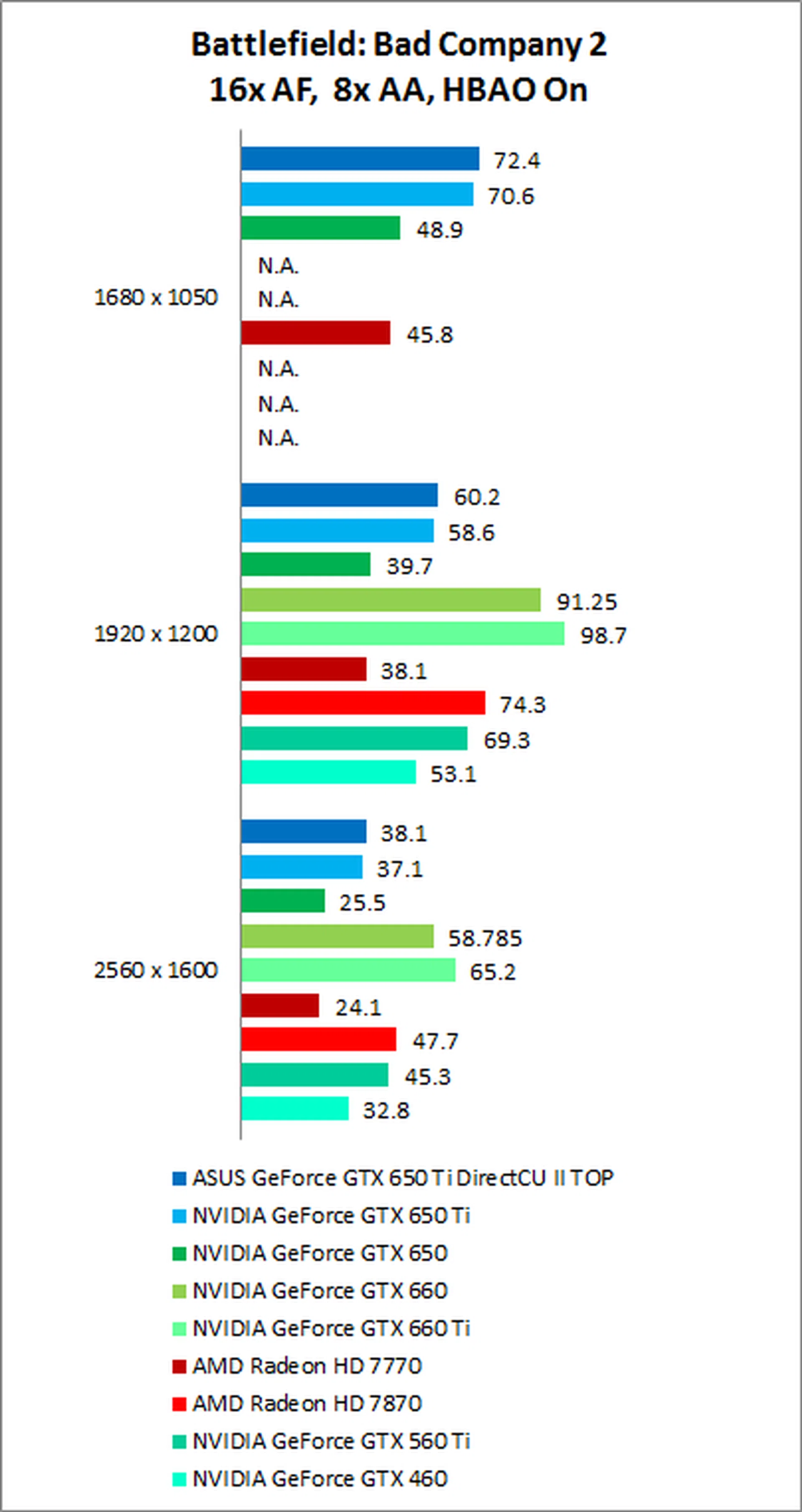
Our first gaming benchmark is Battlefield: Bad Company 2, one of the earliest DirectX 11 first-person shooters. While it's showing its age a bit, its Frostbite 1.5 engine is still a fairly good test of a GPU’s geometry shading power and should be a good starting point for our entry-level cards.
The GTX 650 Ti was again very impressive, outperforming both the GTX 650 and AMD Radeon HD 7770 by about 47%, a significant difference that pushed it up to the targeted 60 FPS average at the resolution of 1920 x 1200 and well above it on 1680 x 1050. The GTX 660 however remained out of reach, outperforming the GTX 650 Ti by 55% on the 1920 x 1200 resolution.
ASUS' custom card was less impressive on our first gaming benchmark, averaging a performance increase of only 3% against the reference design.
Far Cry 2 Results
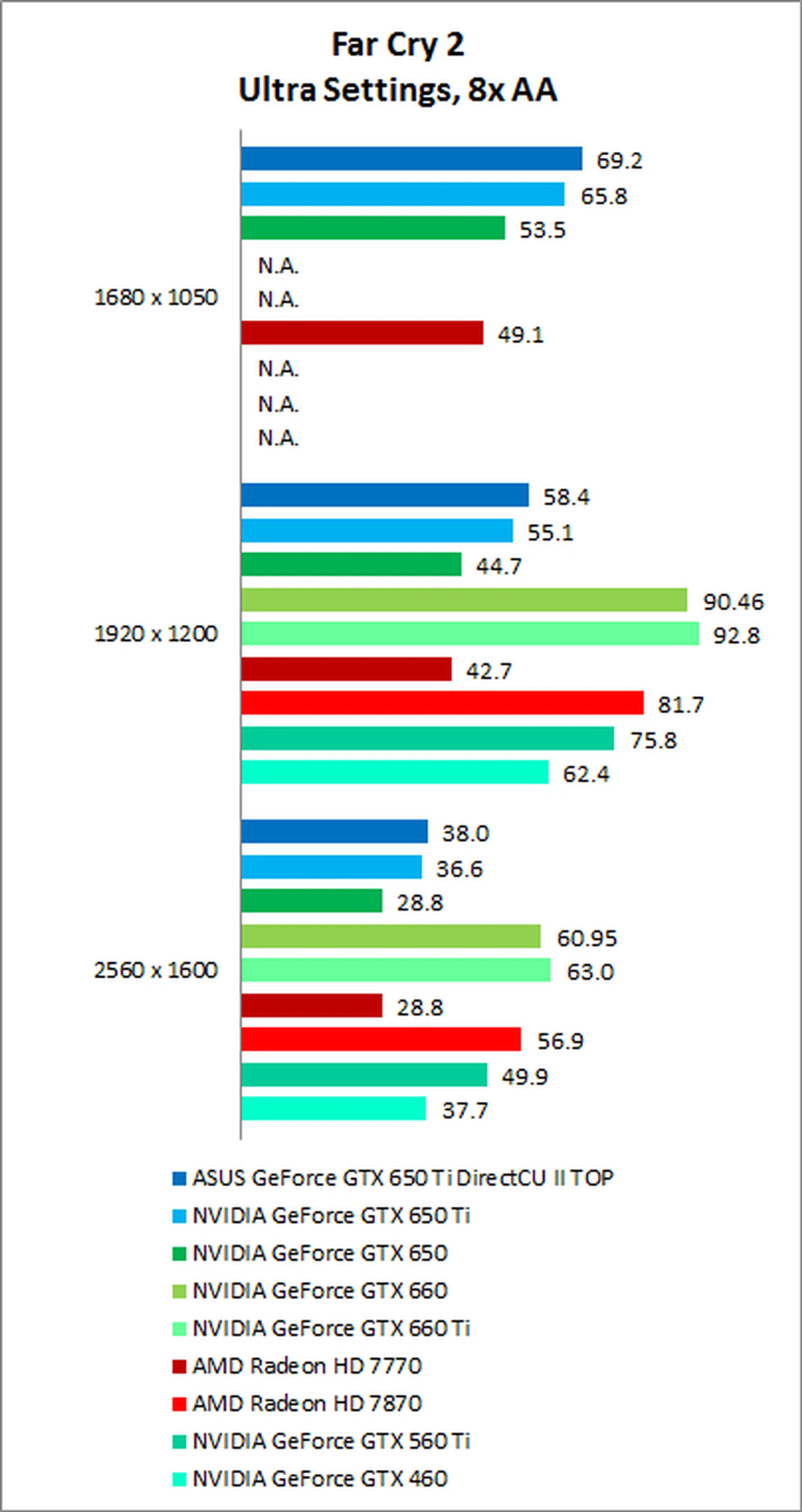
NVIDIA cards usually perform well on Far Cry 2 and it was no different with the GTX 650 Ti, which beat its rival from AMD by an average of about 35%. ASUS improved its showing, outperforming the reference card by around 6% across all resolutions and settings.
Crysis Warhead Results
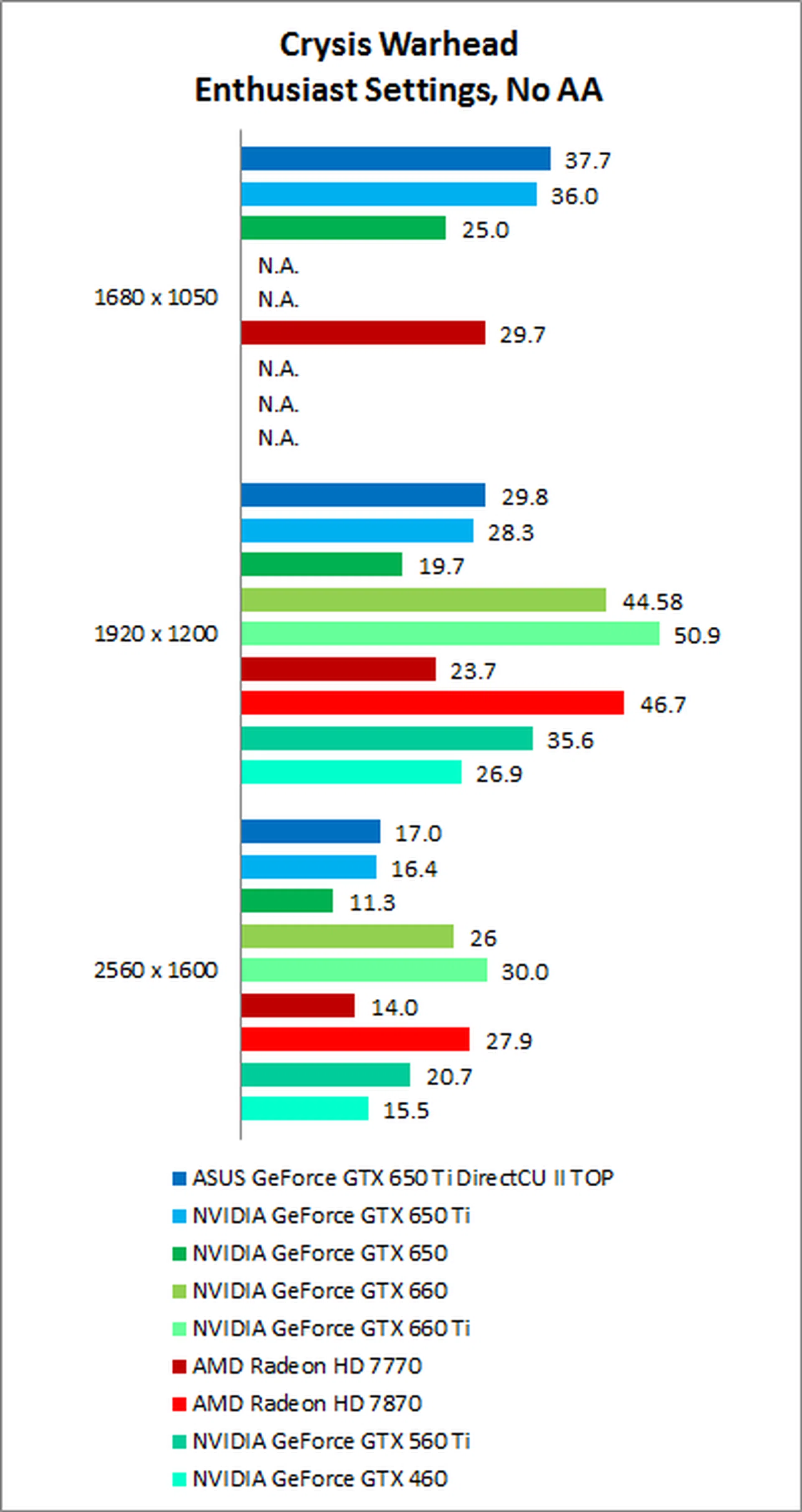
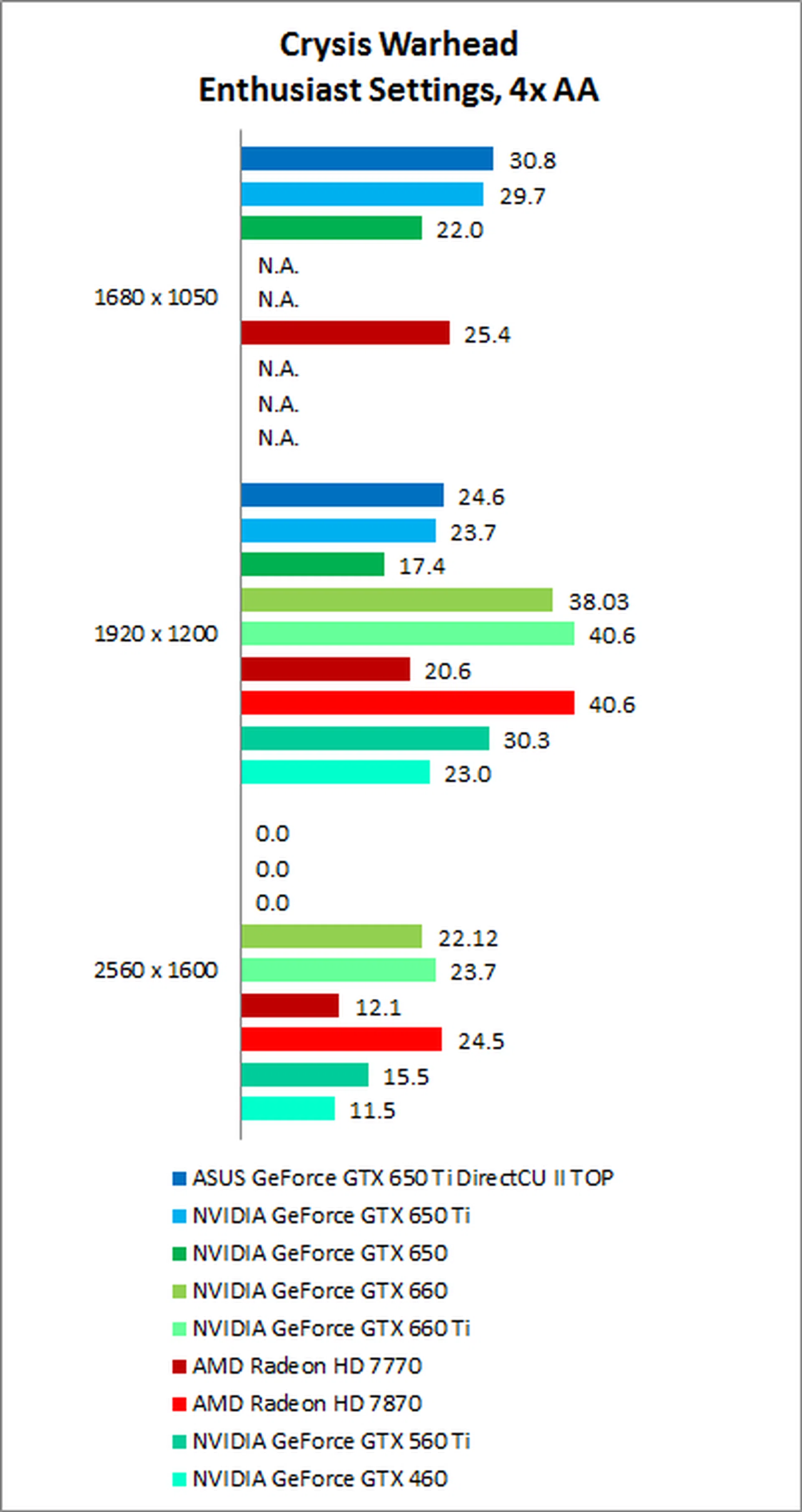
While Crysis Warhead is running on a DX10 engine, it is still fairly taxing and features heavy tessellation. After AMD's win in the Unigine 2.1 "Heaven" benchmark we expected another win for AMD here. Surprisingly, the GTX 650 Ti held its own and maintained a 15-20% lead across almost all settings.
The one test in which the GTX 650 Ti failed to claim victory was at the 2560 x 1600 resolution at 4x AA. In fact, it failed to run at all, whereas AMD's 7770, while not impressive, or even anywhere near playable, was able to run the benchmark and post a score. Do note though that these graphics cards are not designed to be run at such high resolutions and settings.
Crysis 2 Results
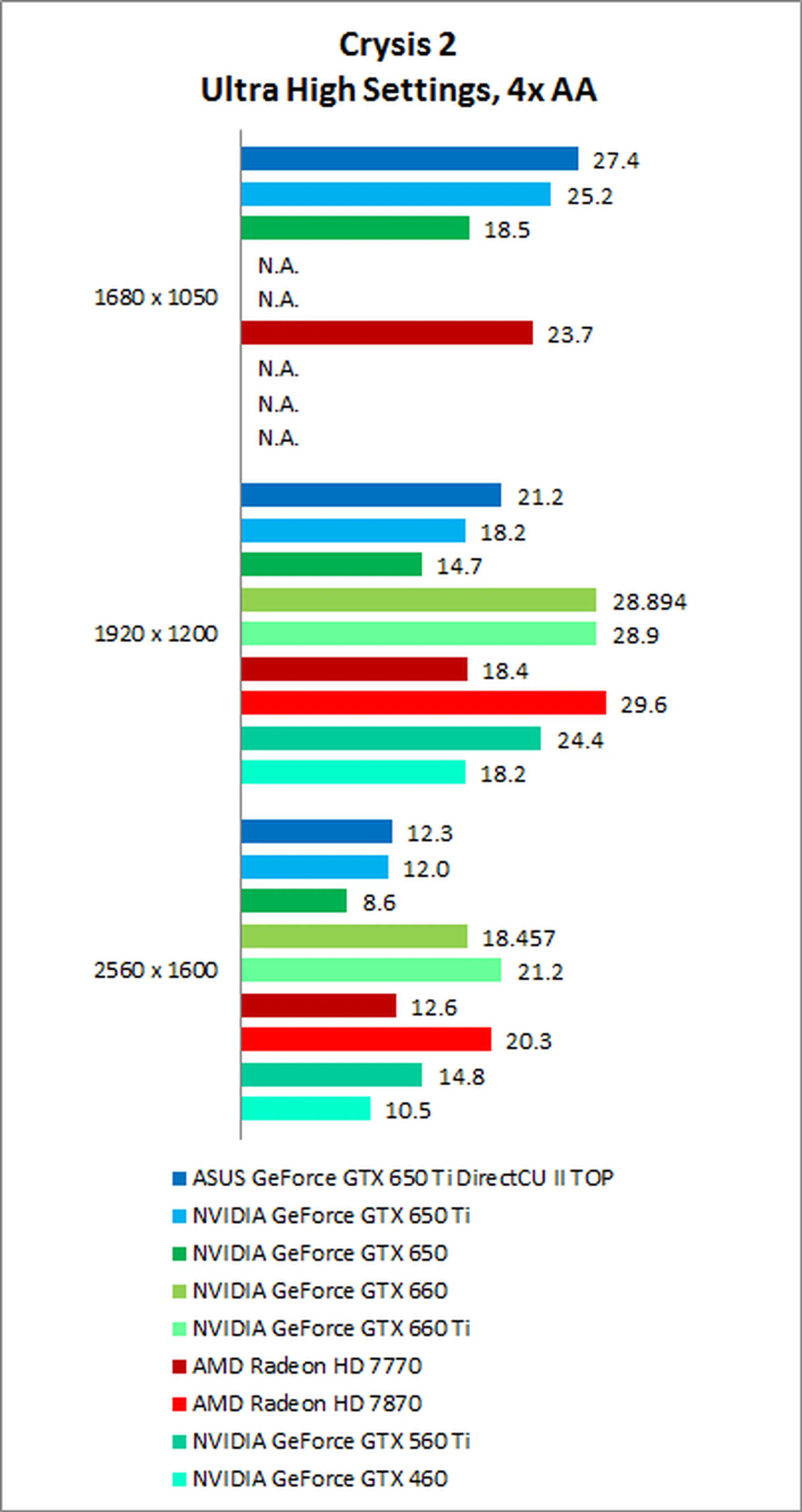
Much like its predecessor, Crysis 2 requires a beast of a machine to run with its Ultra High setting putting GPUs through their paces with a grueling test of tessellation, Parallax Occlusion Mapping, water rendering, and particle motion blur and shadowing.
At the lower 1680 x 1050 resolution setting, NVIDIA recorded a narrow 6% win over AMD's 7770. Both cards effectively tying at the 1920 x 1200 resolution, while the situation was reversed at 2560 x 1600, with AMD outperforming NVIDIA by about 5%, although it should be noted that the actual difference in frame rate between the two cards was negligible.
ASUS was quite strong in this benchmark, scoring as high as 16% more than the reference design at the resolution of 1920 x 1200 pixels.
Batman: Arkham City
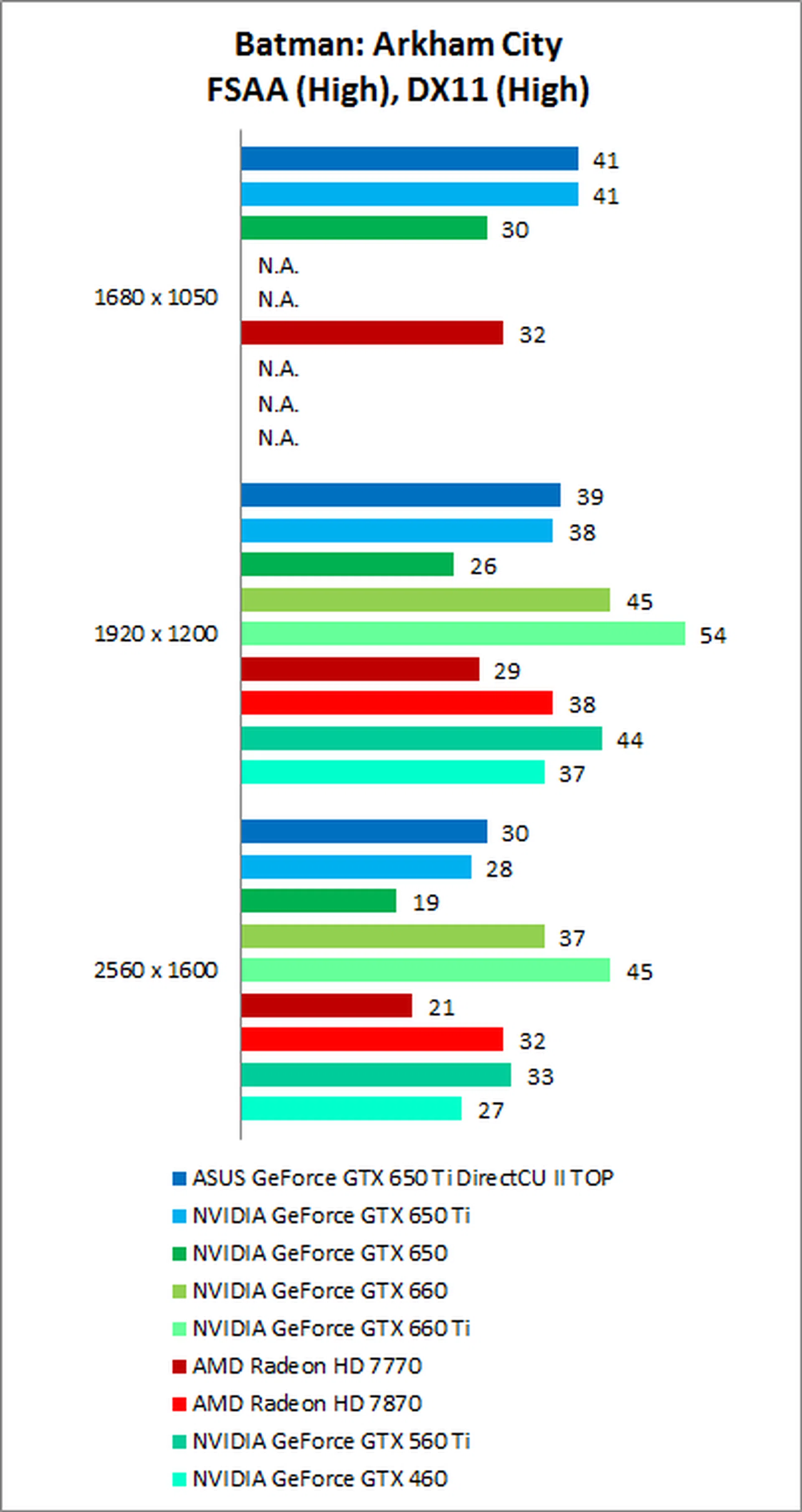
Batman: Arkham City is optimized for NVIDIA PhysX and as expected, the GTX 650 Ti easily outperformed the Radeon HD 7770. Compared to the GTX 650, we saw a big increase in performance, of about 35% at the resolution of 1680 x 1050 pixels and up to 50% at high resolutions.
Dirt 3 Results
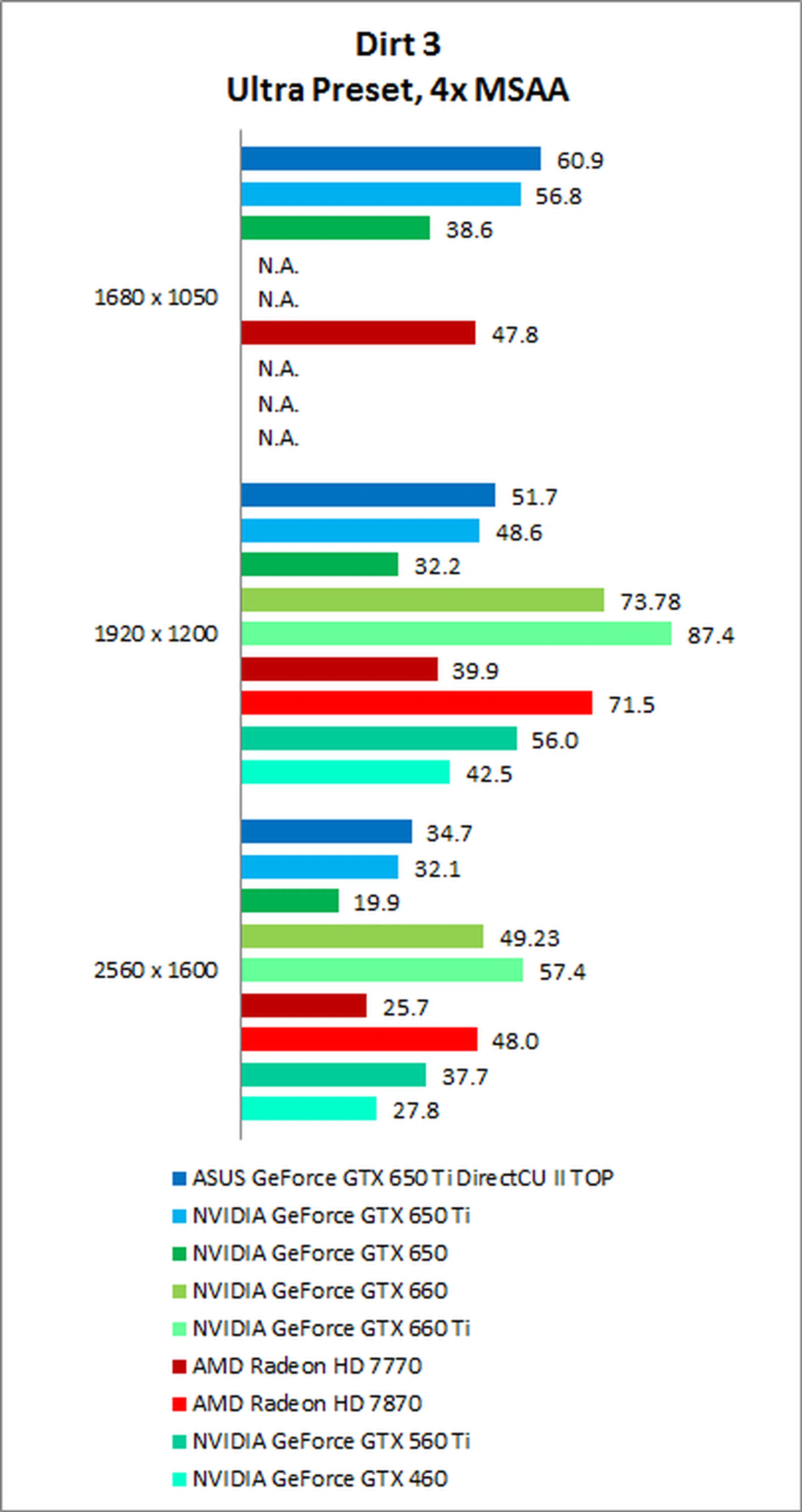
Dirt 3 was one of the earliest games to support DirectX 11 gaming and is still a decent test for mid-range cards. Once again NVIDIA was able to claim the lead with the GTX 650 Ti outperforming AMD's 7770 by about 20%. Notably, this put it much closer to the targeted 60 FPS average at both 1680 x 1050 and 1920 x 1200 pixels resolutions, and tweaking with some of the less important settings should easily bump the average FPS up a few more points.
ASUS put in another round of solid performance, outscoring the reference design by about 7%.
S.T.A.L.K.E.R.: Call of Pripyat Results
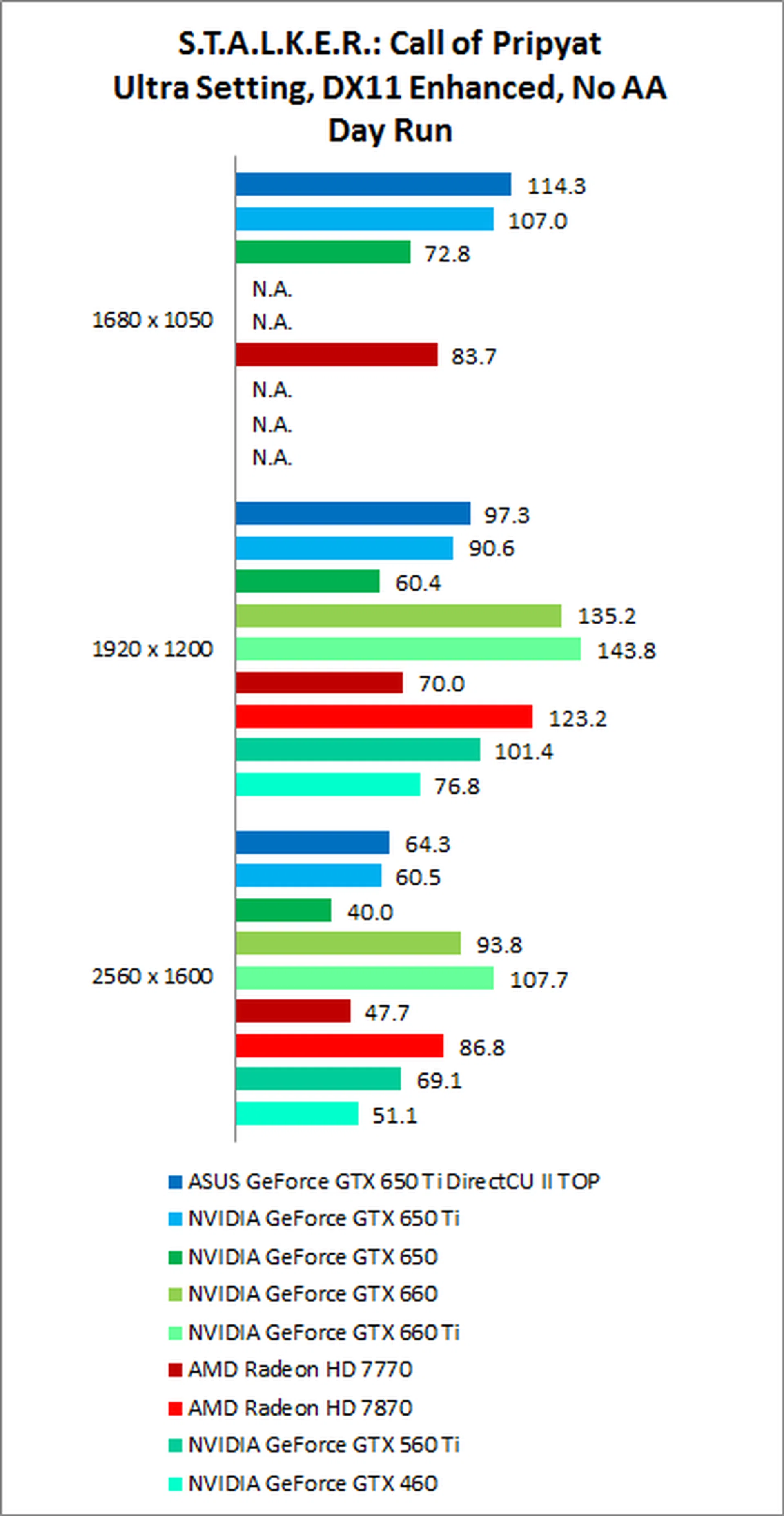
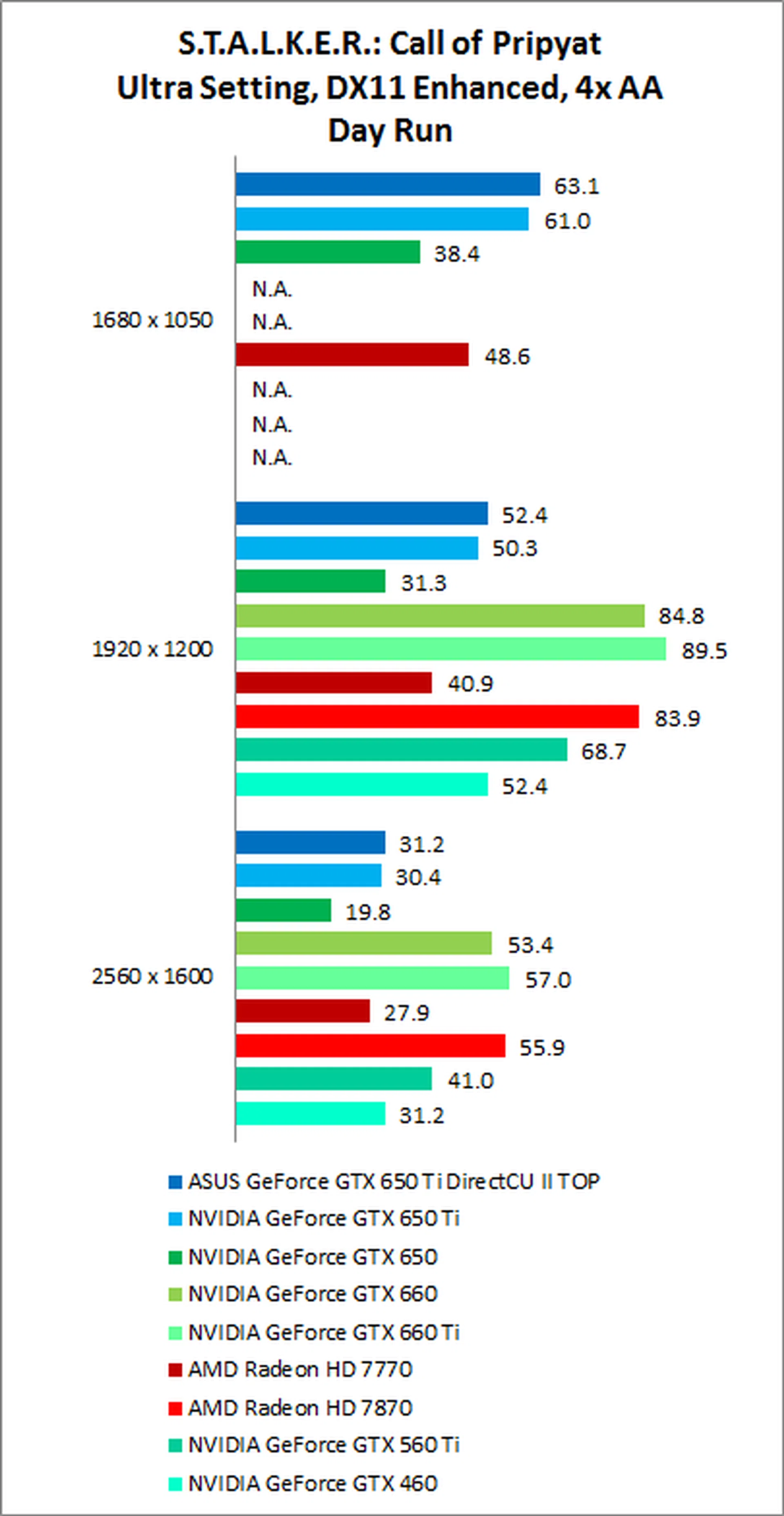
On the less challenging Day Run the GTX 650 Ti was the clear winner, both with AA disabled and set to 4x, outscoring the HD 7770 by about 20%.
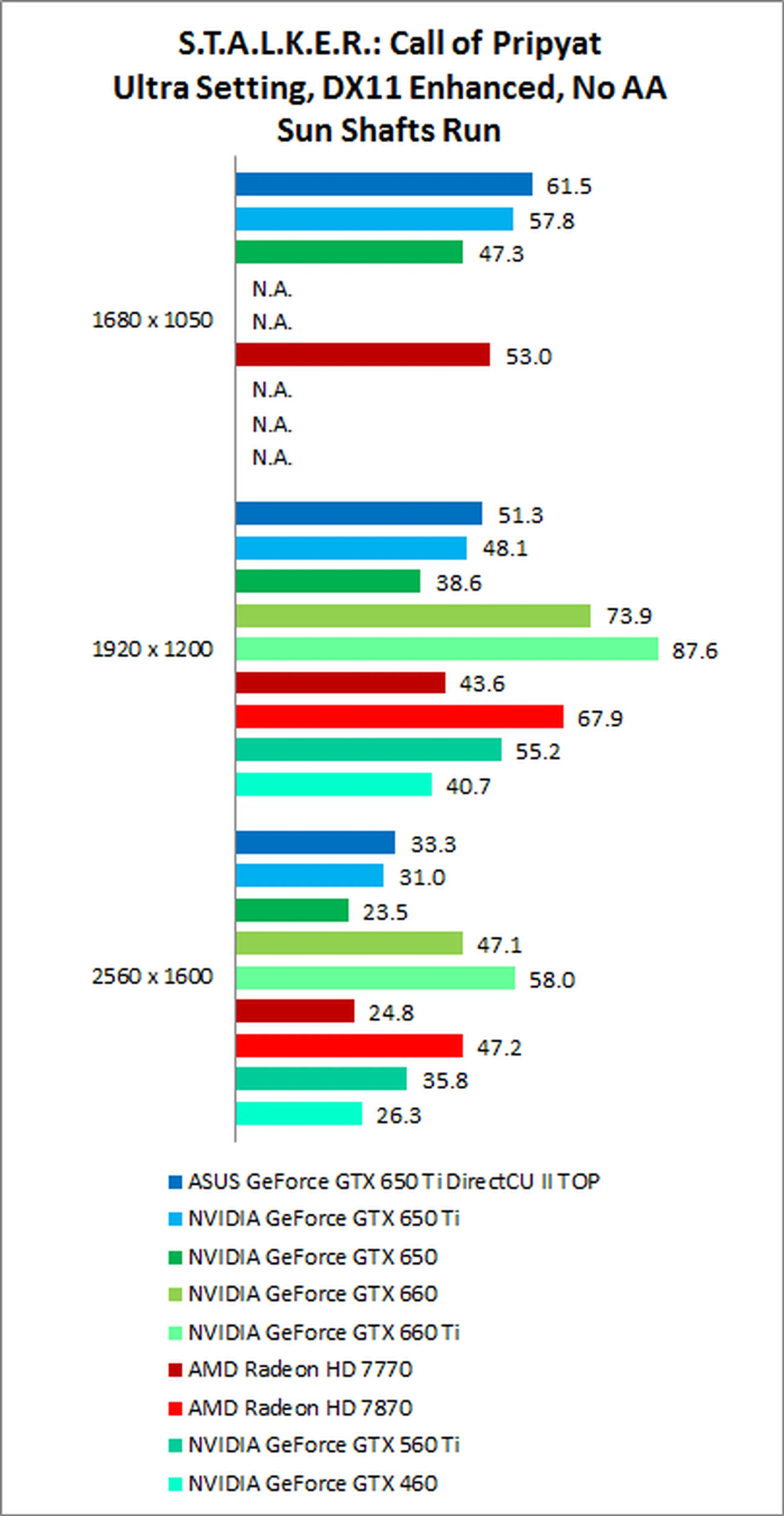
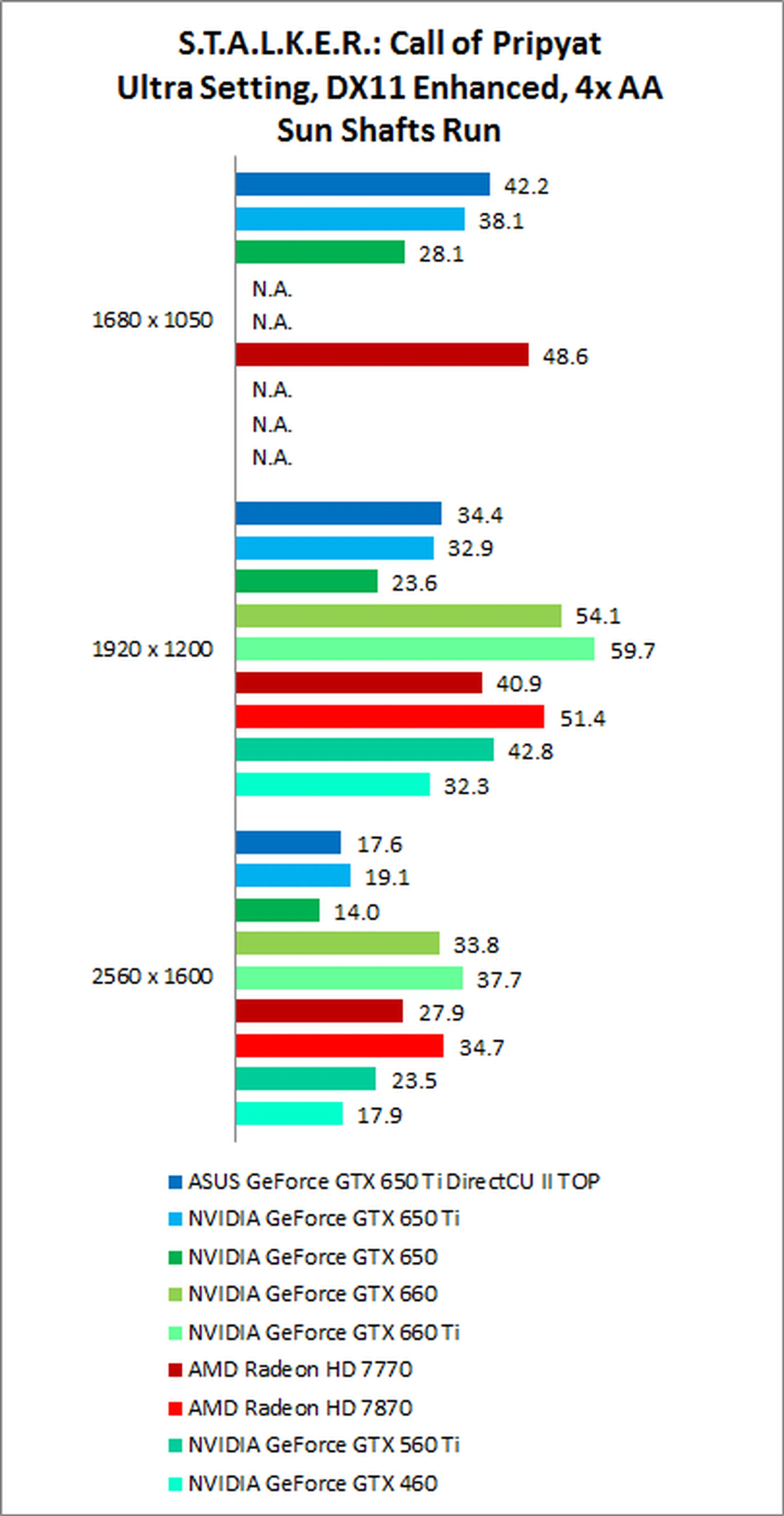
However, on the more taxing Sun Shafts Run, that gap closed significantly, and the GTX 650 Ti was only able to hold onto a slim 8% lead with AA disabled. With AA set to 4x, the HD 7770 was better at all three resolutions, averaging a lead of about 22%. This is yet another classic case where we found that NVIDIA cards aren't able to outperform its competitor in some of the harshest tests.
Overclocking Results
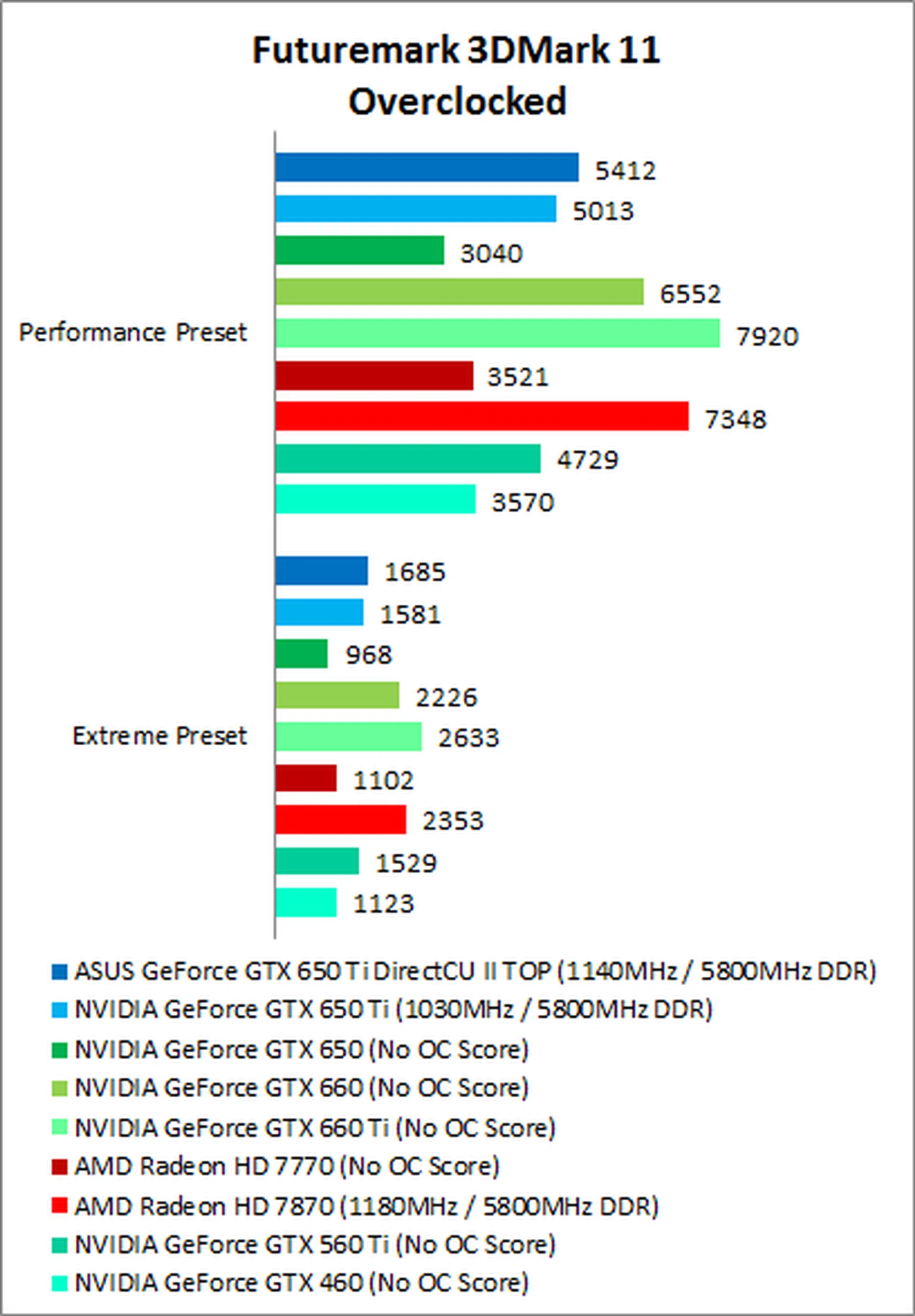
For our overclocking efforts, we were able to push the reference card up to 1030MHz at the GPU core with memory speeds going to 5800MHz DDR. This put it quite close to ASUS's factory overclocked speeds, which was reflected in our overclocked scores, with the reference card gaining about 8%.
For ASUS, we were able to ratchet up the GPU core clock speeds up to 1140MHz with memory also raised to 5800MHz DDR. This resulted in a gain of about 7% on both Performance and Extreme presets against its stock performance and up to 16% when compared to a non-overclocked reference card. We won't say it's a worthwhile effort, but it's quite a decent attempt.
Temperature Results
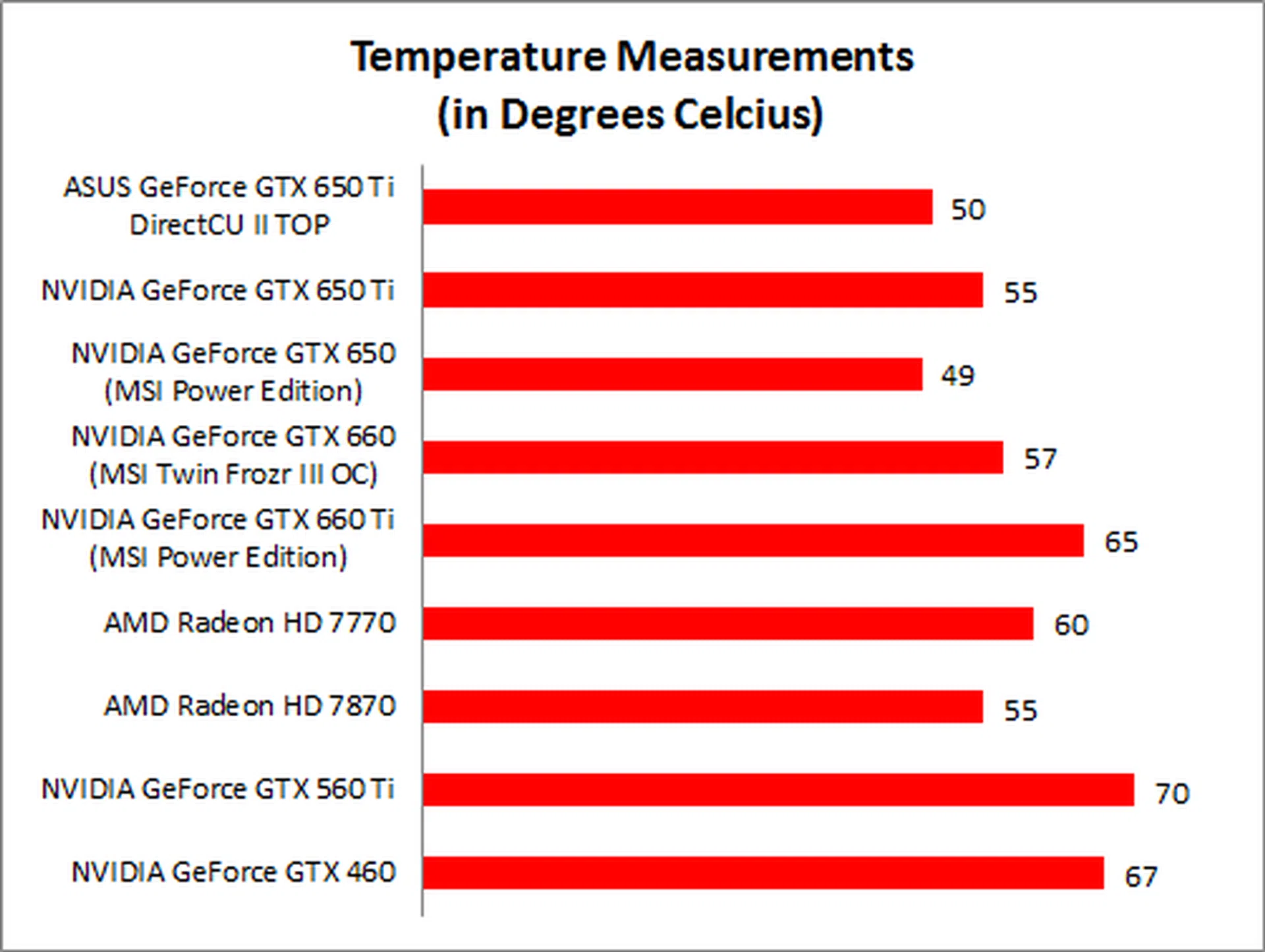
As we were missing quite a few reference card scores, we have substituted custom editions to give you a rough idea for how that card performs. The GTX 650 Ti was reasonably cool, running at 55 degrees Celcius at the core, which is about 5 degrees cooler than AMD's Radeon HD 7770.
Disappointingly, ASUS's huge dual-fan custom cooler was not all that much better than NVIDIA's compact single fan design, registering only 5 degrees cooler operation. As the GTX 650 Ti doesn't really require a lot of power, we don't expect it to overheat and as such, a large custom cooler such as ASUS' is probably more for show than actually required.
Power Consumption Results
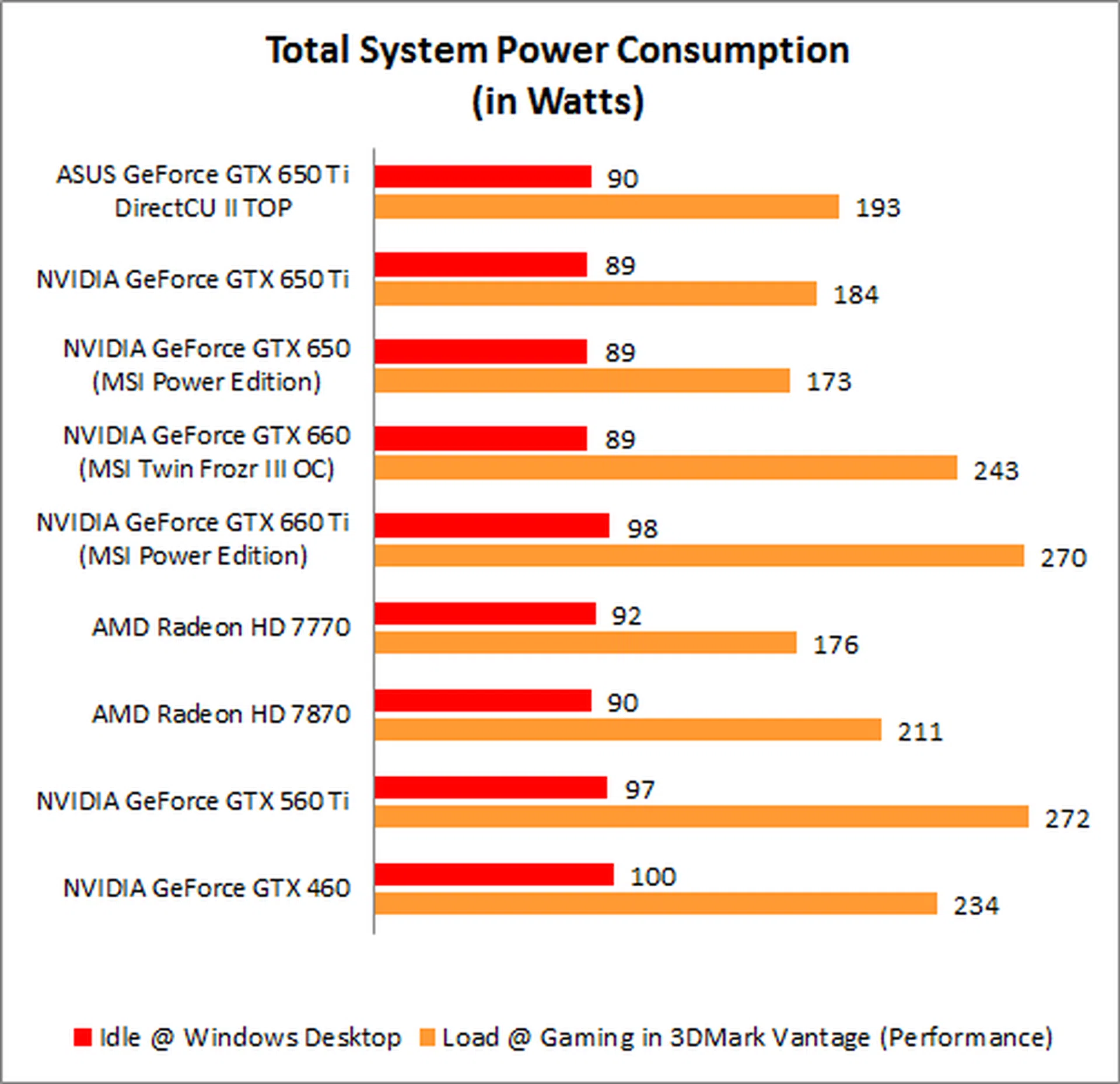
Power consumption on the GTX 650 Ti was quite good, measuring just 6% more than MSI's GTX 650 Power Edition for a significant increase in performance.
ASUS's model was also quite impressive, with its large cooler and overclocked core drawing only 5% more power, while registering on average about a 6-8% increase in performance against the reference card.
Price-Performance Comparison
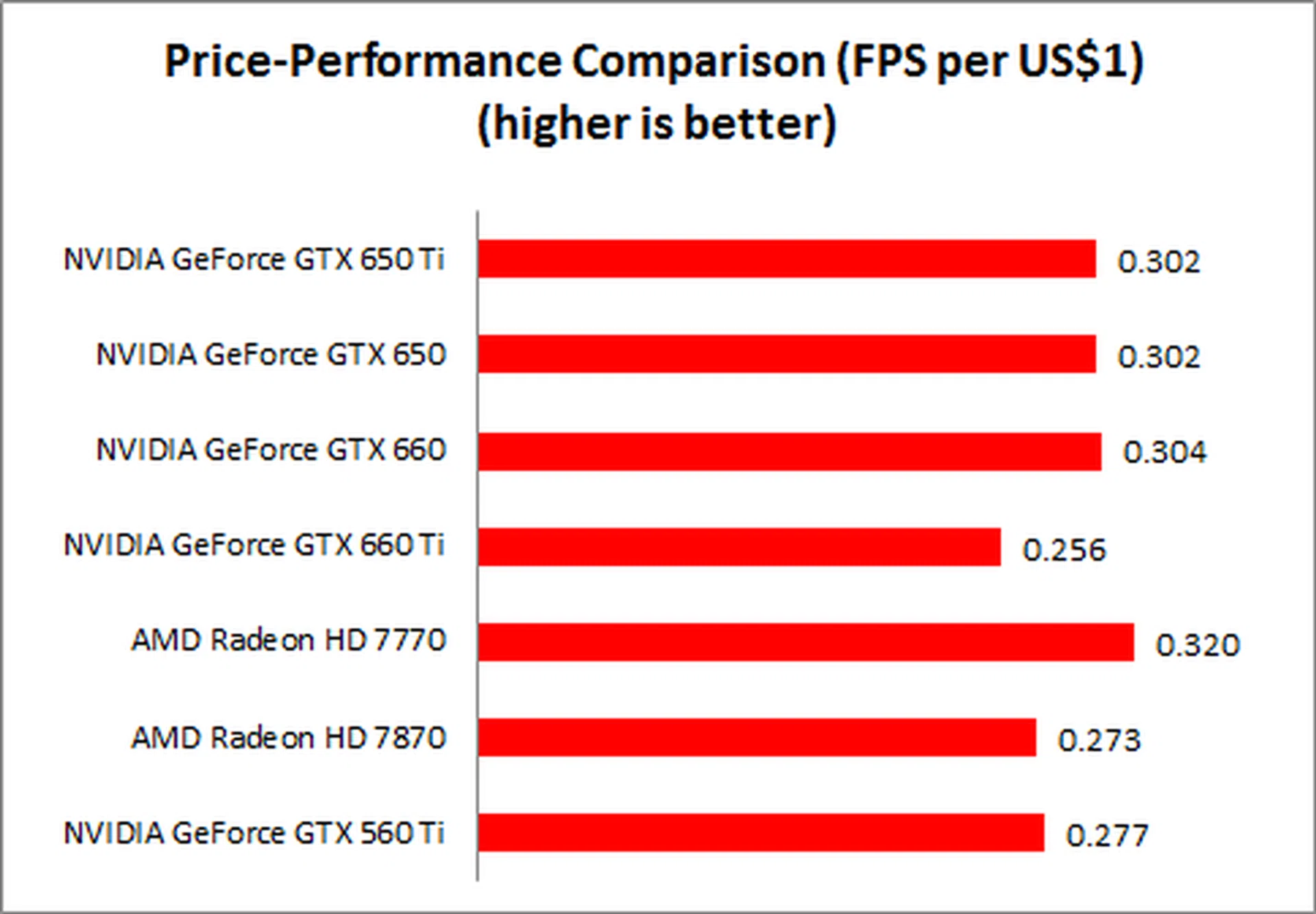
When it comes to entry-level and mid-range graphics cards, the key metric gamers will be looking at is its price-to-performance ratio, i.e. how much bang do you get for your buck?
For this comparison, we calculated the average FPS of each card, based on its sum total score across all settings and resolutions on our gaming benchmarks, as well as the synthetic benchmark Unigine 2.1 "Heaven". We then divided that score by the card's suggested retail price in US dollars to derive exactly what 1 US dollar will get you in terms of FPS for each card.
Model | Current Price in US$ | Average FPS | FPS per US$1 |
NVIDIA GeForce GTX 650 Ti | $149 | 44.9 | 0.302 |
NVIDIA GeForce GTX 650 | $109 | 32.9 | 0.302 |
NVIDIA GeForce GTX 660 | $229 | 69.6 | 0.304 |
NVIDIA GeForce GTX 660 Ti | $299 | 76.5 | 0.256 |
AMD Radeon HD 7770 | $119 | 38.1 | 0.320 |
AMD Radeon HD 7870 | $239 | 65.2 | 0.273 |
NVIDIA GeForce GTX 560 Ti | $199 | 55.1 | 0.277 |
As you can see, the GTX 650 Ti provides exactly the same amount of FPS per US$1 as the entry-level mainstream GTX 650. As such, if you can afford the extra US$30 this makes it a great pick as you're getting more performance for the same dollar value. If you're looking for the card providing the absolute best value for money, AMD's Radeon HD 7770 with its revised pricing of US$119 is extremely hard to beat. Do remember though that this chart is not indicative of which card is more powerful, it merely shows the relative value worthiness of the card. In our tests, the GTX 650 Ti is, for the most part, a better performer than the AMD Radeon HD 7770. However, that comes at a higher premium. We'll discuss more on which card is a better buy after more local comparisons in the next section below.
Factoring in the Local Price-Performance Aspect
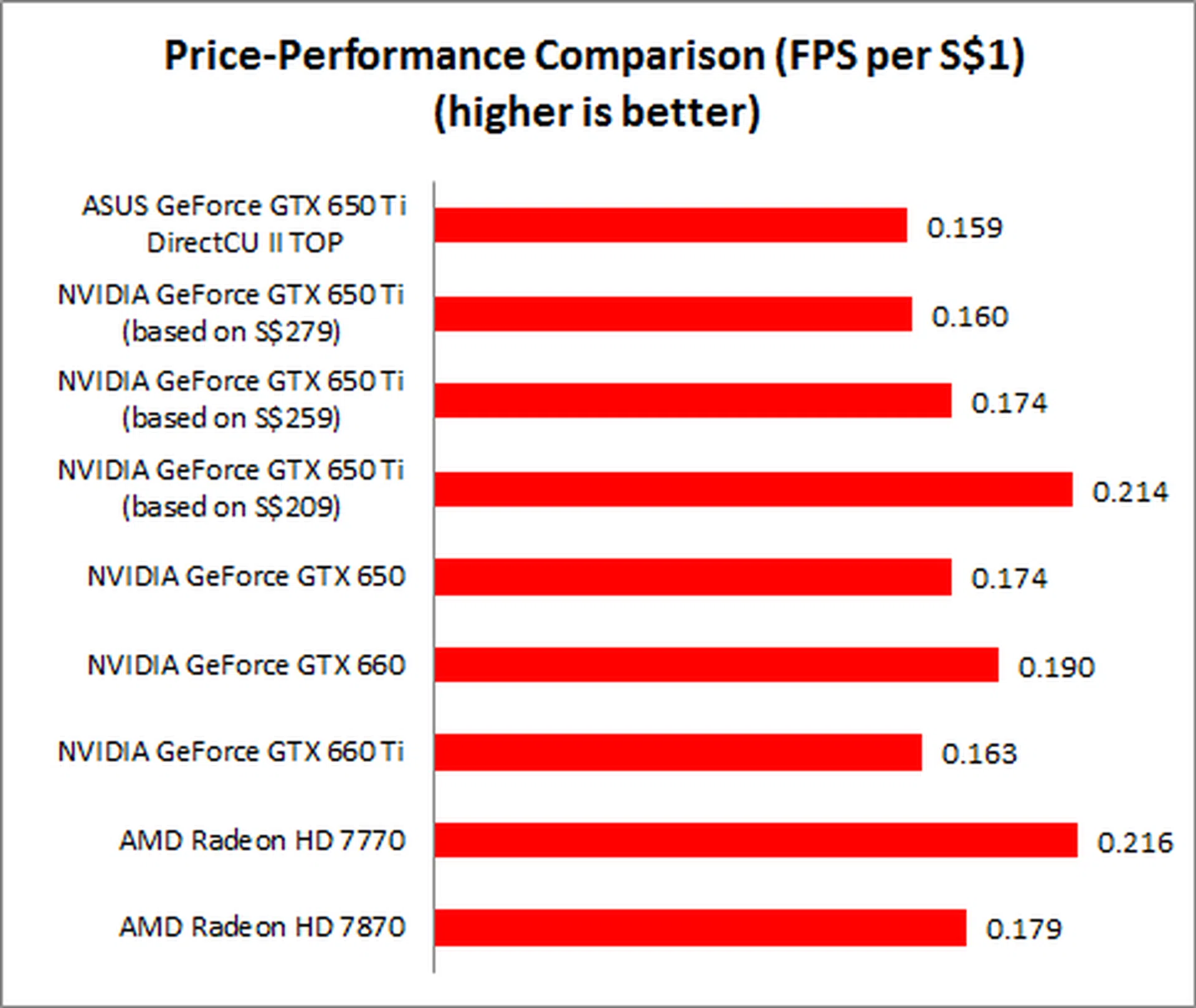
By now,we're all well aware of the pricing disparity in overseas and local markets. For a look at how things stand in Singapore, we have gathered as many current retail prices from as many add-in partners of that particular card as possible to generate an average price. Currently, we do not have an SRP for the GTX 650 Ti, but have estimated it to be about S$259 (see below for explanation):
Model | Current Average Price in S$ | Average FPS | FPS per S$1 |
ASUS GeForce GTX 650 Ti DirectCU II TOP | $299 | 47.5 | 0.159 |
NVIDIA GeForce GTX 650 Ti | Estimated $259 | 44.9 | 0.174 |
NVIDIA GeForce GTX 650 | $189 | 32.9 | 0.174 |
NVIDIA GeForce GTX 660 | $367 | 69.6 | 0.190 |
NVIDIA GeForce GTX 660 Ti | $468 | 76.5 | 0.163 |
AMD Radeon HD 7770 | $176.4 | 38.1 | 0.216 |
AMD Radeon HD 7870 | $364.7 | 65.2 | 0.179 |
As for the GTX 650 Ti, at the time of writing, most vendors have yet to reveal the pricing on their GTX 650 Ti SKU and as such we need to make predictions based around similar SKUs. We do know that ASUS' DirectCU II TOP model will retail for $299, with the non-TOP edition available for $279. ASUS' prices are usually slightly above the average, so this gives us an idea of where we can expect the rest of the vendors to set their SRPs.
If the vendors were to follow US pricing, with a price-performance ratio to match that of the GTX 650, which has an average price of S$189, the 650 Ti will need to be priced at S$259 (derived from keeping the constant ratio and multiplying that with the card's average frame rate). This is where we expect a standard edition card's pricing to be. If pricing is closer to ASUS's non-TOP edition at S$279, the price-performance comparison ratio will fall slightly, making it a less appealing buy.
At time of writing, the absolute best buy in Singapore is AMD's Radeon HD 7770. There's actually nothing even close in terms of value for money, with a ratio of 0.216 FPS per S$, making it the only card above the 0.200 ratio. In fact, for the GTX 650 Ti to even match the Radeon HD 7770's value proposition, it would need to be priced at S$209, something that's very unlikely to happen. Having said that, many add-in partners have been known to announce special promotional pricing and one-off deals, so do look out for these - if you see a GTX 650 Ti model drop as low as $209, it would be, without a doubt, one of the best bargains around.
We will be sure to update this chart when the GTX 650 Ti's actual average local pricing is known. At this point of time, what's certain is that unlike what NVIDIA seems to be targeting, the Radeon HD 7770 isn't the real competitor to the GTX 650 Ti. If anything, it's perhaps more apt to compare with the 1GB edition of the Radeon HD 7850 that's retailing for less than S$300. Unfortunately, this variant is still too new and we'll have to re-look at this comparison in the near future.
Conclusion
The NVIDIA GeForce GTX 650 Ti is a much needed entry into NVIDIA's lineup as it bridges the gap between the entry-level GTX 650 and the mid-range GTX 660 - and, while not a resounding victory, for the most part it still outperformed its so-called rival from AMD, the Radeon HD 7770. The real competition would come from AMD's Radeon HD 7850 1GB edition, but as we mentioned in the last page, this variant is still rather new to the market and we'll have to re-look at its proposition in the near future. Having said that, despite the GK106 core used in the GTX 650 Ti, performance on the whole was closer to the GTX 650 side of things and we saw it struggle a bit with heavy tessellation and high anti-aliasing. As such, despite NVIDIA saying that this completes its Kepler lineup, we feel that there's still room for another card in the future which should help bridge the gap between the GTX 650 Ti and GTX 660 if NVIDIA wishes to release one (perhaps the rumored GTX 660 SE?) By itself, given its overall performance standings and asking price, it was rather decent.
A solid upgrade from the GTX 650, but it can't compete with the GTX 660.
The ASUS GeForce GTX 650 Ti DirectCU II TOP Proposition
ASUS's custom card showed solid performance gain of between 5-8% against the reference design, and also showed fairly good power consumption. On the other hand, while its custom cooler let it run 5 degrees cooler than the reference design, it didn't seem to justify its extra size and weight. If you prefer the aesthetics of a higher-end card with a full shroud design, you might prefer it over the compact style of NVIDIA's reference card, but for anyone looking to save space or using a smaller case, you will want to look elsewhere.
Price-wise, ASUS' TOP edition cards are usually quite expensive and the 650 Ti is no exception, at $299, it's veering into mid-range pricing, and can no longer really be considered budget or entry-level. If you look at our Price-Performance comparison chart, at a ratio of 0.159, it's quite a bit lower than what we expect to see for the reference GTX 650 Ti. At the same time we considered their non-TOP edition that's retailing from S$279, which might seem like a better proposition, but once we did our price-performance calculations, both ASUS cards returned similar ratios. As such, its overall price premium is somewhat justified, but it could have been lower to have made a better impact.
| |


Our articles may contain affiliate links. If you buy through these links, we may earn a small commission.