
XFX GeForce 7950 GT 570M Extreme
Barely a week after NVIDIA officially launched the GeForce 7950 GT, we are already seeing multiple models from various vendors deluging our labs. XFX sent us a pair of custom GeForce 7950 GT cards featuring an all-passive cooler design, so we just had to show you how it fared.

Introduction
We have mentioned this before but the specter of paper launches still hovers over ATI. No doubt the situation has improved since the early days of the Radeon X1000 series or CrossFire but as we sought the latest offerings from ATI's recent product refresh, like the Radeon X1650 PRO and the Radeon X1300 XT, we found our choices severely limited. Perhaps as a result of the tight supply, the listed retail price was also much higher than ATI's official price point, further compounding our disappointment. Considering that these two products are rehashes based on ATI's existing graphics processors, the lack of availability is unexpected.
In contrast, come launch day we often find NVIDIA and its partners impressively flooding the retail channels. More often than not, we have been able to find the latest NVIDIA product readily available from multiple vendors straightaway. Since at its heart, both ATI and NVIDIA are essentially chip design firms following the same foundry business model (where the chips are outsourced to foundries like TSMC and others), it is rather strange that NVIDIA appears to have largely avoided whatever problems plaguing its rival.
One of the main reasons for this discrepancy is probably related to ATI's Radeon X1000 architecture, which is as complex as it is ambitious. Other probable reasons include miscalculating the demand and the cost of inventory for stockpiling chips. As outsiders, we may never know the true reasons. With the merger between AMD and ATI, it has been speculated that AMD may elect to manufacture ATI's graphics processors at its own foundries in the future. This could help cushion the impact of supply/demand mismatches and ensure a more constant supply of ATI chips at the very least. However, AMD won't be having excess bandwidth anytime soon as they are currently highly focused on churning as many processors possible to satisfy all their partner, channel and retail demands and this is vital to ensure they can stay in the game competitively. As such, things will probably remain unchanged for ATI in the interim.
Meanwhile, those shopping for a graphics card will more often than not find the newest NVIDIA products staring from store shelves. And it's not just the reference models that are making their debuts right on time. Overclocked, custom variants are also commonly found, implying that the vendors had enough time to tinker with the product. XFX's latest overclocked and passively cooled GeForce 7950 GT is probably one of the more impressive examples of NVIDIA's 'punctuality'.
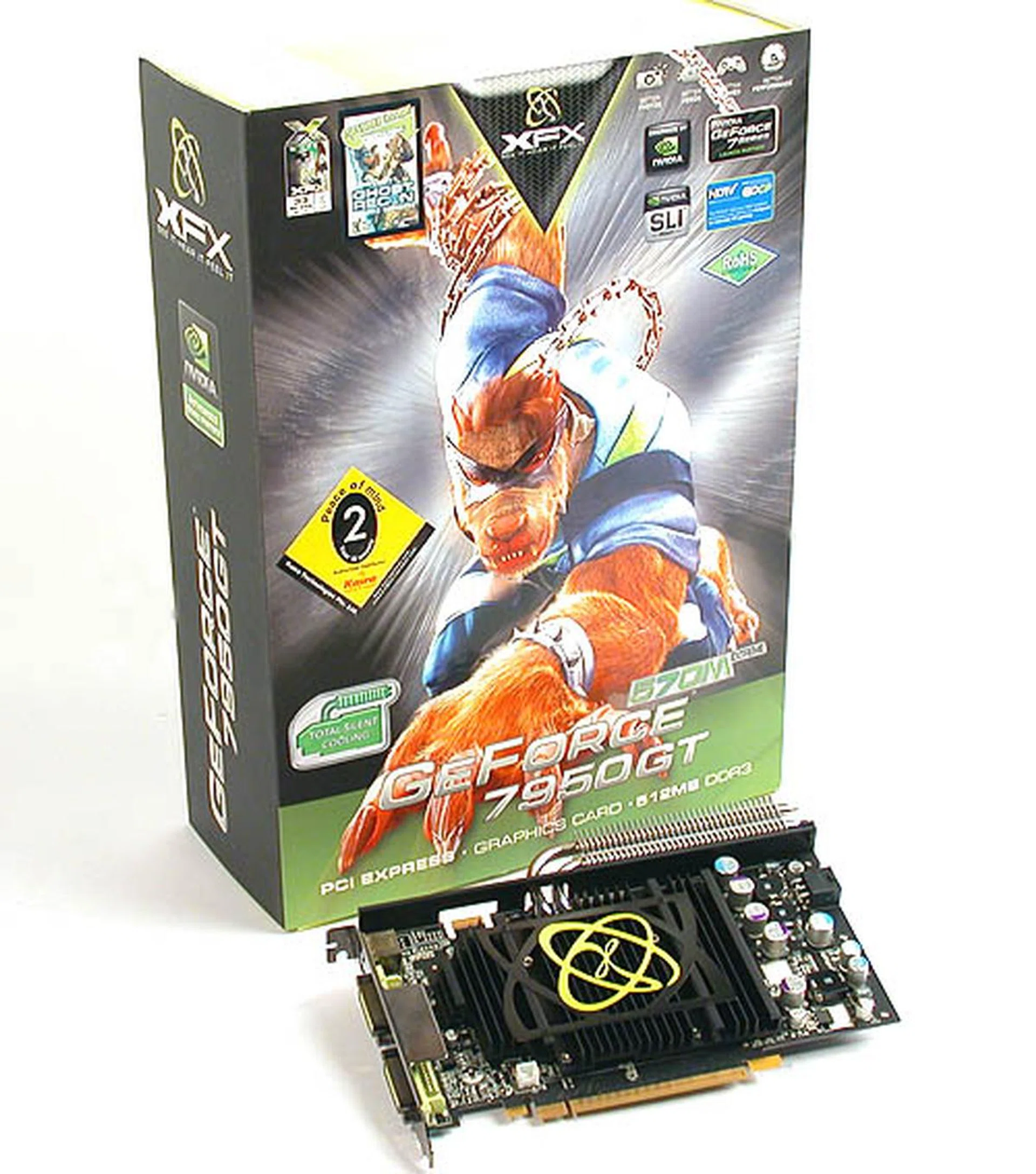
Looking rather similar to XFX's packaging for its GeForce 7950 GX2, the major differences lie in the modest stickers which proclaim its passive cooling and the inclusion of the latest Tom Clancy line of first person squad shooters.
XFX's Fanless Wonder
As the big brother spawned from the original GeForce 7900 GT, the new GeForce 7950 GT has the same GPU architecture as the GeForce 7900 GT. Of course, the new arrival has been bolstered with another 256MB of DDR3 memory for a total of 512MB. Clock speeds for both the core and the memory have been increased to 550MHz and 1400MHz DDR respectively on the reference models. Despite these tweaks, the actual performance gains over the GeForce 7900 GT have probably been less significant than most consumers would have expected. However, given that production of the GeForce 7900 GT will halt, leaving the GeForce 7900 GS, there should be a distinct gap between the two, just as NVIDIA has intended.
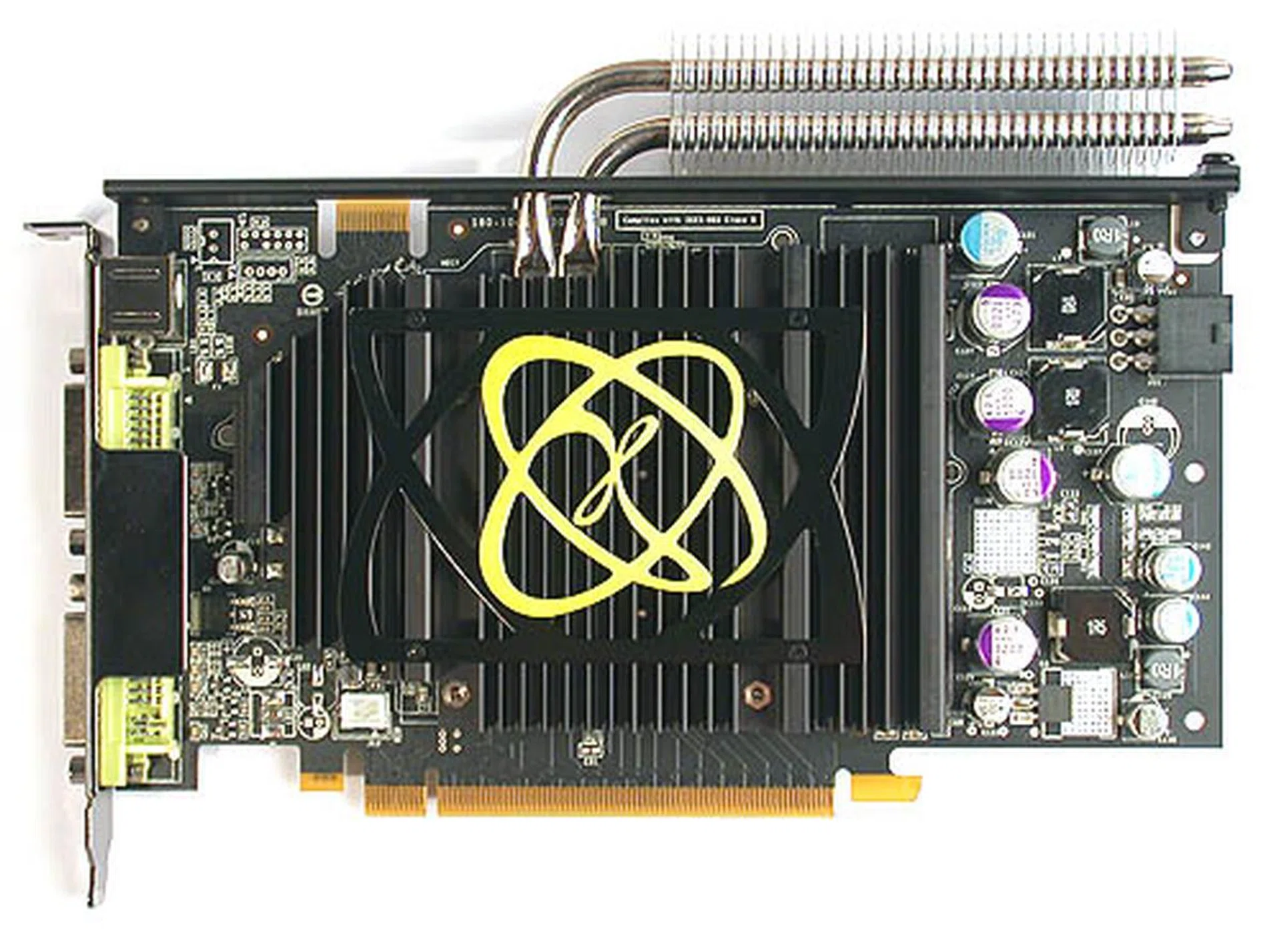
We all know from our elementary science lessons that the color black is an excellent radiator.
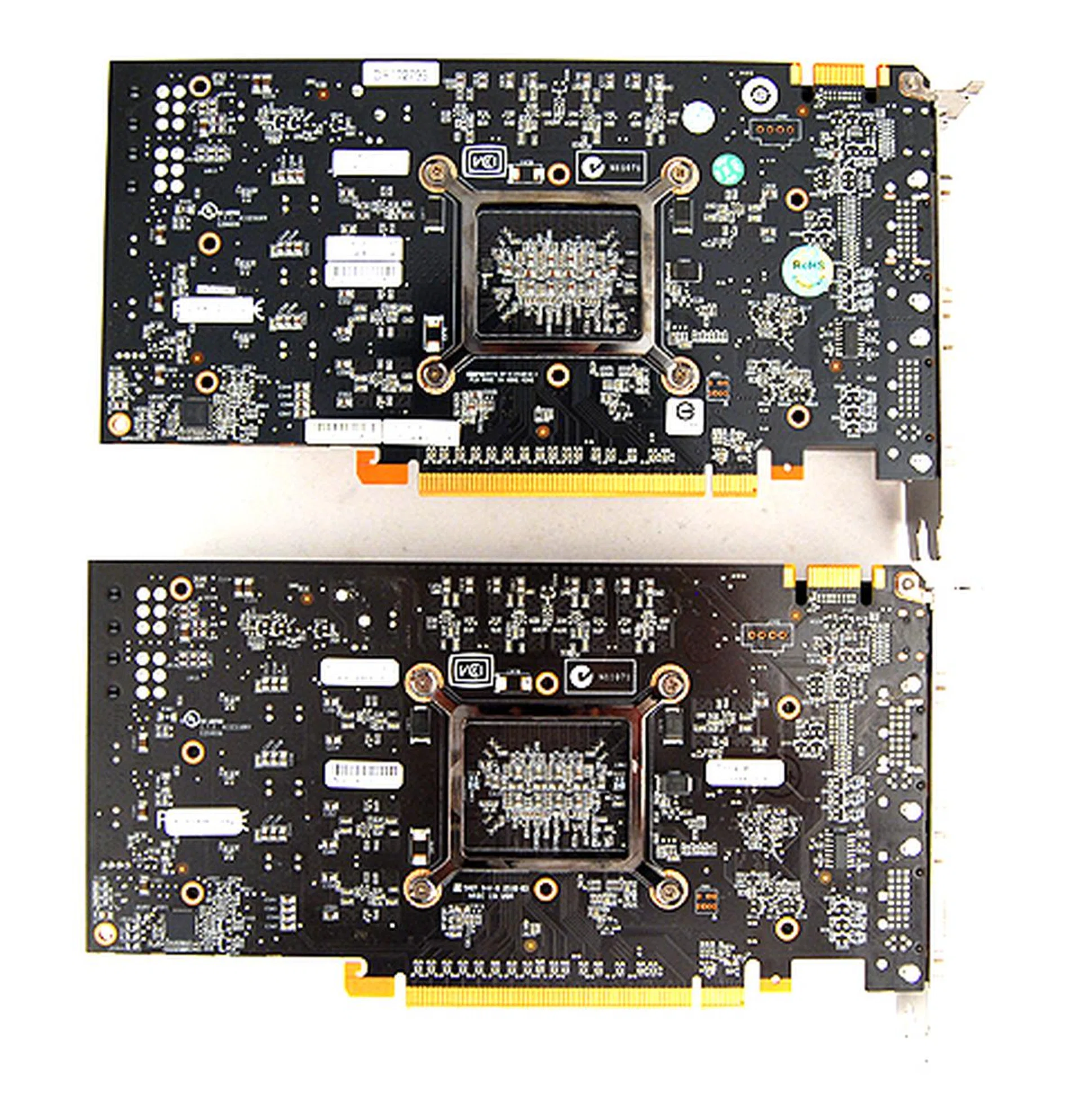
The fins actually take up the upper top portion of the back of the card but there is more than enough clearance.
XFX goes a step or two further with its GeForce 7950 GT 570M Extreme. As its name suggests, the 570M refers to its core clock speed of 570MHz, a mild bump up from the default 550MHz. The memory also gets a similar treatment, reaching 1460MHz DDR compared to the standard 1400MHz DDR. However, what should attract the attention of most consumers should be the black passive cooler adorning the black PCB of the XFX GeForce 7950 GT 570M Extreme.
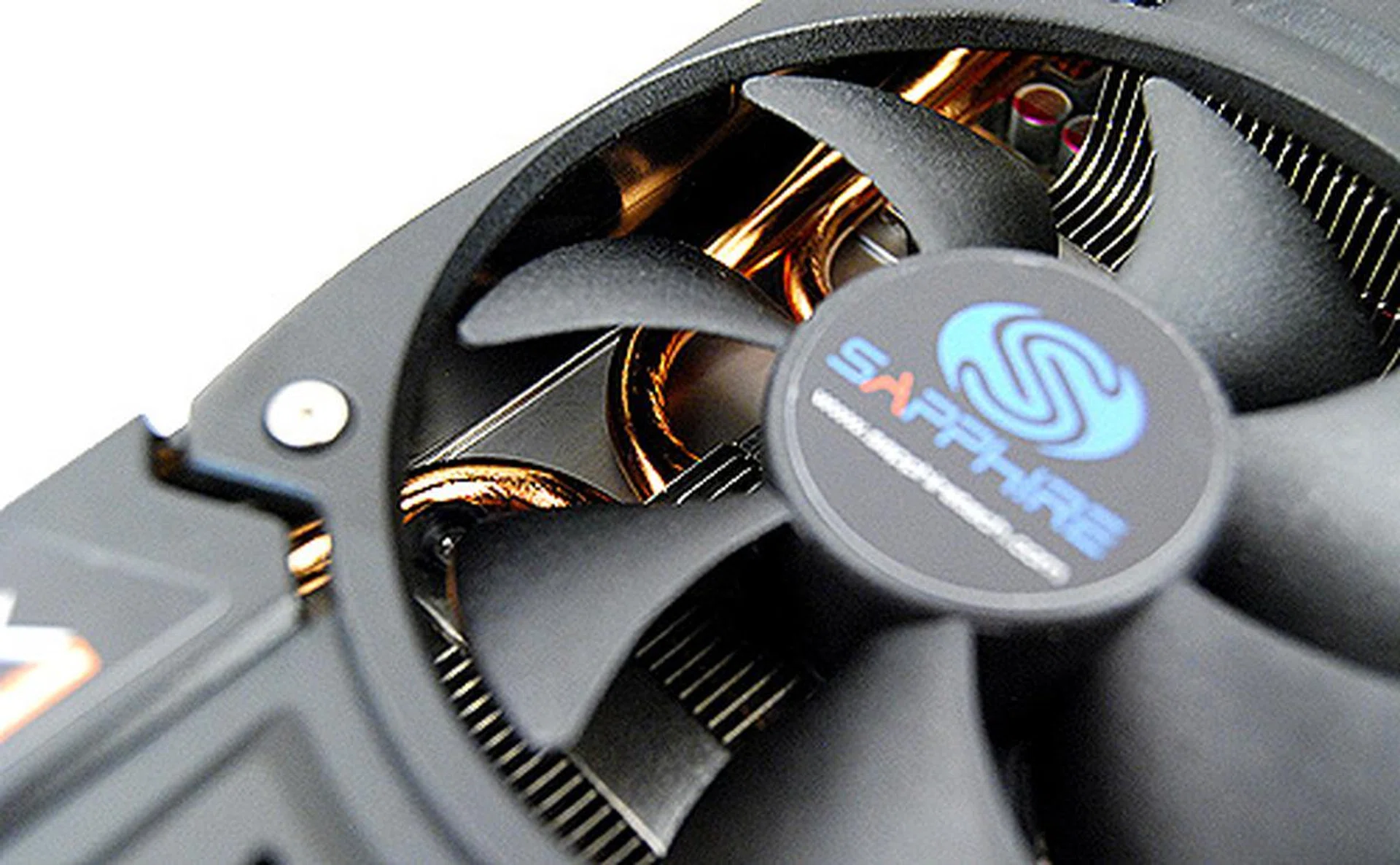
The XFX logo on its cool black passive heatsink.
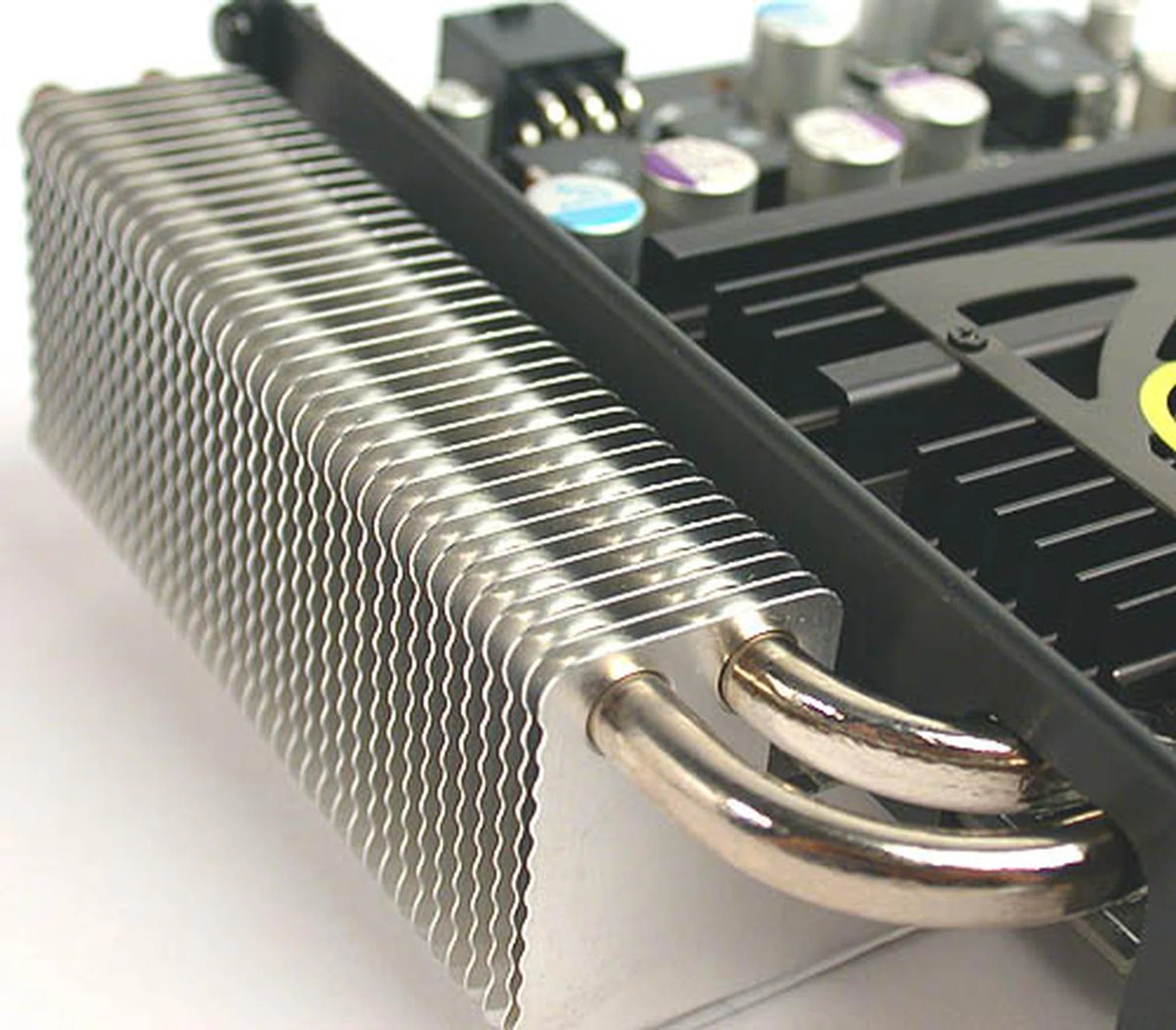
The radiating aluminum fins are located at the top of the card to avoid clashing with your motherboard components, similar to what we have seen from ASUS. A metal support bar is also needed to prevent its weight from warping the card.
Such passive coolers are common fixtures on less powerful graphics processor but it's probably the first time we have seen it on a high-end card like the GeForce 7950 GT. After all, we are talking about base temperatures of more than 60 degrees on a reference GeForce 7950 GT. Is XFX taking a big risk by offering a passively cooled version? We'll know soon enough in our temperature testing section but meanwhile, we couldn't help but admire the solid construction of the cooler. With a supporting bar to stabilize the PCB, the cooler is securely attached to the card despite the inherently top-heavy aluminum radiator. Heat pipes are used to transfer heat from the core to the fins, though the memory modules are not cooled in this arrangement.
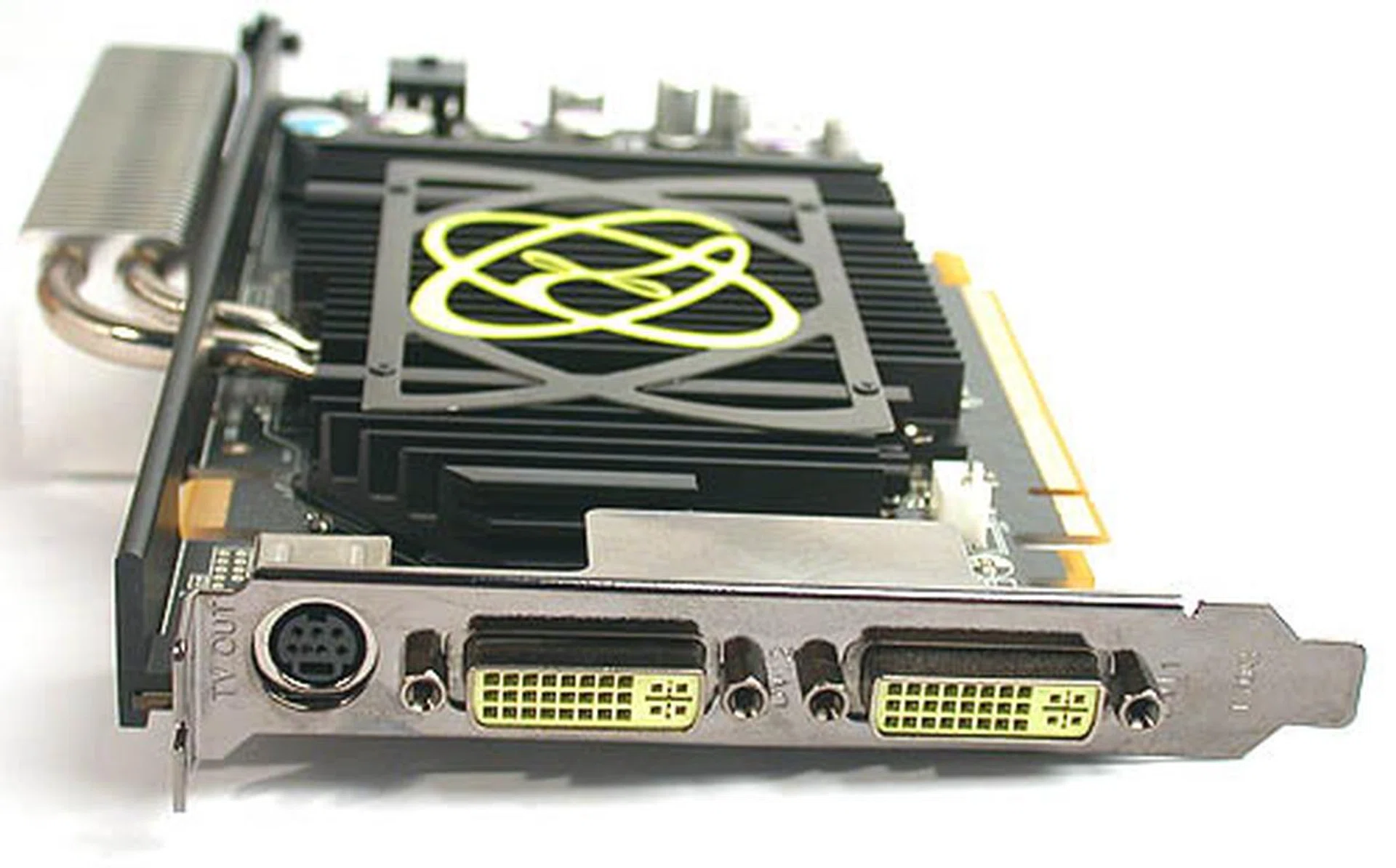
These DVI outputs are in XFX's trademark lime green and most importantly, are certified HDCP ready.
XFX has also provided a game worthy of its enthusiasts and gaming image. A recent best-selling game by the way of Tom Clancy's Ghost Recon Advanced Warfighter is included in the bundle, which is devoid of other software applications besides the sole game and the graphics drivers. This is not surprising given XFX's history and is probably the right choice for its target audience. The other accessories found in the bundle are:
- 2 x DVI-to-VGA adaptors
- 9-pin mini-DIN to Component dongle
- 6-pin PCIe to 4-pin Molex power plug converter
- S-Video extension cable
- Driver CD
- Quick Installation Guide
- User Manual
- Tom Clancy's Ghost Recon Advanced Warfighter (full game)
Test Setup
To test the XFX GeForce 7950 GT 570M Extreme, we had a system built around a MSI K8N Diamond Plus motherboard and installed with an AMD Athlon 64 FX-55 (2.6GHz) processor. This was supplemented with 2 x 512MB Kingston low latency DDR400 memory running in dual channel mode. A Seagate 7200.7 SATA hard drive with Windows XP Professional installed (Service Pack 2 and DirectX 9.0c) completed the system.
The graphics cards and the respective drivers used in the comparison are as follows:
- XFX GeForce 7950 GT 570M Extreme (ForceWare 91.47)
- NVIDIA GeForce 7950 GT 512MB (ForceWare 91.47)
- NVIDIA GeForce 7900 GS 256MB (ForceWare 91.47)
- NVIDIA GeForce 7900 GT 256MB (ForceWare 91.47)
- Palit GeForce 7900 GT Sonic 512MB (ForceWare 84.21)
- NVIDIA GeForce 7900 GTX 512MB (ForceWare 84.21)
- ATI Radeon X1900 XT 512MB (Catalyst 6.8)
Since we had on hand a pair of XFX GeForce 7950 GT 570M Extreme graphics cards, we decided to throw in some SLI tests to spice things up. Here are the additional cards for the SLI sections and the drivers used:
- XFX GeForce 7950 GT 570M Extreme - SLI (ForceWare 91.47)
- NVIDIA GeForce 7900 GTX - SLI (ForceWare 91.31)
- NVIDIA GeForce 7950 GX2 (ForceWare 91.29)
- NVIDIA GeForce 7900 GT - SLI (ForceWare 84.21)
And finally, the list of benchmarks tested:
- Futuremark 3DMark05 (ver. 120)
- Futuremark 3DMark06 (ver. 102)
- Tom Clancy's Splinter Cell: Chaos Theory
- F.E.A.R
- Chronicles of Riddick: Escape from Butcher Bay
- Quake 4
Results - 3DMark05 Pro & 3DMark06
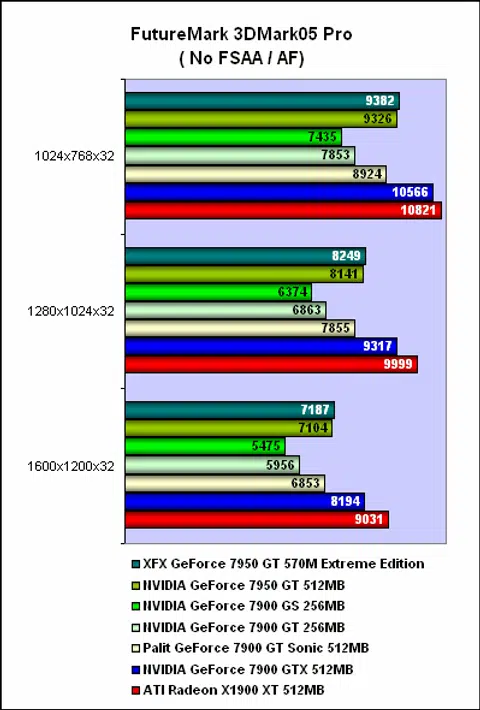
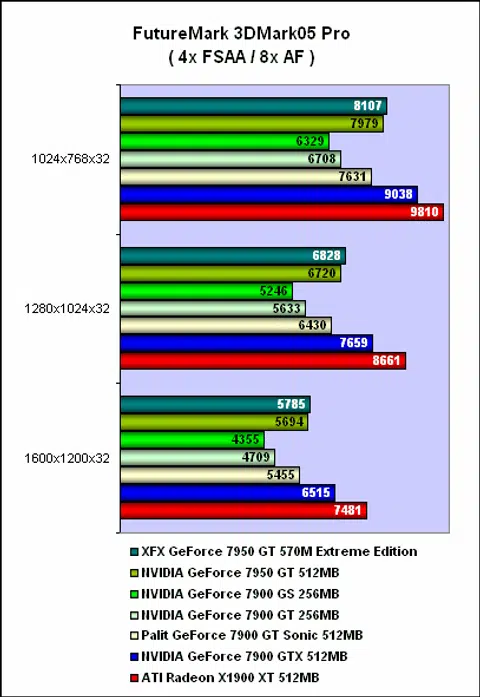
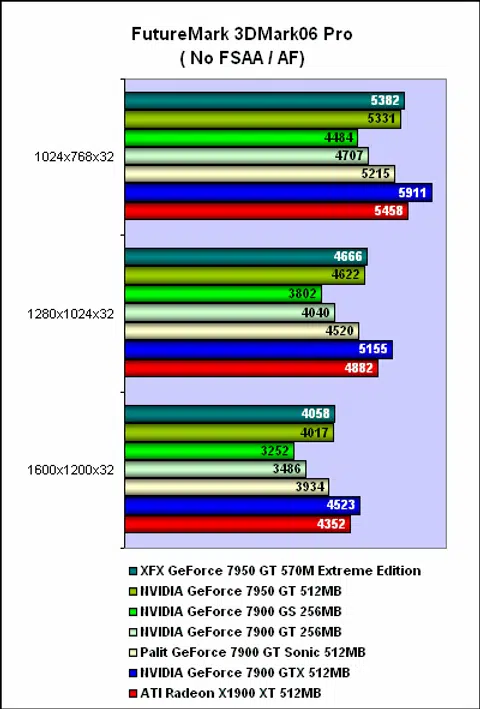
As one might expect from the mild overclocking, the scores for 3DMark05 and 3DMark06 grew only marginally by around 1%. Hardly worth it you may think and we agree wholeheartedly with that. ATI does extremely well in 3DMark05, with the Radeon X1900 XT 512MB leading the pack. Even in 3DMark06, where it wasn't as skewed in favor of ATI, the Radeon X1900 XT held the upper hand. Therefore, similar to our conclusion regarding the GeForce 7950 GT, the Radeon X1900 XT, especially in its 256MB guise, should be the closest competitor in terms of performance and value.
SLI Results
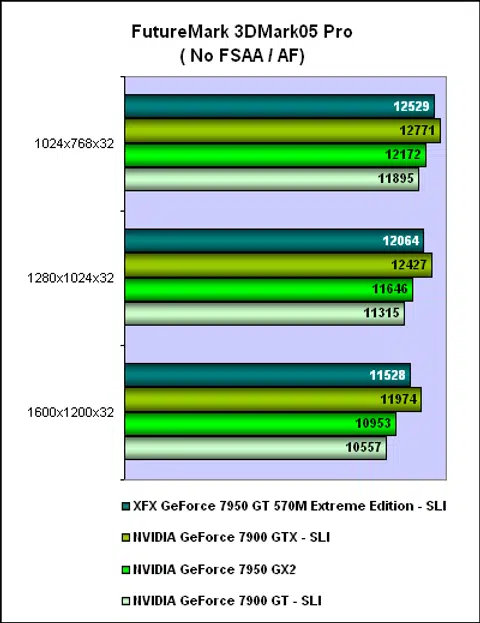
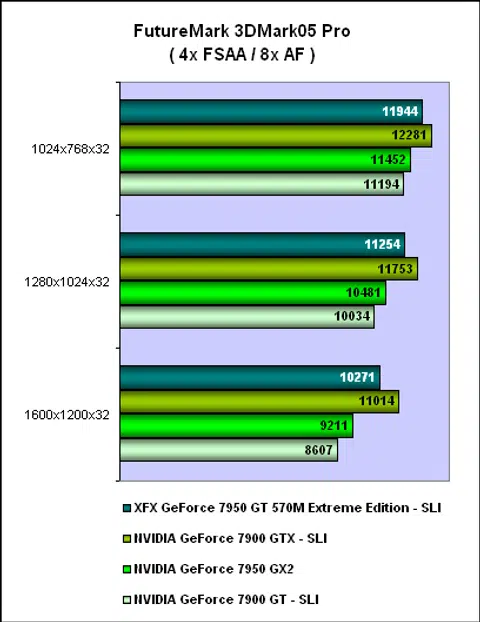
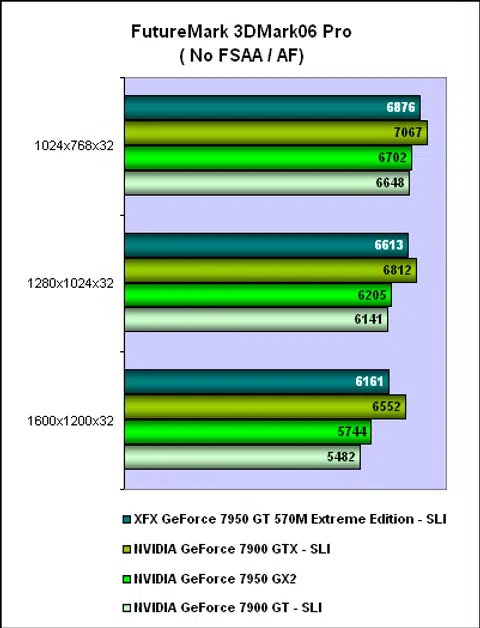
With two XFX GeForce 7950 GT 570M Extreme, our system instantly felt much more warmer, even with a healthy gap between the two cards. As the SLI scores show, the higher clock speed of the GeForce 7950 GT meant that it beat the GeForce 7950 GX2 but by rather modest margins too.
Results - Splinter Cell: Chaos Theory & F.E.A.R (DirectX 9 Benchmarks)
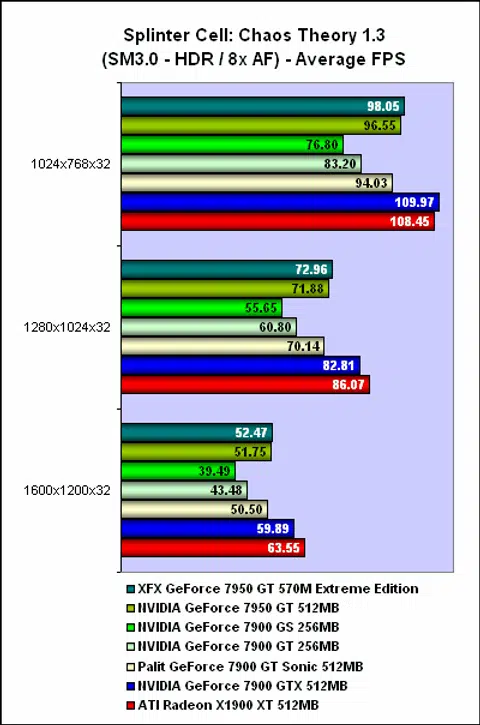
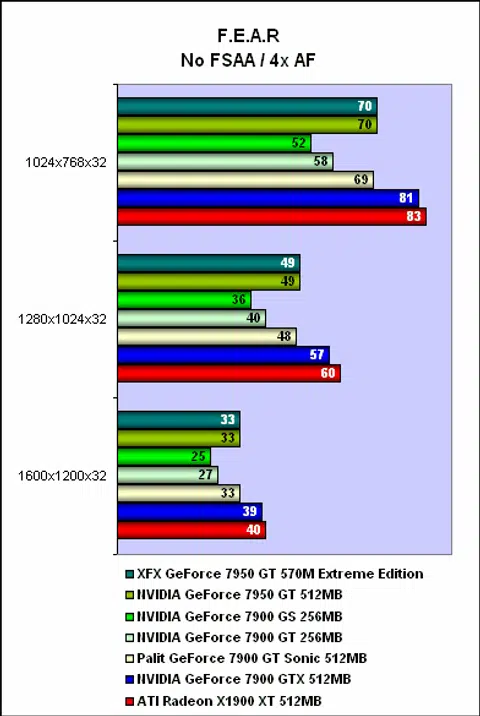
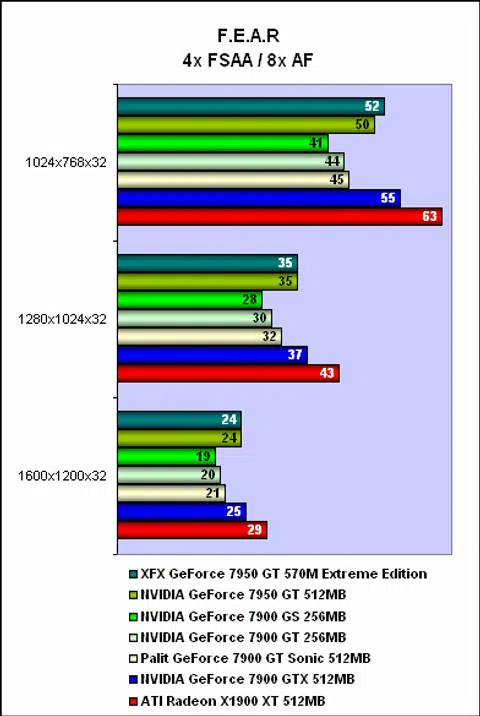
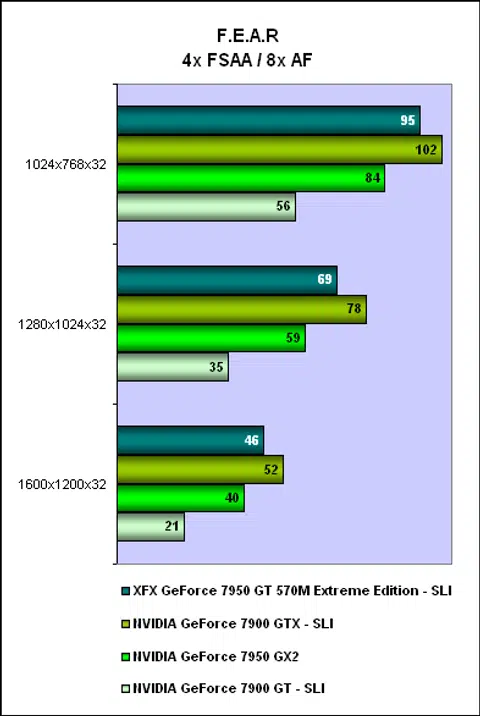
The minor improvement that we noticed in 3DMark was similarly observed in Splinter Cell. A single frame or less separates the two cards in all the resolutions tested and again the Radeon X1900 XT 512MB emerged as comfortable winners. F.E.A.R was representative of the ineffectual overclocking by XFX as for all but one resolution, the XFX was on par with the reference GeForce 7950 GT. If you are hoping for greatly improved performance, get a GeForce 7900 GTX instead.
SLI Results
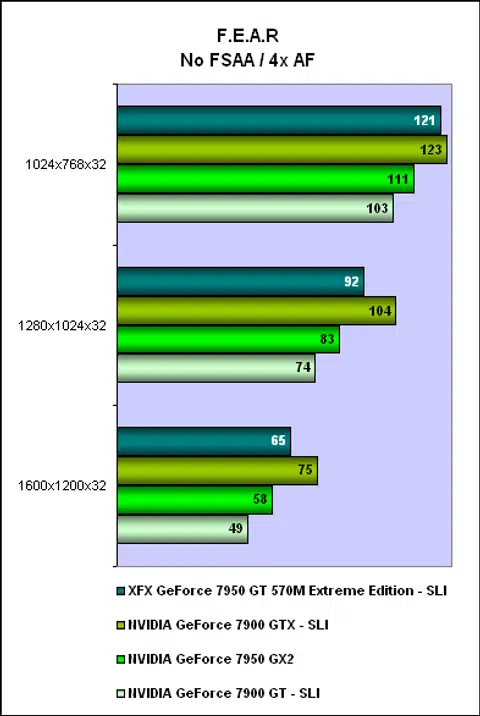
The SLI scores for F.E.A.R were quite predictable, following closely the trend we had observed in 3DMark earlier. The XFX SLI configuration was nicely sandwiched between the GeForce 7900 GTX SLI and GeForce 7950 GX2. Given the almost negligible improvement due to the overclocking, one may expect the XFX scores here to be very similar to that of a standard GeForce 7950 GT SLI setup.
Results - Chronicles of Riddick (OpenGL SM2.0+ Benchmark)
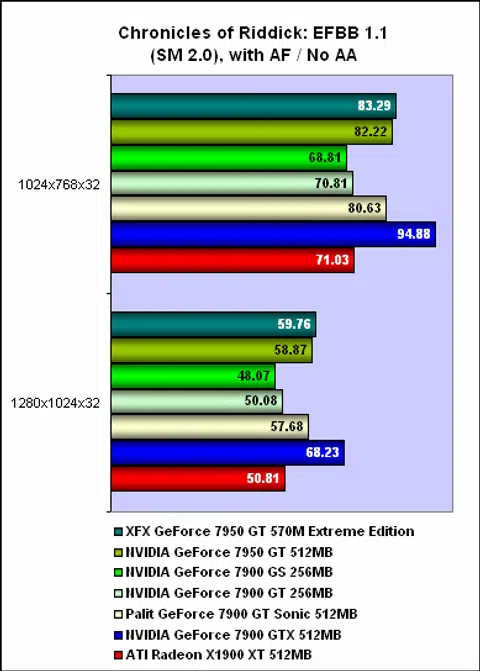
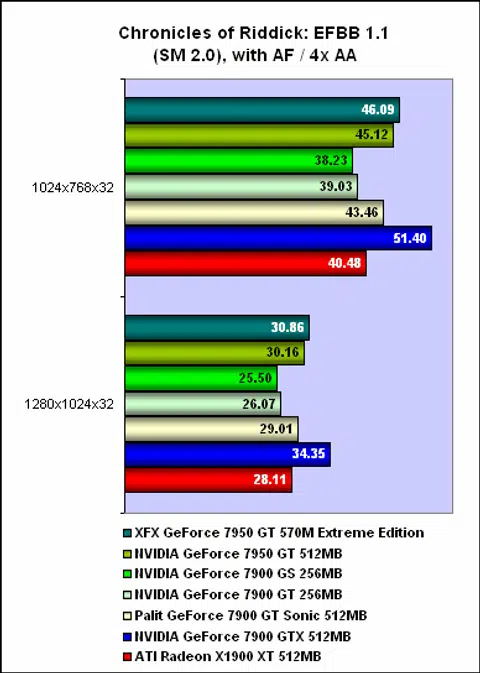
NVIDIA got back some of its pride in the OpenGL based Chronicles of Riddick as the Radeon X1900 XT performed quite woefully here. At best, the Radeon was on par with the GeForce 7900 GT, while XFX's overclocked GeForce 7950 GT ended up in second place behind the GeForce 7900 GTX, which had a clear lead. This game is probably one of the better examples of how ATI's recent driver optimizations seem to extend only to the bigger OpenGL titles like Quake 4 and not to all games using OpenGL. Again, the minute performance difference between the overclocked XFX and the standard GeForce 7950 GT is almost not worth mentioning.
Results - Quake 4 (OpenGL SM2.0+ Benchmark)
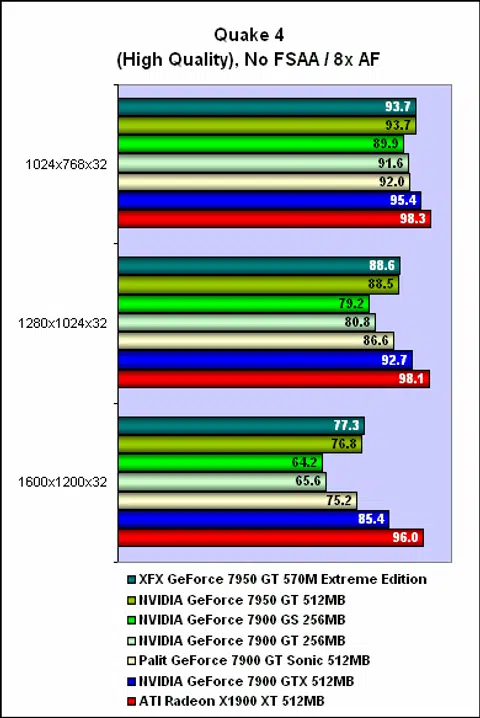
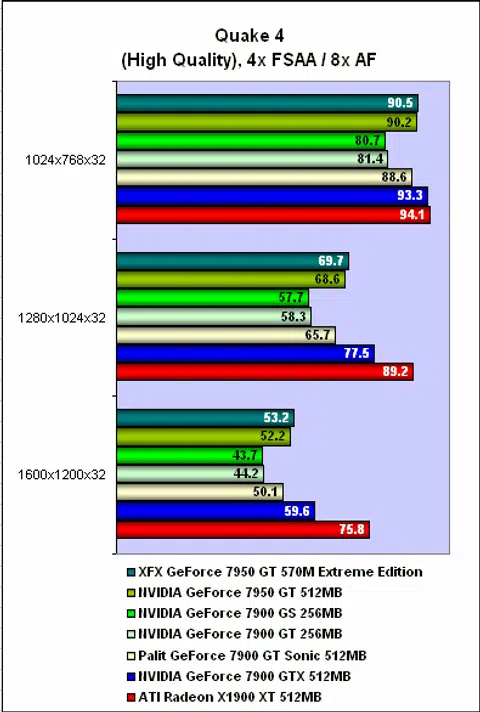
Finally, in Quake 4 we also failed to find a convincing case for the overclocking on the XFX GeForce 7950 GT 570M Extreme. The margins were razor thin between the XFX and the reference card and we doubt that anyone could discern between the two while in-game. Thanks to the incremental good work done by ATI, the Radeon X1900 XT 512MB was now the fastest card here in Quake 4, provided you have installed the latest Catalyst drivers of course.
SLI Results
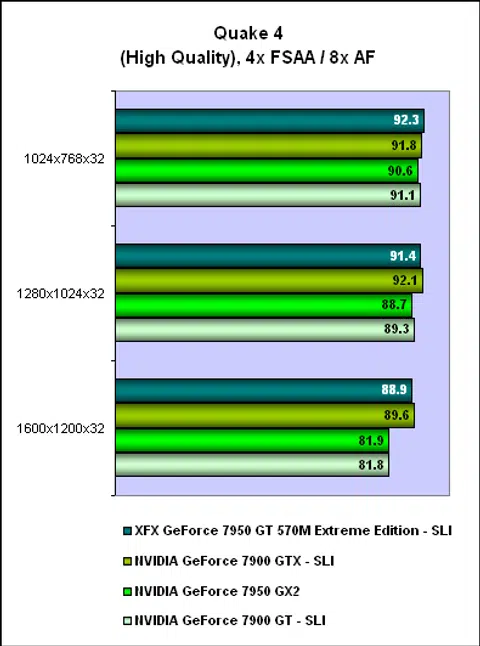
Even with settings like antialiasing enabled, the SLI setups breezed through the Quake 4 benchmark. Only at 1600 x 1200 do we find the XFX and the GeForce 7900 GTX pulling away from the rest. If you have the cash for such a setup, you might as well try more intensive settings to fully stress your system. We would have done more of those tests to show you the results, but lets not stray from the fact that this is a review of the XFX graphics card and not of what a dual card GeForce 7950 GT setup has to offer. We'll reserve that in another forthcoming article.
Temperature Testing
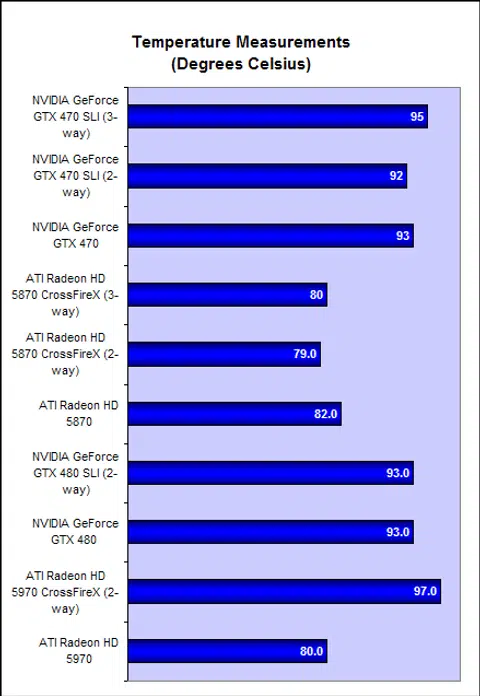
We were glad to report that passive cooler not withstanding, the XFX was only slightly warmer than the reference fan-based version. Obviously the heat pipes are doing their jobs of diverting the heat to the aluminum fins. The key to this is the airflow of the casing and whether your environment has air-conditioning like our lab.
Overclocking
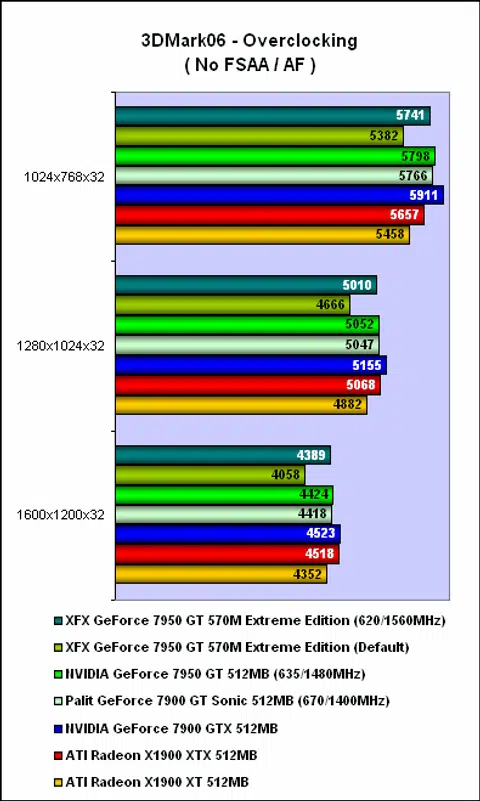
Surprisingly, we could push the reference card further than we managed with the XFX. The core could only reach 620MHz and it was this factor that meant the overclocked reference card outperforming the XFX in 3DMark06. Despite the memory hitting 1560MHz DDR, the core clock proved to be the decisive factor, as shown by the Palit faring better than the XFX, due to its 670MHz core. The heat of the passively cooled XFX may be culpable for the lackluster core overclock. Despite the overall decent overclock, we wouldn't recommend doing so on passively cooled products, especially a high-end card such as this.
Conclusion
NVIDIA's move to split its successful high-end GeForce 7900 GT into two new separate models was driven in part by ATI's changes to its lineup. The new 256MB version of the Radeon X1900 XT arguably poses the stiffest challenge in both the performance and price stakes. With its price dropping to 240 US dollars recently , the Radeon X1900 XT 256MB is now right in between the two NVIDIA rivals. The US$199 GeForce 7900 GS may benefit from its lower pricing as its performance is almost on par with the GeForce 7900 GT. But the US$299 GeForce 7950 GT may struggle to win over the discerning enthusiast.
The saving grace for NVIDIA probably lies in the seemingly more plentiful supply of GeForce 7900 GS and GeForce 7950 GT cards. Our informal check of online retailers finds the number of vendors offering the GeForce 7950 GT outnumbering those hawking the Radeon X1900 XT 256MB. There are also other advantages to NVIDA in terms of temperature, noise output, power consumption and overall form factor. However, going just by performance figures, it is another story.
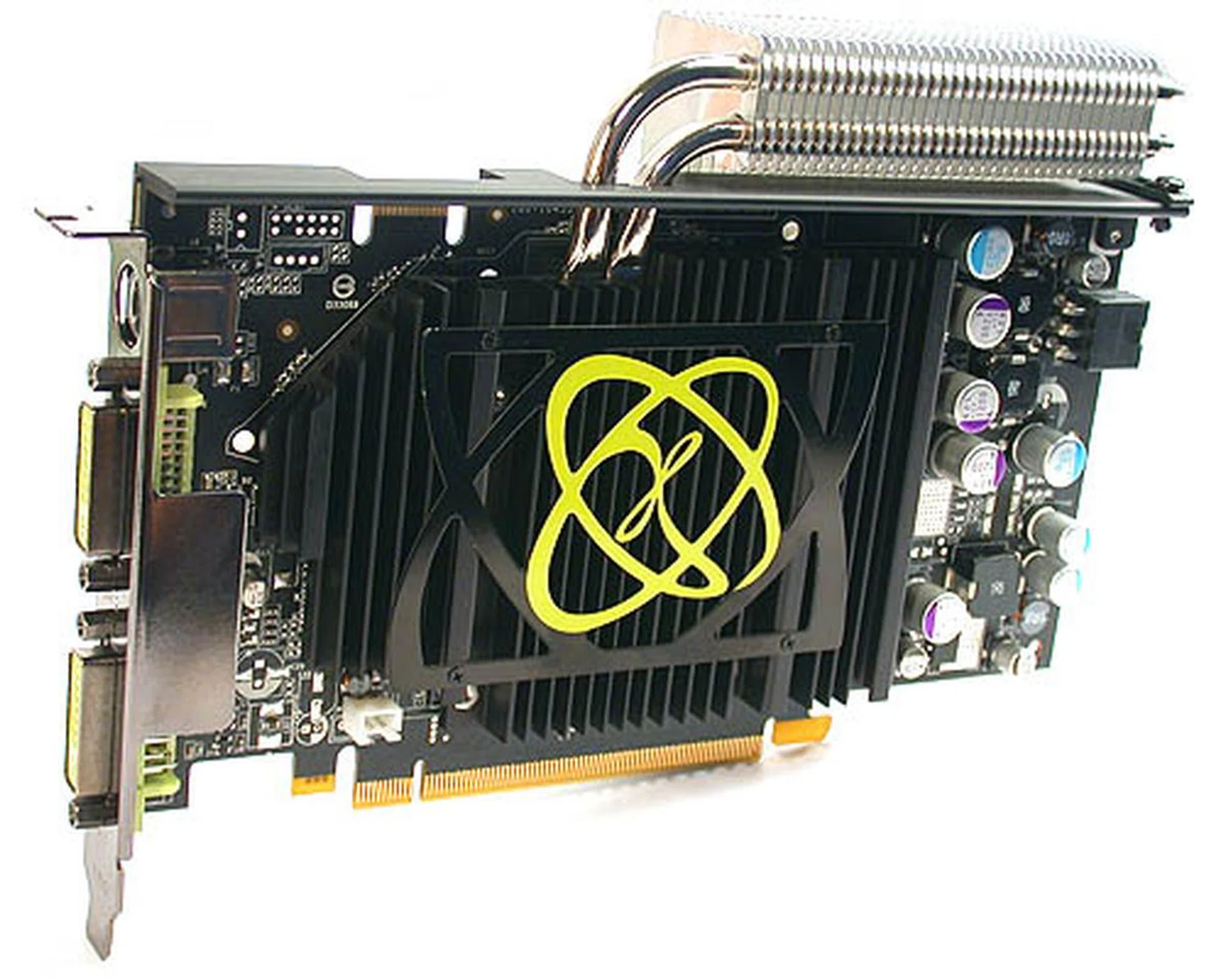
XFX just about pulls it off with this passive and overclocked GeForce 7950 GT.
According to our benchmarks for the overclocked XFX GeForce 7950 GT 570M Extreme, the Radeon X1900 XT 512MB was leagues ahead of the opposition in most benchmarks. That is only natural since the Radeon X1900 XT 512MB was meant to compete against the flagship GeForce 7900 GTX and its class. For most games and settings, we feel that the 256MB version should exert the same performance authority as the 512MB unit over the GeForce 7950 GT. Meanwhile, the minor speed boost from XFX's out of the box overclocking did little to distinguish it from the typical GeForce 7950 GT, which may partly be due to the reference card being highly tweaked. Instead, it is the rather daring move on XFX's part to make the graphics card passively cooled that should differentiate it from the rest. We must also admit that the lime green and black color scheme is a refreshing departure from the usual green NVIDIA boards. Despite the lack of LED lights, the XFX should still handily qualify as eye candy to most consumers.
Of course, the main advantage of the passive cooling is in its total absence of noise. This is however balanced by the slower heat dissipation of such a cooler. Adequate airflow is a must for this graphics card as we naturally found that temperatures naturally were higher than the reference card, though fortunately not excessively so. The readings we observed were within the safe limits though the heat is probably holding back our overclocking.
Finally, as you may have expected, eliminating the noise along with official overclocking means that the XFX GeForce 7950 GT 570M Extreme is not cheap. Estimated at around US$370, this compares quite unfavorably with the US$299 price of the standard clocked GeForce 7950 GT. Then again, NVIDIA did mention that we can expect the exotic versions to be priced as much as up to US$350. The bundled game title, one of the newest games available now, may help to soften the blow but with no other software applications, it may not be sufficient by itself to tilt the balance. Against the ATI Radeon X1900 XT 256MB, the XFX does not provide value for its graphical performance. With the excessive pricing being the bigger dampener, the XFX GeForce 7950 GT 570M Extreme may only find its way to niche users having high priority for absolutely silent high-end graphics cards. In fact, this XFX model is the fastest all-silent graphics card at the moment and it is little wonder why it commands the premium.
Our articles may contain affiliate links. If you buy through these links, we may earn a small commission.