
The Striker - NVIDIA's New GeForce GTX 275
Never one to sit back, NVIDIA responded swiftly with their new GeForce GTX 275 model to counter the Radeon HD 4890, which was only released earlier today. Boasting specifications that lie between a GeForce GTX 285 and GTX 260 Core 216, the battle between green and red just got a little hotter.

Lightning Quick Response
After the setback inflicted upon them by ATI's Radeon 4800 series, NVIDIA has been slowly but surely picking themselves up. Sure, they were left floored by the sheer value-for-money proposition that ATI was touting, but like real men, they licked their wounds and soldiered on.
Since then, they've been hard at work. Their GeForce GTX 295 stole the speed king crown from ATI's Radeon HD 4870 X2 and with a new pricing strategy and improved products in the form of GeForce GTX 285 and GeForce GTX 260 Core 216 (GTX 260+), they gave gamers looking for high-end graphics solutions something to really think about. And luckily for them, their choices of high-end graphics card have just become a little more varied, because NVIDIA is releasing the GeForce GTX 275.

At its heart, the new GeForce GTX 275 is an overclocked version of the single GPU that makes up the GeForce GTX 295.
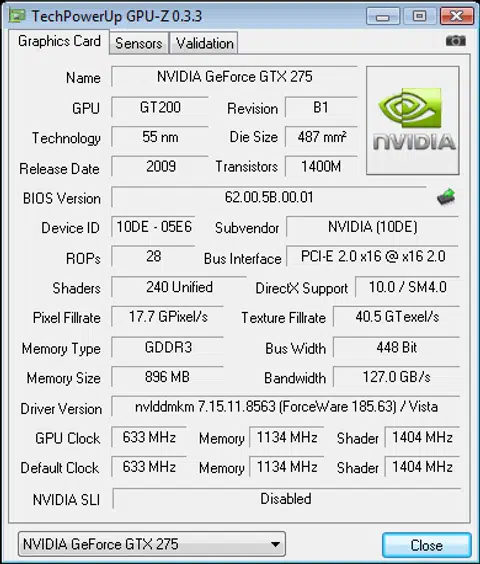
Like a never-ending game of cat and mouse, the GeForce GTX 275 is NVIDIA' counter to the , which we earlier reviewed. As its name implies, it fills the gap between the awesome (but pricey) GTX 285 and the GTX 260+. It has 240 stream processors and a 448-bit memory bus width; its core is clocked at 633MHz, whereas memory and shaders are clocked at 2268MHz DDR and 1404MHz respectively. In a nutshell, the new GTX 275 is the lovechild of the GTX 285 and GTX 260+. What's very interesting is the nice US$249 price point and we'll soon see how this pans out.
Before we put it to the test, do have a quick look at its technical specifications and see how it stands up against comparable competitive SKUs.
Model | NVIDIA GeForce GTX 275 896MB | ATI Radeon HD 4890 1GB | ATI Radeon HD 4870 512MB | ATI Radeon HD 4850 512MB | NVIDIA GeForce GTX 260 Core 216 896MB | NVIDIA GeForce GTX 285 1GB |
Core Code | GT200 | RV790 | RV770 | RV770 | GT200 | GT200 |
Transistor Count | 1400 million | 959 million | 956 million | 956 million | 1400 million | 1400 million |
Manufacturing Process | 55nm | 55nm | 55nm | 55nm | 65nm | 55nm |
Core Clock | 633MHz | 850MHz | 750MHz | 625MHz | 576MHz | 648MHz |
Stream Processors | 240 Steam Processors | 800 Stream processing units | 800 Stream processing units | 800 Stream processing units | 216 Stream Processors | 240 Stream Processors |
Stream Processor Clock | 1404MHz | 850MHz | 750MHz | 625MHz | 1242MHz | 1476MHz |
Texture Mapping Units (TMU) or Texture Filtering (TF) units | 80 | 40 | 40 | 40 | 72 | 80 |
Raster Operator units (ROP) | 16 | 16 | 16 | 16 | 28 | 32 |
Memory Clock | 2268MHz GDDR3 | 3900MHz GDDR5 | 3600MHz GDDR5 | 2000MHz GDDR3 | 1998MHz GDDR3 | 2484MHz GDDR3 |
DDR Memory Bus | 448-bit | 256-bit | 256-bit | 256-bit | 448-bit | 512-bit |
Memory Bandwidth | 130.4GB/s | 124.8GB/s | 115.2GB/s | 64GB/s | 111.9GB/s | 159GB/s |
PCI Express Interface | PCIe ver 2.0 x16 | PCIe ver 2.0 x16 | PCIe ver 2.0 x16 | PCIe ver 2.0 x16 | PCIe ver 2.0 x16 | PCIe ver 2.0 x16 |
Molex Power Connectors | 2 x 6-pin | 2 x 6-pin | 2 x 6-pin | 6-pin | 2 x 6-pin | 2 x 6-pin |
Multi GPU Technology | SLI | CrossFireX | CrossFireX | CrossFireX | SLI | SLI |
DVI Output Support | 2 x Dual-Link | 2 x Dual-Link | 2 x Dual-Link | 2 x Dual-Link | 2 x Dual-Link | 2 x Dual-Link |
HDCP Output Support | Yes | Yes | Yes | Yes | Yes | Yes |
Street Price | US$249 | US$260 | ~US$219 | ~US$159 | ~US$229 | ~US$359 |
The NVIDIA GeForce GTX 275
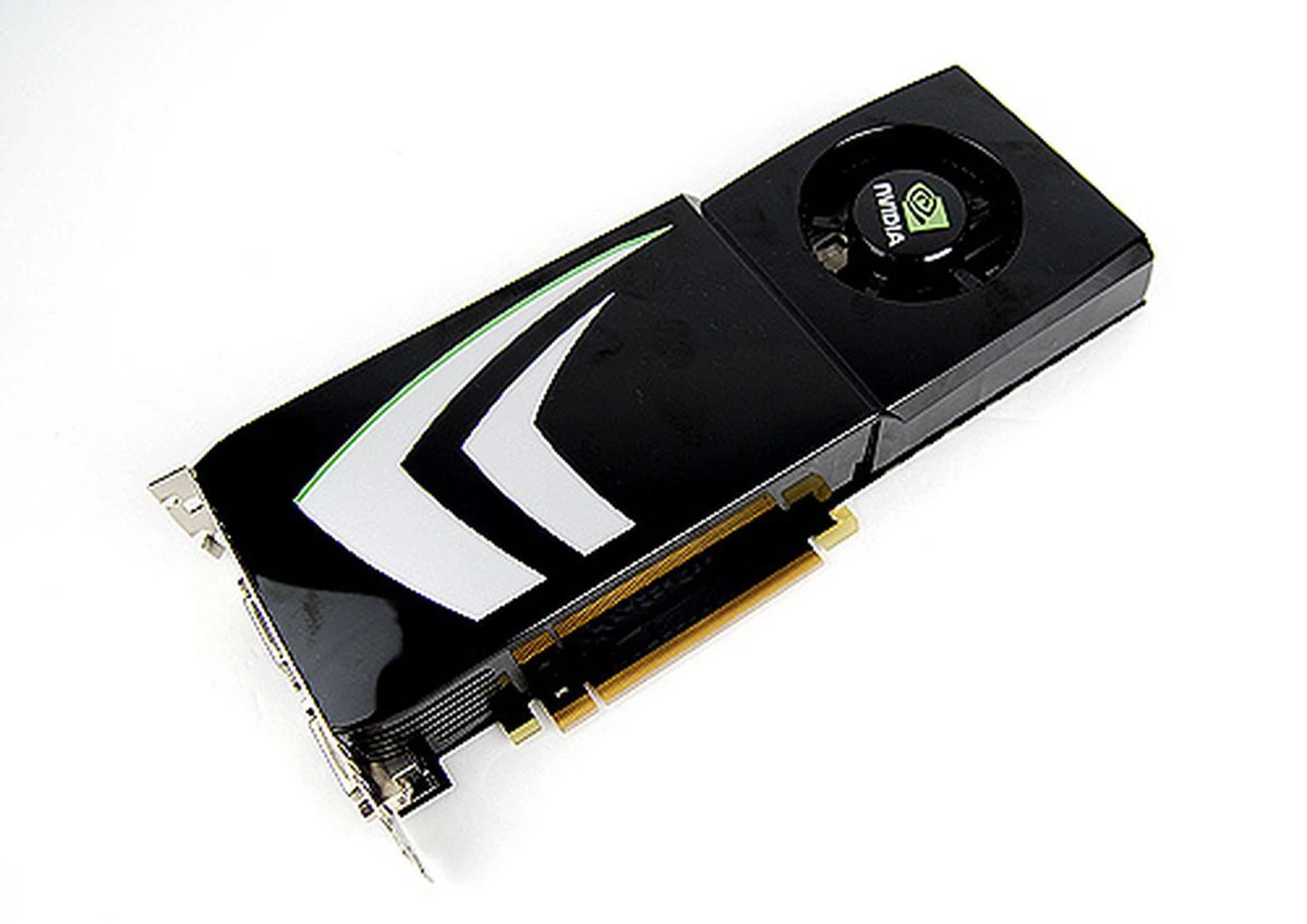
Like most reference high-end cards from NVIDIA, our reference GeForce GTX 275 is about as interesting as reading a dictionary. It comes with the standard big, black, boxy cooler that we're all familiar with, and really, looks no different from any other GeForce GTX 285 or GTX 260 cards we have.
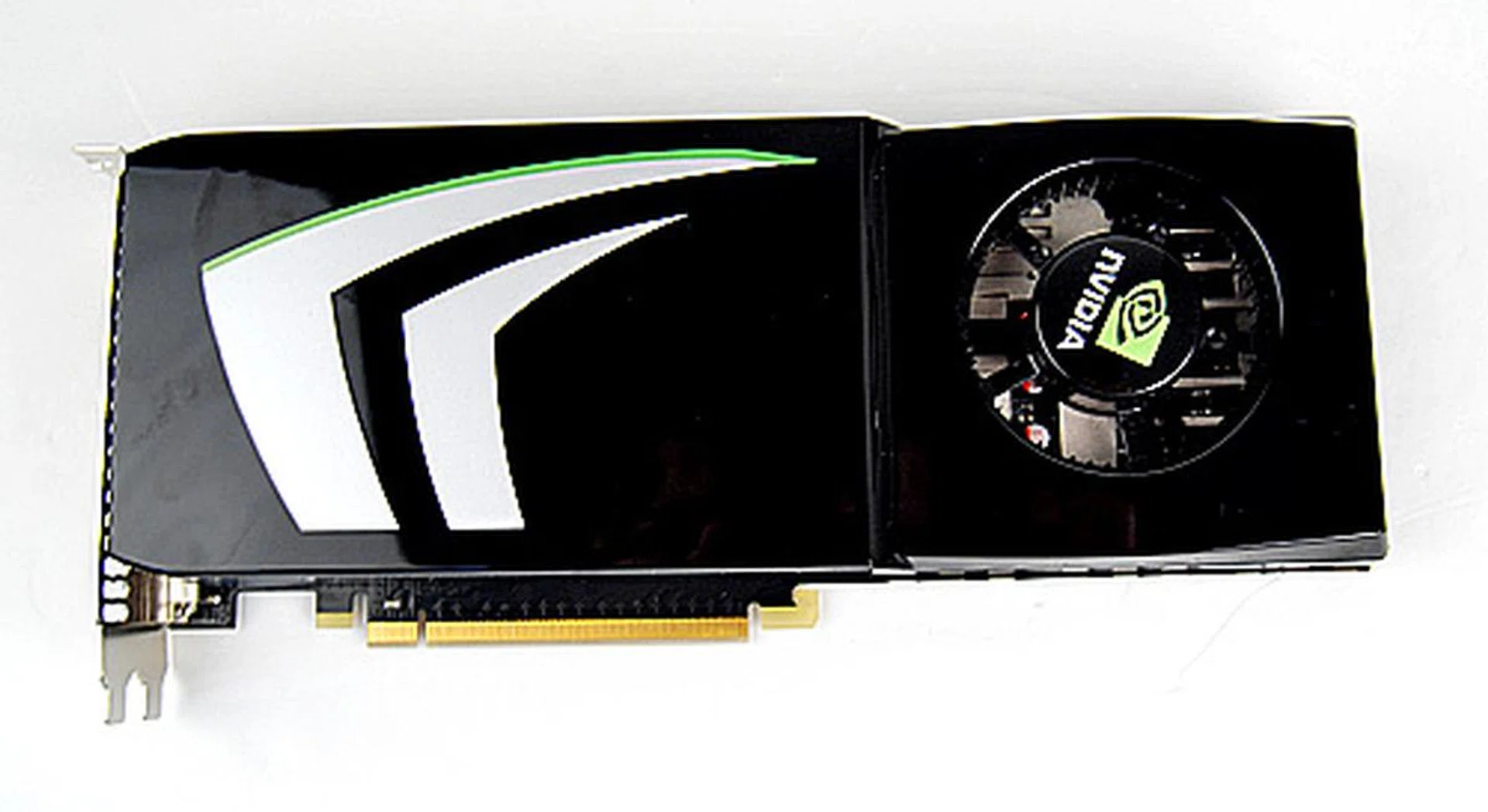
The GeForce GTX 275 comes in NVIDIA's standard reference form, so there's really nothing interesting about its looks.
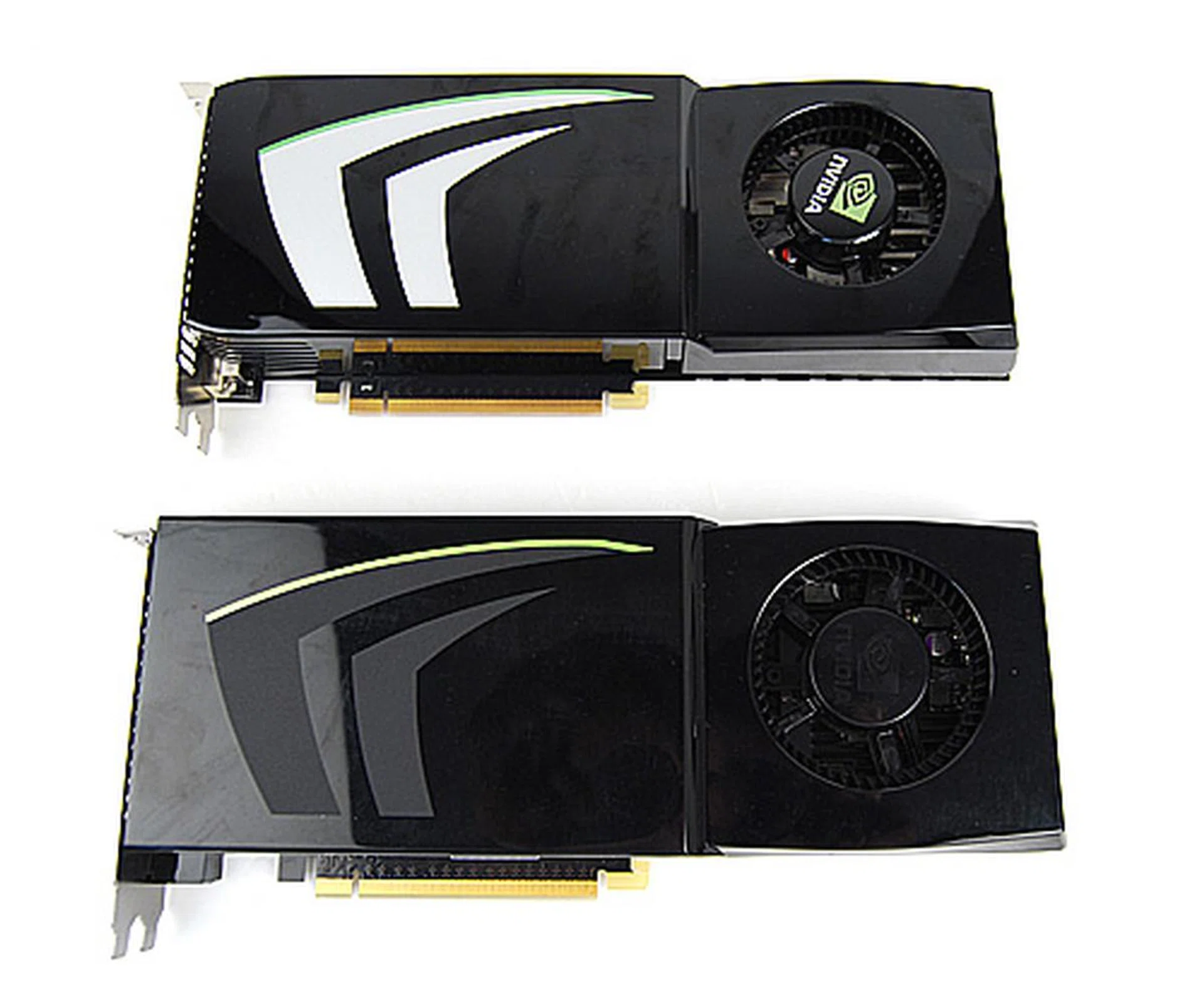
As is the case with high-end reference NVIDIA graphics cards, they all look identical to one another. Can you guess what's the other card?
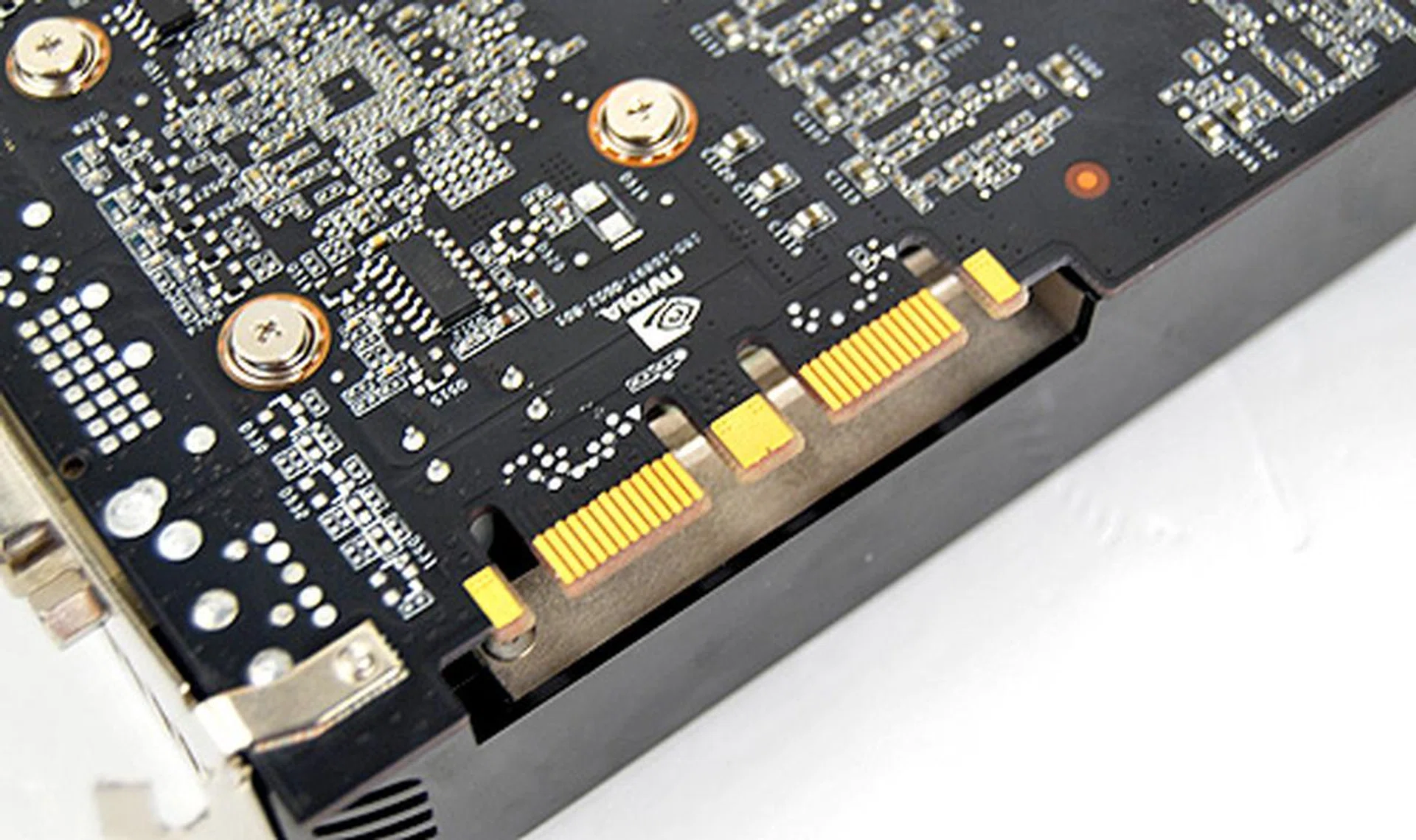
Plug in another GeForce GTX 275 and you'll have a GeForce GTX 295. Two SLI connectors also mean that 3-way SLI is a possiblity.
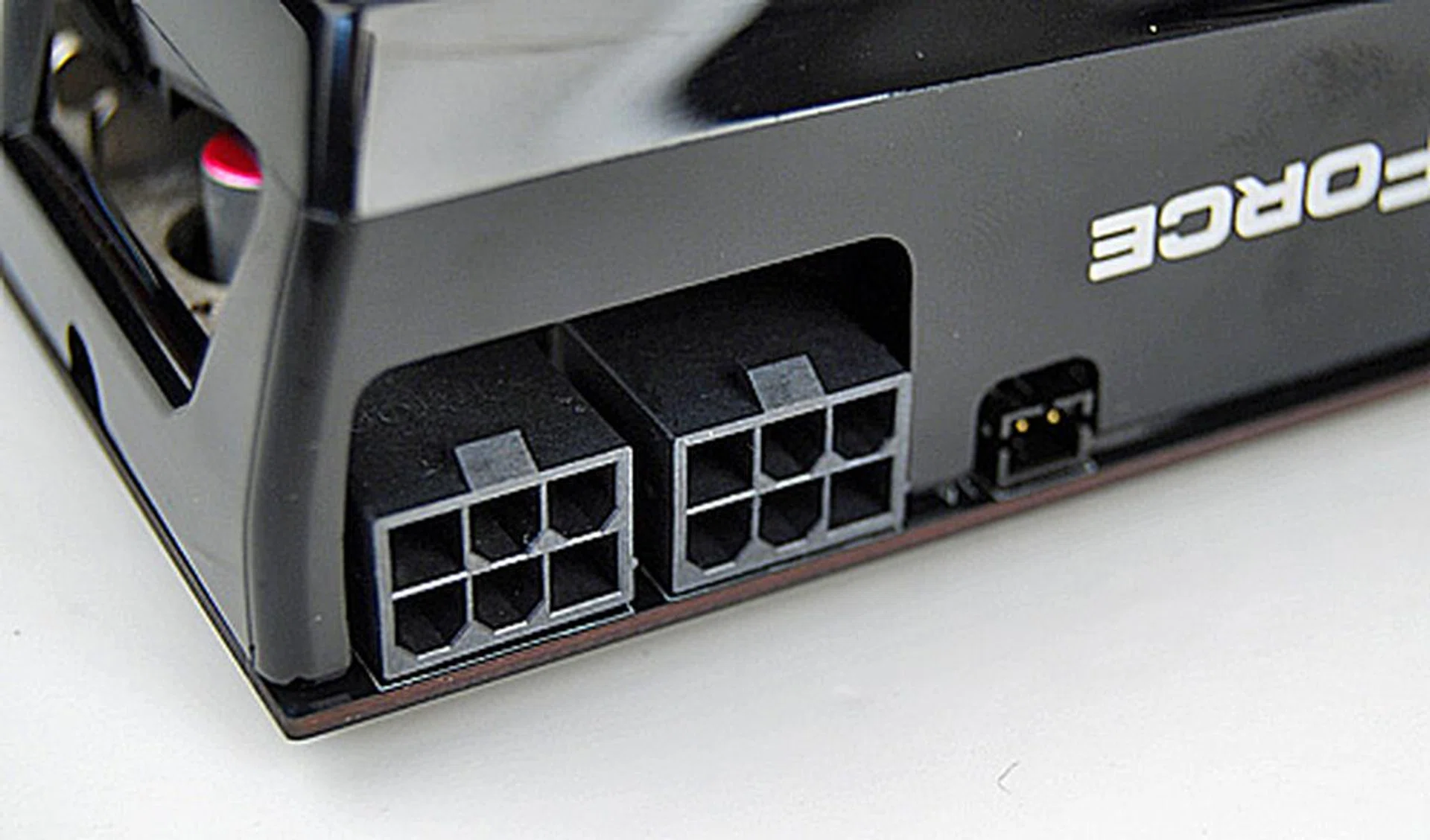
Two 6-pin PCIe connectors are needed to power this dynamo. NVIDIA recommends a PSU with a rating of at least 500W.
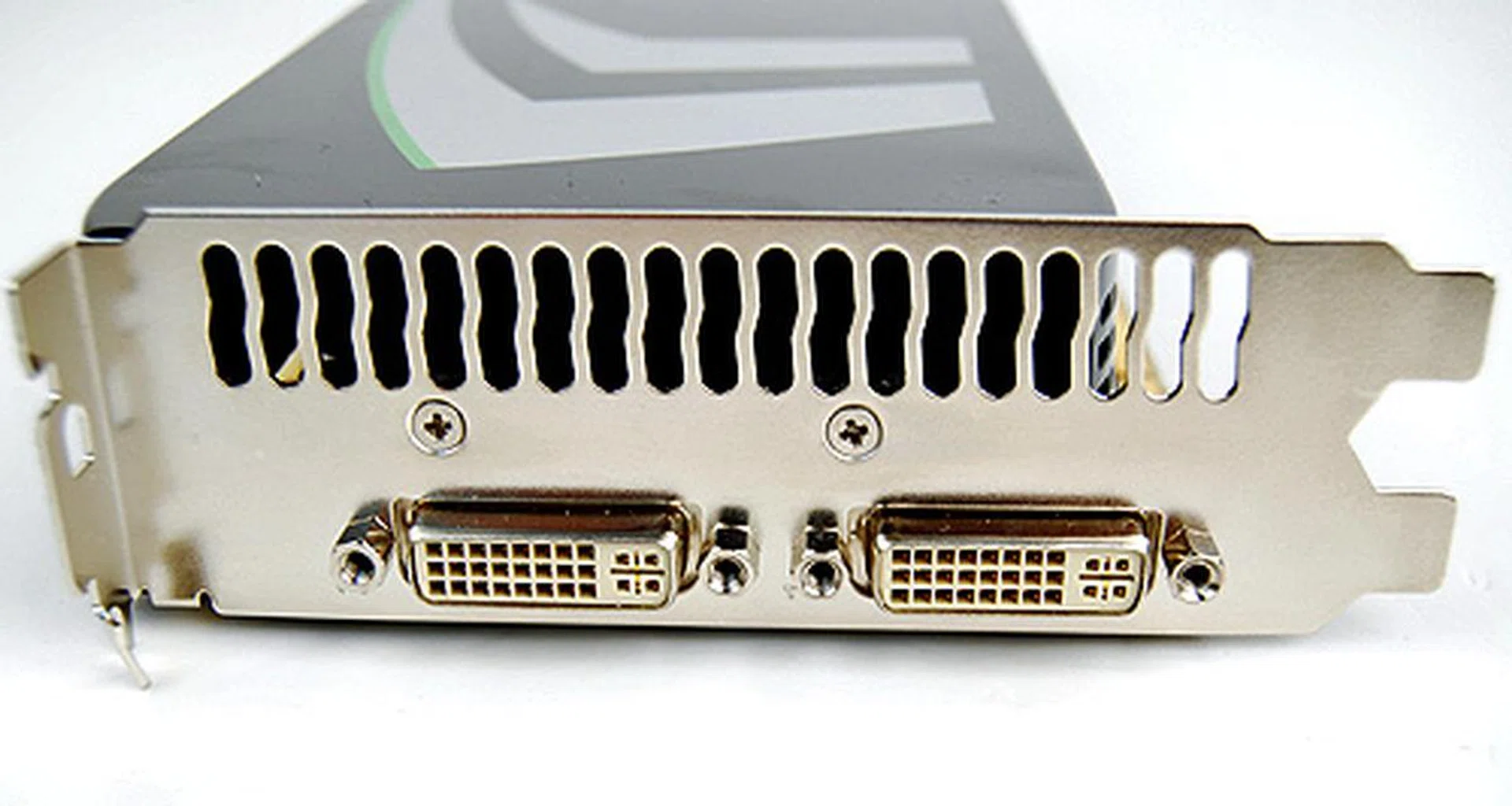
The reference card has only two miserly DVI ports. Hopefully vendors will offer more on their takes of the GeForce GTX 275.
Test Setup
As has been our practice for some time, the NVIDIA GTX 275 cards will be put through its paces using our Vista system which has the following specifications:
Windows Vista SP1 Test System
- Intel Core 2 Extreme QX6850 (3.00GHz)
- Gigabyte X38T-DQ6 motherboard
- 2 x 1GB DDR3-1333 Aeneon memory in dual channel mode
- Seagate 7200.10 200GB SATA hard drive
- Windows Vista Ultimate with SP1
As the intended rival to ATI's Radeon HD 4890, we'll be pitting the new GeForce GTX 275 against the three Radeon HD 4890 cards we tested earlier. And given that the specifications of the new GeForce GTX 275 lie directly between the GeForce GTX 260 Core 216 and GeForce GTX 285, we've also thrown in two of these cards into a mix, so that we can get a better picture of NVIDIA's present SKU hierarchy.
The list of cards tested and their driver versions:
- NVIDIA GeForce GTX 275 (ForceWare 185.63 Beta - provided by NVIDIA)
- ASUS Radeon HD 4890 1GB (modified Catalyst 9.3 - provided by ATI)
- PowerColor HD 4890 1GB (modified Catalyst 9.3 - provided by ATI)
- Sapphire Radeon HD 4890 1GB (modified Catalyst 9.3 - provided by ATI)
- Palit GeForce GTX 260 Sonic 216 SP (ForceWare 181.20)
- NVIDIA GeForce GTX 260 Core 216 (ForceWare 181.20)
- Sapphire HD 4870 1GB Toxic Edition (Catalyst 8.12)
- ATI Radeon 4870 512MB (Catalyst 9.1)
- NVIDIA GeForce GTX 285 (181.20)
To add on, the cards were tested using the following benchmarks:
- Futuremark 3DMark06
- Futuremark 3DMark Vantage
- Crysis Warhead
- Far Cry 2
- Unreal Tournament 3
Windows Vista Results - 3DMark06
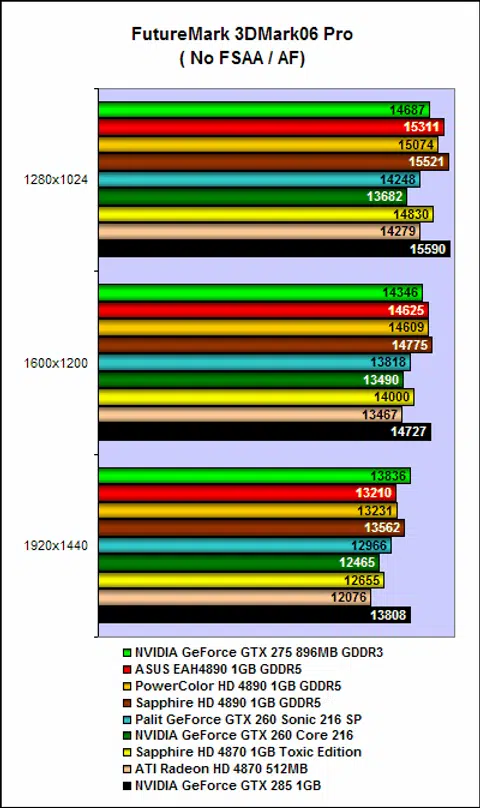
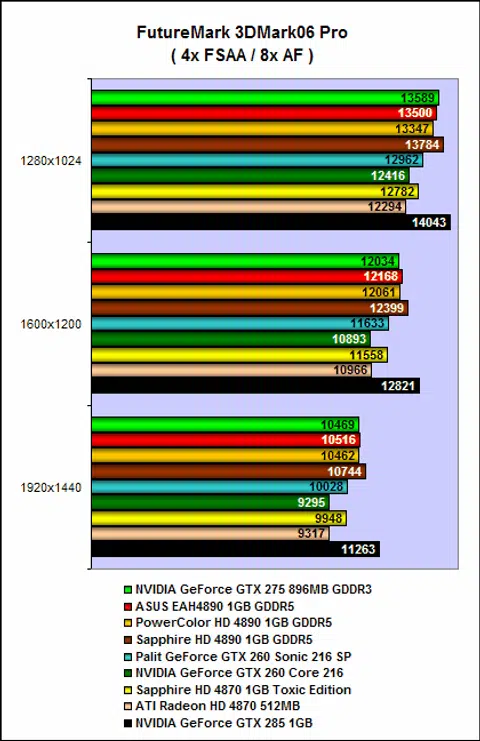
With each driver revision, it seems that NVIDIA is placing less and less emphasis on 3DMark06 as it seems their cards are not optimized for this benchmark. With that, we noted that the GTX 275 achieved scores that were mostly comparable to the HD 4890. The factory-overclocked Sapphire HD 4890, however, seemed to be a smidge faster.
Windows Vista Results - 3DMark Vantage
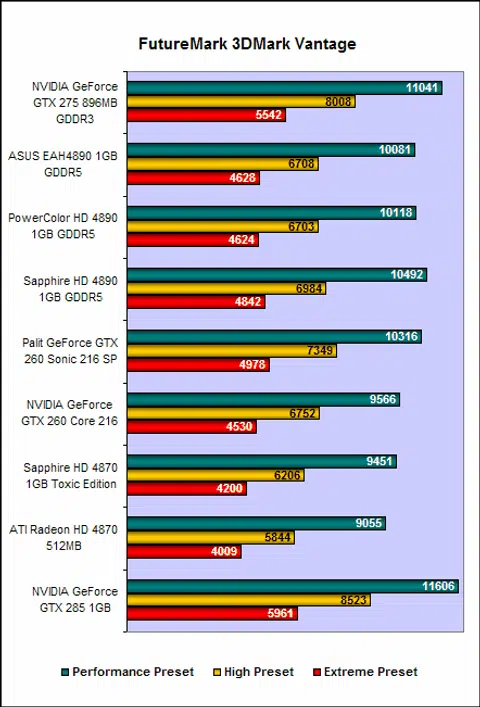
3DMark Vantage, on the other hand, seems to be NVIDIA priority as the GTX 275 posted bigger margins against our trio of Radeon HD 4890 cards. The gulf in performance is most obvious on the "high" and "extreme" presets, where the GTX 275 recorded scores that was as much as 15% more than the Sapphire HD 4890. We also noted that the GTX 275 performs faster than even the factory-overclocked Palit GTX 260+ Sonic, but it was still some way off the GTX 285.
Windows Vista Results - Crysis Warhead & Far Cry 2
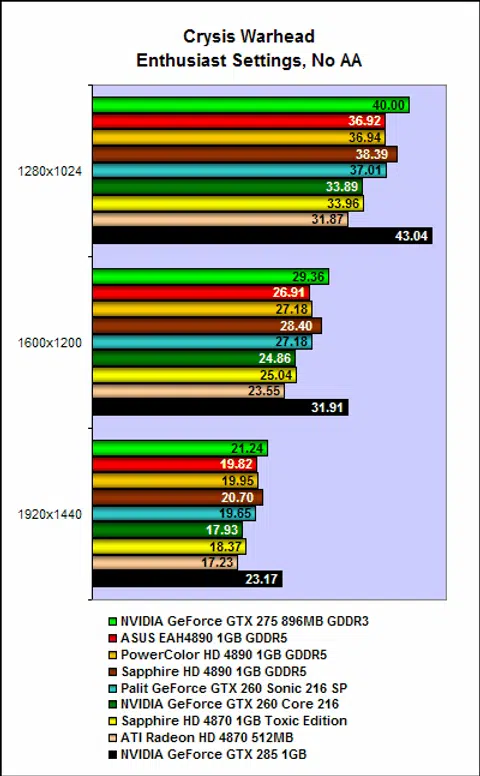
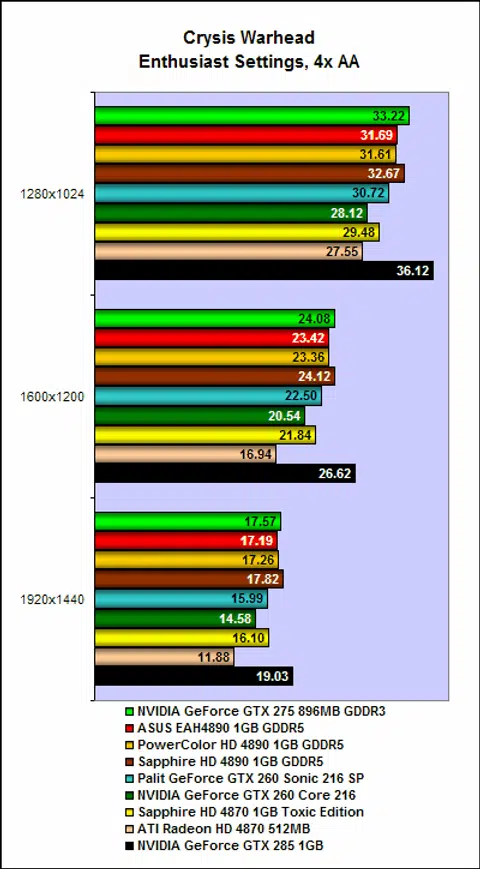
The GTX 275 continued to stretch its legs when we got to Crysis Warhead, where it could be as much as 10% faster. However, we noted that the gap in performance diminished when we turned anti-aliasing on. This could perhaps be attributed to its smaller 896MB frame-buffer.
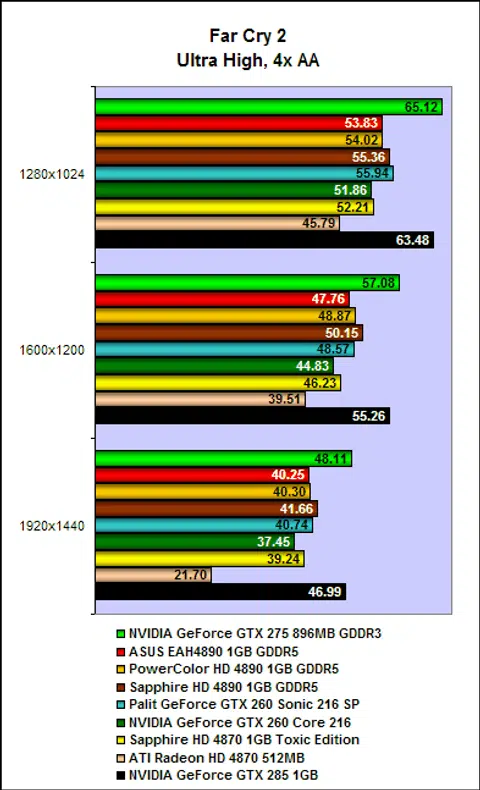
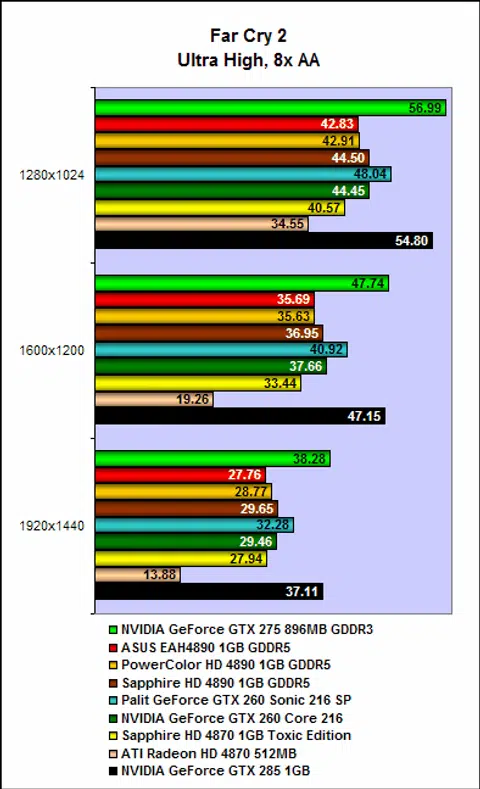
Far Cry 2 was where the GTX 275 really shone, as its frame rates were greater than even the GTX 285, and was at least 20% faster than the HD 4890 cards. Then again, it could be the early GTX 275 drivers used in this test were better tweaked for this game and we should probably see the GTX 285 return to its throne with even better performance once a newer WHQL driver set is released.
Windows Vista Results - Unreal Tournament 3
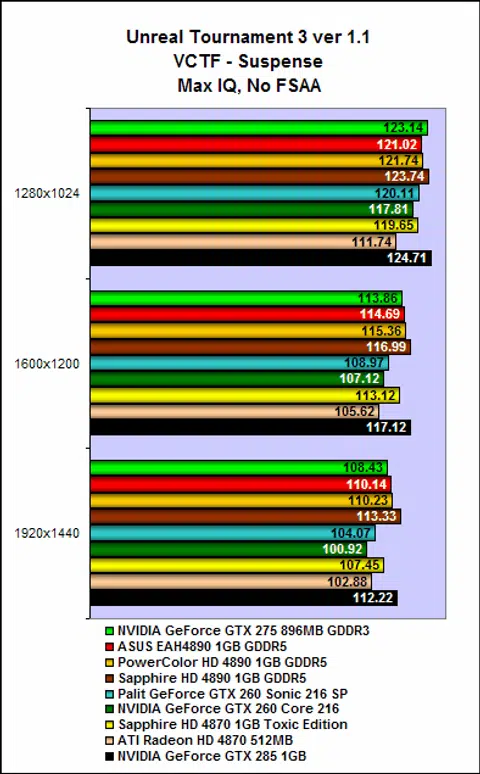
Unreal Tournament 3 was pretty much a stalemate between the GeForce GTX 275 and the Radeon HD 4890, with the cards all managing similar results.
Temperature
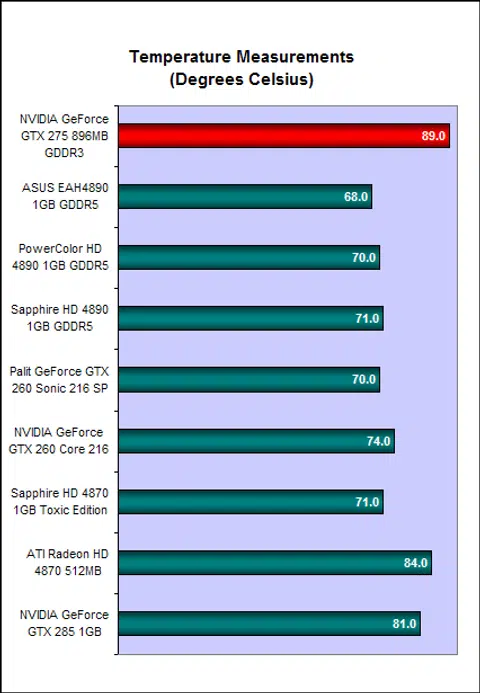
We know from past experiences that the reference cooler that NVIDIA provides for its GTX-200 series cards is inadequate, and the GTX 275 certainly showed the cooler's shortcomings. Recording a peak operating temperature of a whopping 89 degrees Celsius, the GTX 275 could serve as a heat source for cold winter days should one be lucky, or unlucky, enough to experience the four seasons.
However, the cooler is no different from the rest in the series and there shouldn't be a reason for this radical temperature reading. We believe it has something to do with poor power optimization which we noted in the next segment below.
Power Consumption
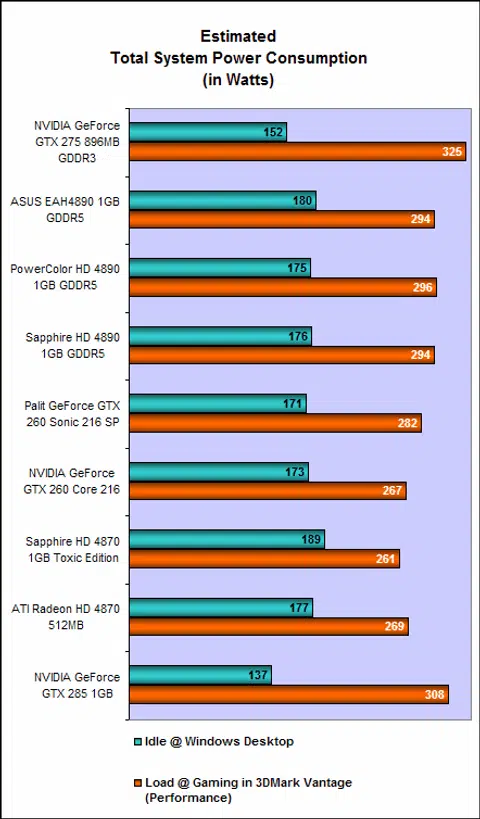
The GTX 275 fared poorly here too as we noted its peak power consumption figures to be higher than the competition and even the GTX 285. This, however, could most be due to the drivers we received from NVIDIA, which are still in beta phase and might have poor power optimization. This issue is quite likely linked with the higher temperatures we noted above. Hopefully, this issue would be ironed out once the new drivers go live. Hence take these readings here with a pinch of salt.
Overclocking
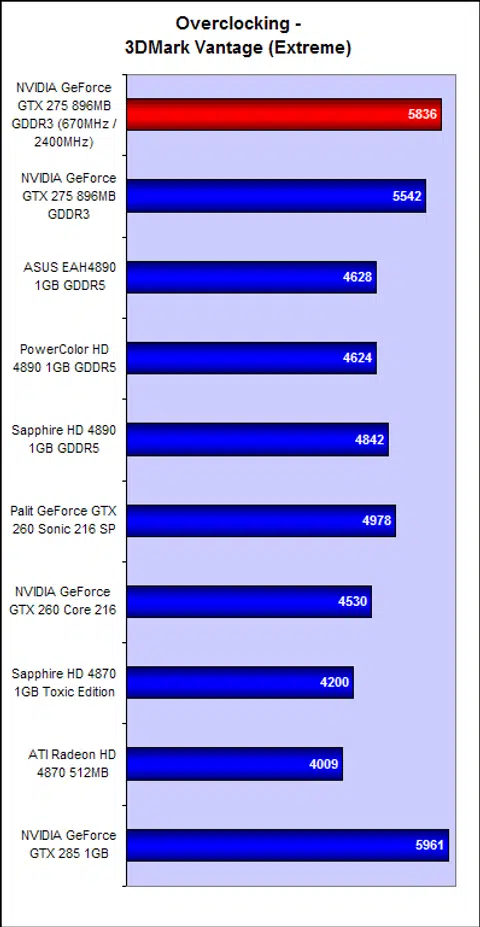
Unlike the Radeon HD 4890 we've seen earlier, the GeForce GTX 275 is a reluctant overclocker. We only managed to increase the core clock speeds by a meager 37MHz and memory clock speeds by a more respectable 132MHz DDR. This gave us an additional 294 3DMarks or a 5% increase on 3DMark Vantage, putting it nearly on par with the GTX 285.
Decisive Counter-attack
As the benchmarks show, the GeForce GTX 275 is more than a capable performer. Clearly a notch above the GTX 260+, it also has enough oomph to trouble even the GeForce GTX 285, which says quite a bit on its potential. More importantly, however, it is substantially faster against its intended competitor - the Radeon HD 4890.
Then came the knockout roundhouse punch after a successful parry - the price. NVIDIA tells us that the recommended retail price of the GTX 275 will be an astonishing US$249. This makes it even cheaper than some of the existing GTX 260+ cards on the market. At that price, the GTX 275 is also about US$100 less than the GTX 285, which is not that much faster. This is truly great value for money.
For the performance it offers and the price it commands, the GeForce GTX 275 is really something special.
However, the GTX 275 is not without its shortcomings. Most notably, it is extremely hot. In fact, it is one of the hottest cards we've ever tested. This means a setup with adequate and ample ventilation is required, lest you want your whole system to go up in flames. Another thing that we didn't like was how power-hungry it was. Fortunately, these problems are rectifiable and as noted in the review, are quite likely due to poor power management implementation. We are hopeful that NVIDIA will have these problems fixed once they finalized their new Release 185 drivers and we'll certainly check to see if these aspects have improved.
To sum up, NVIDIA has come up with something truly special - not really because of the hardware, but more in part of proper positioning. Not only was their response to ATI's new Radeon HD 4890 quick, it was also decisive. Furthermore, let us not forget NVIDIA's support for PhysX-enabled games and CUDA-enabled software. We might make fun of NVIDIA for renaming and rehashing products, but when something as enticing as this SKU comes along, we've nothing but recommendations. And taking everything into account, we think it is not superfluous to say that the GeForce GTX 275 is perhaps the best value-for-money high-end graphics card we've seen yet. Now we really hope it stays that way in retail as well and not get marked up radically as we've noted in some past instances due to shortages.
Our articles may contain affiliate links. If you buy through these links, we may earn a small commission.