
Samsung Galaxy S20 and S20+ review: Smaller screen, big value
Are the Galaxy S20 and S20+ fated to live in the shadow of their all-singing, all-dancing Ultra brother? We find out!

Note: This review was first published on 17 March 2020.
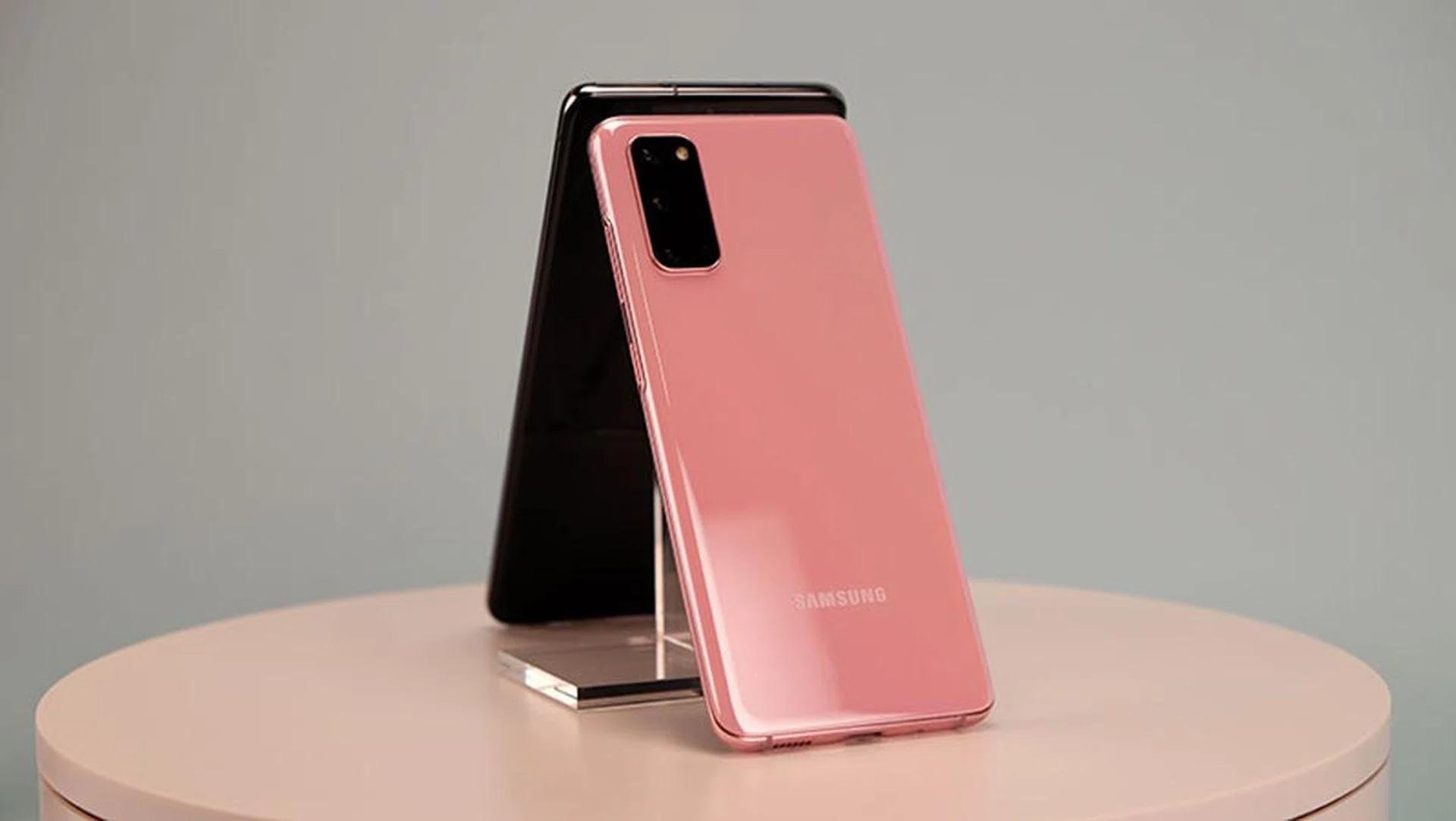
Samsng's Galaxy S20 and S20+ are flagships in their own right.
"She's cheer captain and I'm on the bleachers..."
108 megapixels. Space Zoom. These phrases have been helping the Samsung Galaxy S20 Ultra hog the limelight from the moment the first image leaks of its substantial camera hump were published. The fact that my colleague Wanzi crafted two reviews - one of the phone and a separate one of its camera - in double quick time speaks volumes about our collective eagerness regarding these sensational features - not just leapfrogs of the competition, but perhaps even radical redefinitions of how smartphone cameras should work.
But what of the S20 and S20+, then? That they sound like mere iterations next to the Ultra is one thing, but would you be consigning yourself to past-generation technology by not ponying up the several-hundred extra buckaroos for an S20 Ultra?
In this article, we won't be rehashing the features of the S20 family, or talking about One UI. Instead, we'll be examining if they can earn their keep as the lower-cost members of the family. At the same time, it's worth checking out if users of the previous Galaxy S10 series should upgrade, and we've been given an S10+ to use as an example. So dive in with us to find out if the #FOMO is justified...
Design
While the S20 family is packed to the gills with bleeding-edge tech, all of it is dressed in a design that's basically just a rectangle within another rectangle. That's as safe as you can get in 2020. No halo rings, no separated camera lenses - not even any gradients. It's not saying much that the "Cloud Blue" colourway on the S20 we were sent is the most visually interesting, while the Cosmic Gray (and Black) colourways have simply given up:
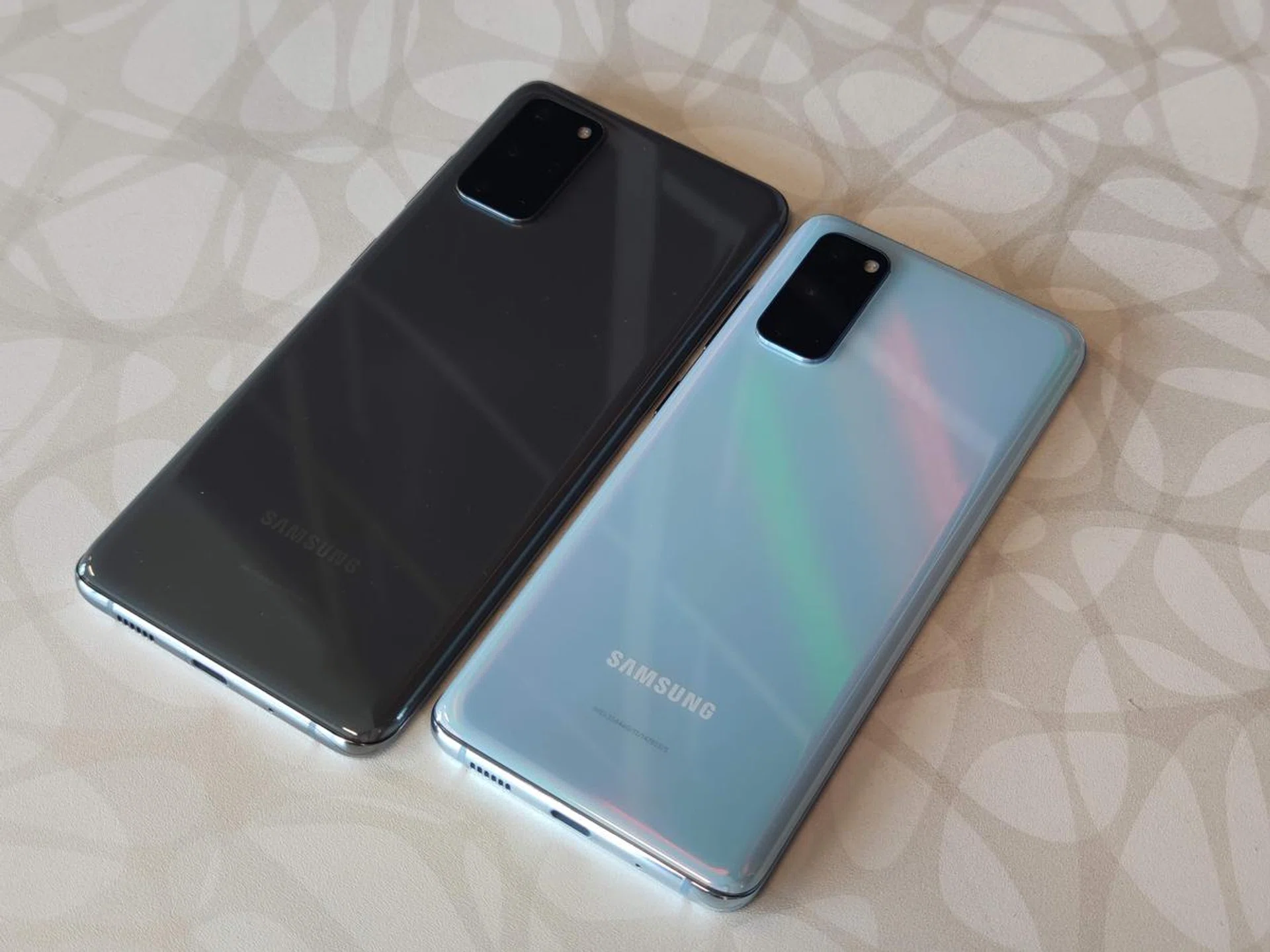
Woah-oh-oh-oh-oh, square rooms...
Like the S20 Ultra we reviewed previously, the build remains solid on the smaller S20 phones, but then I think this should be a basic expectation of a flagship-tier Samsung - or indeed, any phone costing north of S$1,000. Due to the solid build and well-specced batteries, the smaller S20, at 163 grams, is only 5 grams shy of the S20+ in weight.
One other little detail we also noticed is that there's a hole in the camera lens assembly for some sort of microphone...
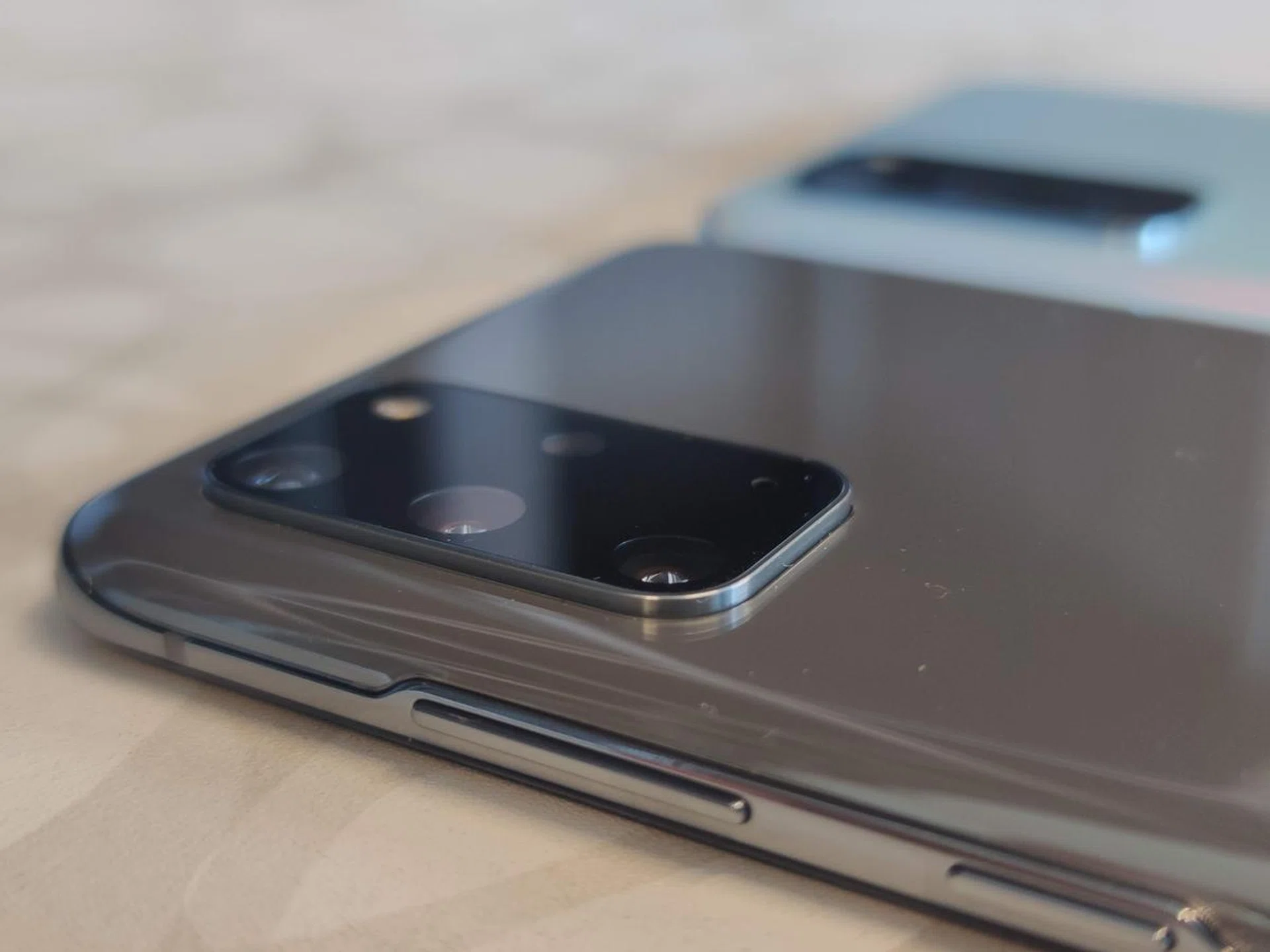
It's on the lower right of the camera bump.
...and this may not be a good idea, because it creates a weak spot in the glass where something sharp in a pocket or handbag might start a crack going. (Tempered glass is weakest at its edges.)
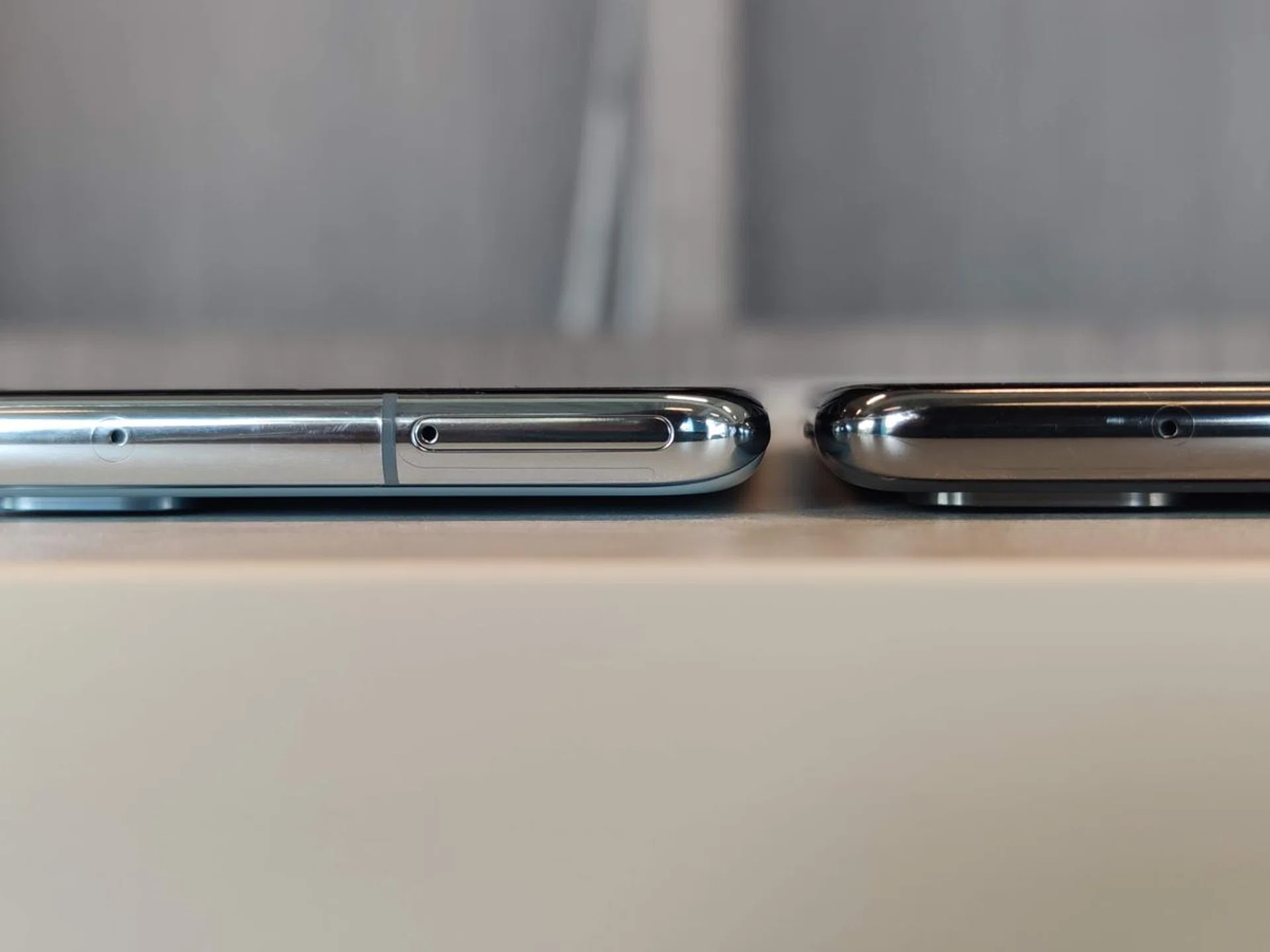
I also realise why the camera bump had to be so large and wide - this ensures a modicum of stability when the phone is placed on a flat surface.
There's nothing much on the bottom to talk about (USB-C ports, speaker holes) and the top (SIM and microSD combination slots).
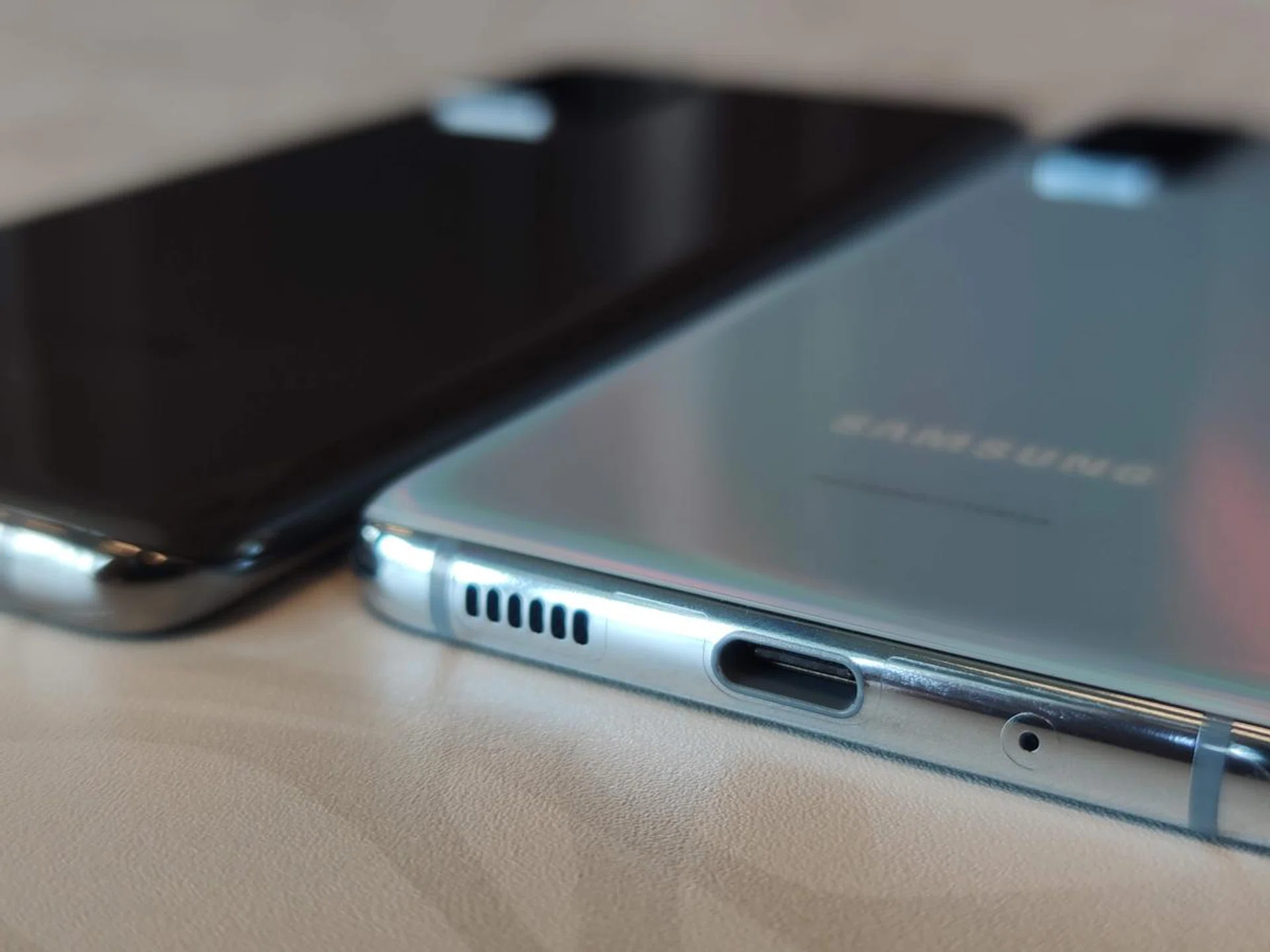
No headphone jack, of course. It's 2020, and Samsung would like to sell you some Galaxy Buds.
Now, my colleagues (and students) will tell you I'm an Android diehard. I munched popcorn while the world burned with all the "boba pearls" memes making fun of the 3-ring camera lens design on the iPhone 11 Pro models. But the S20's aesthetic - or lack of it - is, to me, a strike for Team Android. It sets the art of smartphone design back to when smartphones first existed (and, hey, the first smartphones were arguably more visually engaging to look at!)
Almost everyone I showed the S20 and S20+ to, whether from the iPhone or Android camps, agreed that if they did not already know anything about them, they would have given neither of them a second look were it not for the Samsung branding - and all wondered why the cheaper A-series midrange phones, with their "Glasstic" gradients, actually looked better than these so-called flagships.
I'm not asking for gaudy gradients or weird concentric rings, Samsung. We can leave these to the Chinese brands. But surely you can give us something befitting an industry leader in the next iteration of the S-series, yes?
Design Verdict: These are phones you buy for the technology... so just buy them for the technology. Come to think of it, the S10+ didn't look all that revolutionary, either... so let's move on to the next page.
Displays
If the rear of the Samsung Galaxy S20 series represents a liability for the art of smartphone design, the front, thankfully, claws that ground back. Because when you think of the very best displays, you think of AMOLED, and when you think of the very best in AMOLED, you must needs think of Samsung...
These 3,200 x 1,440 pixels resolution displays with a 20:9 aspect ratio, termed Infinity-O (sounds like a Toy Story breakfast cereal) for the O-hole front camera cutout, both support DCI-P3 and HDR10+, and go to 6.2 inches on the Galaxy S20 and 6.7 inches on the S20+.
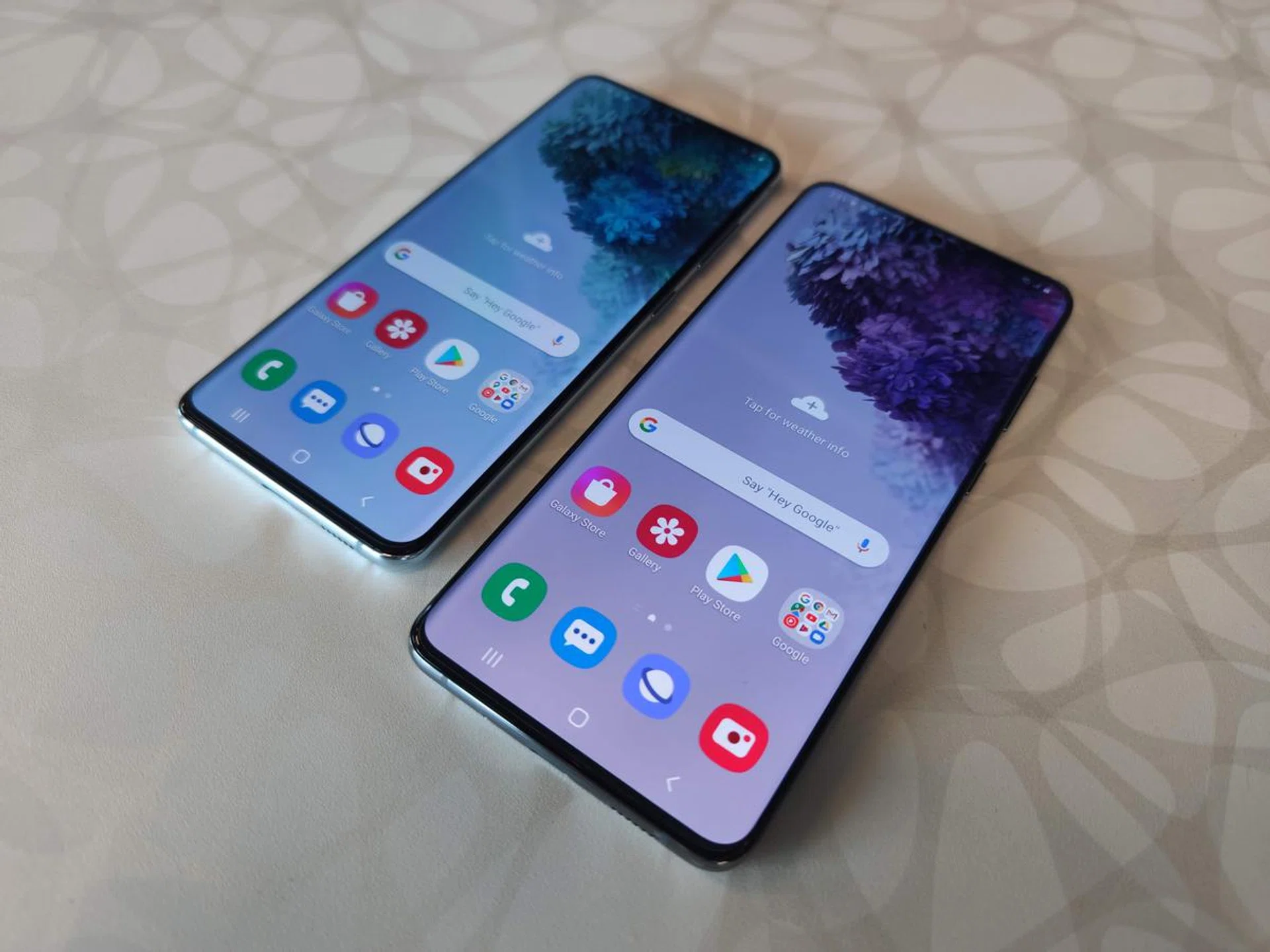
As with previous Samsung phones, there is no fault to find regarding colour accuracy, viewing angles, and overall brightness.
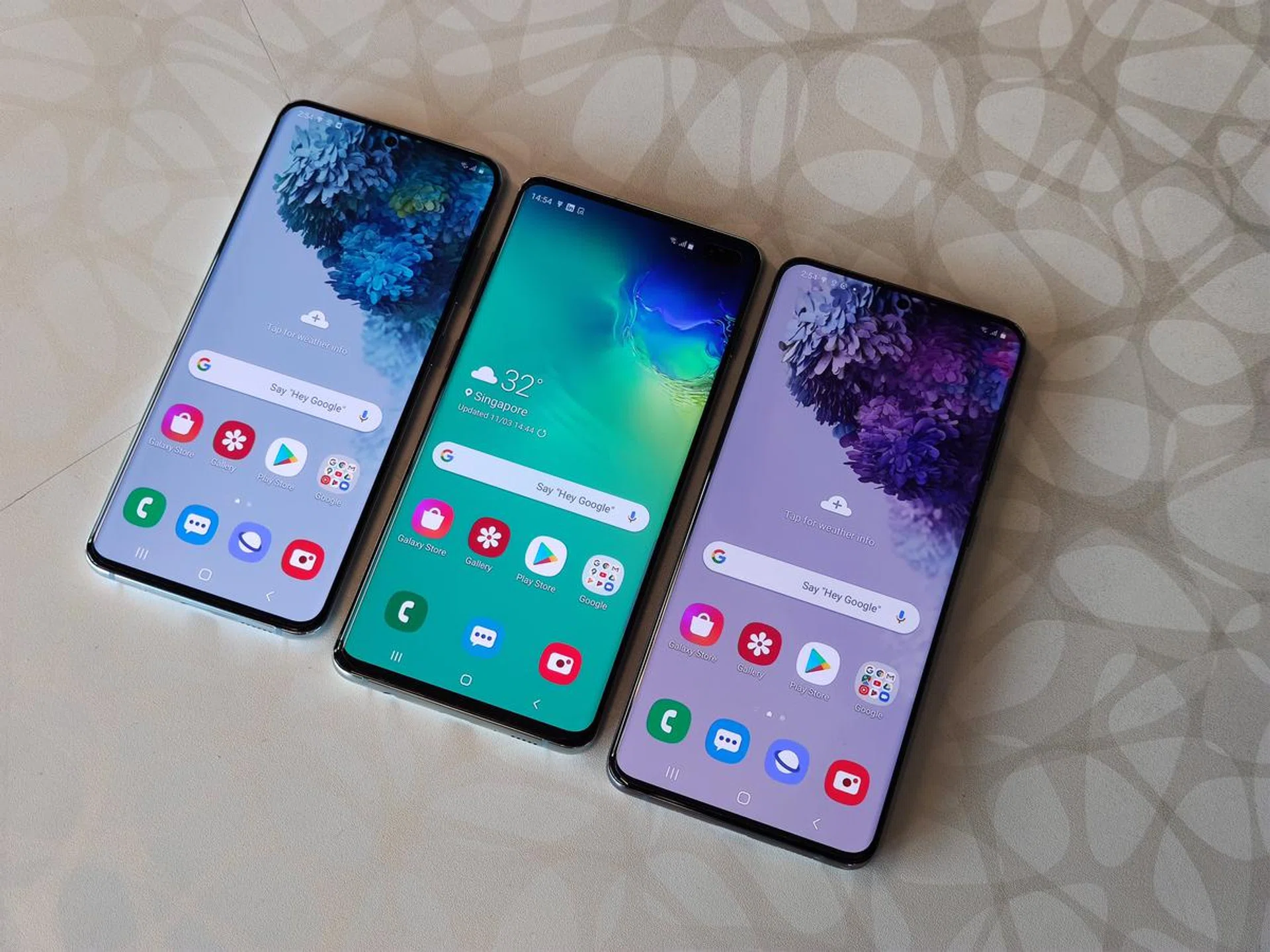
Versus the previous Galaxy S10+ (itself no slouch in the display department), the only real discernible difference is the removal of the curved edges and the smaller O-hole as opposed to the dual-camera cutout on the S10+.
Granted, this marvel of display engineering is not new to many (including iPhone X and 11 users) but it now comes with a 120Hz refresh rate. In my tests, these 120Hz displays are even more usable than OnePlus's 90Hz displays, which first brought high refresh rates to the world's attention, and, paradoxically, it's better because it's slower. On its 90Hz phones, OnePlus made a critical mistake of having extremely sensitive flick and swipe response as well, heightening the impression of speed - but causing display elements to scroll by at blinding, uncatchable rates. Samsung didn't.
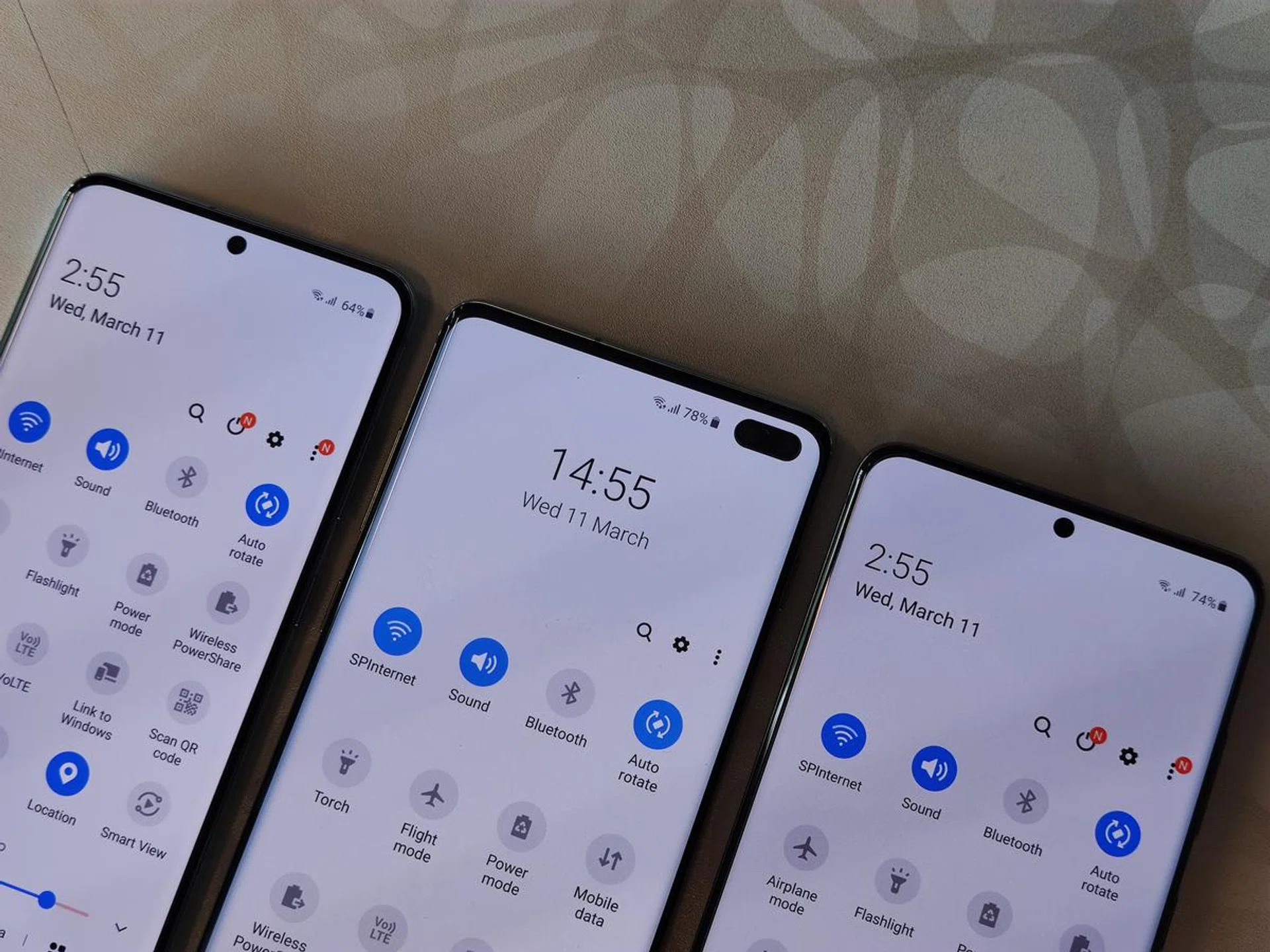
Still a great screen, no matter which way you slice it.
Now, a bit on the in-display fingerprint sensor. Unlike just about everyone else, Samsung has cosyed up with Qualcomm for its ultrasonic technology. This sensor has been known to be very finicky in the S10 series, and is said to respond poorly to dry skin (like mine), for example.
I certainly found this to be true. When it's fast, the sensor is very fast, so fast it almost seems to unlock before the finger actually touches the display glass...

...which was the case immediately after enrollment - as I had just washed my hands. Fast forward to 30 minutes later, and the unlock delay was a good 2 seconds longer.
Curious, I tried it in the shower, with a light mist of water - and the phone unlocked almost immediately again. After a while of this, however, the skin on my thumb grew puffy, and it no longer worked. Maybe Samsung should just use a good optical sensor, like everyone else.
Verdict: There's not much more room for improvement in the displays of the S20 series, since Samsung is already king of the hill when it comes to mobile displays. The icing on the cake is the 120Hz refresh rate, which, paired with sensibly-judged scroll and flick speeds, delivers a knockout punch to every other smartphone in the business. If you've grown irked by curved-edge screens such as the one on the S10+ (and the difficulty of finding affordable, easy-to-apply glass screen protectors for them), the S20 range should also offer some much-needed relief. However, the ultrasonic in-display fingerprint sensor is still a bit of a hit-and-miss affair.
Audio quality
Since most modern high-end smartphones lack any sort of headphone jack, we figured it would be worth taking a non-scientific look at loudspeaker performance on the Galaxy S20 and S20+ instead, again with some comparison to the previous S10+.
Using Florence and the Machine's Spectrum as my favourite test track - a difficult track even for IEMs and headphones - first on the S10+, vocals seemed a bit recessed in difficult passages such as the first chorus (and the transition to it), and the midrange was noticeably muddier. The S20 phones dealt with this a bit better than the S10+, and the S20+ better than the S20, which didn't have much mid-bass, probably due to a smaller bass chamber.
Verdict: Regardless, the S10 and S20 series will serve up loud, bright output well suited to casual listening in a room. I would have appreciated a bit more bass on the newer models, though.
Benchmarks
Considering that the S20, S20+, and S20 Ultra all use the same Exynos 990 processor, we didn't expect to find much variance in performance between devices - and for the most part, we were right. We'll be taking into account the amount of RAM each of these is endowed with: 8GB on the S20 and S20+, and 12GB for the Ultra, both LPDDR5, while the predecessor S10+ has 8GB of RAM, which is also the previous-generation LPDDR4 type.
A bit of a refresher on the Exynos 990: you get two Cortex-A76 cores and four Cortex-A55 ones, plus two of Samsung's own Mongoose M5 core, which is going to be Samsung's last before it axes the whole Mongoose microarchitecture altogether.
It's interesting that Galaxy S20-series devices sold in some other markets use Snapdragon 865 processors instead, which employ four Cortex-A77 cores - the latest and greatest from ARM. How this competes against the Mongoose is not directly obvious, but from benchmarks run by others, it would seem that the Snapdragon devices have an edge simply because there are more A77s in the Snapdragon 865 than there are Mongoose(s? Mongeese?) in the Exynos.
But since we're not getting Snapdragons, the point is moot anyway, so let's move on...
JetStream 2 on Chrome
For web browsing, we use JetStream 2, which measures the browsing performance of a device when processing JavaScript. It takes into consideration the underlying hardware performance, favouring in particular browsers that start quickly, execute code well, and run smoothly.
A note on our test methodology has been long overdue. We always run JetStream on Chrome, since it gives the best indication across devices, processors, and OS platforms - whether iOS or Android. Also, screen timeouts are always set to off or the longest available duration, and we make sure the screen doesn't turn off, since this would relegate the browser's thread(s) to background processing.
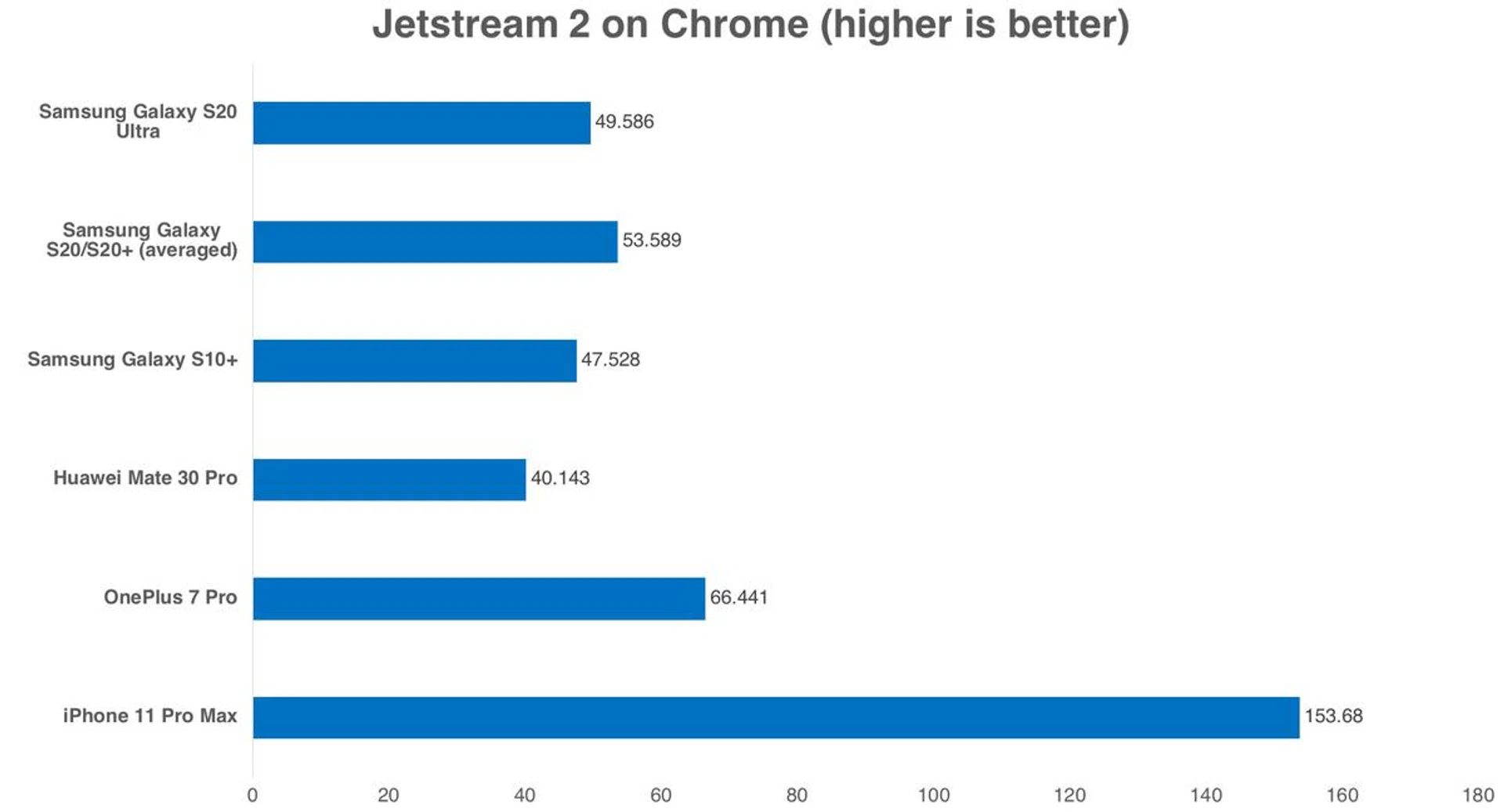
For some strange reason, the S20/S20+ duo always beat out their bigger brother by a bit, and the bigger brother fared not a lot better than the previous S10+, and this despite having a whopping 12GB of RAM. We can only guess that certain system optimisations (or lack of them) had a part to play in this.
For some strange reason, the S20/S20+ duo always beat out their bigger brother by a bit, and the bigger brother fared not a lot better than the previous S10+, and this despite having a whopping 12GB of RAM. We can only guess that certain system optimisations (or lack of them) had a part to play in this.
Geekbench 5
For CPU performance, we go to Geekbench, a cross-platform processor benchmark that tests both single-core and multi-core performance with workloads that simulate real-world usage.
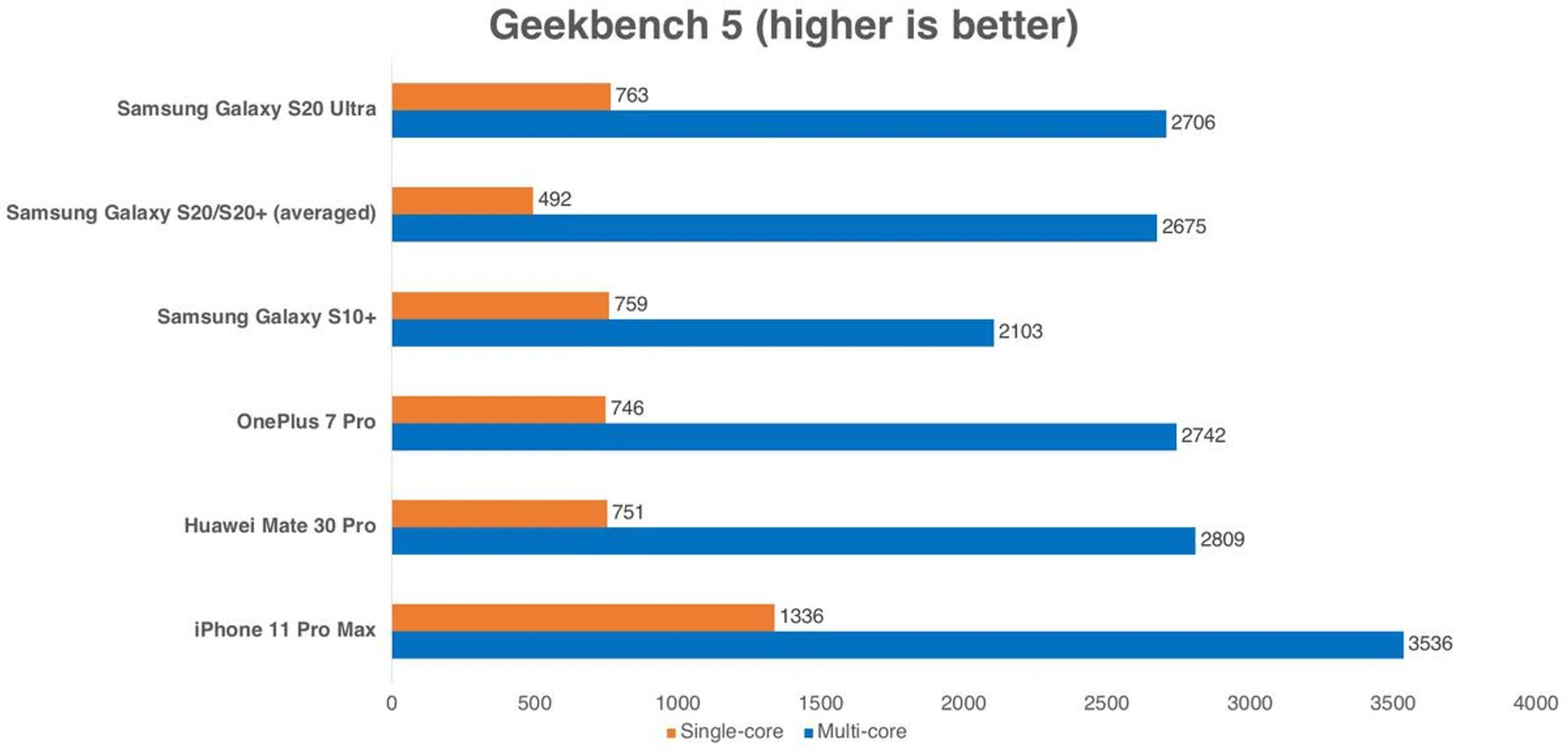
No surprises here; no differences among the S20 family, but a marked improvement in single-core scores against the S10+ and its previous-gen Mongoose M4. The S20 phones are also neck-and-neck with the OnePlus (Snapdragon 855) and Mate 30 Pro (Kirin 990), but as usual every Android phone is destroyed by the sheer might of Apple's A13 (Bionic)...
Antutu 7
Of course, CPU benchmarks don't mean much in real-world usage, so we also need an all-in-one benchmark that tests CPU, GPU, memory, and storage - and that's Antutu.
The CPU benchmark evaluates both integer and floating-point performance, while the GPU tests assess 2D and 3D performance, the memory test measures available memory bandwidth and latency, and the storage tests gauge the read and write speeds of a device's flash memory.
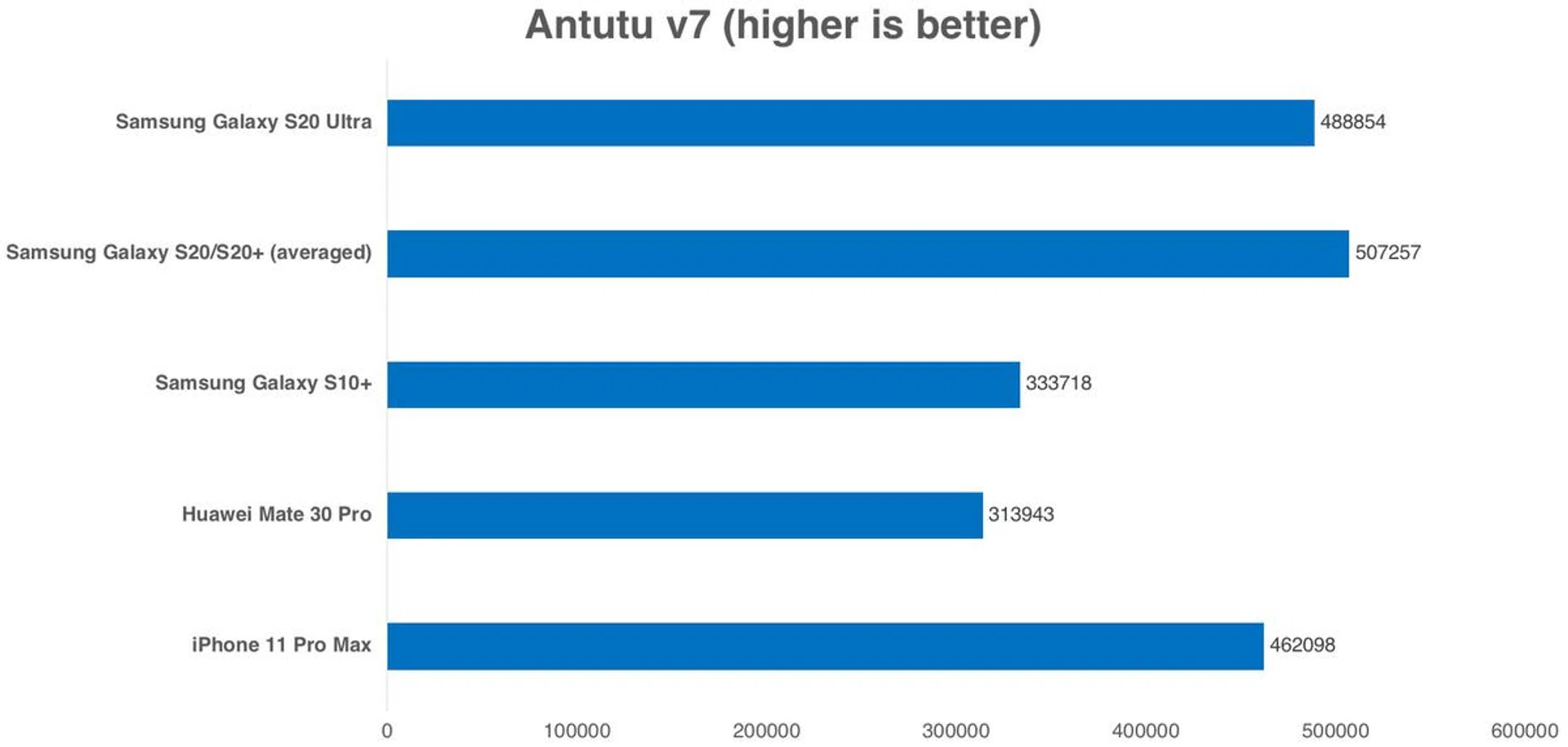
Again, for some reason, the S20 and S20+ beat their Ultra brother, and at last, they were able to see off the iPhone...
3DMark
3DMark Sling Shot is an advanced 3D graphics benchmark that tests the full range of OpenGL ES 3.1 and ES 3.0 API features including multiple render targets, instanced rendering, uniform buffers and transform feedback. The test also includes impressive volumetric lighting and post-processing effects.
The S20 series comes in on this front with all guns blazing, and finally, with the upgraded Mali-G77 GPU, manages to banish the ghosts of poor performance, relative to conspecifics, that have dogged the Mali name for quite a while, and which the previous Bifrost architecture claimed to be able to exorcise but never did.
For this, ARM has its new Valhall architecture to thank, which switches to wider, 16-wide warp-based execution units for better thread handling. Among other improvements, the instruction set has also been simplified, and instruction scheduling is now done by hardware, putting less load on the compiler. All this translates into a claimed overall 40% improvement in performance, even if there is no change in the manufacturing process size.
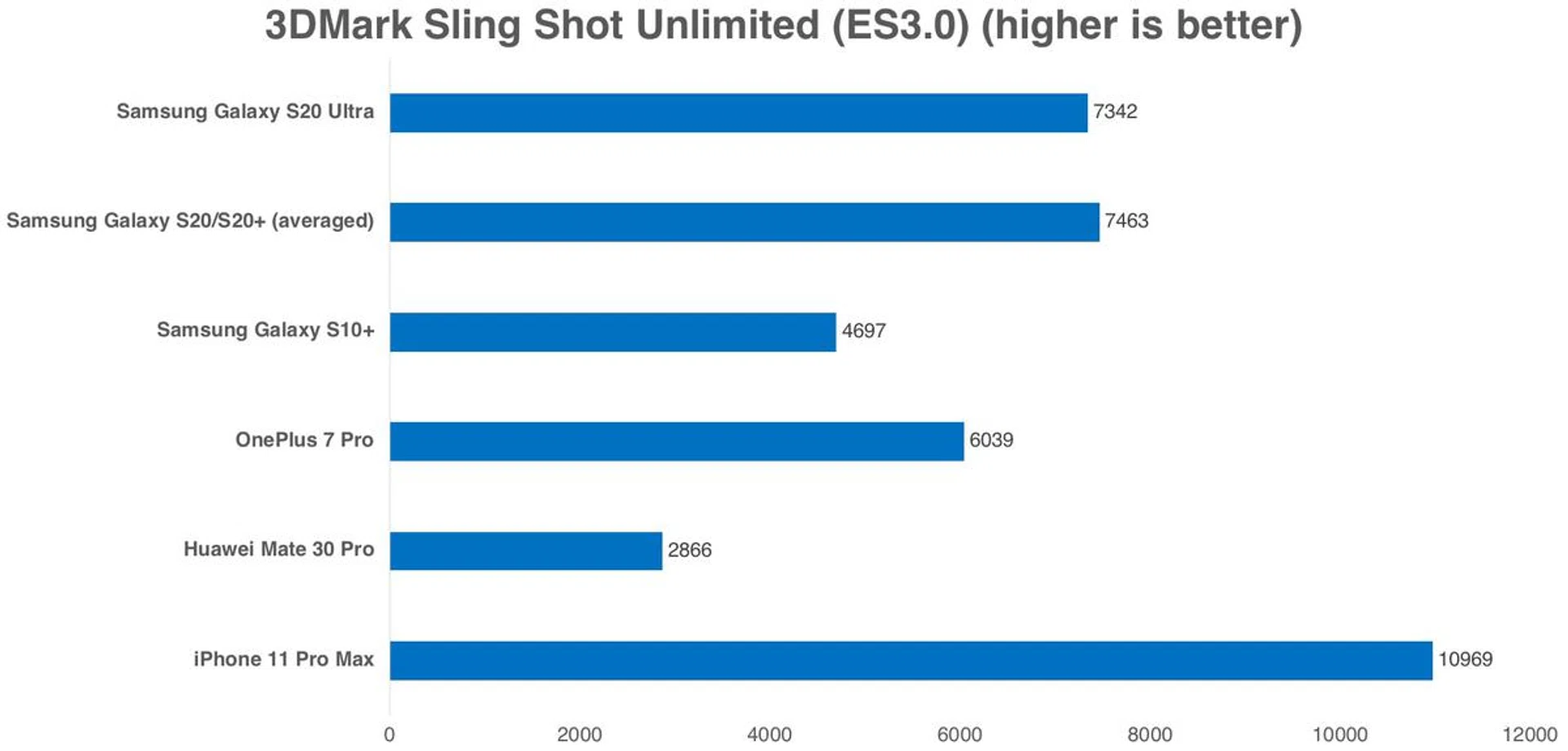
While it can't quite come close to the iPhone, the S20 family puts in a great showing with a jump of some 41% on the previous-gen S10+! Against the Mate 30 Pro, a Mali-G76 device, the leap ahead is even more pronounced.
Battery life
Our standard battery test for mobile phones has the following parameters:
- Looping a 720p video with screen brightness and volume at 100%
- Wi-Fi and Bluetooth connectivity turned on
- Constant data streaming through email and Twitter
In this case, all tests between all three S20 units were run at the maximum display resolution.
While the S10+ depended on a 4,100mAh unit to drive a 6.4-inch screen, the S20 has 4,000mAh of juice lighting up a 6.2-inch display, and the S20+ a 4,500mAh unit for a 6.7-inch one. These look like great numbers, but the reality is somewhat different:
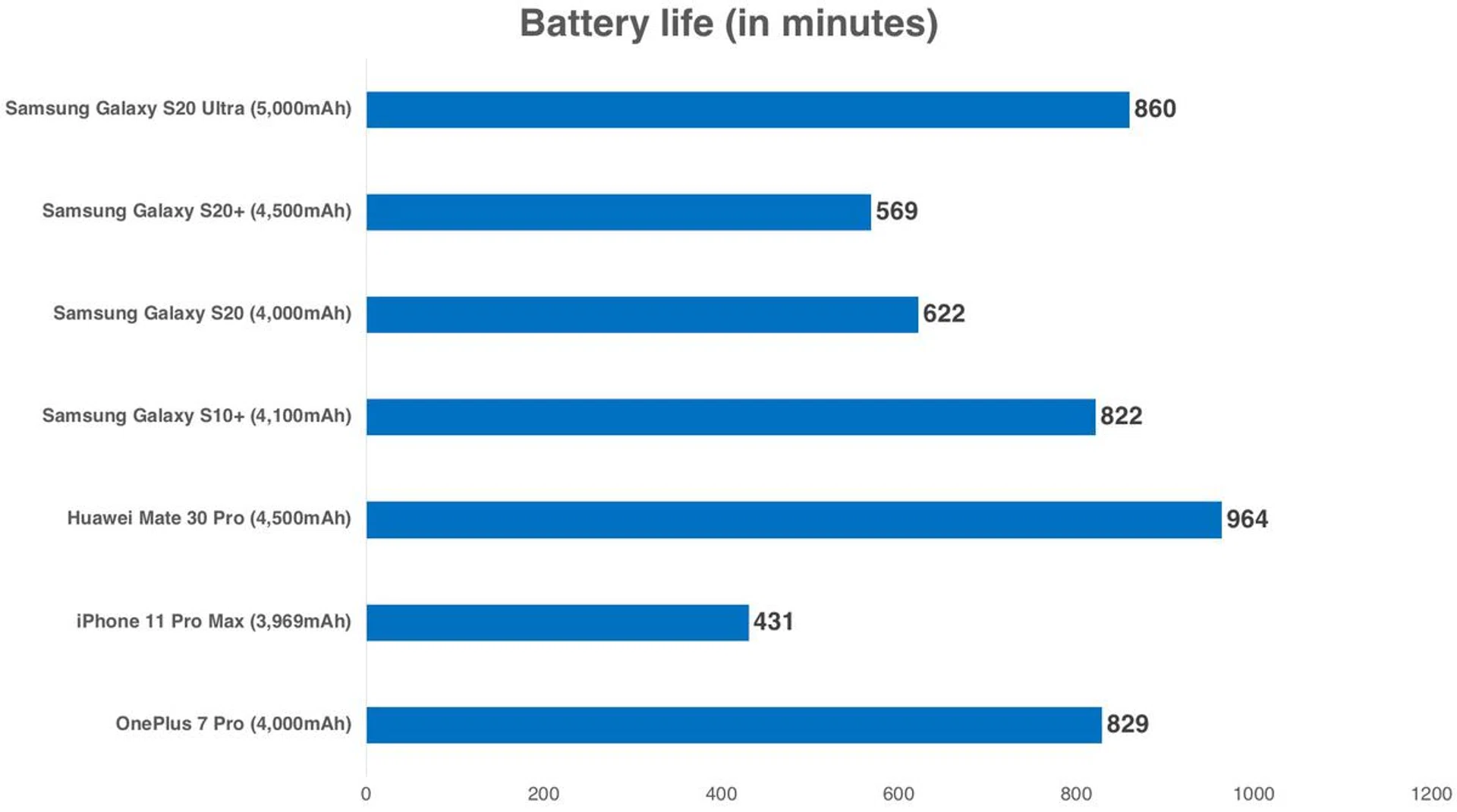
The S20+'s larger display seems to be exponentially more power-hungry than the 6.2-incher, sucking juice at a faster rate, despite the larger battery. A jump to 6.9 inches from the 5,000mAh S20 Ultra actually seemed to do wonders for battery life. But more interestingly, neither of the smaller S20 devices could beat the S10+ in battery performance.
In real-world use, we had little trouble eking out screen-on times exceeding 6-7 hours from either device, and getting through a day of moderate use. There were also no slowdowns or lag to speak of, something definitely helped by the availability of the 120Hz display refresh rate.
Verdict: While battery life seems to have taken a hit, these are very much definite upgrades. Especially if you're the gaming sort, you'll be well served by an S20 device if you're upgrading from the predecessor S10 phones.
Very decent cameras... but should you just go for broke?
When I was mulling over how to structure this review, one of the first things that came to mind was: maybe we don't want to see a deluge of shots, because they're Samsung flagships...

Galaxy S20+. Badly lit food looks good.
...everyone else is going to be reviewing them...

Galaxy S20, Night mode. Look at the awesomely saturated and very balanced highlights and midtones!
and - as the Android phones most compared against iPhones - Samsung flagships can be counted upon to have cameras that are more than decent.
So, let's just do a direct camera comparison of the Galaxy S20 and S20+ versus their bigger Ultra brother to see if there's any sort of yawning chasm between them.
Before we begin, here's a simple breakdown of all three cameras:
- The highest megapixel count on the S20 and S20+ is 64MP for both, while the S20 Ultra is, of course, 108MP.
- The 108MP sensor, custom-made by Samsung, uses "Nonacell" technology that combines the output from the 8 pixels around each pixel (sort of like Minesweeper) to gather more light, for brighter images in low light conditions. Till date, all other smartphone image sensors have used 4-pixel groups ("tetracells").
- The S20 Ultra's telephoto camera is a periscope-lens unit with 4x (real) optical zoom and a 48MP sensor, and it enables 100x hybrid zoom.
- The S20 and S20+ have a telephoto camera that crops the image from a 64MP sensor to give 3x "hybrid optical" zoom, which goes up to 30x hybrid zoom.
- The ultra-wideangle camera is the same across all models: 12MP, f/2.2, 13mm.
- The S20+ and S20 Ultra have a Time-Of-Flight (TOF) sensor, which should help with ensuring properly separated backgrounds in shots where shallow depth of field (aka background blur aka "bokeh") is required.
Again, we'd like you to note that since the S20 and S20+ have the same sensor hardware, it was unsurprising that the outputs of both cameras were found to be virtually indistinguishable from each other.
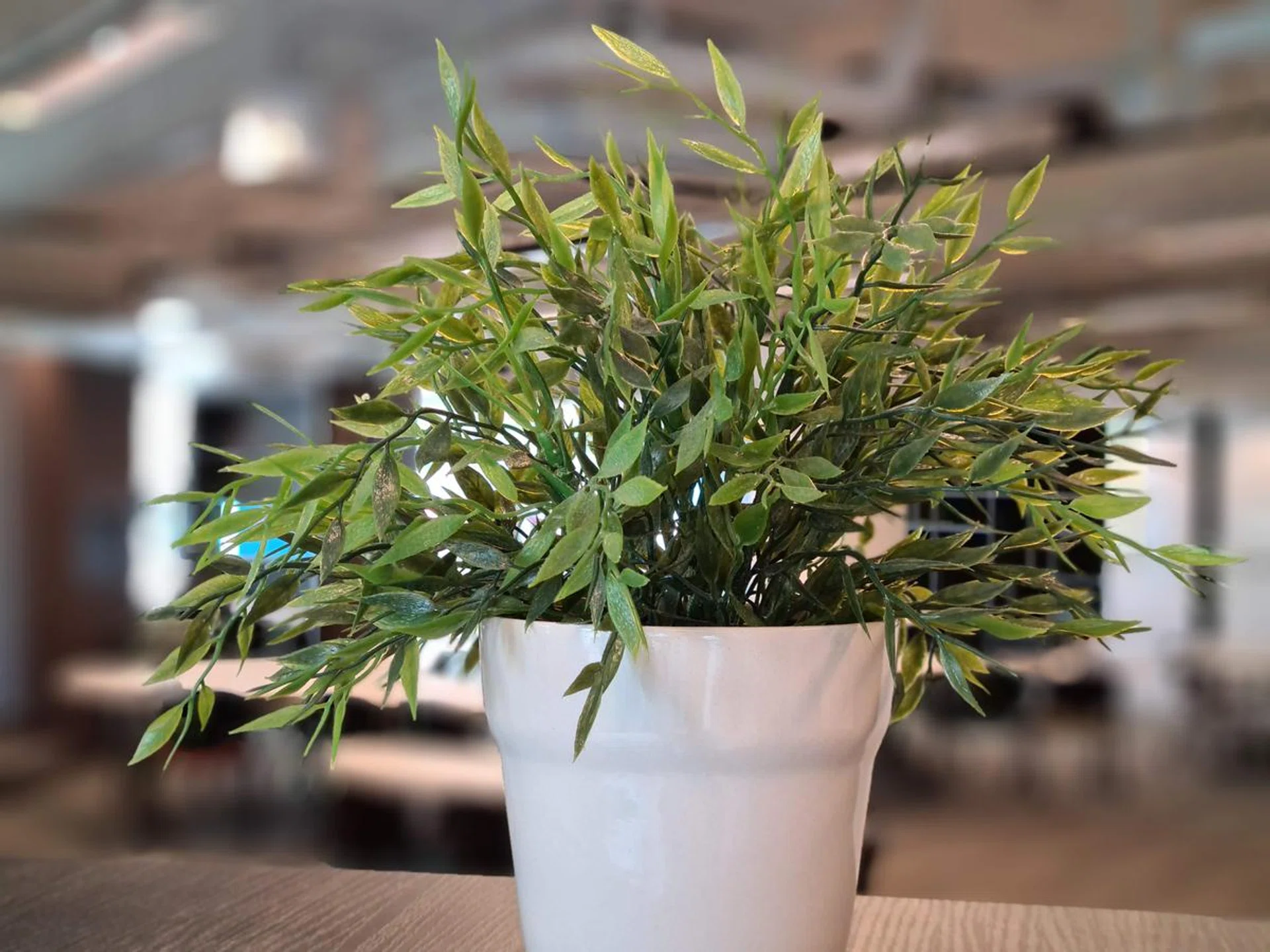
Even without a Time-of-Flight (ToF) sensor, which is supposed to help improve edge detection in bokeh, the Galaxy S20 was just as good...
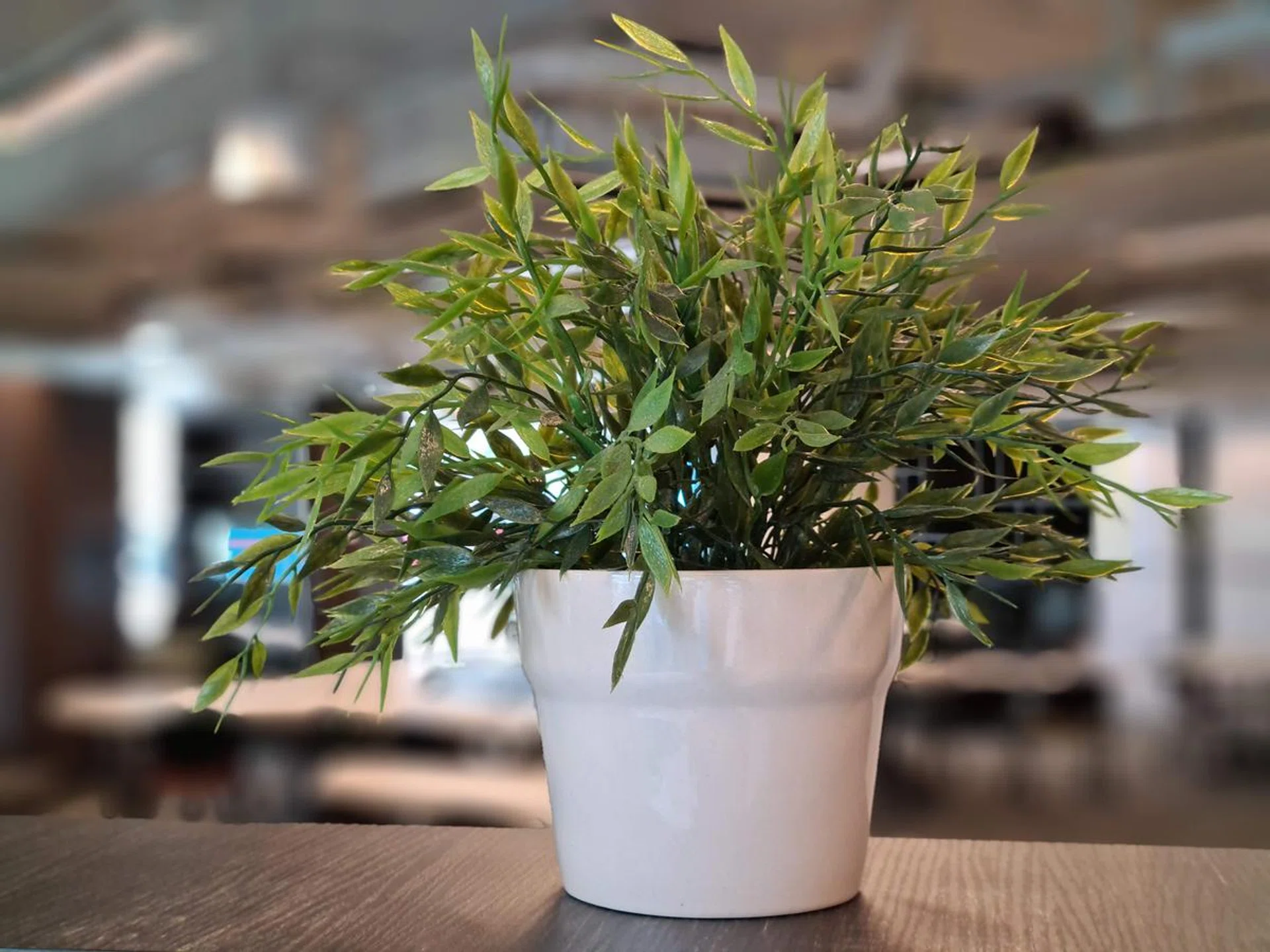
...as the S20+. There was no real difference in the quality of edge detection.
As such, we'll mostly be comparing just 2 sets of images: S20/S20+ vs. S20 Ultra.
Let's start by examining basic camera output. At first, it was hard to find meaningful variances in colour, contrast and tonality between all S20-family phones:
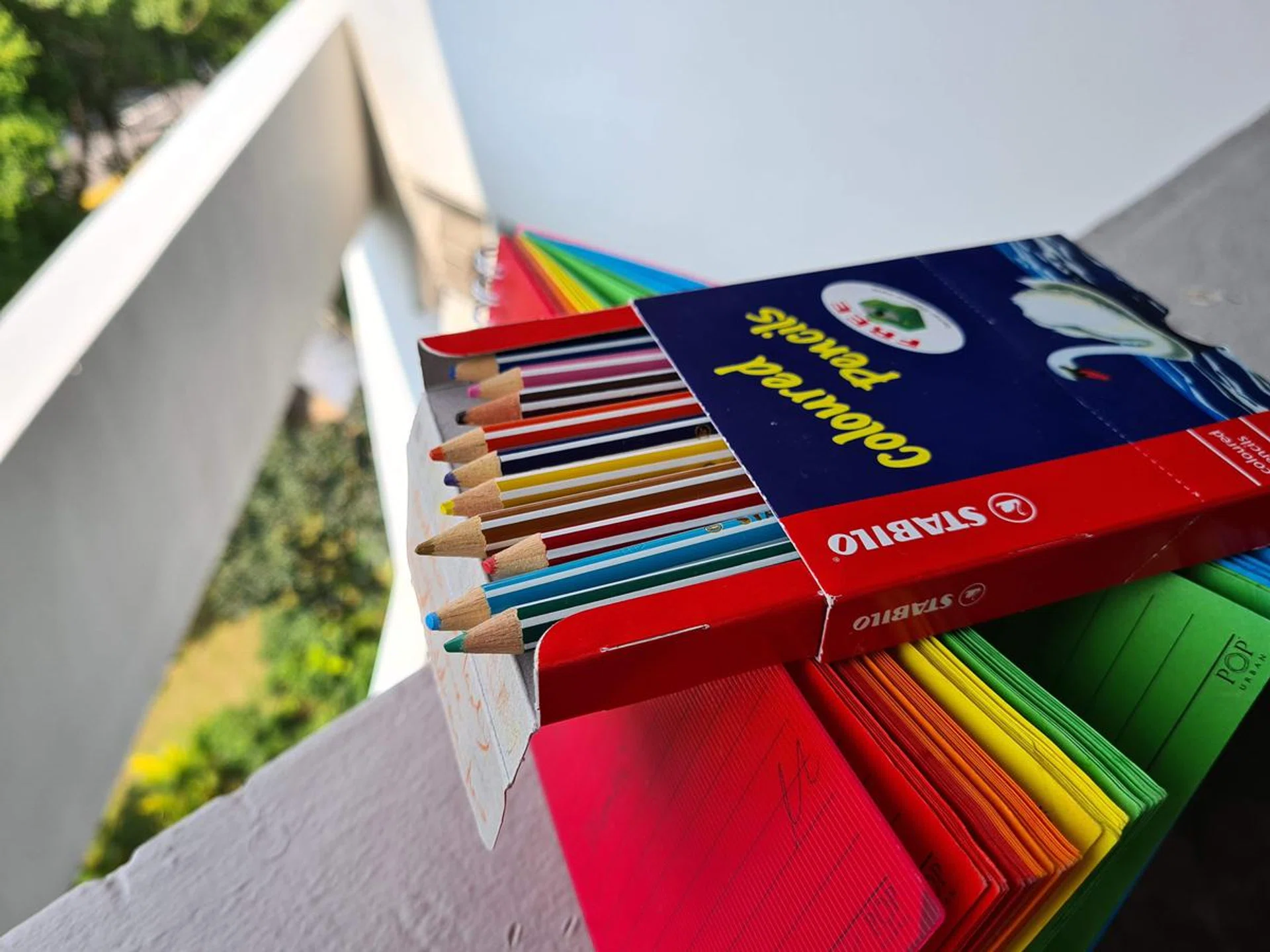
Galaxy S20/S20+, wideangle (normal) lens.
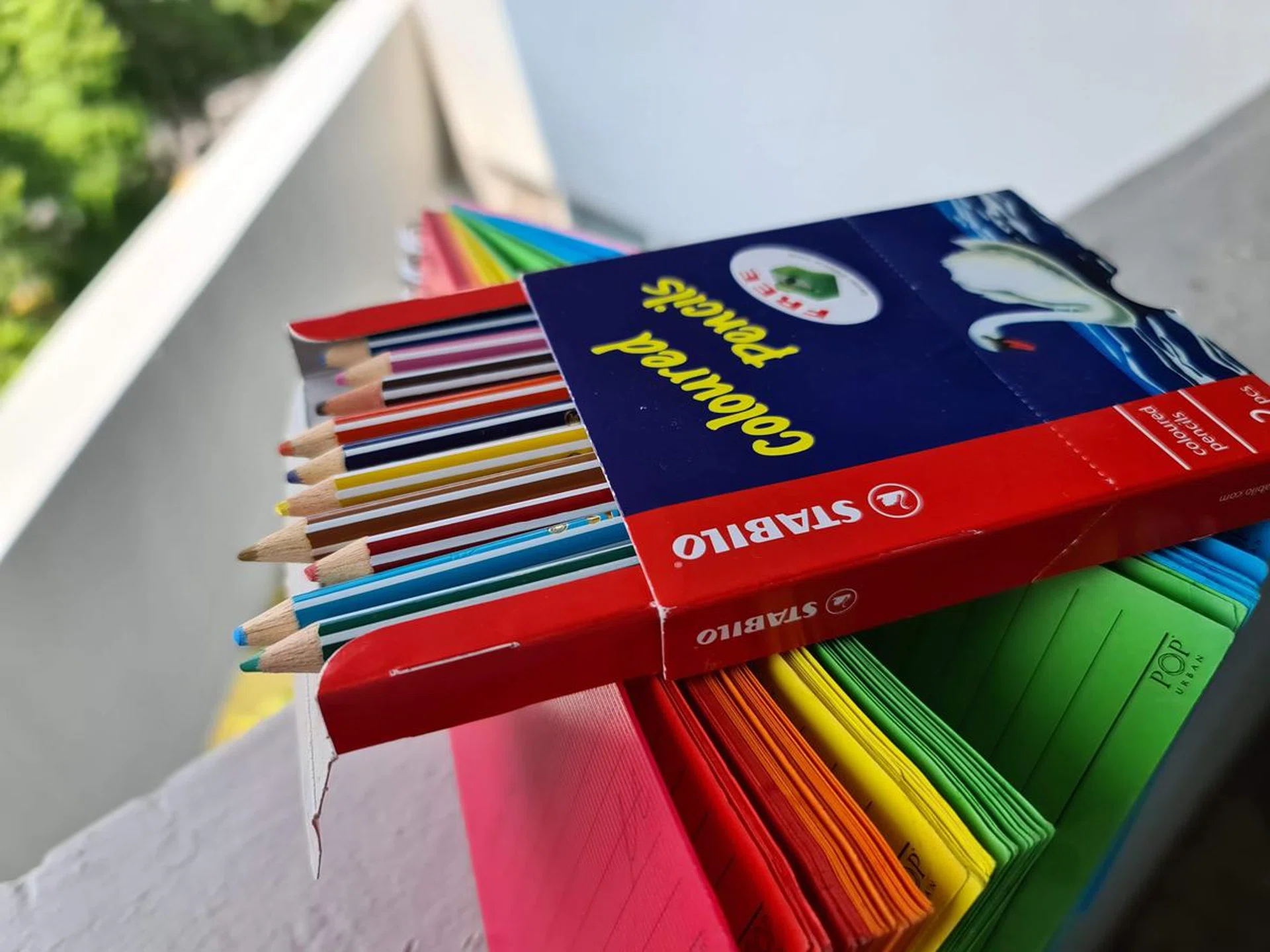
Galaxy S20 Ultra, wideangle (normal) lens.
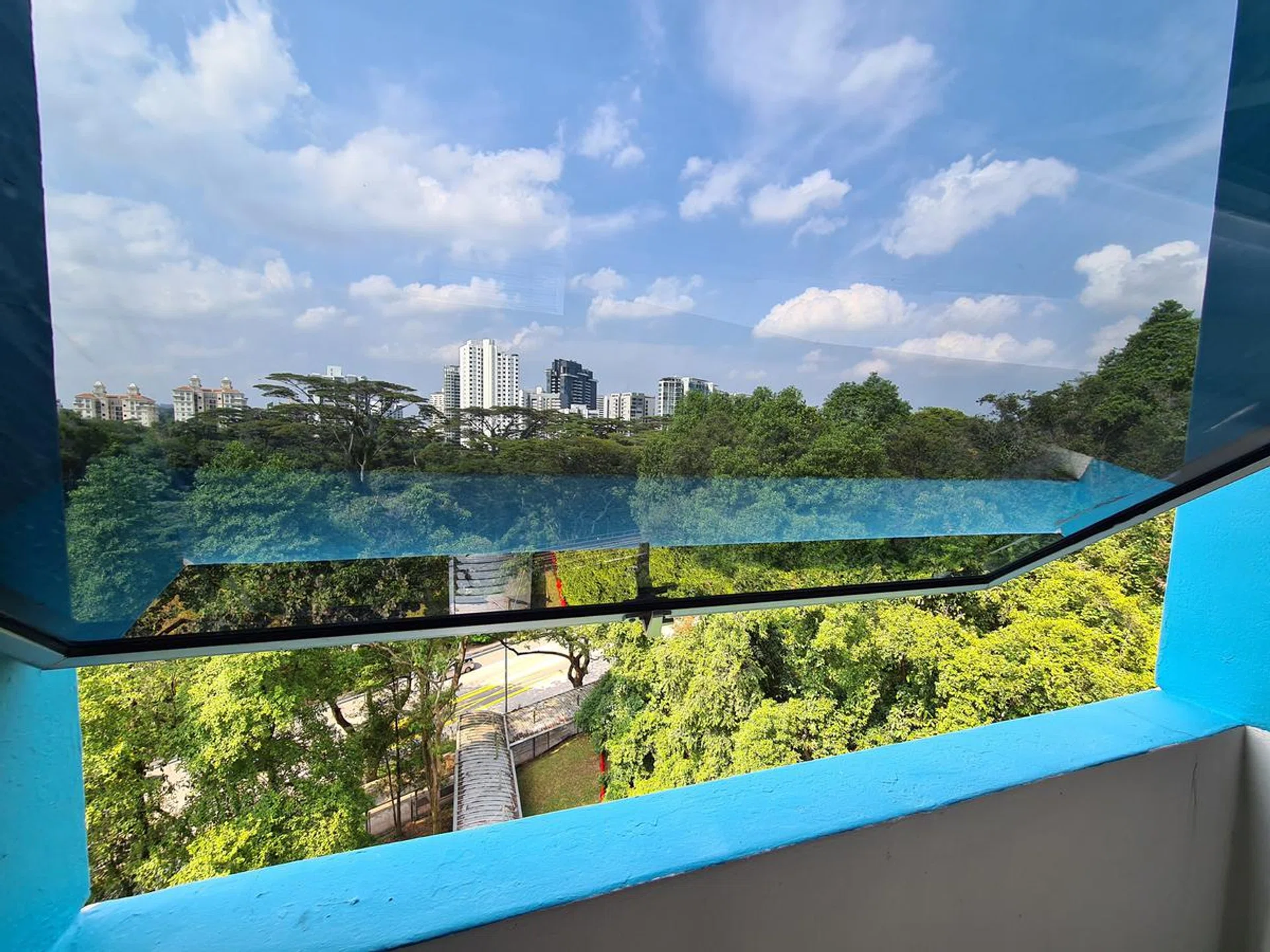
Galaxy S20/S20+, ultra-wideangle lens.
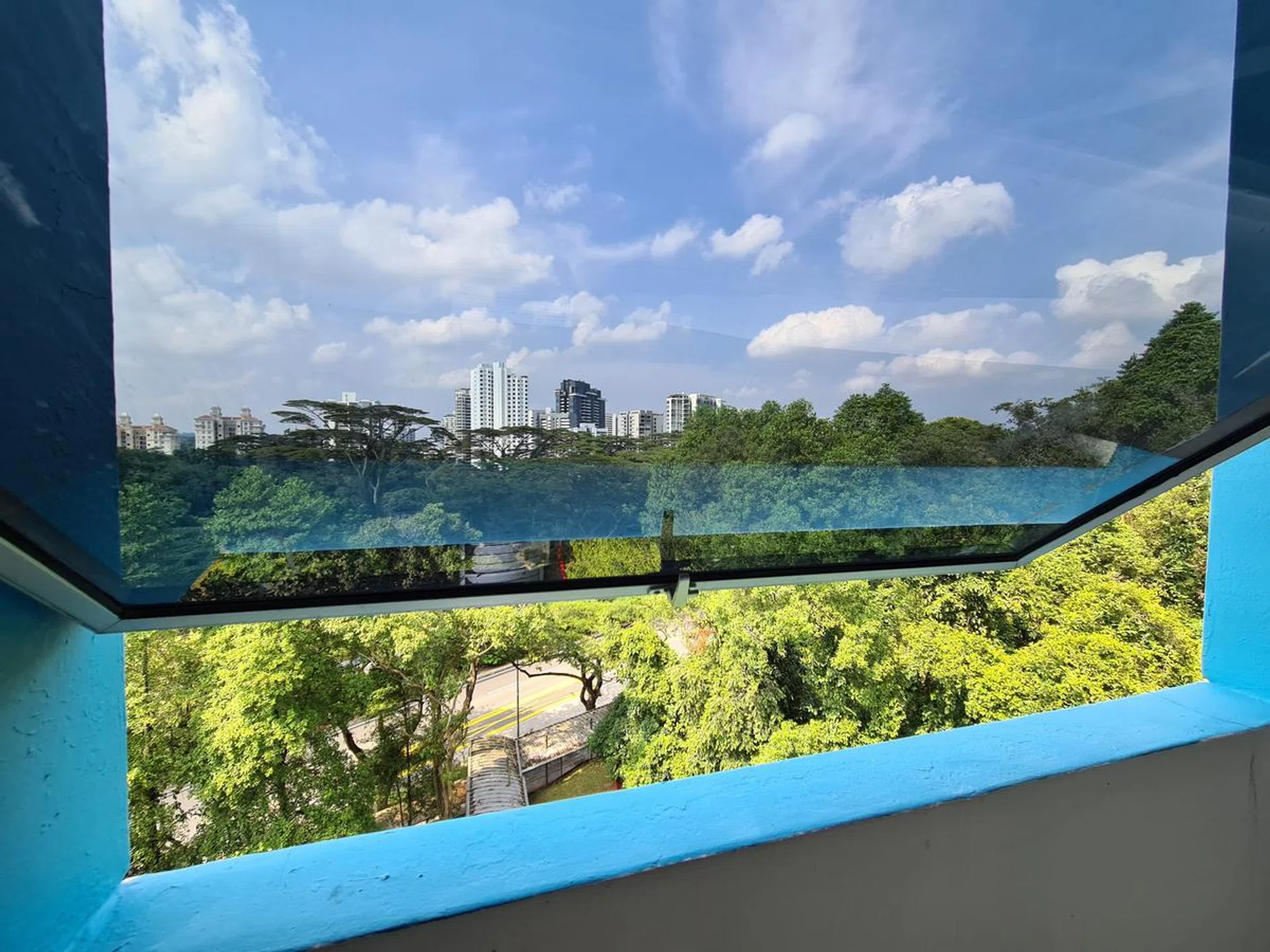
Galaxy S20 Ultra, ultra (hah!)-wideangle lens.
We started to see differences only in high-contrast scenes or scenes with light sources that could potentially confuse white balance processing, as this shot at Jewel Changi Airport illustrates:

The Galaxy S20/S20+ produced the more pleasing image of all three as far as saturation and tonality were concerned. The green cast on the roof glass panes is a faithful reproduction.

The Galaxy S20 Ultra seemed to flatten the highlights a bit, although it expectedly produced more detail.
I had the privilege of hanging out at a homely house in the Tanjong Pagar area over the weekend, and got some really nice views that further drive home the point:

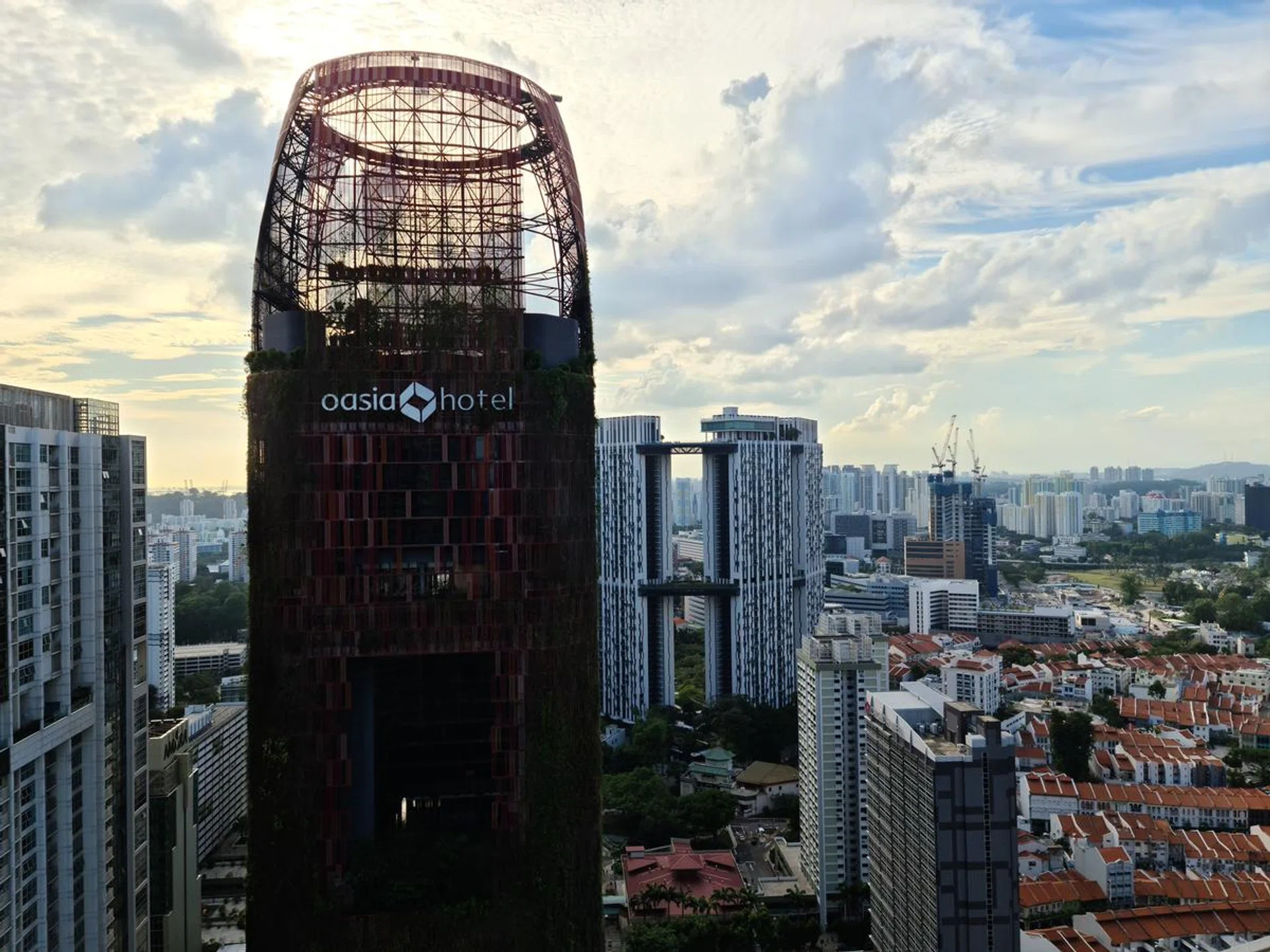
Galaxy S20/S20+. Observe the hotel's shadow detail...
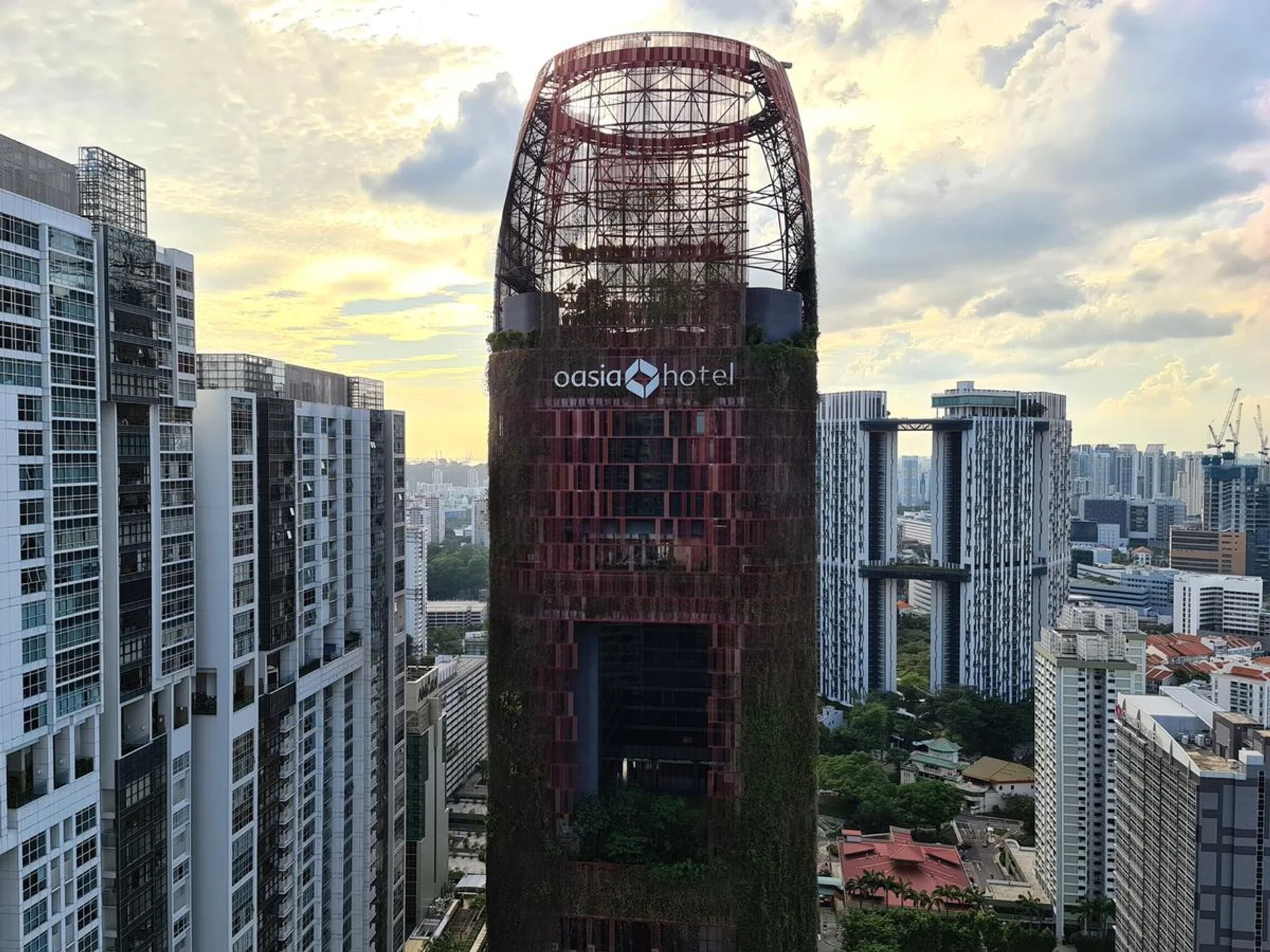
Galaxy S20 Ultra. Again, shadow detail is more muted.
And now, for the part you've really been wondering about:
So... how do they zoom?
The S20 and S20+ have "only" 30x hybrid zoom, while the whole planet likely knows by now that the S20 Ultra maxes out at a mindboggling 100x "Space Zoom". However, before you rush out of the house with your fistful of dollars, read this part through:
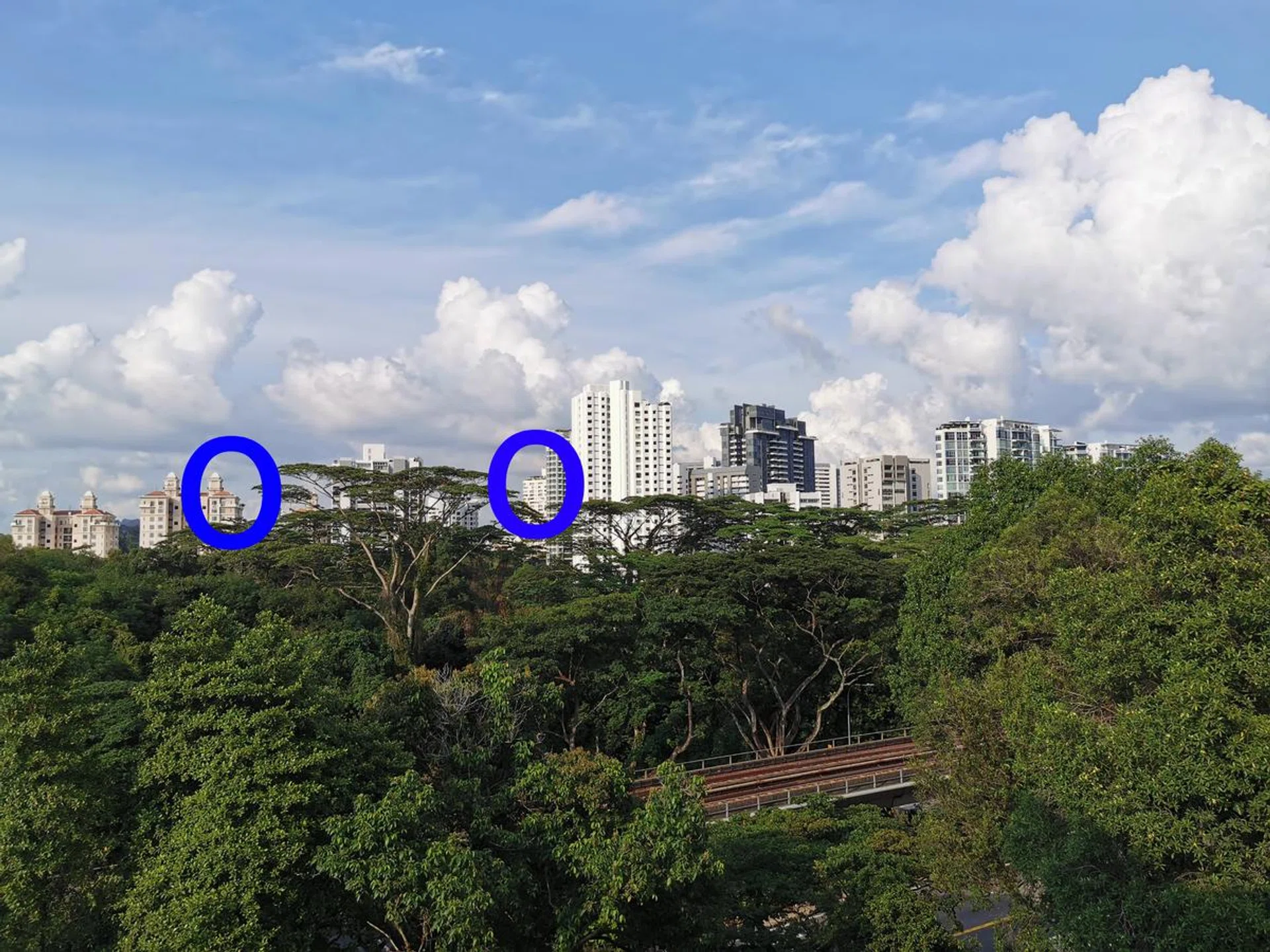
We're going to use this image as a guide for our zoom tests. Observe the two blue-circled areas. (This image was not shot with the Samsung devices.)

Galaxy S20/S20+, 10x hybrid zoom. (This is the circle on the left in the image above.) The lower 64MP resolution and lack of a true zoom lens mean less image data to work with, and it's clearly struggling at this range.

Galaxy S20 Ultra, 10x hybrid zoom. There's just a lot more detail, and the image is perfectly usable.
But at 30x hybrid zoom, the S20 and S20+ are, strangely, not as terrible as you might expect:

Galaxy S20/S20+, 30x hybrid zoom. The image has a lot of processing artifacts, but the texture in the roof tiles is retained, and you can still make out the railings.
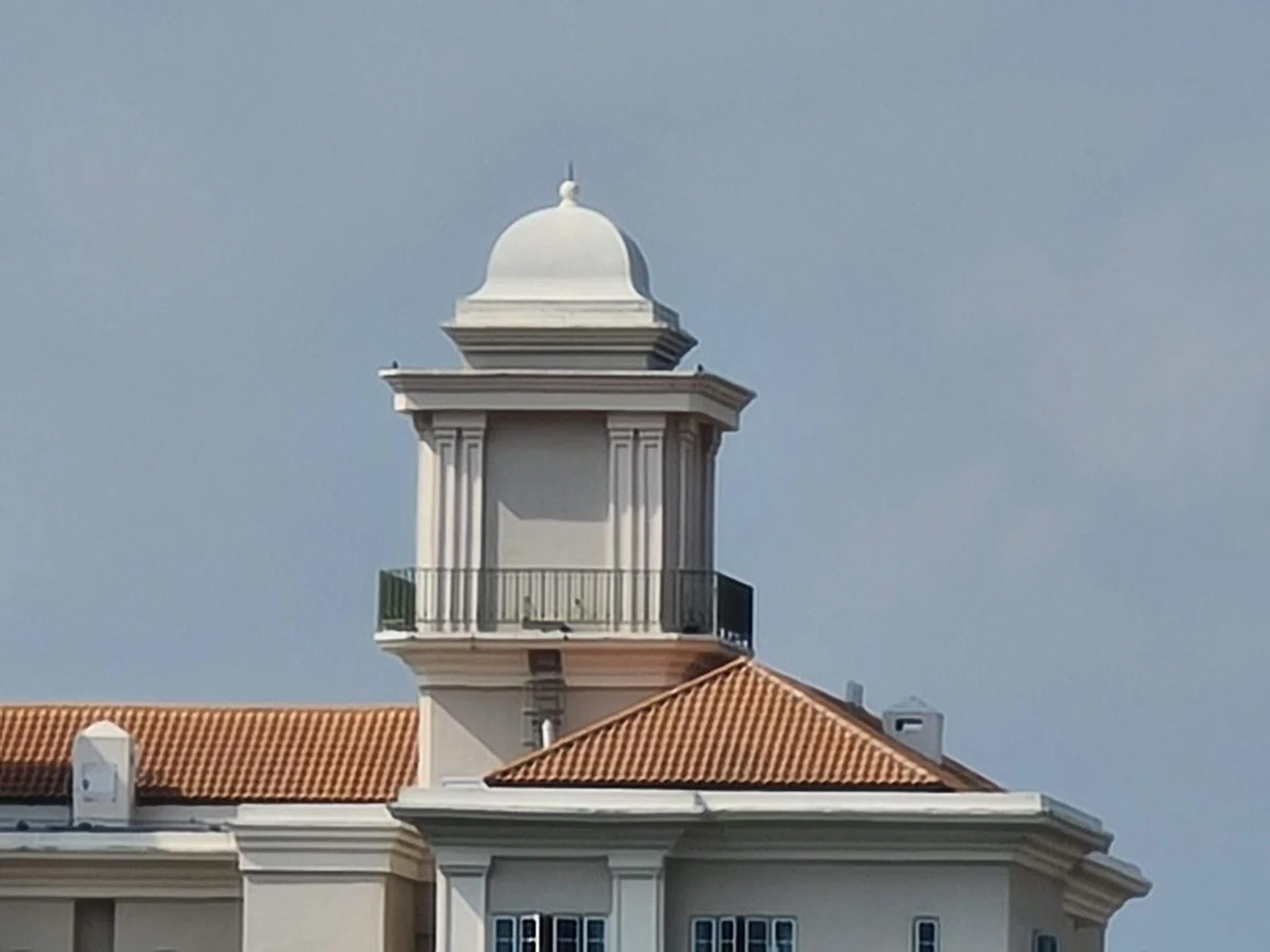
Galaxy S20 Ultra, 30x hybrid zoom. The image is usable, but not by a huge margin.
Let me try to make this point in a slightly different way. Consider these three shots:

We'll use this shot from the Galaxy S20 Ultra as a reference. This was taken at 10x zoom.

Galaxy S20/S20+, 30x hybrid zoom. The branding and detail on the containers can be made out.

Galaxy S20 Ultra, 30x hybrid zoom. While there's a little more detail, it's still not sufficient to give clear edges to the brand logotypes.
Let's take another look:
Look below the Pinnacle@Duxton flats and you should be able to make out what we're looking for: the roof of the Poo Thor Jee Temple.

Galaxy S20/S20+, 30x hybrid zoom.

Galaxy S20 Ultra, 30x hybrid zoom.
Would I say there was a meaningful difference between the zoom quality on the S20/S20+ and the S20 Ultra? Yes - depending on your needs. Would I say it was worth a full $600? Maybe not.
We've come a long way with periscope lenses plus high-megapixel sensors that were once only the preserve of medium-format studio cameras, pumping out huge amounts of detail which today's lightning-fast processors can integrate and crop in a matter of mere seconds to produce levels of digital zoom hitherto unseen on smartphones. But you know what? It's still digital. Don't expect to take the S20, S20+, S20 Ultra, or any of their contemporaries on safaris and get long zoom shots of cheetahs or wildebeest worth a page in a coffee-table book. The quality still isn't there yet.
Verdict: If the idea that the S20 Ultra wipes the floor with any other smartphone today in terms of resolution and zoom power keeps you awake at night, then by all means go for it. However, the average Joe and Jane, unaccustomed to zooming even past 5x on a daily basis, will probably not make enough use of the extra detail to justify the huge premium - and the S20/S20+ already have very good cameras.
There's also the issue of the S20 Ultra's gigantic form factor and huge camera bump. The S20 Ultra is certainly better at this new and exciting hybrid zoom game, but whether it's $600 better off-the-shelf (maybe some can close the gap by signing a telco contract) is something you should think about carefully, especially since for all other intents and purposes both sets of cameras have very similar output quality.
Has 8K video killed the 4K video star?
8K video recording is still an idea before its time. There's not a lot of (affordable) gear out there that will play your glorious clips at full resolution, and all you'll be doing is filling up your internal storage (and whatever poor microSD card serves in your phone) at 600MB per minute. Also, video is recorded at a film-era 24fps with no autofocus tracking or image stabilisation.
On top of all these, what I consider the Numero Uno problem with 8K video was that we just could not find anywhere to share it. We read that both YouTube and Vimeo would accept it for upload, but YouTube had only processed it to Full HD 1080p a couple of days later, while Vimeo hadn't even gotten past 360p.
What sounds like a more practical use of 8K video on the S20 phones is the ability to produce 33-megapixel still images from any frame in an 8K video. This can be done from within the phone's native Video player app by tapping the Quick Crop button on the upper left hand corner (the one below the file name.)
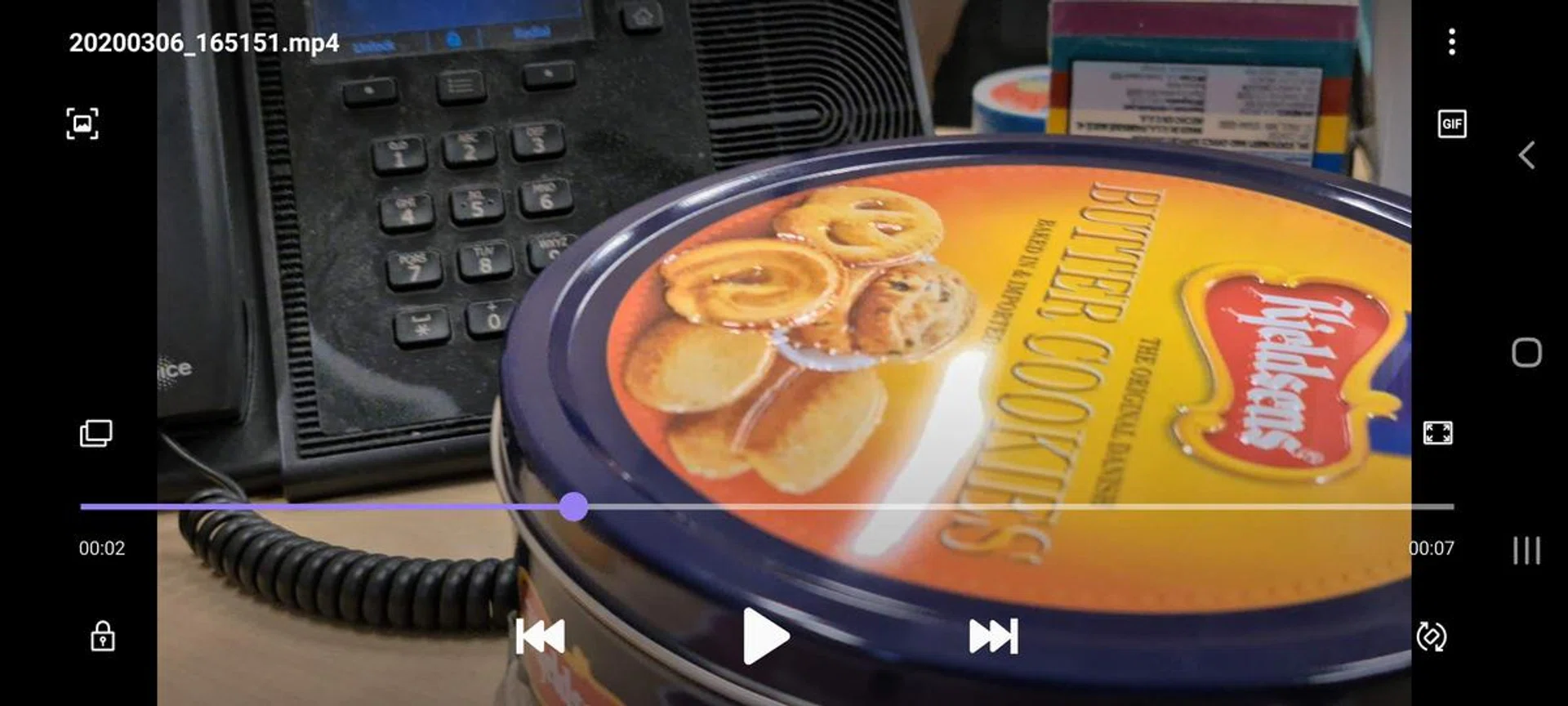
Now here's the catch. I say "sounds like" because, with any camera movement and indoors or in low light, the 24fps frame rate results in too many blurred frames to deliver enough keepers for Quick Crop:
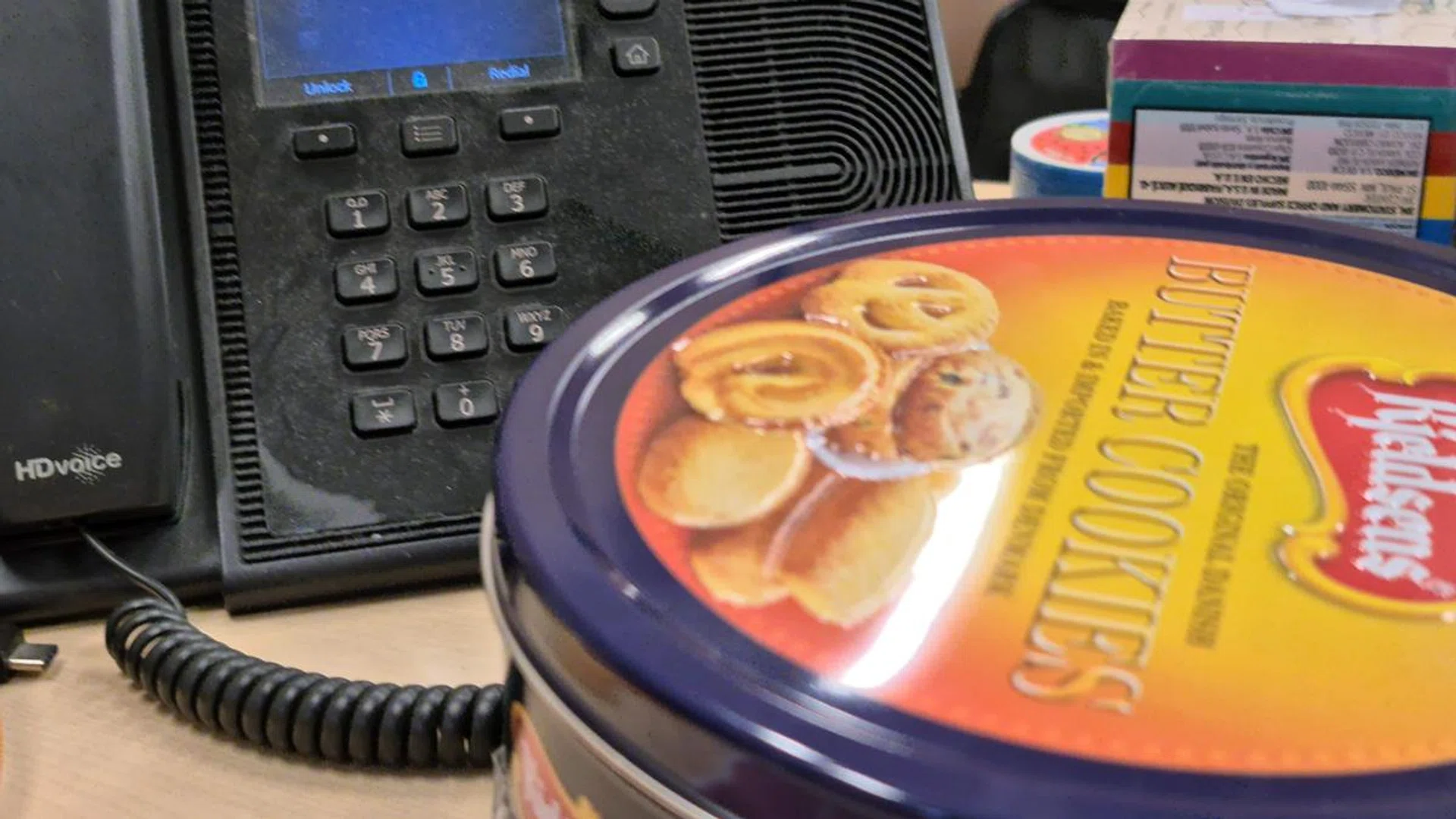
This wasn't even a fast pan, mind you.
On the other hand, Samsung has made sure that the standards are well in place. Good ol' 4K video is recorded at 60fps, doesn't look any less crisp (the difference is practically indiscernible on the phone's display), and best of all, looks great even in low light. The Quick Crop stills from 4K video are 8.3MP, more than enough for social media sharing.
There's something to remember regarding angle of view in both camera modes, too. Eagle-eyed punters will have noticed (and think) that you get more hybrid zoom ("10x") in 4K mode, while in 8K mode you'll have to make do with only "6x". Sorry to burst your bubble, though: the actual amount of zoom is the same!
I'll sum it up thusly: 8K eats storage and battery juice like it's going out of style, while affordable, ubiquitous 8K consumer displays are not even ripe for the picking. Nope - just like "108MP mode", 8K video is, for now, just another party trick.
How do these phones fare at selfies?
The S20 and S20+ use a 10MP, f/2.2 selfie cam, losing the dual-camera setup on the S10+.
In normal conditions, the selfie cam is unremarkable (which is to say, quite acceptable...)

I threw the selfie cam a hard task with this shot.
And what about S10 upgraders?
Maybe it's that time of the year when your contract is due. Should you get the S20/S20+?
A 128GB S10+ seems to be able to fetch north of $500 (as of the time of writing) in some of the more well-known mobile stores. If you're renewing your contract, it's a no-brainer. You could pay a couple hundred, or nothing, after selling off your existing phone.
As for no-contract purchases, with the street price of the S20+ being about $1,100 now this would mean forking over another $600. Is $600 still worth paying? For the first high-resolution pixel-binning camera hardware on a flagship Galaxy, a class-leading combo of AMOLED and 120Hz display refresh rates, and a more efficient and powerful Exynos processor and more RAM... I say yes.
If the camera is your main concern, here are some comparison images that might sway you. Or not:

In certain difficult lighting conditions, the S10 tended to compensate better for white balance. This is from the S20/S20+...

...the same shot looks more pleasing on the S10+.

In some cases, the S20/S20+ produced images with blurring off-centre...

...versus the S10+.
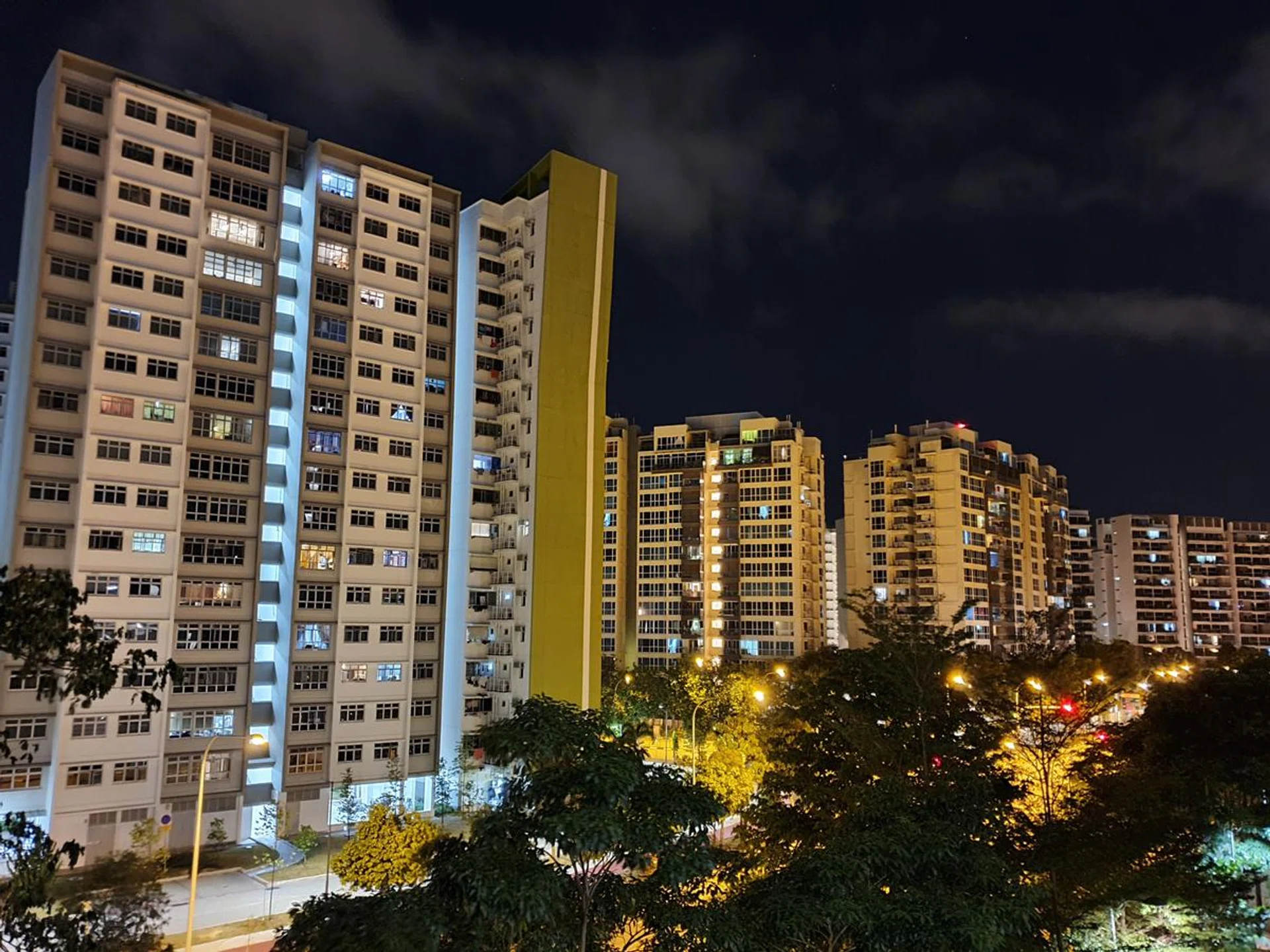
At night, however, while the S10+ had more pleasing white balance, it was harder to keep up in detail...
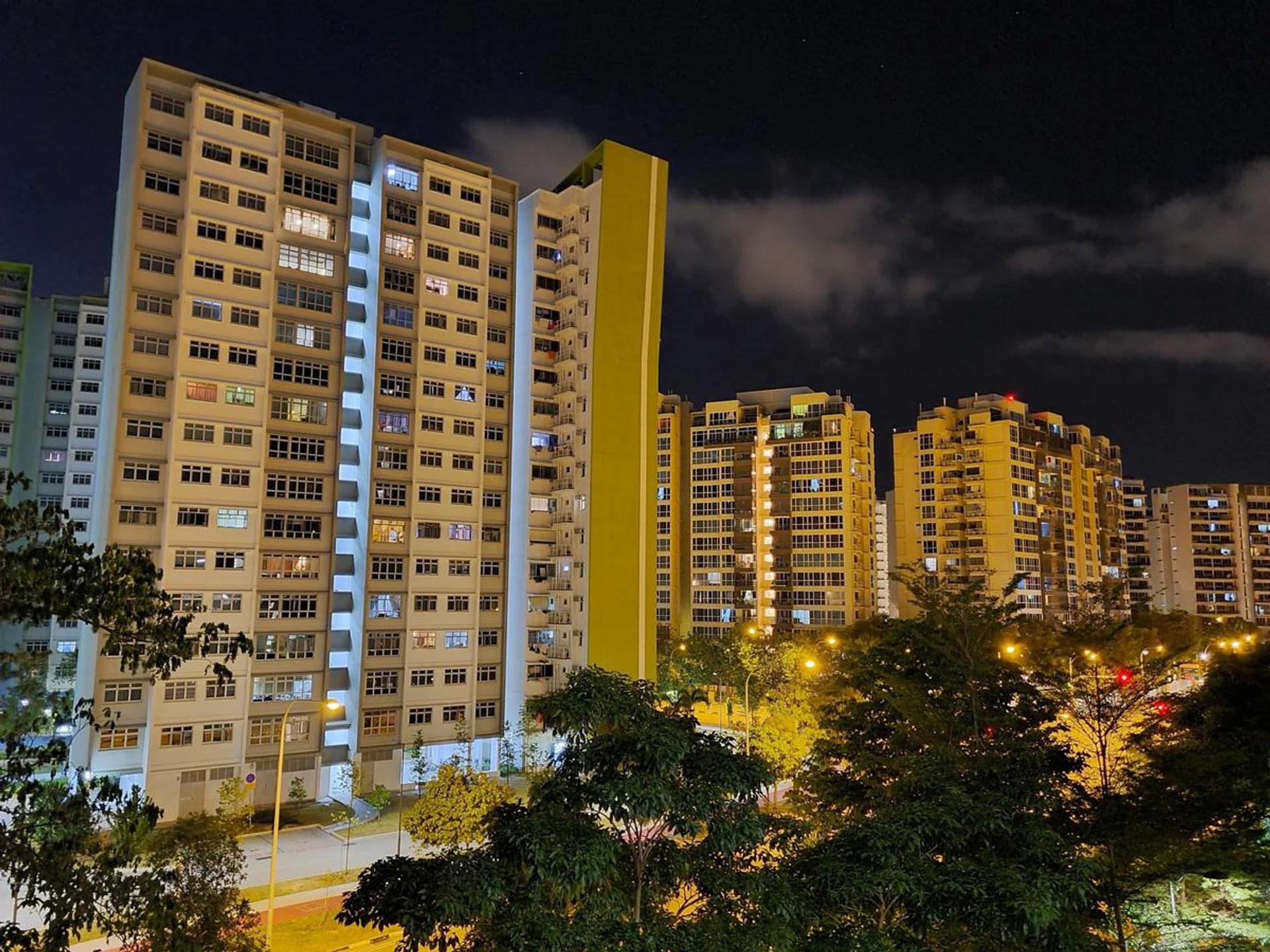
The S20/S20+ duo and their pixel-binning 64MP shooters were simply able to combine additional detail with superior light-gathering ability. Observe the detail in the trees.
Conclusion
Apart from their rather "meh" design language, I found that I enjoyed the time I spent with the S20/S20+ duo more than I expected.
I received all three members of the S20 family for review, and I was initially only excited to finally be able to Space Zoom my way to infamy on my own Instagram feed. But after some time, it became clear that the bread-and-butter casual shots were good enough to impress friends, family and followers - and that the smaller duo were easier to handle than the Ultra, yet with similar battery life.
The S20 and S20+ together represent a solid effort from Samsung that addresses most of the gripes I've had with previous-generation flagship products, and so both come highly recommended from me. Now, if you'll excuse me, I'll be off to look for some flashy cases...