
PowerColor Radeon X1950 XT 256MB
With all the attention on NVIDIA's GeForce 8 series, ATI's second ranked card, the Radeon X1950 XT has entered the market well under the radar. Priced to compete against the GeForce 7950 GT, how would this revamped Radeon fare against the competition? Here are our thoughts.

Introduction
In case you have not noticed, ATI's website has undergone some superficial changes in appearance to match its new owners - AMD. The red team has gone green, though its logos and brands seem to have remained the same. Its website URL has been changed to reflect the new order at the graphics chipmaker. For AMD, it's a rather familiar story as it takes over a graphics business facing stiff competition in the market from NVIDIA, analogous to what it encounters now with Intel in the CPU arena. Going by the numbers, the new combined entity is currently at a performance disadvantage for both processors and graphics, but the synergy potential was highlighted recently with AMD's launch of a dedicated stream processor for high performance computing.
Meanwhile, the latest in ATI's recent rehashes of its graphics lineup has slipped quietly into retail channels with hardly any fuss. The Radeon X1950 XT looks to be the final update for the retiring Radeon X1900 XT though it has more in common with the older chip than other existing members in the Radeon X1950 series. For one, the R580 core is carried over from the Radeon X1900 XT, unlike the modified R580+ in the Radeon X1950 XTX or the 80nm RV570 in the Radeon X1950 PRO.
What ATI did essentially was to slap on faster memory chips on the older Radeon X1900 XT and up its clock from 1450MHz DDR to 1800MHz DDR. Therefore, the 'new' Radeon X1950 XT has a core and memory clock of 625MHz and 1800MHz DDR, along with 256MB of DDR3 memory. No doubt, we may find custom 512MB versions from vendors but 256MB seems like the more cost efficient and common variant.
So is the Radeon X1950 XT 256MB worth your time? We recently got one from PowerColor and put it through our usual tests. Before revealing the details, here's a glance of the PowerColor retail package:
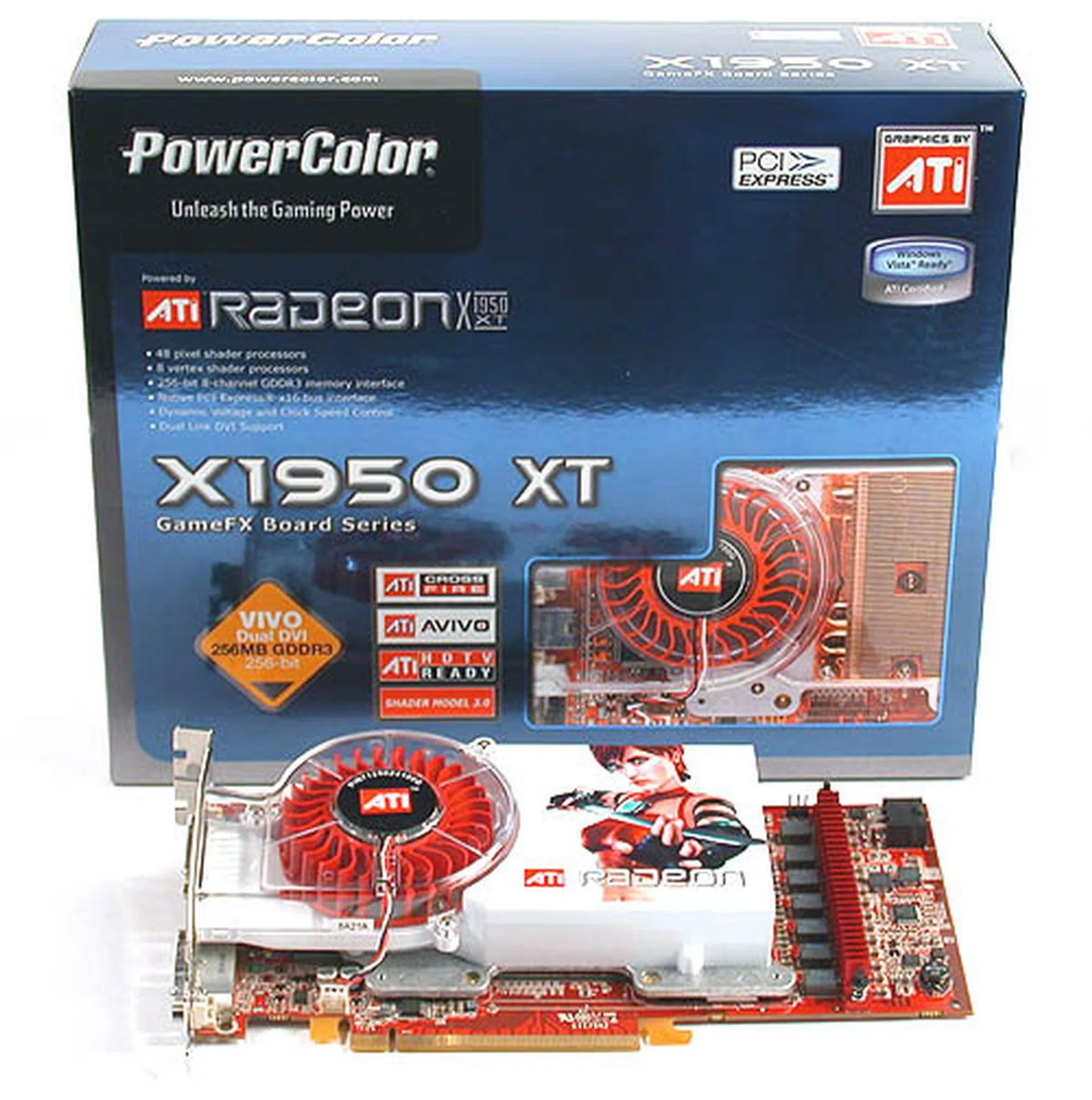
The PowerColor Radeon X1950 XT 256MB.
The PowerColor Radeon X1950 XT 256MB
Another mainstay of the older Radeon X1900 series, the two-slot cooler that became infamous for its noise, is retained for the PowerColor Radeon X1950 XT. Hence, it could be difficult to tell between the new from the old, given that same cooler. At least there has been some improvement from that initial batch of Radeon X1900 XT cards as the cooler on the PowerColor Radeon X1950 XT is slightly quieter. We could still hear the cooler of course but it was not as annoying. However, if you are used to the excellent coolers on the Radeon X1950 XTX or the X1950 PRO, this is a step backwards.
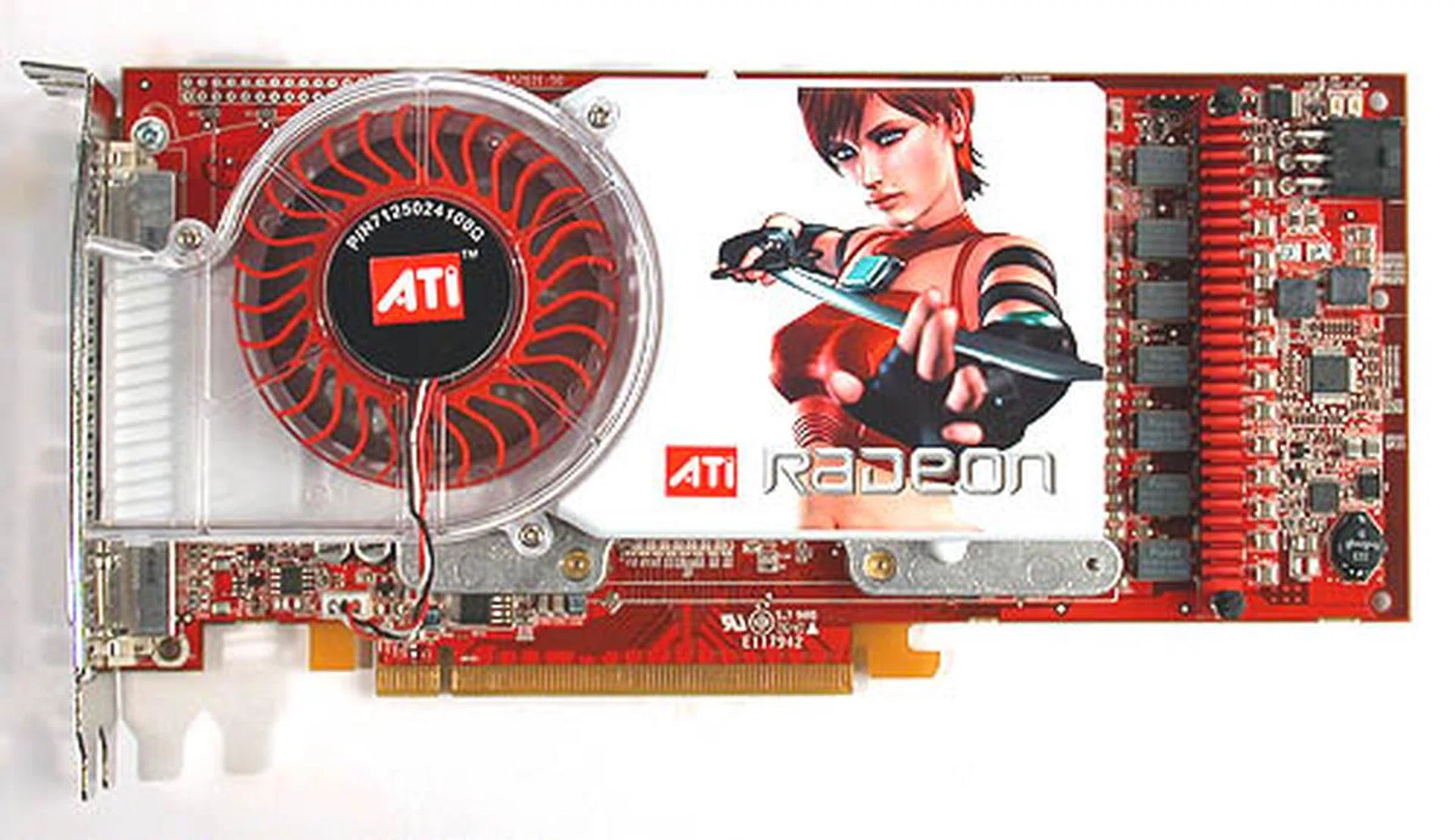
After the GeForce 8 series, the Radeon X1950 XT looks almost puny by contrast. It is actually the same size as the original Radeon X1900 XT and has the same cooler too.
The main difference between the new Radeon X1950 XT and the Radeon X1900 XT lies in the memory. For the PowerColor, we found Hynix 1.0ns memory modules onboard and as we mentioned earlier, these are clocked at 1800MHz DDR, which is about 350MHz DDR higher than the Radeon X1900 XT. Unlike the Radeon X1950 XTX however, these are still GDDR3 memory modules and not the more energy efficient GDDR4 so while you could theoretically overclock the memory on the Radeon X1950 XT to approach that of the X1950 XTX, heat could be a limiting factor.

The memory modules are rated at a very fast 1.0ns, more than sufficient for its clock speed of 1800MHz DDR.
For those who have not given up on CrossFire despite its many changes and setbacks, the PowerColor Radeon X1950 XT supports software CrossFire, i.e. there's no hardware compositing engine onboard. Since ATI did not redesign this card extensively, the newfangled Internal CrossFire (through a SLI look-alike bridge and found only on the Radeon X1950 PRO and X1650 XT) is not possible while the original CrossFire method requiring the CrossFire dongle is also not implemented for the Radeon X1950 XT. Instead, software CrossFire requires the latest Catalyst 6.11 drivers, bringing us to yet another common ATI grouse - the drivers.
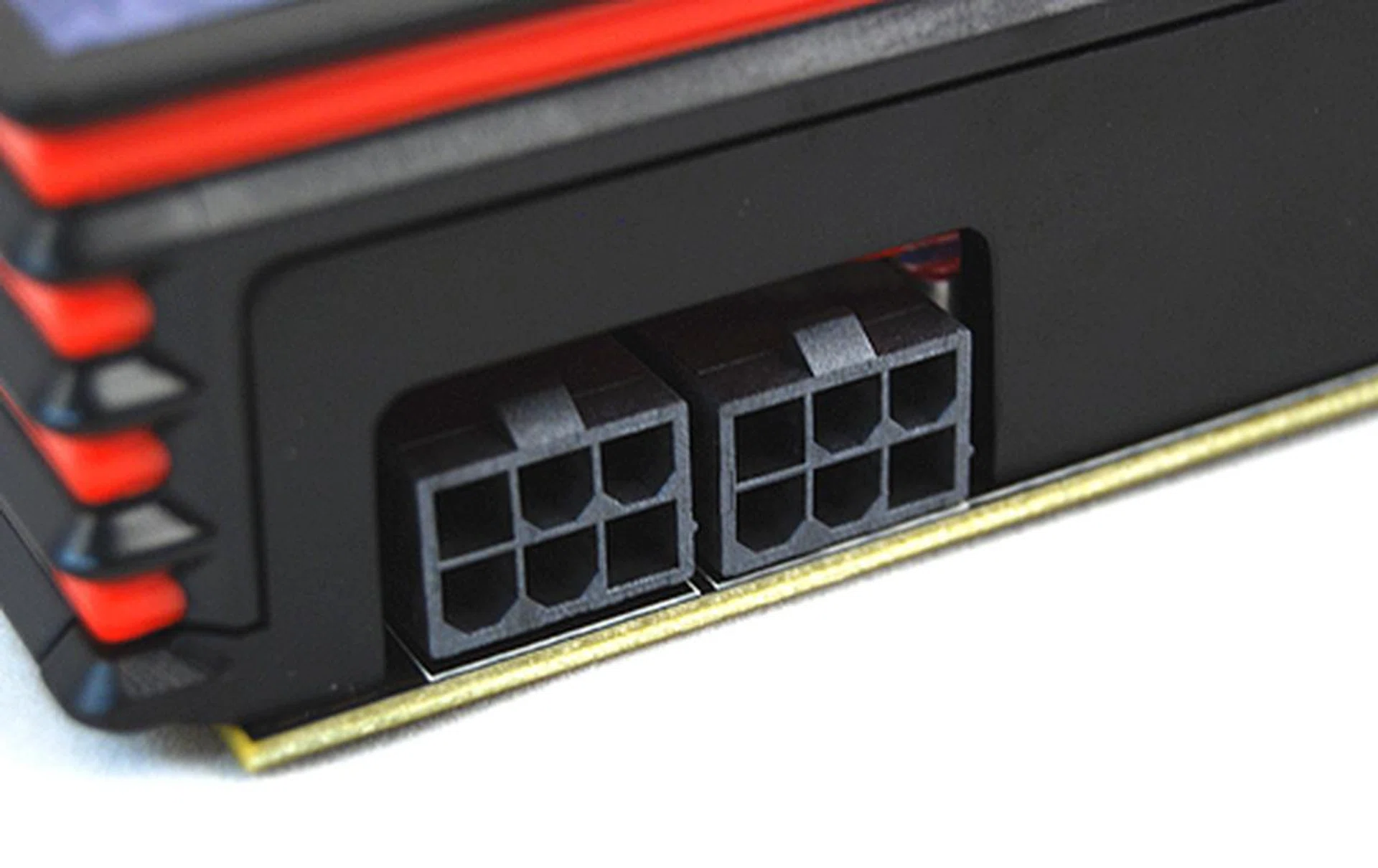
It's a familiar sight, the passive heatsink over the power circuitry.
Namely, we tried to install Catalyst 6.11 (8.31.5 drivers) on the PowerColor Radeon X1950 XT. However, the PowerColor was not recognized and we had to resort to the included drivers from the vendor, which turned out to be Catalyst 6.10 (8.30.2 drivers). ATI should really try to make sure that its latest drivers support their new products, especially since we feel that adding support for the Radeon X1950 XT is a trivial matter and particularly for a redesigned update of a card like this. In short, this looks like the driver fiasco with the Radeon X1950 PRO again (where one had to wait a couple of driver revisions to get official Catalyst support) and we hope that it can be resolved soon.
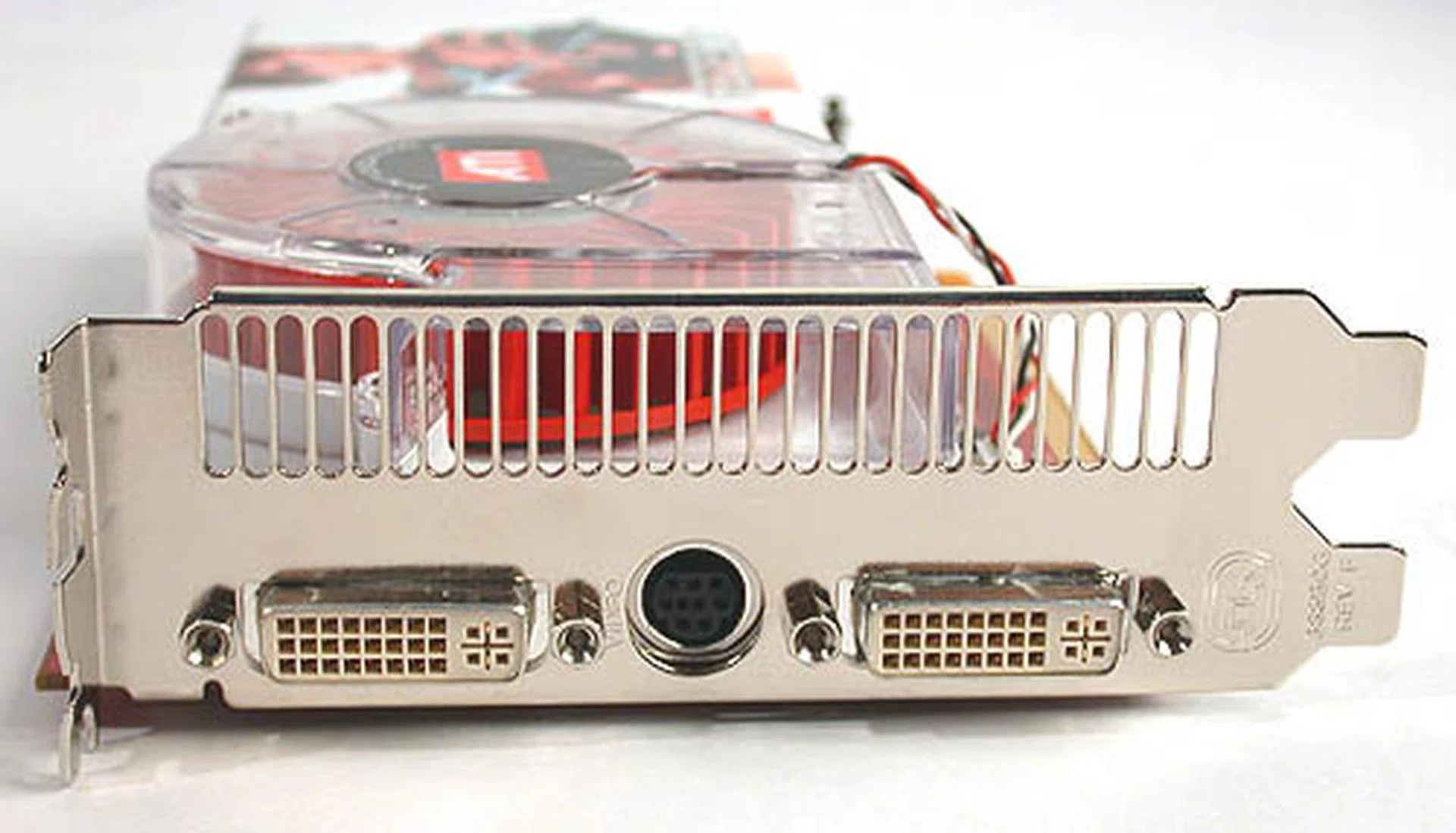
There appears to be no HDCP support on the PowerColor, though this is likely to be vendor dependent.
Like most high-end ATI graphics cards, the Radeon X1950 XT comes with VIVO thanks to a Rage Theater ASIC but if you are concerned about future-proofing, HDCP support appears to be missing. You'll find the standard dual-link DVI outputs of course and PowerColor has included a generous selection of cables and adaptors suitable for almost every purpose. There was only one software CD however and no games in the bundle, though that's the norm for PowerColor. At least the included software is a comprehensive suite of DVD utilities from CyberLink. Here are the items we found in the PowerColor package:
- 1 x DVI-to-VGA adaptor
- 6-pin Molex power connector
- 9-pin mini-DIN to Component dongle
- 9-pin mini-DIN to Composite/S-Video dongle
- S-Video extension cable
- Composite extension cable
- Quick Installation Guide
- Driver CD
- CyberLink DVD Solution
Test Setup
For our benchmarks, we used a system configured with an AMD Athlon 64 FX-55 (2.6GHz) processor running on a MSI K8N Diamond Plus motherboard. We also installed 1GB of DDR400 low latency memory from Kingston in dual channel mode and a Seagate 7200.7 SATA hard drive. The operating system used was Windows XP Professional and this was updated with Service Pack 2 and DirectX 9.0c.
Like we mentioned earlier, the official Catalyst 6.11 drivers from ATI's website does not recognize the PowerColor Radeon X1950 XT so we had to fall back to the ones included by the vendor, which turned out to be based on Catalyst 6.10. We did not include the almost retired GeForce 7900 GTX, since most should know that its performance is in the ballpark of a Radeon X1950 XTX and in most cases, slightly inferior. Below is a list of the graphics cards we compared the PowerColor against, along with their driver versions used for testing.
- PowerColor Radeon X1950 XT (Catalyst 6.10 - 8.30 drivers)
- MSI RX1950XTX-VT2D512E (Catalyst 6.9 modified - 8.29 drivers)
- ATI Radeon X1900 XT 512MB (Catalyst 6.8)
- PowerColor Radeon X1950 PRO 256MB (Catalyst 6.9 modified)
- NVIDIA GeForce 7950 GT 512MB (ForceWare 91.47)
And the following benchmarks were tested:
- Futuremark 3DMark05 (ver. 120)
- Futuremark 3DMark06 (ver. 102)
- Tom Clancy's Splinter Cell: Chaos Theory
- F.E.A.R
- Chronicles of Riddick: Escape from Butcher Bay
- Quake 4
Results - 3DMark05 Pro & 3DMark06
The Radeon X1950 XT proved to be the update of the older Radeon X1900 XT as the scores for both these cards were very similar. The additional 256MB on the Radeon X1900 XT probably accounted for its slight lead but with the Radeon X1900 XT 512MB phased out in favor of the 256MB version, the Radeon X1950 XT does look like another substitute for the Radeon X1900 XT 256MB. Compared to ATI's top Radeon, the X1950 XTX, the PowerColor was around 7 - 9% slower while it also fared well against its main NVIDIA price competitor, the GeForce 7950 GT.
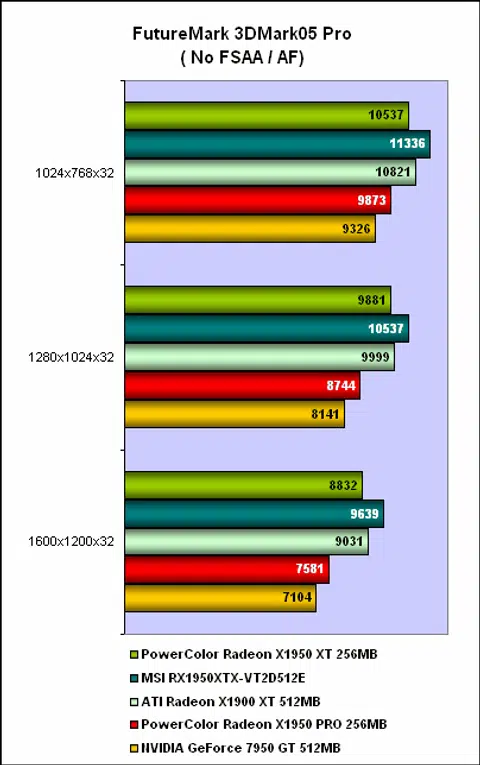
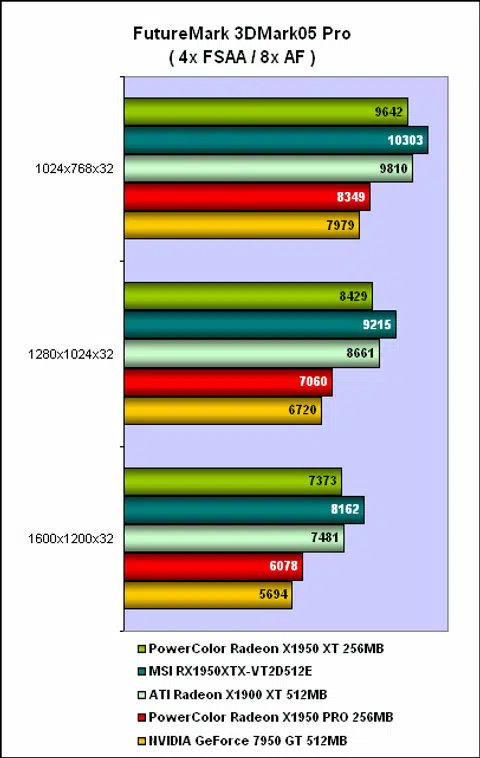
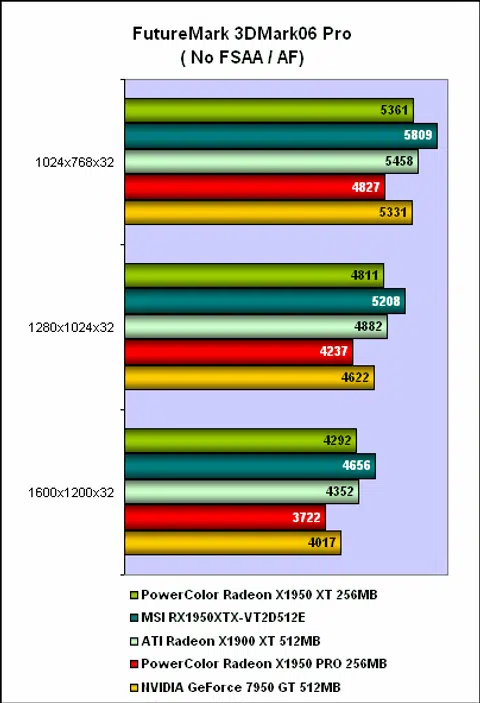
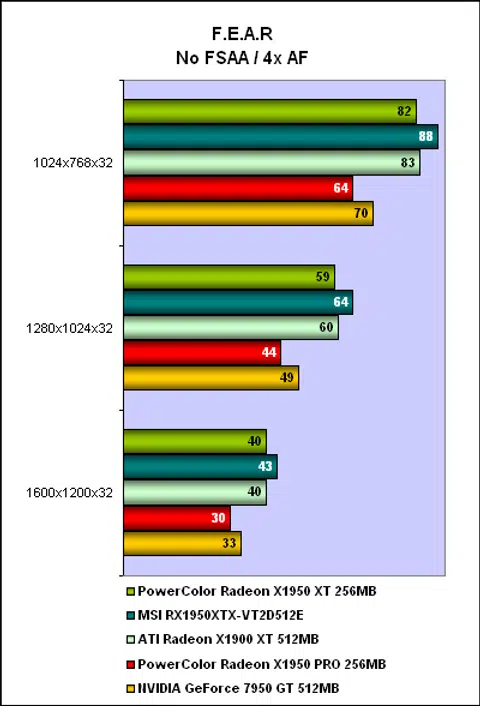
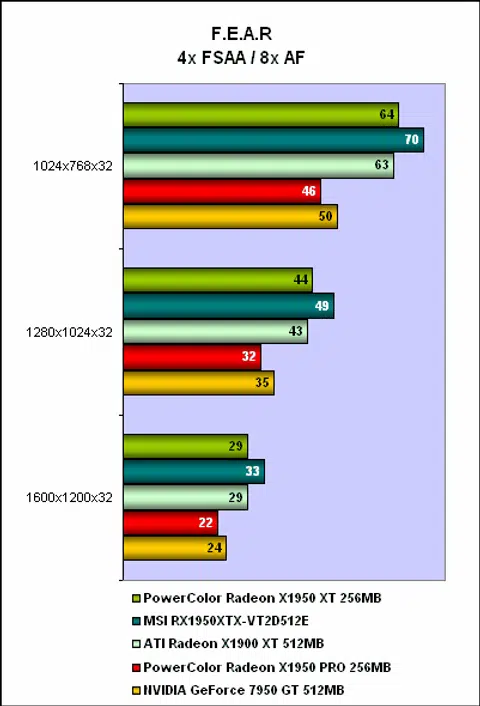
Results - Splinter Cell: Chaos Theory & F.E.A.R (DirectX 9 Benchmarks)
Near identical scores was again the trend for the Radeon X1900 XT and X1950 XT for both Splinter Cell and F.E.A.R. Since both cards have the same core clock, one could assume that the various difference in memory size and frequencies have limited impact on these benchmarks. Not to mention that there is also a slight variation in driver versions between them but looking at the results, one is hard pressed to separate them. Meanwhile, the Radeon X1950 XT continued to outperform NVIDIA's GeForce 7950 GT, which was lagging distantly at about 20% slower.
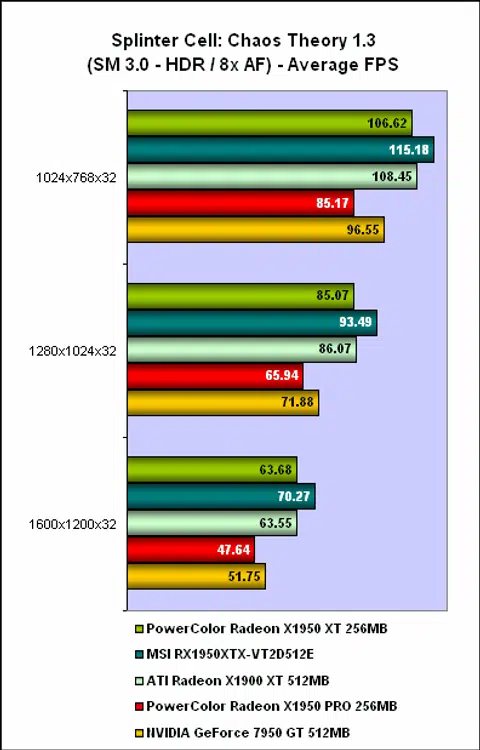
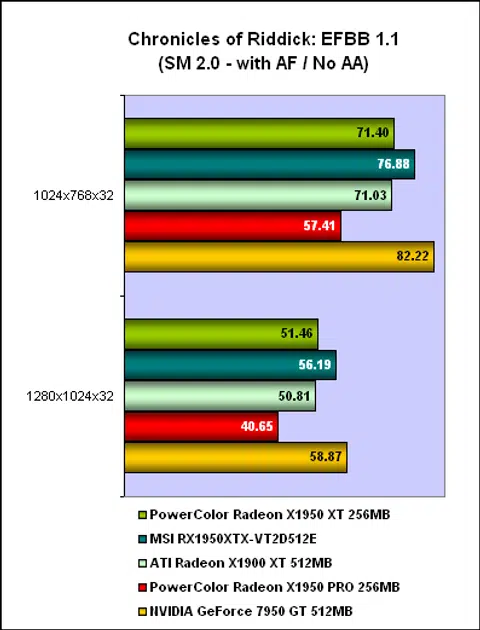
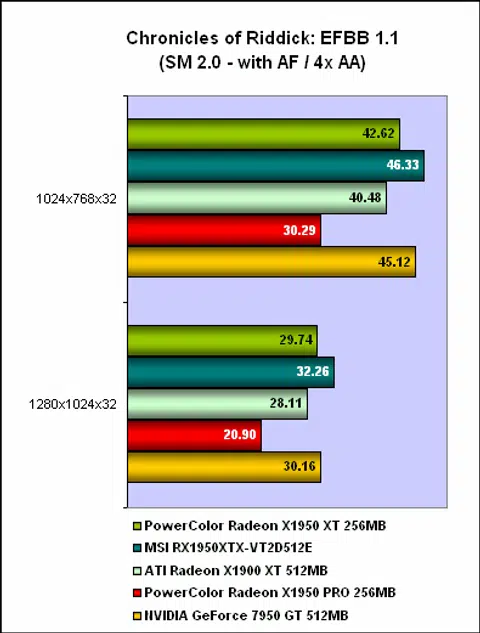
Results - Chronicles of Riddick & Quake 4 (OpenGL SM2.0+ Benchmarks)
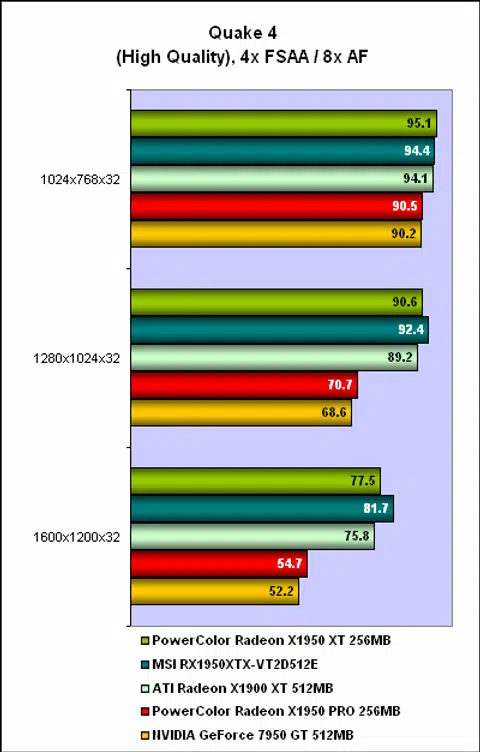
The GeForce 7950 GT got back into the game in Chronicles of Riddick, topping even the mighty Radeon X1950 XT. However, this was in an unoptimized OpenGL game and things actually became more equal once anti-aliasing was enabled later. In Quake 4, the ATI cards restored the advantage, with the GeForce 7950 GT losing to all the cards, including the cheaper Radeon X1950 PRO. From the results, it does seem that the higher memory clocks do help to boost performance to a certain extent, though the impact was not always significant.
Temperature Testing
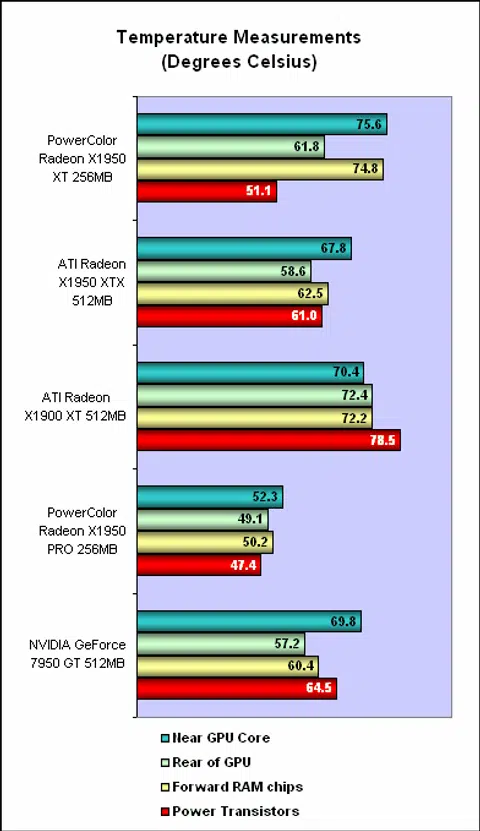
The major difference between the Radeon X1950 XTX and the PowerColor was the choice of cooler. The PowerColor used the same cooler as the Radeon X1900 XT, which was not the most efficient of coolers. Not surprisingly, the PowerColor was almost 10 degrees Celsius warmer than the Radeon X1950 XTX. The temperatures of the memory modules were also quite high, probably as a result of the high clock speeds. Overall though, the PowerColor performed slightly better here compared to its predecessor.
Overclocking
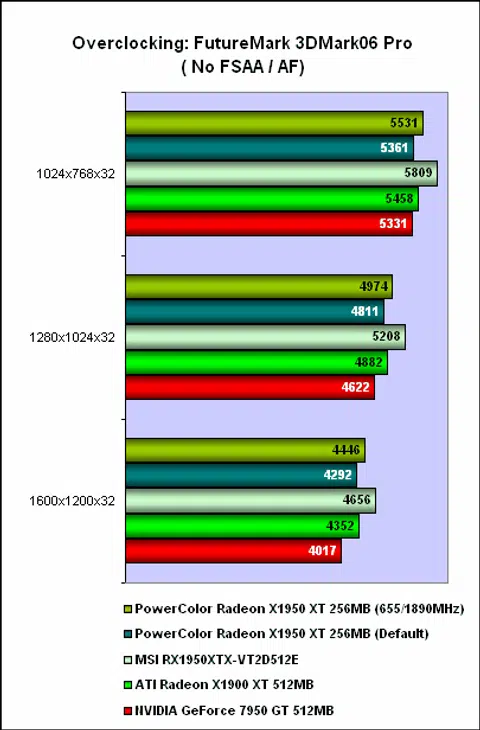
The maximum clock speed available using ATI's Overdrive utility in the Catalyst control panel was 690MHz for the core and 1900MHz DDR for the memory. We did try using the latest beta of ATI Tools but it did not seem to work accurately, hence we were limited to the Overdrive utility for overclocking. For those thinking of getting a cheap Radeon X1950 XTX by overclocking the Radeon X1950 XT, be warned that the core did not seem easily overclockable.
While we did reach a maximum of 655MHz, which is 5MHz more than the default of the Radeon X1950 XTX, the memory was restricted by the Overdrive utility. We managed to reach the maximum possible memory clock using Overdrive (the tool automatically adjusted our 1900MHz setting to 1890MHz) and as you can see from the 3DMark06 scores, we eventually saw an improvement of around 3%. Perhaps you will have better luck with the memory, especially with another overclocking tool but looking at our temperature readings, it did not seem like the wisest option.
Conclusion
With its next generation R600 core still under wraps until next year, ATI, like AMD has lost the high-end performance ground to NVIDIA's new GeForce 8 series. However, the distinct lack of DirectX 10 games and Windows Vista hardly make a strong case for NVIDIA's GeForce 8 series at the moment even though the green team has retired two of its GeForce 7 series cards to make way for two of its new GeForce 8800 cards. While performance of these newcomers is unquestionably good, there have been unconfirmed reports of weak sales such as this for the new cards. As odd as it may seem, there is a small possibility that users might be holding out for the expected, more affordable mid-range derivatives. Of course, the more possible reason in our opinion is that potential consumers are eyeing the recently launched and much hyped consoles from Nintendo and Sony instead of a graphics upgrade.
Rather than compete head-on, ATI seems to be concentrating on strengthening its present high-end lineup in order to challenge NVIDIA's GeForce 7 series. It is a strategy that it has been using since the Radeon X1950 XTX and it has only been picking up steam slowly with the Radeon X1650 series and X1950 PRO. Now we have the Radeon X1950 XT joining the team as a direct replacement for the Radeon X1900 XT. More expensive memory chips capable of higher memory clocks, together with software support for CrossFire seems to be the obvious changes compared to the older Radeon X1900 XT.
The only downside that we can see with the Radeon X1950 XT is that for some consumers, it's not exactly the latest in graphics technology. For this elite group of users, a decent performance to price ratio is not exactly the bragging material they require. Fortunately, these users form an extreme niche and are more than likely to wait for the R600 if they haven't already bought a GeForce 8800 GTX by now.
ATI's recent product refreshes have all been about price competitiveness and the Radeon X1950 XT continues that with a strong performance against the NVIDIA GeForce 7950 GT. If only the noise and heat quotient were better rated as well, the Radeon X1950 XT would have won a major battle just like the Radeon X1950 XTX did. For now, its performance is more than enough reason to give it a serious thought.
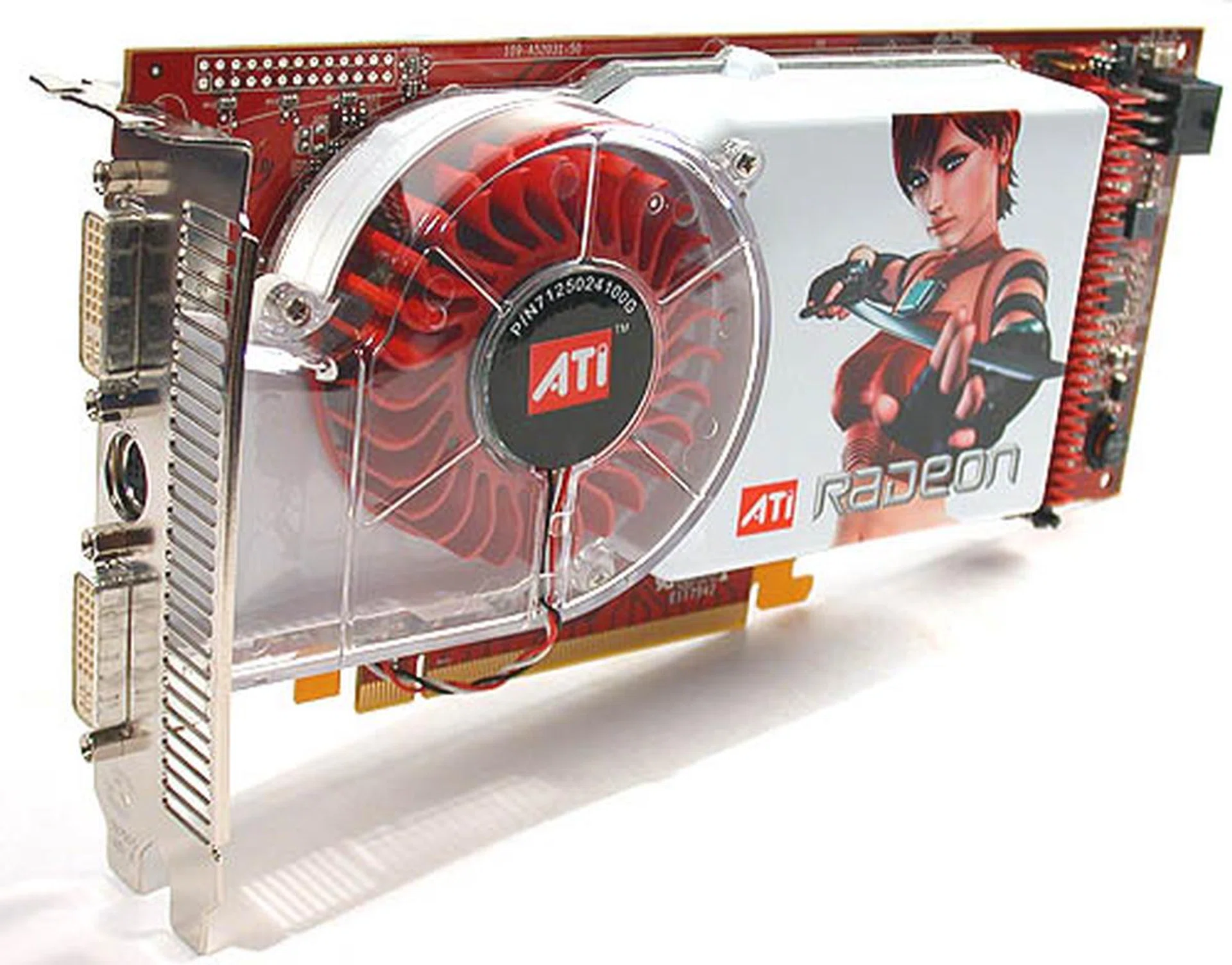
PowerColor's retail Radeon X1950 XT doesn't differ from the reference model and just by looking at it, you won't be able to distinguish it from the old Radeon X1900 XT or perhaps for some of you, even the Radeon X1800 XT. Besides a suite of DVD software and more than sufficient cables, it is a rather standard and competent product. Temperatures were predictably higher than the Radeon X1950 XTX or the 80nm Radeon X1950 PRO, especially for the core. We also found some limitations in overclocking the core, but the 1.0ns memory modules does seem to be limited more by ATI's Overdrive utility rather than the hardware.
While the Radeon X1950 XT seems to have been released with relatively little fanfare, it is not another paper launch from ATI. It would of course have been quite a disaster if even a rehashed design turned out to be unavailable, but such fears seem unfounded, given by the brands we have seen selling at online retailers. Prices too reflect its attractive price performance ratio, ranging from US$250 - US$300. This places it directly against NVIDIA's GeForce 7950 GT. Based on the benchmarks we have seen, the Radeon X1950 XT more than holds its own against its NVIDIA opponent and mirrors ATI's recent successes like the Radeon X1950 PRO in offering a slightly better price performance proposition. Priced at S$479 locally, the PowerColor Radeon X1950 XT is decently priced while its performance should tide you over till more DirectX 10 cards and games are launched half a year later.
Our articles may contain affiliate links. If you buy through these links, we may earn a small commission.