
PowerColor Radeon X1950 PRO 256MB
To counter NVIDIA's diversifying GeForce 7900 series, ATI today has hard-launched their answer - the Radeon X1950 PRO. Based on a new 80nm core, ATI was able to deliver the price-performance combination that was lacking in their range for a long time. Check out what we thought about PowerColor's souped up version.

Moving to 80nm
Feverish does not begin to describe what's happening in the graphics scene recently. Both ATI and NVIDIA are slugging it out before the DirectX 9 era officially ends. It is therefore a period of transition and both firms know that they have to work doubly hard to lure fence-sitting consumers who may be holding out for the new generation. Already, we have had new releases coupled with attractive price revisions that have made the past couple of months, the most intense and competitive graphics showdown for a while. It certainly helped that ATI seems to have staged a mini comeback, especially in terms of price and performance.
ATI arguably started it all when they revamped its flagship card by outfitting it with GDDR4 memory and an improved cooler - the Radeon X1950 XTX. Now they are following up with a less powerful version that still falls into the high-end segment, but at a more accessible price. The ATI Radeon X1950 PRO has a new core designation (RV570) but like most 'new' graphics chipset released recently, it's based on the older R580 core. In fact, it has the exact same shader and pipeline configuration as its Radeon X1900 GT predecessor that was using a R580 core with a one operating quad disabled from the total possible of four on the full fledged R580 core. Unlike that, the Radeon X1950 PRO's RV570 core is a streamlined core that is tailored only for this SKU, meaning it has nothing more than the 36 pixel shader processors, 8 vertex shaders, 12 general rendering pipelines (with 12 TMUs and 12 ROPs). However, the RV570 will probably be remembered as ATI's first core to be manufactured using an 80nm process. ATI also took the opportunity to introduce changes to its multi-GPU solution, CrossFire. The new 'native CrossFire' technology does away with the whole idea of Master and Slave CrossFire edition cards by integrating the CrossFire composting engine functionality within the RV570 GPU, bringing ATI's solution a step closer to NVIDIA's more established SLI technology.
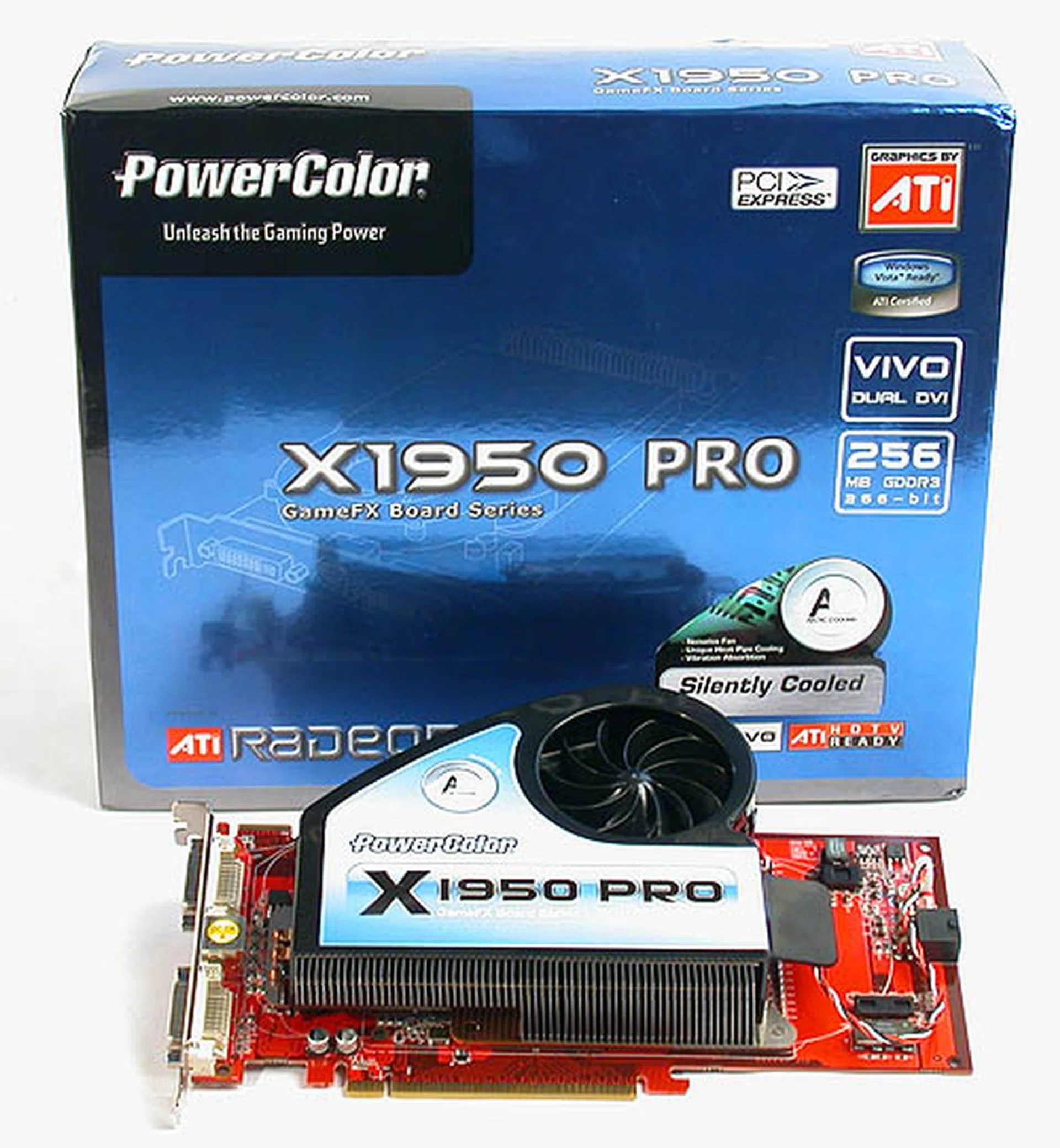
PowerColor was the first to send us its Radeon X1950 PRO 256MB.
Before we reveal the full details about the Radeon X1950 PRO, here's a comparison chart displaying the new card and some of the current high-end alternatives:
Model | ATI Radeon X1950 PRO 256MB | NVIDIA GeForce 7900 GS 256MB | NVIDIA GeForce 7950 GT 512MB | ATI Radeon X1900 XT 256MB | ATI Radeon X1900 GT 256MB |
Core Code | RV570 | G71 | G71 | R580 | R580 |
Transistor Count | 330 million | 278 million | 278 million | 384 million | 384 million |
Manufacturing Process (microns) | 0.08 | 0.09 | 0.09 | 0.09 | 0.09 |
Core Clock | 575MHz | 450MHz | 550 MHz | 625MHz | 575MHz |
Vertex Shaders | 8 | 7 | 8 | 8 | 8 |
Rendering (Pixel) Pipelines | 12 | 20 | 24 | 16 | 12 |
Pixel Shader Processors | 36 | 20 | 24 | 48 | 36 |
Texture Mapping Units (TMU) | 12 | 20 | 24 | 16 | 12 |
Raster Operator units (ROP) | 12 | 16 | 16 | 16 | 12 |
Memory Clock | 1380MHz DDR3 | 1320MHz DDR3 | 1400MHz DDR3 | 1450MHz DDR3 | 1200MHz DDR3 |
DDR Memory Bus | 256-bit | 256-bit | 256-bit | 256-bit | 256-bit |
Memory Bandwidth | 44.1GB/s | 42.2GB/s | 44.8GB/s | 46.4GB/s | 38.4GB/s |
Ring Bus Memory Controller | 512-bit (for memory reads only) | NIL | NIL | 512-bit (for memory reads only) | 512-bit (for memory reads only) |
PCI Express Interface | x16 | x16 | x16 | x16 | x16 |
Molex Power Connectors | Yes | Yes | Yes | Yes | Yes |
DVI Output Support | 2 x Dual-Link | 2 x Dual-Link | 2 x Dual-Link | 2 x Dual-Link | 2 x Dual-Link |
HDCP Support | Yes | No - Vendor dependant | Yes | No - Vendor dependant | No - Vendor dependant |
Street Price | US$199 (Launch Price) | US$199 | US$299 | US$259 | US$199 - 249 |
Other Information | Internal CrossFire Ready | SLI Ready | SLI Ready | CrossFire Ready | CrossFire Ready |
ATI's Native CrossFire
Perhaps the most important development for consumers in the Radeon X1950 PRO, the introduction of native CrossFire makes this multi-GPU platform more palatable for consumers. It used to be that the compositing engine for CrossFire was only found on the Master card and the presence of the additional hardware was passed onto consumers in the form of a higher price. Not only that, an external dongle that used up a DVI output was required. Compared to the relative convenience of NVIDIA's competing SLI technology and its widespread support in terms of drivers and games, it was not difficult to understand why CrossFire has not fulfilled its potential.
Since then, ATI has been gradually making concessions to its CrossFire technology. Setting the Radeon X1950 XTX CrossFire cards at the same retail price as the non-CrossFire edition was the first small step towards making CrossFire more attractive to consumers. With the Radeon X1950 PRO, ATI has made some drastic changes. First, every card supports native CrossFire and has the compositing engine built-in the GPU. Whichever card is master or slave depends solely on the drivers, which will presumably assign a card to take the lead. Next, CrossFire connectors no longer require an external dongle; instead, two bridge connectors similar to NVIDIA's SLI bridge are the replacements. Each native CrossFire ready graphics card will ship with one bridge connector, so if you buy two cards intending to do CrossFire, you will naturally have the required pair.
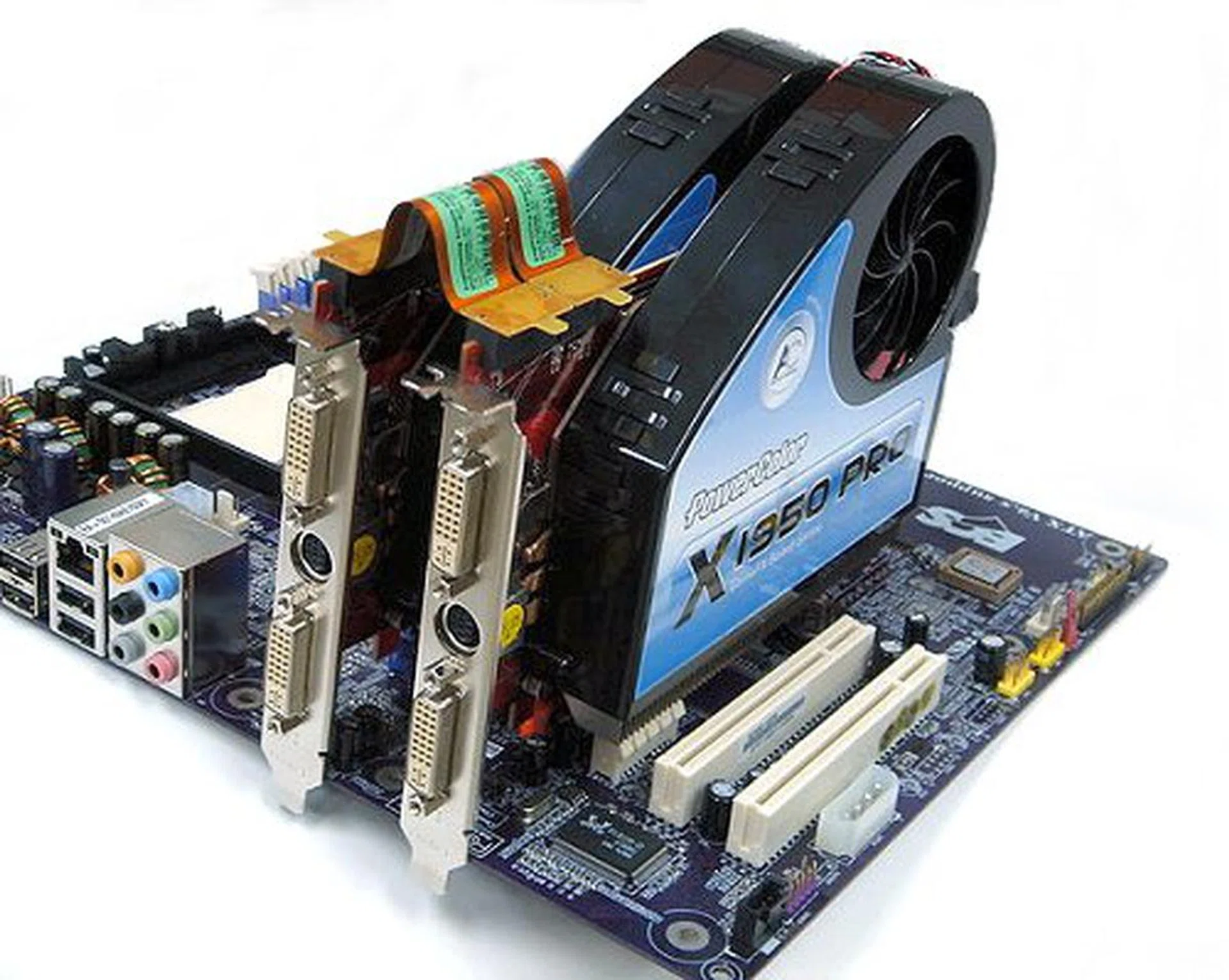
PowerColor provided this picture of their pair of Radeon X1950 PRO cards running CrossFire. Notice the flexible dual connectors used.
According to ATI, they chose these dual 12-bit connectors instead of a single large one because their combined bandwidth can deliver the requisite 24-bit performance and support resolutions of up to 2560 x 2048 at a high refresh rate of 60Hz. They had initially considered going for software CrossFire, which was to do away with connectors (found on the lower-end Radeon X1300 and X1600 series) but the lack of peer to peer write capability on Intel's P965 platform meant that that this was impractical so ATI went for the solution with the greatest platform compatibility and they probably also took in consideration the fact that the P965 platform is a popular choice for enthusiasts using Intel's new Core 2 Duo processors.
Also, the flexibility of having two connectors allows for the possibility of linking more than two cards in the future. This is related to ATI's future plans to counter NVIDIA's Quad SLI with their own scheme and having two connectors is crucial, since one could conceivably connect up to three cards or more using these connectors, with each connector linking to another card in a daisy chain manner. ATI's CrossFire Physics could also be a possible application for these dual connectors. However, ATI has not implemented these ideas yet and we have no clue about the timeline for these changes. What is confirmed is that such features are presently unavailable for the Radeon X1950 PRO or any other card at the moment.
Finally, native CrossFire will only be available for the Radeon X1950 PRO and the upcoming mid-range Radeon X1650 XT. ATI seems to be using these new cards as a testing ground for this native CrossFire technology, but they've also mentioned that forthcoming graphics card SKUs and GPUs will steadily feature native CrossFire as opposed to the original implementation. So if you like the idea of 'internal' CrossFire, you can surely look forward to more of it in the future.
The PowerColor Radeon X1950 PRO 256MB
We were expecting to receive the reference model from PowerColor, hence it was a surprise to find that the PowerColor was using a third party cooler from Arctic Cooling for its Radeon X1950 PRO. The cooler was the new two-slot Accelero X2 from the renowned cooling specialist and while its height and thickness was perhaps more than we expected, there was no doubting its pedigree. We were glad to report that the PowerColor Radeon X1950 PRO is pleasantly silent, though whether you will want to give up an expansion slot for it is another matter. Since we have not tested the reference cooler yet, we can't tell if the Accelero X2 will be a marked improvement over the default and hence worth the sacrifice. Nevertheless, we believe that there is probably some merit in this choice of cooler given the reputation of Arctic Cooling and until we get our hands on a reference card, we can only speculate as to its overall efficacy.

Arctic Cooling provides the thermal expertise to ensure that this will be a cool and quiet Radeon X1950 PRO. Note that this is not the default cooler found on the ATI reference card.
The PCB looks quite different from the older Radeons. For one, it looks less packed.
As for the need for a third party cooler, perhaps the reason lies in the slightly overclocked core that we found on the PowerColor. According to ATI, the core clock of the Radeon X1950 PRO is fixed at 575MHz while the memory clocks are at 1380MHz DDR. For the PowerColor, its core is a bit faster at 595MHz, but the memory modules remain at the standard frequencies. From our experience, a minor leap in core clock is not that effective so while you can expect slightly higher scores on the PowerColor, the impact will likely be limited. Meanwhile, there are also 36 pixel shaders on the Radeon X1950 PRO like its Radeon X1900 GT predecessor, 12 less than that on the Radeon X1950 XTX. Of course, the clock speeds of the Radeon X1950 PRO are much slower than the flagship Radeon so there will be quite a large difference in performance between them. Squarely, the new Radeon X1950 PRO aims to be a more enticing Radeon X1900 GT, being more competitively priced for a similar performance envelope.
It's a huge chunk of aluminum and copper that bumps the requirements of the Radeon X1950 PRO requiring two expansion slots, which is no different from the many other high-end Radeons.

The secret beneath that giant sized cooler - three heat pipes.
After all the ruckus about the lack of true HDCP support on graphics cards from both ATI and NVIDIA some time ago, both companies have gradually introduced this feature in their high-end offerings. The Radeon X1950 PRO falls in that category and HDCP support is present on all these cards. Whether you will really make use of them is debatable, since the availability of high definition content and the other supporting components, like a display with HDCP support, is still not prevalent. However, for a card that should last you till the DirectX 10 cards are mature, it is appropriate that it should have that feature and together with the built-in VIVO functionality on the PowerColor, makes this a very versatile card. As usual, ATI's Rage Theater ASIC is there to make the VIVO work and this is a feature that you are unlikely to find on the standard NVIDIA graphics card.
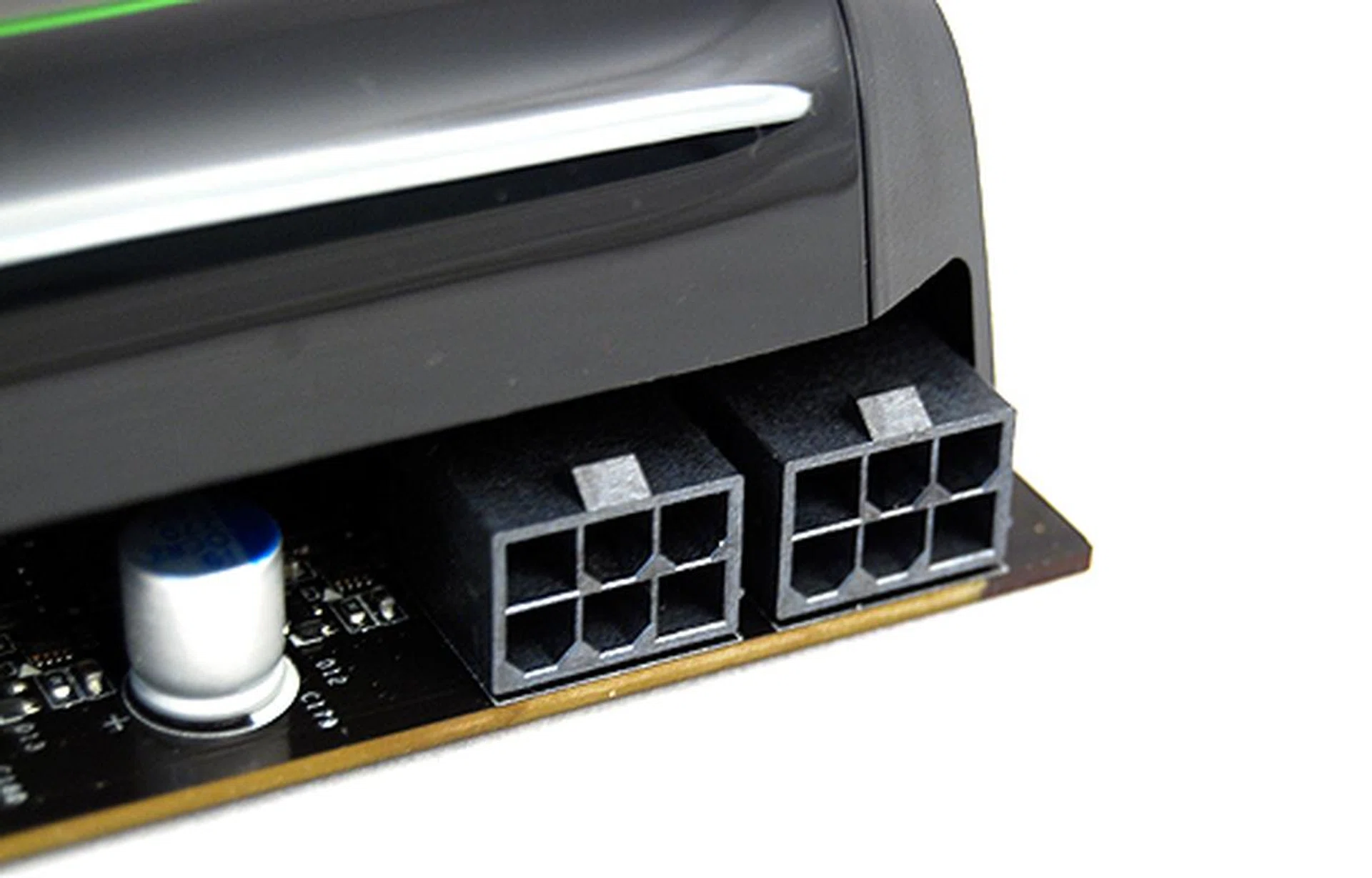
The position of the 6-pin Molex power connector has been adjusted but the relatively empty PCB is the big change here. It's a direct result of the die shrink and a more optimized core requiring less power than the older Radeon X1900 GT brother, thus a renewed PCB (albeit unfortunately not any shorter).
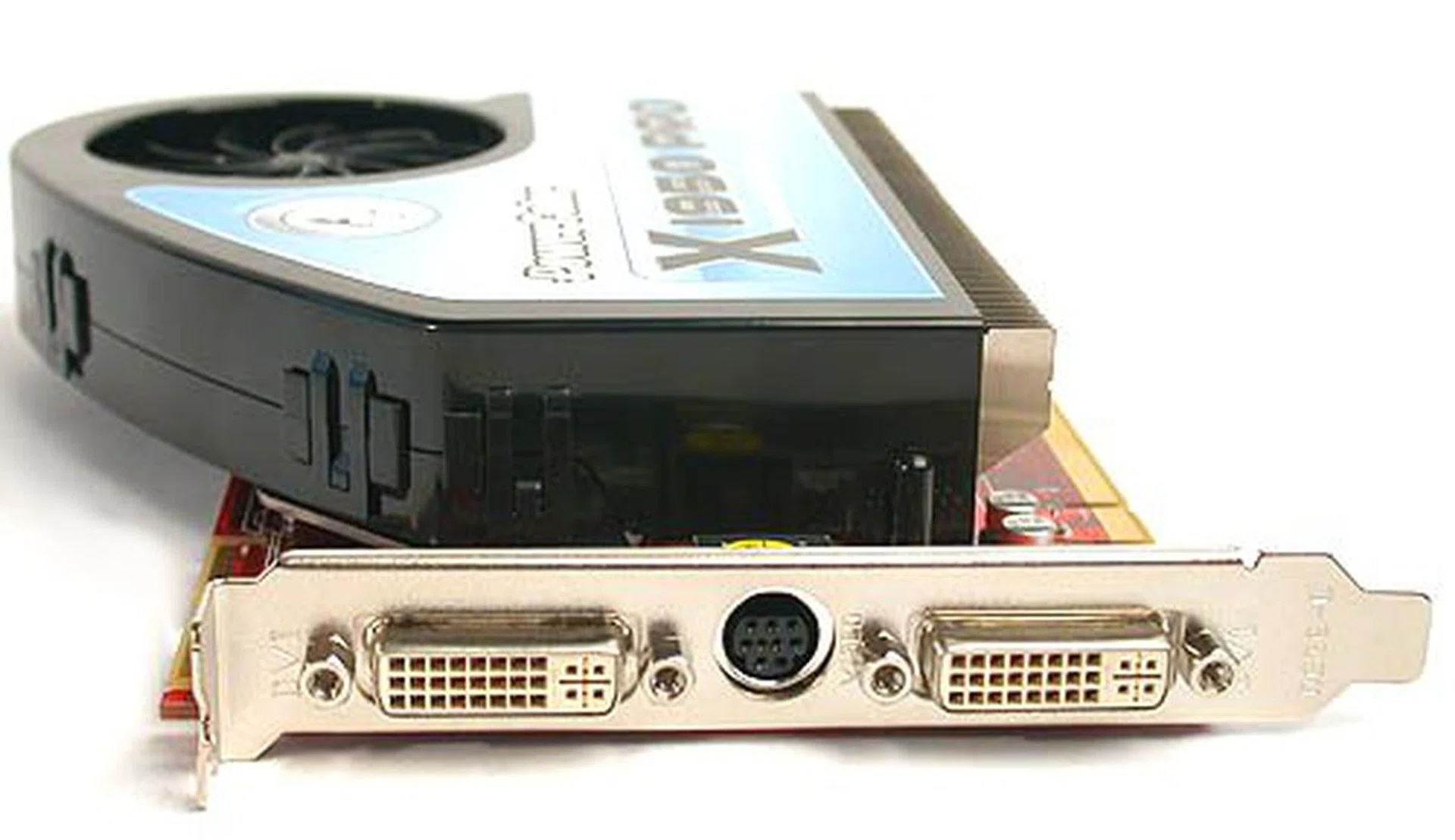
HDCP support and dual-link DVI outputs. In other words, all you can expect from a high-end graphics card now.
PowerColor usually provides a decent bundle along with its graphics cards and here, we found a full suite of CyberLink DVD utilities and the usual graphics drivers. Since the official drivers from ATI will not recognize the Radeon X1950 PRO at the moment, we recommend that you don't lose the driver CD. We also found a very comprehensive selection of cables and accessories in the package. ATI cards have usually featured more cables than its equivalent NVIDIA counterpart but even then, it was more than we expected. Most of these cables are related to the VIVO functionality on the card so we predict that most Radeon X1950 PRO cards should have all or almost all of the accessories we found below:
- 1 x DVI-to-VGA adaptor
- 6-pin Molex power connector
- S-Video extension cable
- Composite extension cable
- 9-pin mini-DIN to Component dongle
- 9-pin mini-DIN to S-Video/Composite dongle
- Quick Installation Guide
- Driver CD
- CyberLink DVD Solution (including PowerDVD, PowerProdcuer, Power2Go, PowerDirector, MediaShow, MusicMatch)
Test Setup
The PowerColor Radeon X1950 PRO was tested on a system consisting of a MSI K8N Diamond Plus motherboard together with an AMD Athlon 64 FX-55 (2.6GHz) processor. There were 2 x 512MB of Kingston low latency DDR400 memory running in dual channel mode and also a Seagate 7200.7 SATA hard drive. The operating system installed was Windows XP Professional with Service Pack 2. DirectX 9.0c was also present.
The direct price and performance rival for the Radeon X1950 PRO has to be the NVIDIA GeForce 7900 GS. Therefore we have included this card together with the Radeon X1900 GT, the card that will be phased out in favor of the new Radeon X1950 PRO. Next, we have also included the higher end cards like the GeForce 7950 GT and the Radeon X1900 XT 512MB to find out how the Radeon X1950 PRO stack up against these more expensive cards. Ideally, we would have preferred to have the Radeon X1900 XT 256MB instead of the 512MB version but unfortunately, we have yet to receive any from vendors. Hence, we have used the 512MB version and we feel that at our modest resolutions and test system, the differences between the two should not be that disparate as to make the comparison invalid.
The graphics cards and the respective drivers used in the comparison are as follows:
- ATI Radeon X1950 PRO (Catalyst 6.9)
- ATI Radeon X1900 GT (Catalyst 6.8)
- ATI Radeon X1900 XT 512MB (Catalyst 6.8)
- NVIDIA GeForce 7900 GS (ForceWare 91.47)
- NVIDIA GeForce 7950 GT (ForceWare 91.47)
The list of benchmarks tested:
- Futuremark 3DMark05 (ver. 120)
- Futuremark 3DMark06 (ver. 102)
- Tom Clancy's Splinter Cell: Chaos Theory
- F.E.A.R
- Chronicles of Riddick: Escape from Butcher Bay
- Quake 4
Results - 3DMark05 Pro & 3DMark06
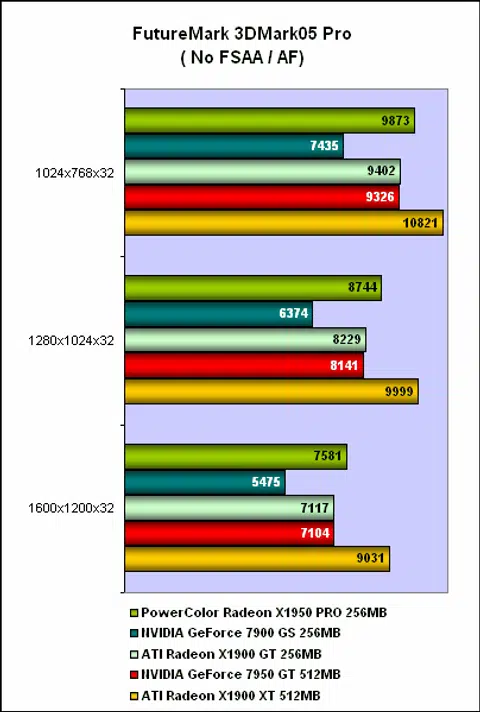
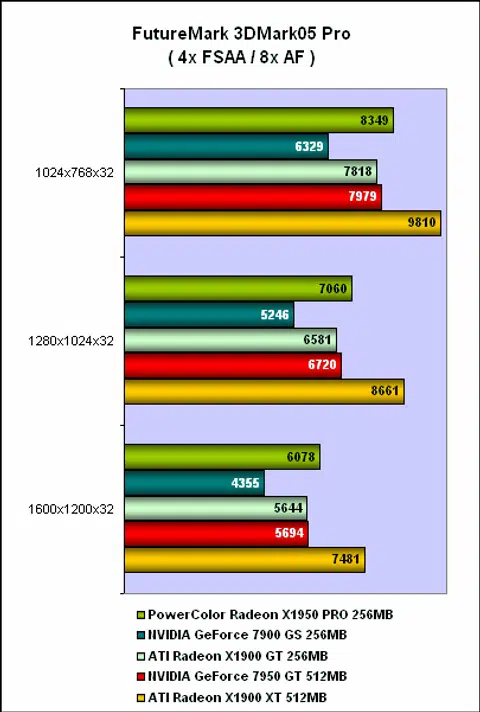
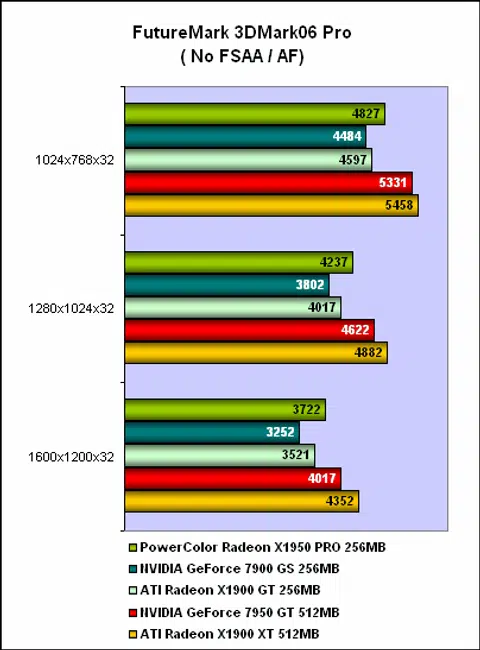
3DMark05 has been the playground for ATI ever since the debut of the Radeon X1000 architecture so we expected the Radeon X1950 PRO to flourish in this benchmark. And this was confirmed as it eclipsed even the GeForce 7950 GT. However, if you look at the difference between the older Radeon X1900 GT and the Radeon X1950 PRO, the margin was only 5 � 6% and that should be the more accurate gauge of ATI's progress. Therefore, it was no surprise when the GeForce 7950 GT retook its second position in 3DMark06. The consolation for ATI was that its Radeon X1950 PRO remained very competitive against its intended opponent, the GeForce 7900 GS, with the margin between 11 and 14% in favor of it.
Results - Splinter Cell: Chaos Theory & F.E.A.R (DirectX 9 Benchmarks)
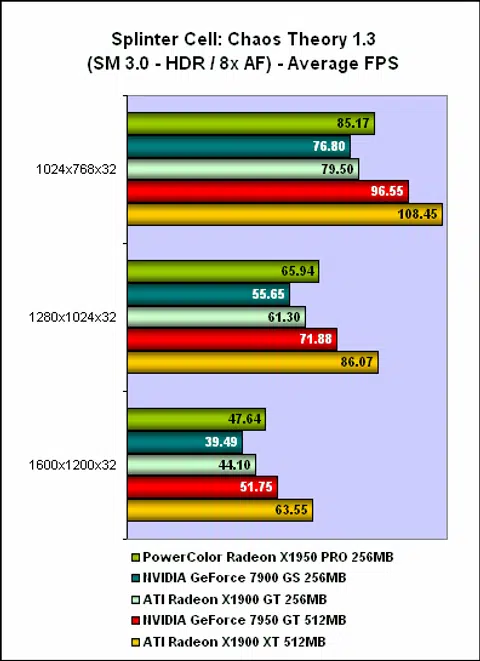
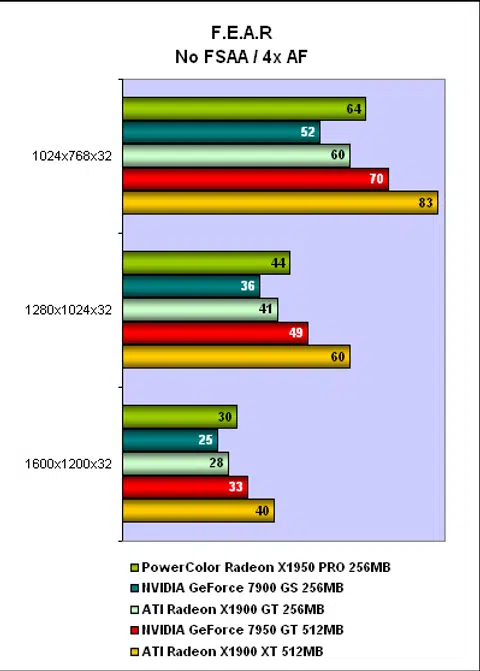
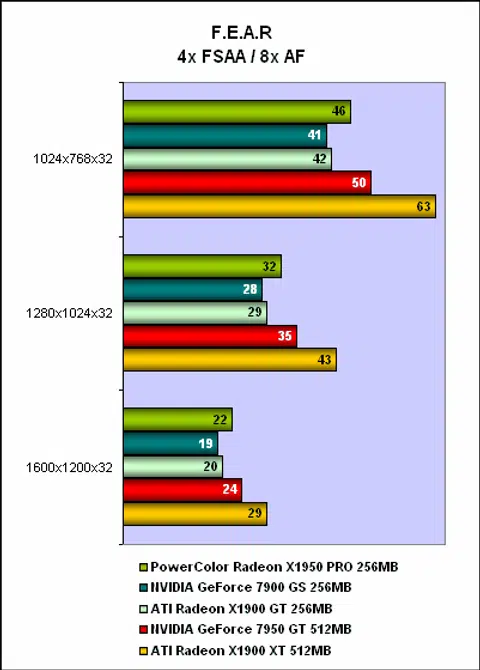
Moving on to the game benchmarks, we found the same order of cards, with the Radeon X1950 PRO leading both the GeForce 7900 GS and the Radeon X1900 GT. The other higher end cards proved to be much too fast for the newcomer. In F.E.A.R, the Radeon X1950 PRO will probably give you between 3 to 5 frames more than the GeForce 7900 GS. At the relatively low frame rates returned by almost every card for this challenging game, such a margin could be the difference whether the game was enjoyable or not.
Results - Chronicles of Riddick & Quake 4 (OpenGL SM2.0+ Benchmarks)
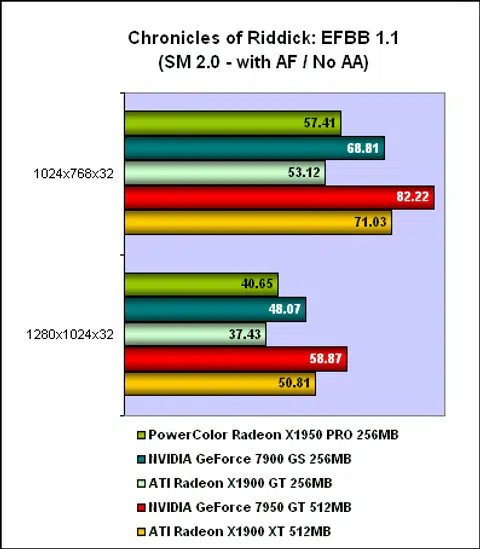
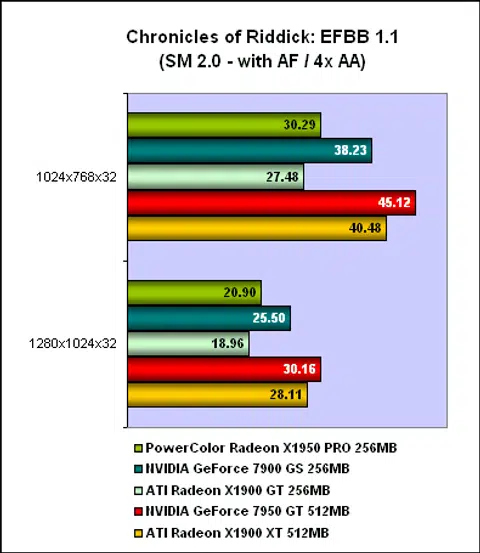
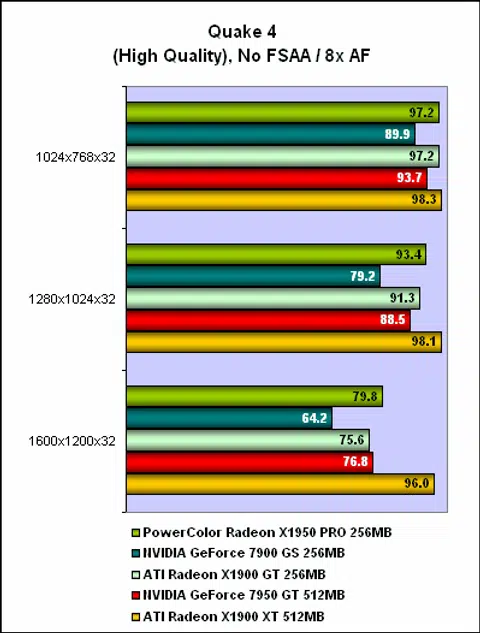
Chronicles of Riddick proved to be a rare loss for the Radeon X1950 PRO, though we knew that it was coming. Quake 4 however, was ATI's domain and we found all three ATI cards doing much better than their NVIDIA rivals. With anti-aliasing enabled, the Radeon X1950 even managed to beat the GeForce 7950 GT by a couple of frames.

Temperature Testing
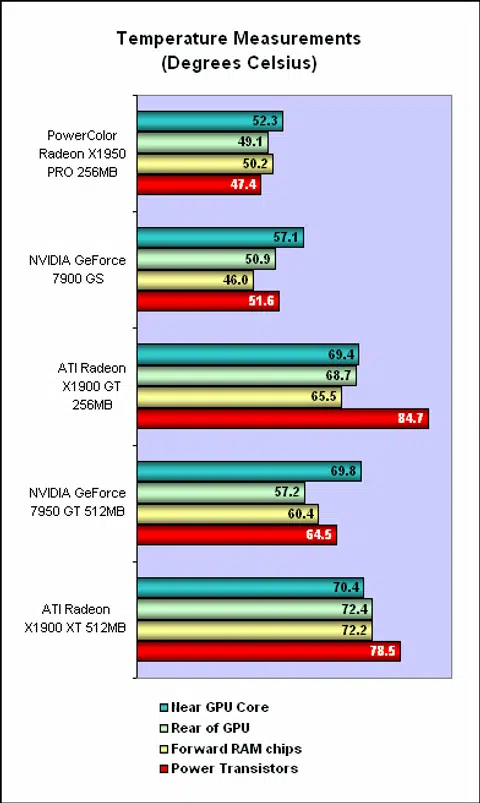
The die shrink from a 90nm to a 80nm manufacturing process probably has led to some improvements in both power consumption and hence heat output. Or it could be that the Accelero X2 is indeed an excellent cooler. We have no definitive answer as to which factor influenced the outcome more crucially until we can test a reference board. The important fact is that the PowerColor Radeon X1950 PRO was one of the coolest high-end cards from ATI we have seen in a long while and even edged the NVIDIA GeForce 7900 GS in terms of lower temperatures. NVIDIA's edge in this department looks to have disappeared.
Overclocking
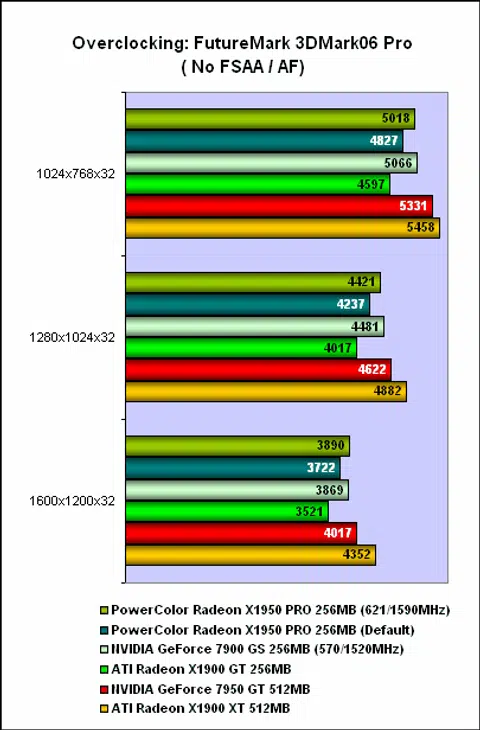
Using ATI's own Overdrive utility in its Catalyst Control Center, we maxed out the clock speeds on the Radeon X1950 PRO. That turned out to be 621MHz for the core and 1590MHz DDR for the memory. It wasn't much but we were restricted by the Overdrive tool. The end result was a 3DMark06 score that obviously improved over that of the standard but as you can see, the GeForce 7900 GS looked to have quite an overclocking margin and will pose a challenge to the Radeon X1950 PRO here.
Conclusion
Even the most optimistic ATI fan will concede that the red team's DirectX 10 cards will only debut early next year. By then, NVIDIA's G80 would have a head start in market share and its lower and mid-range versions, usually the meat of the graphics market, should be available. Hence, ATI has to persuade consumers to accept that its latest DirectX 9 offerings are still worth considering over these upcoming cards from NVIDIA. This task is helped by the fact that the main driver of DirectX 10, Windows Vista and the cutting edge games are in development, while prices for the new generation cards will likely involve a price premium. Given the usual, slow adoption rate of new technologies, it could be a while before a DirectX 10 graphics card becomes necessary. Meanwhile, ATI is suggesting that the Radeon X1950 PRO could be a viable alternative for you without burning a hole in your wallet.

The Radeon X1950 PRO is important not so much for its performance boost over the Radeon X1900 GT but rather, presenting itself as a more attractively priced option than its older counterpart and being a 'pioneer' for ATI's 80nm process and the new native CrossFire technology. In short, it's a preview of things to come for the better.
There are quite a few reasons to applaud the Radeon X1950 PRO. While many will be concerned about its performance, we feel frankly that the Radeon X1950 PRO is not just about its performance, competent as it was. Instead, it is but part of ATI's recent efforts to become more competitive in all ways. No doubt, it is faster than the card it aims to replace, the Radeon X1900 GT, but it really shines when placed besides its price rival from NVIDIA, the GeForce 7900 GS. For not only has ATI achieved a performance lead over a similarly priced rival, the low temperatures on the PowerColor seem to indicate that ATI's woes with heat and noise may be over at last with these new cores. Finally, the introduction of native CrossFire is a positive move that could lead to greater adoption of its multi-GPU platform over that of its rival and it also paves the way for future configurations involving more than two cards and even the much-hyped CrossFire physics.
Going by the US$199 price quoted by ATI, the Radeon X1950 PRO is expected to go squarely against NVIDIA's GeForce 7900 GS, which is currently hovering above US$200. With the introduction of such a keen rival, the GeForce 7900 GS will probably be pressured into lower prices. Overclocked GeForce 7900 GS cards can and will give the Radeon X1950 PRO a stiff fight in both performance and price so consumers ultimately stand to benefit from the ensuing fallout. Nevertheless, the merits of the new Radeon X1950 PRO are many, from its stronger set of features to the raw performance numbers and even the price point which its being offered. At the start of this generation of graphics cards, ATI has consistently failed to match the price performance ratio of its rival despite having an edge technology-wise. As this generation draws to a close, the excellent Radeon X1950 PRO shows that ATI has finally achieved that.
For those of you wondering, the PowerColor Radeon X1950 PRO 256MB will only be available in this one variant with VIVO, higher than normal core clock speed and its huge silent cooler. No word about a reference look-alike has been mentioned from PowerColor for those hoping for a cost-down version. And speaking of cost, while we don't have the global suggested retail price of the PowerColor Radeon X1950 PRO 256MB, you can expect this region's price to be about S$369, which is very competitive indeed among the Radeon X1950 PRO class (for what it offers) and against NVIDIA's options.
Our articles may contain affiliate links. If you buy through these links, we may earn a small commission.