
NVIDIA GeForce 8800 Ultra: The Shadow Warrior
Pre-empting ATI's upcoming GPU launch is NVIDIA's own GeForce 8800 Ultra, a black beauty that was anticipated to have specs more outrageous than the GTX. However as we learnt, the only outrageous aspect of the Ultra is its price. Does it still have what it takes to uphold its "Ultra" nametag?

The Never-ending ATI versus NVIDIA Face-offs
Without a doubt, ATI has a decent graphics card lineup, but it is unfortunately playing second fiddle to NVIDIA's salvos for two years straight. While the GeForce 6 series was NVIDIA's ticket to get back into the game and redeem itself, the GeForce 7 series was surely the leader, be it price or performance and even price-performance as we've explicitly shown in our articles of those days. That's not to say ATI has been taking it down as they were in fact aggressively countering the green team's move with new SKUs, but as quickly as those were announced, NVIDIA had something else in store. It wasn't till the Radeon X1950 XTX and its derivatives when ATI finally arrived at the right formula, but that was just too late as usual. November 2006 once again saw NVIDIA leapfrog ATI with the world's first DirectX 10 GPU and one that even runs circles around anything else in DirectX 9 performance.
Half a year has passed since and the state of the market hasn't changed one bit - ATI still has yet to deliver a DirectX 10 solution for the PC market and NVIDIA's GeForce 8800 series is still spinning circles around them. The situation looks too uncannily familiar when ATI once had the DirectX 9 leadership while NVIDIA slipped with their GeForce FX latecomer. However if our sources and news on the Internet are right, ATI will launch their competitive DirectX 10 lineup on May 14th. Of course you might want to factor in the usual supply lag associated with ATI products for a good measure - and that could mean up to several more weeks delay before there is sufficient supply. Then of course we have the probable initial hiccups associated with any new product and the fact that the new entrants have yet to achieve a 'tried and tested' status. All this could potentially work up against ATI penetrating this graphics segment quickly and sure enough NVIDIA has another card ready to play with today's debut of the GeForce 8800 Ultra.
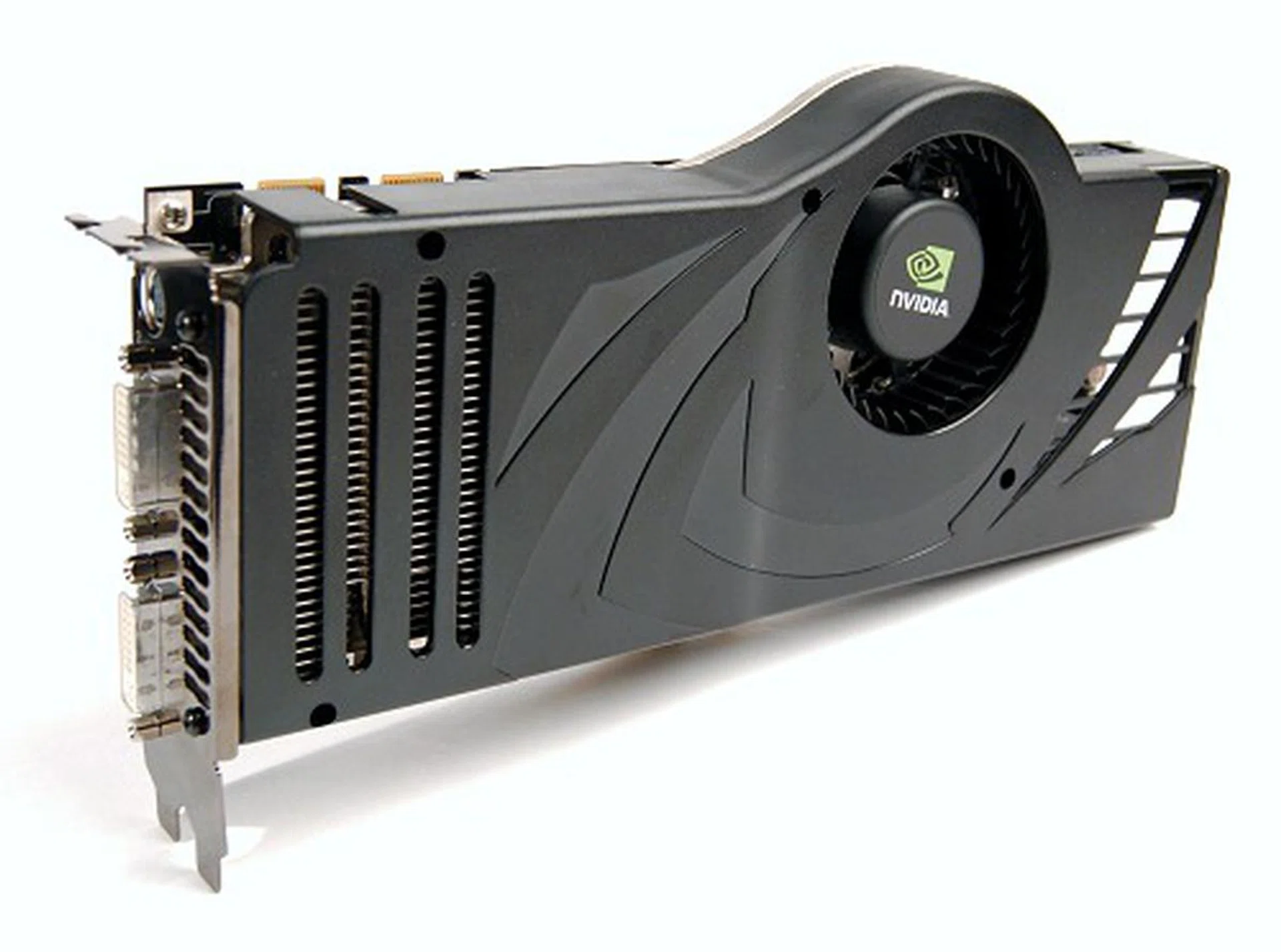
Enter the GeForce 8800 Ultra - NVIDIA's answer to compete against ATI's upcoming new DirectX 10 GPUs.
The GeForce 8800 Ultra Proposition
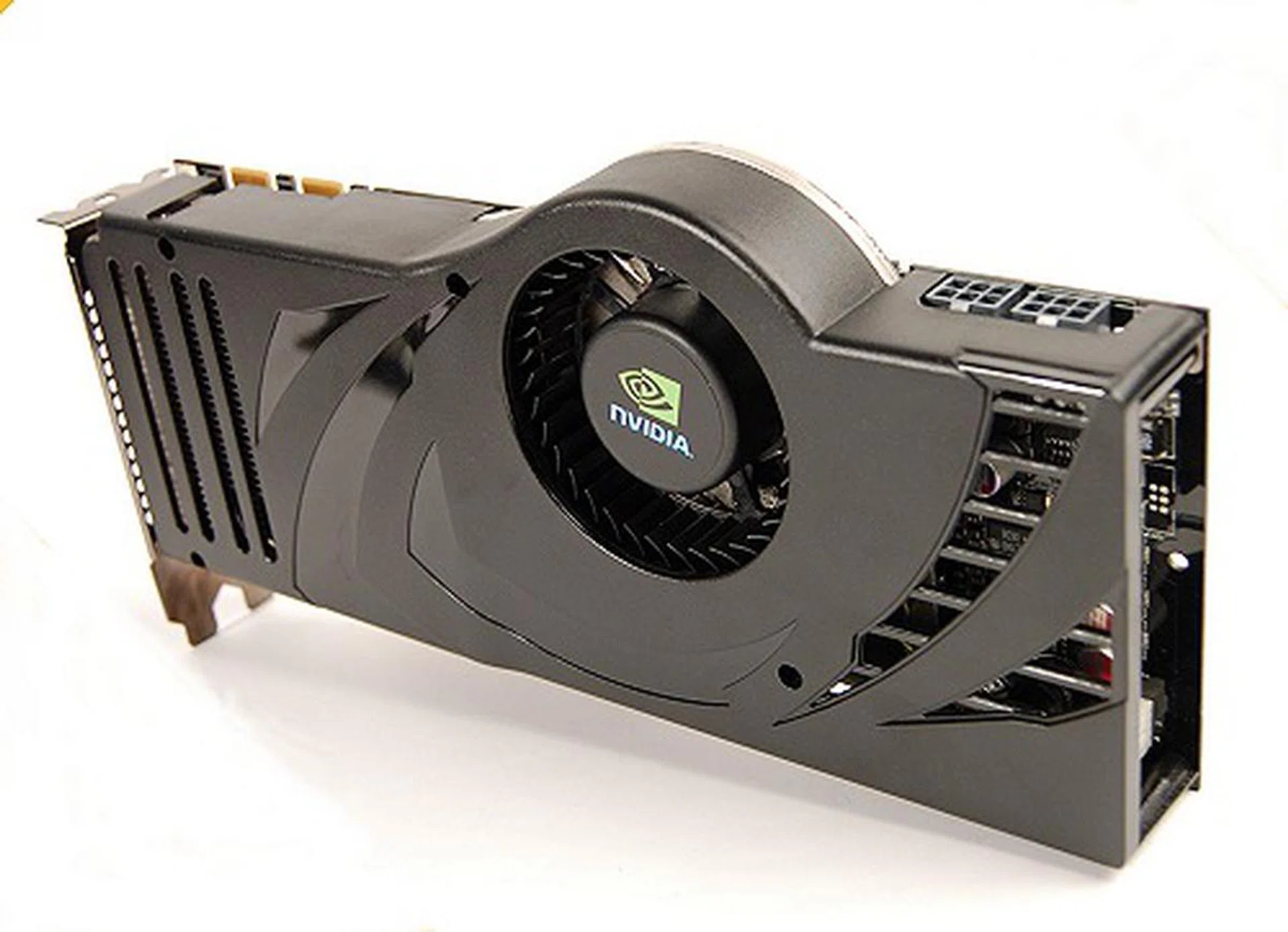
Drenched completely in black from the PCB to its cooler shroud, the GeForce 8800 Ultra is NVIDIA's ultimate enthusiast gaming graphics card targeted at folks who would go to any lengths to obtain the very best in performance. With this mindset, the GeForce 8800 Ultra will sell at a staggering US$829 upwards. Factor in the lack of competition at its inception and the probable limited availability, word has it that the GeForce 8800 Ultra may sell at up to US$999.
So what does the Ultra actually have to command the ultra premium? Bluntly put, the GeForce 8800 Ultra is an overclocked GTX. Every single hardware specification is identical to that of the current 8800 GTX SKU. Only three technical specifications have been changed:- the GPU runs at 612MHz, shader processors at 1500MHz and memory at 2160MHz DDR (up from 575MHz, 1350MHz and 1800MHz DDR respectively on the GTX SKU). Overall, the numbers don't seem impressive, as there are already overclocked GTX cards that closely rival the Ultra's specifications but NVIDIA begs to differ. More on that on the following page, but first the tech specs of the GeForce 8800 Ultra and how it stacks up with the rest of the cards:-
Model | NVIDIA GeForce 8800 Ultra 768MB | NVIDIA GeForce 8800 GTX 768MB | NVIDIA GeForce 8800 GTS 640MB | ATI Radeon X1950 XTX 512MB |
Core Code | G80 | G80 | G80 | R580+ |
Transistor Count | 681 million | 681 million | 681 million | 384 million |
Manufacturing Process (microns) | 0.09 | 0.09 | 0.09 | 0.09 |
Core Clock | 612MHz | 575MHz | 500MHz | 650MHz |
Vertex Shaders | 128 Stream Processors (operating at 1500MHz) | 128 Stream Processors (operating at 1350MHz) | 96 Stream Processors (operating at 1200MHz) | 8 |
Rendering (Pixel) Pipelines | 16 | |||
Pixel Shader Processors | 48 | |||
Texture Mapping Units (TMU) or Texture Filtering (TF) units | 64 | 64 | 48 | 16 |
Raster Operator units (ROP) | 24 | 24 | 20 | 16 |
Memory Clock | 2160MHz DDR3 | 1800MHz DDR3 | 1600MHz DDR3 | 2000MHz DDR4 |
DDR Memory Bus | 384-bit | 384-bit | 320-bit | 256-bit |
Memory Bandwidth | 103.68GB/s | 86.4GB/s | 64.0GB/s | 64.0GB/s |
Ring Bus Memory Controller | NIL | NIL | NIL | 512-bit (for memory reads only) |
PCI Express Interface | x16 | x16 | x16 | x16 |
Molex Power Connectors | Yes (dual) | Yes (dual) | Yes (dual) | Yes |
Multi GPU Technology | Yes (SLI) | Yes (SLI) | Yes (SLI) | Yes (CrossFire) |
DVI Output Support | 2 x Dual-Link | 2 x Dual-Link | 2 x Dual-Link | 2 x Dual-Link |
HDCP Output Cable? | Yes | Yes | Yes | Yes |
Street Price | ~ US$830 - US$999 (SRP) | ~ US$550 - US$650 | US$399 (SRP) | ~ US$400 |
The GeForce 8800 Ultra 768MB Graphics Card
While the full length cooler shroud and air guide on the GeForce 8800 Ultra might seem as if the card actually got longer, it is in fact using the same 10.5-inch PCB as that of the GeForce 8800 GTX. As we iterated earlier, the GeForce 8800 Ultra is using the exact same hardware that we have come to know from the GeForce 8800 GTX. The new cooler shroud and blower placement serve no purpose other than to distract and visually differentiate it from the GeForce 8800 GTX, but make no mistake that the heatsink and heat pipe design is 100% identical. In case you are wondering, the GeForce 8800 Ultra operated just as quiet as its other 8800 series counterparts.
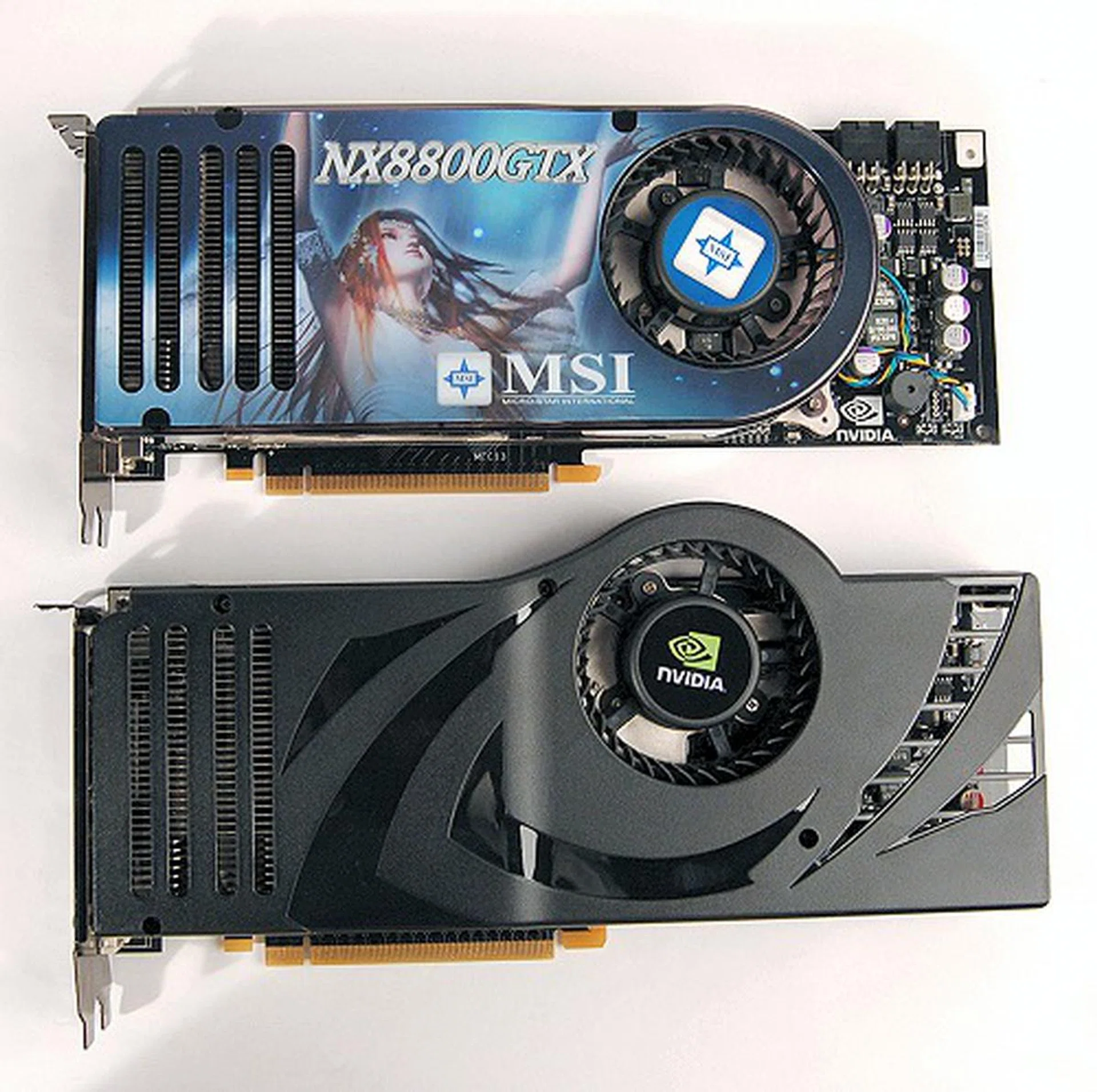
Here's a visual comparison to ascertain that the GTX and Ultra are physically the same form factor, but the Ultra variant just looks meaner and more powerful, which is exactly what NVIDIA had in mind.
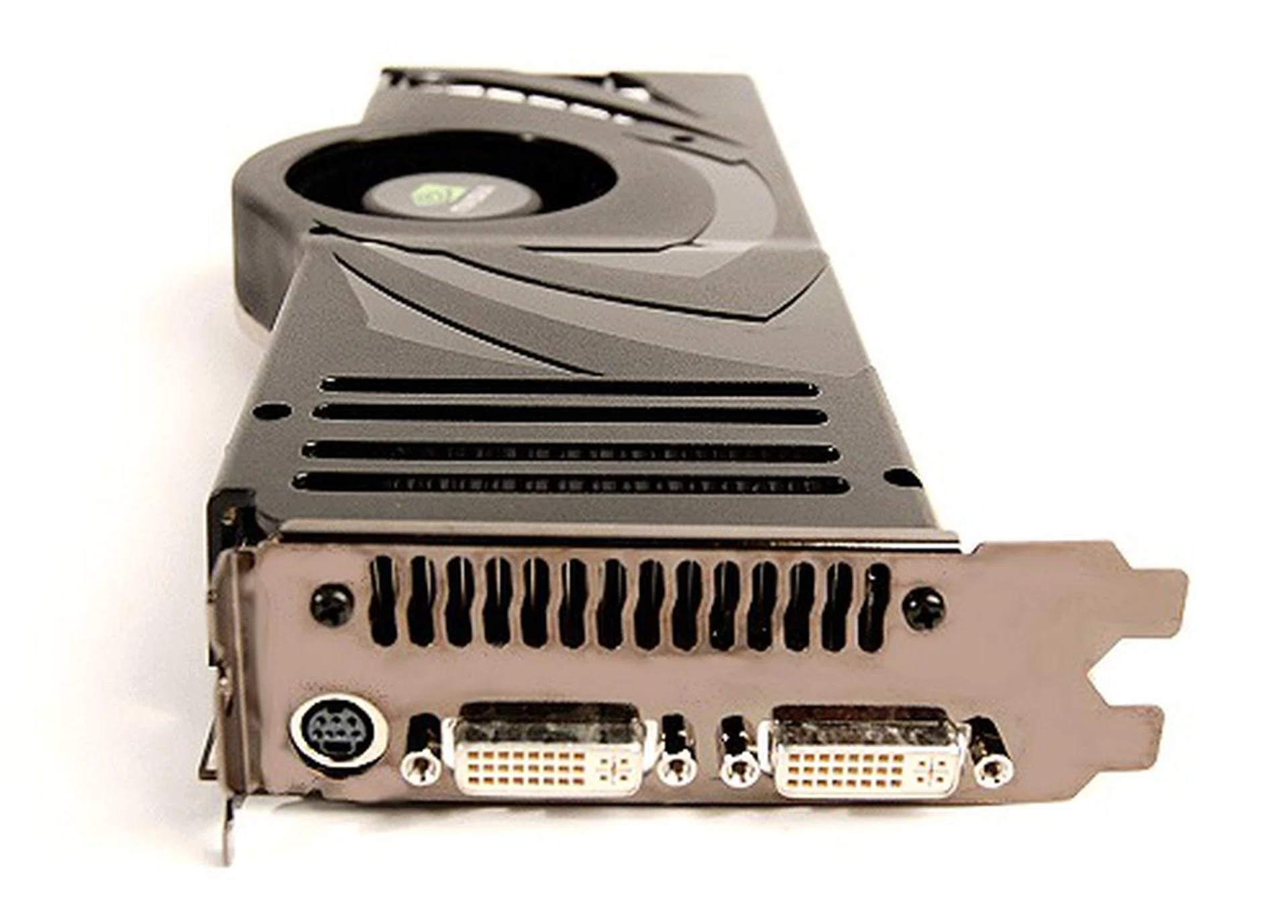
It goes without saying that the GeForce 8800 Ultra is a dual slot card with dual dual-link DVI outputs that are HDCP compliant.
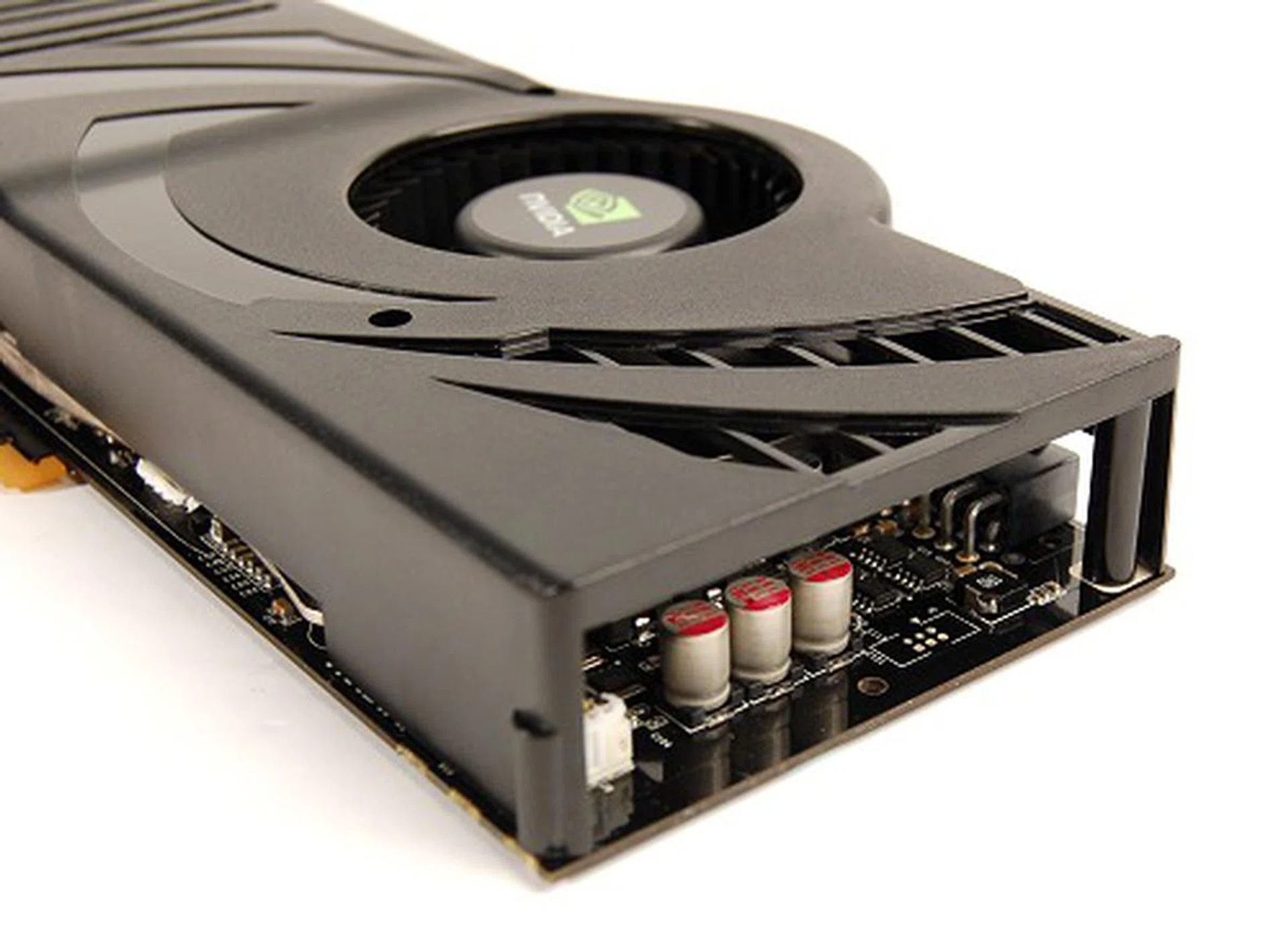
The cooler's shroud now extends to the full length of the card, but its effect is as good as negligible if you think it aids to cool the rear power components.
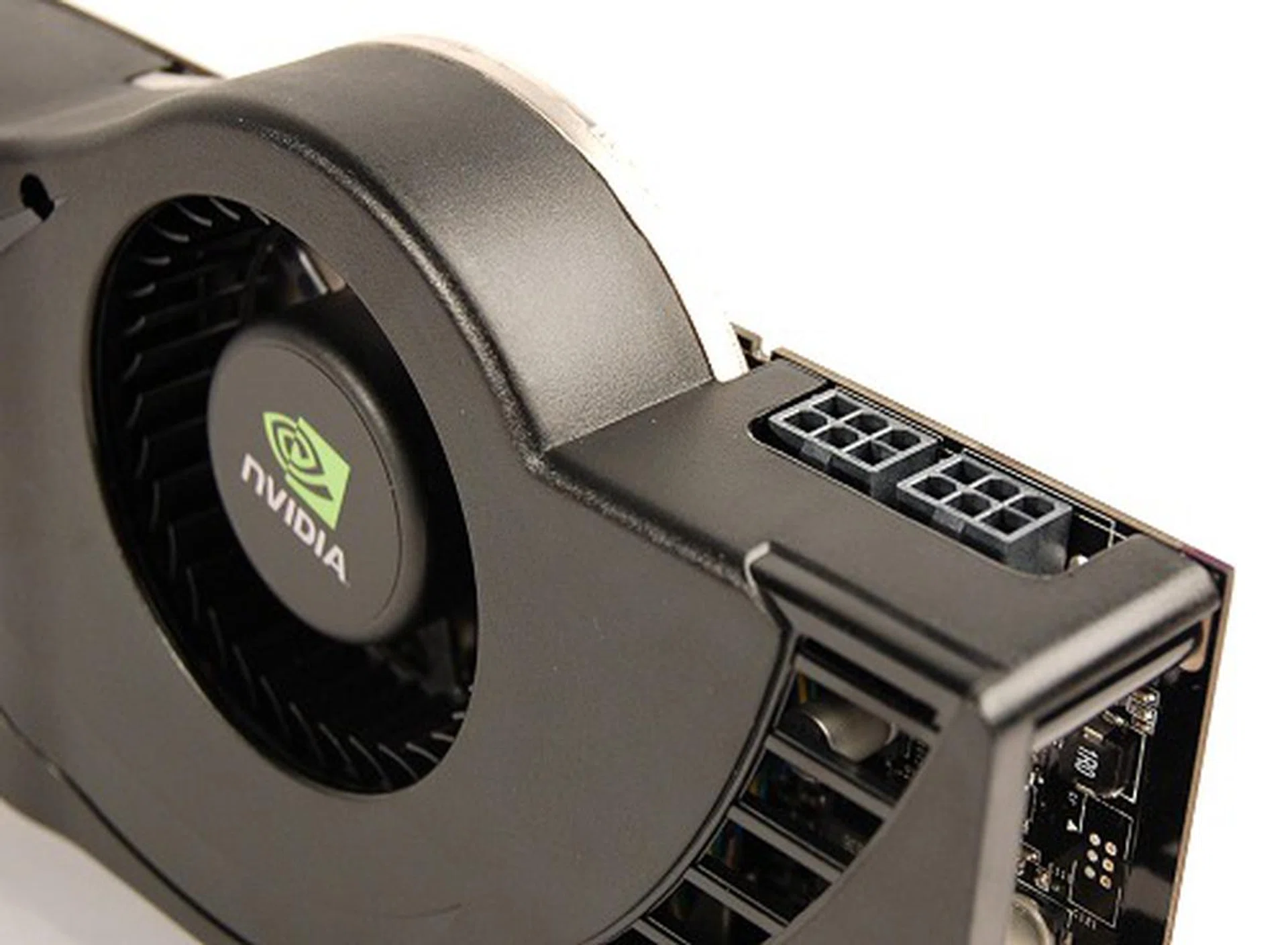
Note that the same pair of 6-pin PCIe power plugs are required to power up this card.
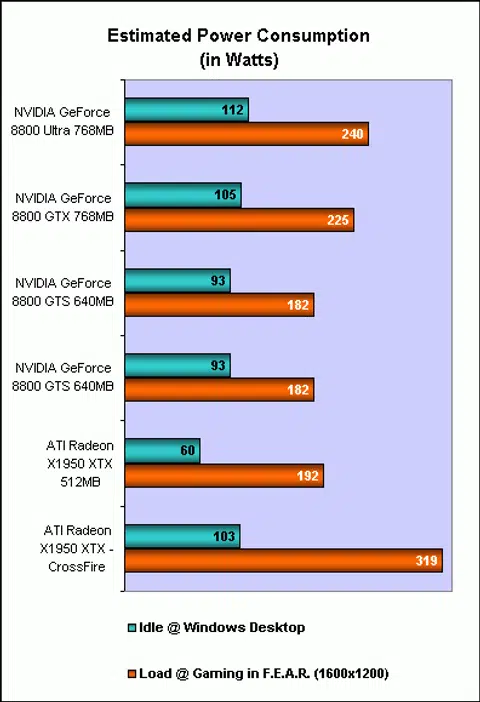
Speaking of power concerns, this is one department where NVIDIA has strongly boasted of its GPU architectural power efficiency and more so with the GeForce 8800 Ultra. Essentially, only the very top quality GPU dies are validated and binned as Ultra-compliant parts. Thus, even with the increased clock speeds, NVIDIA claims that the Ultra's maximum board power consumption is 175 watts versus 177 watts of the GeForce 8800 GTX SKU. Unfortunately, we can't chant that claim as our test results show otherwise. Read on for the complete performance and power consumption breakdown over the next few pages.
Test Setup
Our system for high-end graphics uses an Intel Core 2 Duo E6700 (2.67GHz) processor on an Intel D975XBX 'Bad Axe' motherboard. We installed 2GB of DDR2-800 memory from Kingston running in dual channel mode, along with a Seagate 7200.7 SATA hard drive. Although Windows Vista has been released, our benchmarks are all conducted on Windows XP Professional with Service Pack 2 and DirectX 9.0c. Vista isn't 'prime' yet for mainstream testing/gaming, so we'll revisit Vista testing at a later stage.
The following graphics cards were amassed for this article as well as the driver versions used:
- NVIDIA GeForce 8800 Ultra 768MB (ForceWare 158.19)
- NVIDIA GeForce 8800 GTX 768MB (ForceWare 158.19)
- MSI NX8800GTX OC Liquid (GeForce 8800 GTX 768MB) (ForceWare 97.02)
- NVIDIA GeForce 8800 GTS 640MB (ForceWare 97.02)
- NVIDIA GeForce 8800 GTS 320MB (ForceWare 97.02)
- ATI Radeon X1950 XTX 512MB (Catalyst 7.2)
Time was tight, thus we've managed to refresh our benchmark results with the latest ForceWare 158.19 for only the GeForce 8800 GTX other than the new Ultra SKU. All the other NVIDIA cards shown in the results are just for knowledge sake and are nowhere near the performance or price sector of the GeForce 8800 Ultra, thus we've showcased them based on the Forceware 97.02 driver set.
For those curious to know if the new Forceware 158.19 driver set brought along notable performance gains, the answer is fairly positive. Tests like Splinter Cell: Chaos Theory and Futuremark 3DMark06 saw big gains, but most other games in our test suite showed very minor improvements such as Quake 4, Company of Heros, F.E.A.R. and FarCry.
The following are the exact versions of the benchmarks used to judge the GeForce 8800 Ultra:-
- Futuremark 3DMark06 (ver. 102)
- Tom Clancy's Splinter Cell: Chaos Theory (ver 1.3)
- FarCry (ver 1.4 Beta)
- F.E.A.R
- Company of Heroes (ver 1.3)
- Quake 4 (ver 1.2)
Note that this time round, we've only tested resolutions of 1600x1200 and higher since people purchasing a monster priced card will game at these high resolutions to really appreciate the high-end GeForce 8800 series. Please also note that we are still compiling results of older graphics cards for these ultra high resolutions and as such we have only obtained results from the newest graphics cards. However for the intensions of this article, the data obtained is sufficient and adequate to derive our final opinion.
Results - Futuremark 3DMark06 Pro
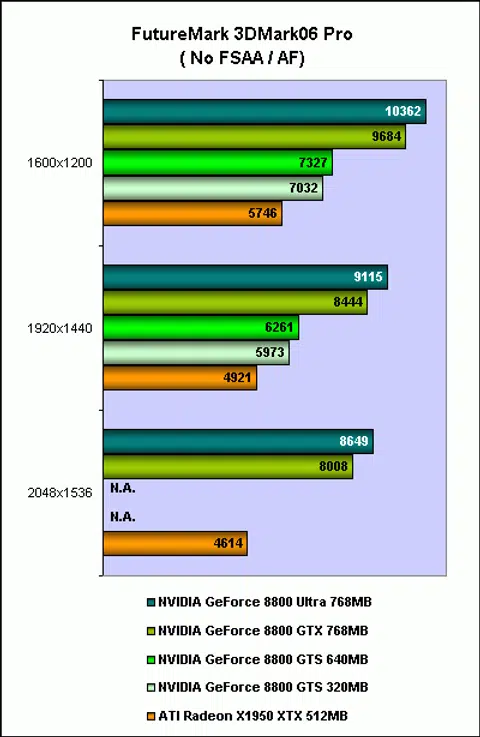
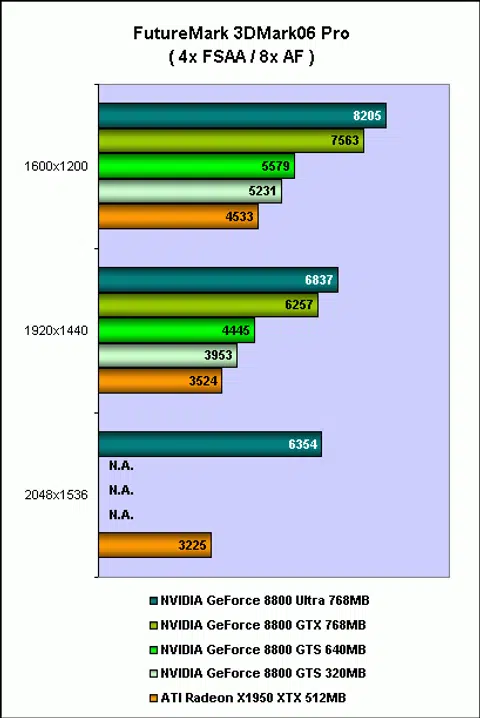
As usual, our first round of tests is based on the synthetic 3DMark series and right off the bat, the GeForce 8800 Ultra garnered 8% to 10% performance gains ahead of the stock clocked GeForce 8800 GTX. By contrast when we tested the overclocked MSI NX8800GTX OC Liquid which averaged only 3% gains, the GeForce 8800 Ultra is in a much better standing. The added boost to the shader clock speeds on the Ultra most definitely did the trick - a tactic we first encountered from MSI's overclocked GeForce 8800 GTS 320MB OC Edition. Can the GeForce 8800 Ultra maintain this lead throughout all our game tests as well? Read on!
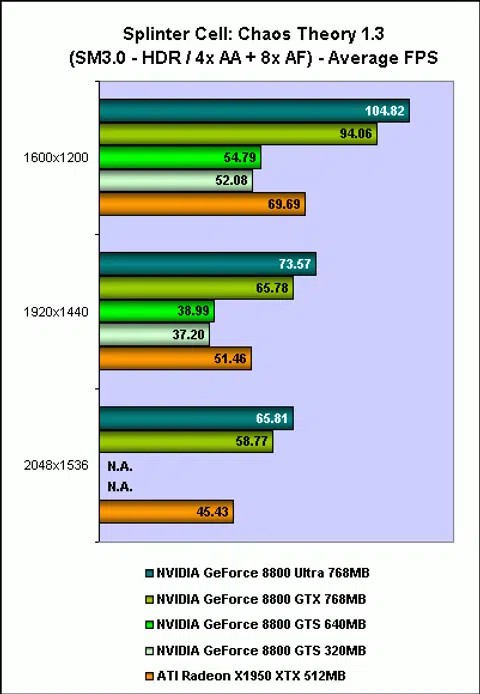
Results - Splinter Cell 3: Chaos Theory (DirectX 9 Benchmark)
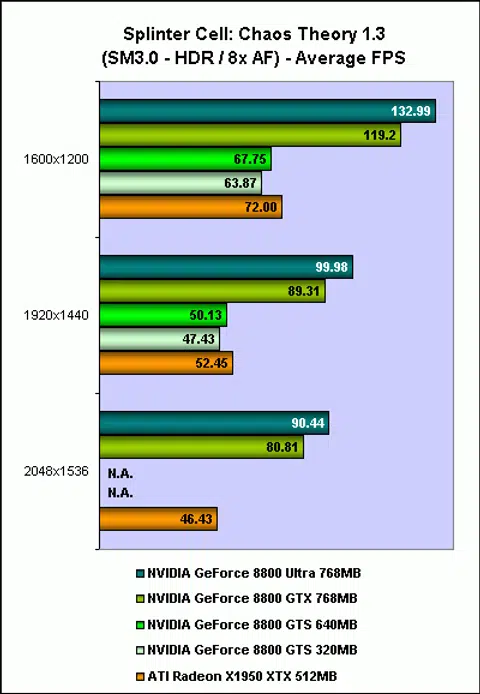
We got to admit it : we were surprised to see over 11% speedup on the results churned by the GeForce 8800 Ultra when compared with the GTX counterpart. Rarely ever does the performance advantage exceed that of what's shown in the 3DMark suite, but Splinter Cell: Chaos Theory clearly digs the extra shader processing throughput.
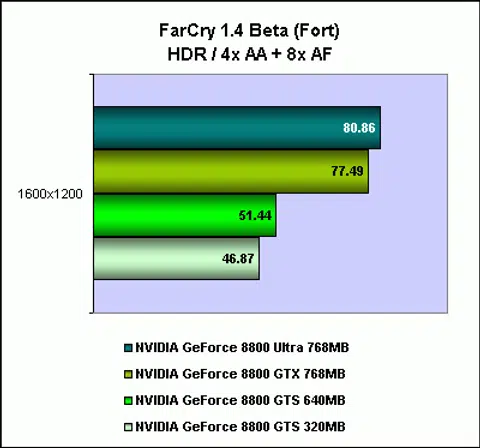
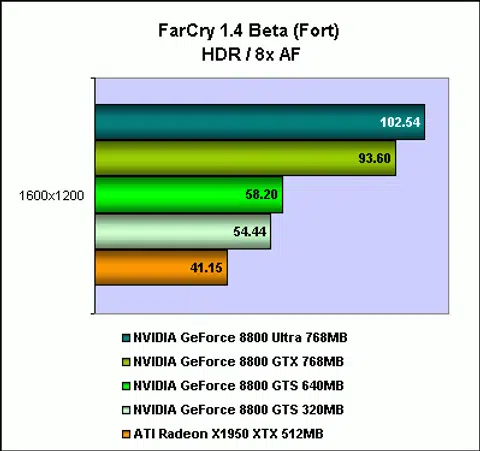
Results - FarCry (DirectX 9 Benchmark)
FarCry results without anti-aliasing looked good with close to 10% performance gain going with the GeForce 8800 Ultra over the GTX. However when we engaged anti-aliasing, the gain slashed to just over 4%. Looking at the actual performance numbers in frames per second, unfortunately nobody can tell the difference if a GTX or an Ultra is installed in the system as they are both excessively fast.
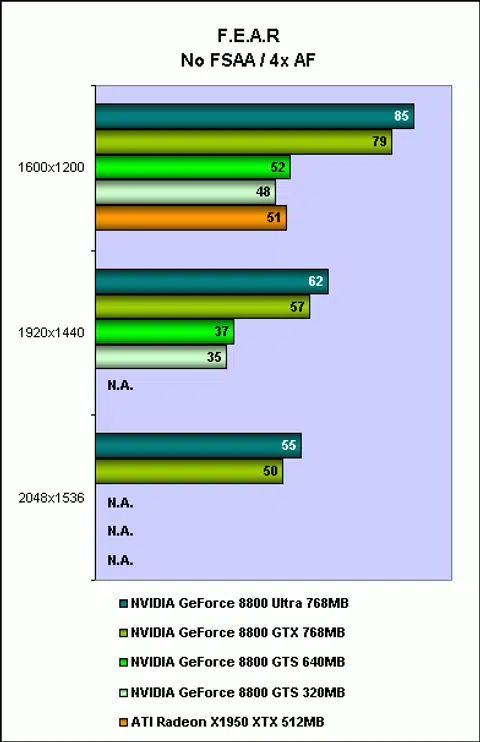
Results - F.E.A.R (DirectX 9 Benchmark)
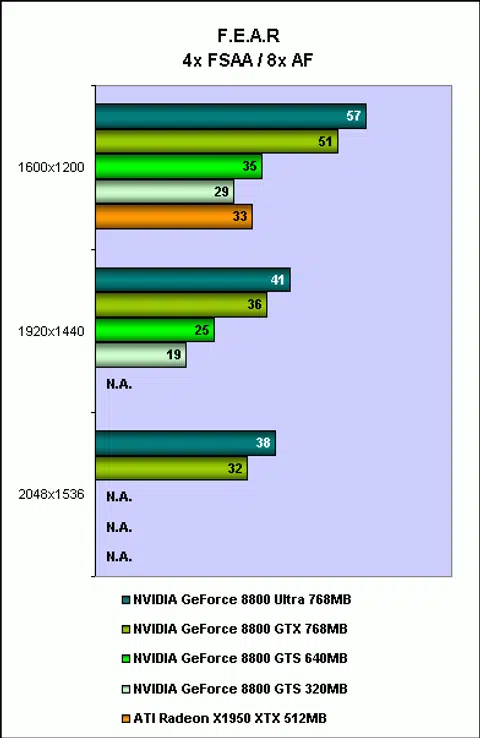
Similar to some of the tests conducted, F.E.A.R. saw 7% to 10% performance improvement for the GeForce 8800 Ultra against the GTX as we stepped up the resolutions. However with FSAA enables, the improvements rocketed to between 13% and 18%, which is a sizable figure. Clearly, the singular GeForce 8800 Ultra card was able to provide a smoother high resolution gaming experience where the 8800 GTX only managed just above 30 frames per second for our highest test setting. However, does it justify the huge premium? You can better answer that query with the results on the next page.
Results - Quake 4 & Company of Heroes (SM 2.0+ OpenGL & DirectX Benchmarks)
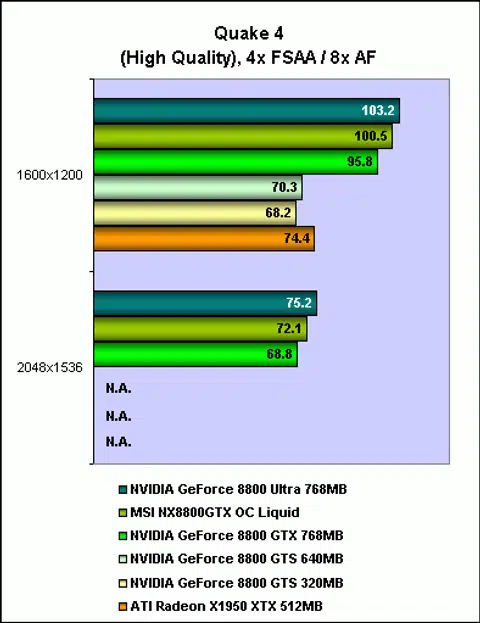
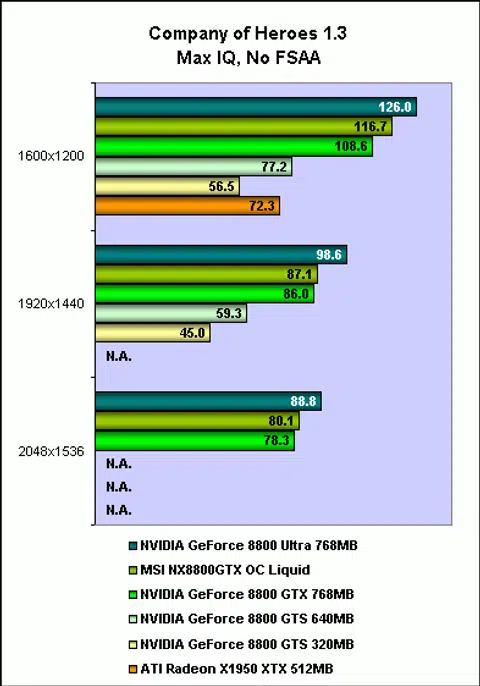
For Quake 4 and Company of Heroes, we saw the GeForce 8800 Ultra garner up to 10% and 14% lead over a stock clocked GeForce 8800 GTX. What's interesting to note in both of these tests is that we added the results of the MSI NX8800GTX OC Liquid edition, which is clocked at 610/2000MHz DDR and was last tested on the older ForceWare 97.02 driver pack. Had we updated its test results with the latest driver version, it would have chalked up a few more frames per second in each test, further closing the already small gap that exists between itself and the GeForce 8800 Ultra.
Results - Power Consumption
While NVIDIA briefed us that the GeForce 8800 Ultra at maximum consumption would consume a tad less power than that of the GeForce 8800 GTX for its cherry picked cores that make the Ultra grade and thus require less power despite the increased clock frequencies, our actual testing turned out otherwise. As plotted in the graph, our total system power consumption increased with a GeForce 8800 Ultra. So much for theory and marketing.
Unfulfilled Dreams
We have long known that NVIDIA would have a special SKU even better than the GeForce 8800 GTX, but little did we realize that the 'illusive' GeForce 8800 Ultra would turn out to be just a speed bumped GTX. Worse still is that the speed bump is within the achievable realm of most good GeForce 8800 GTX cards. The biggest bummer is that knowing what a GeForce 8800 Ultra is actually about and having to pay a sizeable premium for which many enthusiasts can actually get it for free or at reduced costs through modding their GeForce 8800 GTX graphics cards.
Analyzing the results, the new Ultra SKU is at minimum 10% speedier than the GeForce 8800 GTX at stock clocks, which in percentage terms is a reasonable speed bump for a follow-up SKU. However when you find out that the actual frames per second gains are small in certain tests, or large in others of the already amazingly huge numbers, both have the same impact to the end-user where one can't easily distinguish to appreciate the newcomer. Things get dicier after you factor in the cost premium of the GeForce 8800 Ultra, which is ridiculous even if NVIDIA has little or no competition at launch time.
The GeForce 8800 Ultra left us wanting much more for its suggested retail price.
If you have been closely following the ATI's R600 GPU plans and the probable expected performance, the top SKU is said to be roughly in the magnitude of 10% faster than the GeForce 8800 GTX. Though it would be a while before we can surely ascertain this, if we take this as a yardstick of comparison, then NVIDIA's GeForce 8800 Ultra is the perfect candidate to match up against ATI's upcoming top dog in terms of performance today.
As such, the GeForce 8800 Ultra is nothing more than NVIDIA's answer to the market of making sure that it has a competitive product against the ATI's forthcoming volley (and perhaps keeping ATI in-check again). However, at the crazy US$829 or higher SRP, we really have no reasons for recommending the GeForce 8800 Ultra when a perfectly good 8800 GTX or even a pre-overclocked GeForce 8800 GTX at far more reasonable prices can meet up to this niche segment equally well. Then of course you have ATI's own X2900XT and X2900XTX which although may take more time to reach the channel, you can be sure it won't carry an insane price tag.
Our articles may contain affiliate links. If you buy through these links, we may earn a small commission.