
NVIDIA GeForce 7950 GX2 1GB
Instead of forcefully hitting higher clocks to edge out the competition, NVIDIA went with a more parallel design by incorporating two cards in SLI within the footprint of a 7900 GTX and delivered the 'cleverly' designed GeForce 7950 GX2 - a monster sandwich. If a 50% speed boost over the 7900 GTX interests you, this is it.

The Duo that wants to be Single
As if dual graphics card SLI systems weren't fast enough, at this year's Consumer Electronics Show (CES) held in January, NVIDIA proudly displayed their Quad SLI system developed with Dell. Comprising of four customized GeForce 7800 GTX boards (built in a pair) and dual SLI bridges, it was the fastest bad-ass system around for the elite gamers. And later during CeBIT when the GeForce 7900 series were launched, NVIDIA and Dell had a renewed system based on two GeForce 7900 GX2 cards (which essentially had four GeForce 7900 GTX class boards). Though the idea of quad SLI keeps recurring during every major graphics chip upgrade, it's not going to be mainstream anytime soon (or even never at all) and we are all more than aware of that; even NVIDIA. Requiring a special network of components to get it going such as customized motherboard BIOS, top of the line CPUs, an expansive system to accommodate the extremely lengthy PCB boards of the Quad SLI cards and of course top-notch ventilation, Quad SLI was the strictly the realm of customized OEM systems.
However during the course of designing the Quad SLI ecosystem, NVIDIA has gained valuable knowledge in streamlining them and with that, today NVIDIA presents us the GeForce 7950 GX2 graphics card. Basically sandwiching dual PCB boards (each with a G71 GPU) in the same manner as seen in the Quad SLI systems, the difference is that the GeForce 7950 GX2 occupies a significantly smaller real-estate space. In fact it is no larger than the GeForce 7900 GTX in size and length. However, within that volume, you get a pair of GeForce 7950 GX2 GPUs that operate at 500MHz clock speed each and are equipped with a total of 1GB DDR3 frame buffer (512MB per card) running at 1.2GHz DDR.
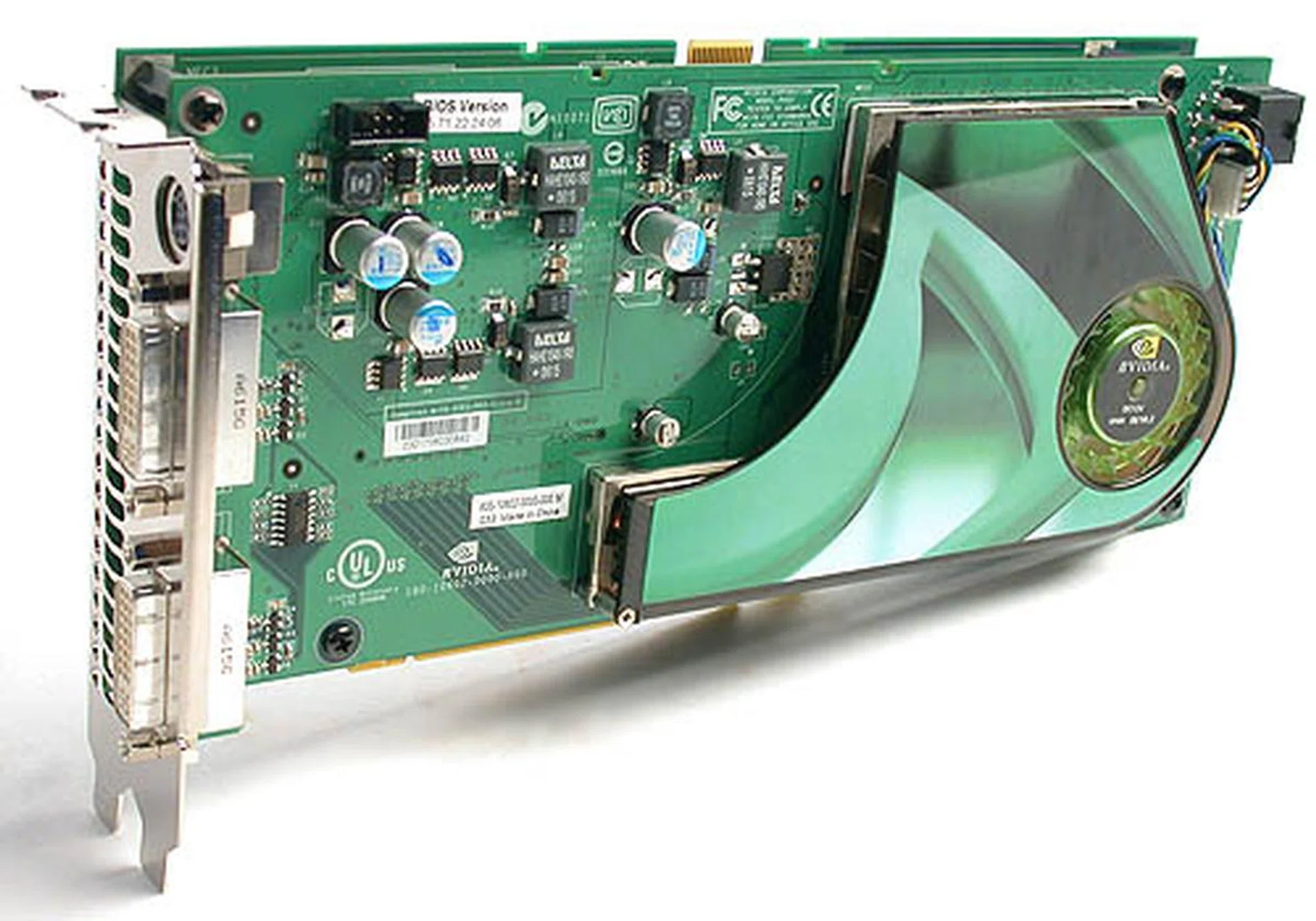
The GeForce 7950 GX2 1GB - a monster sandwich SLI combo.
The GeForce 7900 GTX graphics card was already a very speedy unit and well worth the dreams of being the ultimate Christmas present for many of us. However, it was not the fastest overall card in the market and neither was the competitor's unit. To ensure NVIDIA reclaimed the title of having the single fastest graphics card in a physically acceptable profile no larger than the existing GeForce 7900 GTX, NVIDIA tried their hand at a duo-card solution and thus the GeForce 7950 GX2 was born. Two slim-profile cards were put together and an internal SLI connector linked both boards for a permanent multi-GPU setup. However only one of them had the PCIe x16 interface to communicate with the motherboard while the other had the display output options; thus the so-called 'single graphics card' moniker. Rather amusing if you ask our opinion, but nevertheless, it was well put together.
The primary specifications of the core and memory clock speeds are closest to that of a GeForce 7900 GT and with a pair of cards in the GeForce 7950 GX2 configuration, we expect it to at least equal a GeForce 7900 GT in SLI. Below we detail the GeForce 7950 GX2 specifications and pit it against several comparable graphics cards that would be of major interest to our readers. Read on for a little more information on the overall build of the card before we bring on our benchmark segment.
Model | NVIDIA GeForce 7950 GX2 1GB | NVIDIA GeForce 7900 GTX 256MB | NVIDIA GeForce 7900 GT 256MB | ATI Radeon X1900 XTX 512MB | ATI Radeon X1900 XT 512MB |
Core Code | G71 | G71 | G71 | R580 | R580 |
Transistor Count | 2 x 278 million | 278 million | 278 million | 384 million | 384 million |
Manufacturing Process (microns) | 0.09 | 0.09 | 0.09 | 0.09 | 0.09 |
Core Clock | 500MHz | 650MHz | 450MHz | 650MHz | 625MHz |
Vertex Shaders | 2 x 8 | 8 | 8 | 8 | 8 |
Rendering (Pixel) Pipelines | 2 x 24 | 24 | 24 | 16 | 16 |
Pixel Shader Processors | 2 x 24 | 24 | 24 | 48 | 48 |
Texture Mapping Units (TMU) | 2 x 24 | 24 | 24 | 16 | 16 |
Raster Operator units (ROP) | 2 x 16 | 16 | 16 | 16 | 16 |
Memory Clock | 1200MHz DDR3 | 1600MHz DDR3 | 1320MHz DDR3 | 1550MHz DDR3 | 1450MHz DDR3 |
DDR Memory Bus | 2 x 256-bit | 256-bit | 256-bit | 256-bit | 256-bit |
Memory Bandwidth | 76.8GB/s | 51.2GB/s | 42.4GB/s | 49.6GB/s | 46.4GB/s |
Ring Bus Memory Controller | NIL | NIL | NIL | 512-bit (for memory reads only) | 512-bit (for memory reads only) |
PCI Express Interface | x16 | x16 | x16 | x16 | x16 |
Molex Power Connectors | Yes | Yes | Yes | Yes | Yes |
Multi GPU Technology | Yes (SLI) | Yes (SLI) | Yes (SLI) | Yes (CrossFire) | Yes (CrossFire) |
DVI Output Support | 2 x Dual-Link | 2 x Dual-Link | 2 x Dual-Link | 2 x Dual-Link | 2 x Dual-Link |
HDCP Output Capable? | Yes | No - vendor dependent | No - vendor dependent | No - vendor dependent | No - vendor dependent |
Street Price | ~ US$599 - US$649 | ~ US$499 - US$550 | ~ US$279 - 299 | ~ US$469 - US$579 | ~ US$450 |
The GeForce 7950 GX2 1GB Graphics Card
As we mentioned on the earlier page, the construction of the GeForce 7950 GX2 is such that the one board will interface the motherboard, while the other card has the DVI display connectors. It's a rather interesting design that fits in with the single graphics card nomenclature and what's more, the GeForce 7950 GX2 will work on any motherboard with a PCIe graphics slot. SLI motherboards are not required. The system will detect it as a pair graphics cards installed, but the drivers will see it as only one card with no messy SLI profiles or settings required. Just plug and play. Power requirements aren't exactly doubled either, but it still consumes a staggering 143W at peak usage. Despite that, it requires only one PCIe power connector and would work fine off a simple system equipped with a fine 400W power supply.
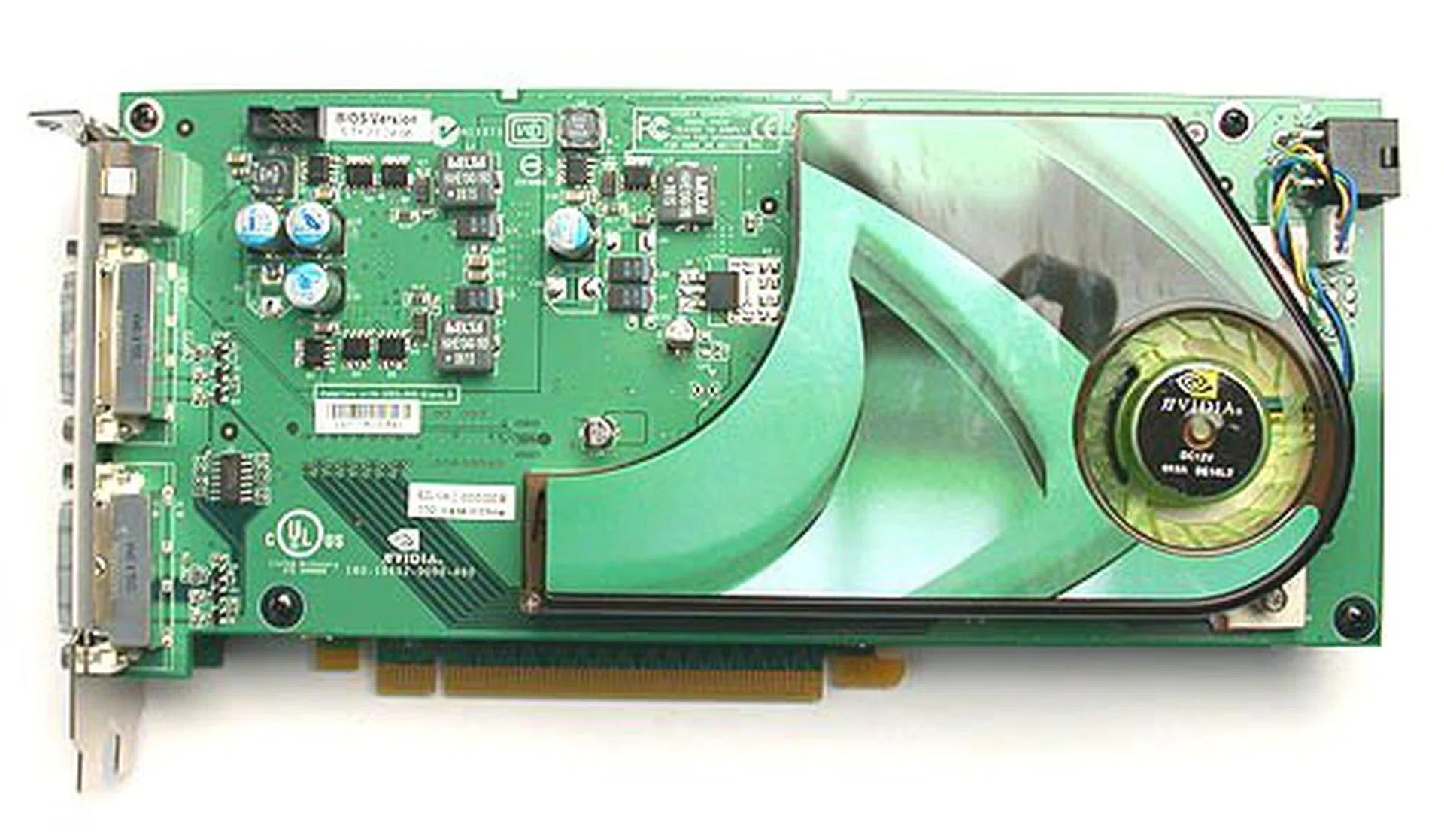
Here's a top-down view of the GeForce 7950 GX2 graphics card. The top board being the slave board with display output connectivity.
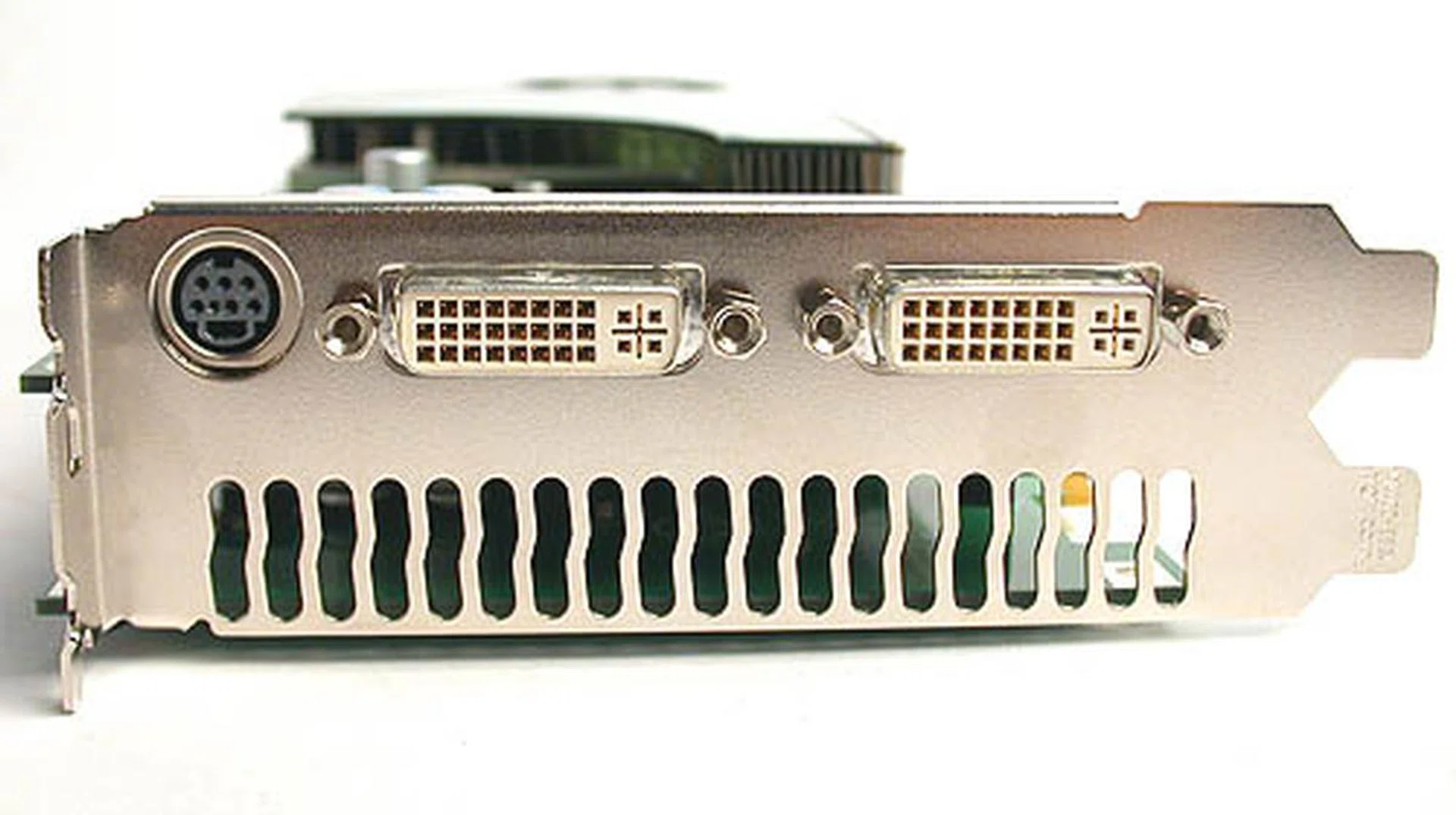
The output interfaces are as standard as they can be, however, the GeForce 7950 GX2 is fully HDCP compliant as the board has a crypto-ROM chip that stores the key required for HDCP encoding of protected digital video content. Definitely one of the first few graphics card SKUs to have this function throughout the entire series.
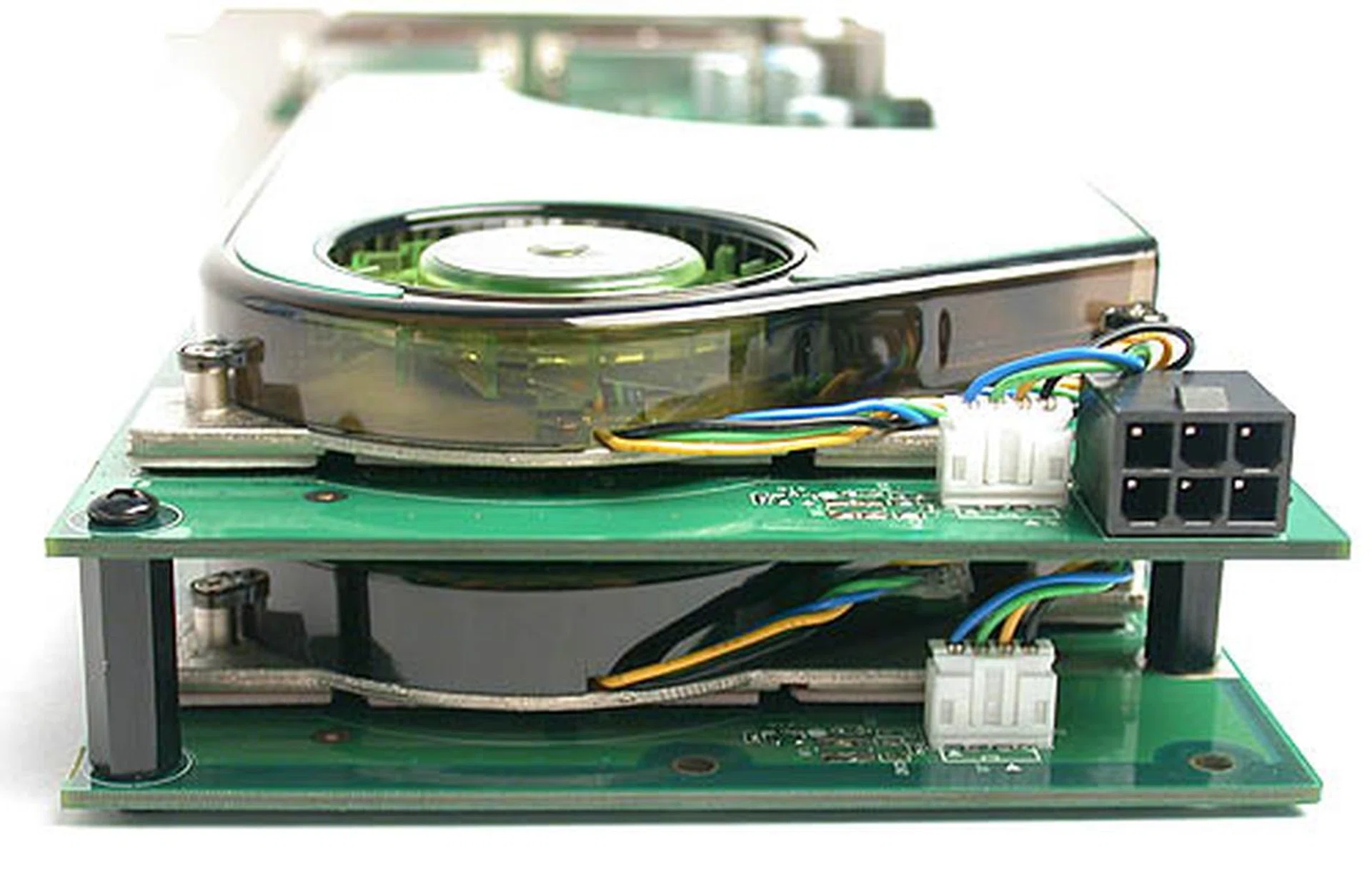
Over on the other end of the card, you can make out the slim cooler profile of each card. Essentially NVIDIA designed the GeForce 7950 GX2 with a specific mechanical and TDP specification to ensure it is easily accepted within the industry and yet able to garner much better performance than the former best GeForce 7900 GTX. Note that only one PCIe Molex power connector is required.
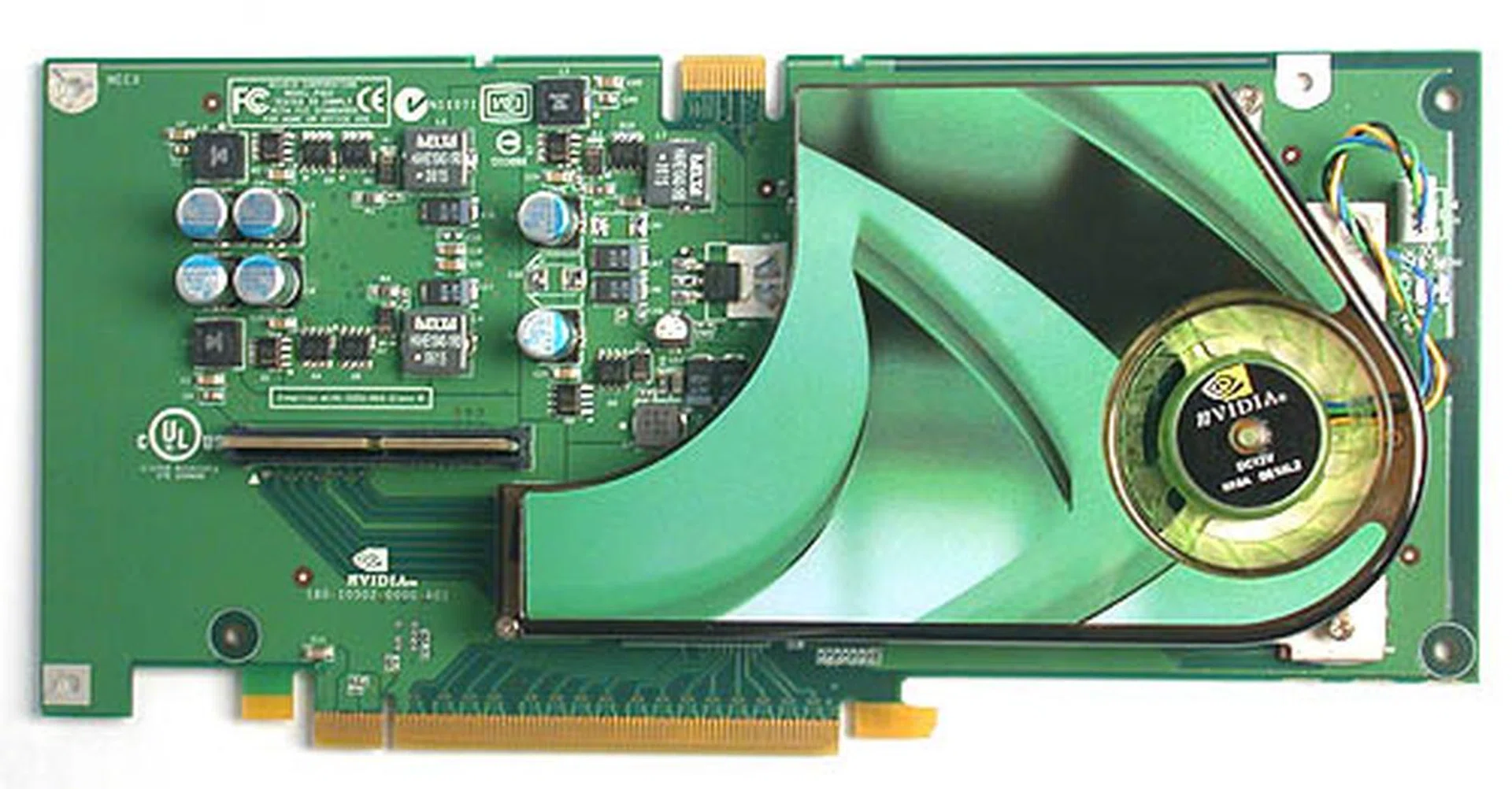
Unscrewing the top board out, here we have the primary board underneath with the PCIe x16 interface, the link bridge and connector to the slave card and even the SLI gold fingers to set up Quad SLI.
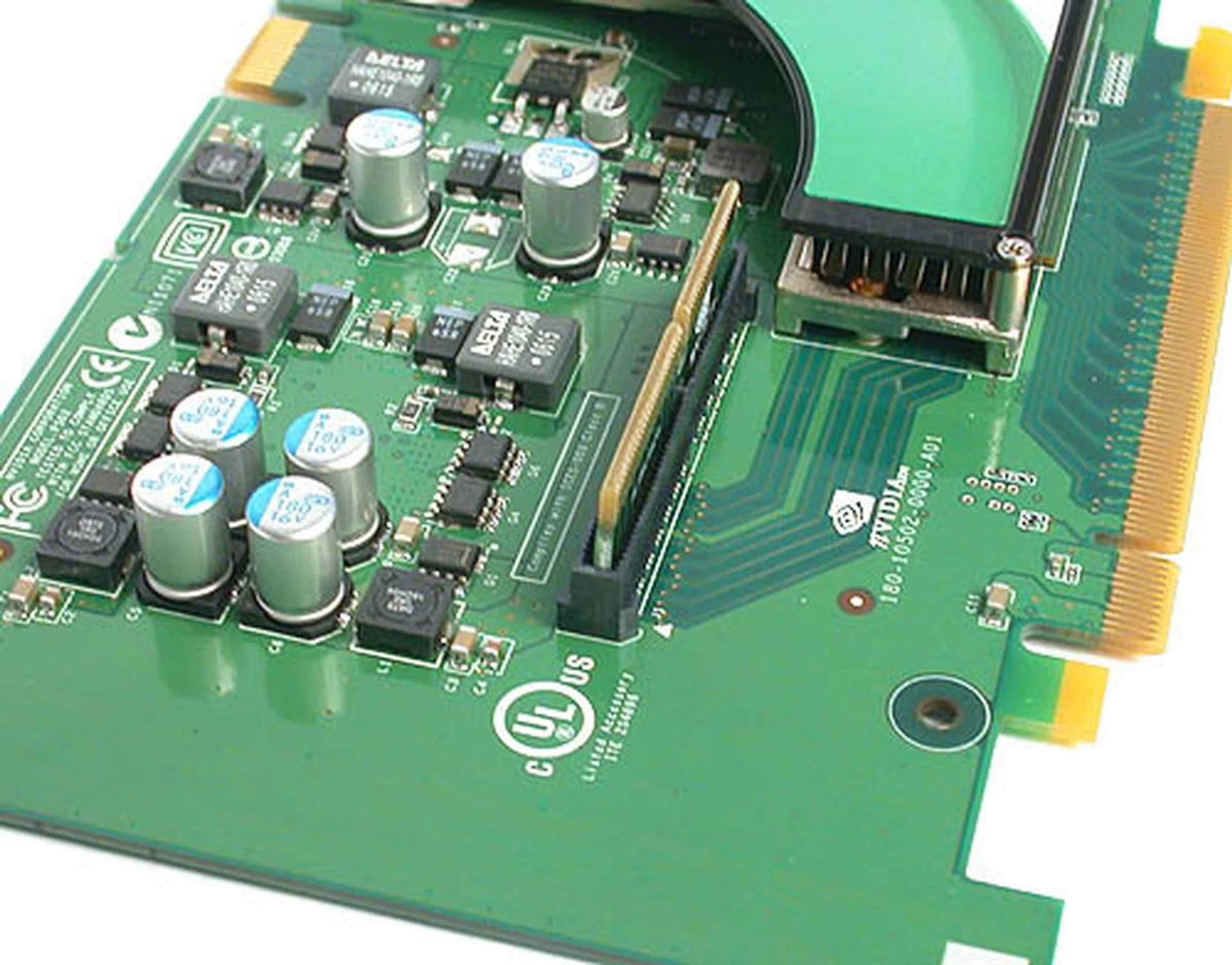
If only the secondary board had move display output options, but perhaps that may be more complex and even violate the 'single graphics card' designation. Notice the link bridge interface facing the slave board?
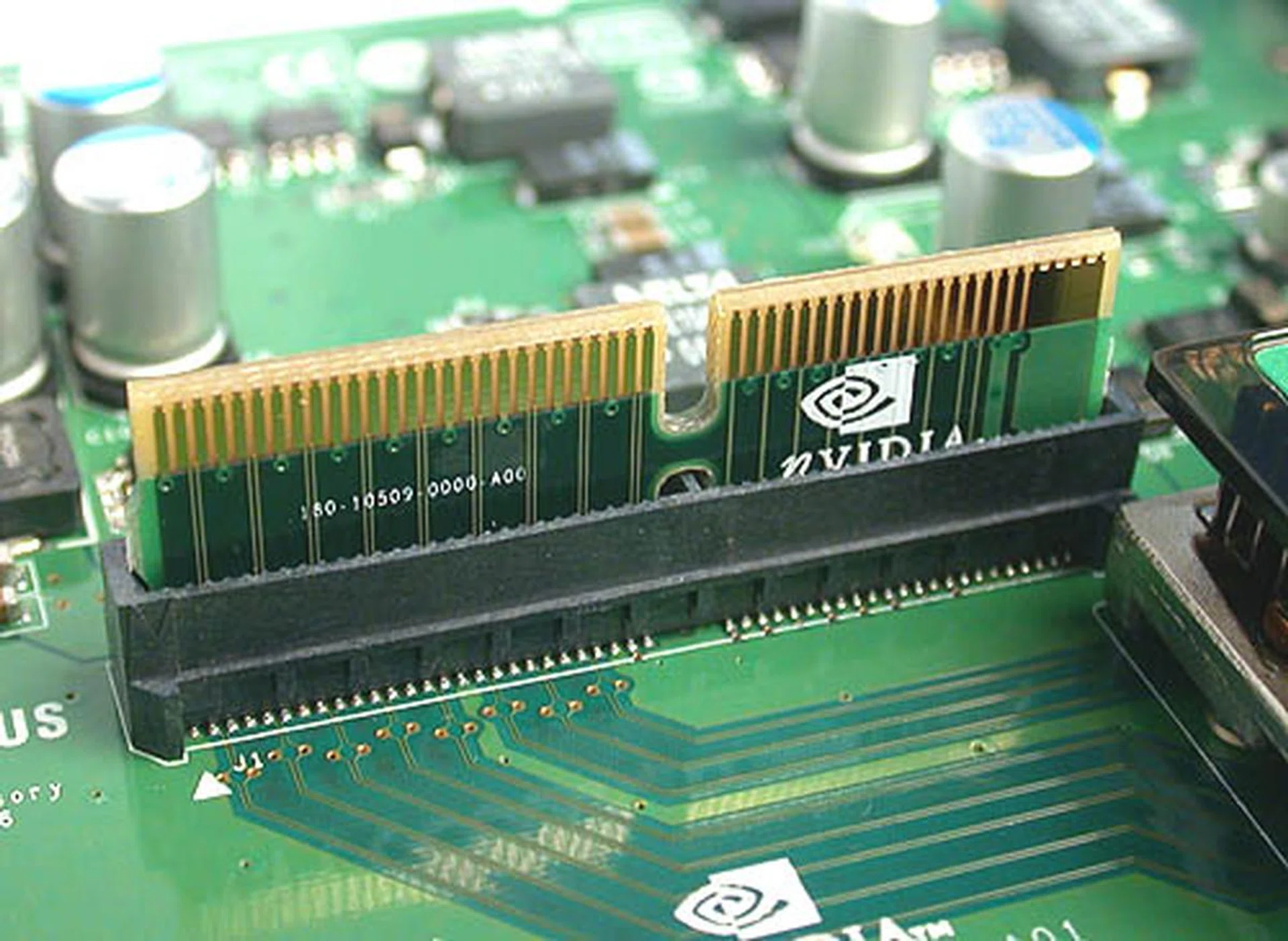
Here's a close-up of that. This bridge acts as both the carrier of data and power between both cards.
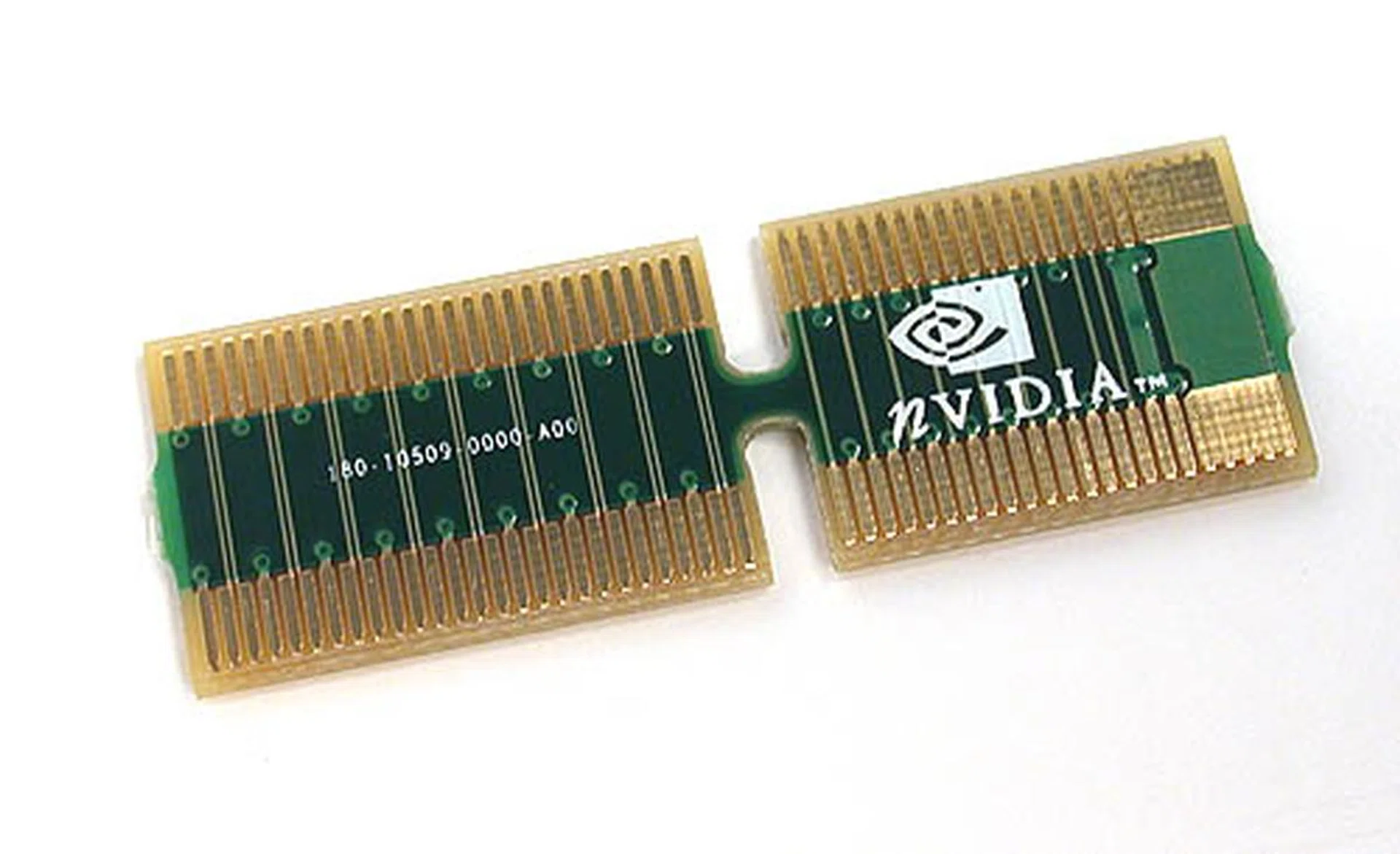
This fragile looking bridge is all that's holding two boards together and making the GeForce 7950 GX2 a possibility.
Though with the SLI gold finger connector on the card, it does hint of the possibility of a Quad SLI setup for consumers. However, NVIDIA has no plans to allow Quad SLI for consumers at the moment citing reasons for the lack of proper qualified motherboard support with the right BIOS to overcome the complicated intricacies such as accounting for additional latencies and the likes. They do acknowledge the availability in future, but they aren't just ready quite yet.
Motherboard Compatibility
Although we mentioned that the GeForce 7950 GX2 could work on any PEG port equipped motherboard, there is still a clause towards that. The limitation lies with the design of the GeForce 7950 GX2 as it requires a PCIe Switch to share the aggregated PCI Express X16 bandwidth between the two boards.
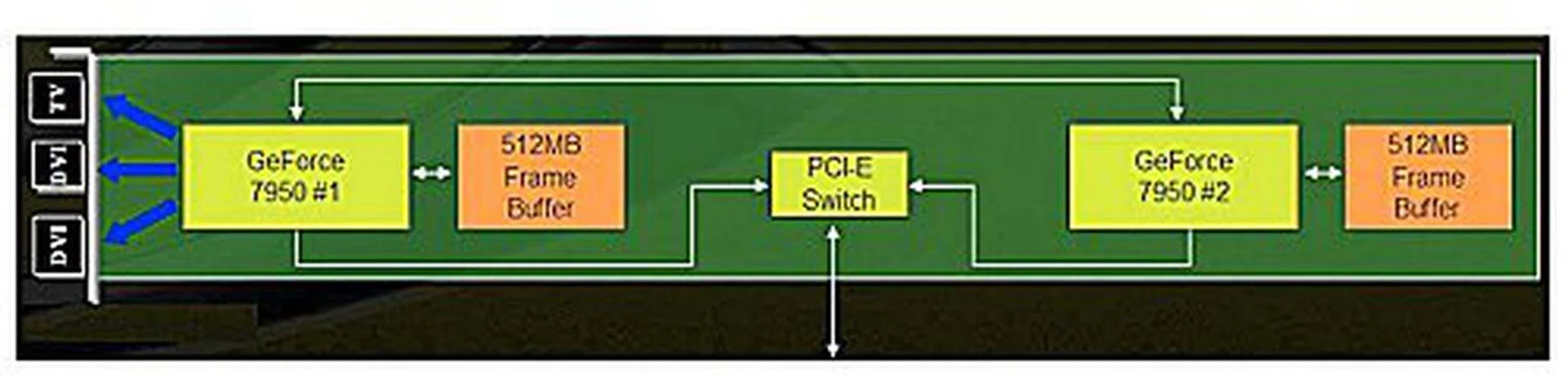
The logical interconnect diagram of the GeForce 7950 GX2 – note the PCIe Switch.
This switch is also the cause of incompatibility because it's not a readily recognizable component. However this can be easily overcome through a system BIOS update to ensure compatibility. Thus at the moment, only a handful of the latest motherboard BIOS' are completely compatible with the GeForce 7950 GX2. We expect the list (available here:- www.nvidia.com/GX2 ) to grow exponentially in time as this is a relatively easy update. For your convenience, we list the compatible motherboard and BIOS revisions at the time of writing:-
Manufacturer | Model | Chipset | System BIOS version |
ABIT | AA8 Duramax | Intel 925X | 2.4 |
ABIT | AW8 | Intel 925X | 1.4 |
ABIT | AN8 SLI | NVIDIA nForce4 SLI | 1.9 |
Albatron | K8SLI | NVIDIA nForce4 SLI | 1.12 |
ASUS | A8N32-SLI Deluxe | NVIDIA nForce4 SLI X16 | 1205 |
ASUS | A8N5X | NVIDIA nForce4 | 0902 |
ASUS | A8N-SLI Premium | NVIDIA nForce4 SLI | 1013 |
ASUS | A8R32-MVP Delux | ATI CrossFire Xpress 3200 | 0404 |
ASUS | A8V-E Deluxe | VIA K8T890/VT8237R | 1005 |
ASUS | M2N32-SLI DELUXE | NVIDIA nForce 590 SLI | 0404 |
ASUS | P5LD2-VM | Intel 945G | 0508 |
ASUS | P5ND2-SLI | NVIDIA nForce4 SLI Intel Ed. | 0304 |
Biostar | i945 G-M7 | Intel 945G | 24F |
DFI | Infinity NF4 SLI | NVIDIA nForce4 SLI | 2006/04/10 |
ECS | KN1 SLI Lite | NVIDIA nForce4 Ultra | 1.1d |
ECS | nForce4-A939 | NVIDIA nForce4 | 1.1g |
Foxconn | NF4SLI7AA-8EKRS2 | NVIDIA nForce4 SLI Intel Ed. | 537F1P34.BIN |
Gigabyte | GA-8I945P PRO | Intel 945P | F5 |
Gigabyte | GA-K8N Pro-SLI | NVIDIA nForce4 SLI | F4 |
Gigabyte | GA-K8N51PVM9-RH | NVIDIA nForce 430/GeForce 6150 | F1 |
Gigabyte | GA-K8NF-9 | NVIDIA nForce4 | F10 |
Gigabyte | GA-K8N-SLI | NVIDIA nForce4 SLI | F9 |
Gigabyte | GA-K8NXP-9 | NVIDIA nForce4 Ultra | F9 |
Gigabyte | GA-K8NXP-SLI | NVIDIA nForce4 SLI | F11 |
Intel | D955XBK | Intel 955X | 2036 |
Intel | D975XBX | Intel 975X | 1073 |
Intel | SE7525GP2 | Intel E7525 | P08 |
MSI | K8N Diamond Plus | NVIDIA nForce4 SLI X16 | A7220NZ1 v1.22 |
MSI | K8N Neo4-F | NVIDIA nForce4 | 5.2 |
Tyan | S2895 D/T | NVIDIA nForce 2200/2050 | 2895_103 |
List is accurate as of launch time only. Please refer to http://www.nvidia.com/GX2 for the most updated list.
In the event that you do want to pick up a GeForce 7950 GX2 card, but your motherboard isn't listed, don't despair yet. Instead, drop a friendly note to your authorized motherboard distributor or to the manufacturer directly to hasten the update process. Without this update, your motherboard might not identify the graphics card correctly and in the worst-case scenario, not boot up at all.
Notes on Monitor Support
By default when you install the GeForce 7950 GX2, it defaults to operating in a multi-GPU mode, hence limiting the monitor output capability to just one visual display unit. This is as expected since any SLI setup would have this limitation as well. If you have two monitors to be powered, the GeForce 7950 GX2 can be 'instructed' via the driver panel to switch to a multi-display mode, thus allowing you to use a proper dual monitor setup along with all its perks and functionalities. Of course when it's time to game, it would be wise to toggle back to multi-GPU mode. This option configuration option is only available via the new NVIDIA control panel interface and not in the classic driver panel interface. Here's a snapshot of that:-
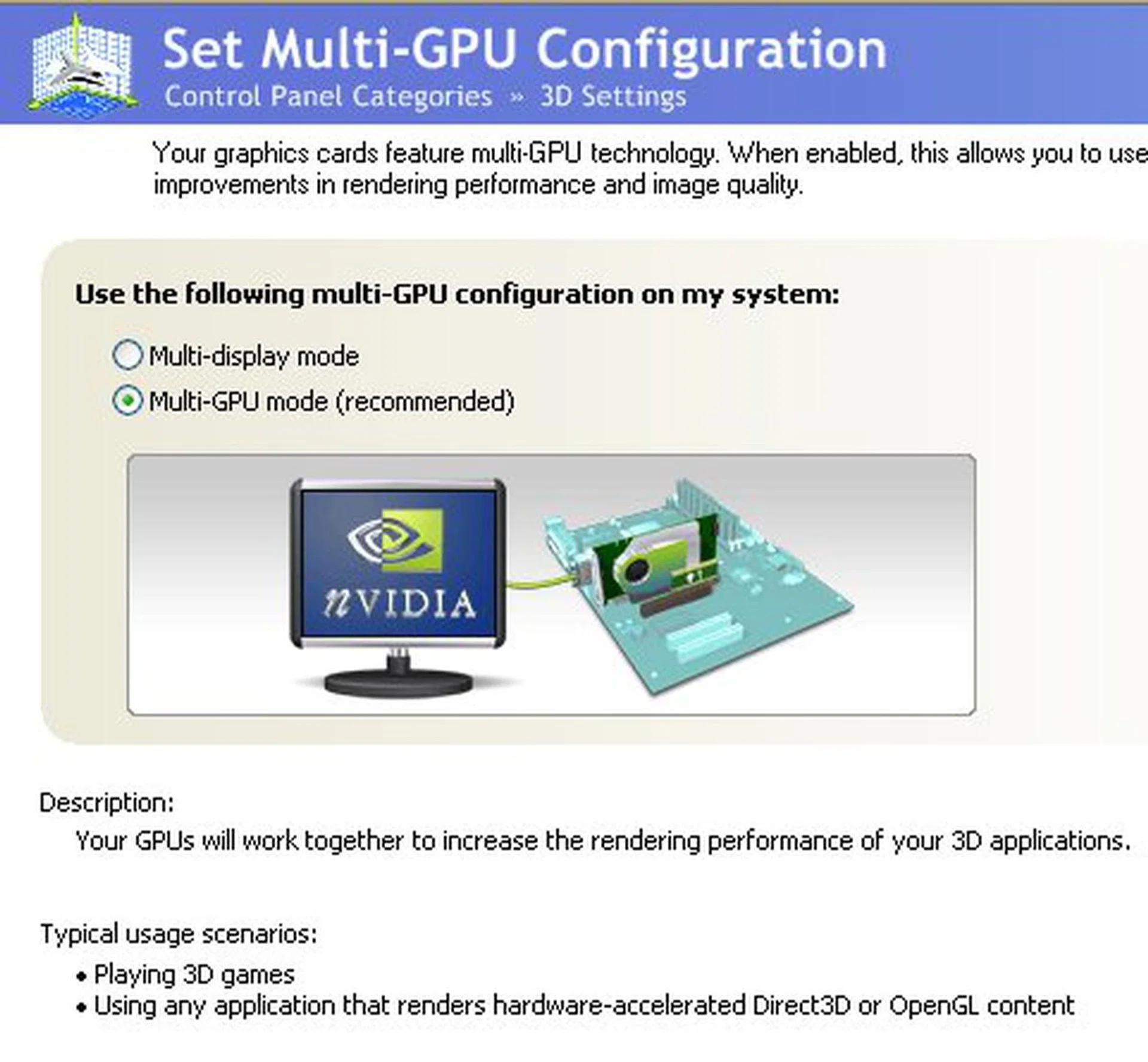
Multi-GPU and Multi-display mode options are available only in the new NVIDIA control panel interface. The default operating mode for the GeForce 7950 GX2 is in Multi-GPU mode.
Test Setup
Our graphics testbed is equipped with an Athlon 64 FX-55 processor built upon the MSI K8N Diamond Plus motherboard and 1GB of low latency Kingston HyperX DDR400 memory. If you took note of the graphics card comparison drawn on the first page, those are the exact same contenders we've lined up against the GeForce 7950 GX2. Here's the list again but this time with the accompanying driver version used:-
- NVIDIA GeForce 7950 GX2 1GB (ForceWare 91.29)
- NVIDIA GeForce 7900 GTX 512MB (ForceWare 84.21)
- NVIDIA GeForce 7900 GT 256MB (ForceWare 84.21)
- NVIDIA GeForce 7900 GT 256MB - SLI (ForceWare 84.21)
- ATI Radeon X1900 XTX 512MB (Catalyst 6.5)
- ATI Radeon X1900 XT 512MB (Catalyst 6.5)
Here then are the benchmarks we used to gather the performance results presented in the following pages:-
- Futuremark 3DMark05 Pro (version 120)
- Futuremark 3DMark06 Pro (version 102)
- Chronicles of Riddick: Escape from Butcher Bay (version 1.1)
- Tom Clancy's Splinter Cell 3: Chaos Theory (version 1.3)
- F.E.A.R
- Quake 4
Results - 3DMark05 Pro & 3DMark06 Pro
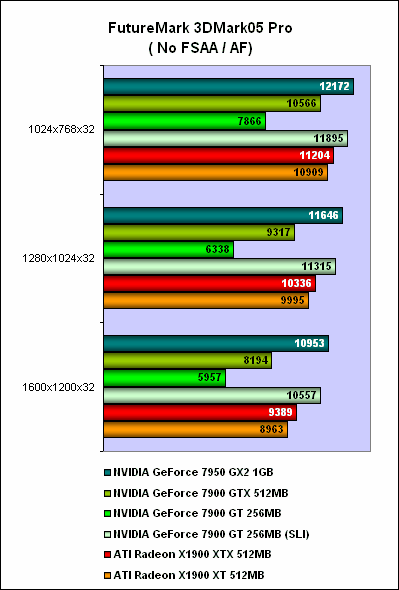
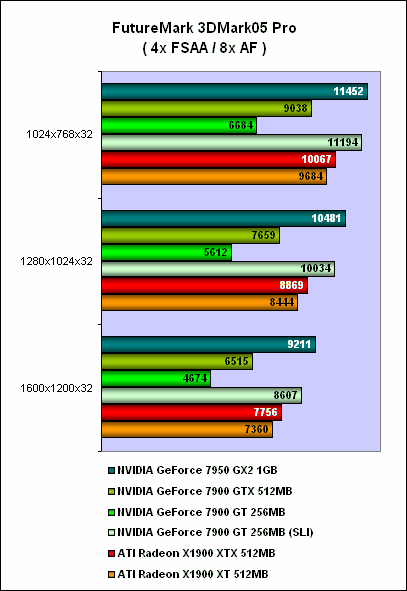
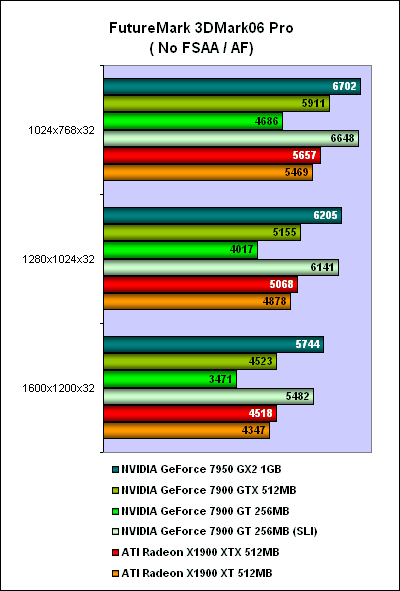
Just as we projected, the GeForce 7950 GX2 matched the performance figures of the GeForce 7900 GT in SLI mode and in fact leaded it by up to 4.7%. However, going by NVIDIA's 'single' graphics card nomenclature, the GeForce 7950 GX2 has a healthy margin of performance of between 25% and 40%. Not bad at all considering that the GeForce 7950 GX2 fits within the same physical profile of a GeForce 7900 GTX and even costs about the same as what the latter used to be.
Results - Splinter Cell 3: Chaos Theory & F.E.A.R (DirectX 9 Benchmarks)
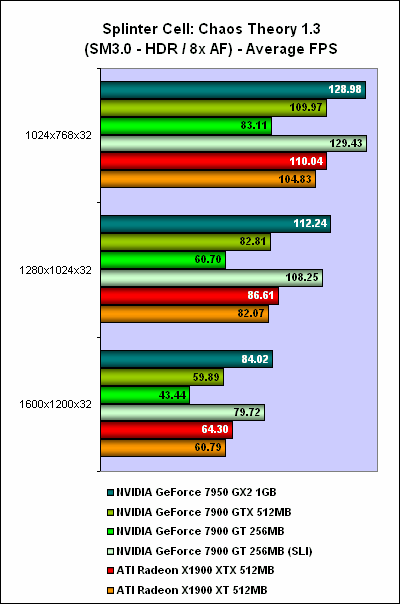
Findings from Splinter Cell 3 were quite on par with the findings of the 3DMark suite, but the advantage of the GeForce 7950 GX2 against the pair of GeForce 7900 GT cards diminished. As far as we were concerned from the specifications, we expected both configurations to match up.
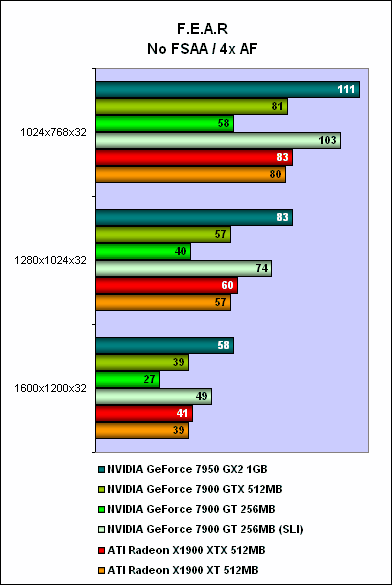
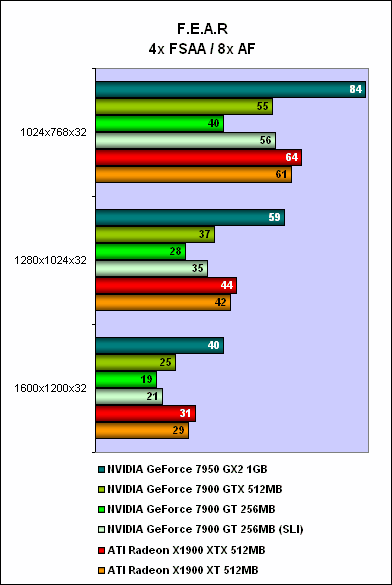
Though Splinter Cell 3 can be classified us a somewhat taxing game, F.E.A.R easily tops the current list of games as being the most resource hogging and graphically taxing game. Especially with Antialiasing. Over here, the GeForce 7950 GX2 managed a staggering performance leap of up to 60% in comparison to the GeForce 7900 GTX and the GeForce 7900 GT in SLI. Evident from the results of the once equivalently performing GeForce 7900 GT SLI configuration, its limited frame buffer size crippled it from even surpassing a single speedy GeForce 7900 GTX. If this benchmark is of any indication, the era of the 512MB frame buffer graphics card has finally arrived. So if you are on the look out for a high-end card now, it would be a good to invest one that has 512MB of memory or simply get the GeForce 7950 GX2.
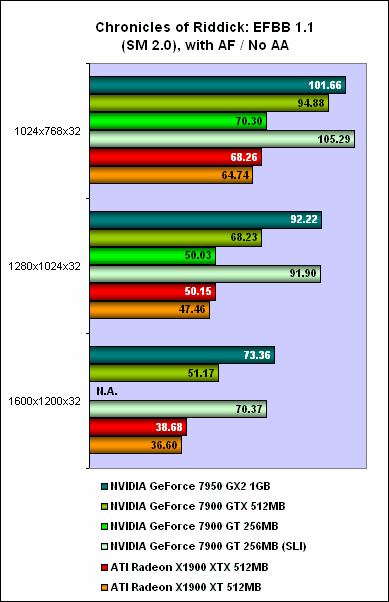
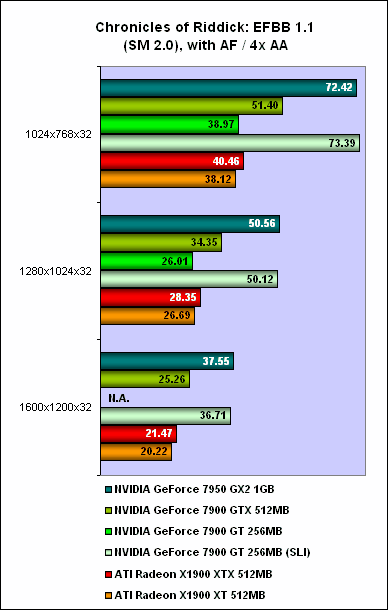
Results - Chronicles of Riddick: Escape from Butcher Bay (SM 2.0+ OpenGL Benchmark)
Chronicles of Riddick is another stressful benchmark, but it wasn't as resource intensive as F.E.A.R, thus we saw the GeForce 7950 GX2 and the GeForce 7900 GT (SLI) on almost equal footing.
Results - Quake 4 (DirectX 9 Benchmark)
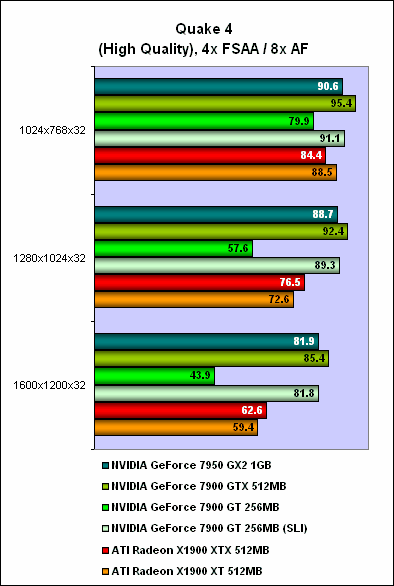
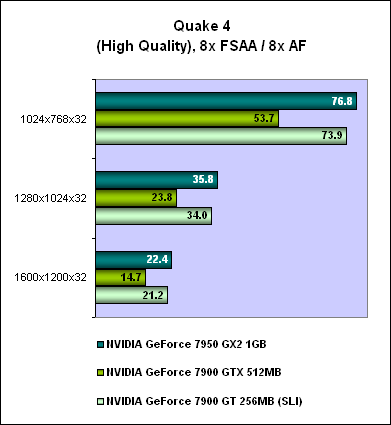
Even with 4x FSAA enabled, the GeForce 7950 GX2 was still mostly CPU-bound in performance and with SLI requiring some system overhead, it came out a fraction slower than the GeForce 7900 GTX. The real advantage of the GeForce 7950 GX2 surfaced when a high degree of antialiasing was employed as shown in the second graph below. Like in any SLI setup, when the render workload is significant, the GeForce 7950 GX2 excels in leaps and bounds.
Overclocking
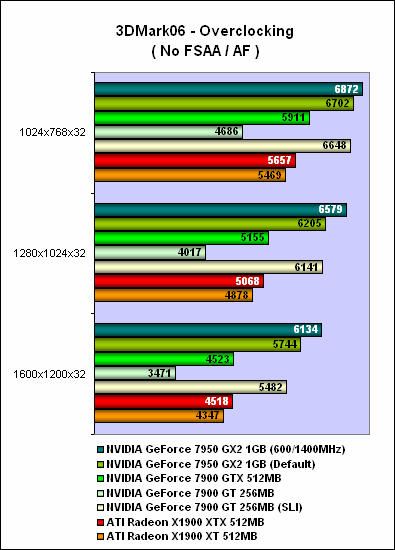
Any hardcore enthusiast aiming for a card like the GeForce 7950 GX2 would be rather curios on the actual mileage they can squeeze out from it. We tried our hand at the reference GeForce 7950 GX2 and we managed a decent overclock from 500/1200MHZ to 600/1400MHz. While the clock speed numbers seemed large, performance gain (of about 6%) wasn't exactly outstanding in 3DMark06. However, we are certain it would fare better in some of the real-world games we've looked at within this review. Even so, we would advise against overclocking on such a complex graphics card(s). You wouldn't want a US$600 card to give up on you prematurely, would you?
Conclusion
Having seen NVIDIA's pursuit of Quad SLI and the likes, it is without a doubt their goal is to be the industry performance leader. Drawing from their Quad SLI design ecosystem, NVIDIA applied that engineering into delivering an ideal two-slot graphics within the footprint of the GeForce 7900 GTX, but making sure this new card delivered the absolute best performance possible. The GeForce 7900 GTX with its already high clock speeds is almost at its seams and it isn't feasible to pump it further within reasonable and safe means to achieve a mass-market product.
Thus instead of scaling clocks, NVIDIA went parallel by incorporating two boards with an internal SLI connection between them. With clock speeds of 500/1200MHz per board and a combined 1GB total frame buffer, this is a product that would at the very minimum match the performance of a GeForce 7900 GT in SLI mode. However, when you crank up image quality settings and set high antialiasing levels, the large frame buffer of the GeForce 7950 GX2 simply shines as depicted in the forward looking F.E.A.R game. Expect up to 50% or more performance gains over the GeForce 7900 GTX and the GeForce 7900 GT in SLI in such game settings. More upcoming games embracing all the newer technology developments such as F.E.A.R would only mean that you'd require graphics cards of the GeForce 7950 GX2 caliber for high visual quality.
The GeForce 7950 GX2 is also aimed at those looking to maximize their huge visual displays that run at very high native resolutions, beyond even 1600x1200. At such setting, even a reasonable degree of antialiasing would quickly consume huge amounts of memory and would require a speedy graphics card solution to tackle that. Even with an internal SLI-like configuration the GeForce 7950 GX2, this card is designed to work on any system with a PCIe graphics slot and will not require any SLI settings (or rather it is seamlessly taken care of in the background), thus it is not platform dependent. However, due to the PCI Express Switch integrated on the card, it would require motherboards to have an updated BIOS to detect the GeForce 7950 GX2 graphics card correctly. This is the only catch for the moment, but it's an issue that should fade away if all major motherboard vendors dutifully address this concern as soon as possible.
Albeit the GeForce 7950 GX2 is actually two cards sandwiched as one, heat output is not really a major concern for this class of cards as we've seen worse with the some of ATI's high-end cards. It is however still expected that adopters should have good airflow within their system as a prerequisite to consideration. And it's not difficult to achieve that. The other concern that goes hand-in-hand is noise. In this aspect, we were delighted to note of its quiet operation; in fact, it felt like there was only a single GeForce 7900 GT operating instead of the duo-card GeForce 7950 GX2. Simply said, NVIDIA has tackled all grounds to deliver the GeForce 7950 GX2 and they've done that rather gracefully, despite the bulky two-card build. In fact, it is even lighter than a GeForce 7900 GTX. One thing to note is that GeForce 7950 GX2 does not eclipse the GeForce 7900 GTX in SLI mode, but if you are looking at the best 'single-card' solution, this is it.
The expected stock price of the GeForce 7950 GX2 is about US$599 and that's actually about the same price as when the GeForce 7900 GTX first debuted, or for that matter, equivalently priced to a pair of GeForce 7900 GT cards now. Considering its capabilities, quiet operation, decent thermal output profile and of course its added performance advantage, there's hardly any other suitable contender to rival it on all aspects (let alone one). Verdict: Highly recommend, so long as your motherboard's BIOS is updated enough to flawlessly work with the GeForce 7950 GX2.
Our articles may contain affiliate links. If you buy through these links, we may earn a small commission.