
MSI P6NGM (NVIDIA GeForce 7150/nForce 630i)
MSI's latest mainstream all-in-one motherboard runs on NVIDIA's new GeForce 7150/nForce 630i mGPU chipset. Its features are nothing to shout about, but having a NVIDIA GPU in the Intel IGP market means finally getting decent compatibility for games and 3D applications alike.

Introduction
The MSI P6NGM motherboard is one of the first NVIDIA GeForce 7-series based mGPU boards we've received for testing. Based on the GeForce 7150/nForce 630i, the P6NGM represents the flagship of NVIDIA's new mainstream chipset line. And as a mainstream oriented motherboard, the MSI P6NGM follows closely with NVIDIA's reference model, with slight modifications here and there. Still, the board offers all the features that one would need from any modern PC. Check out the full technical specifications below before we delve further into the review.
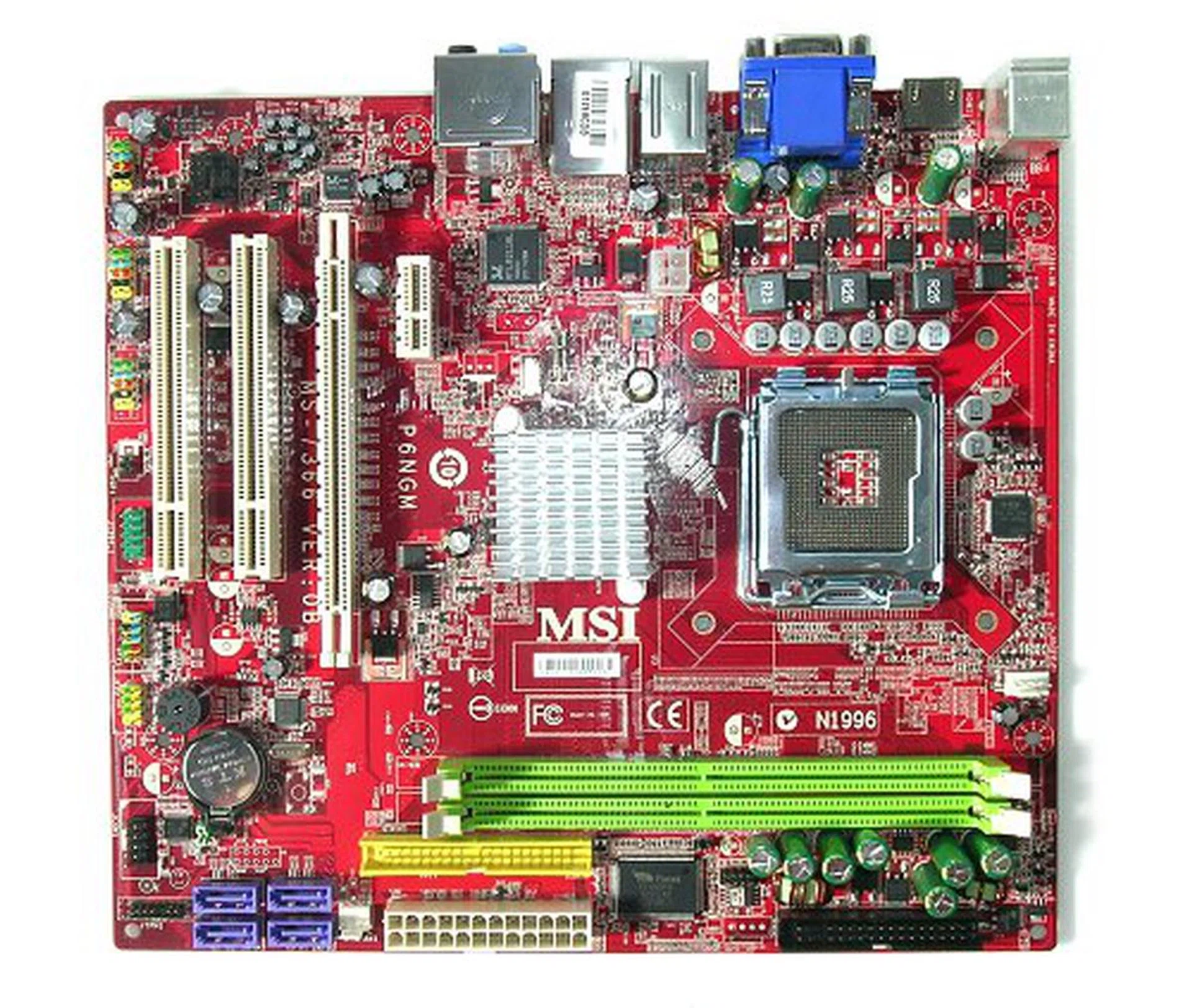
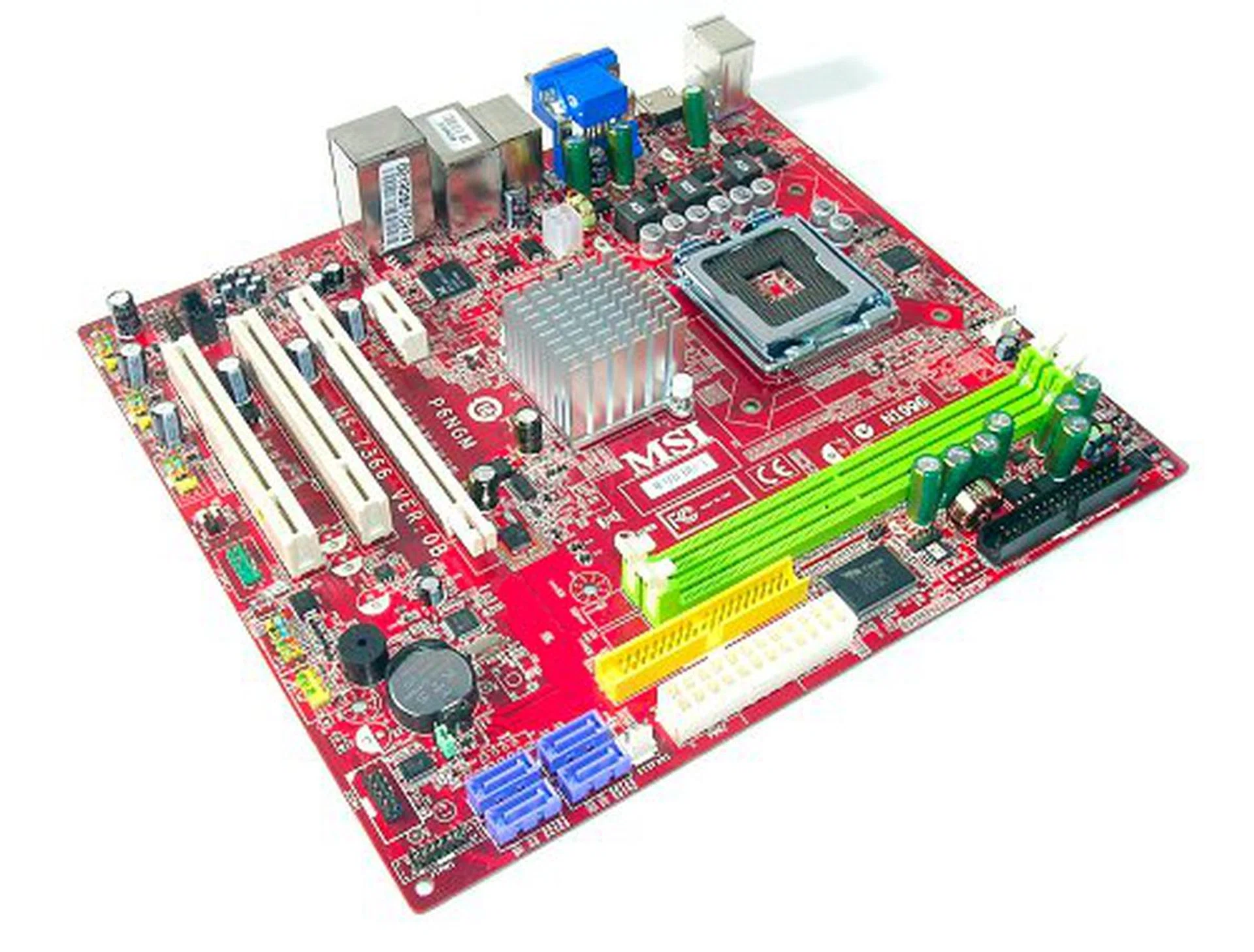
The MSI P6NGM motherboard.
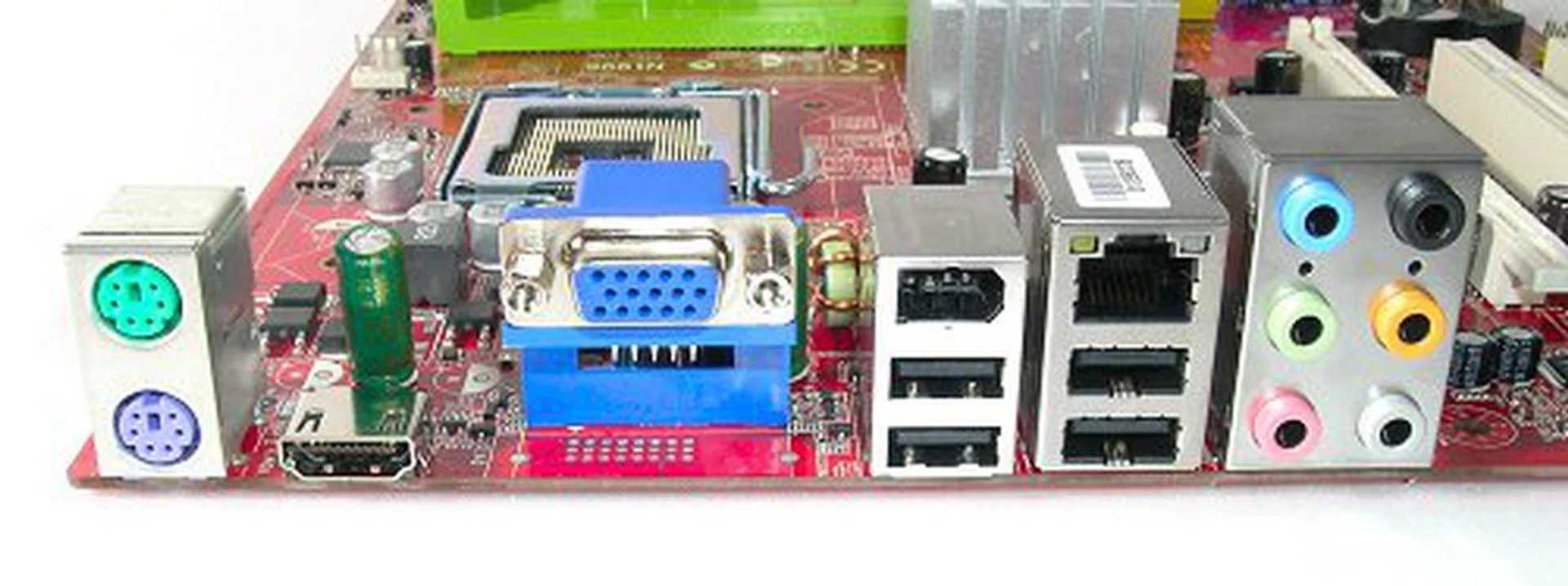
Rear I/O panel includes PS/2 keyboard and mouse ports, one HDMI port, one VGA port, a FireWire port, four USB 2.0 ports, one RJ-45 and analog surround audio. There are no visible S/PDIF ports natively provided by MSI.
Motherboard Features
The MSI P6NGM makes full use of all the features that are offered by NVIDIA's new GeForce 7150/nForce 630i chipset and even includes FireWire support through a JMicron JMB381 2-port FireWire-400 controller. Combined, you actually have a very well balanced motherboard with some pretty high-end support. The board will support the full range of Intel LGA775 processors with FSB up to 1333MHz and comes with two single-channel DIMM slots for up to 4GB DDR2-800 memory.
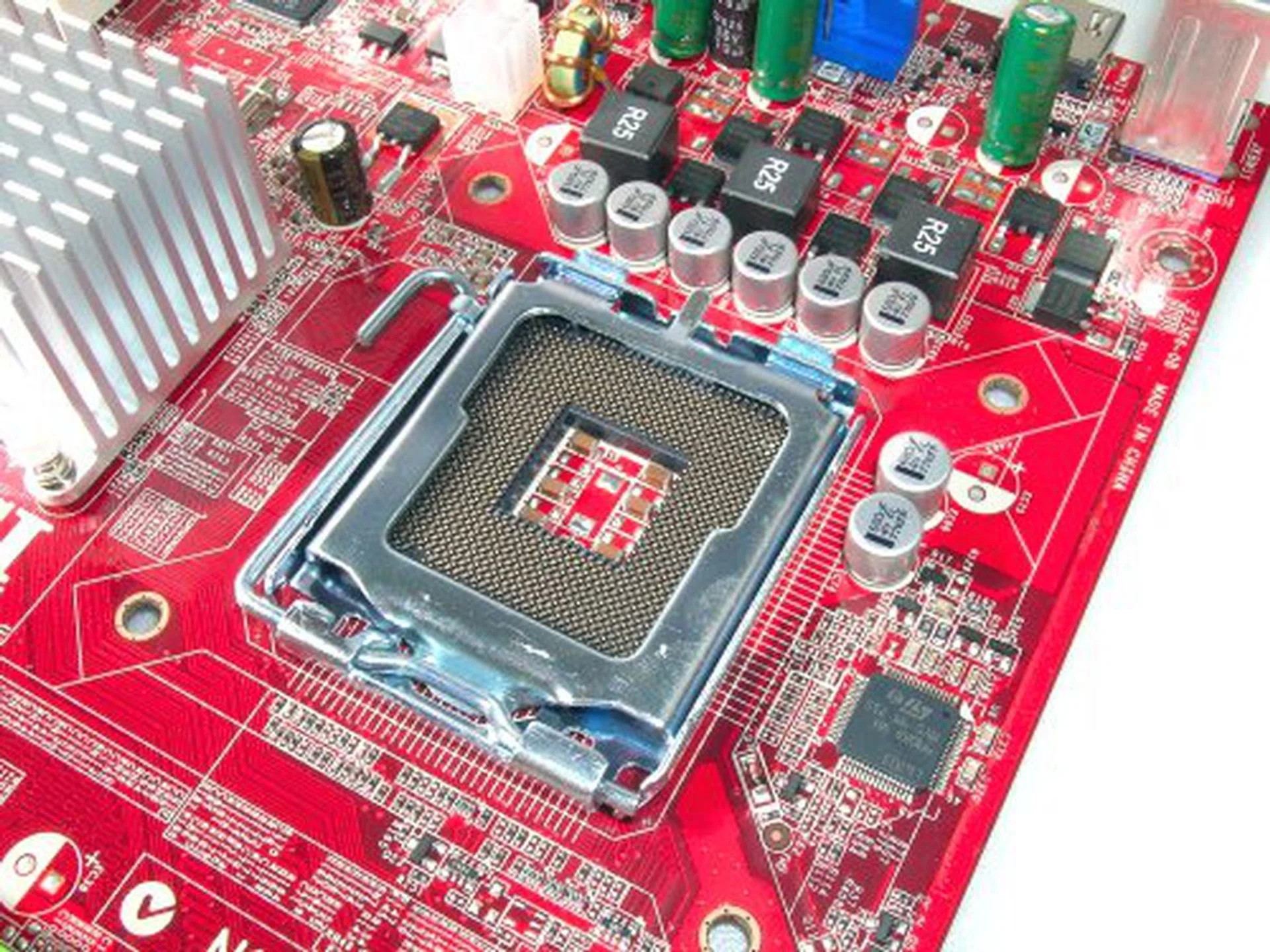
Decently spaced CPU socket with a 3-phase PWM design. While the rest of the motherboard uses normal capacitors, those surrounding the CPU are based on solid capacitors.
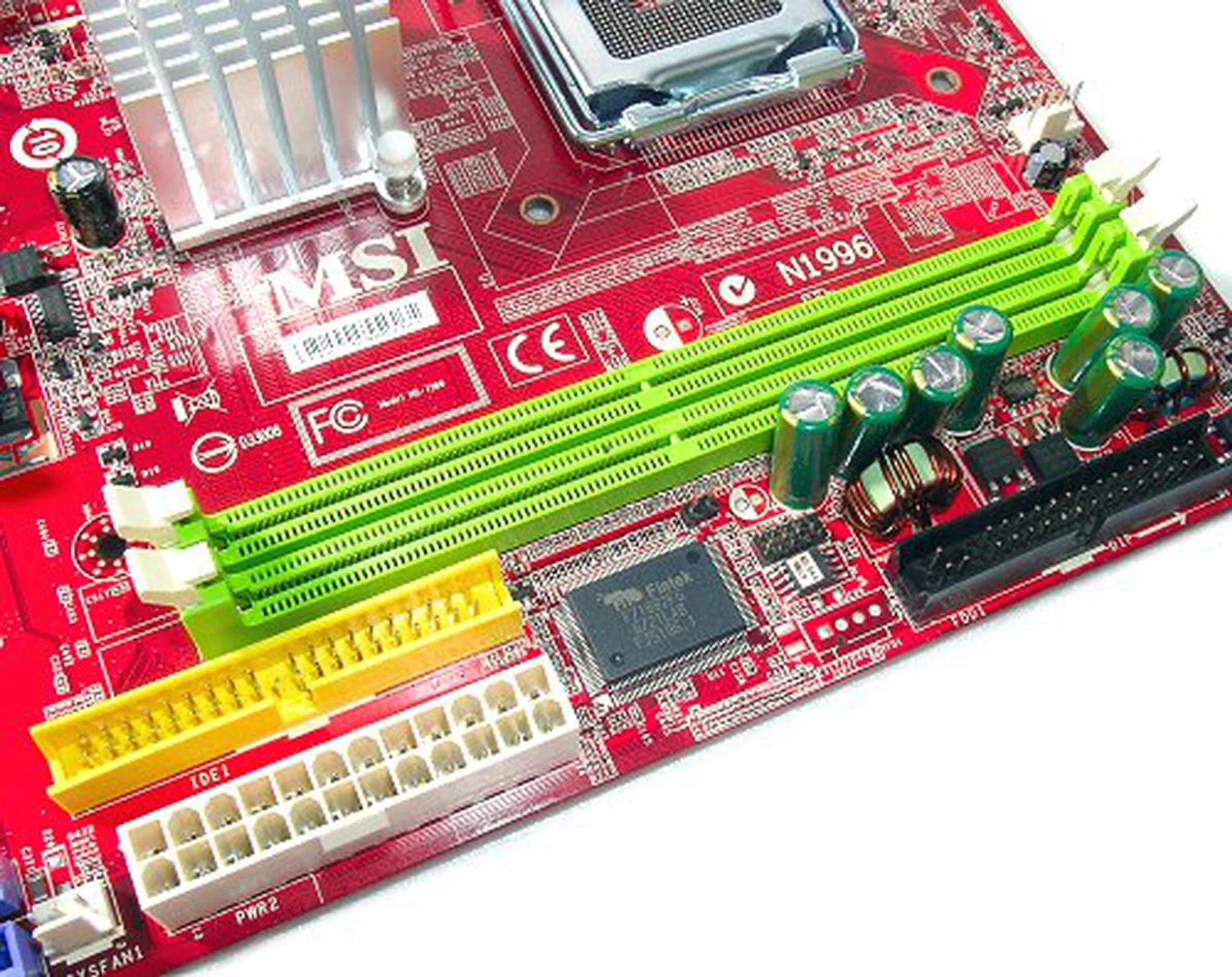
There is plenty of room between the DIMM and CPU socket for better placement of the memory subsystem without having to squeeze it close to the IDE connector.
As expected, the board features four SATA 3.0Gbps ports and one IDE without any additional storage controllers to enhance its offerings, which means no eSATA support out of the box. HD Audio uses the familiar Realtek ALC888 CODEC while MSI chose to pair the onboard Gigabit LAN MAC with a Realtek RTL8211B Gigabit PHY.
Internal graphics is powered by a 630MHz GeForce 7150 mGPU with a maximum 256MB framebuffer support. The P6NGM features a native HDMI port (HDCP compliant), but no DVI. Instead, MSI chose to offer a VGA output for standard monitor connectivity. Expansion slots include two PCI, one PCIe x16 for discreet graphics card upgrade and one PCIe x1.
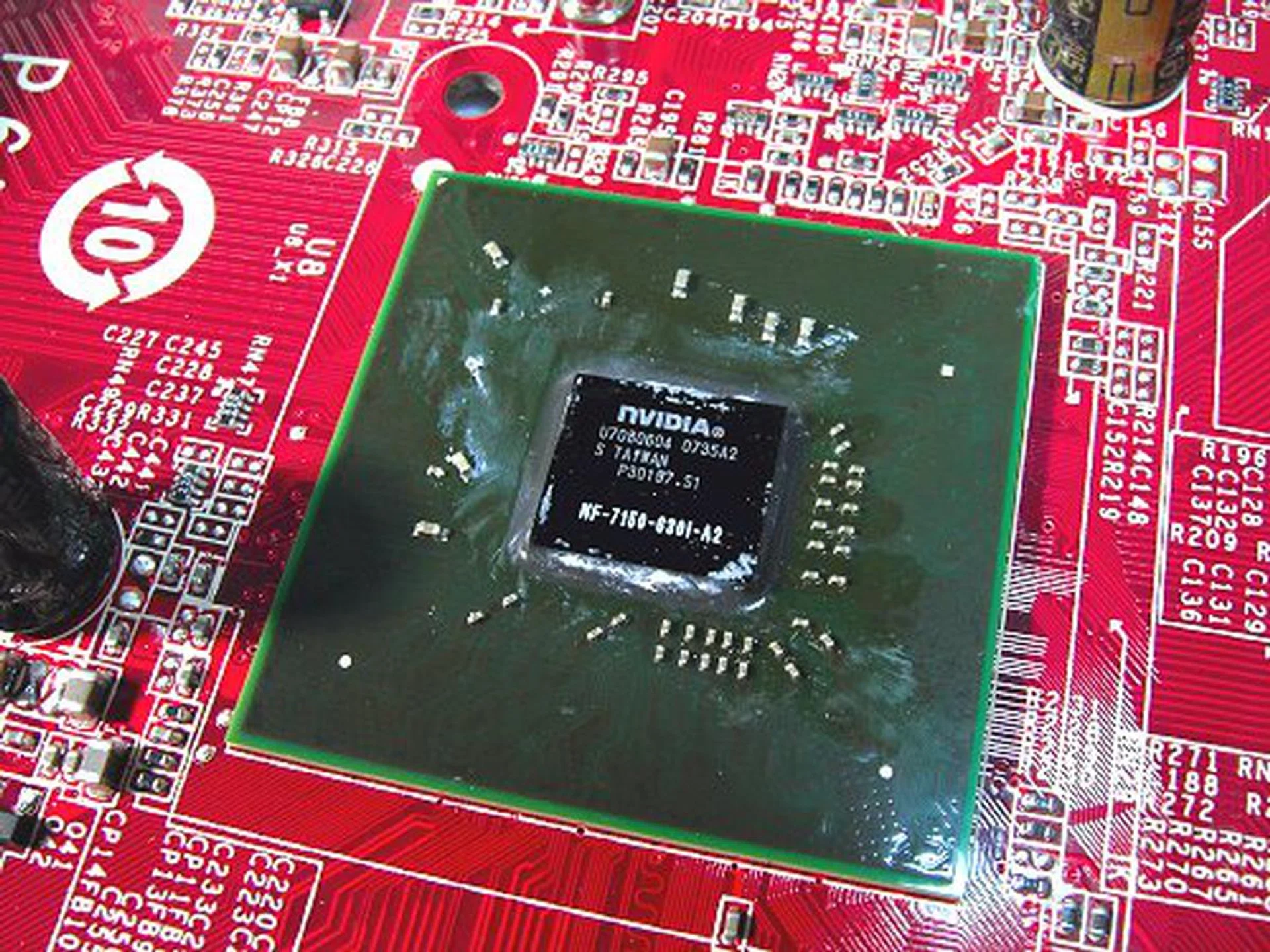
Our MSI P6NGM features the GeForce 7150/nForce 630i chip under the hood.
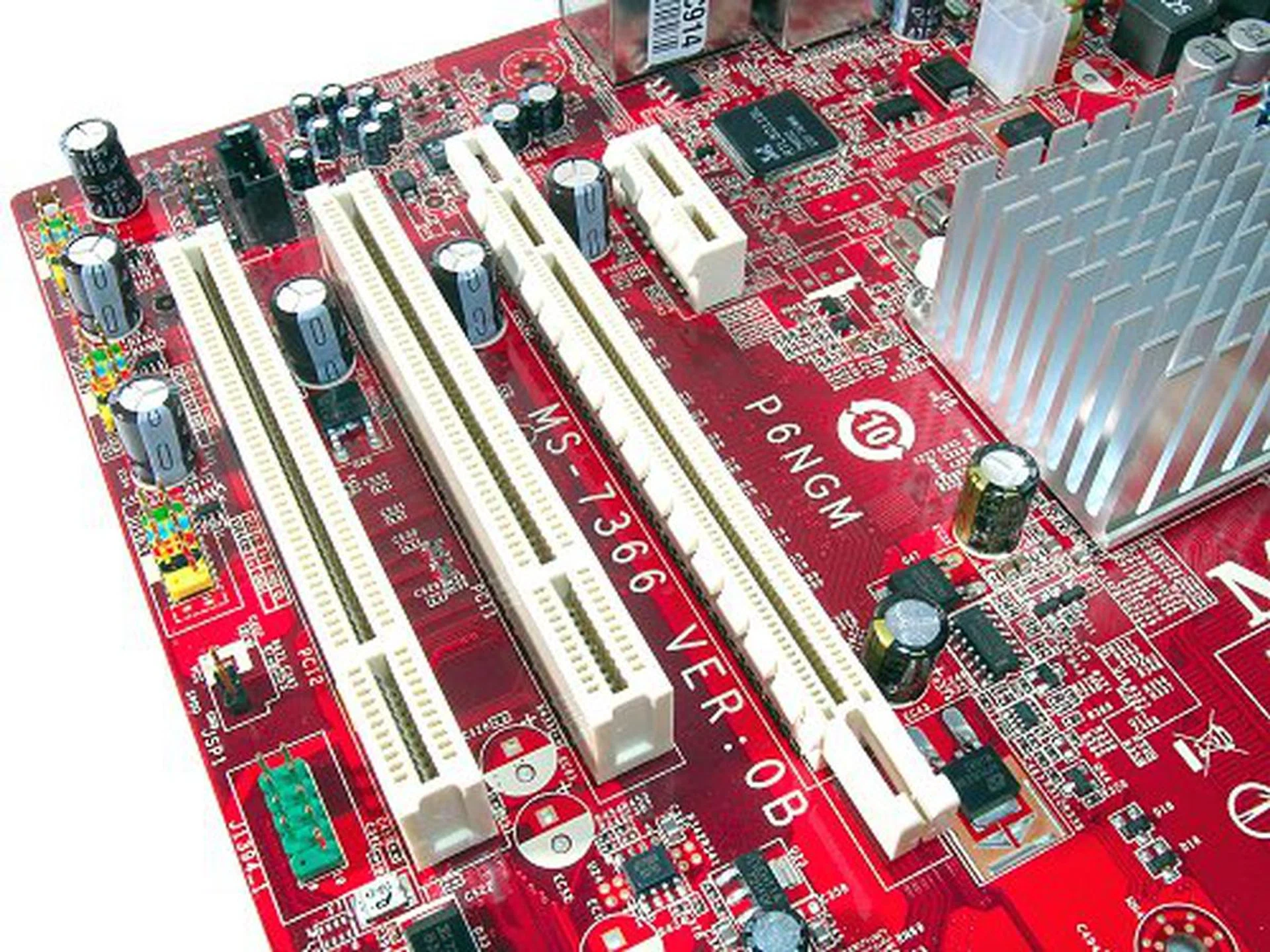
A pretty standard expansion layout for a PCI Express mATX board today.
Layout
The general layout of the PGN6M is quite decent for a standard mATX motherboard. Storage connectors are all within range and does not block each other. Even if you do chose to go with a discreet graphics, only some of the largest cards will interfere with the SATA ports. We do think that the front part of the board is a little cramped though. Since this chipset has only single-channel memory support with two DIMM slots, they could possibly have been moved a little higher to improve overall airflow. Another thing that didn't seem to sit right was the location of the remaining USB 2.0 headers, all of them at the back of the board. Although the P6NGM is a short length board, front panel connectors for some casings do not reach out to the back. Instead MSI chose to put the Serial (COM) port header out in front, which doesn't make a lot of sense.
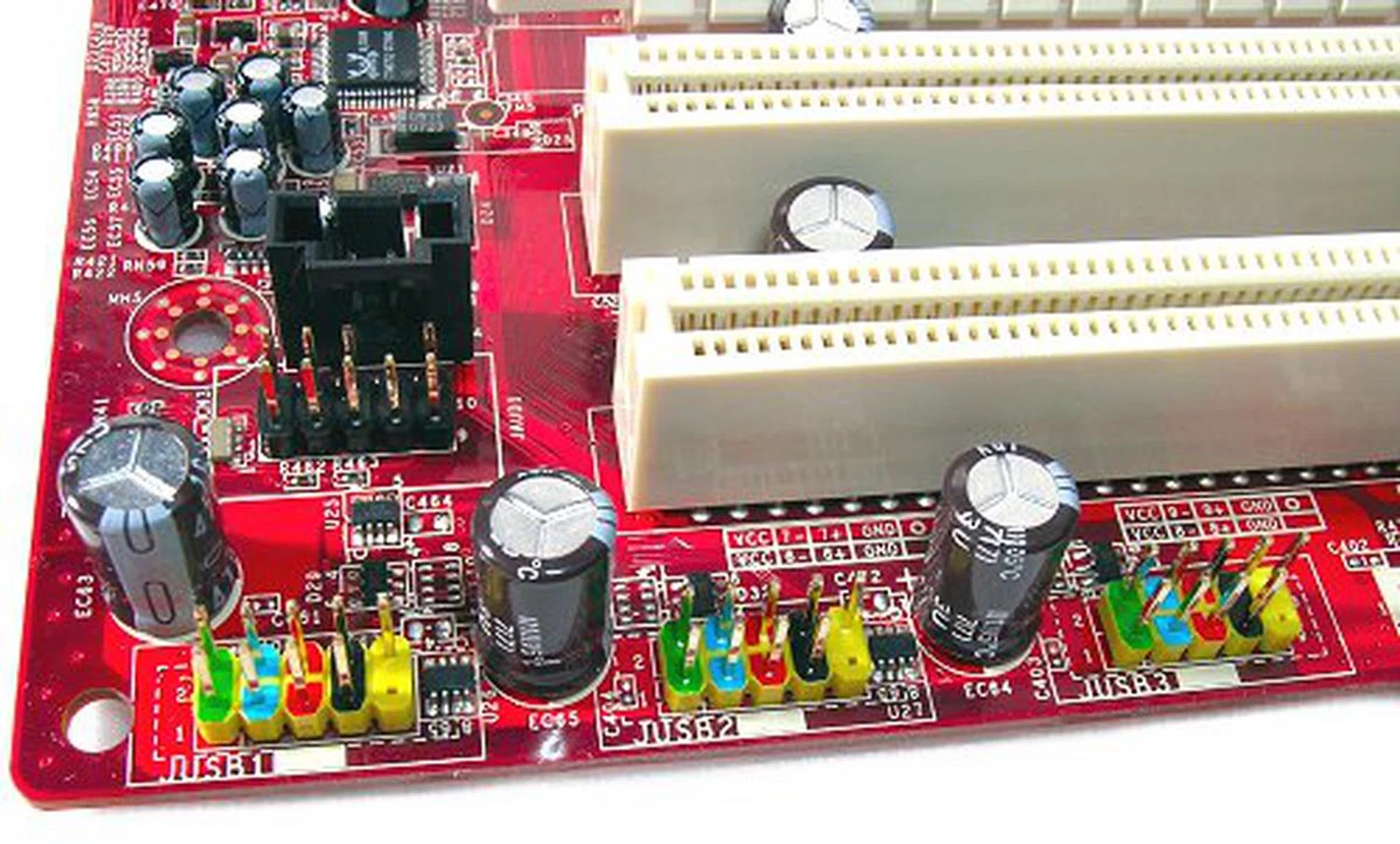
Why, oh why are all the extra USB slots at the back of the board?
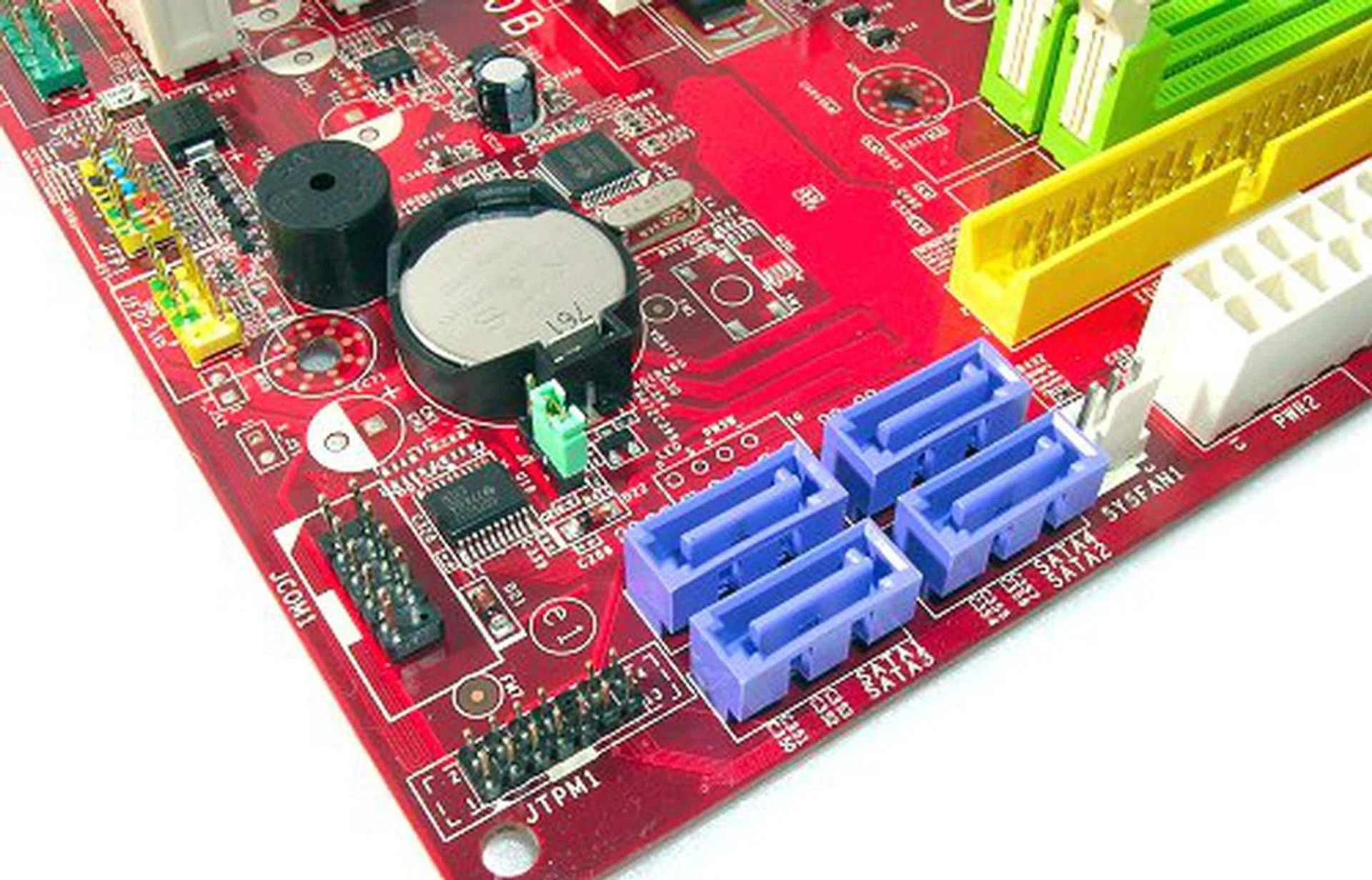
SATA port grouping on the bottom corner. Notice the COM port header to the left.
Overclocking
- FSB Settings: 100MHz to 625MHz (or 400MHz to 2500MHz quad-pumped)
- DDR3 Settings: 400MHz to 1400MHz
- PCIe Settings: 100MHz to 200MHz
- Memory Voltage Settings: 1.80V to 2.00V (in 0.05V steps)
- Multiplier Selection: Yes (unlocked CPUs only)
Our attempts to overclock the MSI P6NGM revealed an interesting issue with the board. Using our usual Intel Core 2 Extreme X6800 CPU, we were unable to overclock the P6NGM at all. Now take note, this is with a 1066MHz (266MHz base) FSB processor. The chipset is supposed to support a 1333MHz FSB, which means we should have at least been able to run our X6800 at 333MHz, but it didn't. However, when we plugged in a Core 2 Extreme QX6850, the board worked and correctly detected a 1333MHz FSB. Using the QX6850 instead, we were able to perform some slight overclocking, claiming a small victory of 350MHz. Considering that our board is an early sample with a beta BIOS, we had initially expected some hiccups along the way. Not that overclocking has ever been a forte of IGP chipsets, but we would expect that the retail boards will at least allow pushing 266MHz processors up to 333MHz. In any case, this is just minor annoyance that should be easily plugged as the board goes retail and the BIOS matures.
Test Setup
In terms of GPU performance at the moment, the only competitor that the GeForce 7150 has in the Intel market segment is Intel's older G965 Express chipset with the GMA X3000 graphics engine. Intel's newer G31 and G33 chipsets have a far inferior graphics engine to be of any real worthy comparison other than for standard productivity usage (their graphics engines are similar to the GMA 950). To this end, our benchmarking segment will pit the MSI P6NGM against the MSI G965MDH. We will also be emphasizing on the single-channel performance of the P6NGM by running the G965MDH in both single and dual-channel modes. This way, we will be able to determine just how true NVIDIA's claims are for its optimized single-channel performance against an Intel chipset. The test bed specifications listed below will be used in all benchmarking unless otherwise specified:-
MSI P6NGM – NVIDIA GeForce 7150/nForce 630i
- Intel Core 2 Extreme X6800 processor (2.93GHz)
- 2 x 1GB Kingston HyperX DDR2-800 @ 4-4-12 CAS 4.0 (Single-Channel only)
- GeForce 7150 256MB – with ForceWare 163.71 drivers
- Seagate Barracuda 7200.10 200GB SATA hard disk drive (one single NTFS partition)
- ForceWare 163.71 beta set
- Microsoft Windows XP Professional with Service Pack 2 (and DirectX 9.0c)
MSI G965MDH – Intel G965 Express
- Intel Core 2 Extreme X6800 processor (2.93GHz)
- 2 x 1GB Kingston HyperX DDR2-800 @ 5-5-15 CAS 5.0 (Single and Dual-Channel)
- Seagate Barracuda 7200.10 200GB SATA hard disk drive (one single NTFS partition)
- Intel GMA X3000 DVMT 256MB - with beta drivers 6.14.10.4864
- Intel INF 8.1.1.1001 and AHCI 6.1.0.1022 driver set
- Microsoft Windows XP Professional with Service Pack 2 (and DirectX 9.0c)
Additional Notes
- The MSI G965MDH does not have manual memory timing controls, which forces our HyperX modules to run at 5-5-5-15. Users should take this into account in the next few pages, as the timings will also affect the performance of the G965MDH. The P6NGM is configured with the usual 4-4-4-12 clocks.
- The ForceWare 163.71 package used in this review are beta drivers for the GeForce 7150/nForce 630i chipset. While the drivers work for the mGPU, Windows still detects several items that are not detected properly such as the SMBus and a 'Co-processor'. We did not notice any functionality loss over these, and deemed it fit to continue benchmarking.
Benchmarks
The following benchmarks will be run to determine the performance potential of the MSI P6NGM:-
- BAPco SYSmark 2004
- Futuremark PCMark05
- SPECviewperf 9.0
- Futuremark 3DMark05
- Futuremark 3DMark06
- AquaMark3
Results - BAPco SYSmark 2004
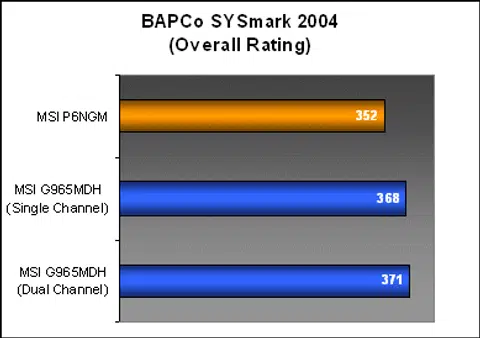
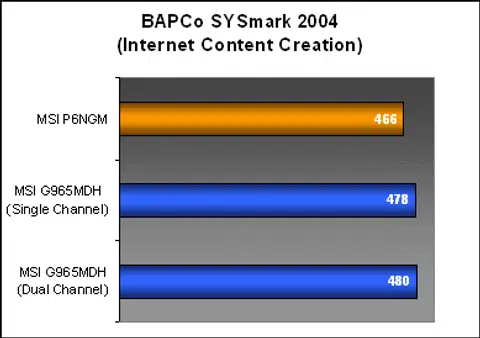
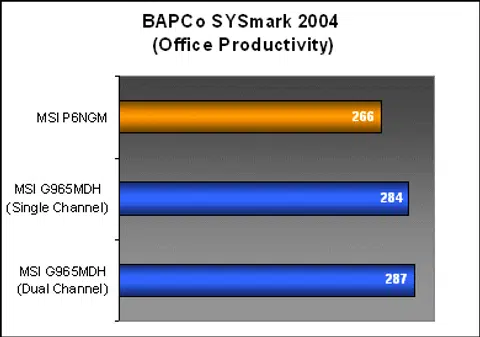
The MSI P6NGM did not start off our benchmarking session very well, losing out to the G965 Express based G965MDH in both single-channel and dual-channel performance for every SYSmark 2004 workload. To top it off, the G965MDH was running with 5-5-5-15 memory timings compared to 4-4-4-12 of the P6NGM.
Results - Futuremark PCMark05
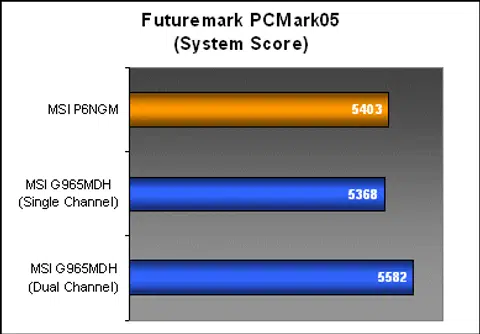
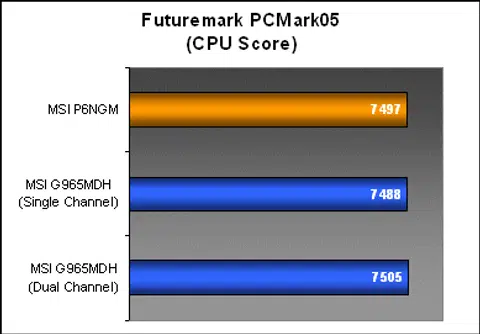
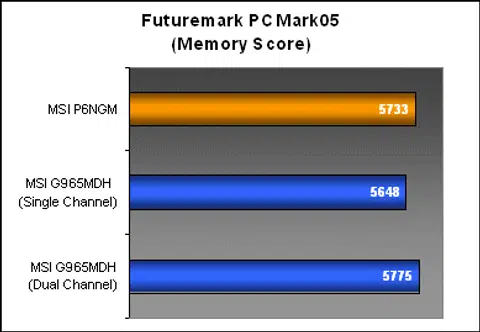
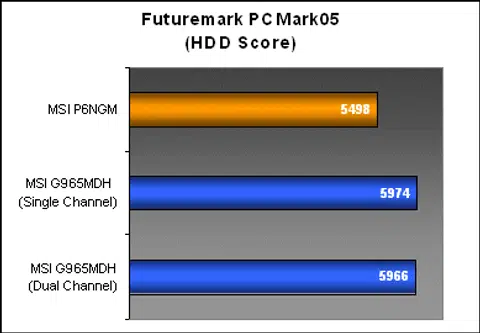
PCMark05's numbers put NVIDIA's claims into better perspective. CPU scores didn't did not really differ from each other, but as you can see, the P6NGM actually performed in between the G965MDH in single and dual-channel configurations. What dragged down its overall score however, was its weaker SATA performance at the moment.
Results - SPECviewperf 9.0
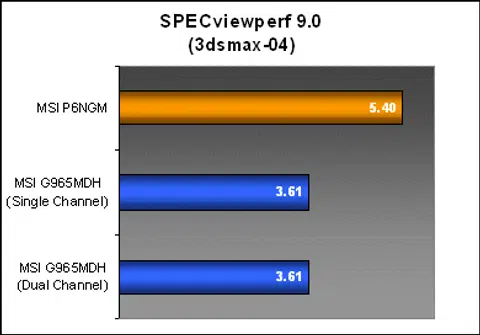
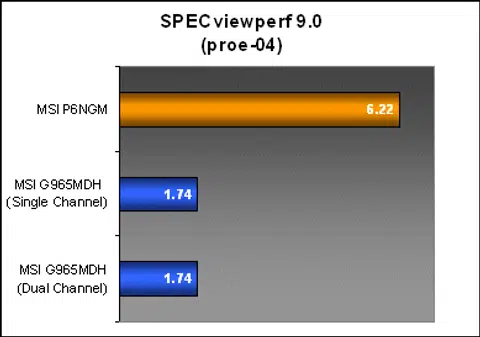
Regardless of memory performance, the GeForce 7150 mGPU demolished the Intel GMA X3000 by a landslide in SPECviewperf 9.0. The numbers may still be low compared to proper discreet graphics, but they are actually half decent numbers for an IGP today.
Results - Futuremark 3DMark05
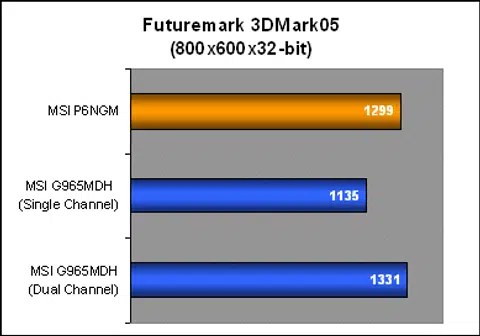
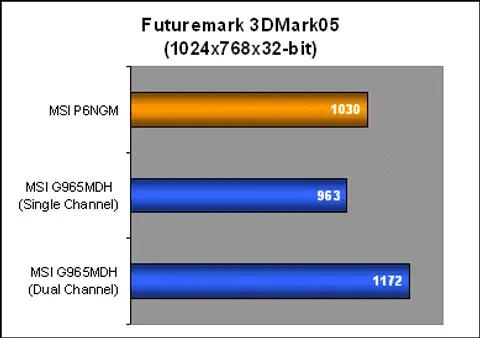
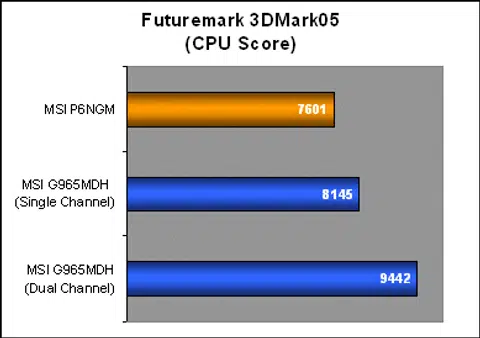
While running our benchmarks, we received contradicting results from 3DMark05 and 3DMark06, so we thought we'd just show them both here. In 3DMark05, the MSI P6NGM followed the expected pattern where the GeForce 7150 board would perform better than a G965 board in single-channel mode, but lose out on dual-channel. However, in the CPU-only tests, we noticed that the P6NGM was actually the weakest. The close contention actually shows that Intel is gaining ground with IGP performance.
Results - Futuremark 3DMark06
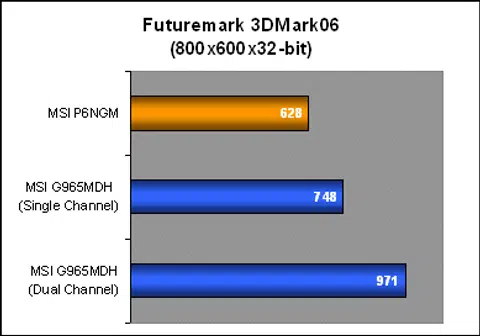
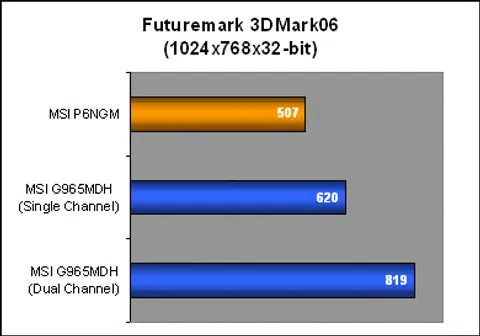
The most surprising results were in 3DMark06, where the GMA X3000 actually beat the GeForce 7150 in all resolutions, whether in single or dual-channel modes. In dual-channel mode, the GMA X3000 outperforms the GeForce 7150 by around 55-60%, which is a pretty huge gap.
Results - AquaMark3
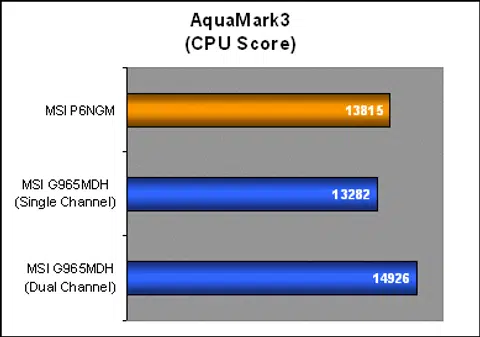
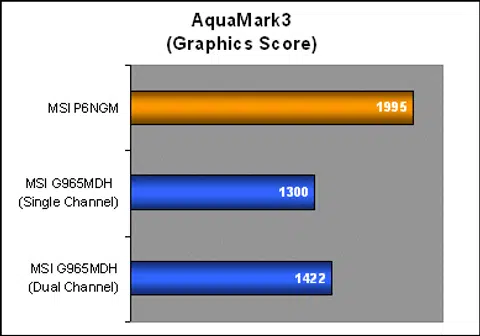
Performance results in AquaMark3 favor back the GeForce 7150. CPU results showed expected single-channel optimization boosts, with much better gaming performance than the Intel GMA X3000. Note that AquaMark3, like 3Dmark05 supports DirectX 9 Shader Model 2.0 only, while 3DMark06 supports Shader Model 3.0. This goes to show that the unified shader processor model implementation on the GMA X3000 is starting to show its advantage in some scenarios and this may continue to show up for newer games as well, if Intel can manage its graphics driver team well. Still, we can't write off NVIDIA yet since what we've tested are based on an early driver set and early system BIOS and there are chances for improvements on both ends.
Conclusion
Despite the NVIDIA GeForce 7-series mGPU chipsets being the new kid on the block, our expectations for the MSI P6NGM were modest. As with most entry-level and mainstream motherboards, the P6NGM is a no-frills entry. 'What you see is what you get' is the topic of the day, and MSI pulls it off with ease here. Simple and unassuming, the MSI P6NGM will fulfill almost all the needs of an average user with a decent array of storage options, connectivity, networking and entertainment features.
Graphics performance for the P6NGM was a little erratic and while the GeForce 7150 was the overall better performer, Intel's GMA X3000 wasn't that far behind in DirectX benchmarks. It really depends on what application you will be running. NVIDIA still has one of the best OpenGL driver support though, as is evident through SPECviewperf. Looking at the big picture, the performance premium of a GeForce GPU - even if it is just an IGP - cannot be denied and in the Intel market, a GeForce part will obviously have the better universal compatibility. The P6NGM has a HDMI port with HDCP support, making the board ready for media center tasks, but without a proper array of A/V connectors, the P6NGM is more suited to be a desktop workhorse.
The memory subsystem performance of the P6NGM also received mixed results. For the most part, the board proved that NVIDIA's souped up single-channel memory controller is indeed better than the competition. However, the results weren't consistent as SYSmark 2004 attested to. We would have no doubt that the GeForce 7150 would have been the clear cut winner if NVIDIA had implemented a dual-channel memory controller. NVIDIA's concerns on this aspect were to bring about a more affordable and efficient mainstream mGPU. Instead of being the latest must-have IGP chipset for the Intel market, the GeForce 7150/nForce 630i seems to be merely a contender to the Intel G965/G33 in terms of desktop productivity performance.
The MSI P6NGM is a worthy mainstream motherboard that can take on almost any role, in the office, at home or as an entertainment center.
Bottom line, the MSI P6NGM is a well implemented mainstream motherboard, our chipset gripes notwithstanding. Like the MSI G965MDH, the design is clean, comes fully featured and stable enough for everyday use. We wouldn't necessarily recommend the P6NGM over the G965MDH however; both boards (or more appropriately, both chipsets) are equally on par for different reasons, but note that the G965 boards are already exiting the market. The NVIDIA GeForce 7150 lends the P6NGM an advantage in terms of graphics that cannot be denied, and if you're a heavy multimedia user, your choice might then be skewed towards the P6NGM.
Our articles may contain affiliate links. If you buy through these links, we may earn a small commission.