
Kingston HyperX Fury 240GB sounds furious, but only in name
Kingston has just released its new HyperX Fury SSD, a mainstream drive specifically targeted at budget-conscious gamers. Oddly, it uses a SandForce controller, but we gave it a go to see how it compares to other mainstream heavyweights from Crucial and Samsung.

SandForce Comeback
What a difference a year makes. In 2013, as evidenced by Great High-end SSD Shootout, most drives were powered by the SandForce SF-2281 controller. Fast forward a year, and if you look at our recent shootout, you will find that not a single drive has a SandForce controller in it.
Clearly, to attract buyers in this increasingly tight market, brands have realized that they need to differentiate themselves to stand out and that cannot be achieved with the SF-2281’s ho-hum performance (in today's context), especially in the light of new controllers from Marvell, Samsung, OCZ and now, Toshiba. Hence, what was once considered a high-end controller has now been almost completely shunned... until now.
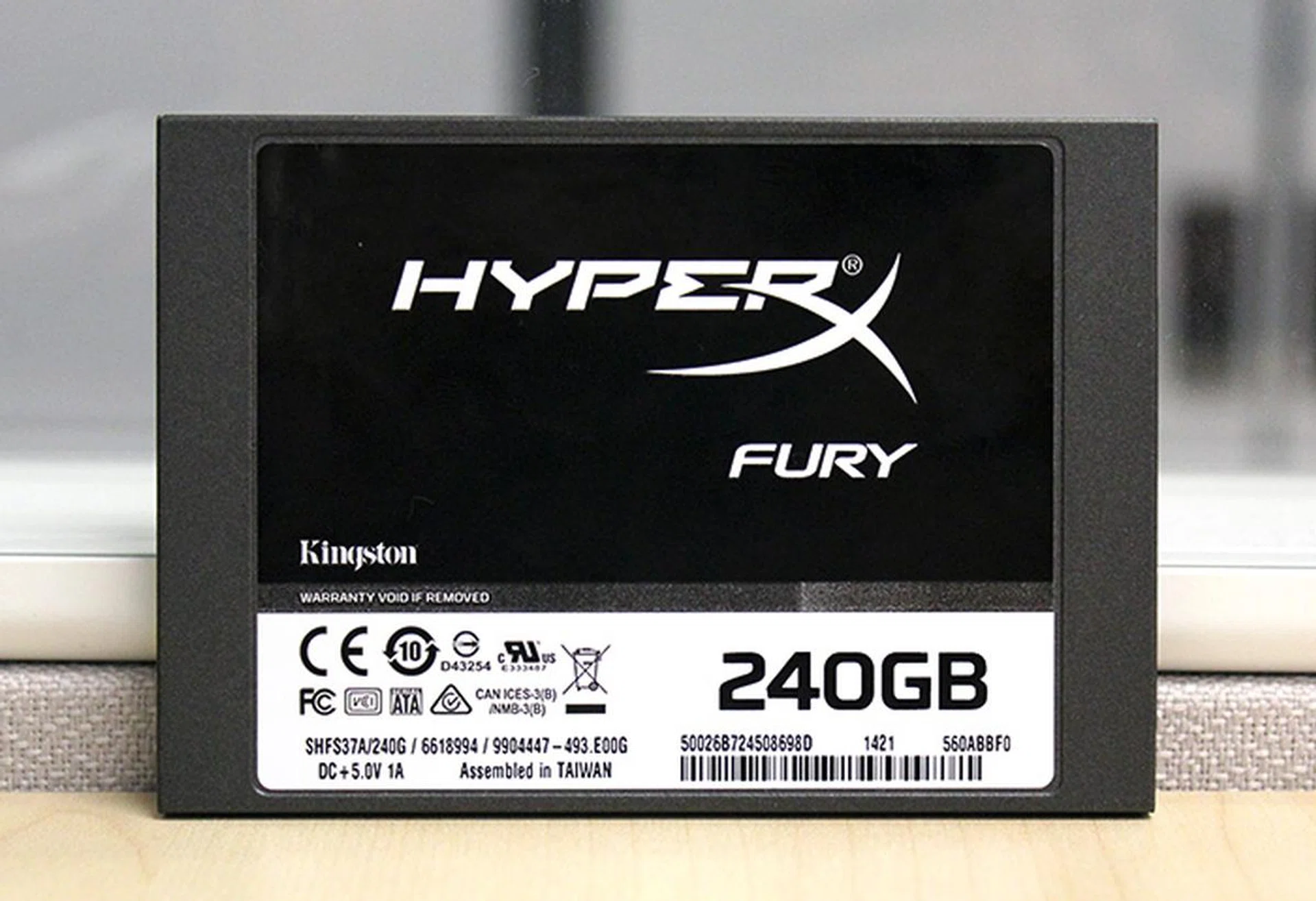
It's been a long time since we reviewed a SandForce-based SSD, so it will be interesting to see how the HyperX Fury fares.
First seen at Computex 2014, the Kingston HyperX Fury is targeted at budget-conscious gamers; and claims to deliver high performance, but at a low price. It is available in 120GB and 240GB capacities, and for those who think that 240GB is insufficient, Kingston has other SSDs at higher capacity points, such as the recently launched SSDNow V310.
The HyperX Fury is also one of the few SSDs in the market today to be equipped with the SandForce SF-2281 controller. The SF-2281 was a leading controller two years ago, but it has since fallen out of favor with manufacturers because its performance is no longer competitive in the high-end segment of the market. And since the Fury is targeted budget-conscious gamers, to keep costs down, Kingston has also opted for Micron’s high density 128Gbit MLC NAND - the same used in drives like the Crucial M500. As we have noted in our review of the Crucial M550, the use of 128GBit NAND in a 240/256GB drive will negatively impact performance because of NAND parallelism - that is to say that there is not enough NAND dies to maximize the performance potential of the memory controller. Hence, it will be interesting to see later how the HyperX Fury performs and if it can still maintain its edge against other competitive drives.
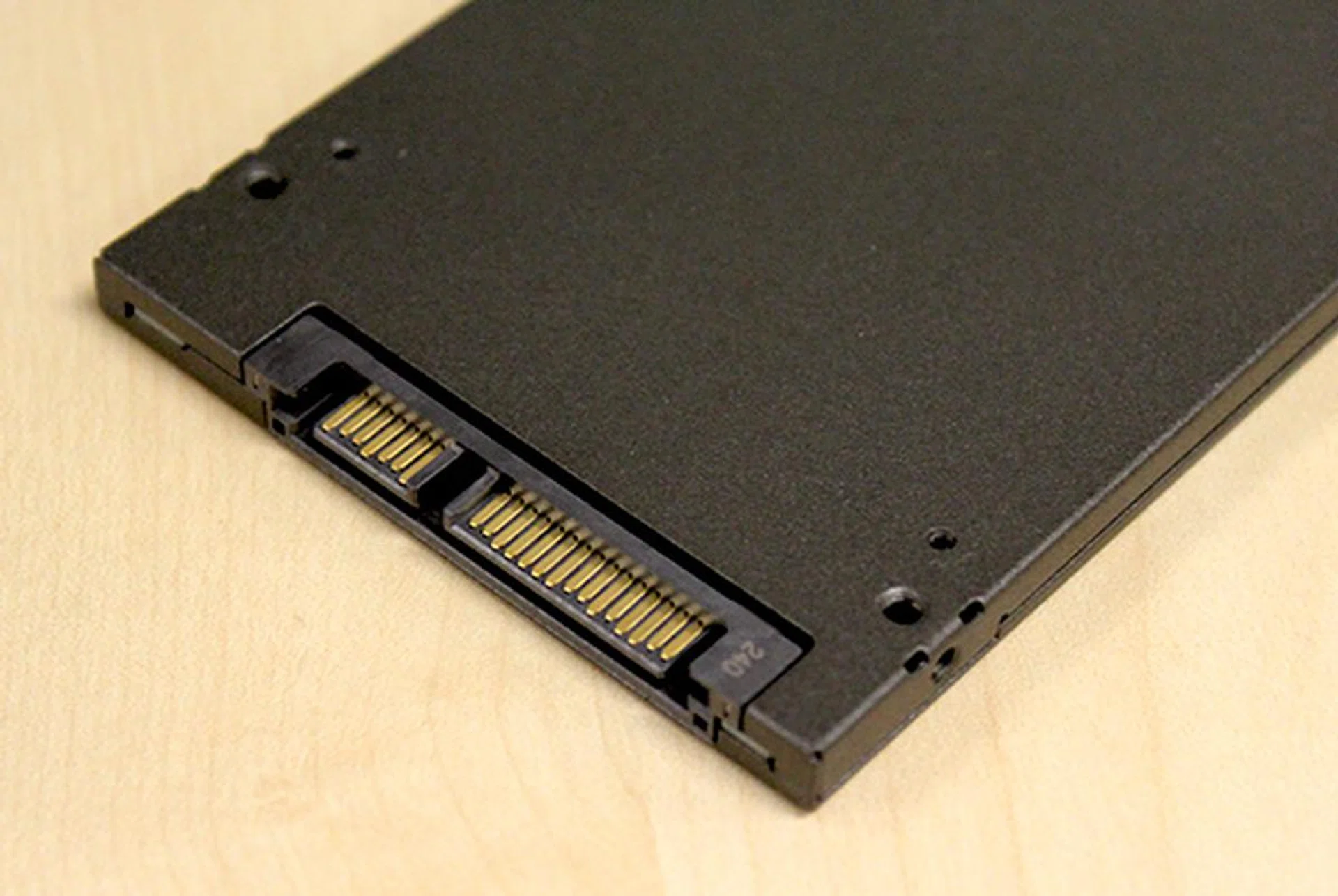
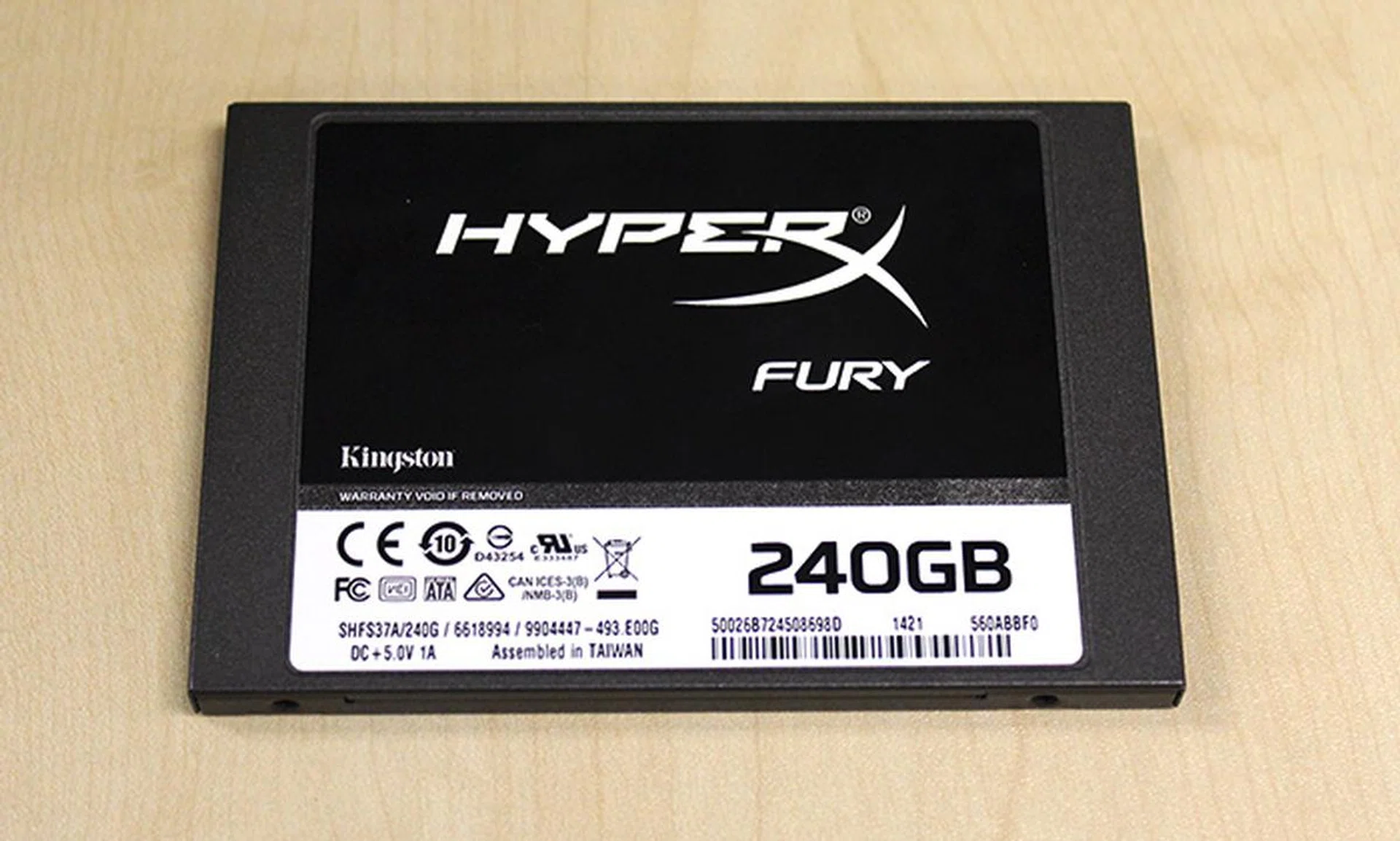
The HyperX Fury supports the SATA 6Gbps interface.
The HyperX Fury supports the SATA 6Gbps interface. As for accessories, the drive only comes with a 2.5mm bumper for installations that specifically require a 9.5mm thick drive - not unusual for a drive at this price point. Also, we noticed that the drive feels heavier than most other drives and that it has a very solid chassis akin to those found on OCZ drives.
Test Setup
The drives will be tested on our dedicated storage testbed:-
- Intel Core i5-2500K (3.3GHz)
- ASUS P8Z77 Pro Thunderbolt (Intel Z77 chipset)
- 2 x 2GB DDR3-1600 memory
- MSI GeForce 8600 GTS
- Windows 7
We have recently revised our benchmarks, ditching older benchmarks such as HD Tune and also including an all new timing test to better evaluate the drive’s real world performance. The list of benchmarks used are as follows:
- AS-SSD benchmark 1.7.4739
- CrystalDiskMark 3.0.1
- PCMark 7 (Storage suite)
- Iometer (version 2006.07.27)
- Timing Tests (Cold start, Reboot, Apps Launching)
There’s no shortage of mainstream SSDs in the market right now and the Kingston HyperX Fury will be facing stiff competition from the likes of Crucial and Samsung, the two of the most popular SSDs for budget conscious users right now. We have also included results from the new and recently reviewed Plextor M6S, which only recently joined the fray and is proving to be quite popular as well. To show the discrepancy in performance between a mainstream SSD and the best SSD currently available, we have also included results of the Samsung SSD 850 PRO.
Here is the list of drives tested:
- Kingston HyperX Fury
- Crucial M550
- Crucial M500
- Samsung SSD 840 EVO
- OCZ Vertex 460
- Samsung SSD 850 PRO
Timing Tests
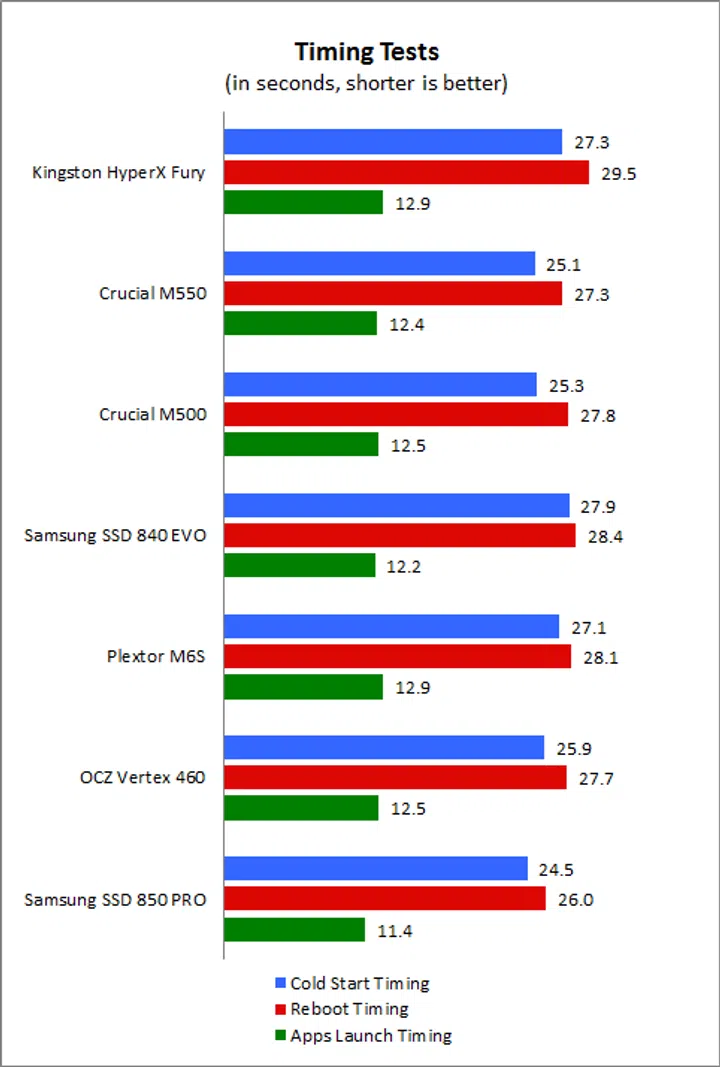
Recently added to our evaluation of SSDs is how they perform in real world everyday situations, namely booting up from a cold start, reboot and launching applications. As for the applications used, we made the drives launch 11 applications from the Adobe CS6 suite of utilities simultaneously, which includes resource intensive applications such as Photoshop, InDesign, Dreamweaver, Premiere Pro amongst others. As a point of reference, a 7200rpm mechanical hard disk would take over 5 minutes to open all the applications.
The Kingston HyperX Fury got off to a disappointing start as its recorded timings for all three tasks were on the high side. 27.3 seconds is the second slowest timing recorded for a cold start and 29.5 seconds is the slowest timing for a reboot. Finally it took 12.9 seconds to launch the entire Adobe CS6 suite of utilities, which means it is tied for slowest with the Plextor M6S. Although realistically speaking, the differences in real life will be slight, it is still an indication of the lack of performance from the HyperX Fury.
PCMark 7 Results
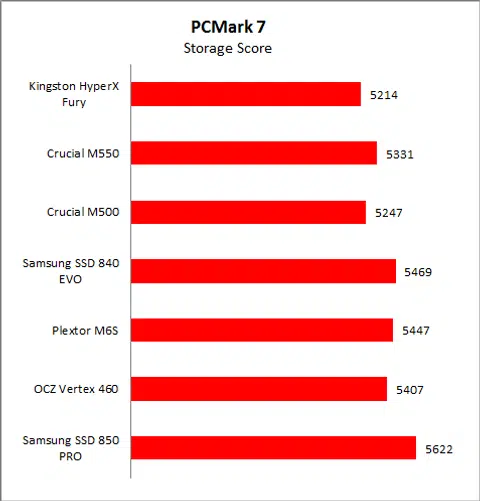
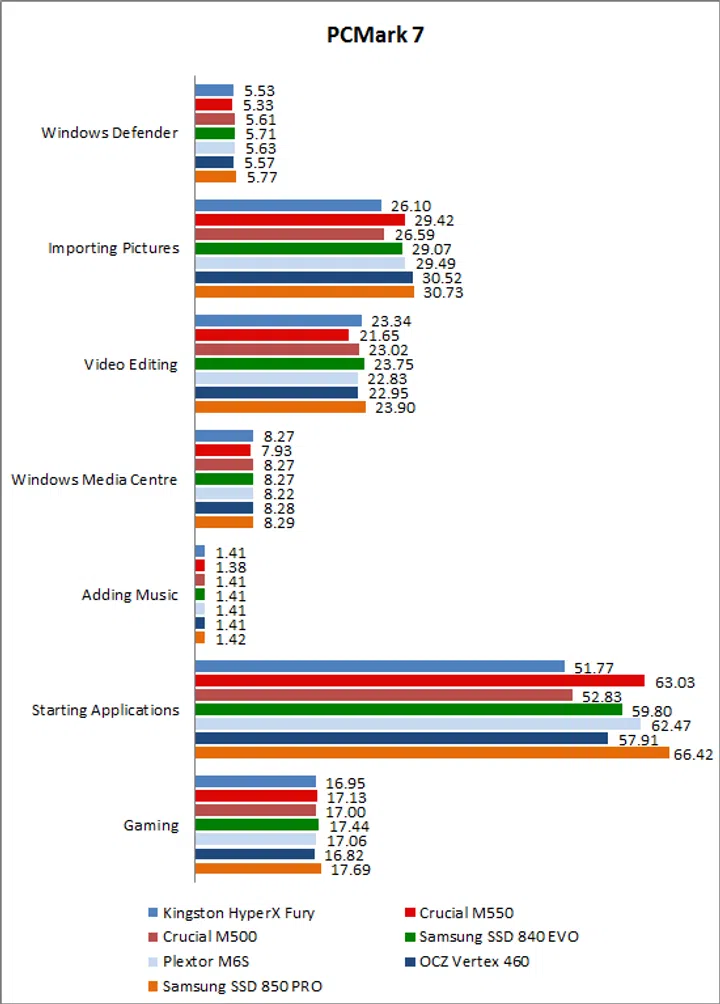
PCMark 7 is a benchmarking suite from FutureMark that evaluates the performance of Windows 7 machines. It tests a wide range workloads and aspects of the system ranging from computation, image and video manipulation and storage. We’ll be looking solely at the storage test here.
Unfortunately, the Kingston HyperX Fury failed to pick itself up on PCMark 7 as it recorded a disappointing score of 5214 - around 2% - 5% less than its key competitors. However, if we were to look at the breakdown, we can see that the HyperX Fury actually did quite well on certain scenarios, but was ultimately heavily penalized for its poor showing on the “Starting Applications” workload.
CrystalDiskMark 3.0.1 Results
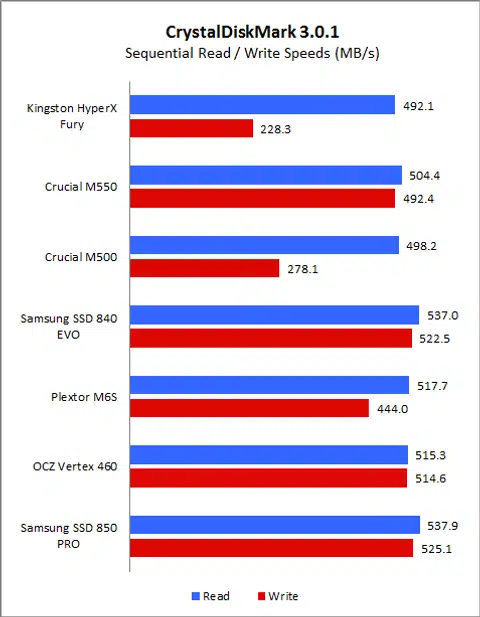
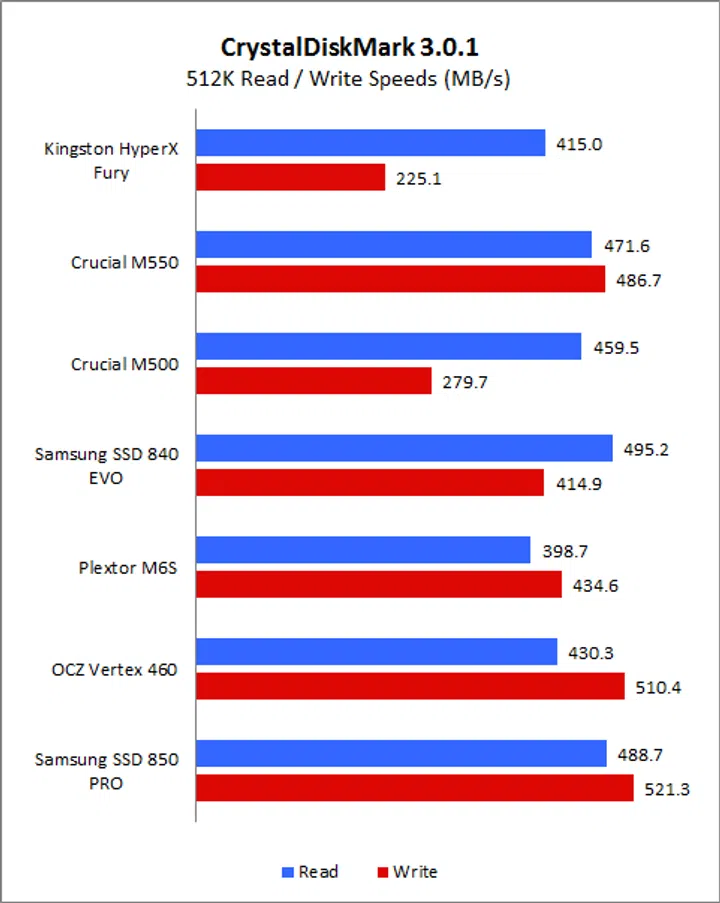
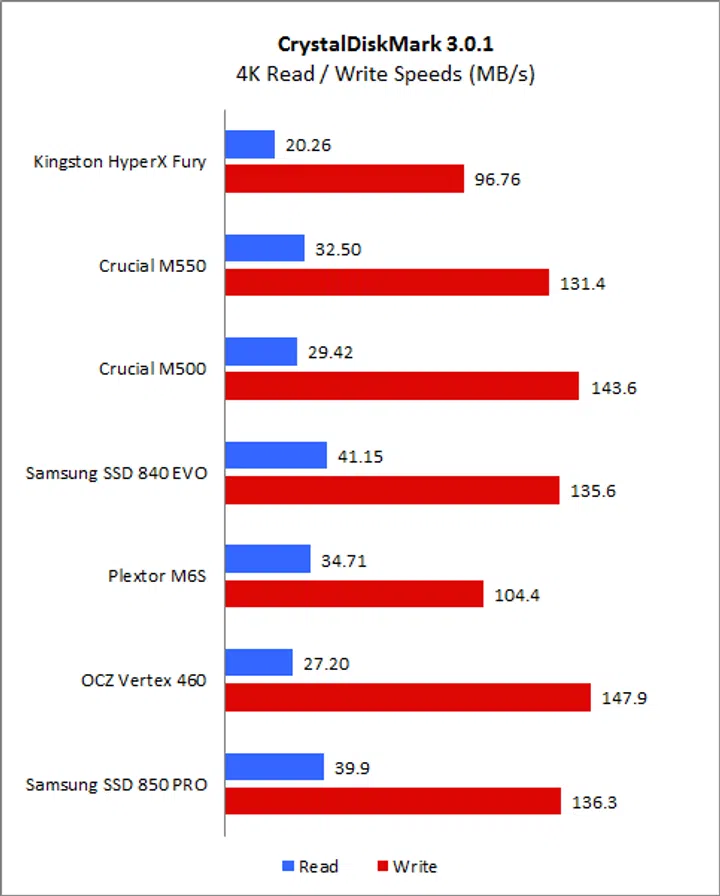
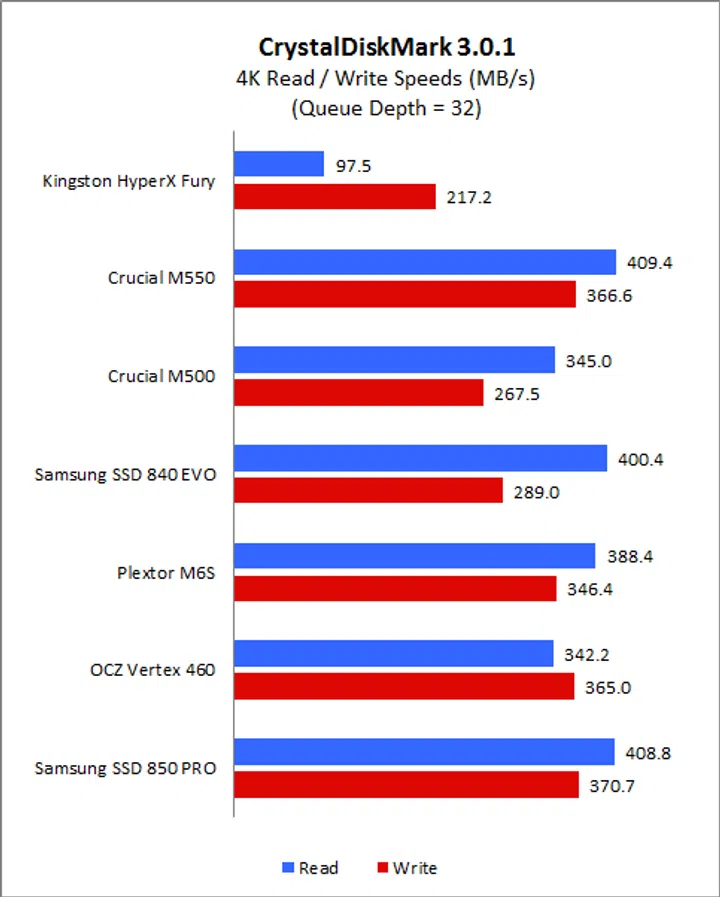
CrystalDiskMark is an easy-to-run and quick utility to use to gauge a drive’s performance. It measures sequential read and write performance and random read and write speeds of random 4KB, 4KB (queue depth 32) and 512KB data.
The Kingston HyperX Fury uses Micron’s 128Gbit MLC NAND, the same employed in the Crucial M500, hence it was not surprising to see that their performance often mirrored each other. However, the HyperX Fury was clearly performing at a lower level and this could be attributed to the outdated SandForce SF-2281 controller. Write performances, in particular, was particularly poor when compared to the competition, and read performance, though more decent, was nothing to shout about either.
AS SSD 1.7.4739 Results
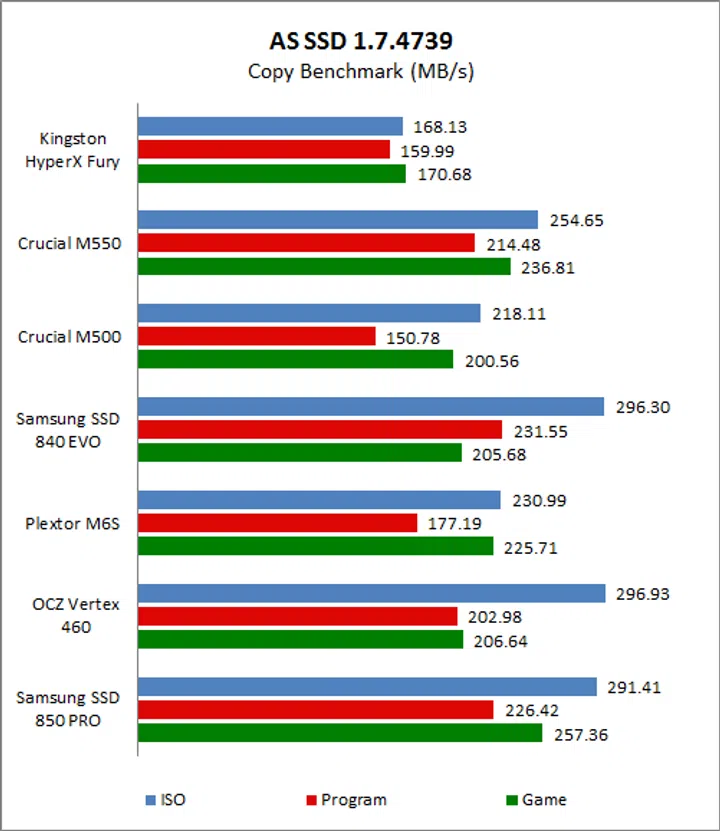
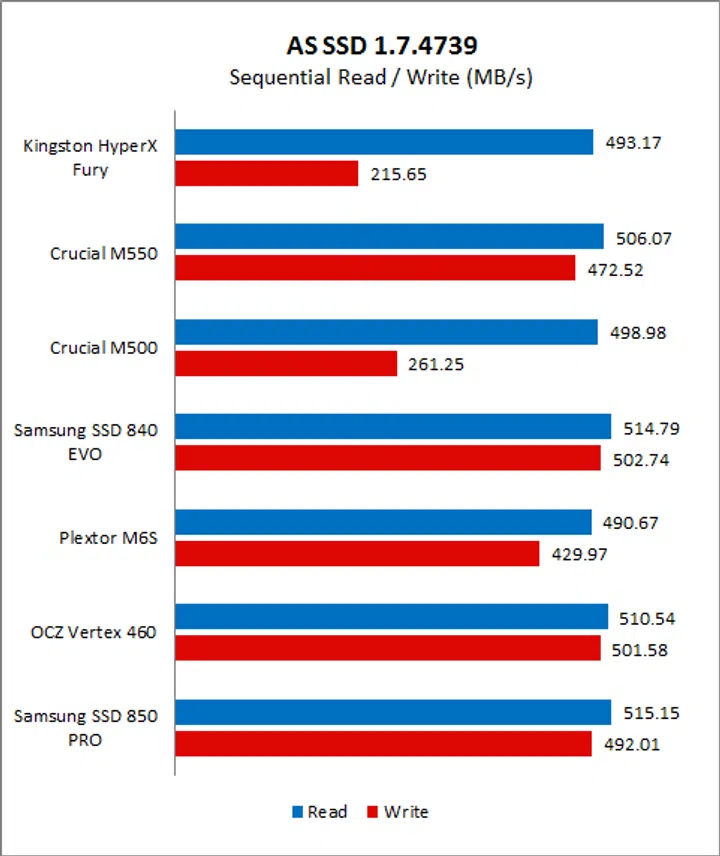
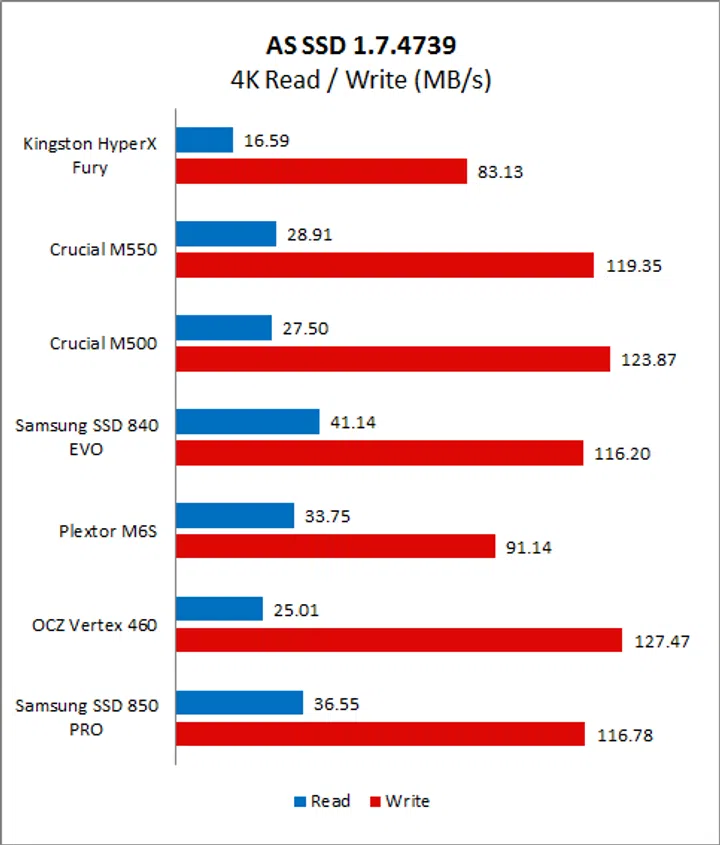
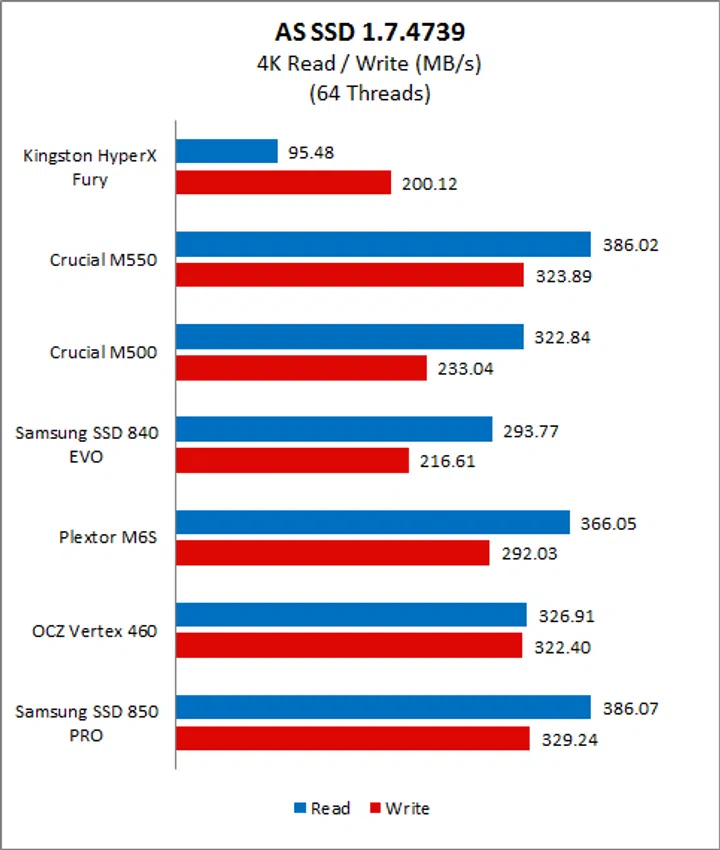
AS SSD is a benchmark that uses non-compressible and completely random data. What this means is that the drives using the SandForce SF-2281 controller cannot compress the data first, which takes away one of the strong advantages of this controller. Therefore this is a useful benchmark because drives that use the SF-2281 controller or similar, don't gain an upper hand.
The Kingston HyperX Fury’s poor showing continued on AS SSD and its shortcomings are now even more glaring given that AS SSD uses non-compressible and random data, which takes away one of the key advantages of the SandForce controller. Across all work loads, the HyperX Fury’s recorded speeds were the lowest, but its showing on the 4k and 4k, 64 threads workloads were particularly disappointing.
Iometer Results (Part 1)
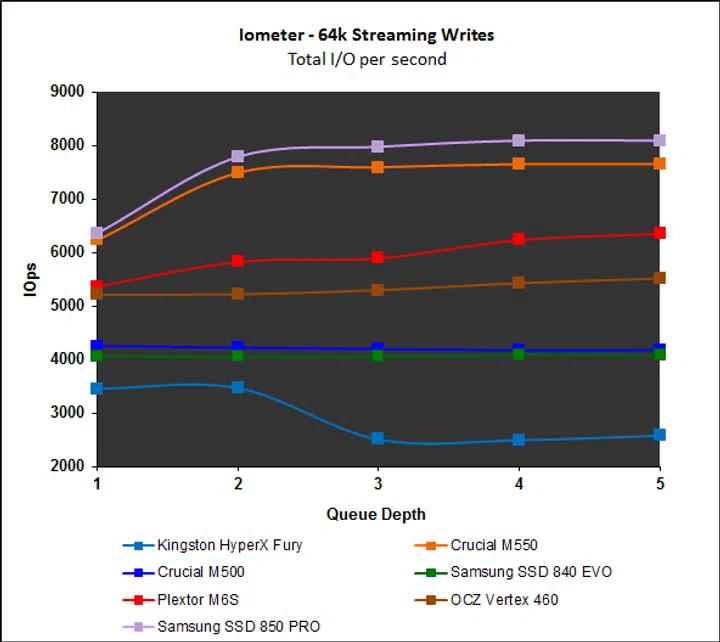
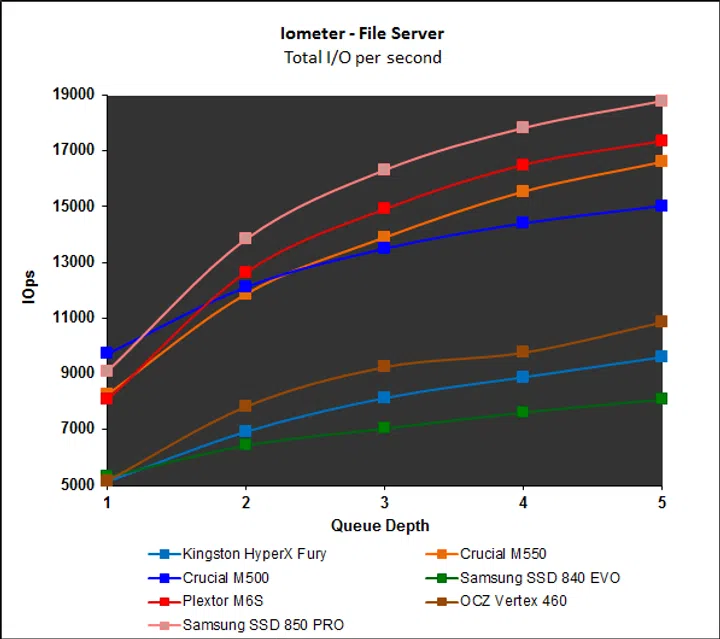
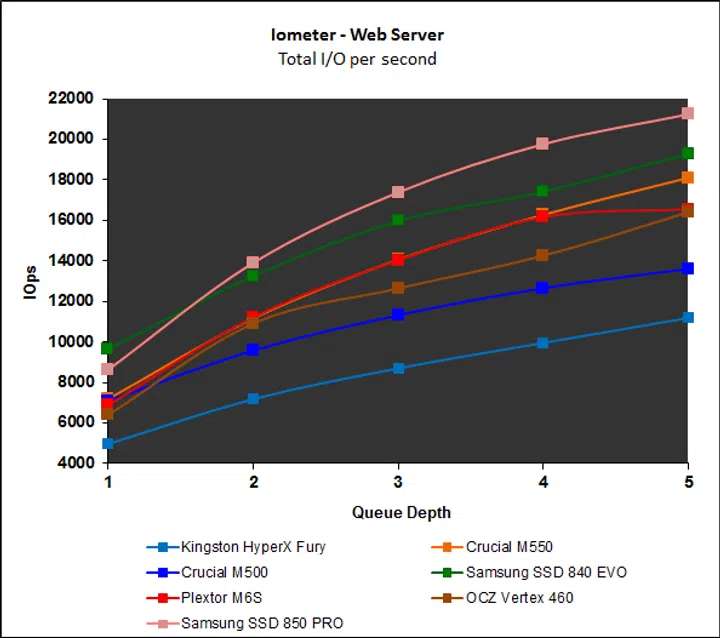
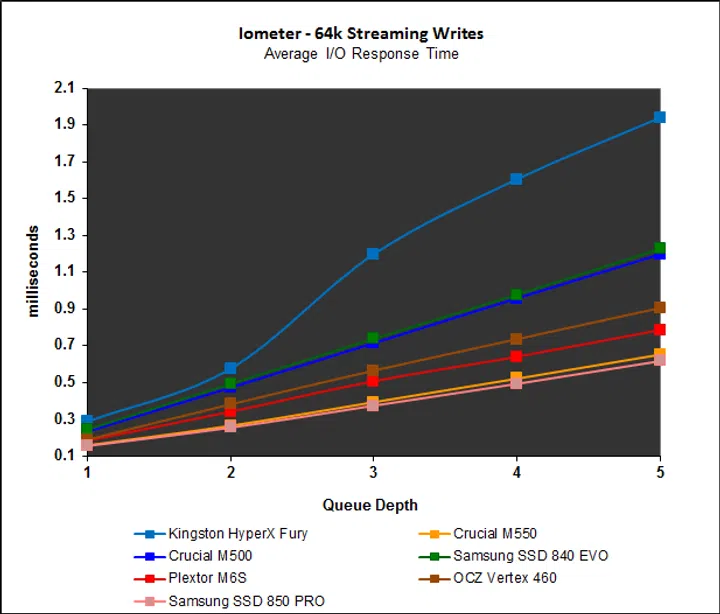
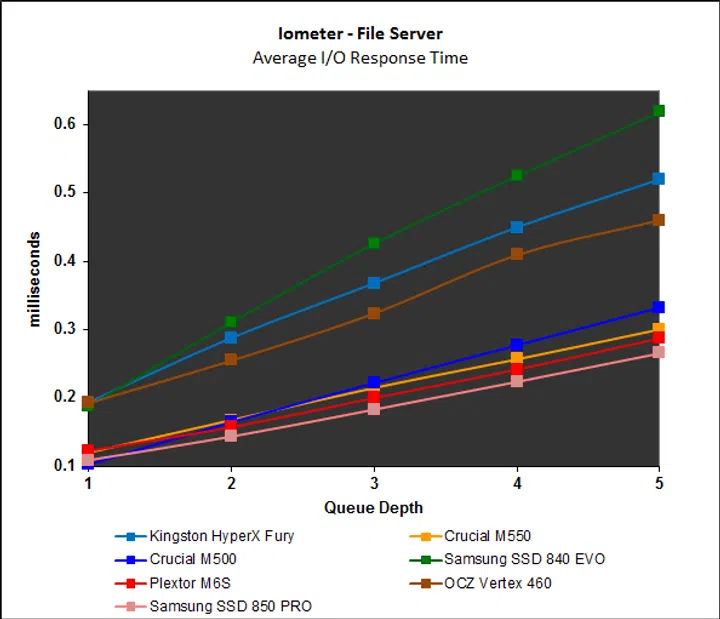
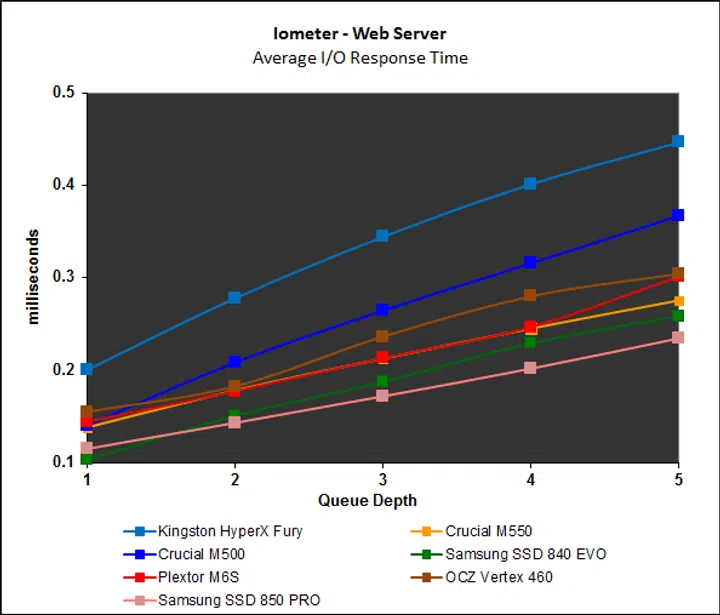
Lastly, we put the drives through the rigorous grind of Iometer, with different workloads and I/O queue depths. We have chosen to show results from a queue depth of 1 to 5 as this better represents the workloads a typical consumer might face.
Iometer is an intensive benchmark and we saw no surprises here as the Kingston HyperX Fury found itself on the wrong end of the graphs. The HyperX Fury’s performance on the streaming writes and Web Server workloads was particularly poor and on a level well below that of its competitors.

Iometer Results (Part 2)
Finally, we look at the I/O response times for the workloads reported on the previous page. Given the lackluster IOPs numbers recorded on the previous page, it was not surprising to see that the average response times for the HyperX Fury are on the high side. The average response times for the streaming writes workload were nearly double that of its competitors, which explains the HyperX Fury's poor performance.

A Waning Force
Looking at the results on the earlier pages, it is hard to find any positives. There is simply no getting around the fact that when it comes to performance, the Kingston HyperX Fury is well and truly beaten by its competitors. And this should come as no surprise either, considering its using an aged controller. The SandForce SF-2281 might be considered high-end stuff two years ago, but it is now thoroughly trounced by the new generation of controllers from Marvell, OCZ and Samsung.
An aging controller and high density 128Gbit NAND do not make for a good combination.
On the pricing front, things are not looking good for the Kingston HyperX Fury too. Because of stiff competition, prices of SSDs have never been quite lower. In fact, prices of the 250GB variant of the Samsung SSD 840 EVO was recently dropped to less than S$189 - it was over S$250 in April. The Kingston HyperX Fury, on the other hand, has a recommended retail price of S$199. How does it stand amongst other drives then? Here’s a table that provides a quick summary against other drives with current street prices:-
Model | Price | Cost per Gigabyte |
Crucial MX100 | $158 | $0.61 |
Samsung SSD840 EVO | $189 | $0.76 |
Plextor M6S | $190 | $0.74 |
Kingston HyperXFury | $199 | $0.83 |
OCZVertex 460 | $199 | $0.83 |
Crucial M550 | $228 | $0.89 |
As you can see only the Crucial M550 costs more right now, but it is also appreciably quicker, so the premium is more or less justified. But as it is, the best bang for buck SSD in the this segment has to be the Samsung SSD 840 EVO. And if you are cash strapped, you can look further than the Crucial MX100 (the replacement to the Crucial M500). At S$199, there is simply nothing outstanding about the HyperX Fury - be it performance, warranty or accessories - that lets it stand out in this crowded marketplace.
All in all, there is sadly very little going for the Kingston HyperX Fury and unless street prices do turn out to be substantially lower (around S$150), there is no compelling reason to choose it ahead of other competitors.
Our articles may contain affiliate links. If you buy through these links, we may earn a small commission.