
Gigabyte Aorus GeForce RTX 4080 Super Master review: More power, less pricey than its predecessor
Great performance, beautiful RGB and LCD Edge screen makes this card easy to recommend.


The Gigabyte Aorus GeForce RTX 4080 Super Master's design is more of the same as its predecessor.
The Gigabyte Aorus GeForce RTX 4080 Super Master 16G is the first custom GeForce RTX 4080 Super card we received after our NVIDIA GeForce RTX 4080 Super Founders Edition review, and if you think the card looks familiar it’s because it looks exactly the same as its predecessor, the Aorus GeForce RTX 4080 Super Master (read our review here).
That means it retains the same striking triple-ring RGB Halo lights that encircle each of the three “bionic shark” fans that, along with the 12 composite copper heat pipes and a large vapor chamber, forms the Windforce cooling system. It also sports the same LCD Edge screen on its side, which displays GPU information such as temperature and fan speed, alongside text, pictures, or GIFs of your choosing.
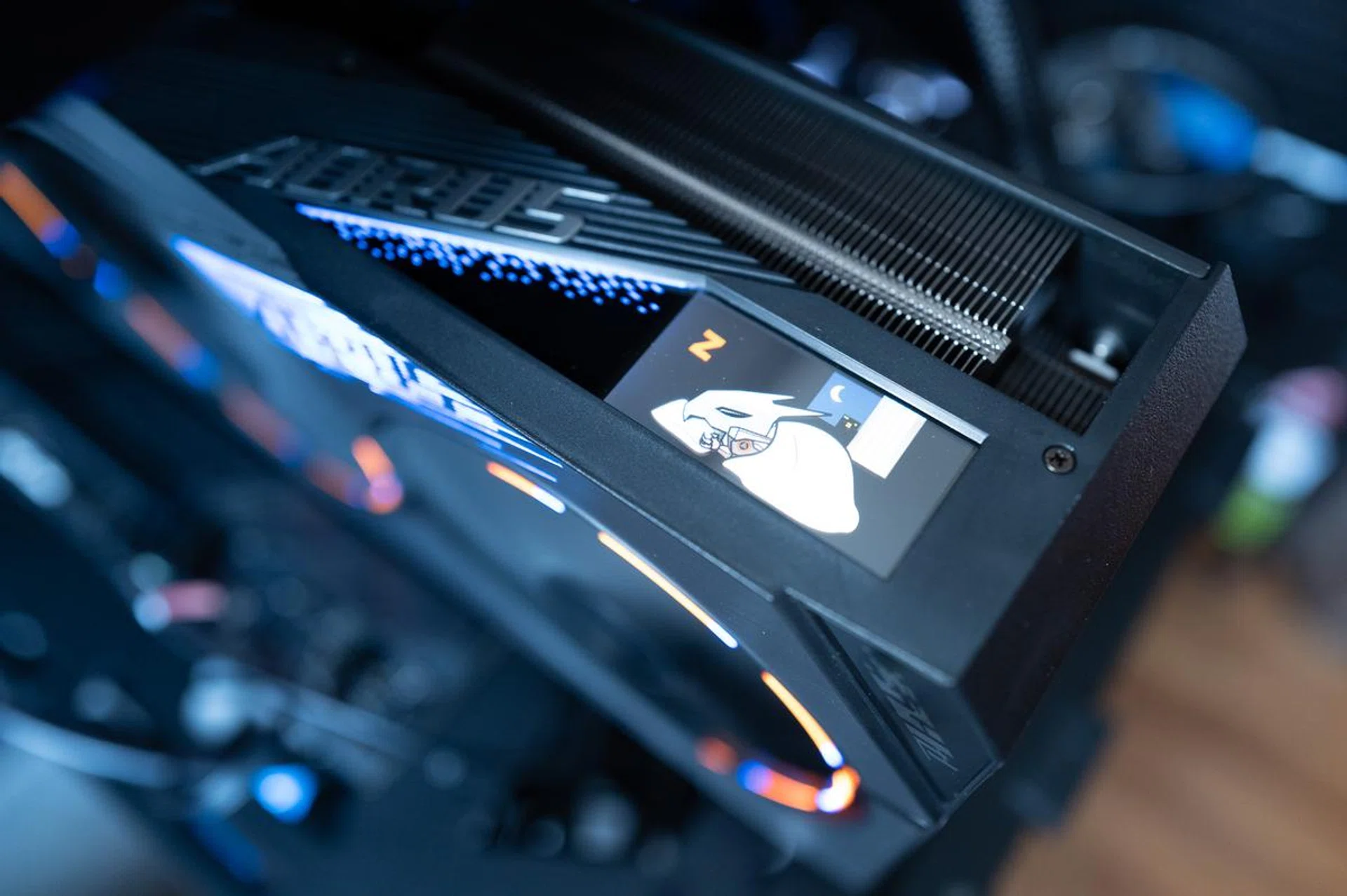
The card also retains the same LCD Edge screen, but this only looks good if you aren't installing the card vertically.
In short, it’s almost impossible to distinguish the new Aorus GeForce RTX 4080 Super Master from the previous RTX 4080 card if you’re none the wiser. Internally though, Gigabyte says it has made one big improvement: Using a stronger protection metal back plate that it says enhances the structure of the graphics card to give it better protection against warping of the circuit board over time. Gigabyte also bundled the same anti-sag bracket that you can install on the end of the card to give it additional reinforcement against sagging, although this won’t work with E-ATX sized motherboards.
The PCB itself also boasts a dust-resistant coating, which protects it from everything from dust to insects, dropped screws, and abrasion. It is moisture and corrosion-resistant as well, which is supposed to prevent unwanted conduction paths and board damage, and should shrug off high-humidity climates as well.
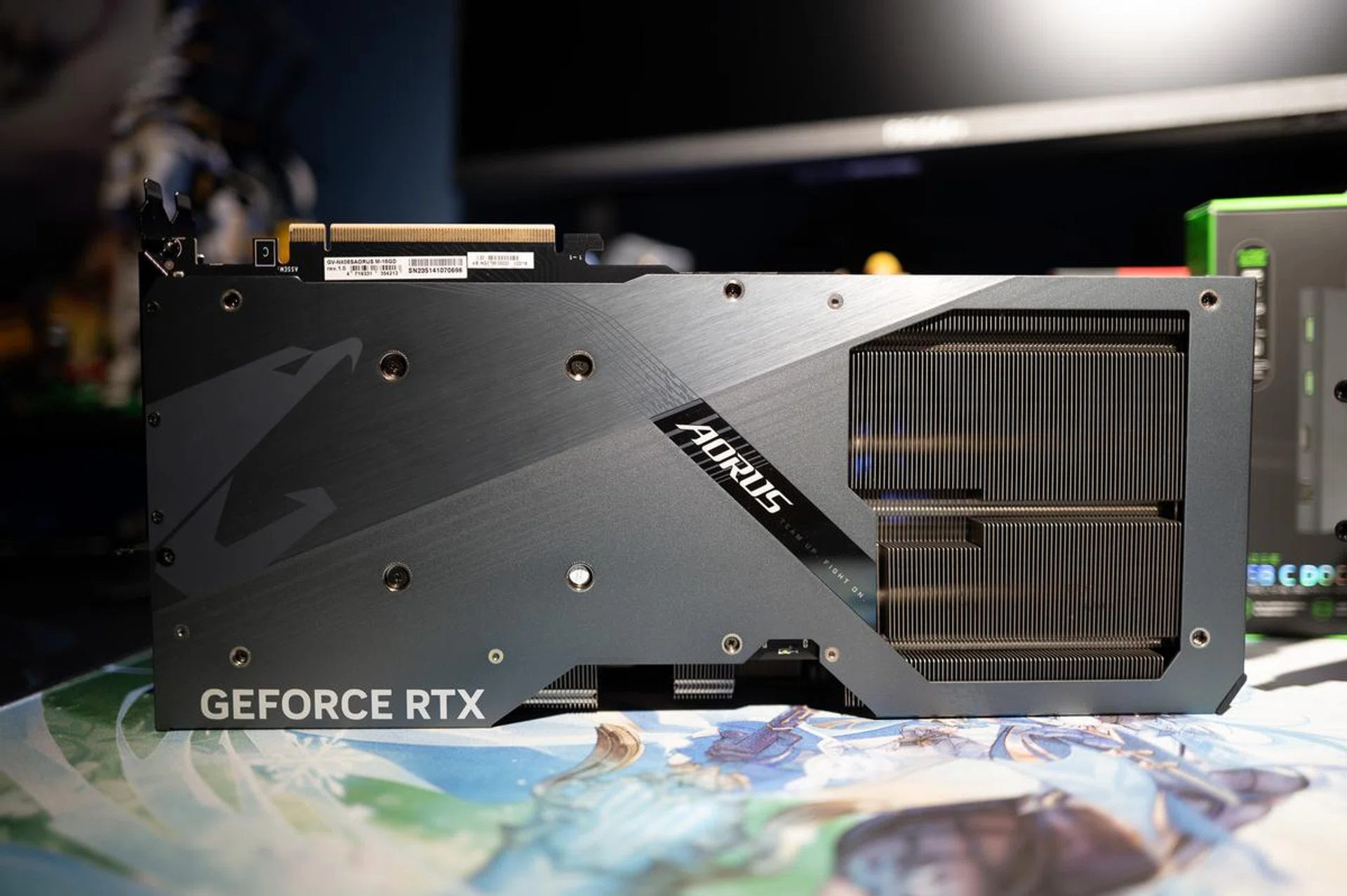
Gigabyte says it has made the new Aorus card sturdier to prevent the PCB from warping over time due to its weight.
Then there’s also the improved clock speed out of the box. The Aorus card comes with a 2625MHz boost clock, up from the 2550MHz on the Founders Edition model. Memory clock comes in at 1438Mhz for the new card.
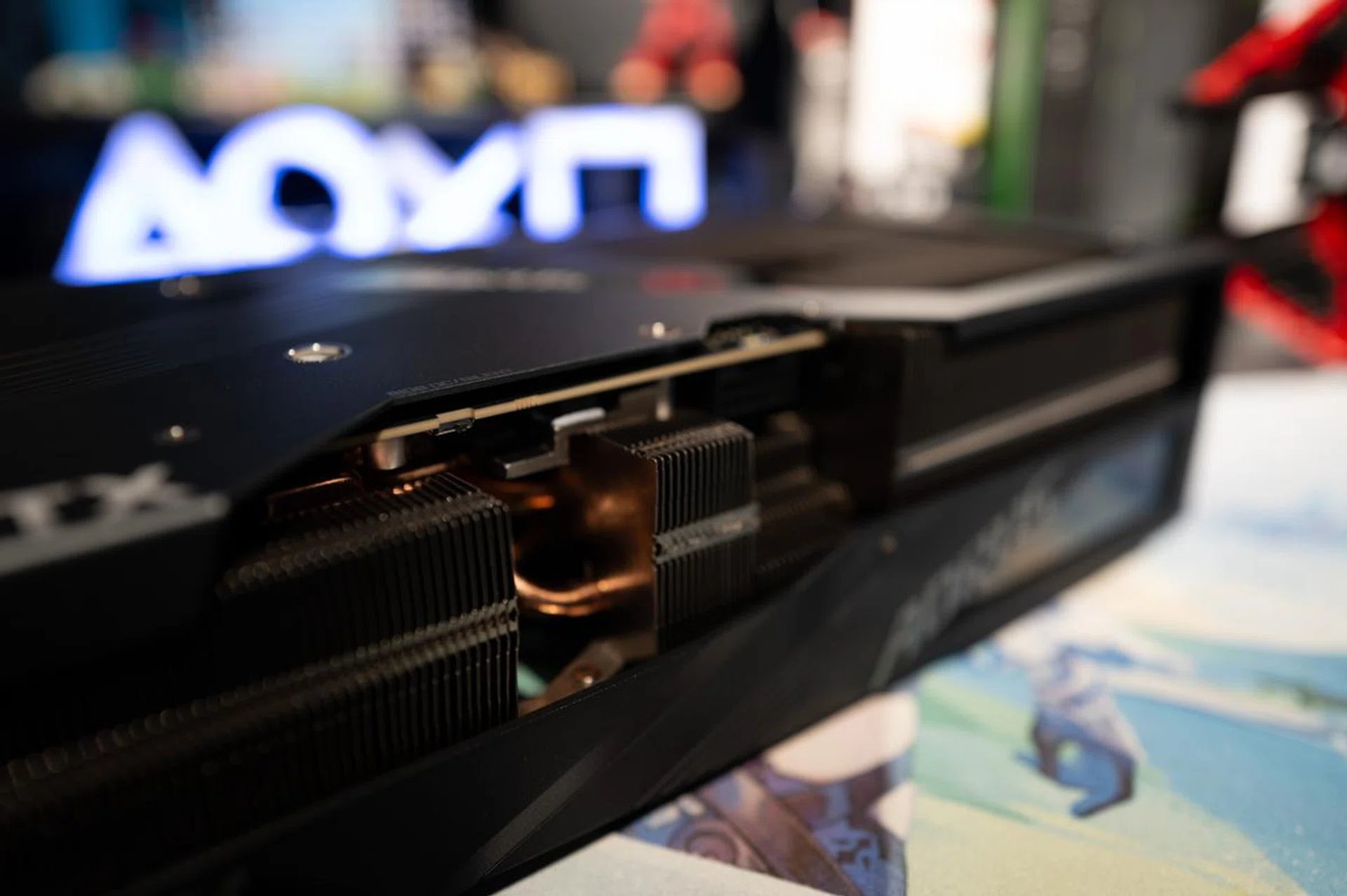
The card features a warning LED indicator if there are any power abnormalities.
A convenient dual BIOS switch lets you switch between OC mode and silent mode, in the event that you really want your quiet. A nifty power indicator light also sits above the 16-pin power connector. If there are any power supply abnormalities, the light will start flashing.
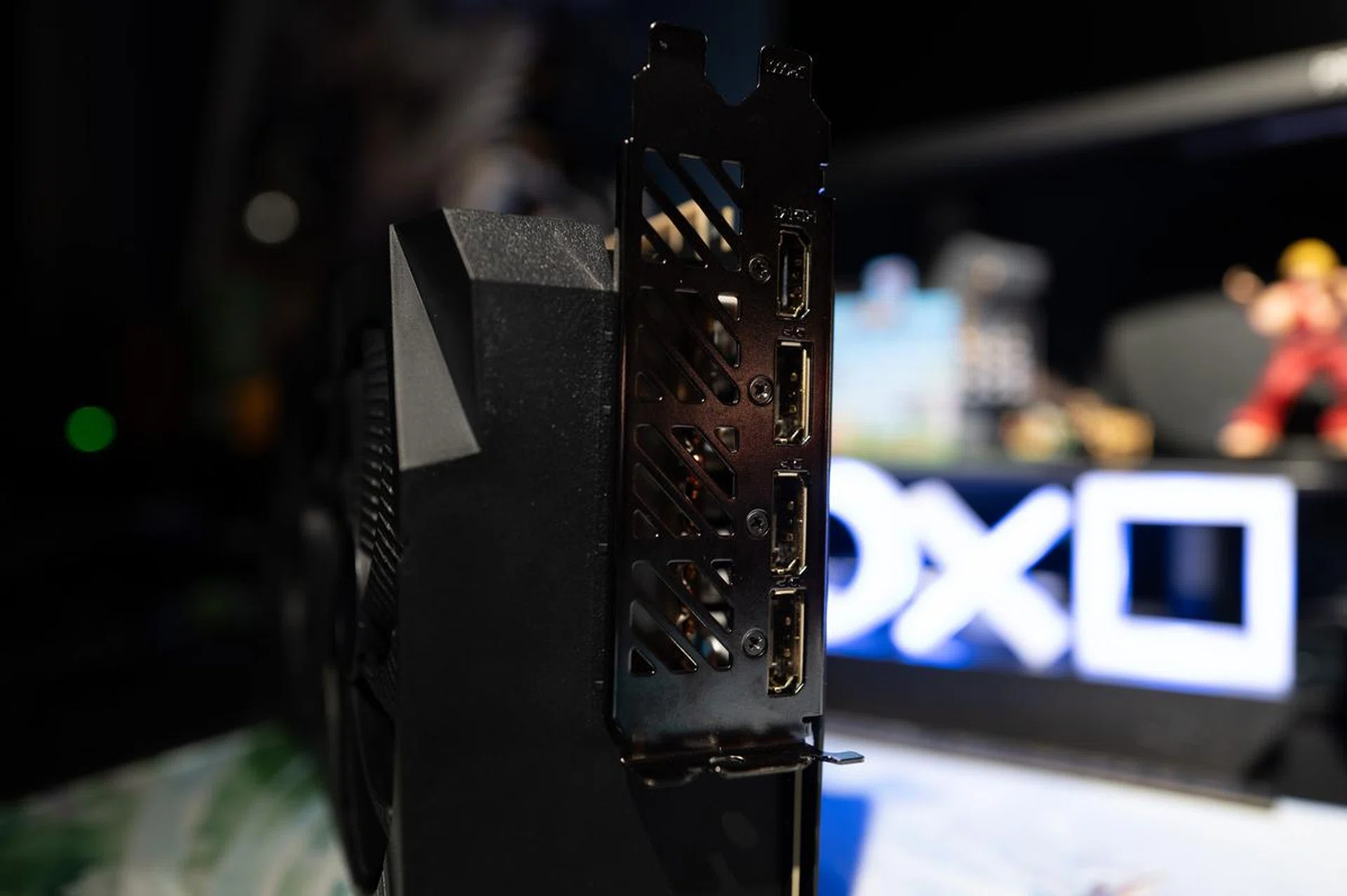
Just like the Founders Edition, the card does not feature the latest DIsplayPort or HDMI tech yet but that's ok.
The card has three DisplayPort 1.4a connections and one HDMI 2.1 connector. Measuring a good 357mm long, you'll need to check if you actually have space in your case for it, and it may bump up against your front radiator if you have one installed within your chassis. This is a huge card, after all. Now let’s see how it fares in our benchmarks.
Performance benchmarks
Here's a refresher of our test rig's specifications:
- Intel 14th Gen Core i9-14900K CPU
- ROG Maximus Z790 Dark Hero
- Seagate FireCuda 540 PCIe 5.0 SSD
- Kingston Fury 32GB DDR5
- Windows 11 Home 64-bit
- ASUS ROG Swift PG43UQ 4K Gaming Monitor
GeForce
Graphics Card | Gigabyte Aorus GeForce RTX 4080 Super Master | NVIDIA GeForce RTX 4080 Super FE |
GPU | Ade Lovelace (AD103) | Ade Lovelace (AD103) |
Process | 5nm (TSMC) | 5nm (TSMC) |
Transistors | 45.9 billion | 45.9 billion |
Streaming Multi-processors (SM) | 80 | 80 |
CUDA cores | 10240 | 10240 |
Tensor Cores | 320 | 320 |
RT Cores | 80 | 80 |
GPU base / Boost clocks (MHz) | 2295 / 2625 | 2295 / 2550 |
Memory | 16GB GDDR6X | 16GB GDDR6X |
Memory bus width | 256-bit | 256-bit |
Memory bandwidth | 736.3 GB/s | 736.3 GB/s |
Interface | PCIe 4.0 | PCIe 4.0 |
TDP | 320W | 320W |
Price (at launch) | S$1,889 | US$999 |
As this isn’t a GPU-class review, I’ll be comparing the Aorus card against the RTX 4080 Super Founders Edition (used as our reference card). If you’re keen to see how the RTX 4080 Super fares against the RTX 4080 or even the RTX 4090, do check out my article here. Aside from raw frame-rate numbers, I’ll also be looking at other key factors – namely power draw and thermal performance. All visual settings are tweaked to the highest settings available, with DLSS and ray-tracing turned off.
Gaming performance (1440p & 2160p)
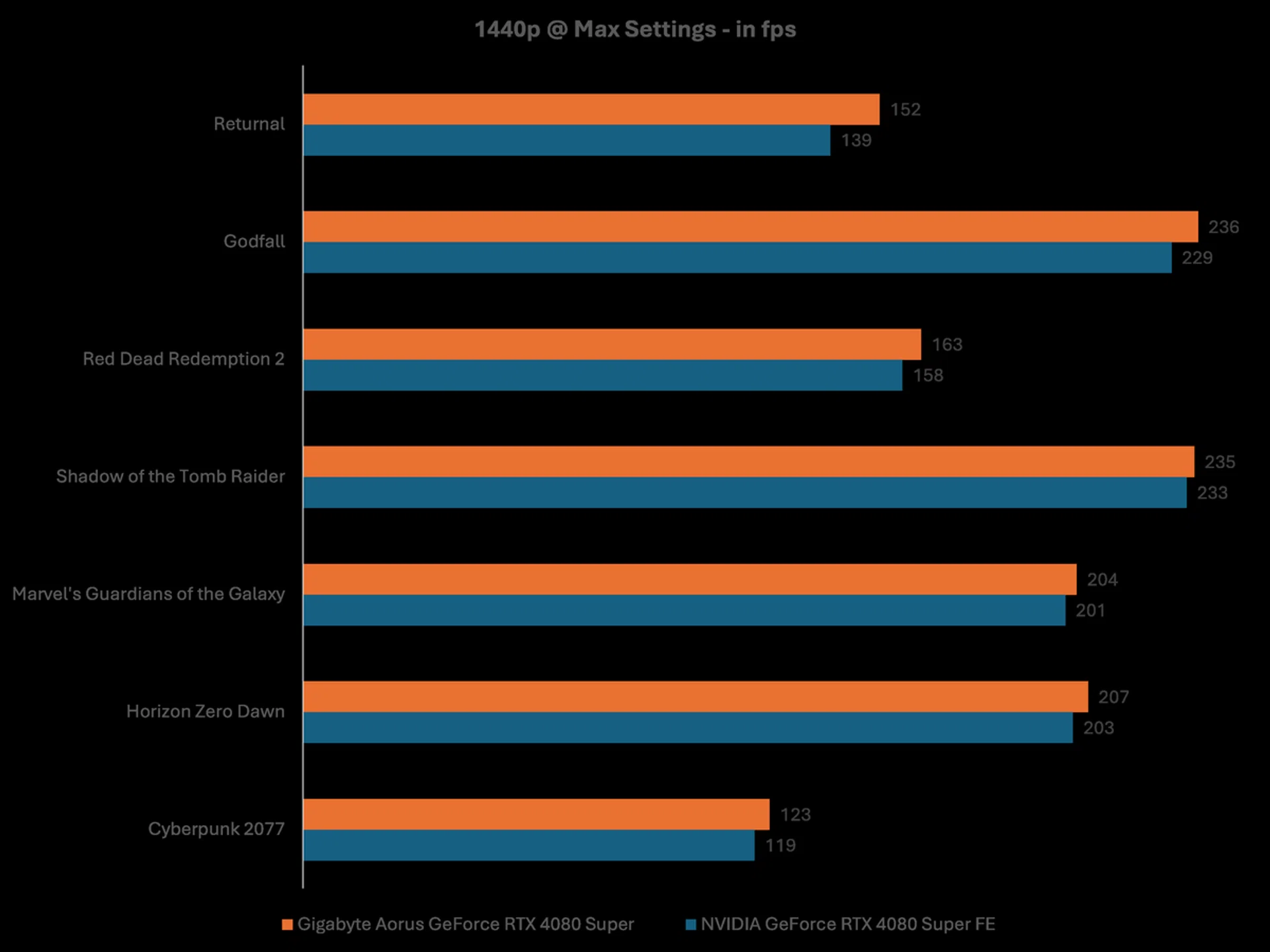
1440p Benchmarks.
In real-world games at 1440p and 2160p (4K), the Aorus card consistently outperforms the Founders Edition reference card. Which isn’t surprising, considering that it does have a faster boost clock speed. Of course, taking these numbers into context the improvements in frame-rates are really, really, marginal at best – especially at lower resolutions like 1440p. 152fps in Returnal, for example, is not going to play any noticeably better than 139fps.
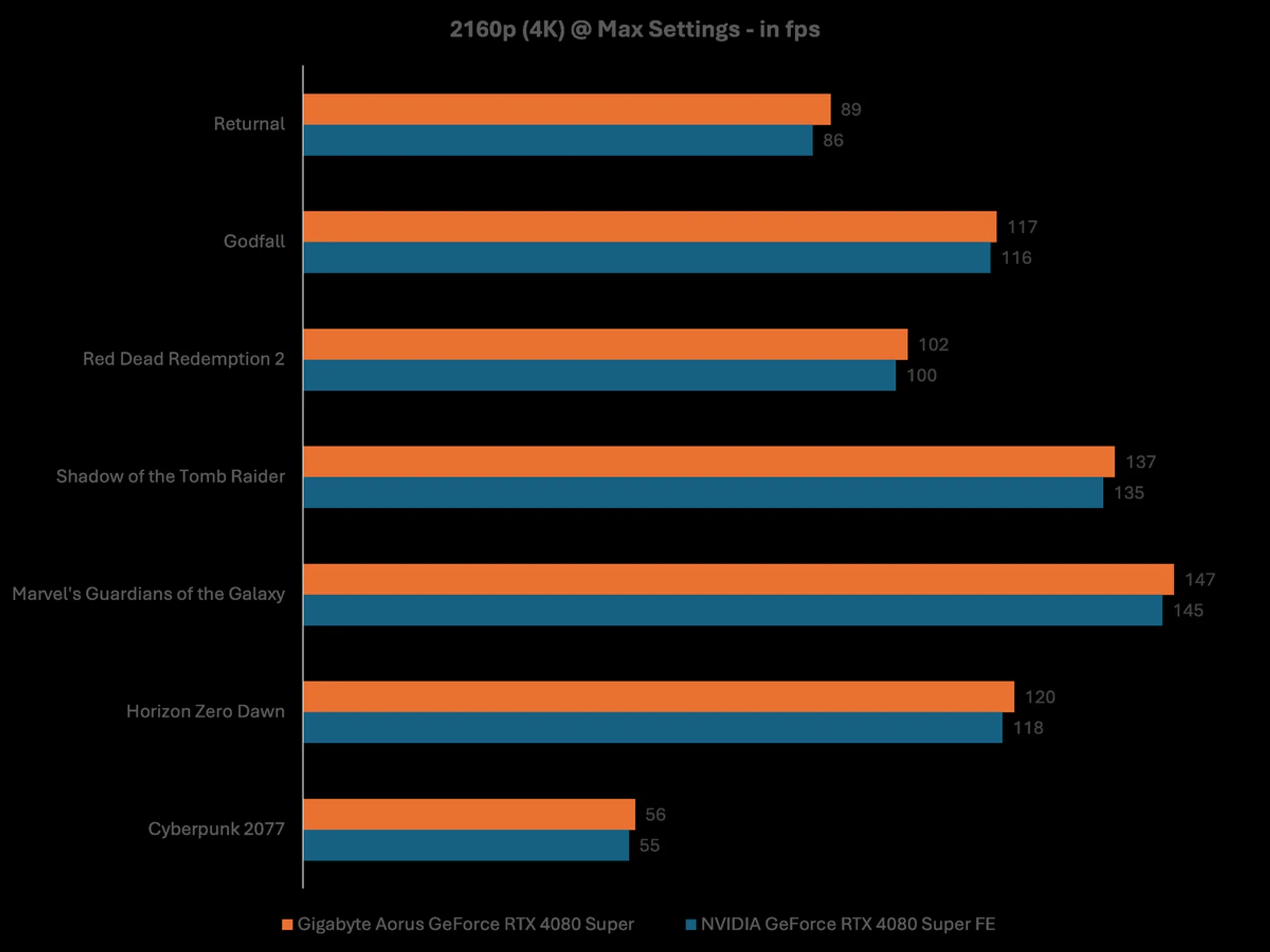
4K Benchmarks.
But at 4K, every gains count especially in more intensive games like Returnal and Cyberpunk 2077 and the Aorus does not disappoint – edging out the RTX 4080 Super Founders Edition in all games benchmarked
Temperature and Power
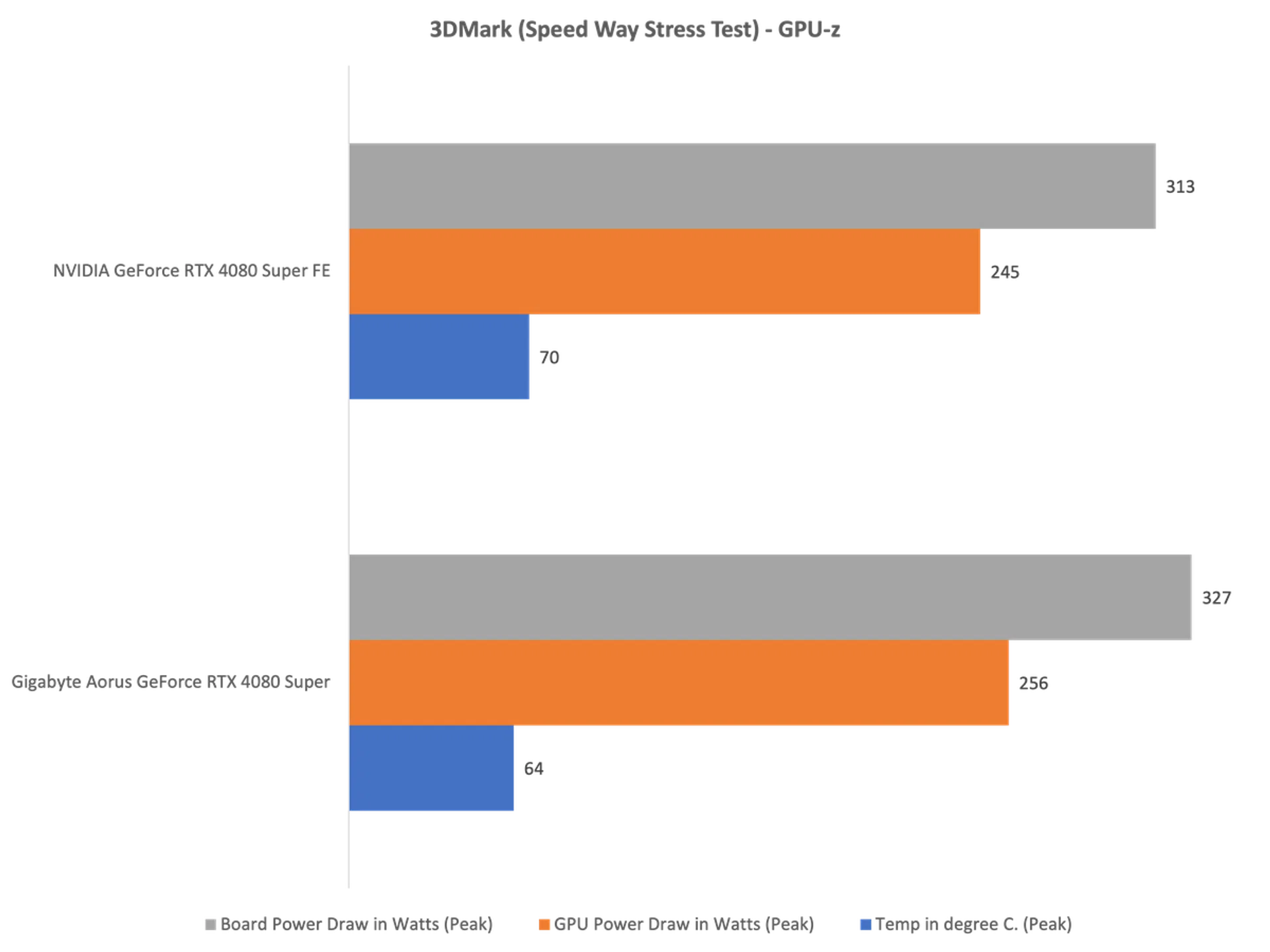
Power and Temperature Benchmarks.
Cooling performance is the real differentiator when comparing custom cards. With a higher boost clock right out of the box, it’s no surprise that the Aorus card’s GPU chip draws more power than the NVIDIA card. Additionally, unlike the Founders Edition, it also has plenty of bells and whistles going for it – such as the RGB lights and LCD Edge screen – so the card also naturally draws more power.
What’s really good to see though, is that the Aorus card runs a lot cooler than the Founders Edition card, and I think there’s a lot of potential headroom if you are intending to do some serious overclocking with this card.
Final thoughts
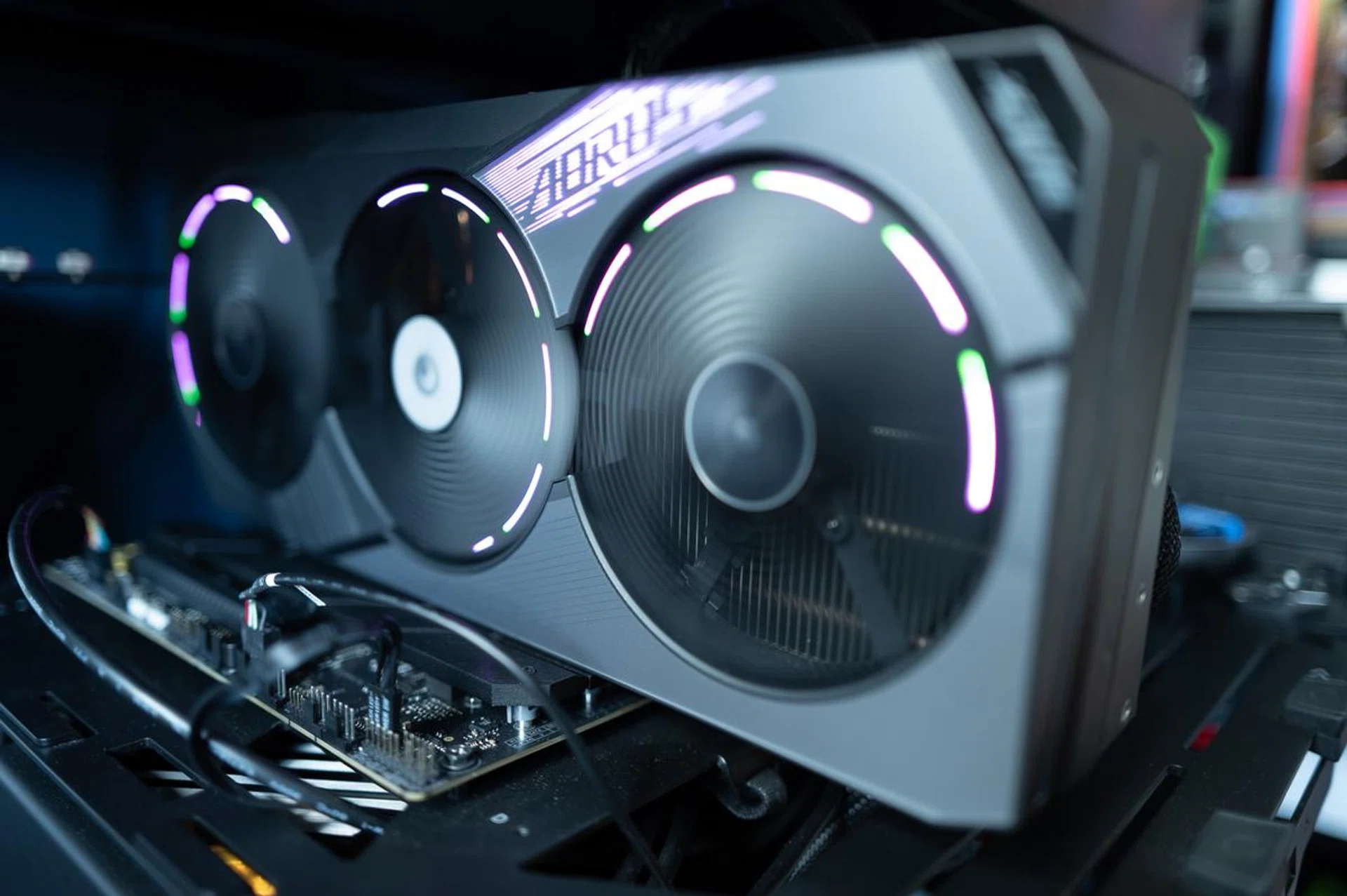
The Gigabyte Aorus GeForce RTX 4080 Super Master is easy to recommend if you're looking to upgrade your existing RTX 30 series card.
With a price of S$1,889 (as seen on Lazada), the Gigabyte Aorus GeForce RTX 4080 Super Master commands a pretty hefty price tag compared to the Founders Edition US$999. But it is also worth noting that the non-Super version of the Aorus GeForce RTX 4080 Master launched at a more painful $2,350 over a year ago, and a faster card that also cost lower now can’t be a bad thing.
The Gigabyte card reinforces my opinion that the Super variant of NVIDIA’s GeForce RTX 4080 now makes this GPU a compelling choice for gamers looking for a suitable upgrade to their older GPUs. Especially for those still holding on to their RTX 3080 cards, which is four years old by now and is now primed for an upgrade. There’s where RTX 4080 Super cards like this Aorus comes in, with its more accessible pricing and performance edge, beautiful RGB and LCD Edge screen making the card easy to recommend.
If you're interested in getting the Gigabyte Aorus RTX 4080 Super Master, check out e-retailers’ offerings at Lazada or at NVIDIA's e-store.
Our articles may contain affiliate links. If you buy through these links, we may earn a small commission.