
Gigabyte Aorus GeForce RTX 4080 Master review: All about that RGB lighting
Enthusiast performance meets RGB lighting.

Note: This review was first published on 29 December 2022.
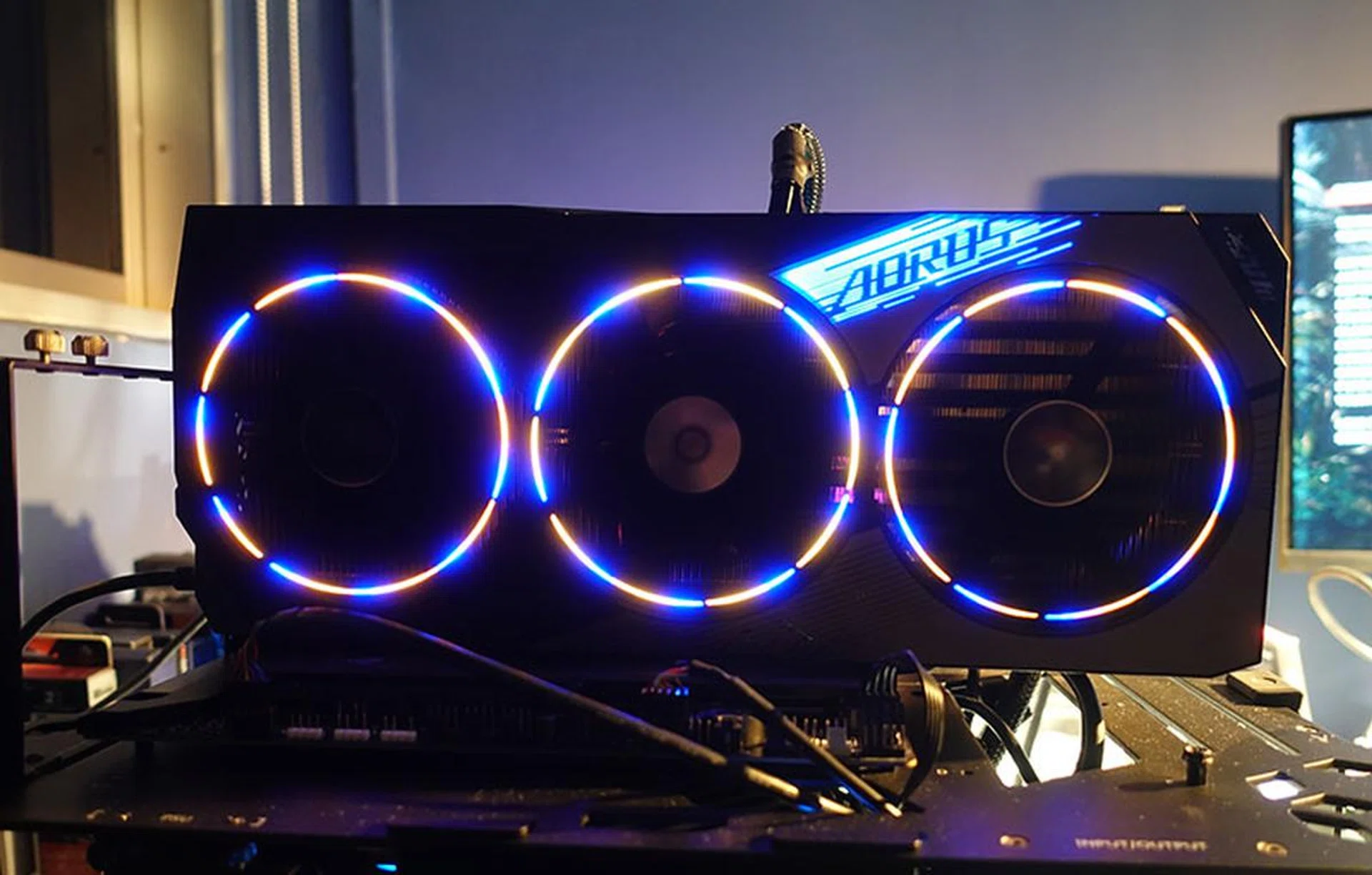
The Gigabyte Aorus GeForce RTX 4080 Master is just one of a wide selection of custom GeForce RTX 4080 cards from Gigabyte and is the next contestant after our recent review of the ROG Strix edition from ASUS.
Unlike offerings like the WindForce or Gaming OC series, it stands out with its striking triple-ring RGB Halo lights that encircle each fan. In comparison, the WindForce cards have a more understated look, while the Gaming OC series is more concerned with performance thanks to its aggressive factory overclocks.
That said, the Aorus Master is no slouch in the numbers department. It has a 2,550MHz boost clock, up from the 2,505MHz on the Founders Edition model.
It also utilises the WindForce cooling system, featuring three "bionic shark" fans, alternate spinning for lower turbulence, 12 composite copper heat pipes, and a large vapor chamber that comes in direct contact with the GPU.
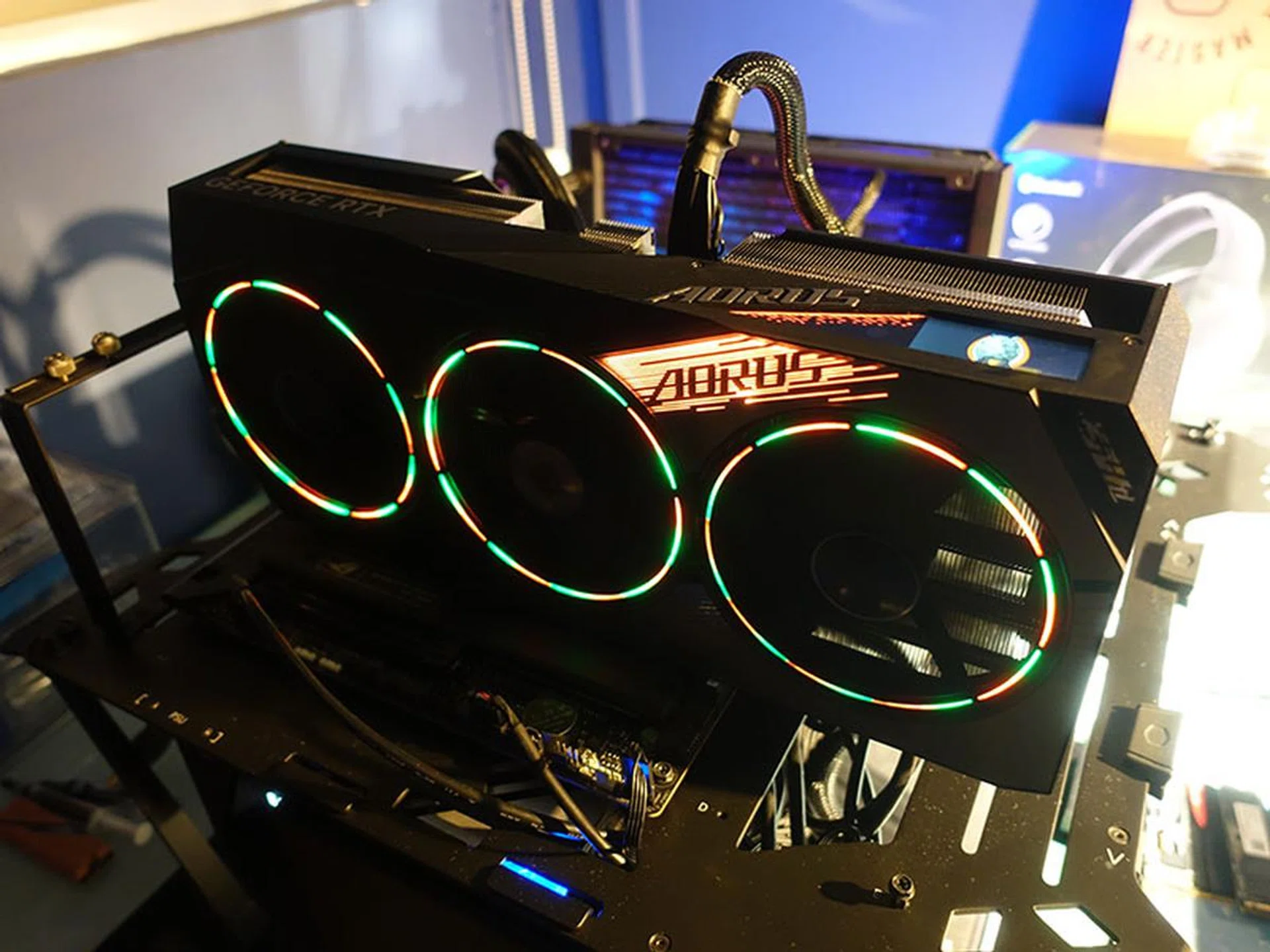
The fans take inspiration from a shark's dermal denticles, according to Gigabyte, and are dotted with small raised ridges to increase airflow by reducing micro turbulence. The double ball bearing structure also grants better heat endurance and efficiency than sleeve bearing fans, which should be expected of in such high performance components.
Each fan also spins in the opposite direction as the one adjacent to it, reducing turbulence and increasing air pressure. On top of that, they support semi-passive cooling, which means they will stop spinning if the GPU load is low to reduce noise.
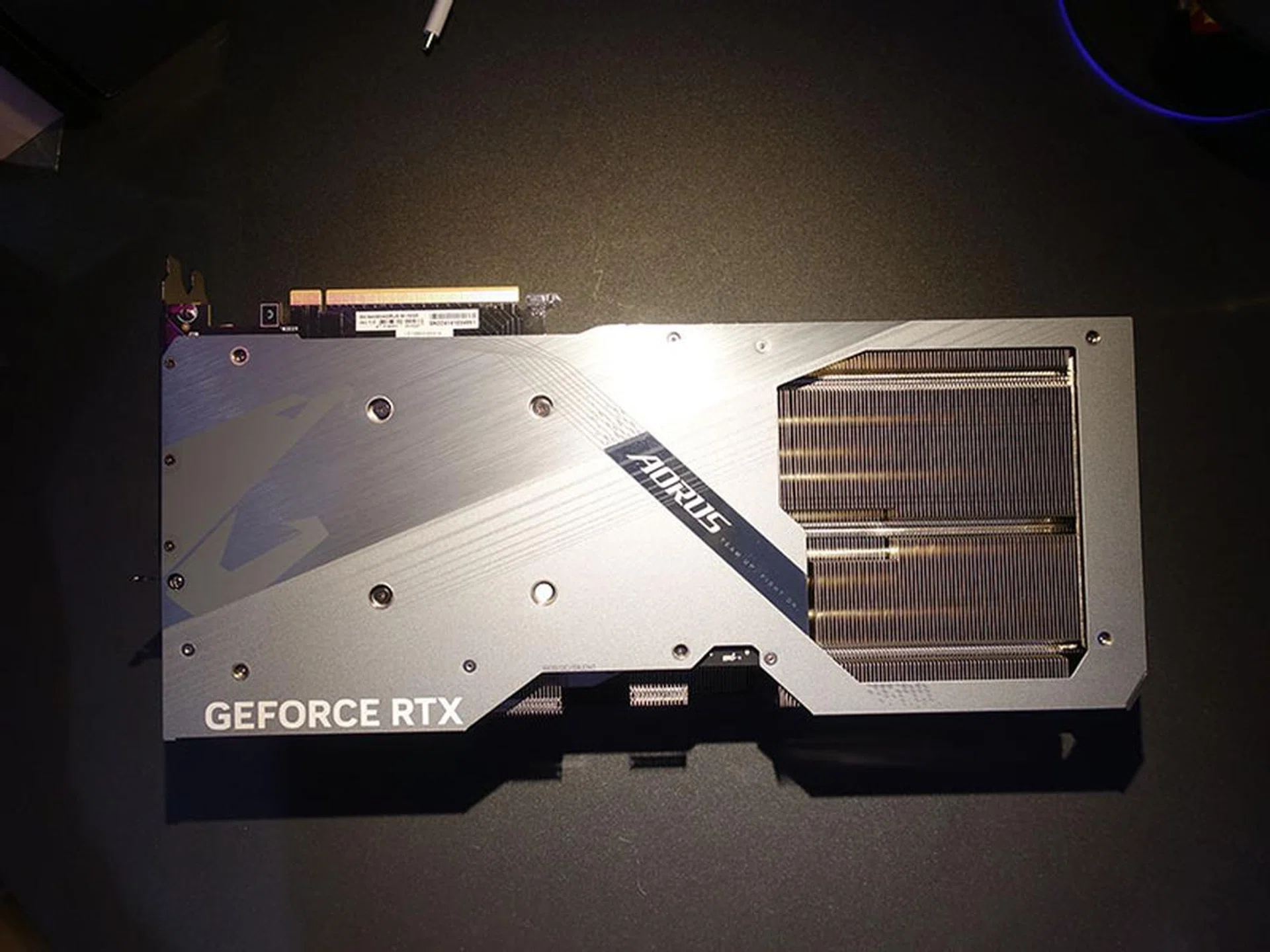
The copper heat pipes work in tandem with the vapor chamber to draw heat away from the GPU and VRAM to the heatsink. Finally, the heatsink itself extends over the PCB to increase ventilation and improve heat dissipation, and you can see it exposed through the backplate cutout.
Gigabyte has also gussied up the card with an LCD screen on its side, which displays GPU information such as temperature and fan speed, alongside text, pictures, or GIFs of your choosing.
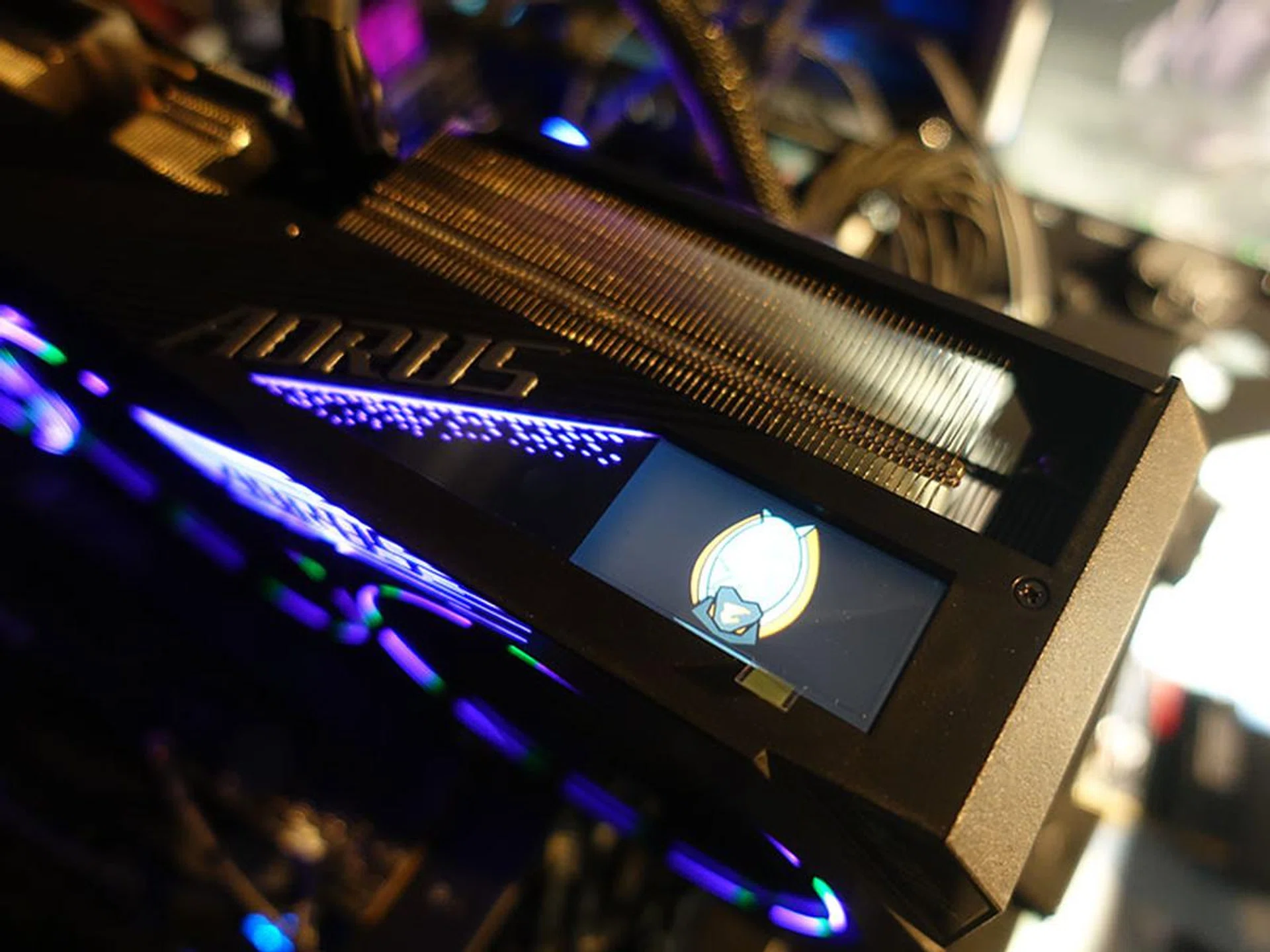
But its true crowning glory is probably the three-ring lighting that puts on a stunning visual display. You can also adjust the displayed lighting effects via the Gigabyte Control Center software.
Round the back, the metal backplate reinforces the PCB and prevents flexing. A new anti-sag bracket on the end of the card also provides additional reinforcement. The PCB itself also boasts a dust-resistant coating, which protects it from everything from dust to insects, dropped screws, and abrasion. It is moisture and corrosion-resistant as well, which is supposed to prevent unwanted conduction paths and board damage, and should shrug off high-humidity climates as well.
A convenient dual BIOS switch lets you switch between OC mode and silent mode, in the event that you really want your quiet. A nifty power indicator light also sits above the 16-pin power connector. If there are any power supply abnormalities, the light will start flashing.
The card has three DisplayPort 1.4a connections and one HDMI 2.1 connector. Measuring a good 357mm long, you'll need to check if you actually have space in your case for it, and it may bump up against your front radiator if you have one installed within your chassis.
Test setup
Here are the specifications of our test rig:
- Intel 12th Gen Core i9-12900K CPU
- ROG Maximus Z690 Hero
- Samsung 980 Pro 1TB SSD
- Kingston Fury 32GB DDR5
- Windows 11 Home 64-bit
- ASUS ROG Swift PG43UQ 4K Gaming Monitor
We'll be comparing the Aorus Master against the ASUS ROG Strix GeForce RTX 4080 and the NVIDIA Founders Edition model, looking mainly at factors like power draw and thermal performance.
The following synthetic benchmarks and games were run, with the games chosen from a wide range of genres to give a better indication of performance across different segments:
- Shadow of the Tomb Raider
- Metro: Exodus
- Horizon Zero Dawn
- Guardians of the Galaxy
- Cyberpunk 2077
- F1 22
3DMark
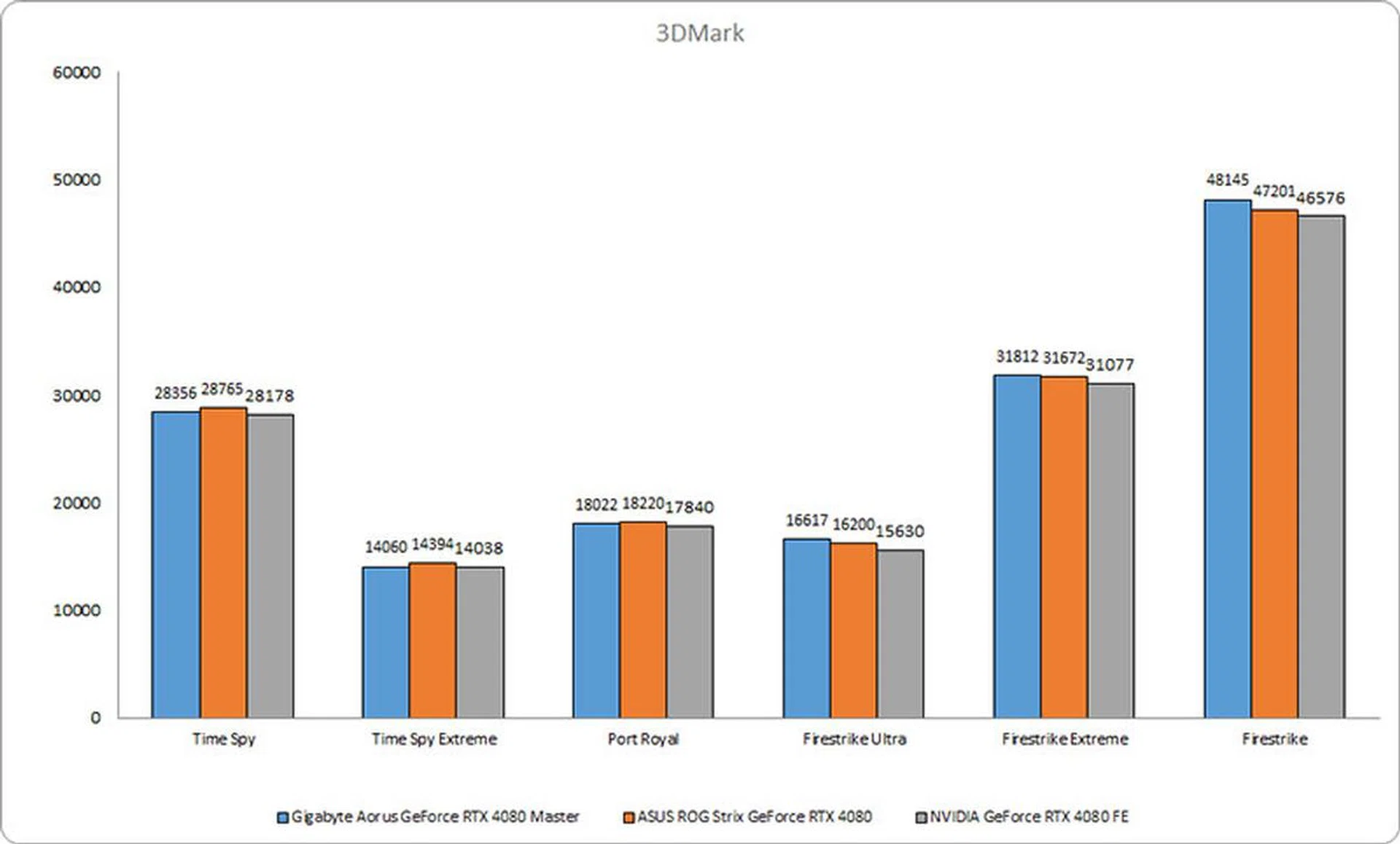
3DMark is a synthetic benchmark that tests graphics and computational performance at different resolutions, starting at 1080p and going all the way up to 4K. A series of two graphics test, one physics test, and then a combined test stresses your hardware in turn to assess its performance.
Despite the small bump in boost clocks, the difference in performance is negligible compared to the Founders Edition model. All three cards were neck-and-neck in 3DMark, although the Gigabyte card inched ahead by 3% in Fire Strike.
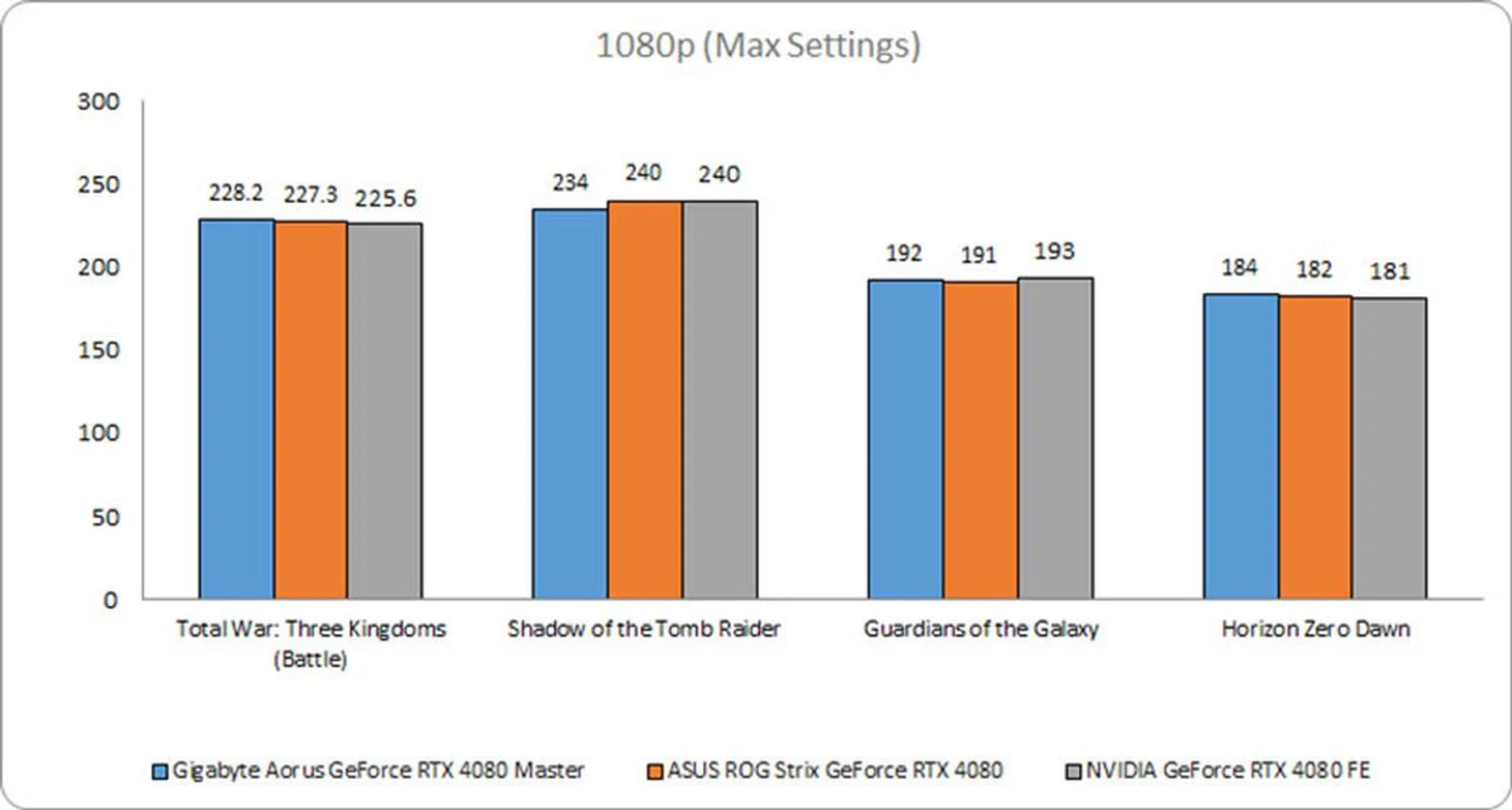
1080p Benchmarks (Max Settings)
In real-world games, all three cards were within a few frames of each other, and there was no significant difference observable.
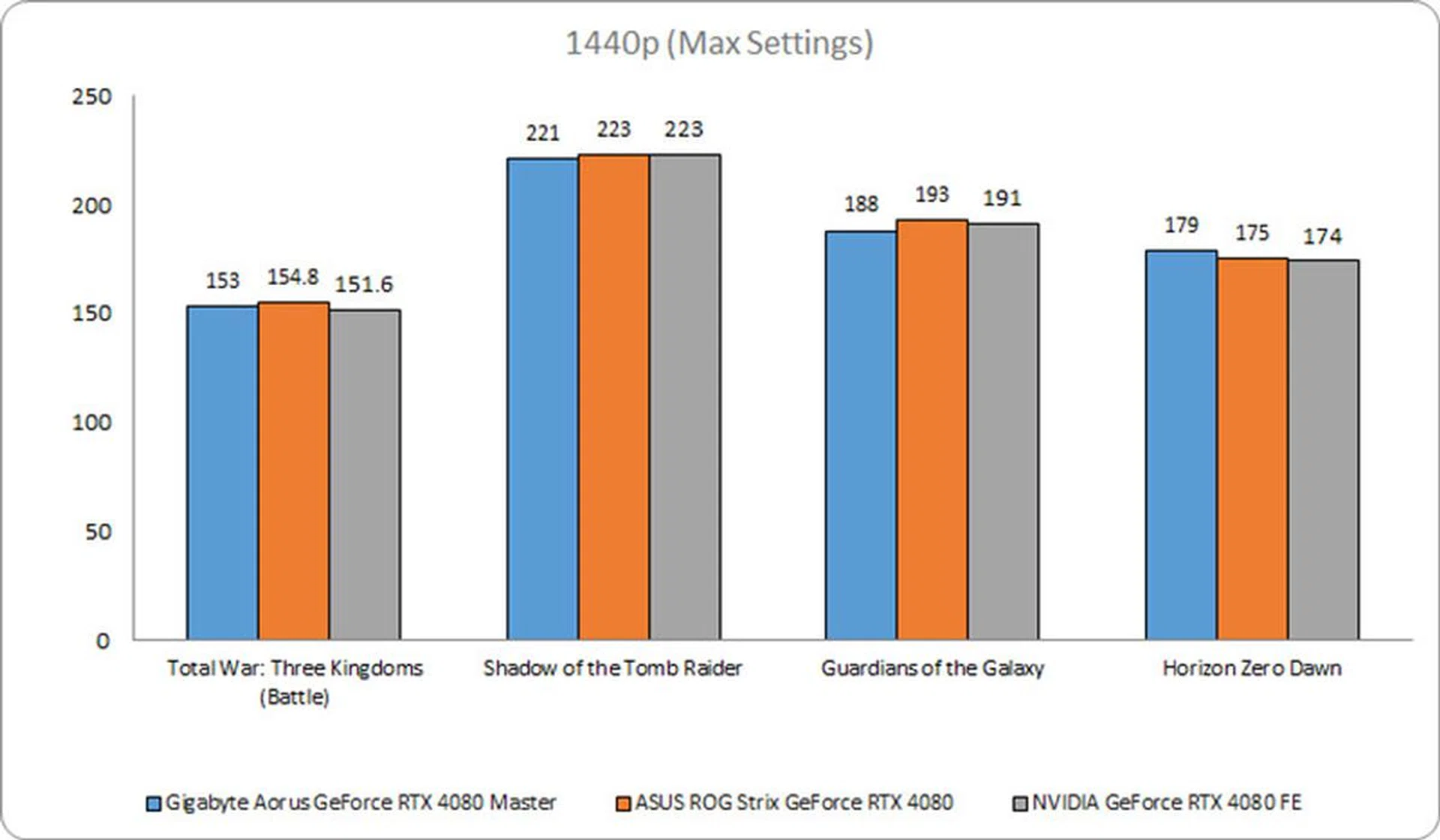
1440p Benchmarks (Max Settings)
The same was true at 1440p, where the performance of all three cards was nearly indistinguishable from one another.
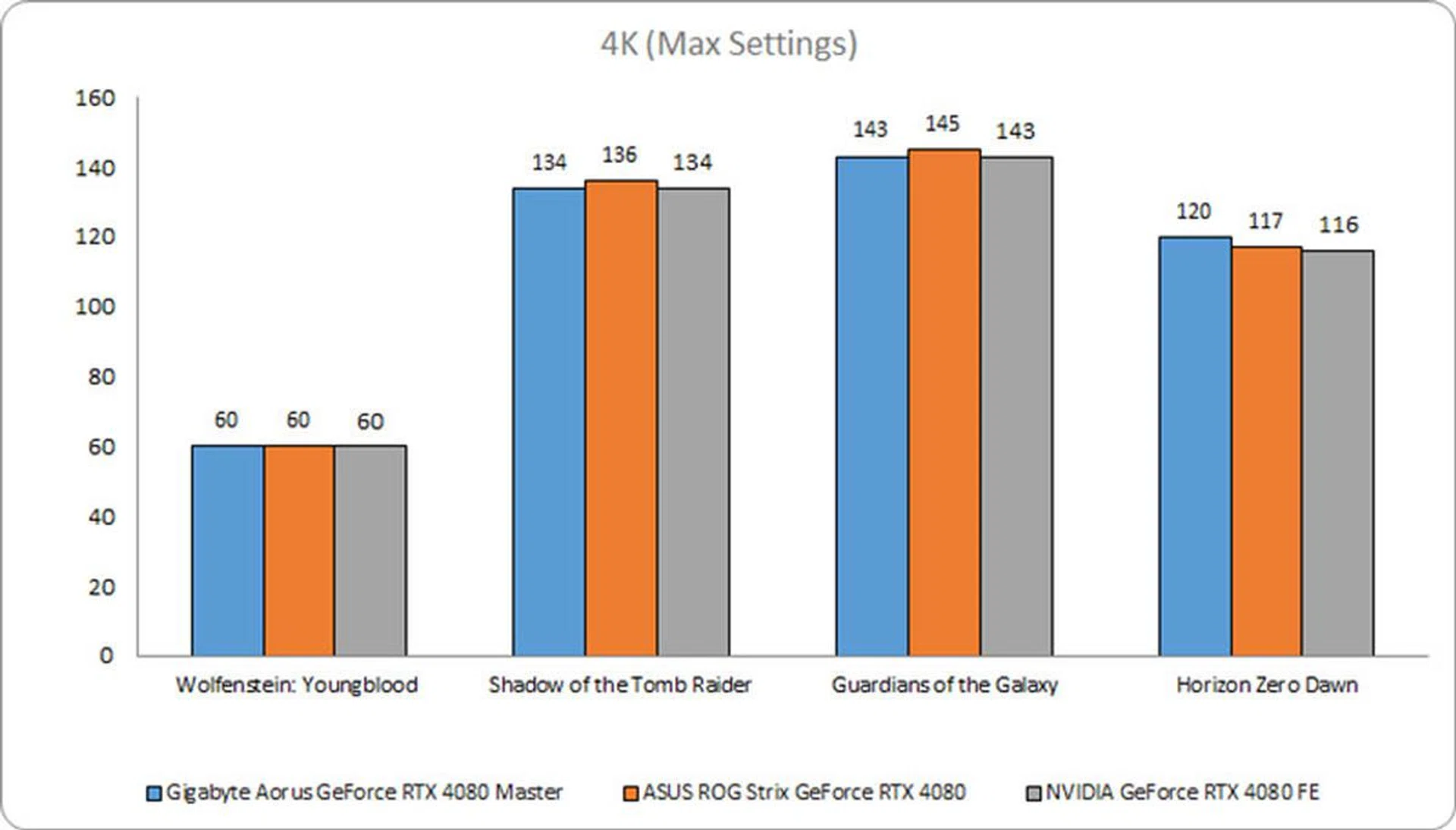
4K Benchmarks (Max Settings)
The status quo remains unchanged at 4K, and the differences were so negligible that they are hardly worth mentioning.
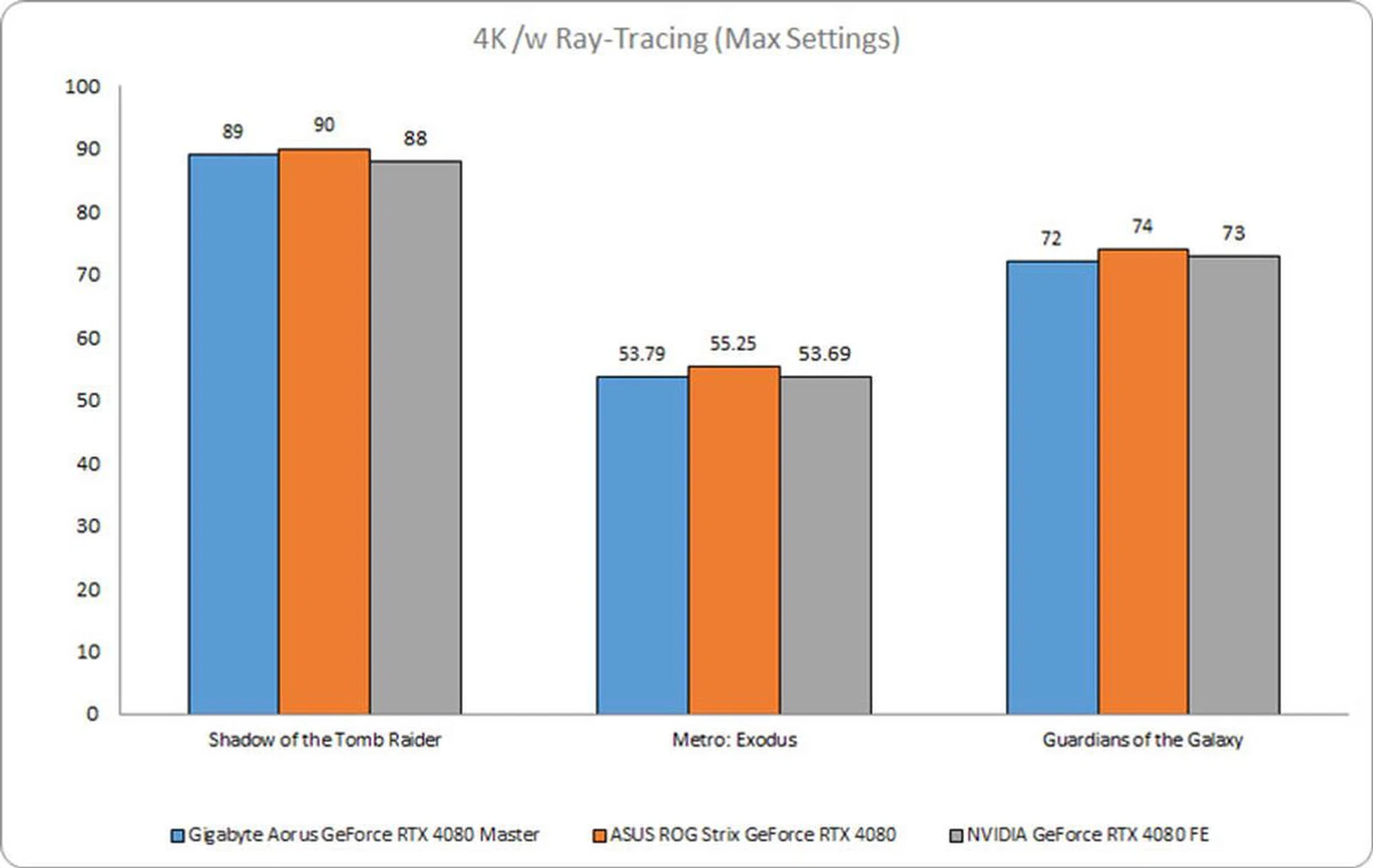
4K @ Max Settings (Ray Tracing)
With ray tracing turned on, all three cards still maintained a level playing field, with barely any difference between them.
Temperature and Power
Cooling performance is the real differentiator when comparing custom cards. Unfortunately, the Gigabyte model ran hotter than even the Founders Edition model, despite its beefed-up cooler. It was even further behind the ASUS card, by a good 8°C.
Power draw sits between the Founders Edition and ASUS models, in line with their boost clocks.
Gigabyte Aorus GeForce RTX 4080 Master | ASUS ROG Strix GeForce RTX 4080 | NVIDIA GeForce RTX 4080 FE | |
Temperature (Peak) | 72.4°C | 64.3°C | 68.1°C |
Board power draw (Peak) | 337W | 357W | 310.8W |
Conclusion
At an official price of S$2,350, the Gigabyte Aorus GeForce RTX 4080 Master commands a pretty hefty price tag, considering that most GeForce RTX 4080 cards in the market hover around the S$2k price bracket, like Gigabyte's own Eagle edition. It attempts to make up for that with bells and whistles like an LCD display, unique customisable RGB lighting, and an upgraded cooler.
However, despite the size of its heatsink, the card still ran hot in our tests, and by quite a large margin. Your mileage may vary, especially if you live in a cooler climate, but the fact remains that the card was outdone by even the cooler on the Founders Edition model.
If cooling performance is not a priority for you, the Aorus Master offers up plenty to like in terms of features and aesthetics. If not, you may want to look elsewhere.
If you're interested in getting the Gigabyte Aorus RTX 4080 Master, do look out for them at either Gigabyte's Shoppe Store or at NVIDIA's. At the time of publishing, it's not yet listed in these stores and only Amazon has it listed (though it's shipping from abroad).
Our articles may contain affiliate links. If you buy through these links, we may earn a small commission.