
ASUS ZenFone 5Q review: Fighting for five
Costing just $20 less than the impressive ZenFone 5 and boasting quad cameras, we find out where exactly does the ZenFone 5Q fit in their lineup and if it's worth your time.

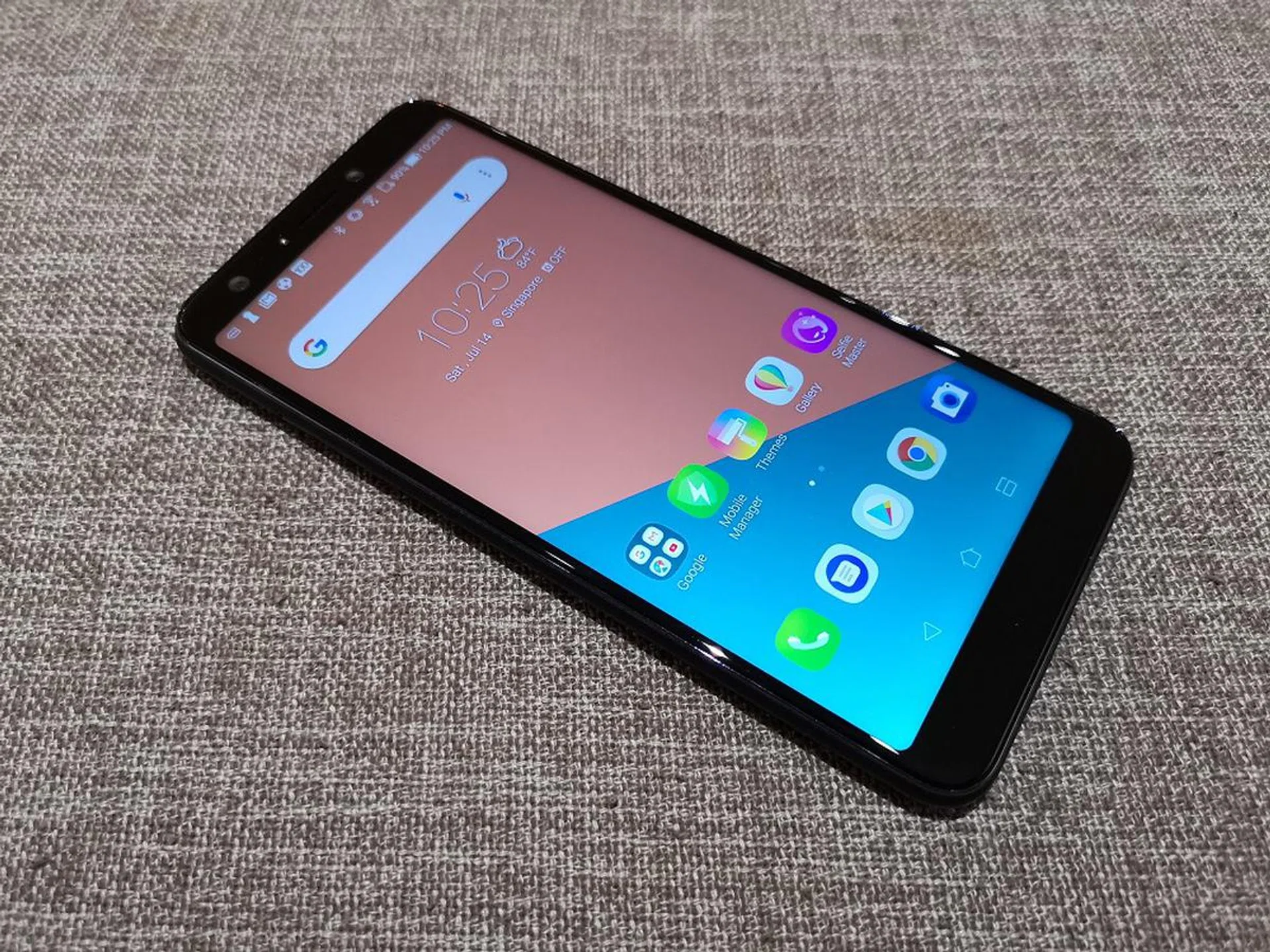
Overview
The year is 2018.
The planet has been virtually overrun by phones with notched displays. Virtually all manufacturers have succumbed to the onslaught. Legions of phone designers now operate in classified maximum-security facilities, with armed guards keeping watch, making sure they don’t design any smartphone without a notch. Those who refuse are hauled off to re-education camps where the virtues of face-recognition unlock are drilled into them. Huge crowds, from Mexico to Mozambique, are wringing their hands in the streets. Meanwhile, on the Internet, clandestine Telegrams are flooding the accounts of mobile phone shops: “do u hav phone with no notch if I dont want samsung what do u hav thx.”
In a dark alley somewhere in Beitou, Taipei, a phone dealer opens his jacket and hands you a wrapped package marked “ASUS ZenFone 5Q”. Back at your hotel, you sweep your room for surveillance devices, before tearing the paper apart with shaky hands. You were promised another worthy addition to the notch resistance, but will this turn out to be just another short-lived freedom fighter? Well, it’s time for a briefing from HWZ HQ.
Design
If there’s anyone fighting the good fight in the smartphone market, we’re pretty sure it’s ASUS. Wasting no time in shoring up its strong showing with the ZenFone 5 (which itself was launched only 6 months after the ZenFone 4), the Taiwanese giant now lobs into Singapore its latest salvo in the battle for midrange glory.
If you recall, we really liked the feel and build quality of the ZenFone 5, but weren’t so hot about its average performance, features billed as “AI” that were anything but, and perhaps most of all: its almost near-perfect homage to That Other Notched Phone X.
The first thing that strikes you about the ZenFone 5Q is that it has clearly inherited some good genes. It’s a premium-looking sandwich of glass and metal that doesn’t give off any pretentious vibes. This is due in part to the weight: in my opinion, the ZenFone 5 was a little too light at 155g. The 5Q adds only 13g, but what a difference this makes - it feels perfectly weighted.
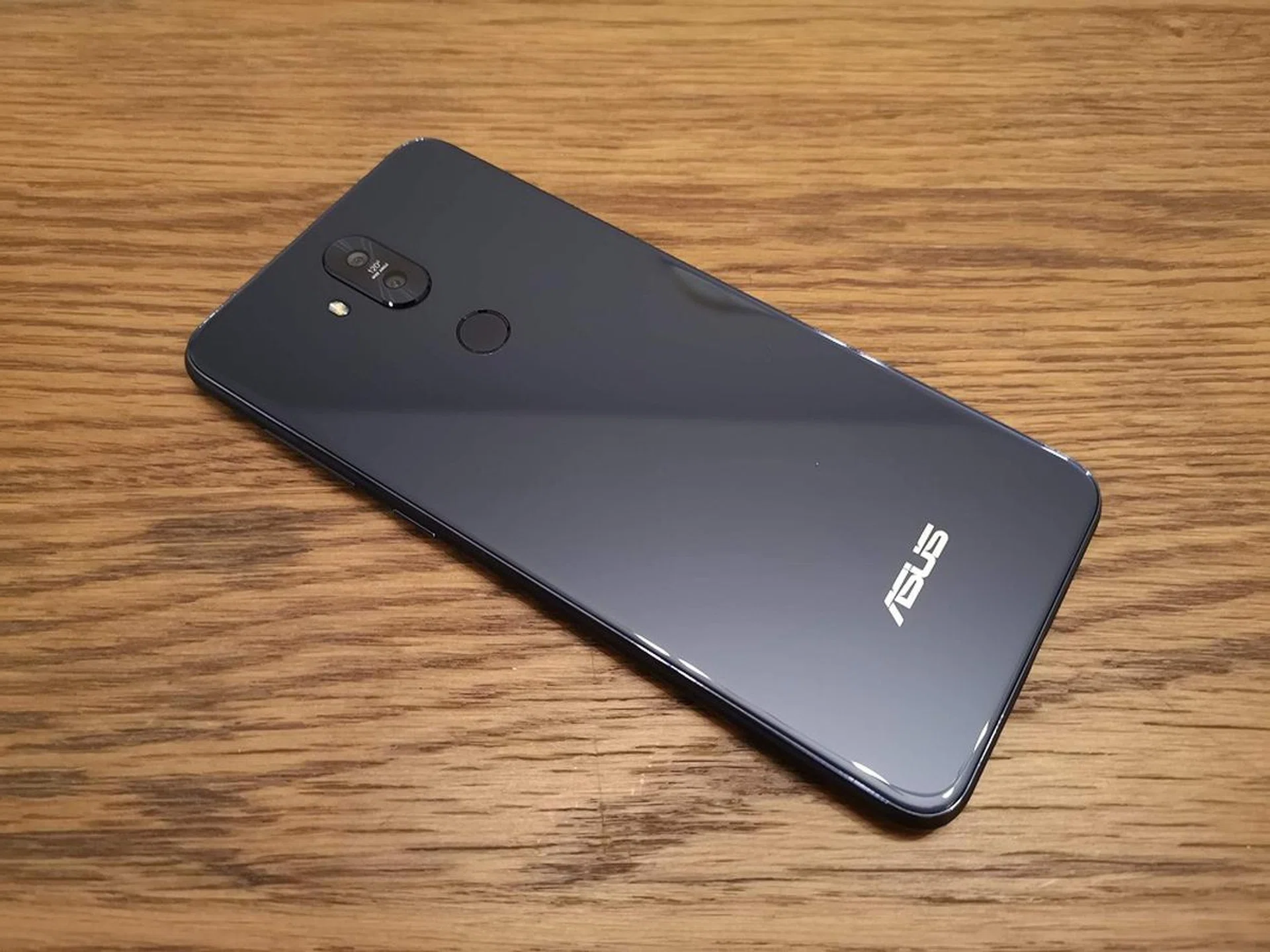
The ZenFone 5Q is thankfully as much of an “anti-X” round the back as its sibling is pretty much an iPhone X clone: the camera is placed centrally, in line with the fingerprint sensor (which the iPhone X doesn’t possess.)
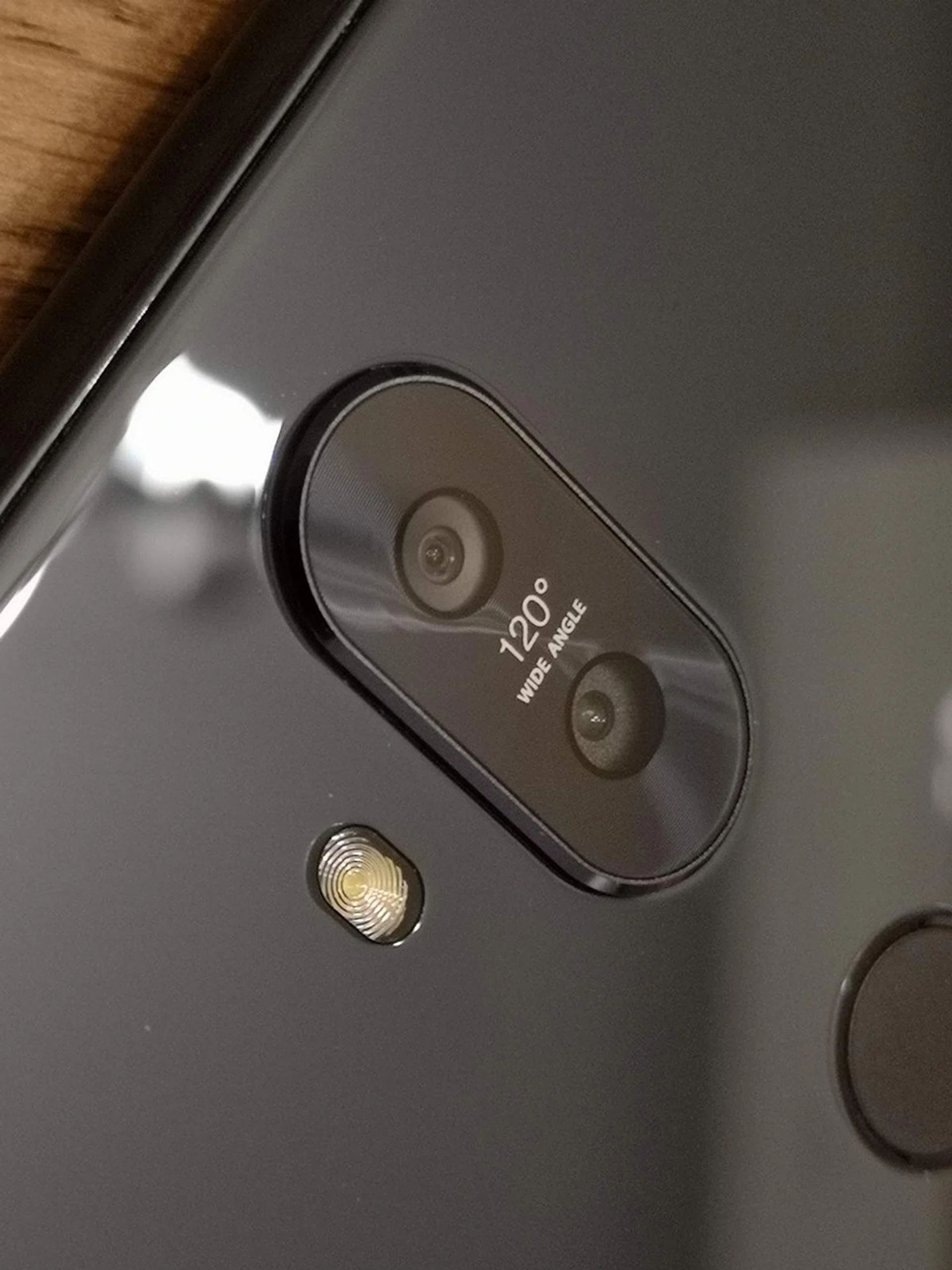
The camera hump, which is thankfully not too prominent, sports two lenses, one of which is a wide angle 120-degree lens:
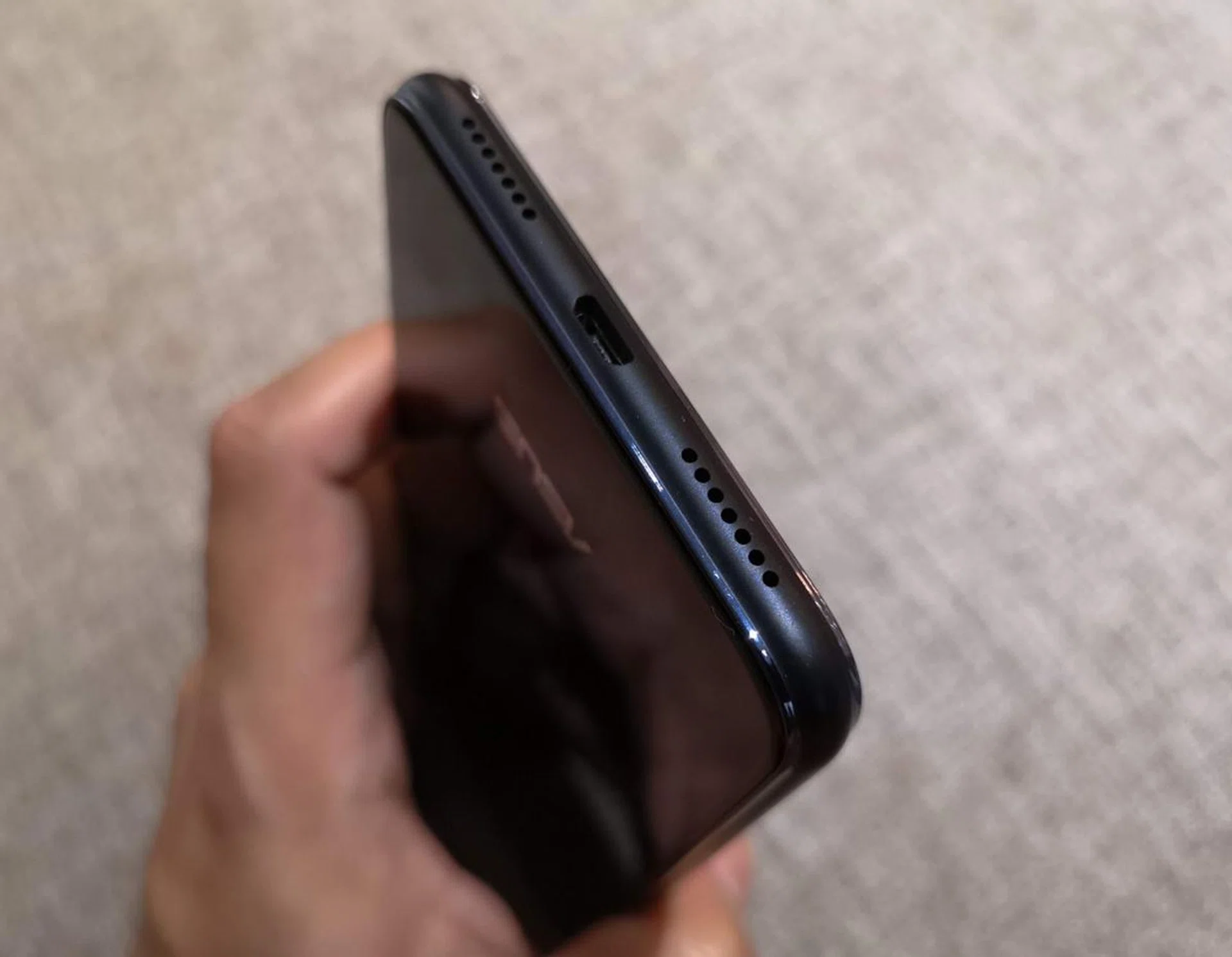
There’s a headphone jack up top, and you can see the diamond-cut edges of that aluminum frame:-

But it is on the bottom edge where this phone takes its first huge hits. First: no, those are not stereo speakers. In fact, they sound pretty ho-hum, being all about the mid-tones, with next to no bass. And second: why is yet another phone using a micro-USB port in 2018?
The news is not all good on the front, either. The specs say the 6-inch panel is an IPS type, but compared to the ZenFone 5, it’s nowhere near as sunlight-legible…

Not to mention, it doesn’t deliver the same surprisingly impressive black levels as ZenFone 5's notched display did. The colors are disappointingly muted, and tend towards cool:-
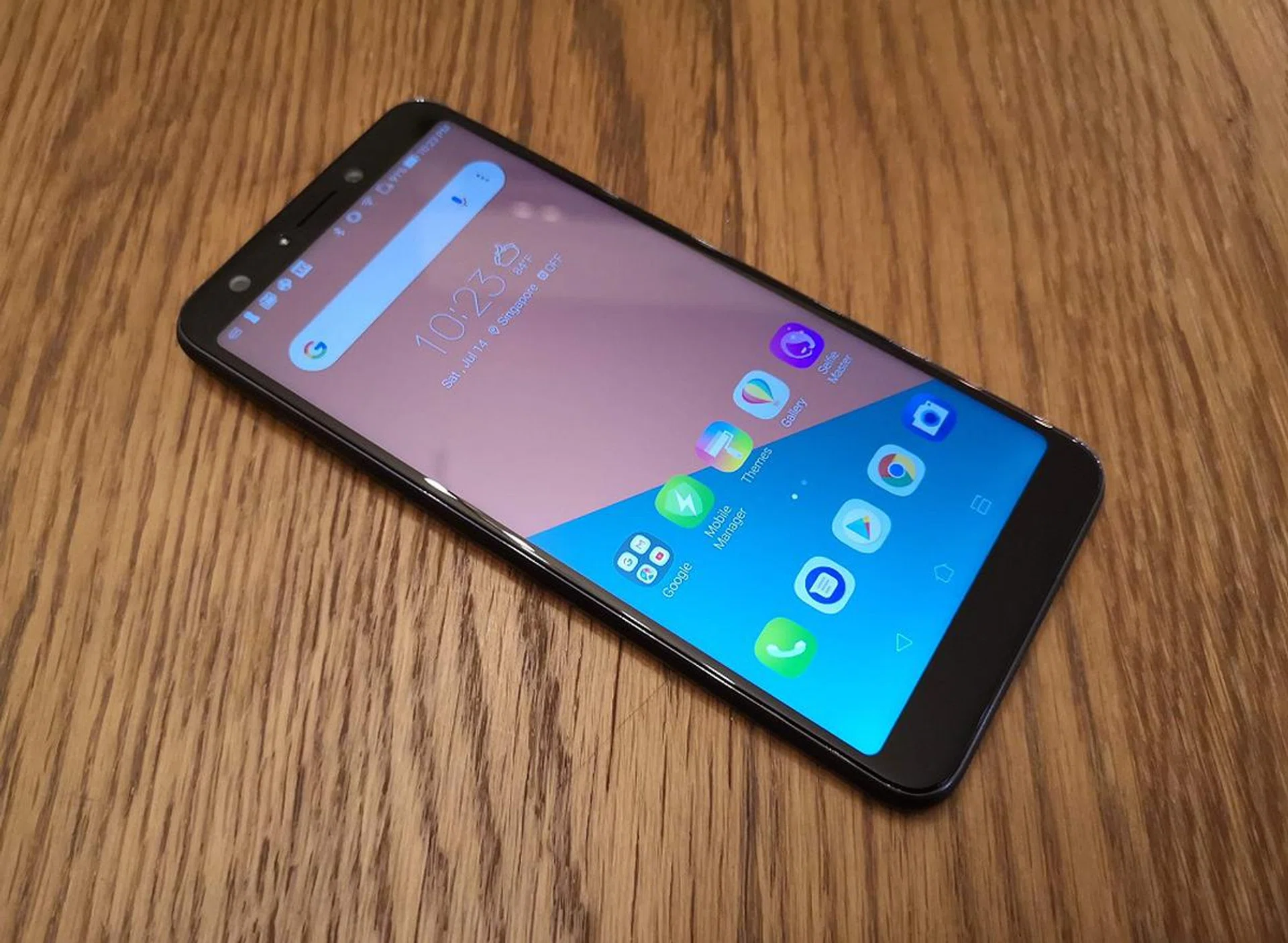
At least this display is 1,080 pixels in the vertical, and... well, we don’t wish to make sport of the vivo V7+ yet again.
One trend we wholeheartedly support is Taiwanese and Chinese phone makers bundling TPU cases with their phones. It feels great to be able to use your brand-new toy immediately after you’ve paid for it without worrying about bumps and drops. Take a bow, folks!
Software
Unlike most software on phones coming out of the Chinese region, ASUS’ ZenUI has grown over the years in its faithfulness to stock Android. But when you still have icons and illustrations that look like they came out of a kindergarten textbook, plus English that is less than accurate, tacked onto a version of Android that’s not even current (7.1.1 with the latest updates), you’ll find it hard to shake that “Chinese” feel.
Thankfully, the ZenFone 5Q is very light on the bloatware, and most of it is easily uninstalled. ASUS has also not messed around with the stock Android notification system.


Most of the features on this phone have already been covered in our ZenFone 5 review, such as Face Unlock, which on most Android phones is very dependent on the quality of the front-facing camera (since all of them employ simple image verification, rather than 3D facial projection mapping as used on the iPhone X.)
Since the ZenFone 5Q employs a 20-megapixel front camera compared to the ZenFone 5, and that camera could be expected to have much smaller pixels and hence inferior low light performance, we weren’t surprised to find that Face Unlock on the 5Q doesn’t recognize and unlock as quickly, or as well in low light, as its more expensive stablemate.

One of ASUS’s most useful (and non-gimmicky features) is an app called Page Marker. This is basically a Pocket or Instapaper clone that works very well with Chrome for Android and lets you download entire web pages for later reading. You can even save pages to Google Drive.

Finally, one other thing we realized was that the same “AI”-branded features that the ZenFone 5 was awash in are either absent or, thankfully, not named “AI” on the 5Q.

Benchmark Performance
We mentioned in our review of the ZenFone 5 that we were not very impressed with its Qualcomm Snapdragon 636 chip. In Qualcomm’s 6xx series of mid-range processors, the 636 currently plays second fiddle to the 660, with both employing Kryo 260 (modified ARM Cortex-A73) cores.
The ZenFone 5Q, on the other hand, uses a Snapdragon 630 processor that actually uses a conventional Cortex-A53 core setup. You’d expect this to produce numbers for the 5Q that are somewhat different from the ZenFone 5, and actually closer to the previous-generation Snapdragon 625 chips.
To see if this is indeed true, our mix of devices today includes both the Snapdragon 636-toting ZenFone 5 and a Xiaomi Redmi 5 Plus, which employs a Snapdragon 625 - and which costs just S$299.
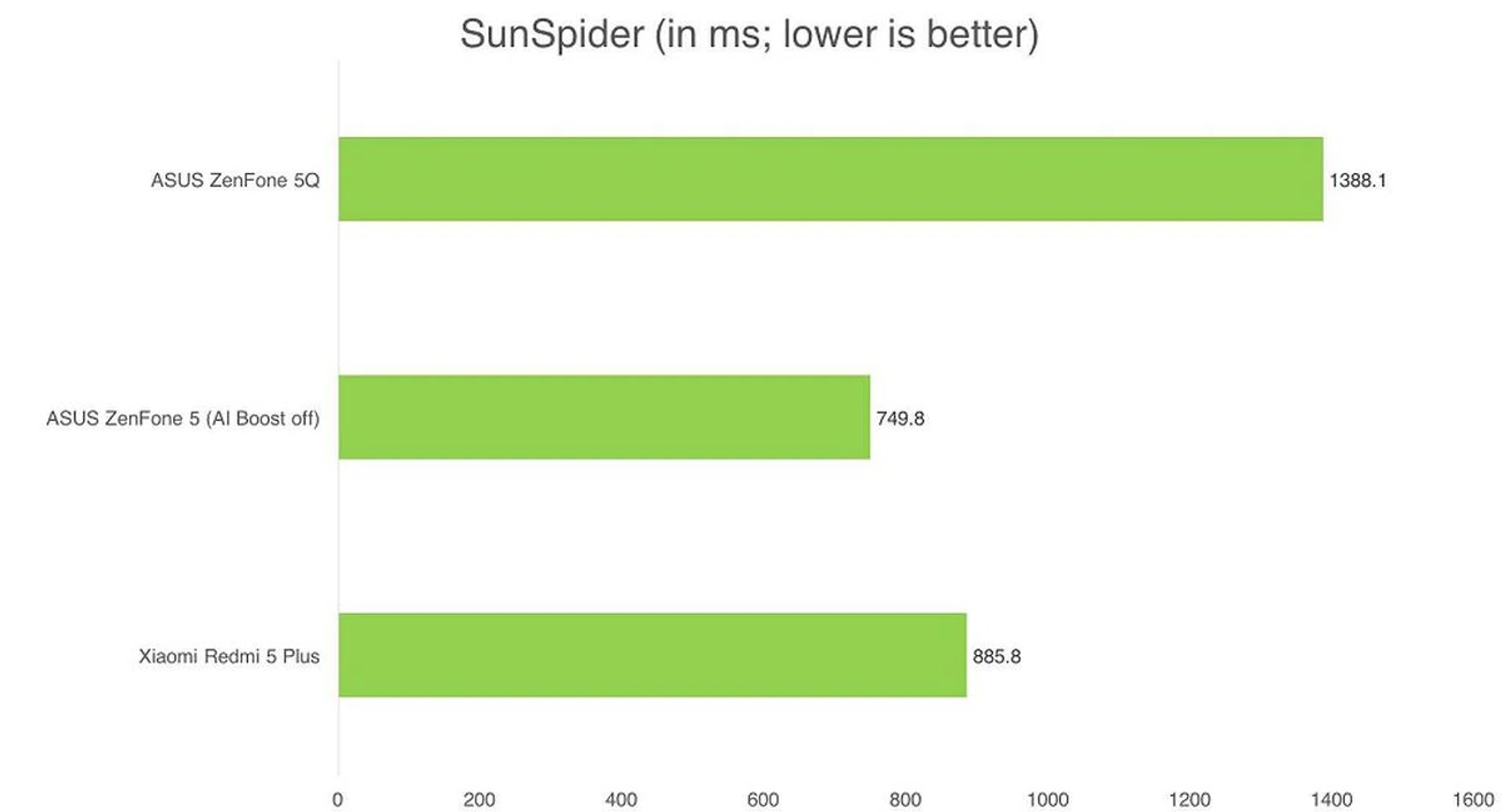
First up: SunSpider, which measures JavaScript processing performance. SunSpider takes into consideration not just the underlying hardware performance, but how optimized a particular platform is in delivering a high-speed web browsing experience. Shockingly, the 5Q isn’t even close to the 636-powered ZenFone 5; it’s actually some distance from even the 625-powered Redmi 5 Plus. One wonders if slow RAM is to blame:
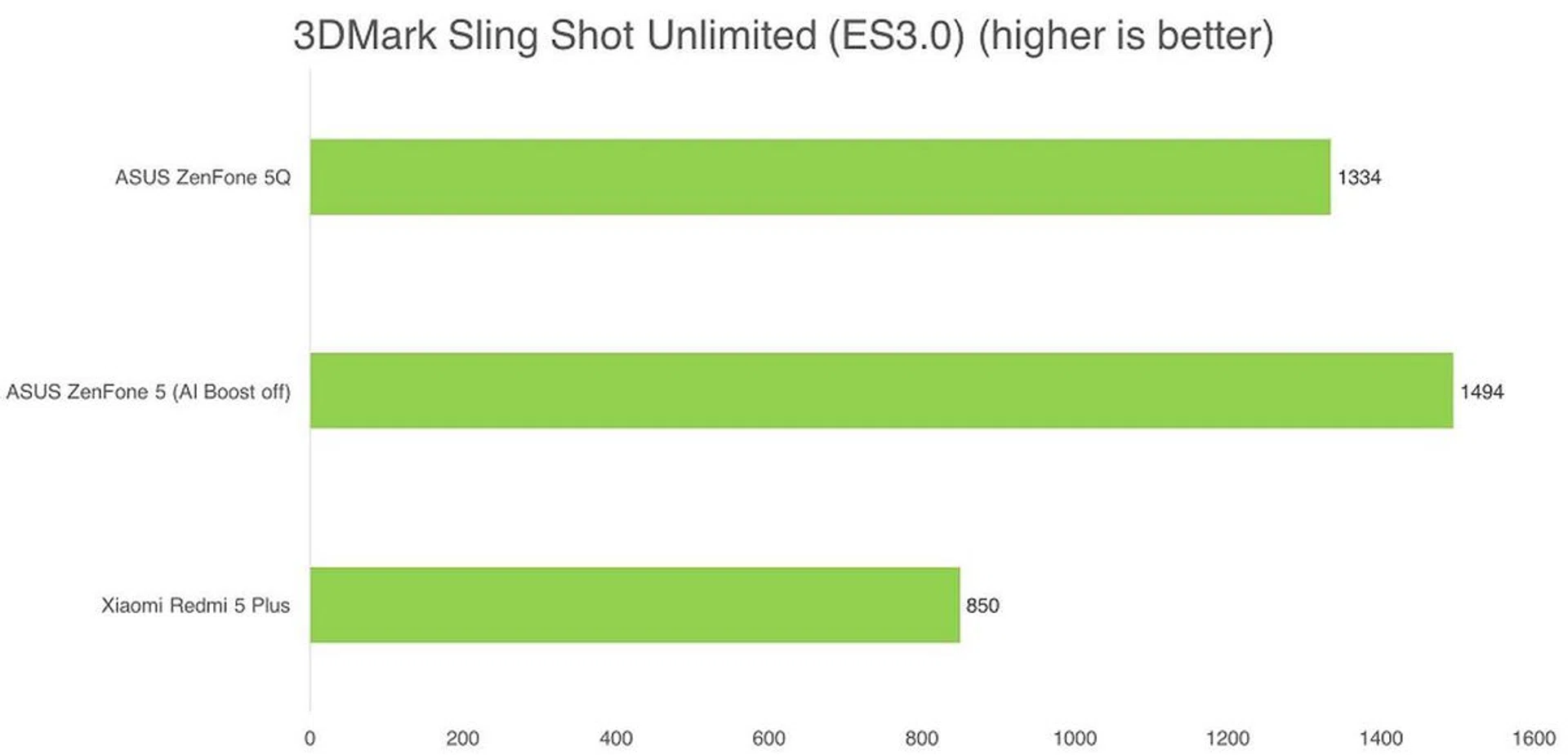
3DMark Sling Shot Unlimited 3.0 uses a mix of graphics and physics tests to measure hardware 3D performance. Qualcomm claims the Adreno 508 GPU in the Snapdragon 630 is 30% faster than “prior generation” devices. We’re guessing this means the Snapdragon 625/Adreno 506 combo in the Redmi 5 Plus going by our findings:-
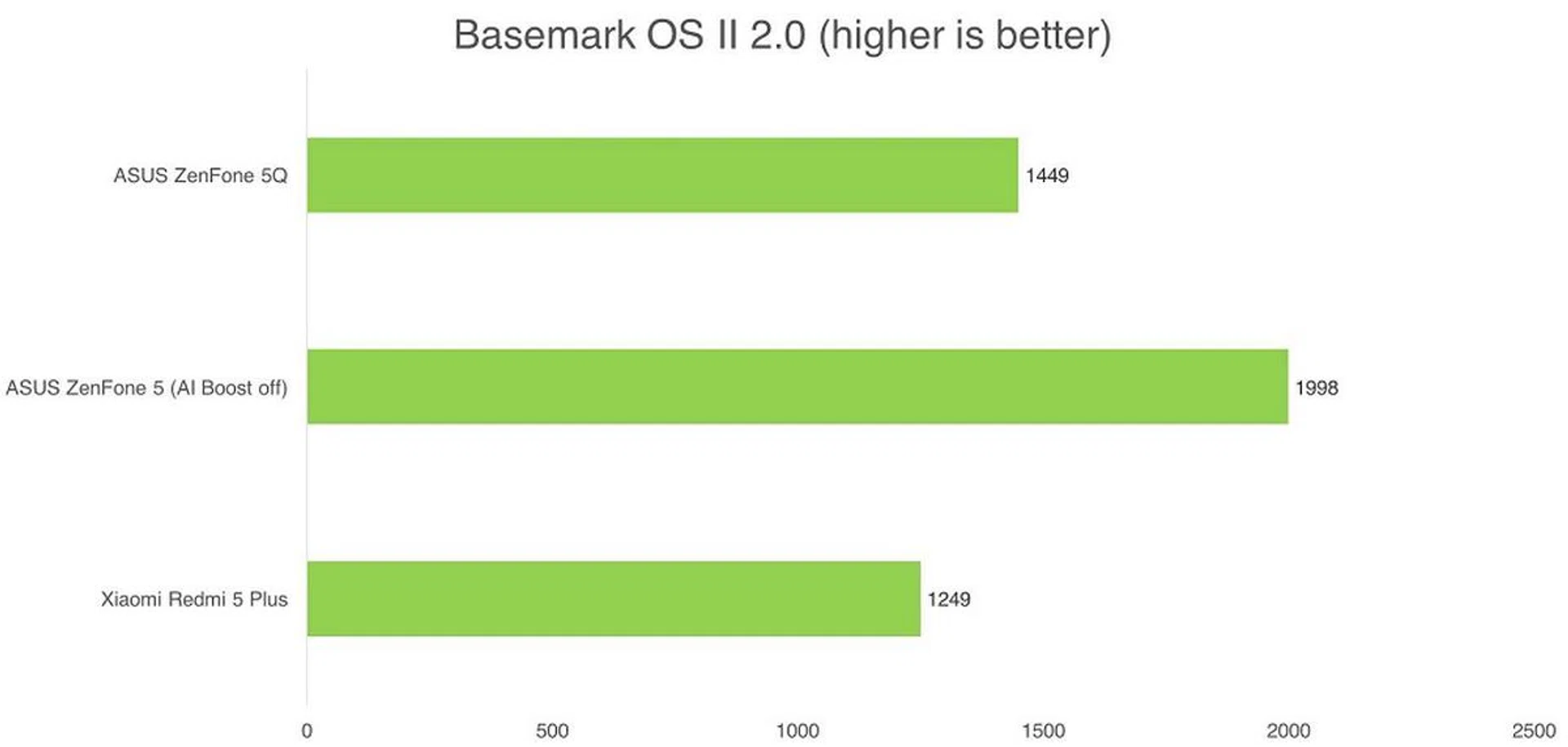
BaseMark OS measures overall system performance over a number of different metrics. The ZenFone 5Q only manages to edge out the Redmi 5 Plus by 200 points, yet the gap between it and its more luxurious cousin is much bigger:-
Finally, here’s our standard battery test, which involves:
- Looping a 720p video with screen brightness and volume at 100%
- Wi-Fi and Bluetooth connectivity turned on
- Constant data streaming through email and Twitter
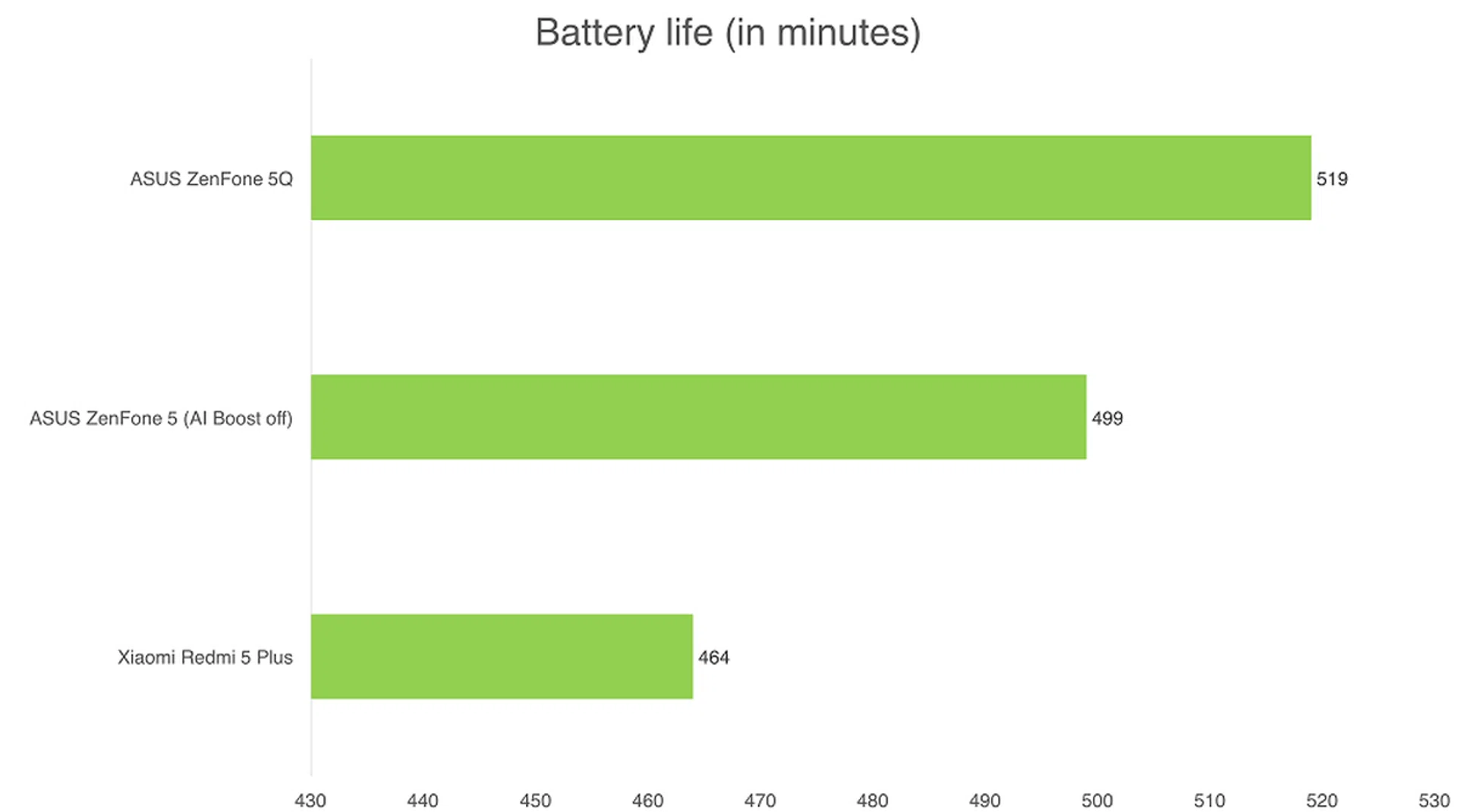
Now for the second big surprise of the day. Given that the 5Q has only a 3,300mAh battery, we expected it to be handily pipped by the Redmi 5 Plus, which has a larger 4,000mAh juice pack.
But no, the tables have been turned! The 5Q lasts almost an hour more than the Xiaomi!
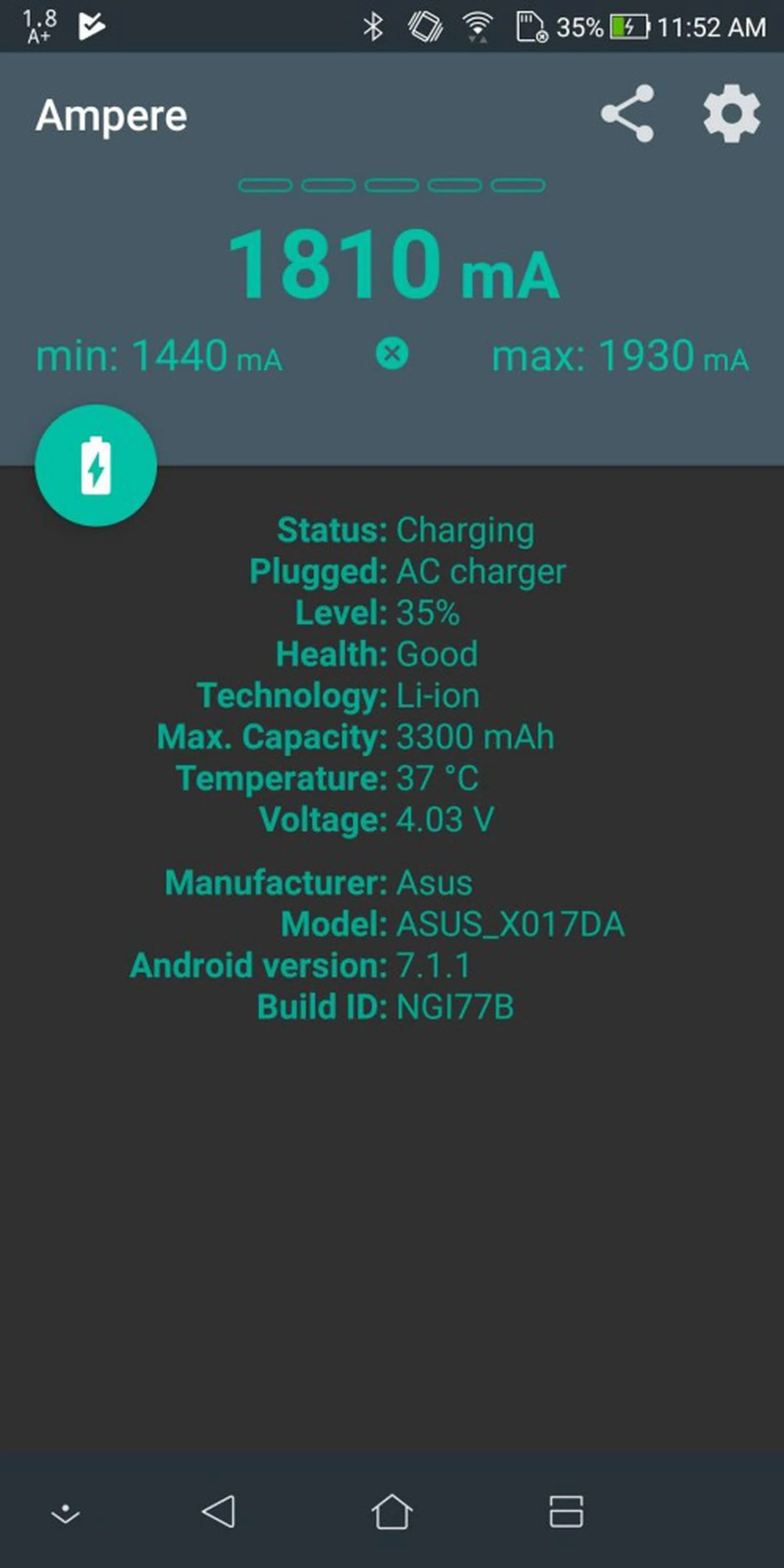
In day-to-day use, the 5Q was certainly also able to power comfortably through an entire workday, and better yet, while it doesn’t appear to support any form of fast charging, a quick and dirty test seemed to confirm otherwise, with currents peaking at almost 2 amps on a Qualcomm Quick Charge 2.0 charger:-
Camera Performance
It’s a generally reliable observation by now that for cameras on mid-range phones, the lower down in the range, the higher the megapixel counts tend to be. Of course the main shooter of the ASUS ZenFone 5Q would be a 16-megapixel unit, backed by an 8-megapixel wide-angle “120-degree” lens (we don’t understand why no manufacturer wants to describe this as the 35-mm equivalent focal length instead) which also doubles up as a depth sensor for bokeh.
The camera UI is the same as the ZenFone 5’s, which is to say, logically laid out and pretty easy to understand:
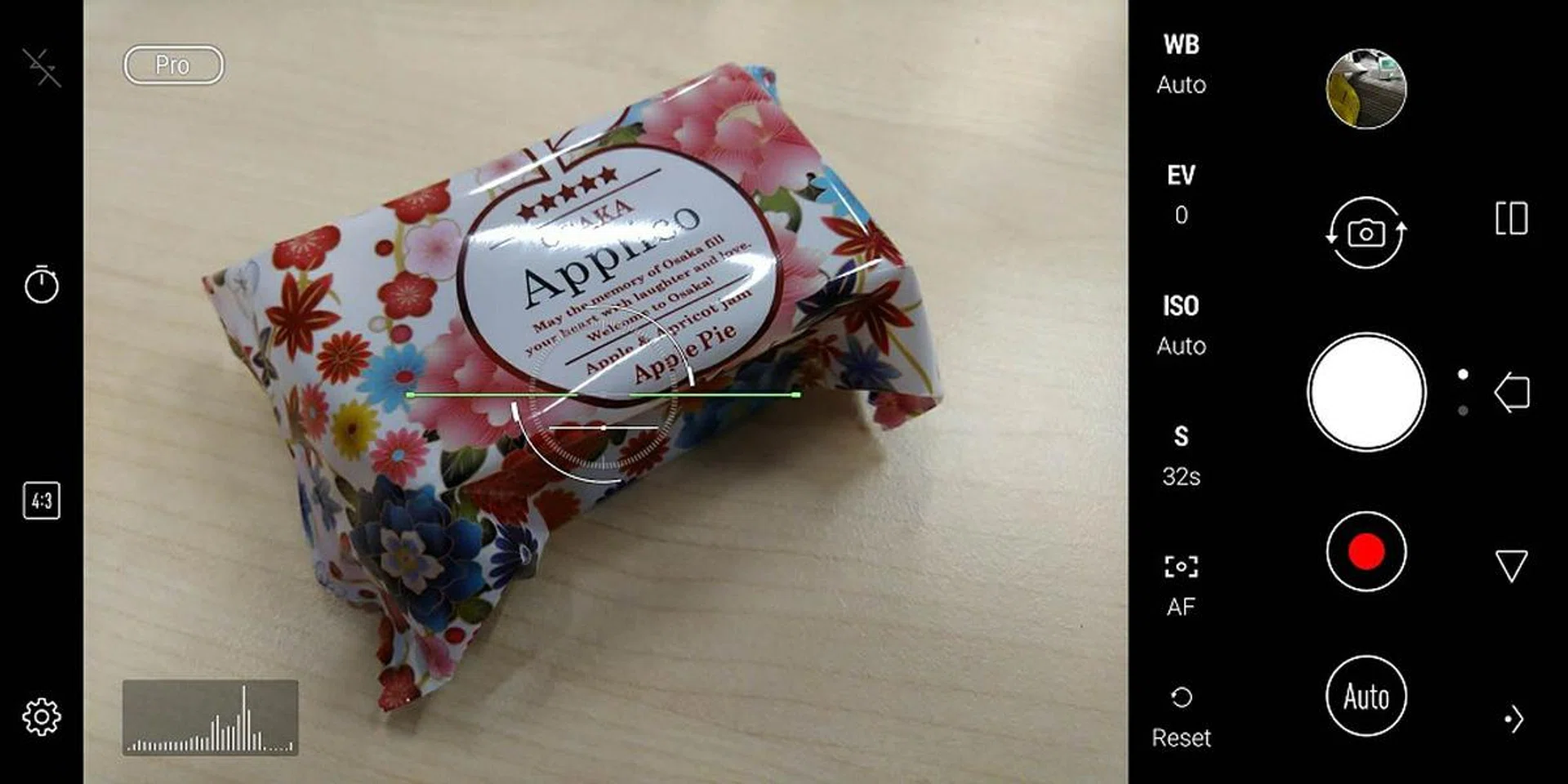
And that’s still true even in Pro mode.
At this price point, crushed shadows or blown highlights are inevitable to some extent. ASUS appears to have taken the former route, but the images are a bit too contrasty. In landscape shots, for example, the results are quite muted in terms of tone and color:-

Main 16-megapixel camera.

120-degree wide 8-megapixel camera. Notice the shift in default white balance.
This ASUS phone does reasonably well indoors, with the 16-megapixel strategy providing decent detail along with nice (but contrasty) colors:-


However, when the lights go down, the relatively outdated f/2.0 aperture creates problems for the main shooter, which does a commendable job of hanging on to colors, but can’t do much about the lack of OIS:-

While ASUS deserves praise for putting in a full complement of “pro” settings, including shutter speed (Samsung, it’s really time to do something about your Galaxy A range!), using these is a somewhat bittersweet experience. On the one hand, being able to lower the ISO greatly overcomes the inherent light-gathering weakness of a high-megapixel sensor like this one. But on the other, it means certain situations actually require the Pro mode to get by - shooting in Auto would result in images that are hard to use.
Here’s a rather nice long exposure (about 1 second) at the lowest ISO of 100:-

However, the same shot on the wide-angle camera, which can’t benefit from the Pro mode settings, is markedly different:-

Bye-bye shadow detail!
We’ve also included two images in Auto mode to show you how detail drops off as the ISO is raised:-

At ISO 1,000, the images are still Instagram-worthy…

...but we’re not sure why ASUS even bothered with ISO 2,000.
Actually, in some situations, the ZenFone 5Q has the audacity to raise the ISO on the main shooter as high as 3,000 (gasp), which results in shots Georges Seurat would really have liked:-

Some of you will be coming to the party for the ZenFone 5Q’s front 20-megapixel shooter. Truth be told, it’s just serviceable:

Saved by HDR.
The camera comes with a selfie LED flash, which puts out a rather ”pointy” beam of light and is therefore not very useful:-

We should really warn people not to read our reviews when eating.
Want to steal the ZenFone 5’s thunder? Get in the Q.
ASUS has been putting out some great stuff lately, but the ZenFone 5Q is difficult to recommend compared to its sexier cousin. Why? Once again, as with a couple of phones we’ve reviewed this year, poor pricing strategy rears its ugly head: The ZenFone 5 is priced at S$488, while the 5Q is just $20 cheaper.
The thing is that the ZenFone 5 offers a lot of phone for the money. While its iPhone X-cloning design does look highly unoriginal, it certainly looks good (some might even say premium.) It also has a faster processor, a more vibrant and contrasty display that’s awfully close to OLED screens in quality, vastly better-sounding speakers, and, not least, a better camera than the 5Q.
The ZenFone 5Q, on the other hand, is a “safe” design for a segment that relies on safe choices. It lacks a notch (which in itself is not a bad thing) - but this alone brings up mental images of phones that cost less, of which there are quite a few. Add to this an older version of Android and so-so all-around performance, and it quickly drops to near the bottom of any decision matrix.
Quad cameras are nice to have, but imaging quality is only serviceable.
So what do we advise? It’s simple. If you’re looking for a ZenFone 5Q, go into a shop and ask for a ZenFone 5 (the 2018 one, of course).
The ZenFone 5Q has met the enemy, and it is a ZenFone.