
ASUS EN8800GTS TOP (GeForce 8800 GTS 512MB)
The rumors about its existence have been around since the GeForce 8800 GT hit the market but now, it's finally here. The new, revised GeForce 8800 GTS based on the G92 core is now available and we take one of the fastest incarnations available from ASUS for a spin. Details inside!

The New & Improved GeForce 8800 GTS
The original consensus regarding NVIDIA's new G92 core has been a unanimous thumbs up. That was when reviewers like us finished testing the G92 based GeForce 8800 GT with a broad smirk on our faces. It was fast, it was hot and unfortunately it sold faster than hotcakes. As frustration sets in from the many shortages of the GeForce 8800 GT in retail channels, resulting in higher prices than the initial launch price, our positive feeling for it has slowly been tempered by these supply issues and a nagging suspicion that the NVIDIA GeForce 8800 GT at its original price was too good to be true after all.
Now, NVIDIA is once again promising another G92 product in the form of the revised version of the GeForce 8800 GTS. As most of you are aware, the outstanding performance of the GeForce 8800 GT has practically made the original GeForce 8800 GTS obsolete. Hence, rumors have long been circulating that the G92 would find its way eventually to the GeForce 8800 GTS. Finally, this is now a reality and we have in our hands, an overclocked, TOP edition of this new 512MB GeForce 8800 GTS from ASUS. Does having the G92 core restore the GeForce 8800 GTS to its proper place in the GeForce 8 hierarchy?
According to the released specifications, it would seem so. The standard GeForce 8800 GTS will be clocked at 650MHz, higher than the 600MHz on the GeForce 8800 GT. Memory clock is set at 1940MHz DDR, again higher than the 1800MHz on the 8800 GT. The stream processor clock is also higher for the GTS, at 1625MHz against the 1500MHz on the GT. What's more, the GTS will have the full complement of stream processors, 128 as compared to the 112 on the GT. With such specifications, this new GTS looks more like the caliber of a GeForce 8800 GTX, except for the rather 'trifling' matter of memory bandwidth, with the 8800 GTS having the same 256-bit bus as the GT. This gives it a total bandwidth of around 62GB/s, lower even than the original GeForce 8800 GTS and a fair distance from the GTX.
Of course, solely going by the memory bandwidth, even the Radeon HD 3870 has more than the new GeForce 8800 GTS. Whether this limitation on the GTS matters in today's games is hard to say, since we're not exactly convinced by the Radeon HD series despite their high memory bandwidth. Perhaps NVIDIA decided that higher clock speeds will compensate for it, even at high resolutions and settings.
Other important details that most of you should already know include the other benefits of the 65nm G92 core, from its support of the new PCIe 2.0 standard to the improved video processor (VP2) found onboard. If not, you can refer to our article on the GeForce 8800 GT and the G92. Before we examine our ASUS review unit in detail, here's a table summarizing the differences between the various high-end GPUs as compared to the GeForce 8800 GTS Version 2.
Model | NVIDIA GeForce 8800 GTS 512MB | NVIDIA GeForce 8800 GT 512MB | NVIDIA GeForce 8800 GTS 320/640MB | NVIDIA GeForce 8800 GTX 768MB | ATI Radeon HD 3870 512MB |
Core Code | G92 | G92 | G80 | G80 | RV670 |
Transistor Count | 754 million | 754 million | 681 million | 681 million | 666 million |
Manufacturing Process | 65nm | 65nm | 90nm | 90nm | 55nm |
Core Clock | 650MHz | 600MHz | 500MHz | 575MHz | 775MHz |
Stream Processors | 128 Stream Processors | 112 Stream Processors | 96 Stream Processors | 128 Stream Processors | 64 Shader Processors (consisting of 320 Stream Processing Units) |
Stream Processor Clock | 1625MHz | 1500MHz | 1200MHz | 1350MHz | 775MHz |
Texture Mapping Units (TMU) or Texture Filtering (TF) units | 64 | 56 | 48 | 64 | 16 |
Raster Operator units (ROP) | 24 | 16 | 16 | 24 | 16 |
Memory Clock | 1940MHz DDR3 | 1800MHz DDR3 | 1600MHz DDR3 | 1800MHz DDR3 | 2250MHz DDR4 |
DDR Memory Bus | 256-bit | 256-bit | 320-bit | 384-bit | 256-bit |
Memory Bandwidth | 62.0GB/s | 57.6GB/s | 64.0GB/s | 86.4GB/s | 72.0GB/s |
Ring Bus Memory Controller | NIL | NIL | NIL | NIL | 512-bit |
PCI Express Interface | PCIe ver 2.0 x16 | PCIe ver 2.0 x16 | x16 | x16 | PCIe ver 2.0 x16 |
Molex Power Connectors | Yes | Yes | Yes | Yes (dual) | Yes |
Multi GPU Technology | Yes (SLI) | Yes (SLI) | Yes (SLI) | Yes (SLI) | Yes (CrossFireX) |
DVI Output Support | 2 x Dual-Link | 2 x Dual-Link | 2 x Dual-Link | 2 x Dual-Link | 2 x Dual-Link |
HDCP Support | Yes | Yes | Yes | Yes | Yes |
Street Price | US$299 - 349 | ~ US$269 - 319 | ~US$289 - 449 | ~ US$449 - 529 | From US$249 - 279 |
The ASUS EN8800GTS TOP 512MB
What's immediately different about this ASUS EN8800GTS TOP and any standard GeForce 8800 GTS for that matter is that NVIDIA has gone back to a two-slot cooler, so it looks almost like the original GeForce 8800 GTS. There seems to be some slight modifications in the design but they are minor ones. For those concerned about noise levels, it is quiet even at full load and with the kind of clock speeds that the new GeForce 8800 GTS runs at, a two-slot thermal solution may be the prudent choice. After all, the heat on the single slot GeForce 8800 GT has been one of our chief grouses.
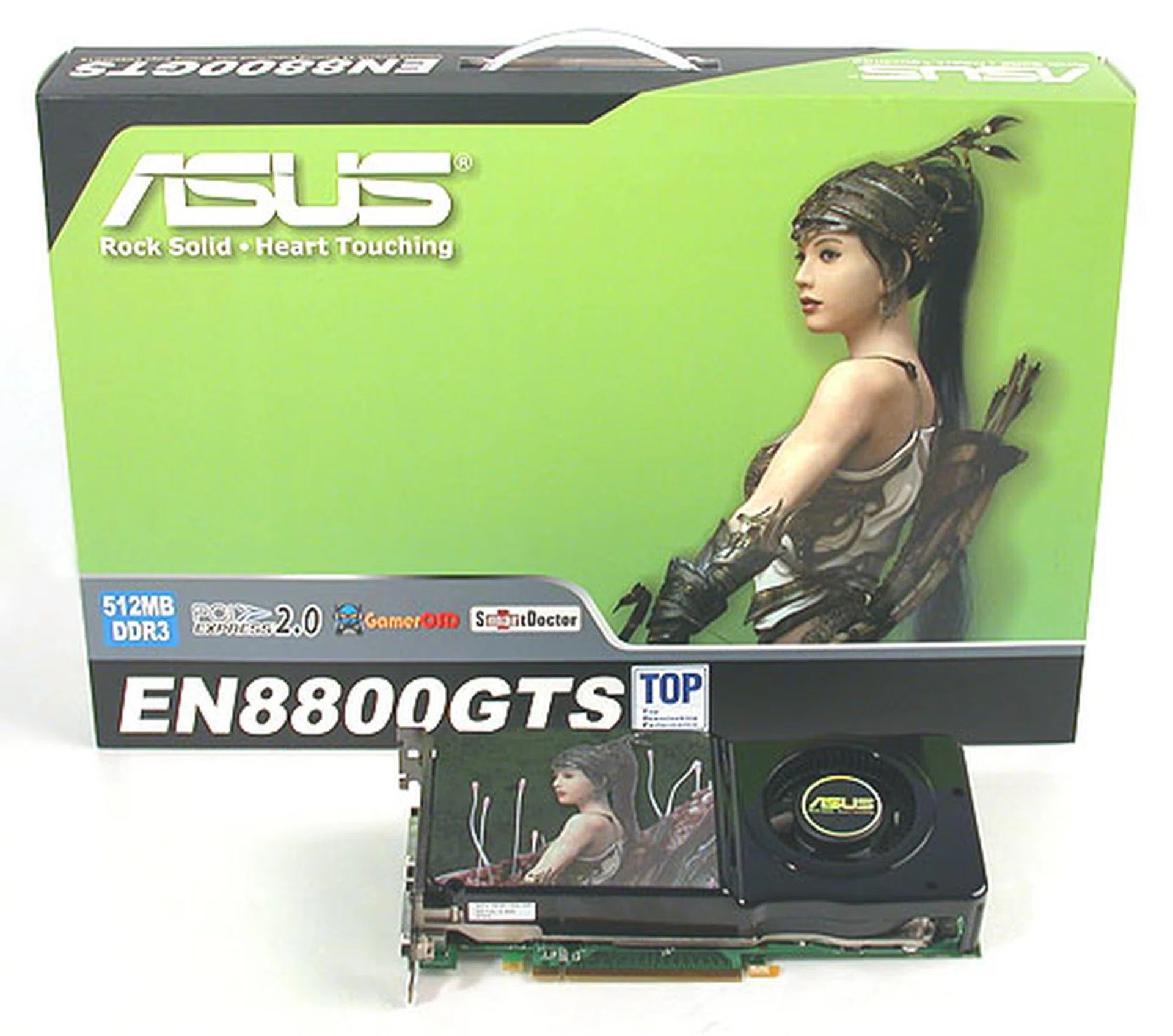
ASUS surprised us with this rather unattractive and generic looking package for its TOP edition.
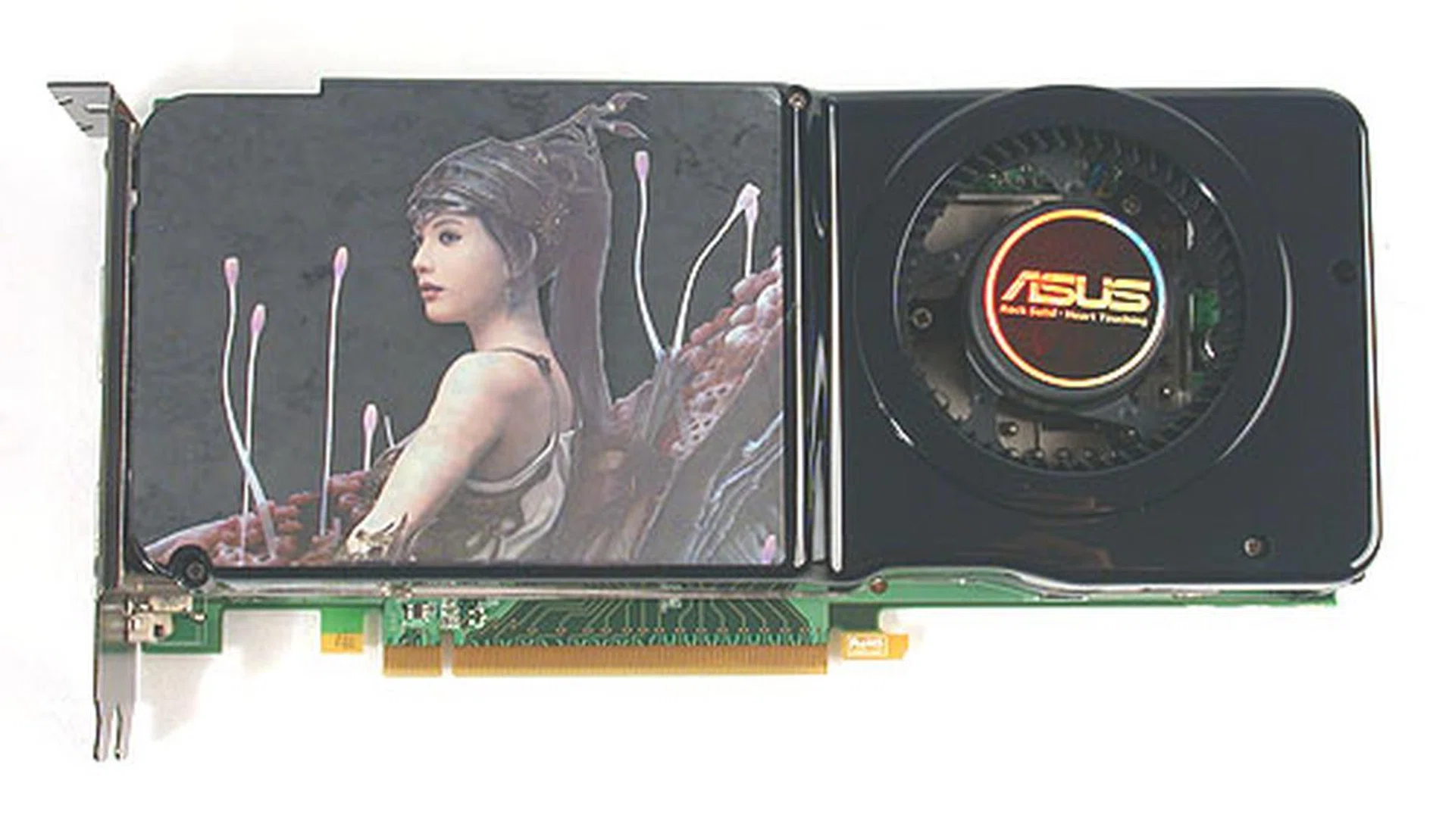
Besides the slightly different cooler used, the new GeForce 8800 GTS looks almost the same as the old one. Internally of course, that's another case.
Since this is the TOP Edition from ASUS, you'll expect even higher than usual clock speeds. The core is hence clocked at 740MHz and the memory has increased to 2070MHz DDR. It certainly sets the bar even higher in how much one can push the G92 core to. The stream processors have also been boosted to 1800MHz from the 1625MHz on the standard edition. It all makes for a very aggressive set of clock speeds, which will probably be reflected in benchmarks scores that may supersede the GeForce 8800 GTX, given that an overclocked GeForce 8800 GT already rivals it.
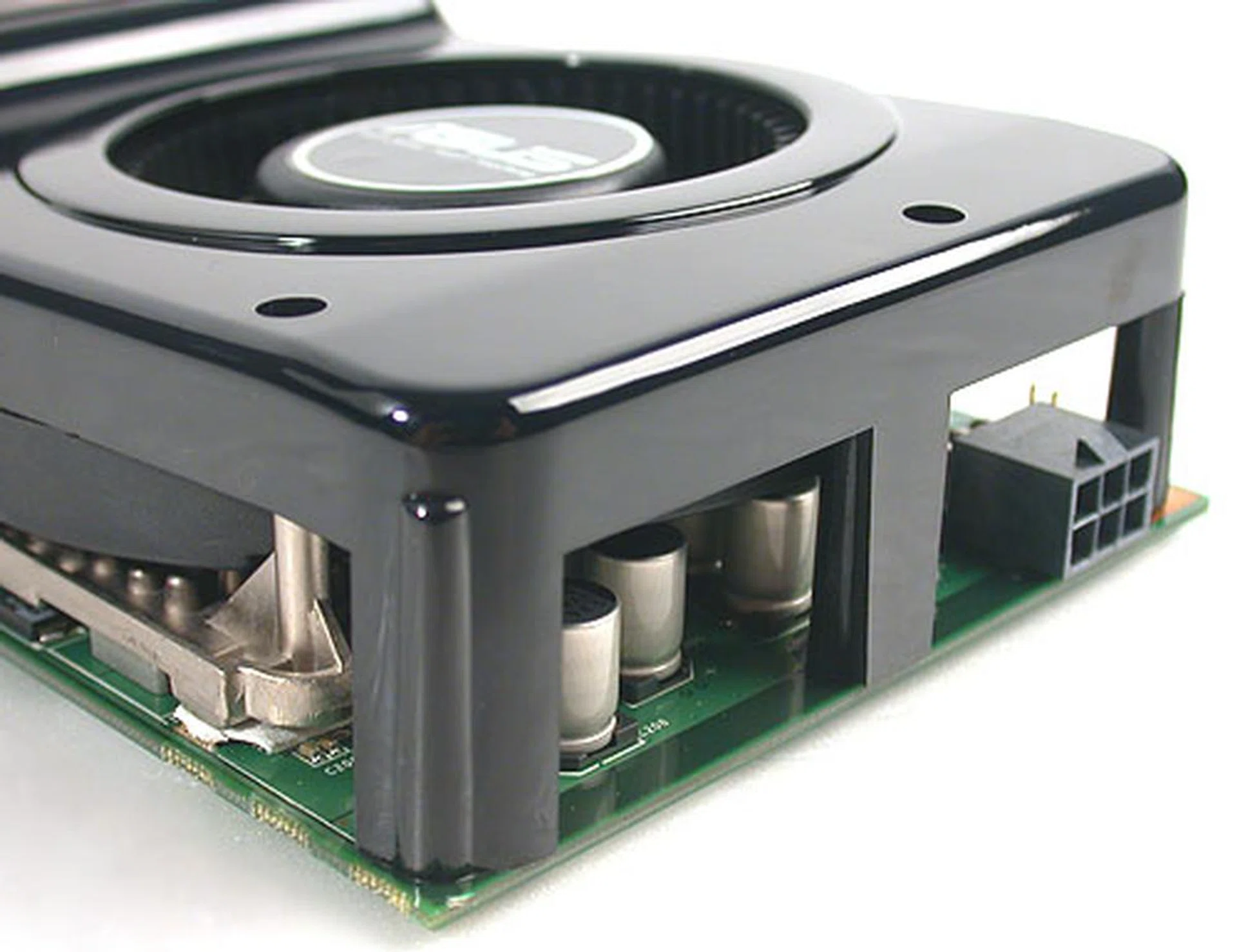
There is a slight elevation in the fan now, perhaps as a way to allow for greater airflow to the components hidden below?
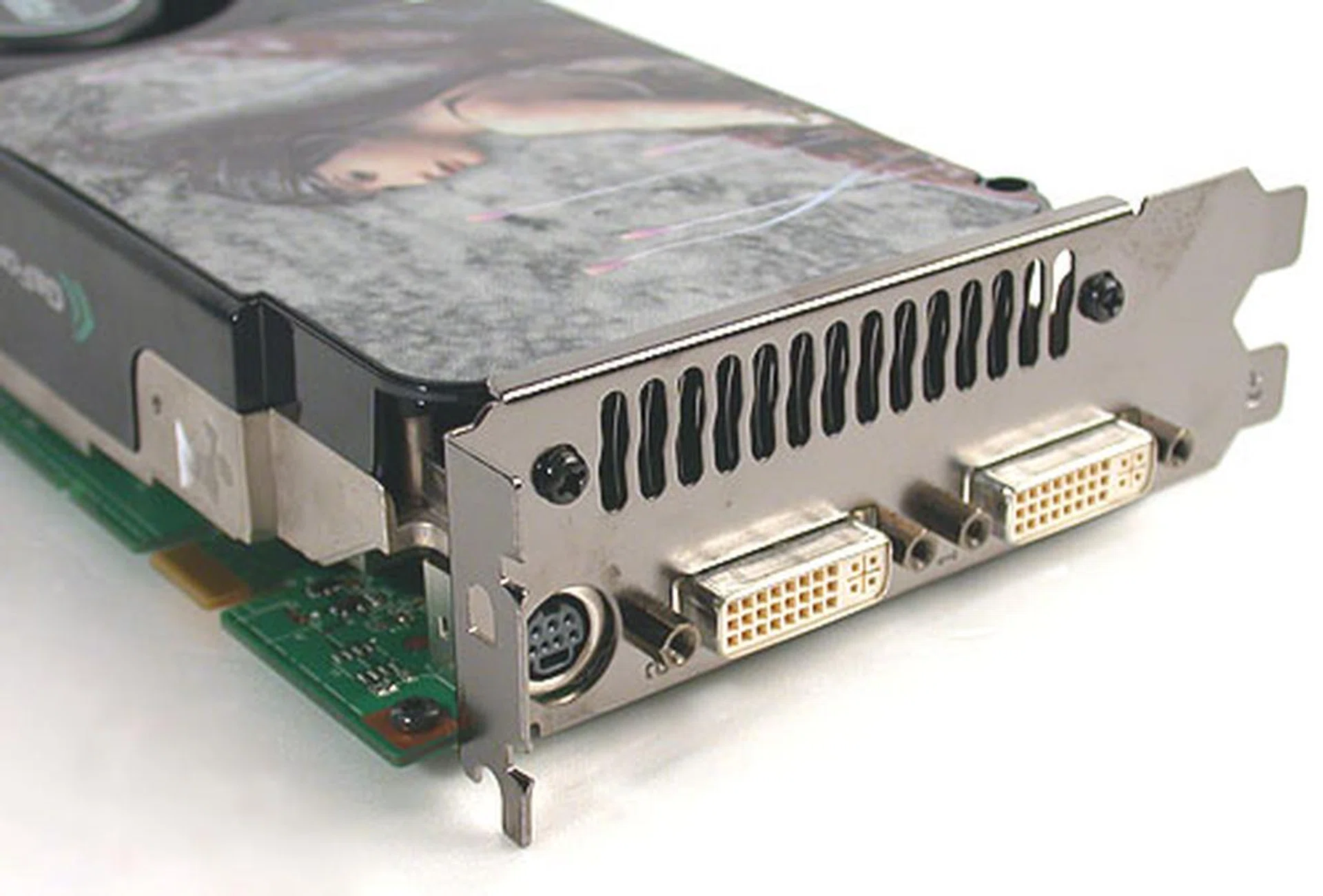
A standard complement of outputs. The new GeForce 8800 cards have only a single SLI connector, meaning if you're looking for quad SLI, you may need an older GeForce 8800.
As usual from ASUS, their package is bundled with accessories that some may deem superfluous. Surprisingly, there is no game included, unlike the Company of Heroes: Opposing Fronts that we found with its GeForce 8800 GT cards. Instead, what was inside the CD were the ASUS proprietary applications like GamerOSD and SmartDoctor, which are useful for those into tweaking game settings on the fly or need another application to overclock their card.
- 1 x DVI-to-VGA adaptor
- 6-pin Molex power connector
- 7-pin mini-DIN to Component cable
- Quick installation guide
- Driver CD
- CD Leather wallet
Test Setup
Like always, testing this ASUS EN8800GT TOP was done on an Intel Core 2 Duo powered system, with a E6700 (2.66GHz) processor, an Intel D975XBX 'Bad Axe' motherboard and 2GB of low latency DDR2-800 HyperX memory from Kingston. The hard drive is a Seagate 7200.7 and Windows XP Professional with Service Pack 2 and DirectX 9.0c remains our operating system of choice for now.
The ASUS EN8800GTS TOP was using a modified version of NVIDIA's ForceWare 169.02 drivers and the same too was applied for the ASUS EN8800GT TOP that we chose as our GeForce 8800 GT representative (since both cards are overclocked TOP editions). We also included the GeForce 8800 GTX and the 320MB of the GeForce 8800 GTS, both using the older 158.19 drivers. The new Radeon HD 3870 was added to the fray so that readers can see where it stands.
The following benchmarks were tested using their built-in time demo or benchmarking tools, though we did not have all the results yet for some of the older cards at the time of publishing:
- Futuremark 3DMark06 (ver 102)
- Company of Heroes (ver 1.3)
- F.E.A.R (ver 1.0)
- Supreme Commander (patched to 3255)
- Crysis
- Unreal Tournament 3 Beta Demo
Results - 3DMark06 (ver 1.2)
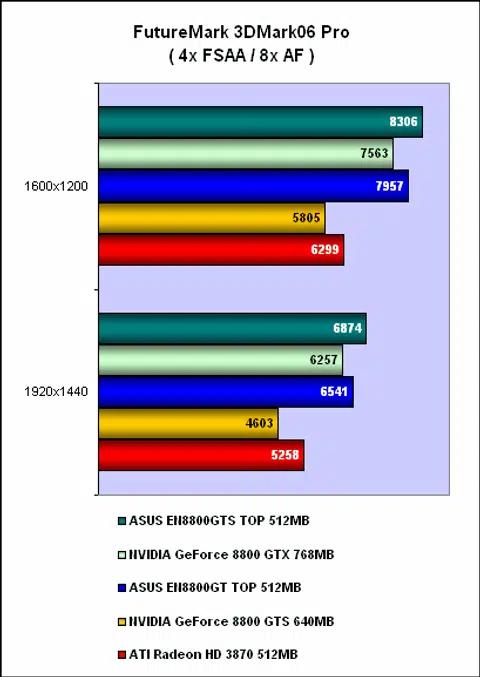
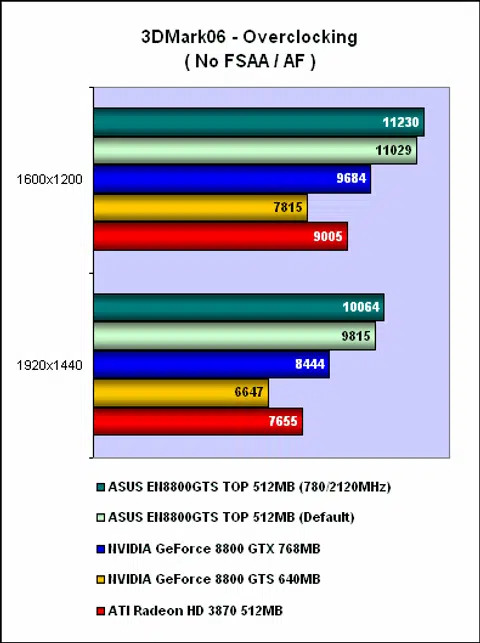
The results that we got for 3DMark06 is the perfect example of the relentless progress in the technology sector. The new products that appear on the market are invariably faster and better than the ones that they replace and how many other industries can say that for sure? As these two graphs illustrate, both the overclocked ASUS TOP editions are faster than the GeForce 8800 GTX, showing that the G92 core is indeed the way forward, at least till the next gen core. No doubt, the slightly older 158.19 drivers on the GeForce 8800 GTX and the original GeForce 8800 GTS did not help but even discounting it, there's no question that consumers should only be looking at a G92 card from now on.
A closer look at the anti-aliasing enabled results showed that the superior bandwidth of the GeForce 8800 GTX do matter to a certain extent. There is a 13 - 16% difference between the ASUS EN8800GTS TOP and the GeForce 8800 GTX without anti-aliasing but this was reduced to slightly less than 10% when anti-aliasing came into play. We'll have to see if this happens in other games but this affects the similarly 256-bit GeForce 8800 GT too, though the fact that the overclocked speeds more than makes up for it, should sway the argument for the G92 cards. Meanwhile, ATI's Radeon HD 3870 looked out of the running and going by its scores, should make suitable companions with the older and slower GeForce 8 cards instead. For reference to the performance of a standard GeForce 8800 GT, you can use the GeForce 8800 GTX as a ballpark (which is why we've omitted adding more graphs of similar performance levels) or refer to our previous article for the exact results.

Results - Company of Heroes & F.E.A.R
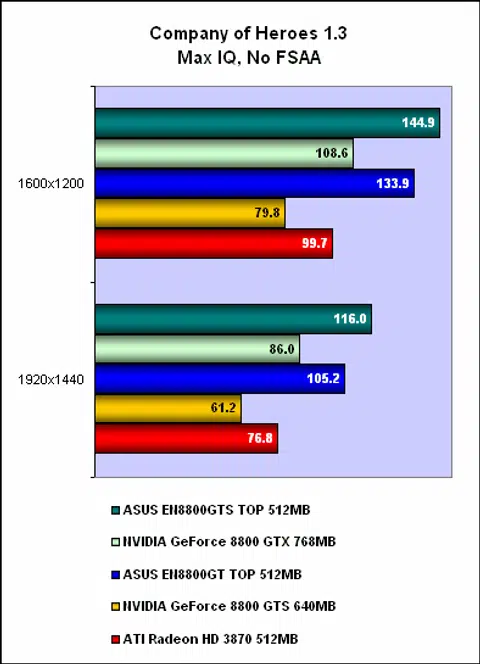
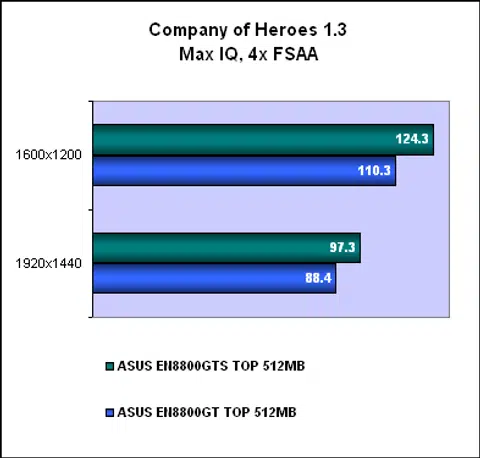
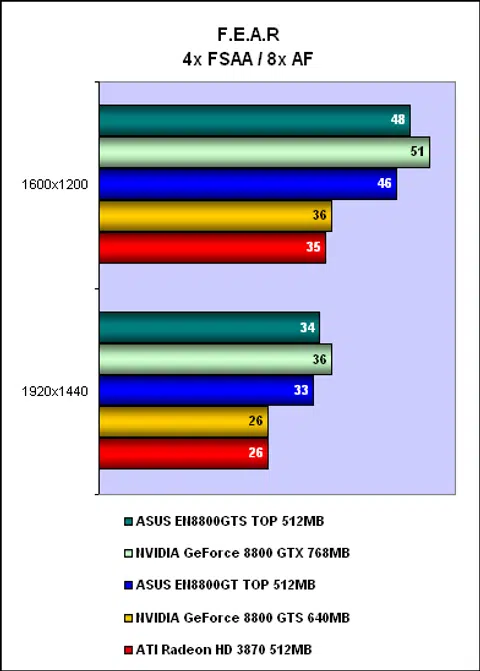
Again, we have to make excuses for the performance of the GeForce 8800 GTX as a matter of its drivers but we doubt that would fly. The facts are simply this: the overclocked G92 cards are just too fast. The ASUS EN8800GTS TOP for instance, got very impressive numbers for Company of Heroes and while we only had the results for the two G92 cards to compare for the anti-aliasing portion, they were all rather high frame rates even at these resolutions.
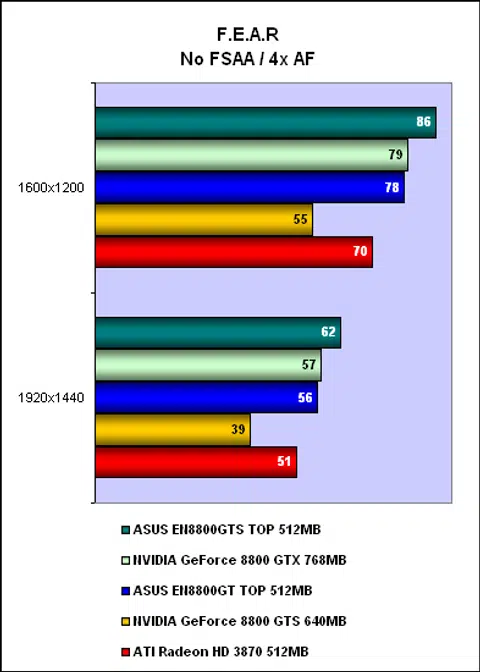
F.E.A.R was less impressive however, as the GeForce 8800 GTX showed that it still had a place, albeit only when anti-aliasing was enabled. This looks to be the trend, with the GTX excelling only in certain situations and hence, relegating it into a niche product for those requiring the highest resolutions and settings (and perhaps the only route to 3-way or Quad SLI)
Results - Supreme Commander
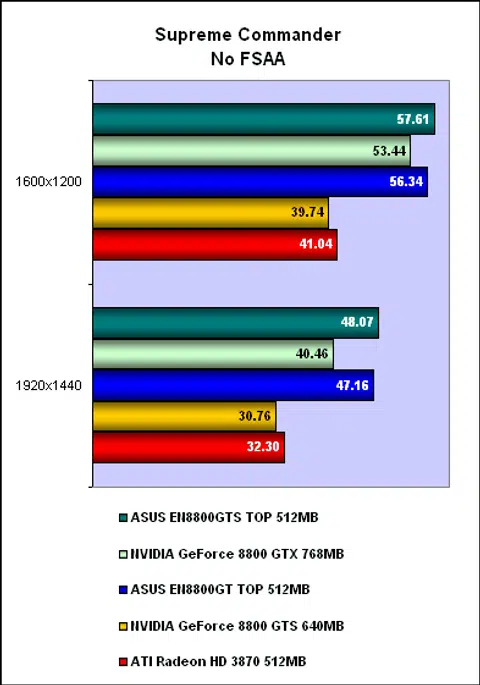
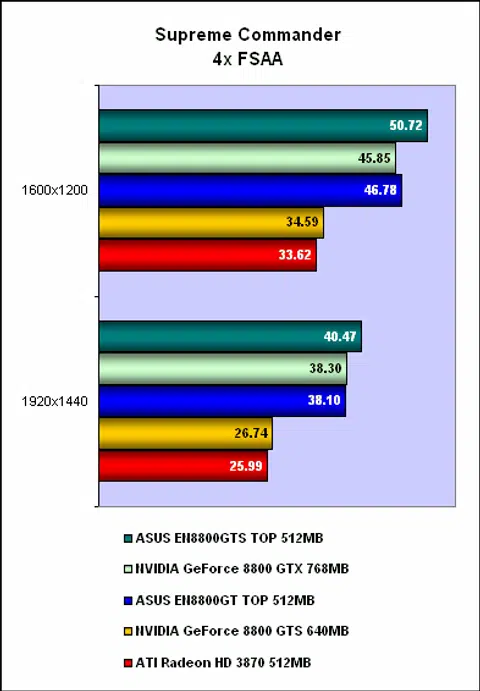
In Supreme Commander, the overclocked GeForce 8800 GTS retained its lead, trailed closely by the overclocked GeForce 8800 GT. This time, even with anti-aliasing, the GeForce 8800 GTX was unable to bridge the gap and it was only roughly on par with the ASUS GeForce 8800 GT Top Edition. As for the original GeForce 8800 GTS, it's evident why we have dismissed it in the light of the new competitors.
Results - Unreal Tournament 3 Demo & Crysis
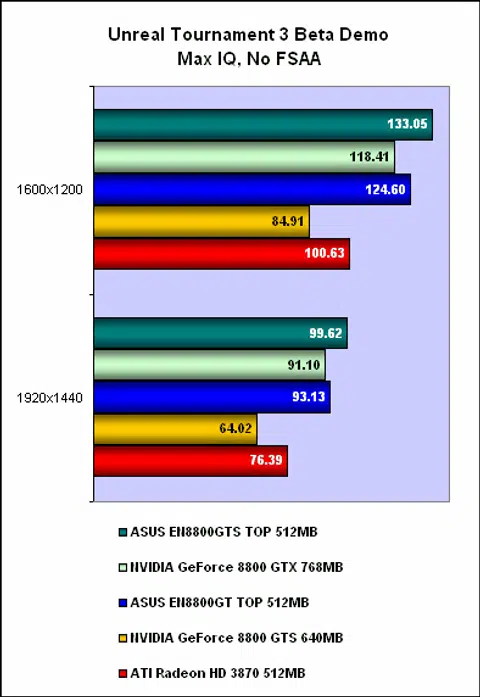
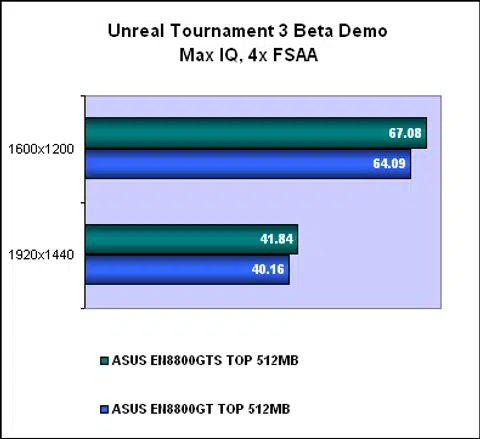
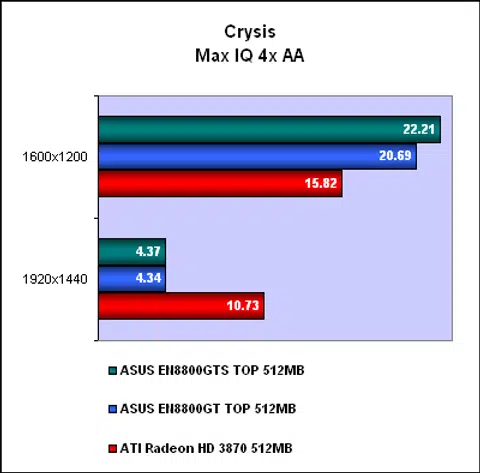
The ASUS EN8800GTS TOP came out equally strong in Unreal Tournament 3 demo and Crysis, though the two games could not be more stark in terms of scores. While Unreal Tournament 3 looked playable even with relatively modest hardware, Crysis will bring down the best with its settings at maximum. Without anti-aliasing, the frame rates we got were around 30 frames per seconds at 1600 x 1200 and it got worse from then on. Note the weirdly low frame rates on the NVIDIA cards at 1920 x 1440 for which we highly suspect that it is a driver related issue. We'll soon sort that out as newer drivers are released.
Temperature Testing
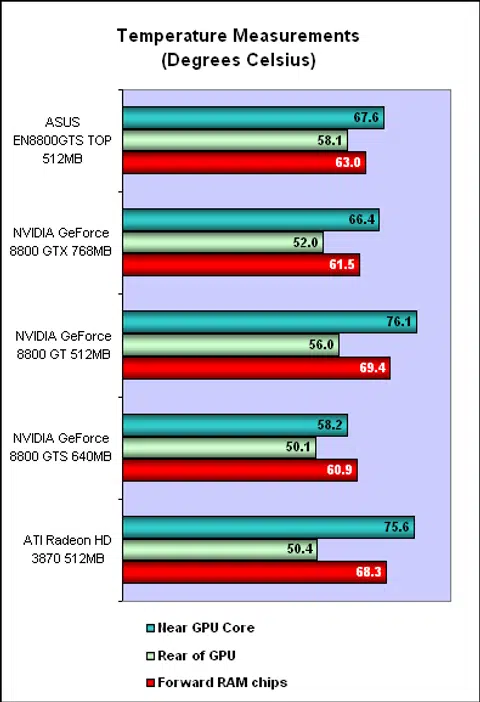
The decision to go with the two-slot cooler paid off for NVIDIA as even the overclocked ASUS TOP was well below the high temperatures on the GeForce 8800 GT. The ASUS EN8800GTS TOP is not exactly the coolest of the lot however: that went to the original GeForce 8800 GTS. At least, with temperatures and noise that are comparable with the GeForce 8800 GTX, this card will not raise red flags among enthusiasts looking for silent and cool graphics cards.
Power Consumption
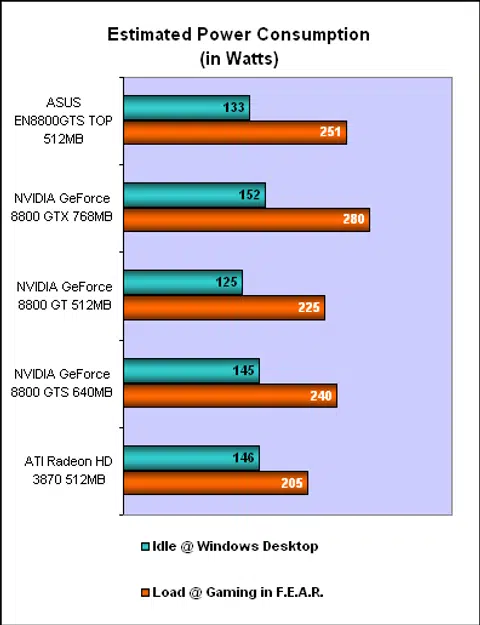
Given its higher clocks and the presence of the full 128 stream processors, the ASUS EN8800GTS TOP unsurprisingly drew more power than the GeForce 8800 GT. At idle however, it was only slightly more than the GeForce 8800 GT, though at full load, it was notably lower than the original GeForce 8800 GTX. It won't win any awards for saving energy but neither will it be a power hog.
Overclocking
With its already high clocks, it's never an easy task to squeeze more from the ASUS TOP edition graphics cards and it was no different with the EN8800GTS TOP. We did manage to get it to 780MHz for the core and 2120MHz DDR for the memory. That only brought about a minor 2% improvement in 3DMark06 and of course, further extends its lead over the other cards by that small margin.
Conclusion
As the saying goes, once bitten, twice shy. And that is the reason behind our guarded optimism to the new GeForce 8800 GTS from NVIDIA. The performance has been up to our expectations if not as spectacular as the initial G92 debut. It is only a slight increase in scores over the GeForce 8800 GT. However, if you take the entire GeForce 8 series in perspective, it means the GeForce 8800 GTS has most likely usurped the position held by the GeForce 8800 GTX. It is superior to the older card not just in performance but in features too. Only the insanely expensive Ultra remains a slight notch above the new GeForce 8800 GTS and that's not mentioning the predictably overclocked versions.
But our concerns are not just about the performance and includes the long term supply of these popular G92 graphics cards. With so many SKUs from NVIDIA utilizing this core (GeForce 8800 GT 256/512MB, GeForce 8800 GTS), would NVIDIA be able to meet the expected demand, especially with the crunch holiday season almost here?
Before the launch of the GeForce 8800 GT and its supply problems, we had no such worries. Now, we are not that sure and given the attractive price tag of around US$299 - 349 for the new GeForce 8800 GTS, we are just not completely convinced. Do bear in mind that the GeForce 8800 GT is priced in retail only about US$30 less. Would we see prices soar after the initial batches like the GeForce 8800 GT? That's something we can't really answer. Does it mean you should grab one immediately if you see it selling at its launch price? That is a definite yes. Again however, you would have to consider the minimal performance gain of a standard GeForce 8800 GTS 512MB over the standard GeForce 8800 GT 512MB, and we've seen the same small performance delta between both TOP editions from ASUS too.
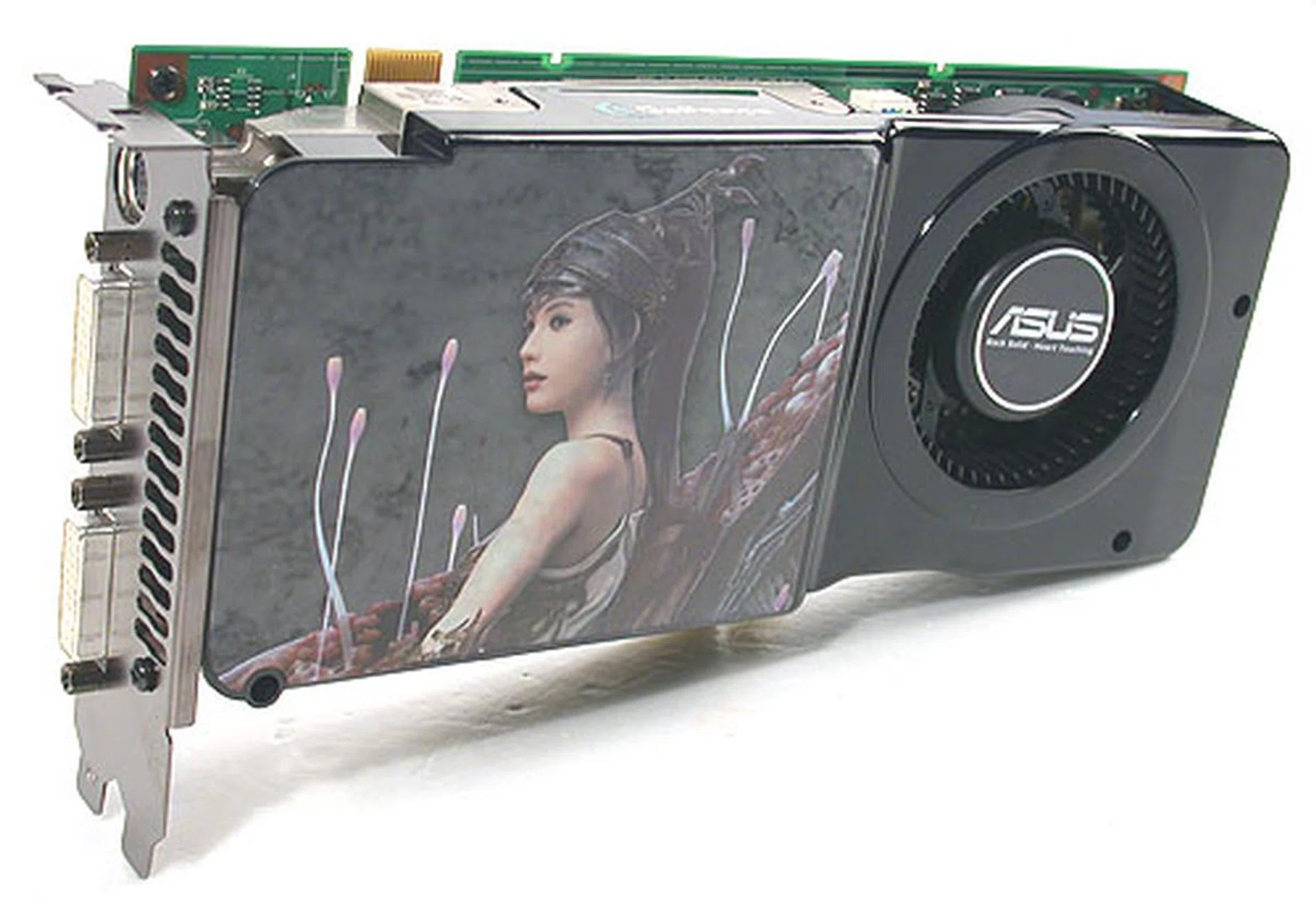
Despite its high clocks, we get the impression that the ASUS EN8800GTS TOP is not the company's best effort and not the equal of the ASUS EN8800GT TOP in terms of the overall package.
As for the ASUS EN8800GTS TOP, the rather generic nature of its bundle and package as compared to the ASUS' GeForce 8800 GT TOP Edition, makes us wonder if ASUS had to cut some corners in order to get this product out on time. It didn't give us the lavish impression that comes with an ASUS 'TOP' edition. Here's to hoping that it won't be that much a premium over the standard GeForce 8800 GTS, given its relatively ordinary bundle. We have no word about the official retail price yet but it would probably be along the prices indicated by NVIDIA, at least for the initial batch. Subsequently, we aren't too sure about market fluctuations. If you're looking for a card that runs cooler than the GeForce 8800 GT, overclocks better and more importantly, may actually be found on the retail shelves, then the new, revised GeForce 8800 GTS is a more than worthy successor to its name.
Our articles may contain affiliate links. If you buy through these links, we may earn a small commission.