
ASUS EN7600GS TOP Silent (GeForce 7600 GS 512MB)
The GeForce 7600 GS has remained in the shadow of the faster GeForce 7600 GT. Then NVIDIA introduced the GeForce 7300 GT which, depending on its clock speeds, posed a competitive threat. To stay relevant, ASUS has a new bolstered GeForce 7600 GS but can it reverse the tide like its unique Reverse Cool system?

Forgotten and Forsaken
With the entry of its GeForce 7300 GT, NVIDIA attempts to bridge the differences between its low-end GeForce 7300 and the mid-range 7600 series. From a consumer's point of view, having more options is almost always preferred so such a move should be welcomed. To get a handle on its capabilities, know that the GeForce 7300 GT uses the same G73 core as the GeForce 7600 series, with a slight handicap of having four pixel pipelines disabled. NVIDIA has broadly painted the hardware specifications for the GeForce 7300 GT, leaving the implementation details to its manufacturing partners. This has thrown up some surprises, such as the , which takes advantage of some very extreme clock speeds to perform way above expectations. In fact, it is faster than the GeForce 7600 GS, the lesser pair of GeForce 7600 cards in the series.
Since it was launched together with the faster GeForce 7600 GT, the GeForce 7600 GS has been overshadowed by its more powerful compatriot. A quick glance at the market reveals more models and variations for the GeForce 7600 GT. Both vendors and consumers alike seem to have arrived independently at this preference for the faster product, aided by the initial price of US$199 for the GeForce 7600 GT, which probably hits the sweet spot for those looking for a mid-range graphics card. Many potential buyers of the GeForce 7600 GS probably felt more comfortable topping up their budget slightly for the GeForce 7600 GT instead.
However, not all vendors have given up on the GeForce 7600 GS yet. ASUS at least has made quite an effort to bring to market a rather unique version of this GPU. Its latest EN7600GS TOP Silent is overclocked (like so many other graphics cards now) and it also comes with its special Reverse Cool system with a passively cooled heatsink and up to 512MB of DDR2 memory. Intrigued? Well, we were very interested to know if this enhanced GeForce 7600 GS could stand up against the challenge of the best GeForce 7300 GT cards so we promptly put it to the test:
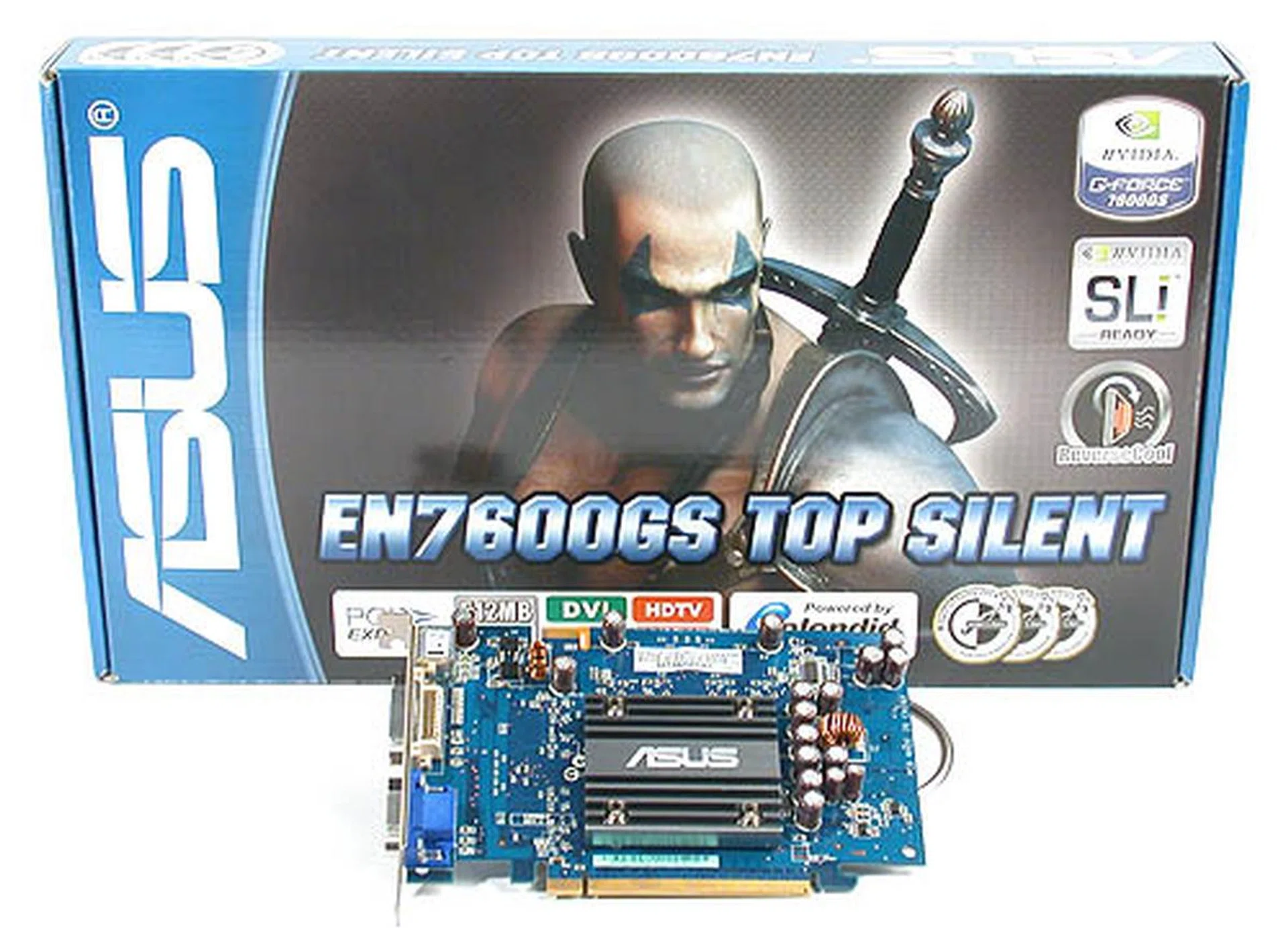
ASUS' latest silent cooler uses an unique 'Reverse cooling' system where the GPU, memory chips and the heatsink are found on the other side of the PCB compared to the usual arrangement.
The ASUS EN7600GS TOP Silent 512MB
ASUS has experimented with quite a few passively cooled heatsinks in its time, including some rather exotic looking ones with heat pipes and adjustable radiators. Hence, the Reverse Cool system employed on the EN7600GS TOP Silent did not seem that radical to us. So what did ASUS mean by Reverse Cool? Basically, the idea was to 'reverse' the usual cooler from its traditional side to the other side of the PCB. To make sure that the Reverse Cool technology actually works a grade better than hanging a cooler on the reverse side of the graphics card, ASUS has actually re-engineered the PCB to relocate the GPU core and memory modules together with the heatsink. The reason for this unconventional layout is such that the passive heatsink (with its adjustable fins) can take advantage of the airflow generated by the nearby CPU cooler for increased heat dissipation. Whether it works as advertised, that will be revealed in our temperature test segment later. What's evident at once is of course the comfortable silence, since this GeForce 7600 GS, like the reference design, is passively cooled as a result.
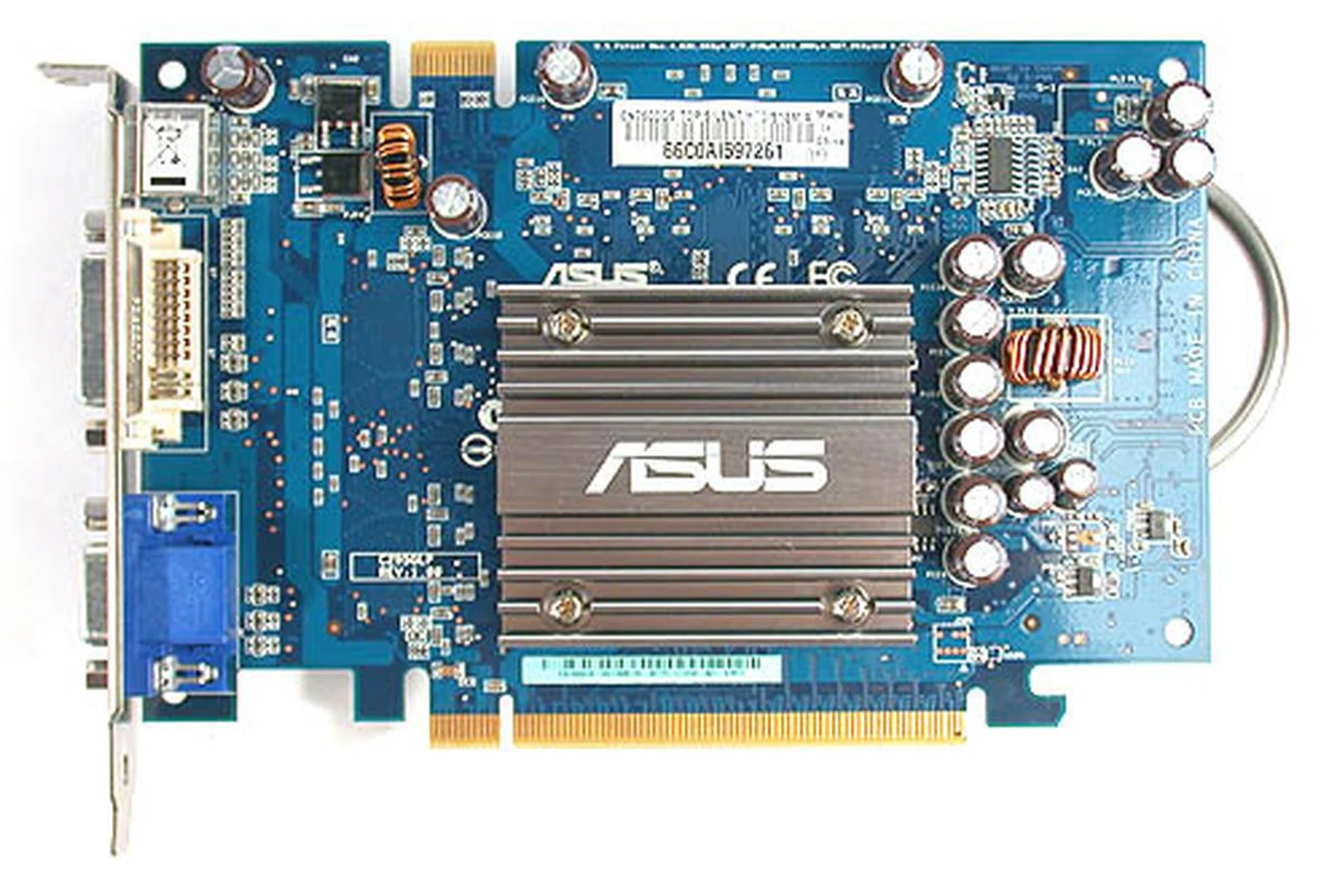
This looks like the front view but the GPU core is actually on the other side.
Another deviation from the standard GeForce 7600 GS has to be its 512MB of DDR2 RAM, twice that of the original. We are not too sure what ASUS intended with this. Granted that the memory clock has also been increased from 800MHz to 950MHz DDR but the relatively limited 128-bit memory bus doesn't seem to deserve such a large amount of video memory. These DDR2 memory modules were from Infineon and rated at 2.0ns, meaning that they are already running close to their limits. In our opinion, faster DDR3 memory would have been the more logical choice to improve performance, not by doubling its frame buffer size. Costs of production would likely be higher and that's probably why ASUS chose to increase its memory. After all, 512MB sounds more impressive to the average consumer than DDR3, but technical folks will quickly see through this as a marketing advantage to ASUS rather than any benefit to the consumers.
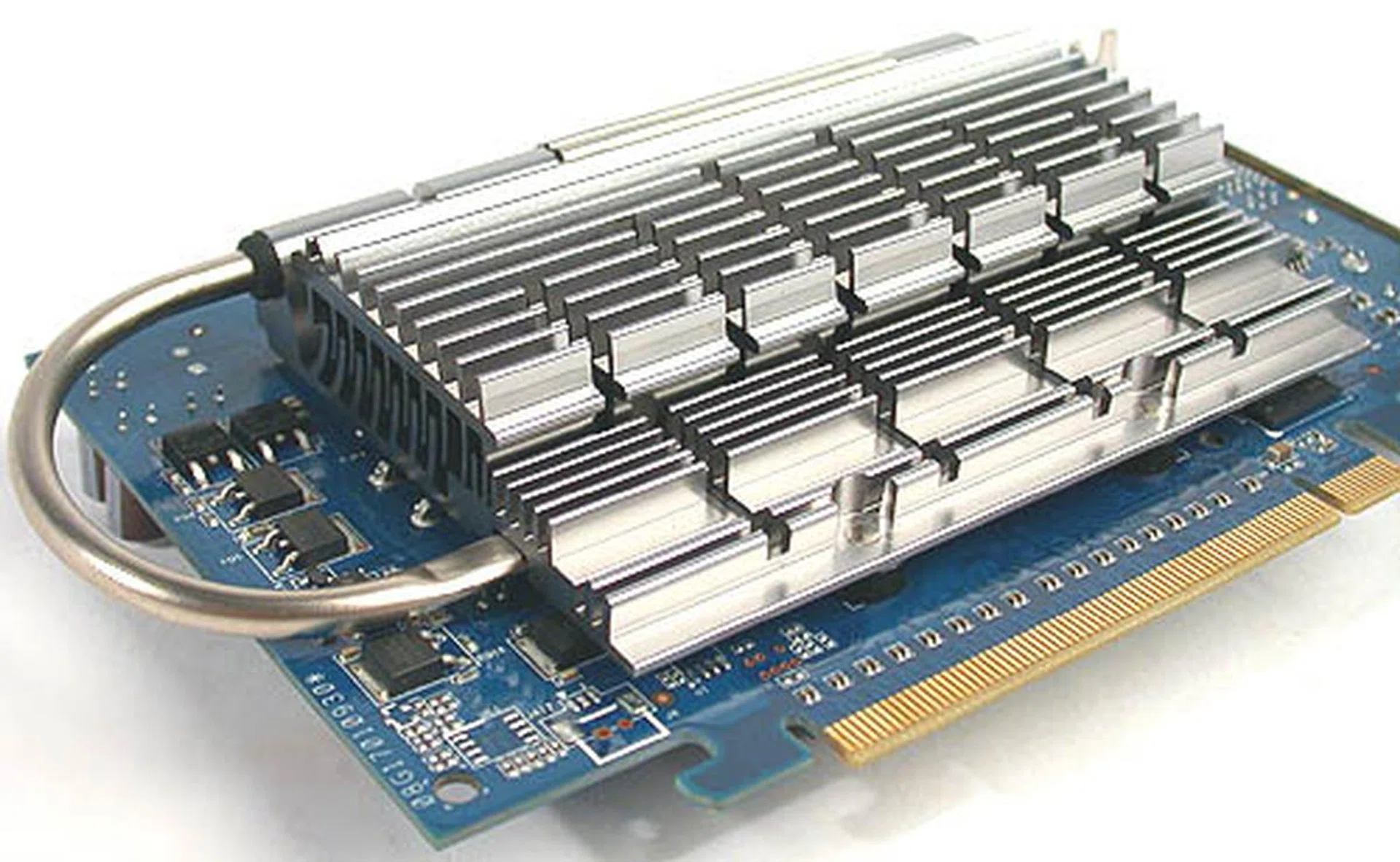
This is the heatsink mounted directly over the core and memory chips in its default position. However, only the core has contact with the heatsink. The memory chips are not cooled.
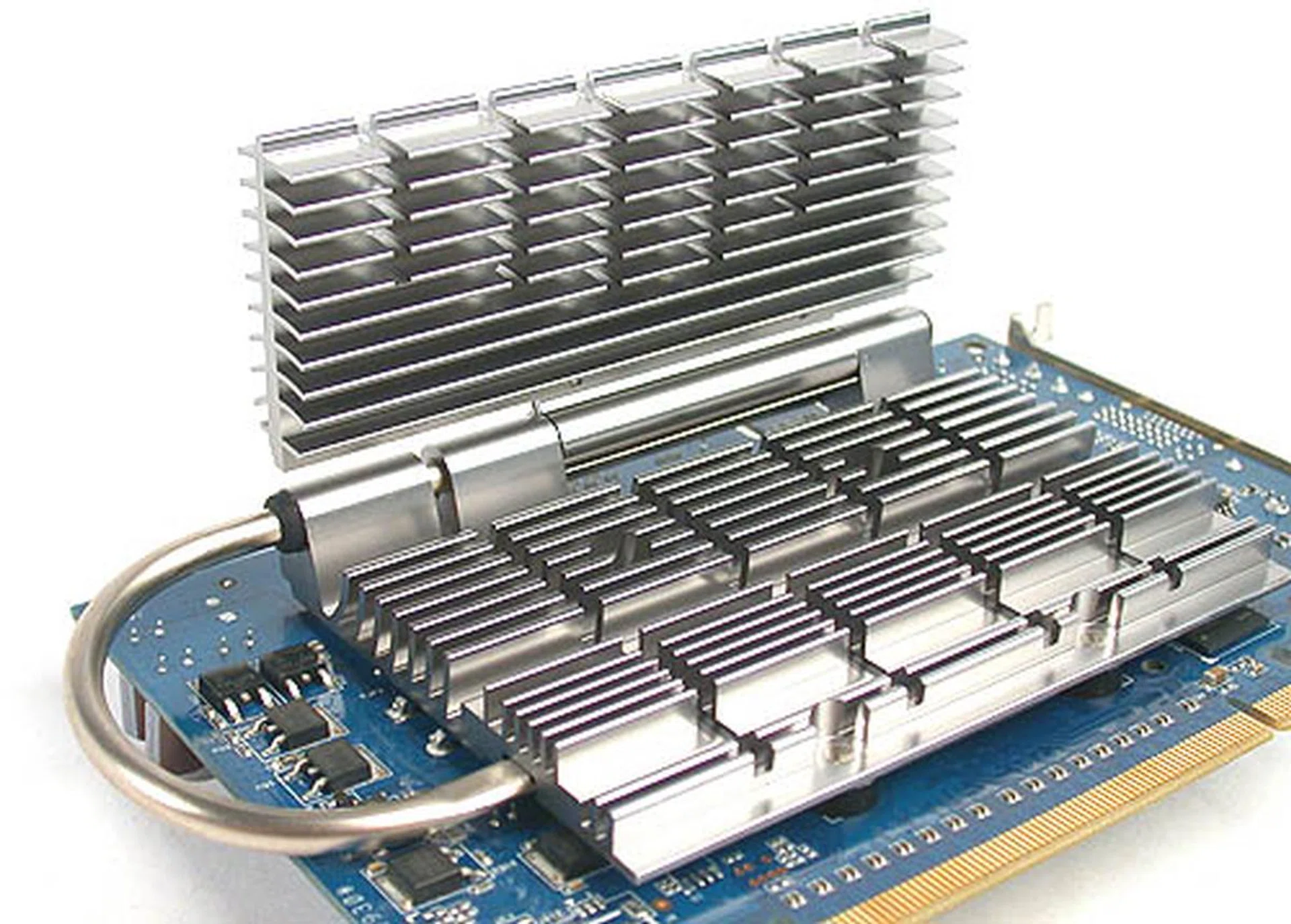
You can adjust the heatsink by flipping it open such that it can take advantage of the nearby CPU cooler to improve the rate of heat dissipation.
Finally, the core is also running at a higher clock than the default 400MHz. ASUS has overclocked it to 550MHz, bringing it close to that of a GeForce 7600 GT (560MHz). From the increase in frequencies for both core and memory, we should find the ASUS EN7600GS TOP Silent performing better than the average GeForce 7600 GS. However, some may be disappointed by the inclusion of an analog VGA output instead of dual DVI outputs. Again, this looks like a decision to limit costs though the DVI port is a dual-link output.
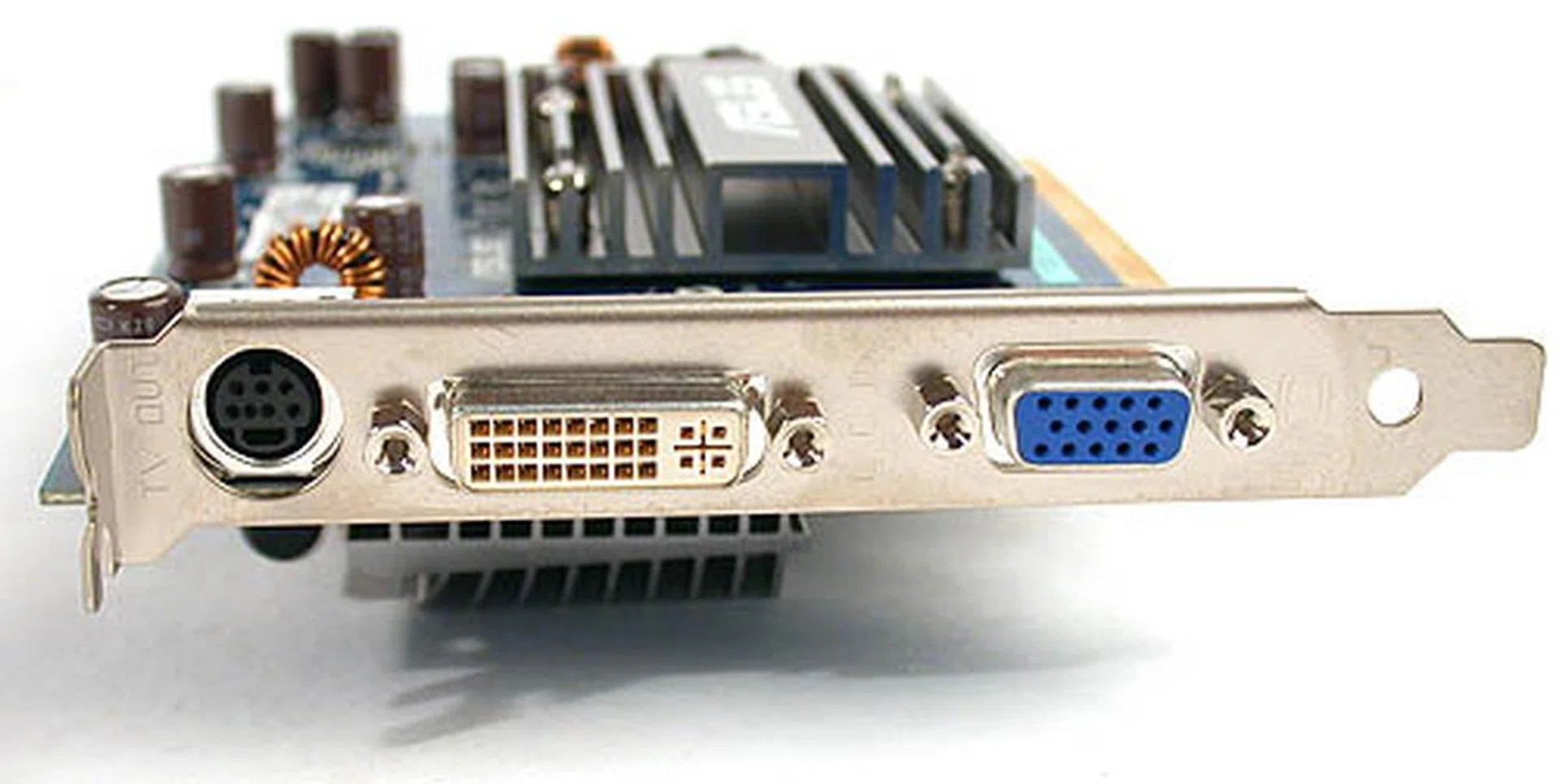
Unfortunately, ASUS decided that to include the cheaper analog VGA output instead of dual DVI outputs.
The cost cutting seems to extend also to the bundle for this card. A 'bonus' game pack consisting of three budget games is the only form of entertainment in the package. The other applications found are ASUS' own utilities and tools, like its Video Security Online and GameFace Messenger. We really doubt that many consumers would be keeping these applications on their systems after initially trying them out. The accessories were also quite minimal leading us to conclude that this is one of ASUS' weaker offerings. Here's an inventory list of the items:
- 1 x DVI-to-VGA adaptor
- 9-pin mini-DIN to Component dongle
- User Manual
- Quick Installation Guide
- Driver CD
- ASUS Utilities CD
- ASUS Bonus Game Pack
Test Setup
For this review, we prepared a K8N Diamond Plus motherboard from MSI. This was paired with an AMD Athlon FX-55 (2.6GHz) processor and 1GB of low latency DDR400 RAM from Kingston (in dual channel mode). The operating system used was Windows XP Professional, patched to the latest Service Pack 2 and DirectX 9.0c. The OS and all benchmarks were installed onto a Seagate 7200.7 SATA hard drive.
All the NVIDIA cards were tested with the beta ForceWare 91.29 drivers, which should be mostly similar to the latest 91.31 drivers. For the comparison, we included the standard GeForce 7600 GS and the GeForce 7600 GT. What's interesting would be how the ASUS would perform against the overclocked Gainward Bliss 7300GT PCX, which was found to be even faster than a normal GeForce 7600 GS. Of course, such a card is only available in limited quantities and so we added one more GeForce 7300 GT from Gigabyte (operating at more reasonable clock speeds) to better represent its class of cards. Below is the list of benchmarks tested:
- Futuremark 3DMark05 Pro (version 120)
- Futuremark 3DMark06 Pro (version 102)
- Unreal Tournament 2004 Demo
- Tom Clancy's Splinter Cell 3: Chaos Theory (version 1.3)
- Chronicles of Riddick: Escape from Butcher Bay (version 1.1)
- Quake 4
Results - 3DMark05 Pro & 3DMark06 Pro
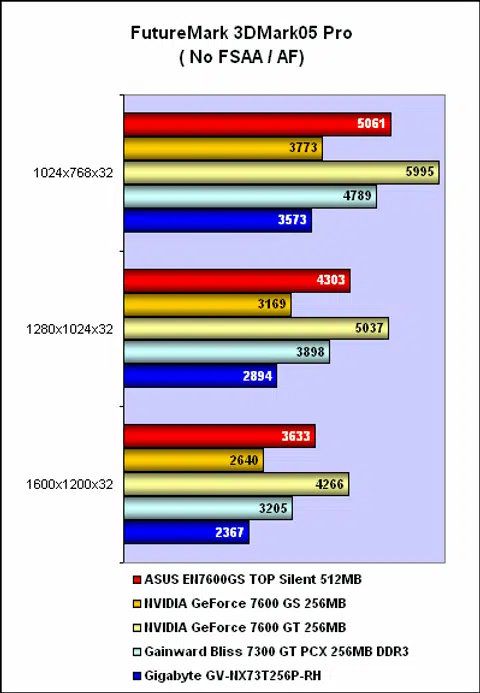
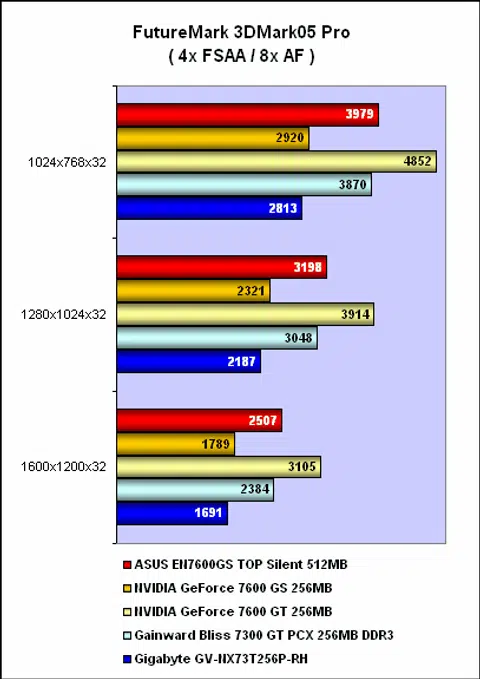
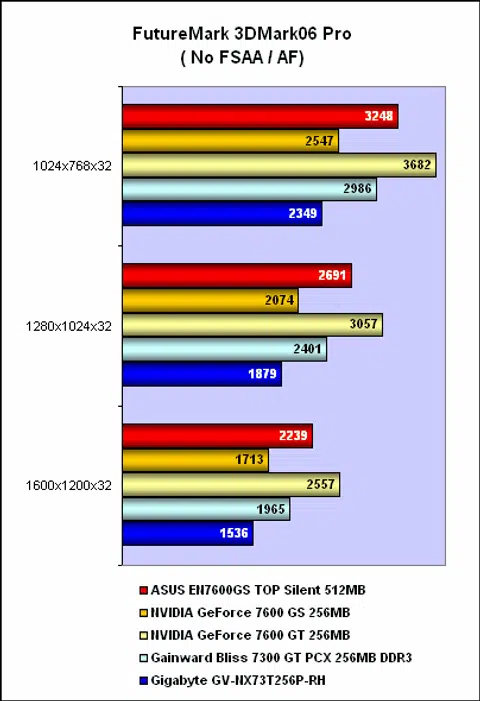
In both benchmarks here, the ASUS EN7600GS TOP Silent just about pushed the pretender, the Gainward GeForce 7300 GT into third place with a lead varying from a narrow 5% to a more comfortable 13%. However, the gap between the ASUS and the GeForce 7600 GT still remained quite wide at 17 - 23%. At the same time, the ASUS was definitely much faster than the default GeForce 7600 GS and if we take a more 'normal' GeForce 7300 GT in the one from Gigabyte, the ASUS was also convincingly ahead. At least the dramatic improvement for the ASUS GeForce 7600 GS over the standard version provided a good indicator of the value in overclocking the GeForce 7600 GS.
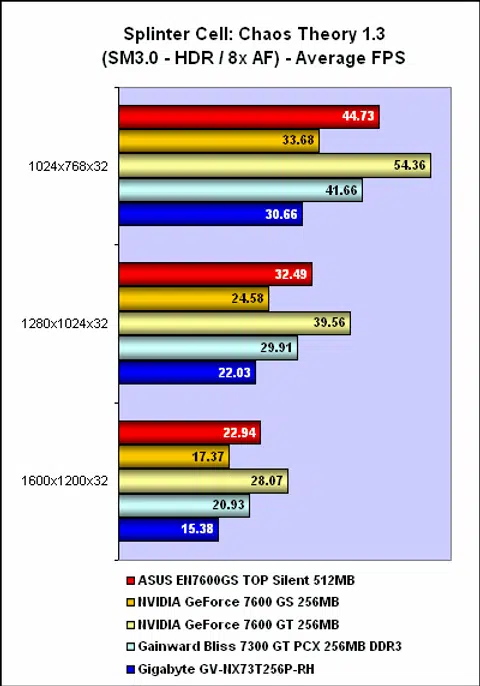
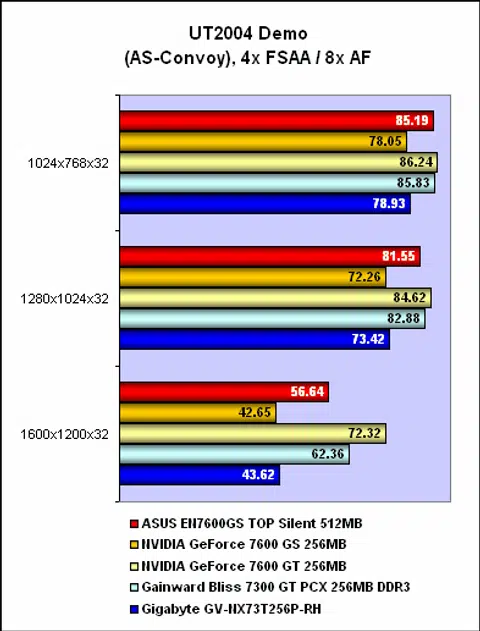
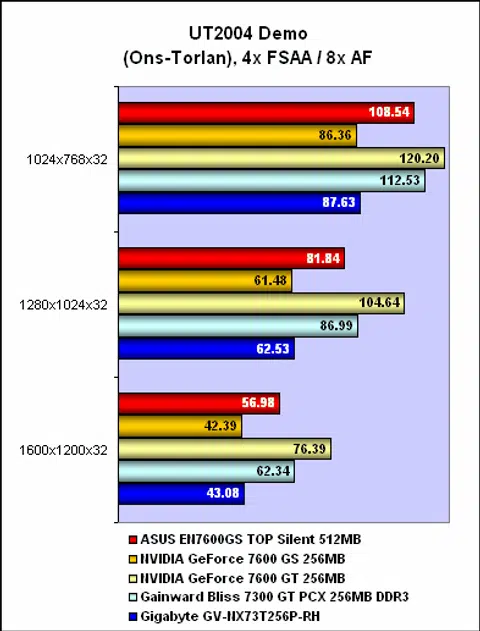
Results - Splinter Cell 3: Chaos Theory & Unreal Tournament 2004 (DirectX Benchmarks)
The rankings of the cards remained constant from that in 3DMark, with the ASUS barely knocking the Gainward GeForce 7300 GT from second spot. The margins though seemed to be narrowing, as the best the ASUS managed over the Gainward was only 9%. As usual the GeForce 7600 GT was too fast for any of the cards here and the ASUS showed clearly its superiority over the standard GeForce 7600 GS. The tide started to turn in Unreal Tournament 2004 as we saw the Gainward gradually surpass the ASUS. That was no fault of the ASUS, as it still retained an impressive gain over a standard GeForce 7600 GS. However, the high clock speeds of the Gainward and its DDR3 memory helped it to overtake the ASUS for the first time.
Results - Chronicles of Riddick: Escape from Butcher Bay (OpenGL, SM2.0+ Benchmark)
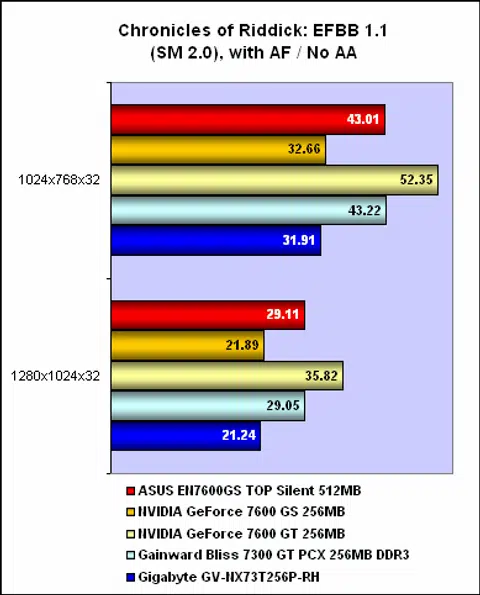
It was close between the GeForce 7600 GS and GeForce 7300 GT cards. In this benchmark, we saw both GeForce 7600 GS cards (the reference and ASUS' special edition) narrowly edging out their corresponding GeForce 7300 GT counterparts. Once antialiasing was enabled, the situation was reversed, as the GeForce 7300 GT cards edged out the respective GeForce 7600 GS comparisons. To put things in perspective, the margins between them were all quite small and unlikely to be noticed in-game. If you really want to see and feel the difference, we recommend that you get a GeForce 7600 GT.

Results - Quake 4 (OpenGL SM2.0+ Benchmark)
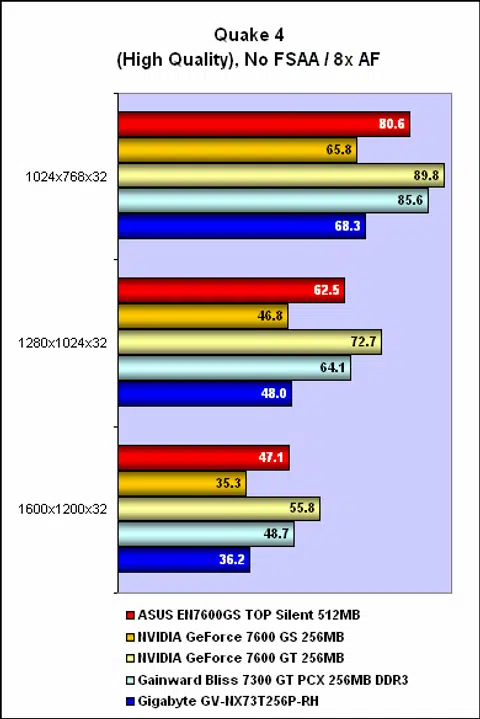
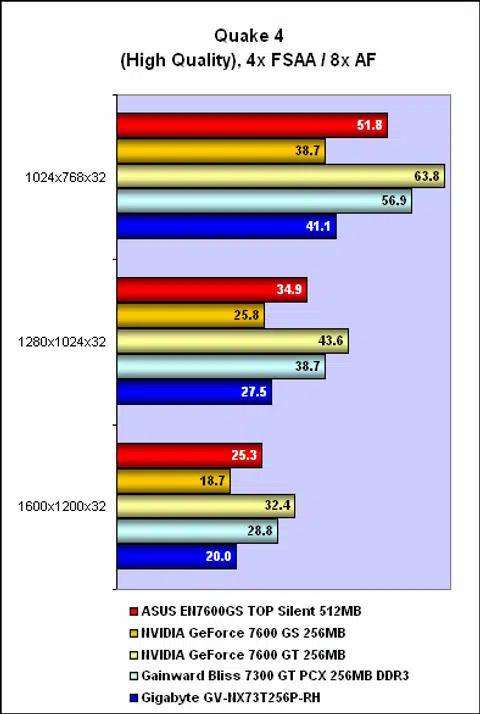
The results in Quake 4 mostly followed that of Chronicles of Riddick with the key difference being that in both sets of scores, with and without anti-aliasing, the Gainward came out tops against the ASUS EN7600GS TOP Silent. Again, the lead was quite narrow but it was indeed refreshing to find the 'lower end' card emerging the winner. If you would focus on the less powerful GeForce 7300 GT from Gigabyte, you would also find it quite competitive against the standard GeForce 7600 GS. Does this spell the imminent demise of the GeForce 7600 GS? We would think so.
Temperature Testing
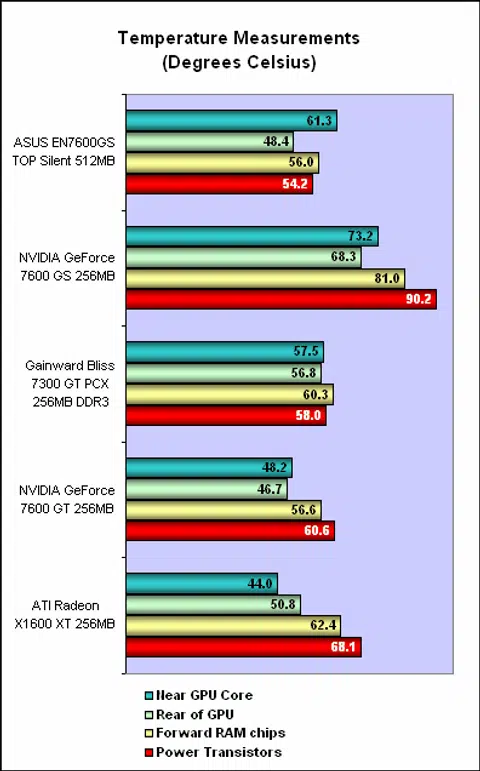
For a passively cooled card, the ASUS EN7600GS TOP Silent was very decent for its thermal output. Besides the temperature readings that we took for the following components, we also measured the surface of the heatsink. The average temperature for this was around 43 degrees Celsius, though of course the core was a different story at about 60 degrees. It did compare quite well to other cards, especially the standard GeForce 7600 GS, which similarly does away with the cooler fan.
Overclocking
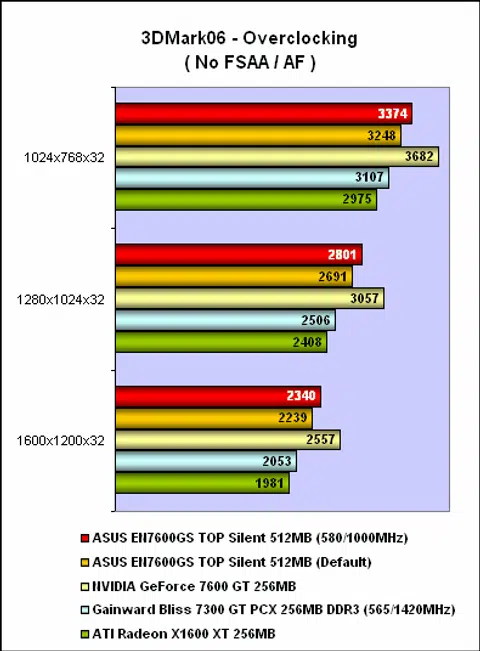
The ASUS EN7600GS TOP Silent may have come overclocked but we all know that vendors are usually more conservative than enthusiasts. So we tried to push the card further and the end result was that the ASUS didn't have much in reserve for overclocking. Of course, the final 580/1000MHz clock speeds for the core and memory was quite good compared to our one and only previous GeForce 7600 GS card from MSI. However, the gains of around 3 - 4% were not really enough to excite us though to be fair, the ASUS was a passively cooled card.
Conclusion
The bells are already tolling for the GeForce 7600 GS. With limited uptake of this GPU SKU in the retail scene since launch, there's a probability that it might be eclipsed once the mainstream GeForce 7300 GT gathers momentum and more vendors pitch in with their versions. While the Gainward Bliss 7300GT PCX we highlighted in our comparison is without doubt one of the fastest GeForce 7300 GT cards you can find now and hence perhaps not the fairest of comparisons, the competitive performance of the more sedate Gigabyte GeForce 7300 GT does show that this newcomer has the chops to match a normal clocked GeForce 7600 GS.

This ASUS EN7600GS TOP Silent has an unconventional heatsink design that's quite similar to some of ASUS' previous efforts. Throw in the large amount of DDR2 RAM (512MB) and overclocked speeds and you'll get a premium mid-range graphics card. But is it enough to grab its intended market share? That's probably difficult to tell now and entirely depends on how consumers react.
ASUS has tried to stave off the probable impending obsolescence by outfitting its GeForce 7600 GS with a host of features. Some work while others just have a gimmicky feel to them. We were rather pleased that ASUS has stuck with the passive cooling approach found on the NVIDIA reference design. This would make the card useful for systems where silence is golden, like small form factor systems and HTPCs. Of course, ASUS went one better with its own unique Reverse Cool system, where the entire card was engineered the other way around with the cooler and most of the important components like RAM and GPU are on the rear side of the PCB, contrary to conventional graphics card design. We don't really care much as long as it works and the combination of its special layout, the heat pipe and the adjustable radiator kept the temperatures lower than the standard, which was a plus point and proves that ASUS' cooling technique does help.
The extra 256MB boost in onboard memory that makes the ASUS a 512MB DDR2 card however is unconvincing in its usefulness. We doubt that the GeForce 7600 GS has enough memory bandwidth to utilize the additional memory effectively. In short, this memory increase would probably not do much for your performance and ASUS would have achieved more with faster DDR3 memory instead. From a marketing perspective though, the 512MB may have the desired effect of attracting users who think that increasing graphics memory would have the same impact as upgrading system memory.
While the overclocking does have its intended effect of pulling the ASUS EN7600GS TOP Silent away from the customary GeForce 7600 GS standards, the only problem is that an overclocked GeForce 7300 GT like the Gainward Bliss 7300GT PCX can more than match the ASUS in performance and probably has very competitive pricing too by virtue of its lower ranking in NVIDIA's hierarchy. As for the ASUS, it's retailing at S$269 (US$170), which rightly places it between a standard GeForce 7600 GS and the GeForce 7600 GT. Considering the market outlook now, this pricing is quite sensible but with the better GeForce 7300 GT cards eating into the lower mid-range segment and the GeForce 7600 GT still maintaining an excellent price to performance ratio at the top, the ASUS EN7600GS TOP Silent may just find itself being squeezed into obscurity.
Our articles may contain affiliate links. If you buy through these links, we may earn a small commission.