

Note: This review was first published on 2 February 2023.
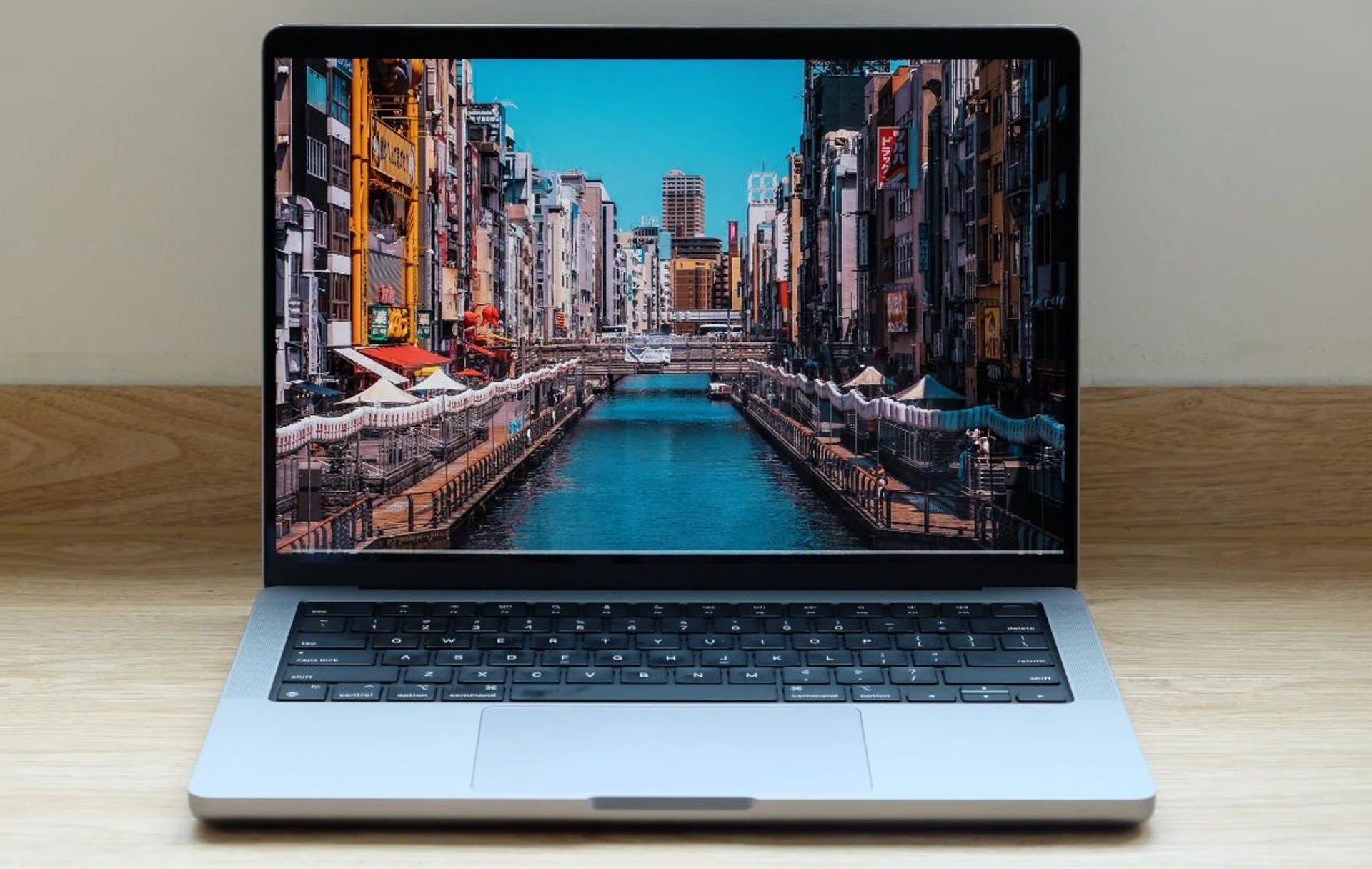
Apple has updated the 14 and 16-inch MacBook Pros with newer, faster processors.
Spec-bump update
Many regard the M1 Pro and M1 Max MacBook Pros from 2021 to be the finest notebooks Apple has ever made. Well-built, supremely powerful, possessing a good selection of ports and a brilliant display, there is no doubt that they are landmark Mac notebooks.
The TL;DR version:
With its combination of gorgeous display, top-notch build quality, great battery life, and out-of-this-world performance, this is the best ultraportable notebook you can buy.
A year or so later, Apple has naturally tinkered with them and made them a little better. I’ll cut to the chase, the newest 14 and 16-inch MacBook Pro are spec-bump updates. The big news is that they have new processors. They are now powered by the new M2 Pro and M2 Max. There are also some minor updates here and there which I’ll get to later. But the big news is the processors.

The Liquid Retina XDR display uses a mini-LED panel and looks gorgeous.
The rest of the hardware is unchanged, which is no bad thing. Build quality is high and they are relatively portable considering the levels of performance that they offer. The Liquid Retina XDR display continues to impress with its dazzling colours even if they still suffer from blooming issues. The camera notch is still there and sadly doesn’t do Face ID. The keyboard, trackpad, and speakers are all best-in-class items and will not disappoint.
To find out more about the design, display, keyboard, and trackpad of the MacBook Pro, read my review of the M1 14-inch MacBook Pro here.
Say hi to M2 Pro and M2 Max
(Image source: Apple)
As usual, Apple is coy on the specifics of its new M2 Pro and M2 Max chips. What we do know is that they are built on the success of the M1 Pro and M1 Max chips and feature more cores and performance.
Here are the high-level details.
- Built on a second-generation 5nm process
- Up to 40 billion transistors in M2 Pro, and 67 billion transistors in M2 Max
- Now up to 12 CPU cores
- Up to 19 GPU cores in M2 Pro and 38 GPU cores in M2 Max
- Up to 32GB memory in M2 Pro and 96GB in M2 Max
- Next-gen 16-core Neural Engine, up to 15.8 trillion operations per second
- Unified memory architecture
The end result of all these indigestible facts and figures means that you can expect up to 20% more CPU performance and 30% more GPU performance over the last-generation M1 Pro and M1 Max MacBook Pros. That’s quite a substantial improvement given that it’s only been a little more than a year since Apple unveiled the M1 Pro and M1 Max chips.
Other improvements
Connectivity is better on these new MacBook Pros. To start, the HDMI port now support the newer 2.1 standard which means support for 8K external displays at up to 60Hz and improved support for 4K external displays at up to 240Hz.
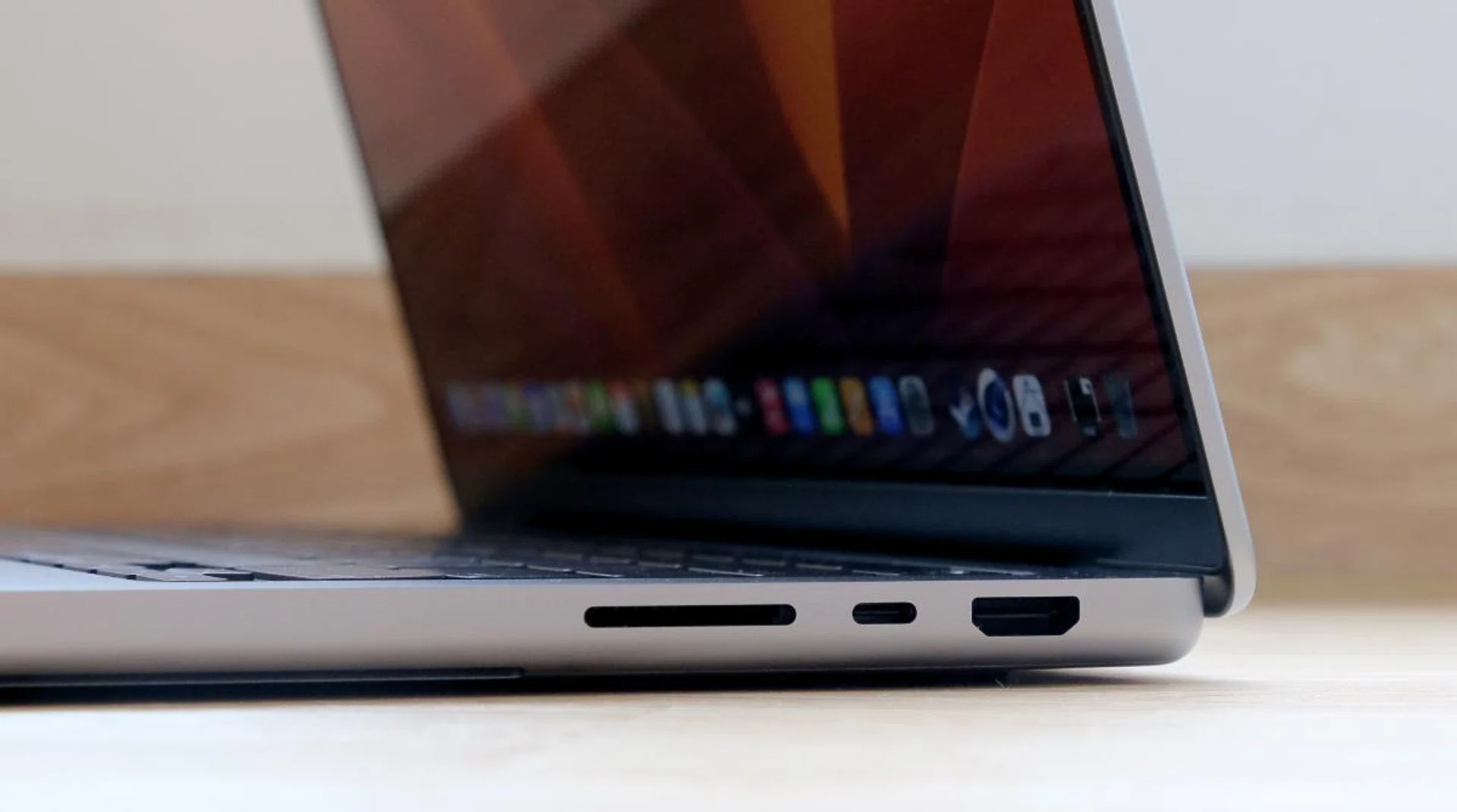
The new MacBook Pros can now output to an 8K external display at up to 60Hz.
There’s also support for Wi-Fi 6E. However, this feature is less likely to appeal to users here in Singapore since the 6GHz spectrum has yet to be cleared for us by the IMDA. Regardless, this means the ability to tap into the relatively uncontested 6GHz band with compatible Wi-Fi 6E routers like Google’s Nest Wifi Pro.
Battery life, according to Apple, has been improved thanks to the more efficient M2-class chips and other optimisations. The 14 and 16-inch MacBook Pro now last an hour longer respectively than the models they replace so battery life is now up to 18 hours for the 14-inch MacBook Pro and 22 hours for the 16-inch MacBook Pro. They last very long but I’ll need more time to test if the battery life has really improved. I’ll report back on this later.
CPU performance analysis
Note: The unit I’m testing is the 14-inch MacBook Pro with 12 CPU cores, 38 GPU cores, 64GB of memory, and a 2TB SSD.
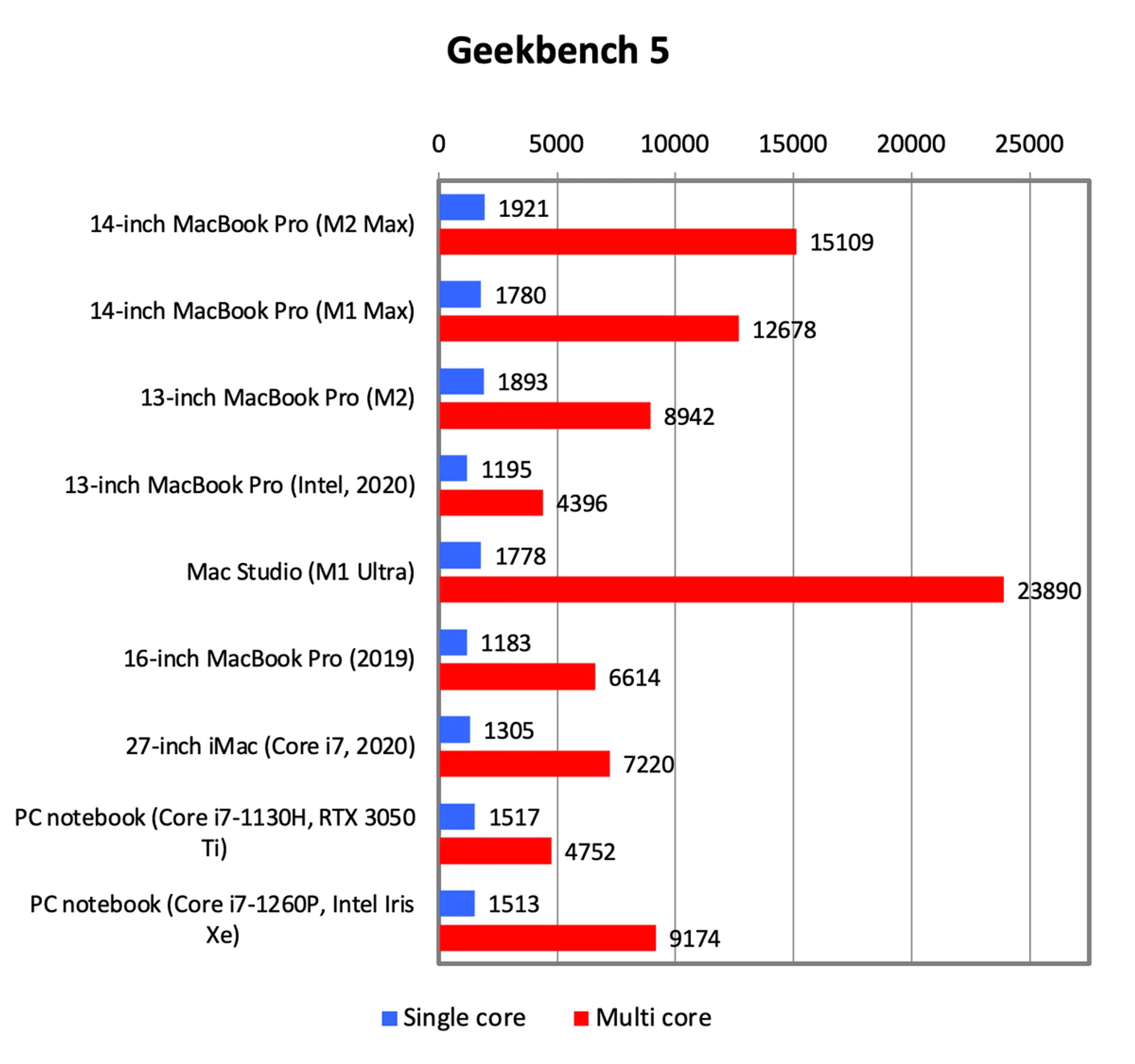
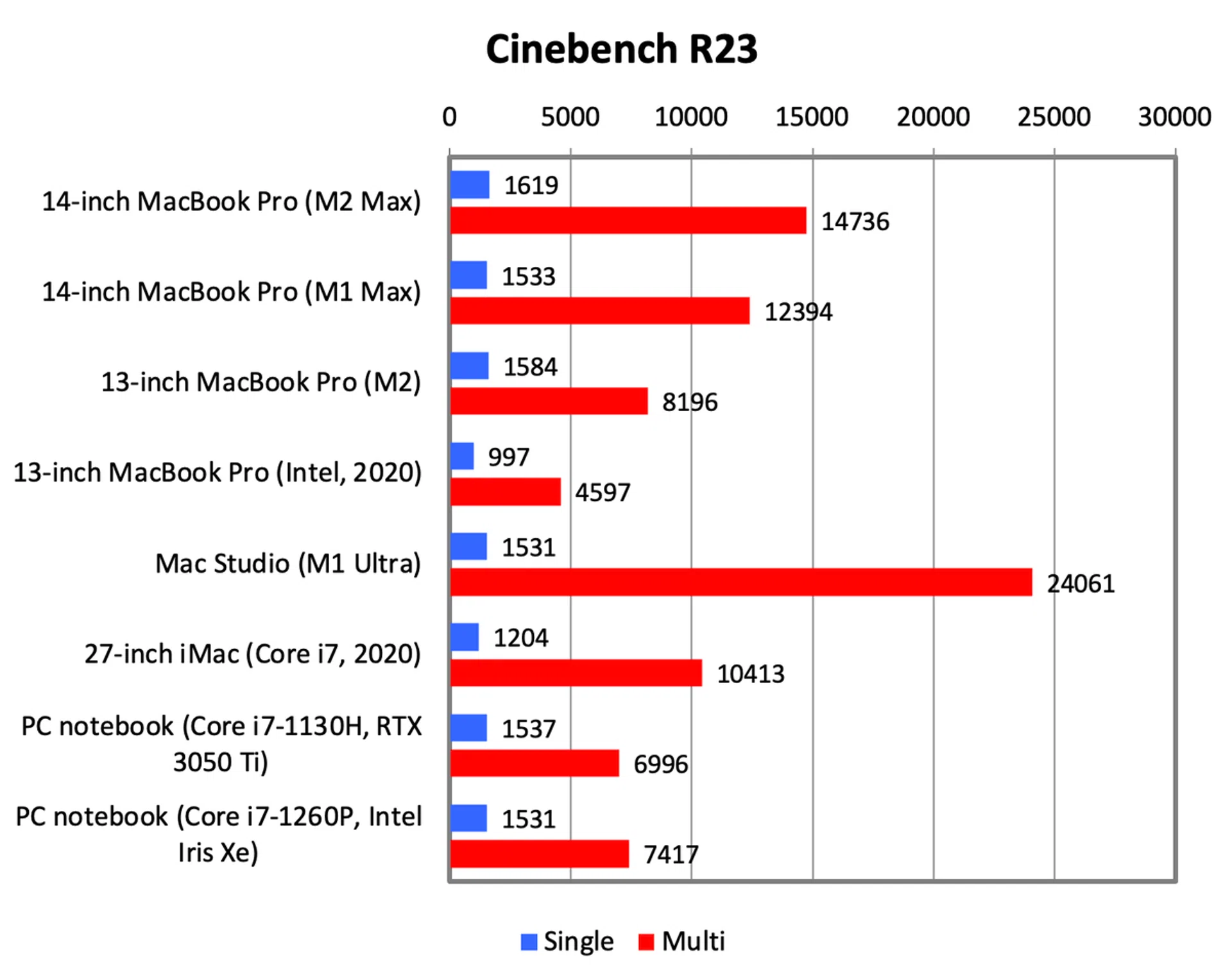
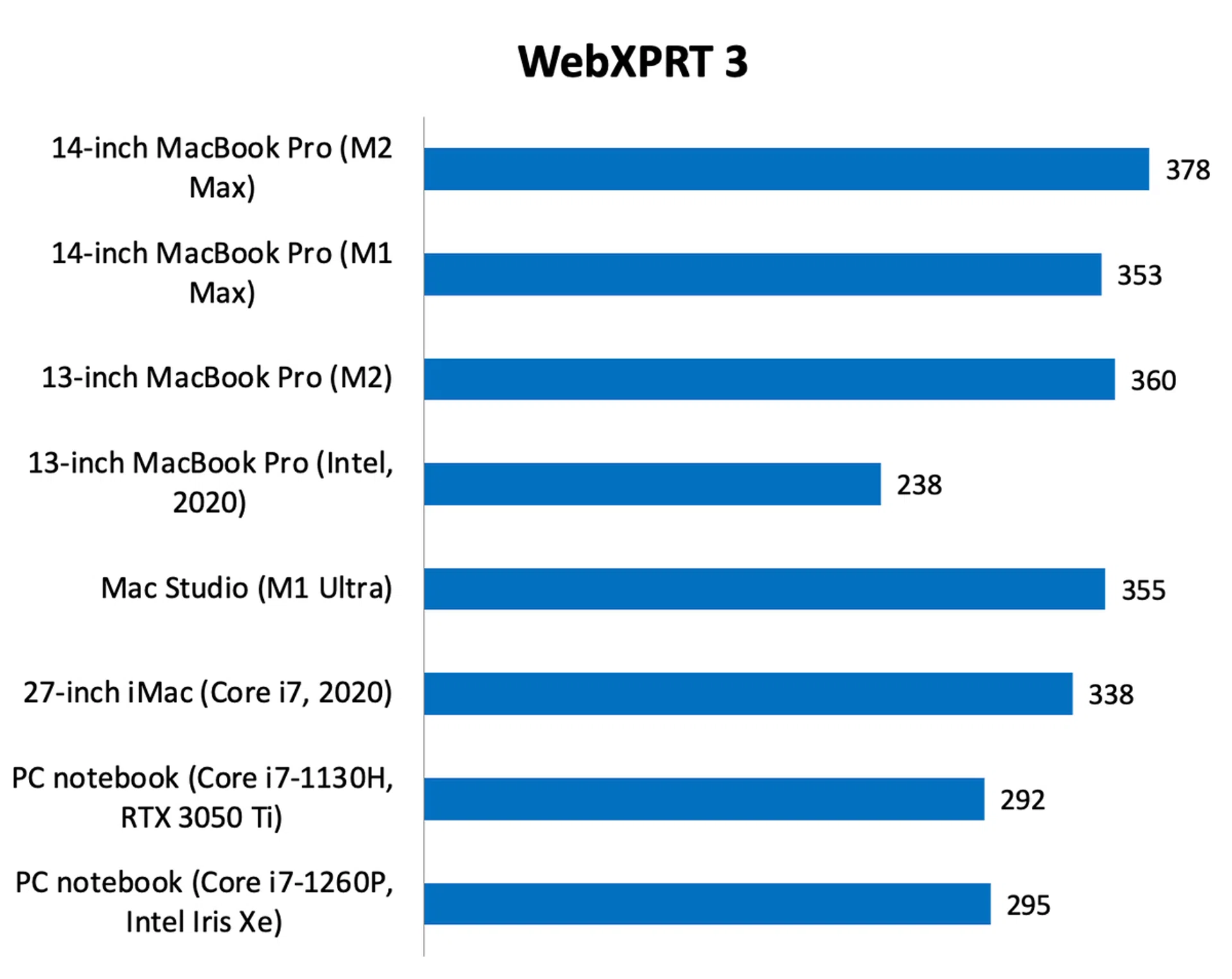
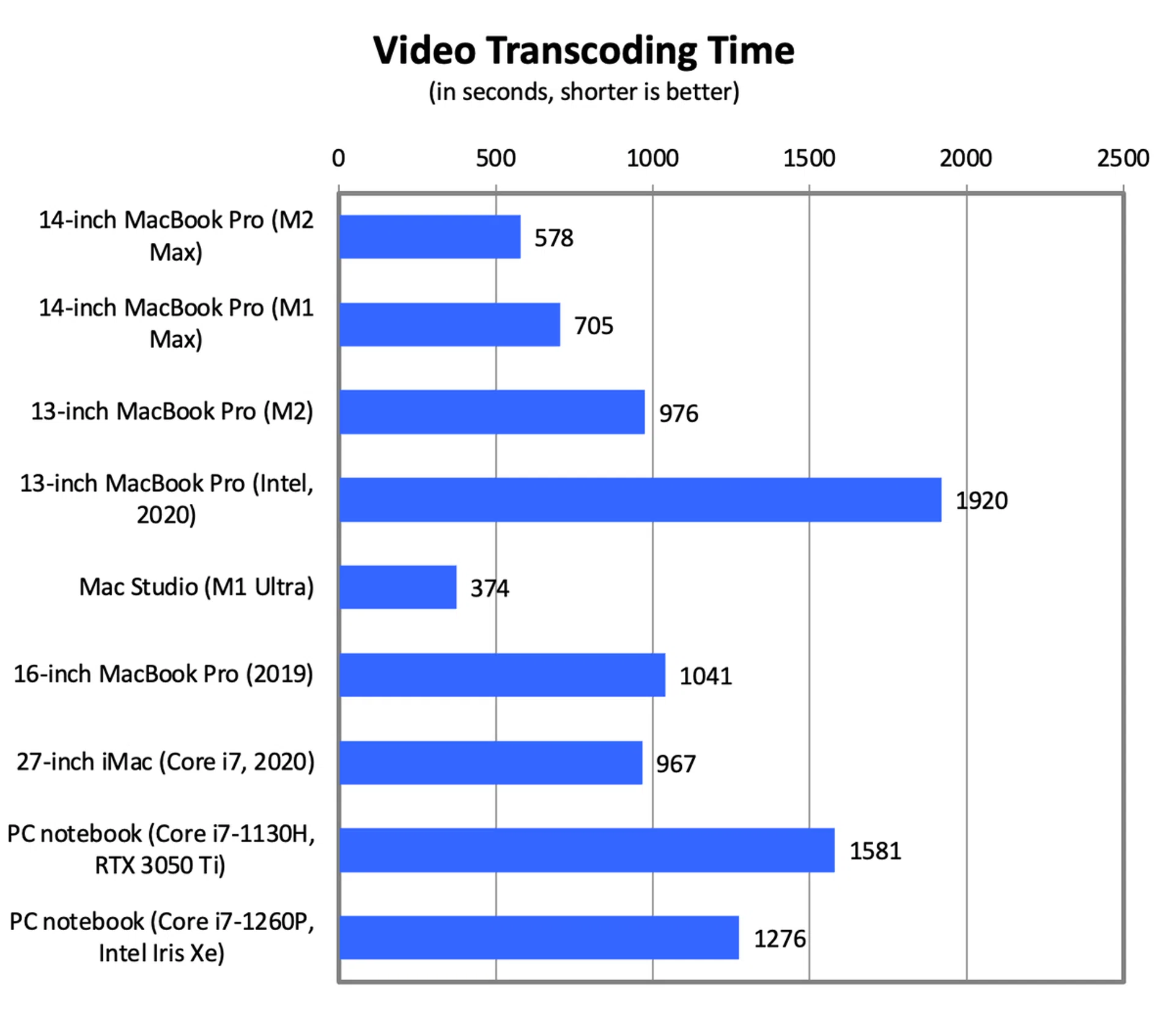
Apple says the new M2 Pro and M2 Max MacBook Pros can deliver up to 20% more CPU performance and that’s true for multi-threaded workloads. The multi-core performance of the new M2 Max chip was 19% and 18% better than the M1 Max on Geekbench and Cinebench respectively. And in our video transcoding test, the new M2 Max completed the task in just a little over 578 seconds (9mins 38s). That’s over two minutes faster than the M1 Max which took 705 seconds or nearly 12 minutes.
Single-core performance was less impressive but the M2 Max was still around 5% to 7% faster than the M1 Max. Interestingly, this means its single-core performance is also better than the M1 Ultra. However, the M1 Ultra is still the undisputed king in multi-threaded workloads – thanks mostly to the fact that it has 20 CPU cores (8 more than the M2 Max).
GPU performance analysis
Note: The unit I’m testing is the 14-inch MacBook Pro with 12 CPU cores, 38 GPU cores, 64GB of memory, and a 2TB SSD.
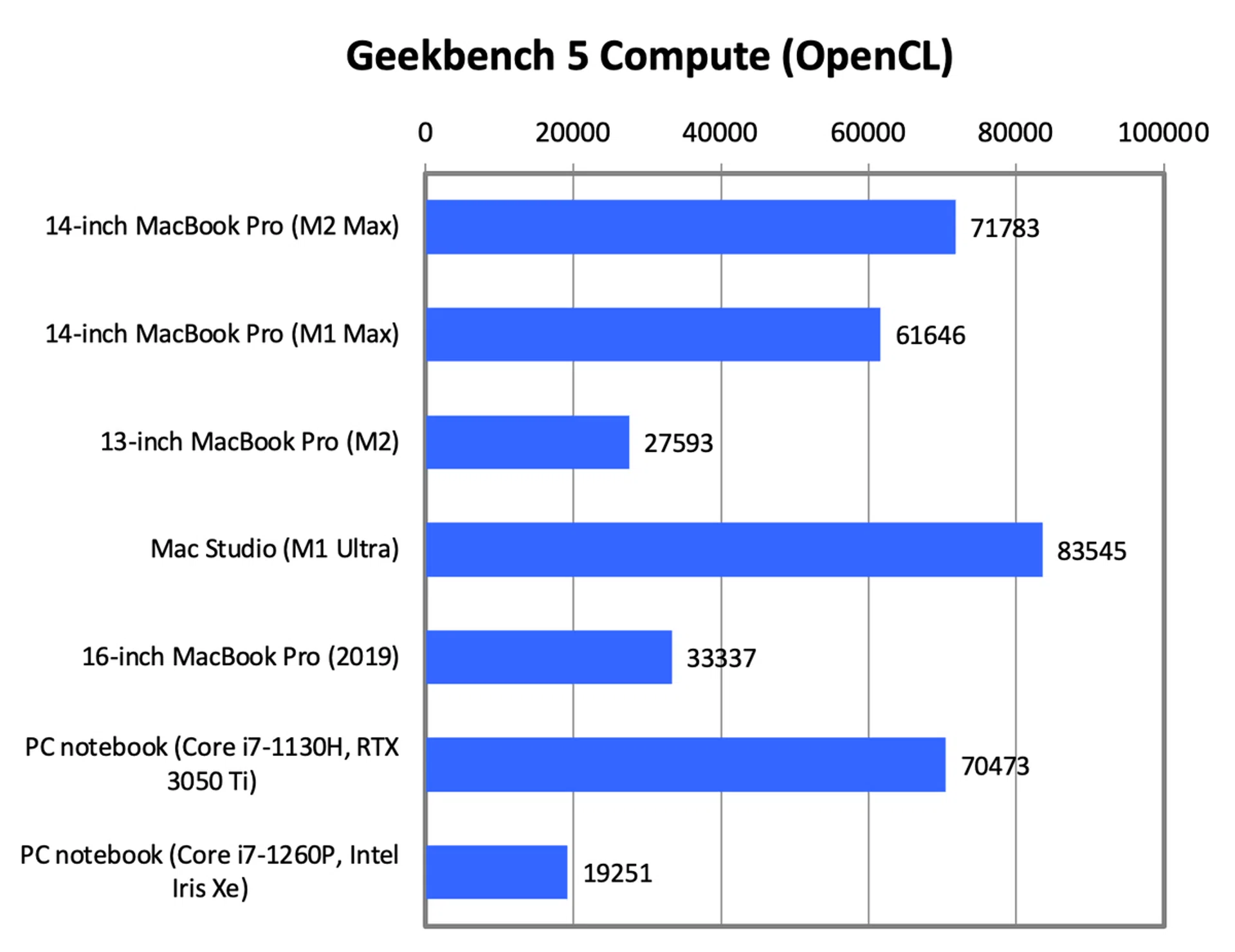
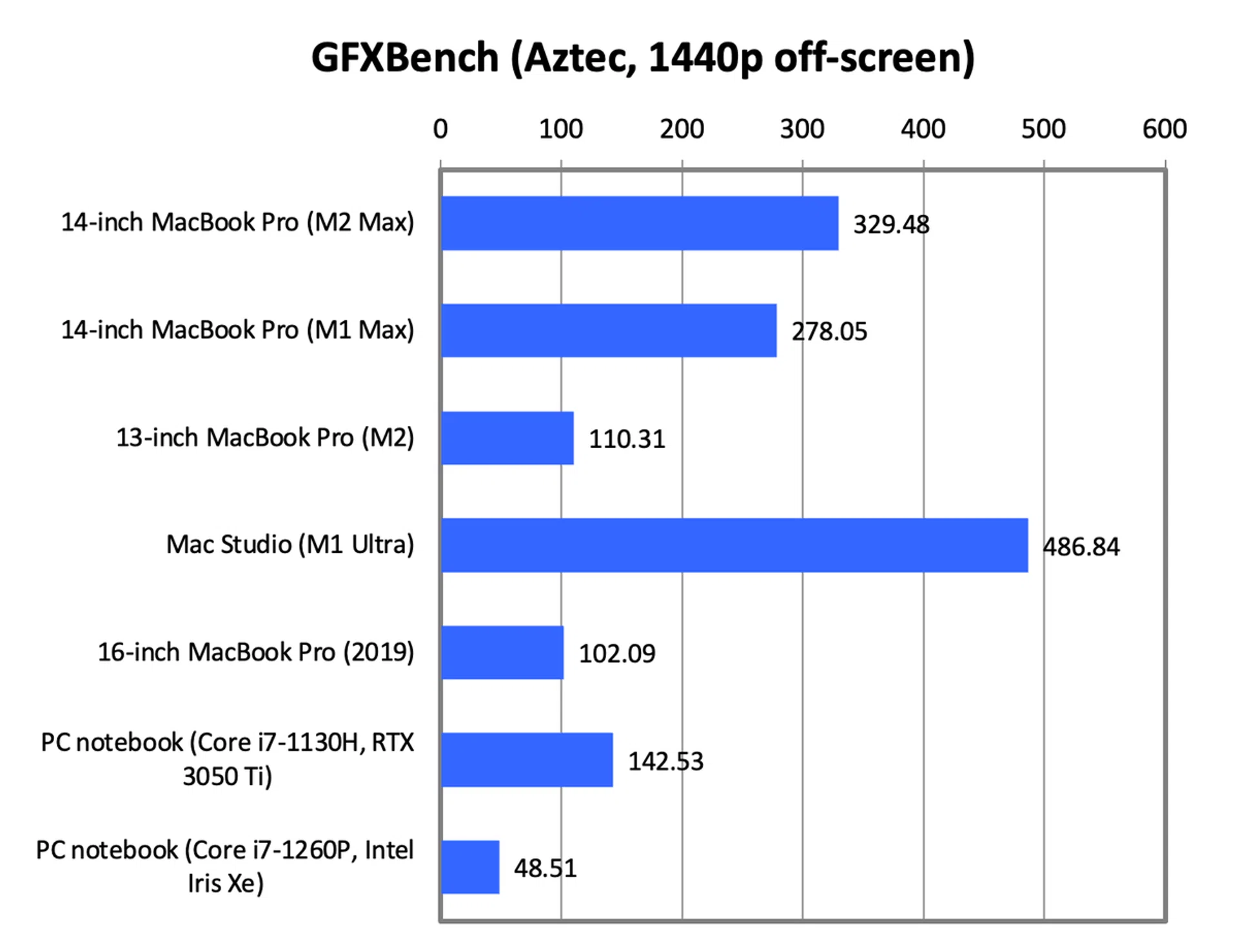
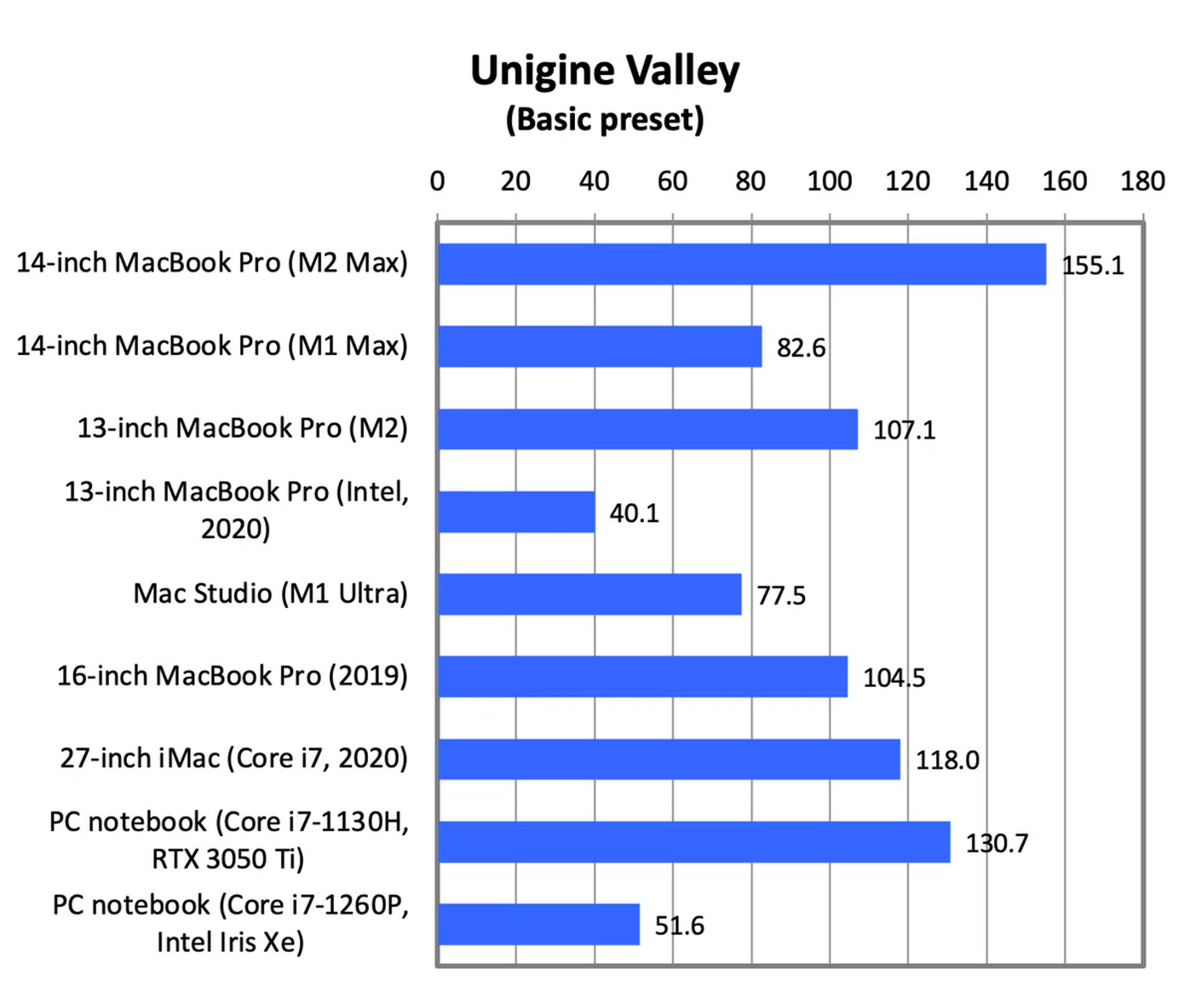
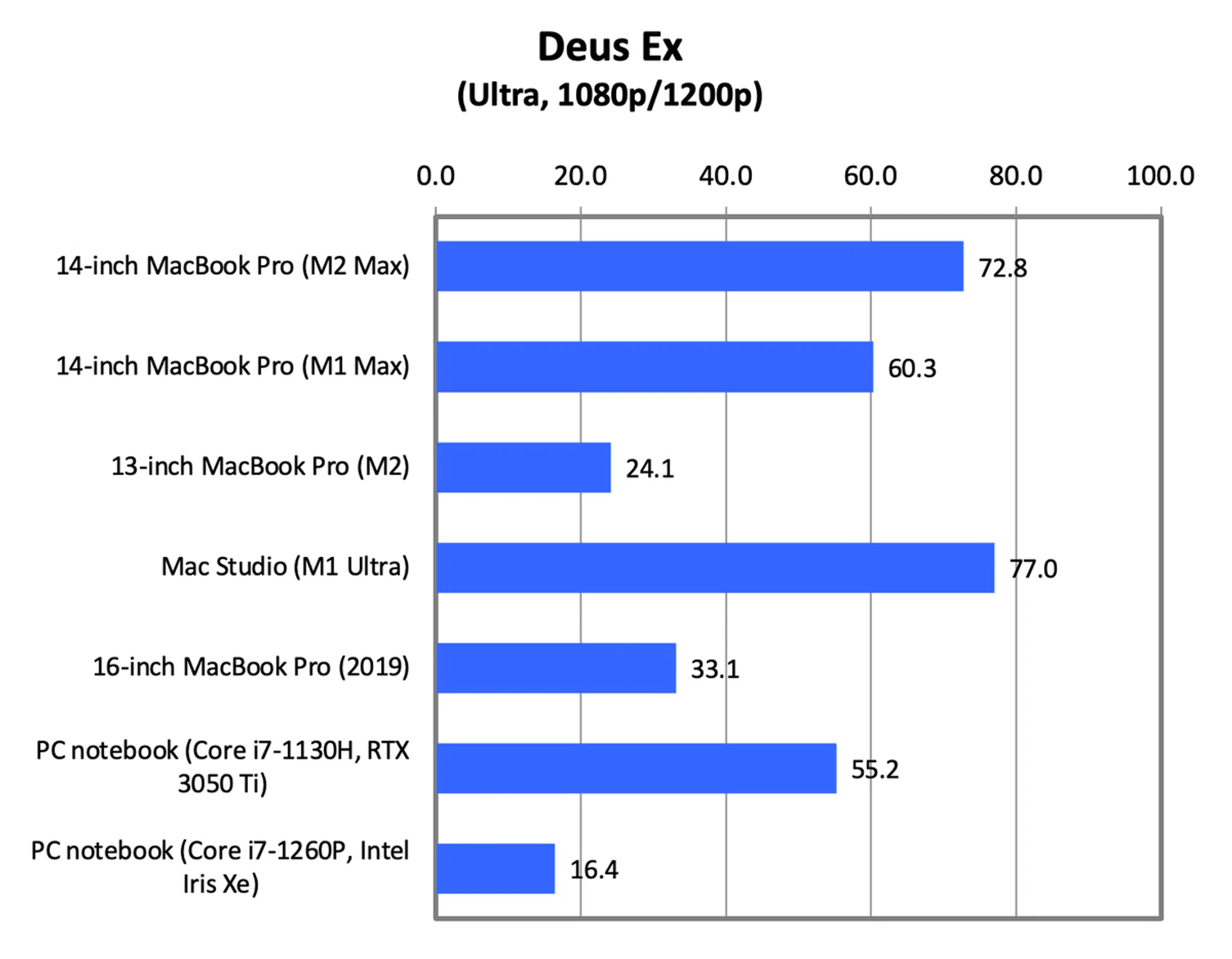
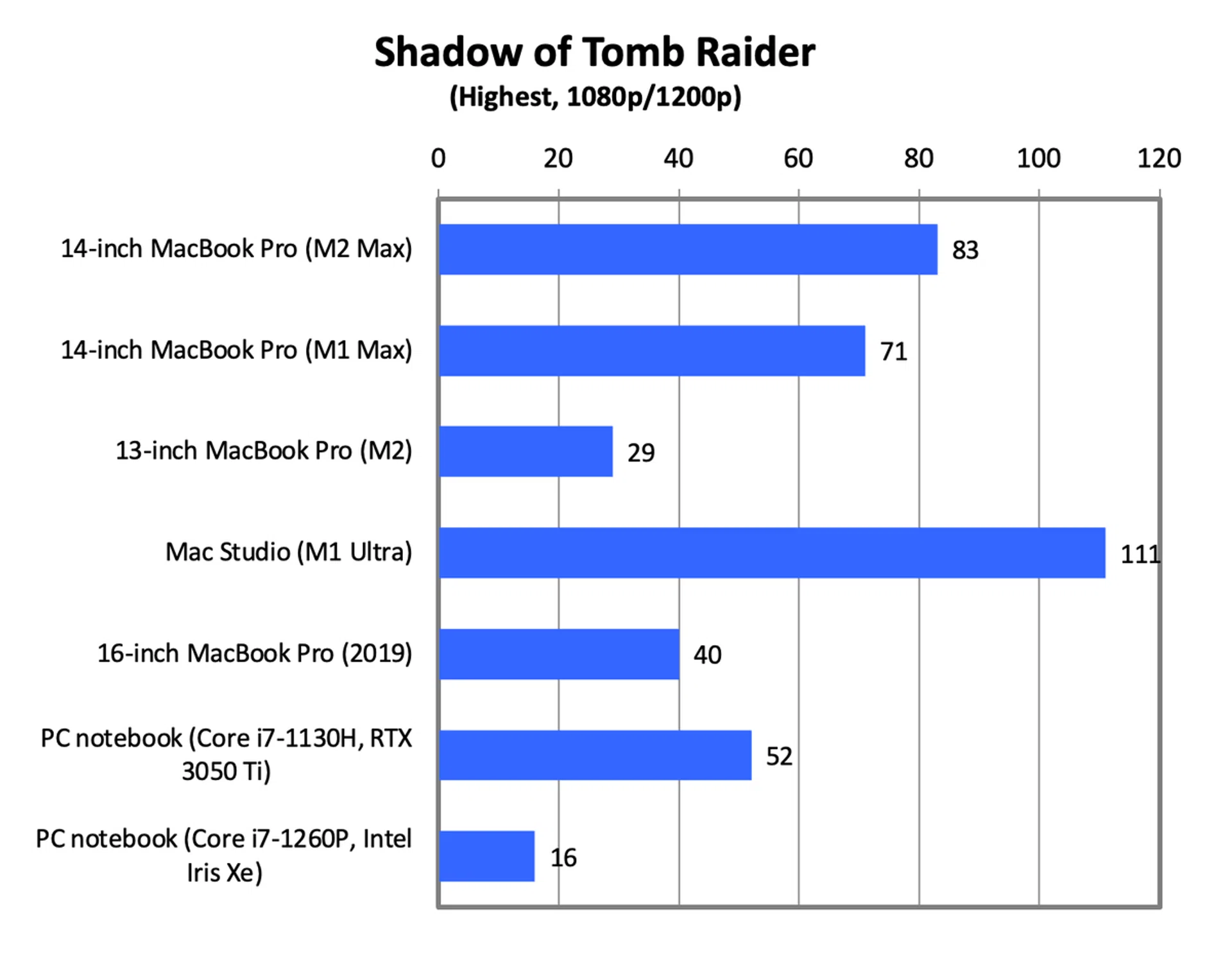
Apple says the new M2 Pro and M2 Max MacBook Pros can deliver up to 30% more GPU performance over the last-generation M1-series Max MacBook Pros. In my tests, I found the increase in performance to be more modest but still remarkable. On Geekbench’s Compute workload, the M2 Max was around 16% faster than an M1 Max and performed similarly to a PC notebook powered by an NVIDIA GeForce RTX 3050 Ti GPU. It would have recorded higher numbers still had it been running using the Metal API – OpenCL was used so that comparisons could be drawn against Windows notebooks. Perhaps what’s worth noting is that gaming performance has increased by around 18% across both Deus Ex and Shadow of Tomb Raider. Bear in mind that these games are running emulated on the M2 Max.
Still excellent, still overkill for most people
It’s hard to fully eulogise just how exceptional Apple’s 14 and 16-inch MacBook Pros are. I didn’t think the M1-based ones needed to be updated because they were and still are so fast and capable but yet Apple has given us even more powerful ones.
But you can never have too much power and the performance gains of the new M2 Max chip are appreciable, particularly if you do a lot of multi-threaded workloads or run apps that are graphically intensive and can take advantage of the extra GPU cores. That said, I’d like to test the less powerful variants to know just how good the less expensive MacBook Pros are.
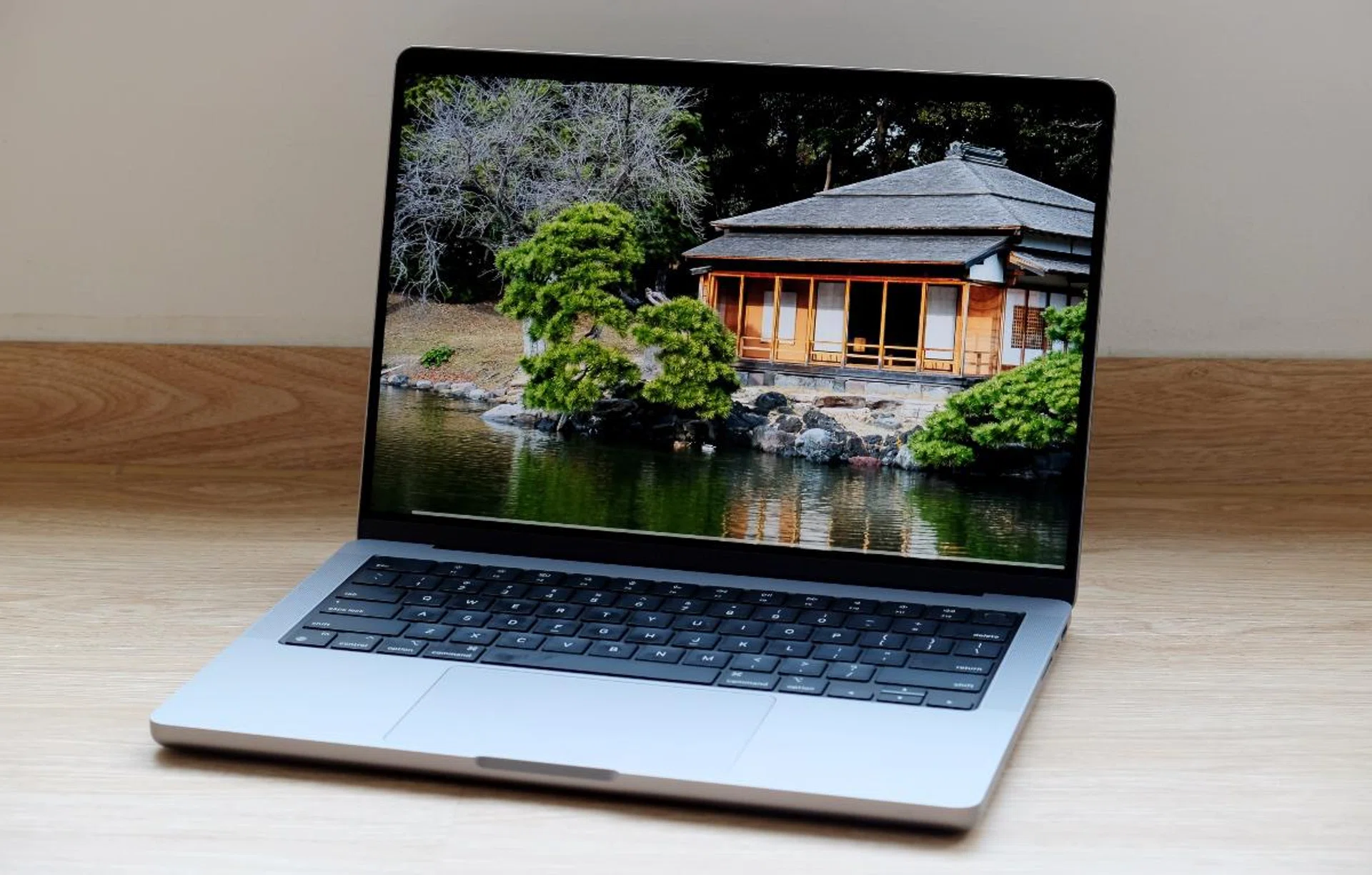
The last MacBook Pro was already very good, this new one is even better.
This brings us neatly to price. As tested, my unit with a nearly fully decked out M2 Max with 12 CPU cores, 38 GPU cores, 64GB of memory, and 2TB of storage is a whopping S$6,013. This is a machine designed for pros and it is priced accordingly. For professionals, many would be quite happy to pay for the MacBook Pros’ searing performance and high-quality hardware.
Fortunately, even the most affordable versions of the 14 and 16-inch MacBook Pros with M2 Pro chips have decent specs with 16GB of memory and 512GB storage. That should suffice for most users, and at those prices, they are just about attainable without being too ludicrously expensive. Certainly, I think the performance and features justifies their starting price tags. Once you start adding more cores, more memory, and more storage, that's when things get tricky.
Some might be tempted by the cheaper 13-inch M2 MacBook Pro but I’d say forget about it. That comes with the less powerful M2 chip and if you spec it up with 16GB of memory and 512GB of storage, it comes in at S$2,502. That’s only S$399 less than the cheapest 14-inch MacBook Pro which also has 16GB of memory. I’d take the 14-inch MacBook Pro in a heartbeat. That extra S$399 gets you a faster chip, a superior display, better connectivity, and speakers, which is well worth it.
Model | MacBook Air | 13-inch MacBook Pro | 14-inch MacBook Pro | 16-inch MacBook Pro |
Chip | M2
(8 CPU, 8 GPU) | M2
(8 CPU, 10 GPU) | M2 Pro
(10 CPU, 16 GPU) | M2 Pro
(12 CPU, 19 GPU) |
Display | 13.6-inch Liquid Retina | 13-inch Retina | 14.2-inch Liquid Retina XDR | 16-inch Liquid Retina XDR |
Memory | 8GB | 8GB | 16GB | 16GB |
Storage | 256GB | 256GB | 512GB | 512GB |
Price | S$1,714.85 | S$1,896.55 | S$2,899 | S$3,599 |
The budget-conscious should consider the M2 MacBook Air instead, it has more than enough performance for most people. The display isn’t as nice but it counters by being a lot more portable and affordable. The MacBook Air is the Mac notebook for everyone.
And as for owners of the older M1-based MacBook Pros, I see little need to upgrade unless you really need the improved connectivity (the old models couldn’t output to an 8K screen), work with really large files and need a system with 96GB of memory, or could really use the additional multi-core performance.
So what then is a MacBook Pro? It is as the title of this review suggests, the computing equivalent of a Rolls Royce. With vast amounts of power, and beautifully built, it is way more notebook than most of its buyers would ever need. If you do not absolutely have to use a Windows machine and have deep enough wallets, this is the best pro-grade ultraportable notebook you can buy today.
You can find the new M2 Pro and M2 Max 14 and 16-inch MacBook Pros on Amazon, the Apple Flagship Store on Lazada, the Apple Flagship Store on Shopee, and the Apple Online Store.
Our articles may contain affiliate links. If you buy through these links, we may earn a small commission.