
AMD rolls out seventh-generation Bristol Ridge PRO APUs in desktops
AMD has launched its seventh-generation Bristol Ridge PRO APUs in desktops from HP and Lenovo. Compared to the Bristol Ridge APUs that rolled out in September, the PRO APUs are targeted at commercial systems and come with additional features tailored for professional applications.

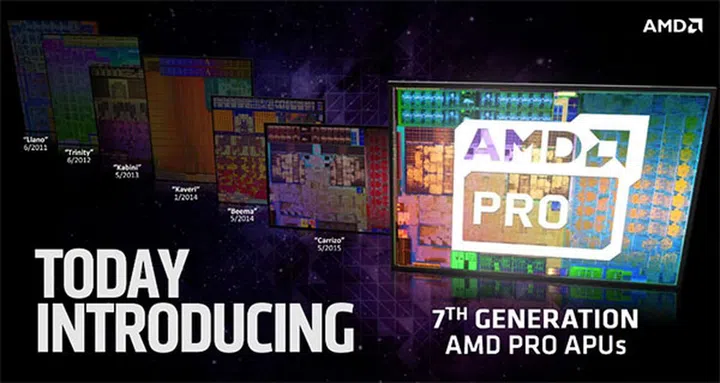
Image Source: AMD
AMD has announced the first PCs featuring its seventh-generation Bristol Ridge PRO APUs. The new systems, built by HP and Lenovo, are targeted at businesses and enterprises with improved graphics and compute performance, better energy efficiency, and more robust security.
AMD first unveiled its new processors earlier this year at Computex, and followed that up with a similar announcement in September that HP and Lenovo were shipping Bristol Ridge APUs with the AM4 socket.
The difference is that the PRO – the acronym actually stands for Performance, Reliability, Opportunity – APUs are designed for commercial markets, where the company is claiming a 45 per cent growth in shipments since 2014. Compared to the more consumer-focused chips, the Bristol Ridge PRO APUs include a range of encryption, security, and virtualization functions and things like out-of-band management that make them better suited for professional use cases.
The new Bristol Ridge PRO series APUs span the entire spectrum from basic use cases to more performance-oriented scenarios, and AMD has further broken up the product stack into APUs catered for desktops and small form factor systems.

Here's a slide showing the Intel processors that the Bristol Ridge PRO APUs are intended to compete with. (Image Source: AMD)
The desktop parts come with a 65 watt TDP, while the lower-powered SFF chips – designated by an “E” suffix – have a 35 watt TDP.
How much more performance is AMD claiming? Here's a look at the performance figures AMD provided, although they should, as always, be taken with a pinch of salt. AMD used PCMark 8 Work Accelerated to quantify system performance and 3DMark 11 Performance for graphics performance.
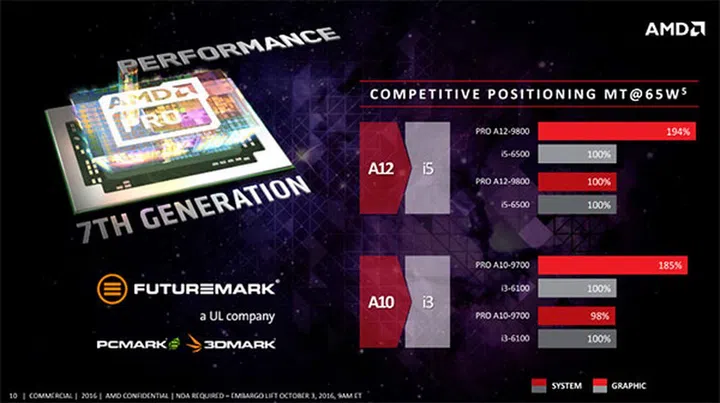
A slide from AMD showing the relative performance advantages compared to equivalent Intel chips. (Image Source: AMD)
All the chips use AMD’s Excavator CPU and GCN 3.0 cores, and are based on the updated 28nm process (we’ll have to wait for Zen to get 14nm). While the Zen architecture will eventually make its way to AMD’s APUs, AMD will launch Zen desktop parts first, and the recent Bristol Ridge launches may mean that we still have some ways to go before Zen APUs arrive.
One of the first systems to ship with the Bristol Ridge PRO APUs is the HP EliteDesk 705 G3, which is available in mini, small form factor, or mini-tower configurations.
Our articles may contain affiliate links. If you buy through these links, we may earn a small commission.