
Seagate Outlines the Future of Storage
Hardware Zone had the golden opportunity to chat with James M. Chirico, Jr., the Senior VP of Global Operations at Seagate. We discussed the future of hard drives and talked about Seagate's plans to dominate more than 97% of the storage market space.
About Perpendicular Recording
A shorter version of this article also appeared in our recent January issue of HWM.
Hardware Zone had the honor of catching up with James M. Chirico, the Senior VP of Global Operations at Seagate on their upcoming perpendicular recording technology, their upcoming products for 2006 and the developments in the storage business. James currently oversees all of Seagate's operations including the development of media.
HWZ : Well, the hottest topic these days around storage has to be perpendicular recording technology. Is Seagate on track to deliver its first hard drive featuring perpendicular recording technology?
James M. Chirico : We are on track. In fact, a number of drives now are going through our reliability and quality processes today. The drives are performing better than our expectations and we're really excited about getting that out into the marketplace. We said back in June that they are going out in 1Q2006 and we're on track to meet that date. The performance to date is phenomenal. We're really excited about it and we believe it's going to have tremendous market acceptance.
True to Seagate's promise, Seagate has recently launched their first perpendicular recording drive, the Momentus 5400.3, a 2.5-inch notebook drive with a capacity at 160GB.
HWZ : While Seagate was developing perpendicular recording technology, what kind of technological trade-off did Seagate encounter?
Chirico : I won't say there's any trade-off from the technology perspective. There are some issues in developing perpendicular that are different from longitudinal. One of the areas that we really needed to spend a fair amount of time was on media. Perpendicular technology actually requires a totally new media process (because it is more) susceptible to different type of media defects than longitudinal. We've invested tremendously - most of which were in our Woodlands facility here in Singapore. From the technology perspective, one of the biggest investments we made more than any in the rest of the program was in the area of media. We've been able to overcome that and we feel really bullish about where we are with the product now.
About Hard Drive Capacity
HWZ : How much more capacity can we obtain with perpendicular recording?
Chirico : Obviously perpendicular gives us the capability to extend the areal density performance of the drive, therefore the storage capacity can be extended. But I think that coupled with the fact of just how rugged are the drives, the performance and the price, I think the market would just reach an inflection point or at the beginning of, what I believe to be a tremendous demand for hard drives. This quarter (4Q05) was projected to be the first quarter for the hard drive industry itself to ship 100 million drives. You go back two years ago, I think the industry shipped about 300 million for the whole year. And expectations are that within the time we get to 2008, the number could be about 600 million. So, it's still a tremendous growth, but all centered around cost, performance and size. Most of that is driven around the whole big consumer market space. The consumer space has more and more applications coming out that are really fuelling a lot of the growth.
HWZ : When do you think we can break the Terabyte barrier?
Chirico : Well, we're shipping a 500GB drive now. The Tera barrier would probably be within two to three years time. Since we're on a projected growth of areal density of about 40% a year, so in about two to three years, we should be in the area of about a 900GB to a Terabyte.
The recently announced Seagate Momentus 5400.3 featuring perpendicular recording technology.
HWZ : Is Seagate going to continue offering 5 year warranty on their new perpendicular recording drives since Seagate has, so far, no track record on its reliability?
Chirico : I don't see anything that's going to change the warranty. I can tell you that the testing we're doing today, whether it's perpendicular or longitudinal drive, compared to where we were three to five years ago, has increased by orders of magnitude because our customers today are demanding a higher level of performance when it comes to the area of quality. And as we introduce new products, one of our guiding principles is to ensure that the new product performs equal to or better than the existing product. We're making sure that everything is tested out and we send a number of customer test units out to our key suppliers and key customers who run them extensively, so we can understand exactly how the drives are performing and what improvements we need to make.
About Desktop Drives
HWZ : Seagate just recently launched their ninth generation of the Barracuda drive with capacities of up to 500GB. Warranty is still set at 5 years and it now supports the newer SATA 3Gbps interface. To us, that's already an enterprise class drive. Do you think SATA drives are positioned to take over SCSI now, or in the near future?
Chirico : Serial ATA will have its niche in the enterprise space but it won't overtake the enterprise space itself. There will be areas that will fit, but SCSI and Fiber Channel (FC), I think are still going to be the two main drivers from the interface perspective. In the real core of the enterprise space, I don't see much will change to that. We're shipping some SATA in that, and as you grow higher in areal density, you'll see it take over some area but I think most of the core applications, you'll see SCSI and FC.
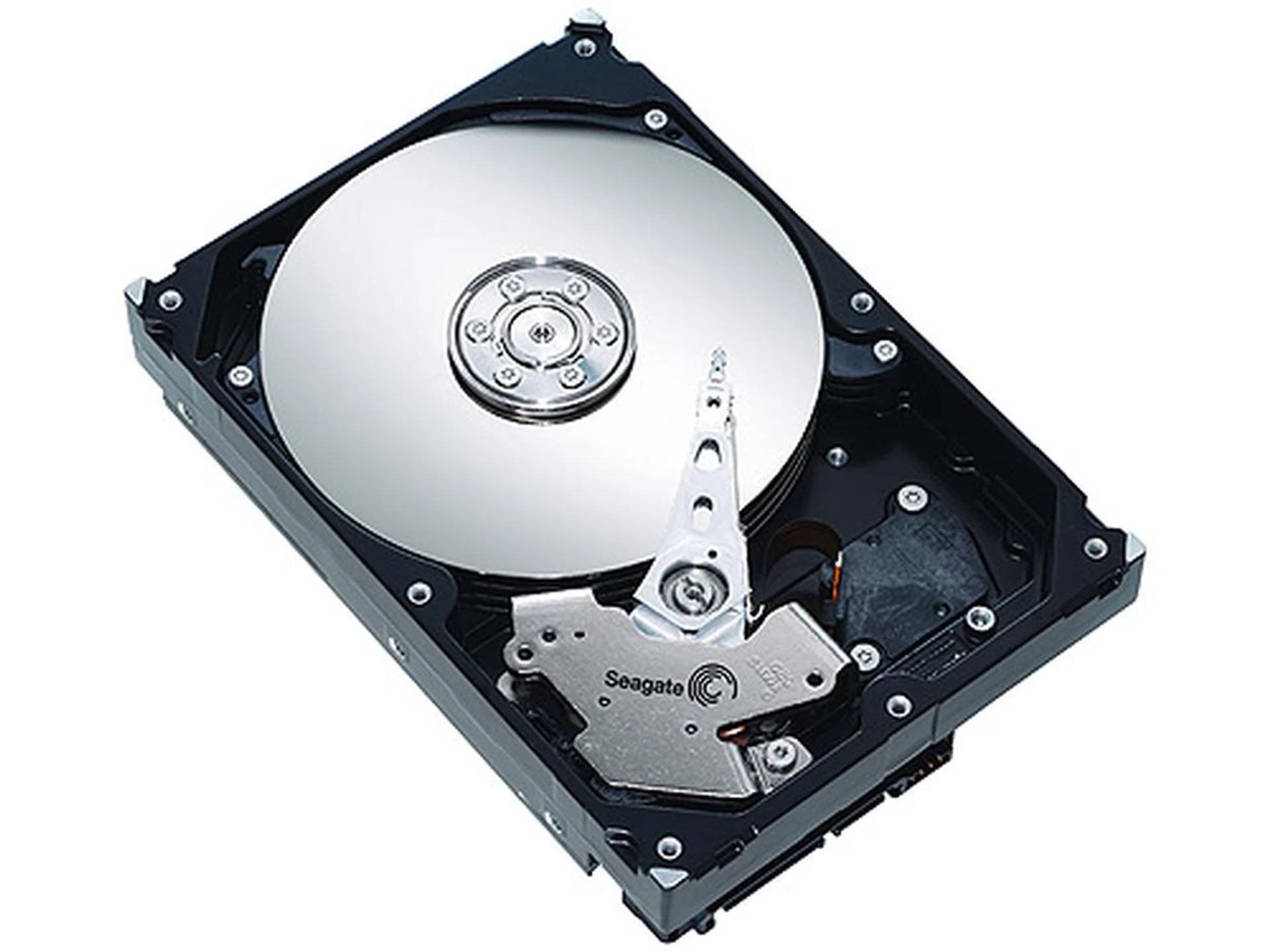
The Seagate Barracuda 7200.9 hard drive offers up to half a Terabyte of storage capacity. Seagate believes that storage capacity will hit the Terabyte level in two to three years' time.
HWZ : Any possibility of 10K or 15K RPM SATA drives with SATA 3G technology?
Chirico : Obviously there's opportunity for everybody to work on different ways to exploit markets they are not in today or empty spaces in the market segments. As we're working closely with a number of the top five or six vendors in the enterprise space, and looking out at their roadmaps and how much time we spent in joint development activities with them, I don't see anything in the near term that's going to be disruptive to that. Anything is possible, but I don't see it today.
HWZ : When do you think SATA will completely replace the legacy PATA interface?
Chirico : We get tremendous fluctuation, believe it or not, that flip flops back between SATA and PATA. Drives going out to key OEMs today are still being equipped with PATA and looking out into the horizon, we still see the demand for PATA, so I honestly don't know.
About NAND vs. Hard Drives
HWZ : Today, we have NAND Flash competing with the small lightweight 1-inch drives. We saw iPod Nano already adopting NAND Flash for its memory. What do you think about this trend and how is Seagate competing in this area in terms of capacity, price and reliability?
Chirico : First of all, when you take a look at the lower capacity points, Flash does offer an advantage today over hard drives. When you really look back, that was a market that was totally owned by solid state and with the introduction of the 1-inch drive, I think we're a little bit more disruptive to Flash than Flash has been disruptive to our drives. If we stay on the trajectory that we're going to grow in areal density at the rate of about 40% a year, we honestly don't see a crossover point where Flash can be competitive with hard drives from a cost perspective. The MP3 is a good example where we were disruptive and made some guys sharpen their pencils a little bit. I think they were over-committed and I'm not sure over the prices that they gave but it's hard to picture how they are making money. There are a number of applications, other than MP3 players, that's driving for a smaller capacity point and we're working with retail and other consumer folks to provide applications that a 1-inch has a perfect fit. So there's obviously going to be a huge demand for small form factor high capacity low cost drives.
In fact, by losing the Apple business or by Apple announcing some of their products (not all) going to Flash, didn't really have a big effect on our bottom line. We cover 97% of the market and although something would fluctuate here or there, it doesn't have a huge impact on our bottom line because we play in 97% of these segments and we're working hard to make sure that the number becomes 100%. It keeps us sharp and we understand what's going on in the enterprise, desktop, notebook or the huge applications inside your handheld or 1-inch space.
Flash is going to be a competitor and now that you have someone outside of the industry coming into the storage space, I tell you it is eye opening. It's only going to make Seagate that much better because we're vertically integrated - we own our development, we own our key technologies, we're able to leverage a lot faster than our competition. I can tell you that in the last six to nine months, it has really changed the way we look at the world and changed a lot of our product offerings rolling out over the next one to two years in our development pipeline.
HWZ : We know that Samsung have plans to introduce a lightweight notebook with up to 32GB of NAND Flash storage. In the ultra mobile market segment, do you think traditional hard disk drives are losing their appeal since solid state storage is increasingly more attractive?
Chirico : There's obviously a huge market out there and if they can actually come up with 32GB with the right price point then they are targeting to move the demand from traditional disk drives into Flash. I'm not sure that they can manufacture to the price point to do that. But I can tell you that there's a lot of work that we're doing to drive down the price point, to improve the power, to improve the ruggedness and to come out with smaller form factor drives with a lot higher areal density than we have today. I can tell you that a lot of activities are going on inside of Seagate to ensure that we remain competitive. We have high expectations that we're still going to continue to grow from a market share perspective in notebook.
About CE Storage and R&D
HWZ : How about 1.8-inch drives? Any plans to populate that space?
Chirico : I can't get into new product offerings but I can tell you our goal is not to have only 97% market coverage. We'll go into markets when we think there's an opportunity. Obviously the 1.8-inch is now becoming a 'sweet spot' and although I can't talk about new products but clearly we're here to cover the entire breadth of the storage business.
HWZ : How about the mobile phone segment? Where's the market heading right now in terms of hard drive storage?
Chirico : I think disk drives will only be a niche player in mobiles phones. Even though there are more and more applications and need for streaming, I don't really see hard drives as a significant player in the mobile phone market in the next five years. However, if you're doing a billion of phones a year, if you have 5-10%, that's still 50-100 million drives that we don't sell today. I think you're going to start to see that take off somewhere in 2006-2007. I think it will be “significant in the grand scheme of things” because even if it's just 40 million units a year, that's still 10 million a quarter. If you take a look at 1-inch around the industry, there's no way that anyone's doing 10 million a quarter, probably best about 2-3 million max. So when it gets to a number like 7-10 million units a quarter, it will be pretty significant and I can see that it's probably a niche 5-10% of the mobile market.
HWZ : Has Seagate begun shipping the EE25 series of rugged hard drives for the automotive industry? What kind of applications do you think these drives are suited for?
Chirico : Today, it's in qualification stages. The two uses that we're working are GPS and entertainment. So far, it is doing really well in testing. Anything in the automotive industry takes years before it gets into their product cycles. So we've been working on this for a while. We put a lot of technology around temperature sensitivity but there's a tremendous amount of technology and software that's built into the drive (in order to handle the wide temperature range). We're working with a handful of major automotive companies, so I think this will be a niche product for a while, with best expectations at 50% of the market moving to hard drives in the next three to five years. Then, you're talking another 10 million units a quarter and they all start to add up.
HWZ : We know that Seagate has an R&D center right here in Singapore. What kind of products are developed here and why do you choose Singapore to develop these products?
Chirico : They have 100% of the consumer electronics market space here and in fact it's expanding. Anything below 2.5-inch drives in the consumer electronics space are all here in the R&D center. We started the R&D center here years ago and they were targeted to go after low cost drive development. They did a really nice job and we initially set them up over here because a lot of low cost demands were driven around Asia. So we wanted to get this design center really focused on more of your non-traditional market places and we thought we can break into those with low cost applications. And then from there, as we embarked on our 1-inch, the innovation and technology that these guys have and the track record that they have, it was a no-brainer to mission the R&D center here with our 1-inch offering. Plus, a lot of the MP3 guys, like Creative, where we work hand in hand sort of made a perfect fit. We've just extended our 1-inch drives to the second generation and beyond and there's obviously new markets that we want to get into. We also brought over our software development and we do an awful lot of software development over here now.
HWZ : Seagate has always been pushing the technological limits and hard drive capacities are getting larger every year. With perpendicular recording, we expect it to increase even further. Now, the world's full of data, and even Google encourages users to never delete their mails, since they have like more than 2.5GB of storage just for emails. Most desktop users never delete their stuff, and if you have half a Terabyte, you'll likely not delete anything. Do you think that given such technological advancements, users are getting increasingly bad housekeepers since they'll never have the urge to keep their PC free of junk? What are your views?
Chirico : I agree, I'm one as well. I used to do a lot of 'folder management' but now I just call up and ask for more space. I'm pretty bad as well. But that's also good because that's driving demand for more storage. But people are going to get lazy (like me) because we can just go get more and you don't spend the time to move, delete or backup. I think that's true, I think people will get a little lazier. Maybe that's good for driving demand for storage. *laughs*
Our articles may contain affiliate links. If you buy through these links, we may earn a small commission.