

NVIDIA introduces a cheaper 64GB DGX Spark for local AI development
The new DGX Spark retains the same GB10 Grace Blackwell Superchip as the 128GB model.
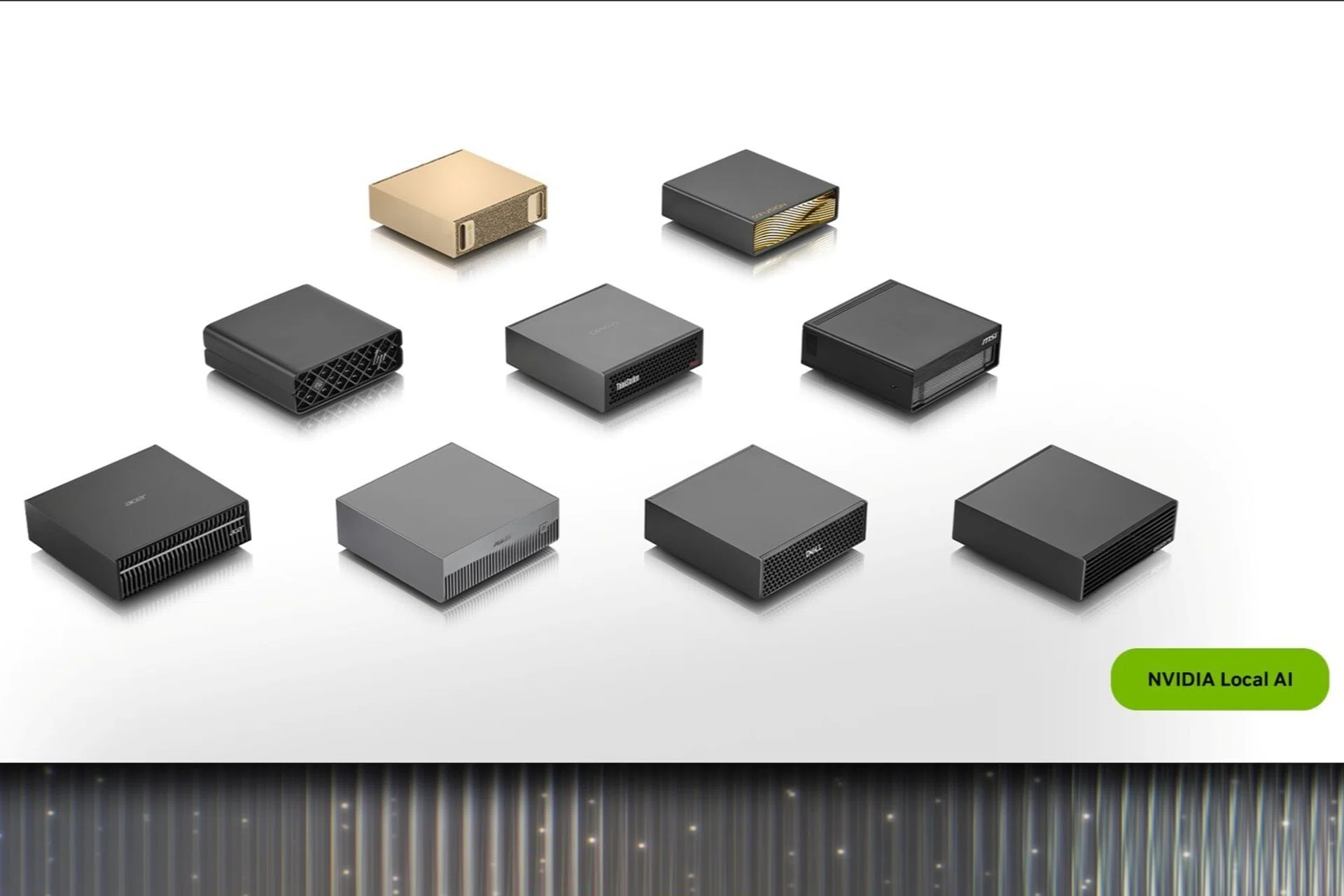
NVIDIA is making its DGX Spark personal AI supercomputer slightly more accessible with a new 64GB configuration, although its US$4,999 starting price means this is still very much a machine for serious AI developers and not for those looking to run a chatbot from home.
Available from 23 October, the 64GB DGX Spark will be sold through Acer, Asus, Dell, Gigabyte, HP and MSI. Unlike the original 128GB version, there will not be a Founders Edition model offered by NVIDIA.
As the name implies, the key difference with the new model is just the reduced memory. It retains the same GB10 Grace Blackwell Superchip, DGX OS and NVIDIA AI software stack as the 128GB DGX Spark, along with its built-in ConnectX-7 networking.
According to NVIDIA, a single 64GB system allows developers to run models containing up to 100 billion parameters entirely on the device, and is intended for work involving AI agents, inference, model fine-tuning, data science and edge development – all without having to send their data to a cloud service.
A lower barrier of entry
This is where I think the 64GB version makes the most sense. It lowers the cost of getting into the DGX ecosystem without turning the machine into a completely different product. Developers working with smaller models can begin with one unit, keep their code and data locally, and add another DGX Spark if their projects eventually demand more memory.
Of course I would still hesitate to call US$4,999 affordable, but it is simply a less expensive way into a specialised category of computers that was never meant to compete with an ordinary desktop PC.

NVIDIA is also making it easier to join two DGX Spark systems together. Two 64GB units can be connected directly using a QSFP cable, pooling their memory to 128GB and supporting models with as many as 200 billion parameters. It says this arrangement provides twice the memory bandwidth and up to 1.7 times the performance of a single system. More interestingly, developers will not have to configure the cluster manually. NVIDIA Sync Cluster Assistant can detect the connected systems, check their configuration and set up the ConnectX-7 network automatically.
NVIDIA’s Sync Model Launcher, which is expected at the end of October, will simplify the process further. It will let developers download and launch models such as Qwen3.8-27B on either one DGX Spark or a two-system cluster, before making the model accessible from a laptop. It can also configure OpenCode so that developers can begin coding through a web browser.
What about the RTX Spark?
The broader strategy becomes clearer when the new DGX Spark is considered alongside NVIDIA’s upcoming RTX Spark PCs. While DGX Spark runs DGX OS and is sold as a dedicated local AI development platform, RTX Spark will appear in Windows 11 laptops and mini-PCs from companies including Acer, Asus, Dell, HP, Lenovo, Microsoft and MSI.
Unlike DGX Spark, RTX Spark machines are designed to do more than run AI models. NVIDIA is also positioning them for content creation and gaming, with support for familiar RTX technologies including DLSS, Reflex and ray tracing.
RTX Spark is NVIDIA’s most serious move yet to establish itself as a full-platform player in Windows laptops and small-form-factor PCs. These are markets where Intel and AMD have traditionally supplied the processors, while Qualcomm has more recently pushed Windows on Arm. Apple, meanwhile, remains a strong alternative for developers who want to run AI models locally, often at a lower entry price than a DGX Spark.
DGX Spark gives NVIDIA a purpose-built platform for developers who want a ready-made local AI environment, while RTX Spark puts the wider Grace Blackwell and CUDA proposition into more familiar Windows PCs. That could make local AI development more approachable, especially for those who do not want a separate Linux computer.
It also tightens NVIDIA’s hold over the development process. The company is no longer supplying only the GPU. With both DGX and RTX Spark, it is supplying the processor, unified memory architecture, operating environment, networking, development tools and software used to scale the workload. For AI developers, that integration could save considerable setup time, and the trade-off is becoming even more closely tied to NVIDIA’s CUDA ecosystem.