


Quadro-class NVIDIA RTX Ada Lovelace GPUs will soon grace mobile workstations. (Image source: NVIDIA)
Just at the start of the year in CES 2023, NVIDIA brought the power of their Ada Lovelace GPUs (GeForce RTX 40 series) from desktops and crammed them into the latest generation of gaming laptops that are now coming into the retail channel. Barely two months since that announcement, NVIDIA is wasting no time putting these incredible mobile GPUs into the hands of serious creators, engineers, data scientists and more to power the growing new era of AI, design and the industrial metaverse.
Compared to the previous generation Ampere architecture-based pro-grade GPUs, the Ada Lovelace architecture will significantly benefit the above-mentioned professionals in these key areas:-
- A massive boost in ray tracing performance
- Thrid-gen RT cores to tackle more complex workloads efficiently
- Fourth-gen Tensor Core for a big AI uplift
- DLSS 3.0 for breakthrough AI-powered graphics acceleration
We've covered these features in great detail in this feature that shows off why these features are the hallmark traits of the Ada Lovelace GPUs. At GTC 2023, NVIDIA has now launched the NVIDIA RTX Ada Generation Laptop GPUs in the following configurations:-
Graphics Processor | RTX 5000 Ada Generation Laptop | RTX 4000 Ada Generation Laptop | RTX 3500 Ada Generation Laptop | RTX 3000 Ada Generation Laptop | RTX2000Ada Generation Laptop |
GPU | NVIDIA Ada Lovelace | NVIDIA Ada Lovelace | NVIDIA Ada Lovelace | NVIDIA Ada Lovelace | NVIDIA Ada Lovelace |
Process | 4N
(TSMC) | 4N
(TSMC) | 4N
(TSMC) | 4N
(TSMC) | 4N
(TSMC) |
CUDA cores | 9728 | 7424 | 5120 | 4608 | 3072 |
Tensor Cores | 304 | 232 | 160 | 144 | 96 |
Tensor Performance1 (FP32) | 682TFLOPS | 538 TFLOPS | 369 TFLOPS | 319 TFLOPS | 232 TFLOPS |
RT Cores | 76 | 58 | 40 | 36 | 24 |
RT Performance | 98.5TFLOPS | 77.8TFLOPS | 53.3TFLOPS | 46.0 TFLOPS | 33.5 TFLOPS |
Memory | 16GB GDDR6 ECC | 12GB GDDR6 ECC | 12GB GDDR6 ECC | 8GB GDDR6 ECC | 8GB GDDR6 |
Memory clock speed | 2.25Gbps | 2.25Gbps | 2.25Gbps | 2.0Gbps | 2.0Gbps |
Memory bus width | 256-bit | 192-bit | 192-bit | 128-bit | 128-bit |
Memory bandwidth | 576GB/s | 432GB/s | 432GB/s | 256GB/s | 256GB/s |
TGP | 175W | 175W | 140W | 140W | 140W |
1. Effective Tensor performance with and without using the Sparsity feature.
The new GPUs include the latest generation of NVIDIA Max-Q 5.0 for optimal energy efficiency while churning out fantastic photorealistic graphics, and are backed by NVIDIA Studio technologies for creators. Products with NVIDIA RTX GPUs benefit from RTX optimizations in over 110 creative applications, NVIDIA RTX Enterprise Drivers for the highest levels of stability and performance in creative applications, and exclusive AI-powered NVIDIA tools: Omniverse, Canvas and Broadcast.
Professionals using these laptop GPUs can take advantage of DLSS 3.0 to increase frame rates by up to 4x compared to the previous generation, and NVIDIA Omniverse Enterprise for real-time collaboration and simulation.
Apart from the above list of NVIDIA RTX Ada Generation GPUs, NVIDIA is also maintaining two other SKUs based on the existing Ampere architecture, the RTX A1000 and RTX A500 Laptop GPUs, for their 2023 line-up of notebook GPUs for creators.
What about small form factor systems?
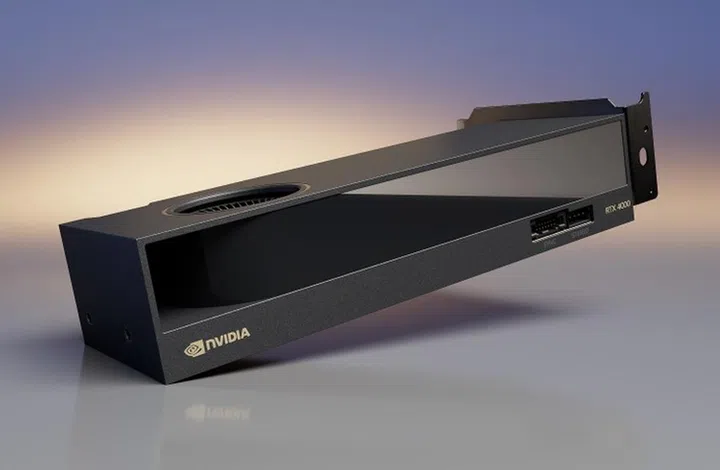
There's always something for every platform and size. Meet the new RTX A4000 SFF Ada Generation GPU. (Image source: NVIDIA)
Nearly two years back, NVIDIA launched an Ampere-architecture powered RTX A2000 low-profile professional graphics card for micro desktop workstations in a 70W TDP power profile. Today, NVIDIA is offering the RTX 4000 SFF Ada Generation GPU that more than doubles the performance of the previous RTX A2000, while still maintaining the same 70W TDP in a low-profile, dual-slot offering. Here are its vital performance markers of this Ada Lovelace GPU-based professional graphics card:-
- 306.8 teraflops of Tensor Core performance
- 44.3 teraflops of RT Core performance
- 6133 CUDA cores
- 192 Tensor cores
- 20GB GDDR6 memory with ECC
- 160-bit memory bus width and 320GB/s memory bandwidth
- 70W TDP
The RTX 4000 SFF also has four micro DisplayPort 1.4 ports, which makes it suitable for use with multi-monitor setups, just like its predecessor.
What about for desktop powerhouse workstations?
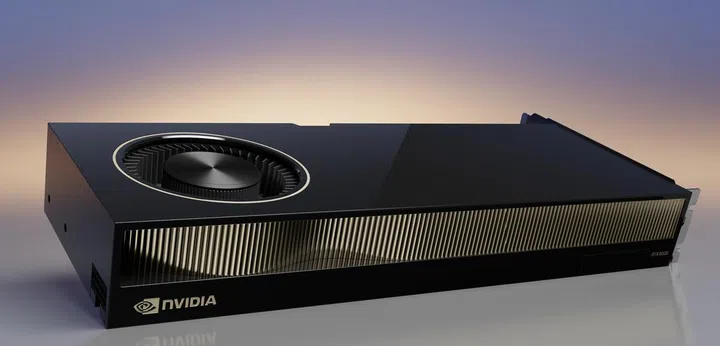
Why can't NVIDIA still name them as a 'Quadro' escapes us, but here's the top-end Ada Lovelace GPU for professional creators - the RTX 6000 Ada Generation. (Image source: NVIDIA)
Back in GTC 2022 Fall, NVIDIA announced the Ada Lovelace architecture-based high-end Quadro equivalent variant of the RTX 4090, but it wasn't available till earlier this year in late January 2023. To date, the NVIDIA RTX 6000 Ada Generation remains to be the only 'Quadro' class professional high-end workstation GPU launched, and its specs hint that it could also be the yet-to-be-announced RTX 4090 Ti. The rest of the professional desktop GPU lineup is still occupied by the previously launched Ampere architecture-based options and the above-mentioned new SFF variant.
Graphics Card | RTX 6000 Ada Generation | RTX4090 | RTX 4080 | RTX A6000 | RTX
3090 Ti |
Class | Professional | Consumer | Consumer | Professional | Consumer |
GPU | Ada Lovelace
(AD102) | Ada Lovelace (AD102) | Ada Lovelace (AD103) | Ampere
(GA102) | Ampere
(GA102) |
Process | 4nm
(TSMC) | 8nm
(Samsung) | |||
Transistors | 76 billion | 76 billion | 45 billion | 28 billion | 28 billion |
Streaming Multi-processors (SM) | 142 | 128 | 76 | 84 | 84 |
CUDA cores | 18176 | 16384 | 9728 | 10752 | 10752 |
Tensor Cores | 568
(Gen 4) | 512
(Gen 4) | 304
(Gen 4) | 336
(Gen 3) | 336
(Gen 3) |
Tensor Performance1 (FP16) | TBD | TBD | TBD | 309.7 TFLOPS | TBD |
RT Cores | 142
(Gen 3) | 128
(Gen 3) | 76
(Gen 3) | 84
(Gen 2) | 84
(Gen 2) |
RT Performance | 210TFLOPS | TBD | TBD | 58 - 75.62 TFLOPS | TBD |
GPU base / boost clocks (MHz) | TBD | 2230 / 2520 | 2205 / 2505 | 1455/ 1860 | 1670 /
1860 |
Memory | 48GB GDDR6X with ECC | 24GB GDDR6X | 16GB GDDR6X | 48GB GDDR6 with ECC | 24GB GDDR6X |
Memory bus width | 384-bit | 384-bit | 256-bit | 384-bit | 384-bit |
Memory bandwidth | 960GB/s | 1,018GB/s | 716.8GB/s | 768GB/s | 1,008GB/s |
Interface | PCIe 4.0 x16 | PCIe 4.0 x16 | |||
NVLink | No | Yes | No | ||
TDP | 300W | 450W | 320W | 300W | 450W |
Price (at launch) | US$6,800 | US$1,599 | US$1,199 | US$4,650 | US$1,999 |
1. Effective Tensor performance with and without using the Sparsity feature.
2. Peak rates based on GPU Boost Clock.
Availability
The new NVIDIA RTX Ada Generation laptop GPUs will be available starting this month in mobile workstations from global workstation manufacturer partners.
Meanwhile, the new NVIDIA RTX 4000 SFF GPU will be available from global distribution partners such as Leadtek, PNY and Ryoyo Electro starting in April at an estimated price of US$1,250 and from global workstation manufacturers later this year.
Our articles may contain affiliate links. If you buy through these links, we may earn a small commission.