

Stereoscopic Wonder
Lately, 3D madness is gripping almost everything under the sun as manufacturers start churning out stereoscopic 3D products for consumers. This isn't about to end just yet, as 2010 seems to be the year when 3D finally goes mainstream. 3D stereoscopic PC gaming has long been a niche market, though NVIDIA's recent efforts with its 3D Vision have given this technology a much needed boost.
NVIDIA's 3D Vision is based on active shutter technology and unlike the older anaglyphic (the familiar red/blue glasses) type, there are no color issues to worry about. It also delivers brighter images as it does not use polarized glasses that limit the amount of light passing through. However, shutter glasses require a monitor that's capable of a 120Hz refresh rate, and these are more expensive compared to your usual monitor.
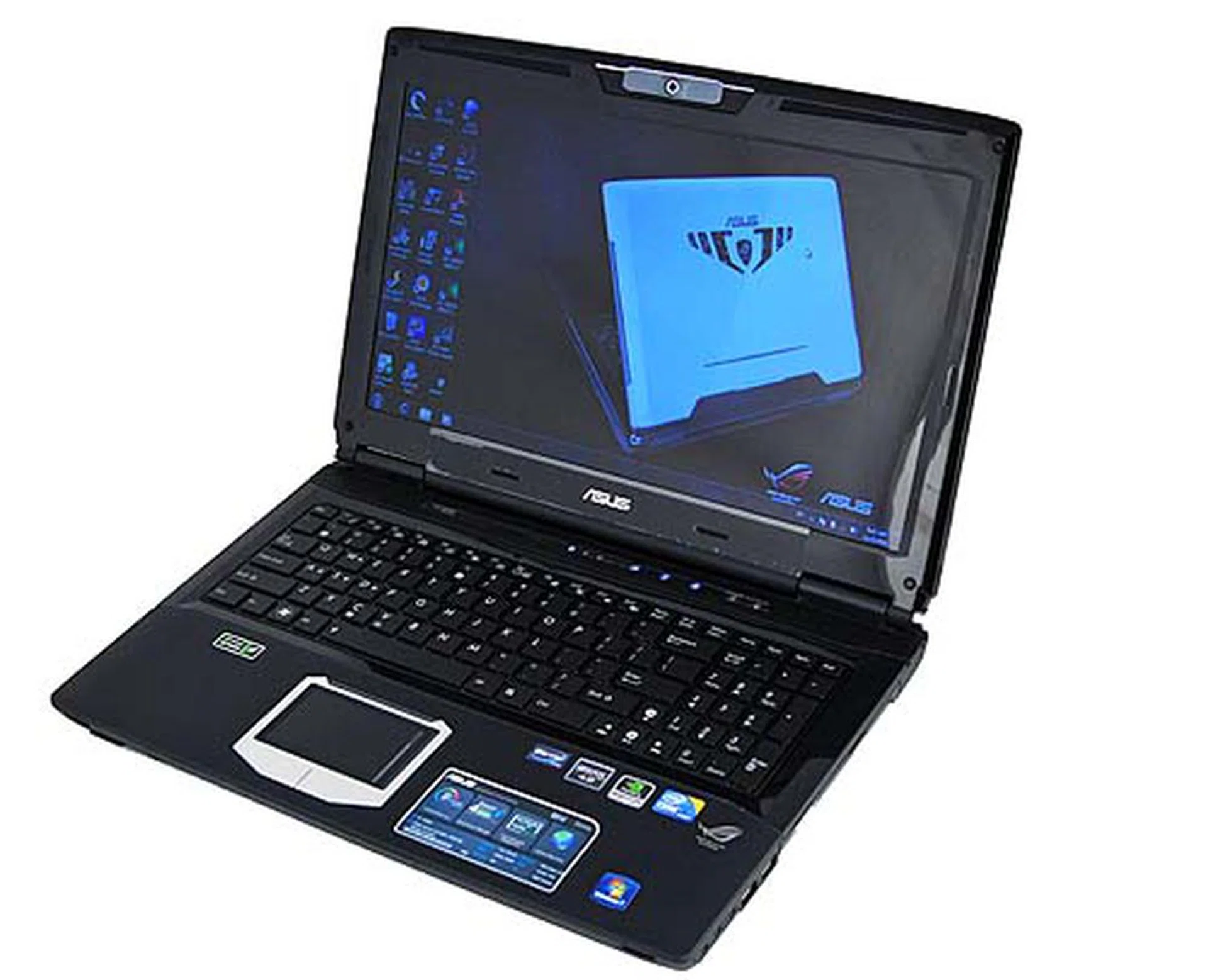
Gaming notebooks with 3D stereo capability are even more rare, but today, we lucked out with the 15.6-inch ASUS G51J, a 3D-ready notebook that comes with a 120Hz screen, NVIDIA graphics and of course, NVIDIA 3D Vision.
Is the notebook any good? Well, let's begin our review by taking our usual look at the flashy exterior before we inspect the innards, the bundled accessories and performance aspects.

The ASUS G51J is a boldly colored and in your face (more ways than one) gaming notebook.

The right side ports play host to the audio jacks, two USB 2.0 ports and the Blu-ray optical drive.
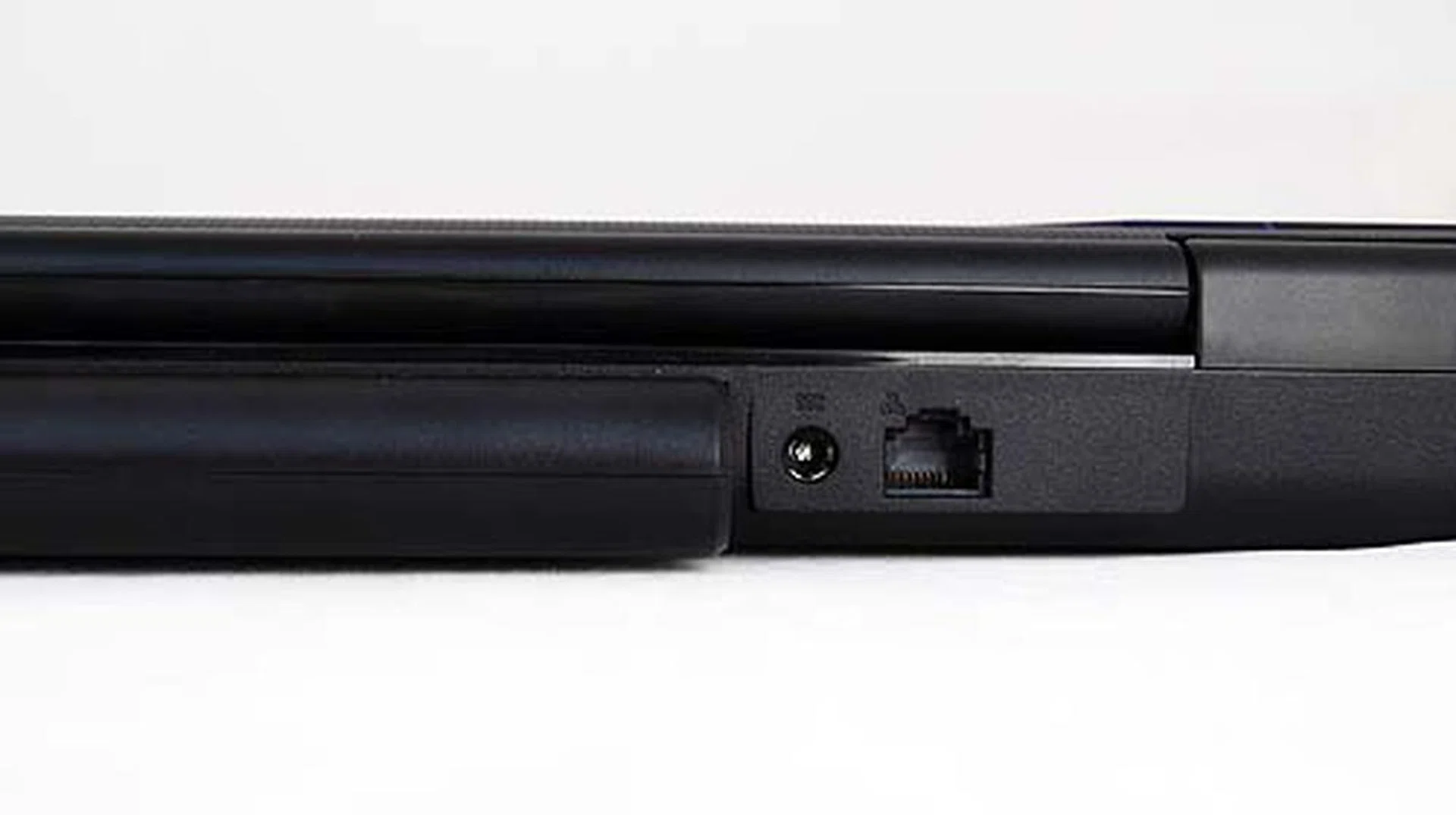
We rarely see ports at the back these days, but the G51J has space for the LAN and power jack.

On the left, you get the rest of the ports, including a VGA out, S/PDIF jack, FireWire, HDMI, eSATA and two more USB 2.0 ports.
Tri-Dimensional Interior
As for the interior design, the G51J has a sexy, sleek look much like the exterior. You get your standard screen and keyboard configuration, though ASUS has thrown in a Razer Abyssus mouse too. While it looks the same as its non-3D counterpart, bear in mind the resolution of this screen is only 1366 x 768 pixels and not Full HD resolution (i.e. 1920 x 1080 pixels), but we're guessing this to be a cost issue. The non-stereo 3D version of the ASUS G51J comes with a Full HD screen, more RAM but less one 500GB HDD and it's also S$100 cheaper.

The interior of the ASUS G51J.
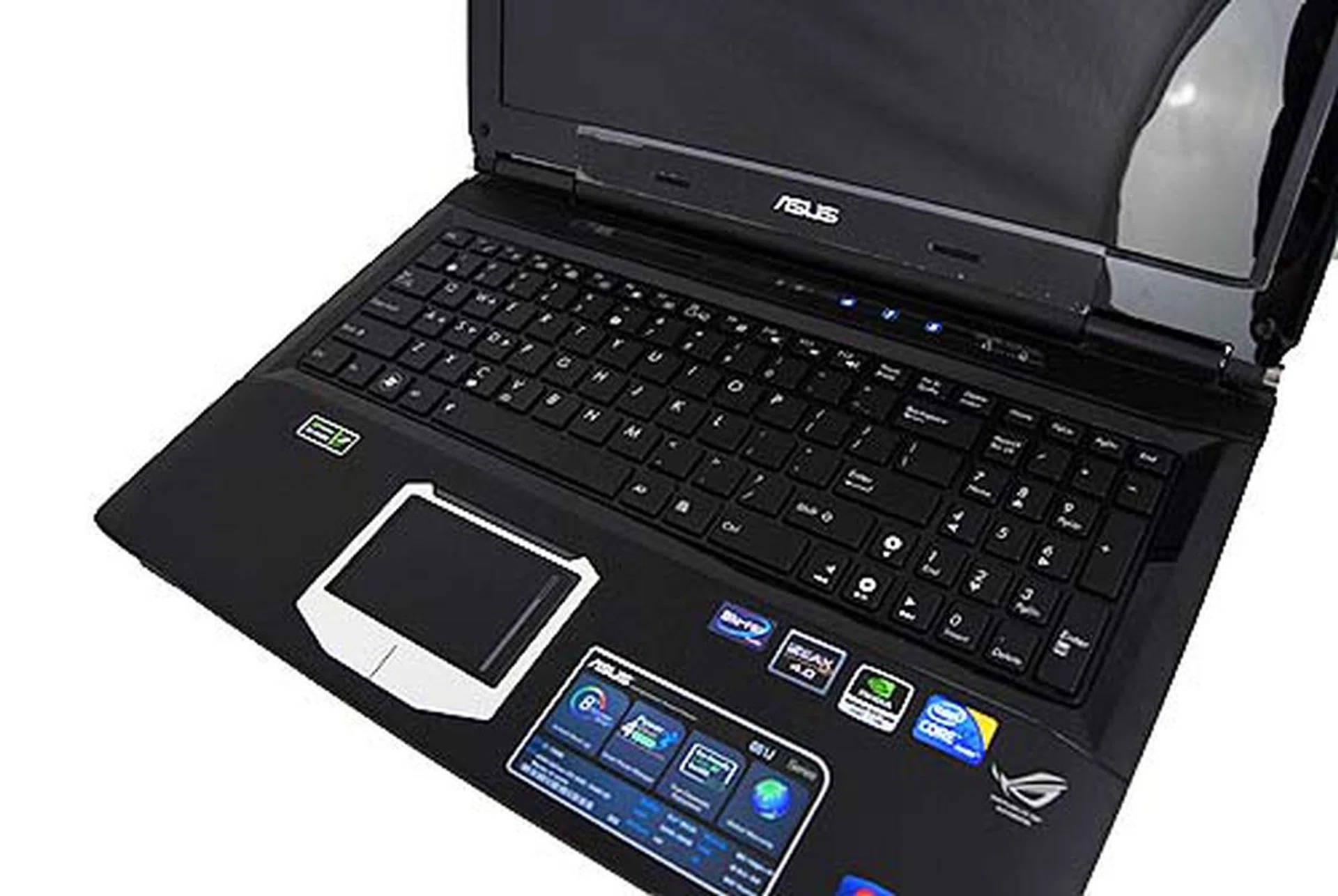
The keyboard uses a chiclet style that's quite easy to type on.
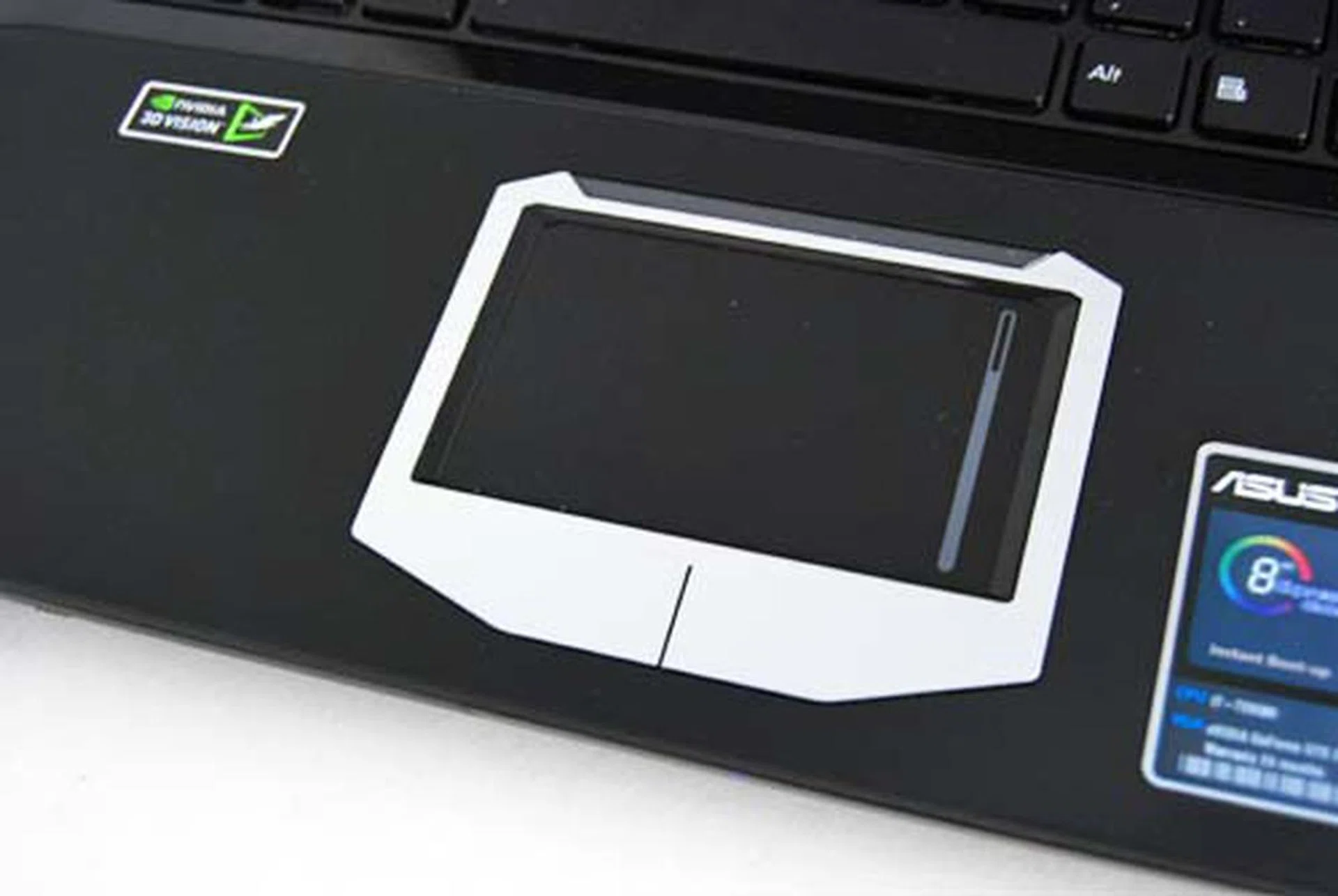
The trackpad's pretty decent too, but you won't be using this because you'll be using the included Razer Abyssus mouse.
While the notebook is a multimedia capable workhorse in its own right, loaded with a Blu-ray drive, EAX Advanced HD 4.0 sound and a subwoofer to boot, it's the bundled accessories for NVIDIA's 3D Vision kit and the 120Hz screen that turns the notebook from a normal gaming notebook into an immersive gaming machine. You'll get a transmitter and a pair of shutter glasses. For more information of the 3D Vision kit in detail and our past experience with this, you can read all about it here.

The bundled accessories comprising of the shutter glasses, transmitter and the Razer Abyssus mouse.
From there, it's a simple matter of plugging in the transmitter into a free USB port and putting on the glasses to get your stereo gaming going. Apart from some noticeable flickering, the ASUS G51J works as advertised. We tested the unit with a demo of Batman Arkham Asylum and enjoyed the 3D effects that added depth to the already great game. Despite the screen only being 15.6-inches wide, we still found ourselves captivated by the action going on screen.
While the 3D effects were still viewable from other angles, we found the best experience to be right in the center, and you can easily adjust the notebook for the best viewing angle unlike a bigger monitor. Our only issue during the test was how hot the unit turned out when the discrete graphics started working. We probably could cook an egg with the amount of heat we felt, but we didn't put that to the test, obviously.

Update: The round circular object you see here is actually a fan cooler that we mistook for a subwoofer. <s>Booming beats will come from the bottom of the unit via this subwoofer.</s>
Dissecting the Performance
Fact is, the ASUS G51J comes packed with such powerful hardware we're not sure why it hasn't yet turned sentient and taken over the world. It packs an Intel Core i7-720QM (1.6GHz) processor, 4GB DDR3 RAM, 2 x 500GB HDDs and a blazing fast NVIDIA GeForce GTX 260M. That should be enough to get pretty high scores in our usual benchmarks, so let's take a look at how it stacks up against some of it competition.
Specifications / Notebook | ASUSG51J | Dell Alienware m15x | Acer Aspire 8935G |
Processor | Intel Core i7-720QM (1.60GHz, with turbo up to 2.80GHz) | Intel Core i7-920XM (2.0GHz, with 8MB L2 cache) | Intel Core 2 Quad processor Q9000 (2.0GHz, with 6MB L2 cache) |
Chipset | Intel PM55 | Intel PM55 | Intel PM45 |
Memory | 4GBDDR3 | 8GB DDR3 | 4GB DDR3 |
HDD | 2 x 500GBSATA5400RPM | 1 x 500GB SATA 5400 RPM | 2 x 500GB SATA 5400 RPM |
Video | NVIDIAGeForce GTX 260M | NVIDIA GeForce GTX 260M | ATI Mobility Radeon HD 4670 |
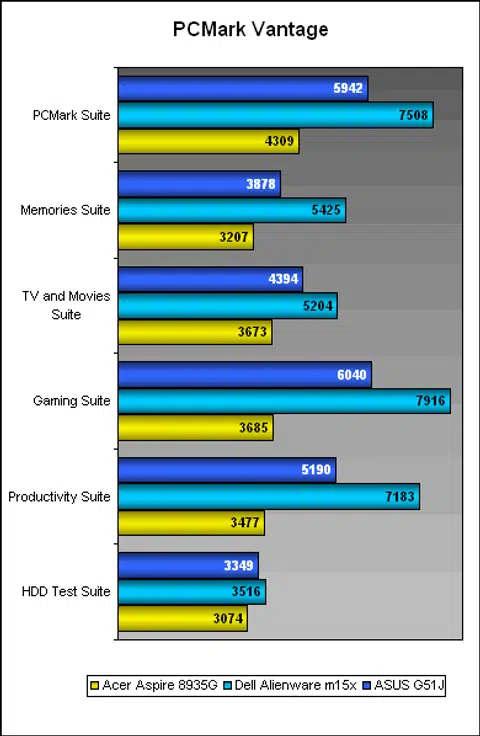
On PCMark Vantage, the ASUS G51J showed its muscle with a pretty decent score of 5942 PCMarks. It comes with a pretty decent quad-core Core i7 processor. Note that despite the low 1.6GHz base speed, it excelled better than the Acer Aspire 8935G notebook's 2GHz quad-core processor because of the new Core i7 processor's Turbo Boost feature. Of course, it was no match for the Alienware's Extreme processor class that it was equipped with and rightfully so since the differential in processor price between them is about 300%. Otherwise, the ASUS G51J handled pretty well for its specs.
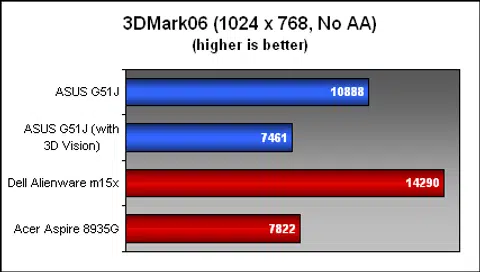
And in 3DMark06, the NVIDIA GeForce GTX 260M discrete GPU made its presence felt with a respectable 10888 3DMarks. We also re-tested it with 3D Vision enabled to check out its impact on overall performance and we noted that it scored 7461 3DMarks - about 30% lower since the GPU had to do more work to pump out a 120Hz output, which is double the norm.
As can be seen from our previous benchmark, the Dell Alienware m15x continued to beat the ASUS G51J down in 3DMark06 due to its better overall specs, but we like to note that the G51J's benchmark scores in this department are more than sufficient to make most notebooks turn green with envy. It also means that the notebook has enough capability to handle modern 3D games with no issues even at high settings.
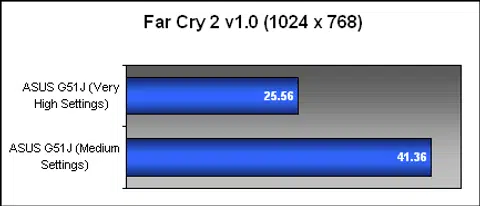
On Far Cry 2, the card showed its capabilities, delivering a solid average 25.3 fps on Very High settings, while easily going up to 41.36 fps on Medium settings. For some reason, turning on stereoscopic rending hardly affected the scores on this particular benchmark.
Note that we aren't quite able to compare the G51J's scores to the other notebooks as our usual testing for Far Cry 2 is done at a 1280 x 1024 resolution, as we pretty much figured that this test would only be run on higher end gaming notebooks whose screens are capable of displaying at this resolution. Sadly, the G51J, despite its more than adequate specifications, is capped at a 1366 x 768 pixels resolution, which means we were only able to test at a resolution of 1024 x 768 and not at our usual settings. Hence, there are no direct comparisons for this particular set of results.
Battery Performance
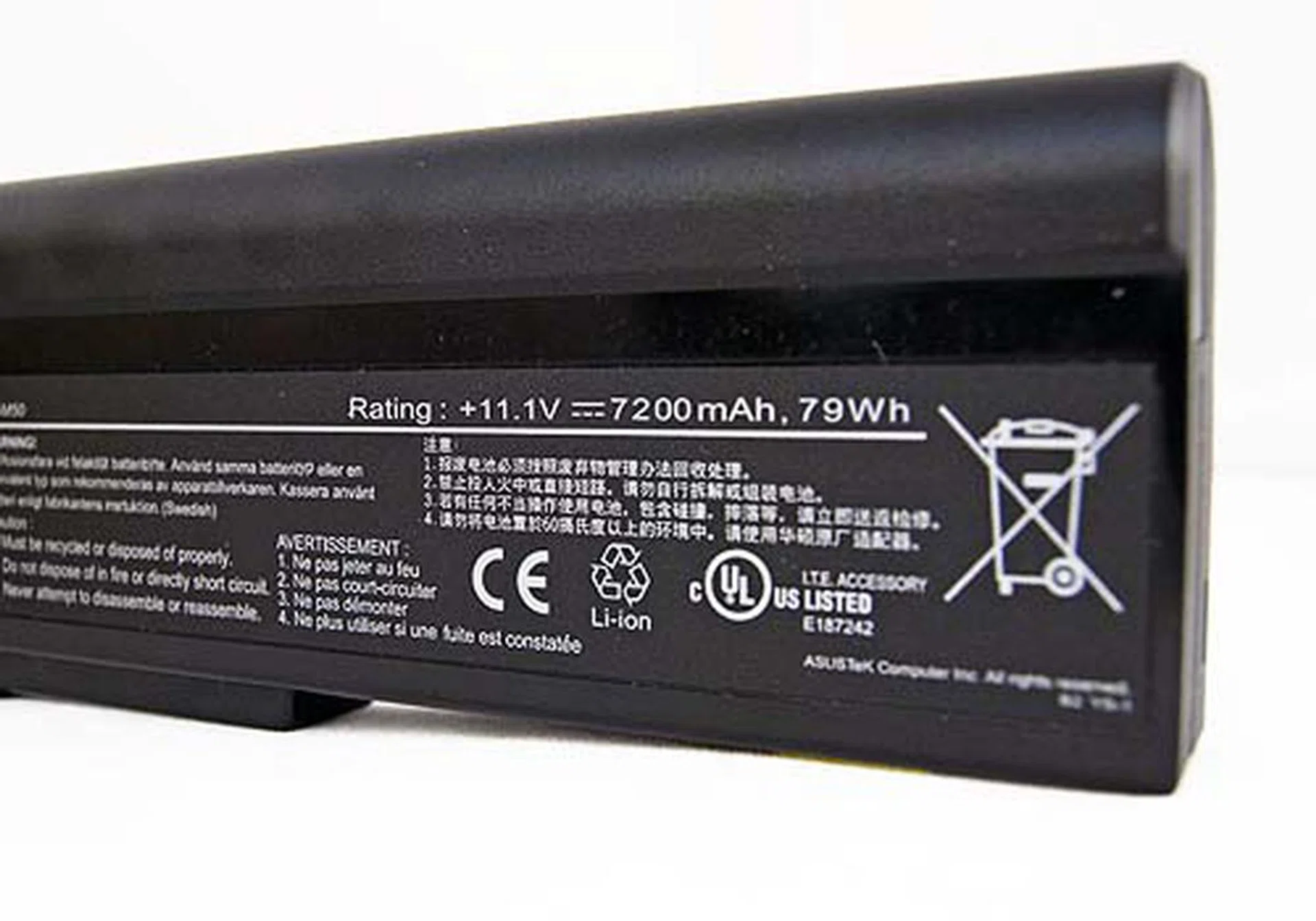
When you're nowhere near a power plug, you'll be relying on this 9-cell 11.1V, 7200mAh battery.
Our experience with gaming notebooks (and we have extensive benchmark results to prove it) is that they tend to have very short battery lives. This is to be expected of course; you don't get powerful performance without needing the processing power, which in turn, requires more energy. So, how does the ASUS G51J perform here?
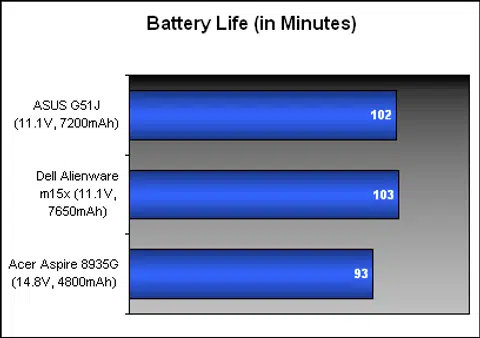
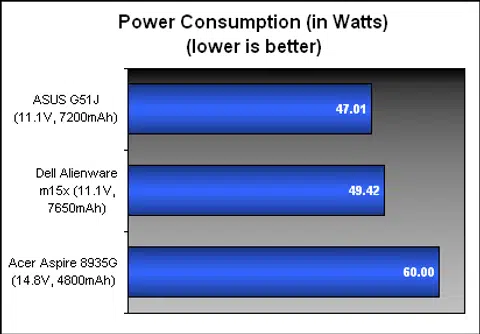
From our usual battery test, you'll find the notebook lasting 102 minutes, but that's based off our standard DVD looping test. If you're going to be making the GPU do more work by rendering 3D graphics, or gunning enemies in cyberspace, expect to see a huge dip in battery life (approximately half of the DVD test outcome). Power consumption figures also reflect this as the G51J chalks up 47.01 watts per hour, which is about as competitive with the other desktop replacement/gaming notebooks.
Portability Index
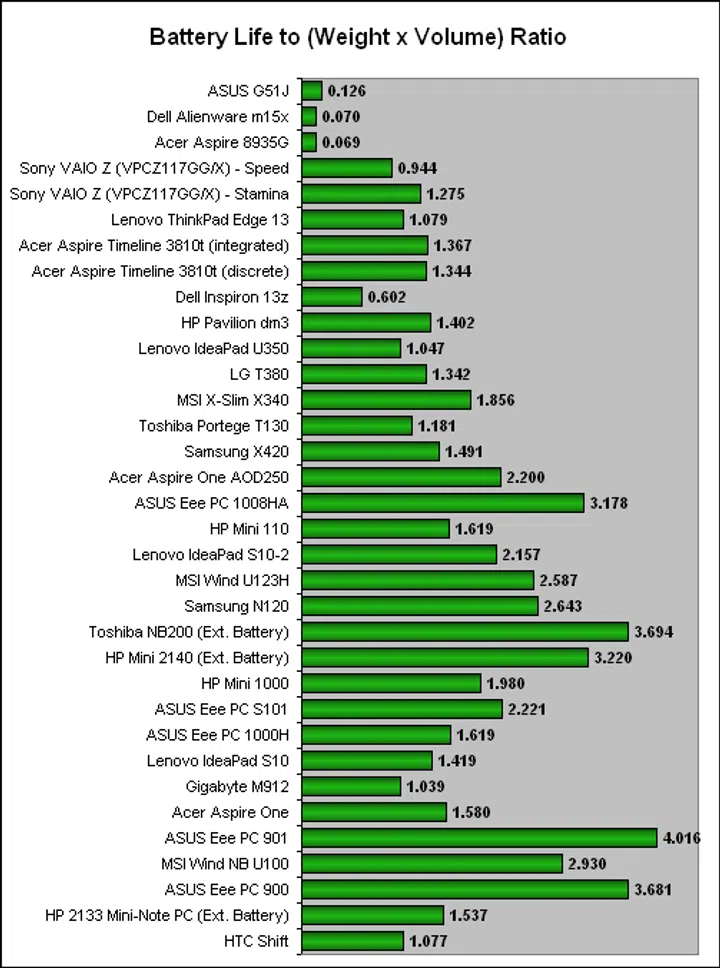
Next is our Portability Index score, where we take a unit's battery uptime and divide it by the product of the unit's weight and volume. The result is a ratio that we can use to reliably judge how portable a notebook is. The higher the score, the better a noteboook is in terms of overall portability. No surprise that the ASUS ranks pretty low and pretty much reflective of where this gaming notebook belongs (i.e. plugged into a power socket at your desk). Nothing out of the ordinary since other notebooks of its class rank equally low, so it's perfectly fine for its segment.
3D Immersion
If stereoscopic 3D is the future, then gaming will definitely be one of the pull factors for consumers. The fact is, 3D movies are the ones pushing the well-heeled consumers into getting a 3D HDTV, but with the PS3 getting a firmware update for 3D capability, who knows if gaming too will start moving towards stereoscopic 3D. PC gamers are already endowed with this feature if they have a modern NVIDIA graphics card with the separate 3D Vision kit. Recently, ATI too has announced something similar at long last, the Open Stereo 3D initiative, where the graphics chipmaker will support the 3D products of third-party vendors in terms of drivers and middleware.
The 3D stereo capable ASUS G51J 3D is the first in the market for consumers, and right now this 15.6-inch widescreen notebook is one that delivers the 3D experience easily and impressively. While the design elements are pretty flashy (and given that it's a gaming notebook, we don't see why not), it's the internal notebook specs and design that won us over. You're definitely getting good performance out of this notebook, and the added NVIDIA 3D Vision kit gives users even more incentive to get this notebook instead of other gaming notebooks. Of course, this wouldn't have been possible if ASUS had not incorporated a 120Hz capable screen in this machine. Our one concern for the display was that its screen resolution was low for a gaming-grade machine and you can't enjoy Full 1080p HD videos in their native format. However if you are fine with its 1366 x 768 pixels screen resolution, then this true 3D gaming notebook should be of high consideration.
Price wise, you're looking at S$3098, which is kind of expensive, but it's still more affordable than a Dell Alienware m15x. However the Alienware notebook has its own niche in extreme performance, which is why for the same physical notebook size, it is a lot more faster and also way more expensive at around S$6390. The Alienware machine however, doesn't come with the stereoscopic 3D yet, so here's where the ASUS G51J 3D strikes the knockout blow, with its trinity of decent performance, reasonable pricing and of course its immersive 3D capability. For those who might want to give the 3D stereoscopic gaming a miss, ASUS has the non 3D version of the G51J with a higher resolution panel that's also for your consideration.
Having a 3D stereo capable notebook doesn't mean breaking the bank, and the ASUS G51J does well enough here that we think it's a great buy if you're an early adopter.
Our articles may contain affiliate links. If you buy through these links, we may earn a small commission.