

For years, Windows on Arm has lived in an awkward space. It was promising enough to be interesting, but never quite convincing enough to replace an Intel or AMD laptop as our main workhorse. That started to change when Qualcomm’s first Snapdragon X Elite chip launched in 2024, giving us Arm-based Windows laptops that were slim, quiet, and genuinely impressive when it came to battery life and productivity performance. But performance expectations for laptops in 2025 and beyond are no longer modest. Creators want to edit videos on the go. Students want machines that last a full day and still run games. Professionals want thin machines that don’t feel thin on power.
This is where the Snapdragon X2 Elite really starts to make sense. Earlier this month, I was invited by Qualcomm to its headquarters in San Diego to have a first look at it, and it became clear why the company sees this as a second wave rather than a simple refresh.
Oryon cores, aggressive clocks and a beefed-up GPU

At the heart of the Snapdragon X2 Elite is Qualcomm’s third-generation Oryon CPU architecture. According to Qualcomm, the top-tier variants scale up to 18 CPU cores, split into clusters designed to juggle heavy workloads and background tasks with more efficiency than the first X Elite processors. Clock speeds are now pushing into territory that, a couple of years ago, would have sounded unrealistic for an Arm laptop chip, with peak boost clocks that can touch the 5GHz mark in short, single-core bursts.
There’s a very practical reason why this matters, beyond bragging rights. Windows, even in its more modern Arm-friendly form, still leans heavily on strong single-core performance for day-to-day stuff. App launches, browser tabs, UI responsiveness and even little background system behaviours tend to fall back to single-threaded performance. Earlier Arm chips handled this in a “good enough” kind of way. The X2 Elite, at least on paper and in demos that I’ve seen, feels more like it’s properly stepping into Intel and AMD territory. Cache has also been pushed further, with Qualcomm bumping the L2 cache up to 44MB.
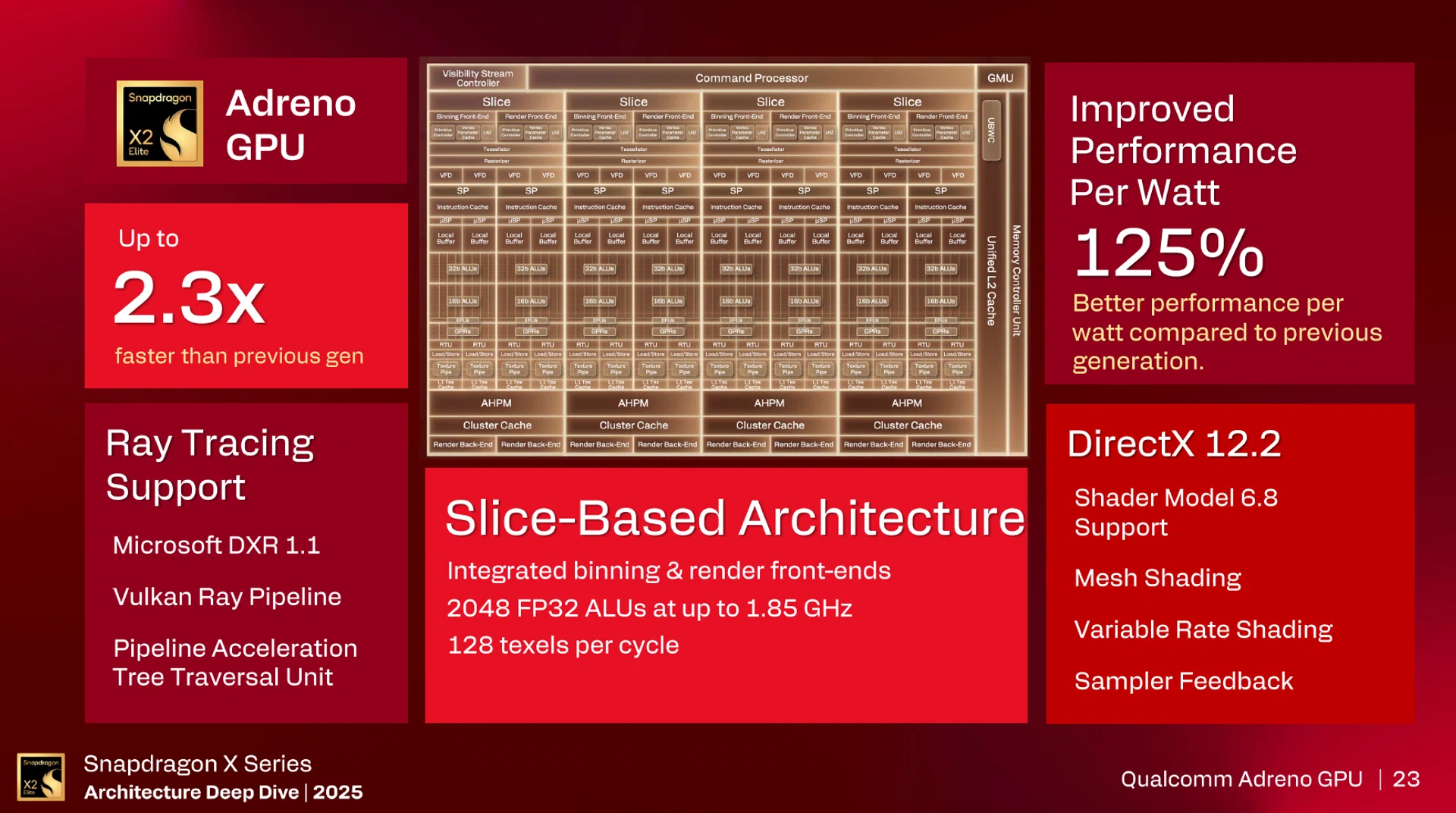
The GPU side has seen an even more dramatic uplift. The new Adreno X2 graphics architecture comes in multiple configurations depending on the SKU, scaling compute units and clock speeds. On paper, Qualcomm’s performance claims are ambitious, but what stood out more was actually seeing it in action.
At the San Diego demo, Qualcomm ran a live build of Cyberpunk 2077 on a thin-and-light reference laptop. It wasn’t some canned video loop – it was being played in real time. Frame rates were comfortably sitting above 60fps at 1080p, and while it was clearly a controlled demo environment, it still looks pretty darn impressive. For an integrated GPU in a fan-light design, that’s not nothing.
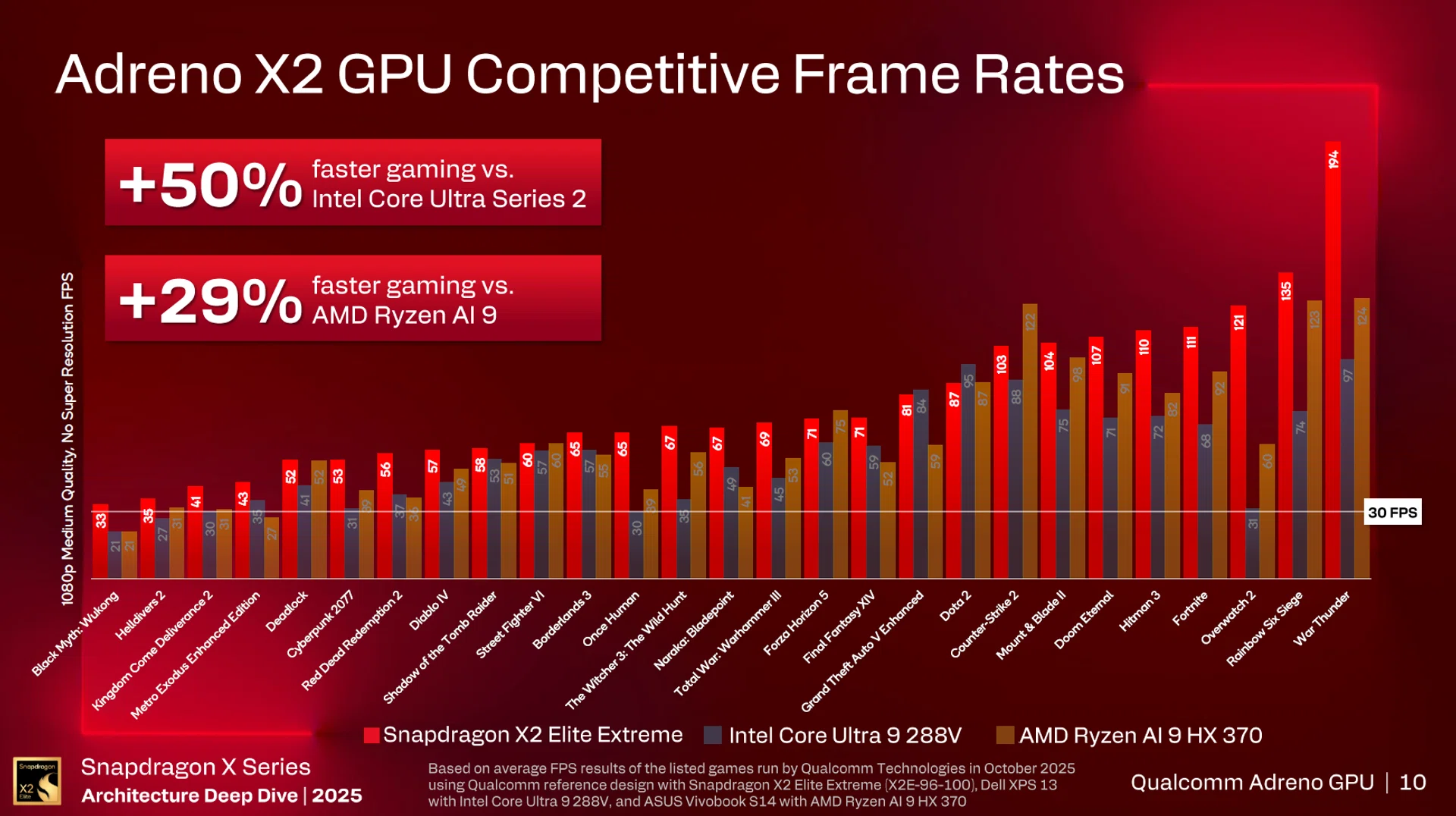
More importantly, this GPU isn’t just about raw frame rates. It supports modern PC graphics standards like DirectX 12 Ultimate, Vulkan, and hardware-accelerated ray tracing, alongside improved media engines for video encode and decode. That last part matters more for today’s content creators looking for lighter and slimmer work horses. If you’re editing video, exporting clips or just scrubbing through timelines in something like Adobe Premiere Pro, this kind of hardware support makes a real difference to how usable a thin-and-light laptop feels.
Smarter hardware without draining your battery

Rather than treating AI as a bolt-on feature, Qualcomm has clearly rethought how AI workloads are handled across the chip. The Snapdragon X2 Elite carries a significantly larger Hexagon NPU based on its 6th-generation NPU6 design, delivering up to 80 TOPs of compute. That headline number matters less than what sits behind it.
The NPU now has dual master ports for higher memory bandwidth, 64-bit DMA for handling larger AI models, and support for up to 12 concurrent threads. This is to help keep AI workloads from stalling when juggling large models or multiple tasks. Qualcomm is claiming big jumps in scalar, vector and matrix performance, and while those are lab-tested figures, the architectural changes are real. Vector engines now handle multiple 128-bit SIMD instructions and support modern data types like FP8 and BF16. Matrix operations are faster too, with support for low-precision weights and dedicated acceleration for things like fused activations and depthwise convolutions.
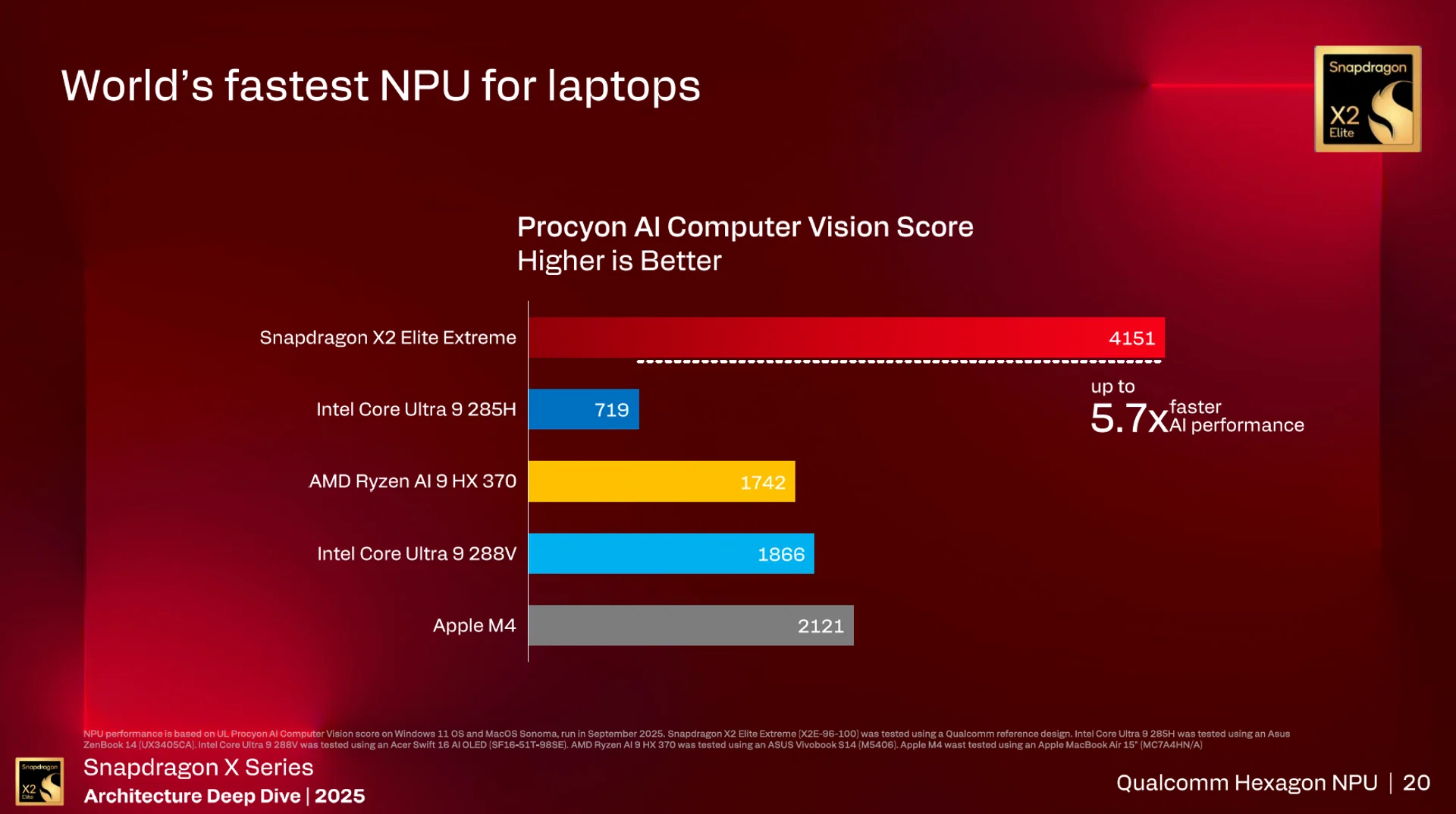
One smart design choice here is power. The main Hexagon NPU runs on its own power rail, which lets it scale independently of the CPU and GPU. In thin laptops, that directly affects heat and battery drain. On top of that, Qualcomm has added dual low-power embedded NPUs on a dedicated sensing island. These handle always-on tasks like presence detection, background blur, voice isolation and contextual sensing without constantly waking the main parts of the chip.
Qualcomm has the momentum but the work isn’t done
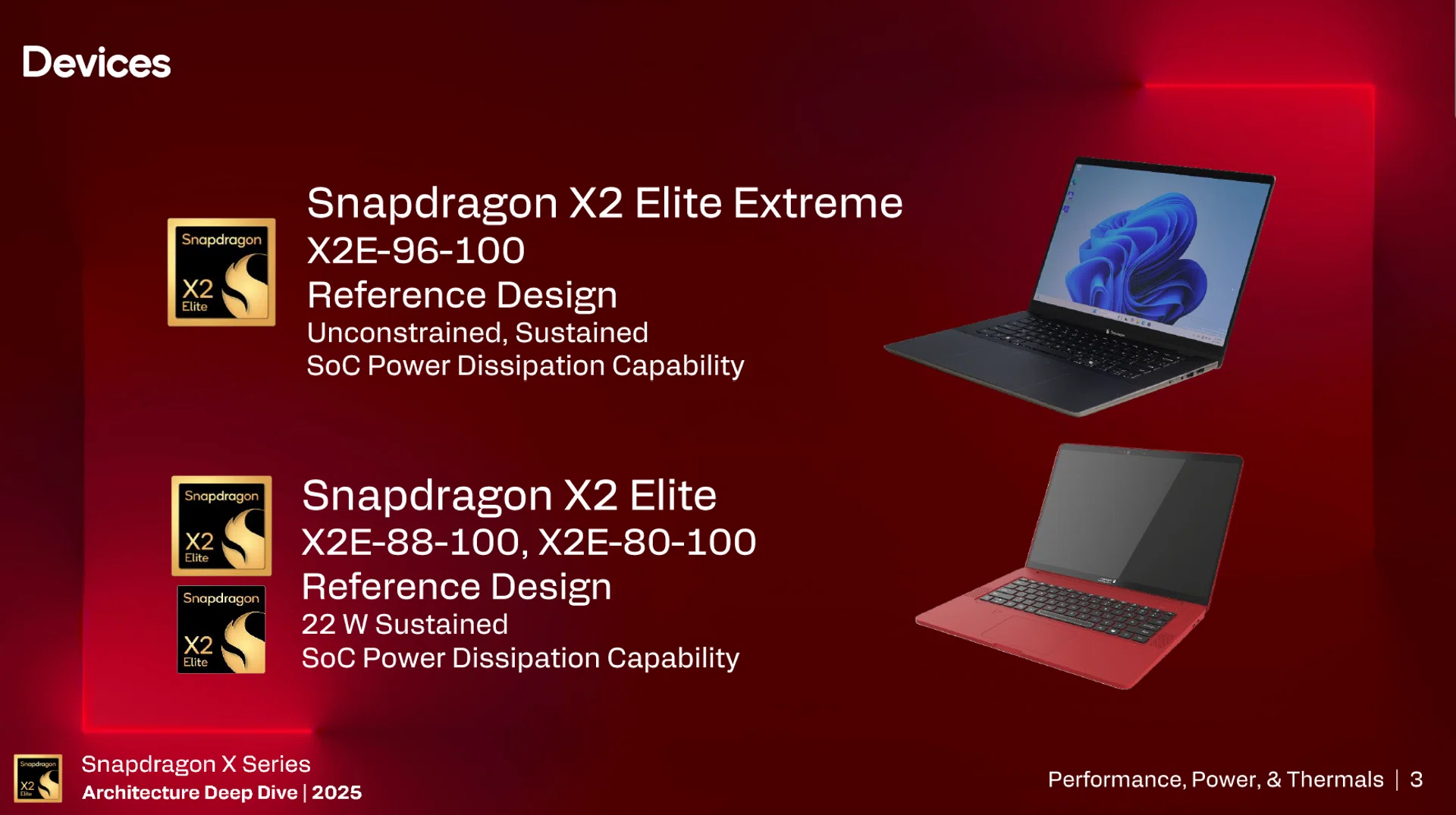
I’m personally excited by what I’ve seen, but until we’ve had the chance to test retail-ready Snapdragon X2 Elite laptops (or mini-PCs), I’d remain cautiously optimistic. On paper, the platform looks genuinely strong. Faster Arm cores, stronger integrated graphics, a serious on-device AI engine and battery life that still plays to Arm’s strengths give it real momentum, and Qualcomm does seem to have addressed many of the growing pains that affected the first Snapdragon X Elite generation in a meaningful way with X2 Elite.
That said, Qualcomm isn’t entering a quiet market. Intel and AMD are far from standing still, with upcoming mobile processors that are getting more efficient, more graphics-capable and more AI-focused with every cycle. Qualcomm also has to convince partners like ASUS and Lenovo to put Snapdragon X2 Elite into their flagship models if it’s going to truly break through. Last year’s X Elite laptops were mostly consigned to lower-end or ‘budget’ tiers, which isn’t necessarily a bad thing, but it kept the platform feeling like a side project rather than a priority for these laptop makers. If Snapdragon X2 Elite shows up in properly premium machines, that’s when we’ll really know whether Qualcomm has moved from an ‘interesting alternative’ to a genuine x86 challenger in the PC space.