
Investigating the GeForce GTX 460M
The GeForce GTX 460M is one of the more recent and powerful mobile GPUs from NVIDIA. Unsurprisingly, it is used widely in gaming-grade notebooks and desktop replacement systems.
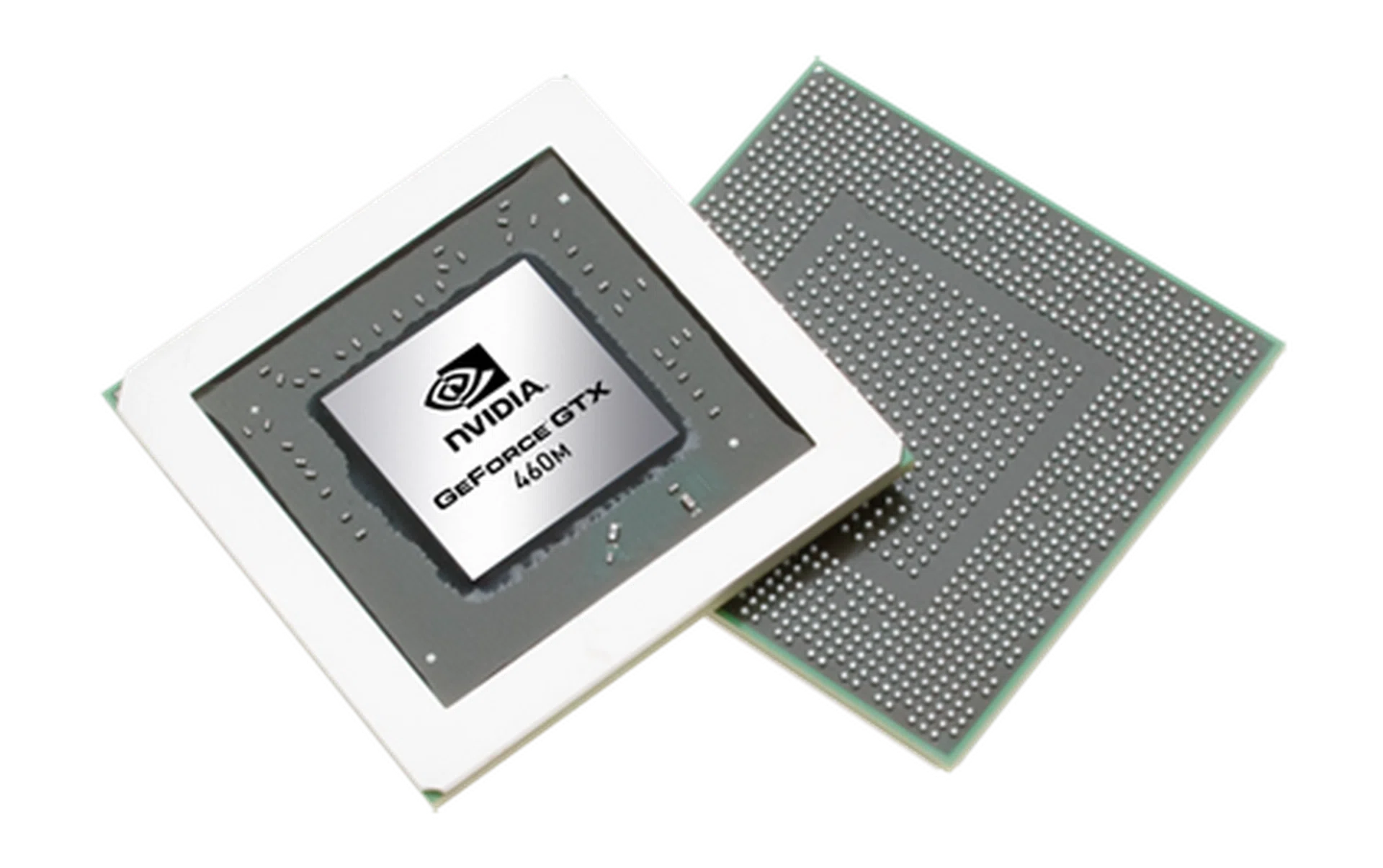
However, don’t be fooled by the name though, it is not as powerful as its desktop counterpart - the . Nevertheless, it is still a beefy mobile GPU, packing 192 CUDA cores, 32 texture filter units and 24 raster operating units. Clocks speeds are pegged at 675MHz at the core, 1350MHz at the shaders and 2500MHz DDR at the memory. For those more familiar with NVIDIA’s desktop line-up, it’s roughly the equivalent of the desktop , which we know to be a competent card for mainstream users.
To evaluate the performance of this mid to high-end tier mobile GPU part, we’ve just gotten hold of the ASUS G73Jw, a massive 3D-ready, 17-inch, full HD, gaming notebook. It’s powered by a powerful Core i7-740QM processor, packs a whopping 8GB of memory and is of course loaded with the GeForce GTX 460M mobile GPU. Too bad this notebook edition wasn't sporting the Sandy Bridge CPU, but we'll get to that soon enough. All things considered, this notebook looks like the ideal desktop replacement system for anyone looking for a fuss-free way to hop on the 3D bandwagon. Or is it?

The G73Jw is the latest 3D gaming notebook to come from ASUS. It features NVIDIA's GeForce GTX 460M mobile GPU and has an integrated IR transmitter for a cleaner, less cumbersome 3D setup.
Some of you may know that is achieved using the principle of stereoscopy, more specifically, it quickly presents two slightly different images to the eye to create an illusion of depth. This is why you need special shutter glasses and ultra-fast 120Hz displays. This also means that for every scene, two images needs to be rendered and this effectively doubles the GPU’s workload. So while the GeForce GTX 460M is no doubt a beefy mobile GPU and should do well for regular gaming applications, does it have what it takes to run 3D smoothly?
This is what we want to find out, but before we do, here’s a quick look at how the GeForce GTX 460M stacks up against competitive mobile GPUs.
Model | NVIDIAGeForce GTX 460M | NVIDIAGeForce GTX 470M | NVIDIA GeForce
GTX 485M | ATIMobility Radeon HD5850 | ATIMobility Radeon HD 5870 |
Core Code | GF106 | GF104 | GF104 | Broadway PRO | Broadway XT |
Manufacturing Process | 40nm | 40nm | 40nm | 40nm | 40nm |
Core Clock | 675MHz | 550MHz | 575MHz | 625MHz | 700MHz |
Stream Processors | 192 Stream Processors | 288 Stream Processors | 384 Stream Processors | 800 Stream Processing Units | 800 Stream Processing Units |
Stream Processor Clock | 1350MHz | 1100MHz | 1150MHz | 800MHz | 700MHz |
Texture Mapping Units (TMU) or Texture Filtering (TF) units | 32 | 48 | 64 | 40 | 40 |
Raster Operator units (ROP) | 24 | 24 | 32 | 16 | 16 |
Memory Clock | 2500MHz GDDR5 | 2500MHz GDDR5 | 3000MHz GDDR5 | 4000MHz GDDR5 | 4000MHz GDDR5 |
DDR Memory Bus | 192-bit | 192-bit | 256-bit | 128-bit | 128-bit |
Memory Bandwidth | 60GB/s | 60GB/s | 96GB/s | 64GB/s | 64GB/s |
TDP (GPUonly) | 45 - 50W | 45 - 50W | 100W (MXMmodule) | ~39W | ~50W |
Performance Matters
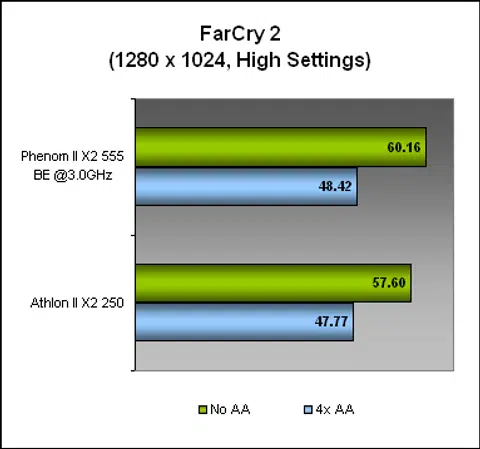
To evaluate the performance of the GeForce GTX 460M, we wanted to first find out where it stands amongst other gaming notebooks. To that end, we’ve pitted the ASUS G73Jw against some recent gaming notebooks we’ve tested, namely the and , which uses a ATI Mobility Radeon HD 5870 and NVIDIA GeForce GTX 260M respectively. We don't yet have a wide database of results for gaming class notebooks, but we do have a couple of pertinent benchmarks that are adequate to paint the picture.
Although the notebooks are not similarly specced, from this rough assessment, we can see that the ASUS G73Jw is a some ways faster than both the Sager and Dell Alienware notebooks.
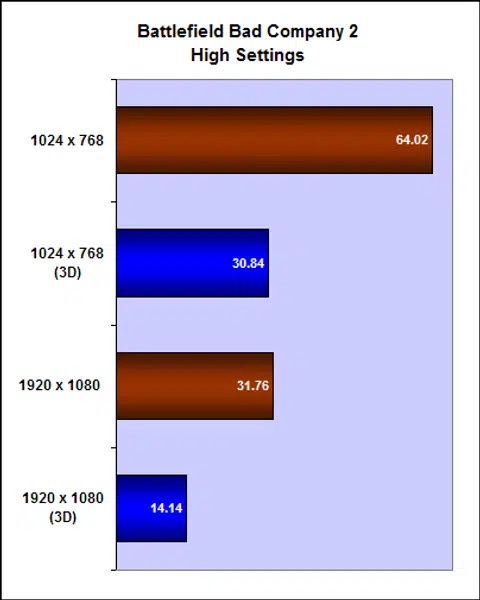
Next, let’s take it look at its 3D performance on Battlefield Bad Company 2. As the graph shows, enabling 3D had an adverse effect on frame rates, which we had expected. As we’ve mentioned, with 3D enabled, the ASUS G73Jw now needed to render two frames at any given instance to create an illusion of depth. This meant that its workload has doubled, which also explains why with 3D enabled the ASUS G73Jw was only half as quick.
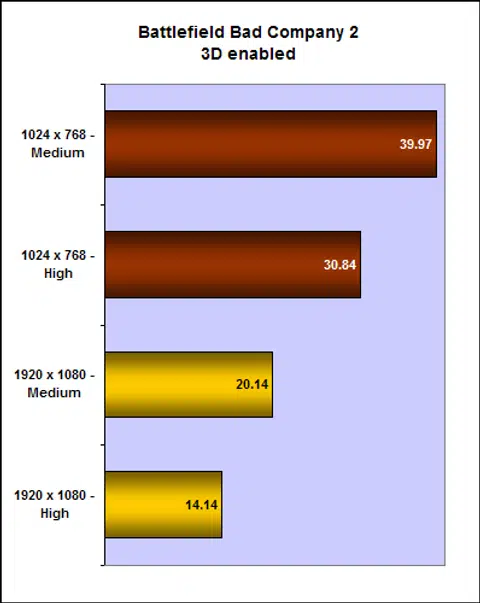
Moving on, we ran another test to see how the notebook will fare if we turned the settings down a notch from ‘High’ to ‘Medium’. Although it did lighten the load, we found that the GeForce GTX 460M still wasn’t quite up to task especially if we ran it at the ASUS notebook's native 1920 x 1080 pixels resolution.
Conclusion
The GeForce GTX 460M is potent for gaming, but 3D requires much more graphics horsepower and we're afraid it falls a bit short.
Judging from the ASUS G73Jw, there’s no doubt that the GeForce GTX 460M is a competent mobile GPU, quite capable of running games at decent settings. However, 3D is a much more intensive task, and as our results showed, the GeForce GTX 460M isn’t particularly ideal for the task. It’s not that it cannot run 3D, but its performance suffers considerably. Alternatively, you could turn down the graphics settings to get better frame rates, but that would mean sacrificing on image quality. So the case with 3D is that it's hard to have the best of both worlds.
In closing, the GeForce GTX 460M is a powerful mobile GPU and is great for notebook gaming. But if you want the best 3D experience possible, a beefier graphics solution is needed and for the time being at least, we think that mobile GPUs are not quite up to the mark yet. Sure there are faster mobile GPUs, but they are extremely expensive and rare to find them implemented. On the horizon, the newer GeForce 500M series of GPUs would slowly surface, but we doubt even these would elevate the notebook gaming standards significantly. Hence for high quality 3D gaming, it’s advisable to stick to NVIDIA’s more powerful desktop graphics solution instead.
Our articles may contain affiliate links. If you buy through these links, we may earn a small commission.