
Intel Centrino Duo 'Napa' Mobile Technology Explained
The highly anticipated Intel Centrino Duo mobile technology is finally retail ready. Despite having two execution cores on one die, Intel claims the battery life is on par, if not better than previous generations of Centrino platforms. Sounds unbelievable isn't it?
Intel's Hat Trick
The old…
Timing is everything when it comes to marketing, and none the more appreciative of perfect timing than the biggest name in the I.T. industry, Intel Corporation. Intel grabbed headlines everywhere when it effected a new 'Intel. Leap ahead.' brand identity on the 3rd of January 2006 that sought to position the Intel name around a platform model focusing on four key market segments – digital home, enterprise, health and mobile. Now, all attention is once again converged on Intel as they unveil the new Intel Centrino Duo mobile technology, codenamed 'Napa' platform.
…makes way for the new.
Given the phenomenal marketing success of its Intel Centrino mobile technology after it was introduced in early 2003, this change in corporate identity to go towards being a solutions rather than specific hardware provider is not entirely out of the blue, which for some, could even be argued as predictable. The whole idea behind the creation of Intel Centrino mobile technology was marketing, and this clever branding was exactly what Intel needed to distinguish Centrino powered notebooks from all others that were available. Rather than focusing on the type of processor a notebook has, which was how notebooks were classified in the past, the arrival of Intel Centrino mobile technology meant consumers, for the first time, need only look for one such notebook to be assured of good battery life, performance and mobility. This is because all components in a Centrino notebook were first optimized and tested to operate faultlessly together with mobility as the key proposition of the Centrino platform.
Although the headache of buying a notebook has been significantly relieved with the availability of packaged Centrino notebooks that are well sorted out for mobile computing, there are still notable differences where chipset and processor technologies are concerned. Exactly a year ago when Intel released its second generation Centrino platform codenamed 'Sonoma', the chipset, processor and WiFi controller were all improved and technically different from those found in the first generation models. Yet, despite the clear disparity in components between the two generations, the same Intel Centrino mobile technology branding was reused for the then new notebooks based on the second generation 'Sonoma' Centrino platform. Inescapably, less technically informed consumers soon became confused and unclear whether or not they were paying good money for "old" Centrino (Intel 855 chipset) or "new" Centrino (Intel 915) notebooks.
Intel's Duo to Challenge The Status Quo
Fortunately, the good folks over at Intel has come up with a completely new badge designed from the ground up to satisfy both the recently implemented corporate identity change and its brand new Centrino Duo mobile technology. This is to say the same group of consumers who were previously confused would be confused no more should they decide to step out and purchase the very latest Intel has had to offer (at least for now).
Similar to the two earlier Centrino generations, the new 'Napa' platform is assembled to ensure Intel remains planted in pole position where notebook technology is concerned. And just as with each generation of Centrino platform, the three core components, namely the processor, chipset and WiFi controller, are all supplied by Intel and no other. Intel argues that this unyielding control of components is necessary as the combination of hardware has been designed and rigorously tested in accordance to the four basic vectors of mobility as laid out by Intel for Centrino when it was first launched. That is to say the Centrino Duo mobile technology represents the best in mobile performance, WiFi capability, battery life, and notebook designs and form factors. There are of course other advantages in going with an all Intel solution. Not only do manufacturers get to rely on the strong Centrino branding for notebook sales due to the intense marketing blitz by Intel, they will also be subsidized for marketing Centrino notebooks. Essentially, Intel has created a very attractive win-win situation for its OEM partners, although admittedly, it also explains why notebooks bearing the highly coveted Centrino badge are pretty pricey.
So just how different is the 'Napa' from the older 'Sonoma' platform and what significant technological leap can we expect now that Intel is "leaping ahead"? Let's take a closer examination shall we?
The New Famous Three
The first thing you need to know about the Centrino Duo (Napa platform) is that it is a complete overhaul of the older 'Sonoma' Centrino platform, which means to say no Centrino Duo notebook will carry over any remnants from its predecessor. You will find instead a brand new processor, a fresh change of chipset and a cutting edge WiFi controller; Intel Core Duo processor, Mobile Intel 945 Express chipset and Intel PRO/Wireless 3945ABG network connection respectively.
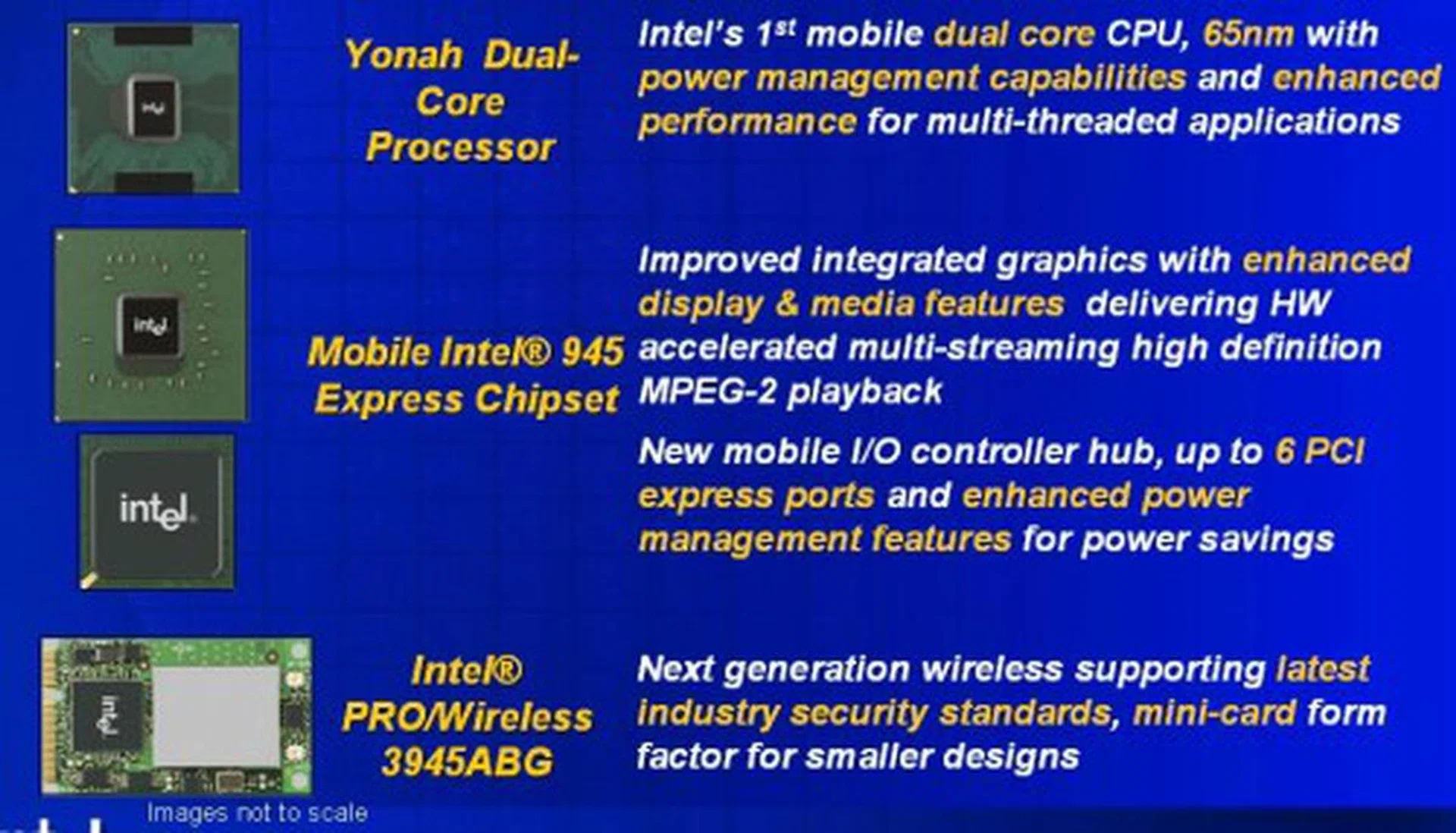
Pack these three components together and you will, theoretically at least, have a Centrino in your hands.
Intel Core Duo Microprocessor
The star of the new Centrino Duo mobile technology platform is none other than the Intel Core Duo microprocessor. Important for not just being the next generation of mobile processors for Intel to further widen the gulf between her and her competitors, the arrival of Intel Core Duo processor also signifies a revolution in notebook computing as it is the first time consumer notebooks are fitted with a mobile-optimized dual-core processor built using the latest 65nm manufacturing process technology.
Codenamed 'Yonah', the new Intel Core Duo processor has been put under the spotlight for the longest of time. Yet, despite all the ongoing talks and intimate discussions about the elusive processor when it was first mentioned at IDF Fall 2004, no further technical details had been disclosed from then till now – but that has not stopped us from carrying out our own probing.
Two "Brains" Are Better Than One
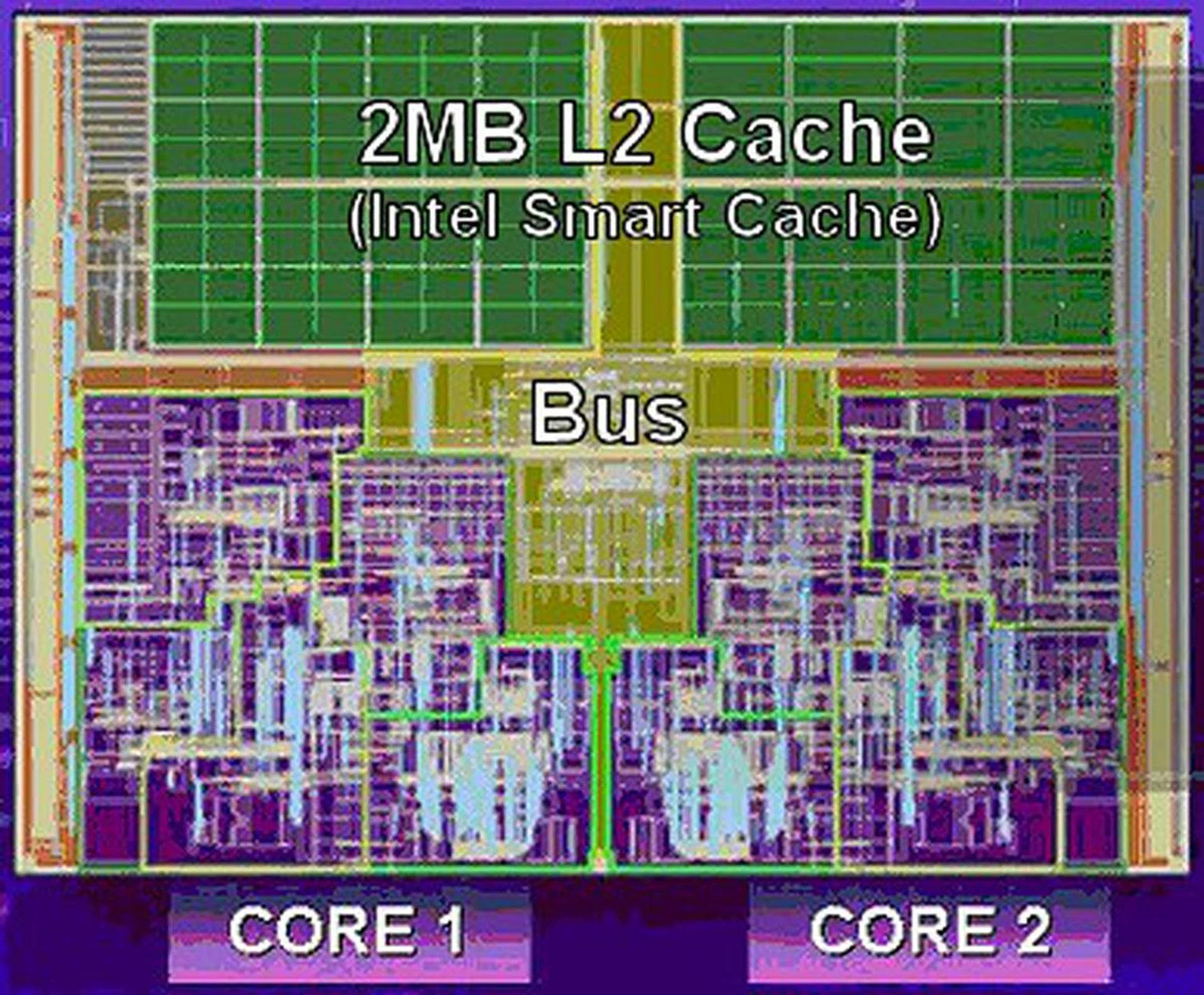
Not one but two cores.
Suffice to say, Intel is right on track to make the year 2006 a year of dual-core computing now that they have kick started the year with the Intel Centrino Duo mobile technology. By squeezing two execution cores onto one tiny 90.3mm� die, Intel claims the immediate benefit is a tangible performance gain for multi-threaded applications and where multitasking is concerned. While this does make perfect logical sense, there is actually more sophistication to the brain of 'Yonah' than just a mere increment in the core department.
Engineered from the ground up, the architectural design of Yonah is such that it features two Pentium-M cores (Dothan variants) positioned side by side on a die but with a shared 2MB L2 cache. The idea is to utilize a clever shared bus interface to allocate cache access so that it would result in a small yet efficient processor rather than having to deal with thorny issues such as redundant logic, signal strength and power leakages if separate pools of cache were implemented. As a result of this and the 65nm manufacturing process, Intel was able to pack almost twice the number of transistors found in the first generation of Centrino notebooks without dramatically increasing the die size even with the addition of a second core. At a staggering count of 151 million transistors, Yonah has 11 and 74 million more transistors than its predecessors, the 'Dothan' and 'Banias' processors respectively while the die size of Yonah is just 7.5% and 10% more respectively. Even the processor side bus or more commonly known as front side bus, has been steadily increased over the generations, now cruising at a speedy 667MHz as compared to Dothan's 533MHz and Banias' 400MHz.
Processor Model | Banias | Dothan | Yonah |
Manufacturing Technology | 130nm (0.13 micron) | 90nm (0.09 micron) | 65nm (0.065 micron) |
No. of Transistors | 77 million | 140 million | 151.6 million |
Die Size | 82 mm² | 84 mm² | 90.3 mm² |
Processor Side Bus | 400MHz | 400MHz/533MHz | 667MHz (Power Optimized) |
L1 Cache (data + instruction) | 32KB + 32KB | 32KB + 32KB | 32KB + 32KB |
L2 Cache | 1MB full-speed | 2MB full-speed | 2MB shared (Intel Smart Cache) |
Form Factor | mPGA479 | mPGA479 | PGA478 or BGA479 |
Thermal Design Power | 24W | 21W | ~21W |
Core Technolologies | SSE, SSE2, Enhanced SpeedStep | SSE, SSE2, Enhanced SpeedStep | SSE, SSE2, SSE3, Enhanced SpeedStep, Virtualization Technology, Enchanced Deeper Sleep |
Intel Smart Cache
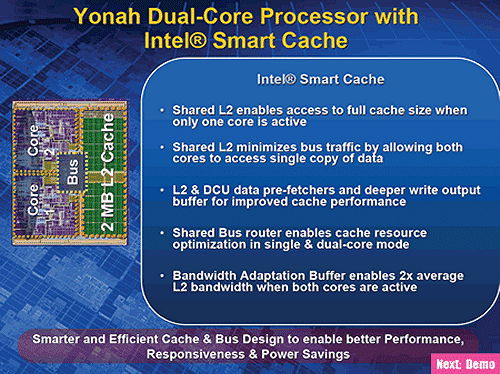
Key points of the Intel Smart cache.
Critical numbers aside, one of the most impressive aspects of the Core Duo processor has got to be the Intel Smart Cache. Because of the design limitations where a single bus sits between the 2MB L2 cache and the two execution cores, concurrent access of the L2 cache by the two cores would be impossible. Although the two cores are able to have full access to the L2 cache, access is restricted to just one core at any given time. Compared to the access time and bandwidth if both cores were able to access the 2MB L2 cache simultaneously in a hypothetical two cores, independent bus design, you can clearly see that the access time available for L2 access in each core is halved for the Core Duo processor. This then is where the "Smart" bit of the Intel Smart Cache steps in.
To prevent the limited access time from severely impacting the overall performance due to the two core, one bus design, the Intel Smart Cache features a Bandwidth Adaptation Buffer that basically functions to ensure the bandwidth that is available to the L2 cache per core in Yonah stays virtually identical to that of its predecessors (Dothan and Banias) without incurring additional clock cycles, in essence virtually doubling average L2 bandwidth when both cores are active. On a sidenote, this also explains why the faster 667MHz FSB in return for higher bandwidth is necessary.
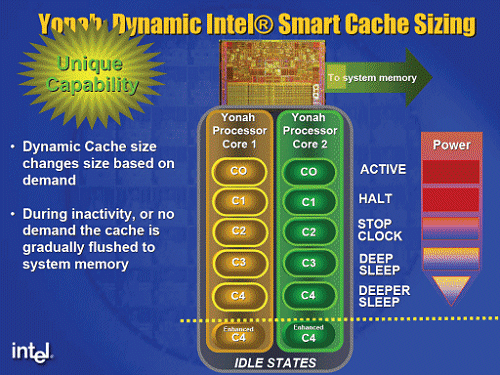
Illustration of Intel Smart cache sizing and Enhanced Intel Deeper Sleep.
Another "smart" attribute lies in its dynamic cache allocation capability, which as its name implies means the L2 cache is constantly and dynamically adjusted to match the data load of each core. In doing so would allow the utilization of the L2 cache to be maximized. Also contributing to increasing the cache performance are optimized pre-fetchers and a deeper write output buffer.
Enhanced Intel Deeper Sleep
Where power is concerned, one of the biggest challenges thrown to the chip designers over at Intel was to ensure that the thermal design power (TDP) of the dual-core Yonah is better if not at least match that of the older 'Dothan' processor. While it is not difficult to raise computing performance, keeping power consumption under check while having more transistors and a faster bus speed is a tall order, even for Intel. On that note, if the latest Centrino Core Duo mobile technology is unable to provide the same kind of battery mileage consumers have come to expect from Centrino platforms, Intel will be looking at a sizeable lost in consumer faith. Furthermore, Centrino notebooks are not cheap, and all the more so for the latest Centrino Core Duo versions. Therefore, power consumption must be kept at least on par with previous generations of Centrino notebooks, or else there is not much value to speak off in going with a Centrino Core Duo notebook now is there?
Happily, the talented engineers over at Intel were able to come up with a number of power saving enhancements to overcome the seemingly impossible power consumption challenge. Other than the use of low VCC cache design, low-power transistors, Intel's second generation strained silicon process that is claimed to reduce electrical leakages by 30% and the familiar enhanced Intel SpeedStep technology, the entire L2 cache was designed such that in situations of inactivity or when the demand for cache memory is low, data stored in the L2 cache is automatically transferred into system memory and flushed before it is powered down to further conserve power. In doing so, current is only needed by the system memory (which is perpetually drawing current anyway) to sustain data caching, thereby allowing the last remaining parts of the processor to be powered down without interrupting the data execution process whatsoever. This ingenious process is what Intel terms as 'enhanced deeper sleep' or Enhanced C4 state. Also helping the cause are the independent sleep states of the two cores, which are controlled by new MWAIT commands from the operating system, thereby increasing the power management flexibility of the processor.
To mark this revolutionary change as Intel puts it, a brand new modeling scheme was devised in conjunction with the change in corporate identity. This would make it easier for consumers to differentiate between the old and new processors across the different platforms of Centrino. After all, you cannot possibly expect a complete recall of older Centrino notebooks just to free up shelf space to make way for the new now can you? Another useful information you should have at your fingertips is that new notebooks built on the 'Napa' platform may come fitted with either an Intel Core Duo or Intel Core Solo processor for which they are denoted as Intel Centrino Duo and Intel Centrino respectively. Readers should also realize that older 'Sonoma' Centrino notebooks would continue to retail alongside the two new 'Napa' variants
Intel Centrino Mobile Technology | Clock Speed | Price (USD) |
Intel Core Duo T2600 with 2MB L2 cache, Intel 945GM chipset and Intel PRO/Wireless 3945ABG | 2.16GHz | $706 |
Intel Core Duo T2600 with 2MB L2 cache, Intel 945PM chipset and Intel PRO/Wireless 3945ABG | 2.16GHz | $702 |
Intel Core Duo T2500 with 2MB L2 cache, Intel 945GM chipset and Intel PRO/Wireless 3945ABG | 2.0GHz | $492 |
Intel Core Duo T2500 with 2MB L2 cache, Intel 945PM chipset and Intel PRO/Wireless 3945ABG | 2.0GHz | $488 |
Intel Core Duo T2400 with 2MB L2 cache, Intel 945GM chipset and Intel PRO/Wireless 3945ABG | 1.83GHz | $363 |
Intel Core Duo T2400 with 2MB L2 cache, Intel 945PM chipset and Intel PRO/Wireless 3945ABG | 1.83GHz | $359 |
Intel Core Duo T2300 with 2MB L2 cache, Intel 945GM chipset and Intel PRO/Wireless 3945ABG | 1.66GHz | $310 |
Intel Core Duo T2300 with 2MB L2 cache, Intel 945PM chipset and Intel PRO/Wireless 3945ABG | 1.66GHz | $306 |
Intel Core Duo T1300 with 2MB L2 cache, Intel 945GM chipset and Intel PRO/Wireless 3945ABG | 1.66GHz | $278 |
Intel Core Duo T1300 with 2MB L2 cache, Intel 945PM chipset and Intel PRO/Wireless 3945ABG | 1.66GHz | $274 |
Calistoga & Golan
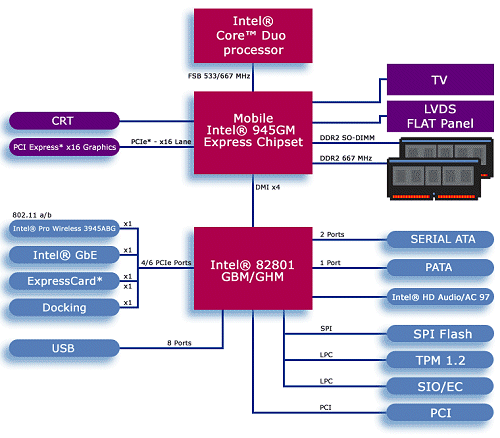
Intel 945GM chipset.
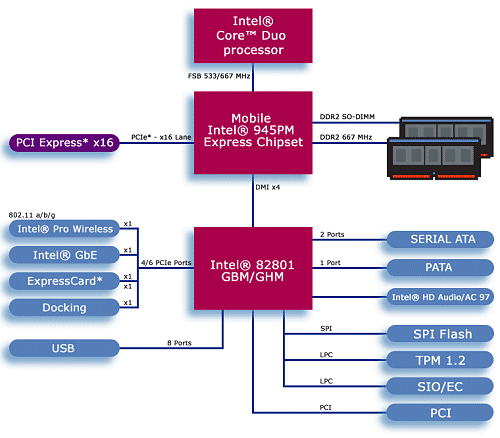
Intel 945PM chipset.
Codenamed 'Calistoga', the Mobile Intel 945 Express chipset family can be further divided into two flavors, the Mobile Intel 945PM and Mobile Intel 945GM. Both chipsets are primarily identical in that 667MHz FSB, DDR2 and both Intel Core Duo and Intel Core Solo processors are supported. The 'GM' of the Mobile Intel 945GM denotes that it features an integrated Intel Graphics Media Accelerator (GMA) 950, which is not available in the Intel 945PM. Clocked at 50MHz higher than the GMA900 found in the 'Sonoma' Intel 915GM chipset, the 945GM features MPEG-2 acceleration with hardware LVD/iDCT, 4x pixel rate motion compression, adaptive de-interlacing, intermediate Z rendering and a full D-connector support for TV output. On the power conservation front, Display Power Saving technology and Automatic Display Brightness, which turns down LCD backlight according to ambient light levels should both help to stretch the battery performance even further. Intel claims the Mobile Intel 945GM chip enables up to 28% less average power consumption compared to earlier generations.
For notebook designs that require more graphics performance over the integrated GMA 950, the Intel 945PM chip is able to offer just that as it is specifically designed to accommodate discrete graphics chips from the likes of ATI and NVIDIA. This small but significant difference determines which of the two chips OEM and ODM manufacturers will opt for when it comes to different notebook designs for which the Intel 945GM is better suited for low-power notebook designs that do not require the added cost and not to forget cooling components that would add to the overall thickness and weight of any given notebook design.
Intel PRO/Wireless 3945ABG Network Connection
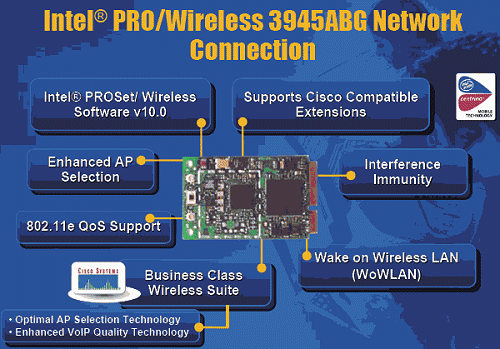
Overview of the Intel PRO/Wireless 3945ABG Network Connection.
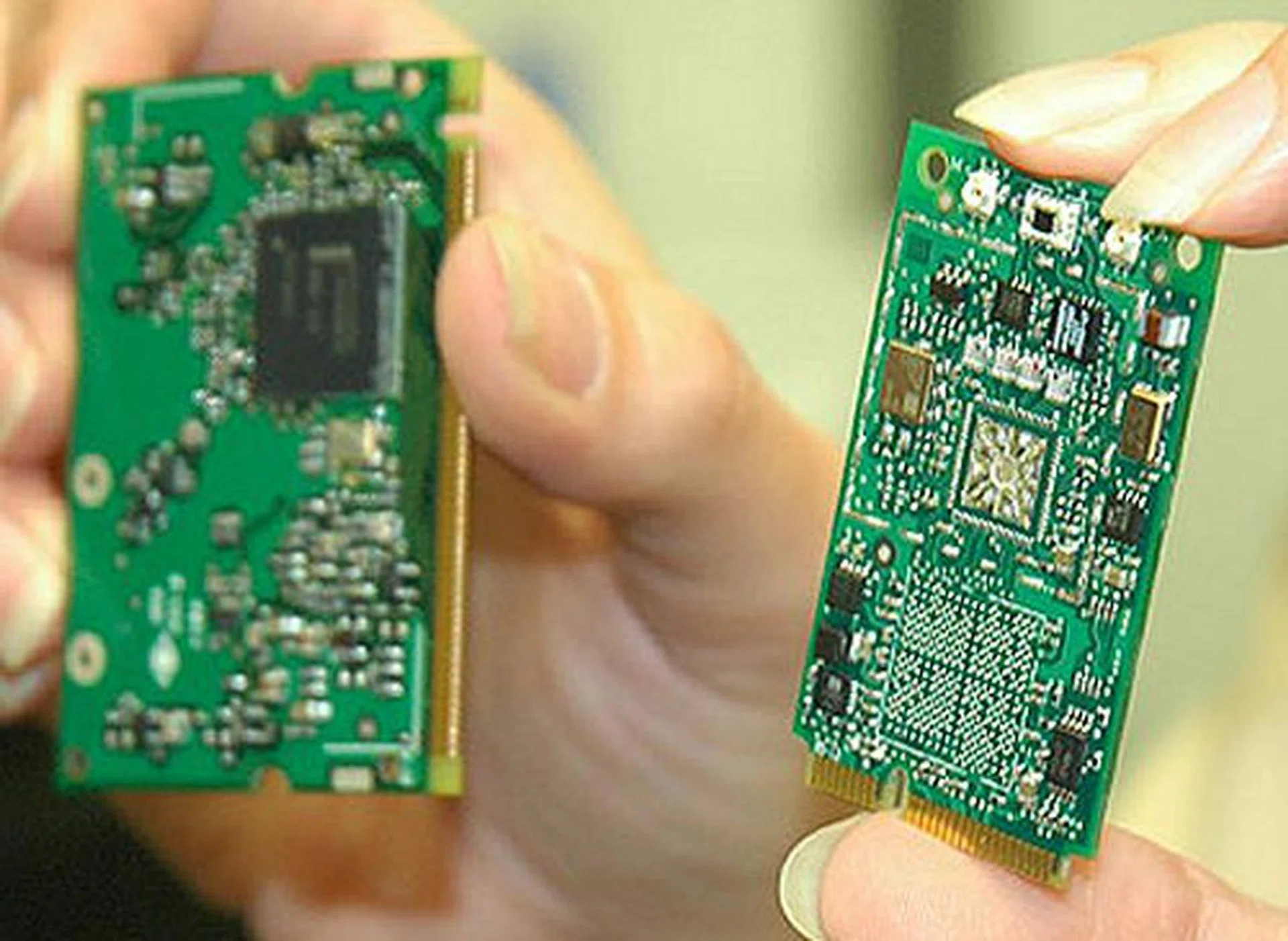
See the difference in size between the Calexico 2 of 'Sonoma' (left) and Golan of 'Napa' (right)?
Not just the next generation wireless network connection to emerge from Intel, the Intel PRO/Wireless 3945ABG network connection (codename 'Golan') is, like the Core Duo/Solo processor and Mobile Intel 945 Express chipset, all about enabling lighter and thinner notebook designs. However, there is much substance beyond its pint-size dimensions, the most prominent of which is the addition of 802.11a support in addition to 802.11b and 802.11g WiFi standards. A list of what's what includes 802.11e QoS support, Cisco Compatible Extensions (LEAP, EAP-FAST and CKIP) and Wake-on-WLAN. Most noteworthy of all is the enhanced AP (access point) selection technology that chooses and connects to available APs not by distance, but through their available bandwidth. This makes a whole lot of sense and as ironic as it sounds, APs that are nearer might not necessarily provide the healthiest connection or the best bandwidth. Hence, to achieve optimum wireless connection with minimal signal breakages, it is more effective to seek out APs by bandwidth rather than by proximity. Needless to say, mobile workers who rely heavily on wireless connections when they are up and about will be most pleased with this new intelligent selection technology.
Sneak Preview
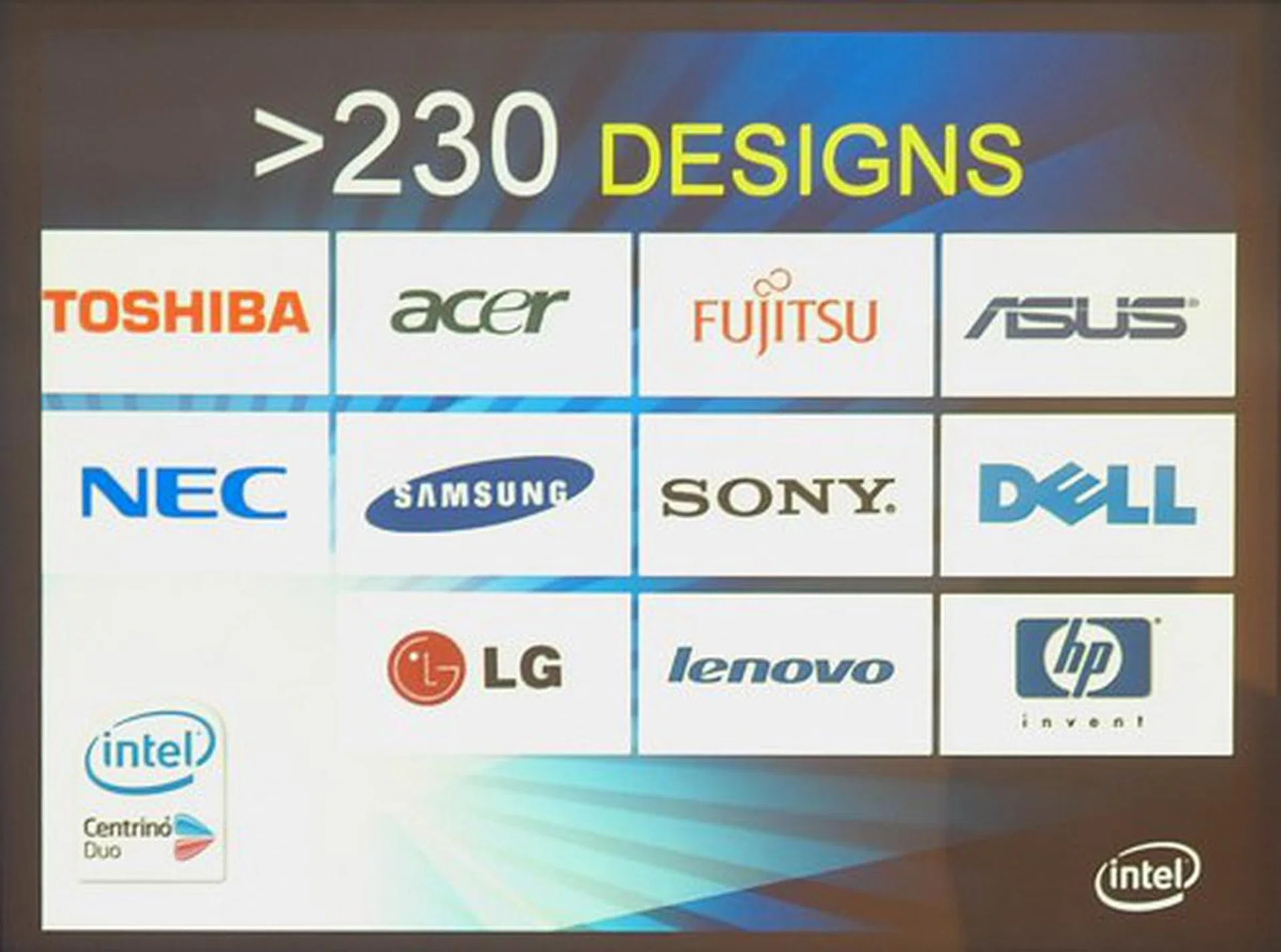
With more than 230 designs for Intel Centrino Duo 'Napa' mobile technology confirmed, you'll be spoilt for choice if you intend to buy or upgrade to the latest Centrino notebook in 2006.
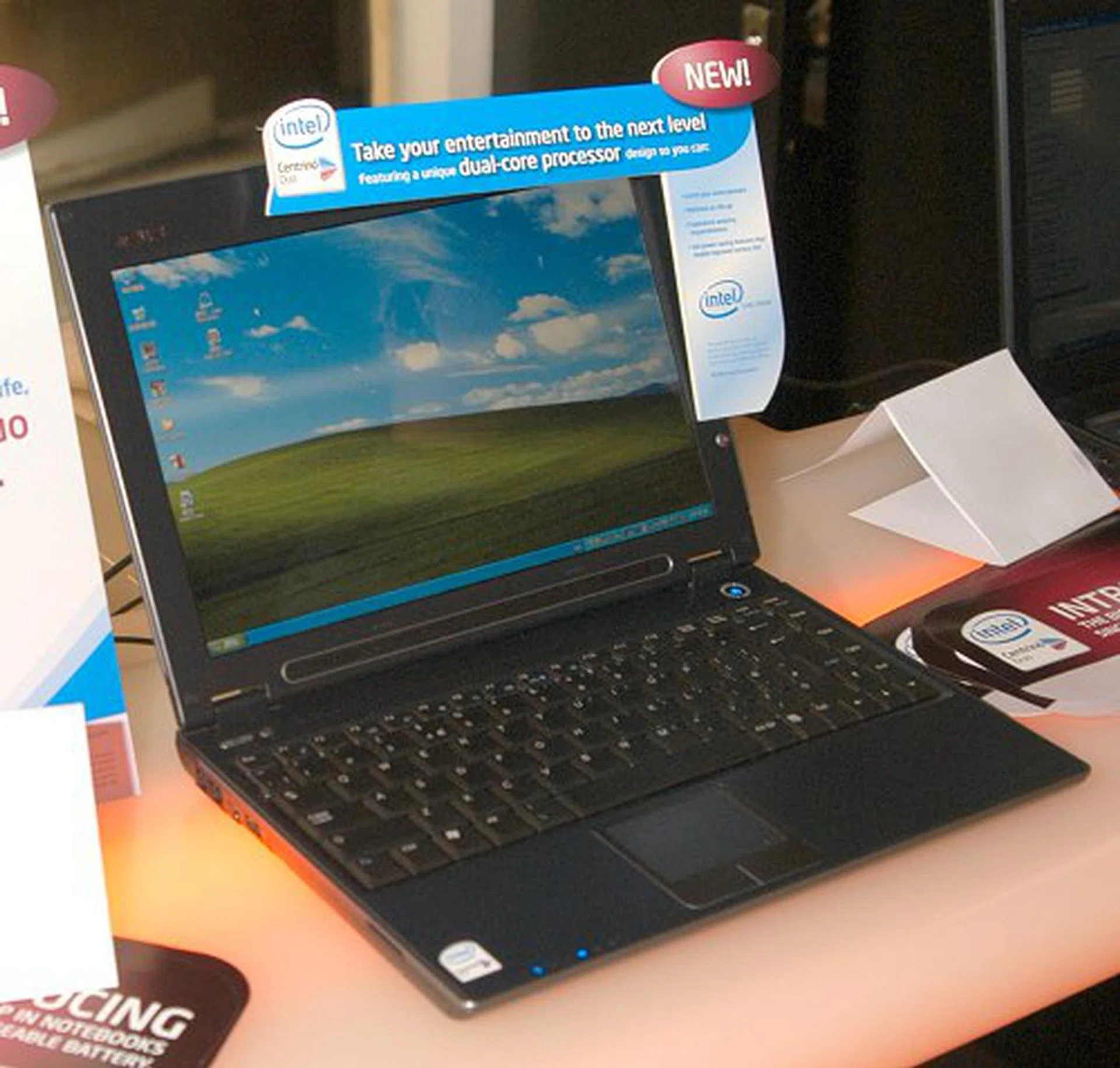
ASUS W5F is the company's first 12.1-inch Intel Centrino Duo lightweight notebook and is fitted with the Mobile Intel 945GM chipset, which means to say the widescreen LCD screen is powered by the integrated Intel Graphics Media Accelerator (GMA) 950. The notebook also comes with a slim all-format DVD writer.
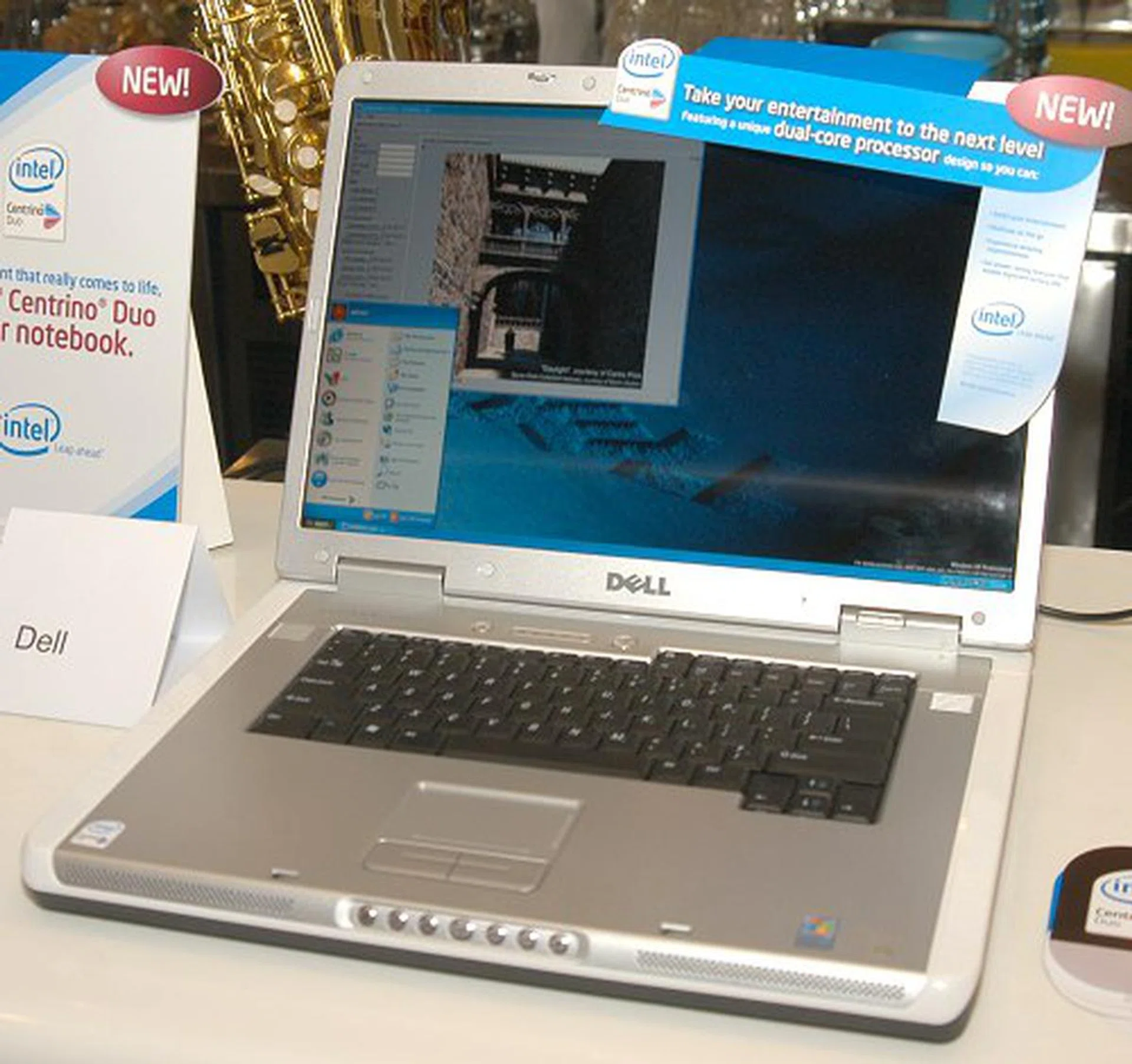
The mighty and hefty Dell Inspiron 9400 can be configured with a maximum widescreen display of 1920 x 1200 pixel resolution. Apart from being a desktop replacement notebook with good multimedia attributes, gamers will fancy the NVIDIA GeForce Go 7800 GPU with 256MB VRAM to take charge of their gaming needs competently.
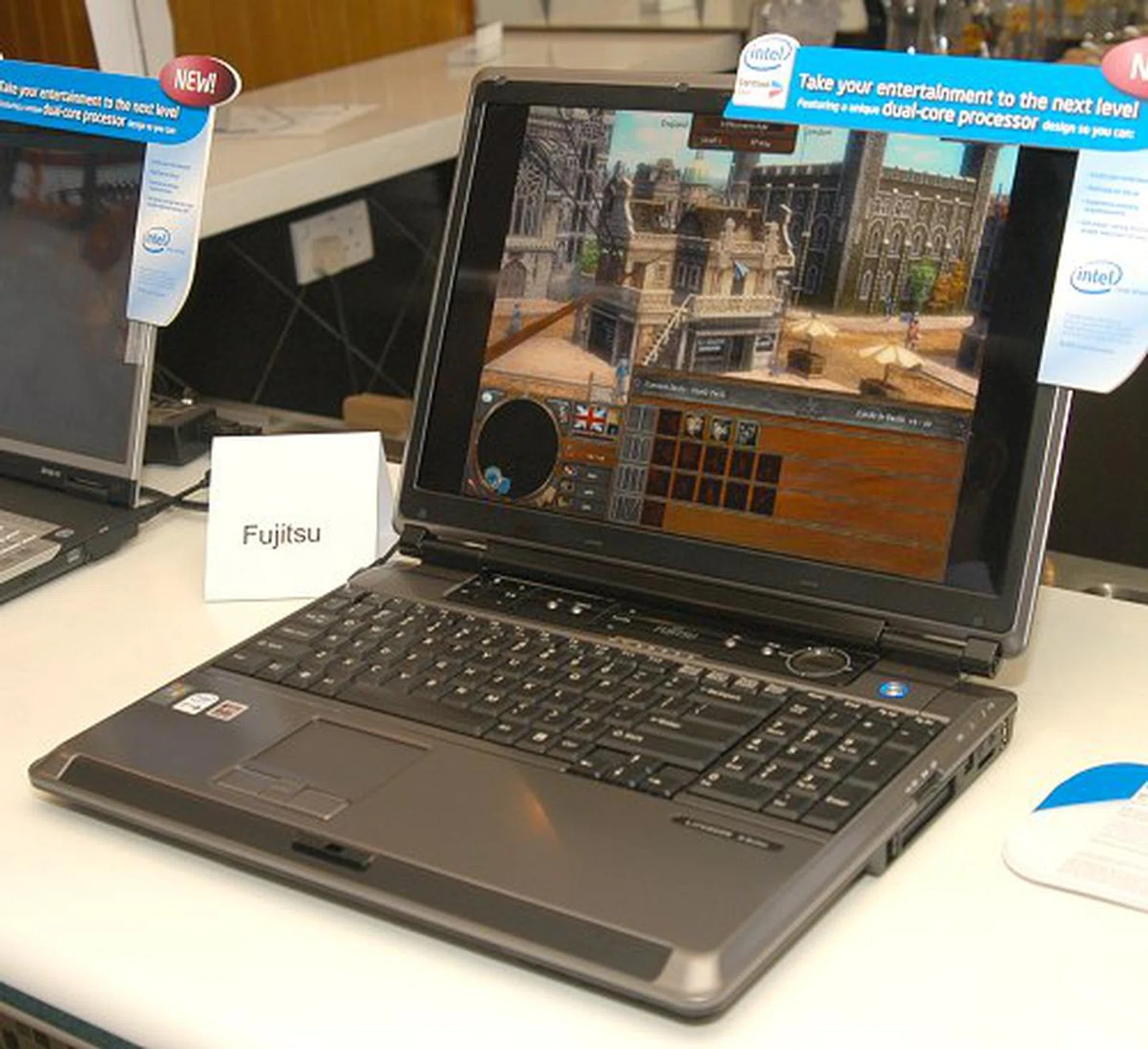
The N6410 from Fujitsu is also a equipped with Intel's new dual-core mobile processor, but home entertainment and storage are the true strengths of the notebook because it has two hard drives for a maximum of 320GB of storage space and a host of multimedia controls and components.
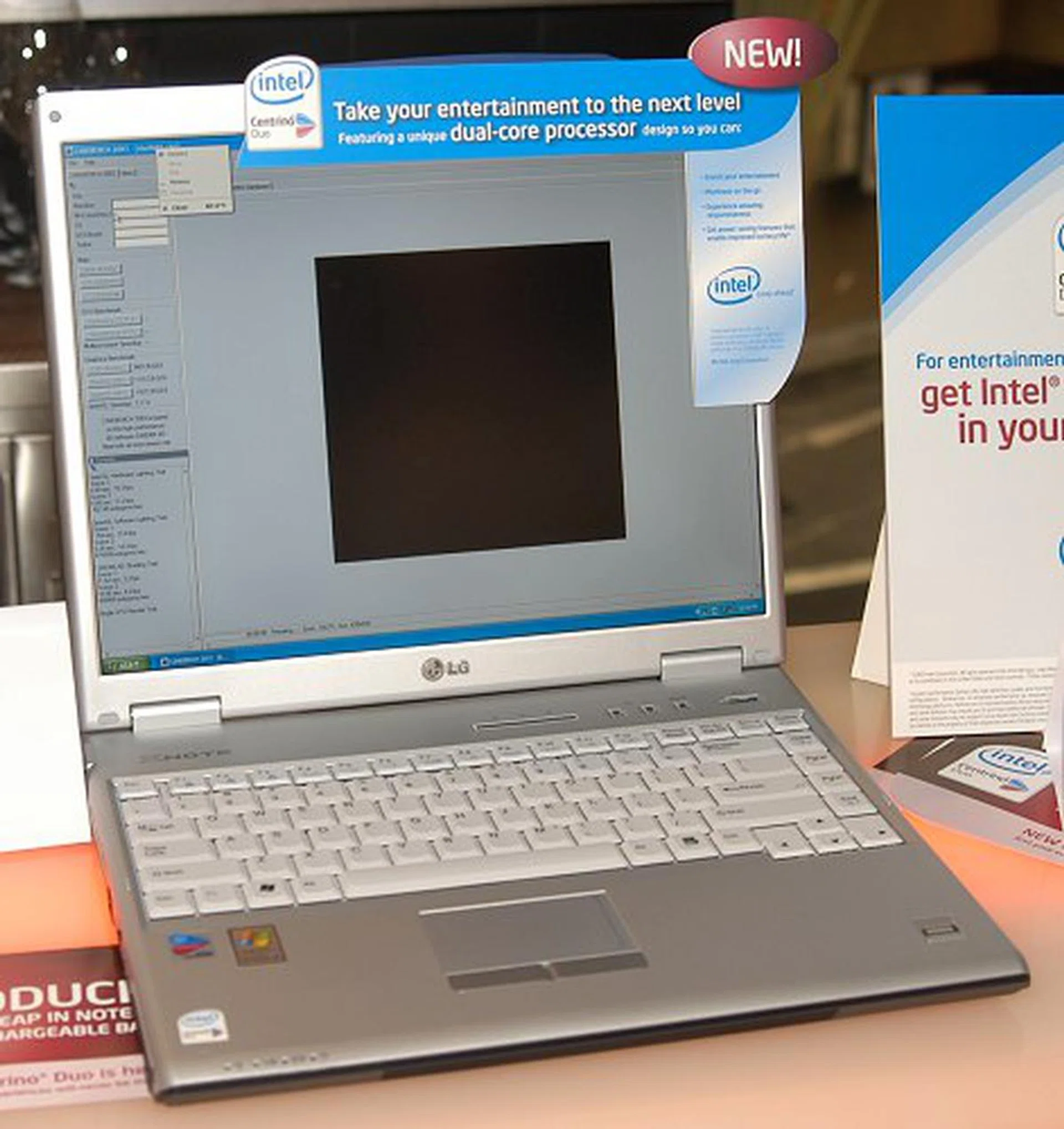
The M1 Express sees LG joining the race for mainstream notebooks with decent security features by including a fingerprint scanner. List of components include a 15-inch widescreen display, all-format DVD writer and NVIDIA GeForce Go 7300 GPU.
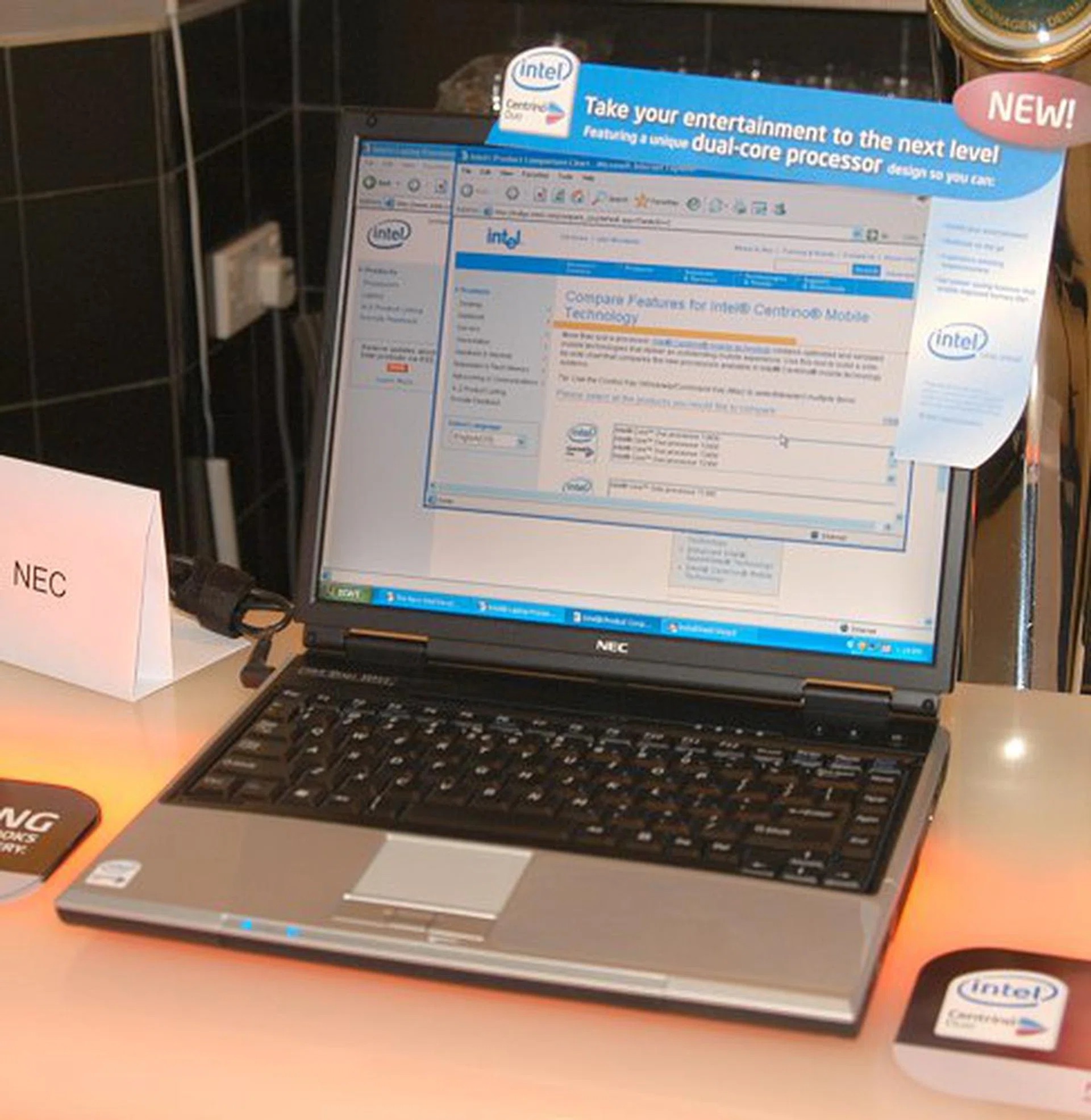
Nec Versa S5200 is a thin and light general purpose notebook ideal for students and for executives. It comes with a 14-inch LCD screen and is attached to the integrated GMA 950 graphics chip.
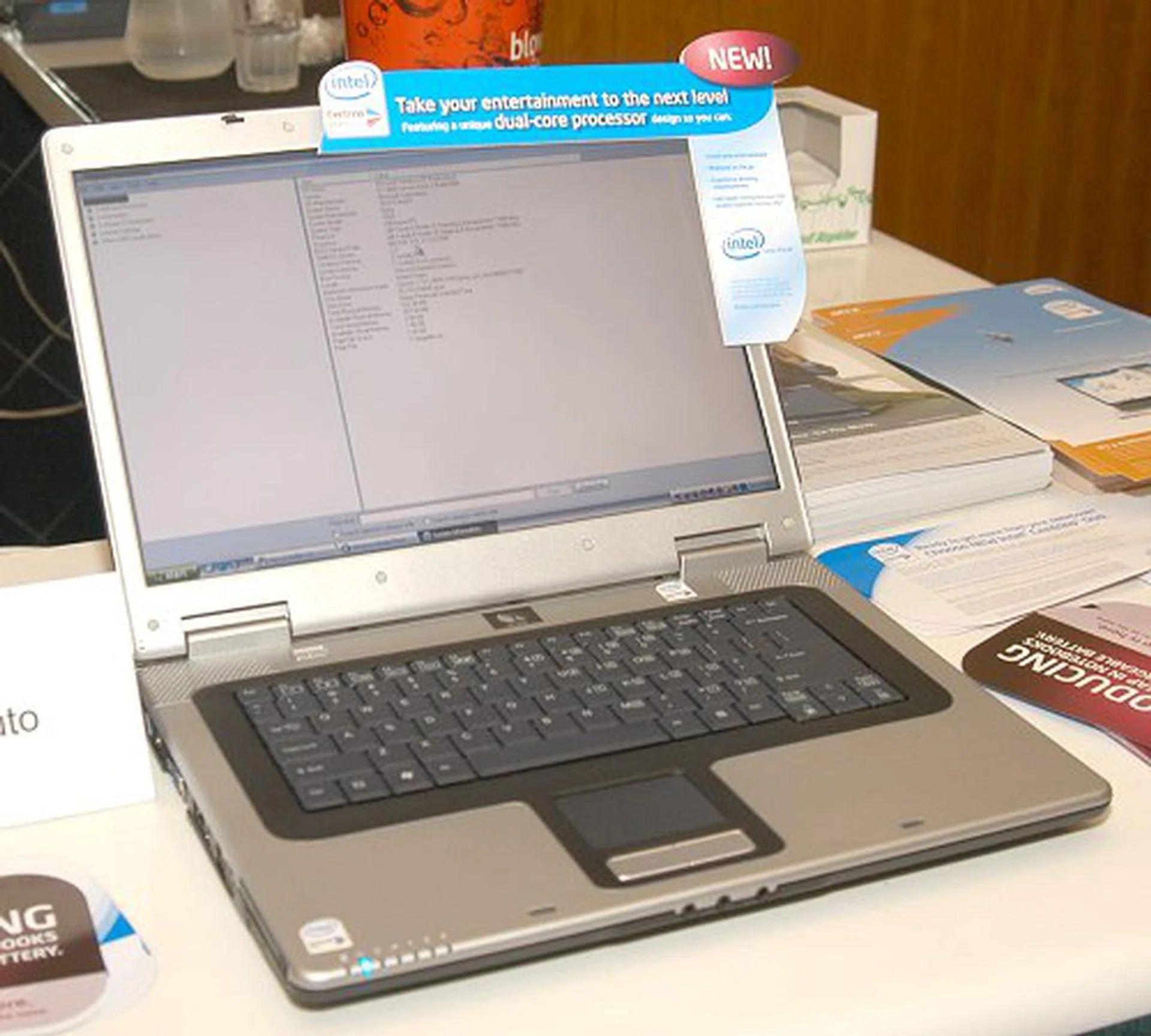
The Pluto B3100 is a mainstream, general purpose notebook that uses integrated graphics to power its 15.4-inch widescreen display.
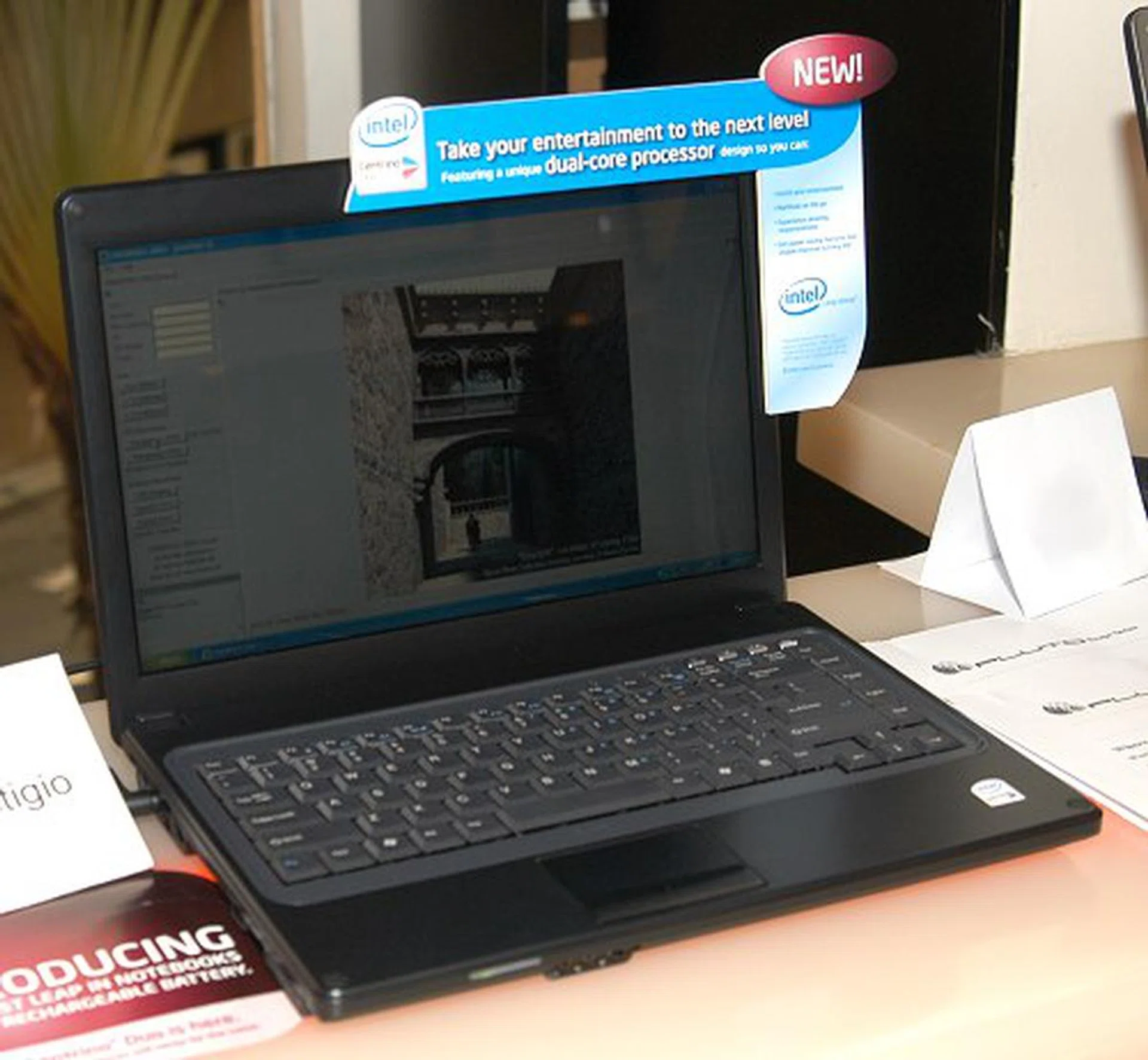
Singapore's Prestigio was seen showcasing an Intel Centrino Duo notebook at the launch.
Our articles may contain affiliate links. If you buy through these links, we may earn a small commission.