
The AMD Radeon Pro Duo is a monster card for both gamers and VR content creators (Updated)
AMD has announced the Radeon Pro Duo, a dual-GPU Fiji card targeted at both gamers and content creators in the VR space. The card is now available globally from select add-in board partners and system integrators.

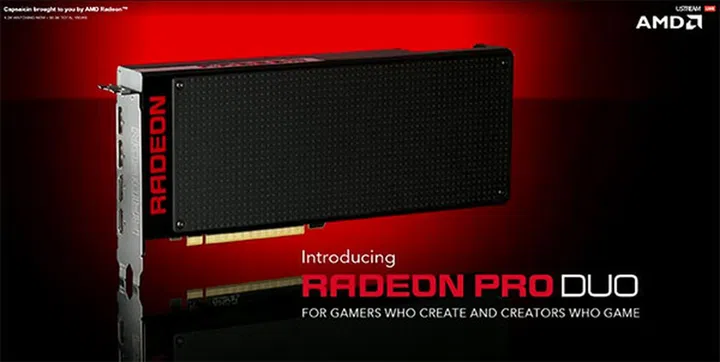
The Radeon Pro Duo is targeted at both gamers and professional content creators.
Updated on 27 April 2016: The Radeon Pro Duo is now available globally from select add-in board partners and system integrators for US$1,499.
Originally published on 15 March 2016:
The rumors were true after all. At its Capsaicin event at GDC 2016, AMD announced the Radeon Pro Duo, its much-anticipated dual-GPU Fiji card. Better known by its rumored name, the Radeon R9 Fury X2, the new card is targeted at both gamers and content creators in the virtual reality space.
First teased back at AMD’s E3 launch of its new Fiji-based cards, the Radeon Pro Duo’s focus has been tweaked to focus squarely on VR. In AMD’s words, the Radeon Pro Duo is the card both for “gamers who create and creators who game”. But a catchy tagline aside, the card has been designed to deliver the graphical computing heft that VR gamers and professional content creators will need to enjoy and deliver compelling experiences.
The Radeon Pro Duo is also the first workstation-class card to feature High Bandwidth Memory (HBM). But compared to AMD’s flagship single-GPU Fiji card, the Radeon R9 Fury X, the Radeon Pro Duo has doubled the amount of onboard HBM to 8GB thanks to its dual Fiji GPUs. On top of that, it features a whopping 16 TFLOPS of performance and will have four DisplayPort outputs. The card actually looks remarkably similar to the Radeon R9 Fury X, with the same soft-touch texture, illuminated Radeon logo, and 120mm radiator. If our experience with the Radeon R9 Fury X is anything to go by, the Radeon Pro Duo should prove itself to be a rather silent card as well.
However, AMD did not release any details on power consumption, although press images reveal the presence three 8-pin PCIe connectors, which would potentially put the maximum power draw at 525 watts.
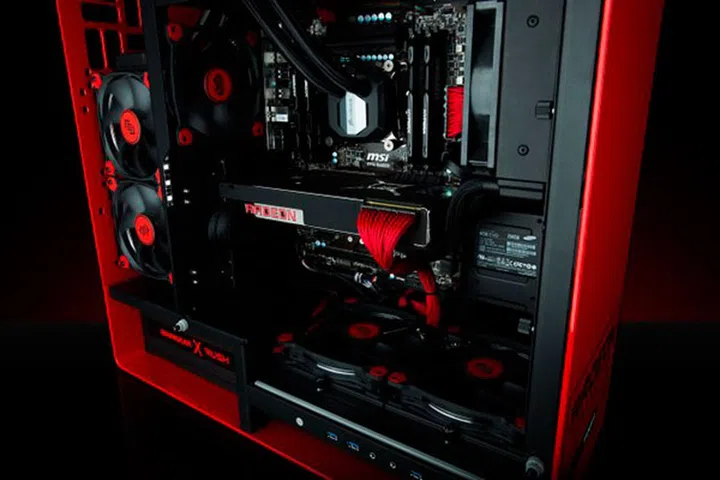
It looks like the Radeon Pro Duo will feature three 8-pin PCIe connectors.
At its launch announcement, AMD brought on top executives from companies like Rebellion, visualZ, and Practical Magic VR, all of whom talked about the importance of having powerful enough hardware for VR rendering tasks. For instance, visualZ’s Gary Davis cited the ability to nearly halve the time needed to render a car in a ray tracing engine called FireRender.
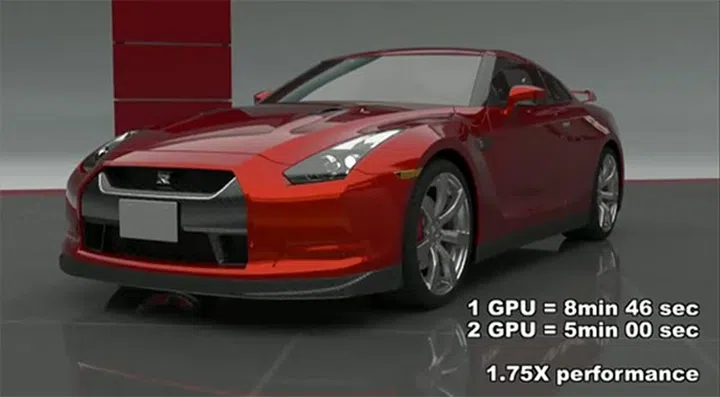
The Radeon Pro Duo can speed up rendering time by around 1.75x.
AMD’s focus on VR with the Radeon Pro Duo also represents a surprising departure from the well-worn trend of releasing dual-GPU cards targeted solely at consumers in the PC gaming market. Its decision to directly address content creators was also another surprise, but it actually makes a fair bit of sense seeing as there still isn’t an established consumer base for VR. In fact, with the impending release of the first wave of VR headsets, content creation may very well be the priority and a crucial step in building up user numbers.
The Radeon Pro Duo will retail for US$1,499, which happens to be the same price that the Radeon R9 295X2 launched at in 2014.
Source: AMD
Our articles may contain affiliate links. If you buy through these links, we may earn a small commission.