
AMD launches Ryzen Pro processors to take on Intel vPro chips in the commercial space
AMD has launched its Ryzen Pro CPUs, a series of processors designed for the commercial desktop and mobile segment that it first announced back in May.


Image Source: AMD
AMD has launched its Ryzen Pro CPUs, a series of processors designed for the commercial desktop and mobile segment that it first announced back in May. Six desktop chips are rolling out first, and mobile processors are not expected until the first half of 2018.
Many of the models have corresponding versions in the consumer-oriented Ryzen line-up, and the key difference is that the Pro series tops out at the Ryzen Pro 1700X as opposed to an 1800X model.
The company is also continuing to push its core/thread-count advantage over Intel. The top-end Ryzen Pro 7 1700X and 1700 both have 8 cores and 16 threads, twice the number on equivalent Intel chips.
In fact, AMD is touting up to 62 per cent better multi-threaded performance over competing products.
Here’s a table with an overview of the key specifications of the Ryzen Pro CPUs:
Model | Core/Thread | Base/Boost clock | Cache (L2 + L3) | TDP |
AMD Ryzen7 PRO 1700X | 8/16 | 3.4GHz/3.8GHz | 4 + 16MB | 95W |
AMD Ryzen7 PRO 1700 | 8/16 | 3.0GHz/3.7GHz | 4 + 16MB | 65W |
AMD Ryzen5 PRO 1600 | 6/12 | 3.2GHz/3.6GHz | 3 + 16MB | 65W |
AMD Ryzen5PRO 1500 | 4/8 | 3.5GHz/3.7GHz | 2 + 16MB | 65W |
AMD Ryzen3PRO 1300 | 4/4 | 3.5GHz/3.7GHz | 2 + 8MB | 65W |
AMD Ryzen3PRO 1200 | 4/4 | 3.1GHz/3.4GHz | 2 + 8MB | 65W |
The Ryzen 7 processors roughly correspond with Intel’s Core i7 vPro CPUs, while the Ryzen 5 will go up against the Core i5 models.
Intel doesn’t make any Core i3 models with vPro capabilities, so AMD is claiming broader market coverage here. If you only need a CPU for basic tasks in a business environment, you can settle for a Ryzen 3 Pro processor instead of having to pay for performance you don’t need with a Core i5 chip.
What do these processors have that gives them their “Pro” branding? AMD has listed features such as firmware-integrated TPM, Secure Boot, and memory encryption, similar to the regular Ryzen CPUs, but the Pro chips also come with additional security measures.
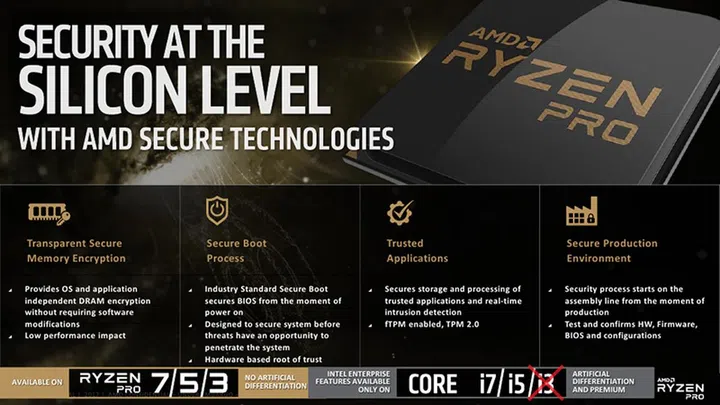
Image Source: AMD
The biggest feature is Secure Virtualized Encryption (SEV), which allows virtual machines to be encrypted and isolated from each other, hypervisors, and hosting software. The Ryzen Pro CPUs also come with remote management features in the form of the DASH management protocol, just like the Pro-series chips of previous years.
Finally, as befits a business-focused line-up, the Ryzen Pro processors are backed by longer warranties and guarantees for platform stability and processor availability. All SKUs are covered by a 3-year limited warranty, compared to just a year for consumer chips.
The more interesting part of AMD’s announcement is actually what it means for the upcoming consumer Ryzen 3 processors. The key specifications for the Ryzen 5 and 7 Pro parts match those of their mainstream counterparts, so it stands to reason that the consumer Ryzen 3 CPUs will be very similar to Ryzen 3 Pro.
The Ryzen 3 Pro chips are also the first Zen-based products to not feature AMD’s simultaneous multi-threading (SMT) technology, and they don’t come with integrated graphics either. However, they have the same 65W TDP as their Ryzen 5 Pro counterparts, despite their supposedly lower performance bracket.
So while businesses might be able to save when choosing Ryzen 3 Pro over an Intel Core i5 vPro CPU, they’d still need to pair it with a discrete GPU, which is an added expense that is somewhat difficult to justify at the low-end.
Ryzen Pro PCs are expected to ship in the second half of 2017 from major commercial desktop manufacturers.
Our articles may contain affiliate links. If you buy through these links, we may earn a small commission.