
All the AMD AM4 motherboards you can buy here
With AMD's Ryzen chips now available to buy or pre-order, we've decided to round up a list of all the AM4 motherboards you can buy from the major brands.

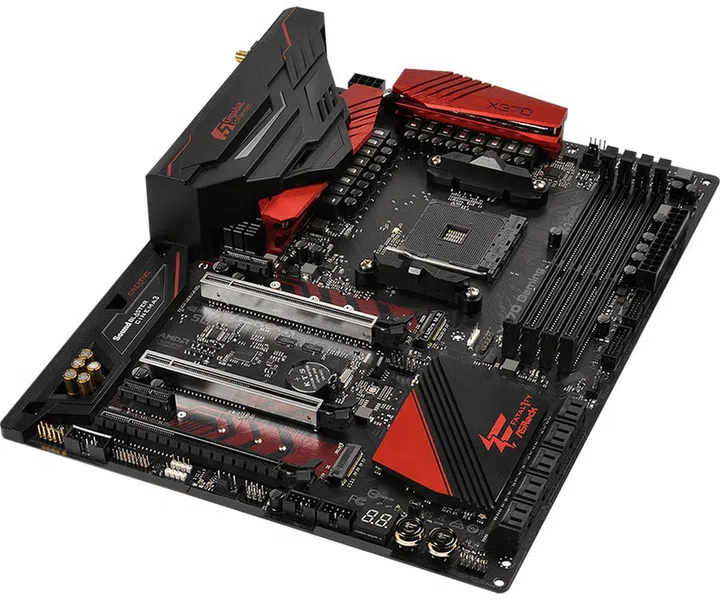
ASRock Fatal1ty X370 Professional Gaming. (Image Source: ASRock)
Updated on 4 April 2017: Added local prices for more Gigabyte AM4 boards.
Originally published on 6 March 2017:
AMD’s Ryzen processors are fresh from the oven, but they are already flying off the shelves like hotcakes in the US and elsewhere. Customers here will have to wait a little longer for Ryzen as it is still up for pre-order only, but local retailers have already dropped news of motherboard and CPU bundles to whet your appetites.
If you’re in need of strong multi-core performance, and are not put off by Ryzen’s relatively weak performance in 1080p games, AMD’s new chips probably appear quite attractive. That said, here’s a roundup of the AM4 motherboards for your Ryzen rig.
ASRock
ASRock has announced its new AMD AM4 motherboards based on the X370 and B350 chipsets, hot on the heels of ASUS’ own announcement of its AM4 line-up. Many of the new boards have a distinctly gamer-oriented focus, which isn’t surprising given that it is this segment of the market that will be most excited about the performance Ryzen offers relative to Intel.
The top AM4 board is the Fatal1ty X370 Professional Gaming, a board aimed squarely at gamers and overclockers. It is decked out in a familiar red-and-black color scheme and features a 16-phase power design, Creative Sound Blaster Cinema3 onboard audio, and steel-reinforced PCIe slots.
One interesting feature is the support for 5Gbps LAN, courtesy of an Aquantia controller. However, you’ll still need a 5Gbps switching hub, and of course a blazing fast internet plan, to fully enable the higher network capacity.
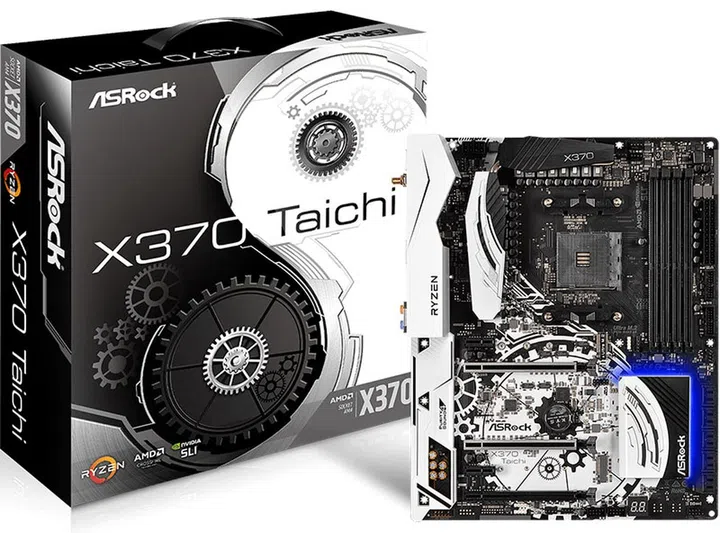
ASRock X370 Taichi. (Image Source: ASRock)
ASRock also highlighted the X370 Taichi, an all-rounded board intended to appeal to a wider swath of the market. That said, it still boasts a 16-phase power design, a Hyper BCLK Engine II external chip for a wider range of frequencies, and a wide range of storage options, including dual M.2 sockets. It will also work with ASRock’s U.2 kit and allow you to install speedy U.2 drives like the Intel 750 series SSDs.
The board shares the same unique design with its X99 counterpart, and appears a good fit for those sick of the usual red and black.

The company singled out the X370 Killer SLI as well, a more budget-oriented board with a strategic selection of features to attract those who want the most bang for their buck. For one, it comes with both SLI and CrossFire support, and ships with ASRock’s own SLI high bandwidth bridge for use with NVIDIA’s latest Pascal GPUs. The SLI support is especially welcome, as cheaper AMD motherboards tend to omit that.
In addition, you get a USB-C connector, dual M.2 sockets, and a 12-phase power design. There is a second variant of the board, the X370 Killer SLI/ac, which comes with 802.11ac Wi-Fi.
Here’s a list of all the boards that will be available to buy locally:
- ASRock X370 Professional Gaming (S$470)
- ASRock X370 Taichi (S$399)
- ASRock X370 Gaming K4 (S$265)
- ASRock X370 Killer SLI (S$255)
ASRock also announced a handful of boards based on the B350 chipset but we don’t have the prices for those yet. Here’s a list of what was announced:
- ASRock Fatal1ty AB350 Gaming K4
- ASRock AB350 Pro4
- ASRock AB350M Pro4
- ASRock AB350M
- ASRock AB350M-HDV
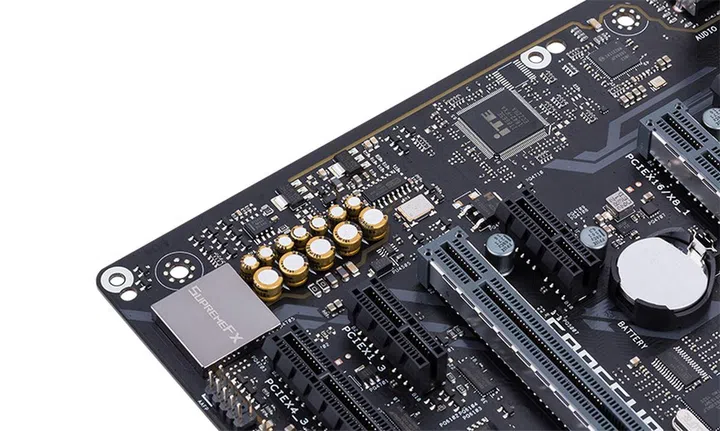
The ASUS ROG Crosshair VI Hero features a higher quality SupremeFX audio solution. (Image Source: ASUS)
The flagship AM4 model from ASUS is the ROG Crosshair VI Hero, an ROG board based on the X370 chipset. It is equipped enthusiast-oriented features like dedicated AIO and water pump headers, beefier heatsinks over its VRMs, and the requisite Aura RGB lighting.
It supports both CrossFireX and two-way SLI, with a total of two PCIe 3.0 x16 and one PCIe 2.0 x16 slots.
One interesting to note is that there are no display connectors on the rear I/O at all. This makes sense given that the board’s target audience is likely to go with discrete GPUs with their own display outputs, and it has the added benefit of making room for a whole lot more USB ports.
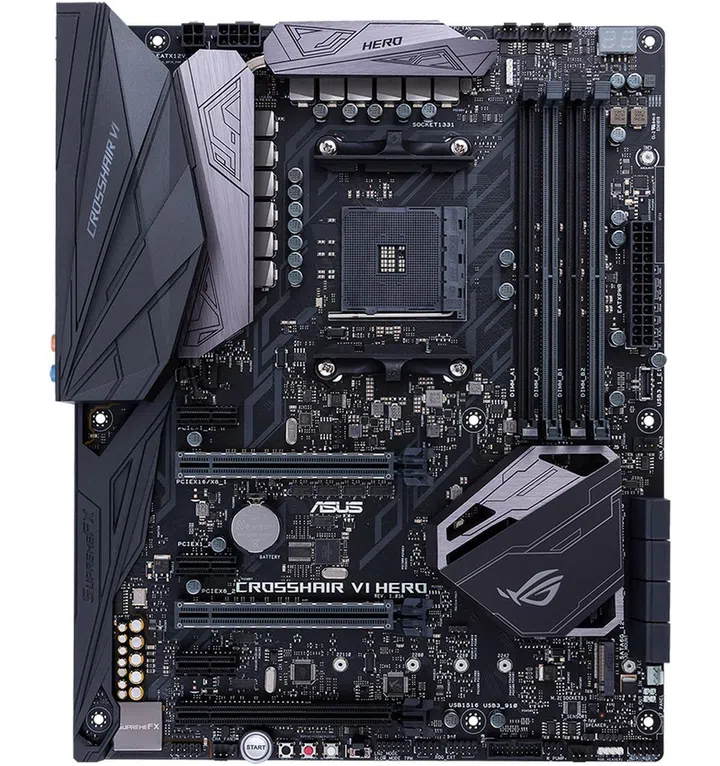
ASUS' flagship AM4 motherboard is targeted squarely at enthusiasts. (Image Source: ASUS)
The other X370-based board is the Prime X370-Pro, a less gamer-centric model. It has smaller VRM heatsinks and is missing the liquid-filled heatpipe on the Crosshair board, but it does have onboard DisplayPort and HDMI connectors and so is better suited than the latter for use with AMD’s next-generation APUs.
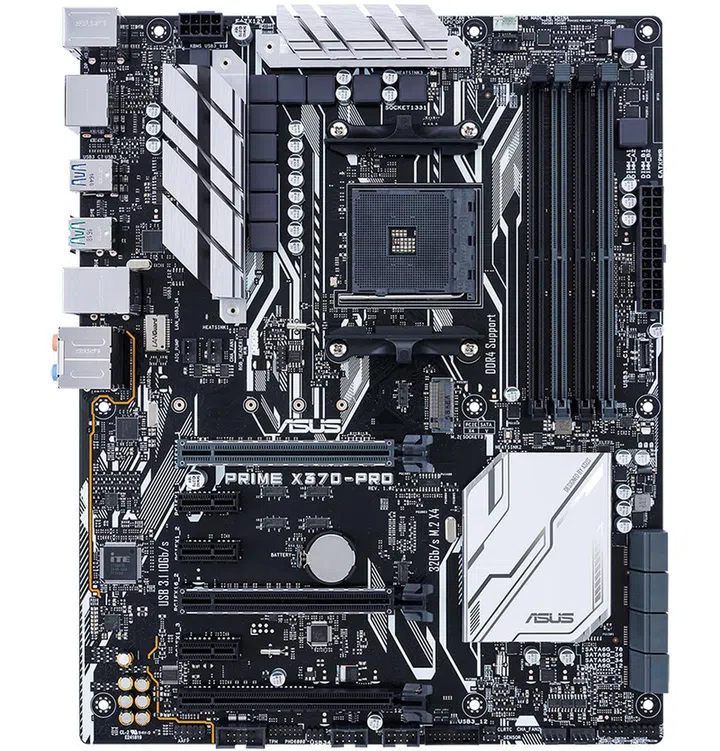
ASUS Prime X370-Pro. (Image Source: ASUS)
The remaining two boards are based on the B350 chipset and are equipped with more modest feature sets. For instance, the Prime B350-Plus has fewer power phases, even smaller heatsinks, a Realtek instead of Intel NIC, and lower-end audio codecs.
There’s no SLI support either, as the B350 chipset doesn’t allow the splitting of PCIe 3.0 lanes from the CPU like on X370. That said, there is just one PCIe 3.0 x16 slot and one PCIe 2.0 x16 slot in the way of full-length slots.
The last board is the Prime B350M-A, the only micro-ATX board in ASUS’ current AM4 line-up. This has been stripped down further as well, and there are no heatsinks over the VRMs at all and just a single PCIe 3.0 x16 slot. So while the B350 chipset does support overclocking, the missing heatsinks are likely to limit performance.
Here’s a list of all the new boards and their prices:
- ASUS ROG Crosshair VI Hero (S$459)
- Prime X370-Pro (S$285)
- Prime B350-Plus (S$175)
- Prime B350M-A (S$155)
The B350 boards are already available to buy now, while the X370 models will be available to buy on 8 March.
Source: ASUS
Gigabyte
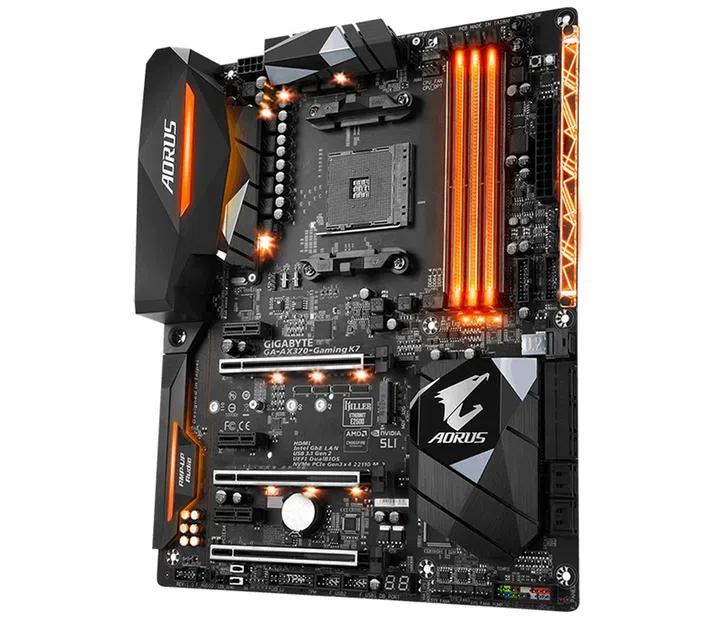
Gigabyte Aorus AX370-Gaming K7. (Image Source: Gigabyte)
Gigabyte is just releasing two X370 motherboards for now, in the form of the Aorus AX370-Gaming 5 and AX370-Gaming K7. The latter is the company’s flagship AM4 motherboard, and it looks every bit the part with the best overclocking features in Gigabyte’s AM4 line-up.
This includes things like a 6+4-phase digital power delivery design and beefy heatsinks to keep the VRMs cool, in addition to dual BIOS chips to recover from a bad overclock. Gigabyte also threw in a third-party clock generator, which will help ease BCLK overclocking.
The audio configuration is different from what you see on most boards, comprising two Realtek ALC1220 audio codecs. One of them is used for the front audio ports, while the other is dedicated to the rear audio jacks. Gigabyte has paired the codecs with high-end capacitors and headphone amps, and you’ll get to use Creative’s Sound Blaster X-Fi MB5 software for further enhancements and tweaks.
The selection of storage and I/O connectors are quite decent as well, including four USB 3.1 ports (one USB-C), eight SATA 6Gbps ports, an M.2 socket, and a U.2 connector.
The AX370-Gaming 5 shares many of the features of the Gaming K7. It is equipped with the same 6+4-phase power design, dual BIOS, and onboard audio, but it is missing the third-party clock generator that the Gaming K7 has.
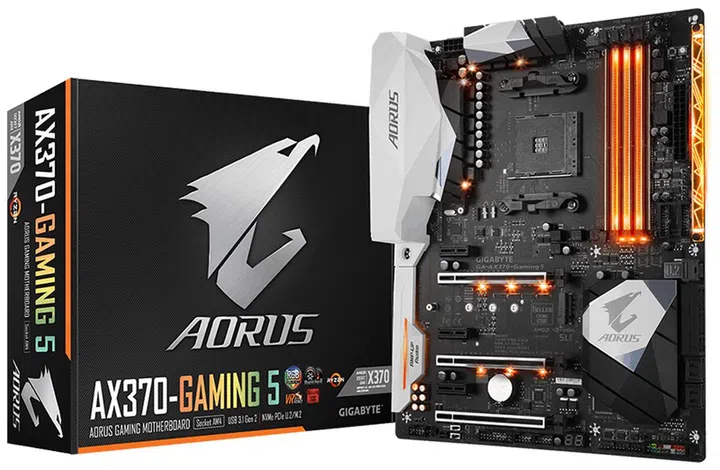
Gigabyte Aorus AX370-Gaming 5. (Image Source: Gigabyte)
That said, both boards also boast steel-reinforced PCIe slots and the swappable LED overlays that Gigabyte first introduced with its Intel Z270 boards. The RGB Fusion LED lighting, as the latter feature is dubbed, allows you to remove and replace the overlay at the top right of the board with a different one with its own light pattern.
The Aorus AX370-Gaming 5 and Gaming K7 cost S$319 and S$345 respectively.
Other than that, Gigabyte also has a handful of B350 motherboards, including a few micro-ATX models designated by the -M suffix for those looking to build compact systems. We've listed the boards and their local prices here:
- Gigabyte AB350-Gaming 3 (S$189)
- Gigabyte AB350-Gaming (S$169)
- Gigabyte AB350M-Gaming 3 (S$159)
- Gigabyte AB350M-D3H (S$159)
- Gigabyte AB350M-HD3 (S$149)
MSI
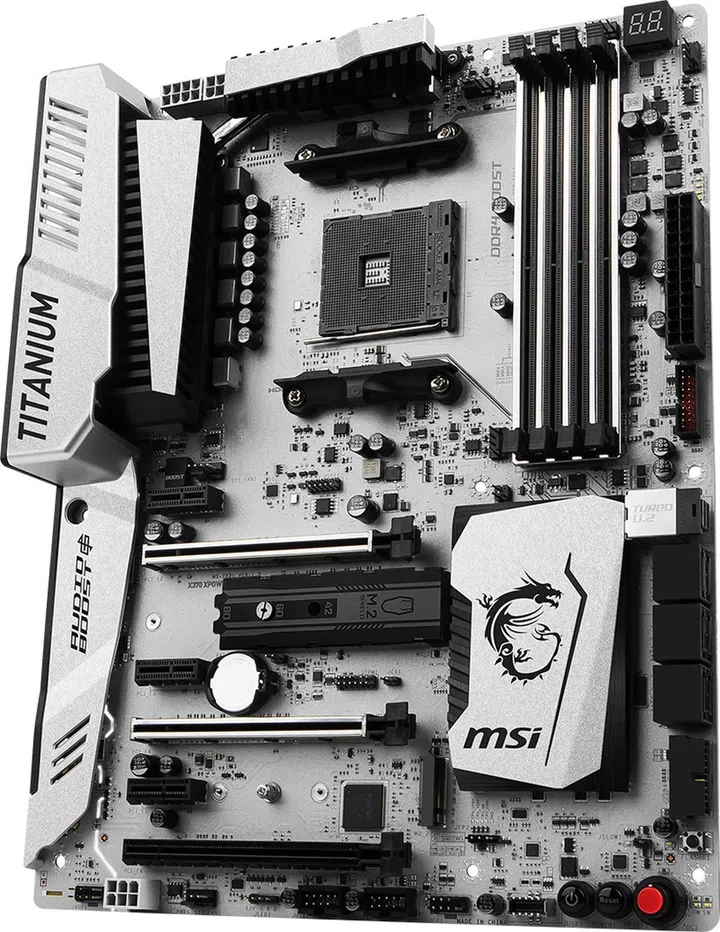
MSI X370 XPower Gaming Titanium. (Image Source: MSI)
For Ryzen, MSI trotted out a couple of X370 boards in two of its signature designs, namely, one titanium and one carbon fiber-style board. The company also announced a more affordable B350-based Tomahawk board for those on a tighter budget, although those gunning for a Ryzen 7 chip are more likely to pair it with one of the higher-end boards.
That said, here’s a list of the boards MSI has released and their prices:
- MSI X370 XPower Gaming Titanium (S$579)
- MSI X370 Gaming Pro Carbon (S$329)
- MSI B350 Tomahawk (S$219)
The B350 Tomahawk is the only board available to buy now, but we’ve been told that the X370 Gaming Pro Carbon will be arriving next week, while the X370 XPower Gaming Titanium is available for pre-order.
MSI also has the micro-ATX B350M Gaming Pro (US$80) and B350M Mortar (US$90), but we don’t yet know if we’ll see them hit our shores.
The flagship X370 XPower Gaming Titanium looks much like the other boards we’ve seen in this series. Its unique titanium coloring helps it stand out from a sea of black and red boards, and it is equipped with a 6+4-phase power design, steel-reinforced PCIe and U.2 ports, and Nahimic 2 audio technology.
MSI’s Titanium series boards have always been designed with overclocking in mind, and this X370 board is no different. Beefy heatsinks sit over the VRMs to keep things cool, and you’ll find a convenient OC Genie knob at the bottom right.
In addition, it has six SATA 6Gbps ports, two M.2 sockets, and single U.2 port for use with the latest storage devices. And as on MSI’s new Intel Z270 boards, the topmost M.2 socket comes with a built-in M.2 shield to protect the drive against heat from the GPU.
There’s of course the requisite RGB lighting, and the motherboard comes with an RGB header that you can hook up a third-party lighting strip to and control using the Mystic Light mobile app.
The X370 Gaming Pro Carbon is a far more affordable option. The heatsinks have all been clad in MSI’s distinctive carbon fiber, and you’ll find RGB LEDs built into the I/O cover, PCH heatsink, audio circuitry, and even around the board’s edges. This is a less overclocking-oriented board, and it’s clear that MSI has focused on getting the aesthetics right here.
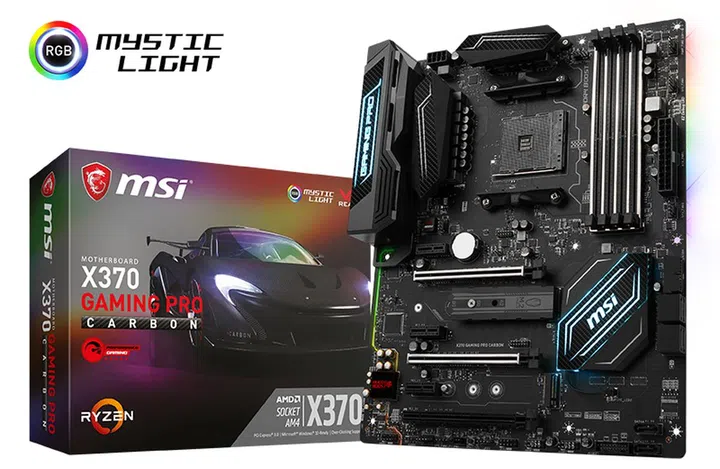
MSI X370 Gaming Pro Carbon. (Image Source: MSI)
That said, its feature set is still quite respectable, with steel-reinforced PCIe and RAM slots, six SATA 6Gbps ports, and two M.2 sockets. There’s a USB 3.1 Type-C port on the rear I/O as well, for use with the latest mobile devices.
Other extras include dedicated RGB and water pump headers and Nahimic 2 audio technology.
One interesting feature that is present on both the Titanium and Gaming Pro Carbon boards is something MSI calls VR Boost. This is a dedicated chip that MSI claims delivers cleaner and stronger signals to a VR-optimized USB port on the rear, thus minimizing performance drops from poor signal. This does sound a little gimmicky, but it’s still nice to see nonetheless.
Our articles may contain affiliate links. If you buy through these links, we may earn a small commission.