
Zotac Gaming GeForce GTX 1660 Super review: This is your new mainstream champ
The GeForce GTX 1660 Super was designed with 1440p gaming in mind - and it delivers.

Note: This article was first published on 29 October 2019.
NVIDIA's entry-level cards are getting faster
NVIDIA today announced upgrades to its GeForce GTX 1660 and 1650 cards, giving them both a spec boost and a leg up to its new Super series of GPUs. The GeForce RTX cards were the first to sport the new Super moniker, but NVIDIA is now bringing it to its entry-level Turing GPUs.
The GeForce GTX 1660 Super now features 6GB of GDDR6 memory running at 14,000MHz. In comparison, the GeForce GTX 1660 used older, and slower, GDDR5 memory, so you get an increase in total memory bandwidth from 192.1GB/s to 336GB/s, an impressive 75 per cent improvement that brings it to level with the GeForce RTX 2060. That said, this should help in running games with higher quality textures and resolutions.
However, the Super upgrade on the GeForce 16-series GPUs isn't quite like that on NVIDIA's higher-end GeForce RTX cards. While the latter saw the addition of more CUDA cores and higher clock speeds, the number of cores and clock frequencies are staying the same on the GeForce GTX 1660 Super. It looks like the memory upgrade to GDDR6 is all you're getting, and the GeForce GTX 1660 Super is also based on the same TU116 GPU as the GeForce GTX 1660.
Here's an overview of its specifications:
NVIDIA GeForce GTX 1660 Super | NVIDIA GeForce GTX 1660 Ti | NVIDIA GeForce GTX 1660 | NVIDIA GeForce GTX 1650 | |
Fabrication process | 12nm | 12nm | 12nm | 12nm |
Transistor count | 6.6 billion | 6.6 billion | 6.6 billion | 4.7 billion |
Graphics processing clusters | 3 | 3 | 3 | 2 |
Texture processing clusters | 11 | 12 | 11 | 7 |
Streaming multiprocessors | 22 | 24 | 22 | 14 |
CUDA cores | 1,408 | 1,536 | 1,408 | 896 |
Tensor cores | - | - | - | - |
RT cores | - | - | - | - |
Texture units | 88 | 96 | 88 | 56 |
ROPs | 48 | 48 | 48 | 32 |
Base/Boost clock | 1,530MHz/1,785MHz | 1,500MHz/1,770MHz | 1,530MHz/1,785MHz | 1,485MHz/1,665MHz |
Memory clock | 14,000MHz | 12,000MHz | 8,000MHz | 8,000MHz |
Total video memory | 6GB GDDR6 | 6GB GDDR6 | 6GB GDDR5 | 4GB GDDR5 |
Memory interface | 192-bit | 192-bit | 192-bit | 128-bit |
Memory bandwidth | 336GB/s | 288.1GB/s | 192.1GB/s | 128GB/s |
TDP | 125W | 120W | 120W | 75W |
Price (USD) | $229 | $279 | $219 | $149 |
While the GeForce GTX 1660 Ti still sits at the top of NVIDIA's 16-series, the GeForce GTX 1660 Super closes the gap with it and gives gamers more price and performance options. Also, NVIDIA will continue to offer the GeForce GTX 1660 at a reduced price point.
NVIDIA's 1660-series currently comprises the following three cards:
- NVIDIA GeForce GTX 1660 Ti
- NVIDIA GeForce GTX 1660 Super
- NVIDIA GeForce GTX 1660
NVIDIA says the GeForce GTX 1660 Super is up to 1.5x faster than the GeForce GTX 1060 6GB, and it's hoping to tempt owners of that older Pascal card with an upgrade. After all, according to the September Steam Hardware Survey, the over three-year-old GeForce GTX 1060 still comprises the largest share of the pie at 14 per cent.
The company's Turing graphics cards may have gotten off to an expensive start last year, but NVIDIA is going all out to appeal to the masses right now with its GeForce GTX 1660 series cards and its Super equivalent.
The new GeForce GTX 1660 Super will be able to take advantage of all the features NVIDIA introduced with Turing, including a new unified cache architecture and an improved NVENC encoder unit that adds support for H.265 (HEVC) 8K encoding at 30fps. The new NVENC encoder supposedly offers up to 25 per cent in bit rate savings for HEVC and up to 15 per cent for H.264, a boon for streamers. In addition, the NVDEC decoder now supports decoding of HEVC 8/10/12-bit video streams with a chroma subsampling rate of 4:4:4.
NVIDIA also worked with Open Broadcaster Software (OBS) to optimise performance and image quality while streaming. OBS v23.0 and higher incorporates NVIDIA's Video Codec SDK to deliver these benefits. With the SDK, frames generated by the GPU are directly grabbed by the encoder, where they're then encoded and streamed. This is supposedly more efficient than the old FFMPEG implementation, which also had to go through the system memory.
As for the card itself, the Zotac Gaming GeForce GTX 1660 Super which NVIDIA sent me for review comes with three DisplayPort and one HDMI output. It features a super compact design that's great for mini-ITX systems, which relies on three copper heatpipes and dual fans for cooling. Finally, it requires just a single 8-pin connector for power.

This is a compact card that will fit in most cases.
There is no Founders Edition model with the GeForce GTX 1660 Super, and NVIDIA is going straight to launch with cards from its board partners.
Test setup
The detailed specifications of our new graphics card testbed system is as follows:-
- Intel Core i7-8086K (4.0GHz, 12MB L3 cache)
- ASUS ROG Strix Maximus X Hero (Intel Z370)
- 4 x 8GB G.Skill Ripjaws V DDR4-3000 (Auto timings: CAS 15-15-15-35)
- Samsung 860 EVO 500GB SSD
- Windows 10 Pro 64-bit
- ASUS PB287Q, 4K monitor
The full line-up of graphics cards tested are listed below:
- Zotac Gaming GeForce GTX 1660 Super
- ASUS ROG Strix GeForce GTX 1660 Ti Gaming OC
- ASUS Phoenix GeForce GTX 1660
- NVIDIA GeForce GTX 1060 6GB Founders Edition
[hwzcompare]
[products=676549,659169,661041,562776]
[width=200]
[caption=Test cards compared]
[showprices=1]
[/hwzcompare]
Benchmarks
Next up, here's a list of all the benchmarks used:
- 3DMark
- Ashes of the Singularity: Escalation
- Deus Ex: Mankind Divided
- Far Cry 5
- Metro Exodus
- Middle-earth: Shadow of War
- Shadow of the Tomb Raider
- Tom Clancy's The Division 2
3DMark
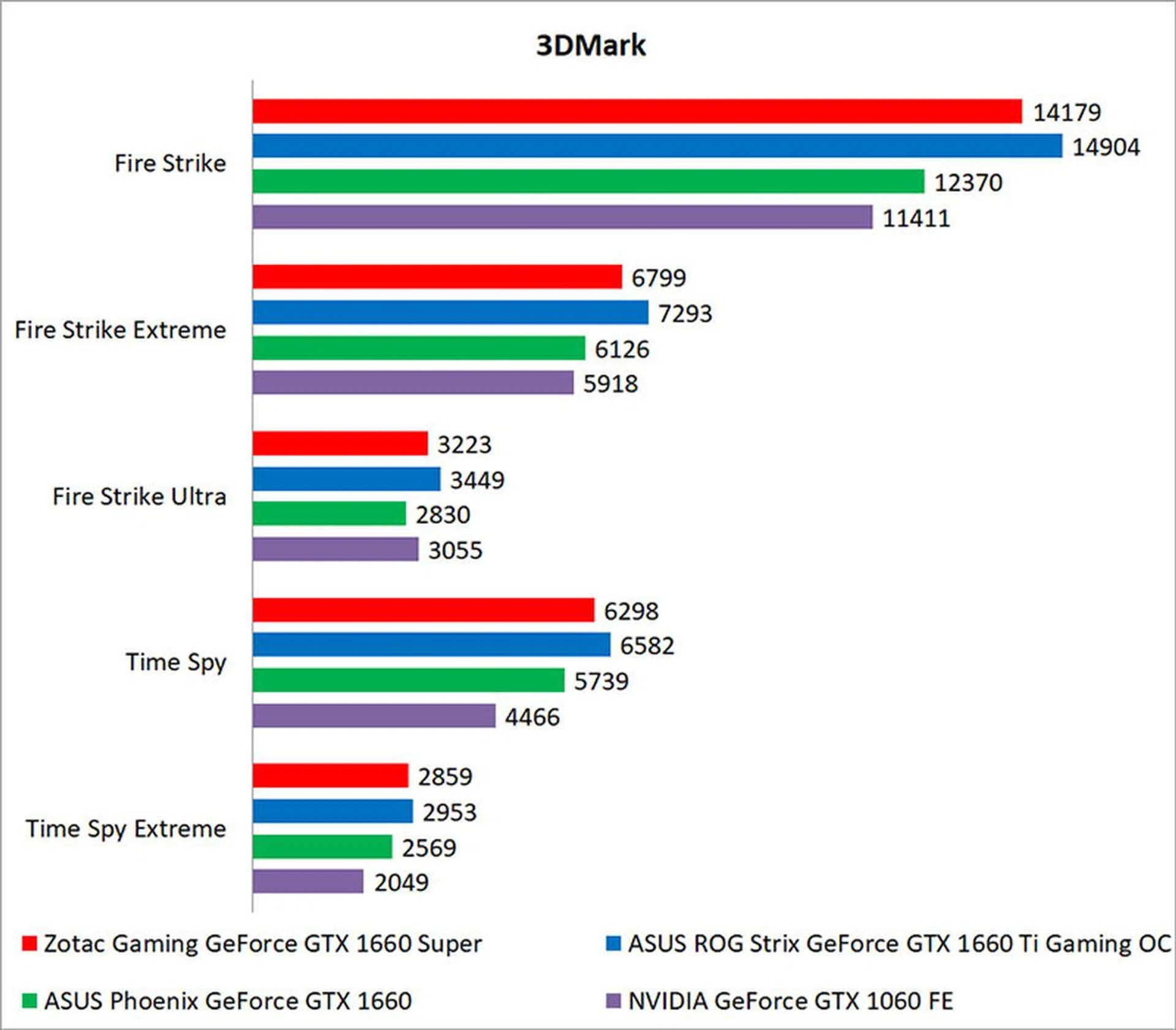
The synthetic 3DMark benchmark tests graphics and computational performance at different resolutions, starting at 1080p and going all the way up to 4K. A series of two graphics test, one physics test, and then a combined test stress your hardware in turn to assess its performance.
The GeForce GTX 1660 Super isn't that far behind the 1660 Ti. In 3DMark Fire Strike Extreme, it's just 7 per cent slower. It's also 13 per cent faster than the three-year-old GeForce GTX 1060 6GB in that same benchmark.
Ashes of the Singularity: Escalation
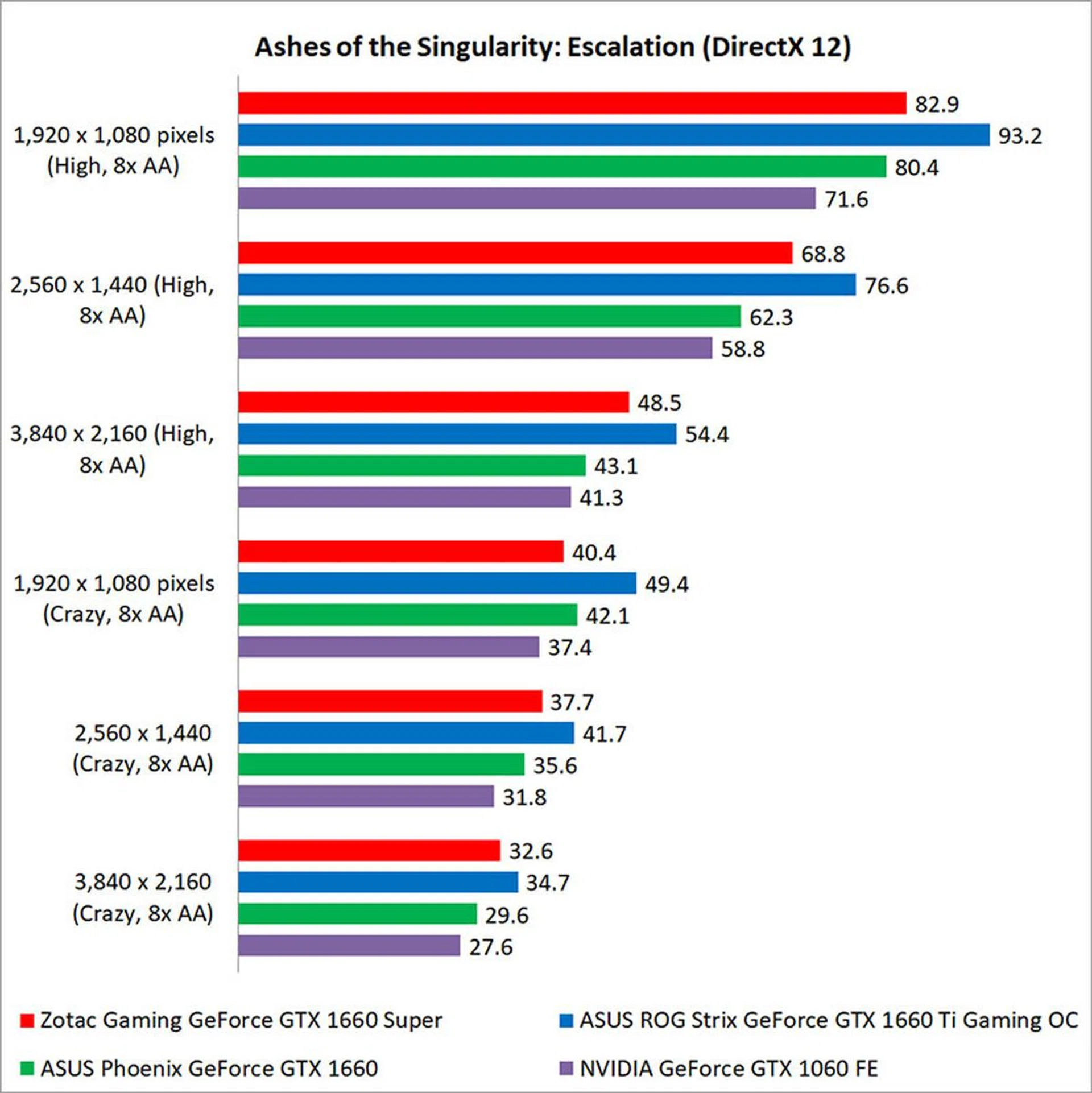
Ashes of the Singularity has long been the poster child for the performance benefits a low-level API like DirectX 12 can bring. It is based on the Nitrous engine and can be extremely punishing thanks to the huge number of onscreen units and the sheer level of detail accorded to each unit. However, the CPU does become the limiting factor at lower resolutions and settings.
The GeForce GTX 1660 Super performs very similarly to the GeForce GTX 1660 in Ashes of the Singularity: Escalation. It's also just under 11 per cent slower than the GeForce GTX 1660 Ti at 1440p and High settings.
Deus Ex: Mankind Divided
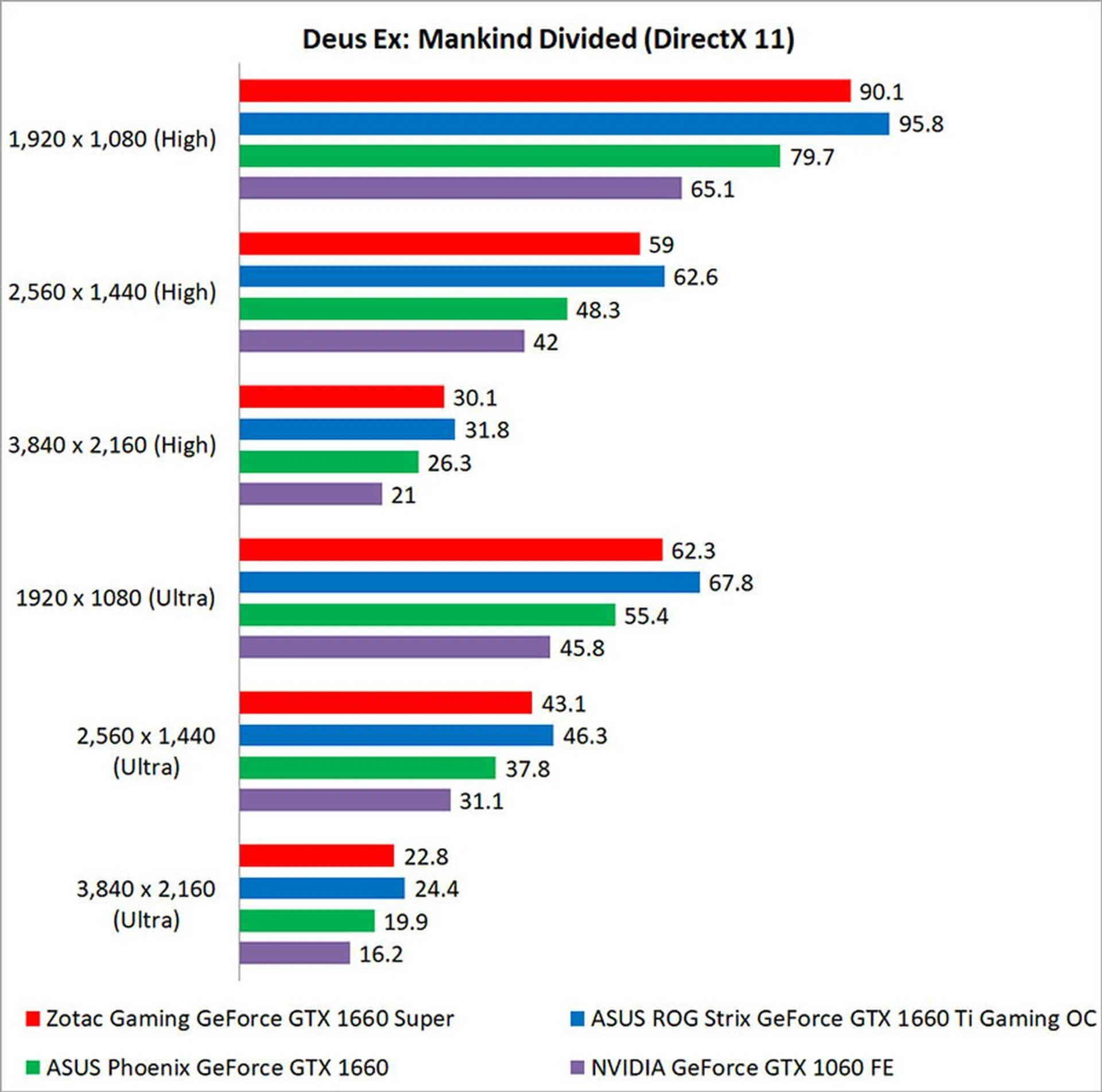
Mankind Divided features just about every trick to make your game look pretty, including things like volumetric and dynamic lighting, screenspace reflections, and cloth physics. Even though it was released in 2016, the game is capable of bringing even the most powerful systems to their knees.
Compared to the GeForce GTX 1660 Ti, the GeForce GTX 1660 Super is a mere 6 per cent behind at 1440p and High settings. It's also a good 33 per cent faster than the GeForce GTX 1060 6GB at the same settings.
Far Cry 5
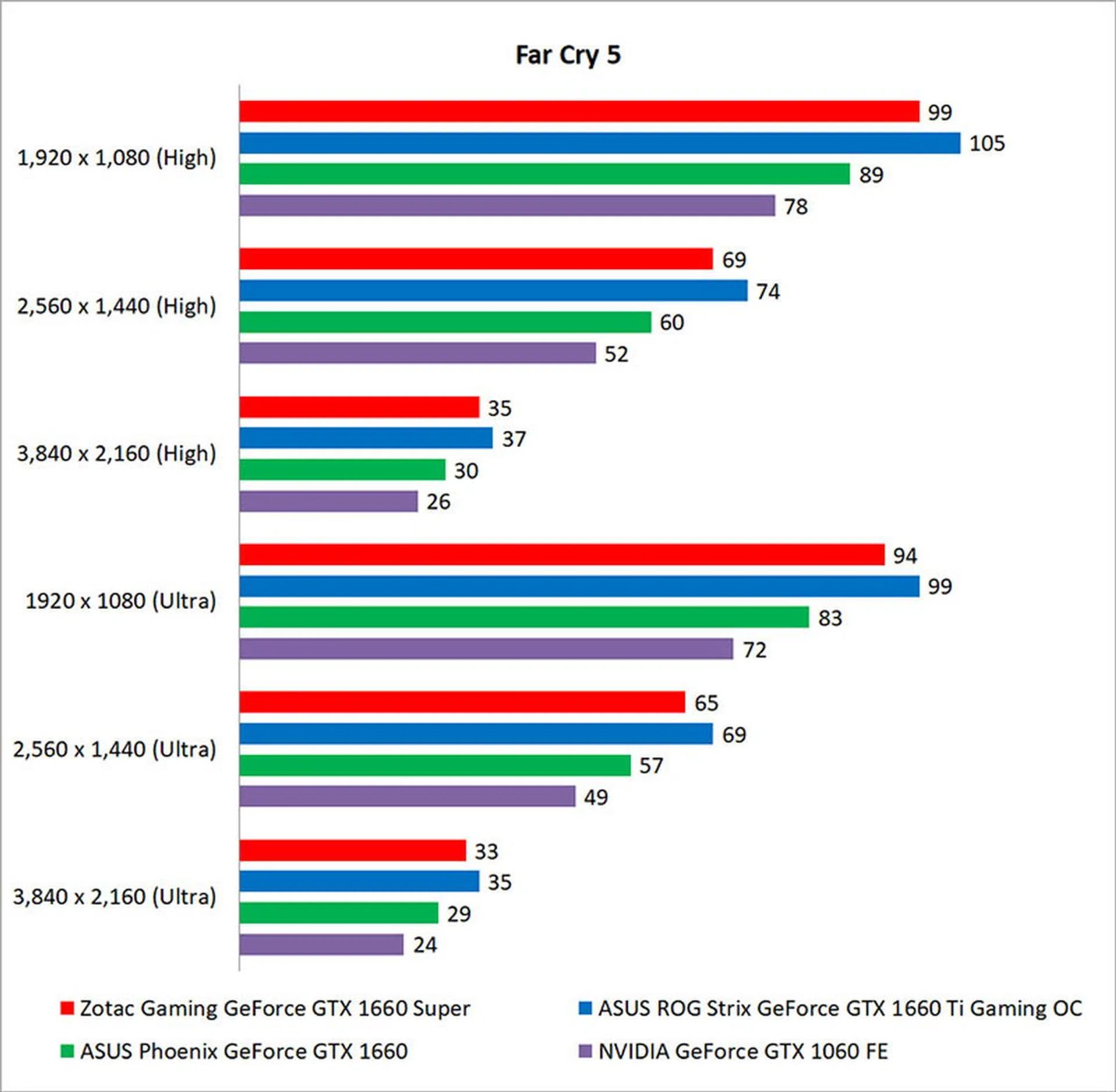
Far Cry 5 is actually an AMD launch title, so it'll be interesting to see how the green camp fares here.
At 1440p and High settings, the GeForce GTX 1660 Super is just under 7 per cent behind the GeForce GTX 1660 Ti. It's also a solid 28 per cent ahead of the GeForce GTX 1060 6GB.
Metro Exodus
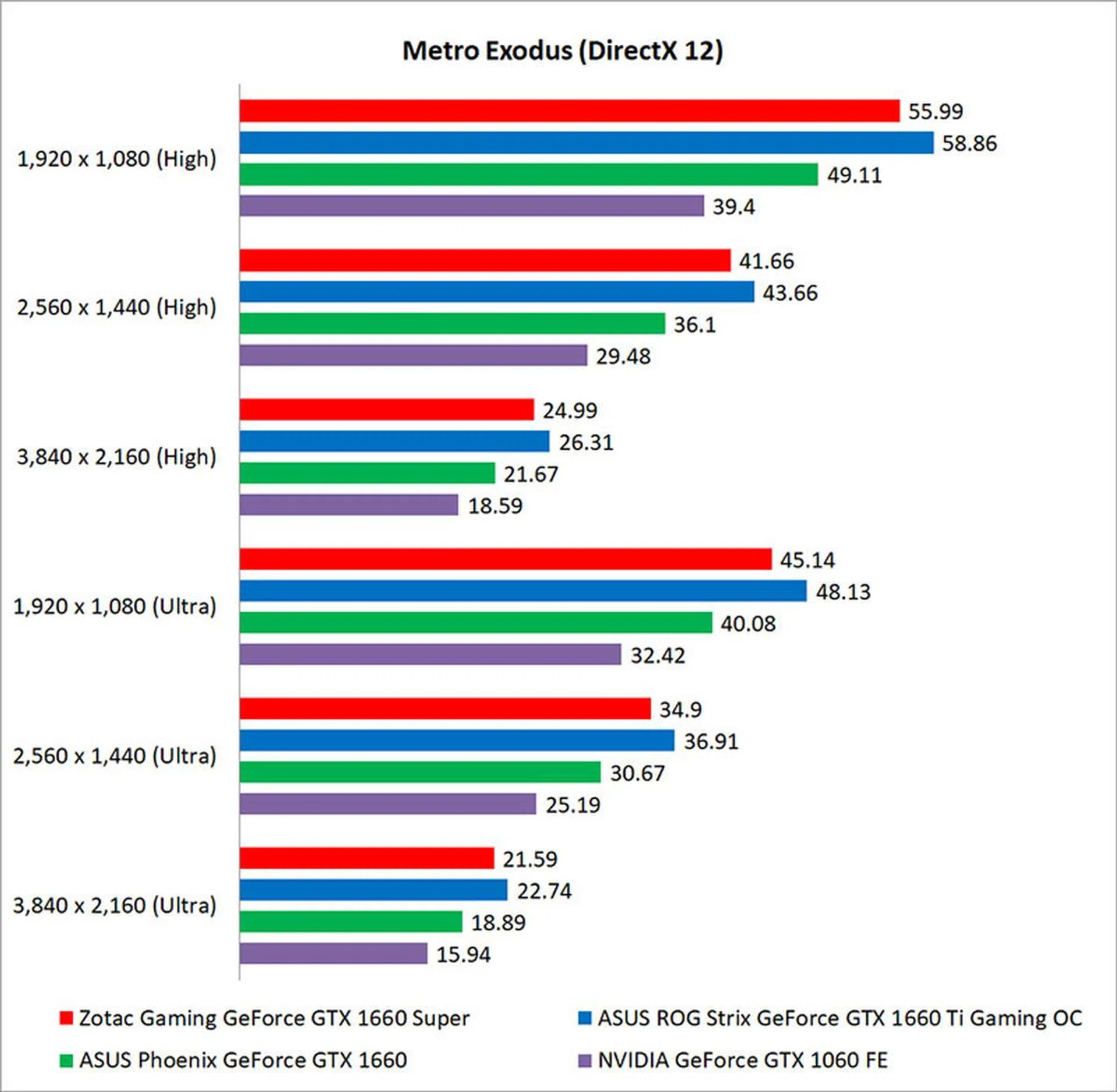
Metro Exodus is one of the most demanding games to run today, even at just 1080p and High settings. The GeForce GTX 1660 Super doesn't quite manage to hit 60FPS, but it comes close enough, a decent showing for a card that's part of NVIDIA's entry-level line-up. Compared to the GeForce GTX 1060 6GB, it's also a good 34 per cent faster.
Middle-earth: Shadow of War
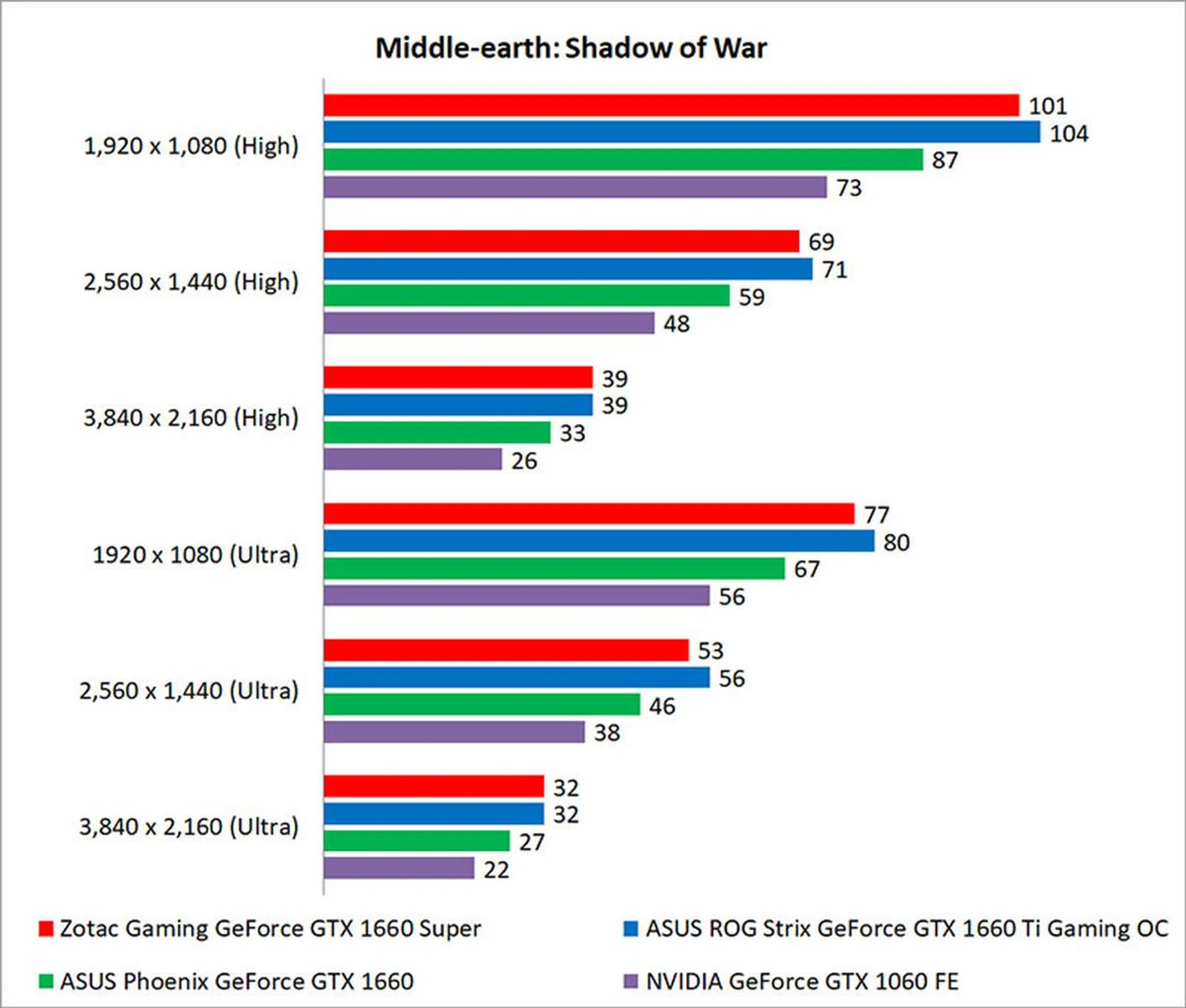
The GeForce GTX 1660 Super closes the gap further with the GeForce GTX 1660 Ti in Middle-earth: Shadow of War. At 1440p and High settings, it's barely 3 per cent behind. The new Super card continues to outpace the older GeForce GTX 1060 6GB by a good amount though, coming in at a whopping 35 per cent faster.
Shadow of the Tomb Raider
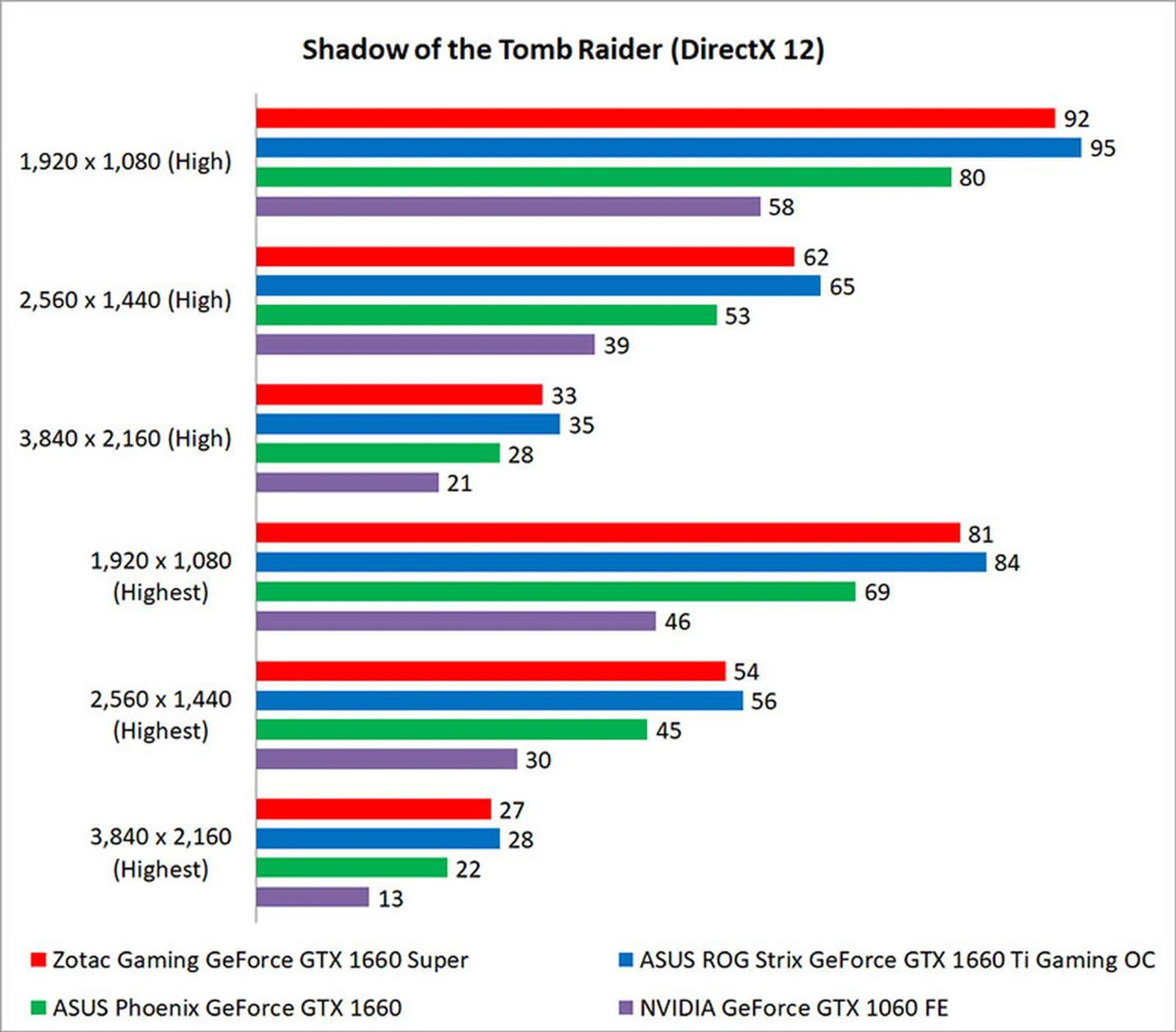
In Shadow of the Tomb Raider, the GeForce GTX 1660 Super once again proves itself a worthy alternative to the GeForce GTX 1660 Ti. In fact, the latter is barely 5 per cent faster than its Super counterpart. Meanwhile, the GeForce GTX 1060 6GB continues to show its age, trailing the GeForce GTX 1660 Super by a whopping 45 per cent.
Tom Clancy's The Division 2
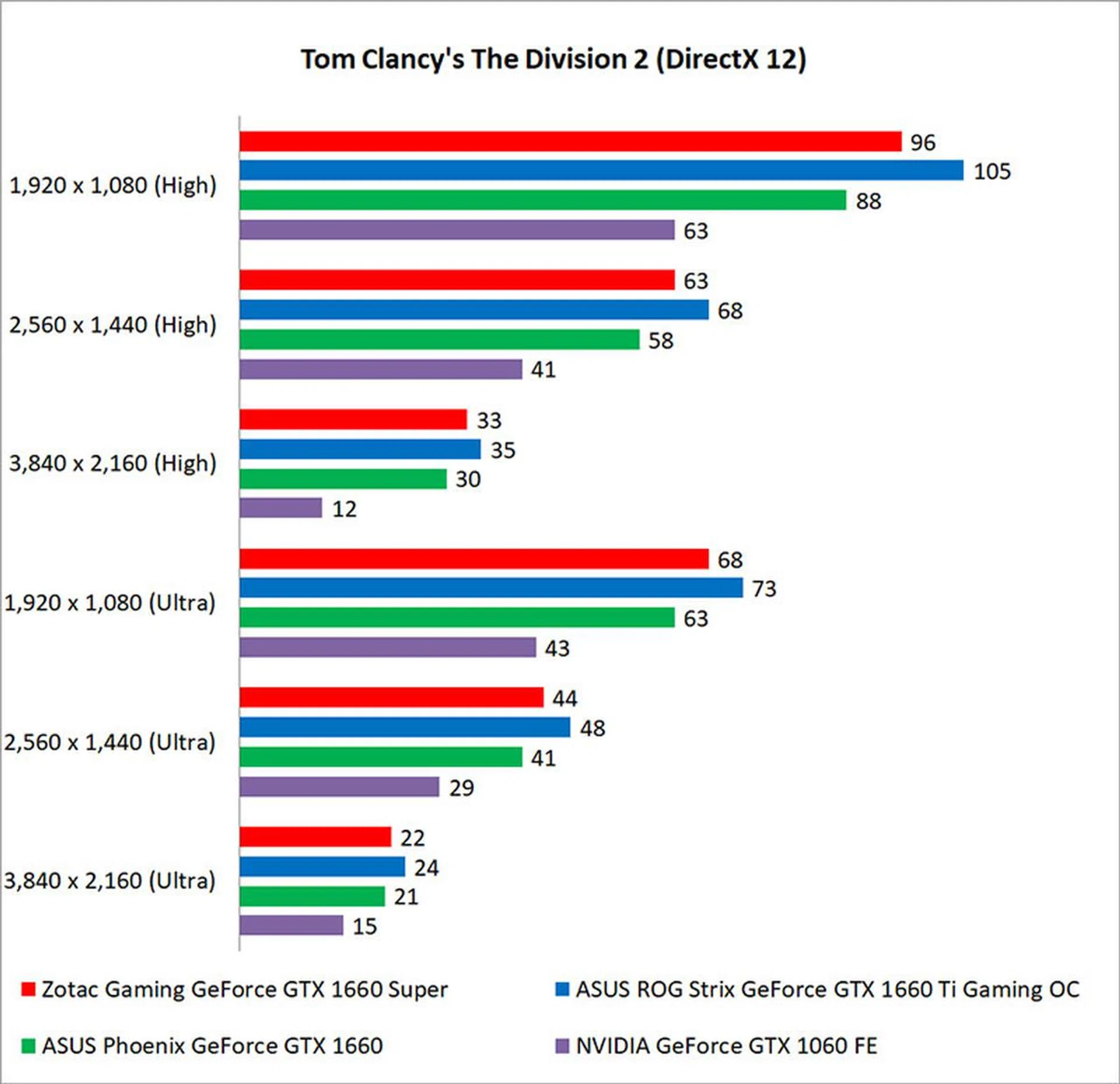
A similar pattern plays out in The Division 2, where the GeForce GTX 1660 Ti inched ahead of the GeForce GTX 1660 Super by just over 7 per cent at 1440p and High settings. The GeForce GTX 1660 Super also proves that it's more than capable of handling nearly any modern game at 1080p and Ultra settings, or even at 1440p but with some of the settings turned down.
Temperature and power consumption
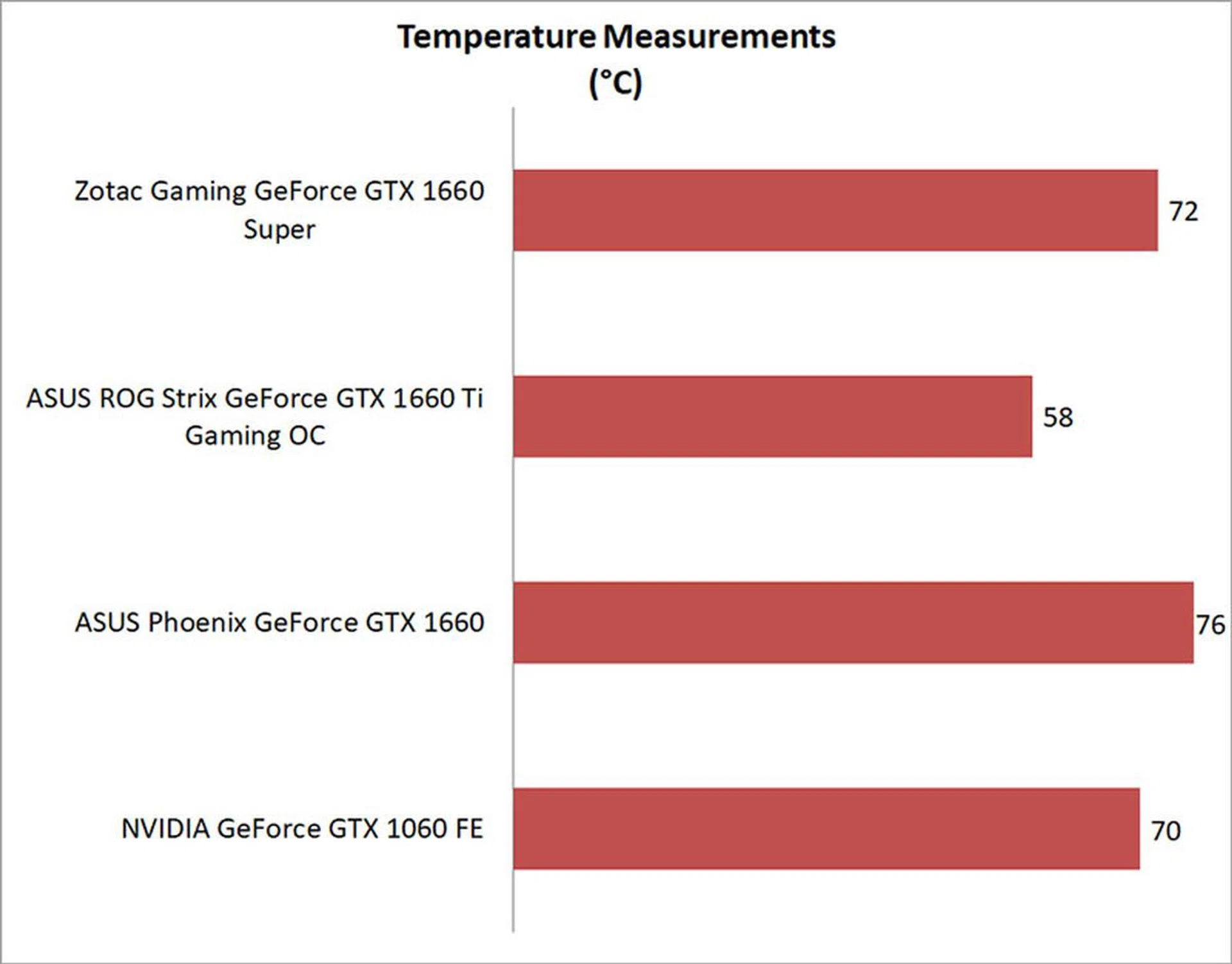
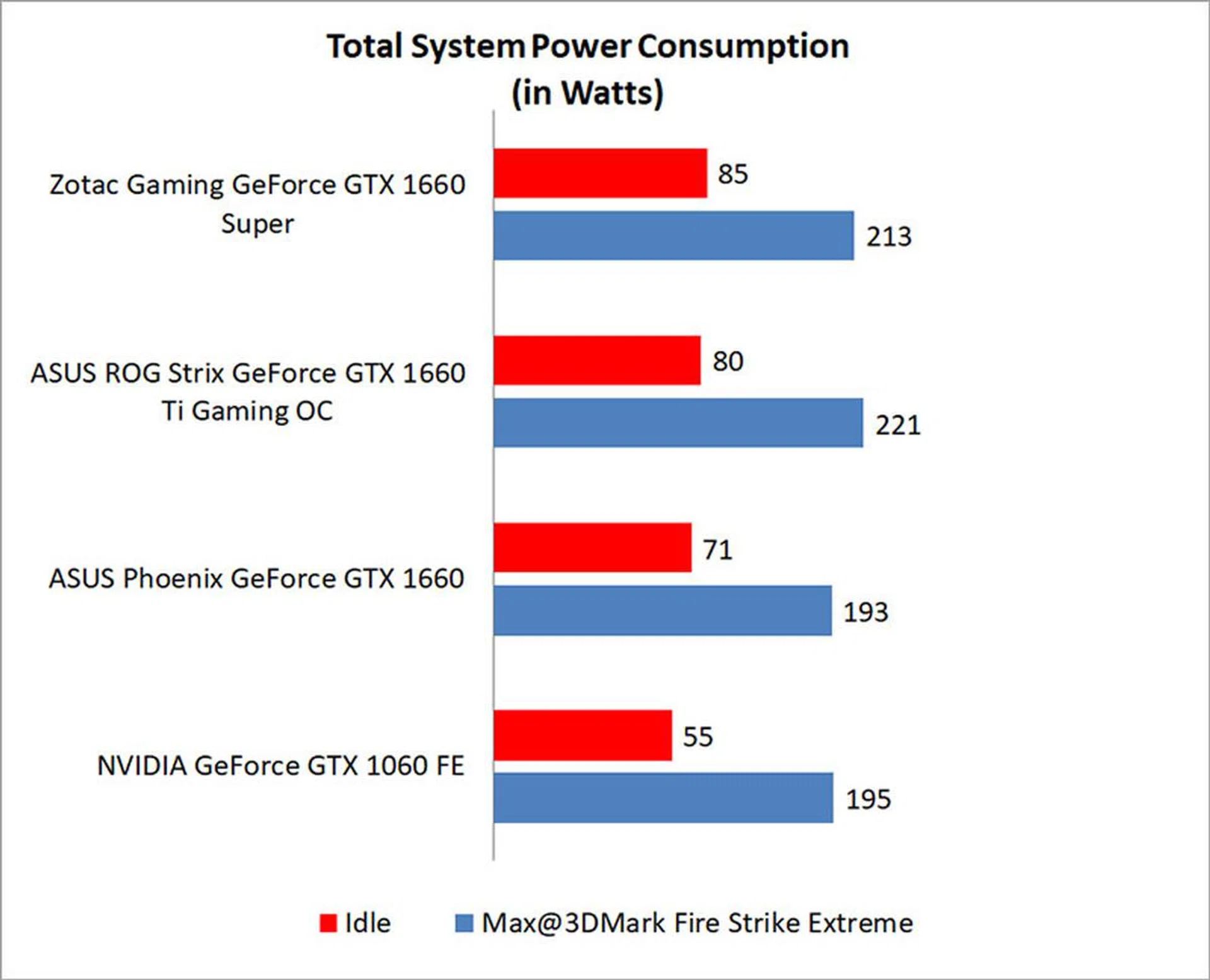
I ran 40 loops of 3DMark's Fire Strike Extreme stress test and took the peak GPU temperatures during the run. Power consumption numbers were obtained from a regular run of Fire Strike Extreme.
The card recorded a peak temperature of 72°C, fairly toasty for a card in this class. The ASUS ROG Strix GeForce GTX 1660 Ti ran quite cool in comparison at just 58°C, so it seems like Zotac's twin fan solution isn't quite as capable in the cooling department. Power consumption numbers are in line with what we've observed previously, slotting in right between the GeForce GTX 1660 and 1660 Ti.
Really close to a GeForce GTX 1660 Ti
The NVIDIA GeForce GTX 1660 Super is a strong addition to NVIDIA's entry-level and mainstream line-up. At just US$229, it's a Turing GPU for the masses, and is also US$50 cheaper than the US$279 GeForce GTX 1660 Ti. However, it comes close to challenging the GeForce GTX 1660 Ti in many benchmarks, often falling behind by just a few percentage points.
The new Super card also beats AMD's Radeon RX 5500 to market, and it'll be hoping to grab a bigger slice of the mainstream pie. The card is a worthy successor to NVIDIA's aging GeForce GTX 1060 6GB, which according to the Steam Hardware Survey, is still NVIDIA's most popular GPU. Compared to the Pascal card, the GeForce GTX 1660 Super is between 30 and 50 per cent faster in many cases, so you'll be getting a nice performance boost. Furthermore, it's capable of handling games at 1440p, which is where the GeForce GTX 1060 really falters today. That's not bad at all for a card that's looking to appeal to gamers on a budget.
The GeForce GTX 1660 Super slots in between the GeForce GTX 1660 Ti and 1660, but it's really closer to the former. Either way, the addition of the new Super card translates to more choice for gamers, so it's good news for everyone. If you're on a tight budget but still want more performance than the GeForce GTX 1660, the GeForce GTX 1660 Super is shaping up to be a good pick, especially since it's only US$10 more expensive.
Three years ago, the NVIDIA GeForce GTX 1060 6GB was released at US$249. It was positioned just below the GeForce GTX 1070 and was overall a pretty good value-for-money card for its time. Today, we have the US$229 GeForce GTX 1660 Super that is up to 50 per cent faster, so NVIDIA has really beefed-up the performance of its more affordable cards. Previously, the cards below NVIDIA's core 10-series line-up were also considered pretty weak. That's no longer the case this year, and the GeForce 1660-series now occupy the space previously held by the GeForce GTX 1060 6GB.
All things considered, I think the GeForce GTX 1660 Super is a great upgrade for existing owners of the GeForce GTX 1060 and older. If you're looking for a similar mainstream champ, this could be it.
Our articles may contain affiliate links. If you buy through these links, we may earn a small commission.