
MSI NX8800GT-T2D256E-OC (GeForce 8800 GT 256MB)
The GeForce 8800 GT is probably one of the most recognizable graphics chipset available now and with both 256MB and 512MB variants, it's set to become even more so. Read on as we check out one of the newer 256MB models, an overclocked version from MSI.

Introduction
It's just the beginning of a new year and already we have seen rumors about the new graphics products upcoming from the two big chipmakers. NVIDIA looks to consolidate an excellent 2007 by reinforcing its mainstream offerings with a GeForce 8800 GS, supposedly with an even more stripped down G92 core. With such heavy reliance on the G92 core, the Taiwanese fabs that NVIDIA is counting on to produce the chip better be working double and triple shifts to meet demand. Look out for our review on this new SKU in the coming weeks.
ATI meanwhile has promised its high-end dual GPU (RV670) R680 graphics card in the first quarter of the year and we really hope that this time, ATI will have a performer capable of giving NVIDIA's high-end cards some proper competition. If ATI's stocks arrive in time to the retailers, from what we've heard, it should be available next week. Both sides are also in the process of preparing their next generation products, though we expect few major architectural changes this time around. It looks like another typical year in graphics and with Intel not expected to enter the field at least until late 2008, it's shaping out to be another familiar two horse race.
So how do these developments relate to consumers now? Well, it's usually the case that the new cutting technologies slowly filter down to the mainstream segment and the recent 256MB version of the GeForce 8800 GT is probably a good example of this trend (while the GeForce 8800 GS mentioned earlier looks to be another upcoming example). In fact, for those with more modest budgets and requirements, a 256MB, DirectX 10 capable graphics card remains a very viable option and here to convince us today, we have the MSI's overclocked GeForce 8800 GT 256MB. With higher than usual clock speeds and a custom cooler, can this card win over the sub US$250 market and emulate the achievements of its more powerful 512MB compatriot?
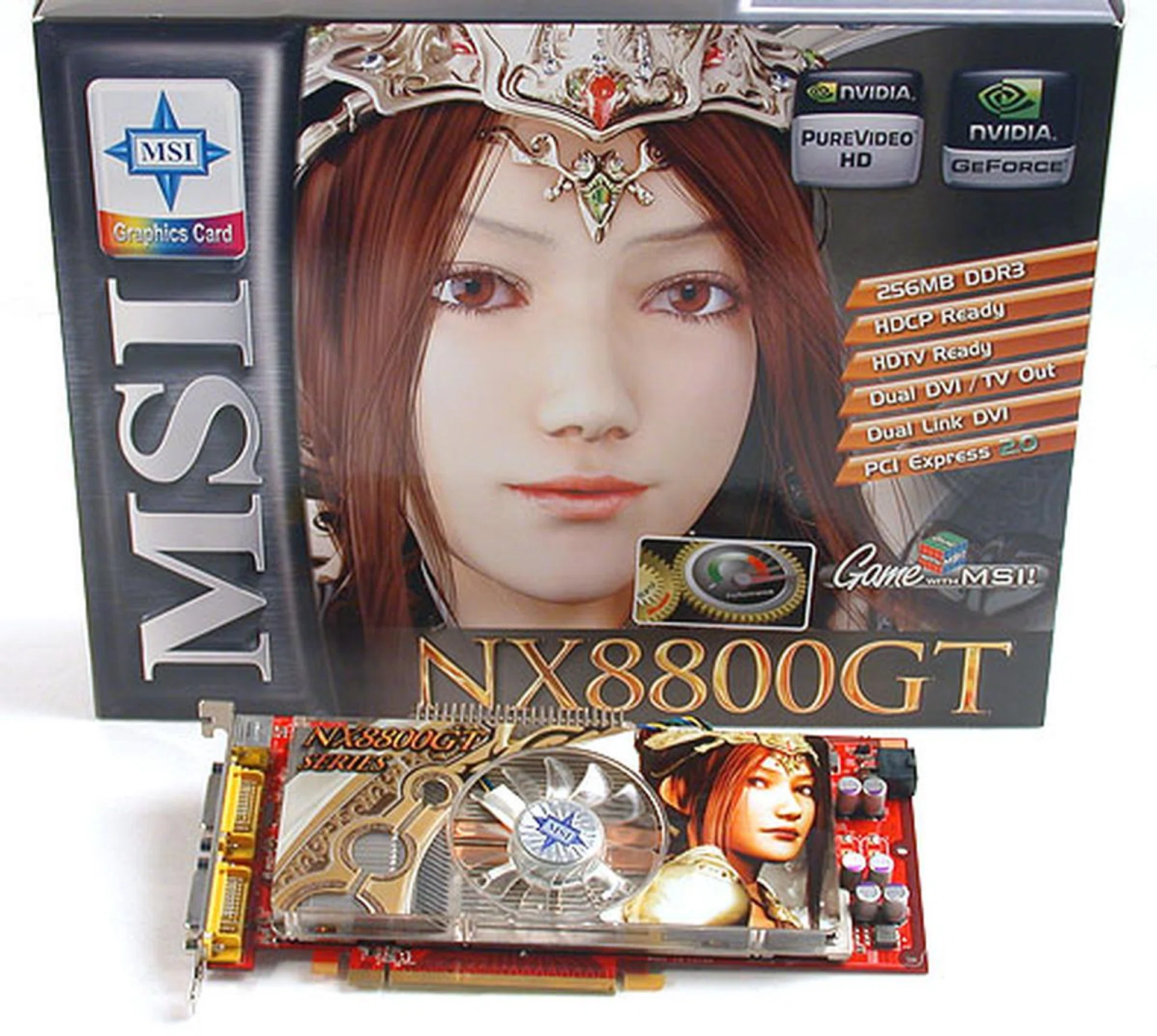
A familiar MSI package, the only difference being the amount of memory on this GeForce 8800 GT.
The MSI NX8800GT-T2D256E-OC
While the standard 256MB and 512MB versions of the GeForce 8800 GT are mostly identical in appearance, MSI's new GeForce 8800 GT 256MB is easily distinguished from the reference model, thanks to a different heatsink fan design and the red PCB. Thankfully, it remains a single slot graphics card and all the memory chips are still cooled directly by the heatsink, with thick thermal pads covering the surface of each chip. Although we don't consider the fan on this MSI card noisy, it is however slightly noisier than the reference cooler, at least according to our less than scientific ears. It should not be a problem, as our internal system fans easily drowned out the noise of the card anyway and we believe that should be the case for most users.
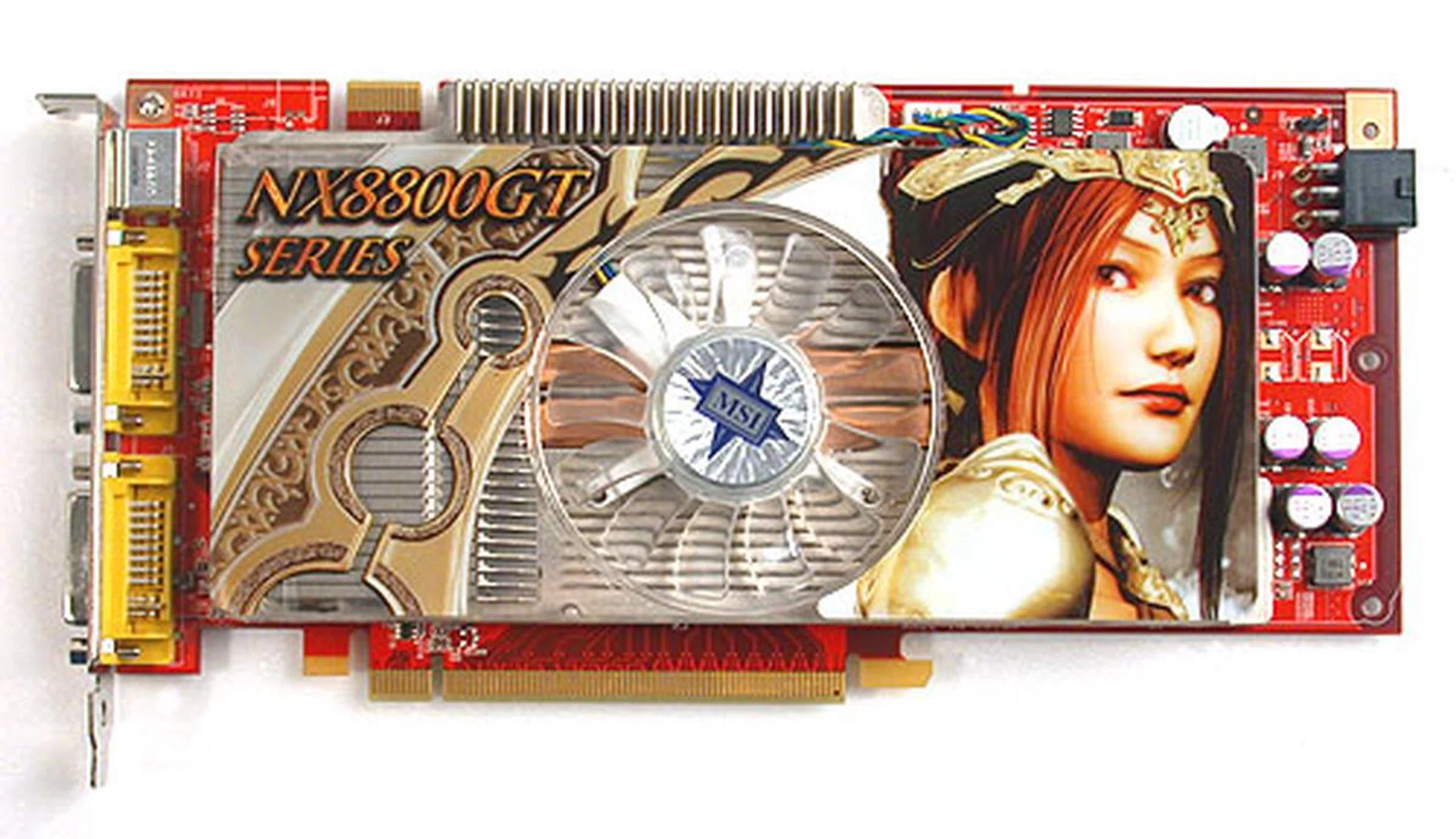
It's a different cooler from the reference version but thankfully still single slot.
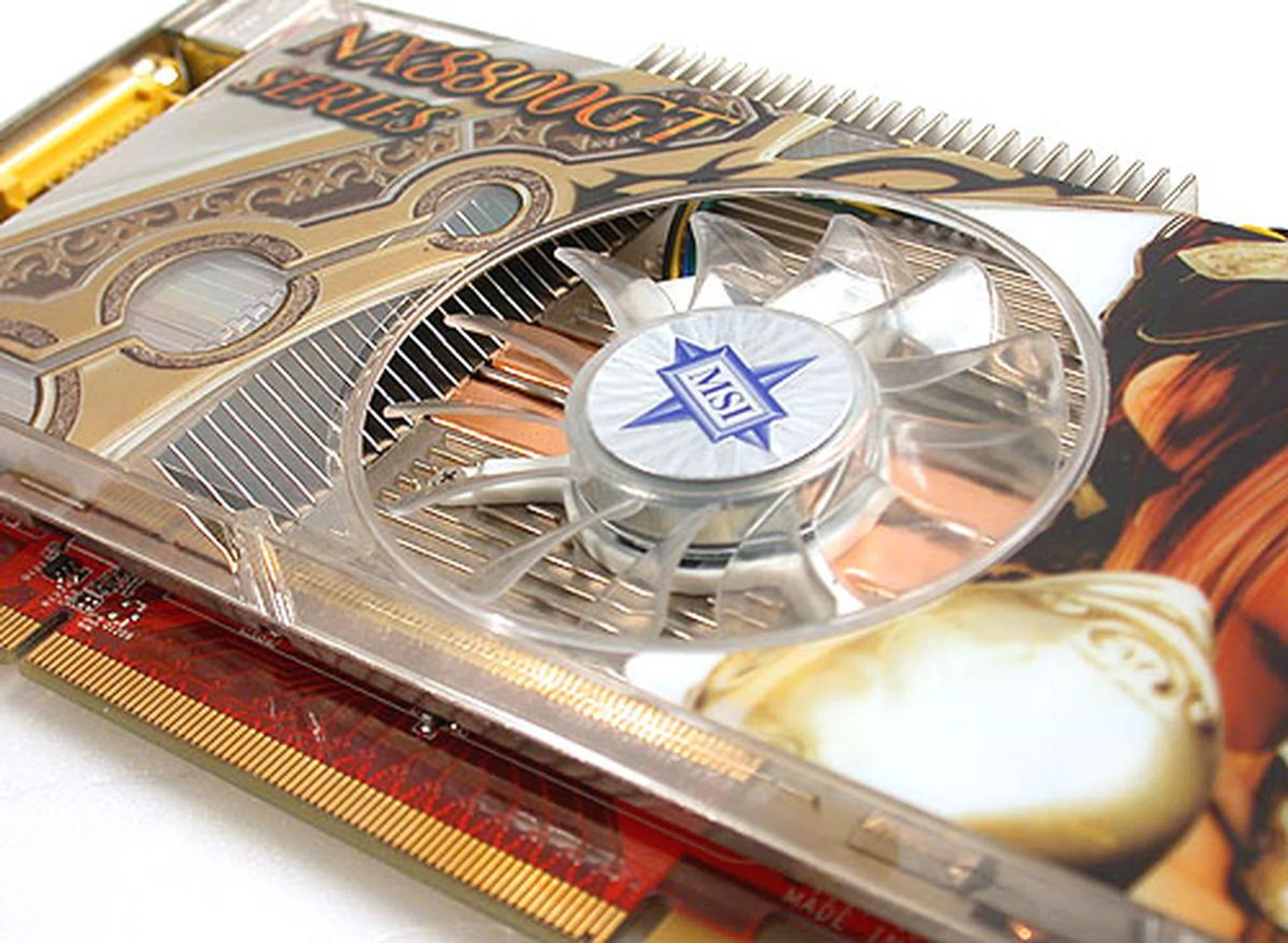
There's actually a couple of heat pipes running inside the cooler to distribute heat to the two stacks of fins on either side of the fan.
On to its overclocked specifications, you should know that this MSI GeForce 8800 GT has a core clock speed of 660MHz, 60MHz more than the default. Its memory clock is also increased to 1900MHz. That is quite a significant amount compared to the official 1400MHz DDR stated for this SKU. Since the other 256MB GeForce 8800 GT that we had seen, the Leadtek WinFast PX8800 GT TDH 256MB also features non-standard memory clocks, it does appear that NVIDIA's specifications are quite conservative (or perhaps in a bid to distinguish between the 256 and 512MB variants) and the retail versions are probably going to be much higher. The stream processors on this card have also received a boost to 1650MHz from the normal 1500MHz, so we are expecting a performance increase to match its overclocking.
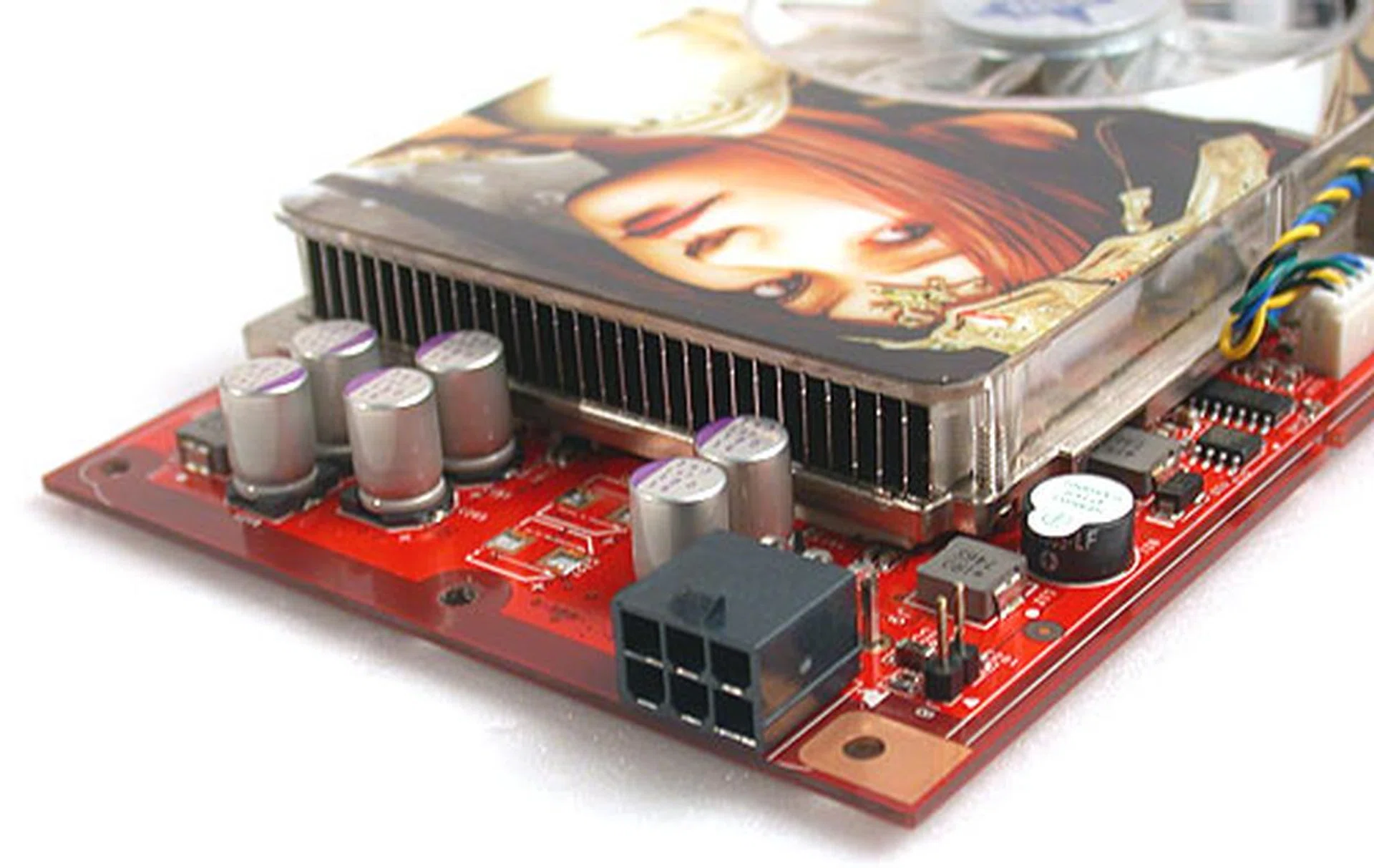
Without the shroud that's found on the usual GeForce 8800 GT, the power connector and the solid capacitors are clearly seen.
Unfortunately, there is nothing much to write home about when it came to the bundled accessories. No doubt, the GeForce 8800 GT 256MB is classified as high-end despite its performance, some vendors may be reluctant to throw in the 'freebies'. For this MSI card, there are only the proprietary MSI applications (e.g. MSI Vivid, StarOSD) and the ForceWare drivers. The other accessories are also the usual ones that you can find on all GeForce 8800 GT bundles and are listed below:
- 1 x DVI-to-VGA adaptor
- 6-pin Molex power connector
- 7-pin mini-DIN to Component/S-Video cable
- S-Video extension cable
- Quick installation guide
- Driver CD (MSI Beyond Multimedia)
Test Setup
An Intel reference D975XBX motherboard together with an Intel Core 2 Duo E6700 (2.66GHz) processor formed the backbone for our test system. Equipped with 2 x 1GB of low latency DDR2-800 HyperX memory from Kingston and a Seagate 7200.7 SATA hard drive, this system had Windows XP Professional installed and updated with Service Pack 2 and DirectX 9.0c.
Since we already had the benchmarks results from our recent review of the Leadtek GeForce 8800 GT, we used the same results, adding the overclocked MSI NX8800GT-T2D256E-OC to the mix. Hence, we have the 512MB GeForce 8800 GT and also the two members of ATI's Radeon HD 3800 series. All the NVIDIA cards were on ForceWare 169.02 while the ATI cards were on Catalyst 7.11 with version 8.43 drivers. The following benchmarks were tested using their built-in time demo or benchmarking tools:
- Futuremark 3DMark06 (ver 102)
- Company of Heroes (ver 1.3)
- F.E.A.R (ver 1.0)
- Supreme Commander (patched to 3255)
- Crysis
- Unreal Tournament 3 Beta Demo
Results - 3DMark06 (ver 1.2)
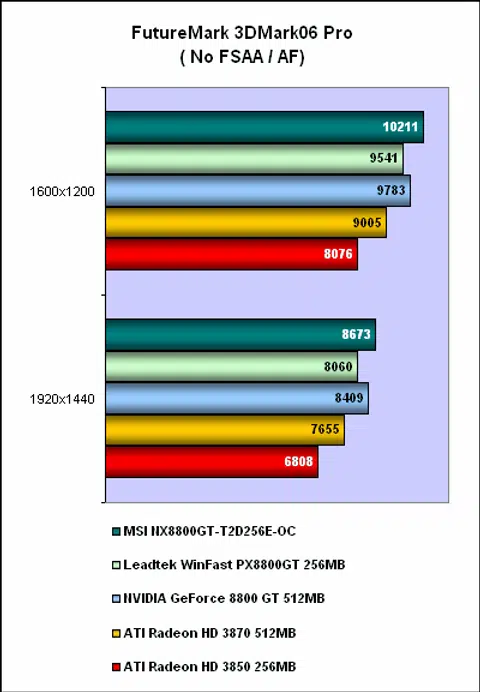
While the Leadtek was slightly behind the 512MB GeForce 8800 GT in 3DMark06, the opposite was true for the MSI, with its higher clock speeds earning it a narrow 3 to 4% lead. However, this was only before anti-aliasing was enabled. Once that came into play, the GeForce 8800 GT 512MB rightfully surged into top position and at 1920 x 1440, it had a very massive lead.

Results - Company of Heroes & F.E.A.R
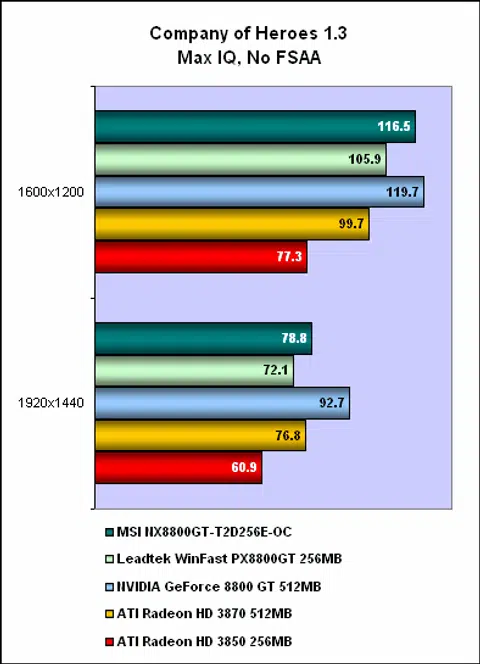
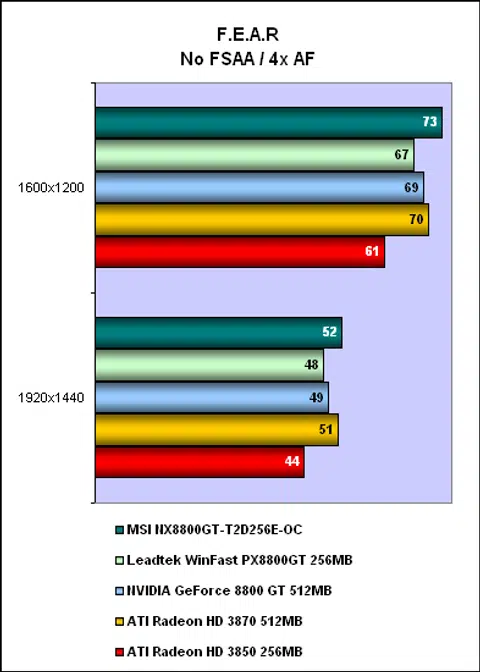
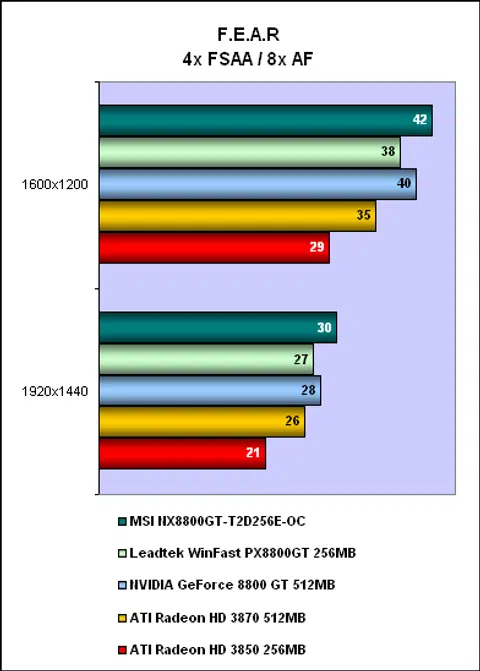
As expected, the MSI NX8800GT-T2D256E-OC performed better than the Leadtek in Company of Heroes by up to 10% but fell short of eclipsing the 512MB version. Again, higher resolutions show how important memory size has become nowadays, with large, widescreen displays and the newer breed of games. This trend obviously doesn't apply to all games and looking at the results for F.E.A.R for instance, the superior clock speeds on the MSI was enough for it to pip the others to the top spot. Even the 512MB version was unable to keep up with the 60MHz clock advantage of the MSI.
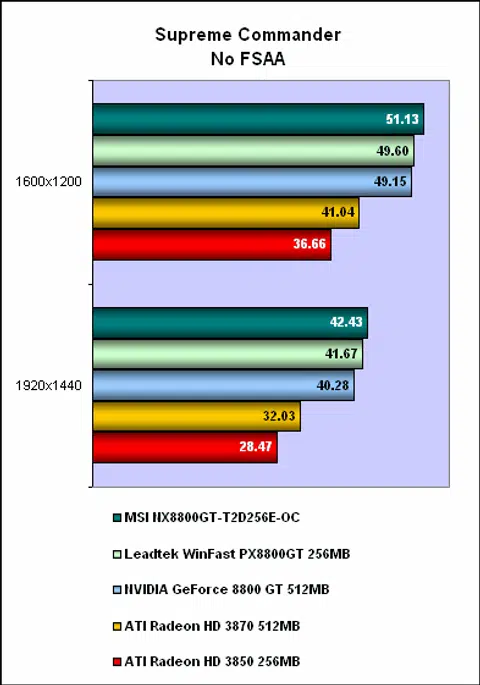
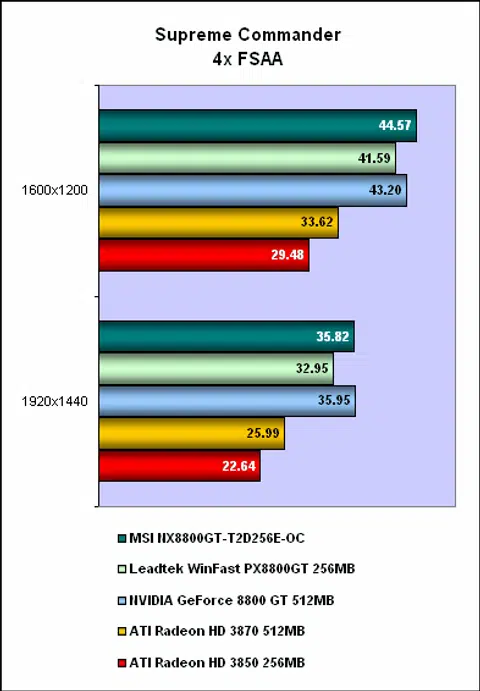
Results - Supreme Commander
Without anti-aliasing, the performance of the MSI card mirrored the earlier scores, with the card edging ahead of the Leadtek and even the reference 512MB version. However, even with anti-aliasing, the MSI managed to stay competitive here in Supreme Commander. Together with the results from F.E.A.R, these are examples of two games which are less affected by memory size and hence games where the MSI NX8800GT-T2D256E-OC can shine.
Results - Crysis & Unreal Tournament Demo
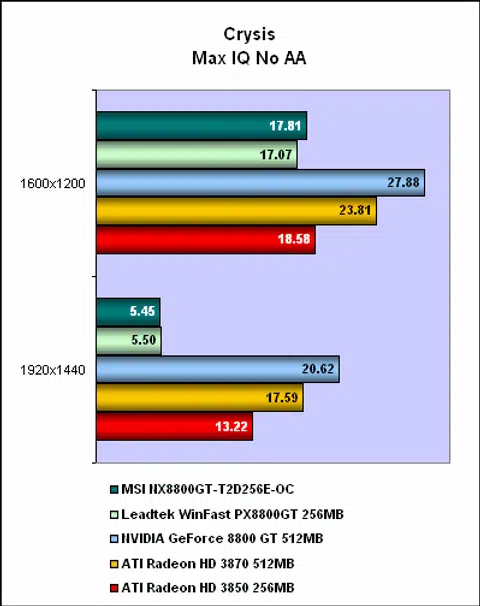
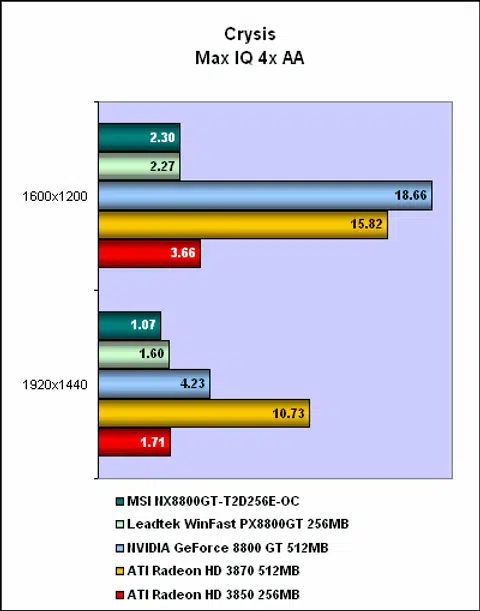
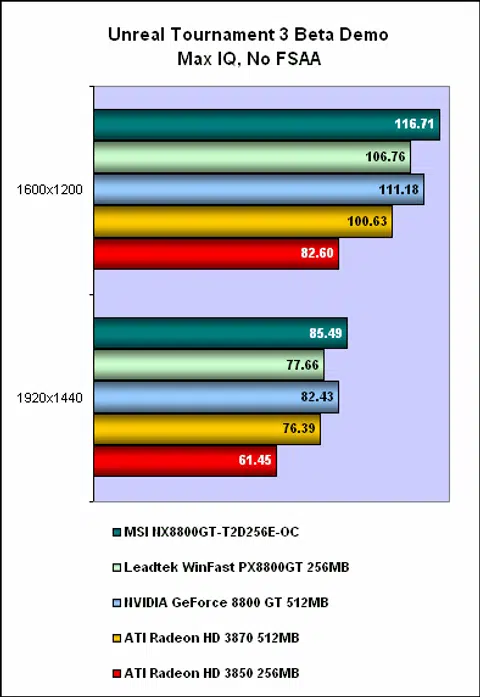
From what we have seen of Crysis so far, it is a real killer with all the settings turned to its maximum and with only 256MB of memory, the MSI was struggling right from the first benchmarking run. In the end, both the MSI and Leadtek turned in similarly low scores and the 512MB variant really showed who's the big brother here. Our results from Unreal Tournament 3 demo was another story however, partly because there was no anti-aliasing and also because this game scaled much better than Crysis even at maximum setting.
Temperature Testing
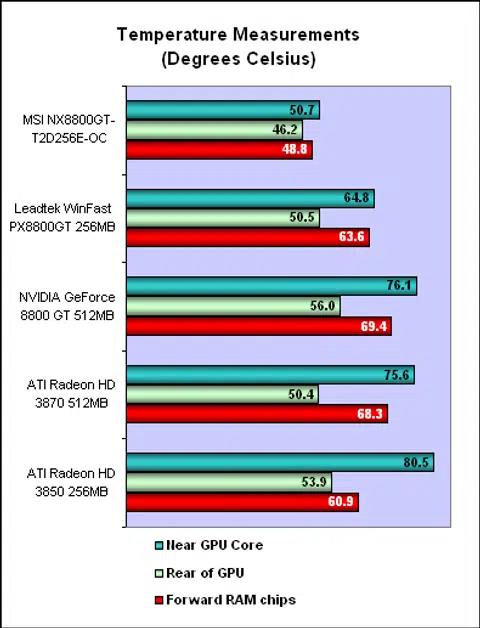
Using a different cooler turned out to be the right approach for MSI as despite having higher clock speeds than the Leadtek, the MSI had much lower temperatures than the Leadtek. The fan on the MSI did seem a bit louder than the reference but given these temperatures, who are we to argue against it?
Overclocking
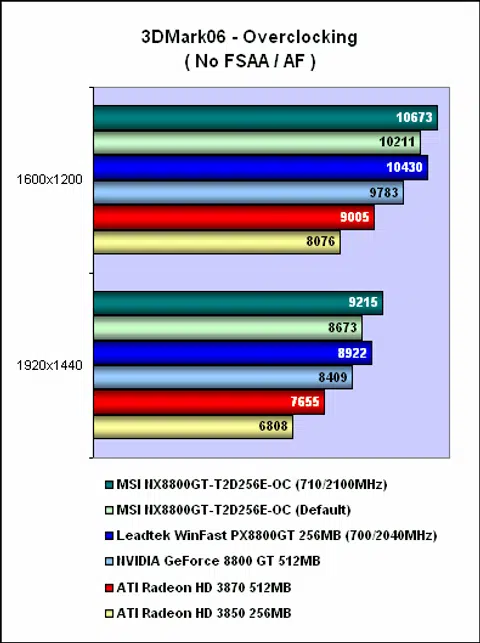
The temperatures on the MSI may be relatively low but it didn't seem to have much impact on the overclocking on this card. Our final clock speeds were quite typical of the GeForce 8800 GT cards we have seen, both 256MB or 512MB versions. While it did slightly better than the Leadtek here again, it was not a large lead and like all overclocking endeavors, your mileage may vary.
Conclusion
A check with retailers both of the brick and mortar variety and their online counterparts showed that 256MB versions of the GeForce 8800 GT have not exactly dominated retail shelves or online catalogs. This is not surprising as the trend pushed by both hardware and software developers have been towards large widescreen display supported by more powerful computing hardware and amply demonstrated by the eye candy effects found in the latest games. Confronted by such photo realistic demos, enthusiasts naturally go for the hardware capable of reproducing such visuals and while the GeForce 8800 GT is a very capable chipset, the 256MB version is however constrained by its memory. This limitation becomes more glaring when we consider display sizes beyond the current 22-inch sweet spot, which is incidentally inching to become the next standard for new buyers with more dough. Up to 22 inches, native monitor resolutions don't go beyond 1680x1050, which the 256MB GeForce 8800 GT seems to tackle reasonably. At the next resolution stepping of 1920x1200, that's when 256MB cards start to falter.
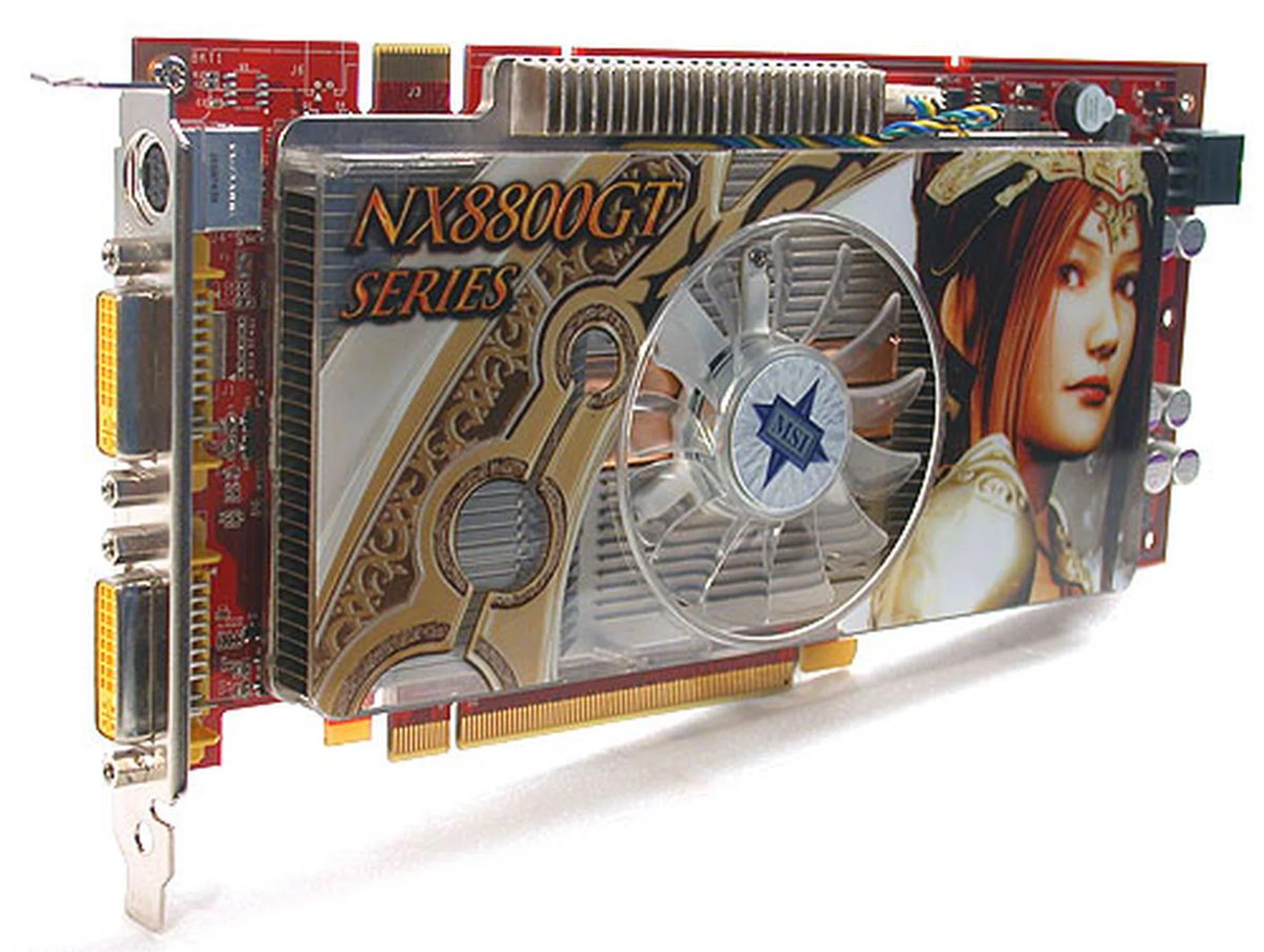
This overclocked MSI GeForce 8800 GT has clock speeds that are more commonly found on the 512MB variant but the discrepancy in memory size severely handicaps it at the high resolutions we tested.
MSI has tried to put a positive spin on the product by overclocking it to quite an extent and essentially putting it on par with some of the overclocked 512MB cards in terms of clock speeds. To sweeten the deal further, there's also a decent cooler that managed to lower the temperatures found on the typical GeForce 8800 GT. What they can't do of course is to give it more memory and with only 256MB, the card naturally faltered at higher resolutions. Anti-aliasing will generally have an adverse effect on performance, though differences are not as significant for older games.
In short, the failings that we are complaining about are related to the chipset itself and not specific to this MSI NX8800GT-T2D256E-OC. The noise of the cooler may be a bit louder to our ears for the MSI and the bundle's disappointing lack of any third party games or applications but that's about the extent of its flaws. Unfortunately, with competition from its 512MB counterpart, price becomes a very crucial factor when it came to deciding which version to get. In fact, some vendors have also voiced to us the exact same issue - that the 512MB variants have dropped in price such that the 256MB models aren't really as competitive as it was first announced. Unless you're really strapped for cash, we highly recommend the 512MB for its longevity.
Alternatively, there are also ATI's Radeon HD 3870 graphics cards that can deliver more stable high resolution performance, albeit slower than this MSI card in less taxing game scenarios. If however you're certain you won't ever need HD resolutions, then by all means get a 256MB card. Given its retail price of S$349, the MSI NX8800GT-T2D256E-OC skates dangerously close to the average S$400 price tag for a 512MB, making it a niche product that will appeal to users unconcerned with heavy anti-aliasing or content with a 22-inch display or less for the near future.
Our articles may contain affiliate links. If you buy through these links, we may earn a small commission.