
Intel's Hexa Strike - Core i7-980X Extreme Edition
Quad-cores are passe nowadays; the next frontier is six and even eight cores. First to start the ball rolling is Intel's newest Core i7, the 980X Extreme Edition, which comes with six cores in a LGA1366 package based on the 32nm Westmere architecture. Check out whether you really need that many cores.

Intel's Hexa Strike
The bar has been raised. With the launch of a single processor, Intel heralds the age of six-core processors on the desktop scene. The new Core i7-980X Extreme Edition, Intel's first six-core processor ships today, with a hefty price tag of US$999. That's equal to the recommended retail price of Intel's former heavyweight, the quad-core Core i7-975 Extreme Edition.
The Core i7-980X is based on the Nehalem microarchitecture. Following Intel's Tick-Tock product cadence cycle, which mandates a process technology refresh after a new CPU microarchitecture, the 980X represents the 'tick' and is the 32nm die shrink of the Nehalem, known as Westmere. This process technology switch has already debuted with the mainstream, dual-core 32nm Clarkdale processors, which introduced numerous desktop and mobile processors.
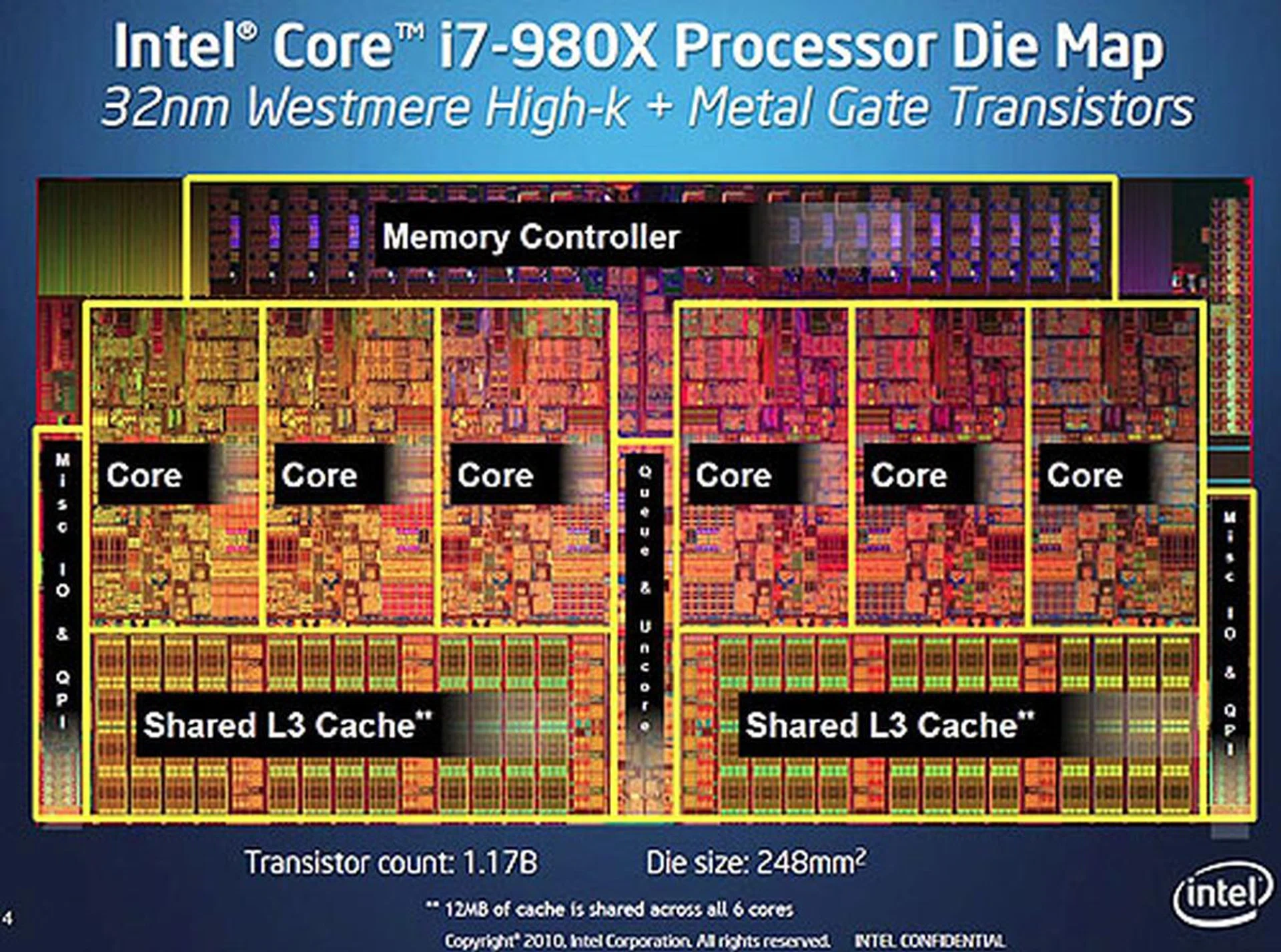
Here's how the six processor cores on the 980X is laid out. A 12MB cache is shared among all the cores.
Unlike the Clarkdale and Lynnfield processors that required a different LGA1156 socket, the Core i7-980X uses the same LGA1366 socket found on the first Core i7 processors and the supporting X58 chipset. That means those who have bought early into the Core i7 platform can now easily upgrade to this six-core processor; it helps that the Core i7-980X has the same 130W TDP. All X58 motherboards should support the new chip, though they will require a BIOS update. Note that you'll have to flash the BIOS while running with your older, existing Core i7 processor first before swapping to the Core i7-980X.
As the table below illustrates, take a Bloomfield Core i7, shrink it down to 32nm and increment the core count by two, including a corresponding increase in the amount of shared L3 cache and you'll get something like the Core i7-980X. In fact, they both have the same default clock speeds and unlocked multipliers that should appeal to the extreme crowd.
Processor Model
| Clock Speed | Cores/Threads | L3 Cache | QuickPath Interconnect | Max TDP (W) | Retail Price (US$) | Availability |
Core i7-980XExtreme Edition | 3.33GHz | 6/12 | 12MB | 6.4QT/s | 130 | $999 (1k Units) | Now |
Core i7-975 Extreme Edition | 3.33GHz | 4/8 | 8MB | 6.4QT/s | 130 | ~$969 | Now |
Naturally, the newcomer gets a new codename, Gulftown, to add to the many different names in use for Intel's processors.
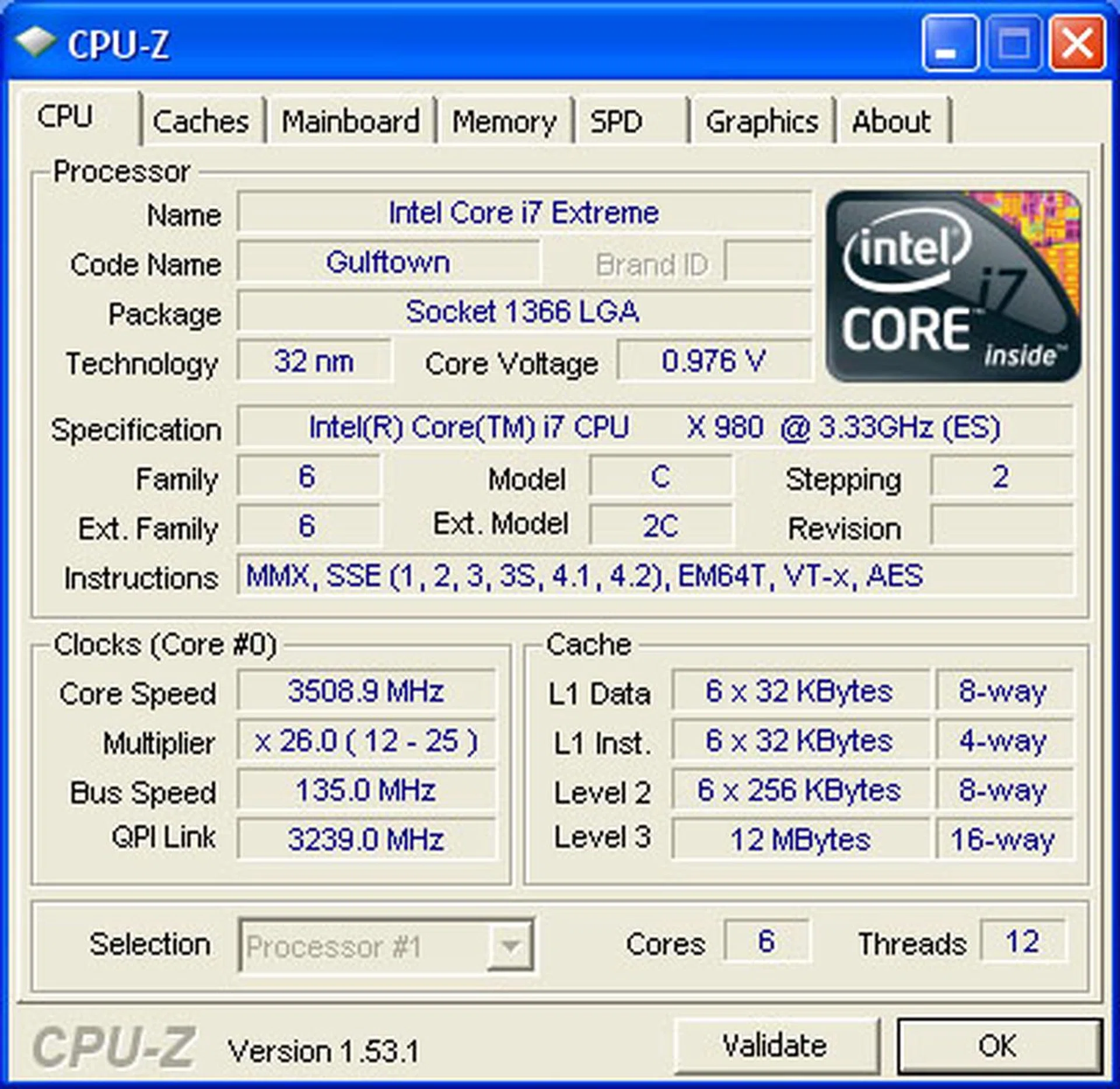
While idle in Windows, the Core i7-980X runs at almost 3.5GHz (133 x 26). Turbo Boost has already kicked in, as the default non-turbo speed is (133 x 25) or 3.3GHz.
While there are many similarities between the two performance heavyweights, the Core i7-980X gets the benefit of being the newer processor. Intel has since added several new instructions to improve AES encryption performance, notably on the Clarkdale processors, and the 980X will have these AES-NI instructions.
Other key features of the Nehalem architecture, like HyperThreading (12 threads!) and Turbo Boost are found on the Core i7-980X. However, unlike the sometimes impressive speed bumps we have seen on Intel's dual-core Clarkdale processors, the Turbo Boost on the Core i7-980X is more reserved due to its already-high TDP. On single-threaded applications, one is likely to find an increase of two speed bins (266MHz) while on multi-threaded applications, it will just be a slight 133MHz increase.
Along with the Core i7-980X processor, Intel has included one of the largest 'stock' coolers we have seen in the retail package. The new Intel DBX-B thermal solution even comes with a switch to toggle between two fan speeds. From our experience, even in its 'Performance' mode, it was not overly loud or intrusive and Intel rates it at less than 35 decibels at its max 1800RPM.
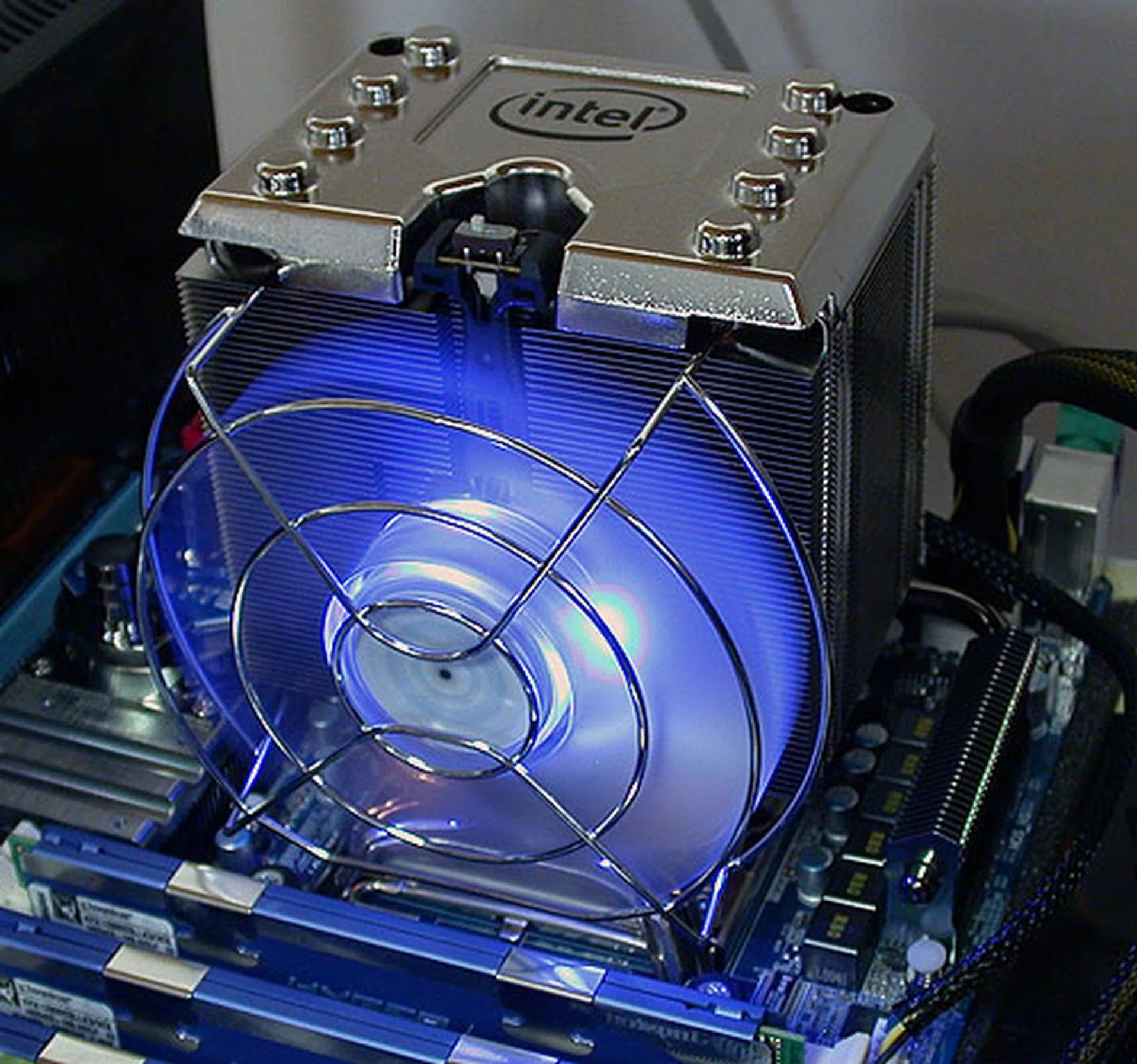
We haven't seen such a large stock cooler from any CPU vendor for like, forever.
So what does one do with a six-core processor? Well, in our case, we put it to the test and benchmark it to death (okay we exaggerated there, but you get the idea). Intel meanwhile trots out a list of existing and upcoming applications that will require the extra processing power. The examples include rendering or video encoding applications like MAXON CINEMA 4D and Sony Vegas Pro 9.0, with some current and future games thrown into the mix, like Napoleon: Total War and Trinigy's Vision game engine. In our case, we put it to test using our tried and tested set of application to figure out how it fares. We might take our testing further with more optimized applications in a separate article in the near future, but we believe our findings for now should generally be an adequate gauge.
Test Setup
There's no six-core equivalent to stack the Core i7-980X against, so we turn to Intel's previous champion, the Core i7-975 Extreme Edition. This unlocked quad-core runs at the same 3.33GHz clock speed as the Core i7-980X at default (discounting Turbo Boost) and we tested both on an identical X58 platform built around a Gigabyte X58 Extreme motherboard (except for a difference in BIOS versions). The main differences between the two are in the number of cores and the 45nm manufacturing process of the older Core i7-975 XE.
Even more illogically, Intel's recommended retail prices for these two chips are identical at US$999 (for 1k units), though we have seen the Core i7-975 XE in retail at US$969, perhaps in anticipation. Both are processors rated at 130W TDP.
Besides these two expensive processors, we have added in the more affordable models that consumers are likely to buy, like the entry triple-channel Core i7-920 and the newer, Clarkdale-based Core i7-870, which operates on a dual-channel memory architecture and uses an LGA1156 socket. Finally, we threw in AMD's Phenom II X4 965 as a reference on where the competition stands. Of course, they are on paper, world's apart, with this quad-core Phenom II costing a fifth of the Core i7-980X.
Intel Core i7 Test Configuration
- Gigabyte X58 Extreme (Intel X58 Express chipset) (F7 BIOS for Core i7-975 XE and F11 BIOS for Core i7-980X)
- 3 x 1GB Kingston HyperX DDR3-1333 (CAS 7-7-7-20)
- Zotac GeForce GTX 260 (ForceWare 178.24)
- Seagate 7200.10 200GB SATA hard drive (one single NTFS partition)
- Windows XP Professional with Service Pack 2
- Intel INF 9.1.0.1007 and Matrix Storage Manager 8.6.0.1007
Intel Core i5/i7 (Lynnfield) Test Configuration
- Intel DP55KG (Intel P55 Express chipset)
- 2 x 1GB Kingston HyperX DDR3-1333 (CAS 7-7-7-20)
- Zotac GeForce GTX 260 (ForceWare 178.24)
- Seagate 7200.10 200GB SATA hard drive (one single NTFS partition)
- Windows XP Professional with Service Pack 2
- Intel INF 9.1.1.1015 and Matrix Storage Manager 8.9.0.1023
AMD Phenom II X4 Test Configuration
- MSI 790FX-GD70 (AMD 790FX + SB750)
- 2 x 1GB Kingston HyperX DDR3-1333 (7-7-7-20)
- Seagate Barracuda 7200.10 200GB SATA hard drive (one single NTFS partition)
- Zotac GeForce GTX 260 (ForceWare 178.24)
- Microsoft Windows XP Professional with Service Pack 2
Benchmarks
The following benchmarks were used in this review:
- SPECCPU 2000 v1.3
- BAPCo SYSmark 2007 Preview (ver 1.05)
- Futuremark PCMark 2005 Pro
- Lightwave 3D 7.5
- 3ds Max 8 (SP2)
- Cinebench 10
- XMpeg 5.03 (DivX 6.8 encoding)
- Futuremark 3DMark06 v1.1
- AquaMark3
- World in Conflict v1.05
- Crysis v1.1
Results - SPECCPU 2000 v1.3
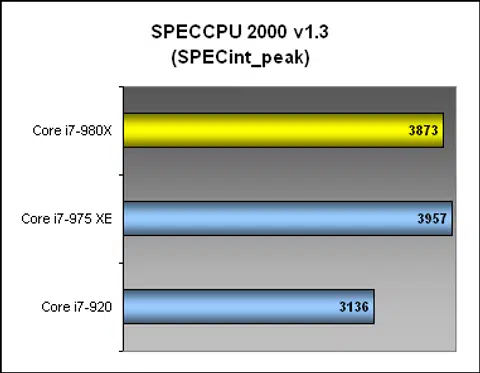
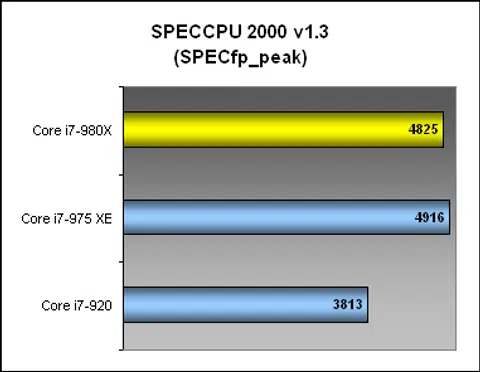
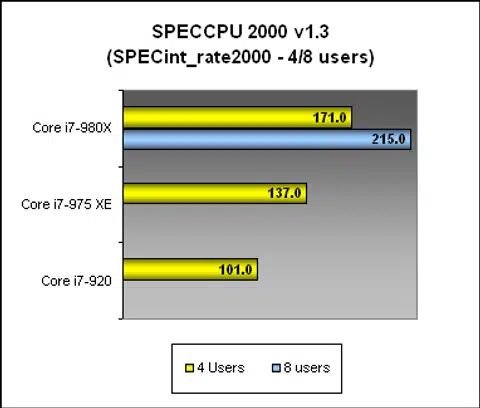
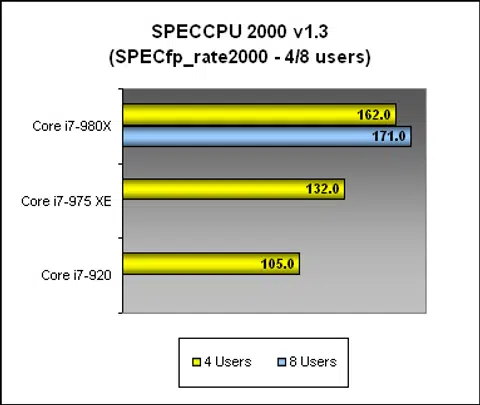
In SPECCPU 2000, the Core i7-980X surprisingly lost on the peak scores for both floating point and integer to the i7-975 XE. It's a very slight margin of around 2% that could be attributed to normal variance or worse, that HyperThreading with that many threads could end up hindering its performance, which is not unheard of. The multi-user rate tests were looking good, highlighting the potential of six cores.
Results - SYSmark 2007 Preview
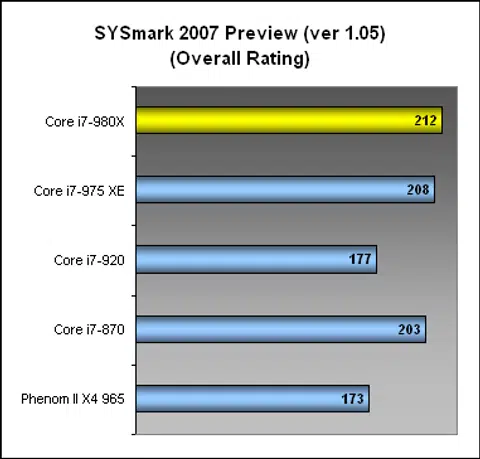
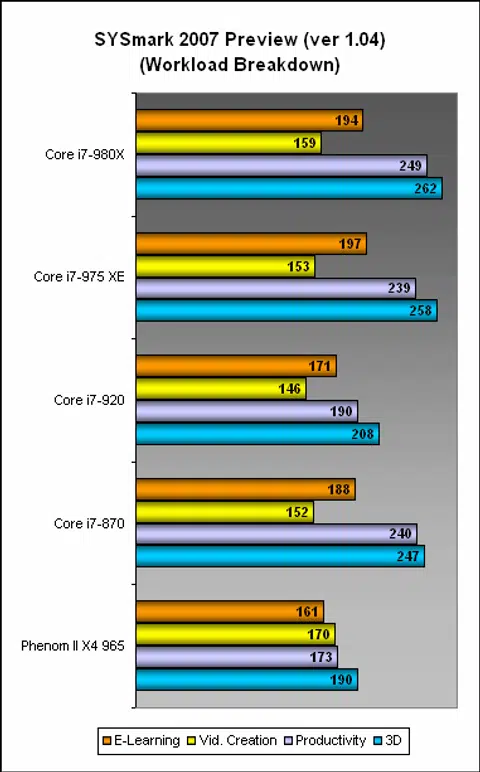
With the mix of applications in SYSmark, including video and 3D applications, we expected the Core i7-980X to post a higher score over the Core i7-975. However, we were surprised at the breakdown, which showed that besides video and 3D, the productivity segment also benefited from the increase in cores. Overall it's not a very big improvement, but it's still something positive given a more average workload mix.
Results - Futuremark PCMark05 Pro
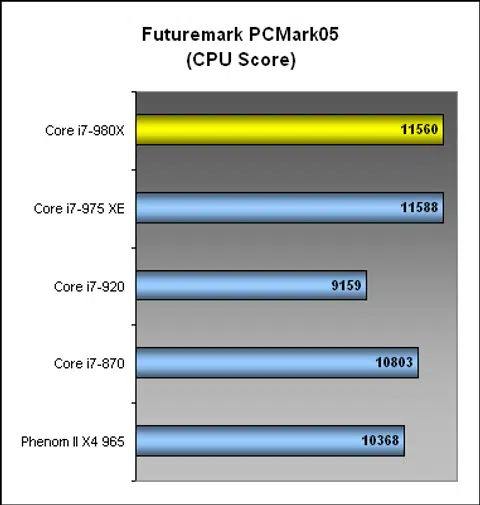
Both the CPU and memory segment in PCMark05 showed little difference between the six-core 980X and the quad-core 975 XE.

Results - Lightwave 3D 7.5
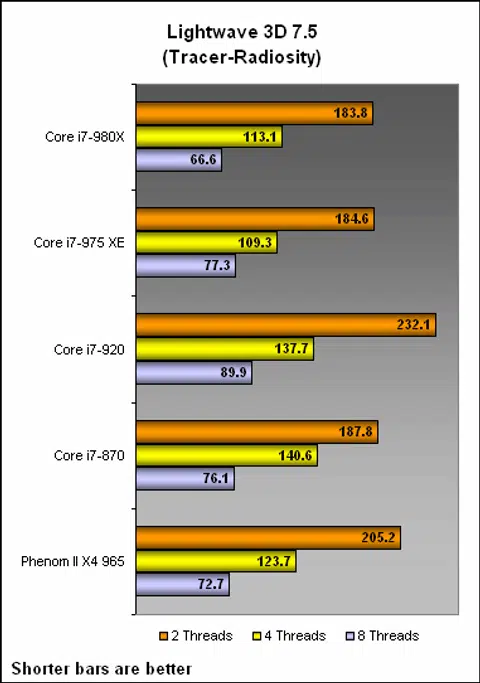
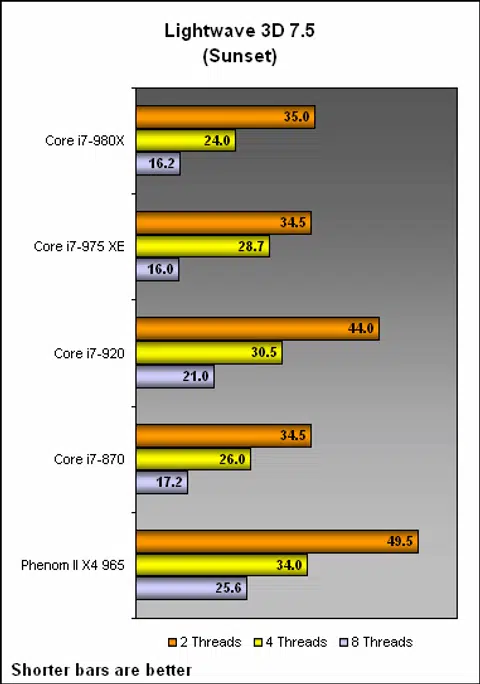
Despite its extra cores, the Core i7-980X was quite ordinary in this rendering application. This however has to do with the number of threads specified in this benchmark, which did not allow the six-core processor free rein. Even when we toggled eight threads, the Core i7-975 and i7-980X processors performed very similar.
Results - 3ds Max 8 (SP2)
Applications like 3ds Max are what drives the adoption of multiple cores and the Core i7-980X proved the point by showing a decent improvement over the already top-class performance of the Core i7-975.
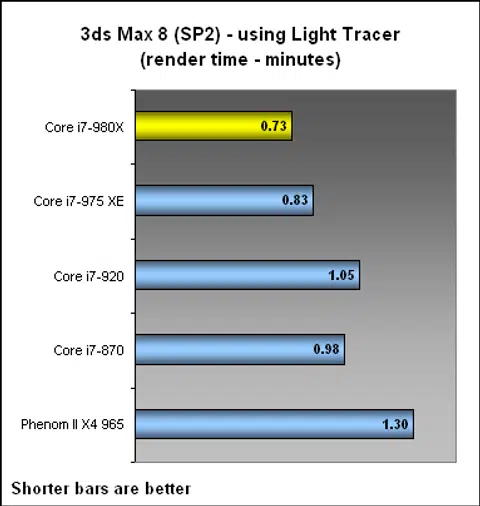
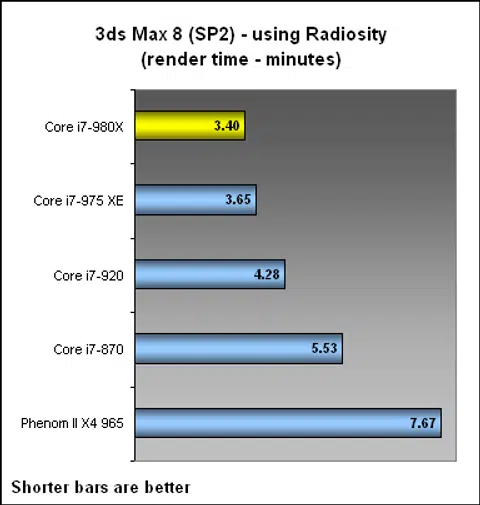
Results - Cinebench 10 and XMpeg 5.0.3 (DivX 6.8 encoding)
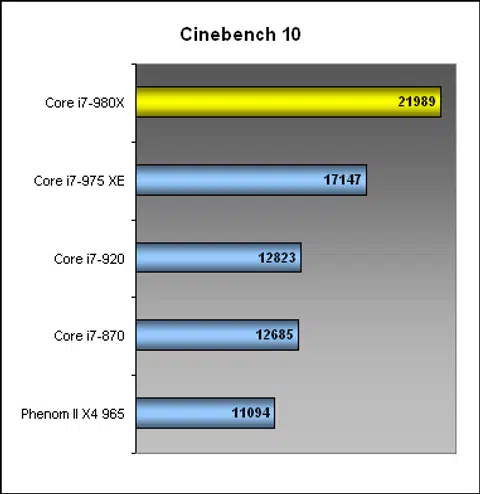
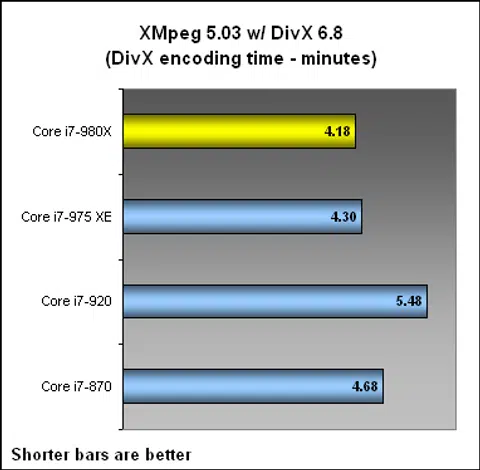
Cinebench saw a remarkable boost in performance with the six-core, with more than 20% improvement. This is more in line with the increase in cores and will surely be one of the six-core processors' poster child applications. XMpeg too saw the 980X leading the pack, but by a slight margin over the Core i7-975 Extreme Edition.
Results - Futuremark 3DMark06 & AquaMark3
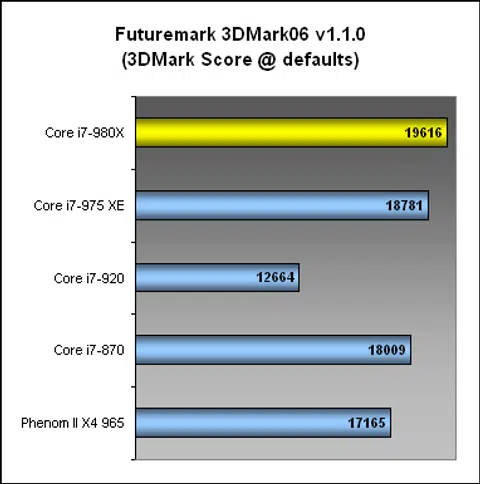
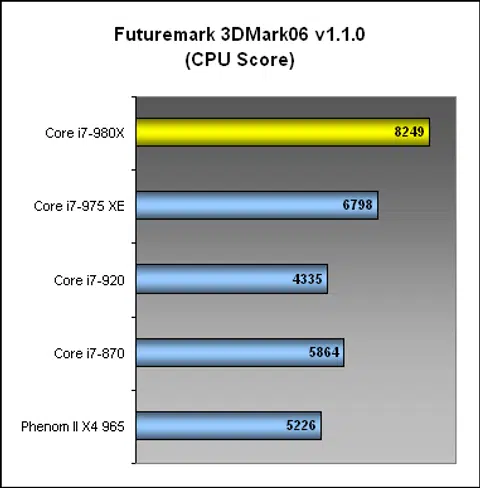
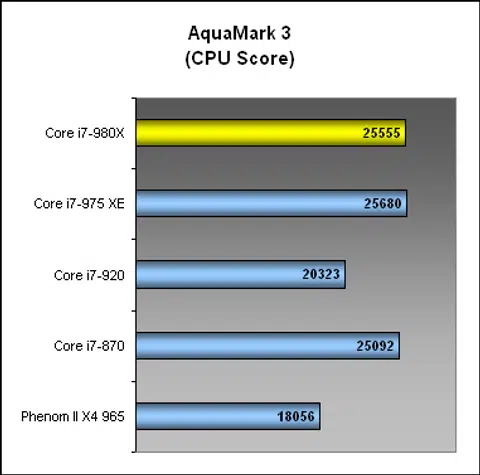
The synthetic 3DMark06 saw the Core i7-980X posting some decent gains over the Core i7-975 XE, especially in the CPU segment. The overall 3DMark score also favored the six-core but by a smaller margin. However, in the singly threaded AquaMark3, there was hardly any differences between the two similarly clocked processors, with the slightest of lead for the Core i7-975 XE.

Results - World in Conflict & Crysis
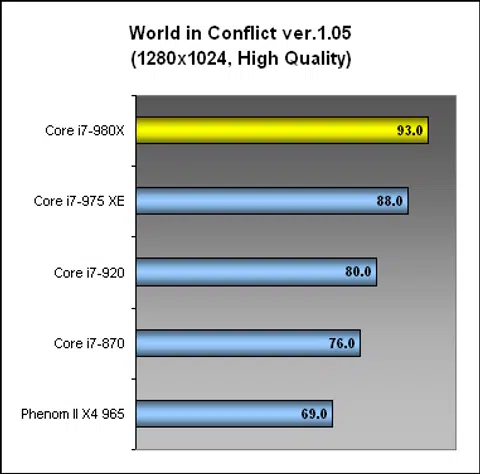
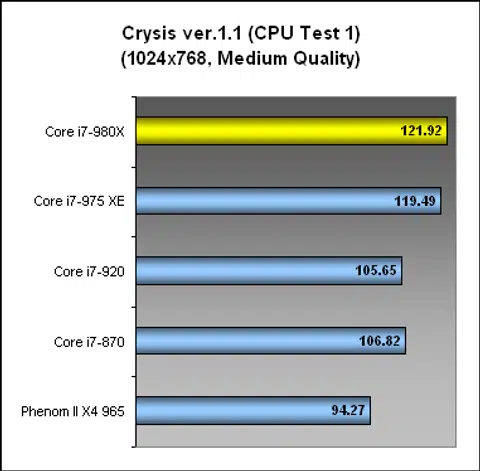
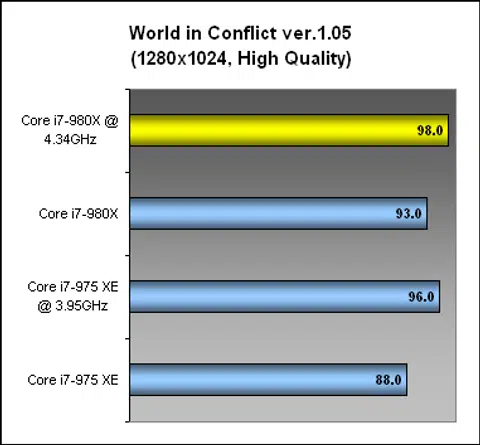
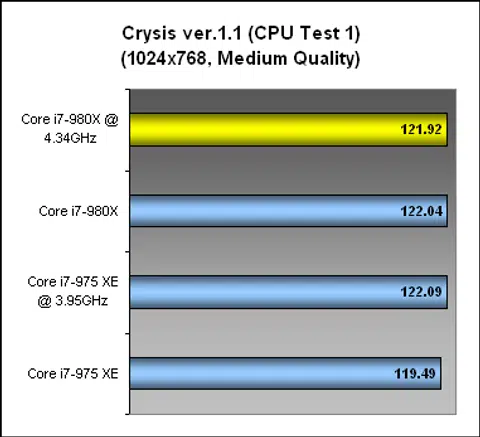
World in Conflict, one of titles quoted by Intel as supporting multiple cores, scaled decently with the extra cores on the 980X. There was less of an increase with Crysis, with the 980X just barely faster than the Core i7-975.
Power Consumption
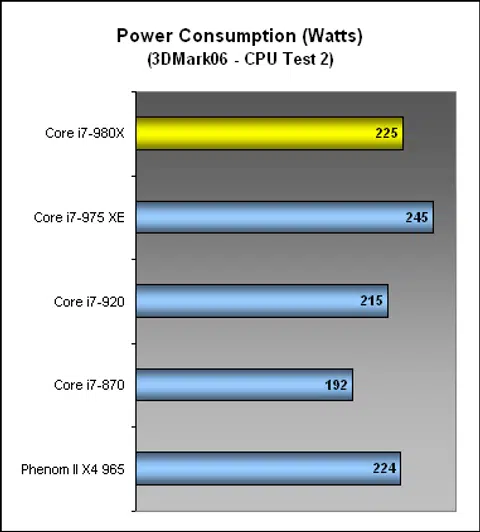
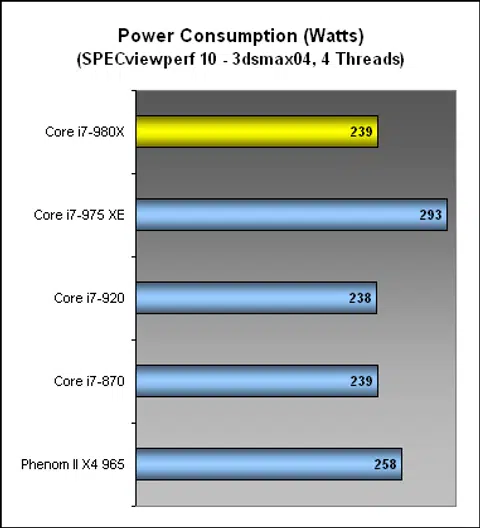
The die shrink made its point in the power consumption figures, with the six-core Core i7-980X impressively modest in power draw despite its number of cores. At idle, it was about level with the Core i7-975 Extreme Edition and when we started loading the applications, the numbers did not jump as much as the 975. At its peak, we found the Core i7-980X to be on par with the slower Core i7 and even the Phenom II X4 965. Considering the price point of the new 980X versus the 975, there's not doubts which you should be selecting for your next ultimate rig.

Overclocking
The 32nm process also appeared to help in overclocking, as we doubt that Intel's new stock cooler, decent as it may, would have made such a big difference compared to our third-party cooler. In any case, the 980X reached almost 4.4GHz stable with air-cooling and in fact, it booted into Windows at more than 4.5GHz, though it failed the subsequent stability test.
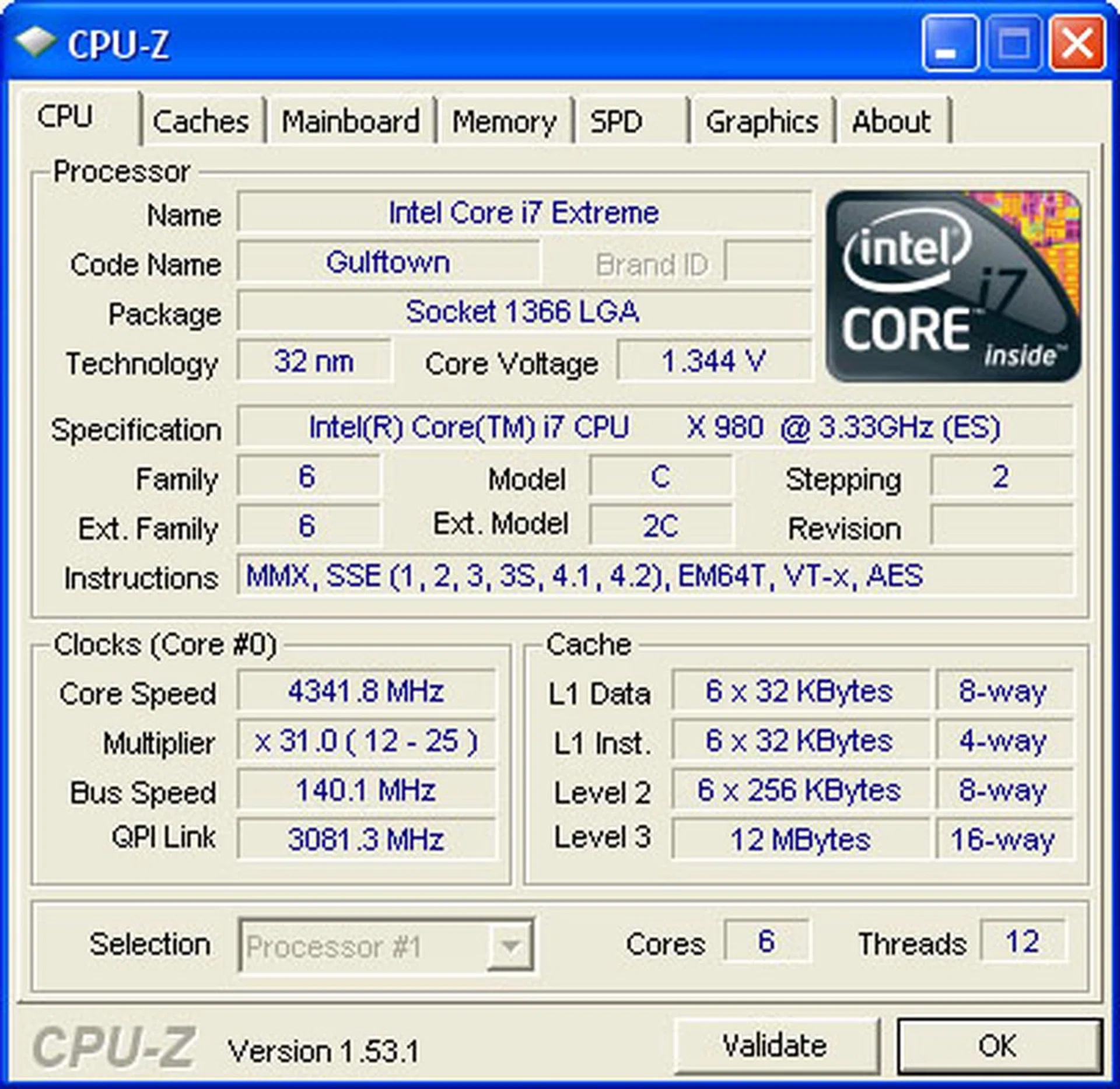
The 32nm process shrink appears to have improved the overclocking capability of this Core i7 processor. This is a new high for us on this platform, easily beating the 3.9GHz we saw on the Core i7-975 Extreme Edition using the stock cooler.
While the higher clocks did not make a difference in Crysis (most likely due to the graphics card now being the bottleneck), we saw a 5% improvement in scores for World in Conflict and up to 15% in 3ds Max 8. For enthusiasts who enjoy the overclocking aspect, this is a big reason to shell out the premium for the Core i7-980X. For more gaming performance impact at such a high CPU speed, we'll explore that separately in a dedicated article with an even more powerful rig. For now, our testing and results are in-line with previous test hardware for proper comparison and backward compatibility purposes.

Conclusion
Intel may be the first to launch a six-core processor on the desktop but rival AMD has had six-cores Opterons since last year and its own consumer six-core variant, Thuban, is rumored to be released next month. That's not all - Intel's 8-core Xeons, Nehalem-EX, is also expected to launch this month. Meant for the server and high performance computing segment, these 45nm processors have a whopping 2.3 billion transistors. And you thought the Core i7-980X had a lot of transistors?
All these developments inevitably brings up the question - what do you do with that many cores? Of course, in the enterprise space where virtualization is practically a norm, that's easy to answer. For the typical consumer however, employing these extra cores could be a rare occasion, unless video encoding and 3D rendering is your usual workload. For despite the introduction of more applications that take advantage of multiple cores, the benefits going from quad-core to 6-core are not that obvious.

If you happen to have a thousand bucks (in US dollars) lying around, the Core i7-980X is the absolute, best desktop processor in the world now. Unless you're waiting for an eight or twelve-core server-grade processor, that is.
Just looking through our benchmarks for the Intel Core i7-980X, the results are mixed. Some benchmarks show remarkable gains, like Cinebench and to a lesser extent 3ds Max. Others like Lightwave surprisingly only show minor gains. On the gaming front, World in Conflict showed that it can utilize the extra cores for a decent performance bump, but older games are unlikely to show gains. What these results mean is that if you're buying a six-core today, you're preparing for the multi-threaded future.
There will be more applications and games that will take advantage of more processor cores, but with the Core i7-980X costing at least US$999, you'll be paying a premium for it. The other reason to get this processor will be its outstanding overclocking potential. As we found out, the die shrink appeared to have improved this aspect dramatically over the Core i7-975 Extreme Edition and we bet that enthusiasts will be setting new records with this six-core.
The relatively low power consumption is another plus point for the Core i7-980X. In fact, besides its premium cost, there are no caveats associated with this processor. If you require the processing power of six cores and can afford this, we say, get on the bandwagon.
Our articles may contain affiliate links. If you buy through these links, we may earn a small commission.