
Intel Core i9-10980XE Extreme Edition review: Just more of the same
It's not that much faster than its predecessor.

Intel's HEDT chips no longer have insane prices
The most interesting thing about the Intel Core i9-10980XE Extreme Edition may just be its price. This is both a good and bad thing. For starters, this is the most affordable Intel's high-end desktop (HEDT) processors have been in years. The Core i9-10980XE is Intel's new 18-core flagship, and it costs just US$979. You're probably thinking that that's still pretty expensive, and it is, but it's also important to remember that the Core i9-9980XE debuted just last year at US$1,979.
That's a massive price drop in just a single year, and it was no doubt prompted by the strong performance of AMD's Ryzen 3000 series processors. AMD's new chips serve up excellent multi-threaded performance and have also made significant leaps in games. They are also very attractively priced – the 12-core Ryzen 9 3900X costs US$499, while the 16-core Ryzen 9 3950X costs US$749.
There was no way Intel could compete with that if it continued to price its HEDT processors in the thousand-dollar range. In response, it's slashed the prices on its Cascade Lake-X processors, which is great news for consumers.
But a new processor also needs more than just an attractive price to do well. The most interesting thing about the Core i9-10980XE is its price, and that's because there just isn't much else to get excited about. Intel isn't introducing a new HEDT chipset this year – the Core i9-10980XE will work on X299 motherboards – and Cascade Lake-X is still based on the 14nm process node.
Furthermore, outside of slightly more aggressive clockspeeds, the Core i9-10980XE doesn't seem to offer any significant upgrades compared to the Core i9-9980XE. Here's an overview of how their specifications compare:
Base/Turbo Boost 2.0 clock | Turbo Boost Max 3.0 clock | Cores/Threads | TDP | Intel Smart Cache | Memory support | |
Intel Core i9-10980XE | 3.0GHz/4.6GHz | 4.8GHz | 18/36 | 165W | 24.75MB | Quad-channel DDR4-2933 |
Intel Core i9-9980XE | 3.0GHz/4.4GHz | 4.5GHz | 18/36 | 165W | 24.75MB | Quad-channel DDR4-2666 |
The processor now also offers 48 PCIe 3.0 lanes, up from 44 from before.
In addition, Turbo Boost 2.0 frequency has gone up slightly from 4.4GHz, while the Turbo Boost Max 3.0 clock has been bumped up to 4.8GHz. The latter should come in useful in single-threaded workloads, as it identifies the processor's fastest core and directs workloads to that core, allowing it to boost higher than usual.
Intel is also highlighting the all-core Turbo speed on Cascade Lake-X. The Core i9-10980XE can boost to 3.8GHz on all 18-cores, and the chipmaker is no doubt singling this specification out because of the trouble AMD has had in getting its chips to boost to their rated specifications. To be clear, the latter problem isn't actually as bad as it sounds, and the Ryzen 3000 chips were initially reported to be falling short of their boost clocks by around 25MHz to 75MHz. This was certainly not ideal, but it wasn't exactly catastrophic either. AMD has also since rolled out BIOS fixes to let the chips boost higher.
To be fair, there are certain 10th Gen features in tow as well, including Wi-Fi 6, Thunderbolt 3, and support for Intel's Deep Learning (DL Boost) instructions for AI. The latter is a subset of AVX-512 and is intended to accelerate CPU performance in AI applications, so it's not exactly something the average consumer would really care about. But then again, this isn't exactly a chip for the so-called average consumer, and AI researchers or developers could see a nice boost in programs that can take advantage of DLBoost.
But as you'll see on the next page, the Core i9-10980XE gets a small performance boost in games, although multi-threaded benchmarks don't budge by much. Read on for a closer look at the performance numbers and whether it's worth an upgrade.
Test setup
The configurations of the test setups we used are listed below. All results were obtained with the Ryzen Balanced power plan and Precision Boost Overdrive disabled. For the Intel processors, multi-core enhancement was turned off on the ASUS motherboards.
Intel Core i9-10980XE/Core i9-9980XE
- Thermaltake Water 3.0 360 Riing RGB Edition with Thermal Grizzly Kryonaut
- ASUS ROG Rampage VI Extreme Encore
- 4 x 8GB G.Skill Ripjaws V DDR4-3000 (Auto timings: CAS 15-15-15-35)
- NVIDIA GeForce RTX 2080 Ti Founders Edition
- Samsung 860 EVO 500GB M.2 SATA SSD
- Windows 10 Home (64-bit)
Ryzen 9 3900X/Ryzen 7 3700X
- Thermaltake Water 3.0 360 Riing RGB Edition with Thermal Grizzly Kryonaut
- ASUS Crosshair VIII Hero (Wi-Fi)
- 2 x 8GB G.Skill Trident Z Royal DDR4-3600 (Auto timings: CAS 16-16-16-36)
- NVIDIA GeForce RTX 2080 Ti Founders Edition
- Samsung 860 EVO 500GB M.2 SATA SSD
- Windows 10 Home (64-bit)
Intel Core i9-9900KS Special Edition
- Thermaltake Water 3.0 360 Riing RGB Edition with Thermal Grizzly Kryonaut
- ASUS ROG Maximus XI Extreme
- 2 x 8GB G.Skill Ripjaws V DDR4-3000 (Auto timings: CAS 15-15-15-35)
- NVIDIA GeForce RTX 2080 Ti Founders Edition
- Samsung 860 EVO 500GB M.2 SATA SSD
- Windows 10 Home (64-bit)
Intel Core i9-9900K
- Thermaltake Water 3.0 360 Riing RGB Edition with Thermal Grizzly Kryonaut
- ASUS ROG Maximus XI Extreme
- 2 x 8GB G.Skill Trident Z Royal DDR4-3600 (Auto timings: CAS 16-16-16-36)
- NVIDIA GeForce RTX 2080 Ti Founders Edition
- Samsung 860 EVO 500GB M.2 SATA SSD
- Windows 10 Home (64-bit)
[hwzcompare]
[products=677384,677385,676564,650200,668796,668798]
[width=200]
[caption=Test CPUs compared]
[showprices=1]
[/hwzcompare]
Here's a list of the benchmarks used:
- PCMark 10
- SPECviewperf 13.0
- Cinebench R15
- Cinebench R20
- Handbrake 1.2.2
- Blender Benchmark
- POV-Ray 3.7
- 3DMark
- Ashes of the Singularity: Escalation
- Deus Ex: Mankind Divided
- Far Cry 5
- Metro Exodus
- Middle-earth: Shadow of War
- Shadow of the Tomb Raider
- Tom Clancy's The Division 2
PCMark 10 Extended
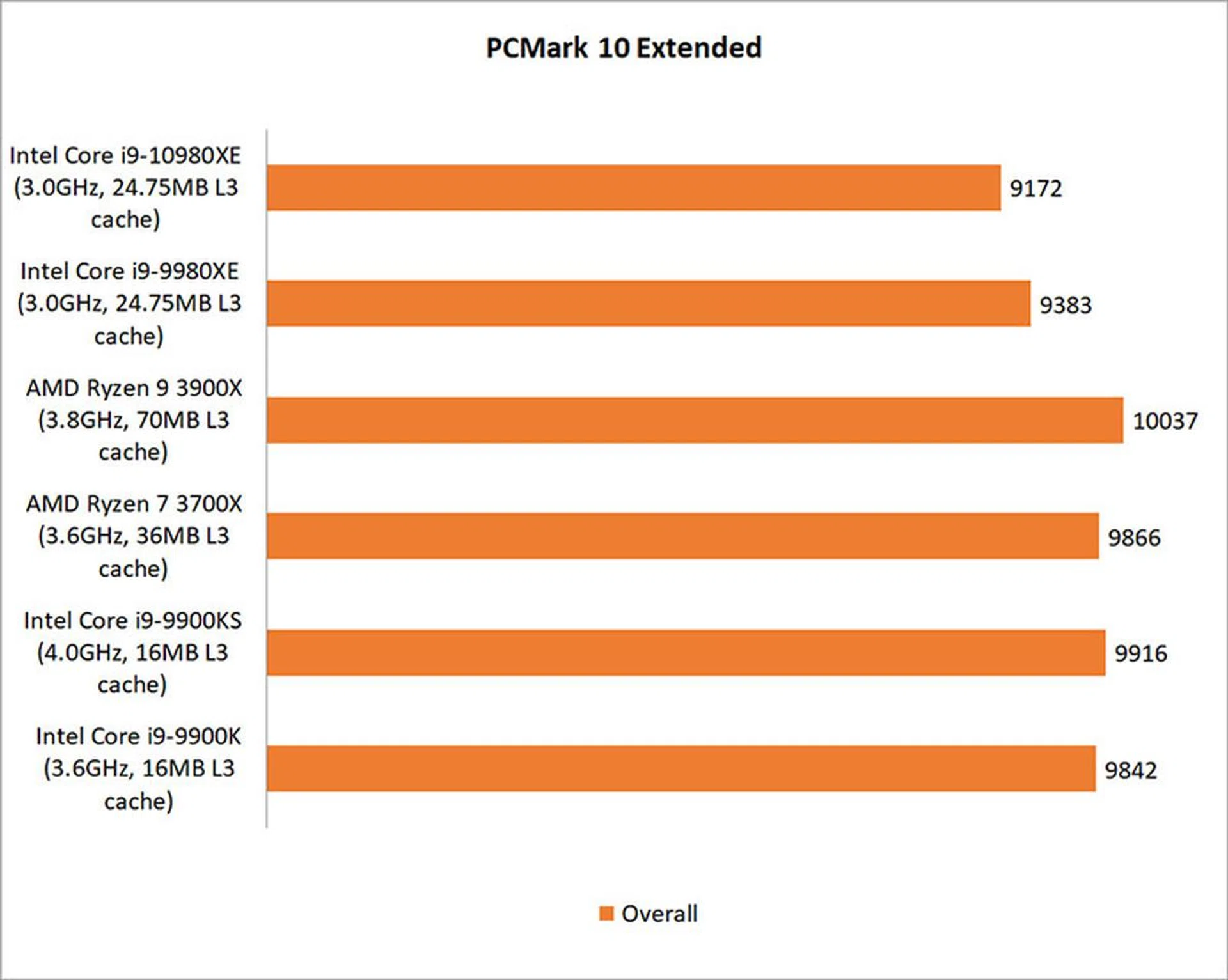
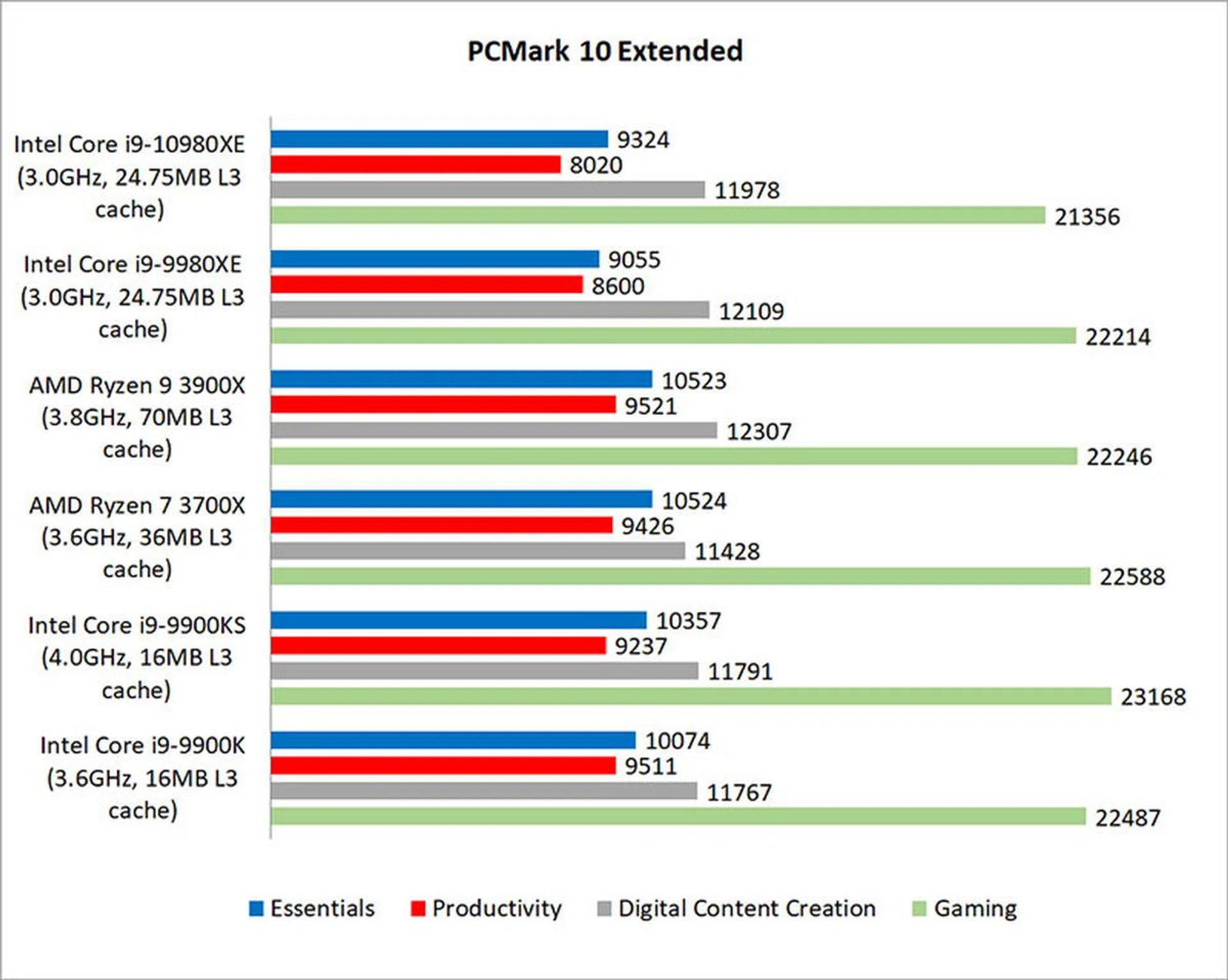
PCMark 10 Extended assesses the performance of systems in a variety of workloads, including basic computing tasks, productivity applications, digital content creation, and gaming. Compared to PCMark 8, it also adds in new test metrics, such as app startup times, which quantifies how long it takes to launch a variety of real-world apps, and a rendering and visualization workload to simulate professional graphics and engineering applications. In addition, existing workloads have been updated to reflect modern usage.
The Core i9-10980XE was slower than even the Core i9-9980XE in terms of overall scores, and a look at the score breakdown shows it lagging behind in productivity workloads. In addition, it trailed the 12-core Ryzen 9 3900X by around 9 per cent.
SPECviewperf 13.0
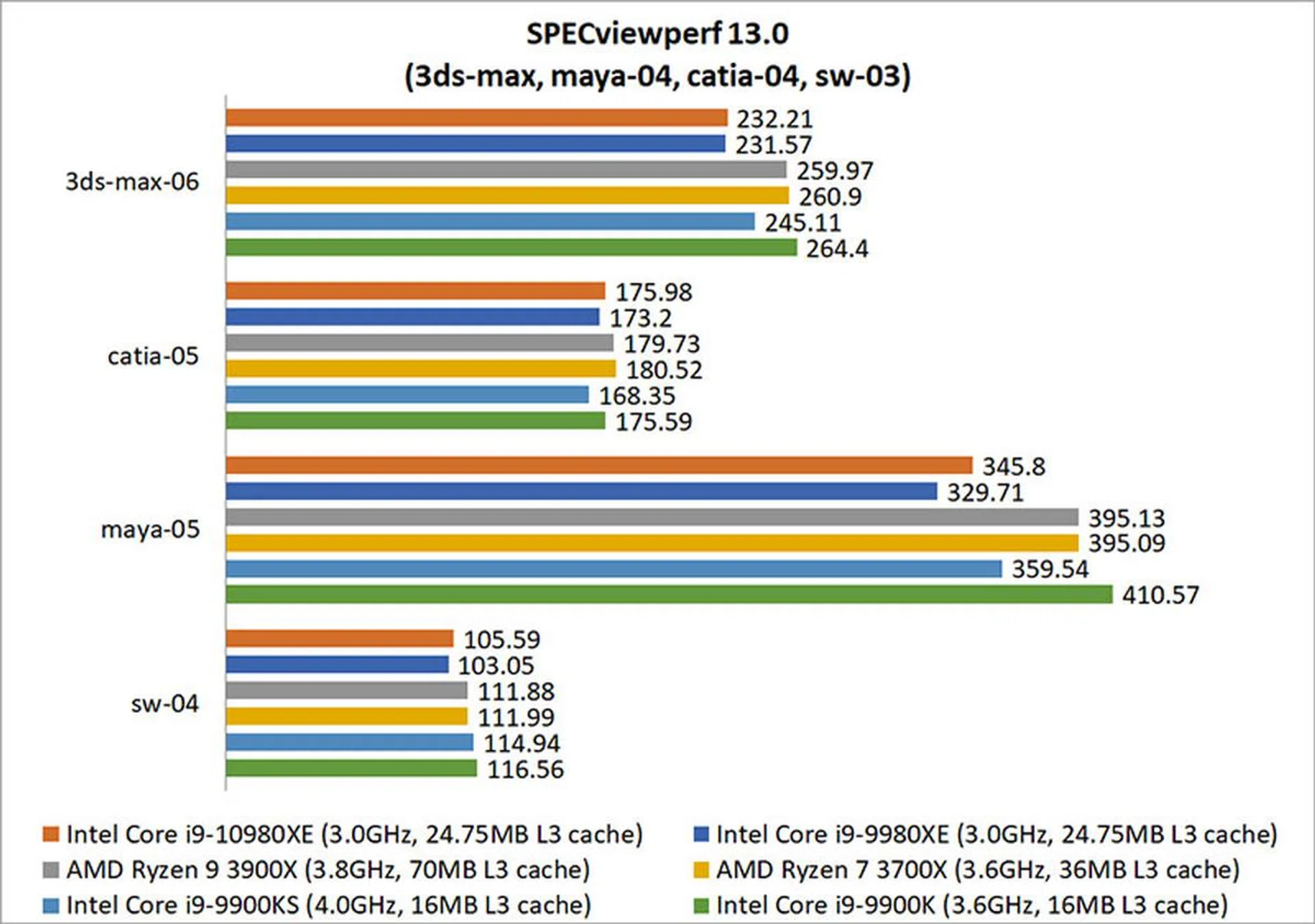
SPECviewperf is used to assess the 3D graphics performance of systems in professional applications. Each individual workload, called a viewset, represents graphics and content from an actual real-world application. SPECviewperf actually runs a total of eight different viewsets, but we’ve picked the four which have the greatest performance variation across CPUs display here.
The new SPECviewperf 13.0 incorporates new models and raycasting for volume visualization. Select viewsets have also been updated with new models and fresh application traces.
The Core i9-10980XE lags behind in SPECviewperf 13.0 as well, consistently coming in behind both AMD chips.
Cinebench R15/R20
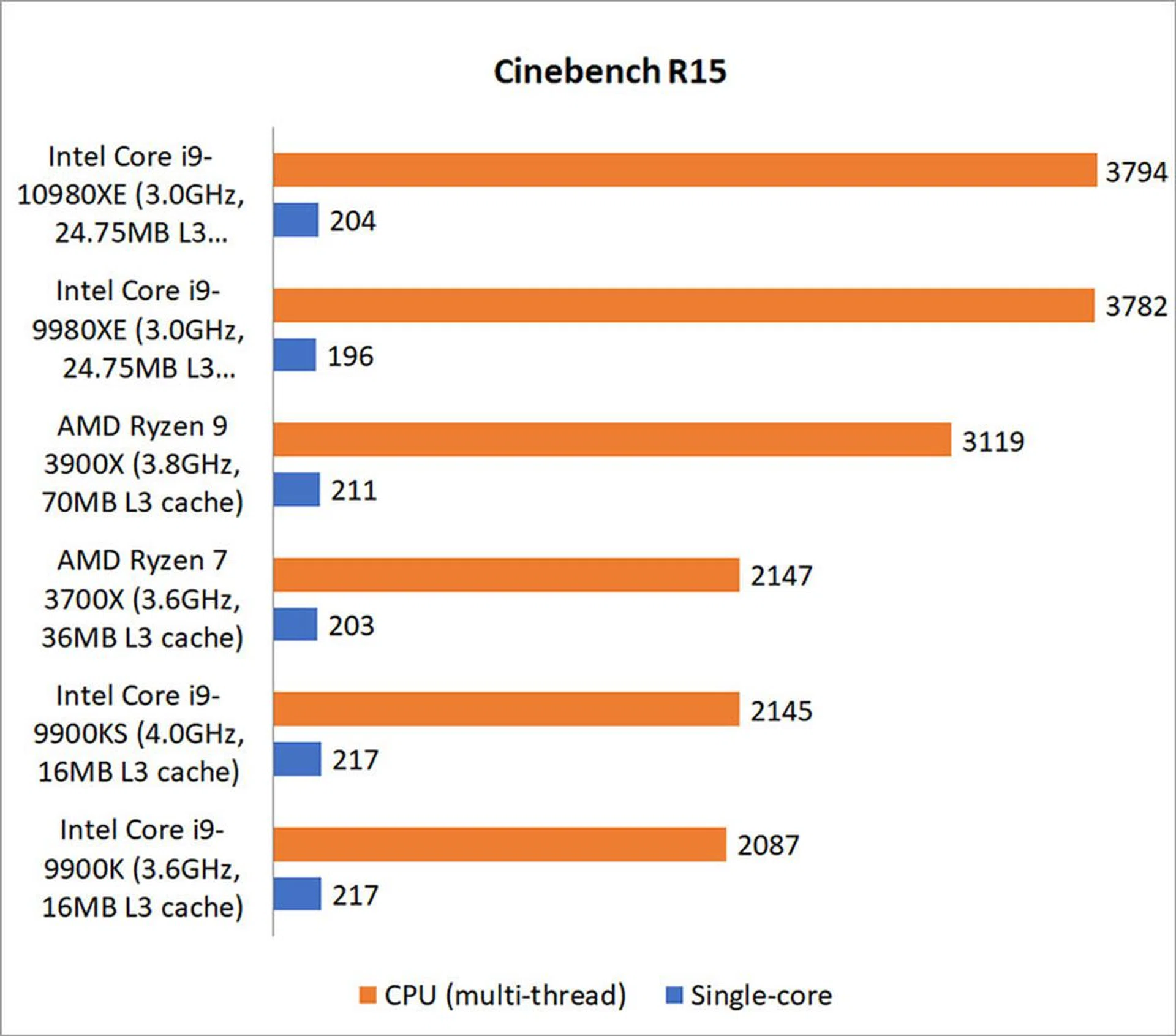
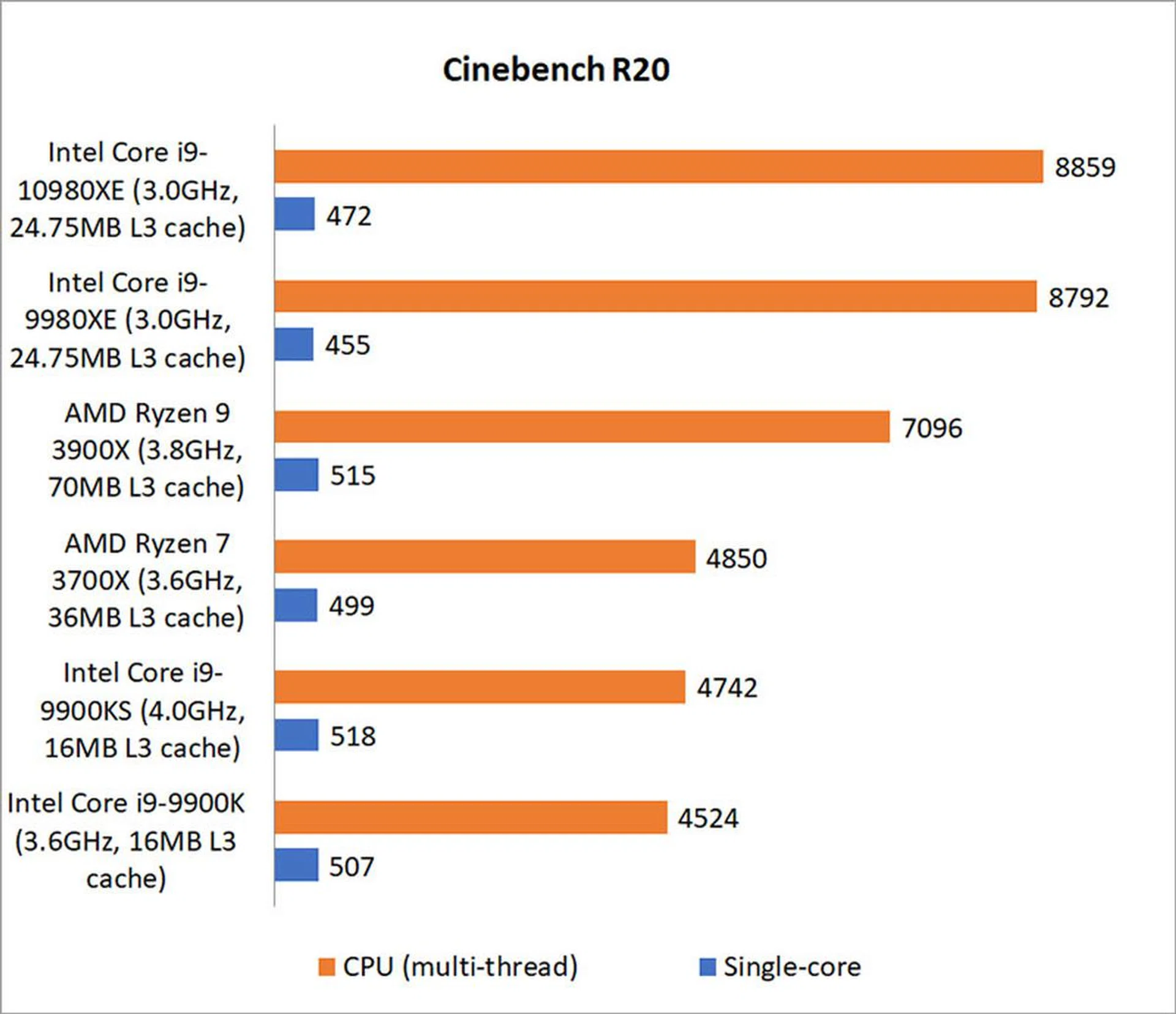
Cinebench R15 is a better indicator of multi-threaded performance because of its ability to utilize up to 256 threads to evaluate a processor’s performance in a photorealistic 3D rendering. We ran both single-core and multi-core benchmarks to evaluate single-threaded performance and multi-threaded scalability here.
The newer Cinebench R20 is even more demanding, featuring increased workload complexity, higher memory use, and the latest rendering engine from Cinema 4D R20. Under the hood, the R20 engine also supports AVX, AVX2, and AVX512 instruction sets and the benchmark now supports up to 256 render threads.
Unsurprisingly, there's not much difference in multi-threaded performance moving from the Core i9-9980XE to the Core i9-10980XE. In Cinebench R20, the Core i9-10980XE was less than 1 per cent faster, which is nearly negligible. Single-threaded performance sees a slightly bigger improvement at around 3.7 per cent, probably thanks to the higher boost clocks. It's still a really minuscule jump though, and the Core i9-10980XE trails the Ryzen 9 3900X in single-threaded scores in both Cinebench R15 and R20.
That said, the Core i9-10980XE was still the overall top performer in the multi-threaded benchmarks, owing to its 18 cores. In Cinebench R15, it was around 19 per cent faster than the Ryzen 9 3900X.
I also used HWiNFO to check the core frequencies in Cinebench R20. All 18 cores had no trouble running at 3.8GHz, and in the single-threaded benchmark, I observed select cores boosting to over 4.9GHz in times (in excess of the 4.8GHz Turbo Boost Max 3.0 speeds).
Handbrake 1.2.2
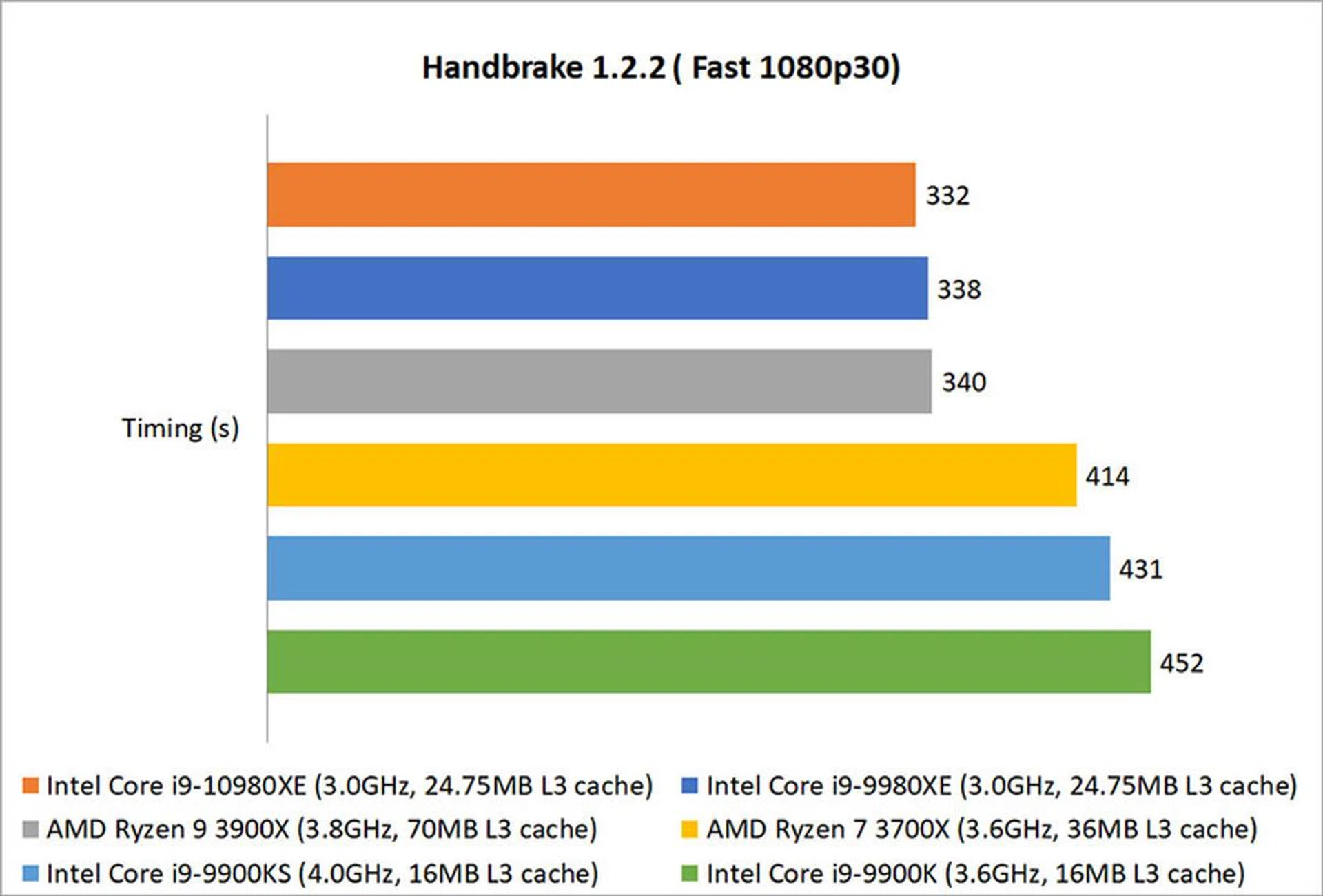
Handbrake is a video transcoder that converts videos into a format for use on PCs and portable electronic devices, and is a good indicator of a processor’s video encoding capabilities. YouTube content creators, Twitch streamers, and other video creators will be most interested in this performance metric. For this benchmark, we used a 1.7GB .mkv file.
This is where the six extra cores on the Core i9-10980XE come in handy compared to the Ryzen 9 3900X. The new Intel chip was the fastest of the lot, beating its predecessor by six seconds as well.
Blender Benchmark
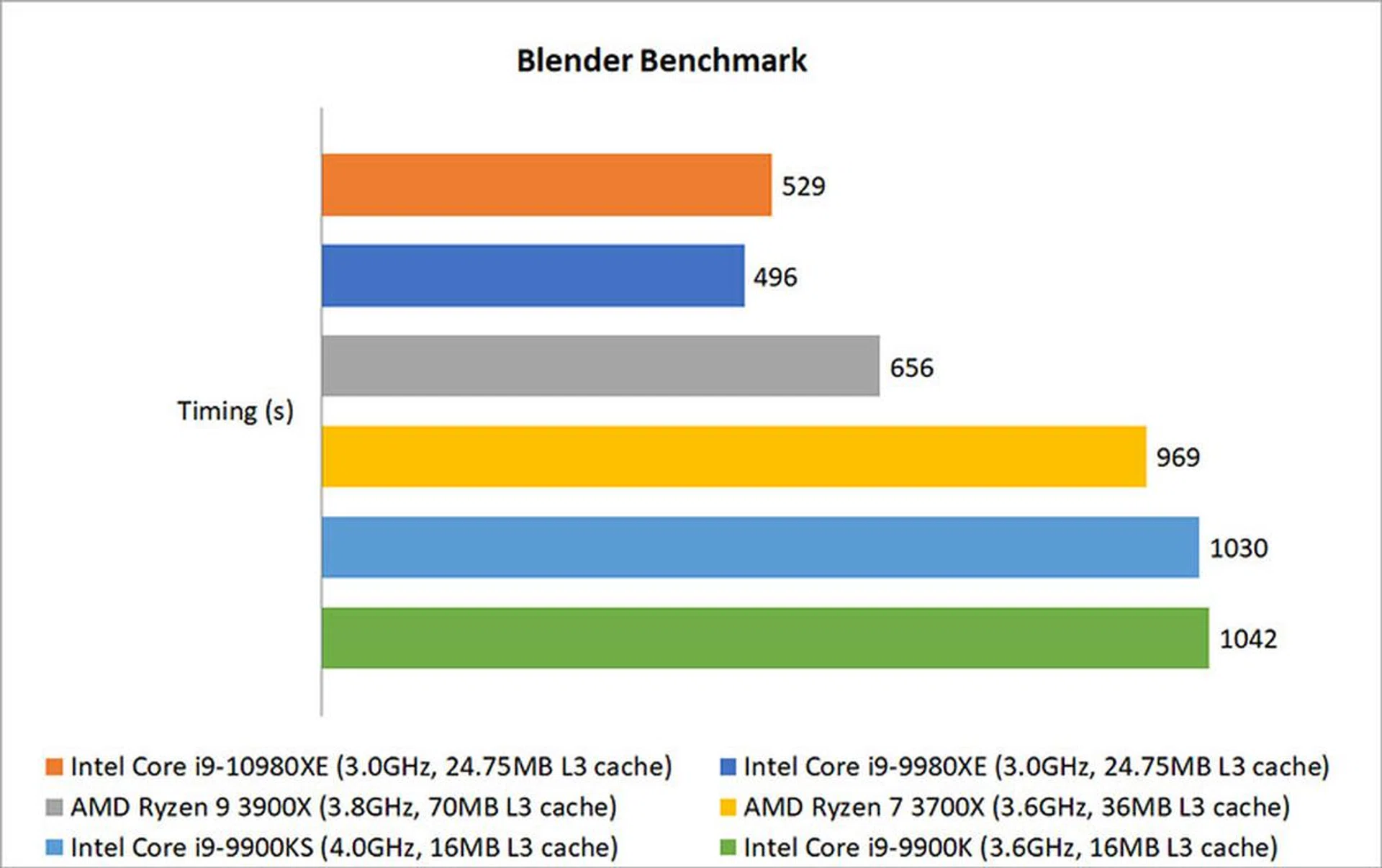
Blender likes having many cores as well, and the open-source software has been used for modeling and to create effects in movies. The new Blender Benchmark offers the option between Quick and Complete runs, and the numbers seen here are from the Quick benchmark, which puts the CPUs through scenarios like the BMW and Classroom demos.
Oddly enough, the Core i9-10980XE was slightly slower than the Core i9-9980XE here. However, it's of course still faster than the Ryzen 9 3900X and the 8-core Intel chips.
POV-Ray 3.7
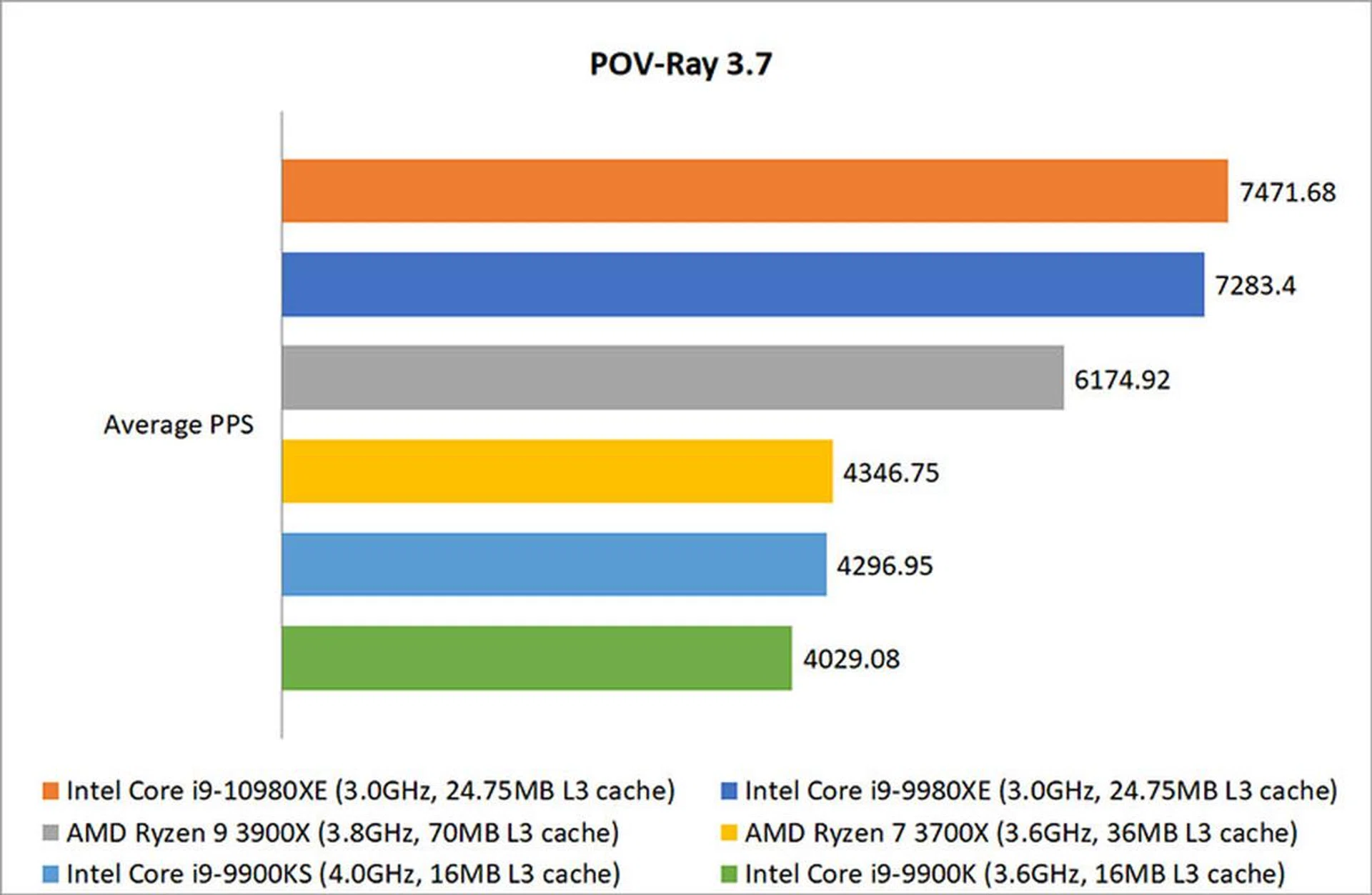
POV-Ray's built-in benchmark also favors having more cores. The Core i9-10980XE was once again the top performer here, but it was just over 2 per cent quicker than the Core i9-9980XE.
Gaming benchmarks
We only ran our gaming benchmark suite at 1080p, since that's where the CPU is more of a factor. At the higher resolutions that are more GPU intensive, the performance differences start to even out.
3DMark
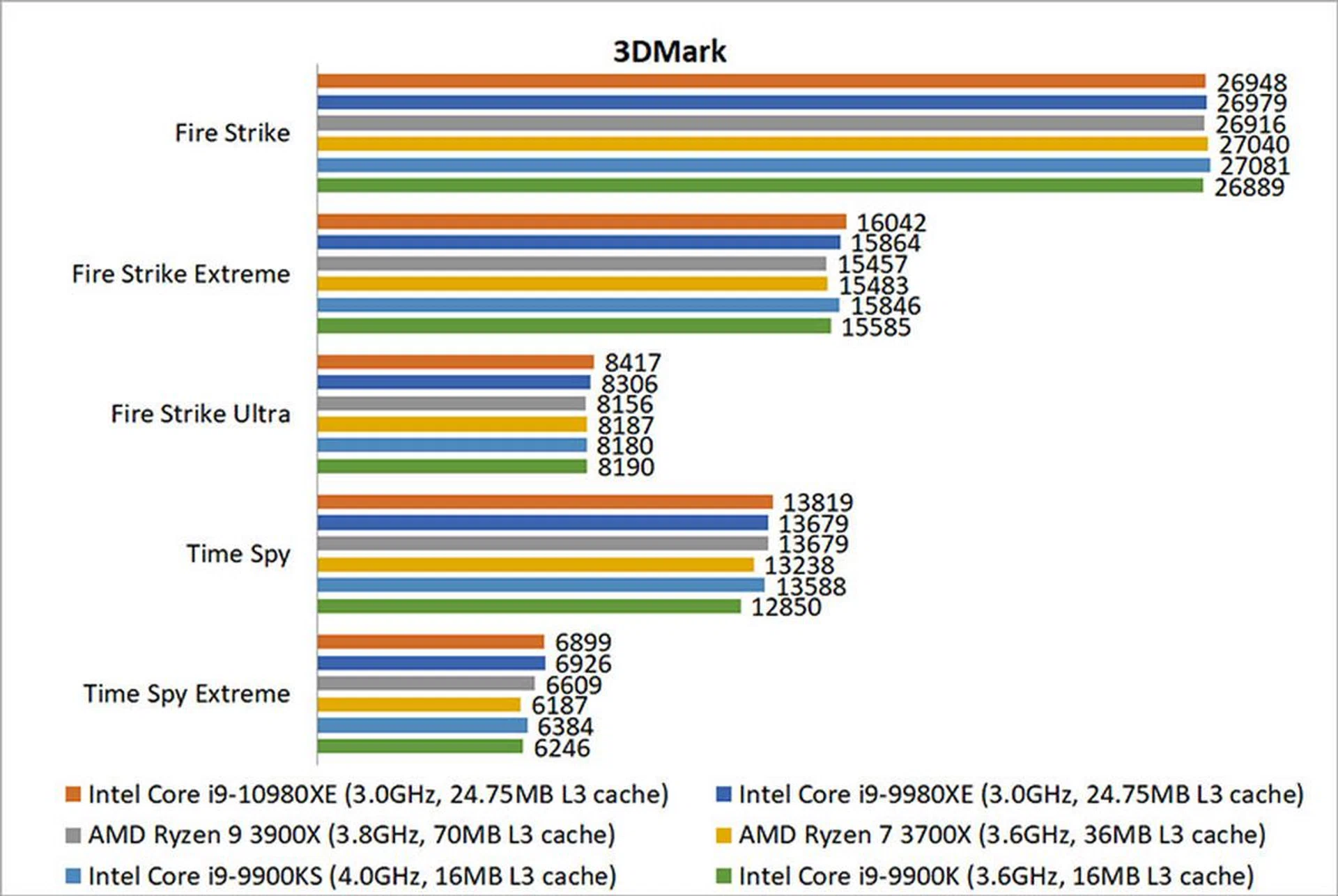
The synthetic 3DMark benchmark tests graphics and computational performance at different resolutions, starting at 1080p and going all the way up to 4K. A series of two graphics test, one physics test, and then a combined test stresses your hardware in turn to assess its performance.
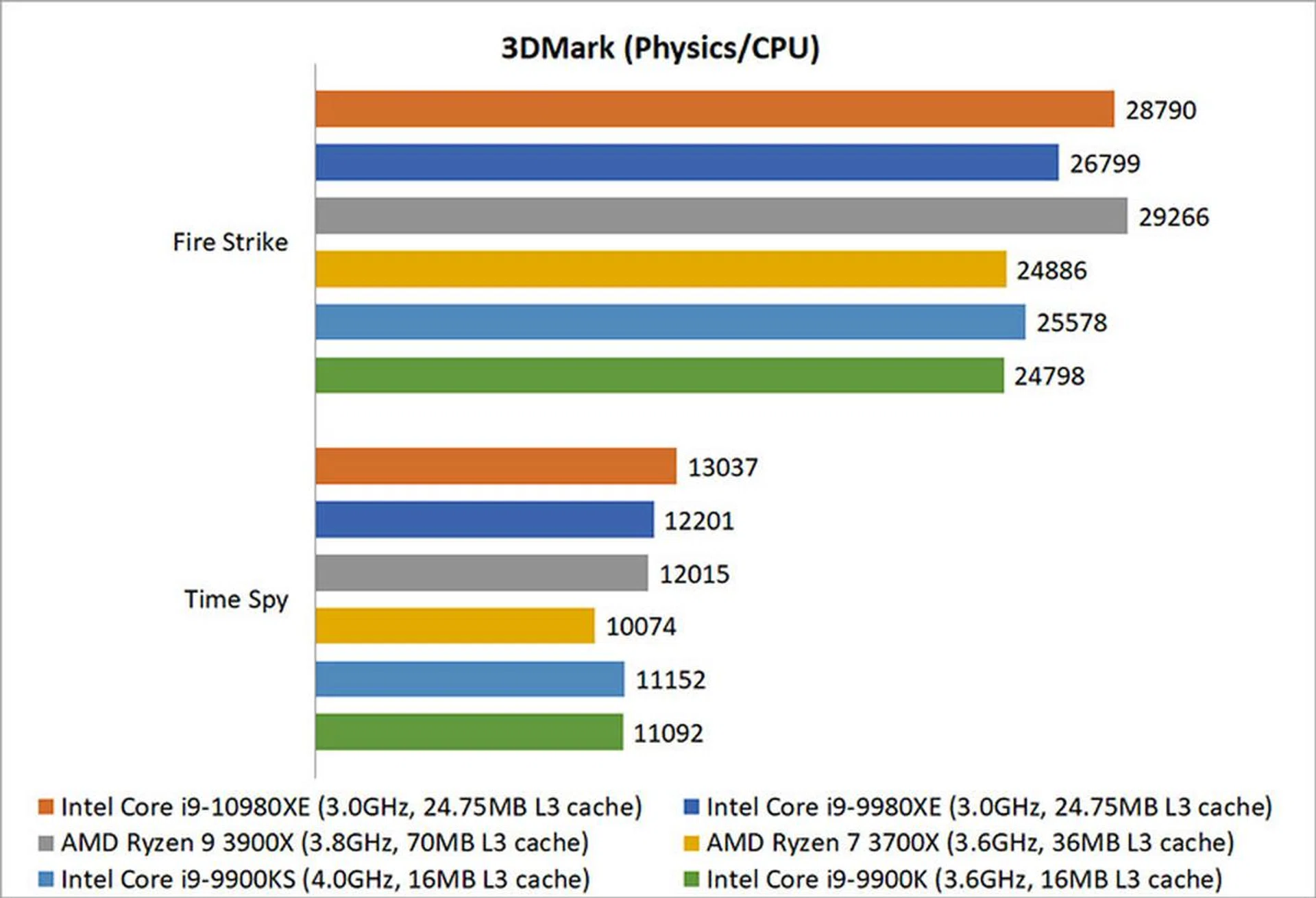
We’ve also teased out the Physics and CPU scores for the Fire Strike Ultra and Time Spy Extreme tests and compiled them in a separate table to give a better idea of how each processor performed.
Performance is pretty similar across the board, although the Physics and CPU scores are more revealing. The Core i9-10980XE doesn't have the best showing in terms of Fire Strike Physics scores though, coming in behind the Ryzen 9 3900X. However, it manages to top the board for the Time Spy CPU numbers.
Ashes of the Singularity: Escalation
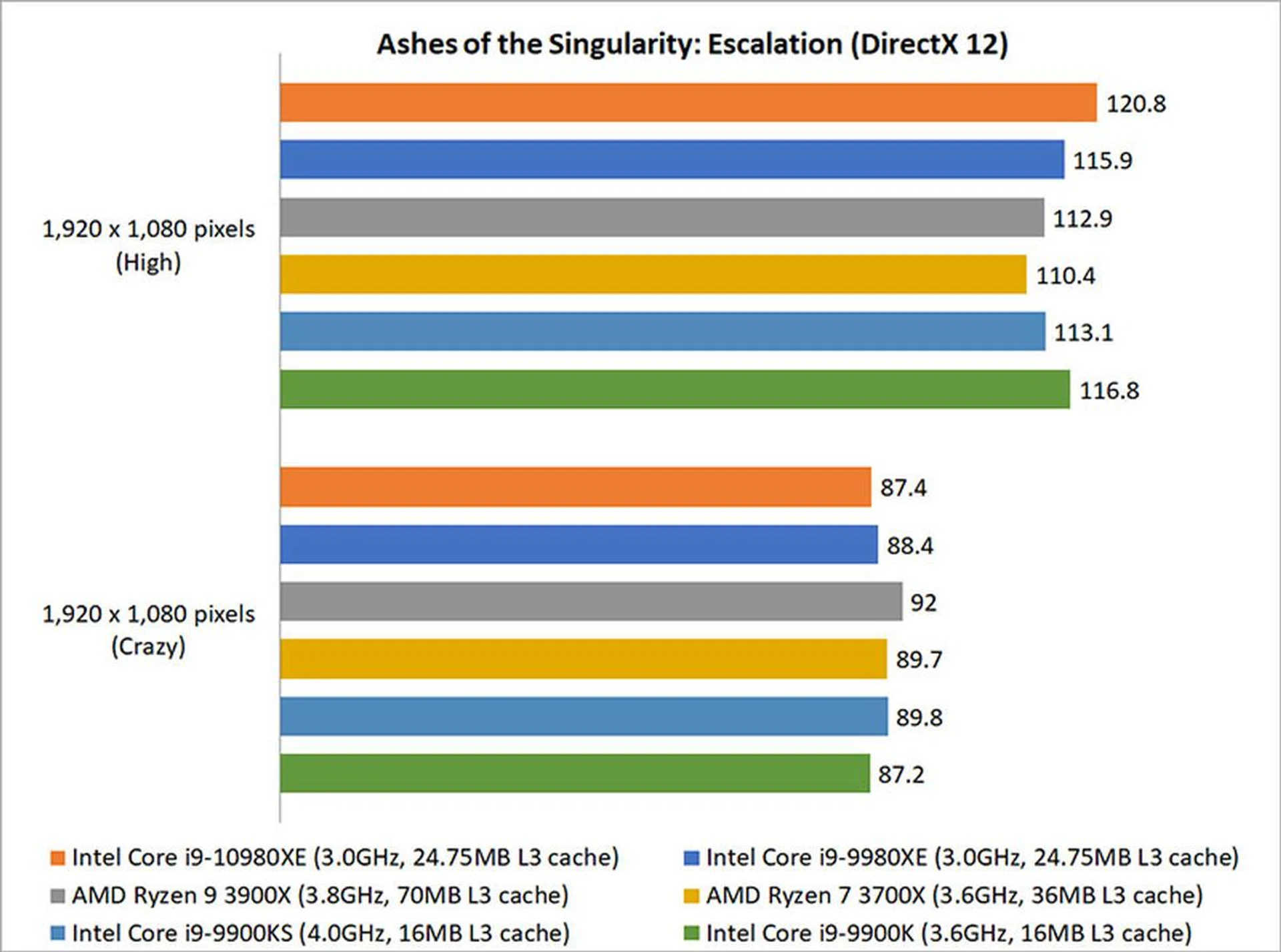
Ashes of the Singularity has long been the poster child for the performance benefits a low-level API like DirectX 12 can bring. It is based on the Nitrous engine and can be extremely punishing thanks to the huge number of onscreen units and the sheer level of detail accorded to each unit. However, the CPU does become the limiting factor at lower resolutions and settings.
The Core i9-10980XE had a surprisingly strong performance here, coming ahead of even the Core i9-9900K at High settings.
Deus Ex: Mankind Divided
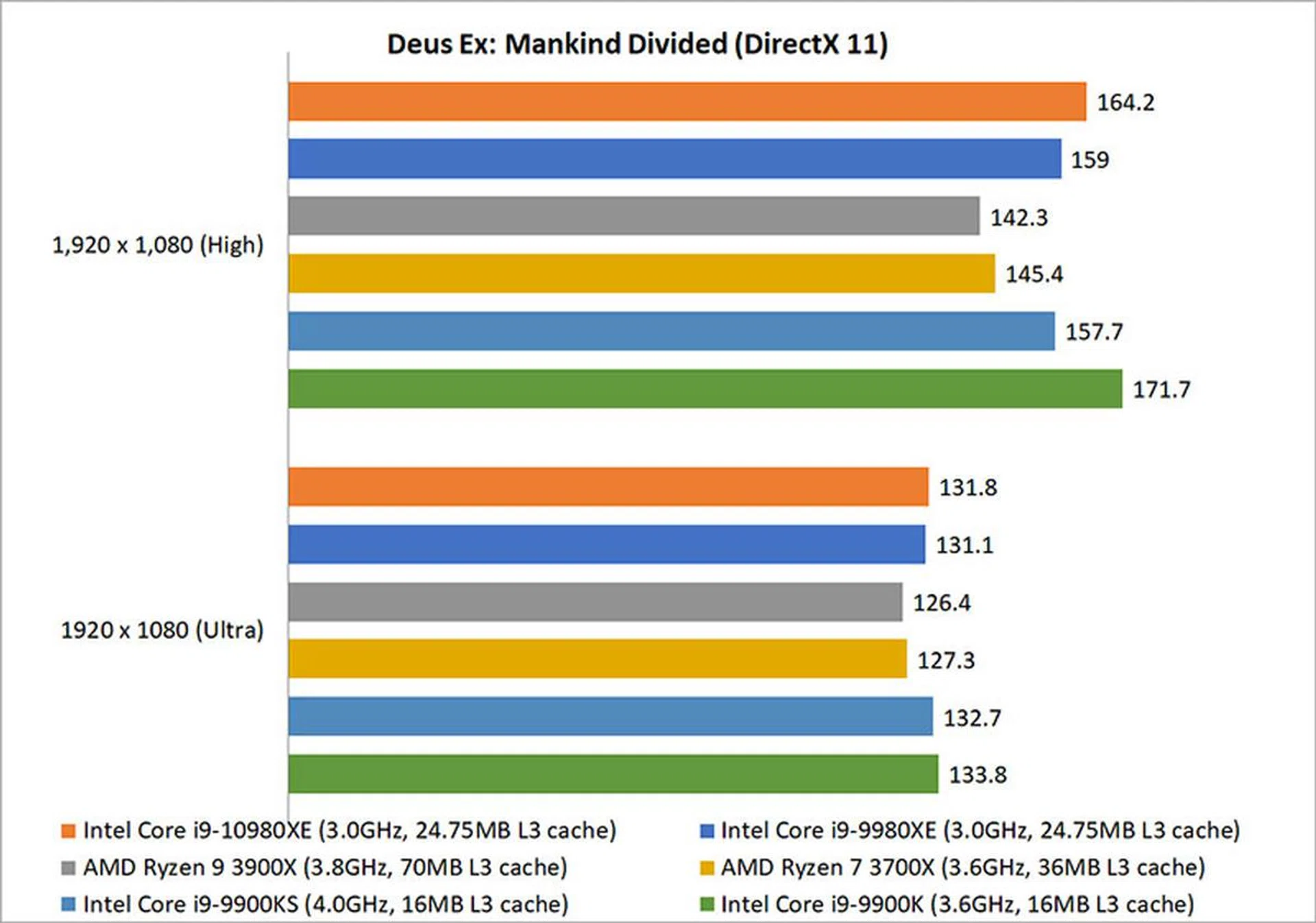
Mankind Divided features just about every trick to make your game look pretty, including things like volumetric and dynamic lighting, screenspace reflections, and cloth physics. Even though it was released in 2016, the game is capable of bringing even the most powerful systems to their knees.
The new 18-core Intel chip does well in Mankind Divided too, beating even the Core i9-9900KS at High settings. It was also around 14 per cent quicker than the Ryzen 9 3900X at those same settings. However, the fastest chip here was the older Core i9-9900K.
Far Cry 5
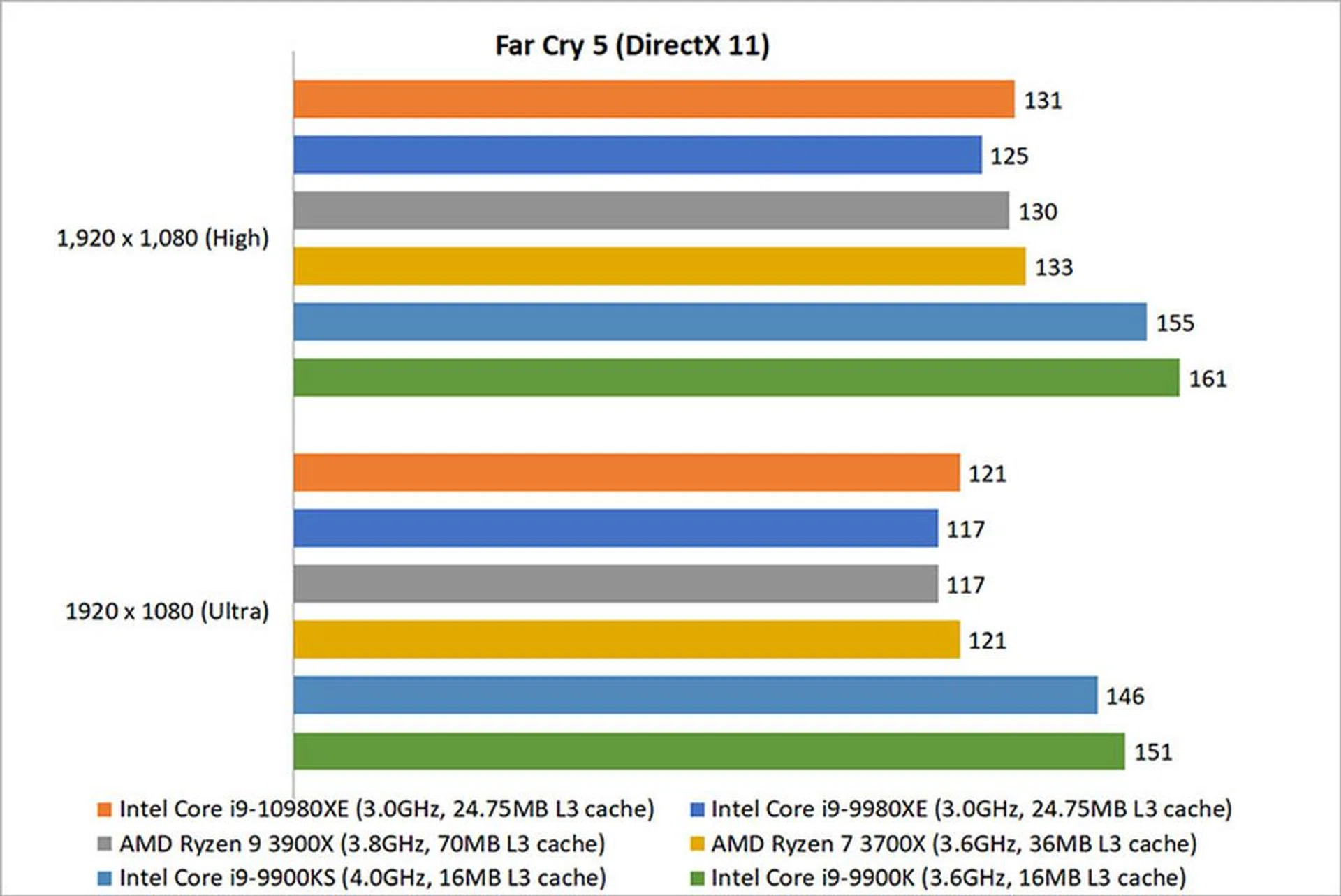
The Core i9-10980XE was roughly on par with AMD's chips here, while the lead quite clearly belongs to the Core i9-9900K and Core i9-9900KS.
Metro Exodus
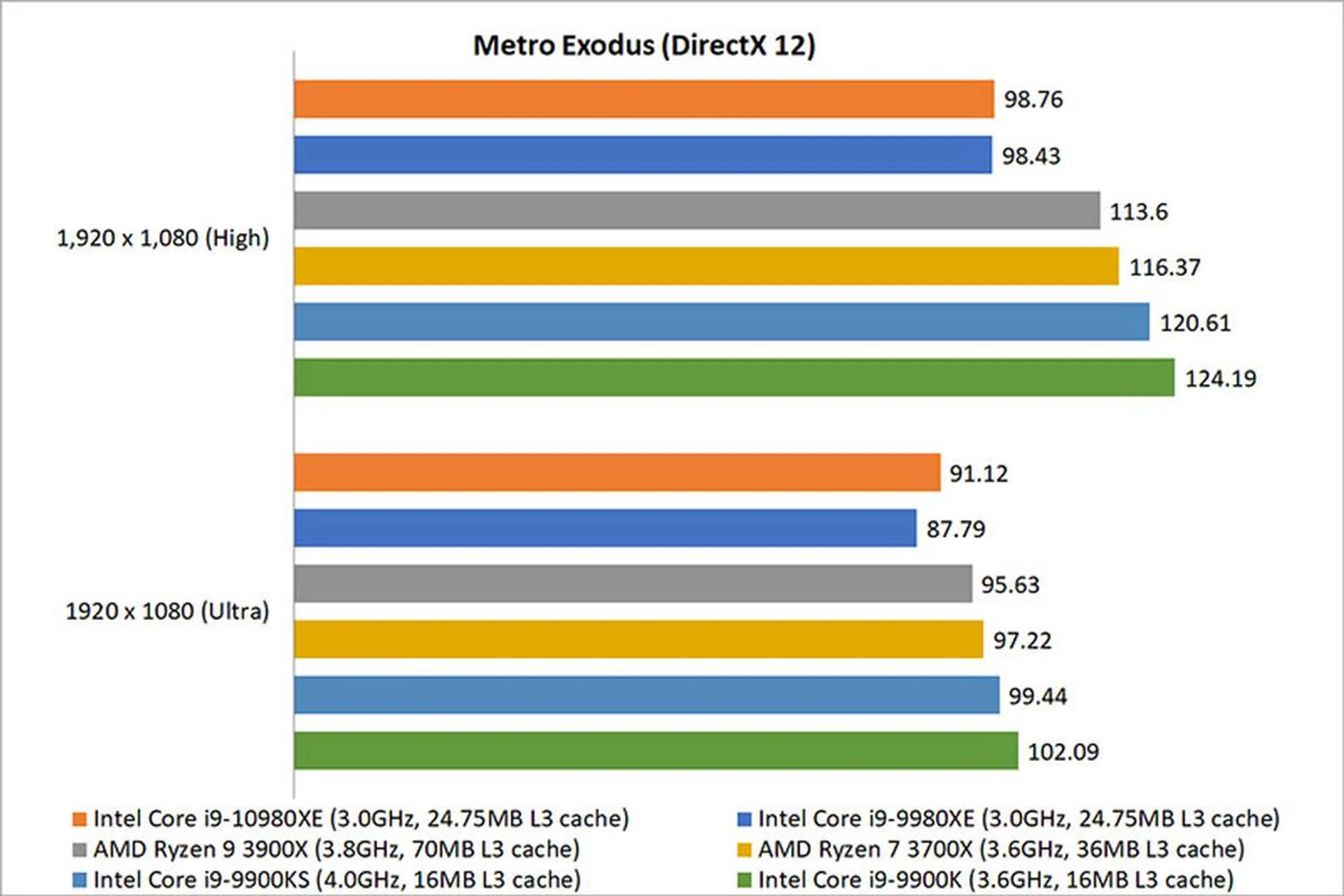
Unfortunately, the Core i9-10980XE doesn't do as well in Metro Exodus, which is a really demanding game to run. It performed roughly the same as the Core i9-9980XE, and both chips were approximately 14 per cent slower than the Ryzen 9 3900X. It's possible that the game doesn't take too well to more cores, since the Ryzen 7 3700X also did better than the Ryzen 9 3900X.
Middle-earth: Shadow of War
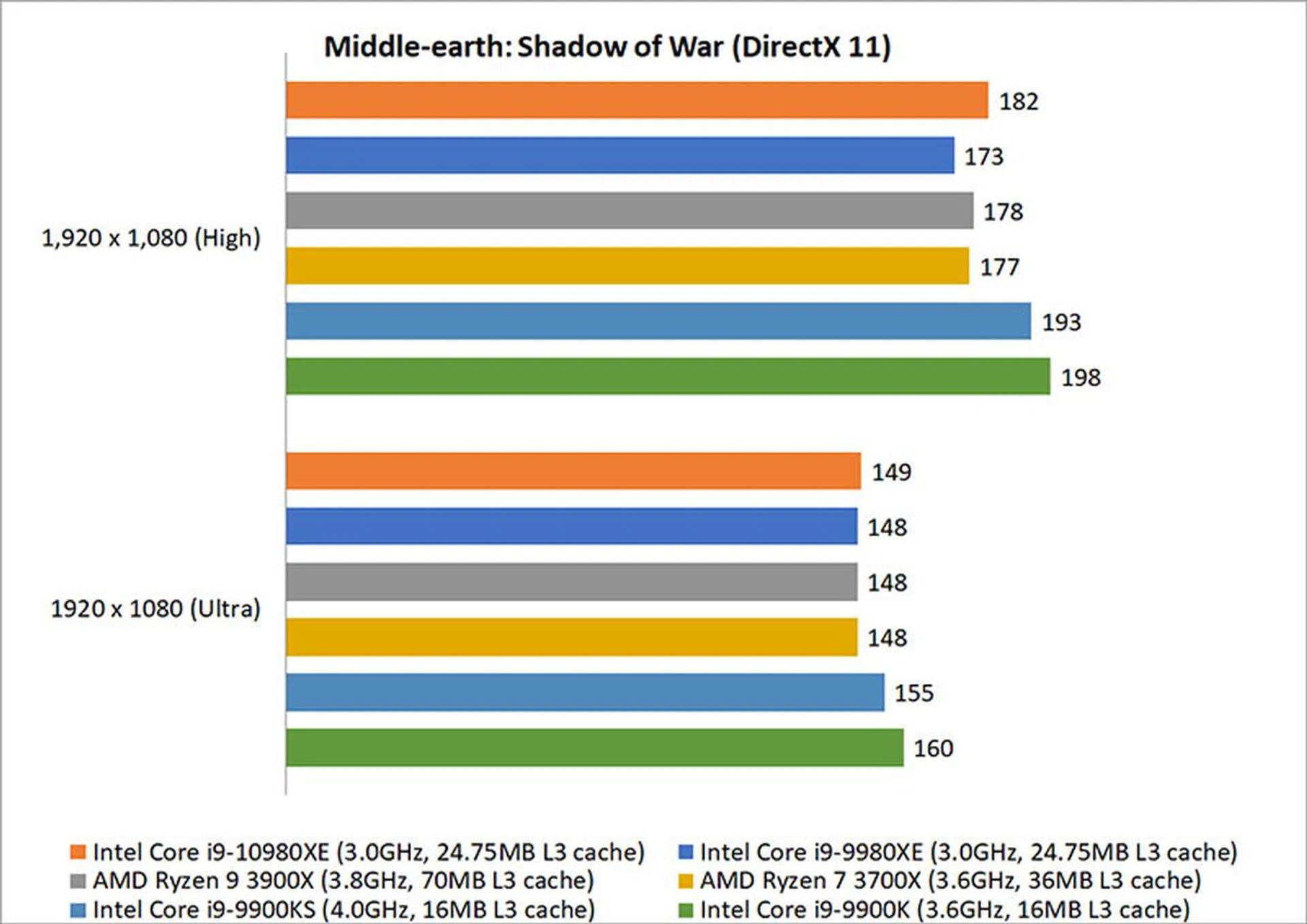
The Core i9-10980XE had another strong showing here, and it only trailed the Core i9-9900KS and Core i9-9900K, which are the best gaming CPUs you can get today. However, the Ryzen 9 3900X isn't that far behind, and it trails the Core i9-10980XE by just a handful of frames. At Ultra settings, the differences between the Intel Core-X and Ryzen processors are pretty much erased once the CPU becomes less of a limiting factor.
Shadow of the Tomb Raider
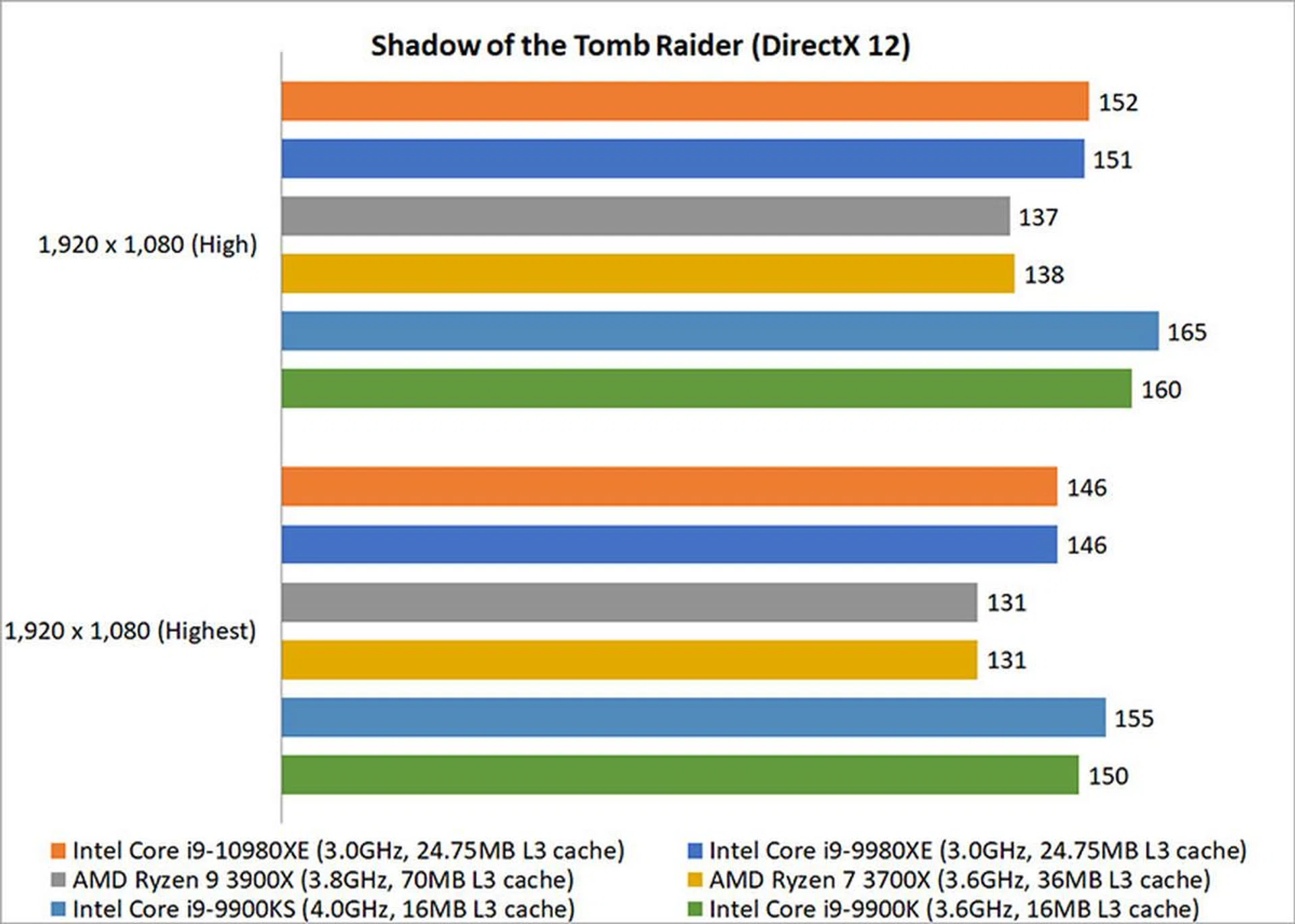
The Core i9-10980XE performs well in Shadow of the Tomb Raider too, but it manages to hang onto its lead over the Ryzen chips even at the Highest settings. In the latter scenario, it was around 10 per cent faster than the Ryzen 9 3900X.
Tom Clancy's The Division 2
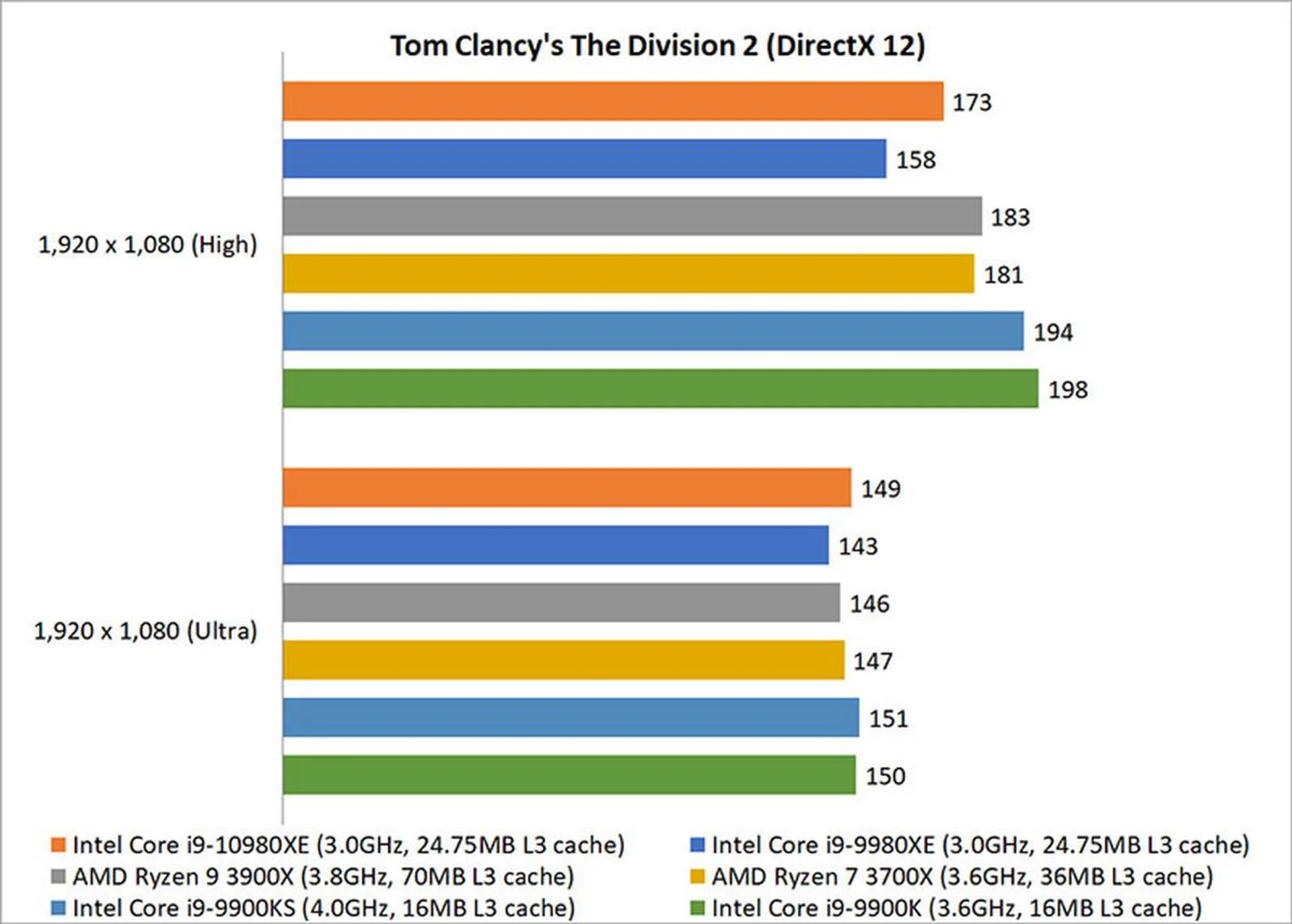
The Core i9-1098XE is slower than the Ryzen 9 3900X at High settings, but the performance numbers even out at Ultra settings, even for the Core i9-9900K and Core i9-9900KS.
Temperature and power consumption
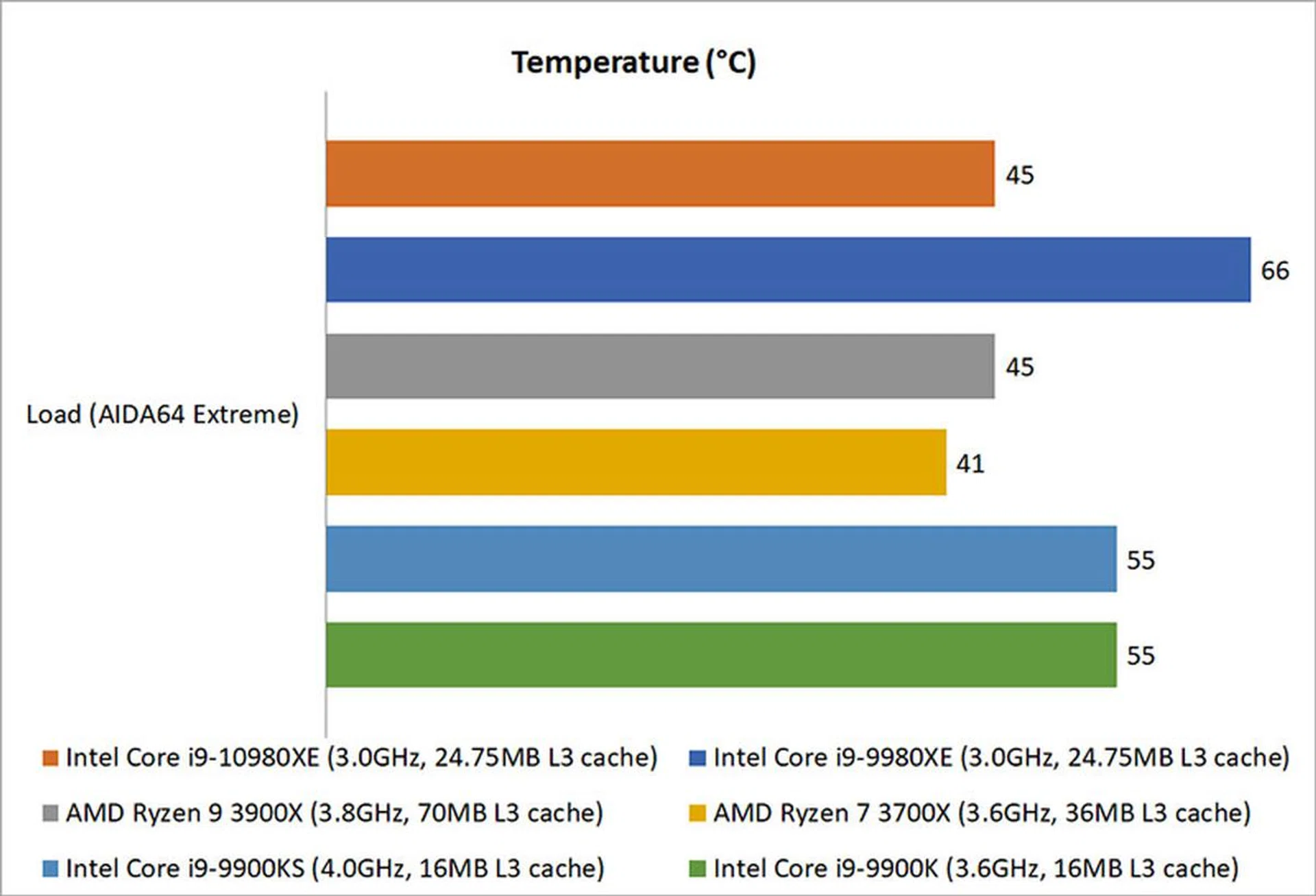
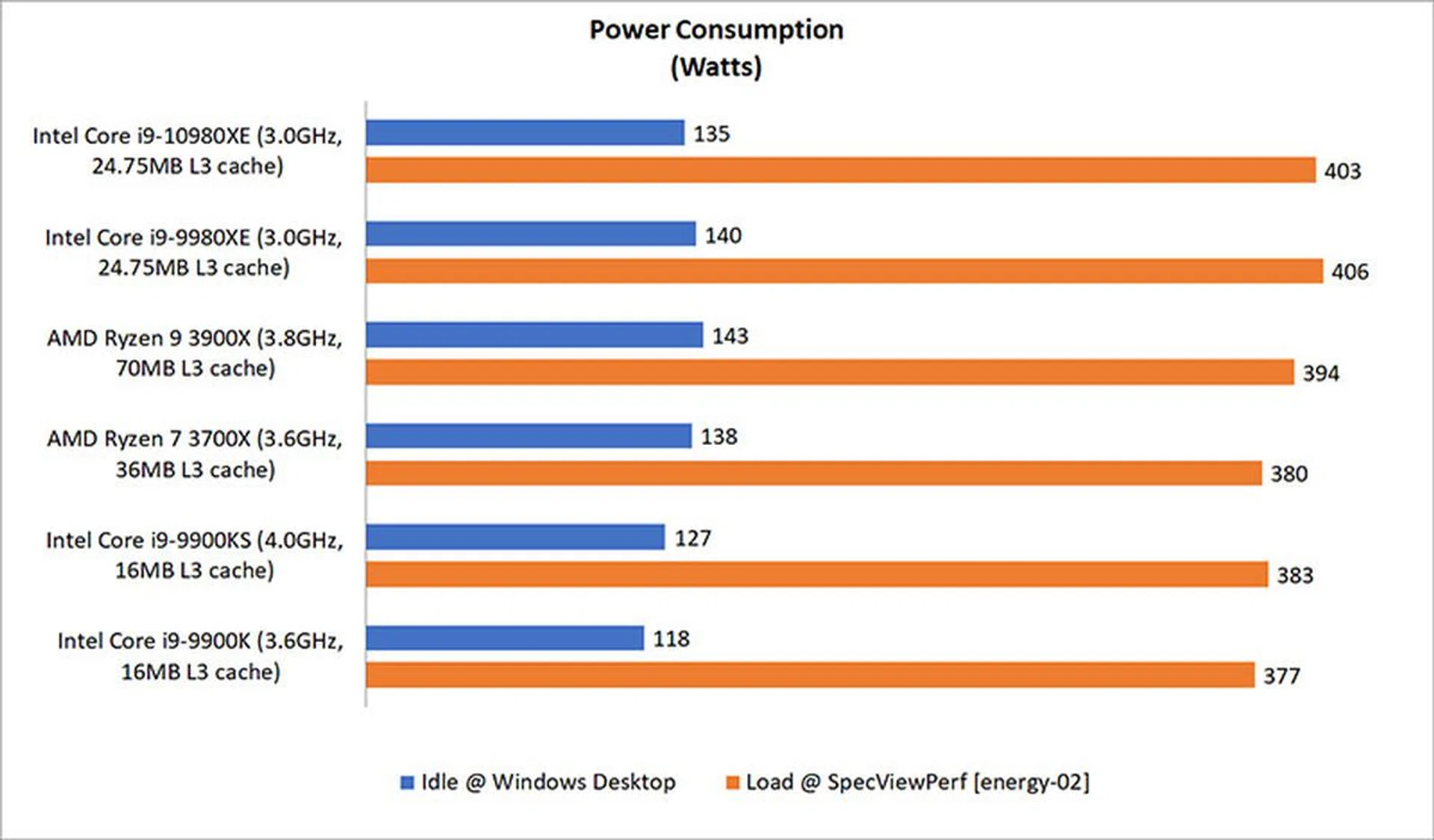
The Core i9-10980XE has the same 165W TDP as the Core i9-9980XE. Power consumption numbers are largely similar, both at load and idle. Temperature performance is a different ball game though, and the Core i9-10980XE demonstrates much improved thermals compared to the Core i9-9980XE.
Slightly faster, but not much else
The Intel Core i9-10980XE is just a slightly faster, and vastly cheaper, version of the Core i9-9980XE. This makes it a much better chip from a value standpoint, but it doesn't do a lot to shake the prevailing narrative that Intel is floundering and failing to provide attractive alternatives to AMD. The 18-core Cascade Lake-X chip is still based on the 14nm process, and other than the higher supported memory frequency and clock speeds, it really doesn't bring anything new to the table in terms of performance.
To be fair, it's not a bad chip per se. It serves up good multi-threaded performance with 18 cores and is no slouch in games either. However, at US$979, it's still more expensive than the US$749 16-core Ryzen 9 3950X, and that is still technically a mainstream chip from AMD. If you want to compare HEDT platforms, the Core i9-10980XE should be pit against AMD's Threadripper 3000 processors, which start at a 24-core part and top out at 32 cores.
Either way, Intel is caught in an awkward position, with AMD's mainstream Ryzen processors encroaching on its HEDT line-up. The company recently also launched the Core i9-9900KS, which doesn't exactly offer groundbreaking performance increases either. And even though the Core i9-10980XE follows the 10th Gen numbering scheme, it's apparently not even a 10th Gen part, and Intel says there is no "generation" associated with its X-series chips at all. Whatever the case, Intel sure isn't doing anything to address its reputation for stirring up considerable confusion with its unhelpful processor names.
If you already own an Intel Core i9-9980XE, there is scant reason to get the Core i9-10980XE. The latter comes with support for Wi-Fi 6, Thunderbolt 3, and DL Boost instructions, but those are small additions that don't drastically change what the processor can do on a day-to-day basis (unless you're a researcher that wants the chip for DL Boost). Ultimately, the new chip still fails to excite, and price cuts aside, it really looks as if Intel is pushing out very iterative upgrades as it claws its way to 10nm chips on desktop.
Having said all that, you also can't overlook what the price drop has done for Intel. The Core i9-10980XE now occupies the middle ground between the Ryzen 9 3950X and Threadripper 3000, and it could still manage to find a willing audience.
Our articles may contain affiliate links. If you buy through these links, we may earn a small commission.