
Gigabyte Radeon R9 280X Windforce 3X OC - The Windforce Treatment
The Gigabyte Radeon R9 280X Windforce 3X OC leaps out of the box with a factory-overclocked R9 280X GPU, rated at up to 1100MHz. With the skeleton thin fan shroud and its three cooling fans, the card cuts a familiar sight to those who are in the know of its Windforce 3x cooling system. We find out how this card fares.

Radeon R9 280X Gets the Windforce 3x Treatment
The Gigabyte Radeon R9 280X Windforce 3X OC is the first Radeon R9 series card from Gigabyte to reach our test lab. Right out of the box, the card sports an overclocked AMD Radeon R9 280X GPU that is rated at 1050MHz - or at least that was how it debuted in retail.

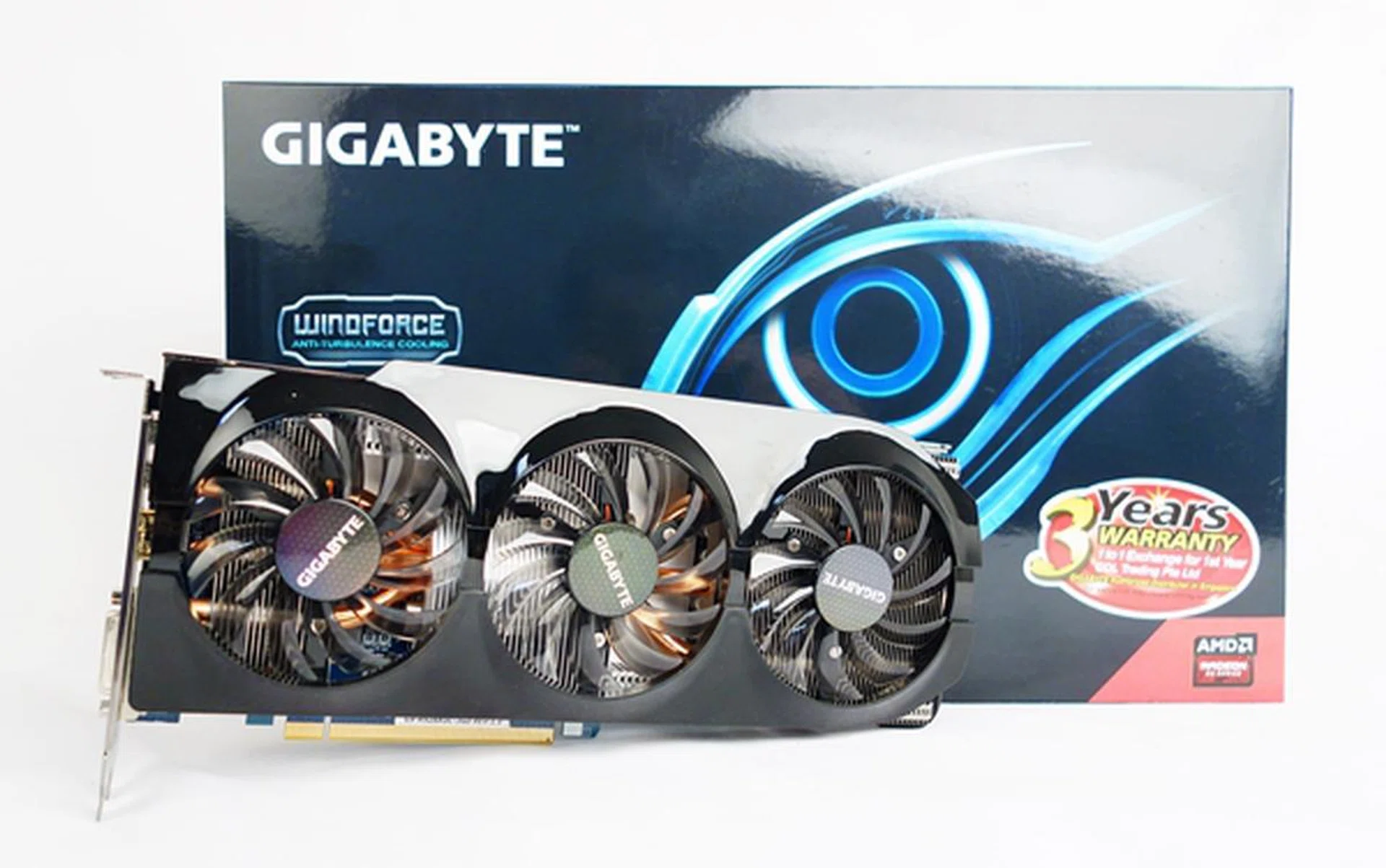
The Gigabyte Radeon R9 280X Windforce 3X OC sports the familiar minimalist fan shroud, with three 80mm cooling fans.
However, at the time when we embarked on testing this card, we were advised by Gigabyte to update the BIOS of the card to a fresh firmware that was just made available. Following the update, the card took on a more aggressive performance profile. According to the GPU-Z utility, the R9 280X GPU has been overclocked to 1100MHz, an increment of 50MHz when compared to its previous specifications. To be sure, we checked that this free speed upgrade was applicable to all customers who've bought this card and indeed, the specs page on Gigabyte's product page is now updated. The graphics memory however is still operating at the default 6000MHz.
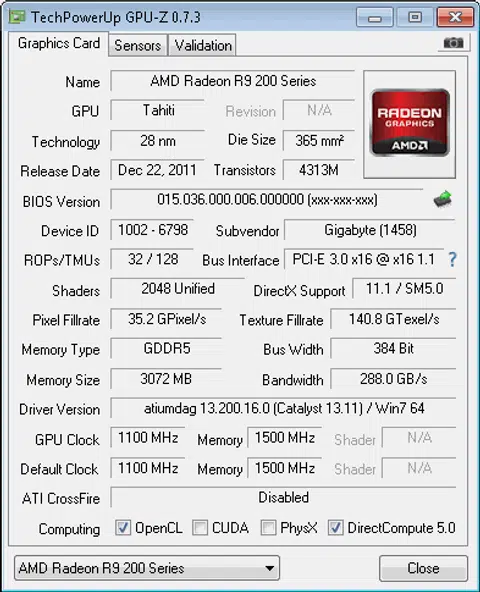
As a result, the Gigabyte card currently has one of the highest factory-overclocked R9 280X GPU in retail. The ASUS ROG Matrix R9 280X Platinum is however the fastest based on our experience, but that's a card built on the principles of being extreme (along with its asking price). Putting that aside, it's clocked faster than the ASUS Radeon R9 280X DirectCU II TOP as well as the MSI R9 280X Gaming 3G. As such, we expect the Gigabyte card to perform as good or better than its similarly priced competitors. For its power delivery system, the card features an 8-phase design system; its GPU core is fed with 6 phases, and 1-phase each for the graphics memory modules and the phase-locked loop (PLL) of the card’s board respectively.
The rear of the card isn't protected and you can clearly see its blue printed circuit board (PCB). You will also notice the metal brackets that hold the aluminum fin-stack radiator. The fin-stack also house three 8mm copper pipes that draw heat away from the R9 280X GPU core.

The PCB of the card is Gigabyte's signature blue, and we can see the metal brackets that hold the aluminum fin-stack of the Windforce 3X cooling system in place.
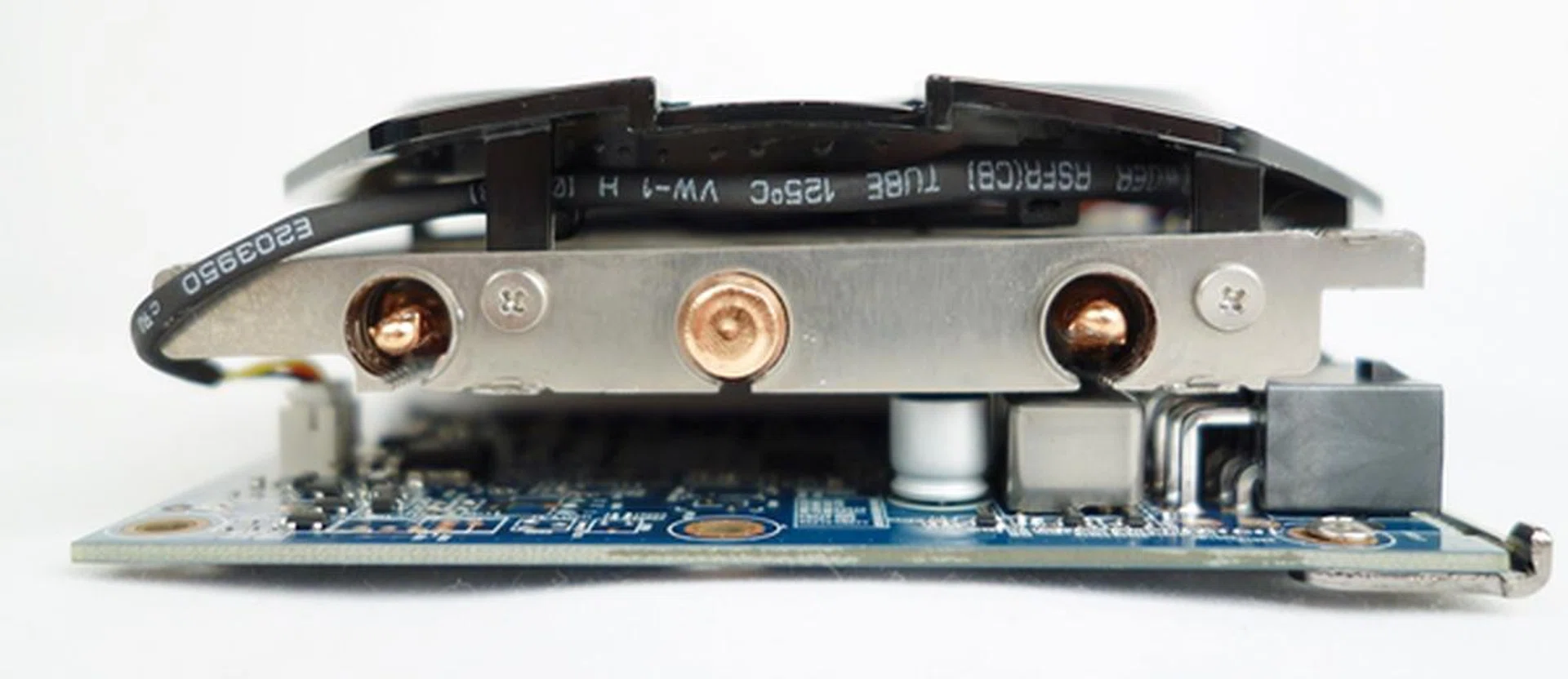
From the rear of the card, we can see the copper heatpipes clearly. According to the card's manual, there is a RAM heatsink attached to the memory modules onboard. This will provide additional cooling for the chips. However, it isn't visible unless the Windforce 3X cooling system is disassembled.
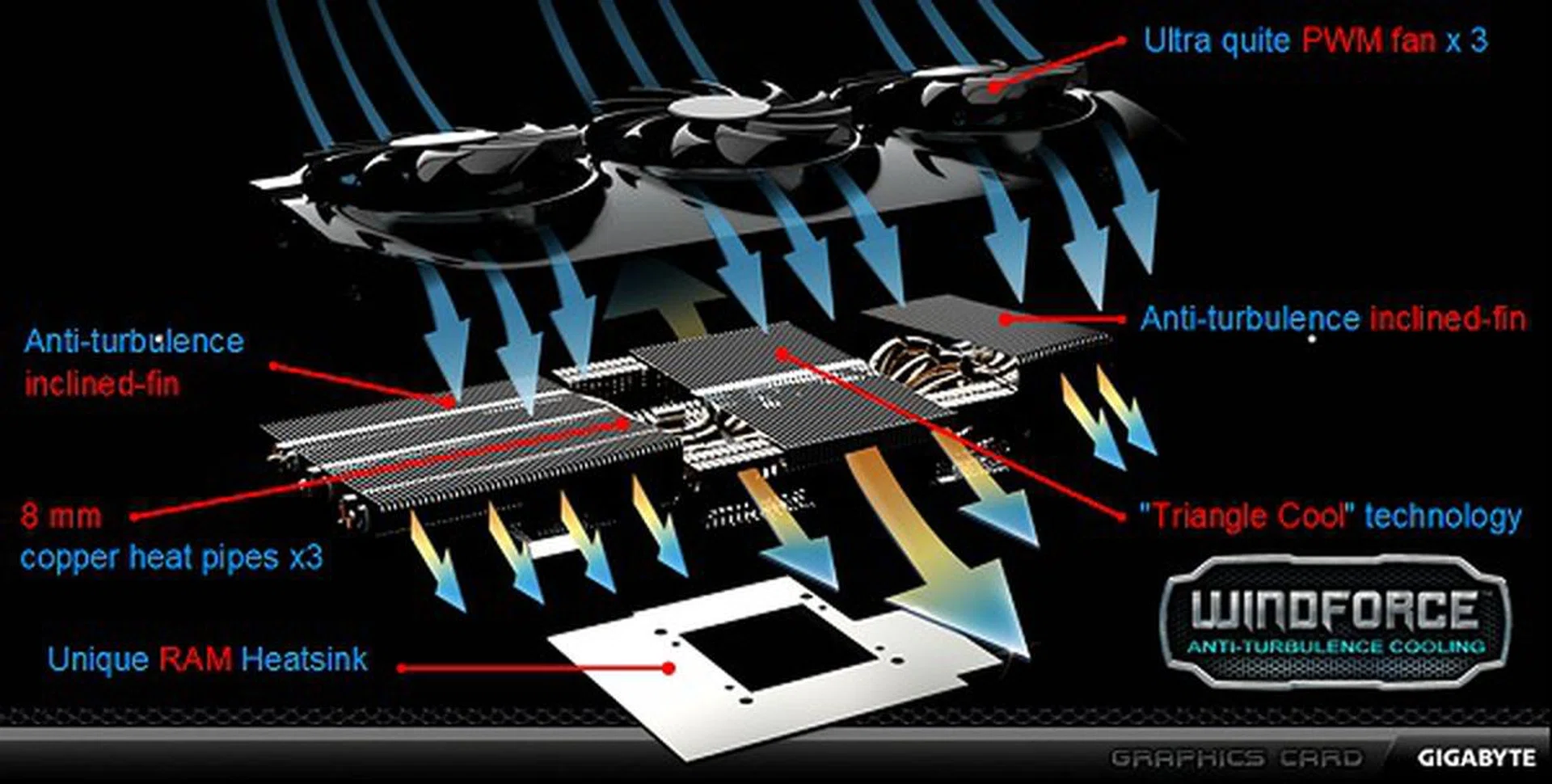
In this WindForce cooler detailed working diagram, you can see where the RAMsinks are located.
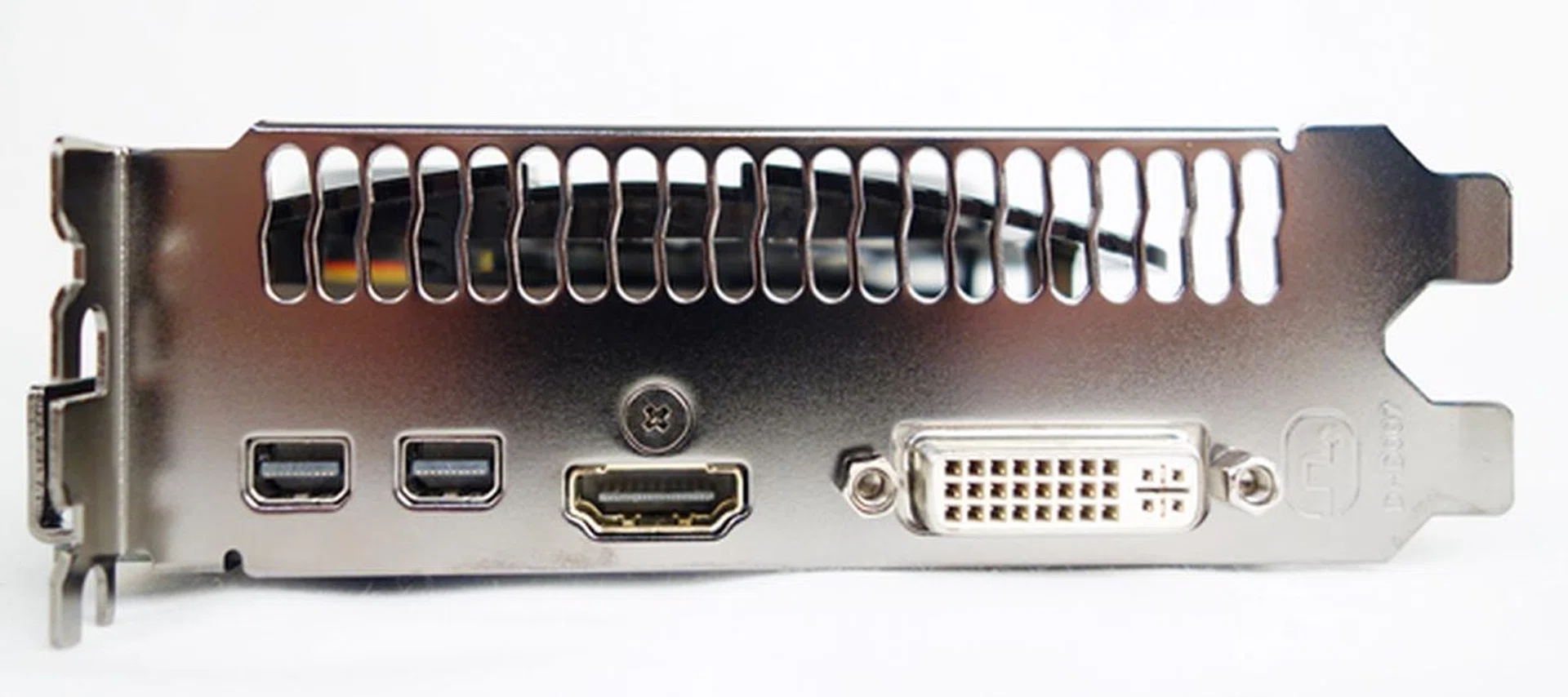
For its video ports, they consists of two mini-DisplayPort ports, a HDMI port, and one dual-link DVI-I port. This configuration is is exactly the same as the old Radeon HD 7900 series.
Taking a leaf from its DualBIOS feature found on its motherboards, the card has two BIOSes; one is for back up purposes and the other contains the factory default settings for the card. In the photo below, the switch is at the factory default position.

The DIP switch for toggling between BIOSes is located near the one of the CrossFire connectors, and the switch is almost hidden by the metal bracket.
As we have mentioned earlier, the R9 280X GPU core of the Gigabyte has one of the highest overclocks, so let us put it to the test to see how it stacks up against the rest!
Test Setup
These are the specifications of our graphics testbed:
- Intel Core i7-3960X (3.3GHz)
- ASUS P9X79 Pro (Intel X79 chipset) Motherboard
- 4 x 2GB DDR3-1600 G.Skill Ripjaws Memory
- Seagate 7200.10 200GB SATA hard drive (OS)
- Western Digital Caviar Black 7200 RPM 1TB SATA hard drive (Benchmarks + Games)
- Windows 7 Ultimate 64-bit
Below is the list of cards we'll be testing. We rounded up the MSI R9 280X Gaming 3G and the ASUS Radeon R9 280X DirectCU II TOP card for direct comparison. In addition, a number of add-on partner cards were used to represent reference ones, and they were downclocked to the clock speeds of their reference counterparts in order to gauge their performance with updated drivers. For the AMD Radeon HD 7970, the downclocked Sapphire Radeon HD 7970 OC 3GB GDDR5 was used. For the NVIDIA GeForce GTX cards, the Gigabyte GeForce GTX 770 Windforce 3X OC was downclocked to represent a reference GTX 770; while the MSI GeForce GTX 760 Twin Frozr IV OC was used to represent the GTX 760.
- Gigabyte Radeon R9 280X Windforce 3X OC 3GB GDDR5 (AMD Catalyst 13.11)
- MSI R9 280X Gaming 3G 3GB GDDR5 (AMD Catalyst 13.11)
- ASUS Radeon R9 280X DirectCU II TOP 3GB GDDR5 (AMD Catalyst 13.11)
- NVIDIA GeForce GTX 770 2GB GDDR5 (ForceWare 331.40 Beta)
- NVIDIA GeForce GTX 760 2GB GDDR5 (ForceWare 331.40 Beta)
- AMD Radeon HD 7970 GHz Edition 3GB GDDR5 (AMD Catalyst 13.9)
Note 1: In temperature and power consumption comparisons, the results used were from the data gathered from the actual reference cards. Please refer to our reviews for the NVIDIA GeForce GTX 770 and GTX 760.
Benchmarks
We have had assessed a couple of R9 280X cards earlier and have a grasp of the potential of the Radeon R9 280X; hence, we'll be using a much more truncated list of tests this time round for our assessment:-
- Futuremark 3DMark 2013
- Crysis 3
Primarily, we will be focusing on the overclocking upside, temperature performance and power consumption of the Gigabyte card. This will help us determine how the overclocked card will perform in the face of strong competition. For our temperature and power consumption tests, 3DMark 2011 was used.
Given the card's specifications, the ASUS ROG Matrix R9 280X Platinum is the ideal competitor, but because it's priced way out (close to $S700) of the normal price bracket of a Radeon R9 280X graphics card (which about about S$500), we opted to not compare with it directly in our benchmark graphs. Even so, we know you'll be curious so we'll still be making cursory comparisons across all cards we've personally tested.
Here's a look at how the Gigabyte Radeon R9 280X Windforce 3X OC stacks up against the competing cards:
[hwzcompare]
[products=426269,422507,422293,298166,394806,400629]
[width=175]
[caption=Gigabyte Radeon R9 280X Windforce 3x OC and competitive SKUs compared]
[showprices=0]
[/hwzcompare]
3DMark (2013) Results
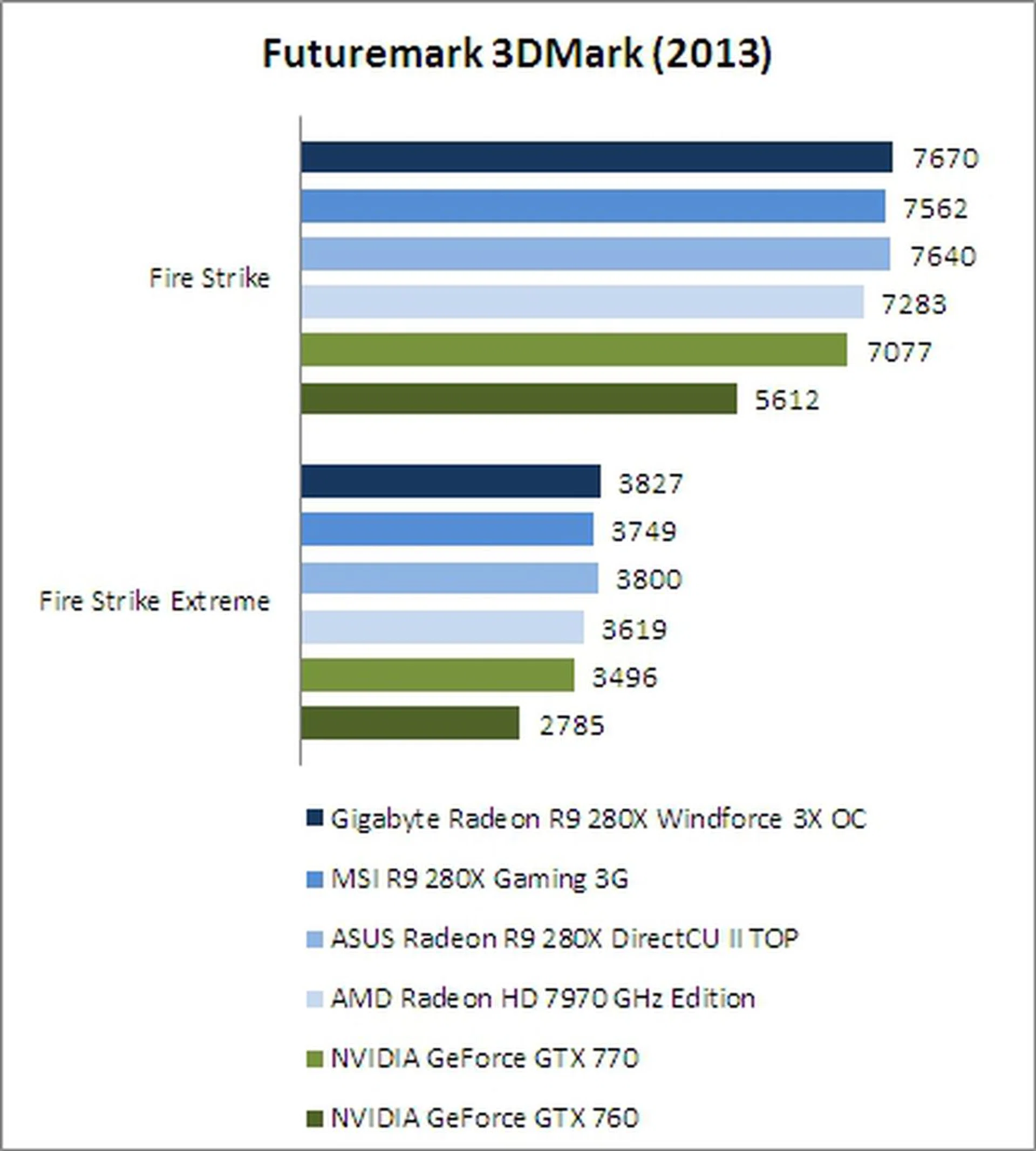
Futuremark's DirectX 11 based 3DMark 2013 benchmark will put the cards through their paces with its Fire Strike and Fire Strike Extreme tests. They consist of extreme levels of tessellation and volumetric illumination, as well as complex smoke simulation using compute shaders and dynamic particle illumination.
As expected, the Gigabyte Radeon R9 280X Windforce 3X OC card pulled ahead of the rest. It managed to beat its closest competitor, the ASUS Radeon R9 280X DirectCU II TOP 3GB GDDR5 by less than 1%, with a ribbon-thin margin that range from 0.4- to 0.7%. Against the reference NVIDIA GeForce GTX 770, its winning margin was widened to the range of between 8- to 9%. This is in line with our expectations as the Gigabyte card has its GPU core boosted to 1100MHz after its BIOS update. When compared to our reference AMD Radeon HD 7970 GHz card, the Gigabyte card pulled ahead by almost 6%.
What it if we compared the Gigabyte card with the fastest available in the market? The ASUS ROG Matrix R9 280X Platinum managed slightly better figures at 7790 and 3885 points respectively for the Fire Strike tests. This translates to the ASUS ROG card being 1.5% speedier than the Gigabyte Radeon R9 280X Windforce 3X OC.
Crysis 3 Results
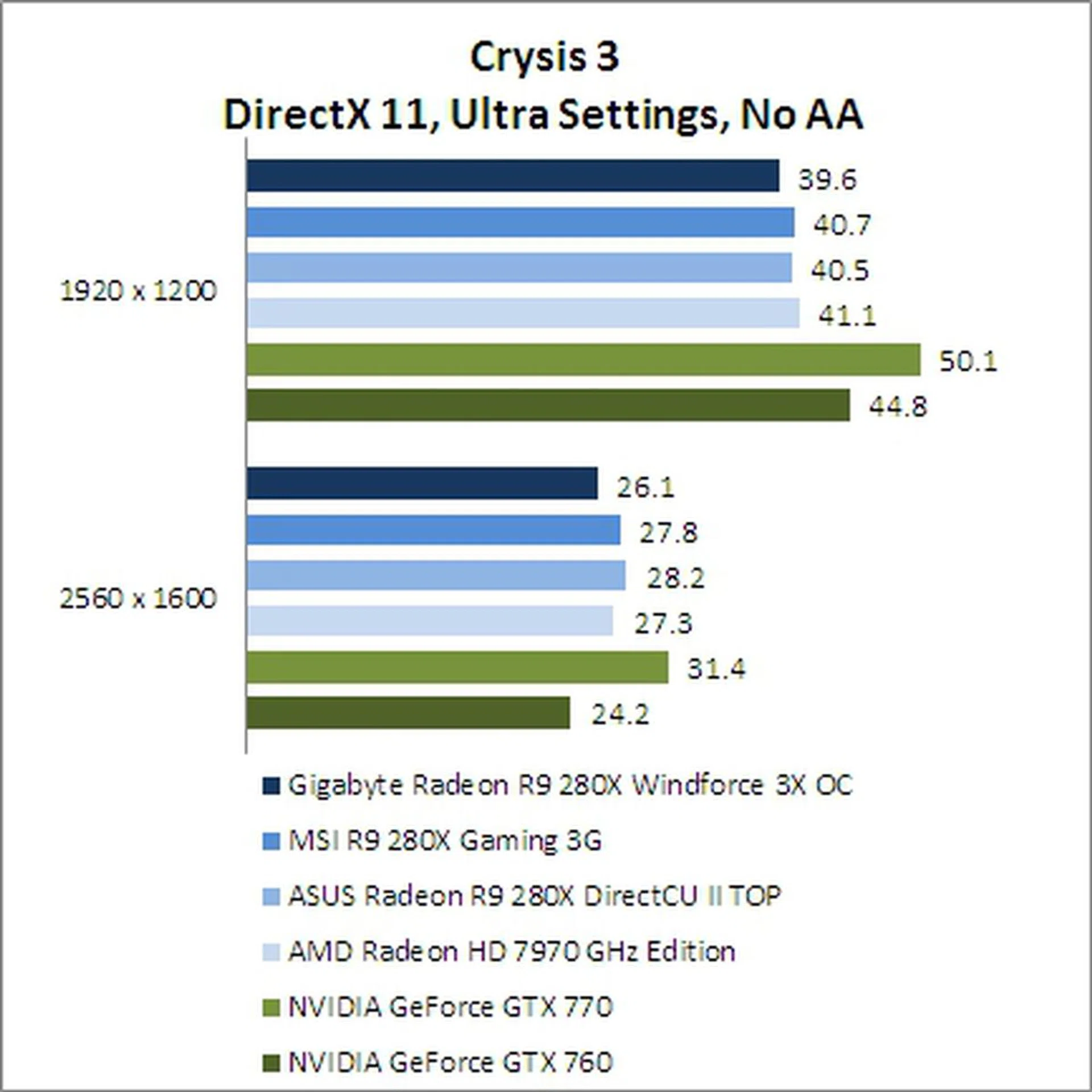
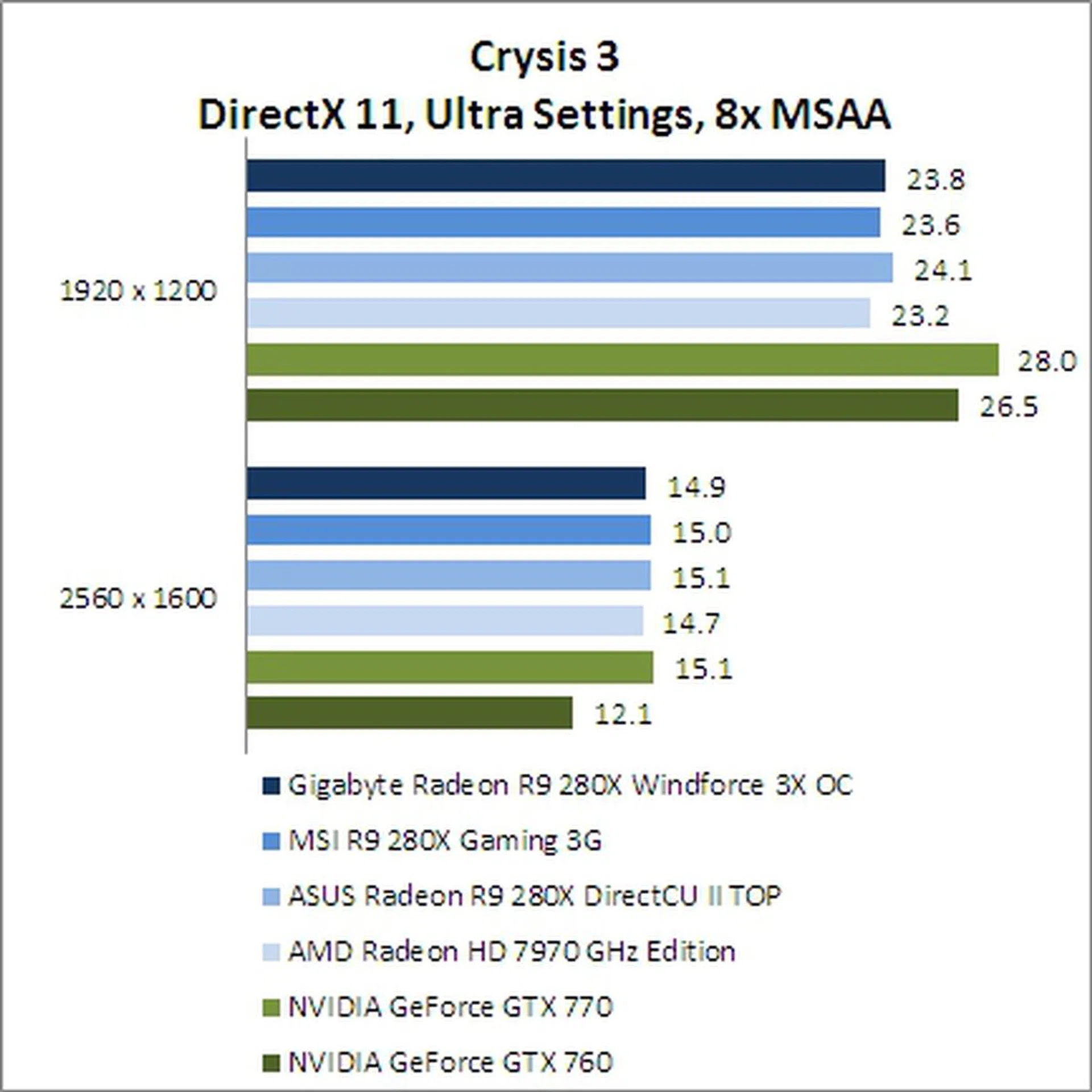
Next, we tested the cards with the Crysis game title, to ascertain their performance level while handling the CryEngine 3 of the game title.
The GeForce GTX 770 turned in the best overall performance. However, at the highest settings for this test; with anti-aliasing turned on, and the resolution set at 2560 x 1600 pixels, the ASUS R9 280X DirectCU II TOP card was actually on par with the GTX 770! The Gigabyte card turned in a score of 14.9fps, only barely beating the reference Radeon HD 7970 GHz edition card. The ASUS ROG R9 280X Platinum is still the best performing card with a score of 15.7fps!
Temperature Results
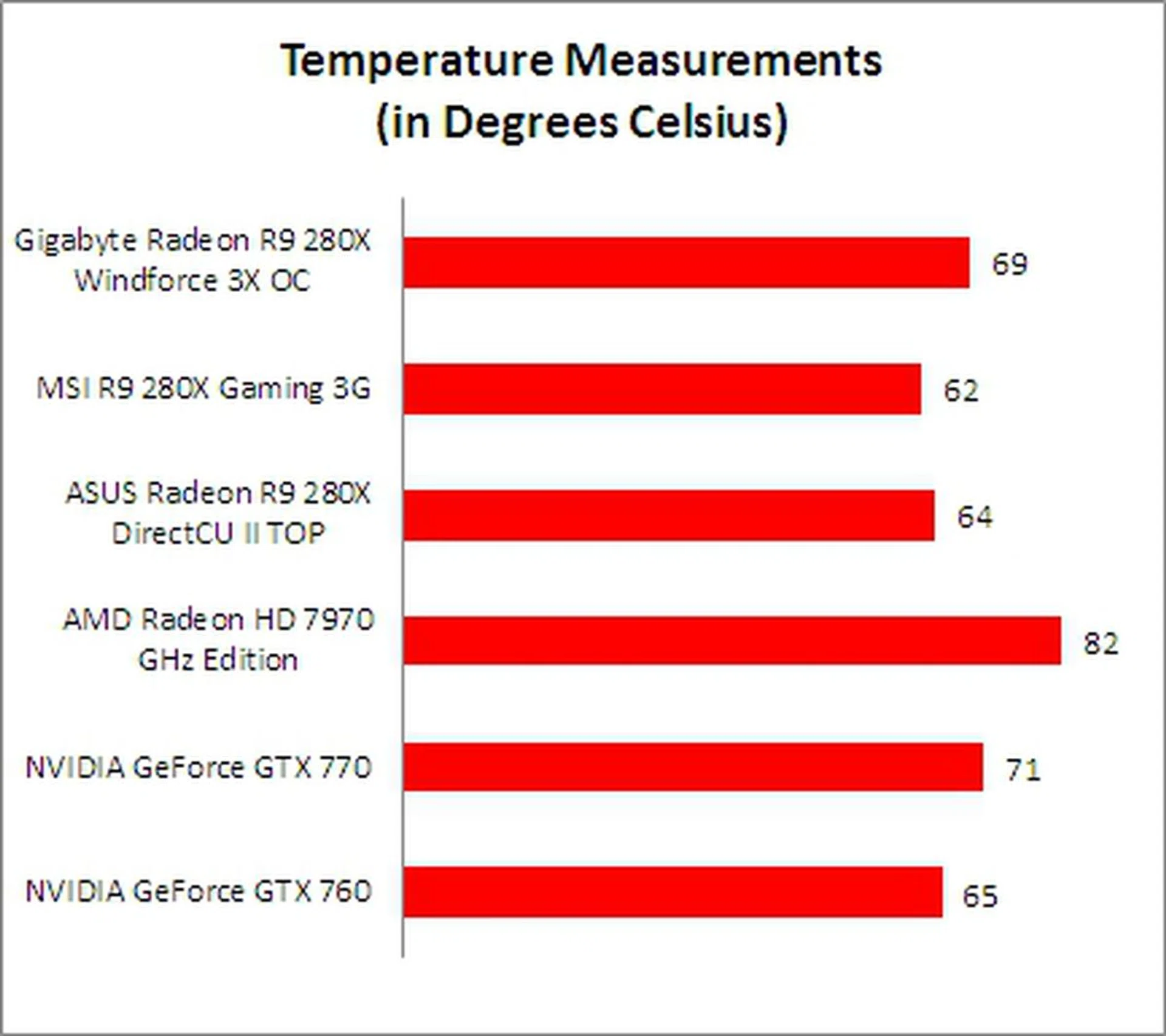
The Gigabyte card ran the hottest at 69 degrees Celsius. This is in line with our expectations as the card features an overclocked and overvolted GPU core. Surprisingly, the ASUS ROG R9 280X Platinum actually fares much better in comparison since it's clocked even higher.
Power Consumption Results
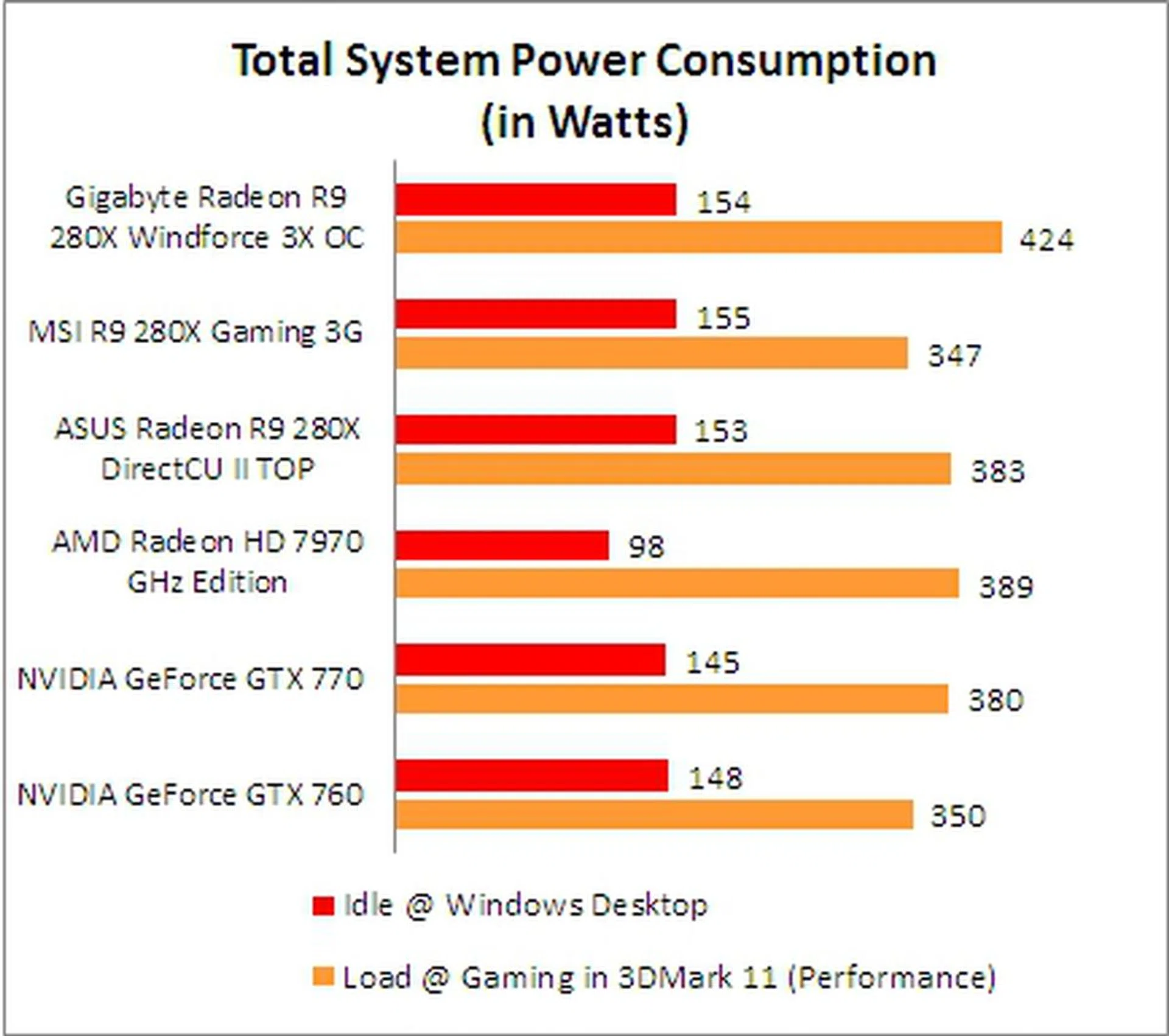
Not surprisingly, for the same reasons behind its high operating temperature, the Gigabyte card had a very high power draw of 424W during our tests. This time round, the higher clocked ASUS ROG R9 280X Platinum raked in the highest power consumption of any Radeon R9 280X graphics card we've tested to-date - 483W at load and 162W at idle.
Overclocking Results
During our overclocking exercise, we noticed that the GPU core of the Gigabyte R9 280X card was already overvolted, at roughly 1,240mV. As a result, we didn't attempt to increase it any further. This happens to be the same voltage level that we had used in past overclocking exercises of the other R9 280X cards. This confirms our earlier speculation that the new BIOS will push the card to perform at a higher level.
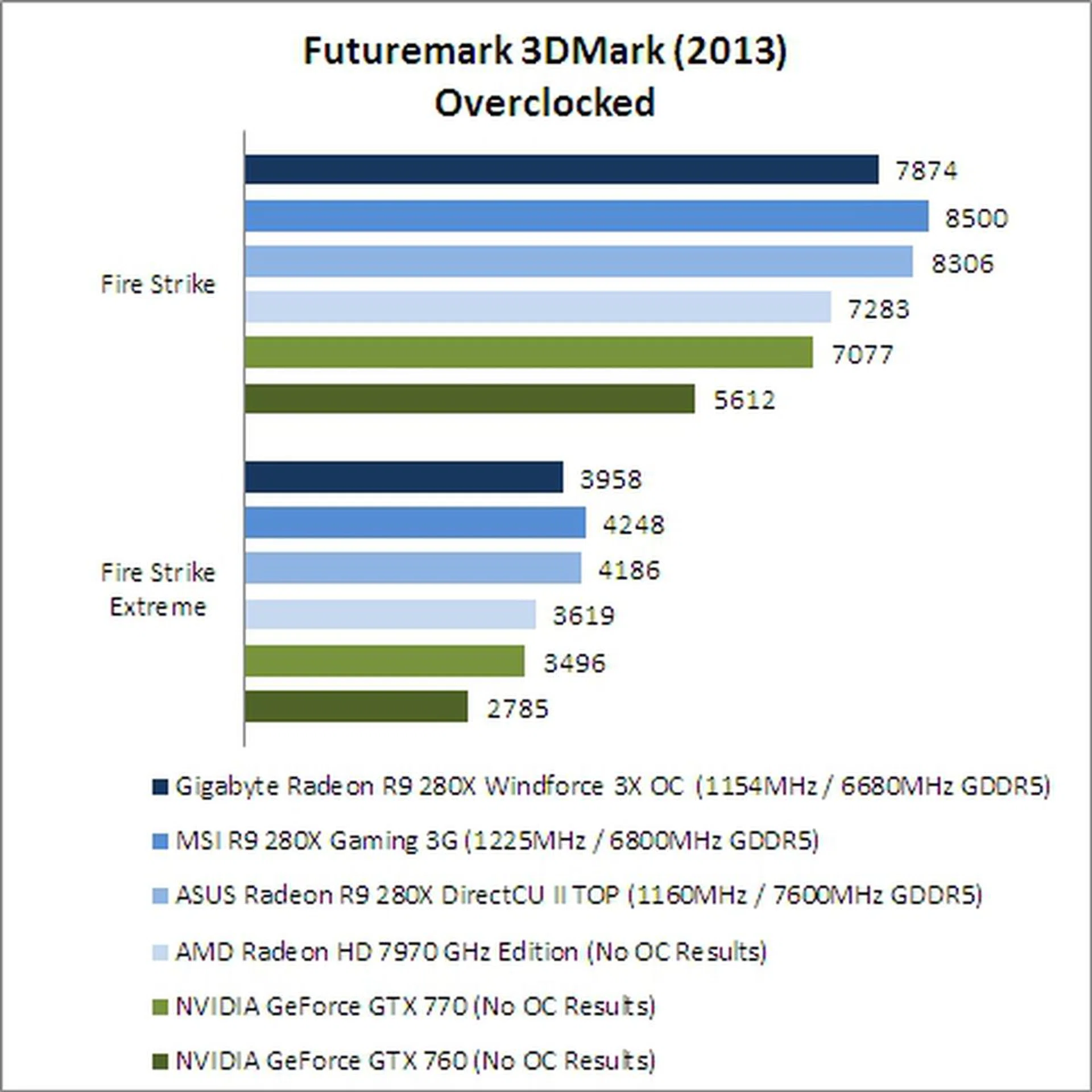
The overclocking headroom of the Gigabyte card was limited. We managed to increase the clock speed of the card's GPU core to 1154MHz, an increment of about 5% from its 1100MHz baseline value. For its memory modules, we managed to overclock them to an operating frequency of 6680MHz. Any attempts to push either higher resulted in the software crashes.
Unsurprisingly, the performance of the Gigabyte Radeon R9 280X Windforce 3X wasn't impressive due to its limited overclocking potential as opposed to its competitors. Against the higher overclocked MSI R9 280X Gaming 3G, the MSI card lead by a margin of 7.7- to nearly 8%. Against the ASUS card, Gigabyte card's fell behind about 5.5- to 6%. Needless to say, it was a fair bit behind the ASUS ROG R9 280X Platinum as well.
On a side note, the three fans operated without excessive noise when we ramped them up to operate at 100% (this is what we usually do to ensure there's nothing holding back our overclocking tests). In doing so, we noticed that they had the lowest operational noise levels when compared to the other cards we've tested. Unfortunately, this could also be a contributing reason to the card's higher operating temperature at stock speeds out of the box; consequently, the higher temperatures might also somewhat hamper extreme overclocking.
Conclusion
We had expected the Gigabyte Radeon R9 280X Windforce 3X OC card to have shown a stronger performance due to its overclocked graphics core out of the box.. In terms of raw clock speed, it was on par with the premier ASUS ROG R9 280X Platinum; however, the video memory modules of the ASUS card were overclocked while Gigabyte's memory was left to operate at reference clock speeds. Against its R9 280X peers that are in the same price range, the Gigabyte's core had the highest clock speed of 1100MHz. This helped it pull away from the pack slightly in our 3DMark benchmarks, but when it came to an actual game test, the card lagged behind on most occasions. It was also handily outclassed by the competition when it came to overclocking potential.
One of the main strengths of the card is its attractive price point of S$449. The card is also backed by a three-year limited warranty from CDL Trading, Gigabyte's local authorized distributor. For the first year, the card is covered by a one-to-one exchange policy, in the event of any unfortunate manufacturing defects.
In addition, the card has two sets of BIOSes that will make it appeal to power users and system tweakers to toggle between performance modes. For example, when we updated the BIOS of the card, we kept one, the backup BIOS, at its factory defaults. As such, we were able to toggle between BIOSes to vary the performance of the card. The card is also bundled with a utility, OC Guru II, which will allow power users to tweak the card's settings with more finesse. The utility supports both GPU and memory overvolting. The usual useful features include monitoring of the card's vitals with display graphs, and the ability to save the card's settings into profiles for easy retrieval.
The Gigabyte Radeon R9 280X Windforce 3X OC card turned in an average performance, in comparison with the rest of the R9 280X-based cohort. However, it has an attractive price point of S$449 that might just seal the deal for some system upgraders.
Due to the factory overclocked state of the card, during our tests, it posted the highest operating temperature and power consumption levels. As a whole, the Gigabyte Radeon R9 280X is a decent catch for its attractive price point, but as we've tested, there are better options for just a little more. If you're able to overlook it shortcomings, the Gigabyte card will make a choice graphics purchase for a mainstream gamer looking to stretch his budget for a R9 280X-based gaming rig.
Do keep in mind that these cards are recommended for gamers who don't mind playing demanding PC game titles, with certain visual features lowered or turned off. For another point of consideration, those using monitors with a resolution of 1920 x 1080 pixels (Full HD), the Radeon R9 280X has more than enough power to meet all your needs. If you plan on driving a higher resolution monitor, you might want to consider a more powerful GPU like the Radeon R9 290X or the GeForce GTX 780 series for a a no-compromise gaming solution.
Our articles may contain affiliate links. If you buy through these links, we may earn a small commission.