
Exclusive: MSI R6870 Hawk - The Eagle Has Landed
MSI's "Hawk" tag is bestowed only on the company's finest mainstream cards. The newest card to receive the Hawk badge is the R6870 Hawk. Needless to say, we had to take a look at it for ourselves and find out if it was worthy.

The Eagle Has Landed
The recently launched might be hogging the limelight for now, but thanks to AMD’s swift response, in the form of price cuts, the Radeons are still holding their ground. And MSI is bringing further power to the Radeons, specifically the , with their extreme Hawk edition. For those who are familiar with MSI’s nomenclature, the “Hawk” tag is only bestowed on their best mainstream edition cards. Having said that, let’s take a look now at what makes the MSI R6870 Hawk so special.
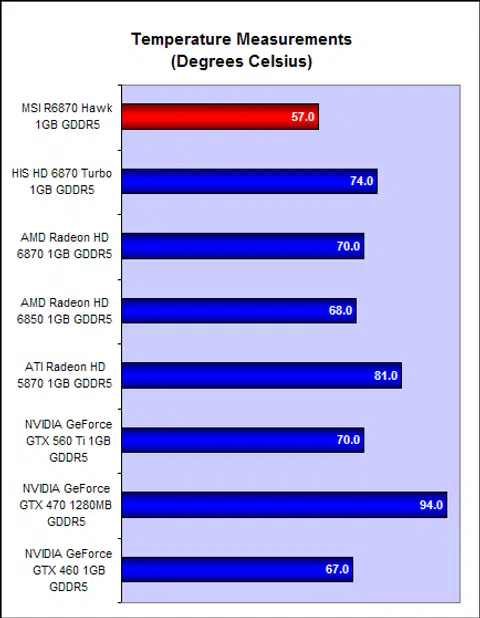
First and foremost, the MSI R6870 Hawk uses a new custom-designed Twin Frozr III cooler, which is an improved edition of the well proven and effective existing Twin Frozr II cooler. To further improve on the cooler’s design, MSI has also introduced “Propeller Blades” which they claim provides up to 20% more airflow over the standard Twin Frozr II design. We'll soon check out if this new design manages to keep the temperatures in check cooler than expected.
Custom cooler aside, the card also employs the use of MSI’s second generation Military Class II components. This suite of components include highly-conductive capacitors with tantalum cores, solid capacitors, and super ferrite chokes, all which help improve efficiency and power stability.
As MSI’s flagship Radeon HD 6870 card, the R6870 Hawk also comes overclocked, 930MHz at the core and 4200MHz DDR at the memory, which, is a tad too conservative for our liking considering a reference card is clocked at 900MHz at the core and 4000MHz DDR. A minor bump of 30MHz at the core and 200MHz DDR at the memory is too 'safe' for a Hawk-class product.
Fortunately, however, MSI touts the card as being extremely overclockable. Apart from the Military Class II components which helps in overclocking, the R6870 Hawk also has a 8 + 2 phase PWM power design, which is capable of delivering twice the current of reference cards - up to 160A.
All in all, the MSI R6870 Hawk is certainly pack full of high-end features and it’ll be interesting to see how it performs. But before we go further, here’s a quick look at the card itself.
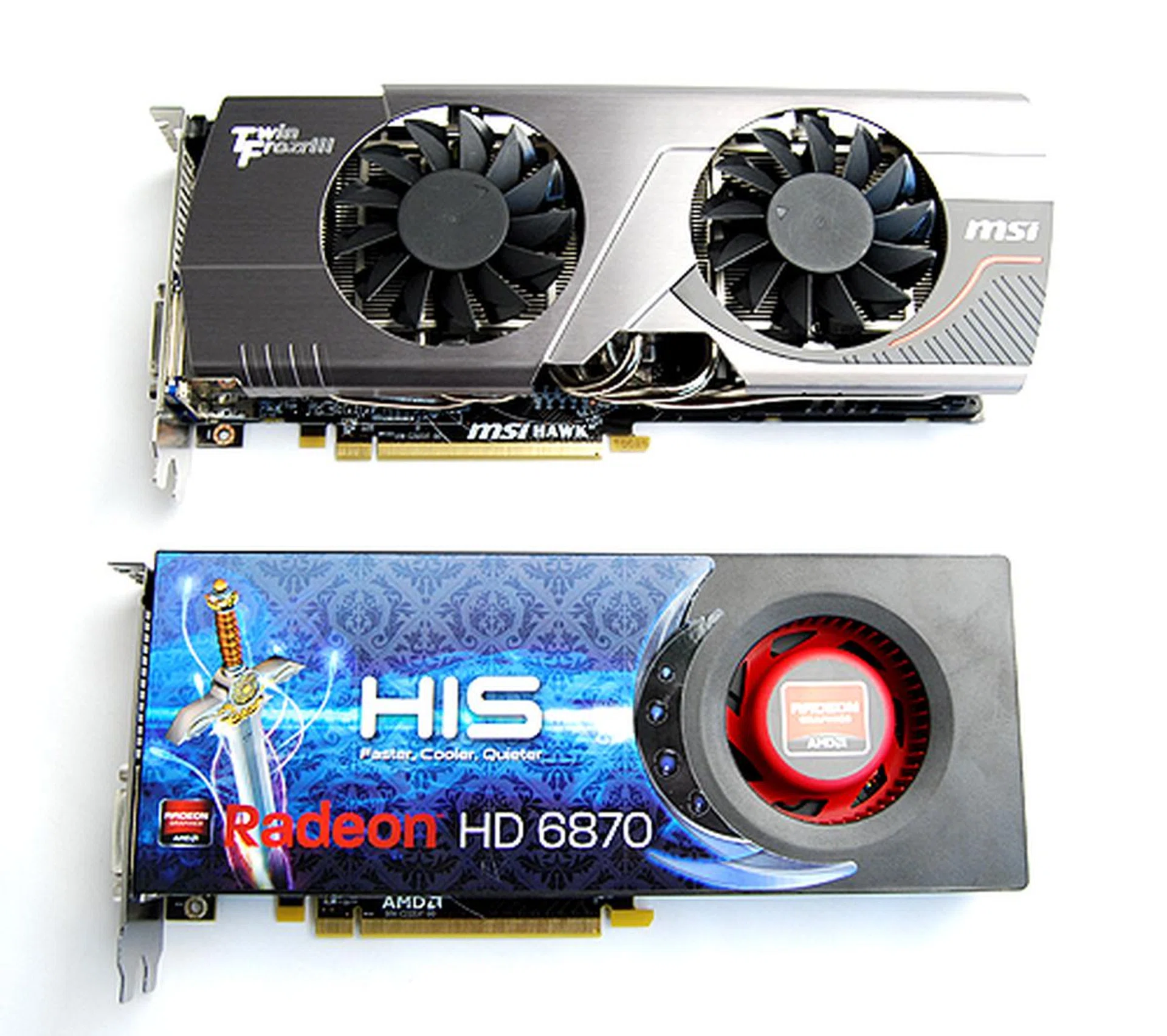
The MSI R6870 Hawk is about the same length as the reference card, but it looks much beefier thanks to its Twin Frozr III cooler.
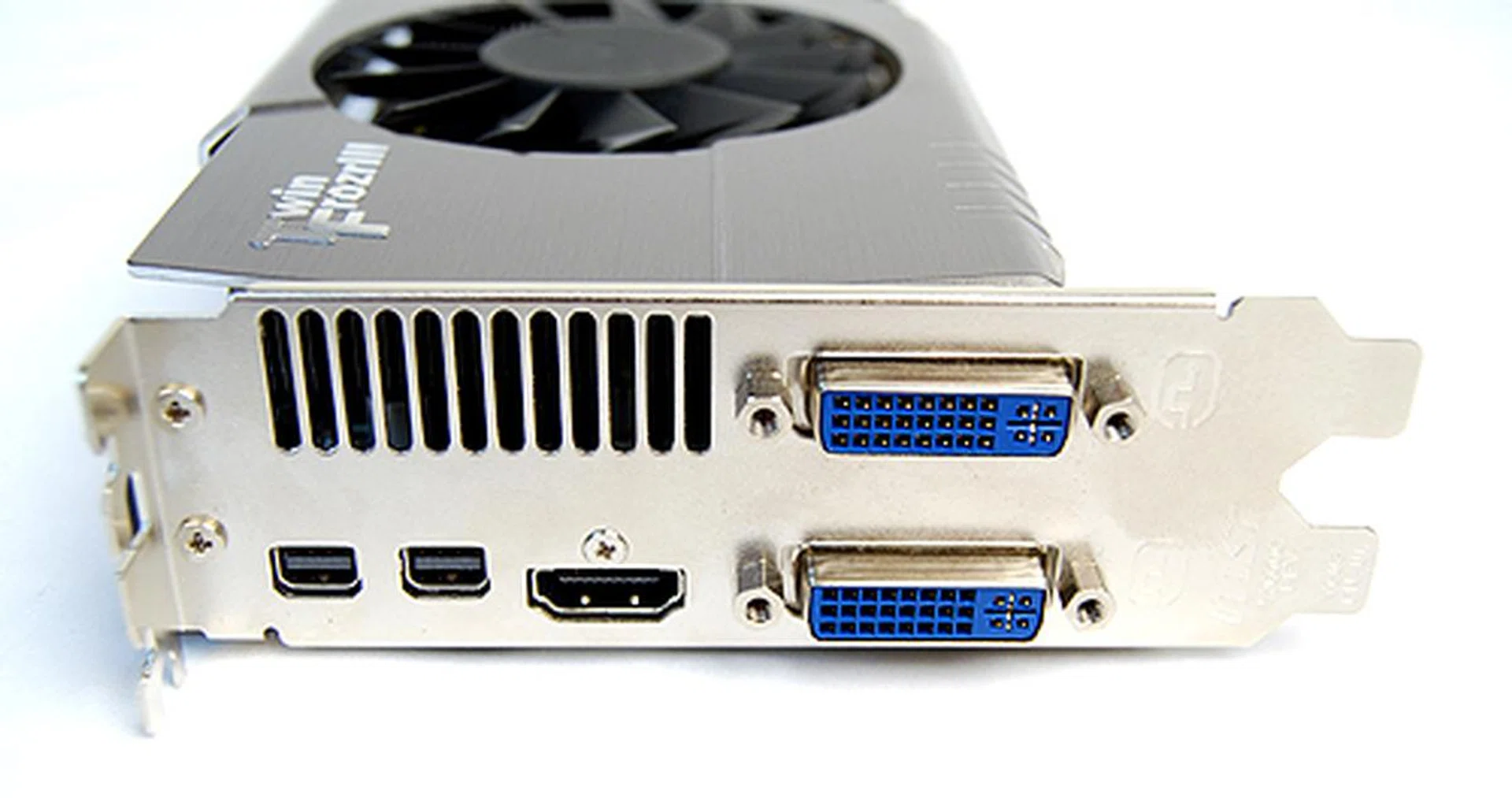
The card gets the usual twin DVI ports (one dual-link, one single-link), twin mini-DisplayPorts, and a single HDMI port.
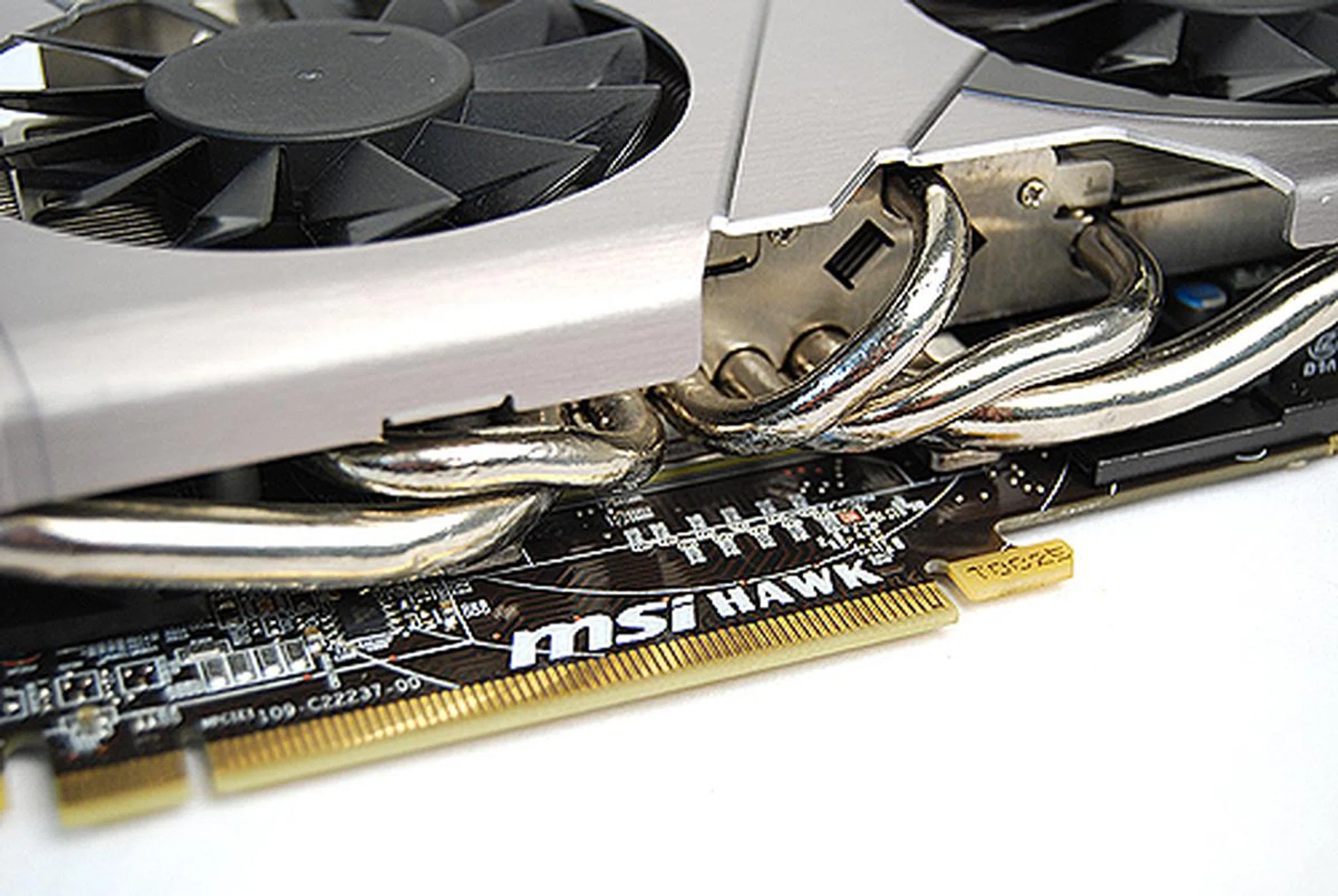
The Twin Frozr III cooler uses no less than five 8mm thick copper heat pipes to draw heat quickly away from the GPU core.
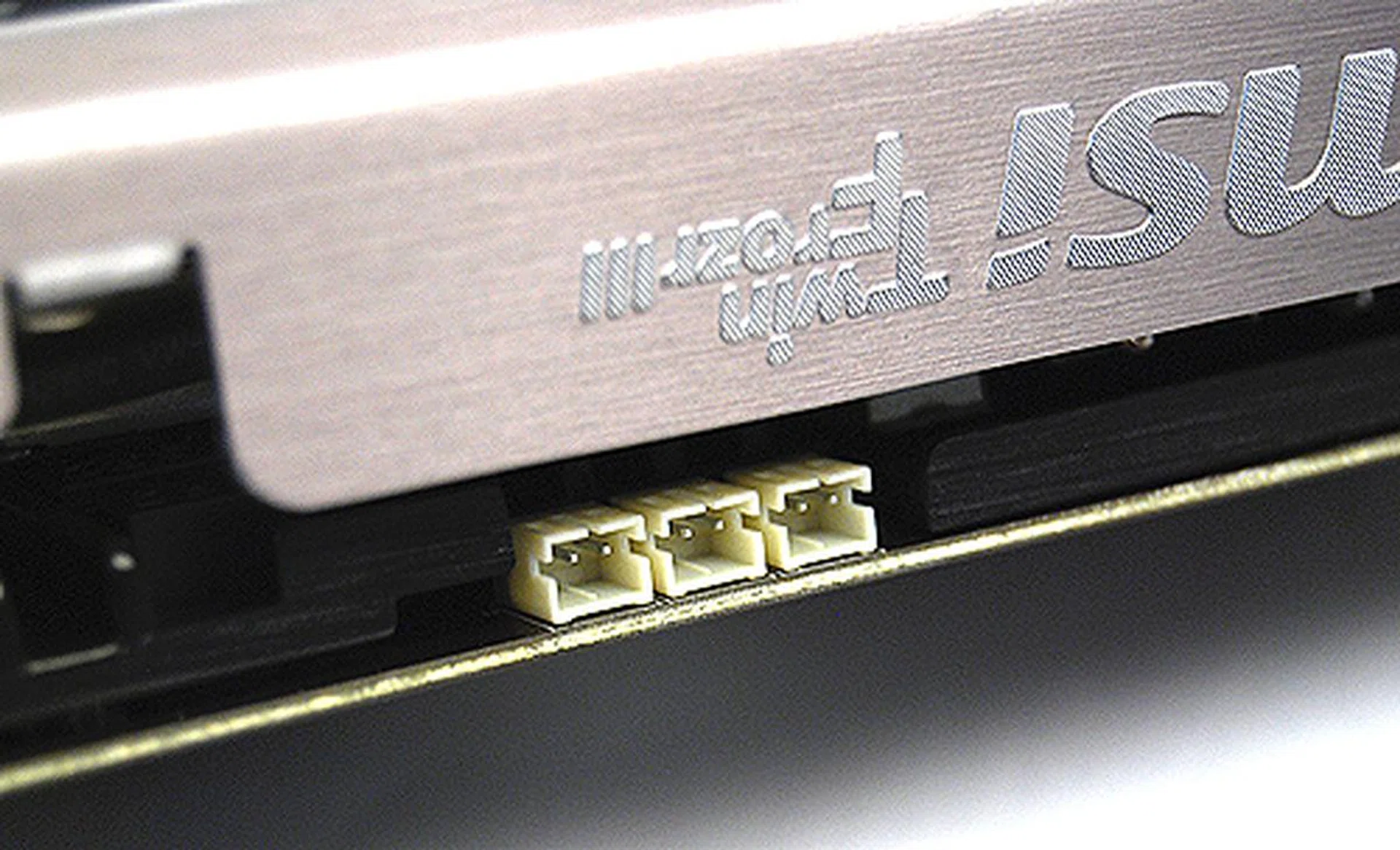
Vcheck points, a staple on "Hawk" graphics cards, allow users to accurately determine the voltage at the GPU core, memory and PLL.
Test Setup
To evaluate the MSI R6870 Hawk, we’ll be using our X58 setup with the following specifications:
- Intel Core i7-975 (3.33GHz)
- Gigabyte GA-EX58-UD4P motherboard
- 3 x 1GB DDR3-1333 G.Skill memory in triple channel mode
- Seagate 7200.10 200GB SATA hard drive
- Windows 7 Ultimate
Since the basic performance of the Radeon HD 6870 SKU has been established in our original Radeon HD 6800 series article and we've also furthered that with a Radeon HD 6870 CrossFire performance article, we've decided to cutback on the number of tests for this card rather than running the usual suite of benchmarking tests.
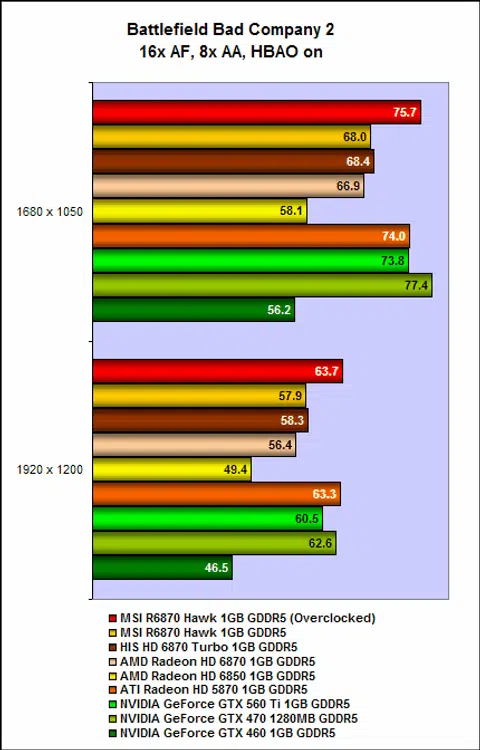
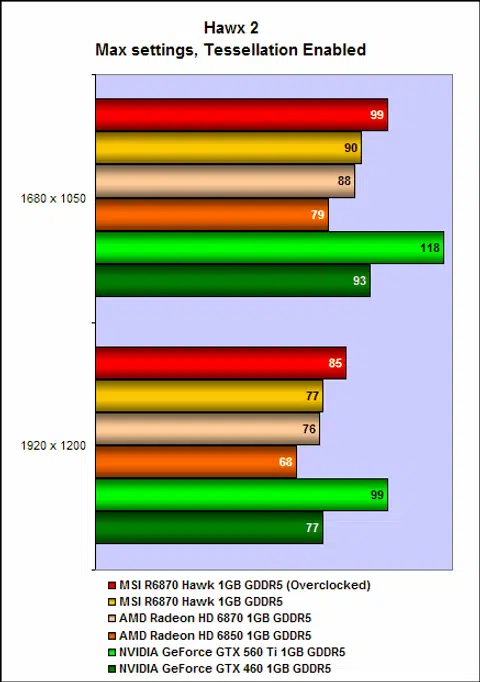
Also, since the MSI R6870 Hawk is touted for its overclocking ability, we will also present results of the card running in the highest overclocking state that we could attain to see how much more performance you can squeeze out of it.
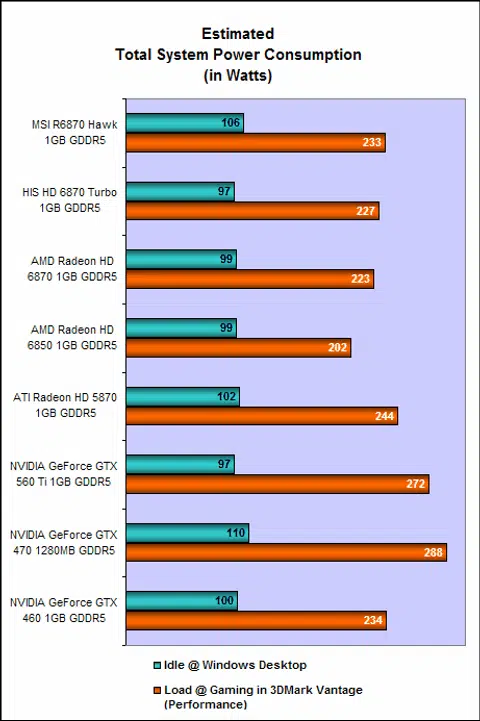
Hence, key comparisons here will be the R6870 Hawk in its highest overclocking state, its stock state, and of course, a reference Radeon HD 6870. We’ve also included results of the HIS HD 6870 Turbo, the last factory overclocked Radeon HD 6870 card we tested. Apart from raw performance, we are also interested to see how effective the custom cooler on the R6870 Hawk is.
The list of cards tested and their driver versions:
- MSI R6870 Hawk 1GB GDDR5 (Catalyst 11.1)
- HIS HD 6870 Turbo 1GB GDDR5 (Catalyst 10.10)
- AMD Radeon HD 6870 1GB GDDR5 (Catalyst 10.12)
- AMD Radeon HD 6850 1GB GDDR5 (Catalyst 10.12)
- ATI Radeon HD 5870 1GB GDDR5 (Catalyst 10.9)
- ATI Radeon HD 5850 1GB GDDR5 (Catalyst 10.9)
- NVIDIA GeForce GTX 560 Ti 1GB GDRR5 (ForceWare 266.56)
- NVIDIA GeForce GTX 470 1280MB GDDR5 (ForceWare 263.09)
- NVIDIA GeForce GTX 460 1GB GDDR5 (ForceWare 263.09)
The list of benchmark used are as follows:
- Futuremark 3DMark Vantage
- Futuremark 3DMark 11
- Crysis Warhead
- Far Cry 2
- Battlefield Bad Company 2
- Hawx 2
Results
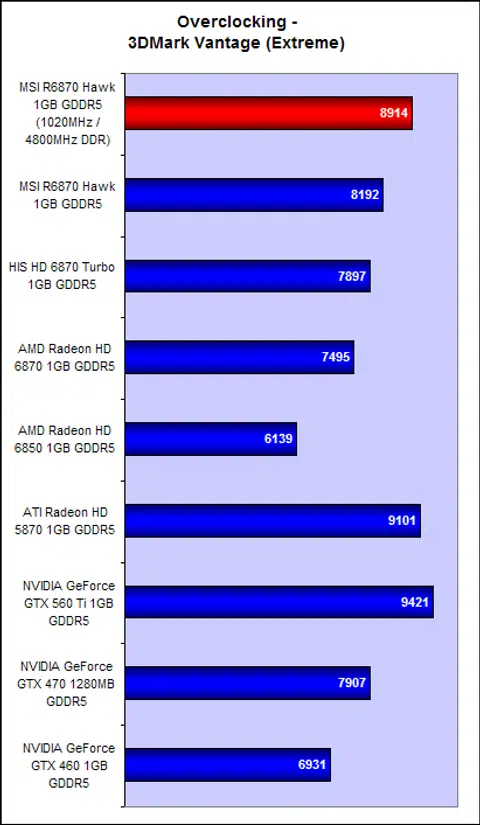
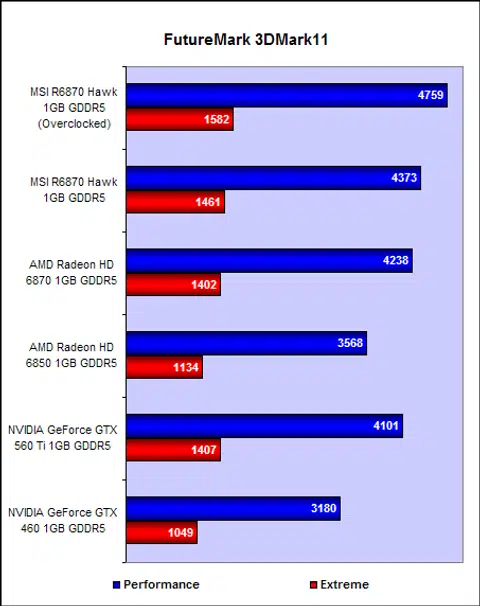
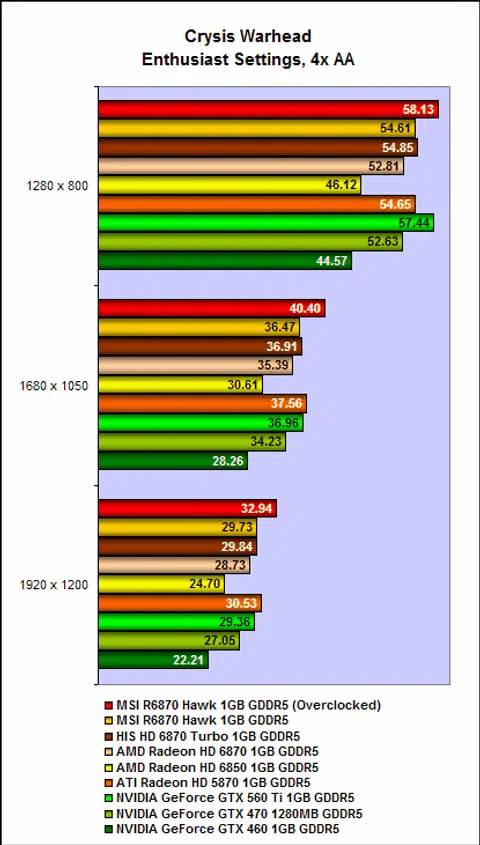
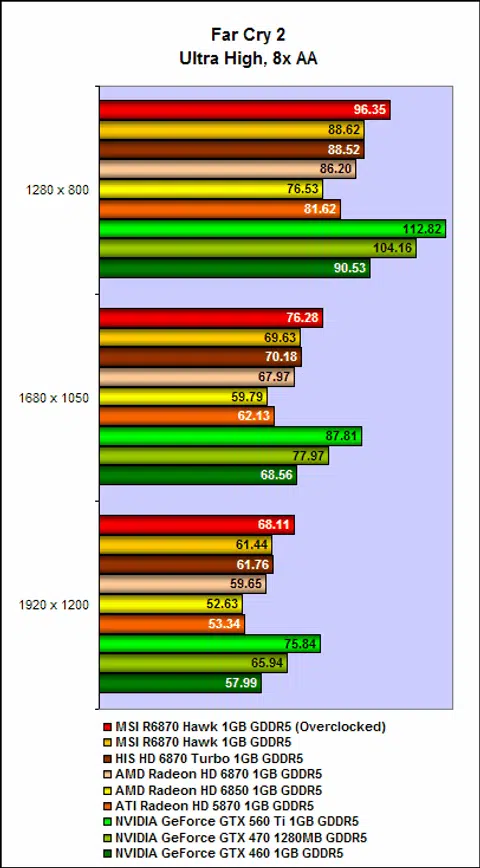
The following benchmarks had measurements taken only at the card's stock clocks:-
Unlocking Hidden Potential
Judging from our results, the MSI R6870 Hawk is not a card that you should use as provided out of the box. Allow us to explain.
In stock form, we found that it was only marginally quicker than a reference card, which is not surprisingly considering it only received an almost negligible 30MHz bump in core clock speeds, while memory clock speeds were completely untouched. This is disappointing because as a “Hawk” card and as the company’s flagship, we expected it to be substantially faster right out of the box.
However, the R6870 Hawk did reasonably well in our overclocking test as it managed to run stably at 1020MHz at the core and 4800MHz DDR - an increase of 90MHz at the core and 600MHz DDR. With these clock speeds, overall performance improved by around 7% to 10%, which is certainly significant, if not impressive.
Much of its great overclockability has to do in no small part with the assortment of components such as solid capacitors and super ferrite chokes which MSI has added to make the card run more efficiently and stably. Also, the Twin Frozr III cooler was supremely effective as we recorded a maximum temperature of only 57 degrees while the card was under heavy load (at stock clock speeds).
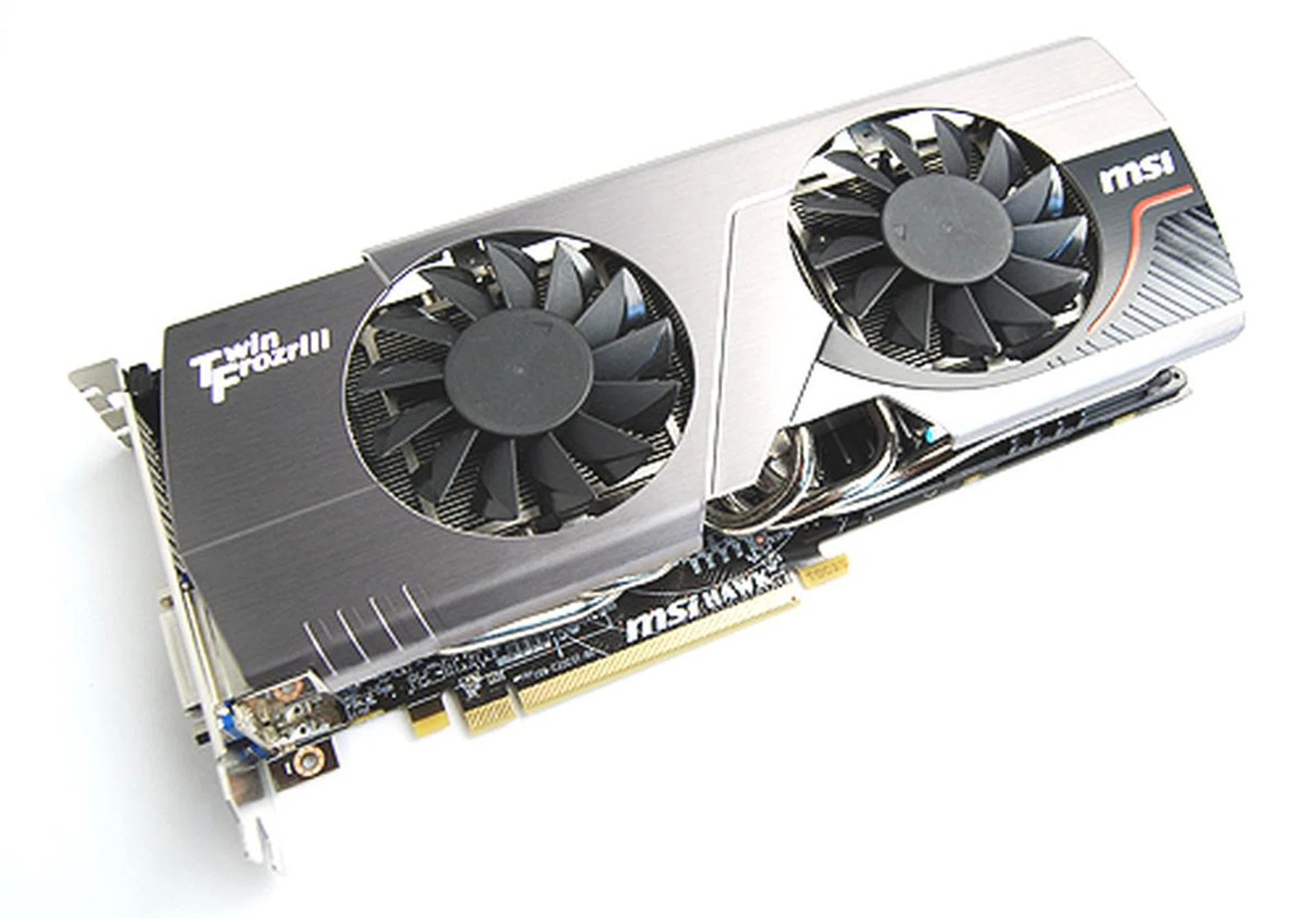
The R6870 Hawk is really one for the enthusiast who wants to push the boundaries of what is possible with the Barts XT chip.
All in all though, the MSI R6870 Hawk is not for those who want a fast card out of the box, for there are faster alternatives. That said, the MSI R6870 Hawk does redeem itself for being massively overclockable. Bearing in mind our clock speeds were achieved using no more than the Twin Frozr III cooler that came with the card, we are confident that enthusiasts with more aggressive cooling setups will achieve even better results with the R6870 Hawk.
According to MSI, the R6870 Hawk will be priced locally at S$395, which costs about the same as the Twin Frozr II version and about S$10 to S$20 more than other regular Radeon HD 6870 cards. Whether this premium is worth it or not depends very much on the user, because as it is out of the box, the R6870 Hawk is underwhelming, but if you have the know-how and tools to push it to the limits, the R6870 Hawk will reward the user with excellent overclocking performance.
Our articles may contain affiliate links. If you buy through these links, we may earn a small commission.