
AMD's Fastest Dual-core - Phenom II X2 555 BE
AMD starts the new year with a number of new processors spanning its range of dual, triple and quad-cores. Among them is the Phenom II X2 555 'Black Edition', the fastest dual-core in its lineup. With 6MB of L3 cache and a 3.2GHz clock speed, can this dual-core change AMD's fortunes?

AMD's Incremental Update
With a volley of its new Clarkdale Core i3/i5 processors, Intel has fired the first shots of 2010. It just so happens that with its cheapest Core i3 desktop processors starting from US$113 and AMD's competing products (with the exception of the Phenom II X4 processors) mostly falling below that price, Intel appears to have missed the mark.
To illustrate this point, AMD has responded with its own lineup of new processors that avoid competing with Intel's newest. New in the sense that these are models that have just been released but the less charitable will find nothing much new about them. What one finds is a minor clock speed bump of 100MHz for most of these models, which probably explains why AMD has merely incremented the model numbers by "5". So the Athlon II X4 630 (2.8GHz) that we covered previously gets a new sibling, the Athlon II X4 635 (2.9GHz).
Below are the new processors from AMD, which includes a new, low-power Phenom II X4, the 910e, which has a significantly lower rated TDP than all the others shown here, despite being a proper Phenom II class. It will also set you back by quite a premium for the power savings.
New AMD Processors | ||||||
Processor Model | Clock Speed | L2 Cache | L3 Cache | Max TDP (W) | Retail Price (US$) | Availability |
AMD Phenom II X4 910e | 2.6GHz | 2MB | 6MB | 65 | 169 | Now (PiB) |
AMD Phenom II X2 555 BE | 3.2GHz | 1MB | 6MB | 80 | 99 | Now (PiB) |
AMD Athlon II X4 635 | 2.9GHz | 2MB | Nil | 95 | 119 | Now (PiB) |
AMD Athlon II X3 440 | 3.0GHz | 1.5MB | Nil | 95 | 84 | Now (PiB) |
AMD Athlon II X2 255 | 3.1GHz | 2MB | Nil | 65 | 74 | Now (PiB) |
While the new processors span across AMD's dual, triple and quad-core offerings, our interest today has to do with the dual-core Phenom II X2 555 'Black Edition'. We did not get the opportunity to test the Phenom II X2 550 BE when it came out last year but AMD has finally sent us the new 555, which is based on the same core as the 550 (with a 100MHz bump), making it the fastest dual-core in AMD's lineup. This also leaves the Phenom II X2 family with two processors currently:
The Phenom II X2 Family | ||||||||
Processor Model | Clock Speed | L2 Cache | L3 Cache | HyperTransport Bus | Memory Controller Speed | Max TDP (W) | Retail Price (US$) | Availability |
Phenom II X2 555 BE | 3.2GHz | 512KB x 2 | 6MB | 2.0GHz | 2.0GHz | 80 | $99 | Now (PiB) |
Phenom II X2 550 BE | 3.1GHz | 512KB x 2 | 6MB | 2.0GHz | 2.0GHz | 80 | $91 | Now (PiB) |
While the Phenom II X2 core is known as Callisto, you may have noticed the hefty 6MB L3 cache on it, similar to what's found on the Phenom II X4. AMD is indeed taking the time-tested route of locking two cores on those Phenom II X4 processors which didn't make the grade and selling them as dual-core Phenom II X2.
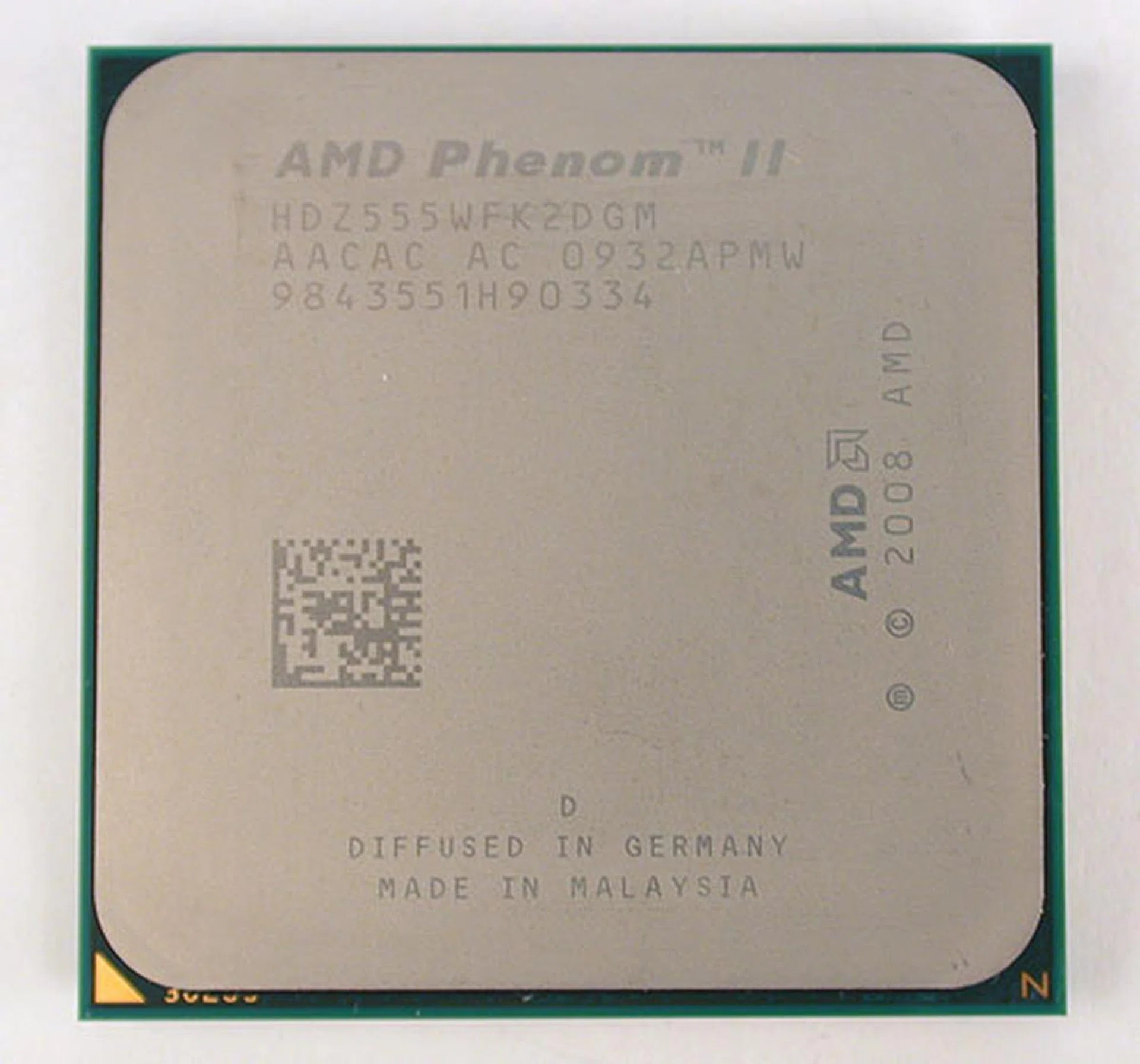
The Phenom II X2 555 'Black Edition' runs at 3.2GHz at default, the fastest among AMD's current dual-core processors.
Obviously, this also means that enthusiasts or anyone with some basic Google skills can find out how to unlock these processors to its full four cores. And it involves nothing more challenging than a BIOS update for most cases. This forum thread for example has a list of possible working motherboards and BIOSes, though luck is a factor when unlocking the chip.
Based on the original selling price of around US$99 for the Phenom II X2 550 BE, that means one can potentially get a Phenom II X4 for around two-thirds the price. With the new Phenom II X2 555 BE debuting at US$99 and running at 3.2GHz, a full unlock will give one an equivalent of a US$166 Phenom II X4 955 BE. We're pretty confident that more than a few enthusiasts would try this and we will be exploring that possibility in the near future. But how does the Phenom II X2 perform in its original state? More on that in the next few pages.
** Updated as of 29th Jan, 2010 **
After our review, we went back to the Phenom II X2 555 BE and tried to unlock the cores based on observations noted online. While the process is relatively pain-free, involving a couple of BIOS settings (Automatic Clock Calibration mainly) at most, our headaches involved flashing the BIOS.
It sounds trivial right? Nothing could be more simple than flashing the BIOS nowadays with Windows-based utilities and even utilities from within the BIOS. Well, our first candidate was the ASUS M4A79T Deluxe and we wanted to use the official 1801 BIOS. So we went into ASUS' EZ Flash 2 utility and started the process. Everything appeared normal until the system rebooted and never came back.
We were confronted with a black screen and no way of recovery short of changing the BIOS chip since ASUS' recovery tool relied on a utility on its motherboard DVD that failed to work for us.
So we tried another board, the Biostar TA790GX A3+. We used a modded BIOS which supposedly supported the new processor and the capability to unlock it. Unfortunately, while the flashing was completed successfully, the board was dead after the restart. It's definitely a lesson learnt on trying unverified BIOS online. It's not too bad of an issue for us, but for end-users, the risks are just too high.
Third time lucky and all that, we decided to use another ASUS board, the M4A78T-E, an AMD 790GX board. It required a particular official BIOS (1402) to get the unlock and so we used EZ Flash again, which worked this time. We had no issues after the usual reboot. Unfortunately, the unlocking was unsuccessful. We followed the instructions and even despite our attempts to increase the voltages and lower the memory timings, the CPU-Z screen refused to report more than two cores.
As the various warnings on those unlocking guides attest, unlocking these AMD processors is not a slam dunk. We are probably unlucky in getting a sample that didn't work. If you really need a quad-core, we suggest you get a proper one rather than try this ghetto method. Not to mention the possible ill luck with BIOS flashing and it could turn out to be more costly than you thought.
** Updated as of 25th Feb, 2010 **
Ironically, while testing the Phenom II X2 555 BE further, we found that the motherboard in our test setup, the MSI 790FX-GD70 did have a new 'Unlock CPU Core' option with an update to BIOS version 1.8. Upon rebooting with the option enabled, the Phenom II X2 555 BE was found to be unlocked, with CPU-Z identifying it as the Phenom II X4 B55. A quick run through our benchmarks produced very similar scores as the similarly clocked Phenom II X4 955 (3.2GHz) so effectively, you're getting a quad-core for cheap with this method.
Test Setup
Like our review of the AMD Athlon II X4, it's difficult getting the modern comparisons for the Phenom II X2 555 BE. Intel has largely left the lower priced segments to its older Core 2 processors and recently the Clarkdale based Pentium G9650. Since we don't exactly have some of these processors lying around in our lab, we had to make do with the ones we tested for the Athlon II X4 review, namely the Core 2 Quad Q8200 (US$160) and the Pentium Dual-Core E6500 (US$87). Of course, we'll also compare the Phenom II X2 555 BE with the Athlon II X4 630 and 620. With the release of the Athlon II X4 635, the Athlon II X4 630 has been reduced in price to US$99, the same price as the Phenom II X2 555 BE, so that makes for an interesting comparison point too.
By downclocking the Phenom II X2 555 BE, we have obtained the results of the Phenom II X2 550 BE for reference. Two systems (AMD and Intel), with similar amount of memory and the same graphics card and hard drive are used to keep the results comparable in our benchmarks. Both were running Windows XP SP2. The full system configurations are:
AMD System Test Configuration
- CPU - Phenom II X2 555 BE, 550 BE; Athlon II X2 630, 620
- MSI 790FX-GD70 (AMD 790FX + SB750)
- 2 x 1GB Kingston HyperX DDR3-1333 (7-7-7-20)
- Seagate Barracuda 7200.10 200GB SATA hard drive (one single NTFS partition)
- Zotac GeForce GTX 260 (ForceWare 178.24)
- Microsoft Windows XP Professional with Service Pack 2
Intel System Test Configuration
- CPU - Core 2 Quad Q8200, Pentium Dual-Core E6500
- ASUS P5E3 Deluxe (Intel X38 Express chipset)
- 2 x 1GB Kingston HyperX DDR3-1333 memory modules (CAS 7-7-7-20)
- Seagate Barracuda 7200.10 200GB SATA hard disk drive (one single NTFS partition)
- Zotac GeForce GTX 260 (ForceWare 178.24)
- Microsoft Windows XP Professional with Service Pack 2
- Intel INF 8.3.1.1009 and Matrix Storage Manager 7.8.0.1012
Benchmarks
The following benchmarks were used in this review:
- BAPCo SYSmark 2007 Preview (ver 1.05)
- SPECCPU 2000 v1.3
- Futuremark PCMark 2005 Pro
- Lightwave 3D 7.5
- 3ds Max8 (SP2)
- Cinebench 10
- Futuremark 3DMark06 v1.1
- AquaMark3
- World in Conflict v1.05
- Crysis v1.1
Results - SYSmark 2007 Preview
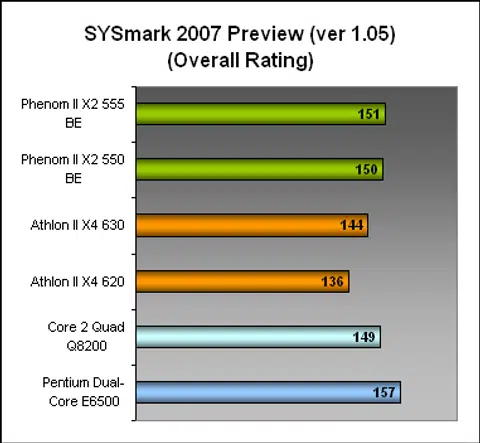
What can 100MHz buy you? Apparently, one measly point in SYSmark 2007. With the clock speeds of the Phenom II X2 processors at more than 3GHz, they were always going to have an advantage over the slower quad-core Athlon II X4 processors, not to mention the huge chunk of L3 cache missing on the Athlon II.
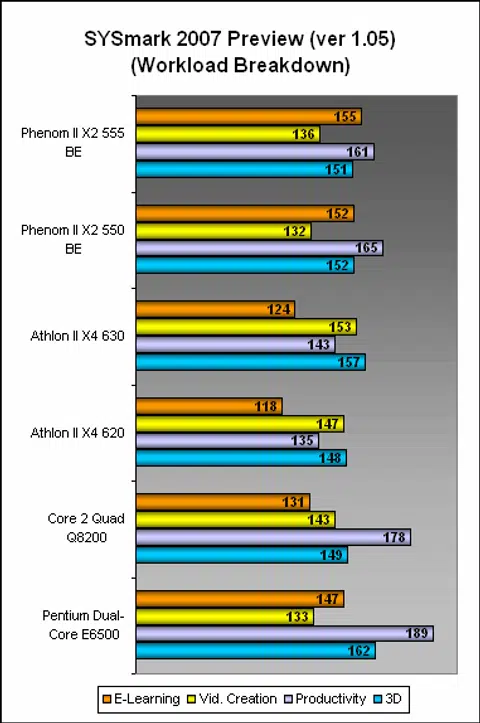
Looking at the breakdown, it's clear that the quad-cores have their strengths in video creation and 3D while falling behind the dual-core Phenoms in the other two segments. Again, it's not that surprising.
Results - SPECCPU 2000 v1.3
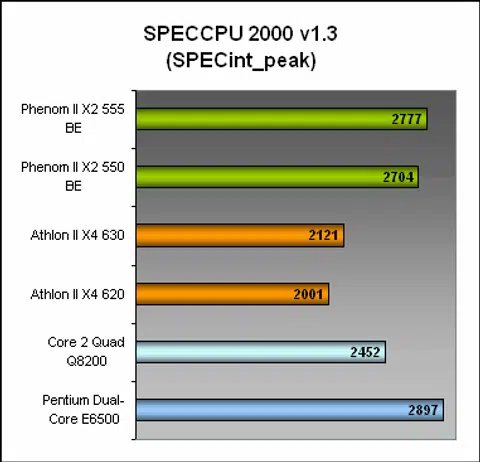
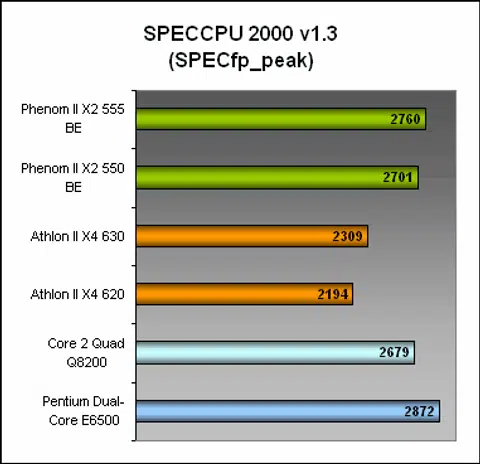
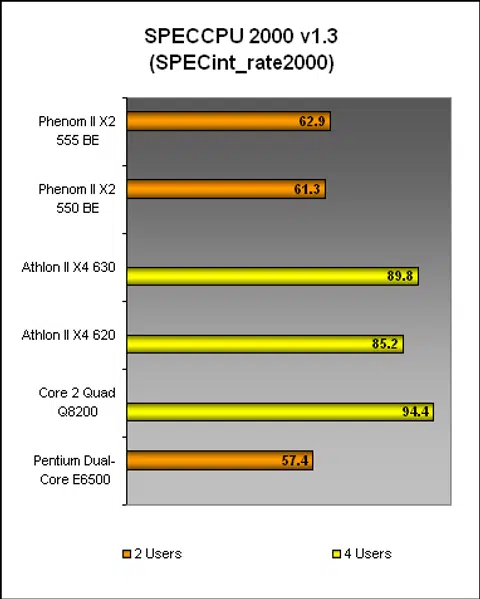
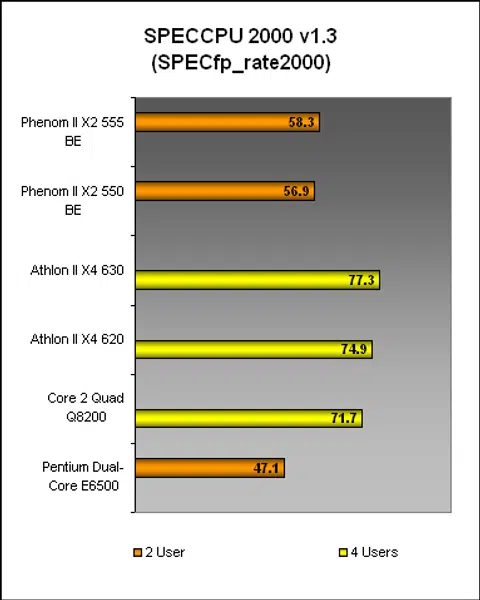
The 3.2GHz Phenom II X2 555 BE managed to do rather well for the peak scores in SPECCPU, helped no doubt by its clock speed. The competing Intel chips however were fairly aggressive too, especially the inexpensive Pentium Dual-Core. Of course, once we looked into the multi-user scenario with workloads doubled or quadrupled for the respective processors, the quad-cores rose to the top, with the Athlon II X4 series leading for floating point performance.
Results - Futuremark PCMark05 Pro
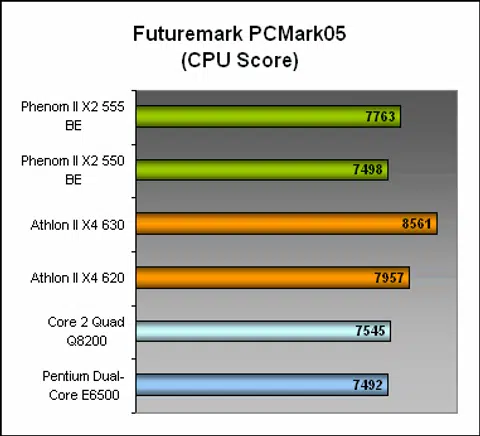
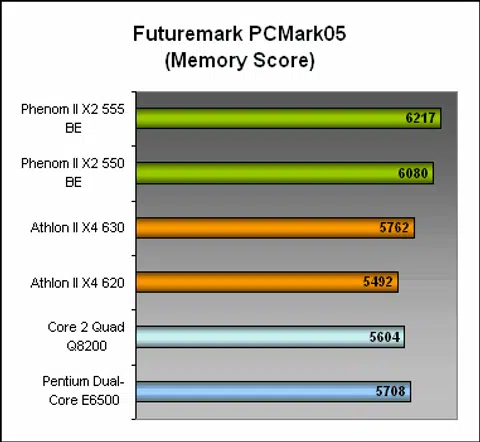
Since the CPU score in PCMark05 took into account the performance of all the cores, the quad-core Athlon II X4 CPUs were deservedly ahead of most of the other processors here. The Intel quad-core processor's relatively low clock (2.33GHz) is probably holding it back. When it came to the memory segment however, the Phenom II X2 series were back on top. It's quite likely that their high clock speeds and huge cache helped them in this test.
Results - Lightwave 3D 7.5
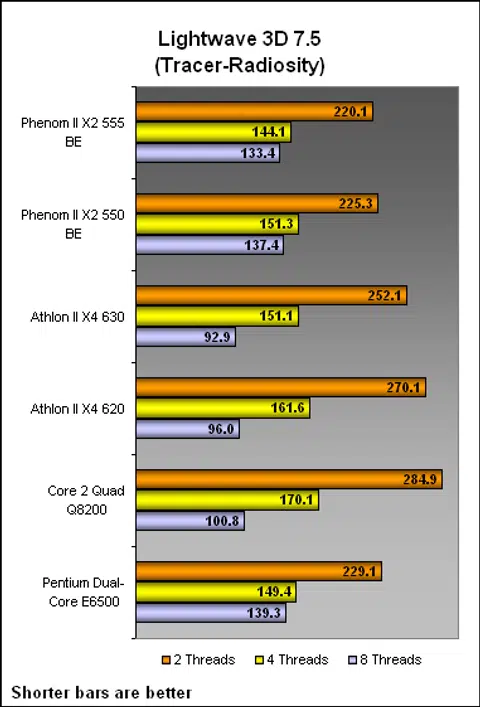
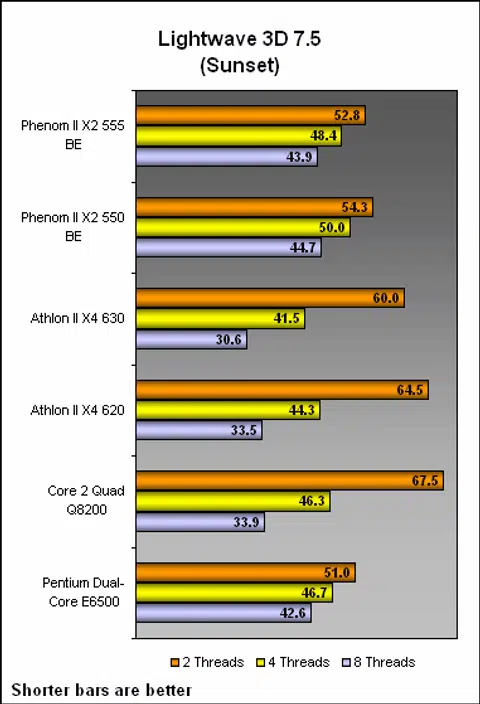
Clock speeds and cores played a major part in this rendering benchmark. As expected, the Phenom II X2 series was the faster set of processors when there were only two threads. Increase the number to four and their advantages were eroded, to the point that in Sunset, the Athlon II X4 CPUs were ahead.
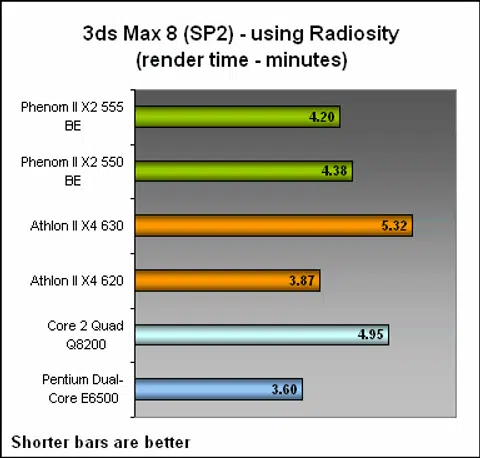
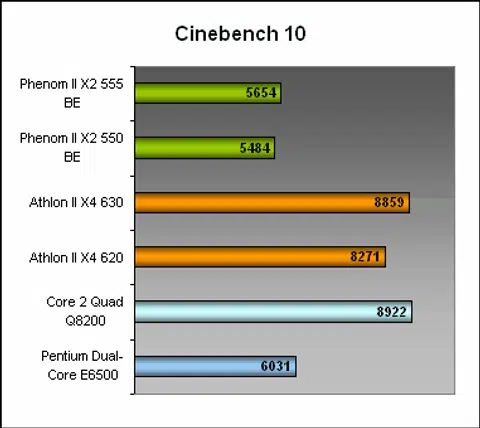
Results - 3ds Max 8 (SP2) and Cinebench 10
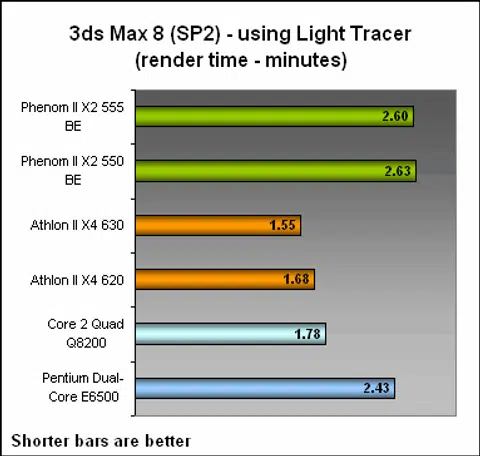
More rendering tests follow and they confirm our general impression of these Phenom II X2 processors. If your usage skews towards multi-threaded applications, then the locked Phenom II X2 is not for you.
Results - Futuremark 3DMark06 & AquaMark3
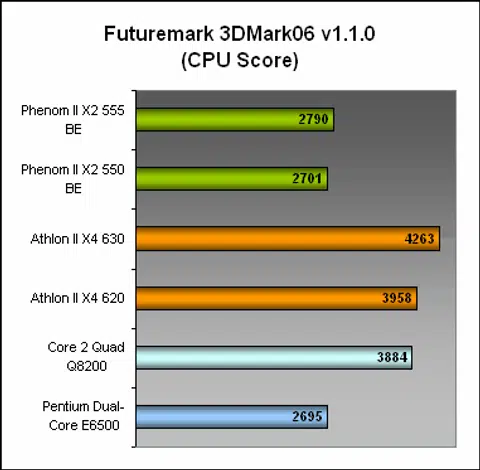
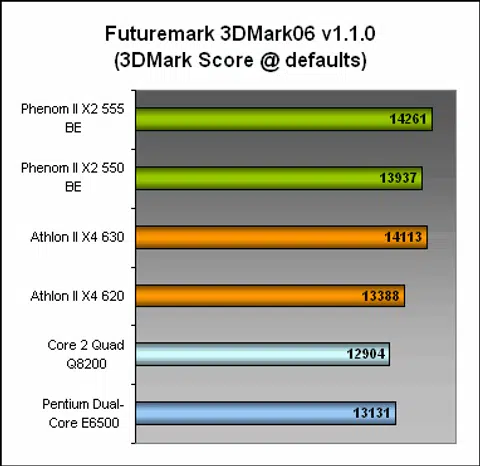
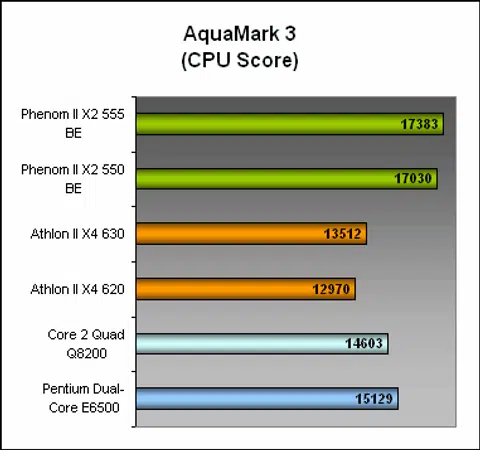
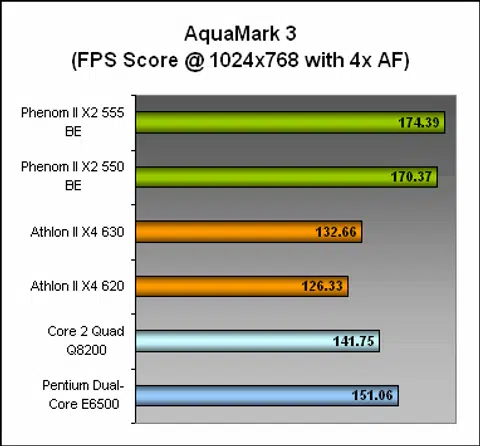
3DMark06's CPU score quite accurately reflected the fact that the Athlon II X4had more raw computing power than the dual-core Phenom II X2. Overall however, clock speed and cache size played an important role and helped the Phenom II X2 555 BE take the top spot. AquaMark3 meanwhile appeared quite fixated on the clock speed, which meant another win for the Phenom II X2 555 BE.
Results - World in Conflict & Crysis
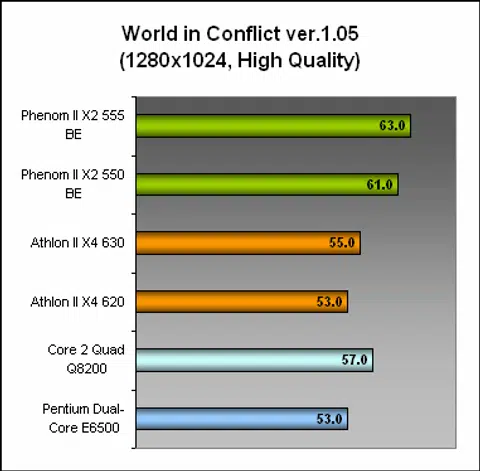
As one would expect from higher clocked processors, the Phenom II X2 processors were significantly faster in the first game we tested, World in Conflict. Whether it was due to the L3 cache or clock speeds, there was no doubt it was a combination of both that brought about their performance.
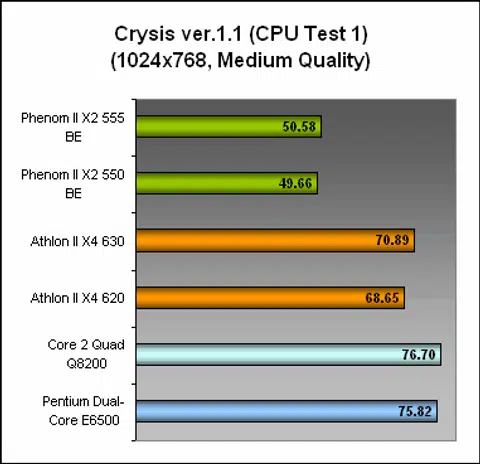
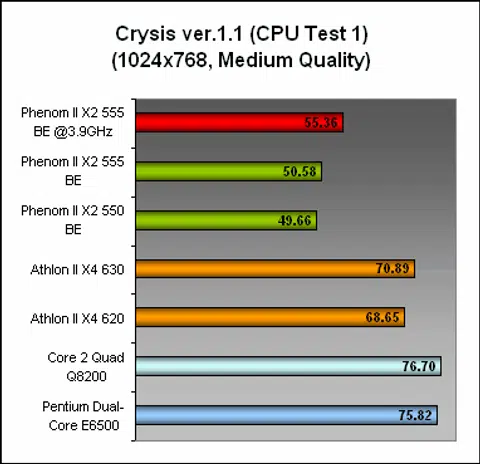
It was however not the case in Crysis, where the Intel processors ruled. While the Athlon II X4 CPUs were just about competitive with them, the Phenom II X2 surprised us by falling behind. While this was a CPU test that allowed the quad-cores to shine, we weren't expecting such a difference. Besides, the dual-core E6500 processor from Intel seemed to have no troubles keeping up.
Power Consumption
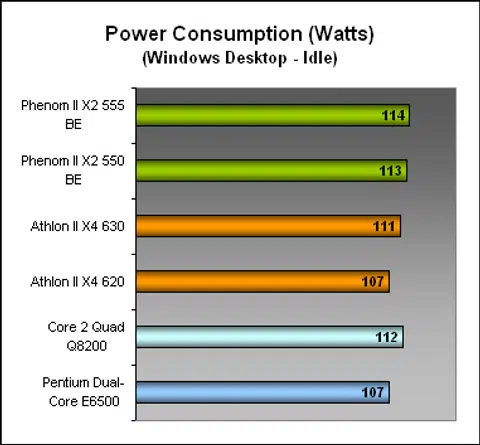
We are not sure if our sporadic issues with AMD's Cool'n'Quiet feature are due to the motherboard vendor or the AMD processor itself but for the Phenom II X2 555 BE and our MSI 790FX-GD70 motherboard (with latest version 1.8 BIOS), this feature did not appear to work as our processor stayed constantly at its rated frequency of 3.2GHz despite having Cool'n'Quiet and hardware C1E enabled in the BIOS.
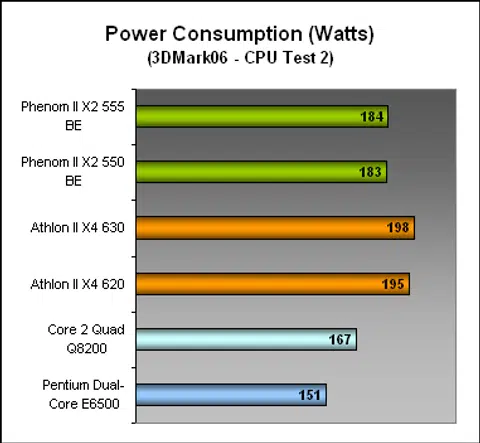
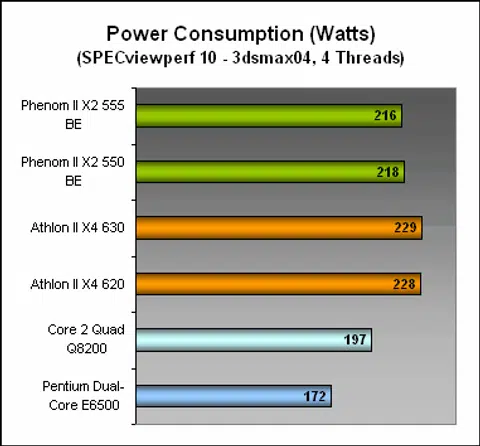
For this reason, the Phenom II X2 555 BE had slightly higher power consumption at idle despite its two cores. This situation improved somewhat once we started to load the system but compared to Intel's processors, the Phenom II X2 series are not the most energy efficient processors.
Overclocking
Without too much effort, we could get our Phenom II X2 555 BE to 3.9GHz. Voltage was mildly increased by a couple of steps to around 1.4V. Despite the clock speed increase, the frame rates in Crysis only went up by around five and the Phenom II X2 555 remained behind the quad-cores, which proved that Crysis indeed utilizes more than the usual two cores. That aside, you can take a guess how much more power hungry the processor is in this overclocking state; this has never been a shining area for AMD unfortunately.
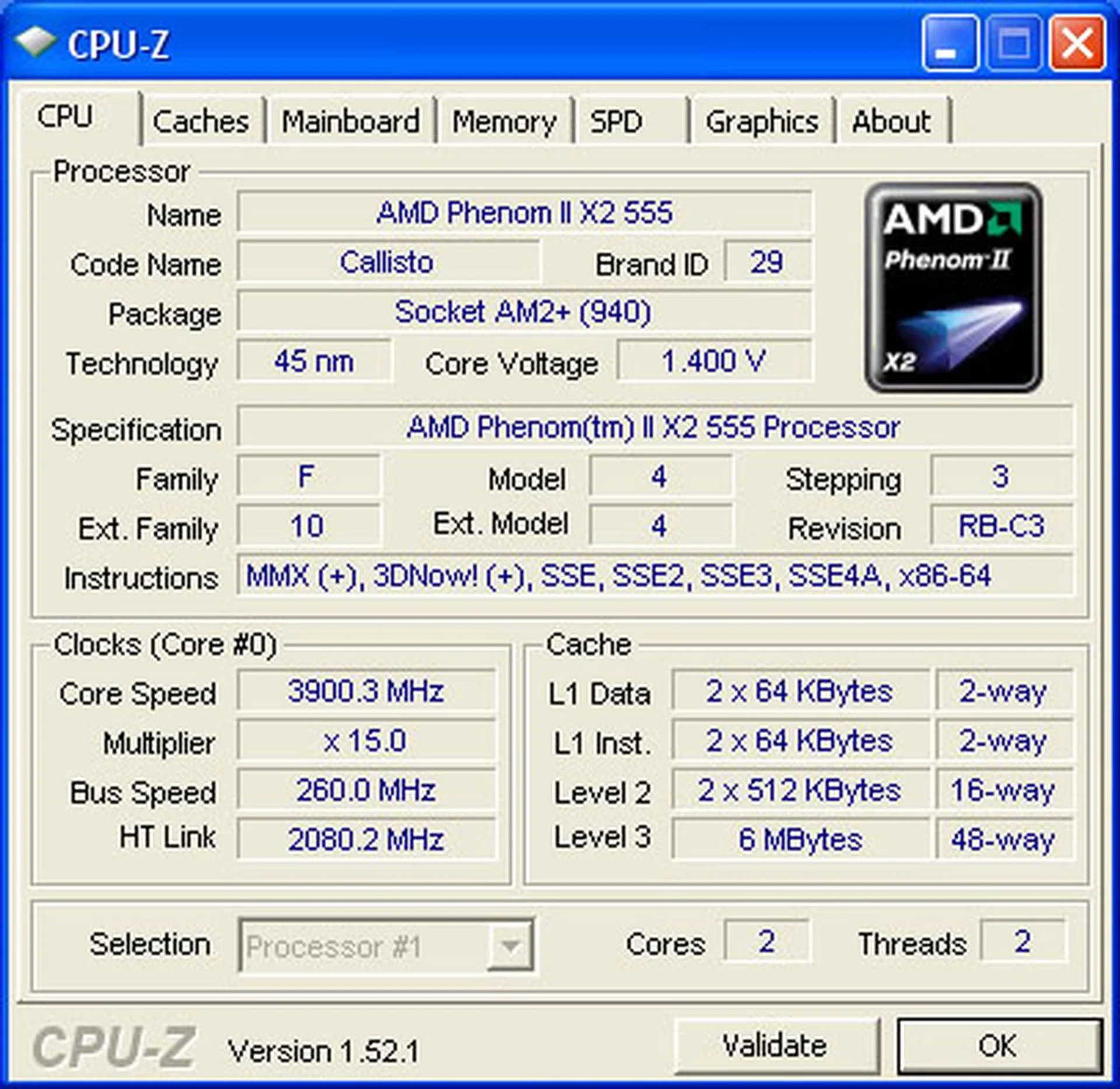
We managed to push it to 3.9GHz air-cooled without too much tweaking involved.
Conclusion
This processor update from AMD is a minor one that's unlikely to impact its bottom line or Intel's for that matter. In fact, it seems that yet again, AMD is dodging the chip giant's all-conquering Nehalem based processors with cheaper ones that expand its budget offerings even further. Whatever your feelings are about having a different processor choice for every other ten-dollar increment, these new processors represent very decent value, particularly for those who are shopping for a cheap quad-core.
For the Phenom II X2 555 BE, the fastest dual-core processor in AMD's lineup, its proposition is straight-forward. Those looking for a decent budget productivity and gaming rig will find the high clock speed a boon while two cores coupled with a competent graphics card should be sufficient for most games. Its value becomes more debatable once we enter the multi-core territory like video transcoding or 3D rendering.
At US$99, the Phenom II X2 555 BE has the same price as AMD's Athlon II X4 630; it becomes a matter of how you're using your computer. Power consumption should also favor the dual-core slightly over the quad-core, though with its 45nm manufacturing process, AMD is far from reaching Intel levels of power efficiency. For the enthusiast, the Phenom II X2 555 BE is an even better deal, as it is easily overclocked to almost 4GHz air-cooled, while the satisfaction from potentially unlocking all four cores is definitely there.
Moving forward, despite the attractive performance to price ratio of AMD's processors below US$100, there's no doubt that the company needs to do more than tread water with such incremental models. We await the six-core processors later this year and most of all, a promise called Fusion.
Our articles may contain affiliate links. If you buy through these links, we may earn a small commission.