
AMD Phenom II X4 955 - A Timely Upgrade
With the release of AMD's Phenom II X4 955 Black Edition and 945 processors, they now have a CPU deserving of its AM3 socket and usage of DDR3 memory. It even overclocks to 3.9GHz on air-cooling. Find out if AMD's flagship processor can tease the Core i7 in our assessment.

When the Going Gets Tough, AMD Ups the Ante
It has been nearly four months since the first Phenom II was officially made available and since its initial release of the X4 940 'Black Edition' and the X4 920 Socket AM2+ processors, AMD has started offering via the newer AM3 socket compliant CPUs. Oddly, these newer AM3 socket compliant processors debuted as lower clocked models (such as the Phenom II X4 810) and it was ironic since DDR3 is generally geared for higher caliber processors with better performance potential when paired with high speed memory. It's a good thing these AM3 processors are backward compatible and will work on existing AM2+ motherboards since nobody in their right mind would actually choose a mainstream processor and pair it with expensive DDR3 memory . Even at an overclocking angle, the cost differential is better used to get a higher clocked Phenom II processor instead.
Finally, on the 23rd of April, AMD has started offering in quantity of their new high speed Phenom II processors based on the AM3 socket. These are the Phenom II X4 955 Black Edition and Phenom II X4 945 processor. Architecturally, they are exactly identical to the existing Phenom II processors, but the 955 model operating at 3.2GHz takes AMD one step closer to its archrival's Core i7 territory. Thankfully its thermal design power envelope hasn't increased and it remains at 125 watts. The 945 model is basically the same 3GHz Phenom II X4 940 model on the AM2+ package which has been updated to support DDR3 via its newer AM3 packaging (and the higher clocked HT bus and memory controller).
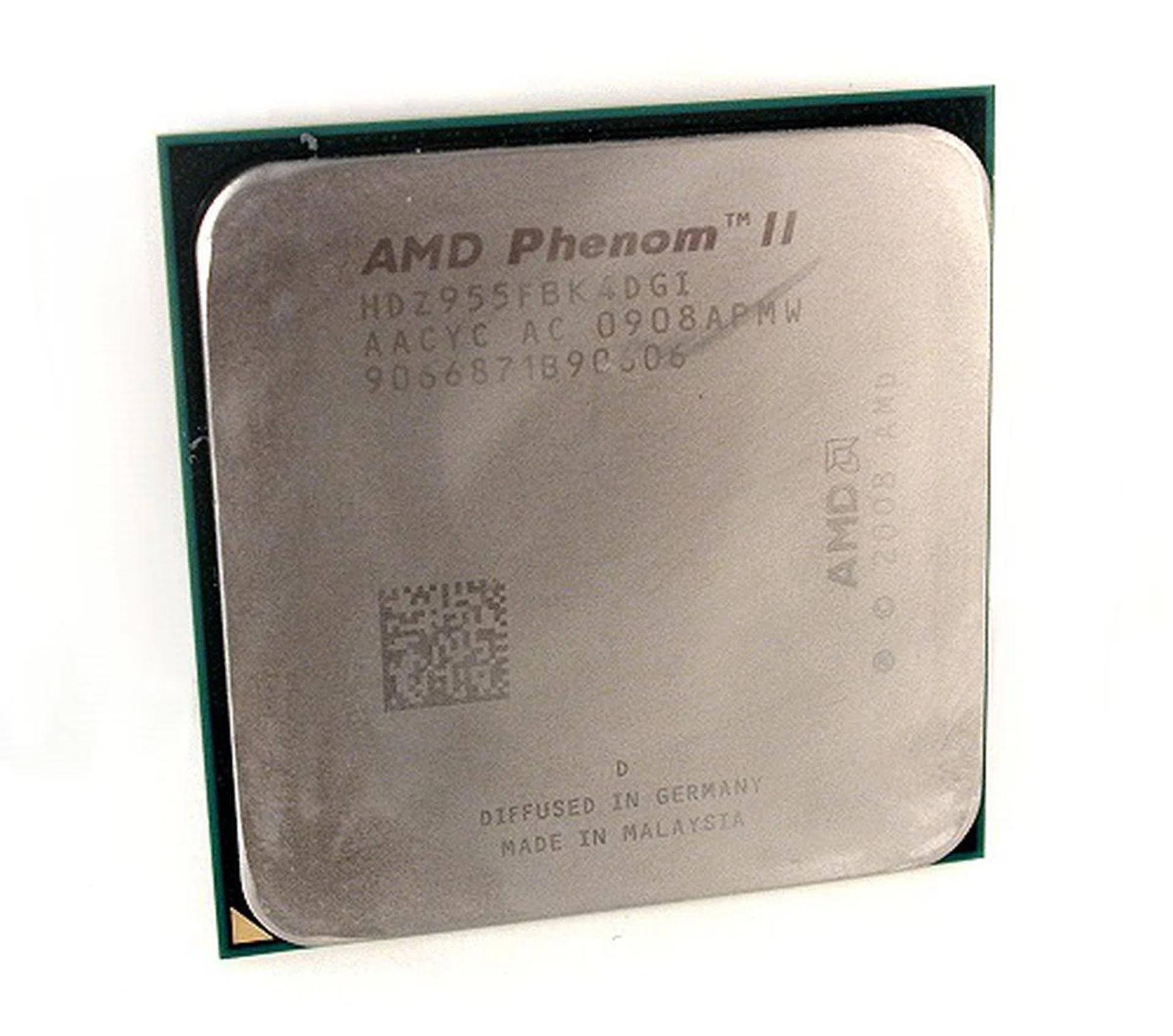
AMD's newest flagship - the Phenom II X4 955 Black Edition. Running at 3.2GHz, it's compatible with both DDR2 and DDR3 memory and uses an AM3 socket interface.
While it would have greatly helped reduce the lineup clutter if all Phenom II processors debuted with the newer socket AM3 package, as the saying goes, "Better later than never". The existing Phenom II X4 940 and 920 on the AM2+ packaging will soon slide off the charts since the newer models using the AM3 package are backward compatible to existing motherboards. At the moment, here's how the newcomers stack up with the existing Phenom II processors:-
New Phenom II AM3 Processors | ||||||||
Processor Model | Clock Speed | L2 Cache | L3 Cache | HyperTransport Bus | Memory Controller Speed | Max TDP (W) | Retail Price (US$) | Availability |
X4 955 'Black Edition' | 3.2GHz | 512KB x 4 | 6MB | 2.0GHz | 2.0GHz | 125 | $245 | Now (PiB) |
X4 945 | 3.0GHz | 512KB x 4 | 6MB | 2.0GHz | 2.0GHz | 125 | $225 | Now (PiB) |
Existing Phenom II AM3 Processors | ||||||||
X4 910 | 2.6GHz | 512KB x 4 | 6MB | 2.0GHz | 2.0GHz | 95 | N.A | Now (Tray) |
X4 810 | 2.6GHz | 512KB x 4 | 4MB | 2.0GHz | 2.0GHz | 95 | $175 | Now (PiB) |
X4 805 | 2.5GHz | 512KB x 4 | 4MB | 2.0GHz | 2.0GHz | 95 | N.A | Now (Tray) |
X3 720 'Black Edition' | 2.8GHz | 512KB x 3 | 6MB | 2.0GHz | 2.0GHz | 95 | $145 | Now (PiB) |
X3 710 | 2.6GHz | 512KB x 3 | 6MB | 2.0GHz | 2.0GHz | 95 | $125 | Now (PiB) |
Existing Phenom II AM2+ Processors | ||||||||
X4 940 'Black Edition' | 3.0GHz | 512KB x 4 | 6MB | 1.8GHz | 1.8GHz | 125 | $195 | Now (PiB) |
X4 920 | 2.8GHz | 512KB x 4 | 6MB | 1.8GHz | 1.8GHz | 125 | $189 | Now (PiB) |
Since it's already that DDR3 brought minimal improvements at best to the Phenom II processors, we shall not focus on the 945 model since it's rather similar to the . Instead we shall focus on how the Phenom II X4 955 Black Edition fairs against equivalent processors of its price points. Read on for test assessment and the results of AMD's new flagship processor. But first, here's a CPU-Z screenshot of its basic info in case you're interested:-
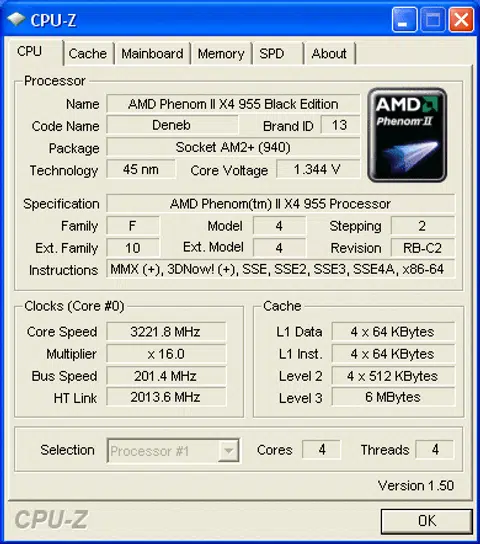
Our usual screen grab of CPU-Z for basic processor info for those interested in visual information. Take note though, the power management wasn't kicking in yet, thus the higher CPU voltage reflected.
Motherboard Compatibility Notes
Even though Phenom II processors have been proudly marketed being cross-compatible with older motherboards, this was of little issue with the initial AM2+ models as well as the initial AM3 processors to work with AM2/AM2+ motherboards (give and take some BIOS updates). For the latest crop of AM3 processors, especially with the Phenom II X4 955 Black Edition processor, it may not even be drop-in compatible with many of the existing AM3 motherboards without a BIOS update to explicitly support it (and the same goes for AM2+ motherboards). So do factor this before purchasing your motherboard and processor combo as you might want to get the retailer to help you flash the BIOS to the latest revision before pushing forth with your purchase.
As usual, given a time span of a few more weeks, most AM2+ and AM3 motherboards should have support for AMD's fastest processor. If you happen to be riding on an AM2 board though, there's still hope for it if it's not one of those very early board revisions. In any case, the wisest advice we can offer here is to monitor your prospective motherboard's BIOS update page for the latest CPU support before jumping in to purchase the Phenom II X4 955 Black Edition.
AMD OverDrive 3.0 - Revised and Improved
Along with the latest crop of Phenom II AM3 processors, AMD has brought about improvements to their AMD OverDrive 3.0 (AOD 3.0) tool as well. Albeit it still retains the same version number, the latest build supports AMD's newest initiative called the AMD Black Edition Memory Profiles (BEMP). Akin to the NVIDIA's SLI memory and Intel's XMP memory scheme, AMD's BEMP attempts to provide the same result but with a different approach.
Instead of hard-coding the higher performance profile information within a special unused portion of the SPD as done by NVIDIA's and Intel's approach, AMD's BEMP approach works on the concept of obtaining the required profile information on AMD's online database of Black Edition memory profiles. To make the process easy, all you have to do is launch the latest build of the AOD 3.0, enter the BEMP section and select "Online Update" button to check on AMD's database if your memory module has an updated BEMP profile. If available, just proceed to obtain the profile and apply it. The utility will then update your BIOS parameters and the boosted settings will take into effect upon a system reboot.
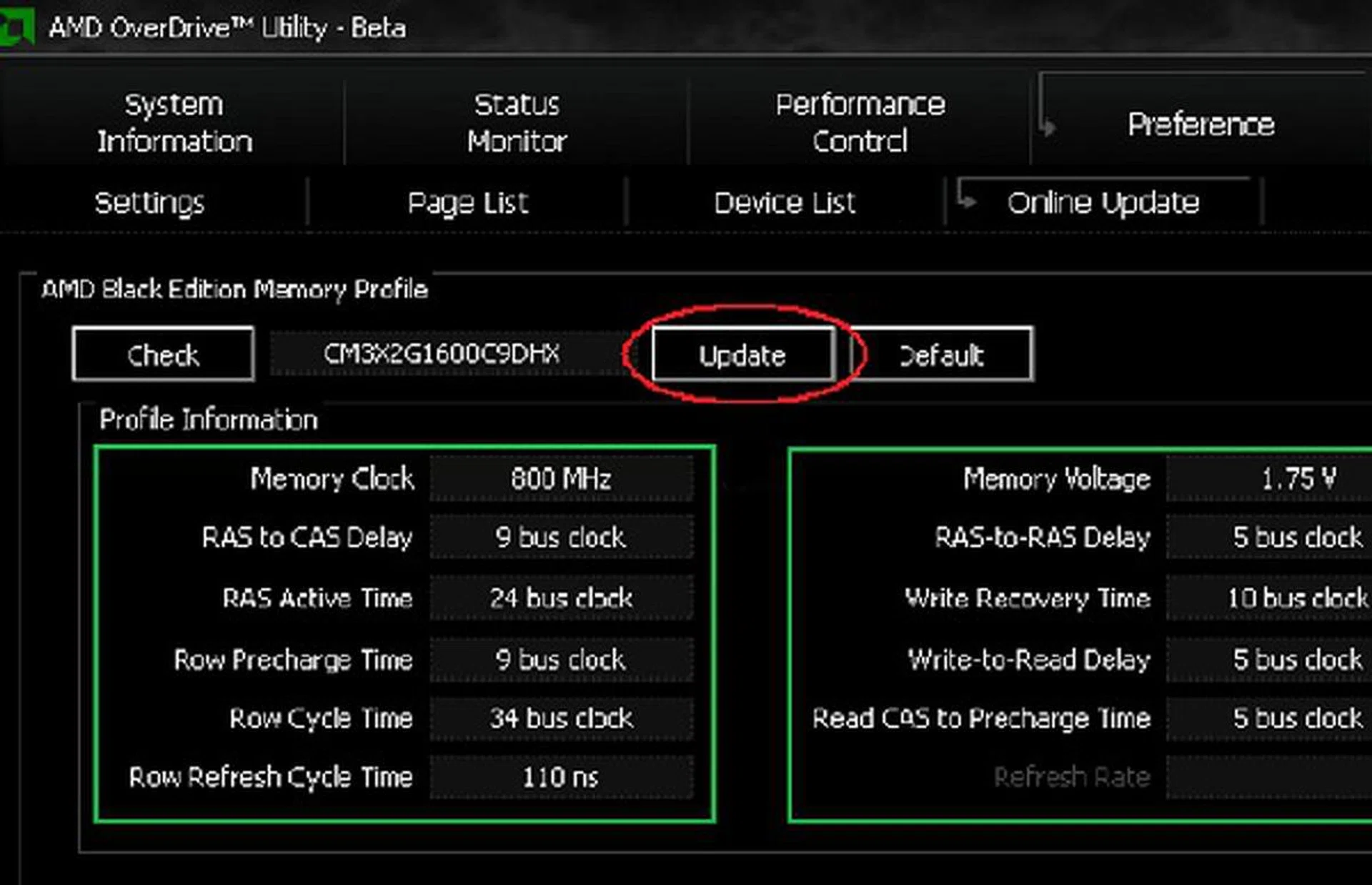
A snapshot of the AOD 3.0 tool in the process of attempting to update the system with the performance parameters.
This can potentially increase the pool of performance memory modules that will work with AMD's platform to offer improved performance and greater overclocking headroom. It will however take time build up the database as it currently only supports a total of five modules from a mix of vendors. Contrary to the BEMP naming scheme, you doesn't require a Black Edition processor as the profiles do not fiddle with the core processor's frequency or multiplier. BEMP will work in conjunction with any AM3 processor and AM3 motherboard.
Yet another notable improvement of the latest AOD 3.0 build is the incorporation of AMD Smart Profiles. This feature has some semblance of the Core i7 processor's turbo function which allows users to set each core's multiplier settings depending on the number of cores loaded. While Intel's function is set a BIOS level and is a little more straightforward, AMD's software approach allows flexibility and is defined by various program profiles. The main function of these smart profiles is to empower the users if they want a particular program at its maximum performance or invoke performance savings by self-setting each core's multiplier settings and saving these profiles. While some of the profiles are pre-loaded on the latest build, you can add/remove profiles as you deem fit.
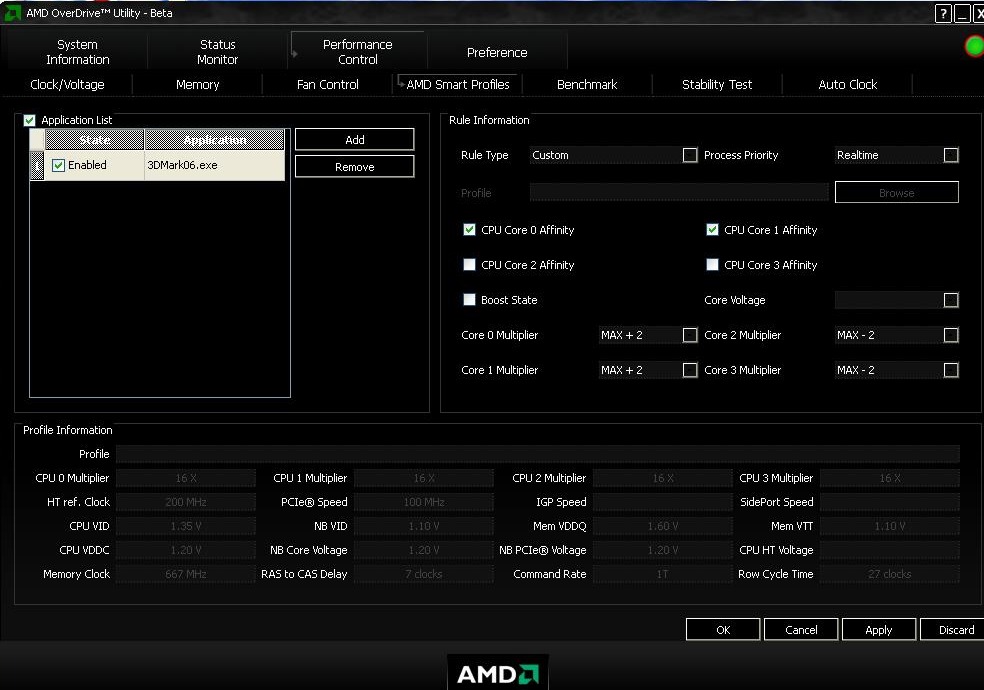
A snapshot of the process of setting CPU affinity and multiplier settings to every core for each program and each saved as a profile that can be activated on your call.
It's a great tool for power users wanting absolute control, but it also requires one to understand a program's core loading levels to better utilize the profiles to their requirements. Unless you're a geek like us, Intel's approach is actually simpler and should take care of common scenarios in our opinion. No doubt, we'll still give credit to AMD for being different on both accounts discussed here.
Quad-Core Processors Compared
Just before we dive in to show you the outcome from our strenuous benchmarking suite, we give you a quick rundown of how the high-end quad-core processors compare at the moment:-
Processor Name | Core i7 | AMD Phenom II X4 (AM3) | AMD Phenom II X4 (AM2+) | Core 2 Quad (45nm) |
Processor Model | i7-965 Extreme Edition, i7-940, i7-920 | 955 'Black Edition', 945, 910, 810, 805 | 940 'Black Edition', 920 | QX9775, Q9650, Q9550, Q9400, Q9300 |
Processor Frequency | 3.2GHz, 2.93GHz, 2.66GHz | 3.2GHz, 3.0GHz, 2.6GHz, 2.6GHz, 2.5GHz | 3.0GHz, 2.8GHz | 2.5GHz - 3.2GHz |
No. of Cores | 4 | 4 | 4 | 4 |
Front Side Bus (MHz) | - | - | - | 1333 |
HyperTransport Bus / QuickPath Interconnect | 6.4GT/sec for i7-965 EE, 4.8GT/sec for i7-940, i7-920 | 2.0GHz | 1.8GHz | - |
L1 Cache (data + instruction) | (32KB + 32KB) x 4 | (64KB + 64KB) x 4 | (64KB + 64KB) x 4 | (32KB + 32KB) x 4 |
L2 Cache | 256KB x 4 | 512KB x 4 | 512KB x 4 | 6MB x 2, 3MB x 2 (Q9300 & Q9400 only) |
L3 Cache | 8MB | 6MB for 900 series 4MB for 800 series | 6MB | - |
Memory Controller | Integrated Triple Channel (up to DDR3-1066) | Integrated Dual Channel (up to DDR2-1066 or DDR3-1333) | Integrated Dual Channel (up to DDR2-1066) | External - Chipset Dependent |
TDP (W) | 130W | 125W for 900 series 95W for 800 series | 125W | 125W for QX9775 95W for all others |
Instruction Set Support | MMX, SSE, SSE2, SSE3, SSSE3, SSE4.1,SSE4.2 | MMX, SSE, SSE2, SSE3, SSE4a | MMX, SSE, SSE2, SSE3, SSE4a | MMX, SSE, SSE2, SSE3, SSSE3, SSSE4.1 |
Execute Disable Bit | Yes | Yes | Yes | Yes |
Intel EM64T / AMD64 | Yes | Yes | Yes | Yes |
Enhanced Intel SpeedStep Technology (EIST) / AMD Cool 'n' Quiet | Yes | Yes | Yes | Yes |
Virtualization Technology | Yes (Enhanced) | Yes | Yes | Yes (Enhanced) |
Packaging | LGA1366 | AM3 | AM2+ | LGA775 |
Process Technology | 45nm | 45nm SOI | 45nm SOI | 45nm |
Processor Codename | Bloomfield | Deneb | Deneb | Yorkfield |
Die Size | 263mm² | 258mm² | 258mm² | 214mm² |
No. of Transistors | 731 million | 758 million | 758 million | 820 million |
Test Setup
In the course of our reviews on processors, we have accumulated a number of test system configurations for both the AMD and Intel platform due to the intrinsic differences between them. Hence, be prepared for a lengthy listing of the various setups used.
Taking into consideration that the Phenom II X4 955 Black Edition has an expected retail price of US$245, we'll be closely focusing upon competitive processors from Intel of the Core i7-920, Core 2 Quad 9550 and Core 2 Quad Q9300 which have an estimated retail price of US$284, US$266 and US$213 respectively. Note that for the Core i7 processors, we left their default HyperThreading and Turbo options enabled since this is a feature of the processor and the auto speed bump is guaranteed by Intel.
With that said, the following testbed configurations will be used throughout our comprehensive benchmarking segment:-
AMD Phenom II X4 955 BE Testbed Configuration
- Gigabyte GA-MA790FXT-UD5P (AMD 790FX + SB750)
- 2 x 1GB Kingston HyperX DDR3-1333 (7-7-7-20)
- Seagate Barracuda 7200.10 200GB SATA hard drive (one single NTFS partition)
- ASUS GeForce 8800 GT 512MB (ForceWare 169.21)
- Zotac GeForce GTX 260 (For World in Conflict and Crysis only, ForceWare 178.24)
- Microsoft Windows XP Professional with Service Pack 2
AMD Phenom II X4 940 BE and 920 Testbed Configuration
- MSI DKA 790GX Platinum (AMD 790GX chipset)
- 2 x 1GB Aeneon DDR2-1066 (CAS 5-5-5-15)
- Seagate Barracuda 7200.10 200GB SATA hard drive (one single NTFS partition)
- ASUS GeForce 8800 GT 512MB (ForceWare 169.21)
- Zotac GeForce GTX 260 (For World in Conflict and Crysis only, ForceWare 178.24)
- Microsoft Windows XP Professional with Service Pack 2
Intel Core i7 Testbed Configuration
- Processors:- Intel Core i7-940 and 920
- Intel DX58SO Motherboard (Intel X58 Express chipset)
- 3 x 1GB Kingston HyperX DDR3-1066 (CAS 7-7-7-20)
- ASUS GeForce 8800 GT 512MB (ForceWare 169.21)
- Zotac GeForce GTX 260 (For World in Conflict and Crysis only, ForceWare 178.24)
- Seagate 7200.10 200GB SATA hard drive (one single NTFS partition)
- Windows XP Professional with Service Pack 2
- Intel INF 9.1.0.1007 and Matrix Storage Manager 8.6.0.1007
Intel Core 2 Quad/Duo Testbed Configuration
- Processors:- Intel Core 2 Quad Q9650, Q9550, Q9300 and E8500
- ASUS P5E3 Deluxe (Intel X38 Express chipset)
- 2 x 1GB Kingston HyperX DDR3-1333 memory modules (CAS 7. 7-7-20)
- Seagate Barracuda 7200.10 200GB SATA hard disk drive (one single NTFS partition)
- ASUS GeForce 8800 GT 512MB - with NVIDIA ForceWare 169.21
- Zotac GeForce GTX 260 (For World in Conflict and Crysis only, ForceWare 178.24)
- Microsoft Windows XP Professional with Service Pack 2
- Intel INF 8.3.1.1009 and Matrix Storage Manager 7.8.0.1012
Benchmarks
The following benchmarks were used in this review:-
- BAPCo SYSmark 2007 Preview (ver 1.04)
- SPEC CPU2000 v1.3
- Futuremark PCMark 2005 Pro
- Lightwave 3D 7.5
- 3ds Max8 (SP2)
- Cinebench 10
- XMpeg 5.0.3 (DivX 6.8 encoding)
- Futuremark 3DMark06 v1.1
- AquaMark3
- World in Conflict v1.05
- Crysis v1.1
Results - SPEC CPU2000 v1.3
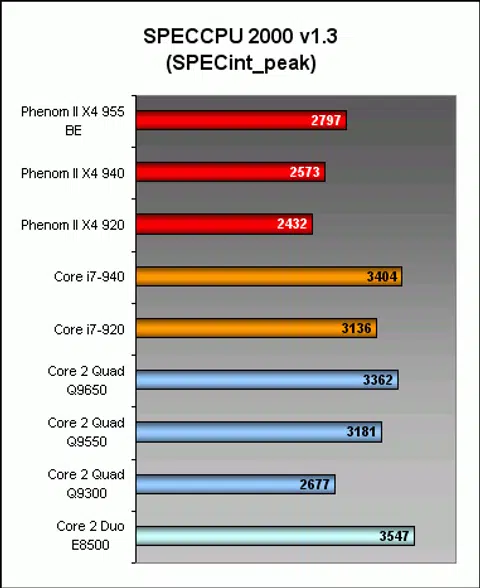
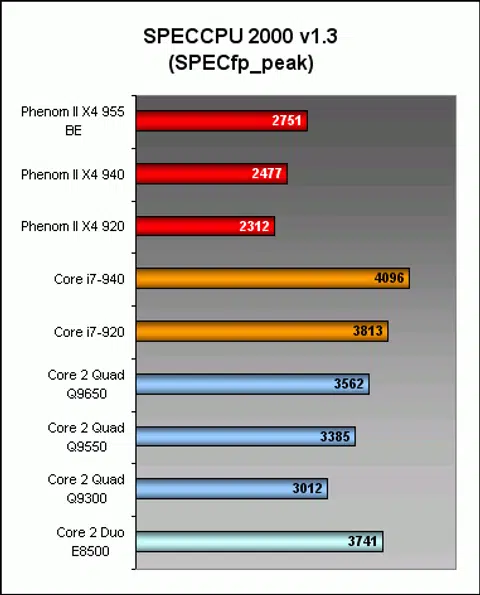
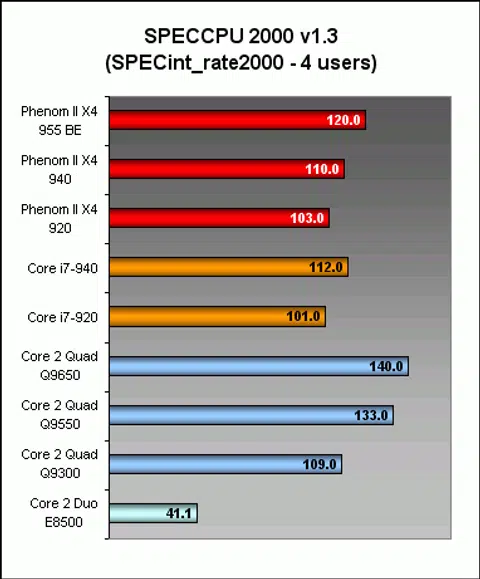
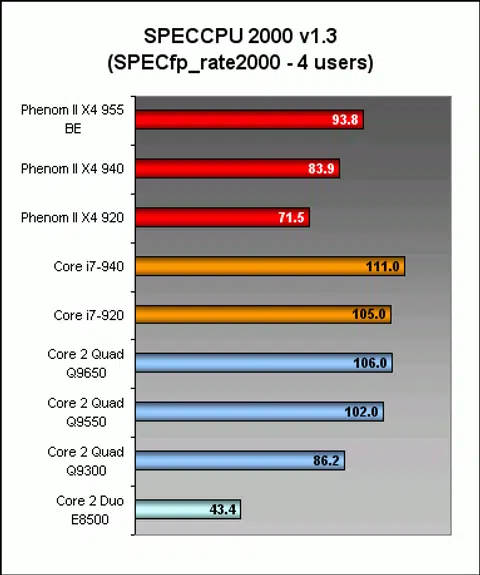
To get a good gauge of the processor's integer and floating-point performance prowess, our first order of testing began with SPEC CPU2000. The Phenom II processors manage this decently and far cry from original Phenom processors which we rather forget they ever existed. In the single-threaded peak speed tests, the new Phenom II X4 955 Black Edition CPU managed 9 to 11% performance increments over the Phenom II X4 940 running on the previous AM2+ platform. That's a nice speed bump. With regards to the competition, the Phenom II X4 955 was in close proximity of the Core i7-920 and that of the Core 2 Quad 9550 processors in the integer tests, but was bumped out of the same performance rank in the floating-point test.
Results - SYSmark 2007 Preview
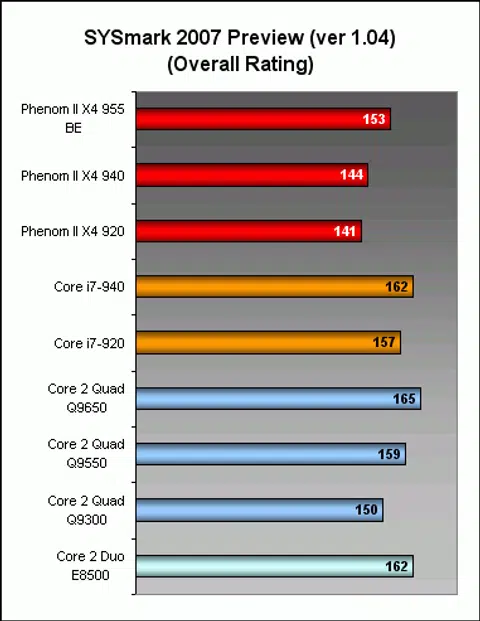
While SYSmark 2007 comprises of several test suites, it's interesting to note that the Phenom II X4 955 on the newer AM3 platform has managed an overall performance score that's just a couple of percentage points different from the Core i7-920.
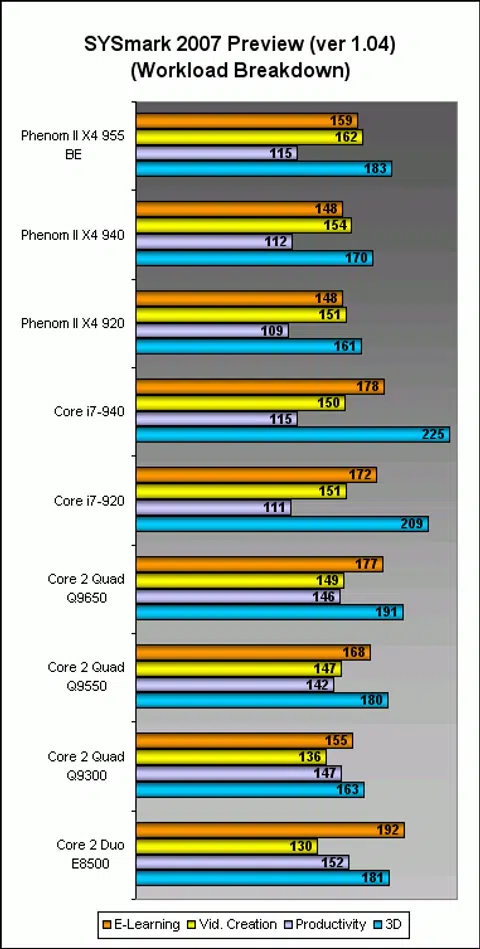
Peering through the breakdown, you can note that the Phenom II X5 955 manages better score in productivity and video creation, whereas the Core i7 fares a whole lot better in the 3D and E-Learning test suites. This outcome holds true in our game tests too as you'll see later which further confirms Intel's platform superiority in this important segment.
Results - Futuremark PCMark05
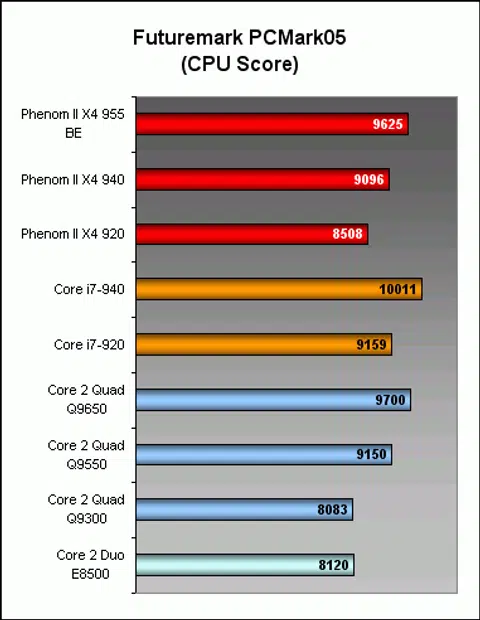
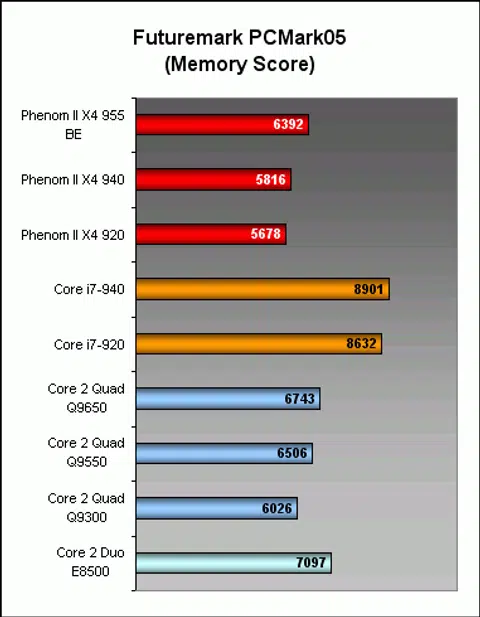
While the DDR3 equipped Phenom II X4 955 processor is still a long shot away from challenging the memory bandwidth of the Core i7 (most likely due to the latter's tri-channel implementation), it's great to note that it's giving Core 2 Quad processors a tough time. In fact, the Phenom II processors fared well in the raw CPU testing of the PCMark05 benchmark.
Results - Lightwave 3D 7.5
In our more taxing Tracer-Radiosity render test, the Phenom II X4 955 and even the 940 model were posing a serious challenge to both the Core 2 Quad 9550 and the entry-level Core i7-920 model. However on the swifter Sunset render test, the Core i7 still retained their crown. Still, the Phenom II X4 955 put up a decent showing as it managed to rival the more expensive Core 2 Quad 9550 in this test.
So far it looks like the Phenom II 955 Black Edition is making quite a positive impression. Let's see if this streak continues throughout our other tests.
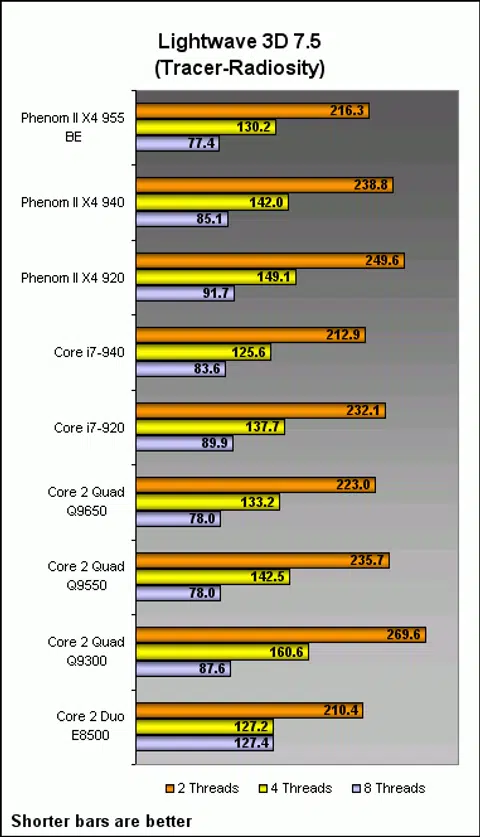
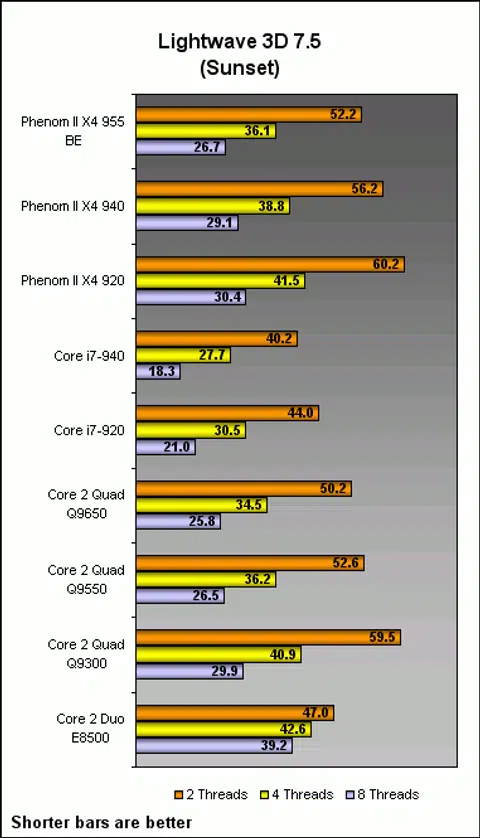
Results - 3ds Max 8 (SP2)
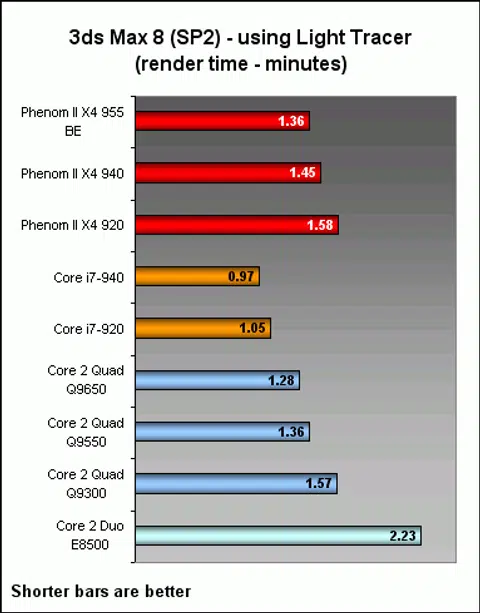
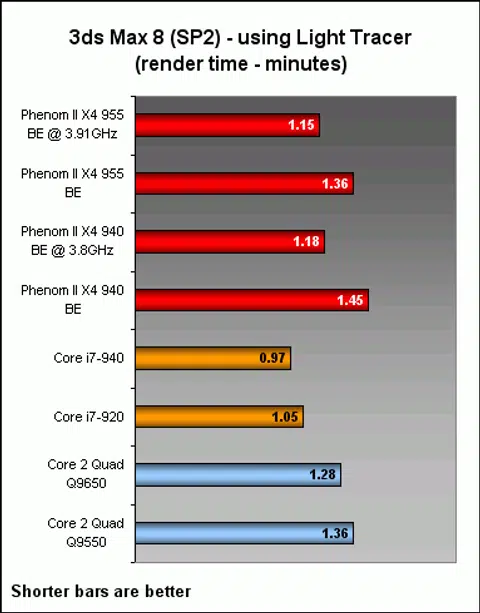
Using Autodesk's 3ds Max 8 rendering program, we ran the same test load by rendering it using Light Tracer and Radiosity advanced lighting options. On utilizing the Light Tracer rendering option, the Core i7-920 was still leading by quite a margin, but the Phenom II X4 955 scored the same result as the Core 2 Quad 9550.
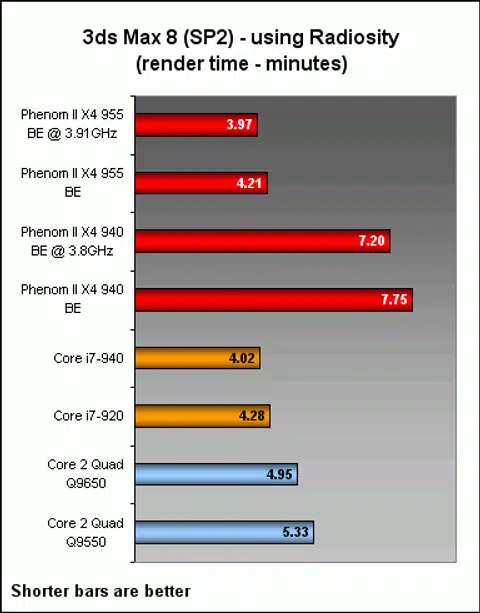
What surprised us more was of using the Radiosity lighting render option, which formerly gave the Phenom II processors (AM2+) nasty results but the Phenom II X4 955 on the new platform managed this workload with flying colors as it came out speedier than the Core 2 Quad processors and more crucially the Core i7-920 (which if you recall has the turbo option enabled).

Results - Cinebench 10 and XMpeg 5.03 (DivX 6.8 Encoding)
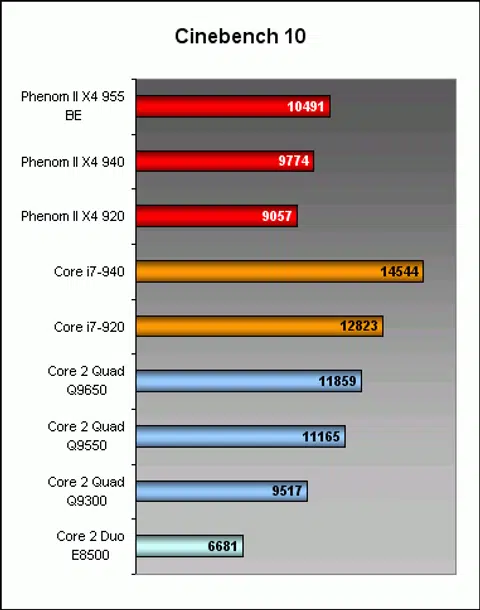
Cinebench 10 being a highly-threaded synthetic rendering benchmark, naturally lapped up the extra logical processing cores of the Core i7 processors with HyperThreading enabled and thus obtained much higher results in this benchmark. Comparing against the Core 2 Quad 9550, it's evident that the Phenom II is still slower and is mostly in-line with the same discrepancy of it floating-point results from the SPEC CPU tests.
Moving on to video encoding using XMpeg and the latest DivX 6.8, we never thought we would say this anytime soon, but it looks like the Phenom II X4 955 is a winner here as it made a beeline for the best performance in its price segment. Both the Core 2 Quad 9550 and the Core i7-920 processors lost out to AMD's latest offering by a small margin. These results again tally with our detailed breakdown in SYSmark 2007 where the Phenom II X4 955 again showed who's boss (even if it's by a small degree).

Results - Futuremark 3DMark06
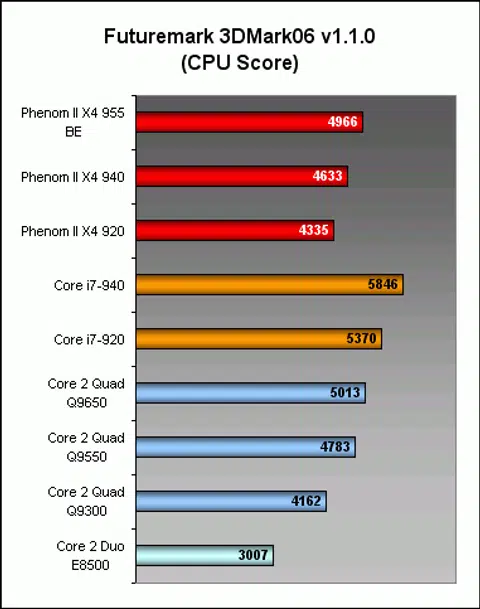
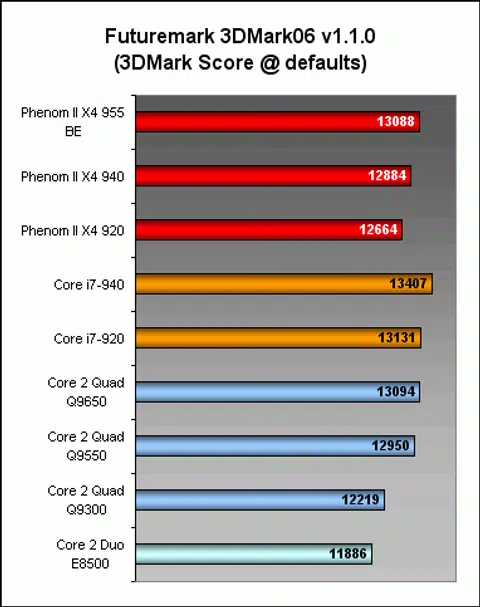
Gaming performance is one area that we've constantly criticized AMD for in the last couple of years. In the synthetic 3DMark06 testing, we the see the Phenom II X4 955 rivaling or leapfrogging the Core 2 Quad processor in both the CPU test and that of the overall performance 3Dmark score. The Core i7-920 still fared much better in the CPU test, but was however hardly much ahead in its overall 3Dmark score.
Results - AquaMark3
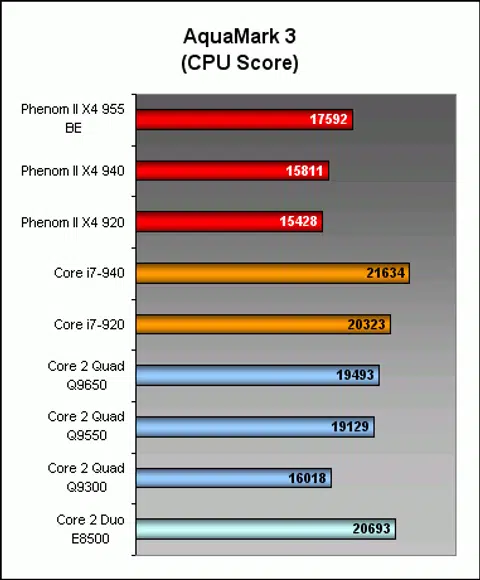
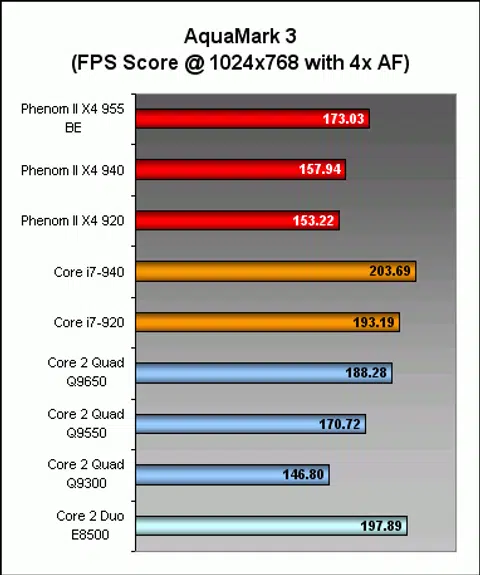
Using the old but reliable AquaMark engine for quick performance testing, we found that the Core i7 processors managed much better results just as expected customarily. However, the Phenom II X4 955 still managed equivalent performance standings when it came to the overall FPS score, which actually matters more.
Results - World in Conflict & Crysis
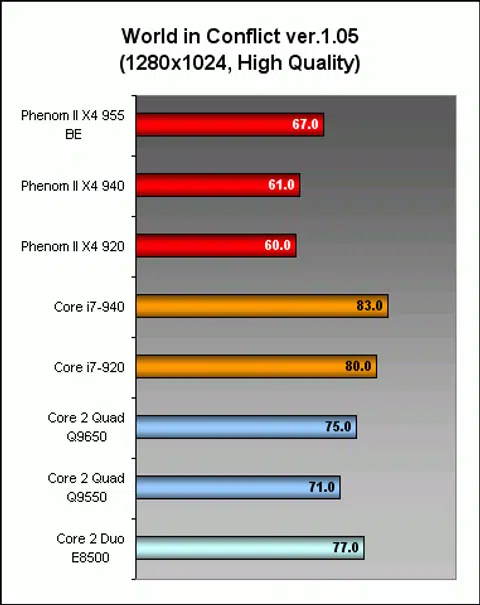
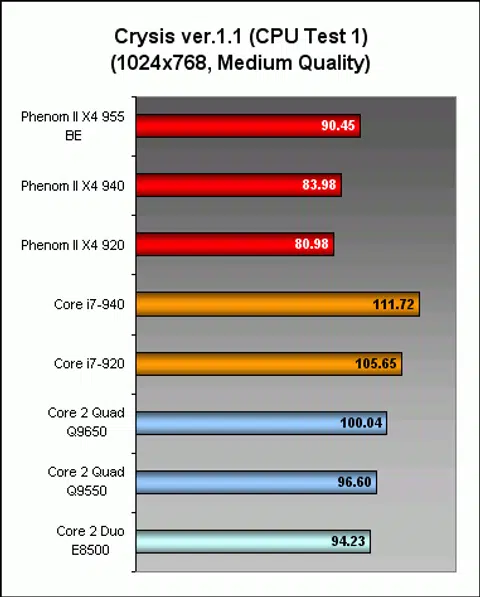
Finally, we arrive at the real-world gaming benchmarks, where we have upgraded our test GPU from a GeForce 8800 GT to a GeForce GTX 260 after concluding in an earlier article that there was a potential GPU benchmark.
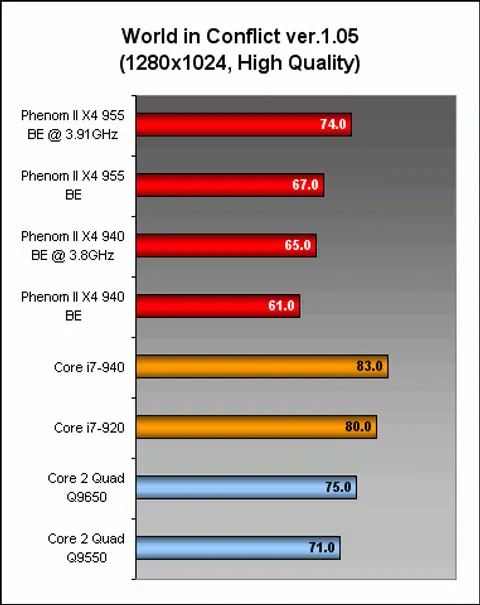
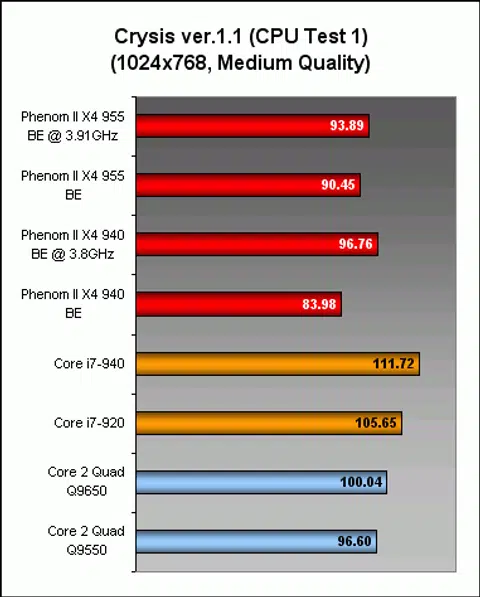
Unfortunately, the Phenom II X4 955 couldn't yet outshine the Intel competition yet when it came to gaming. Despite that note, it was actually just 6% slower than the Core 2 Quad 9550 processor and that's a marked improvement considering previous performance attempts by other Phenom processors.
Power Consumption
If you recall our comments from our original Phenom II article, we noted its commendable power savings quotient when the system is at idle - mostly thanks to its extremely throttling down to just 800MHz and finally being able to shut down various unused segments of the processor. Unfortunately, the C1E state on our 'certified for operation' Gigabyte GA-MA790FXT-UD5P motherboard wasn't working out as utilities reported the full speed; power draw too was on the high side of 130 watts for the system.
This however should be rectified on further BIOS updates as has been the case for other motherboard models according to the number of BIOS signatures popping up to resolve the new CPU's full support. That aside, we continue to present you our full load power measurement findings as follows.
3DMark06 CPU Test 2
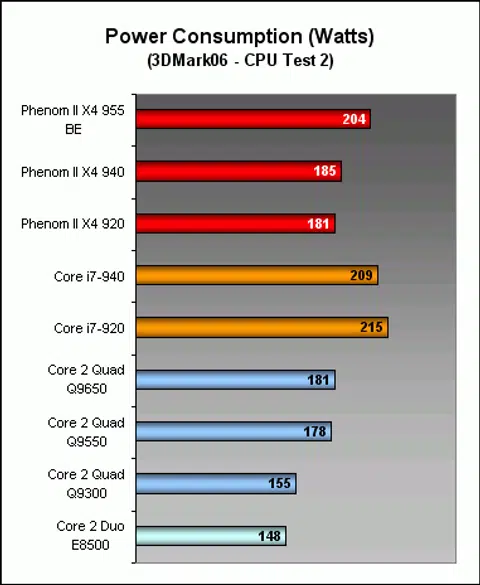
Choosing the CPU-only test portion of the 3DMark06 benchmark to focus upon power consumption based on a mostly CPU-only load, the difference between Phenom II X4 955 Black Edition and Phenom II X4 940 seems to have a higher power draw difference than when comparing the 940 and 920 models. Do note though, the 955 processor using a newer AM3 platform whereas the other pair of processors are using the existing AM2+ platform and this only means that various platforms and motherboard implementations can have an affect on the power consumption of your system.
Compared with the Intel platforms, especially the Core 2 Quad 9550, the Phenom II X4 955 draws about 15% more power. But against the Core i7-920, the AMD system actually fares better. Though the Core i7-920 draws more power, it also performs better than the Phenom II X4 955 - in some scenarios. In other cases, the Phenom II X4 955 is able to rival the Core i7-920, so for the first time in a long while, AMD is able to deliver a decent CPU in both power and performance aspects.
SPECviewperf 10 Full System Loading - Quad-Core Run
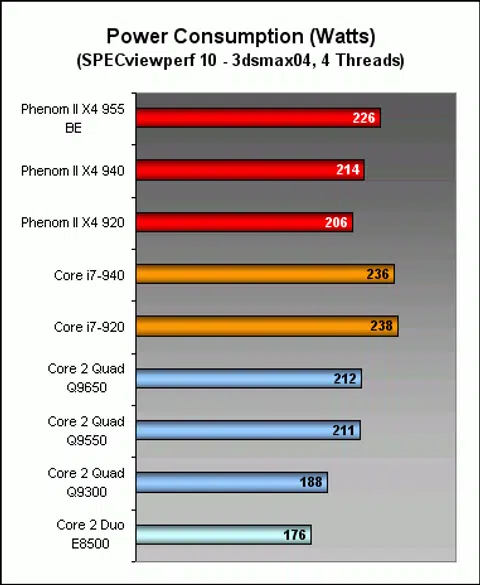
Going with an even heavier system load and this time stressing the GPU as well, the power draw difference between the Phenom II and Core 2 Quad narrows down further to just a 7%, while the AMD system also betters the Core i7-920 by about the same difference as well. Not too shabby at all.
The Overclocking Factor
What's a Black Edition processor without showing off some of its overclocking capability? With the first Phenom II X4 940 Black Edition, we managed to ratchet it up to about 3.8GHz. Now with the newer Phenom II X4 955 Black Edition (thought still using the same stepping), we got it running at a maximum of 3.91GHz with standard air cooling. That's pretty good according to AMD where they document 4GHz is about the maximum to be expected out of air cooling (but extreme cooling tactics can see it soaring to as high as 6GHz).
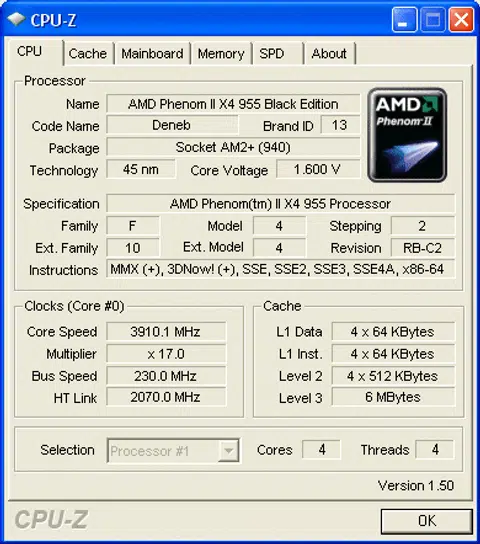
The Phenom II X4 955 Black Edition managed an overclock of up to 3.91GHz with just air cooling.
While both the Phenom II X4 955 and 940 processors overclock easily, they require much higher voltage to keep up their high clocks - about 1.6 volts in our case. The higher voltage and clock speeds do ratchet up power consumption quite badly, but that's usually the unfortunate side-effect if you're really keen on overclocking. What about the actual performance gain? Not as much as we were hoping for, but you be the judge of that if it's worthwhile:-
AMD Gets its Act Together - Finally
We have to admit - the Phenom II X4 955 Black Edition processor finally manages to hold its own turf against the competition in performance, power and price. Having put the processor through a whole range of benchmarks, the Phenom II X4 955 rivaled or bettered the performance of the Core 2 Quad 9550 and even the Core i7-920 systems we've put up for comparison in many of the tests. Even tasks like graphics rendering and video editing/transcoding, which are the usual mainstays of Intel since the days of the Core 2 Duo series, are now rivaled by AMD's latest Phenom II processor.
The Phenom II X4 955 Black Edition processor is definitely a processor AMD has long been waiting to showcase the tech world and it couldn't have come at a better time for the company.
If there's one area where we wished the Phenom II processors would buck-up, it's their 3D performance handling where the equivalent processors still managed a decent lead. Despite that, we have to say that the Phenom II X4 955 processor has narrowed the gap between itself and the Intel processors by leaps and bounds since the first Phenom hit the streets. 3D performance aside, several other benchmarks showcase how capable the newcomer is and we really have to give it credit.
Factor in the Phenom II X4 955 processor's price point, backward compatibility and upgradability, AMD has managed put out a processor that can finally tease Intel's dominance after 3 years. The Core 2 processor family at this juncture in time, though still performing well, is better suited for upgraders than those building new systems since its platform would soon be a dead-end. The Core i7 processors on the other hand are more expensive and require a whole system refresh. Yet the Phenom II processors, especially the X4 955 Black Edition is able to rival the entry-level Core i7 processor on almost all the verticals (except for 3D performance), and welcomes existing AM2/AM2+ platform owners as well as newcomers since the overall system price point is lower. If you're in for a value recommendation on the mid to high level performance scales and need a fine balance of price and power too, the Phenom II X4 955 Black Edition is surely one that you should keep in mind.
In our opinion, AMD should have launched the Phenom II processor family with X4 955 Black Edition heading the pack and the AM3 platform way back in January - it would have surely made a strong statement to its dearest competitor and a godsend for all the AMD fans. Still, better late than never and it looks like AMD will be seeing sunnier days ahead if this newcomer is anything to judge it by.
Our articles may contain affiliate links. If you buy through these links, we may earn a small commission.