
ULi M1695 HyperTransport PCI Express Tunnel Chip
The M1695 is ULi's latest Athlon 64 core logic solution, but this isn't your momma's traditional chipset. The M1695 features HyperTransport as a universal interconnect for vast configuration flexibility and TGi for true PCIe, AGP and PCI operation simultaneously.
Introduction
There are occasions where we come across something truly interesting, a product focused on the mass market in the hopes of reaching as many target groups as possible. What we're talking about is ULi's latest core logic chip, the M1695 HyperTransport PCI Express Tunnel Chip. Who's ULi? We don't blame you if the name draws a blank. ULi was formerly known as ALi (Acer Labs Incorporated), and ALi's last known chipset to have made any impact was the Aladdin V (Super 7) for the AMD K6 in the final days of the socket 7 architecture. ULi Electronics Inc. was formed as a subsidiary to ALi Corporation, taking over sales, marketing and more importantly, the R&D for their core logic chipsets.
To be fair, ULi hasn't really been making vast inroads in the consumer market and their chipsets for both AMD and Intel platforms have been relatively unknown except for their Southbridge solutions that have been paired with third party chipsets. The most common ULi presence today would probably be felt in the mainstream M1689 single chip Athlon 64 chipset and the M1573 Southbridge used in many ATI Radeon Xpress 200 motherboards which are preferred over ATI's own feature starved Southbridges. Fast forward to today, ULi takes another shot at the AMD scene with the M1695, a much anticipated contender to NVIDIA's dominance, but can the M1695 hold a candle against the nForce4 heavyweight? Or is it just another case of 'paperware'?, impressive specifications with no bite. Well that's what we're here to find out and we invite you to take a look at this innovative solution from ULi.
HyperTransport Interface |
|
PCI Express Interface |
|
Express Power - The M1695
So what's all this fuss about another AMD Athlon 64 chipset? Considering that the market has more or less been cornered by NVIDIA and their successful nForce4 series, what has ULi's M1695 to offer that caused heads to turn and ripples to form? Let us first take a glimpse at how NVIDIA has planned their strategy. From the nForce4 onwards, NVIDIA has focused on providing the very best, pushing out the highest end SLI chipsets first to capture market share before releasing their mainstream solutions. This is the same strategy that they've employed for the Intel version of the nForce4 and the recent release of their GeForce 7800 GTX GPU. The nForce4 has been built first and foremost with the enthusiasts in mind, filling it with the latest and greatest of features, including Gigabit LAN, ActiveArmor hardware firewall and of course (re-)introducing SLI technology. This has put NVIDIA on the top with competitors trying to match products
ULi's approach is less grandiose, though no less as exciting. The M1695 intends to make its mark on the Athlon 64 market and the ace up ULi's sleeve is in flexibility, a whole bucket load of it. Instead of going head-on with NVIDIA in terms of high-end features, the M1695 boasts a broad range support of technology and is probably one of (if not the most) adaptable chips at present. In the past, chipset interconnects have mostly been of a proprietary nature, such as VIA's V-Link and Intel's DMI. ATI's latest Radeon Xpress 200 is more technology friendly with their A-Link Express interconnect, which basically uses the PCI Express bus. However, ULi went one step further to design the M1695 as a HyperTransport tunnel chip. The HyperTransport protocol is a relatively more open technology, widely available, easy to implement and offers high throughput. It is probably most recognizable as the interconnect for AMD Athlon 64 processors. The use of HyperTransport in the M1695 allows the chip to practically form connections with a wide variety of downstream components to increase its functionality and support.
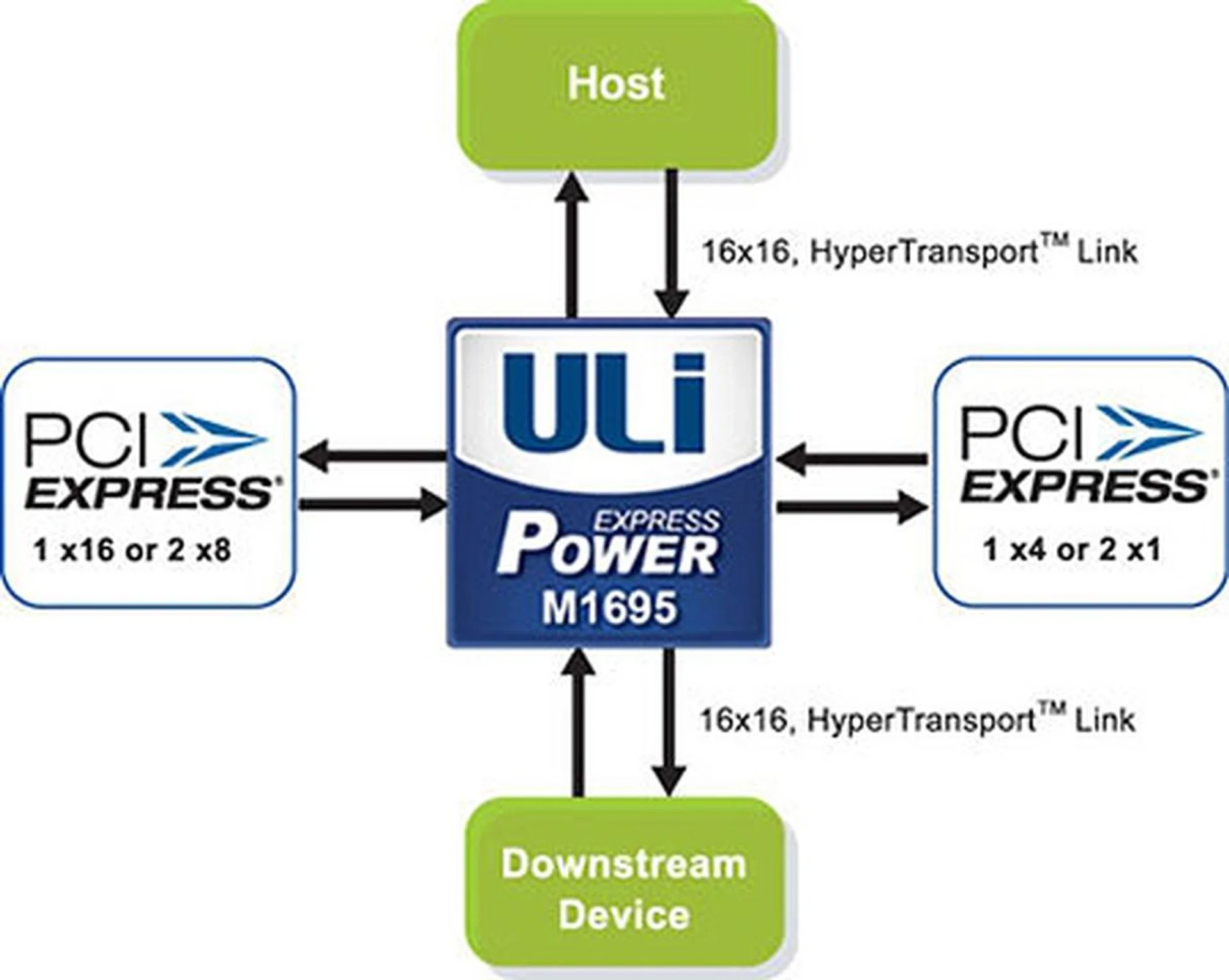
ULi M1695 connectivity and features.
As an Athlon 64 chipset, the M1695 in itself is an incredibly simple component. Since the memory controller is on the CPU, the M1695 has only two functions. Firstly, it is a HyperTransport tunnel offering full 16bit upstream and downstream links between CPU and downstream (Southbridge) devices. Secondly, it provides PCI Express support. That's basically it. The chip supports up to 20 PCI Express lanes split into three possible ports. ULi's whitepaper suggests that the possible configurations for the PCI Express lanes are 16+4, 16+2+2 or 8+8+4. This specification is interesting indeed as the 8+8+4 configuration would mean that the M1695 can support dual PCIe graphics and even SLI setups. We wouldn't rule out the fact that you can even install three PCIe graphics cards, provided that the correct physical slots are available on the board. The block diagram above basically represents the basic M1965 connectivity and features.
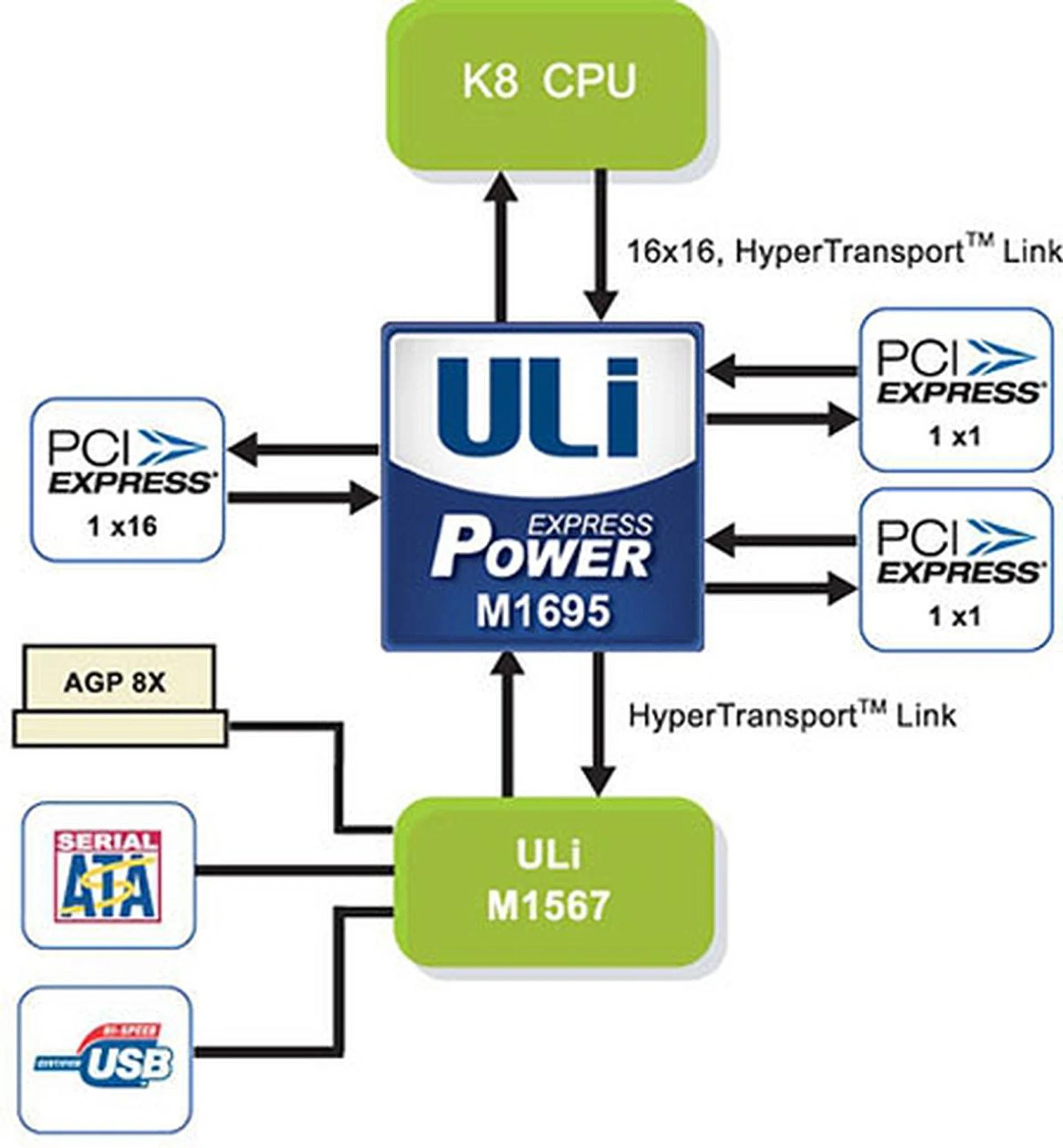
M1695 with M1567 Southbridge for TGi capability.
Besides the ultra-simplistic HyperTransport tunnel interface, the M1695 boasts another feature called Triple Graphics Interface (TGi). This is ULi's way of telling us that the M1695 can support AGP, PCI Express and PCI graphics concurrently. No big deal you might say. There are already motherboards that provide support for both PCIe and AGP graphics interfaces you might think; and you would be right. However, previous attempts to offer AGP on a PCI Express chipset were mainly based on AGP bridges running on top of the PCI bus. Thus, they were greatly performance limited. The M1695 on the other hand, can lay claim to be the first chipset that offers a full speed, full performance AGP 8X port in addition to a PCIe x16 (or dual PCIe x8) and even a traditional PCI card. This little menage trios is made possible through the use of ULi's M1567 companion Southbridge. Possibly the most common configuration for the M1695, the M1567 is a new HyperTransport Southbridge that offers your standard array of features such as onboard audio, LAN, USB 2.0, SATA and of course the AGP 8X port. The following table shows the general specifications of the M1567 Southbridge. Though you might think that the M1567 is nothing to shout about in terms of advanced features, remember that it was basically designed to enable TGi for the M1695 than anything else.
HyperTransport Interface |
|
AGP Interface |
|
Storage |
|
USB 2.0 |
|
PCI Interface |
|
Audio |
|
Networking |
|
Legacy I/O |
|
M1695 - Further Possibilities
Since we're on the topic of flexibility, ULi made sure that we were made known of other possible configurations for the M1695. In the following diagram, the M1695 is paired with an unnamed ULi Southbridge that extends its PCI Express capabilities to two full speed PCIe x16 graphic ports. We already know that NVIDIA's next nForce4 SLI chipset update will feature dual PCIe x16 interfaces, so if ULi has had the foresight to enable such functionality for the M1695, then this would certainly enhance the value and lifespan of the M1695. Theoretically, since the chip is a HyperTransport tunnel, we could actually link up two M1695s together in this configuration and still have the M1567 Southbridge. We're sure that enthusiasts may be lapping this up, but it is highly unlikely that we'll see such a triple chip motherboard out anytime soon for the consumer market.
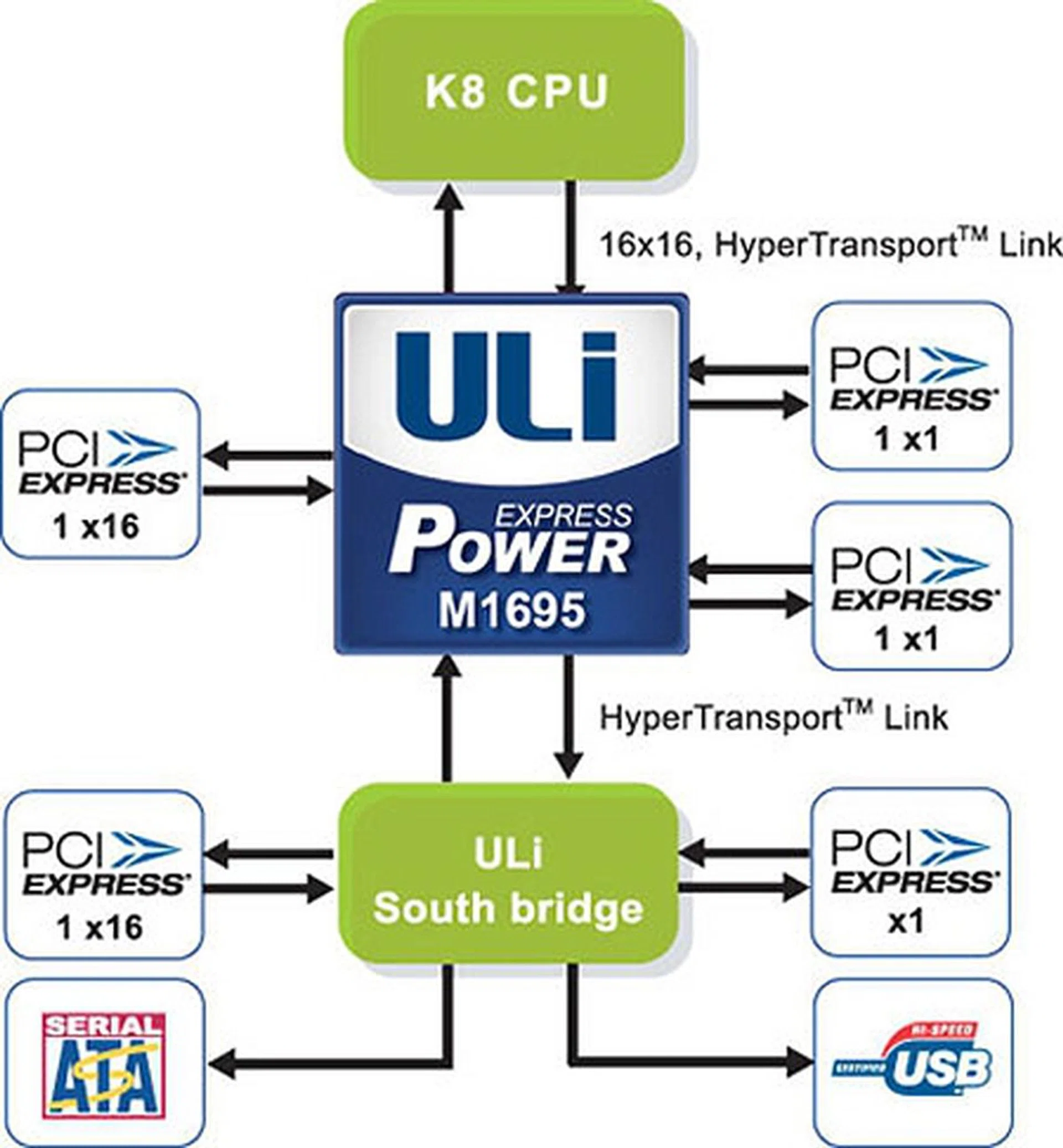
Additional functionality utilizing the HyperTransport link for further PCI Express expansion.
Undeterred, ULi has also provided a possible scenario where the M1695 can be used in enterprise level solutions for servers and workstations though AMD's PCI-X tunnel chip. As you can see, the possibilities of the M1695 are quite extraordinary since the HyperTransport link can be implemented in multiple chains for chip-to-chip interconnection. There is no doubt of the flexibility presented by the M1695, but in the end, its performance levels will determine how fast or how successful it penetrates the market and this is something we intend to find out soon enough.
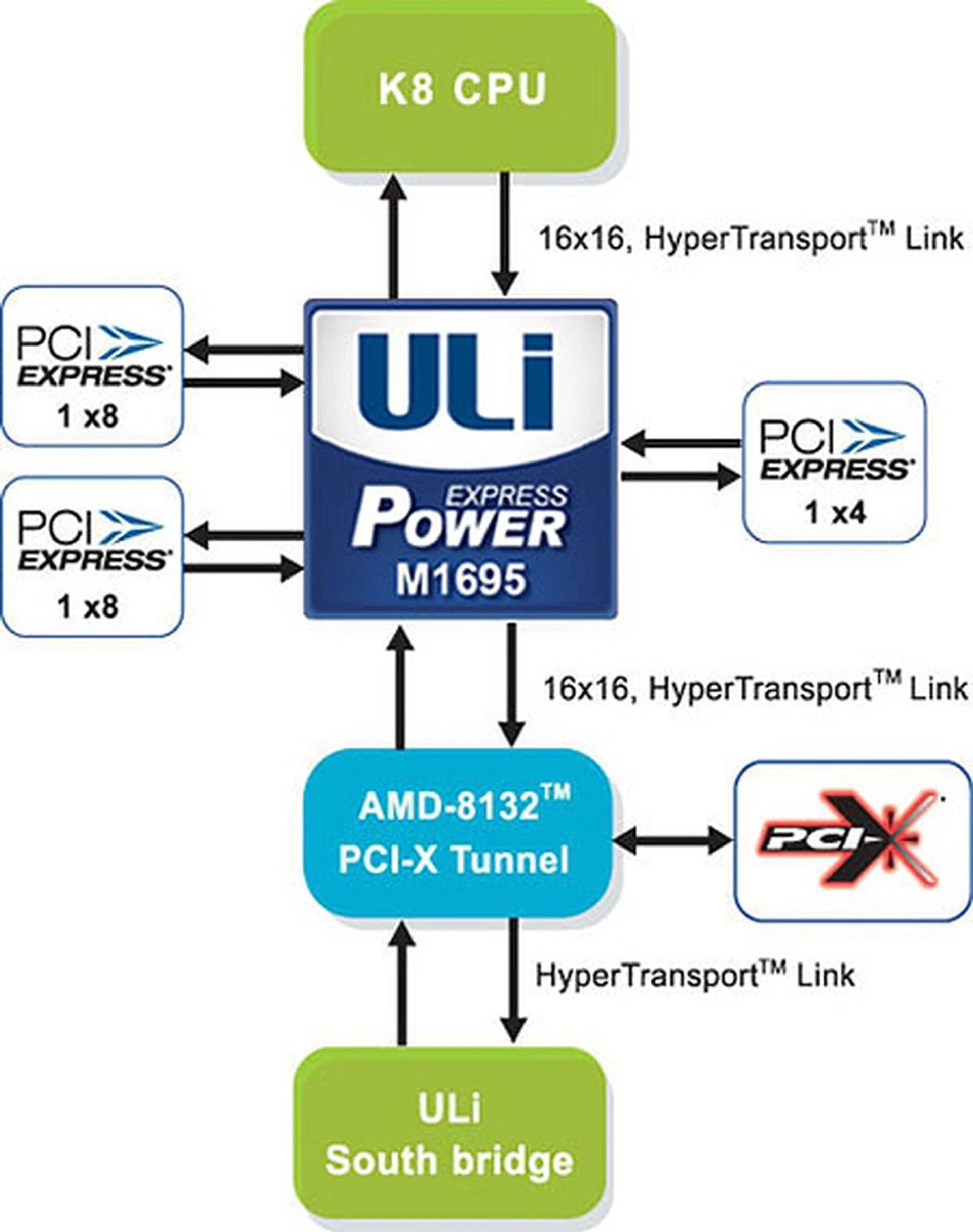
ULi's example of a server/workstation solution with addition of PCI-X functions as well.
The Reference Board (M1695/M1567)
Let's take a quick run through of the reference board that ULi sent us. We've been made aware that this is quite an early sample and one of the first reference designs that ULi has. As far as reference boards go, we shouldn't really be concerned about board design and layout. However, many manufacturers do end up sticking with the reference design and more often than not, the bad qualities filter through as well. Our reference board was of a short depth ATX design and was fitted with all the features available for the M1695/M1567 chipset combo. At a glance, we didn't really have any problems with the layout, except that the 24-pin ATX power and floppy connectors were in difficult positions. Other than that, the PCB was quite optimally used considering the limited space available. An interesting observation was made on the cooling of the chipset. You can see that the M1695 only required a simple, small heatsink and the M1567 Southbridge did not even need to be cooled. Compared to the ultra hot nForce4 chipsets, the M1695 solutions seemed to run a whole lot cooler in operation, even to the touch.
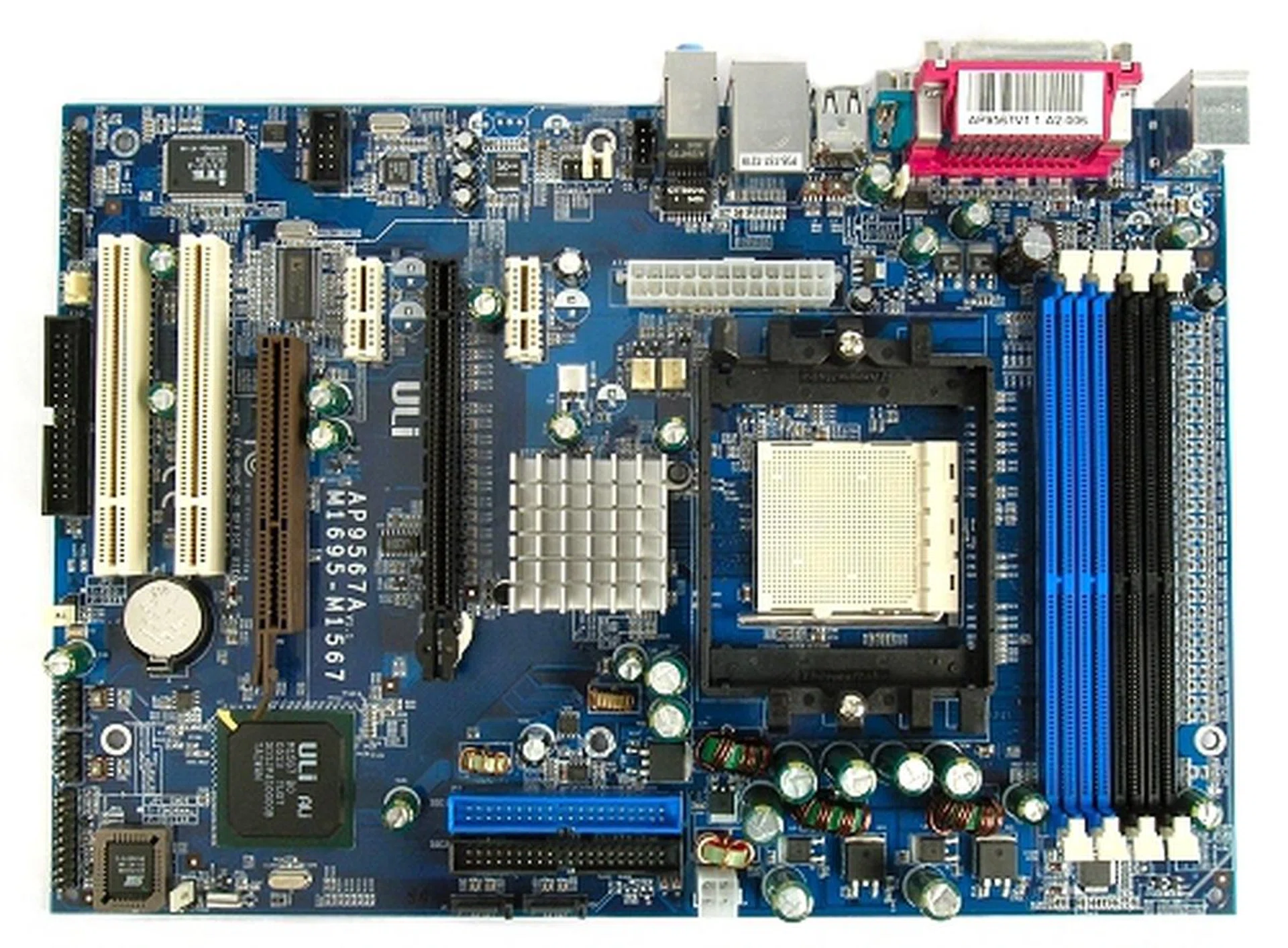
Top view of the M1695 reference board we received from ULi. Clean layout, but some components were not ideally placed.
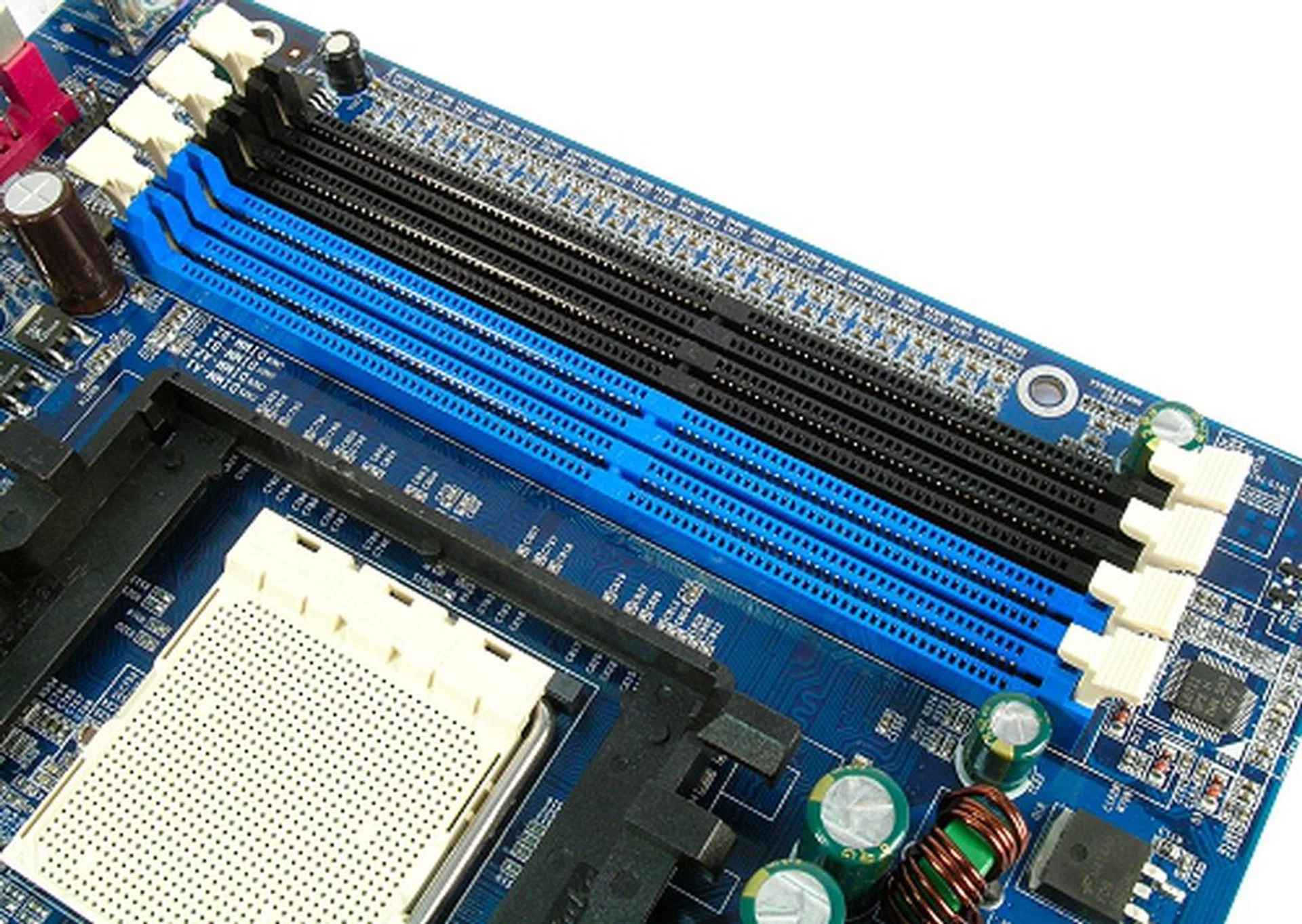
With a short depth motherboard, DIMM slots have to be installed horizontally at the top of the board.

Since the DIMM slots occupy space at the top of the board, CPU socket, capacitors and all storage connectors have been pushed down towards the middle.
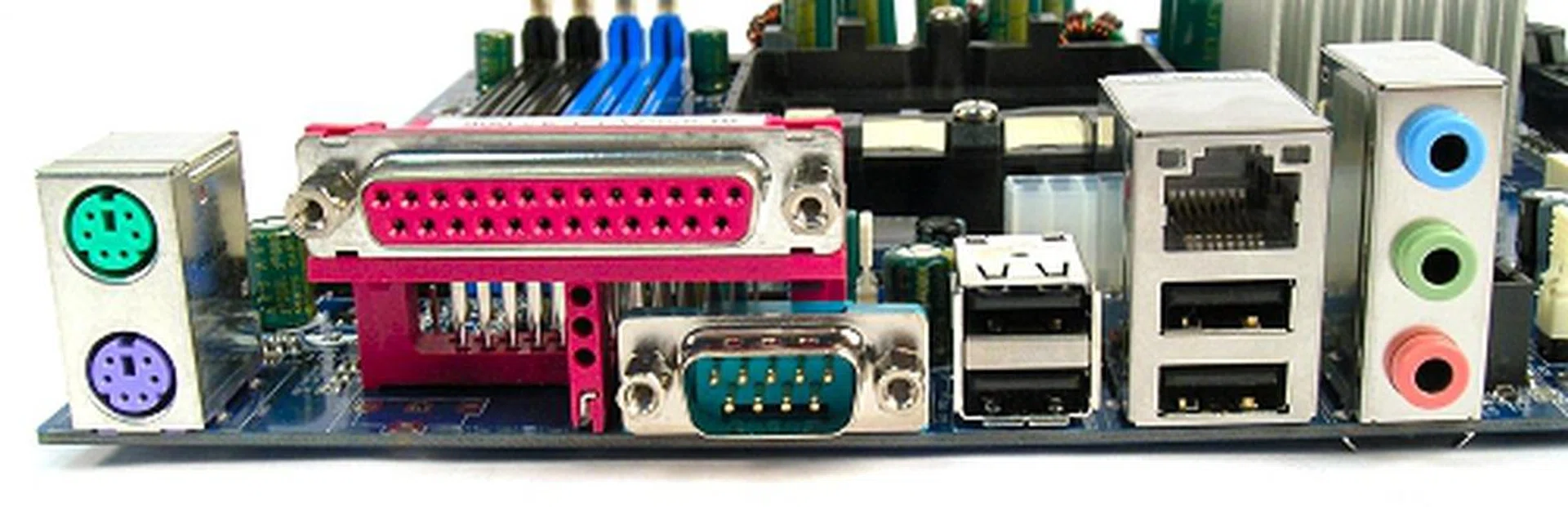
The rear panel of the M1695 reference board has nothing much notable. Let's hope that retail boards are much more fulfilling.
Of course, the M1695+M1567 combination meant that our board was TGi ready. We liked how ULi positioned the slots to give priority to the graphic card. With this configuration, even large two-slot AGP and PCIe cards can be simultaneously installed and still have space for a PCIe x1 expansion slot and a remaining PCI slot for either the third graphic card or some other device.
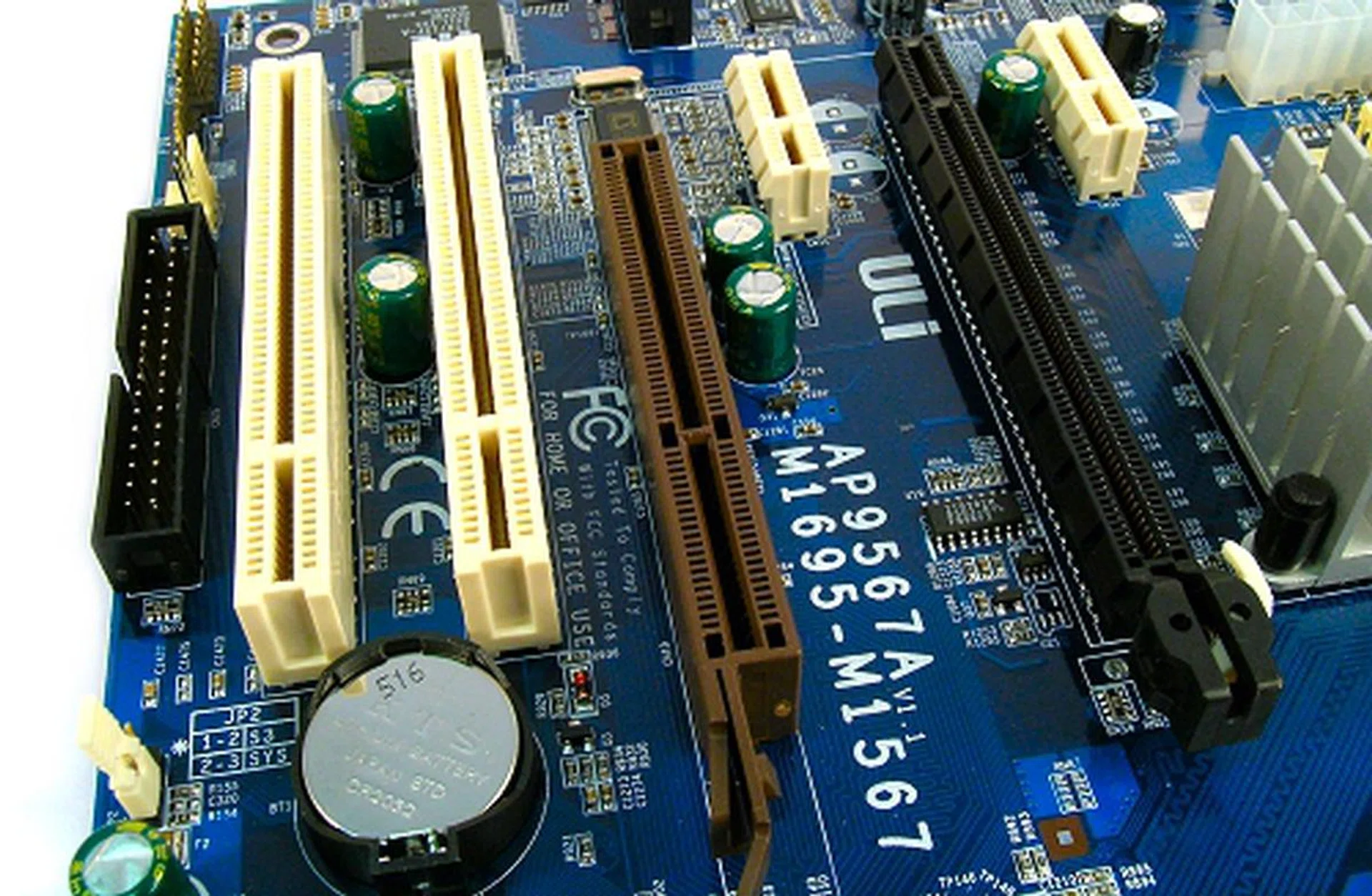
All expansion slots are staggered to allow maximum usability even if both PCIe and AGP graphic cards are of the dual slot variety.
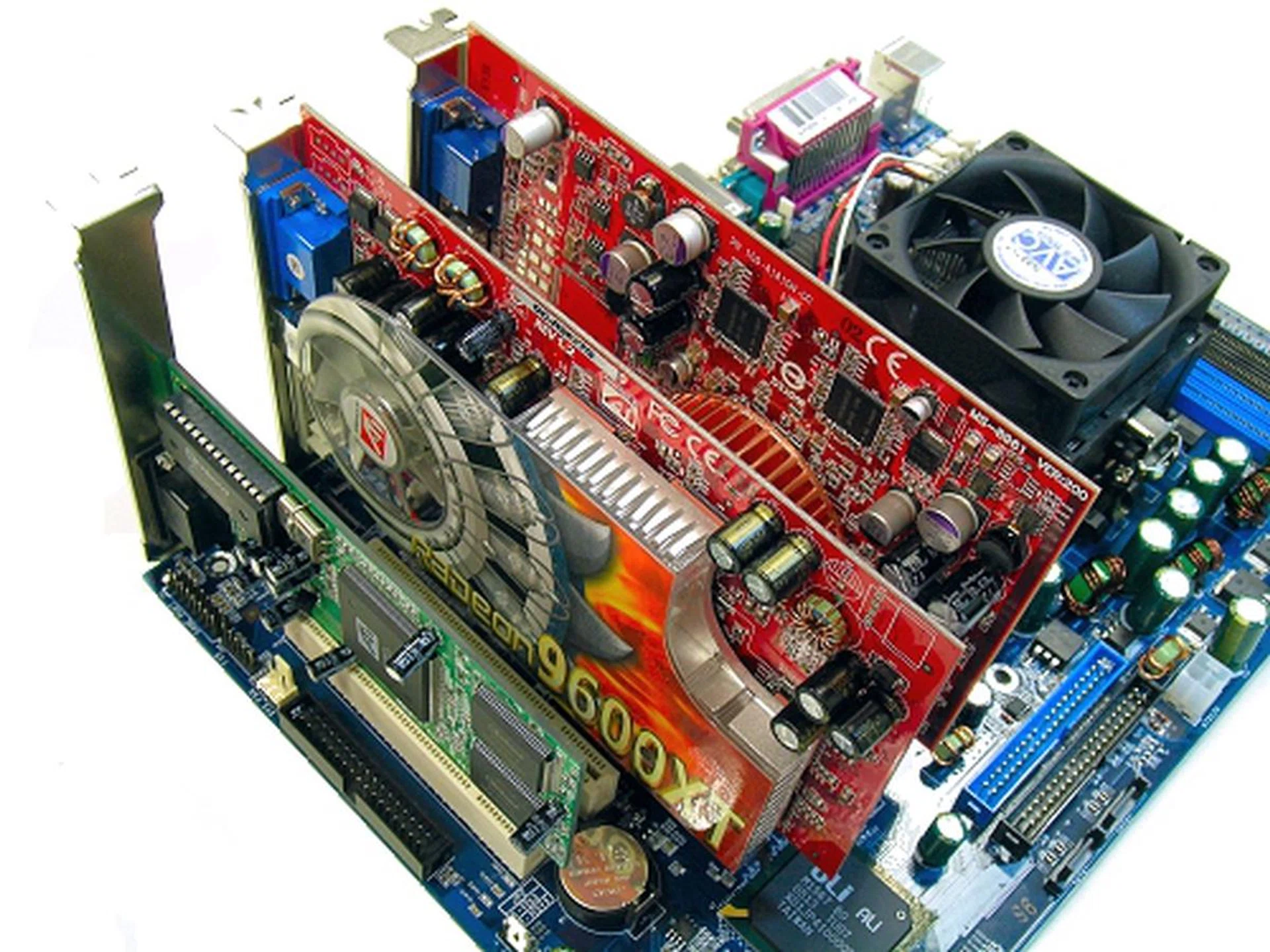
TGi in action. We had to dig up an old PCI graphic card, but Windows detected and installed drivers for all three without a fuss. Kudos to ULi for a working implementation.
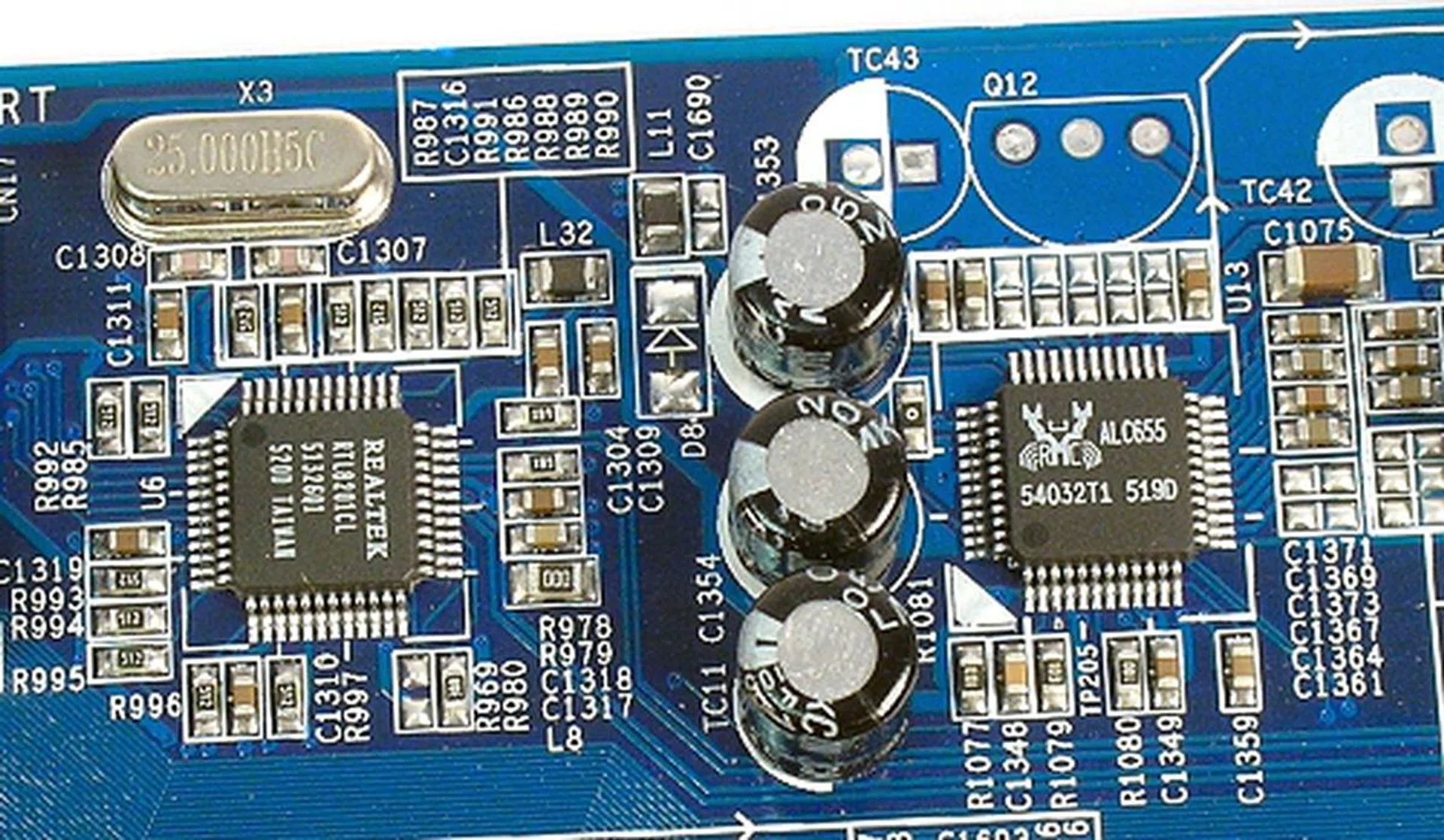
Basic features include a Realtek ALC655 AC'97 6-channel CODEC and a Realtek RTL8201CL Fast Ethernet PHY.
As for the board setup and BIOS configuration, the M1596 reference board was sadly quite bare. We had initially hoped to have greater controls to play around with to test the extent of the chipset functionality. However, the board only came with rudimentary frequency selections and limited memory timing options. There was no voltage selections whatsoever and it also didn't feature a multiplier option for the CPU. As you would have expected, this put a dent into our overclocking efforts. Indeed, we maxed out at 220MHz FSB as our Athlon 64 3500+ became the limiting factor.
Test Setup
Since the M1695 is a newcomer into the Athlon 64 market, we tested it against a wide range of chipsets available today, including both PCI Express and AGP. The various chipsets that we would be pitting the M1695 with are the ATI Radeon Xpress 200P, VIA K8T800 Pro, NVIDIA nForce3 Ultra and NVIDIA's nForce4 Ultra. Considering we have some AGP scores for comparison, we also threw in some benchmarks with the AGP 8X port available on the board. For this purpose though, we had to use some older drivers in order to more accurately compare with previous benchmarks done. The following table depicts the hardware and software configurations used throughout the benchmarking session.
CPU |
|
Memory |
|
Hard Disk |
|
Graphics Card |
|
Operating System |
|
System Drivers |
|
Additional Notes
Most of our previous benchmarks were run using an 8-4-4 CAS 2.5 memory timing due to the ATI Radeon Xpress 200P reference board locking the memory parameters. However, the ULi M1695 reference board defaulted our memory settings back to 6-3-3 CAS 2.5 no matter what was selected in the BIOS. As such, bear in mind that the M1695 would run with slightly tighter memory timings than the rest of the boards used. It should be interesting to see if the M1695 can use this to its advantage.
Our reference board also had problems running benchmarks with resolutions of 1280x1024 and higher on the AGP port. Applications became unstable and would occasionally exit back into Windows. Due to this, we did not run graphical benchmarks at this resolution for fear of unreliable results. Since we have an early evaluation board, these problems could be teething implementation issues. Until we can get our hands on proper retail worthy motherboards, we won't be able to confirm if this is a definite problem with the board setup or the chipset itself.
Benchmarks
The following benchmarks were run to test the various aspects of the M1695:-
- BAPco SYSmark 2004
- Futuremark PCMark04
- SPECviewperf 8.01
- Futuremark 3DMark03
- AquaMark3
Results - BAPco SYSmark 2004
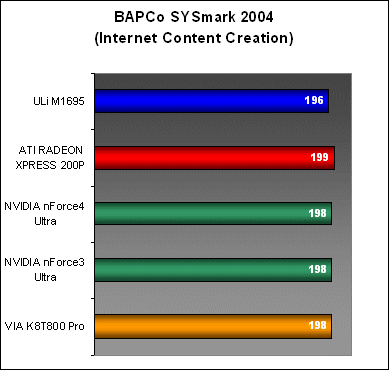
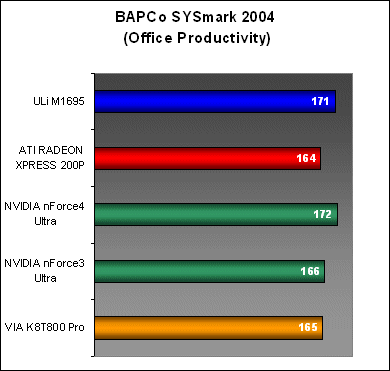
The M1695 did quite well in SYSmark 2004 with a comparable overall score. Our reference board dipped slightly in the Internet Content Creation benchmark, but it came back strong in the Office Productivity tests, showing potential that rivaled the nForce4 Ultra.

Results - Futuremark PCMark04
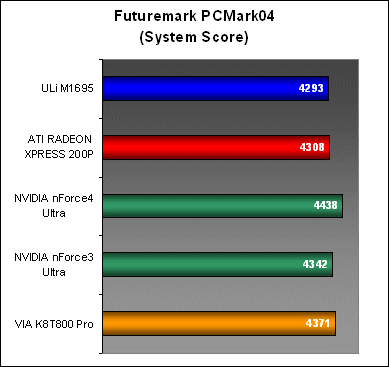
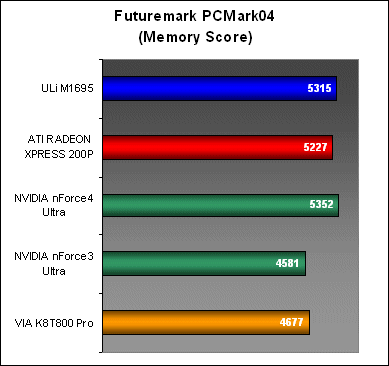
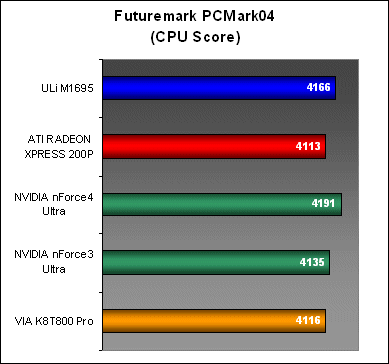
The overall System benchmark seemed low for the M1695. However, there is an explanation for that which we will focus on later. Looking at the CPU and Memory test scores, the M1695 again showed results comparable to the nForce4 Ultra, bearing in mind the slightly better memory timings on the M1695. The HDD ratings for the M1567 Southbridge wasn't all too bad either, though NVIDIA's implementation still hold the lead.

Results - SPECviewperf 8.01
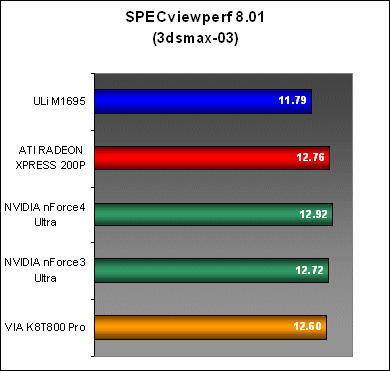
You maybe surprised to see why the M1695 took a sudden dip in the 3dsmax-03 test when it had done so well in both SYSmark 2004 and PCMark04. This was the reason why the board scored slightly lower in the PCMark04 System tests as well. It seemed that the PCI Express subsystem for the M1695 wasn't quite optimized yet. As a more graphic intensive benchmark in the SPECviewperf suite, 3dsmax-03 was able to pick this out. Notice that its scores came back up in the light-07 test because of higher memory subsystem utilization. However, it was still bogged down by the sub-par graphics interface.

Results - Futuremark 3DMark03
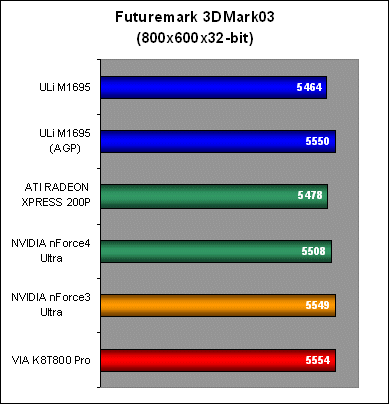
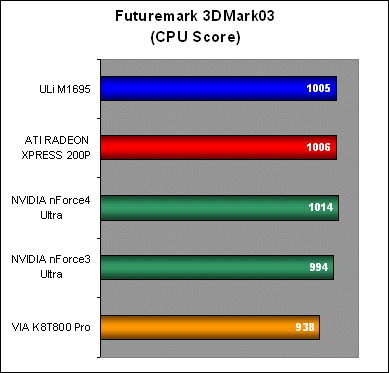
As we move onto our gaming benchmarks, we took the opportunity to test the AGP 8X port available on the M1567 Southbridge and these scores are integrated into the charts below. From the results, the weakness of the M1695's PCI Express graphics subsystem was proven again. However, notice that the board's AGP subsystem managed an excellent performance. It was really too bad that we had problems running at higher resolutions as it really showed incredible potential.

Results - AquaMark3
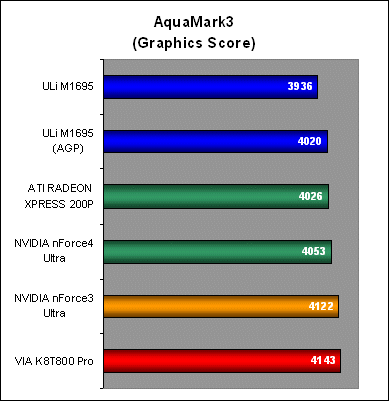
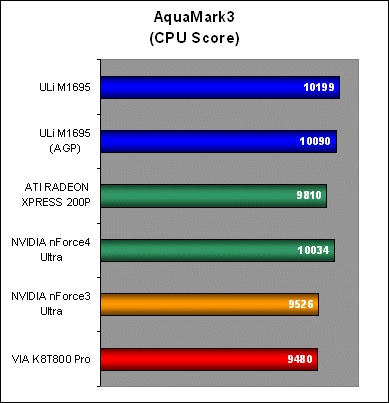
The M1695 really struggled with Aquamark3 as you can see that the scores for both its PCIe and AGP runs were not so flattering. CPU-wise, the chipset showed its worth again as a competitor to the nForce4 Ultra, beating previous generation chipsets (with a little aid in the tighter memory timings of course). However, its graphics subsystem will have to be optimized further before gamers can be enticed to take the chipset seriously.
Conclusion
There is no doubt of the M1695's allure. The chip was designed with one thing in mind and that is flexibility. In this aspect, ULi has given themselves an advantage in the chipset race. However, there are still many hurdles they need to pass. The chipset market isn't really a friendly place and without both manufacturer and consumer confidence, decent chipsets often end up as 'has beens' before they're even given a chance much like ATI's struggle in this area (we're still waiting on their yet-to-be-released, but still highly anticipated CrossFire chipsets). Then there is the problem of support. Frankly, ULi is no NVIDIA or even VIA. At the moment, there really isn't many choices to pair the M1695 with despite its theoretical usefulness. Unless ULi themselves can come up with a full range of configurations, the M1695 could become stereotyped to the configuration of our reference model. Luckily, the server market looks to be a better mover for the M1695 as there is increased support for third party HyperTransport logic sets.

Thankfully, ULi has not been caught sleeping. With the launch of the M1695, ULi has carved a niche for themselves with the companion M1567 Southbridge offering their Triple Graphics Interface. TGi can be seen as a boon to the masses in the midst of upgrades or the many people who have yet to move towards PCI Express. Unlike the PCI-AGP bridge solutions offered by other manufacturers, the M1695/M1567 chipset combo provides users with a true AGP 8X port. The best thing about it was that it worked as advertised and it isn't tied up with specific AGP graphics card models only. We were able to get all three graphic cards installed and running with no conflicts and even confirmed output from all three cards.
As far as performance goes, our little roundup with the various chipsets showed that the M1695 has what it takes to compete with the best. Though we were clearly running an evaluation board without optimized drivers nor BIOS settings, the M1695 was ahead of the ATI Radeon Xpress 200P and only a step behind the nForce4 Ultra in almost every benchmark. While the PCI Express bus did seem to need some tweaking to get the graphics performance up, users of AGP cards will not have to worry about any performance degradation. In fact, it came very near surpassing our long time AGP champion, the VIA K8T800 Pro. The M1695 not only showed its prowess as a decent performer, but was also rock solid through our benchmarks (apart from the high-resolution limitation we noted on our early evaluation board).
ULi has been keeping mum on the exact costing of the chipset, but we've been told that it would be targeted in the mainstream segment. Due to its obvious cost effectiveness, users can count on seeing initial supporters from Asrock, Jetway and Chaintech and even big time ASUS has invested in the M1695. On the whole, ULi has shown that they are capable of innovation and we were very pleased with the excellent performance seen. The announcement of SLI support plus capabilities of running dual PCIe x16 (through additional tunnel chips) add even more value to the already multi-talented M1965. With a good price and growing manufacturer support, ULi might possibly shake up the chipset market with some real competition. Let's just hope that the retail boards are able to live up and more importantly surpass what we've seen here.
Our articles may contain affiliate links. If you buy through these links, we may earn a small commission.