
NVIDIA GeForce GTX 570 - Built with GTX 580 DNA
The new GeForce GTX 570 is here in our labs and we not only have a reference card to test, but also a customized one from Palit in the form of their Sonic Platinum edition. Check out our review to see if this is the card you want for Christmas.
Refreshing the GTX 480
Lately, NVIDIA’s fortunes have taken a turn for the better. Although AMD’s latest Northern Islands card - - have received largely positive reviews, yield issues mean that there’s not enough cards to go around. Moreover, this has also caused AMD to delay the release of their eagerly anticipated high-end Cayman parts (Radeon HD 6900 series).
In the meantime, NVIDIA capitalized on AMD’s misfortune by releasing their uber-quick 512-core , thereby cementing their grip on the title of world’s fastest GPU. To build on its momentum and to take full advantage of the holiday spending spree, NVIDIA has hastily followed up with the GeForce GTX 570, a card which they say was built with GTX 580 DNA.
But first things first, despite the name, the GeForce GTX 570 is actually more similar to the older GTX 480 than the GTX 470. Based on the GF110 chip that powers the GeForce GTX 580, the GeForce GTX 570 possesses less cores, 480 to be exact, which is exactly the same as the old GeForce GTX 480. Apart from that, the GeForce GTX 570 also has the same number of texture mapping units as the GTX 480, which totals 60.
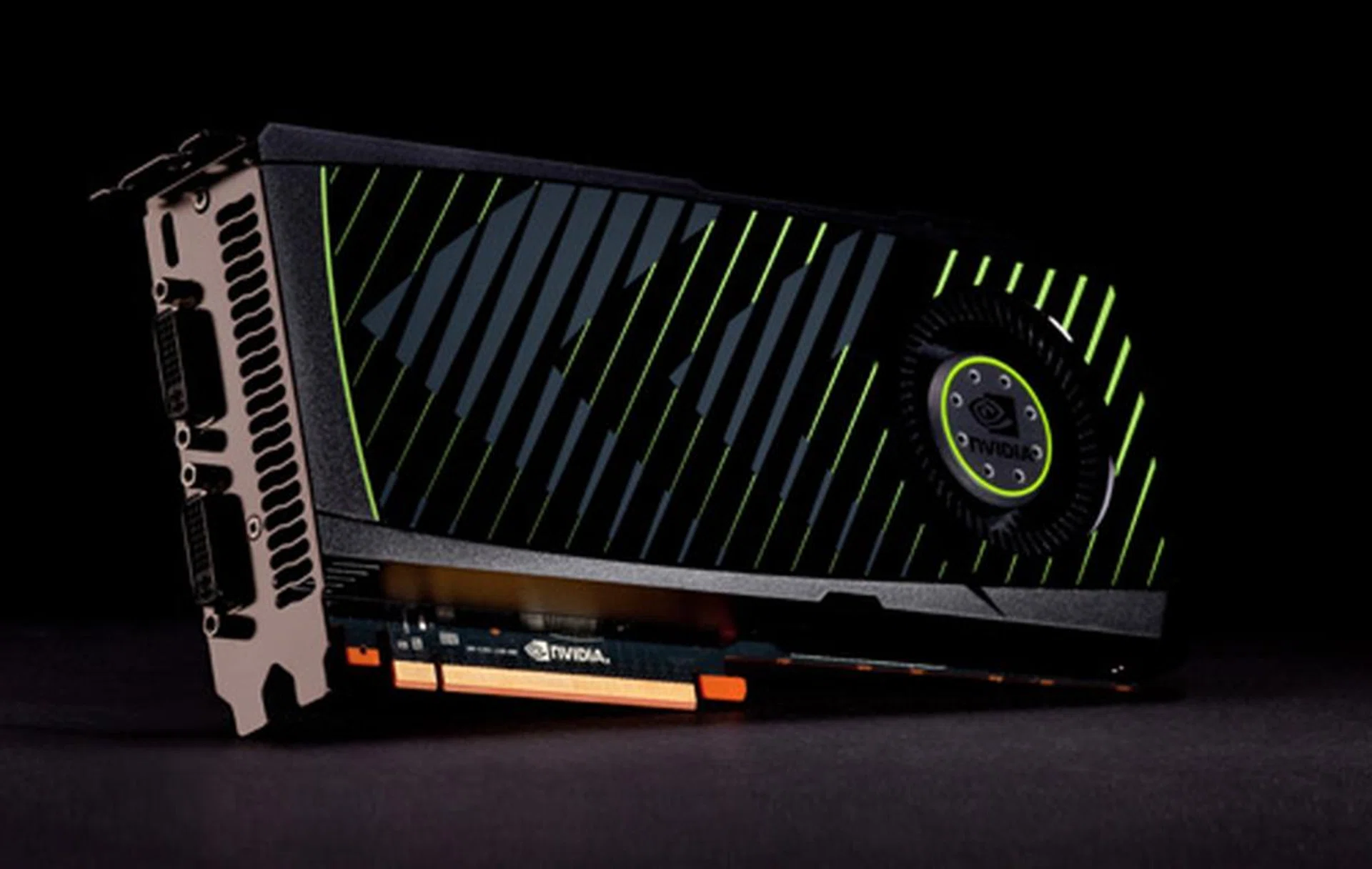
Will it be faster than the old GeForce GTX 480? Or does NVIDIA intend for this to be its direct replacement? Read on to find out.
Where the GeForce GTX 570 is different, however, is that since it is based on the GF110 chip, it has been reworked slightly at the transistor level to make it more efficient. It also boasts the same performance enhancements such as full-speed FP16 texture filtering and support for new tile formats to improve Z-cull efficiency like the GeForce GTX 580. However, the GeForce GTX 570 has eight less raster operating units compared to the GTX 480 and also a narrower 320-bit memory bus width and smaller 1280MB GDDR5 framebuffer.
So to compensate, the GeForce GTX 570 gets higher clock speeds. Compared to the GeForce GTX 480’s 701MHz at the core, 1401MHz at the shaders and 3696MHz DDR at the memory; the new GeForce GTX 570 is running at 732MHz at the core, 1464MHz at the shaders and 3800MHz DDR at the memory.
And although the GeForce GTX 570 was just launched, Palit already have their own customized design for sale and we've got one for evaluation. Factory overclocked and boasting a dual-fan custom cooler, it will be interesting to see how their version improves on NVIDIA’s reference one.
Read on to find out how the two cards will perform, but first, a quick look at how the reference GeForce GTX 570 stacks up against competitive SKUs.
Model | NVIDIAGeForce GTX570 | NVIDIAGeForce GTX 580 | NVIDIAGeForceGTX 480 | NVIDIAGeForce GTX470 | ATIRadeon HD5970 | AMDRadeon HD 6870 | ATI Radeon HD 5870 |
Core Code | GF110 | GF110 | GF100 | GF100 | Hemlock | Barts XT | Cypress XT |
Transistor Count | 3000 million | 3000 million | 3200 million | 3200 million | 4300million | 1700 million | 2150 million |
Manufacturing Process | 40nm | 40nm | 40nm | 40nm | 40nm | 40nm | 40nm |
Core Clock | 732MHz | 772MHz | 701MHz | 607MHz | 725MHz | 900MHz | 850MHz |
Stream Processors | 480 Stream Processors | 512 Stream Processors | 480 Stream Processors | 448 Stream Processors | 3200 Stream processing units | 1120 Stream processing units | 1600 Stream processing units |
Stream Processor Clock | 1464MHz | 1544MHz | 1401MHz | 1215MHz | 725MHz | 900MHz | 850MHz |
Texture Mapping Units (TMU) or Texture Filtering (TF) units | 60 | 64 | 60 | 56 | 160 | 56 | 80 |
Raster Operator units (ROP) | 40 | 48 | 48 | 40 | 64 | 32 | 32 |
Memory Clock | 3800MHz GDDR5 | 4008MHz GDDR5 | 3696MHz GDDR5 | 3348MHz GDDR5 | 4000MHz GDDR5 | 4200MHz GDDR5 | 4800MHz GDDR5 |
DDR Memory Bus | 320-bit | 384-bit | 384-bit | 320-bit | 256-bit | 256-bit | 256-bit |
Memory Bandwidth | 152GB/s | 192.4GB/s | 177.4GB/s | 133.9GB/s | 256GB/s | 134.4GB/s | 153.6GB/s |
PCI Express Interface | PCIe ver 2.0 x16 | PCIe ver 2.0 x16 | PCIe ver 2.0 x16 | PCIe ver 2.0 x16 | PCIe ver 2.0 x16 | PCIe ver 2.0 x16 | PCIe ver 2.0 x16 |
Molex Power Connectors | 2 x 6-pin | 1 x 6-pin, 1 x 8-pin | 1 x 6-pin, 1 x 8-pin | 2 x 6-pin | 1 x 6-pin, 1 x 8-pin | 2 x 6-pin | 2 x 6-pin |
Multi GPU Technology | SLI | SLI | SLI | SLI | CrossFireX | CrossFireX | CrossFireX |
DVI Output Support | 2 x Dual-Link | 2 xDual-Link | 2 x Dual-Link | 2 x Dual-Link | 2 x Dual-Link | 1 x Dual-Link, 1 x Single-Link | 2 x Dual-Link |
HDCP Output Support | Yes | Yes | Yes | Yes | Yes | Yes | Yes |
Street Price | Launch price: US$349 | ~US$529 | ~US$429 | ~US$259 | ~US$500 | US$239 | ~US$360 |
The NVIDIA GeForce GTX 570
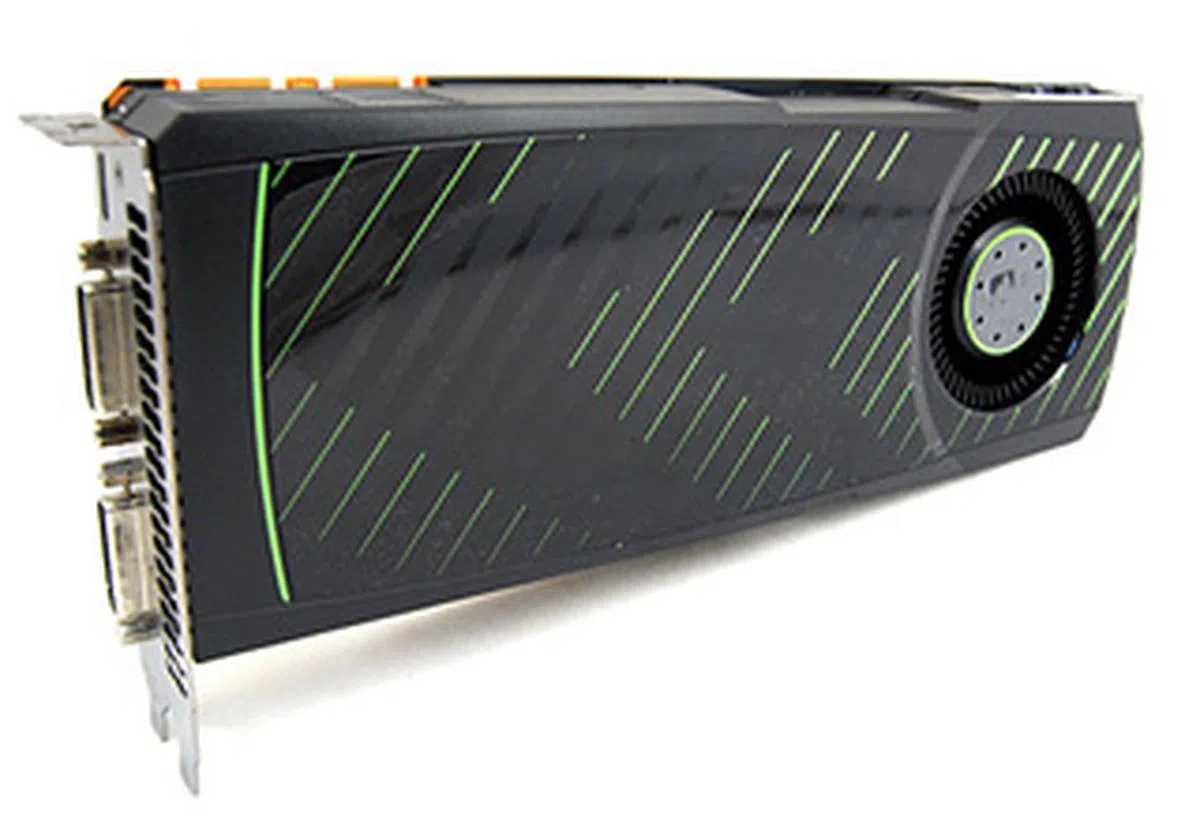
Like most high-end graphics cards, the GeForce GTX 570 is a massive card coming in at about 10.5-inches long - roughly the same as a GeForce GTX 580.
Physically, the GeForce GTX 570 looks remarkably similar to the GeForce GTX 580, which is not surprising because it employs the same vapor chamber technology cooler. And if you recall, this custom-designed vapor chamber cooler also uses a specially-tuned fan that generates a lower pitch so that its less intrusive. Furthermore, the cooling cover is slightly angled so as to help route air to the rear brackets when used in an SLI configuration. Clearly, NVIDIA is taking cooling and acoustics very seriously with their new GTX 500 series cards.
The only major physical difference you’ll notice is that the GeForce GTX 570 requires two 6-pin PCIe power connectors as opposed to the GeForce GTX 580’s 8 and 6-pin configuration. As such, NVIDIA recommends that the GeForce GTX 570 be paired with a 550W PSU at minimum as opposed to a 600W PSU for the GTX 580.
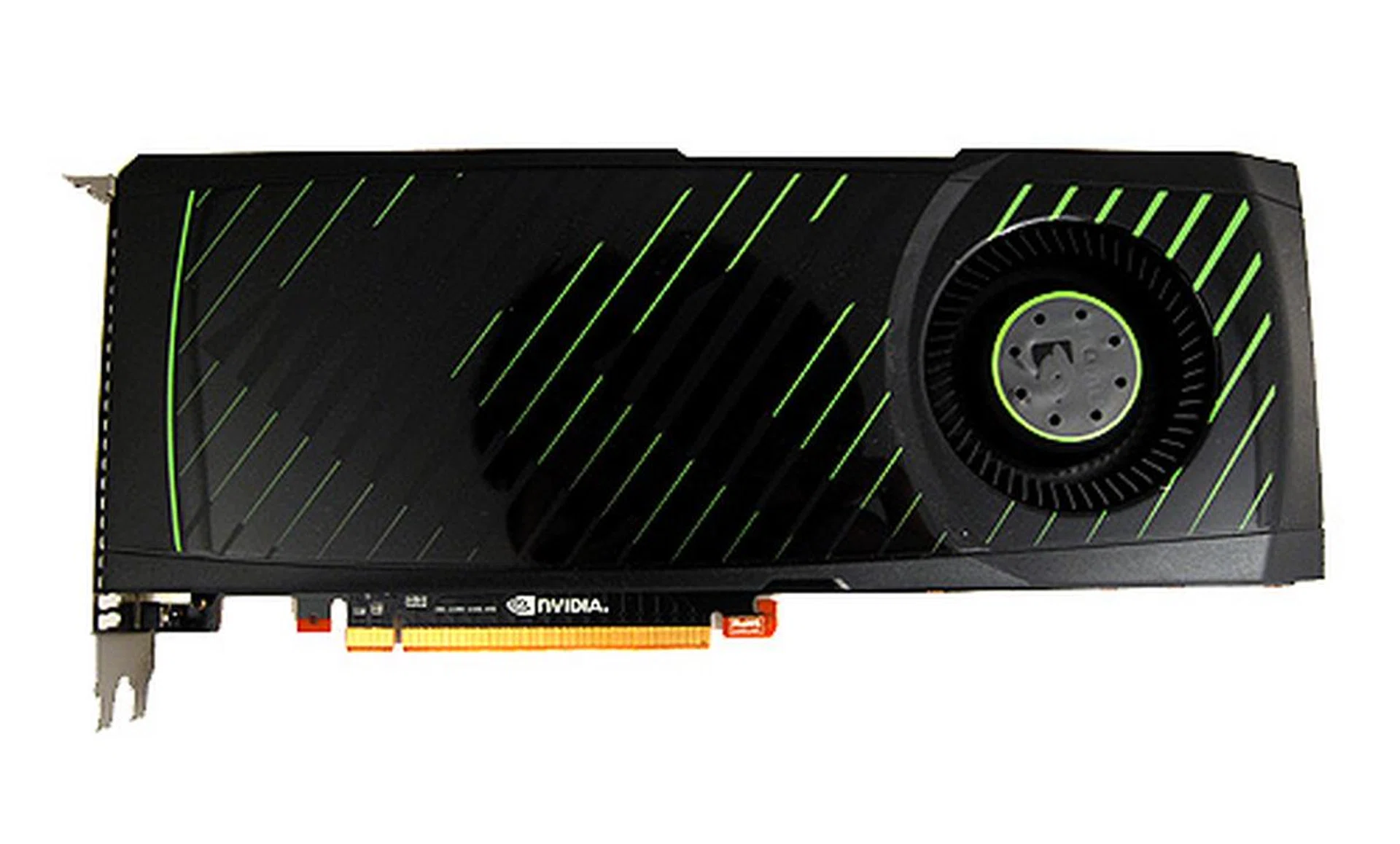
Like the GeForce GTX 580, the new GTX 570 also has a vapor chamber cooler which NVIDIA claims provide better cooling efficiency and acoustics.
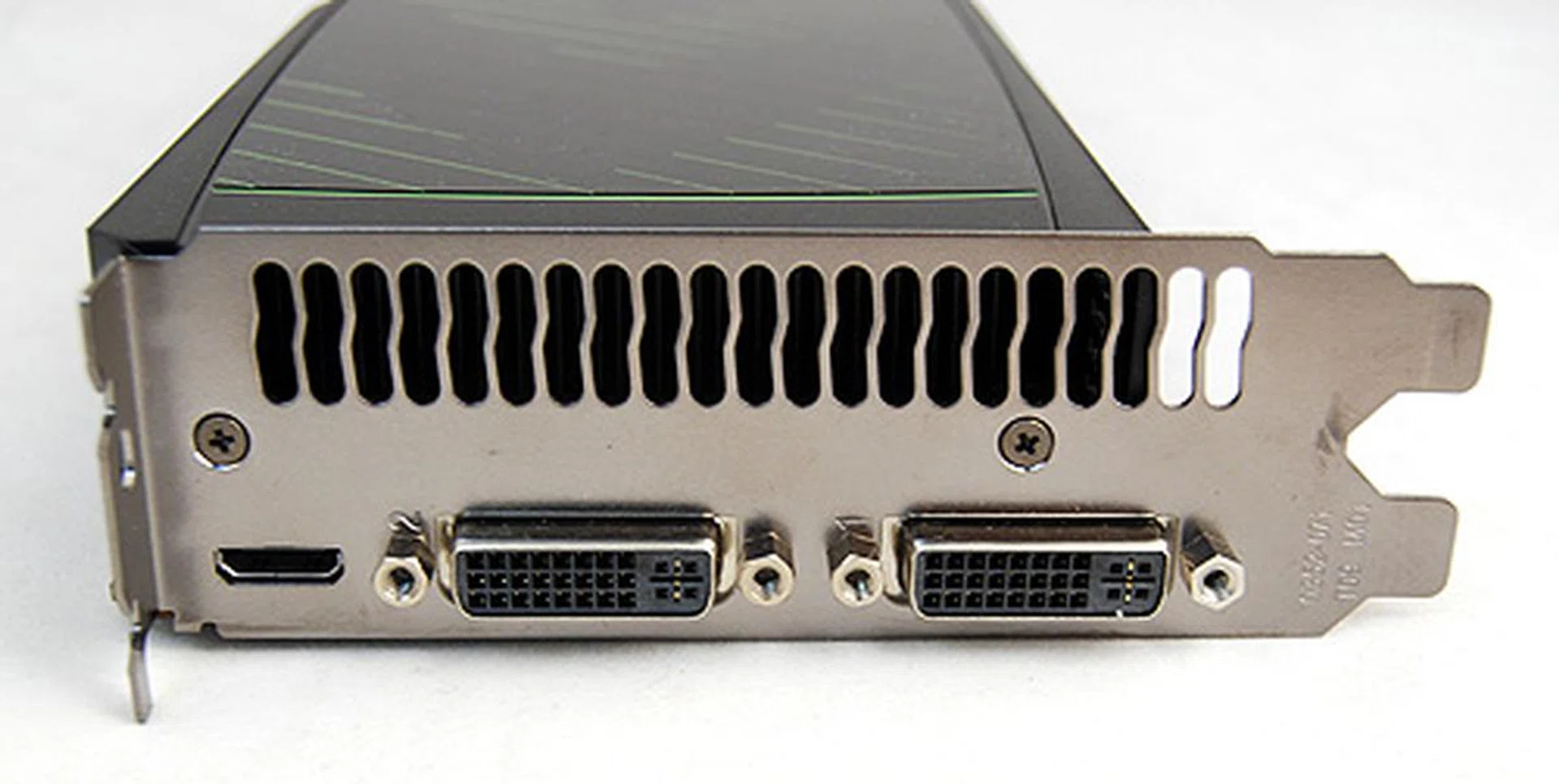
The GeForce GTX 570 has the same twin DVI and single mini-HDMI ports as other Fermi-based graphics cards.
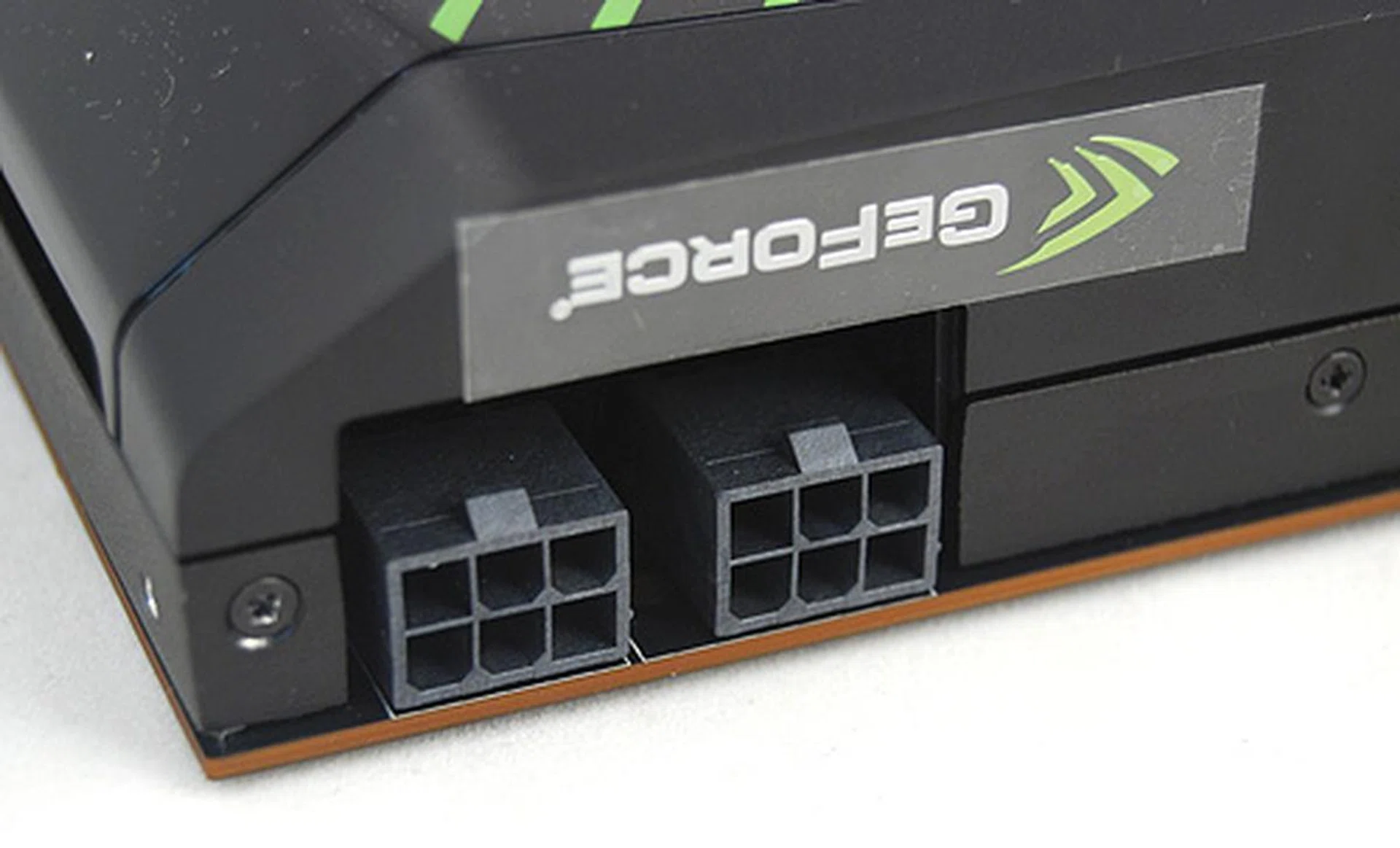
Unlike the old GeForce GTX 480, the GeForce GTX 570 requires only two 6-pin PCIe power connectors for power. It also has a lower rated TDP of 219W compared to the GeForce GTX 480's rated TDP of 250W.
The Palit GeForce GTX 570 Sonic Platinum
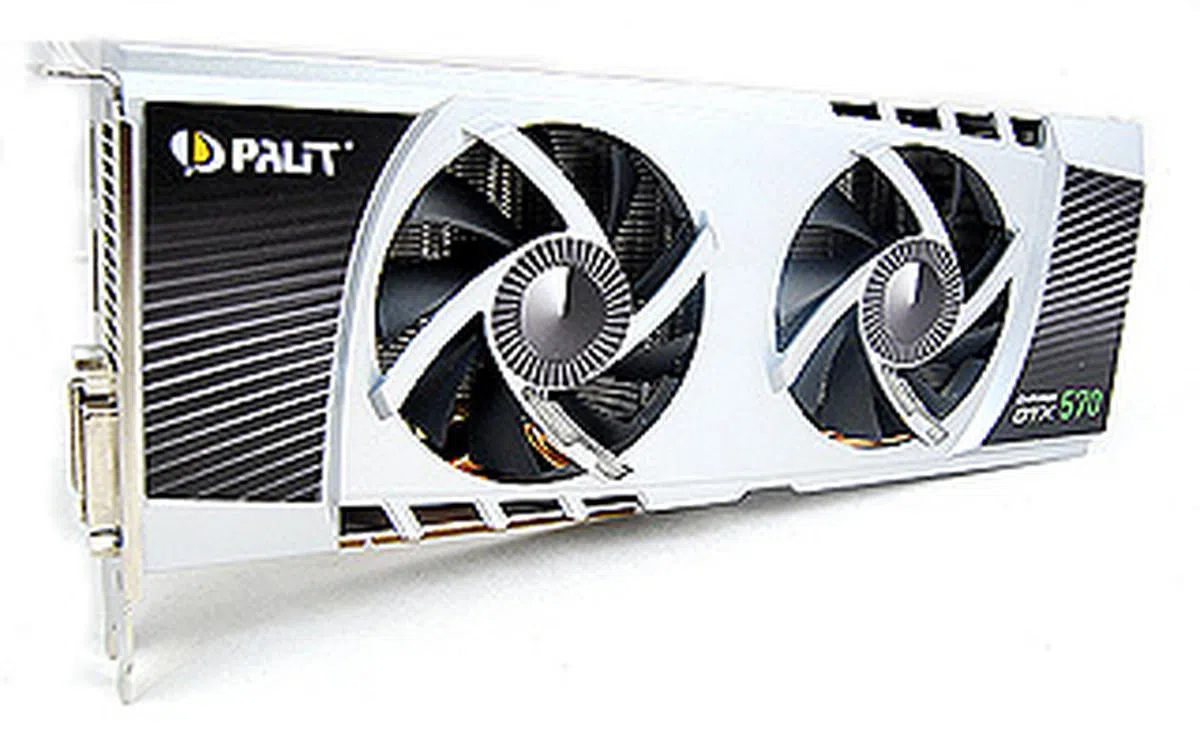
It’s launch day and Palit already has a customized edition of the GeForce GTX 570 ready. This is the Palit GeForce GTX 570 Sonic Platinum and it comes with a custom designed dual-fan cooler and is factory overclocked to boot. Core clock speeds have been bumped to 800MHz from 732MHz which also brings shader clock speeds up to 1600MHz from 1464MHz. Memory clock speeds have been given a boost too, up to 4000MHz DDR from 3800MHz DDR.
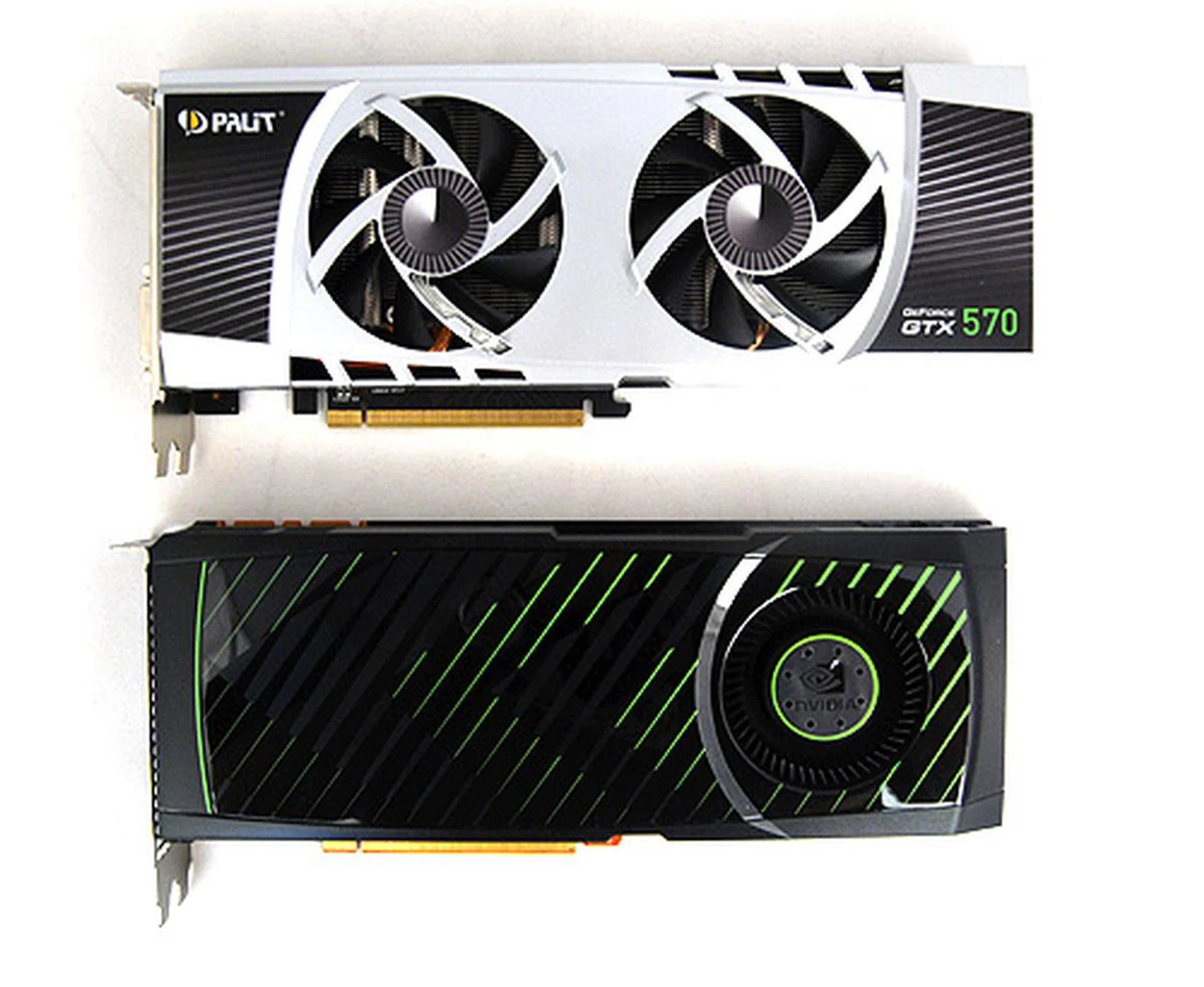
As you can see, Palit's custom designed cooler is very different from NVIDIA's own vapor chamber cooler - and is even a tad longer.
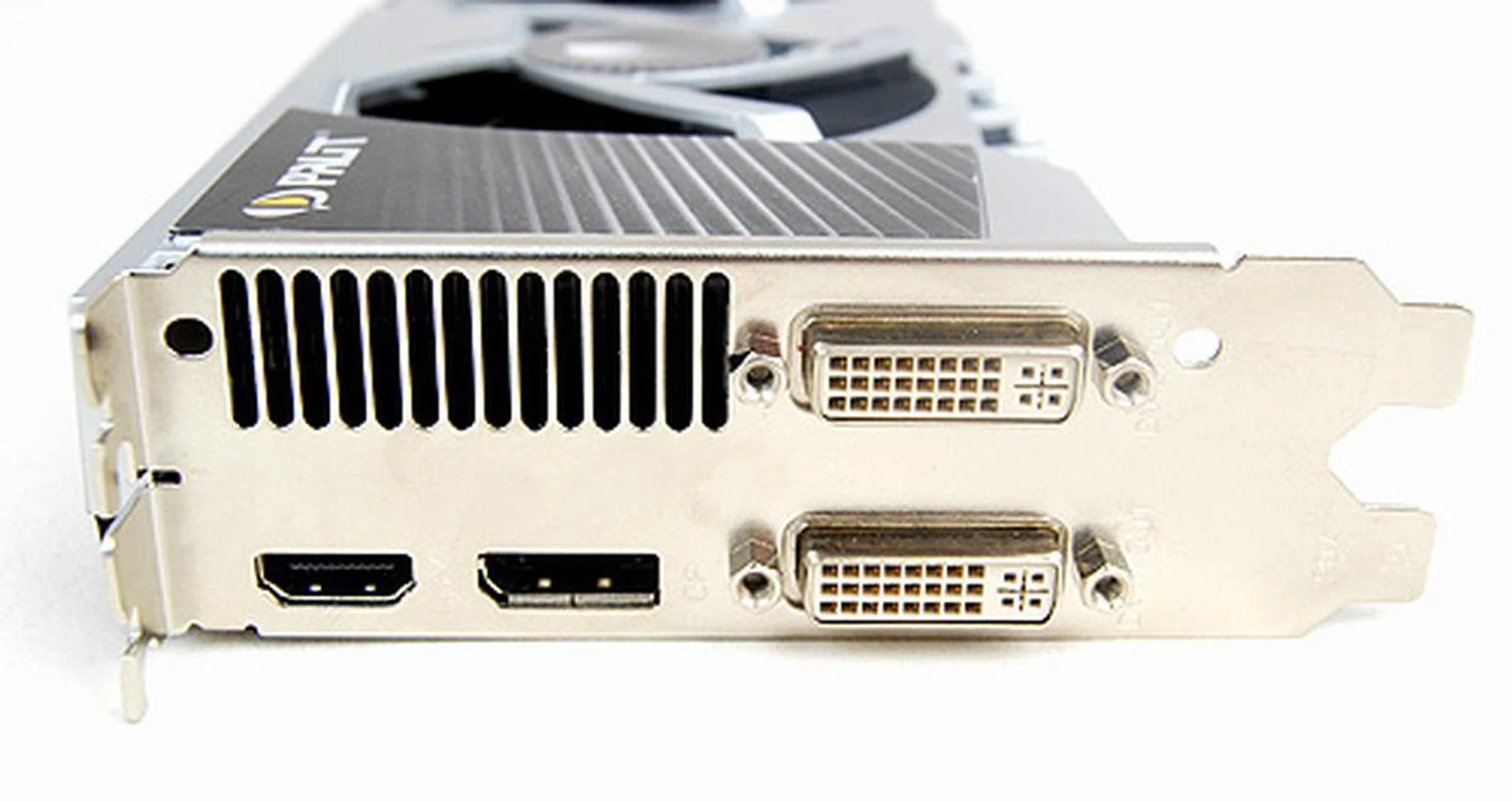
Palit's card is more generous when it comes to video output option seeing that it has twin DVI ports, a DisplayPort and also a full-sized HDMI port.
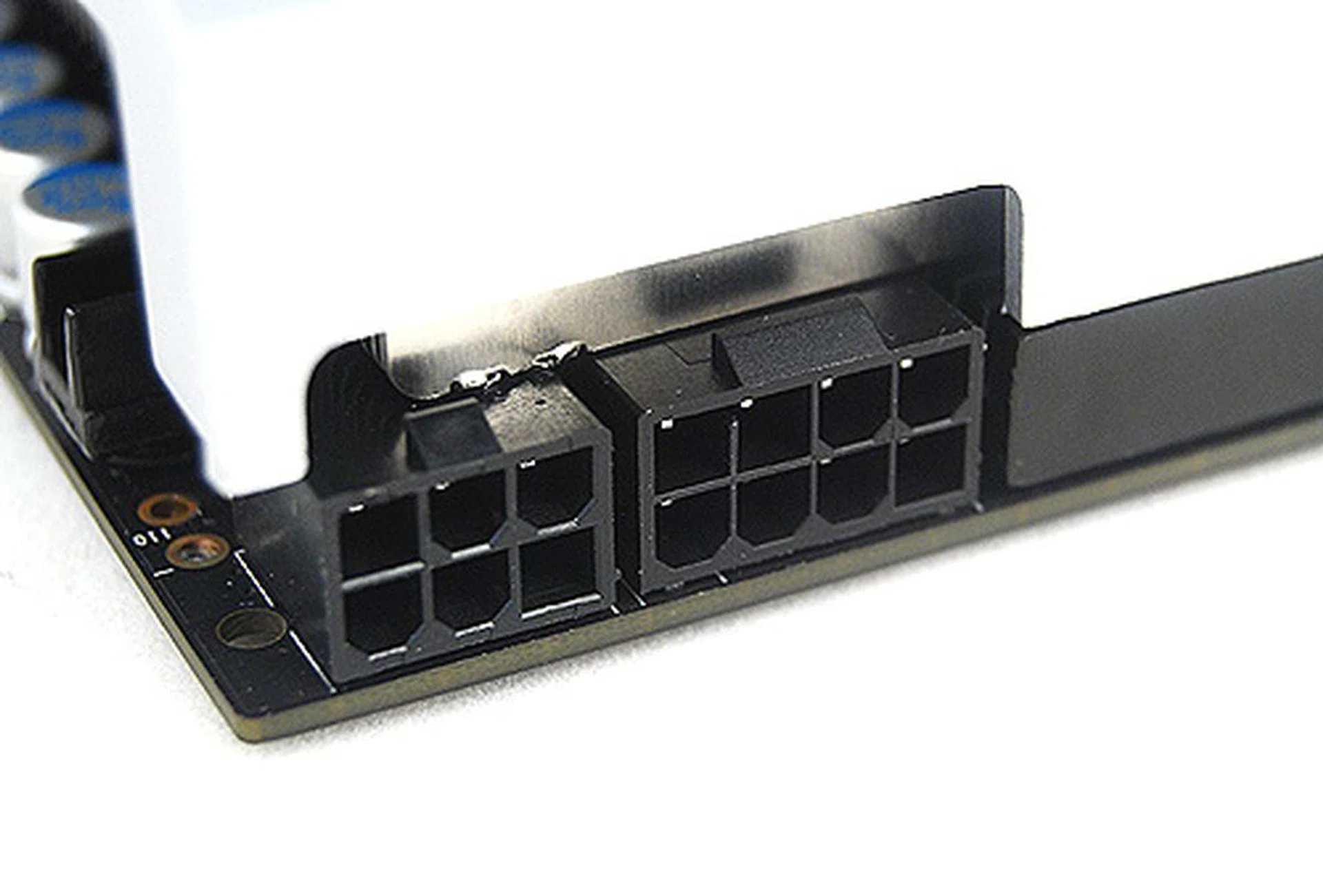
Rather than two 6-pin PCIe power connectors, the Palit card requires one 6-pin and one 8-pin power connector. Will it have any adverse effects on power consumption? We will find out later.
Test Setup
To evaluate the two cards, we’ll be using our X58 setup with the following specifications:
- Intel Core i7-975 (3.33GHz)
- Gigabyte GA-EX58-UD4P motherboard
- 3 x 1GB DDR3-1333 G.Skill memory in triple channel mode
- Seagate 7200.10 200GB SATA hard drive
- Windows 7 Ultimate
Like we mentioned, despite the confusing nomenclature, the GeForce GTX 570 is actually a closer match to the older GeForce GTX 480 rather than the GTX 470, hence we’ll be looking closely at how the GTX 570 matches up against the GTX 480. Elsewhere, we’re also interested to see how it measures up against AMD’s finest.
As for the Palit GeForce GTX 570 Sonic Platinum, we are interested to see how much faster it will be compared to the reference card and also how cool it will run with its dual-fan cooler.
Here is the full list of cards tested and driver versions used:
- NVIDIA GeForce GTX 570 1280MB GDDR5 (ForceWare 263.09)
- Palit GeForce GTX 570 Sonic Platinum 1280MB GDDR5 (ForceWare 263.09)
- NVIDIA GeForce GTX 580 1560MB GDDR5 (ForceWare 262.99)
- NVIDIA GeForce GTX 480 1560MB GDDR5 (ForceWare 260.89)
- NVIDIA GeForce GTX 470 1280MB GDDR5 (ForceWare 263.09)
- ATI Radeon HD 5970 2GB GDDR5 (Catalyst 10.9)
- AMD Radeon HD 6870 1GB GDDR5 (Catalyst 10.10)
- ATI Radeon HD 5870 1GB GDDR5 (Catalyst 10.9)
The list of benchmark used are as follows:
- Futuremark 3DMark Vantage
- Crysis Warhead
- Far Cry 2
- Warhammer: Dawn of War 2
- Battlefield Bad Company 2
- “Heaven" from Unigine v2.1
- S.T.A.L.K.E.R.: Call of Pripyat
3DMark Vantage Results
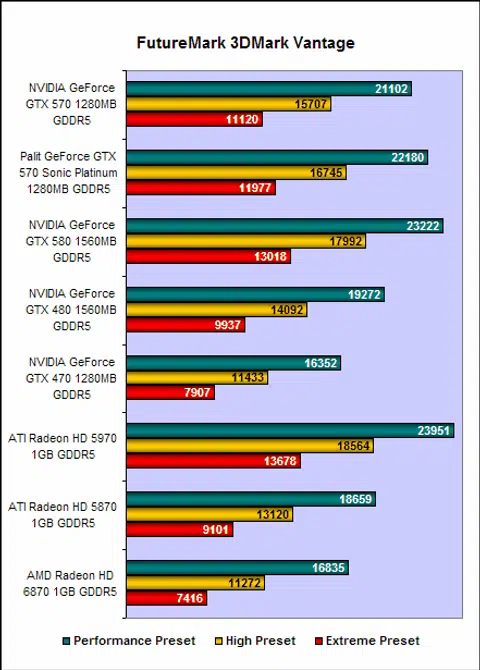
The GeForce GTX 570 got off to a promising start on 3DMark Vantage, as it scored about 10% higher compared to the GeForce GTX 480. It also outclassed both the Radeon HD 5870 and HD 6870, but found itself short of competing for honors when up against the Radeon HD 5970.
The Palit GeForce GTX 570 Sonic Platinum did well too, managing scores that were on average about 6% greater than that of the reference card from NVIDIA.
Crysis Warhead & Far Cry 2 Results
Moving on to real world gaming applications, on Crysis Warhead we noticed that the GeForce GTX 570 was very closely matched by the GeForce GTX 480. This also meant that the GeForce GTX 570 was some way off compared to the GTX 580, by around 15% overall. The GeForce GTX 570 was also at least 10% quicker than the Radeon HD 5870.
The Palit GeForce GTX 570 Sonic Platinum, however, performed admirably as it was markedly faster than the reference GeForce GTX 570 and wasn’t that much slower than a GTX 580.
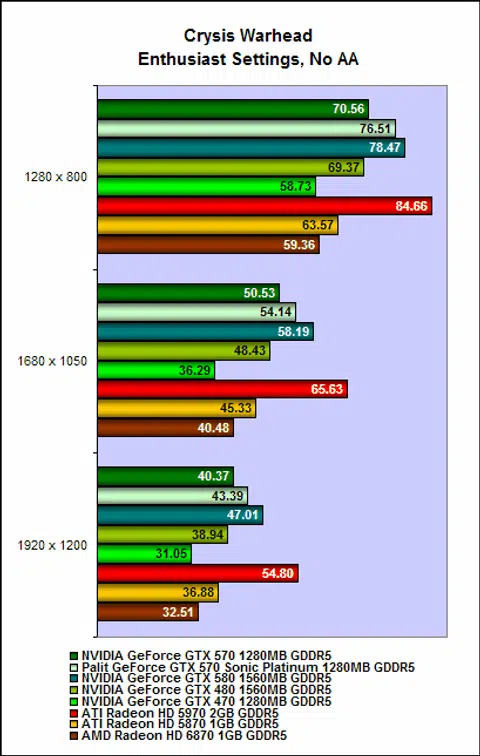
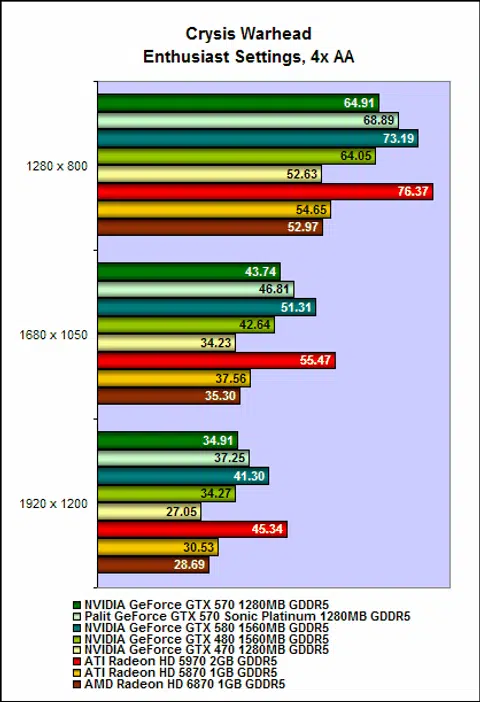
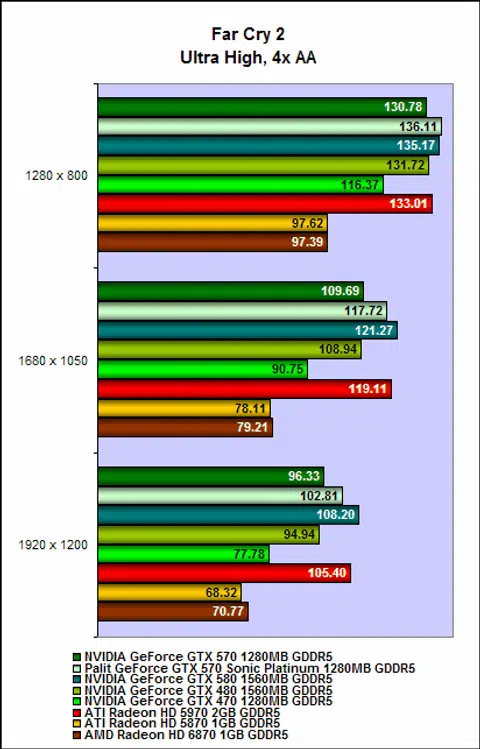
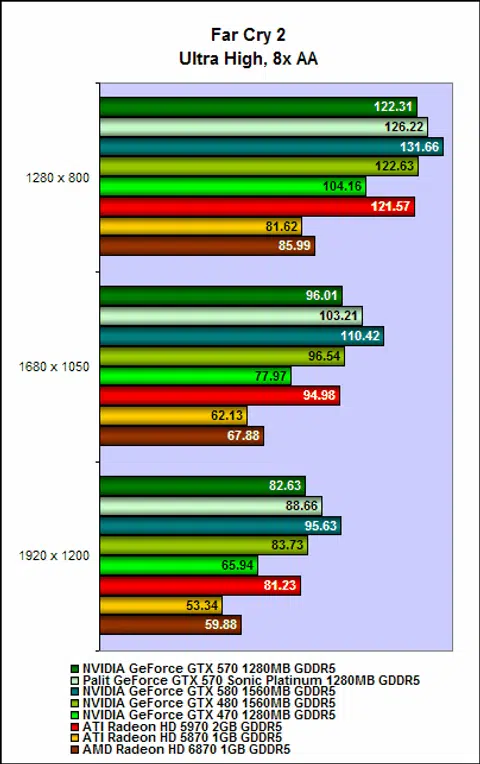
On Far Cry 2, the GeForce GTX 570 was about as quick as the GeForce GTX 480, but some way off the more powerful GeForce GTX 580. It was also comfortably faster than both the Radeon HD 5870 and HD 6870, the current flagship single GPU cards from ATI/AMD, and was only a fraction slower than the dual-GPU Radeon HD 5970.
The Palit card showed its potential by outpacing the reference GeForce GTX 570 by around 6% overall. It also came very close to matching the GeForce GTX 580, which is certainly impressive.
Dawn of War 2 & Battlefield Bad Company 2 Results
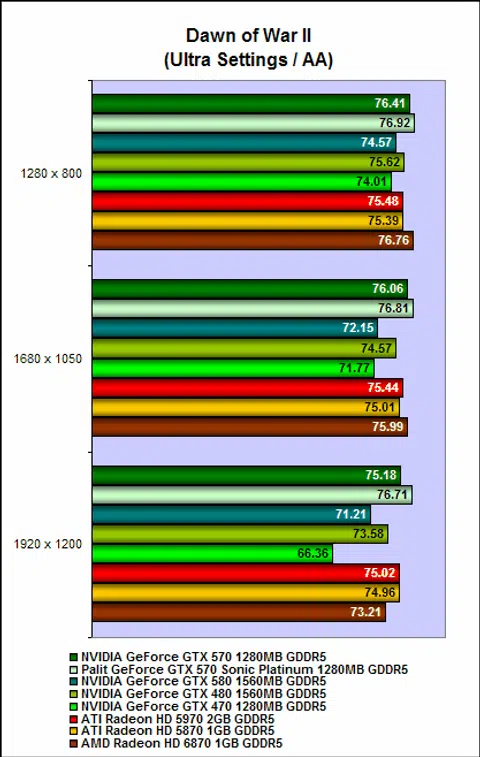
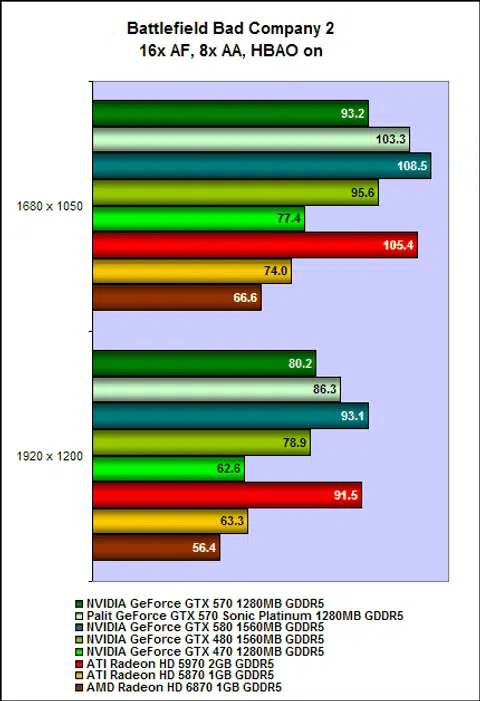
Dawn of War 2 has also been a tightly contested affair but surprisingly we saw both the GeForce GTX 570 cards comfortably outperforming the GeForce GTX 580. This could probably be due to the fact that the GeForce GTX 580 running on older drivers that weren’t properly optimized for it. In any case, there much of a difference between the GeForce GTX 570 and the three ATI/AMD cards.
NVIDIA cards have always tackled tessellation better than their rivals and the GeForce GTX 570 easily out-muscled the Radeon HD 5870 and HD 6870 by a considerable margin. It was, however, a good deal slower than the dual-GPU Radeon HD 5970 and it was also no match for the GeForce GTX 580 which was about 16% quicker overall.
The Palit GeForce GTX 570 Sonic Platinum continued to impress, as it was about 8% faster than a reference card, which is a significant advantage.
Unigine "Heaven" 2.1 Results
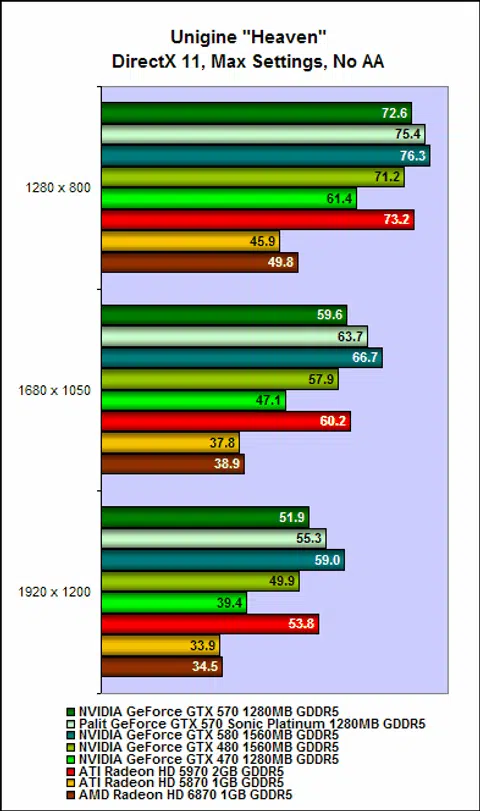
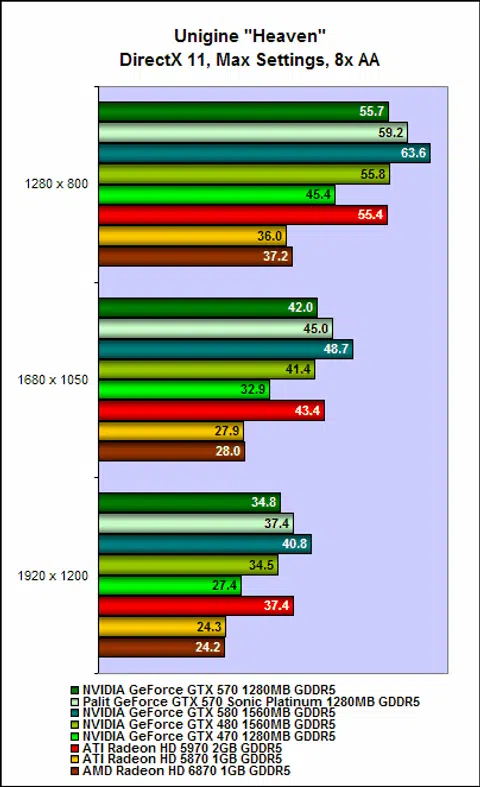
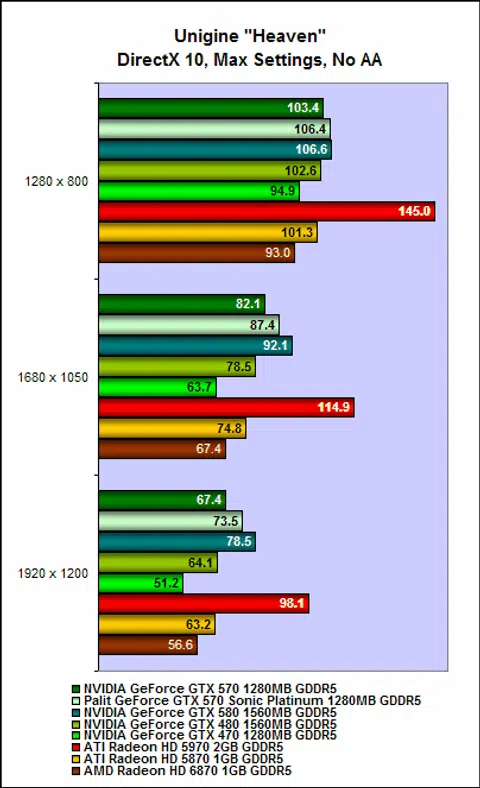
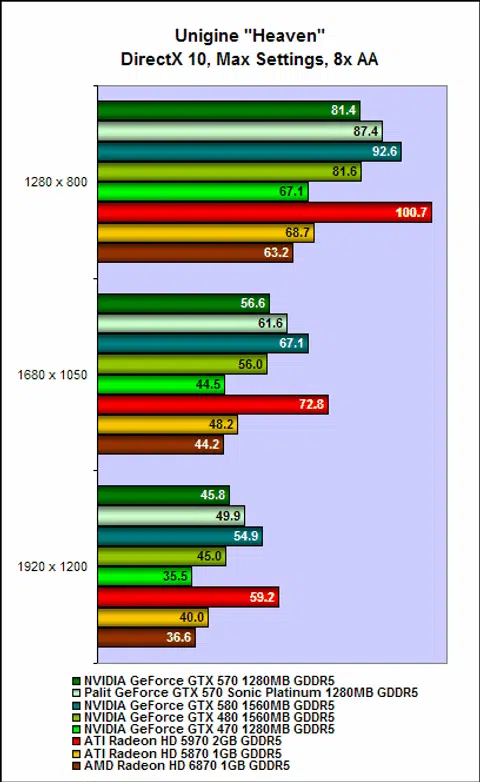
Coming to Unigine 2.1, we noted that the performance of the GeForce GTX 570 continued to closely mirror that of the older GeForce GTX 480. There was just no separating the two. This also meant that the GeForce GTX 580 was significantly faster, by more than 15% overall. Against the cards from the red camp, the GeForce GTX 570 was faster than both the Radeon HD 5870 and HD 6870, with or without tessellation.
The Palit GeForce GTX 570 Sonic Platinum did well too as it was about 7% faster overall compared to a reference card. And in terms of outright frame rates, it wasn’t that much slower than a GeForce GTX 580 either.
DirectX 11 Results
DirectX 10 Results
S.T.A.L.K.E.R.: Call of Pripyat Results
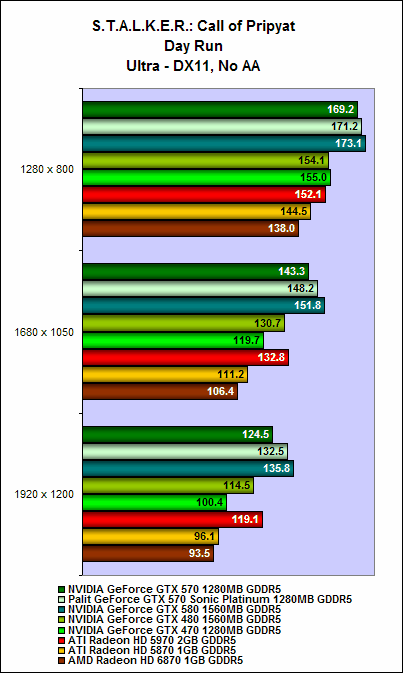
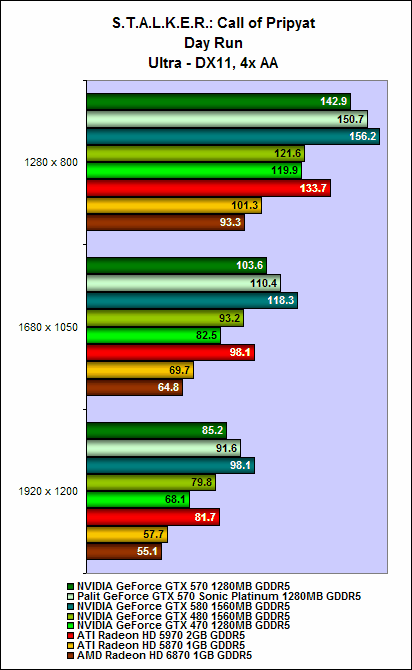
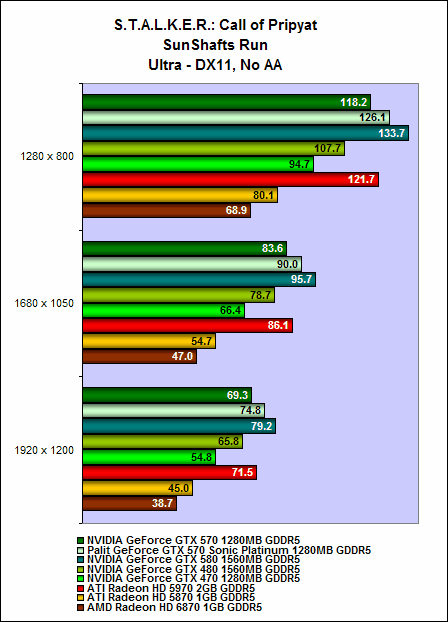
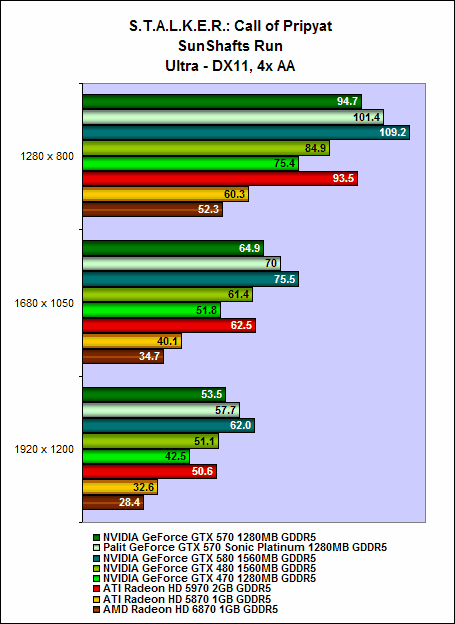
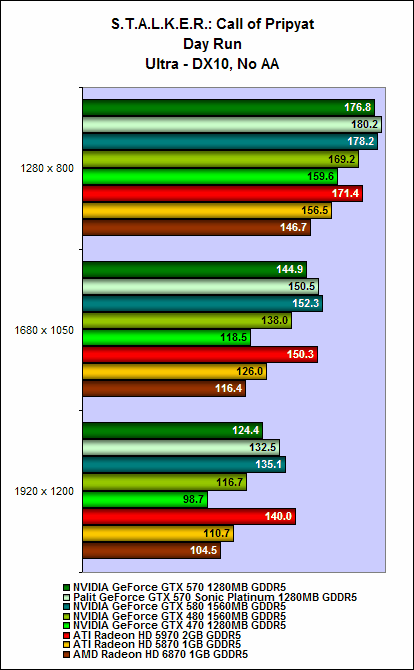
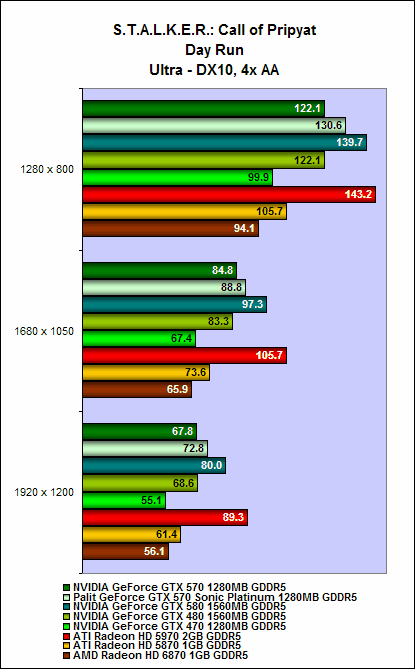
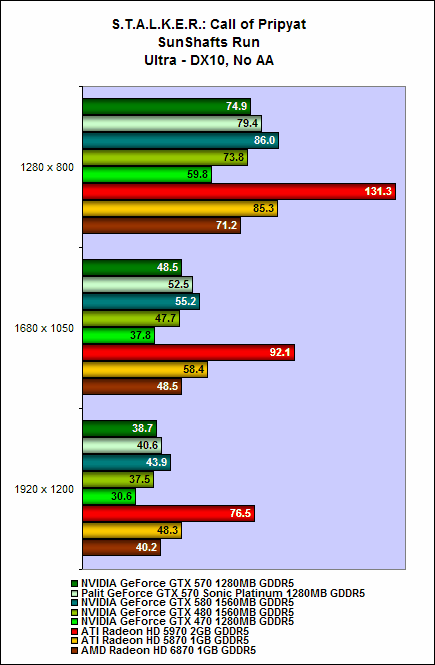
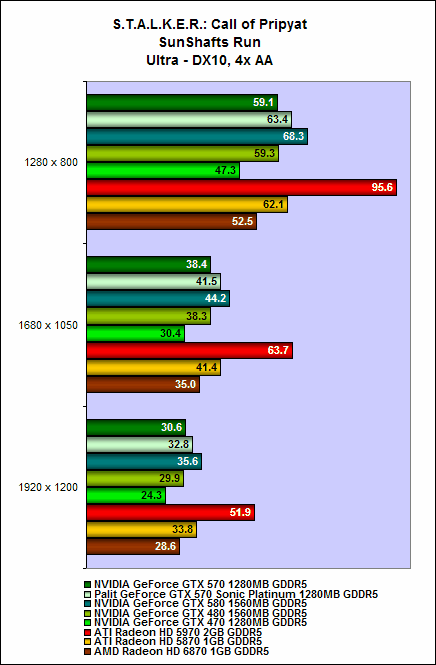
On S.T.A.L.K.E.R.: Call of Pripyat, the GeForce GTX 570 was significantly faster than the GeForce GTX 480 when tessellation was enabled. But when we reverted to DirectX10 and disabled tessellation, the GeForce GTX 570 lost its advantage and was on a par with the GeForce GTX 480.
With tessellation enabled, the GeForce GTX 570 could even match the dual-GPU Radeon HD 5970, which goes to show NVIDIA’s superiority in handling tessellation heavy applications. However, with tessellation disabled, the GeForce GTX 570 struggled and was only about as quick as a Radeon HD 5870.
Lastly, the Palit GeForce GTX 570 Sonic Platinum recorded frame rates that were about 6% quicker than the reference card.
DirectX 11 Results
 |  |
 |  |
DirectX 10 Results
 |  |
 |  |
Temperature
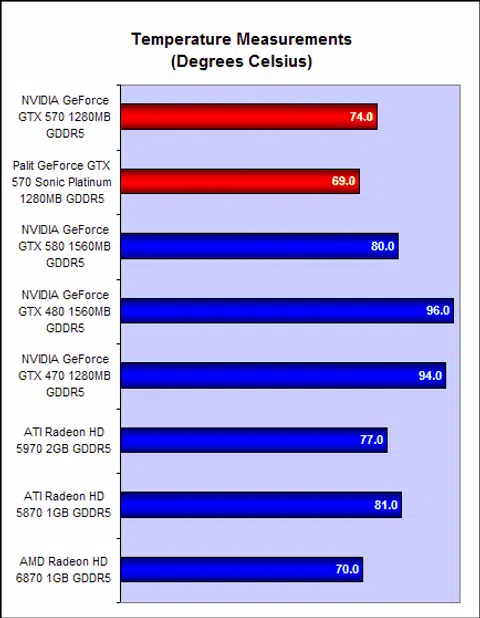
NVIDIA’s custom vapor chamber cooling was very quiet and pretty efficient, keeping the GeForce GTX 570 running at a manageable 74 degrees Celsius. Palit’s custom designed dual-fan cooler was even more effective, keeping the card at 69 degrees Celsius when taxed. However, it’s also considerably more noisy, emitting a low pitch whirring noise that was quite audible.
Power Consumption
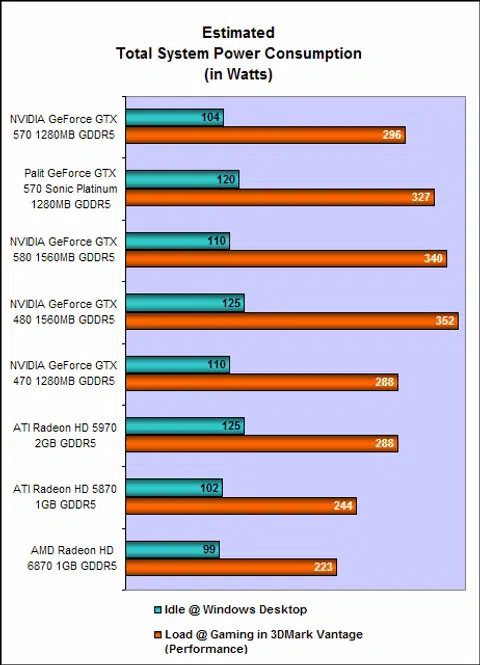
The GeForce GTX 570 is markedly more power efficient compared to the old GeForce GTX 480. Not only are idle power readings improved, power draw at load has also been greatly reduced. NVIDIA has effectively given the GeForce GTX 570 greater performance per watt than what the GTX 480 could deliver.
The Palit card, on the other hand, recorded significantly higher readings, which is understandable given its overclocked status.
Overclocking
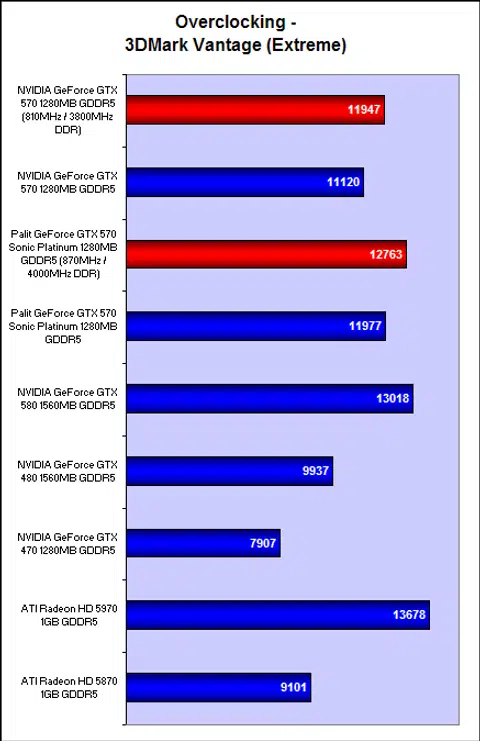
With the reference card, we managed to push get it up to only 810MHz at the core but couldn’t get the memory to run any faster. This gave us 11947 3DMarks, which represented a healthy improvement of 7%.
As for the Palit card, we managed to get it running at a more respectable 870MHz at the core, and again, we couldn’t get the memory to run any faster. This gave us 12763 3DMarks, an improvement of 6%.
A Holiday Hit
Where performance is concerned, the GeForce GTX 570 is very fast card. It might not be as quick as the GeForce GTX 580, but it is a great deal quicker than any single GPU offering ATI/AMD can throw at it right now. However, we were a bit disappointed that it wasn’t at least a little bit quicker than the old GeForce GTX 480. Looking at how much quicker the GeForce GTX 580 is, it seems that like NVIDIA purposely held back so as to make the GeForce GTX 570 perform on the same level as the GeForce GTX 480.
Elsewhere, NVIDIA continued to display its superiority when it came to tessellation heavy applications like Unigine’s “Heaven” benchmark and S.T.A.L.K.E.R.: Call of Pripyat, where even the GeForce GTX 570 could go toe-to-toe with the dual-GPU Radeon HD 5970.
In the same vein, DirectX10 performance continues to disappoint as the Radeons made up for lost ground whenever we reverted to DirectX10. That said, the GeForce GTX 570 isn’t all that bad running DirectX 10, just that it wasn’t up to our expectations.
Clearly, and as we have mentioned previously, the new NVIDIA Fermi cards are geared for tessellation. But with DirectX 11 games still few and far between and AMD already signaling its intentions to improve their cards’ tessellation performance, NVIDIA might have jumped the gun in this aspect. Nevertheless, any one with a Fermi card in hand now can rest assure in the fact that when DirectX 11 does take off in a big way, their cards will be ready for the job.
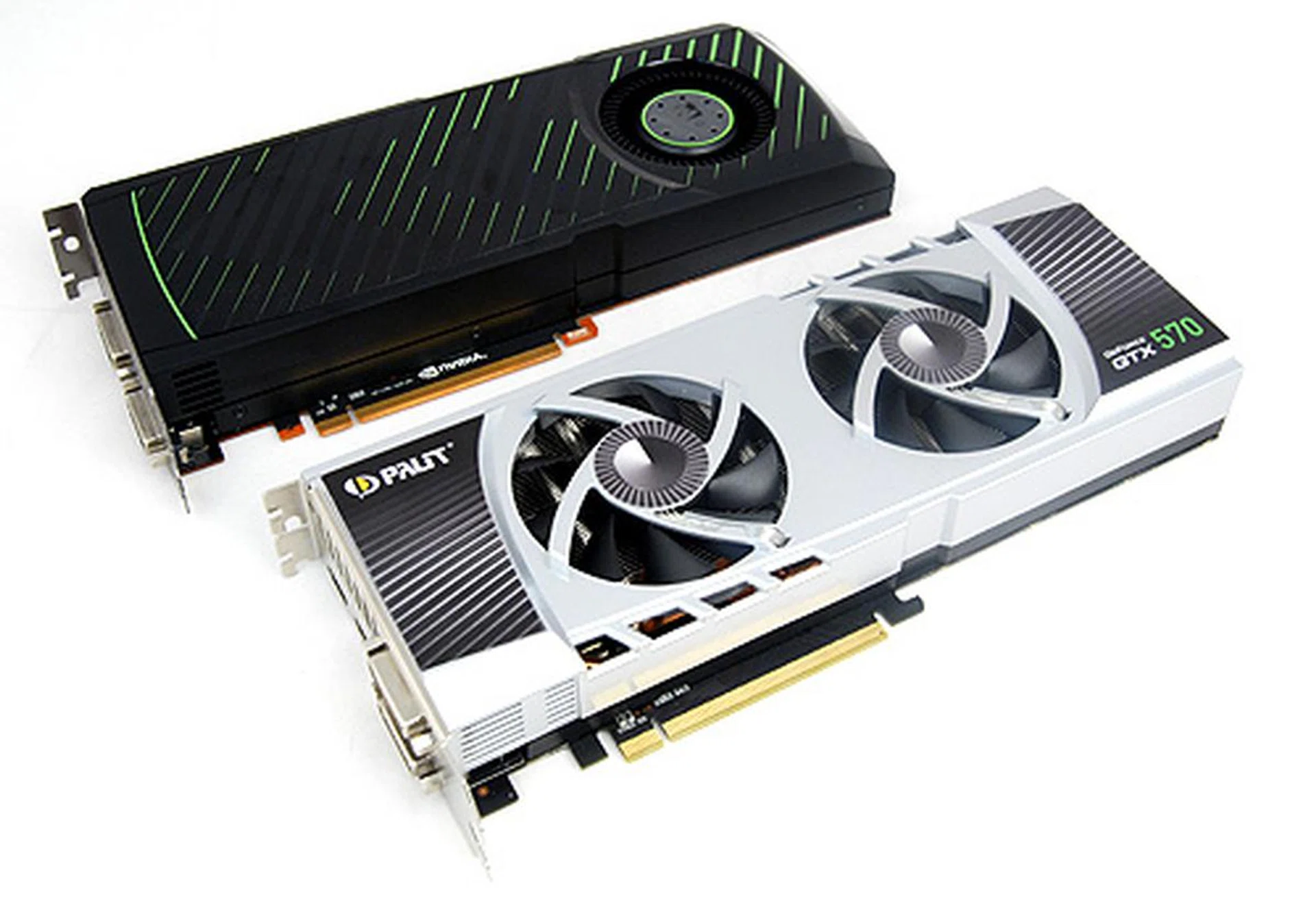
The GeForce GTX 570 is a much improved version of the old GeForce GTX 480, whereas the Palit GeForce GTX 570 Sonic Platinum takes what's good of the GTX 570 and makes it even better.
Moving on, we were happy to find that the GeForce GTX 570 not only runs cooler, but also more efficiently. Obviously, much of this has to do with the better optimized core and NVIDIA’s specially designed vapor chamber cooler.
All in all, with the GeForce GTX 570, what NVIDIA has essentially given us an improved version of the GeForce GTX 480. Set to launch at US$349, it commands the exact same price that the GeForce GTX 470 did when it was launched earlier this year. This makes it much more affordable than the US$499 GeForce GTX 580, and with GeForce GTX 480 cards still going for over US$400 at the time of writing, the GeForce GTX 570 can be said to be very competitively priced. At this juncture, it's not even worth considering a GTX 470.
Against its rivals from ATI/AMD, the GeForce GTX 570 still holds its own as the US$500 Radeon HD 5970 costs markedly more but isn’t that much quicker, especially when tessellation comes into play. Against the single GPU offerings, the GeForce GTX 570 was more than 15% quicker overall, so it justifies its price tag even if the Radeon HD 6870 can be had for as low as US$250. All in all, the GeForce GTX 570 looks set to be a very decent option for those hunting for a high-end graphics card this festive season.
As for the Palit GeForce GTX 570 Sonic Platinum, we have to praise Palit for its promptness in delivering a custom designed card to the market. Furthermore, it’s a very decent card, offering a significant bump in performance over a reference card, although at the cost of higher power draw and a louder cooler. And although Palit couldn’t provide us the price of their card at the time of writing, judging from past experience, we can expect the Palit GeForce GTX 570 Sonic Platinum to command a US$20 - US$30 premium over reference cards, which we think is fair considering it is a good 6% to 7% quicker than NVIDIA’s reference version.
However, it is slightly more power hungry and its cooler is a tad louder, but all in all, its well worth it for the bump in performance because it brings it within striking distance of the all-conquering GeForce GTX 580.
Looking ahead, AMD is finally launching its high-end Radeon 6900 series Cayman parts in the weeks to come. Specifications of these new parts are sketchy at the moment, but bearing in mind NVIDIA’s latest offerings, it is clear that AMD would have to pull something very special out of the bag to come out tops this holiday season.
| |
|  |

Our articles may contain affiliate links. If you buy through these links, we may earn a small commission.