
NVIDIA GeForce GTX 560 Ti SLI Performance Analysis
We follow up on our review of the GeForce GTX 560 Ti by taking a look at how a pair of them will perform in a 2-way SLI configuration. Expect to see some big numbers.
NVIDIA GeForce GTX 560 Ti SLI Performance Analysis
The NVIDIA GeForce GTX 560 Ti replaces the old GeForce GTX 470 and it is a very impressive offering from NVIDIA to start the year. Packing 384 CUDA cores, rumors were that the GeForce GTX 560 Ti would replace the older GeForce GTX 460. However, NVIDIA has set its sights higher as the GeForce GTX 560 Ti was eventually revealed to be the replacement for the older GeForce GTX 470. And despite having less CUDA cores, our earlier review revealed that it’s more than a competent replacement, offering improved performance, while running cooler too. Our only gripe was that its power efficiency was a bit poor compared to NVIDIA’s recent offerings.
We also predicted in our conclusion that AMD would be forced to make changes to their pricing strategy to counter NVIDIA’s new threat, and we were right on the money. Barely a day after the launch of the GeForce GTX 560 Ti, AMD announced that prices of both 2GB and 1GB variants of the Radeon HD 6950 and also the Radeon HD 6870 would be reduced. This makes things interesting. What this means is that AMD is now positioning the 1GB variant of Radeon HD 6950 to do battle with the GeForce GTX 560 Ti. Sadly, we don't have a 1GB Radeon HD 6950 on hand yet, but we're definitely looking to investigate this soon. Anyhow, the new prices of the Radeon cards are as follows:
- Radeon HD 6870 - US$219
- Radeon HD 6950 1GB - US$259
- Radeon HD 6950 2GB - US$269 – $289
To follow up, we’ll now be analyzing its performance in a 2-way SLI configuration. NVIDIA has made great improvements in the way their SLI multi-GPU configurations scale and we fully expect our two GeForce GTX 560 Ti cards to post some impressive numbers.

768 CUDA cores waiting to be unleashed.
To evaluate the GeForce GTX 560 Ti’s performance in a 2-way SLI configuration, we will be testing our cards at the reference clock speeds. Our Intel X58 testbed has the following specifications:
- Intel Core i7-975 (3.33GHz)
- Gigabyte GA-EX58-UD4P motherboard
- 3 x 1GB DDR3-1333 G.Skill memory in triple channel mode
- Seagate 7200.10 200GB SATA hard drive
- Windows 7 Ultimate
The full list of cards and driver versions used:
- NVIDIA GeForce GTX 560 Ti 2-way SLI (ForceWare 266.56)
- NVIDIA GeForce GTX 560 Ti 1GB GDDR5I (ForceWare 266.56)
- NVIDIA GeForce GTX 570 1280MB GDDR5 (ForceWare 263.09)
- NVIDIA GeForce GTX 580 1560MB GDDR5 (ForceWare 262.99)
- AMD Radeon HD 6870 2-way CrossFireX (Catalyst 10.12)
- AMD Radeon HD 6970 2GB GDDR5 (Catalyst 10.11)
- AMD Radeon HD 6950 2GB GDDR5 (Catalyst 10.11)
- ATI Radeon HD 5970 2GB GDDR5 (Catalyst 10.9)
- AMD Radeon HD 6870 1GB GDDR5 (Catalyst 10.12)
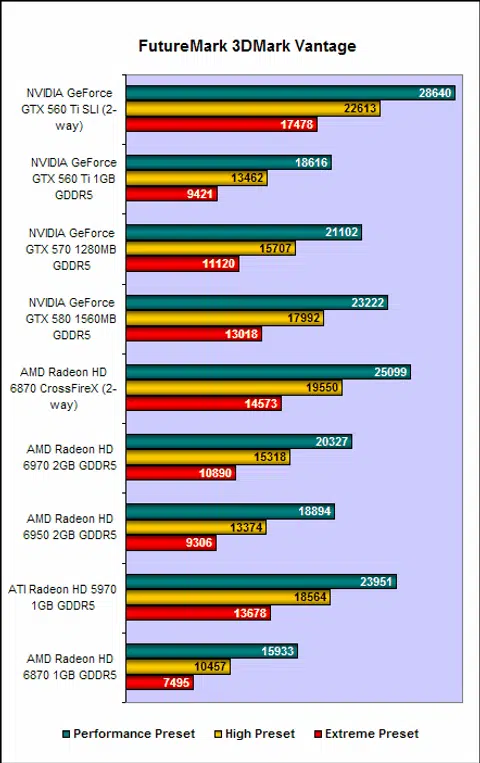
3DMark Vantage Results
3DMark 11 Results

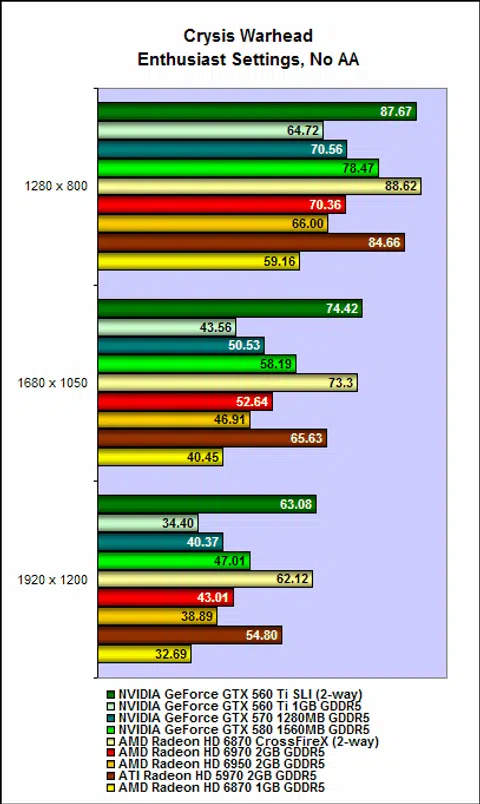
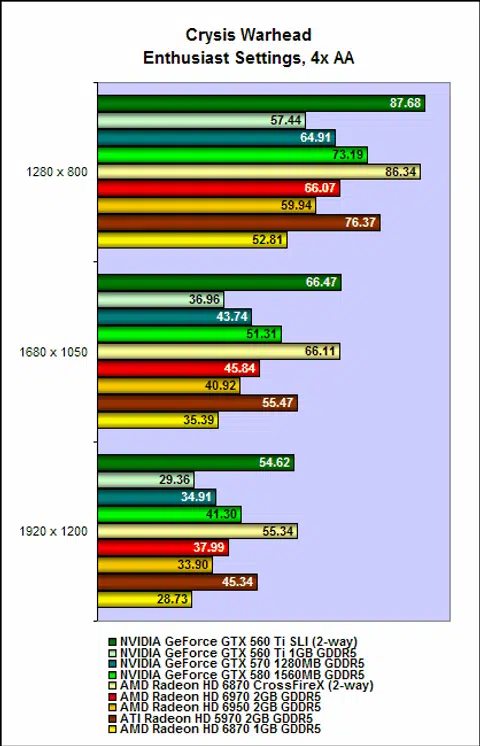
Crysis Warhead Results
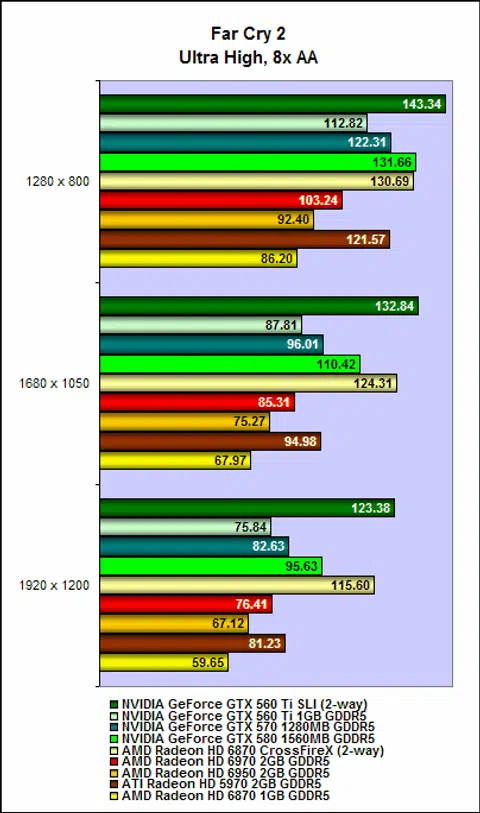
Far Cry 2 Results

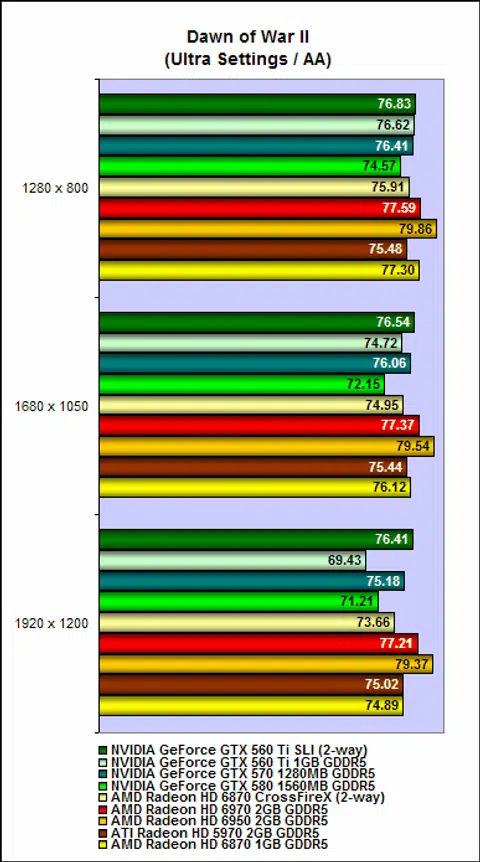
Dawn of War 2 Results
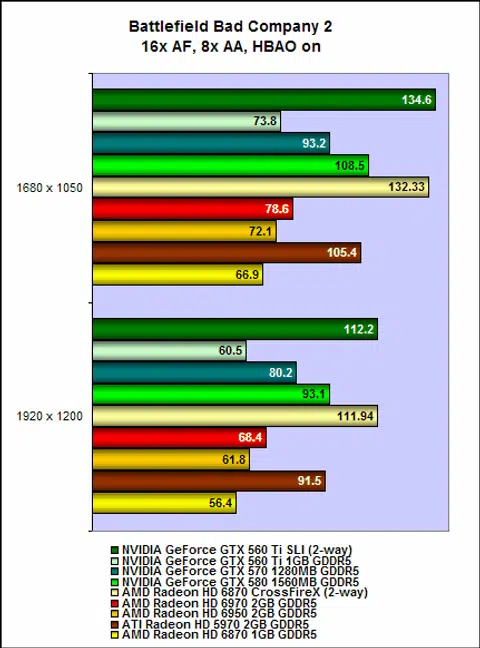
Battlefield Bad Company 2 Results
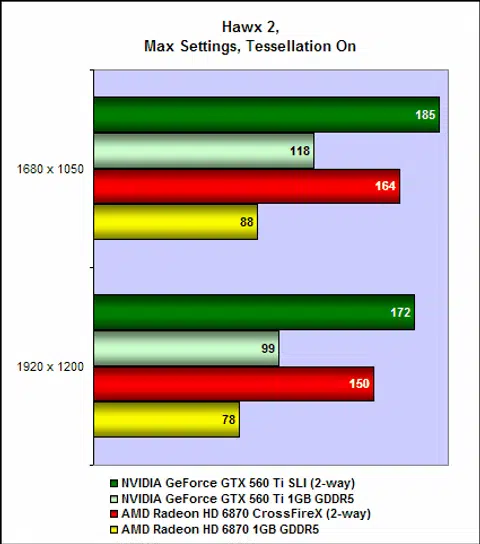
Hawx 2 Results
We're still building up our results database on this gaming benchmark, but here's what we can show for now:-
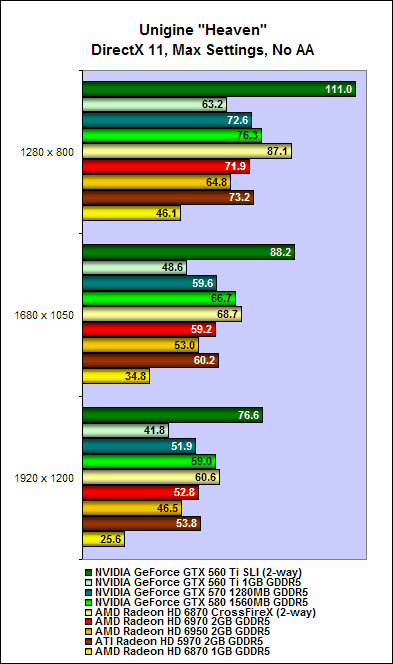
Unigine Results
 | 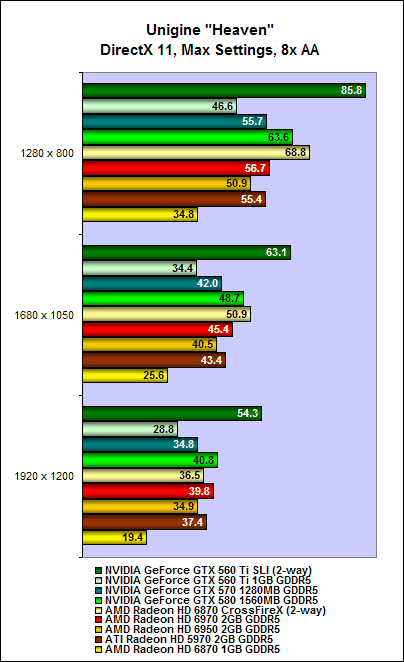 |
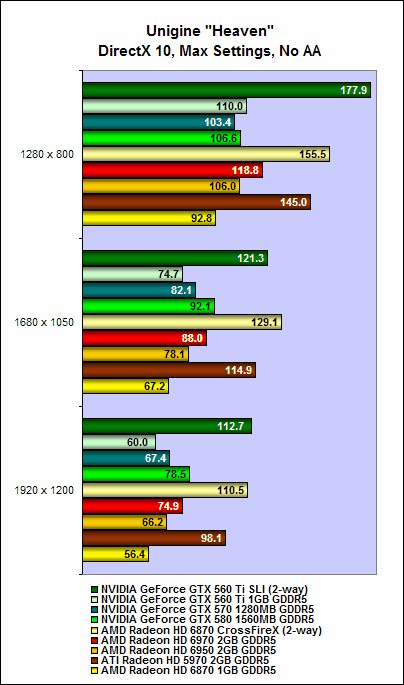 | 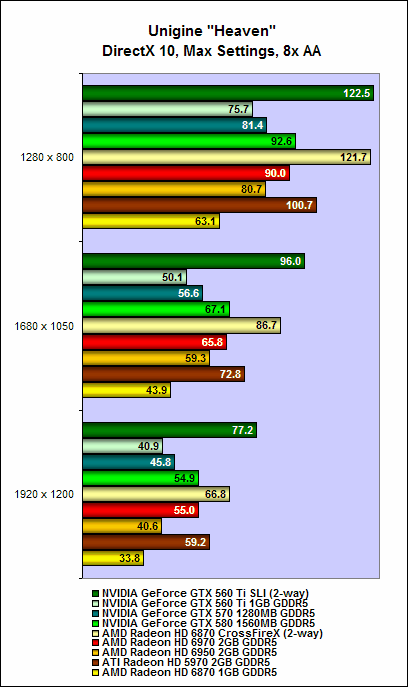 |
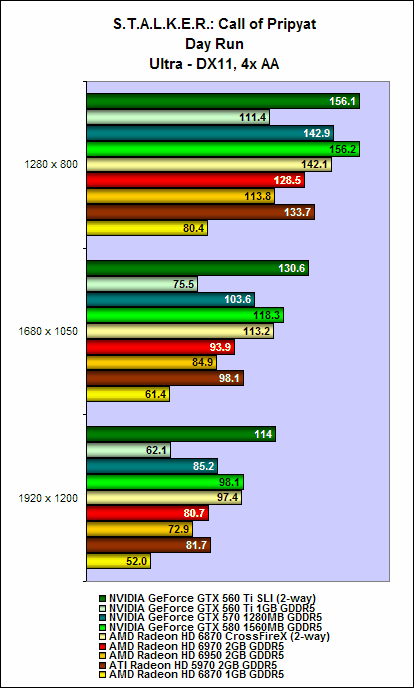
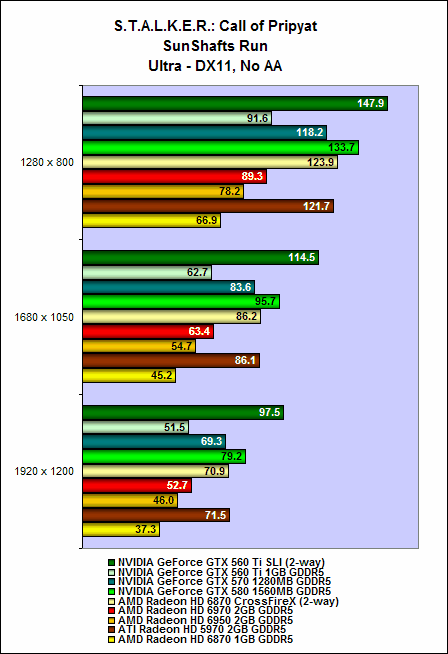
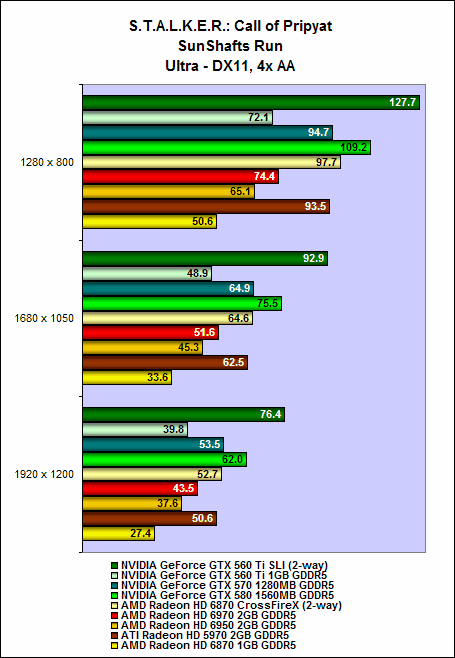
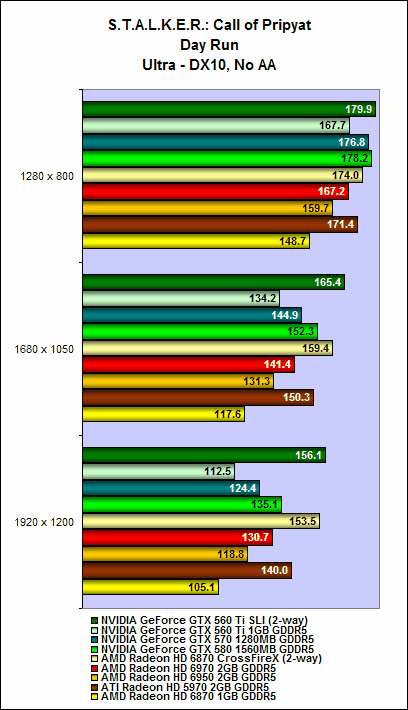
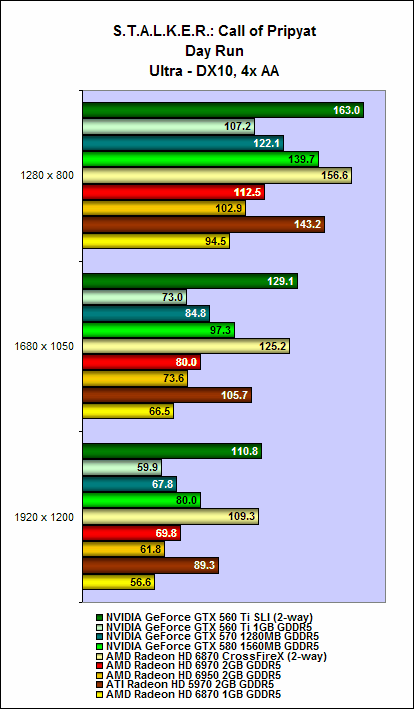
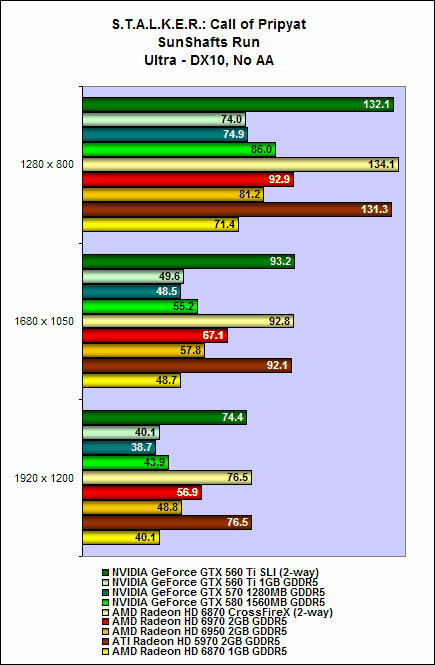
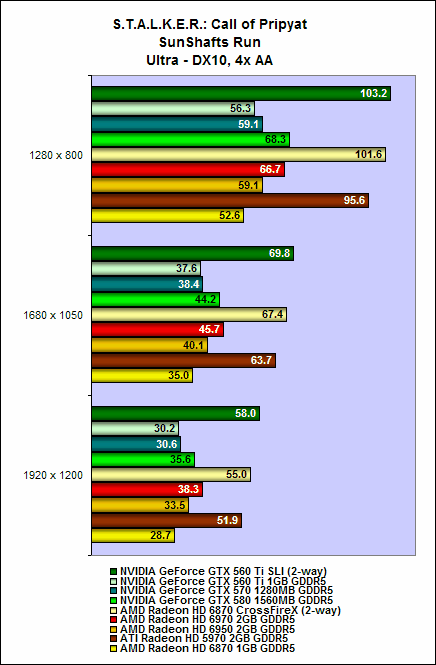
S.T.A.L.K.E.R.: Call of Pripyat Results
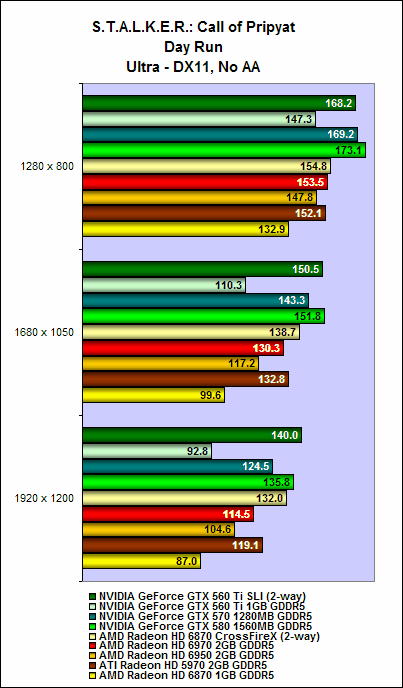 |  |
 |  |
 |  |
 |  |
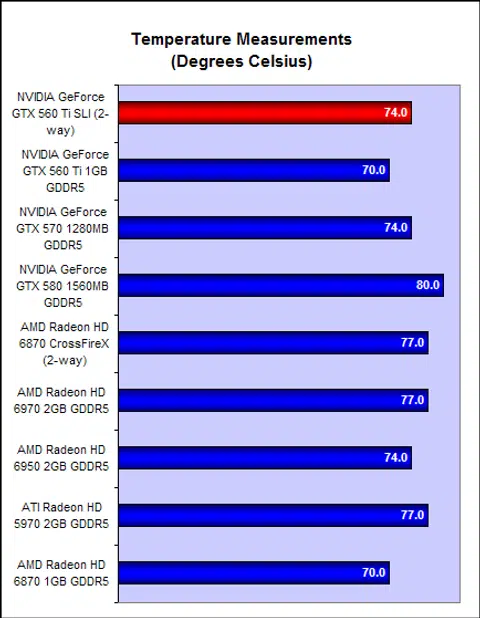
Temperature
Power Consumption
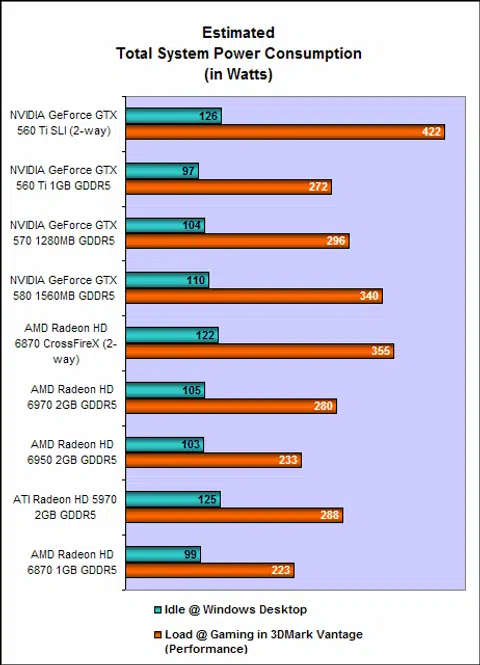
Power Overwhelming
As the graphs show, 768 CUDA cores working in tandem is a fearsome combination, which is exactly what we expected. Scaling performance was also inline with our expectations, as we noted significant increases in performance. On newer titles such as Battlefield Bad Company 2 and S.T.A.L.K.E.R.: Call of Pripyat, the gain an additional GeForce GTX 560 Ti provides can be as much as 82%. Also, we noticed that on games such as Dawn of War 2 and Far Cry 2, our CPU just couldn’t keep up with the enormous amount of graphics horsepower that was at its disposal. We can't wait to transition to the next heavyweight CPU coming in the months ahead as overclocking is just a stopgap measure and not reflective of what most people can achieve or use as a base as reference.
So as we've found, a 2-way SLI configuration consisting of two GeForce GTX 560 Ti is certainly a formidable one. However, it does have a few drawbacks. Fortunately, noise wasn’t one of them as even the reference cooler is fairly quiet, but power consumption certainly is. As seen in our graphs, the power draw of the GeForce GTX 560 Ti is uncharacteristically high, and with two in an SLI configuration, matters get worse. In our tests, our highest sustained reading was a considerable 422W, which means a solid PSU rated for at least 650W or 700W (to be safer) would be needed. And that's assuming the system isn't loaded with many other add-ons.
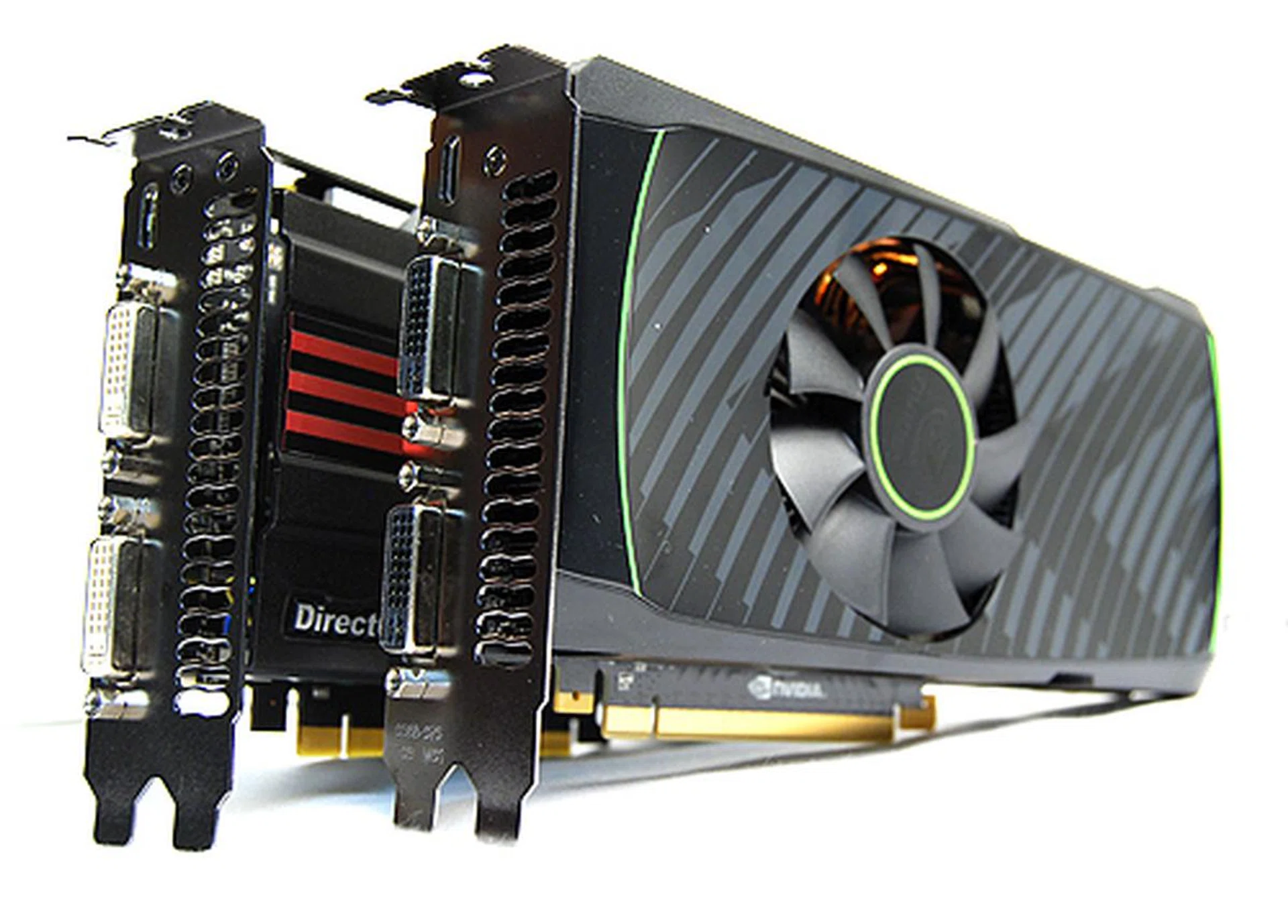
Two GeForce GTX 560 Ti in a SLI configuration is potent, but the usual caveats of high power consumption and heat applies.
Also, one also has to take into account the amount of heat produced. With a single reference GeForce GTX 560 Ti card, we recorded operating temperatures to be around 70 degrees Celsius, but when placed in a 2-way SLI configuration, operating temperatures increased to 74 degrees Celsius per card. And mind you, two cards running in excess of 70 degrees Celsisus produces quite a fair amount of heat. Needless to say, a casing with adequate ventilation to expel excess heat is crucial as built up heat within the chassis can shorten the lifespan of components, or worse, even damage them.
In closing, two GeForce GTX 560 Ti cards in a 2-way SLI configuration is a formidable combination. What this really means is that users can get themselves a GTX 560 Ti and rest assure that in future, more graphics power can be gained simply by adding an additional card to the mix. A side note for this to materialize is that one should already have an SLI capable board with decent bandwidth per PEG slot.
Our articles may contain affiliate links. If you buy through these links, we may earn a small commission.