
NVIDIA GeForce GTX 560 Ti Roundup - Three to the Fore
Thanks to its compelling performance and attractive price, the GeForce GTX 560 Ti has been favorably received by gamers thus far. And today, we are checking out three more customized, factory overclocked editions from Galaxy, Gigabyte and MSI.
Good Start to the Year
The GeForce GTX 560 Ti was the first new SKU to be introduced this year and it was a good offering from NVIDIA. In a nutshell, the new 384-core chip offered GeForce GTX 470 levels of performance for GeForce GTX 460 prices, and so it was no surprise that barely a day after its launch, AMD was forced to slash prices of their 2GB and 1GB Radeon HD 6950 cards as well as the Radeon HD 6870. This just goes to show how much of a threat AMD thinks the GeForce GTX 560 Ti is.
Since we’ve already established the performance of the GeForce GTX 560 Ti in our earlier article, as well as its performance in a 2-way SLI configuration here, we shall now expand further by investigating the latest customized and factory overclocked GeForce GTX 560 Ti cards to hit the market.
It’s been barely a month since the GeForce GTX 560 Ti was launched, but already some really extreme edition cards have started floating round the market. We’ve already reviewed two fairly fast custom GeForce GTX 560 Ti cards in the form of the and , as well as an interestingly cooled . Today, we have three more cards waiting to be benched within an inch of their lives.
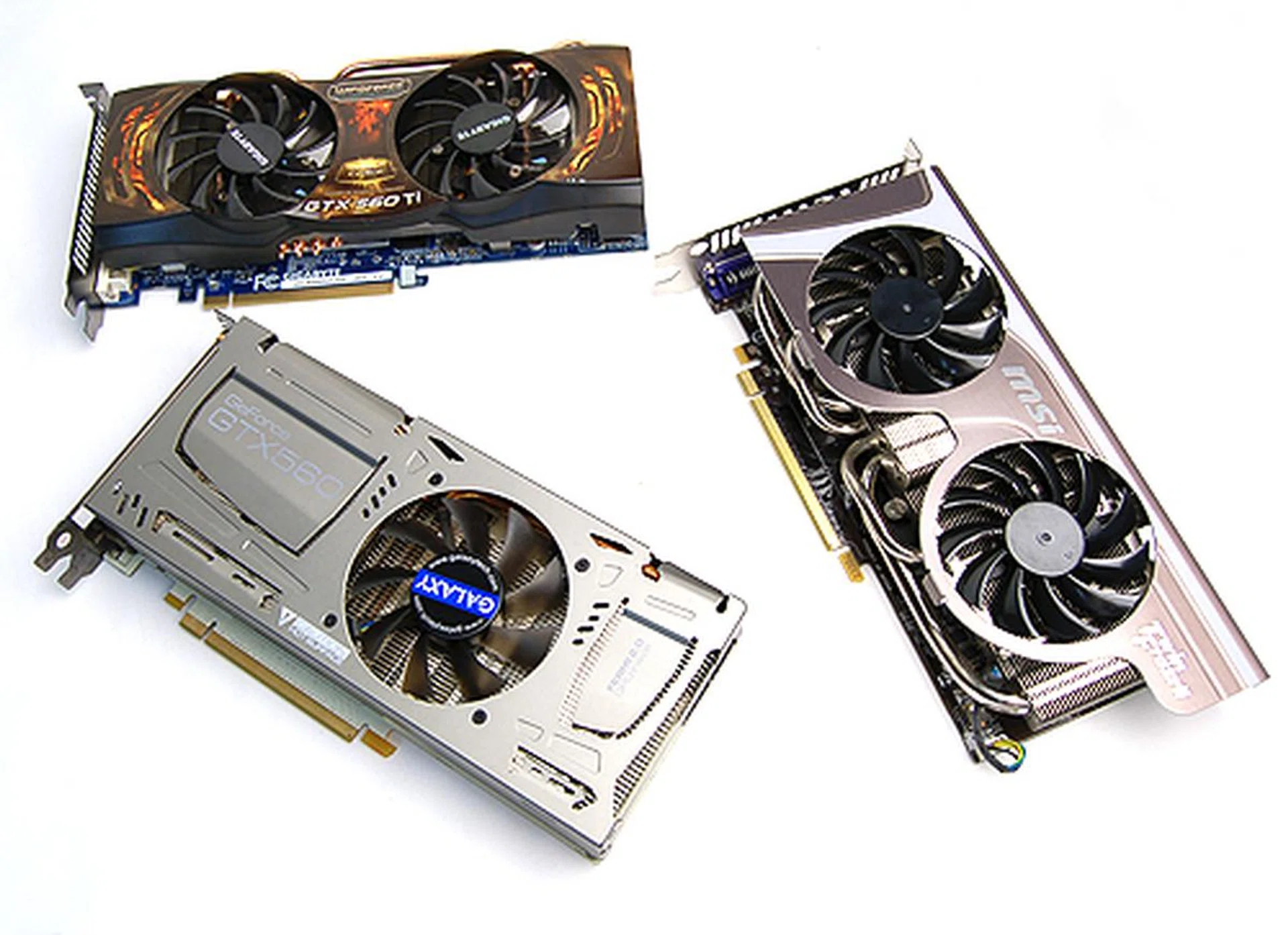
With a combined total of 1152 CUDA cores, please welcome our GeForce GTX 560 Ti competitors today from Galaxy, Gigabyte and MSI.
Here are the cards that will be tested today:
- Galaxy GeForce GTX 560 Ti White Edition
- Gigabyte GeForce GTX 560 Ti Super Overclock
- MSI N560GTX-Ti Twin Frozr II OC
The Galaxy GeForce GTX 560 Ti White Edition
Galaxy has always made some of the most outrageous graphics cards. Previously, they distinguished themselves from the competition by having an unique “flip-fan” cooler, with which users can easily lift the fan up for easy cleaning. Now and as its name suggests, the GeForce GTX 560 Ti White Edition is grabbing attention with its white PCB.
Honestly, it’s not really pure white, more like off-white or cream, nevertheless, the unusual PCB color of the GeForce GTX 560 Ti White Edition is striking. The card also uses a more traditional looking cooler with a quad heat pipe design, rather than the “flip-fan” ones seen on previous cards, and it also comes factory overclocked at a very aggressive 950MHz at the core, 1900MHz at the shaders, and 4400MHz DDR at the memory. Lastly, because of the rare white PCB, the card is limited to only 1000 units worldwide.

Say goodbye to Galaxy's unique "flip-fan" cooler because they have decided to stick to a more conventional cooler design this time round.
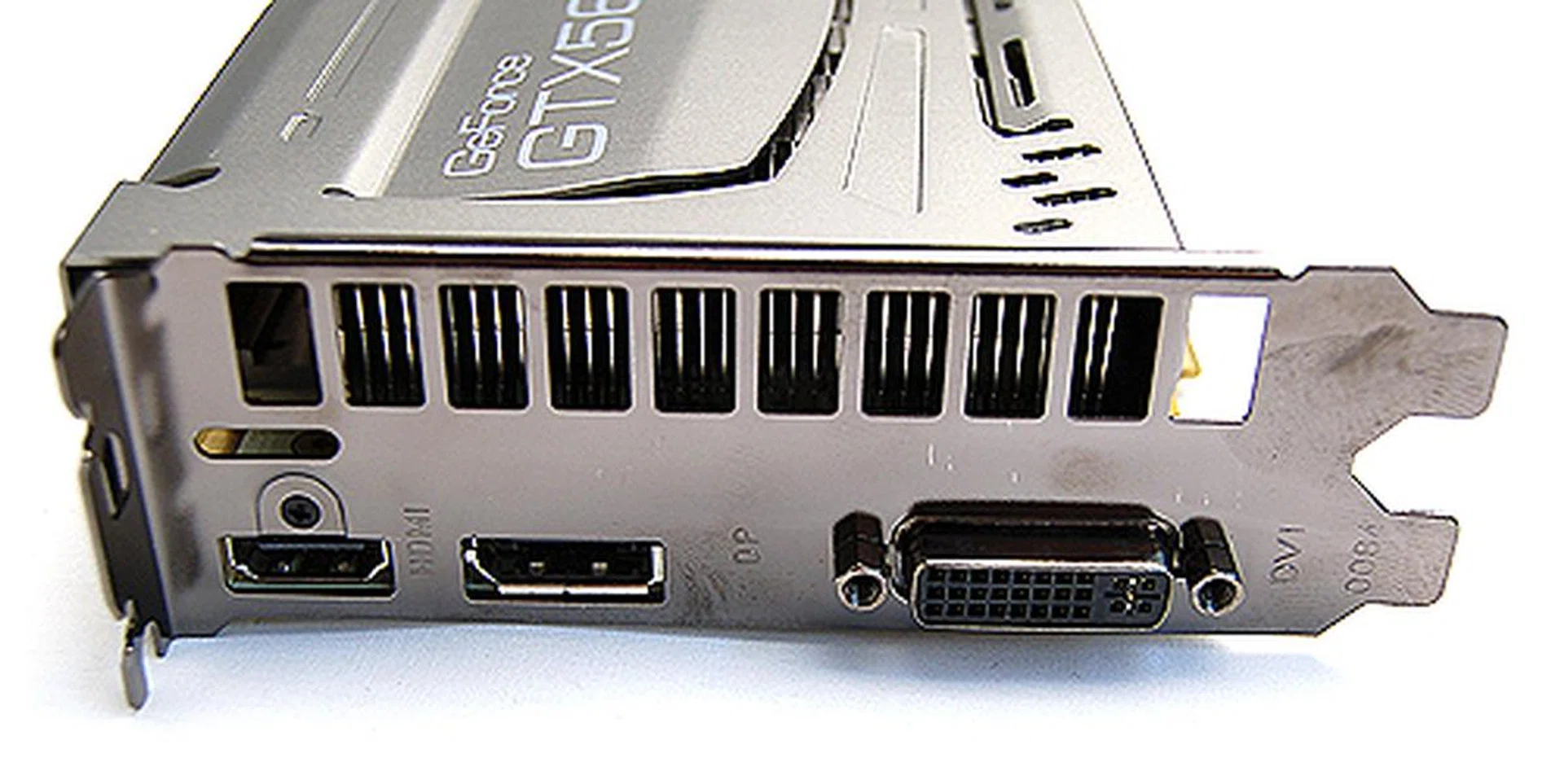
Instead of the usual twin DVI and mini-HDMI ports, Galaxy is offering a single DVI, DisplayPort and full-size HDMI port on their card instead.
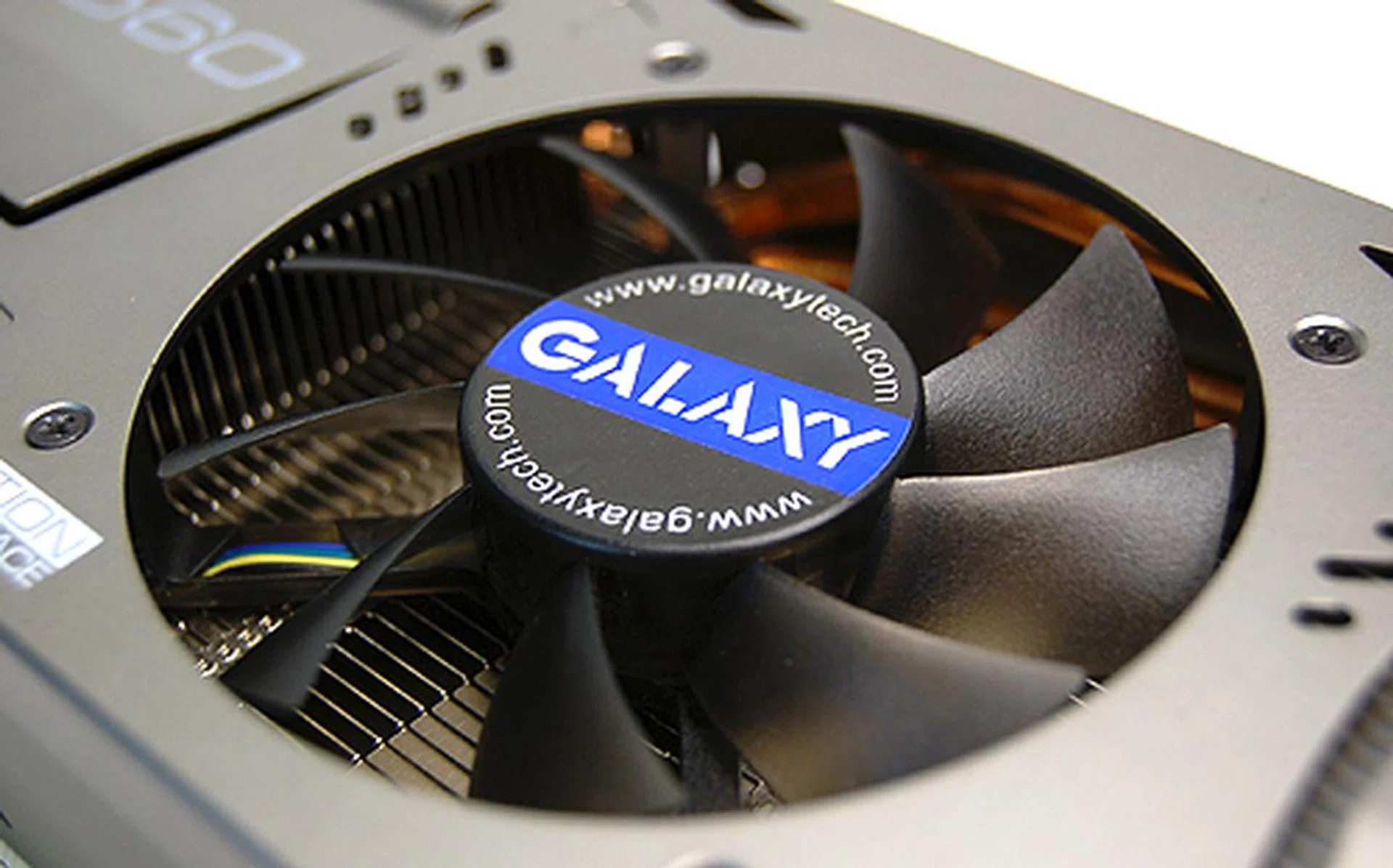
Under the metallic cooler casing is a large heatsink coupled with four thick heat pipes.
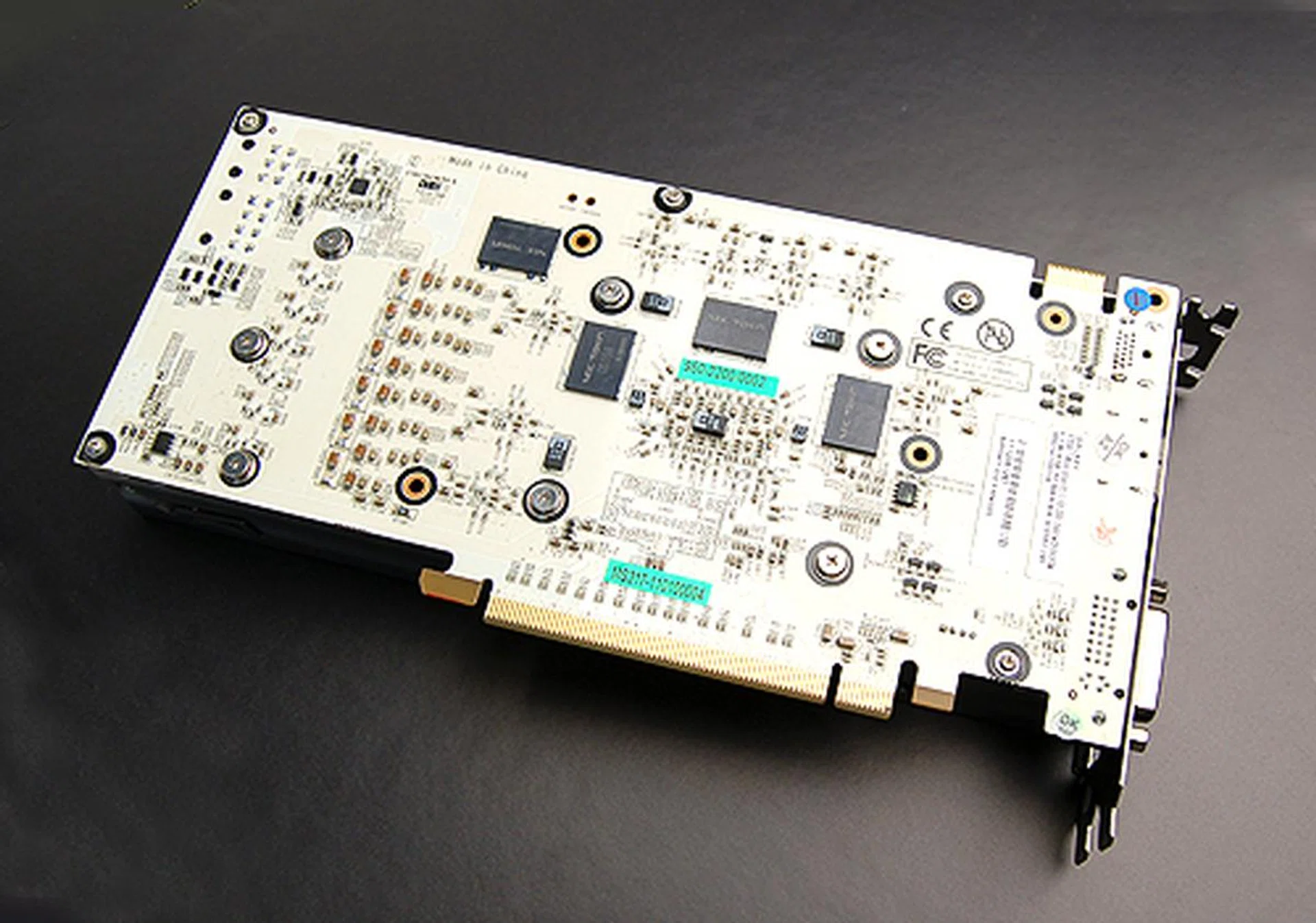
Here's a look at the card's outrageous white PCB. Interestingly, there are several more more proadlizer modules on this card compared to its competition. Would it fare better than the competitors for overclocking or better power efficiency? We'll check these aspects soon enough.
Gigabyte GeForce GTX 560 Ti Super Overclock
On paper, the Gigabyte GeForce GTX 560 Ti Super Overclock is probably the most impressive. Thanks to features such as 'cherry-picked' GPUs and Gigabyte’ Ultra Durable VGA+ suite of high quality components such as 2 oz copper PCB, Japanese-made solid capacitors, and NEC proadlizers for better current capacity, Gigabyte is able to get the card running at an amazing 1000MHz at the core, 2000MHz at the shaders and 4580MHz DDR at the memory - the highest of any custom GeForce GTX 560 Ti cards currently in the market.
On top of the impressive clock speeds, the card also gets Gigabyte’s highly effective Windforce 2x custom cooler, which has dual fans and specially angled heatsink arrays that Gigabyte claims to reduce air turbulence thus allowing greater and smoother airflow.
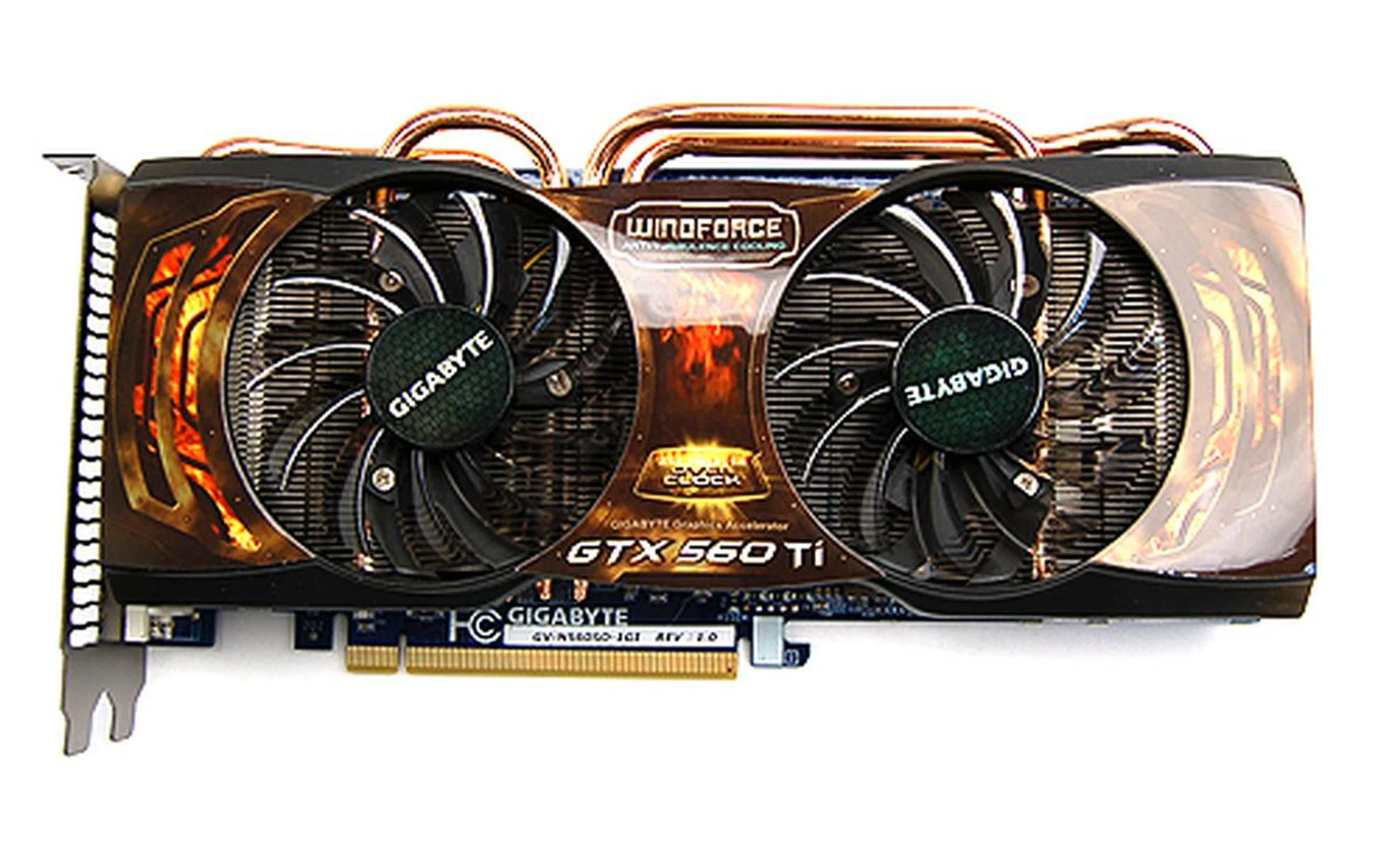
The Gigabyte card uses the familiar Windforce 2x cooler that we've seen on their other cards.
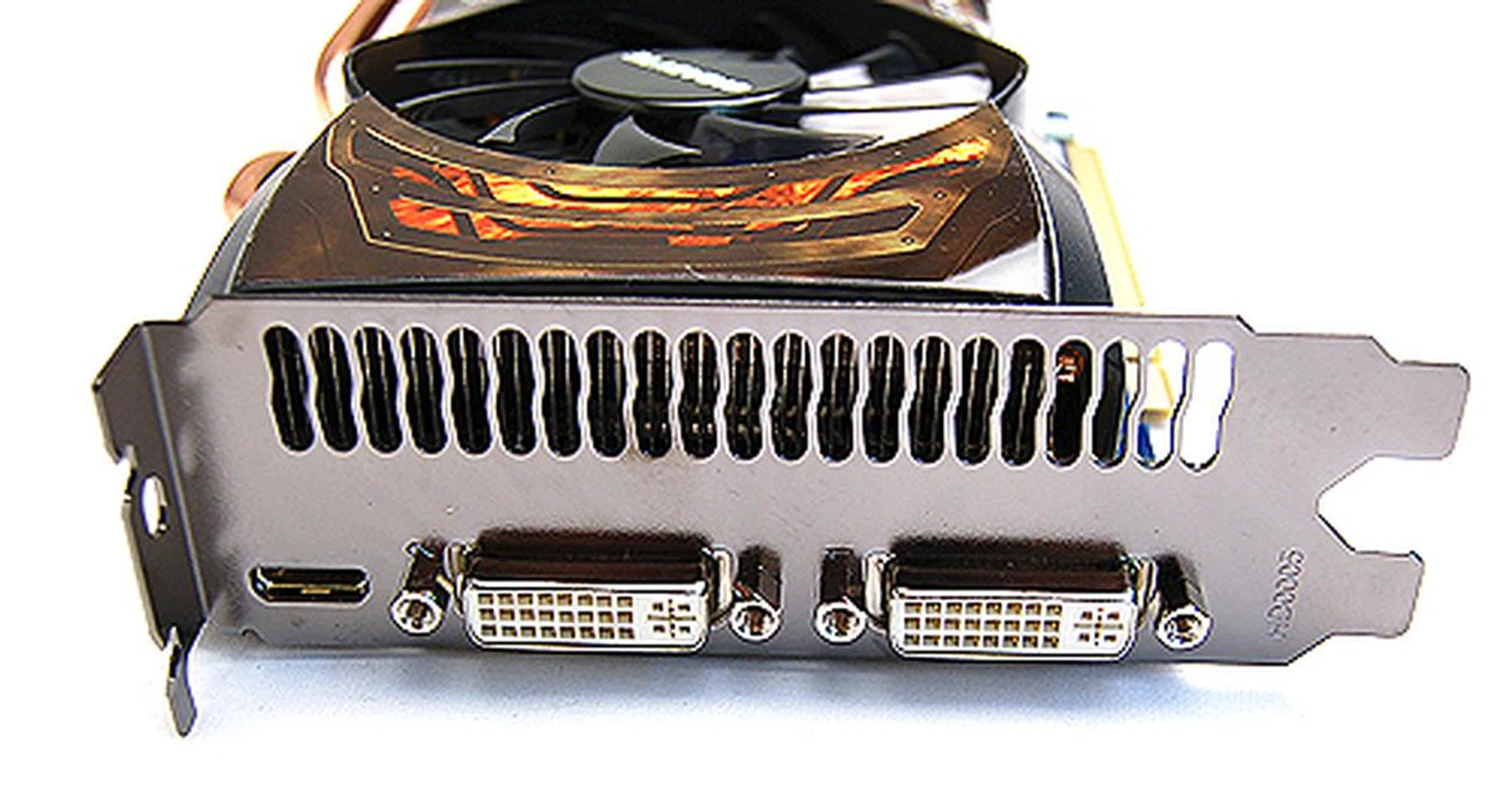
The card has the usual twin DVI ports and single mini-HDMI port found on reference GeForce GTX 560 Ti cards.
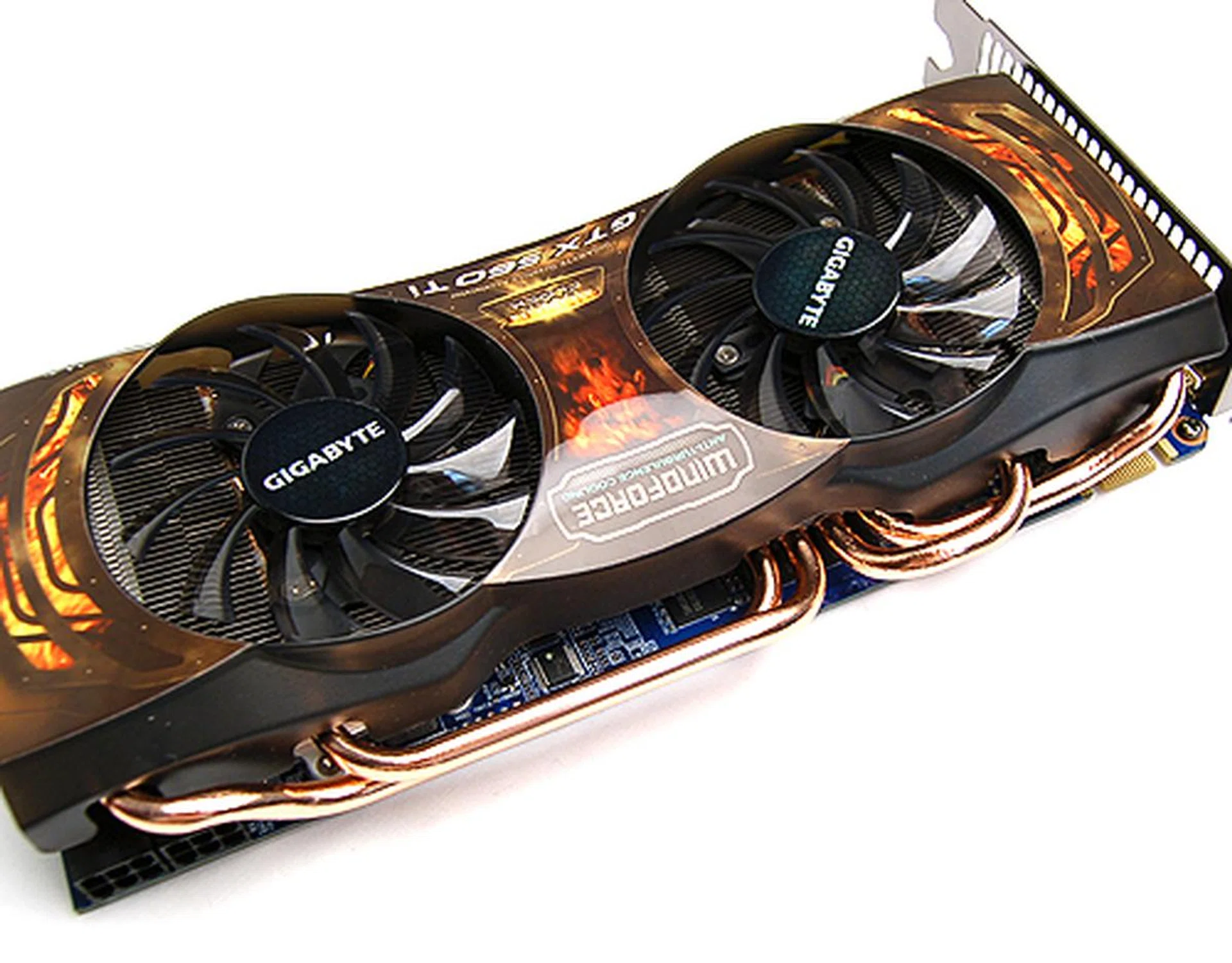
For the uninitiated, the Windforce 2x cooler has specially angled fans and heatsinks which supposedly reduce turbulent air flow and allow for a smoother flow of air.
MSI N560GTX-Ti Twin Frozr II OC
The MSI N560GTX-Ti Twin Frozr II OC follows MSI’s tried-and-tested recipe for a customized overclocked card and that is Military Class II components, featuring solid state capacitors, ferrite core chokes and Hi-C Caps, and MSI’s very own Twin Frozr II cooler. This combination has served MSI well in the past, and we are expecting more of the same today.
In terms of clock speeds, the MSI N560GTX-Ti Twin Frozr II OC is the most modest, coming in at 880MHz at the score, 1760MHz at the shaders and 4200MHz DDR at the memory. Admittedly, it’s a bit conservative considering the clock speeds of both the Galaxy and Gigabyte card, but the MSI N560GTX-Ti Twin Frozr II OC should still be significantly quicker than a reference card.
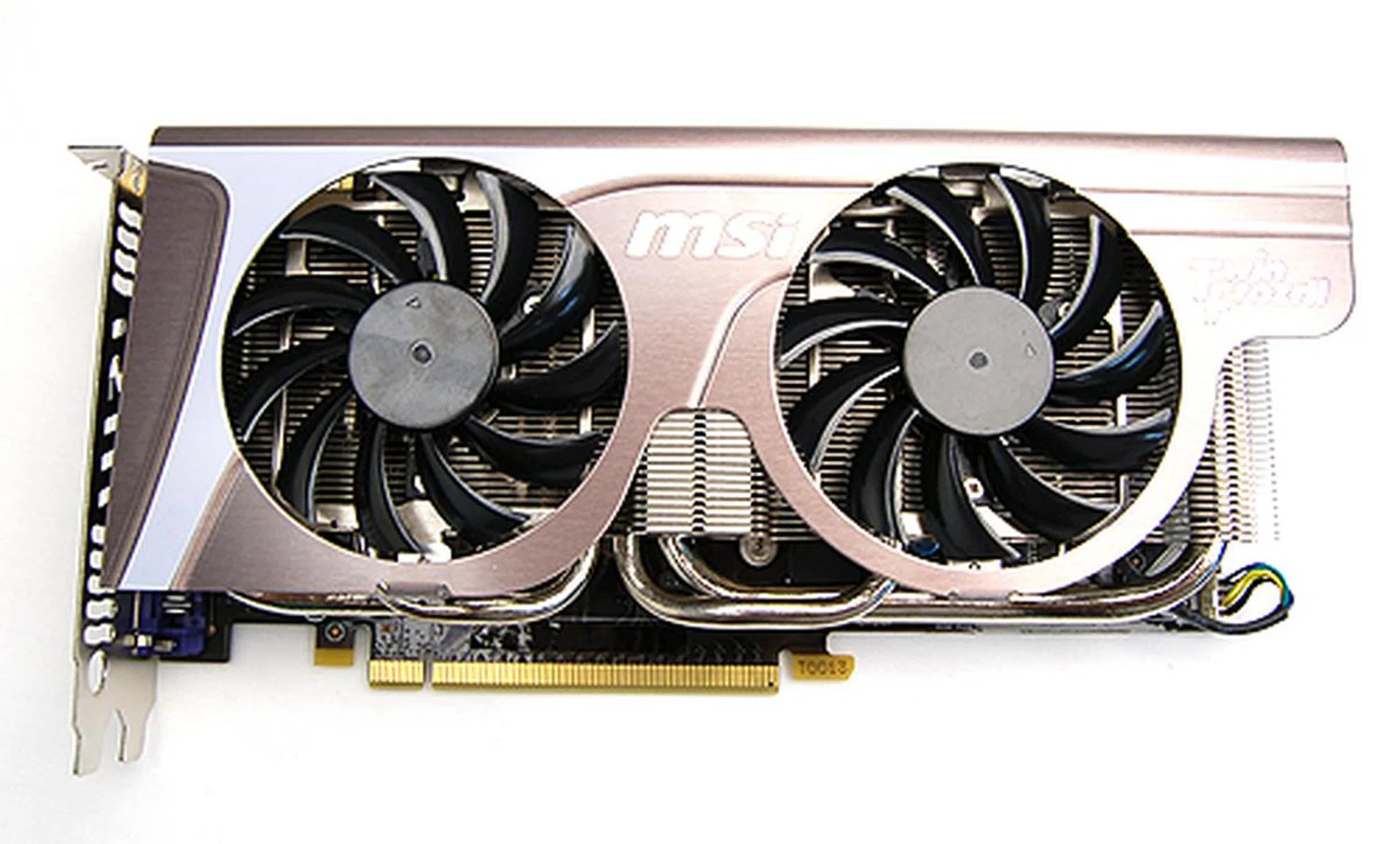
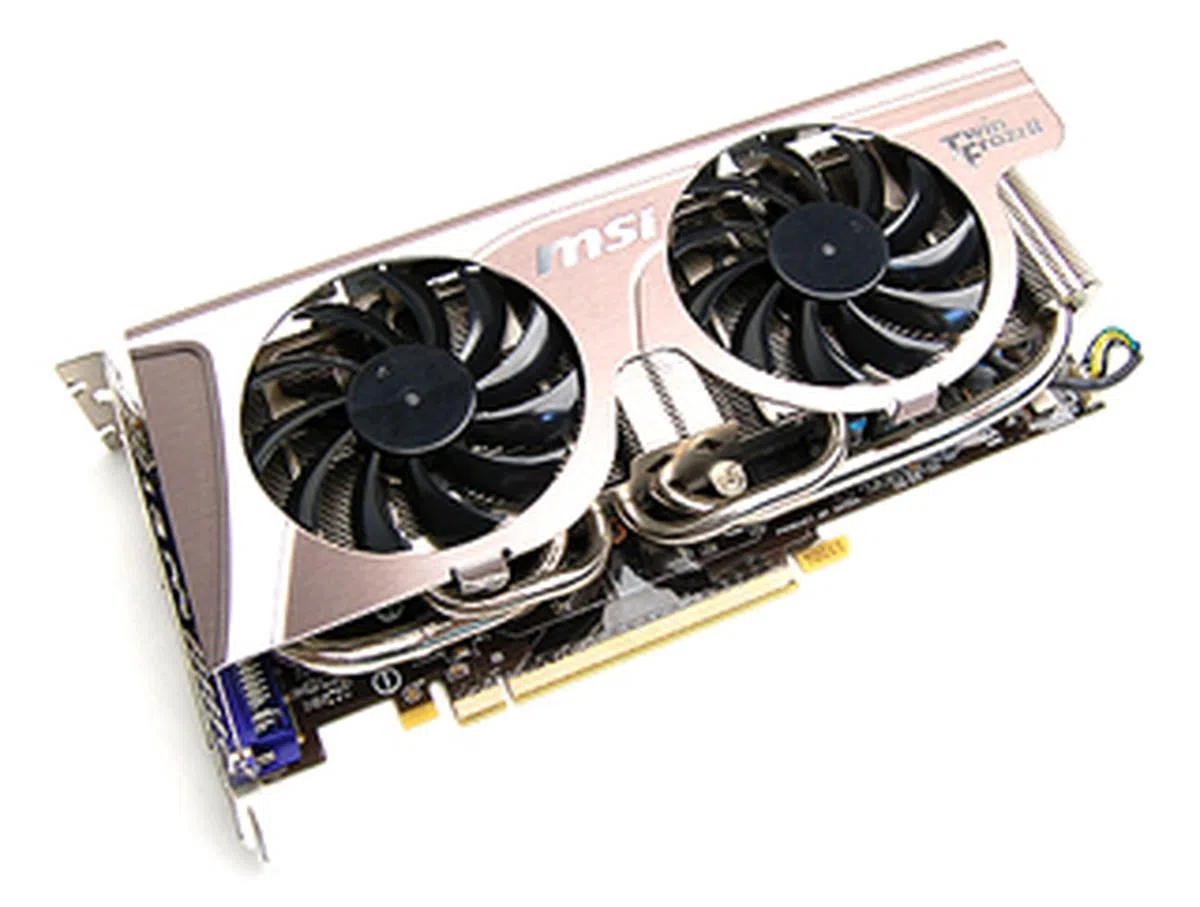
Like the Gigabyte card, the MSI N560GTX-Ti Twin Frozr II OC looks familiar because of the Twin Frozr II cooler which is widely used on MSI's custom designed cards.
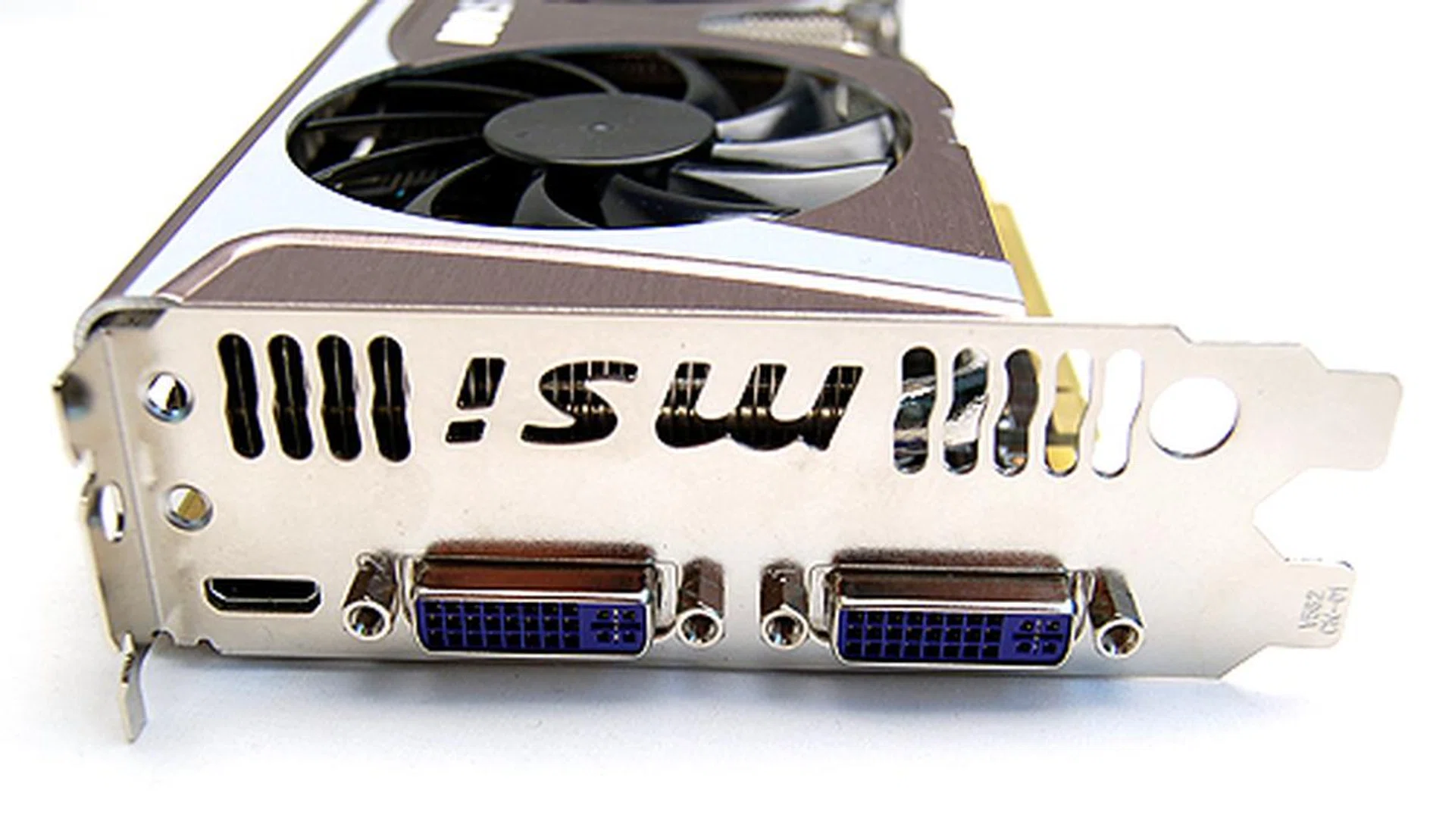
The card gets the usual twin DVI and single mini-HDMI ports for video output.
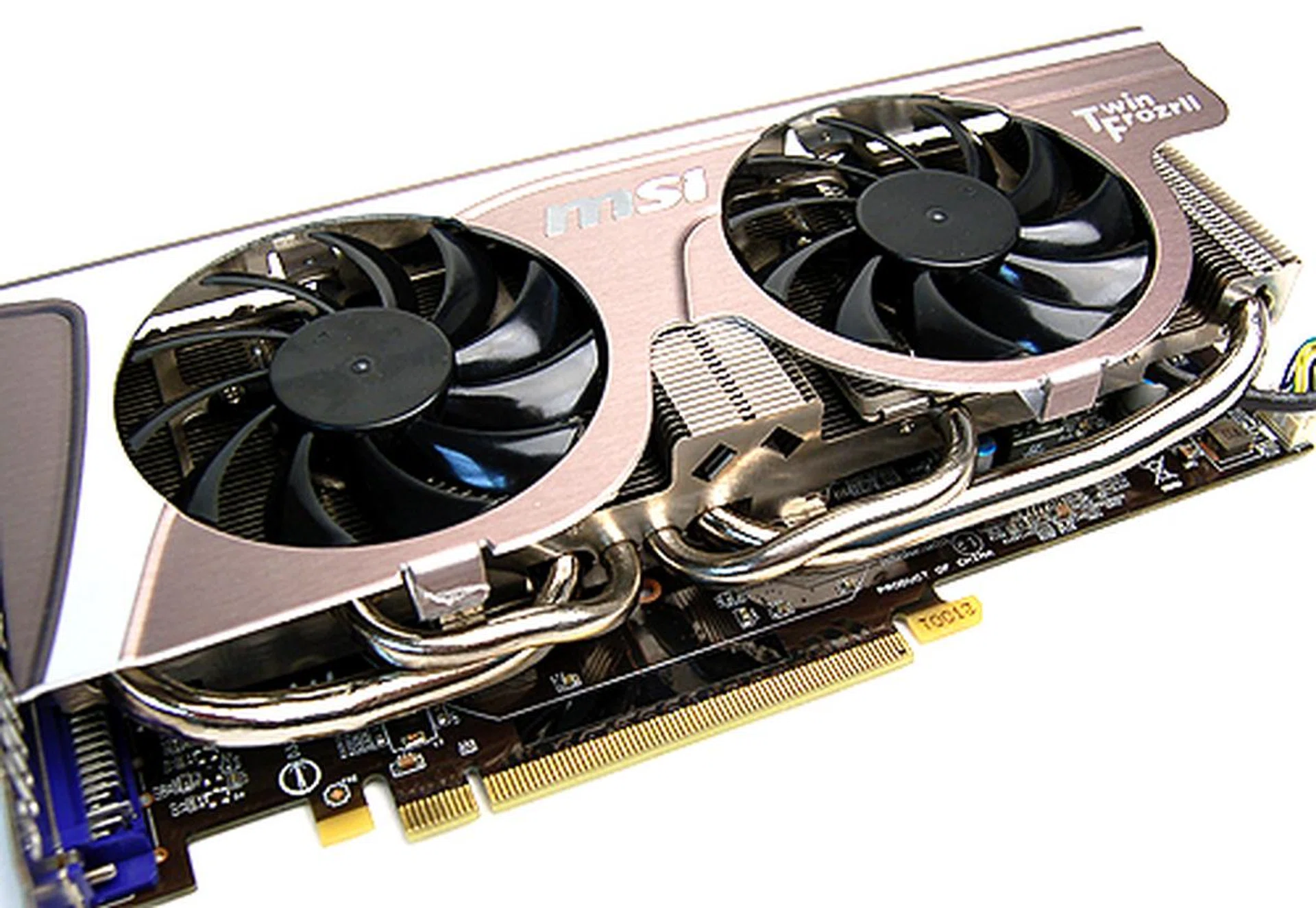
No less than four heat pipes are used to quickly draw heat away from the GPU core to keep the card running cool.
Test Setup
We’ll be evaluating the three cards using our Intel X58 testbed which has the following specifications:
- Intel Core i7-975 (3.33GHz)
- Gigabyte GA-EX58-UD4P motherboard
- 3 x 1GB DDR3-1333 G.Skill memory in triple channel mode
- Seagate 7200.10 200GB SATA hard drive
- Windows 7 Ultimate
?Obviously, we are interested to find out just how much faster these three factory overclocked, custom edition GeForce GTX 560 Ti cards are over a reference card. Since clock speeds are a good indicator of a card’s performance, we fully expect the three cards to be significantly quicker than a reference card. Also, judging from the aggressive clock speeds of the Gigabyte card, we expect it to come out tops in the performance take.
Moving on, we also want to find out just how effective their custom coolers are and how well they can overclock. To spice things up, we’ve also includes results of the ASUS ENGTX560 Ti DC II TOP and the Palit GeForce GTX 560 Ti Sonic.
Here’s a quick summary of the cards’ clock speeds.
Cards | Core Clock Speed | Shader Clock Speed | Memory Clock Speed |
Gigabyte GeForceGTX 560 Ti Super Overclock | 1000MHz | 2000MHz | 4580MHz DDR |
Galaxy GeForce GTX 560 Ti White Edition | 950MHz | 1900MHz | 4400MHz DDR |
MSIN560GTX-Ti Twin Frozr IIOC | 880MHz | 1760MHz | 4200MHz DDR |
The full list of cards tested and driver versions used:
- ?Galaxy GeForce GTX 560 Ti White Edition (ForceWare 266.56)
- Gigabyte GeForce GTX 560 Ti Super Overclock (ForceWare 266.56)
- MSI N560GTX-Ti Twin Frozr II OC (ForceWare 266.56)
- ASUS ENGTX560 Ti DirectCU II TOP (ForceWare 266.56)
- Palit GeForce GTX 560 Ti Sonic (ForceWare 266.56)
- NVIDIA GeForce GTX 570 (ForceWare 263.09)
- AMD Radeon HD 6870 (Catalyst 10.12)
The full list of benchmarks used:
- Futuremark 3DMark Vantage
- Futuremark 3DMark 11
- Crysis Warhead
- Far Cry 2
- Warhammer: Dawn of War 2
- Battlefield Bad Company 2
- Hawx 2
- “Heaven" from Unigine v2.1
- S.T.A.L.K.E.R.: Call of Pripyat
3DMark 11 and 3DMark Vantage Results
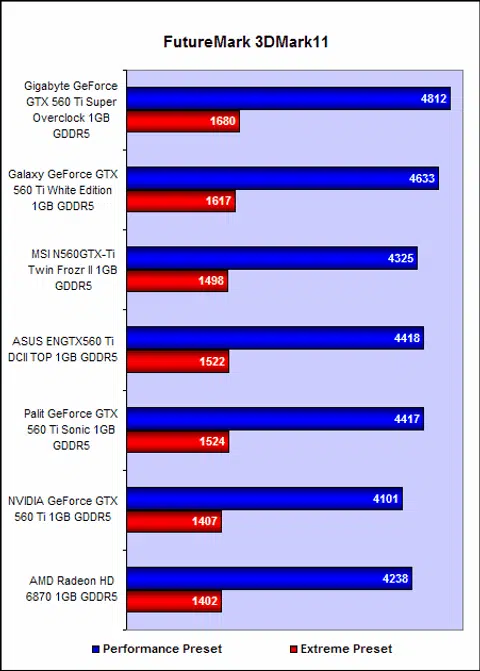
Beginning with the latest FutureMark 3DMark 11 benchmarking utility, it was not surprising to see the aggressively overclocked Gigabyte GeForce GTX 560 Ti Super Overclocking achieving the highest scores - a good 17% more than a reference card. The Galaxy GeForce GTX 560 Ti White Edition came second, outscoring the earlier tested ASUS and Palit cards along the way thanks to its higher clock speeds, while the MSI N560GTX-Ti Twin Frozr II OC, which has the lowest clock speeds amongst all the custom GeForce GTX 560 Ti cards, rounded up the pack.
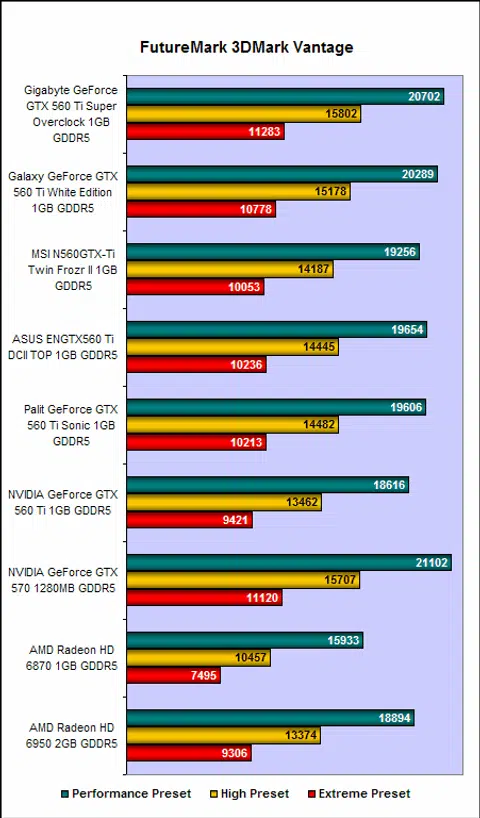
No surprises here again in 3DMark Vantage as the Gigabyte card once again came out tops amongst the GeForce GTX 560 Ti cards. It outscored the reference card by more than 10%, outpaced the second-placed Galaxy card and was comparable to the GeForce GTX 570. The second place Galaxy card came close, while the MSI card was pretty off the pace considering its relatively conservative (in view of the other cards) clock speeds. And to add, the Radeon HD 6950 and HD 6870 from AMD was completely outclassed on this benchmark.
Crysis Warhead and Far Cry 2 Results
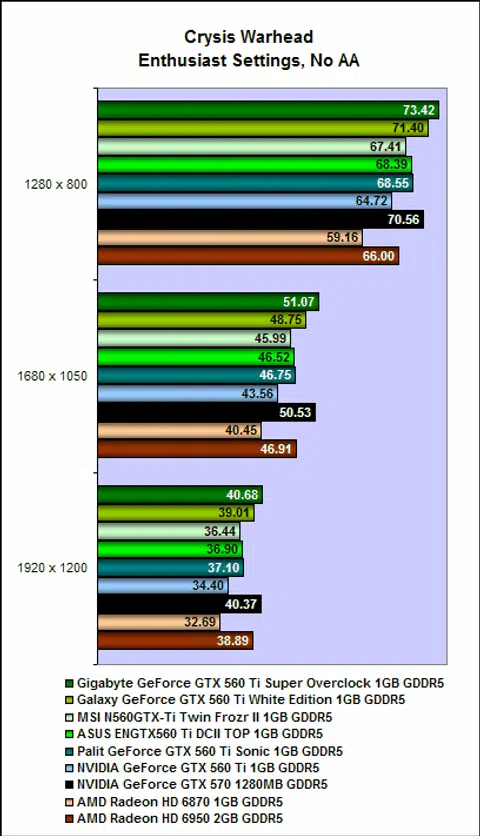
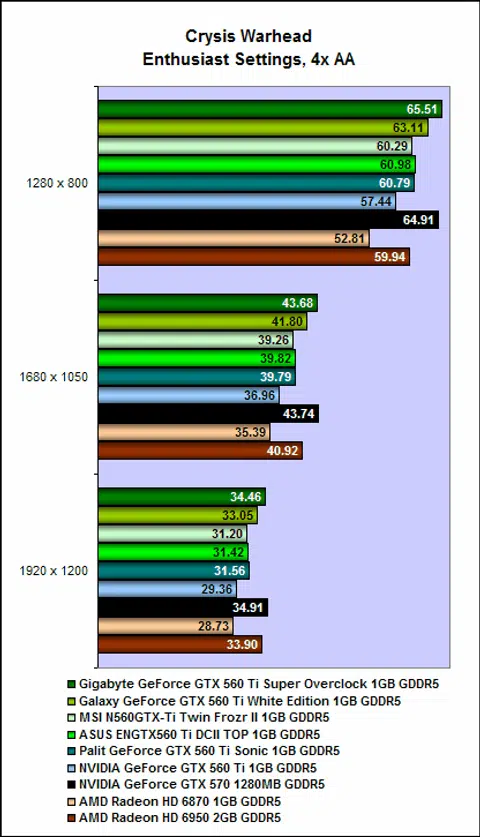
Running at a full 1GHz at the core, the Gigabyte card was easily the fastest GeForce GTX 560 Ti card. Looking at our graphs, it easily held off the second-placed Galaxy card and was an impressive 15% faster than a reference GeForce GTX 560 Ti card. More impressive was the fact that it was marginally quicker than the GeForce GTX 570, losing its advantage only went we enabled anti-aliasing.
Against the cards from AMD, both the aggressively factory overclocked Gigabyte and Galaxy cards proved too much for even the more powerful Radeon HD 6950 and its massive 2GB framebuffer to handle.
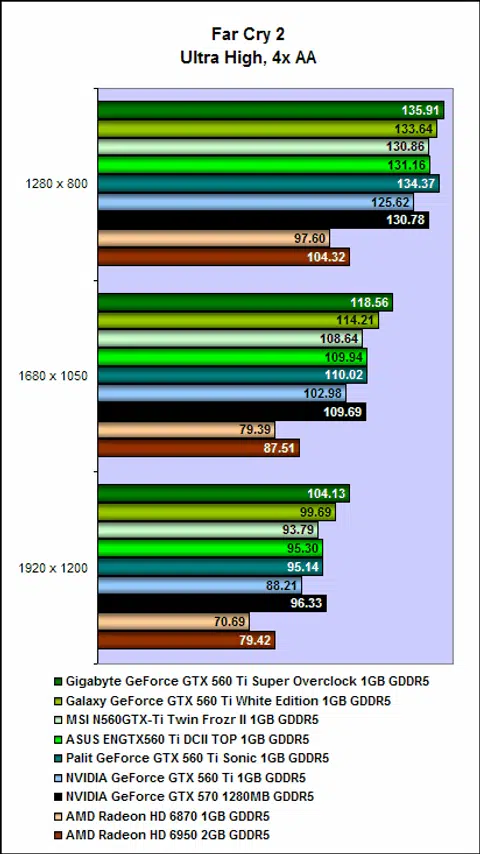
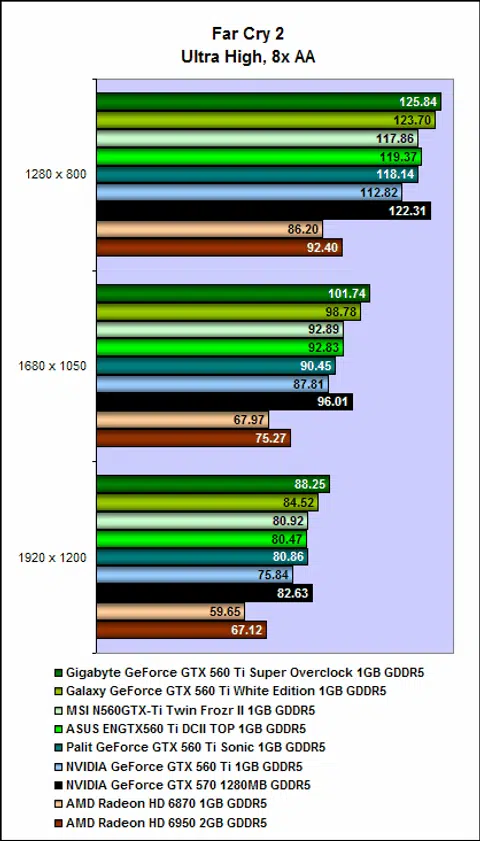
The Gigabyte continued its dominance on Far Cry 2, racking up the highest frame rates, surpassing even the GeForce GTX 570. On the highest resolution of 1920 x 1200, the Gigabyte card was a considerable 17% quicker than a reference card. The second-placed Galaxy card but be outclassed by the quicker Gigabyte card, but it was still a good 10% quicker overall compared to a reference card.
NVIDIA cards have usually performed well on this benchmark, so it was no surprise to find that neither the Radeon HD 6950 nor HD 6870 could come close to challenging our trio of factory overclocked GeForce GTX 560 Ti cards.
Dawn of War 2, Battlefield Bad Company 2 and Hawx 2 Results
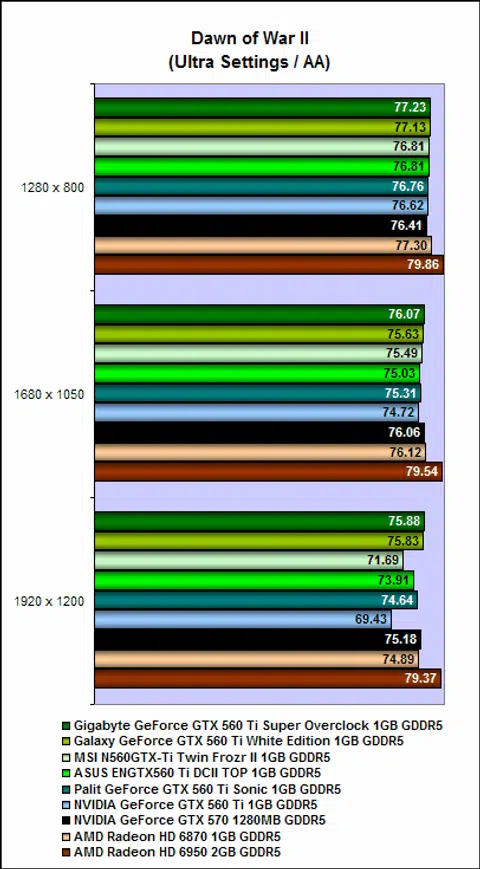
Dawn of War 2 has always been a tightly contested affair and it wasn’t until we increased the resolution to 1920 x 1200 that we started to see some differences in performance. Even so, the differences are slight, often a couple of frames at most, which we think would be impossible to tell with the naked eye. Here, we saw the Gigabyte and Galaxy cards racking up almost similar frame rates, while the lower clocked MSI card was some ways off the pace.
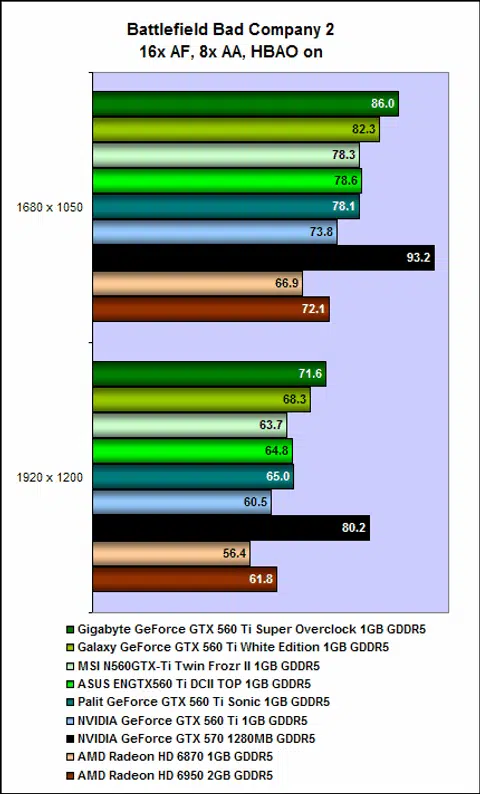
Of all the GeForce GTX 560 Ti cards, the Gigabyte was the quickest in Battlefield: Bad Company 2. Overall, it was about 4% faster than the second placed Galaxy card and a whopping 18% faster than a reference card. Another interesting to note is that while the Gigabyte came close to matching the GeForce GTX 570 on previous benchmarks, it was completely outclassed here.
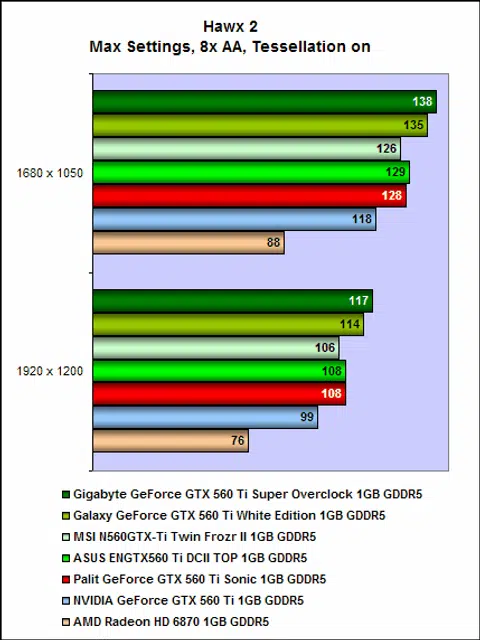
Even on Hawx 2, the Gigabyte card was once again the quickest card of our roundup thanks to its incredible 1GHz core clock speeds. The Galaxy card wasn’t that far off the place, and to add, thanks to their impressive clock speeds, the two cards were more than 10% quicker than a reference card. On the other hand, although the MSI card has pretty conservative clock speeds, it was still a good 5% faster than the reference card.
Unigine "Heaven" 2.1 Results
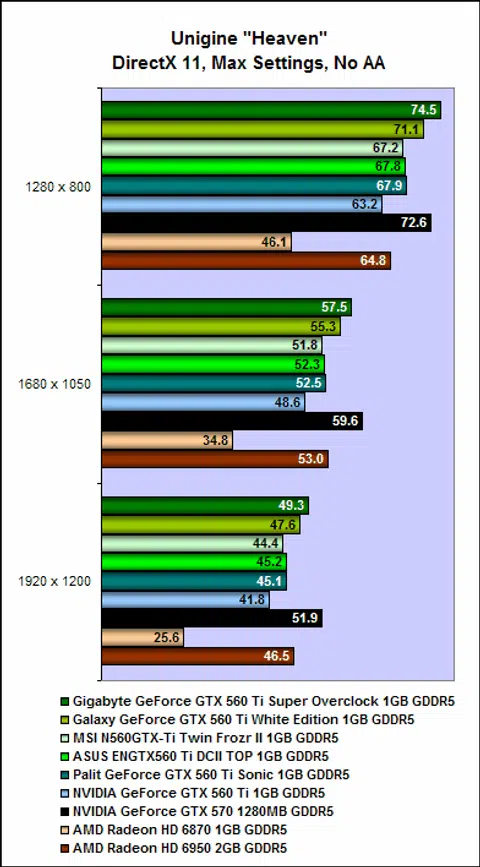
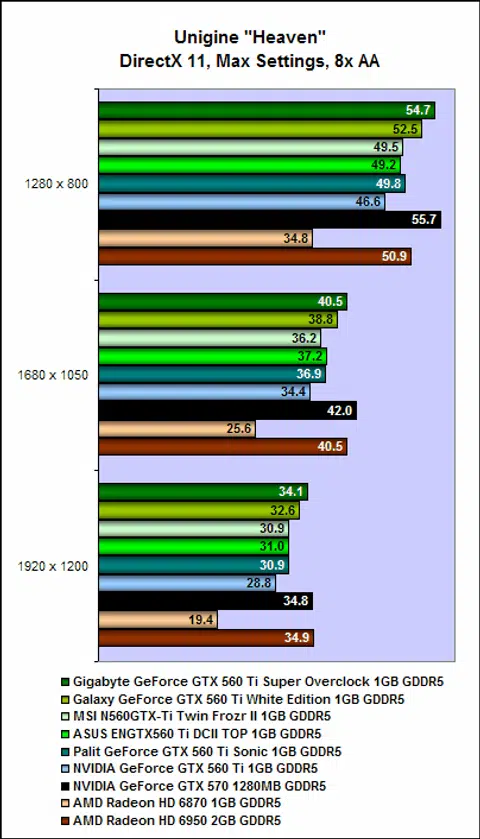
No prizes for guessing which was the fastest GeForce GTX 560 Ti card, as the Gigabyte card once again took top honors, with the Galaxy card just trailing behind. The MSI card with its moderately higher than stock clock speeds once again found itself as the slowest factory overclocked card in this roundup; even so it was still a good 6% faster than a reference card.
S.T.A.L.K.E.R.: Call of Pripyat Results
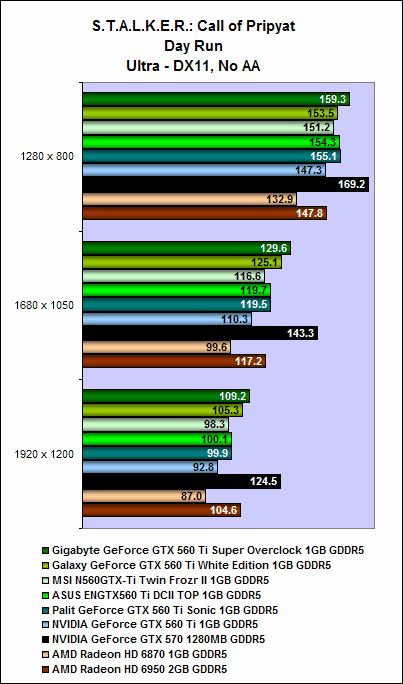
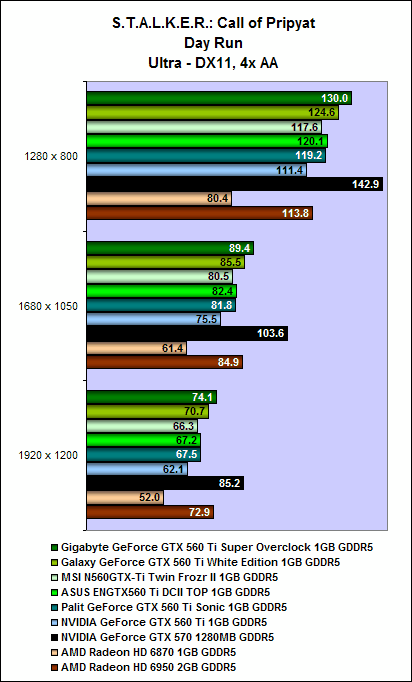
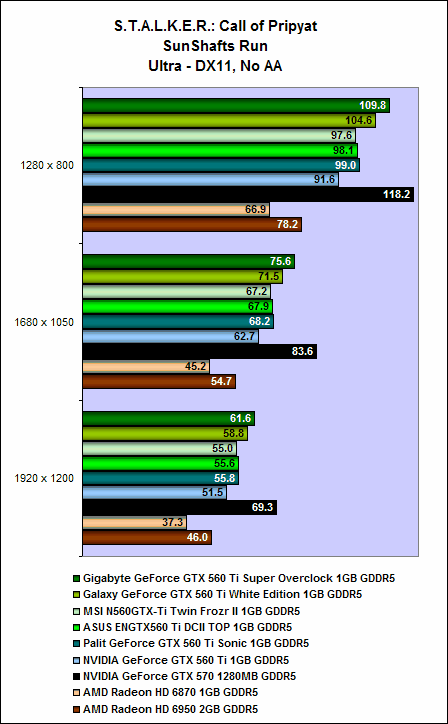
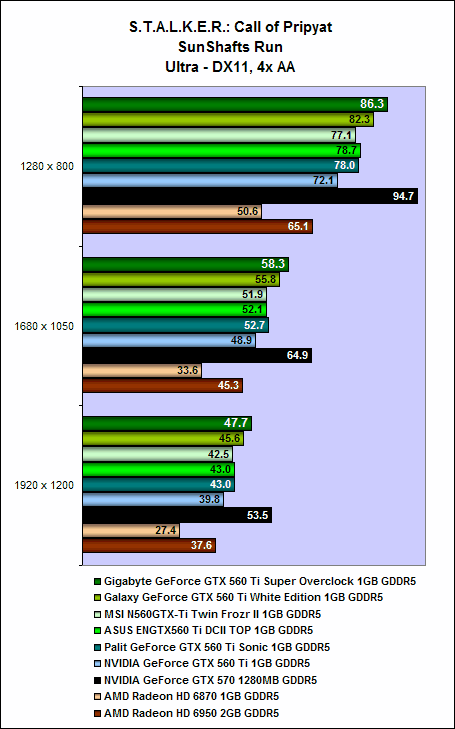
The super fast Gigabyte card continued its dominance on S.T.A.L.K.E.R.: Call of Pripyat as it was around 15% overall faster than a reference card. The Galaxy card was once again a close second, while the MSI card was the least competitive card in our roundup.
Against the Radeons, the Radeon HD 6950 was competitive on the Day runs, but lost its edge on the more intensive Sunshafts run, where it could be as much as 20% slower than the GeForce GTX 560 Ti.
DirectX 11 Results
 |  |
 |  |
Temperature
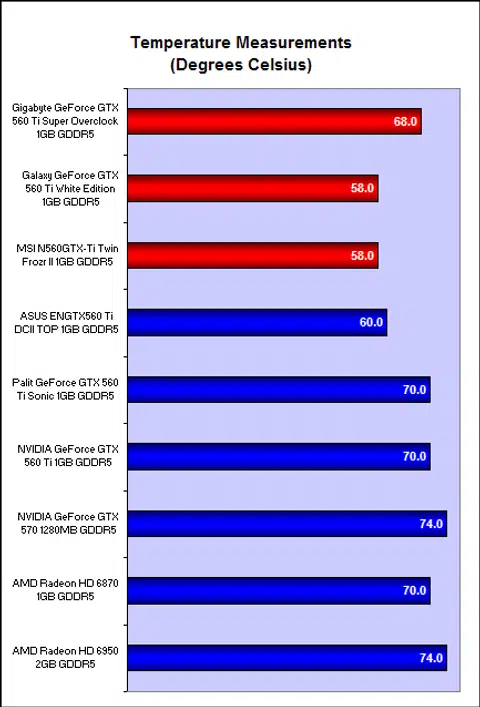
Clock speeds are a good indication of a card’s performance, but nothing can tell us how a card’s cooler would perform until we put it to the test. MSI’s Twin Frozr II cooler has proved to be an effective cooler and it did the job well, as the MSI N560GTX-Ti Twin Frozr II clocked a maximum operating temperature of only 58 degrees Celsius - an improvement of 12 degrees Celsius over the stock card.
Galaxy has decided to go for a more traditional cooler design for their GeForce GTX 560 Ti and it has paid off well, seeing that the Galaxy GeForce GTX 560 Ti White Edition also recorded a maximum operating temperature of 58 degrees Celsius. Previously, we found that Galaxy’s “flip-fan” cooler was less effective as Galaxy would have liked, but judging from the results here, it’s fair to say that the move of reverting to a more conventional design is the right one.
Unfortunately, Gigabyte’s Windforce 2x cooler which has proved itself in many applications previously, has let the card down this time. Perhaps the almost insane clock speeds was too much for even the dual-fan cooler to handle. If it’s any consolation, the Gigabyte GeForce GTX 560 Ti Super Overclock was still mildly cooler to run than a reference card.
Power Consumption
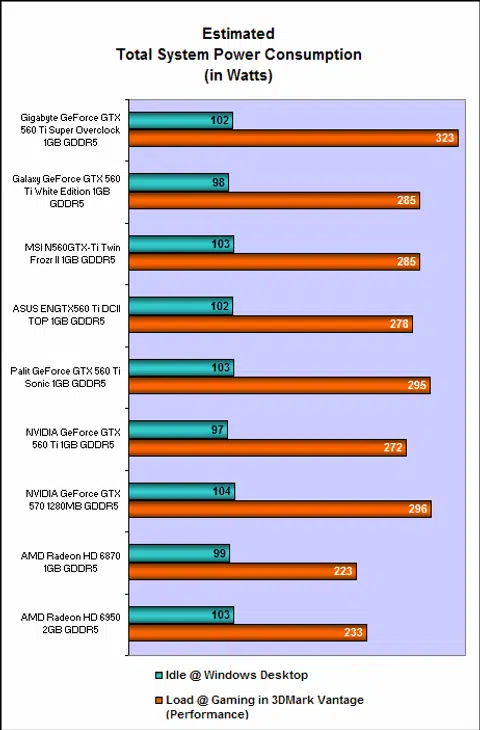
Both the Galaxy and MSI card recorded power draw figures that were very comparable to that of a reference card, but we noted that the Gigabyte card had an abnormally high power draw at load, which exceeded even the more powerful GeForce GTX 570. Earlier, we noted in our review of the GeForce GTX 560 Ti was a tad on the high side, and it seems that Gigabyte, in a bid to ensure that the card runs stably at 1GHz, and decided to trade power for performance, hence the high power draw readings.
Overclocking
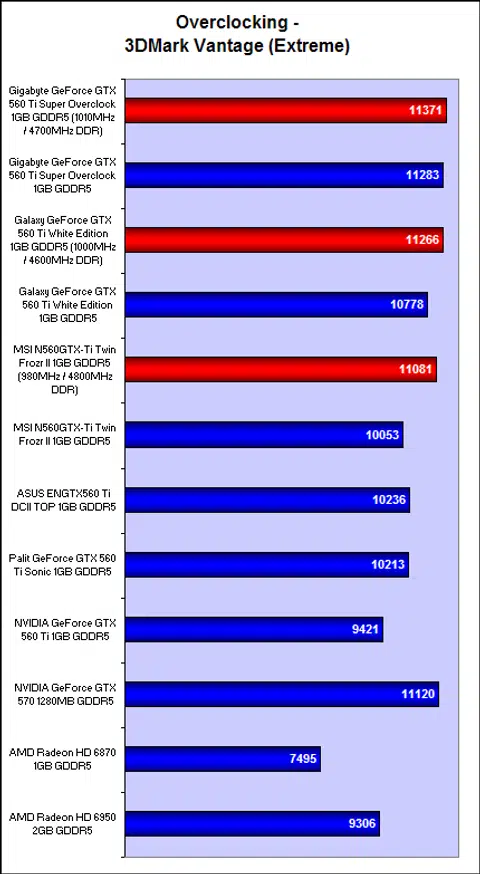
The three GeForce GTX 560 Ti cards were able overclockers. Running at 1GHz at the core, the Gigabyte card is already aggressively overclocked, but managed to squeeze out an additional 10MHz at the core and bumped memory clock speeds up to a respectable 4700MHz DDR, giving us 11371 3DMarks on the Extreme preset of Vantage.
With the Galaxy GeForce GTX 560 Ti White Edition, we achieved a maximum overclocking state of 1000MHz at the core and 4600MHz DDR at the memory, giving us 11266 3DMarks or an improvement of 4%.
Not to be outdone, the MSI N560GTX-Ti Twin Frozr II managed 980MHz at the core and 4800MHz DDR at the memory, which translated to 11081 3DMarks - an improvement of 10%.
The Three Kings
On a whole, the three factory overclocked, custom edition GeForce GTX 560 Ti cards we’ve lined up here have performed admirably. The Gigabyte GeForce GTX 560 Ti Super Overclock with its super aggressive clock speeds proved to be the fastest, while the Galaxy GeForce GTX 560 Ti White Edition was no slouch in the performance aspect either. The MSI N560GTX-Ti Twin Frozr II OC was always going to be at a disadvantage because of its lower clock speeds, but it did well in other areas.
Here’s a quick summary of the cards’ clock speeds and prices, followed by a breakdown of their scores.
Cards | Core Clock Speed | Shader Clock Speed | Memory Clock Speed | Price (USD) |
Gigabyte GeForceGTX 560 Ti Super Overclock | 1000MHz | 2000MHz | 4580MHz DDR | $269 |
Galaxy GeForceGTX 560 Ti WhiteEdition | 950MHz | 1900MHz | 4400MHz DDR | $370 |
MSIN560GTX-Ti Twin Frozr IIOC | 880MHz | 1760MHz | 4200MHz DDR | $249 |
Cards | Performance | Features | Value | Overall |
Gigabyte GeForceGTX 560 Ti Super Overclock | 9.0 | 8.5 | 8.0 | 9.0 |
Galaxy GeForce GTX 560 Ti WhiteEdition | 9.5 | 9.0 | 6.0 | 8.0 |
MSIN560GTX-Ti Twin Frozr IIOC | 8.5 | 8.5 | 8.5 | 8.5 |
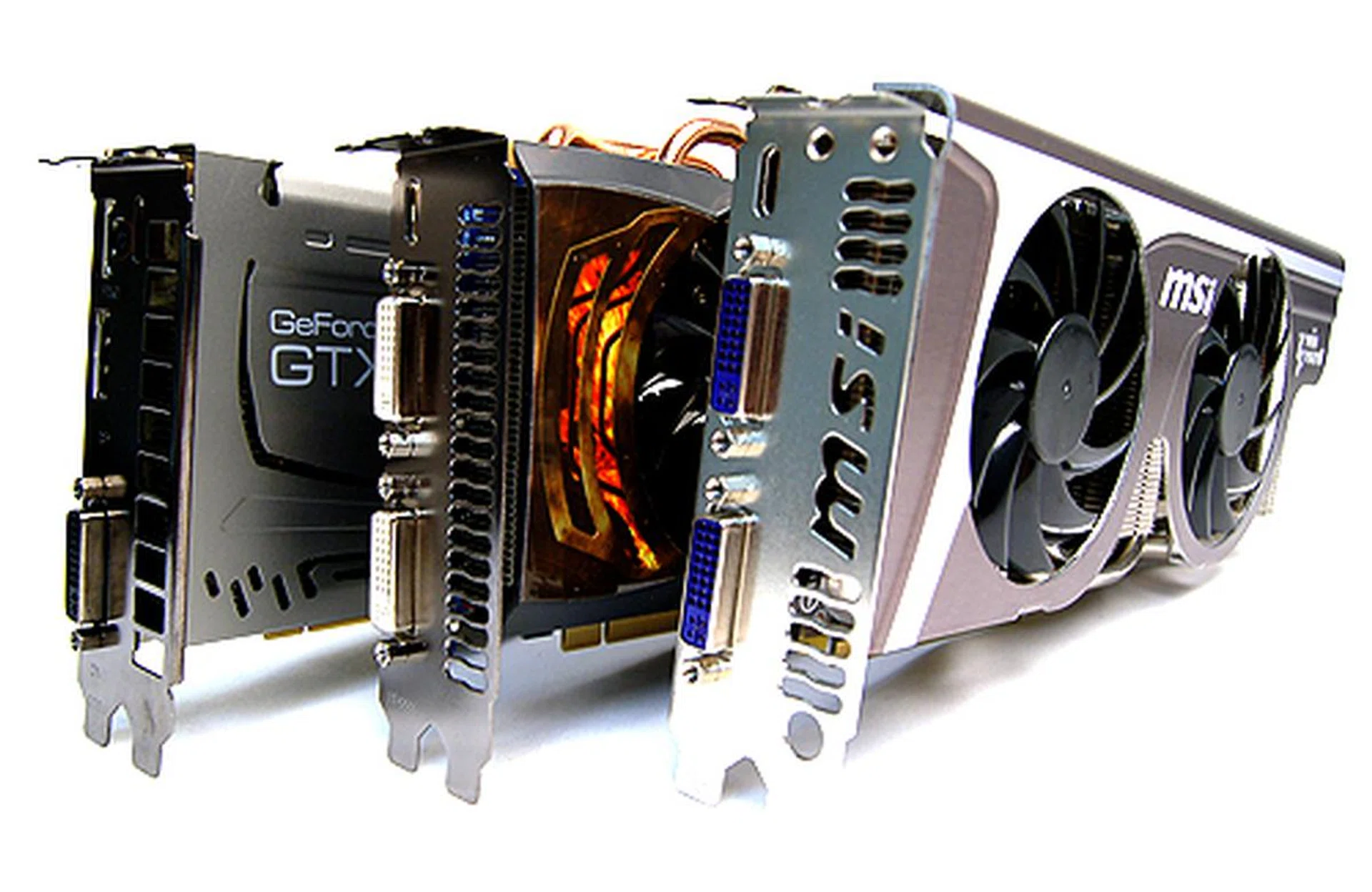
The cards are all commendable takes on the GeForce GTX 560 Ti, but they all have their own shortcomings. The Galaxy card is really expensive; the Gigabyte card is power hungry; and the MSI card is lacking in raw graphics horsepower.
The Gigabyte GeForce GTX 560 Ti Super Overclock is yet another exemplary card from Gigabyte’s Super Overclock line-up of cards. Clocked at a staggering 1GHz at the core and 4580MHz DDR at the memory, the card is a good 15% or more faster than a bone stock GeForce GTX 560 Ti and as our results show, is capable of even challenging the GeForce GTX 570 in some cases. Unfortunately, its blazing performance has come at price because its operating temperatures and power draw figures were substantially higher than the competition. Also, at US$269, it is more costly. However, if outright performance is your foremost concern and you are willing to pay the premium in the form of its retail price and also thermal and power characteristics, this is the card for you.
In terms of performance, the MSI N560GTX-Ti Twin Frozr II OC was no match for the Gigabyte and Galaxy cards, but its cooler was effective and overclocking performance was decent as well, almost on a par with the faster Gigabyte and Galaxy cards. The best thing about it, however, is that at US$249 it costs only about as much as reference cards. As a whole, this is probably a more well-rounded card of the lot.
The Galaxy GeForce GTX 560 Ti White Edition may not be the fastest, but with clock speeds of 950MHz at the core and 4400MHz DDR at the memory, it wasn’t slow either and was only about 3% slower overall compared to the blazing fast Gigabyte card. That aside, we were also impressed with the effectiveness of its cooler, especially considering the clock speeds the card is running at. Furthermore, the white PCB of the card is a refreshing change of the usual red, blue and black. Unfortunately, despite the excellent all round performance of the card, it does have one major letdown and that’s its price. It costs a whopping US$370, which, considering most GeForce GTX 560 Ti cards are going for around US$250, is far too much of a premium even if it is limited to 1000 units worldwide, has good all round performance, and an attractive white PCB. Bear in mind that for that money, you can get a more powerful GeForce GTX 570 or even the Radeon HD 6970. In fact, if it wasn't for the card's frightening price tag, it would have easily been the victor of today's roundup.
At the end of the day, it was difficult to pick a winner from this trio of cards. The Galaxy has good all round capabilities, but its ridiculously expensive; while as fast as the Gigabyte is, it doesn’t have very good power and thermal characteristics; and lastly, the MSI might be the value buy, but it doesn’t offer quite as much in terms of raw performance. Really, these three cards are competent and at the same time have their own slight 'drawbacks'. So in the end, it really depends very much on the individual user’s preferences, needs and wants.
<img width="320" height="247" class="caption" title="The Gigabyte GeForce GTX 560 Ti Super Overclock " src="https://cassette.sphdigital.com.sg/image/hardwarezone/77eec14f8f4da77eca6fc91bf18f10549ed079bf4912baca0e6b5a415c9247ff" alt=""> |
|
| |
<img width="320" height="245" class="caption" title="The Galaxy GeForce GTX 560 Ti White Edition " src="https://cassette.sphdigital.com.sg/image/hardwarezone/47e1427440a323dfe120321bbbe786c489ac4c95f50162fd705f41b271faab76" alt=""> |  |




Our articles may contain affiliate links. If you buy through these links, we may earn a small commission.