

Intel Core 2 (Conroe) Performance Review
Intel's highly anticipated codename Conroe CPU has finally been released and we dive straight into an in-depth, head on performance review of the Core 2 Extreme and Core 2 Duo CPUs. The verdict? Simply amazing. If you think you can trust your eyes, then read on.
The Pentium is Dead, Long Live The Core!
It has finally happened, Intel will be putting to rest the long standing Pentium branding for their next generation of desktop microprocessors in favor of a totally new line-up simply called Core. However, this isn't just a re-branding exercise for Intel. The Core processors mark Intel's first true major revamp of microprocessor technology since their launch of the NetBurst microarchitecture with the Willamette core Pentium 4 back in the year 2000 and before you know it, we're already at Core 2. Now we're getting ahead of ourselves. Considering the major gear shift at Intel to bring about this day, let's take a brief recap on the chain of events that have lead to the development of the new Core processors.
From the very beginning of the Pentium 4 and the introduction of the deeply pipelined NetBurst microarchitecture, Intel has advocated speed, speed and more speed. The deep 20-stage (which was later increased to 31 stages from the Prescott core onwards) pipeline design and SSE technologies were designed to excel at extremely high frequencies and Intel has previously let known that they predicted the Pentium 4 (90nm Prescott) could scale up to 5GHz. That was back in 2003 and in 2006, we've not seen an officially released NetBurst architecture based processor past the 3.8GHz mark.
Intel knowing that frequency scaling has hit a solid wall due to difficulties in controlling the ever increasing thermals and exponentially reduced performance gain, began moving towards parallelism as an answer introducing Hyper-Threading Technology into the Pentium 4 and subsequently the Smithfield dual-core Pentium D was born. The Smithfield was basically two Prescott cores bolted onto one another, which didn't really help reduce neither power consumption nor thermals much. Intel's use of a shared FSB also meant an overall reduced bandwidth to each core, an essential lifeline for NetBurst processors. Intel enhanced their manufacturing process with the 65nm Presler core, increase L2 cache to 4MB (2MB per core) and threw in hardware Virtualization Technology (VT). However, even the Preslers could not shake AMD's steady seat on the performance-per-watt throne and was still putting out too much heat for comfort.
AMD's sharp rise in market share from their hugely successful Athlon XP, Athlon 64 and dual-core Athlon 64 X2 processors in the past two years has been a rude awakening for Intel. AMD was even making inroads into the server market with their Opteron products and went as bold as to openly challenge Intel's dual-core Xeon on both performance and power consumption fronts in 2005 - a challenge which Intel chose to ignore resulting in defacto bragging rights for AMD for a period of time.
Intel of course has not been sitting idle all this while and we've seen a huge effort in promoting their next generation microarchitecture over the past year, which was basically Intel telling the world 'Wait and see, we'll be back and then we will rock!'. Intel officially unveiled the revolutionary Core microarchitecture early this year at IDF Spring 2006 in San Francisco and wet our lips with a preview of the enhanced power saving features (if not the performance) with the launch of the Core Duo (codenamed Yonah) dual-core mobile processor.
It is very important to note that the Core Duo (Yonah) is not a Core microarchitecture based processor, but it is the direct predecessor to some of the technologies that are used in development of Core. The Core version of the mobile processor, currently codenamed Merom will be launched later this year. Today, we will see the launch of the Core 2 Duo and Core 2 Extreme processors (confusing we know, but we guess Intel is still getting into their new groove), Intel's desktop Core lineup previously codenamed Conroe. The table below is a list of the announced Core 2 Duo models, their basic specifications and anticipated pricing and availability:-
Processor Model / Processor Characteristics | Clock Speed | L2 Cache | Front Side Bus (MHz) | Max TDP (W) | Price (US$) | Availability* |
Core 2 Extreme X6800 | 2.93GHz | 4MB | 1066 | 75 | $999 | July 2006 |
Core 2 Duo E6700 | 2.67GHz | 4MB | 1066 | 65 | $530 | July 2006 |
Core 2 Duo E6600 | 2.40GHz | 4MB | 1066 | 65 | $316 | July 2006 |
Core 2 Duo E6400 | 2.13GHz | 2MB | 1066 | 65 | $224 | July 2006 |
Core 2 Duo E6300 | 1.86GHz | 2MB | 1066 | 65 | $183 | July 2006 |
*Approximation
Intel will initially launch these five processors in the Core 2 family. The E6300 and E6400 are actually entry-level processors based on the Allendale core with reduced L2 cache of 2MB. The E6600, E6700 and X6800 are all based on the Conroe core with a full 4MB L2 cache. For this review, we will be focusing exclusively on the Conroe processors.
Core du Conroe
Intel's Core 2 Duo desktop processors will be the first processor based on their new Core microarchitecture to leave Intel's doors. Like the current Pentium D 900-series Presler processors, Intel's new Core 2 Duo will be manufactured under a 65nm process. However, the Conroe shares more similarities with Intel's mobile processor - the Core Duo or Yonah core. With Conroe, Intel has gone back to packing two execution cores into a single die, but with all the goodness of a shared L2 cache of the Yonah. Each core comes with a dedicated 64KB L1 cache (32KB instruction, 32KB data), more than double that of the previous generation Presler's 28KB L1 cache (16KB + 12KB), features five independent prefetchers per core (two L2 data, two L1 data and one L1 instruction prefetch units).
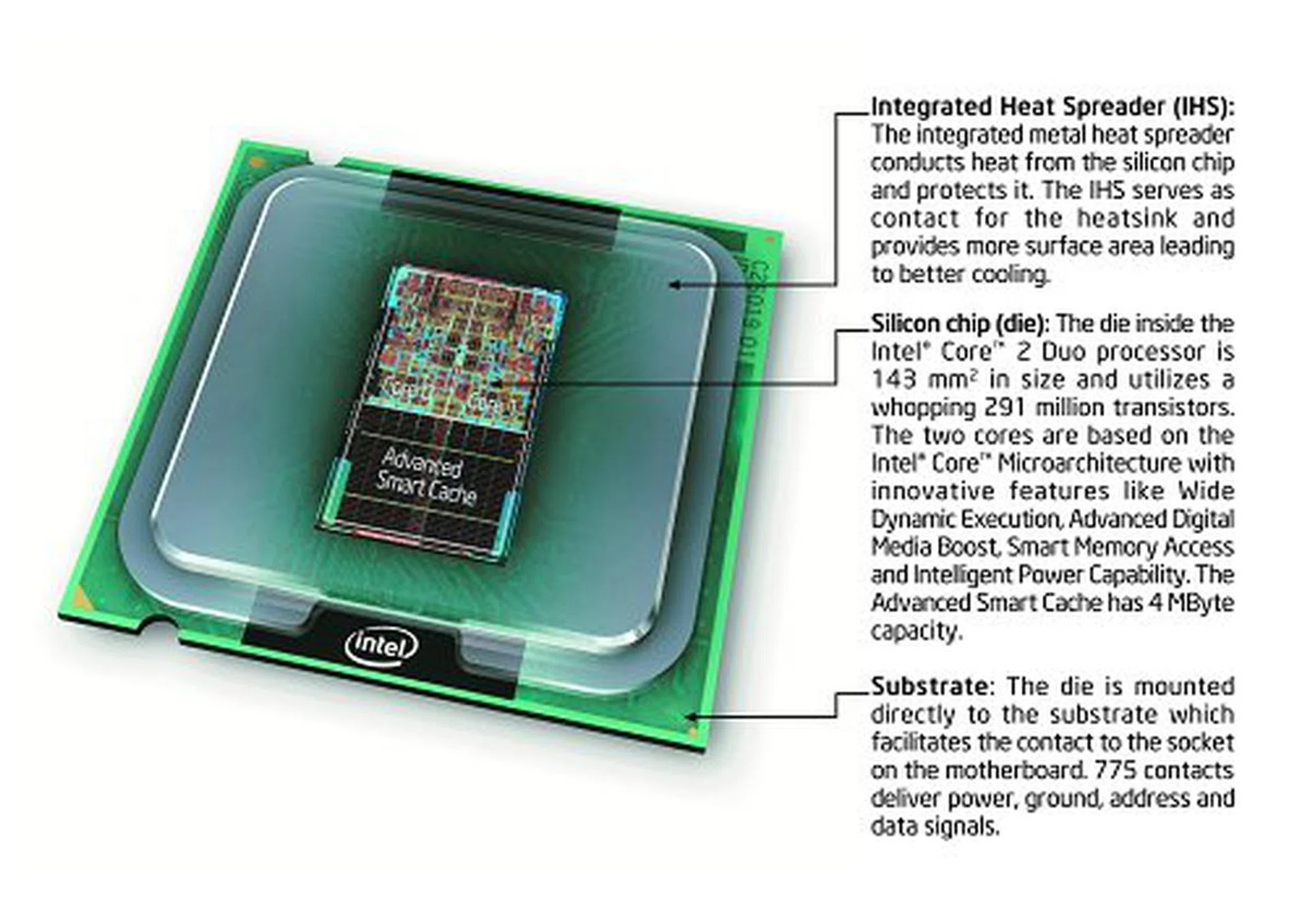
This image basically sums up the advanced features of the new Core 2 microprocessors.
The Core 2 will debut with a total of 4MB L2 cache with a cheaper 2MB L2 variant based on the Allendale core available as well. The shared cache design allows each core to have full dynamic access to the entire cache size, which will have a substantial impact when running non-SMP capable applications where one core is essentially shut off. If you have trouble understanding how this helps, remember the performance gains going from 1MB to 2MB L2 for the Prescott core? Now visualize the processor with a full 4MB L2 cache all to itself. Drool worthy, yes we know.
Surprisingly, although the Conroe core is built with the same 65nm manufacturing process, carry the same amount of L2 cache (4MB) and features more L1 cache as the current Preslers, the die size has shrunk by about 12% from 162mm to 143mm to and transistor count by 22% from 376 million to 291 million. Intel has also managed to drastically improve thermal performance of the processor through fine grain power gating techniques where individual components, registers and cache of each core can be dynamically shut down to save power and brought back up immediately when required so as not to outwardly affect processor performance. All announced Core 2 Duo processors now carry a cool max TDP of 65W with the Extreme edition capping off at 75W, which on average a 50% improvement over the 130W furnace that is the Presler core and even bests AMD's new AM2 Athlon 64 X2 and FX processors by 27 - 48% with exception for the 35W Low Power versions.
The Fat Blue Pipe
Intel's Core microarchitecture is all about efficiency and Intel has been working hard to tweak the processor itself for better performance instead of just beating on the MHz stick. The Core 2 will feature a shorter 14-stage pipeline, more than a 50% reduction of the 31 stages in the current NetBurst microarchitecture and just slightly above the 12-stages in AMD's Athlon 64s. This will put a dampen into Intel's speed ramping with lowest end Core 2 Duo E6300 processor running only at 1.86GHz. However, the shorter pipeline will equal more instructions per cycle with less retry stages.
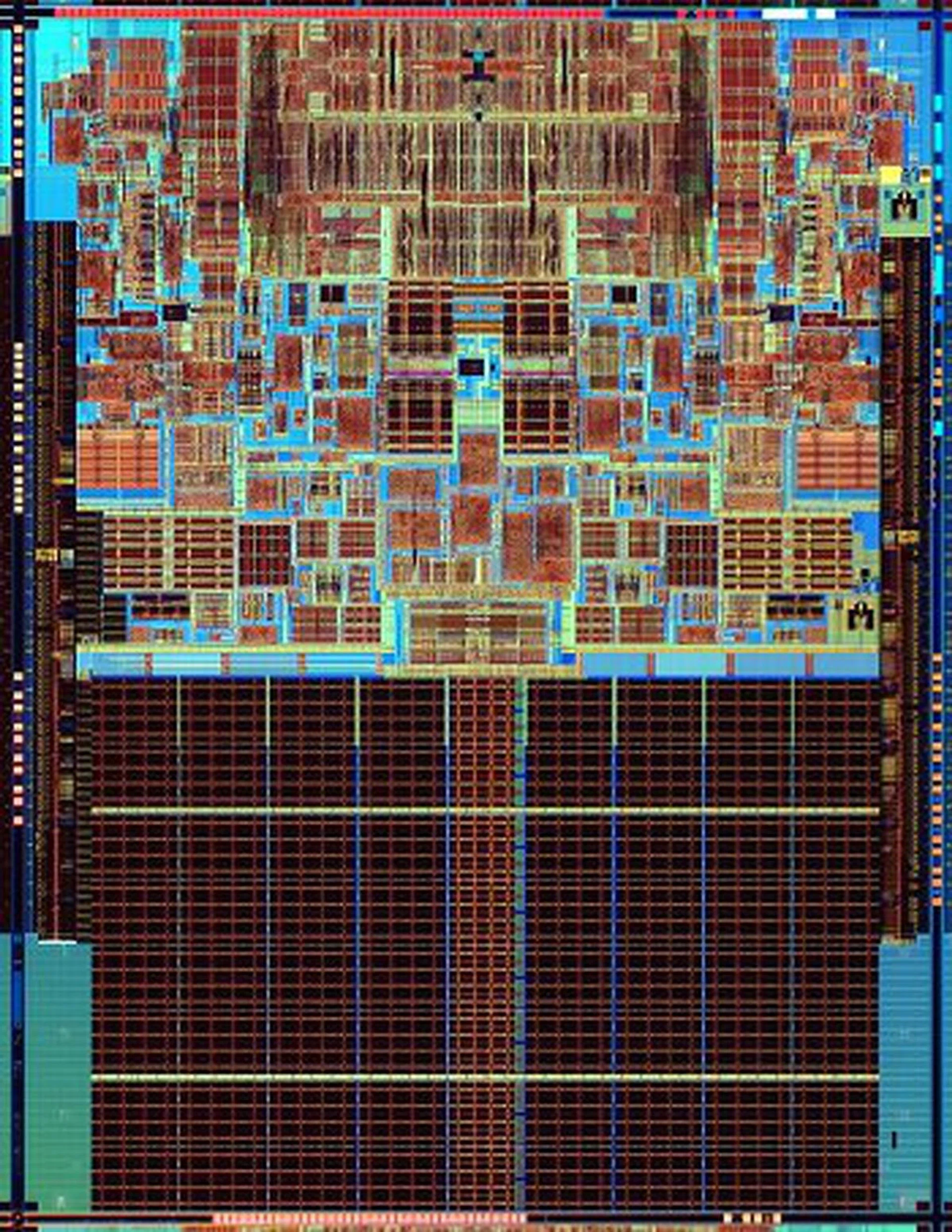
The Conroe die
The Core 2 features a 4-issue wide execution core (per core), up from the 3-issue wide cores of NetBurst processors. This allows the Core 2 Duo to execute more instructions per clock cycle than previous Intel desktop processors. The Core microarchitecture also integrates the Pentium M's Micro-fusion technology and introduces a new feature called Macro-fusion. Modern processors break down certain x86 program instructions into smaller micro-ops for processing and the Pentium M inherited Micro-fusion can identify similar micro-ops pairs and process them in a single cycle. Macro-fusion is a similar feature, but works at the higher instruction level where common x86 instructions like CMP or TEST can be combined into a single macro-op, read and decoded in one cycle. Thus, for the Core 2 Duo, a 4-wide execution core can even mean five instructions per clock cycle.
The Core 2 will also feature an enhanced SSE engine with full 128-bit SSE registers to enable SSE instructions to be executed in a single cycle, where previously would have required two because of the 64-bit data paths of older processors.
Finally, the Conroe core is also a testament to reinforce Intel's views that an integrated memory controller is unnecessary. Intel goes around memory bottleneck issues associated with an external memory controller by effectively 'hiding' memory access latency hits. This is done through a technique called memory disambiguation where the processor can scan instruction queues and speculatively perform memory loads before previous store commands have completed, reducing wait times and enhancing instruction parallelism efficiency. The five data prefetchers per core play a big role in optimizing memory access as well by intelligently loading data before requests are made.

Core 2 Duo processor block diagram.
These are all the new microarchitectural changes that will make its way into the Core 2 and it will also support previous generation features such as Intel Virtualization Technology, EMT64 and Execute Disable Bit. However, Hyper-Threading technology is not supported in any of the announced Core 2 processors (which is perhaps a good thing at this point of time). The following table clearly illustrates the detailed technical differences between the Core 2 CPUs and the latest dual-core processors from Intel and AMD:-
Processor Name | Core 2 Extreme | Core 2 Duo | Pentium Extreme Edition | AMD Athlon 64 FX |
Processor Model | X6800 | E6600, E6700 | 965 | FX-62 |
Processor Frequency | 2.93GHz | 2.40GHz, 2.67GHz | 3.73GHz | 2.8GHz |
No. of Cores | 2 | 2 | 2 | 2 |
Hyper-Threading Technology | No | No | Yes | - |
No. of Logical Processors | 2 | 2 | 4 | 2 |
Front Side Bus (MHz) | 1066 | 1066 | 1066 | - |
HyperTransport Bus | - | - | - | 1GHz (2000MT/s) |
L1 Cache (data + instruction) | (32KB + 32KB) x 2 | (32KB + 32KB) x 2 | (16KB + 12KB) x 2 | (64KB + 64KB) x 2 |
L2 Cache | 4MB | 4MB | 2MB x 2 | 1MB x 2 |
Memory Controller | External Dual Channel (up to DDR2-800) | External Dual Channel (up to DDR2-800) | External Dual Channel ( up to DDR2-667) | Integrated Dual Channel (up to DDR2-800) |
VID (V) | 0.85 - 1.3625 | 0.85 - 1.3625 | 1.20 -1.3375 | 1.35 - 1.40 |
Icc (max) (A)7 | 90 | 75 | 125 | 90.4 |
TDP (W) | 5 | 65 | 130 | 125 |
Execute Disable Bit | Yes | Yes | Yes | Yes |
Intel EM64T / AMD64 | Yes | Yes | Yes | Yes |
Power Management Technology | Yes - Intel Intelligent Power Capability | Yes - Intel Intelligent Power Capability | No | Yes - AMD Cool 'n' Quiet |
Virtualization Technology | Yes | Yes | Yes | Yes |
Packaging | LGA775 | LGA775 | LGA775 | AM2 |
Process Technology | 65nm | 65nm | 65nm | 90nm SOI |
Processor Codename | Conroe | Conroe | Presler | Windsor |
Die Size | 143mm | 143mm | 162mm | 230mm |
No. of Transistors | 291 million | 291 million | 376 million | 227.4 million |
Test Setup
New technology is always a great read, but we're very sure that you're pretty much jaded from listening to product hype on how one feature or another would revolutionize the market as we know it. Yes, we've heard it all too and if we didn't get a hands-on session ourselves back at IDF (check the preview out here), we'd have been skeptical too, but now is the time to put all the hype to rest. For this review, we will pit the brand new Core 2 Extreme X6800, Core 2 Duo E6700 and Core 2 Duo E6600 against the current fastest dual-core desktop processors in the market, and that includes Intel's Presler core Pentium Extreme Edition 965 and the AMD Athlon 64 FX-62.
Despite the Extreme name tagged to the X6800, the three Core 2 processors are actually identical. All three run on a 1066MHz FSB and feature a 4MB L2 cache. The only real difference is the CPU multiplier and operating frequencies. If you're thinking that's not so extreme, we've had the same thoughts too, but that is for another article to discuss. Since all three X6800, E6700 and E6600 do not have any architectural differences, our benchmarks should be able to show you how the new Core microarchitecture performance scales with frequency and the competition.
The testbed specifications used for this review are listed below:-
Intel Core 2 Configuration
- Intel Desktop Board D975XBX (Intel 975X Express chipset)
- Intel Core 2 Extreme X6800, Core 2 Duo E6700 and E6600
- 2 x 512MB Corsair XMS DDR2-800 non-ECC memory modules (CAS 4. 4-4-12)
- Seagate Barracuda 7200.7 80GB SATA hard disk drive (one single NTFS partition)
- MSI GeForce 7900 GT 256MB - with NVIDIA Detonator XP 84.21
- Microsoft Windows XP Professional with Service Pack 2
Intel Pentium XE Configuration
- ASUS P5WD2-E Premium (Intel 975X Express chipset)
- Intel Pentium Extreme Edition 965 (with Hyper-Threading)
- 2 x 512MB Kingston HyperX DDR2-667 non-ECC memory modules (CAS 4. 4-4-10)
- Seagate Barracuda 7200.7 80GB SATA hard disk drive (one single NTFS partition)
- MSI GeForce 7900 GT 256MB - with NVIDIA Detonator XP 84.21
- Microsoft Windows XP Professional with Service Pack 2
AMD Athlon 64 FX Configuration
- ASUS M2N32-SLI Deluxe (nForce 590 SLI chipset)
- AMD Athlon 64 FX-62
- 2 x 512MB Corsair XMS DDR2-800 non-ECC memory modules (CAS 4, 4-4-12)
- Seagate Barracuda 7200.7 80GB SATA hard disk drive (one single NTFS partition)
- MSI GeForce 7900 GT 256MB - with NVIDIA Detonator XP 84.21
- Microsoft Windows XP Professional with Service Pack 2
Benchmarks
The following benchmarks will be used:-
- BAPCo SYSmark 2004
- SPEC CPU2000 v1.3
- Lightwave 3D 7.5
- Futuremark PCMark 2005
- SPECviewperf 8.01
- Cinebench 2003
- XMpeg 4.5 (DivX 5.0.3 encoding)
- XMpeg 5.0.3 (DivX 6.2.5 encoding)
- Futuremark 3DMark05
- Futuremark 3DMark06
- Unreal Tournament 2004
- AquaMark3
- Quake 4 ver.1.20
- F.E.A.R.
Results - BAPCo SYSmark 2004
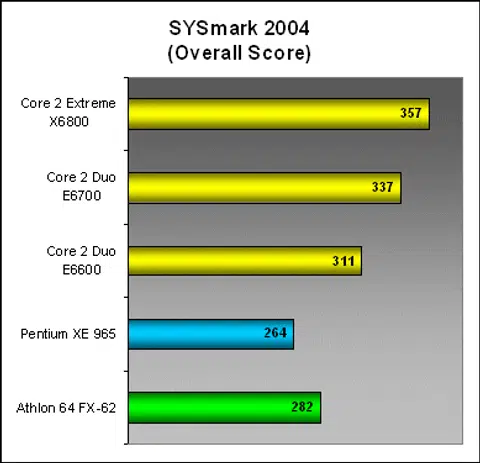
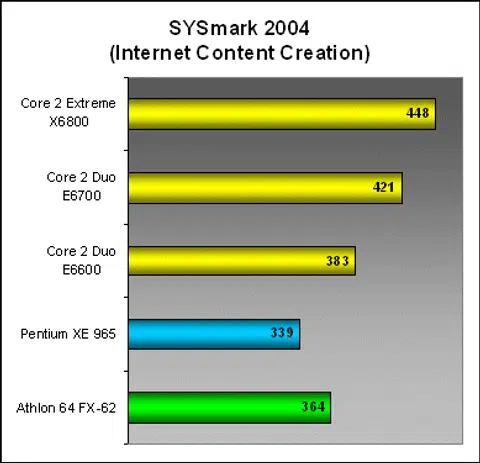
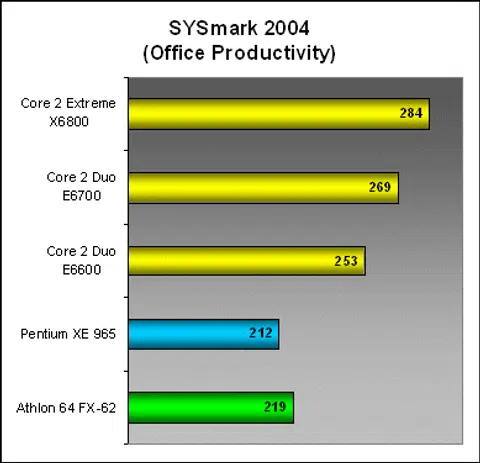
Comparing with the competition, Intel's new Core 2 Duo processors leaves the AMD Athlon 64 FX-62 in the dust as the X6800, running at 2.93GHz manages to take a commanding 27% overall lead and even the mainstream Core 2 Duo E6600, which is clocked at 2.4GHz comfortably leads the 2.8GHz FX-62 by more than 10% in SYSmark's overall results. The scores below show the same performance trend for the Core 2 Duo processors in both the Internet Content Creation and Office Productivity workloads as well.
Results - SPEC CPU2000 v1.3
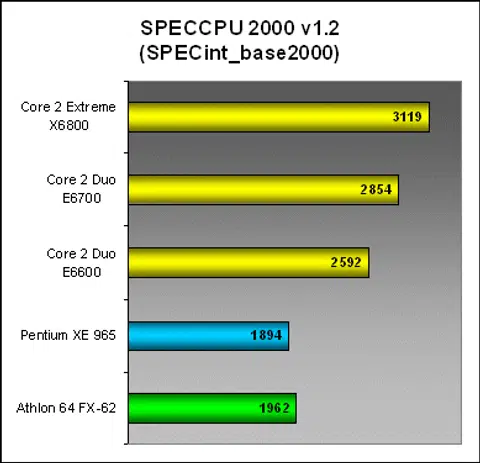
The Core 2's CPU results in SPEC CPU2000 are phenomenal to say the least. While the Athlon 64 FX-62 and Pentium XE 965 both struggle to reach the 2000 mark in the base integer tests, the Core 2 Extreme X6800 achieves an incredible score of 3119. That's a huge 65% improvement over the Pentium XE 965 on the Presler core, more than Intel's initial claim of a 40% integer performance improvement.
With the shorter pipelines of the Core microarchitecture, we had initially thought that floating-point performance might suffer somewhat, a compromise to being an integer monster, but the SPEC's base floating point results for the Core 2 Duo are almost as high as its integer scores.

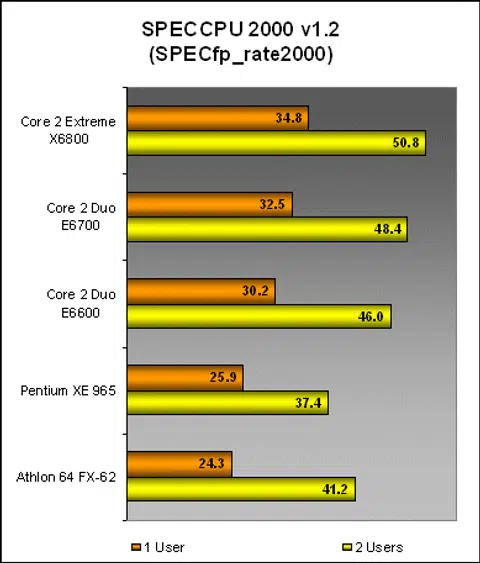
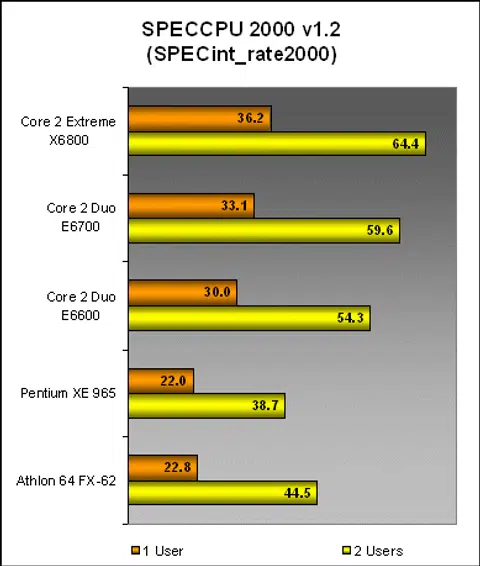
Intel also maintains a healthy lead in SPEC's floating-point and integer rate workloads, showing off linear performance gains ramping from the 2.4GHz E6600 to the 2.93GHz X6800. As the Core 2 processors do not support Hyper-Threading technology, they do not suffer from the same performance hit as the Pentium XE 965 in the two-user multi-threaded tests.
Results - Lightwave 3D 7.5
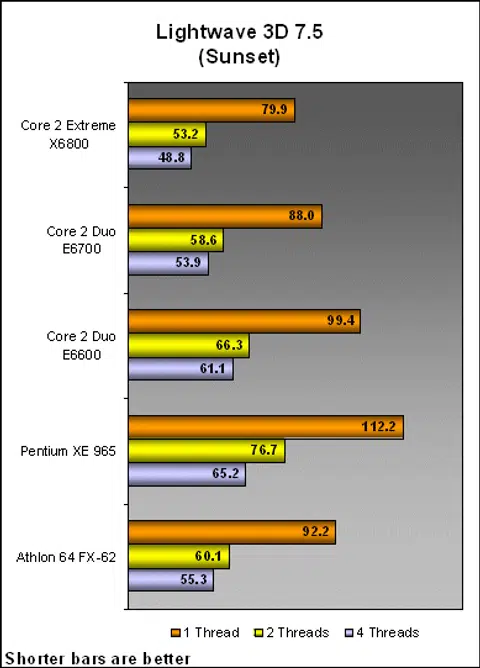
AMD's Athlon 64's have traditionally been able to perform really well in this rendering benchmark due to its more efficient and shorter pipelines. However, with the Core microarchitecture, Intel is able to turn the tables on AMD. The Core 2 Extreme X6800 is able to plow through the benchmark in record time, almost 15% faster than the Athlon 64 FX-62 in most cases. The Core 2 Duo E6700 is also able to complete most workloads 10 - 20 seconds faster than the FX-62, but the superiority of the FX-62 in this benchmark shows since the E6600 is unable to overtake its times.
The deeply pipelined Pentium Extreme Edition 965 is struggling to keep up with the Core 2 Duo and actually runs more than a minute slower than even the E6600 in the Tracer-Radiosity tests. If you strip off all the technology and just look at the raw numbers, it is shocking to see how the 3.73GHz Presler is being schooled by a 2.4GHz Conroe.

Results - Futuremark PCMark 2005
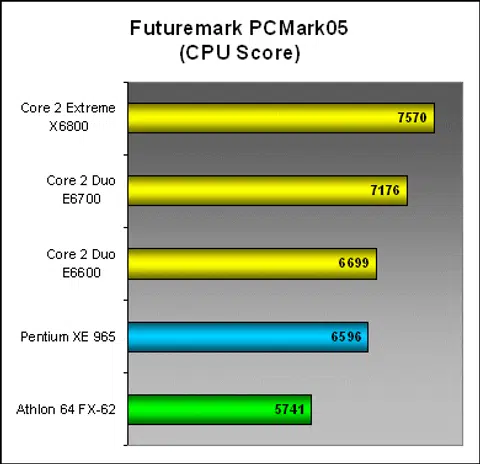
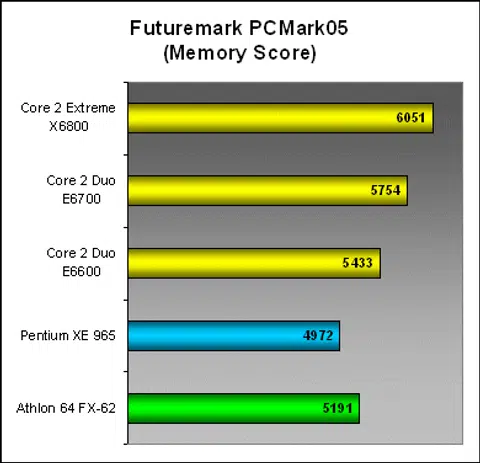
PCMark 2005 is a perfect benchmark example of how the synthetic CPU tests favor the Pentium XE 965 while its memory workloads take advantage of the higher DDR2 bandwidth of the Athlon 64 FX-62. However, the Core 2 Duo processors do not seem to have a weak spot at all and sweeps the floor in both workloads. Again, both the Athlon 64 FX-62 and Pentium XE 965 are outclassed even by the lowest Core 2 Duo processor in this review.
Results - SPECviewperf 8.01
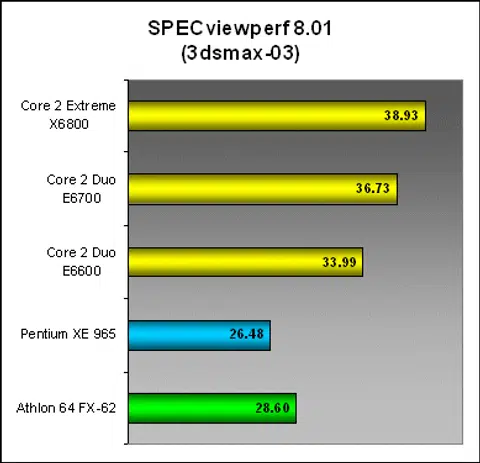
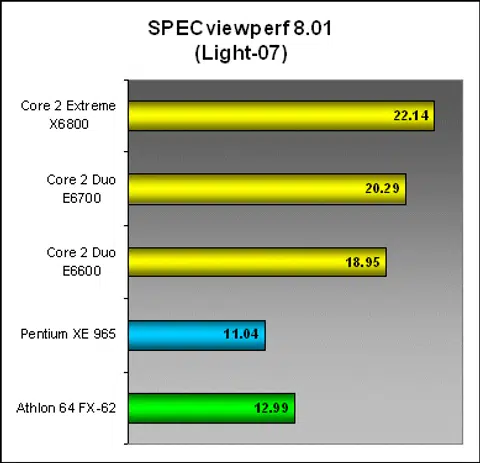
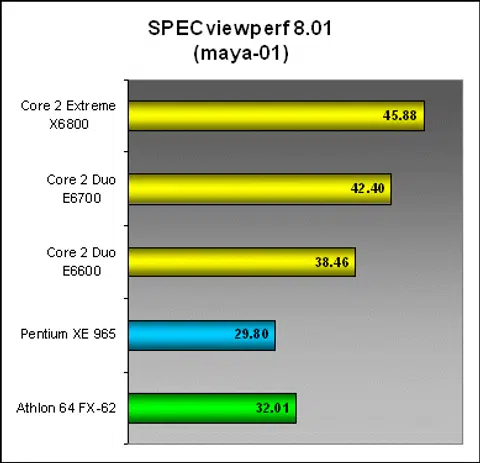
SPECviewperf may be an OpenGL benchmark, but its workloads do stress the memory subsystem and scales particularly well with CPU performance. We've singled out a few workloads that react the most to processor scaling to see how the new Core 2 Duo processors fare.
SPECviewperf posts a very consistent performance trend among all the processors and the Core 2 Duo again proves to be way out of the league of both the AMD Athlon 64 FX-62 and the Pentium Extreme Edition 965. The 2.4Ghz E6600 shows a 20% performance improvement over the FX-62 and when you look at the Core 2 Extreme X6800, the performance gap between the FX-62 jumps to 40% for the maya-01 workload and racks up a 70% improvement in the Light-07 workload.
Results - Cinebench 2003, XMpeg 4.5 and XMpeg 5.03
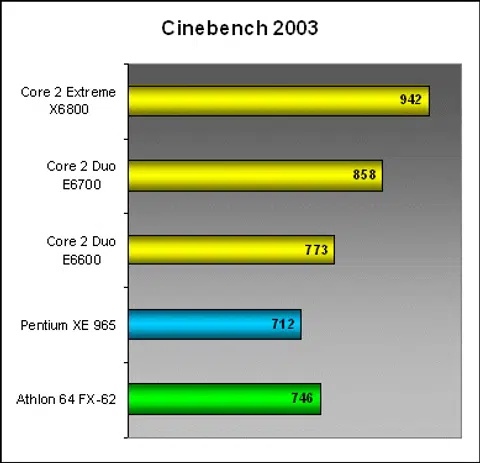
Like LightWave 3D, Cinebench is a heavily threaded benchmark that can utilize multiple logical processors for rendering; once again a traditional stronghold for the Athlon 64 because of its shorter and more efficient pipeline stages. However, the results of the Core 2 Duo processors, especially the X6800, are totally off the charts. The X6800 is able to obtain an unprecedented score of 942, completing the threaded rendering in 27.9 seconds, more than 9 seconds faster than the hyper-threaded Pentium XE 965 (4 logical cores), and around 7 seconds faster than the Athlon 64 FX-62. Both the Core 2 Duo E6600 and E6700 also perform better than the competition.
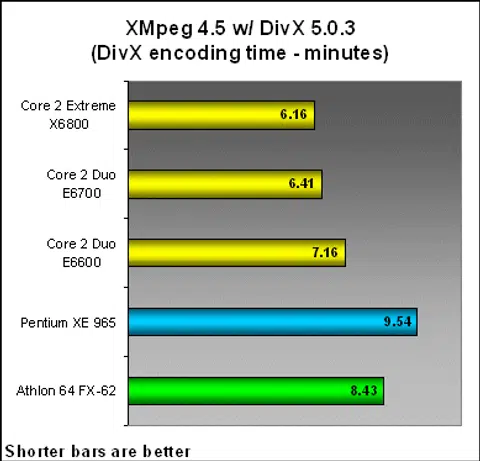
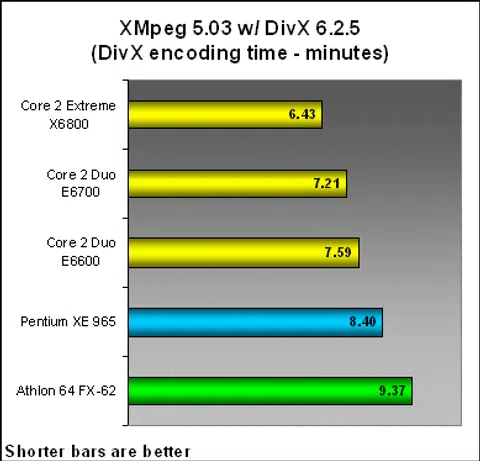
For our DivX movie encoding tests, we will be transitioning towards the newer XMpeg 5.0.3 with the latest DivX 6.2.5 revision. However, since the new DivX seems to be more optimized for Intel platforms, we've decided to include the older XMpeg 4.5 scores as well, which the AMD Athlon 64 FX-62 would generally dominate. As the scores below show, the Core 2 Duo E6600 shaves off more than a minute from the next fastest encoder in both XMpeg 4.5 and 5.0.3, while the X6800 is able to take another minute off the already impressive E6600. It seems that the improved 128-bit SSE engine is really paying off.
Results - Futuremark 3DMark05 and 3DMark06
Thus far, the Core 2 Duo processors have excelled at desktop publishing, office productivity, 3D rendering and video encoding; basically all the boring stuff. How about gaming performance you say? Well in the next few pages, we'll get to see just how well the Core 2 Duo's performance translates to real world gaming.
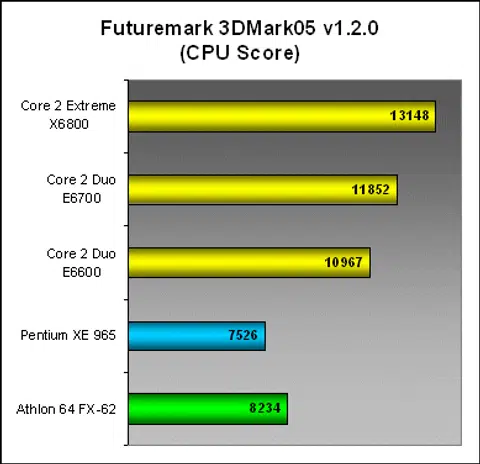
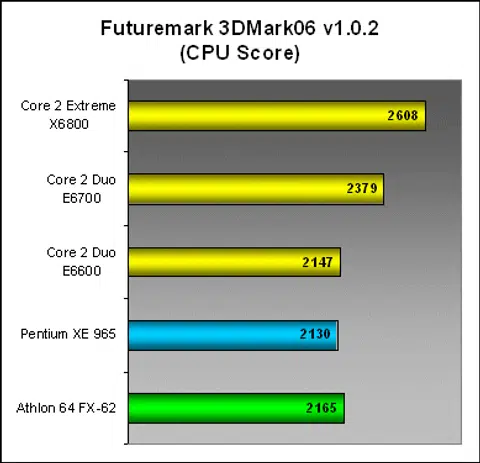
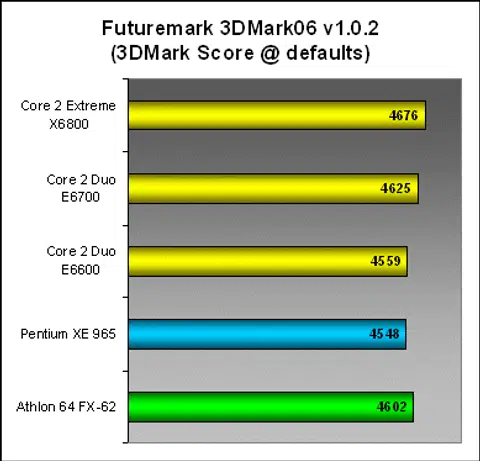
In 3DMark05's CPU rendering tests, all three Core 2 Duo processors are able to return scores well above the 10K mark, which is another milestone for raw processor performance. A similar trend can be noticed on 3DMark06 as well, but this time the Athlon 64 FX-62 and Pentium XE 965 are able to catch up to the E6600.
Results - Unreal Tournament 2004 and AquaMark3
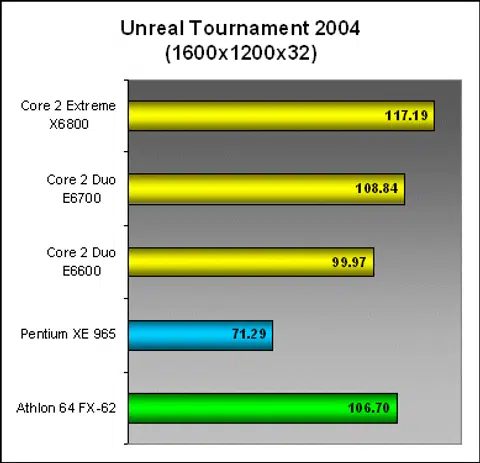
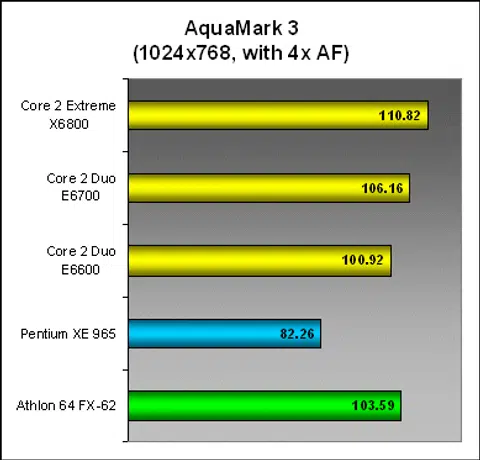
Under older gaming environments like Unreal Tournament 2004 and AquaMark3, where the game engine isn't stressing the graphics subsystem too much, we can still see substantial performance gains from the Core 2 Extreme X6800 processor. AquaMark3's CPU tests still show the Core 2 Duo processors well ahead of all the competition, but the Athlon 64 FX-62 is able to catch up to the lower end E6600 in these tests.

Results - Quake 4 and F.E.A.R.
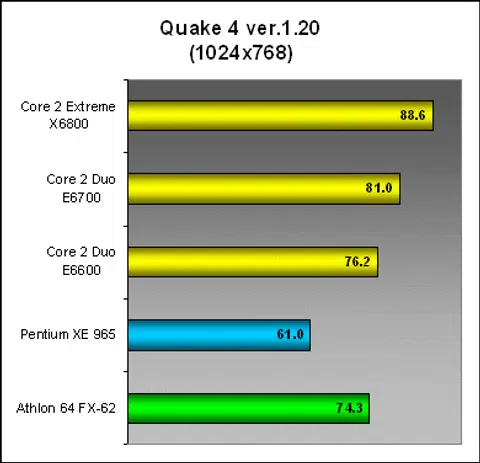
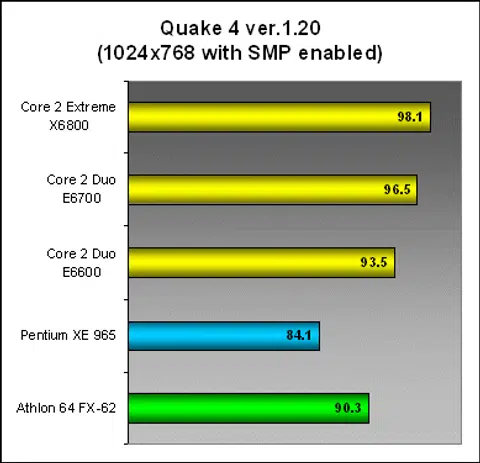
The Core 2 Duo has reigned supreme thus far into our benchmarking and Quake 4 bears no exception. With just a processor change, the X6800 is able deliver more than 10fps over an Athlon 64 FX-62 and nearly a whopping 30fps gain in performance from the Pentium XE 965 in the single-threaded game mode. With SMP enabled, you'll notice that the Core 2 Duo's lead has been reduced slightly, but that still doesn't take away the fact that a 2.4GHz Core 2 Duo in the near future will give you better gaming performance than your friends hyper expensive Athlon 64 FX-62 or the rather gimped Pentium XE 965.
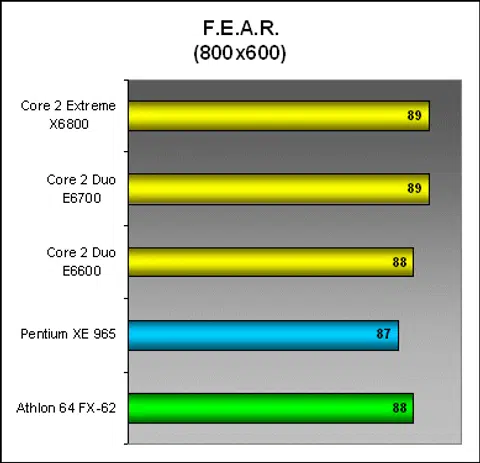
As expected, F.E.A.R. is a game that is more graphics intensive, which is why you do not see any difference in performance. Even on a GeForce 7900 GT, the game is already graphics bound at 800x600 with maximum quality settings. If you want more performance out of F.E.A.R., getting a new graphics card will do you more good than upgrading or overclocking your processor.
Conclusion
This time last year, Intel was busy prepping themselves for the launch of the Smithfield, Intel's first dual-core desktop processor and it just seems fitting that Intel chose July 2006 as the launch pad of their new Core 2 processors. With a whole new look, branding and technology behind this chip, one can easily tell that Intel has been hoping for it to be a resounding success. Well, fresh from our round of benchmarking, we think that no one would disagree when we say that the numbers speak for themselves. The Core 2 processors practically ripped to shreds any and all previous desktop performance records with scores that were mostly through the roof.
Even AMD's newly launched Socket AM2 Athlon 64 FX-62 heavyweight could hardly hold a candle to the Core 2 Duo E6600, let alone the computing monster that is the Core 2 Extreme X6800. With almost half the TDP and a third of its price, the 2.4GHz Core 2 Duo E6600 made the 2.8GHz Athlon 64 FX-62 look like a lumbering giant. It is not everyday that you get to see a lower end processor outperform an enthusiast part most of the time by a wide two-digit margin. The burning question now is how will AMD respond to this 'not so little' threat. AMD's next performance part, the FX-64 is possibly scheduled for a Q4 2006 release and will be nothing more than a speed bump to the FX-62, while retaining the 125W TDP envelop. Looking at the performance of the FX-62 as compared to the Core 2 Duos, it is highly unlikely that the FX-64 will make a ripple even if AMD decided to release it today.
However, in retrospect, the exact same sentiments can be said for Intel's own Presler lineup. The results of the Core 2 Duo really puts the Pentium Extreme Edition 965 in its place, so much so that it isn't even remotely funny. If anything, this is akin to Intel admitting just how inefficient NetBurst has been and the Core microarchitecture is their form of apology. With the Core, Intel has totally redeemed itself of any past shadows.
Moving back to the Core 2, Intel truly has an exceptional product this time around. Taking advantage of the maturity of their 65nm process and a new core design (albeit its roots are practically from the mobile department, which in itself an advanced Pentium 3), the Core 2 die size and transistor count has shrunk considerably compared to the Presler core, which helps keep heat down. All Core 2 CPUs based on the Conroe die will feature 4MB of L2 cache and Intel seems to have officially moved all processors to a higher bandwidth 1066MHz FSB. However, this brings us to one little itch we've been having since we broke open our Core 2 kit. Does anyone feel that the Core 2 Extreme just isn't 'extreme' enough? Granted we've seen its performance, but the X6800 is just the next multiplier in the line after the E6700. What about a 1333MHz FSB and DDR2-1000 memory support? We've certainly seen memory manufacturers ramp up production during Computex last month.
Nonetheless, the Core 2 Extreme and Core 2 Duo CPUs notch up a perfect 5/5 score for the compelling leap in performance and efficiency thanks to Intel's Core microarchitecture. Never have we seen a performance jump as high as we've seen with the Core 2 on any desktop processor in years and yet maintains both low thermals and power consumption - a true innovation in desktop processor microarchitecture. Stay tuned to this space for our follow up article as we tackle power consumption and temperatures of the Core 2 Duo and other interesting articles.
Our articles may contain affiliate links. If you buy through these links, we may earn a small commission.