
GeForce GTX 470: Dual and 3-way SLI Performance Analysis
We continue our bevy of GeForce GTX 470 articles by investigating the performance gains that can be had by putting the GeForce GTX 470 in both 2 and 3-way SLI configurations.
GeForce GTX 470 SLI Performance Analysis
The GeForce GTX 470 was launched along side the more powerful GeForce GTX 480 and has been positioned as NVIDIA as the 'entry-level' Fermi graphics card. And if you've checked out our full review, you'd would agree that while it is by no means a slow card, it has one or two problems that keep it from being great. Like its more powerful sibling, the GeForce GTX 480, the GeForce GTX 470 is plagued by high operating temperatures and power consumption figures.
Fortunately, custom design versions of the GeForce GTX 470 are slowly but surely coming into the market. Already, we've reviewed two such non-reference cards – one from Galaxy and another from Palit – and although power consumption figures are unchanged, both cards are remarkably cooler to run than NVIDIA's reference design card.
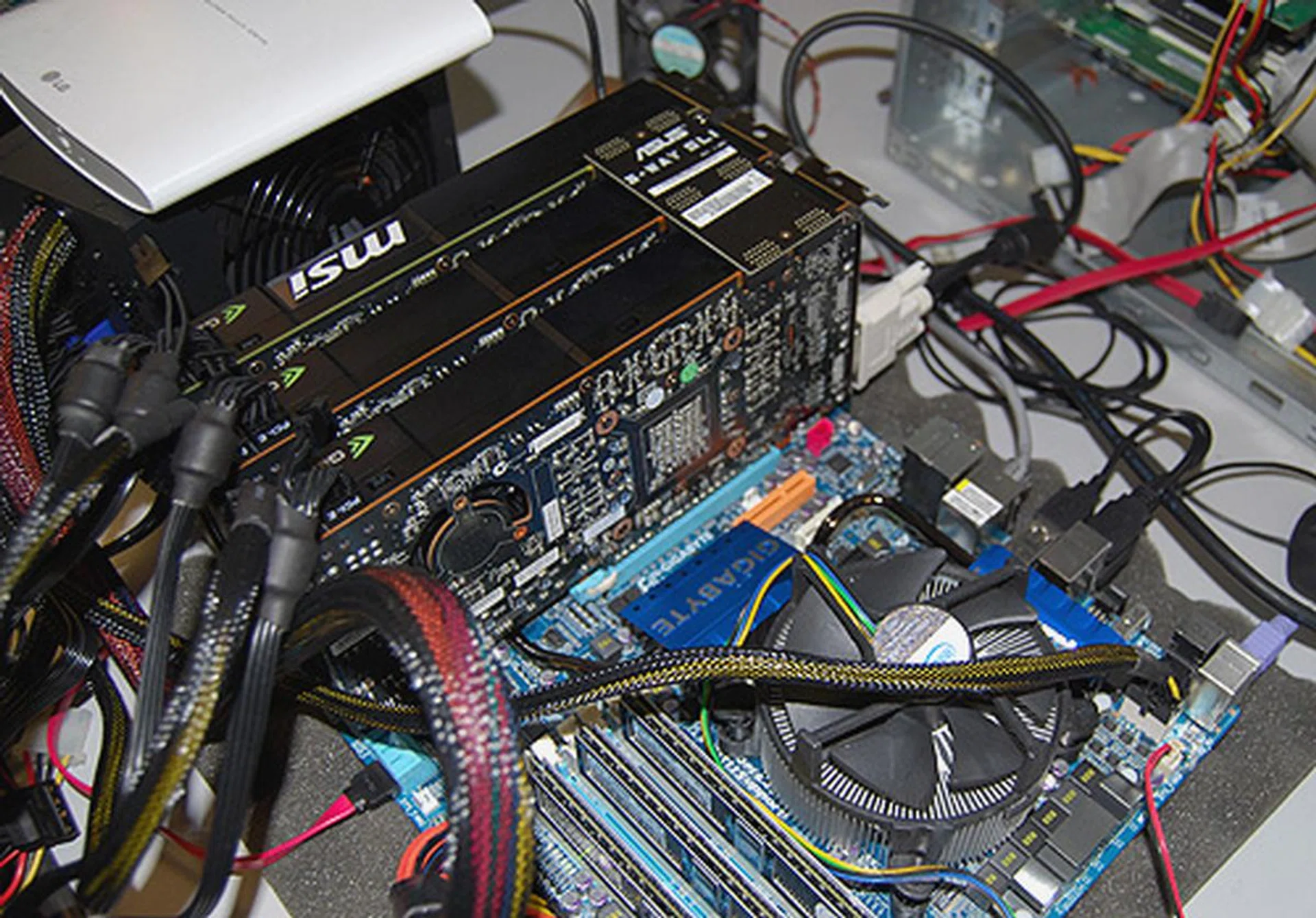
1344 CUDA cores and more than US$1000 worth of unadulterated graphics processing power being put to work.
Today, however, we are going to be looking at how the GeForce GTX 470 would perform in both 2 and 3-way SLI configurations.
NVIDIA claims that the new Fermi cards offer better scaling in performance, and this has been confirmed in our GeForce GTX 480 SLI performance analysis, where, depending on benchmarks, we saw nearly 100% improvement in performance when we stacked on another a GeForce GTX 480. However, that was with two cards. So how would a third card perform? We'll be finding that out shortly, but this time with the GeForce GTX 470 model.
Test Setup
The cards will be tested using our high-end X58 system with the following specifications:
- Intel Core i7-975 Extreme Edition (3.33GHz)
- Gigabyte GA-EX58-UD4P motherboard
- 3 x 1GB DDR3-1333 OCZ memory in triple-channel mode
- Seagate 7200.10 200GB SATA hard drive
- Windows 7 Ultimate
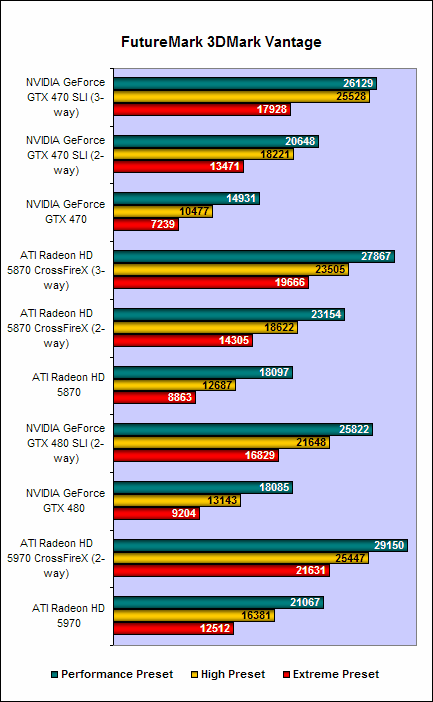
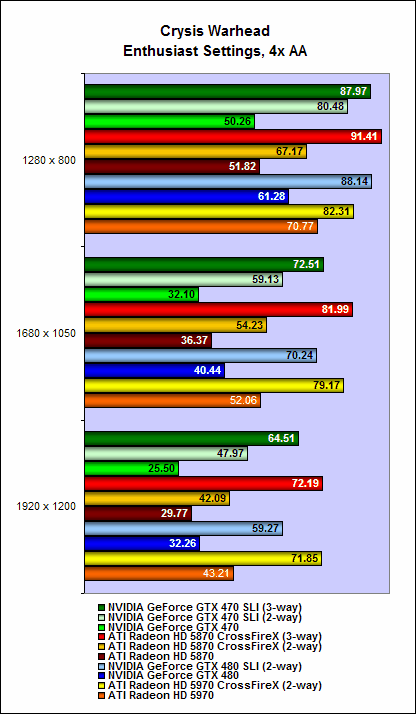
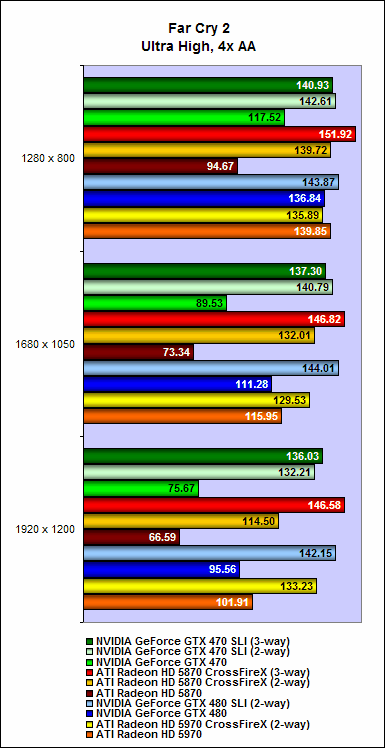
Considering a single GeForce GTX 470 currently retails for around US$350 and that a single Radeon HD 5970 goes for around twice that, it'll be interesting to see how the two GeForce GTX 470 cards will compare against a lone Radeon HD 5970. Also, we'll be paying special attention to how 2 and 3-way SLI holds up against a 2 and 3-way CrossFireX Radeon HD 5870.
This is the complete list of cards/configurations used and their driver versions:
- NVIDIA GeForce GTX 470 (3-way SLI) (ForceWare 197.41)
- NVIDIA GeForce GTX 470 (2-way SLI) (ForceWare 197.75)
- NVIDIA GeForce GTX 470 (ForceWare 197.41)
- ATI Radeon HD 5870 (3-way CrossFireX) (Catalyst 10.4)
- ATI Radeon HD 5870 (2-way CrossFireX) (Catalyst 10.2)
- ATI Radeon HD 5870 (Catalyst 10.2)
- NVIDIA GeForce GTX 480 (2-way SLI) (ForceWare 197.41)
- NVIDIA GeForce GTX 480 (ForceWare 197.41)
- ATI Radeon HD 5970 (2-way CrossFireX) (Catalyst 10.3)
- ATI Radeon HD 5970 (Catalyst 10.2)
The list of benchmarks used are as follows:
- Futuremark 3DMark Vantage
- Crysis Warhead
- Far Cry 2
- Warhammer: Dawn of War 2
- Battlefield Bad Company 2
- "Heaven" from Unigine
- S.T.A.L.K.E.R.: Call of Pripyat
3DMark Vantage
Crysis Warhead
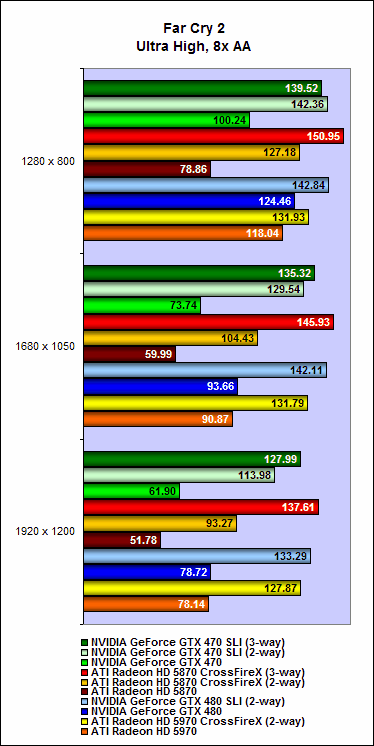
Far Cry 2
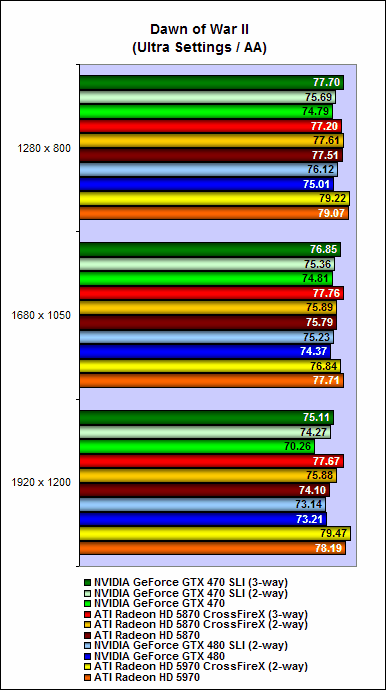
Dawn of War 2
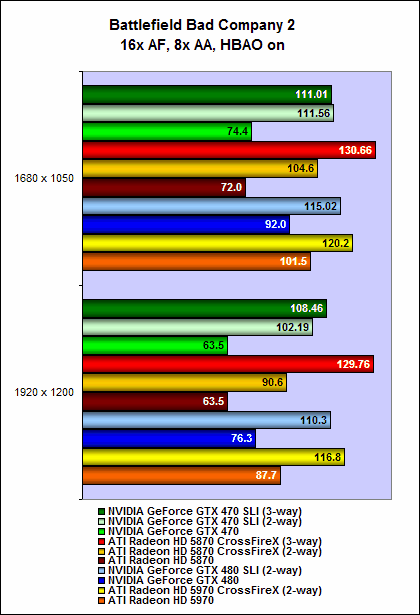
Bad Company 2
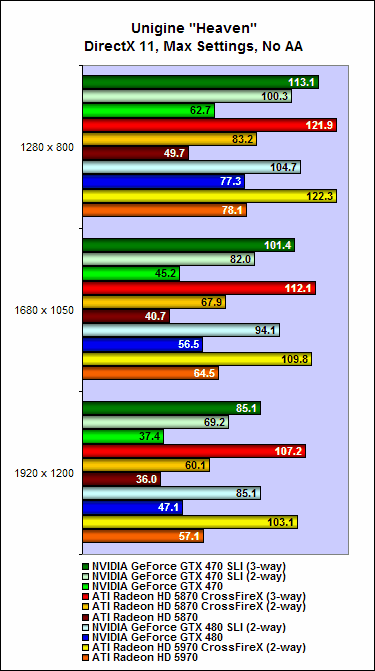
Unigine "Heaven"
 | 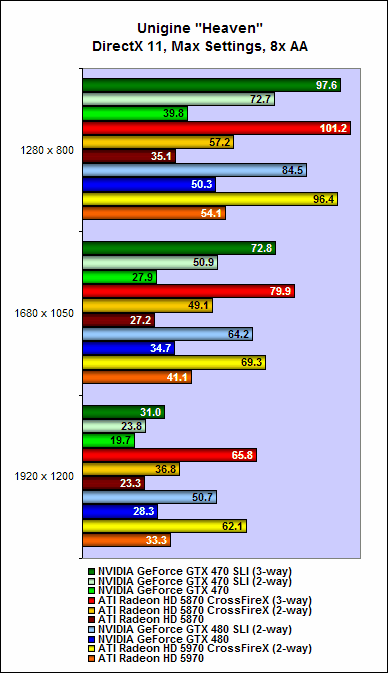 |
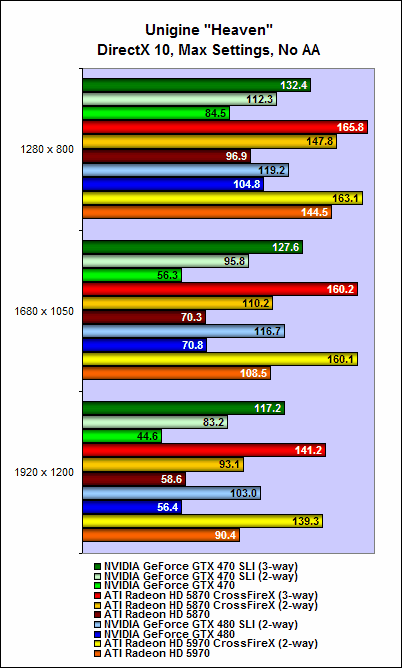 | 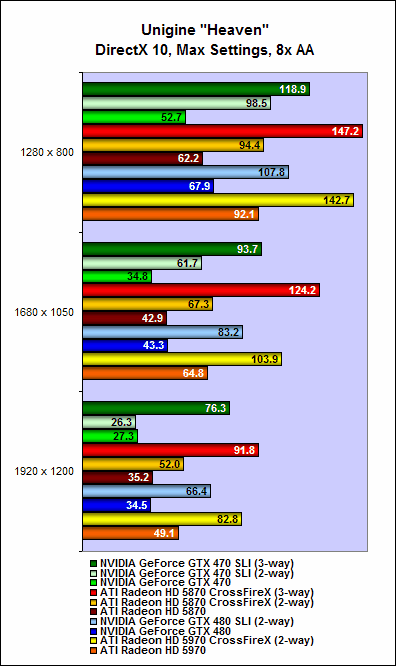 ; ; |
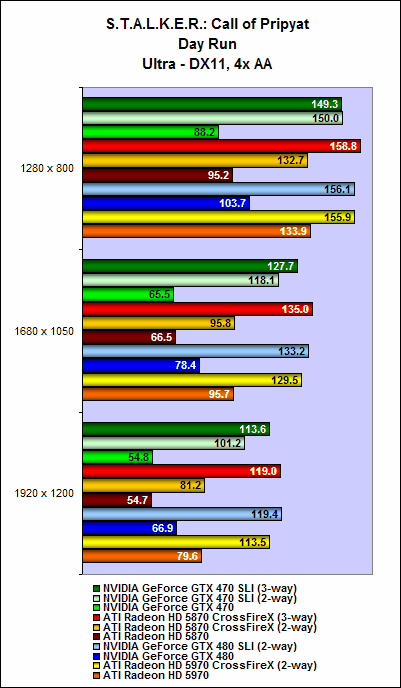
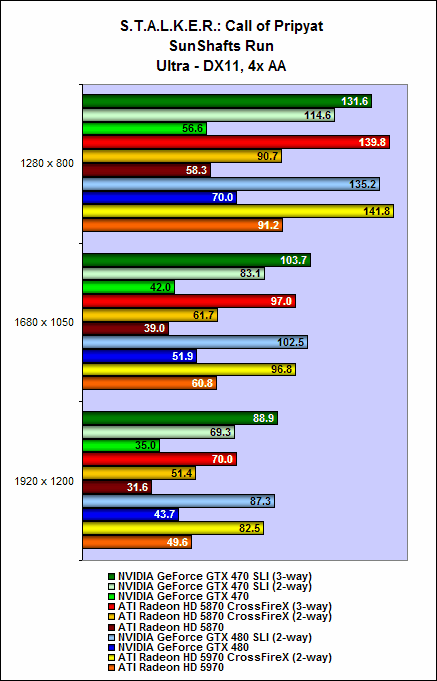
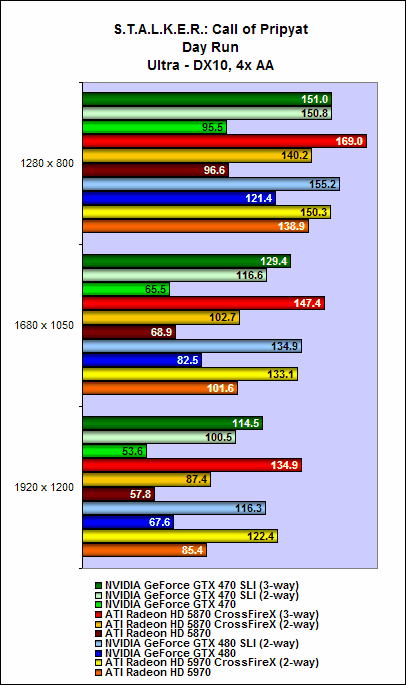
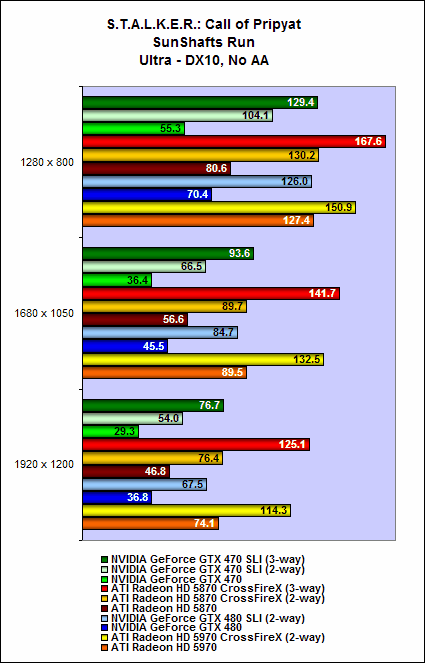
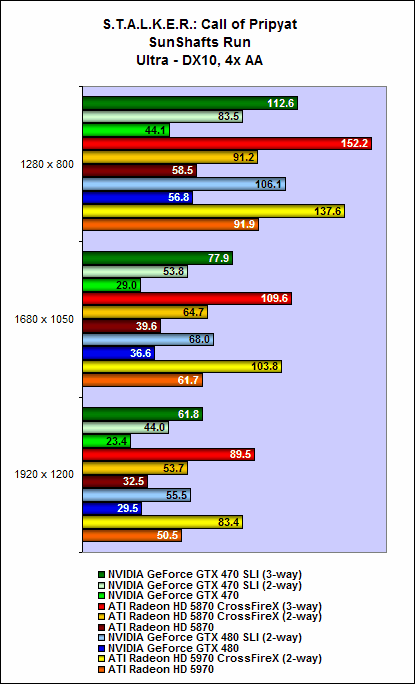
S.T.A.L.K.E.R.: Call of Pripyat
DirectX 11 Results
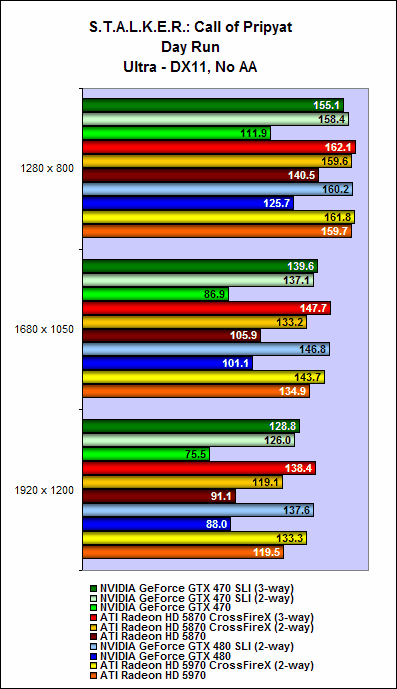
 |  |
DirectX 10 Results

Effects of Overclocking the CPU
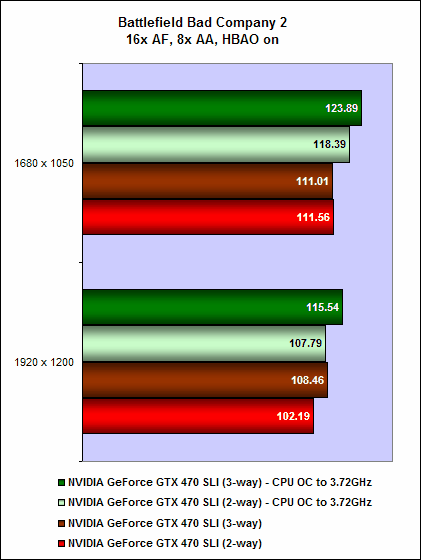
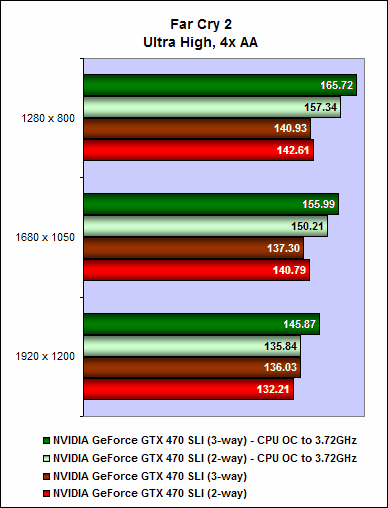
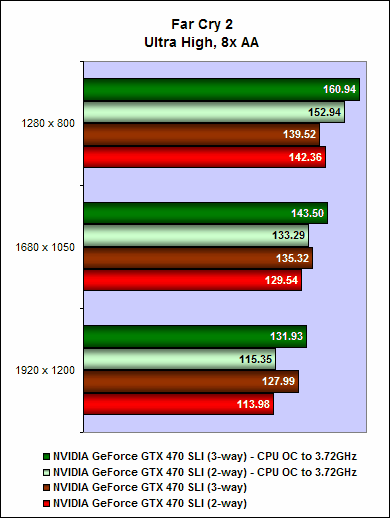
Looking at the results so far, we can see that for most cases, adding a third GeForce GTX 470 isn't going to get you much gains. However, this could be because the CPU is acting as a bottleneck. Hence, we've overclocked our Core i7 975 processor to 3.72GHz (up from 3.33GHz) to see if any substantial gains can be gotten.
And as the following graphs show, with a faster processor, we see the GeForce GTX 470 3-way SLI configuration performing better, showing some gains over the 2-way SLI setup. Looks like you'll need a really, really high-end setup to get the most out of a 3-way SLI configuration. That said, the bigger issue is that NVIDIA has to improve the scalability of 3-way SLI. You can tell from the results from the previous pages that 2-way SLI works very well for the GTX 470 and if you compare that with the competition, the Radeon HD 5870 achieves somewhat acceptable 2-way CrossFire scaling, but fares much better with 3-way CrossFireX. The GTX 470 being a much newer card, it is perhaps not well tuned for 3-way operation at the moment and our results from boosting the CPU performance further confirmed this as the gains weren't much.
Looking at the bigger picture, the gains that can be had from slapping on a third card is most likely going to go unnoticed because a 2-way GeForce GTX 470 SLI configuration is already sufficiently quick. On Bad Company 2, for instance, two GeForce GTX 470 cards in SLI is going to net you above 100fps, which is fantastic by itself.
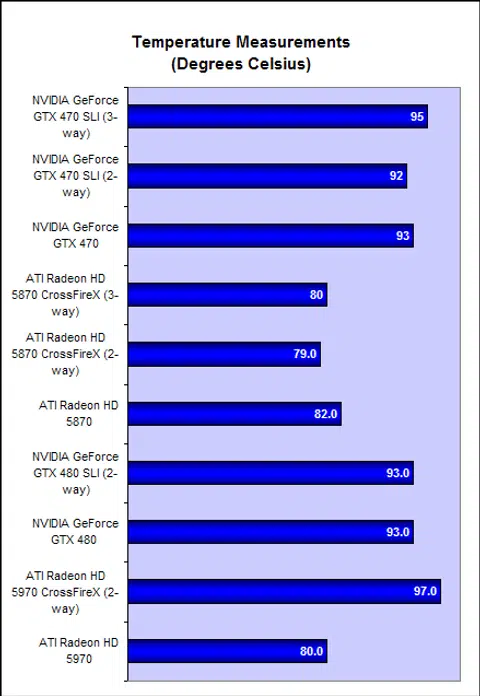
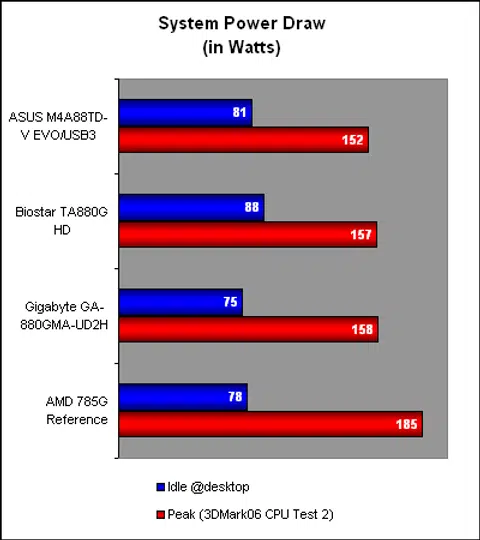
Temperature & Power Consumption
Fast, But...
Much like the GeForce GTX 480, two GeForce GTX 470 in SLI will net you some pretty serious graphics performance. Scaling performance is commendable as we've seen some dramatic increases in performance going from a single GeForce GTX 470 to two. In games like Battlefield Bad Company 2 and S.T.A.L.K.E.R.: Call of Pripyat, an additional GeForce GTX 470 can net up to an 80% increase in performance which is quite outstanding.
That said, our results also show that adding a third GeForce GTX 470 brings little to the table, partly because the CPU is just not fast enough to cope with the sheer graphics crunching power of the new Fermi card. Bear in mind also that our setup is powered by a high-end Intel Core i7-975 Extreme Edition processor. We managed slightly better gains when we overclocked the CPU, but further results scrutinizing revealed that NVIDIA needs more work to be done to wring out better 3-way SLI performance more efficiently. 2-way SLI however, worked like a charm.
Lightning fast performance aside, other considerations of a GeForce GTX 470 SLI setup includes operating temperatures and power consumption. Running two GeForce GTX 470 cards is going to generate lots of heat, e, so a casing with adequate ventilation is necessary. Running three GeForce GTX 470 cards, as you can imagine, is even hotter and demands seriously good ventilation to cool it down.
Besides high operating temperatures, there's also the absurd power requirements. With two GeForce GTX 470 cards, the highest sustained reading we recorded off our power meter is a staggering 470W - more than two Radeon HD 5970 cards in CrossFireX. And with three, it's up to an unbelievable 640W total system consumption! The highest we've ever recorded on our test system. Clearly, SLI setups involving NVIDIA's latest Fermi cards will require a high-end setup all-around.
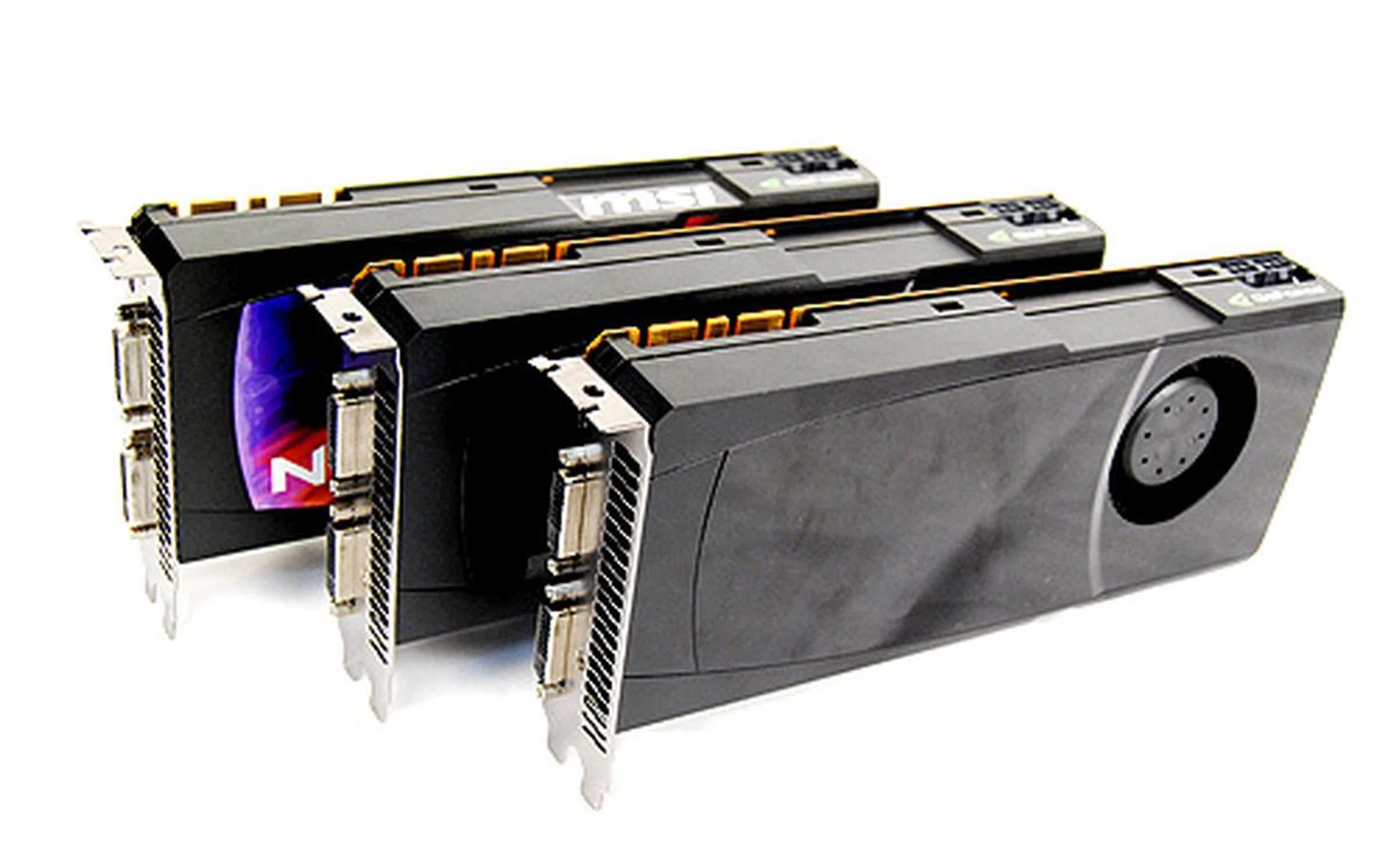
Supremely fast, but there are other alternatives around.
Overall, a 2-way GeForce GTX 470 SLI setup is going to be hard to recommend, despite its good performance. For the same money, a single Radeon HD 5970 or two Radeon HD 5870 cards in CrossFireX is not going to be very much slower than dual GeForce GTX 470 in SLI. Furthermore, users don't have to worry as much about heat and power consumption, especially in the case of a single Radeon HD 5970. For not so hardcore users, a single Radeon HD 5970 is probably the most practical way to go, in our opinion.
3-way GeForce GTX 470 configurations, on the other hand, can be best appreciated only if you have an extremely fast system and lots of spare cash. As we've seen, even a Core i7-975 Extreme edition processor falls short, which means only seriously extreme users who have elaborate setups and who run their processors and memory at the absolute limits are going to reap the fruits of the three GeForce GTX 470 cards in SLI. And perhaps more in future when and if NVIDIA improves 3-way SLI performance efficiency.
But if you're going to such lengths, why not take the plunge and go for the GeForce GTX 480 instead? In fact, why not also consider the Radeon HD 5870 seeing that three in CrossFireX is going to be equally fast but with a less voracious appetite for power.
All in all, while NVIDIA has done a great job in improving SLI performance, it's safe to say that the new Fermi cards in SLI configuration, especially 3-way, is not for everyone.
Our articles may contain affiliate links. If you buy through these links, we may earn a small commission.