
First Glimpse of Intel's 45nm Process Technology
Intel has a breakthrough in transistor technology that Gordon Moore states is the biggest change yet since the late 1960s. Featured in their upcoming 45nm process technology, Intel has shared with us some of this information and even that of their upcoming Penryn family of processors for 2008!
A Breakthrough in Transistor Technology
60 years have passed since the invention of the first transistor in 1947 at Bell Labs and nearly 40 years since Intel was formed and developed the first PMOS polysilicon gate transistor technology, which is still used even today (albeit variations of it). And the technology rat race for advancing transistor technology and production process has continued ever since to quench the thirst of modern progression in the computing and electronics space. Today, 65nm CMOS process technology represents the leading edge of chip manufacturing and is well epitomized by Intel's latest Core 2 Duo processors. However, the next milestone in semiconductor process technology - the 45nm process - will soon be upon us.
Intel's 45nm process technology that will debut in their next family of processors will not just be a shrink in process technology with smaller transistors, but also a breakthrough in transistor technology itself. Featuring a new high-K dielectric and metal gate transistor design (actual materials not disclosed yet) as opposed to the conventional silicon-based elements, Intel boasts that this has improved the drive strength (or drive current) by 20% more than current 65nm based Core 2 Duo processors. Also, this design has reduced source to drain leakage by more than five folds and reduced gate oxide leakage by more than 10 folds.
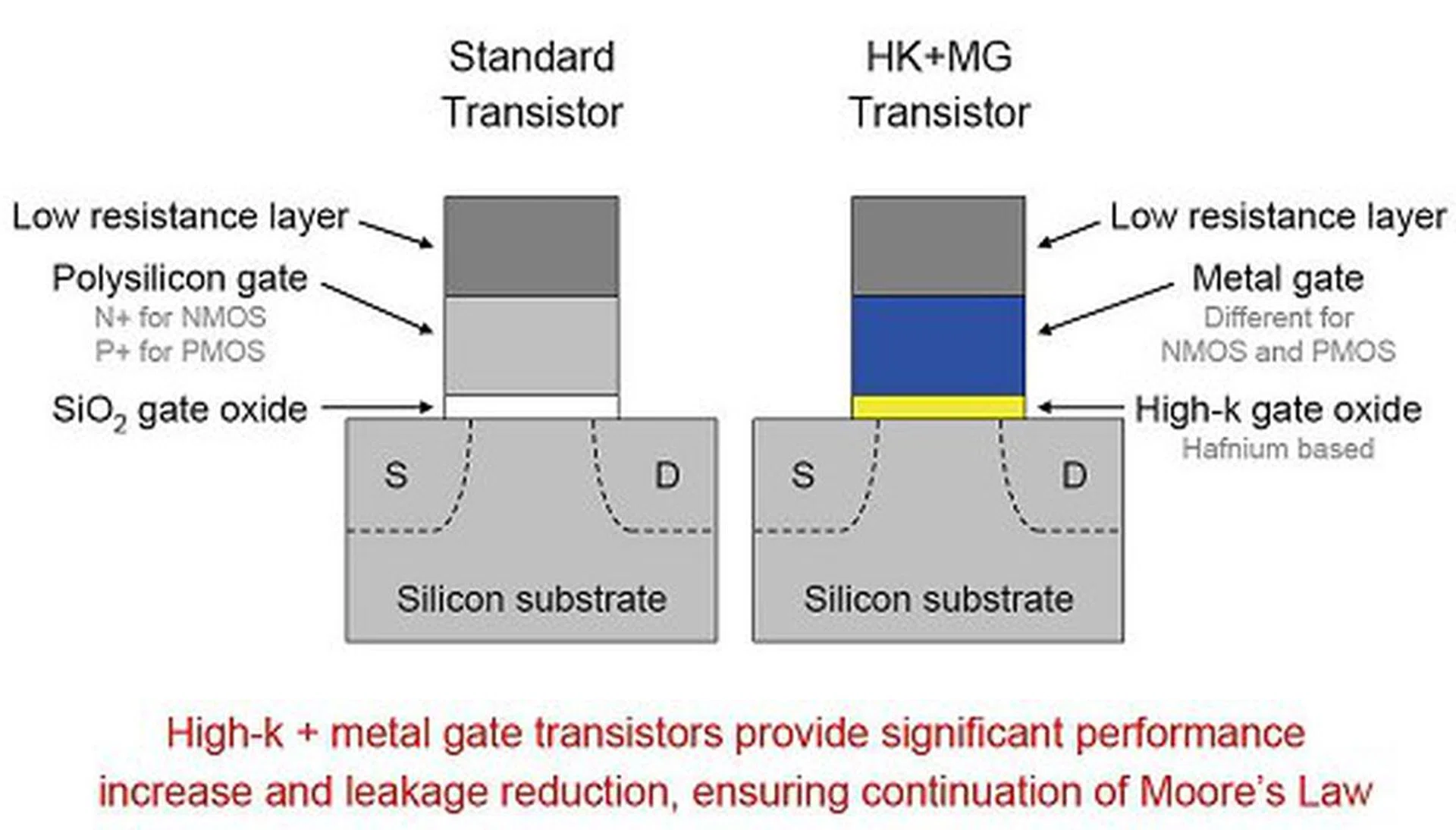
A comparison of a standard transistor versus the new high-K dielectric and metal gate transistor design.
Additionally, when combining these advantages with a smaller process technology, Intel has stated that its new 45nm process technology roughly offers twice the transistor density and a 30% reduction in transistor switching power as opposed to the current 65nm process technology. Bold claims indeed, but they did back it with a few more facts of their upcoming processors.
Penryn - The First 45nm Process Technology based Processor
After last year's release of the successful Conroe core, Intel's next step is shrinking it down with their new 45nm process technology. These 45nm processors will sport a Conroe-like architecture and will be know as the Penryn family of processors. Thus it's still the same dual-core processor architecture of Intel's current Core 2 Duo series. However Penryn will sport a much larger cache size, though no figures on it were revealed yet. What they did share however was the Penryn die photo and its expected transistor count at 410 million:-
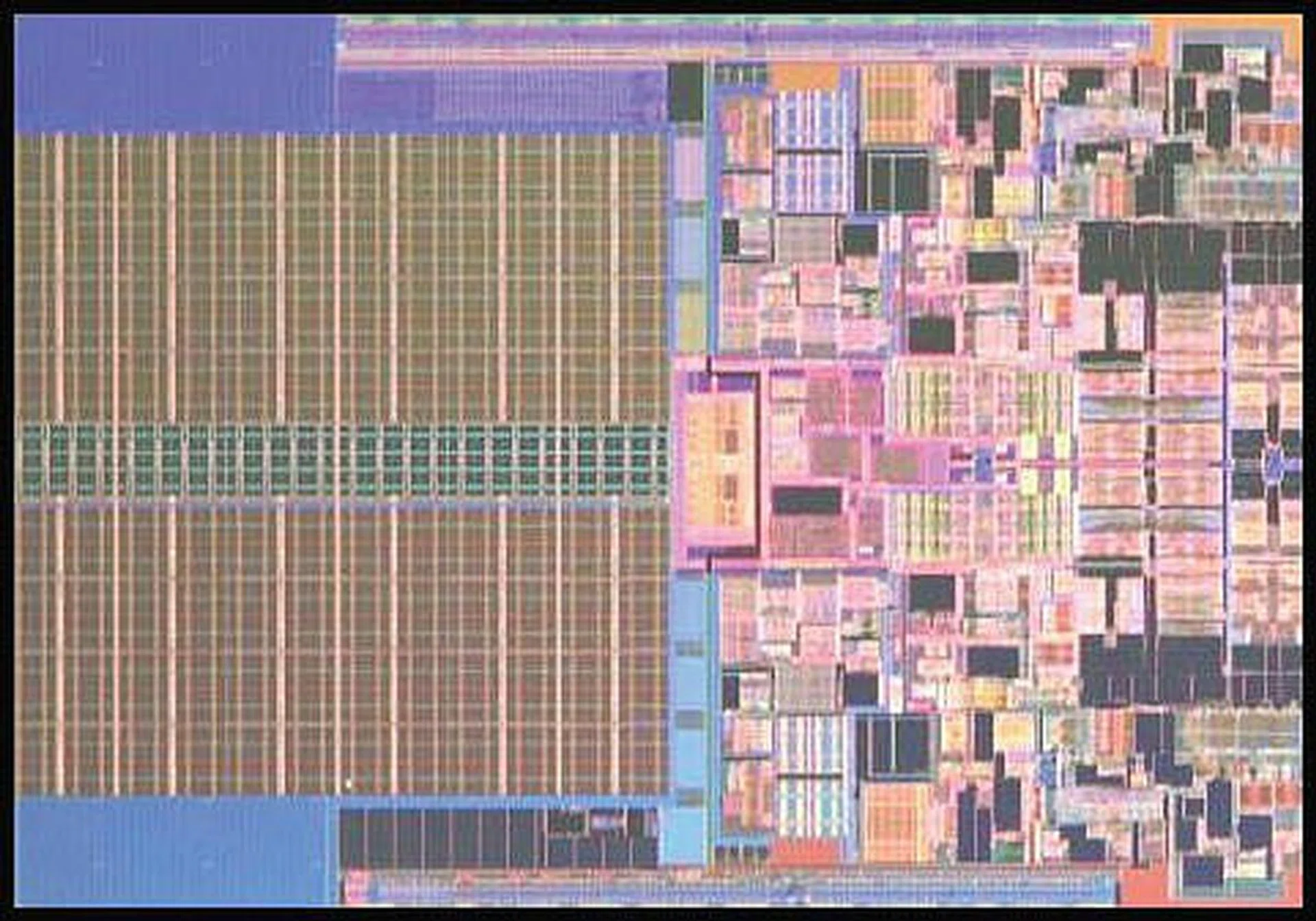
Here's the Penryn die photo. It is said that this dual-core processor has 410 million transistors! 45nm process technology will surely be necessary to maintain current thermal and power envelopes and thankfully Intel is in a position to deliver that.
Judging by the transistor count and die shot comparison with that of a Conroe and its 291-million transistor count , our own extrapolated estimation is that the Penryn may come equipped with 6MB of L2 cache. Already the difference between a similar clocked Allendale and Conroe core sees the latter with a performance advantage of around 5% to 15% at maximum. As such, we feel that a further 50% cache injection to the Penryn over the Conroe might only yield an average of 5% more performance. Of course both the cache size and estimated performance increase are our educated projections, but the real Penryn will surely have an optimized prefetch and caching mechanism to cater to its larger cache size, so we'll reserve further comments when we actually have some hands-on in the future.
Expect to see Penryn processors with variations for the desktop, notebook and server markets just like we saw for Conroe. Quad-core versions will follow the current approach of slapping dual dies on the same packaging for best yield optimization. As such, transistor count for the quad-core version is effectively doubled to 820 million. Currently expected configurations of Penryn processors are as follows:-
- Notebook segment:- Dual-core Penryn processors
- Desktop segment: - Dual-core and Quad-core Penryn processors
- Server segment:- Dual-core and Quad-core Penryn processors
While these five SKUs above are just what Intel has let us in today, they did mention these are just a few of the total of 15 varieties planned for the Penryn processor family.
The 45nm process technology and added cache isn't the only difference you can expect from the Penryn family of processors. You can certainly expect Intel to push for higher clock speeds yet, but the interesting find is that Penryn will feature an updated microarchitecture for improved performance and capabilities via new SSE4 instructions. Targeted for media and HPC (high performance computing) applications, Intel's SSE4 was originally planned to appear in Nehalem, the next processor slated after Penryn. Intel did however carry on to assure that Nehalem will appear in late 2008 and it will primarily sport a second-generation Core microarchitecture.
The Status of Penryn
Intel's breakthrough in incorporating the above mentioned new materials to progress transistor technology was first announced in 2003 and was successfully put to the test in manufacturing a 45nm SRAM part in 2006. Not long back, they even have got the first Penryn silicon fully up and running. As we probed Intel further on the status of Penryn at the moment, they commented that the working silicon as of now is far from its final clock rates and is currently operating well below the speeds of a typical Core 2 Duo. However, they expect to see mature yields of the Penryn silicon in the second half of 2007 and they are on track to begin volume production in that time frame with first retail products to hit somewhere in first half of 2008. No specific dates were made known yet for the actual product launch as it is subjected to the progress of their platform vendors and other partners.
On the note of platforms and the likes, Intel could not yet comment of Penryn processor's compatibility with existing Core 2 Duo motherboards. While still using the LGA775 socket, it is still too early to determine the final compatibility of a product that's a year away. The best outcome is of course a BIOS flash to existing boards, but we have a hunch that Intel will draft yet another power spec for the processor, which may be incompatible with current boards or even require another chipset for proper compatibility. Intel has mentioned that Penryn will support new power management modes and that alone could be enough cause for an updated platform as well.
Our Thoughts
We have to concede that Intel is really using its skill in semiconductor technology in both design and manufacturing prowess and more so when you look at Intel's committed goals. Their hard hitting penetration of the Core 2 Duo, Core 2 Quad products and derivatives for the server space have been swift and effective. Successful internal demo of the 45nm process based processor and two 300mm wafer factories committed to manufacturing these 45nm products and a third fabrication plant by first half of 2008 are no small achievements. With the Spring edition of Intel Developer Forum 2007 just round the corner, you can bet that Penryn would be showcased and media like us will be there to give you a first-hand glimpse too. Not only these achievements, but looking back at its past lithography process technology and timelines, they have continuously matched a 2-year cycle of advancement. Thus by 2009 and 2011, Intel expects to see 32nm and 22nm process technology production runs to commence respectively.
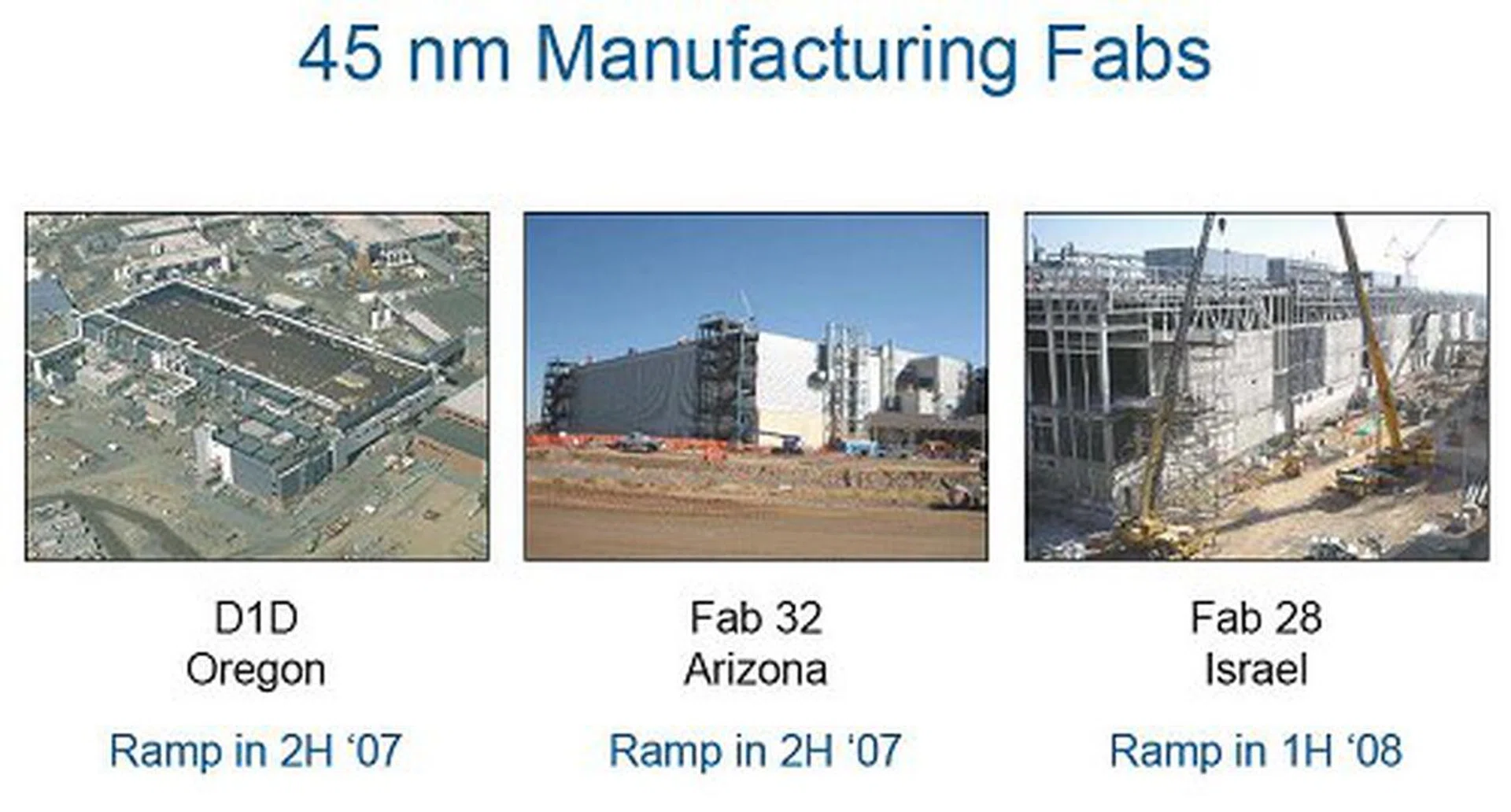
The three 300mm wafer fabrication plants that Intel will rely upon to power its next generation lineup.
As rosy as all these sound, Intel's path is far from being clear as AMD's next generation microarchitecture processor family named Barcelona for the server space and Agena for the enthusiast segment are expected to spring in to action just after the mid of this year. Touting a true native quad-core architecture, this will easily allow AMD to scale to a platform with eight or even 16 processing cores (in the form of dual or quad physical processors) based on existing server designs. Not only is AMD squeezing four cores in one die based on the 65nm process technology, but each of these cores have been overhauled as well with better floating point prowess and memory tweaks to give it a stronger comeback punch - if all their plans go well. AMD expects to catch up with Intel in the manufacturing process technology race somewhere in 2008 as well in the most optimistic scenario, but of course they would first have to prove their worth by delivering their upcoming true quad-core chips later this year as promised.
While Intel is expected to launch much faster Core 2 Quad variants later this year and with new platform technologies, it's still early days to figure out who's playing the right cards. Intel may probably safely ride out the first half of this year, but only in the later half can we truly judge who has got the upper hand for the entire 2007.
Our articles may contain affiliate links. If you buy through these links, we may earn a small commission.