
The Best of the Best - High-end Graphics Card Special
With Christmas only a day away, we present you with a HardwareZone Special - a feature article involving the best performing graphics cards money can buy in four price segments. Involving the Radeon HD 4870 X2, Radeon HD 4870, GeForce GTX 280 and the GTX 260+, this is one roundup you cannot afford to miss.
Bring Your Biggest Guns!
As 2008 comes to a close, we look back on what can only be described as a very exciting year for graphics cards enthusiasts and gamers, with ATI and NVIDIA slugging it out in what can only be described as a bare-knuckle boxing match.
The first blow came in June, in the form of NVIDIA's latest GeForce GTX 200 cards. These one billion over transistor GPUs were unlike anything we've ever seen before. Its GPU was as large as it was fast, and our initial tests with it revealed that it was substantially faster than anything else on the market today. Once again, the honor of having the fastest graphics card went to NVIDIA. At that point of time, and with these latest additions to the NVIDIA arsenal, we couldn't foresee how ATI could possibly launch a comeback.
But comeback they did, in the guise of their HD Radeon 4800 series of cards. Rather than go head-to-head with NVIDIA in vying for the fastest graphics card mantle, what ATI did instead was to create a fairly powerful yet competitively priced GPU, placing their product squarely in a sweet spot. With that, the launch of the HD Radeon 4800 cards saw NVIDIA taking immediate and drastic actions. Most significantly, in response to the new cards from ATI, NVIDIA abruptly slashed prices off their latest GTX 200 cards by as much as US$150. This smells of sheer desperation if you ask us.
ATI then followed up with a sweet uppercut by releasing the dual-GPU HD 4870 X2, which is essentially two HD 4870 GPUs squeezed onto a single PCB. In a single masterstroke, the new HD 4870 X2 allowed ATI to reclaim the title of the single fastest graphics card from NVIDIA. Something no ATI card has done for sometime.
At that point of time, NVIDIA was suddenly looking rather vulnerable, because not only did they have to deal with the constant onslaught from ATI, they were suffering from problems of a different sort - reliability. Sometime in mid-July, news spread that many of NVIDIA's 8400M and 8600M mobile-GPUs were suffering from some sort of a heat issue, which caused the GPUs to overheat and malfunction. To combat the problem, NVIDIA eventually had to set aside around $200 million dollars to cover costs of repairing and replacing these faulty GPUs.
Eventually, however, they responded to ATI's waves of attack by announcing the improved GeForce GTX 260, aptly dubbed the GeForce GTX 260 Core 216, because of its 216 stream processors - 24 more than the original GTX 260. NVIDIA claims that with the additional stream processors, it will be faster than its direct competitor, ATI's Radeon HD 4870, and our initial impressions with the Leadtek GTX 260 Extreme+ seem to confirm that. More recently, NVIDIA announced the coming of their new dual-GPU GeForce GTX 295 card. The results of suggest that this is now the reigning speed king amongst graphics cards, and is an indication that NVIDIA is slowly but surely getting themselves back on track.
Now, with the year nearing at its end, we take a look back at these high-end GPUs and have, in our selection here, the creme de la creme of cutting-edge graphics cards. Each of these cards represents the best their respective SKU has to offer, and we will be pitting it against each other. So let the battle begin.
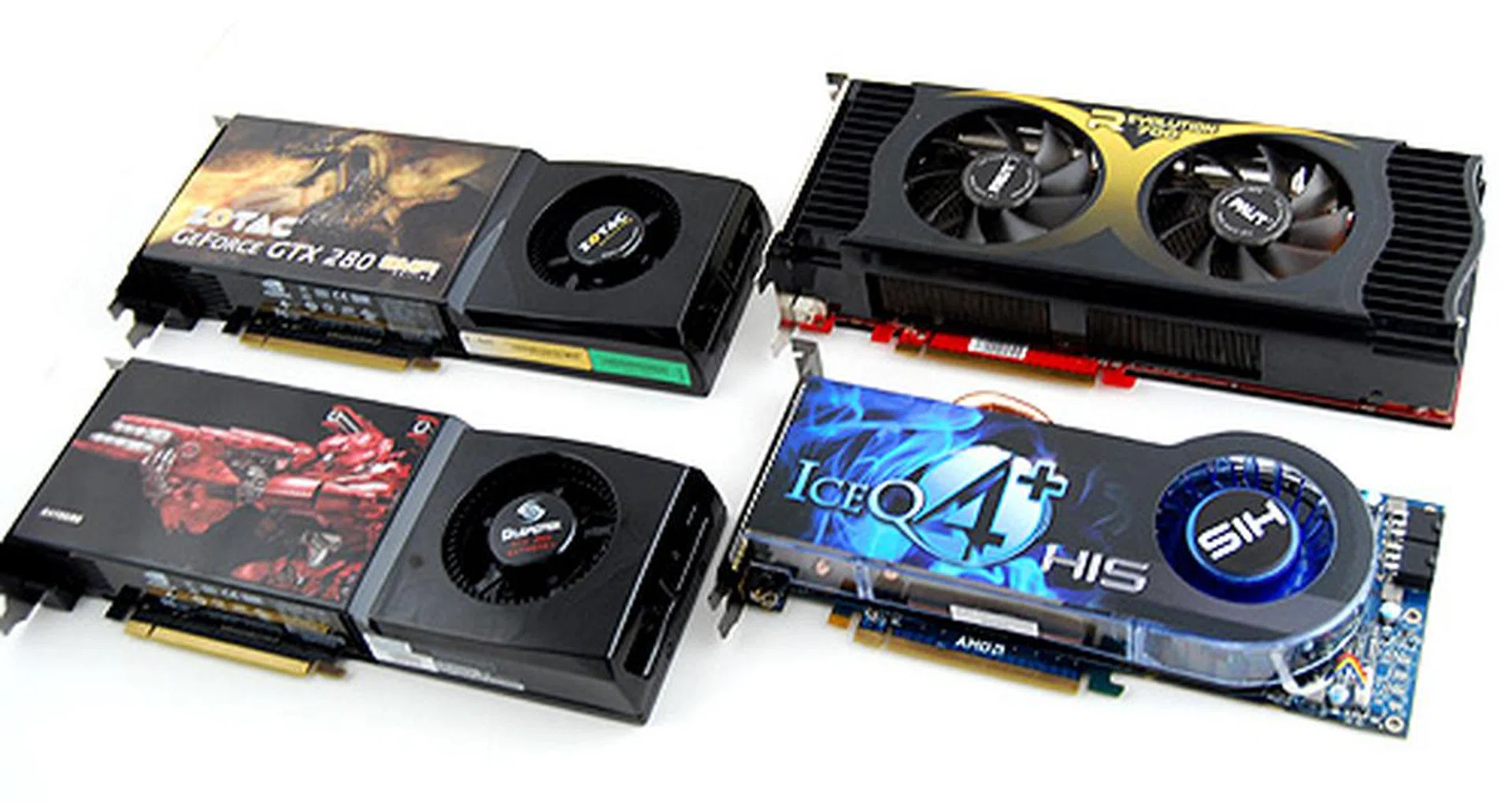
Combined, these four cards have 5 GPUs, nearly 5GB of video memory, close to 3000 shader units, over 5.5 billion transistors, and boast roughly 5.3 teraFLOPS of sheer processing power. If this is not enough for you, we don't know what is.
Graphics Card | Core Code | Core Clock | Stream Processors | Steam Processor Clock | Memory Clock | DDR Memory Bus Width | Street Price |
ATI Radeon HD 4870 X2 | |||||||
Palit Revolution 700 Deluxe | R700 (RV770 x 2) | 750MHz | 320 Processors (1600 Stream processing units) | 750MHz | 3800MHz GDDR5 | 256-bit | ~US$565 |
Reference Radeon HD 4870 X2 | R700 (RV770 x 2) | 750MHz | 320 Processors (1600 Stream processing units) | 750MHz | 3800MHz GDDR5 | 256-bit | ~US$529 |
NVIDIA GeForce GTX 280 | |||||||
Zotac GeForce GTX 280 AMP! Editiion | GT200 | 700MHz | 240 Stream processors | 1400MHz | 2300MHz GDDR3 | 512-bit | ~US$449 |
Reference GeForce GTX 280 | GT200 | 602MHz | 240 Stream processors | 1296MHz | 2214MHz GDDR3 | 512-bit | ~US$429 |
ATI Radeon HD 4870 | |||||||
HIS Radeon HD 4870 IceQ 4+ Turbo | R700 | 770MHz | 160 Processors (800 Stream processing units) | 770MHz | 4000MHz GDDR5 | 256-bit | ~US$320 |
Reference Radeon HD 4870 | R700 | 750MHz | 160 Processors (800 Stream processing units) | 750MHz | 3600MHz GDDR5 | 256-bit | ~US$259 (1GB variant) |
NVIDIA GeForce GTX 260 Core 216 | |||||||
Leadtek WinFast GTX 260 Extreme+ | GT200 | 602MHz | 216 Stream processors | 1296MHz | 2214MHz GDDR3 | 448-bit | ~US$315 |
Reference GeForce GTX 260 Core 216 | GT200 | 576MHz | 216 Stream procesors | 1242MHz | 1998MHz GDDR3 | 448-bit | ~US$256 |
Palit Revolution 700 Deluxe
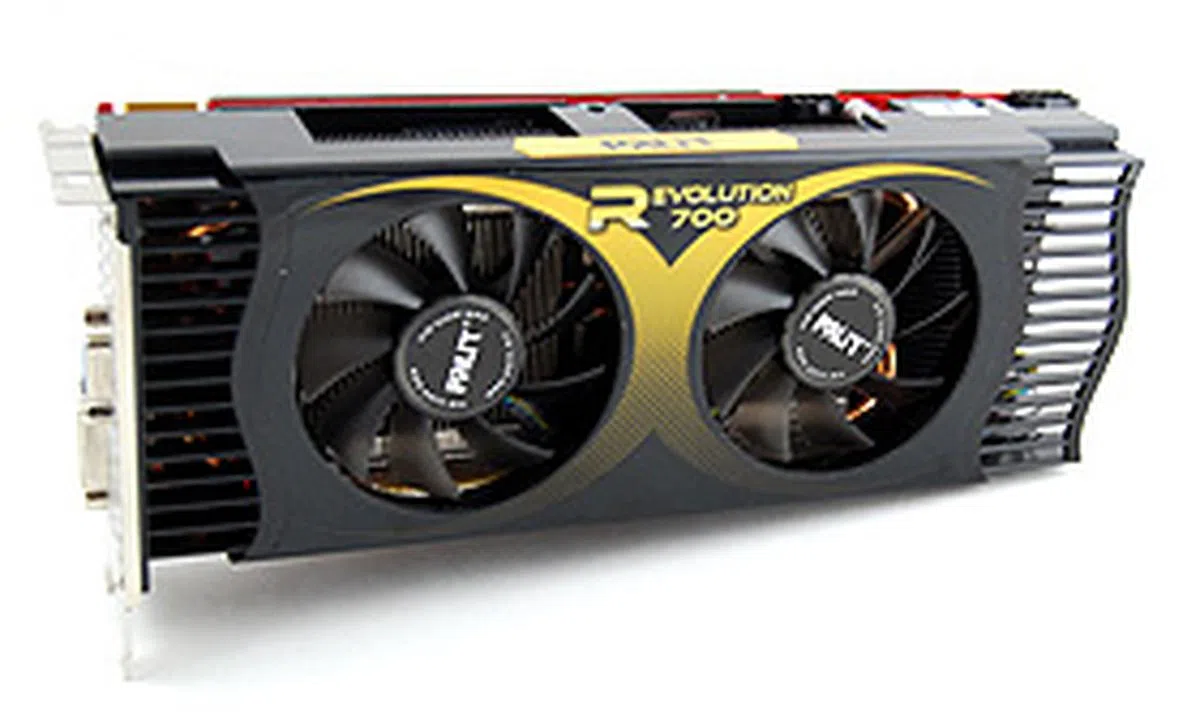
The first card in our high-end graphics card special is Palit's Revolution 700 Deluxe. What's so revolutionary about it, we hear you ask. For starters, it is the first Radeon HD 4870 X2 card in the world that ships with a custom cooler. But more interestingly, its custom cooler is of a triple-slot design. You heard us right. The Palit Revolution 700 Deluxe is a triple slot card and is easily the biggest and heaviest graphics card we've ever seen.
At first glance, we found the triple-slot cooler on the Revolution 700 Deluxe to be very similar to the one employed in its less powerful sibling, the Palit Radeon HD 4870 Sonic Dual Edition, save for the extra slot. Like its sibling, the Revolution 700 Deluxe keeps cool by transferring heat from the twin GPU-cores to the large heatsink by way of its four thick copper heat pipes. The heatsink is then cooled by the cooler's two large 80mm fans. To provide further heat dissipation, and to reinforce and provide extra rigidity to the PCB, there's also a thick metal plate stuck to the back of the card. This is all good news, because in our review of a reference Radeon HD 4870 X2 some time back, it managed a toasty 84 degrees Celsius in our temperature measurement test.
While the Revolution 700 Deluxe might be big on cooling, it is only modestly factory-overclocked. Palit has chosen to keep core clock speeds at 750MHz, whereas memory clock speeds are bumped up to 3800MHz DDR, which is being awfully conservative. We think that a card as radical as this would be more fitting if it had came factory-overclocked at its absolute limit.
This is what the Palit Revolution 700 Deluxe came with:
- Quick installation guide
- Driver CD
- 1 x HDMI to DVI adapter
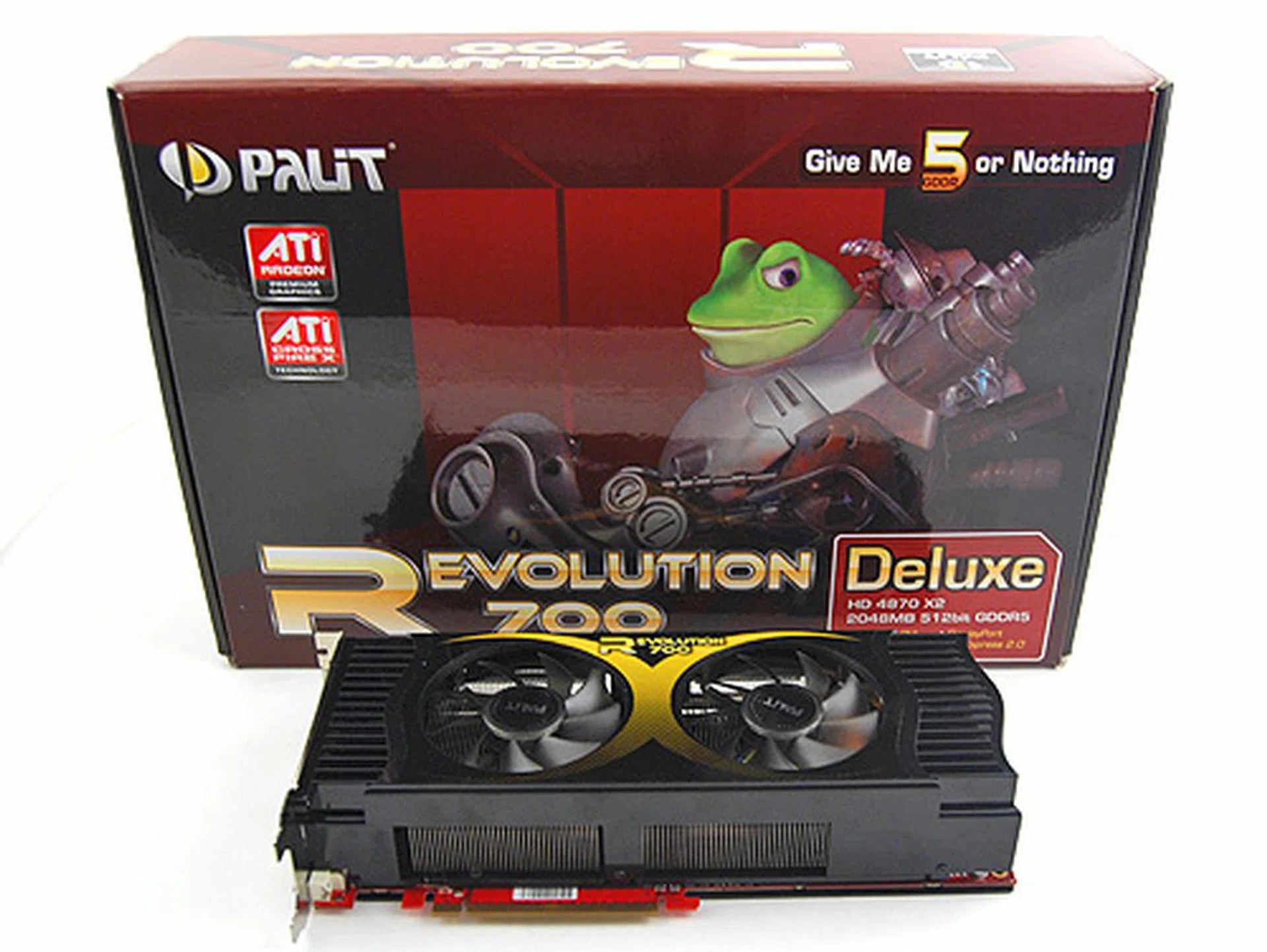
The Palit Revolution 700 Deluxe is our largest card on show. It also came in the largest box, and as usual, Frobo fronts the cover.
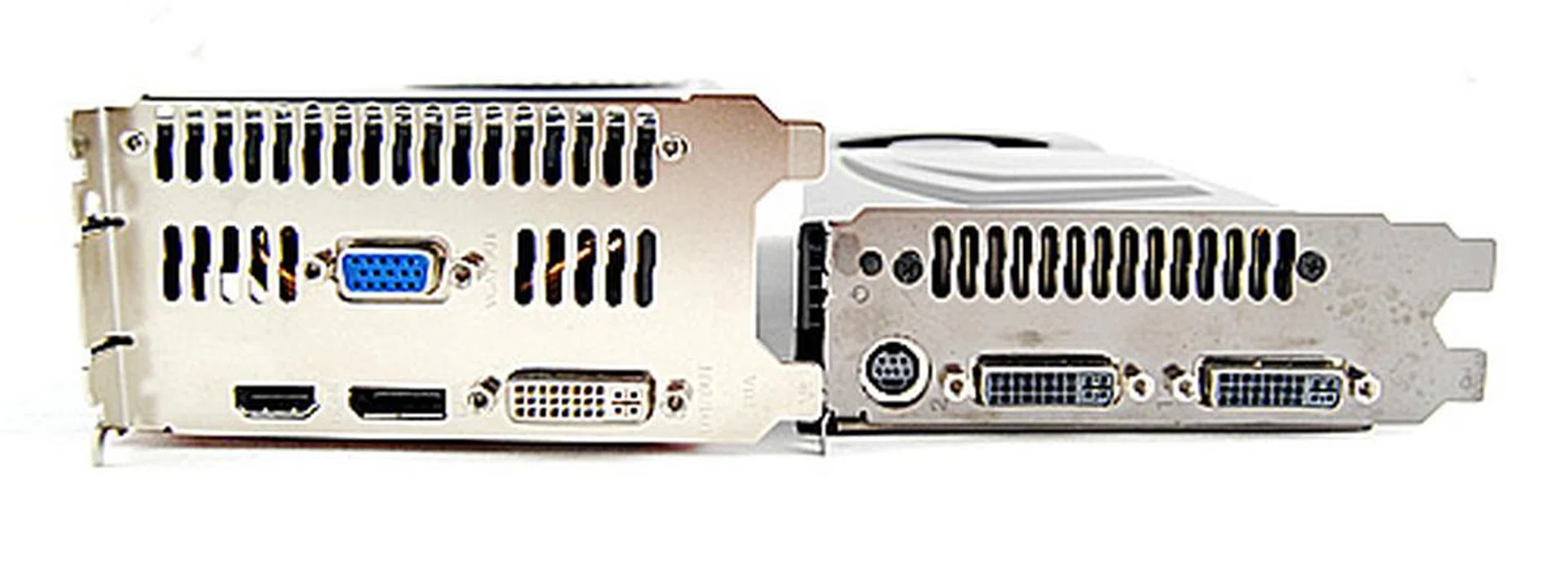
NVIDIA's GeForce GTX 280 is already a very large card, but as you can see, it is absolutely dwarfed by the gargantuan Revolution 700 Deluxe. Do note that some casing's rear faceplate configuration may not bode well for these unusual multi-slot cards.
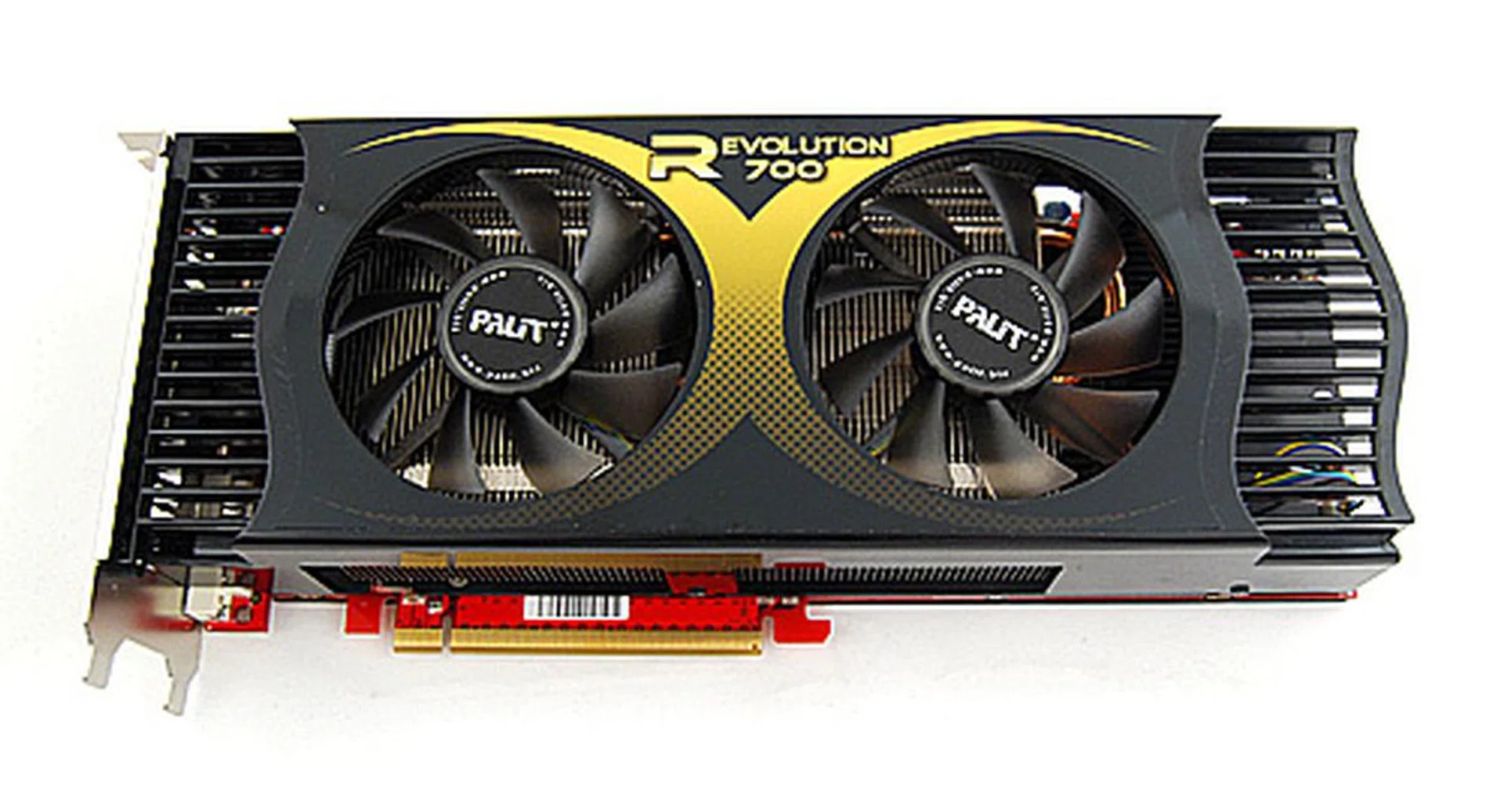
The triple-slot cooler is not some gimmick, Palit reckons it'll help keep the dual-GPUs on the Revolution 700 Deluxe cool. We'll find out how effective it is soon.
Zotac GeForce GTX 280 AMP! Edition
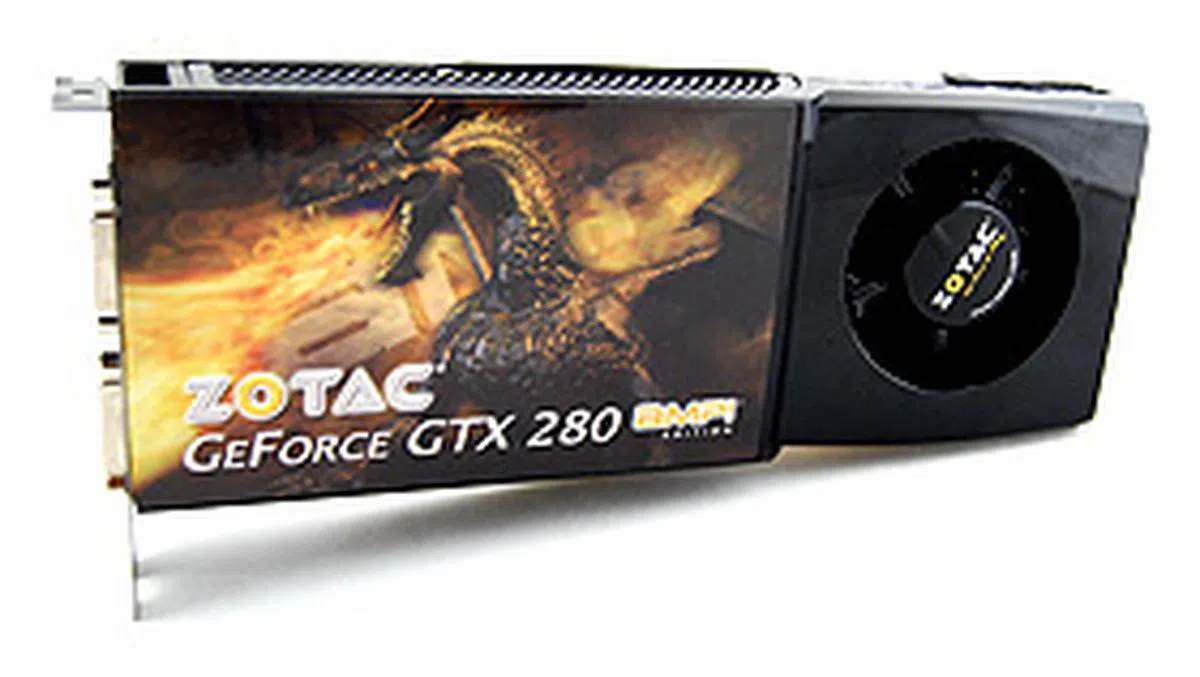
You'll be forgiven if you did not think much about the Zotac GTX 280 AMP! Edition. Apart from the fire-breathing dragon emblazoned on the dual-slot reference cooler, you'll find nothing else that differentiates it from a reference GeForce GTX 280 from NVIDIA . However, underneath its uninteresting facade lies a monster, because the Zotac GTX 280 AMP! Edition is by far the most aggressively overclocked GeForce GTX 280 card we could find. Its core clock speed have been upped from the reference 602MHz to 700MHz; whereas shader clock speed have also been increased from 1296MHz to 1400MHz; and memory, from 2214MHz DDR to 2300MHz DDR. With such substantial increases, we expect the Zotac GTX 280 AMP! Edition to be a real bruiser.
This is what the Zotac GeForce GTX 280 AMP! Edition came with:
- Quick installation guide
- Driver CD
- Racedriver Grid (full game)
- 1 x DVI to VGA adapter
- 1 x DVI to HDMI adapter
- 1 x Molex to 6-pin PCIe power connector
- 1 x S/PDIF cable
- 1 x S/Video cable
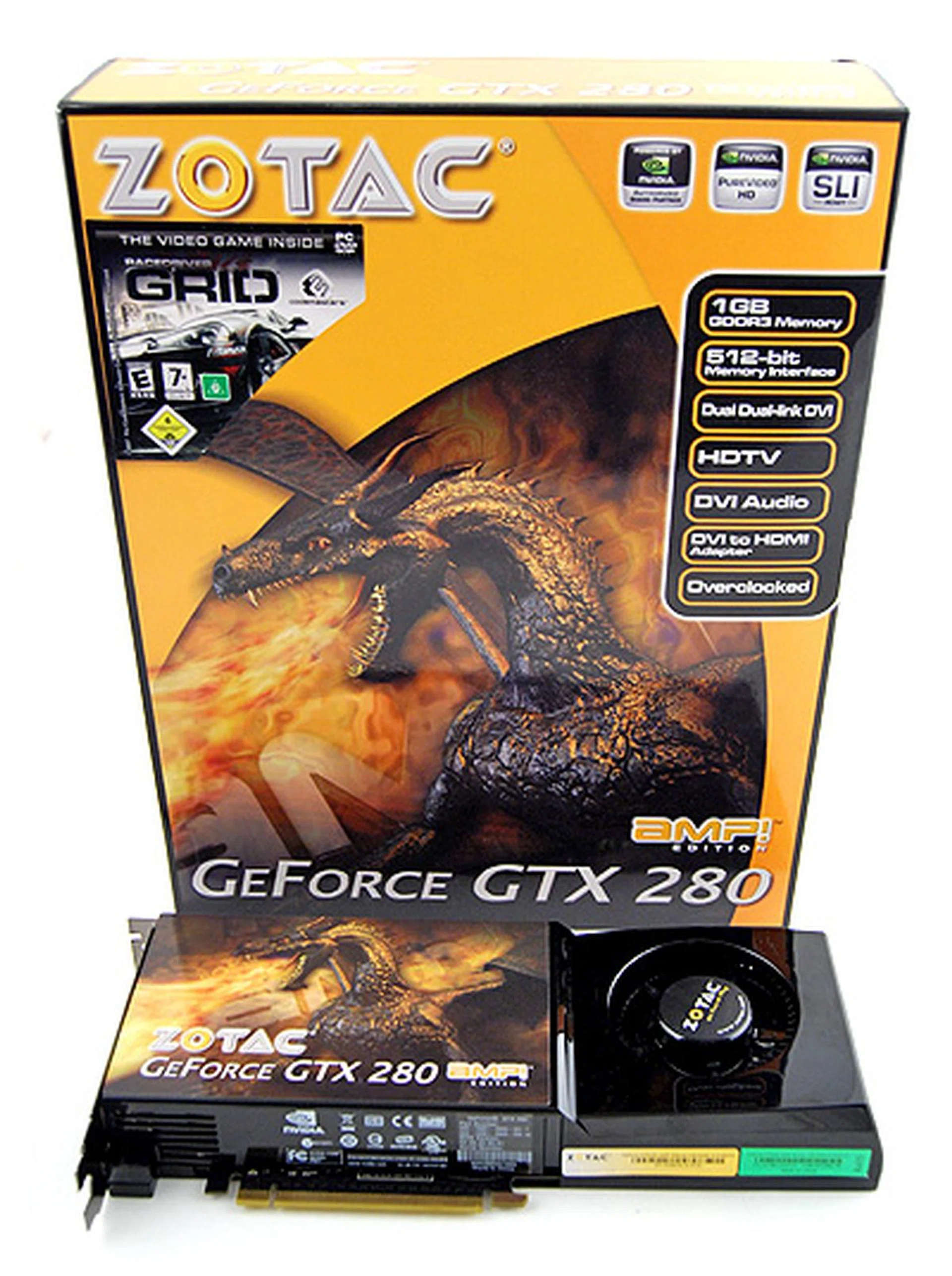
The Zotac GeForce GTX 280 AMP! Edition comes in Zotac's now customary orange box. The fire-breating dragon on it gives an indiction of the kind of performance you can expect from the card.
HIS Radeon HD 4870 IceQ 4+ Turbo 1GB
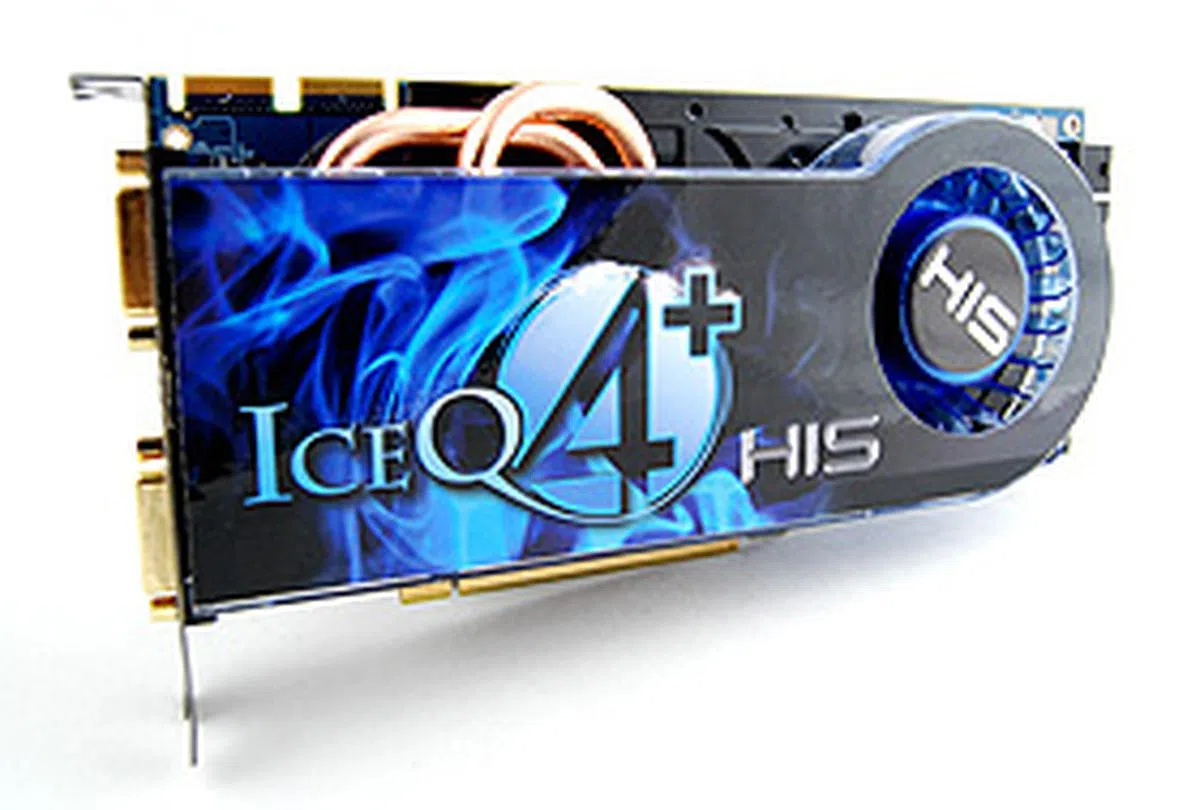
The HIS Radeon HD 4850 IceQ 4 TurboX was a favorite of ours, and it'll be interesting to see how it's more powerful sibling, the Radeon HD 4870 IceQ 4+ Turbo will perform. The Radeon HD 4870 IceQ 4+ Turbo comes factory-overclocked at 770MHz at the core and 4000MHz DDR at the memory, and sports HIS' latest IceQ 4+ cooler, an improved version of the original IceQ 4. On the surface, the IceQ 4+ cooler doesn't look any much different from the IceQ 4, but underneath, HIS says alterations have been made to ensure up to 60% better performance. Chief among which, is the utilization of a redesigned heatsink and thicker heat pipes (8mm from 6mm), which helps ensure faster transfer of heat from the GPU to its surroundings. However, it seems like the new IceQ 4+ suffers a little from these design changes as it didn't sound as fantastically quiet as the original IceQ 4 did.
This is what the HIS Radeon HD 4870 IceQ 4+ Turbo came with:
- Quick installation guide
- Driver CD
- 1 x DVI to VGA adapter
- 1 x DVI to HDMI adapter
- 1 x Molex to 6-pin PCIe power connector
- 1 x CrossFire bridge
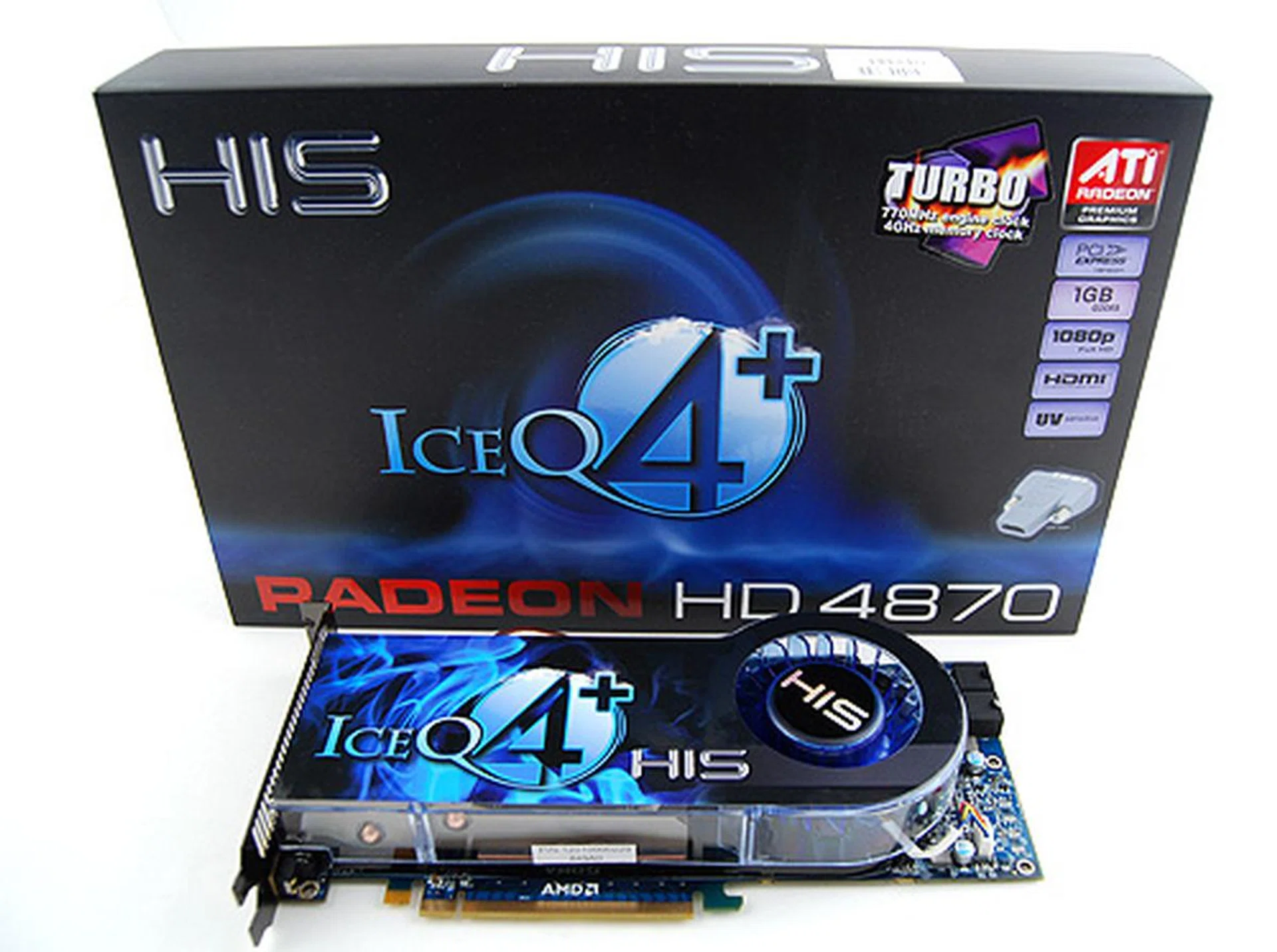
THE HIS Radeon HD 4870 IceQ 4+ Turbo is packaged nicely in the all-too-familiar dark blue HIS box. The large Turbo sticker on it proudly indicates this card is turbo-charged for performance.
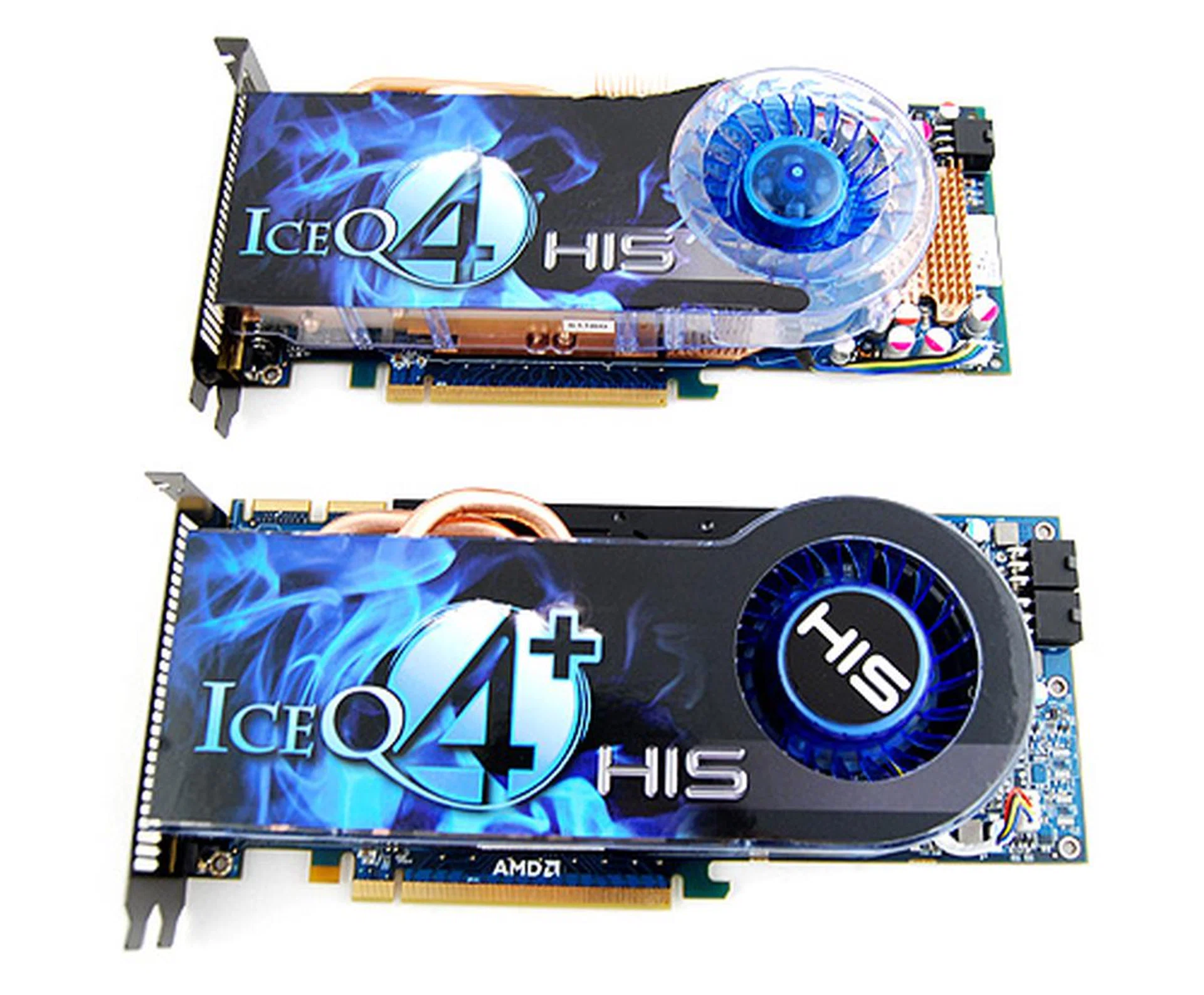
As you can see here, placed beside its sibling, the Radeon HD 4850 IceQ 4 TurboX, the new HIS Radeon HD 4870 IceQ 4+ Turbo looks almost identical.
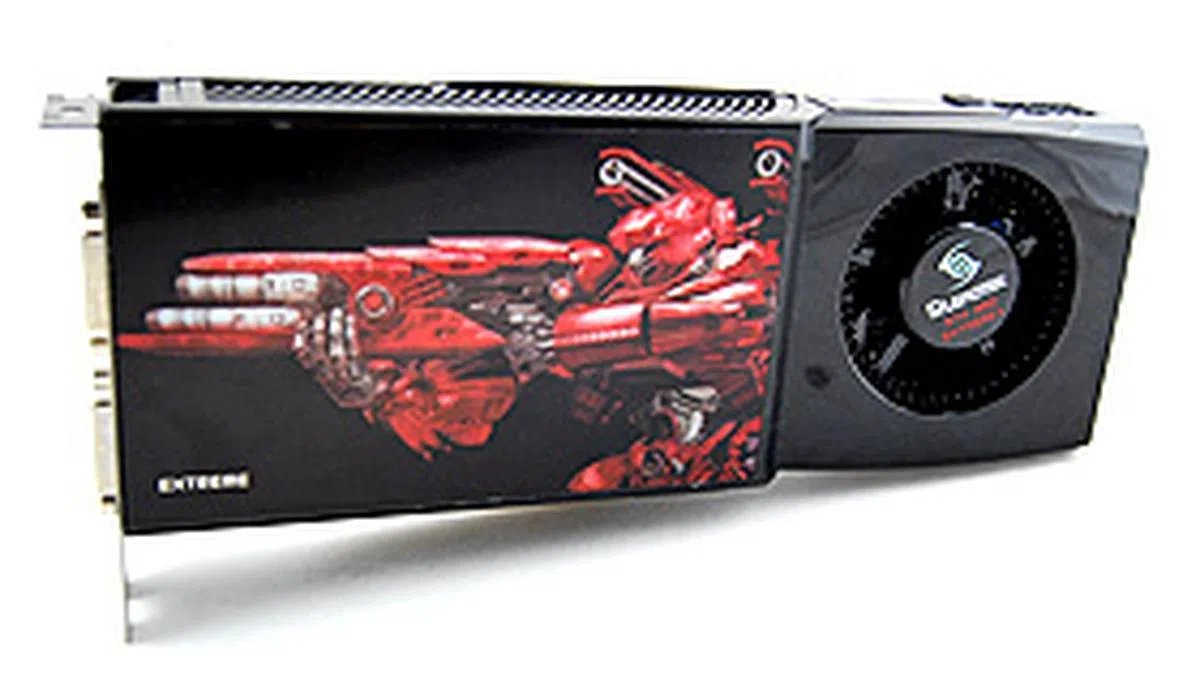
Leadtek WinFast GTX 260 Extreme+
The last card in our high-end graphics card special is the previously reviewed WinFast GTX 260 Extreme+ from Leadtek. Cosmetically, the WinFast GTX 260 Extreme+ looks no different from other cards of GTX 200 series due to its adoption of NVIDIA's reference cooler, but underneath, it sports NVIDIA's latest GTX 260 Core 216 GPU, which they claim will allow it to go one up against its nemesis, the Radeon HD 4870. The WinFast GTX 260 Extreme+ comes factory-overclocked at 602MHz at the core, 2214MHz DDR at the memory and 1296MHz at the shaders.
This is what the Leadtek WinFast GTX 260 Extreme+ came with:
- Quick installation guide
- Driver CD
- Neverwinter Nights 2 (full game)
- 1 x DVI to HDMI adapter
- 1 x DVI to VGA adapter
- 2 x Molex to PCIe power connector
- 1 x S/PDIF cable
- 1 x S/Video cable
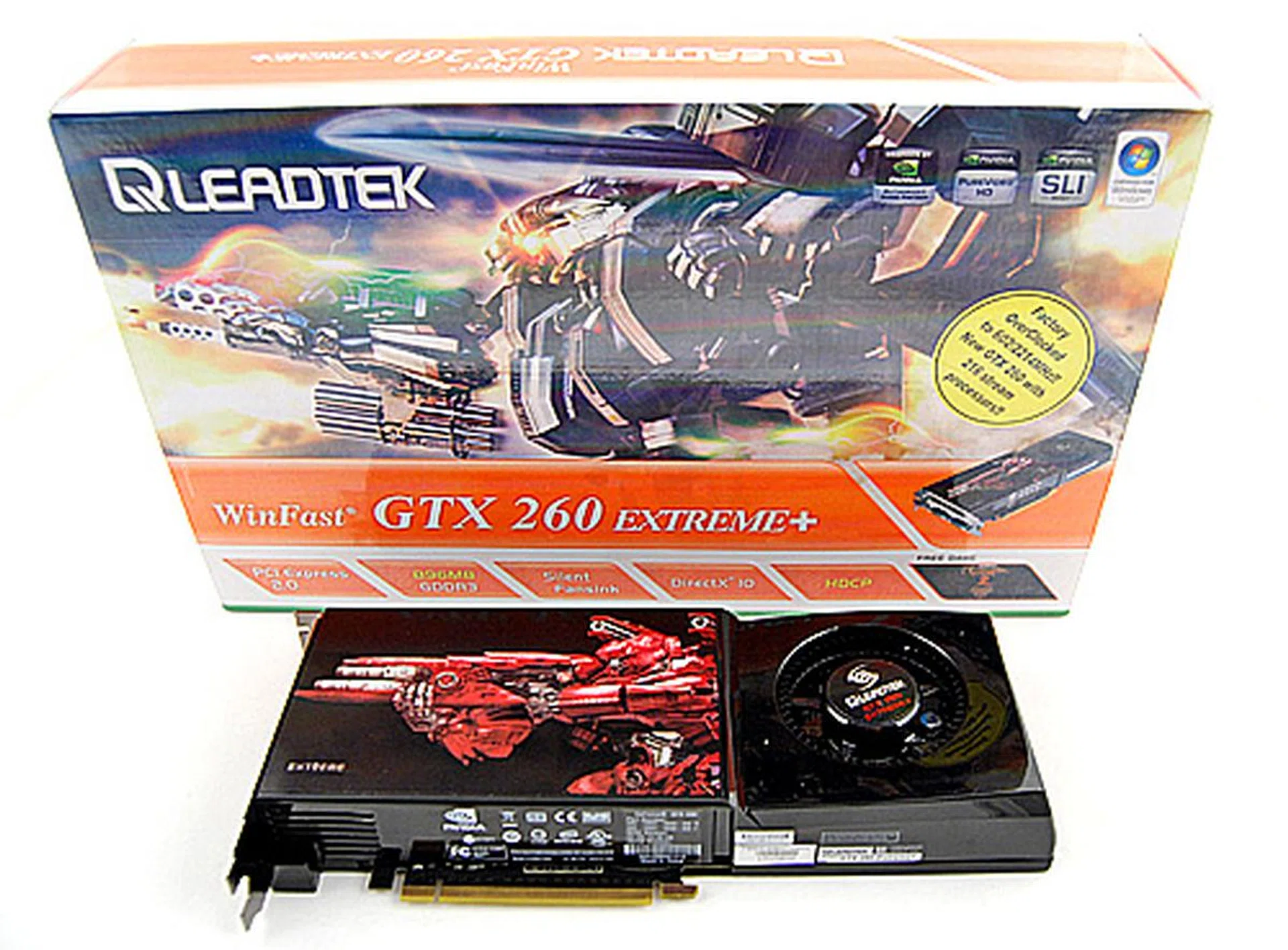
The thing about NVIDIA GT200 series card that irks us is that they come with reference coolers, making one card look no different from the other, regardless whether they are overclocked or not. The Leadtek WinFast GTX260 Extreme+ is no different, it sports a reference cooler and as such looks identical to every other card in the GTX 200 series.
Test Setup
For our benchmarks this time round, we'll be doing things a little differently. First of all, all testing will be done only on our Vista system and we've introduced some new benchmarks as well. But first, these are the specifications of our Vista system:
Windows Vista SP1 Test System
- Intel Core 2 Extreme QX6850 (3.00GHz)
- Gigabyte X38T-DQ6 motherboard
- 2 x 1GB DDR3-1333 Aeneon memory in dual channel mode
- Seagate 7200.10 200GB SATA hard drive
- Windows Vista Ultimate with SP1
For the NVIDIA cards, we'll be using the latest ForceWare 180 drivers; whereas to ensure a level playing field, we'll be using the latest Catalyst 8.12 drivers for the cards from ATI. Both ATI and NVIDIA claim that their latest drivers will offer drastic performance increase, especially on the latest games.
The complete list of cards and driver versions tested are as follows:
- Palit Revolution 700 Deluxe (Catalyst 8.12)
- ATI Radeon HD 4870 X2 2GB GDDR5 (Catalyst 8.12)
- HIS Radeon HD 4870 IceQ 4+ Turbo 1GB GDDR5 (Catalyst 8.12)
- ATI Radeon HD 4870 512MB GDDR5 (Catalyst 8.12)
- Zotac GeForce GTX 280 AMP! Edition 1GB GDDR3 (ForceWare 180.48)
- NVIDIA GeForce GTX 280 1GB GDDR3 (ForceWare 180.48)
- Leadtek WinFast GTX 260 Extreme+ (ForceWare 180.48)
- NVIDIA GeForce GTX 260 Core 216 896MB GDDR3 (ForceWare 180.48)
To fully maximize and tax these high-end cards, we'll also be including some new benchmarks in the form of the latest games, such as Far Cry 2 and Crysis Warhead. The list of what we tested is as follows:
- Futuremark 3DMark 06
- Futuremark 3DMark Vantage (ver 101)
- Crysis Warhead
- Far Cry 2
- Left 4 Dead
- Unreal Tournament 3
Windows Vista Results - 3DMark06
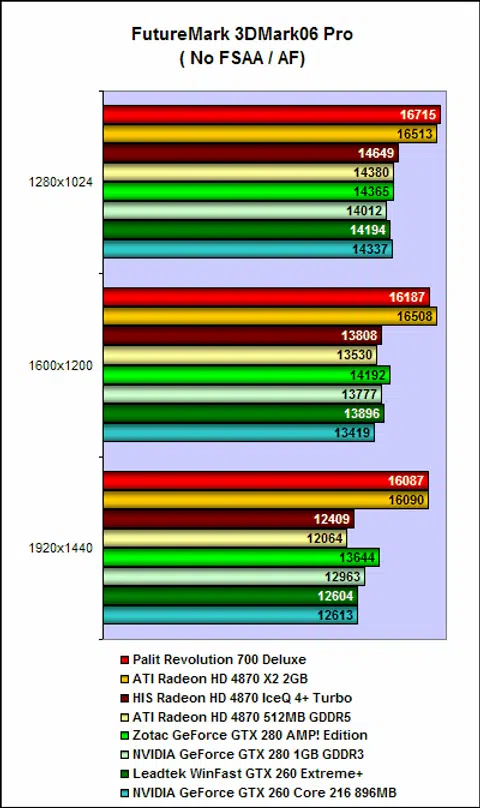
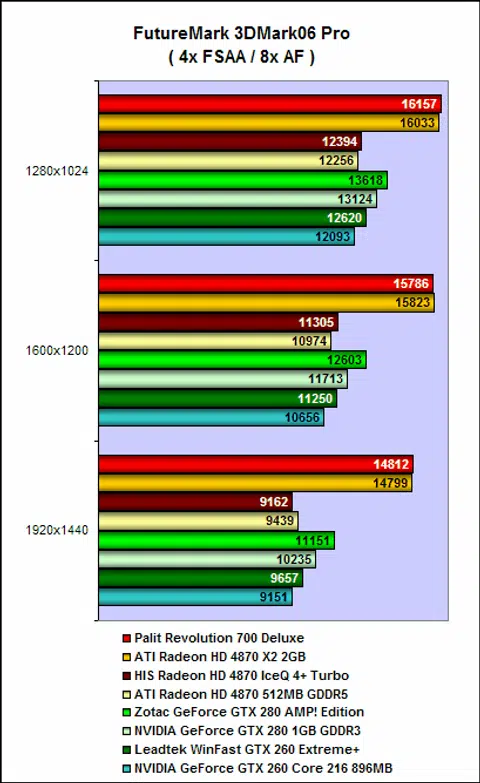
As usual, we begin our reporting the results of our benchmarks by beginning with 3DMark06, which proclaims itself to be "the gamers' benchmark". Considering the sheer power of the cards on hand here, expect to see big numbers.
Expectedly, the twin-GPU powered Radeon HD 4870 X2 cards posted the highest scores here, with scores reaching a stratospheric 16,000 plus 3DMarks. They were, by far, the fastest cards. And as evident here, the nominal memory overclock on the Palit Revolution 700 Deluxe did little to boost its scores over a standard Radeon HD 4870 X2. Elsewhere, everyone else was pretty much equal, but the Zotac GeForce GTX 280 AMP! Edition did pull ahead when we upped the settings.
Windows Vista Results - 3DMark Vantage (ver 101)
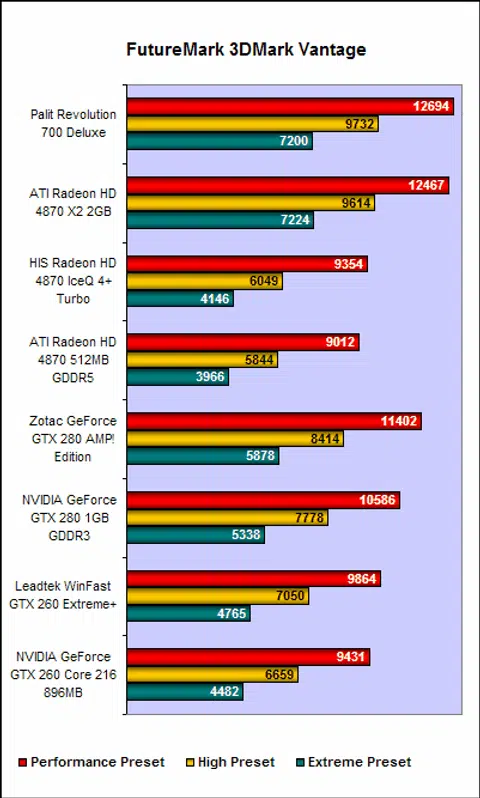
We move onto yet another benchmark from the guys at Futuremark - 3DMark Vantage. Vantage, is of course, 3DMark updated for Vista. It will run only with DirectX 10 and it serves as a good gauge, albeit a synthetic one, to see how the cards handle Microsoft's latest 3D gaming API.
Again, the Radeon HD 4870 X2 cards were the fastest and once more, the Palit Revolution 700 Deluxe was only marginally faster than a reference Radeon HD 4870 X2. The HIS Radeon HD 4870 IceQ 4+ Turbo and Leadtek WinFast GTX 260 Extreme+ did not perform too brilliantly either. Both of them managed only a little increase in Vantage scores. Of all our overclocked cards, the Zotac GeForce GTX 280 AMP! Edition managed the best performance over its reference counterpart, thanks to its aggressive clockspeeds.
Windows Vista Results - Far Cry 2 & Crysis Warhead
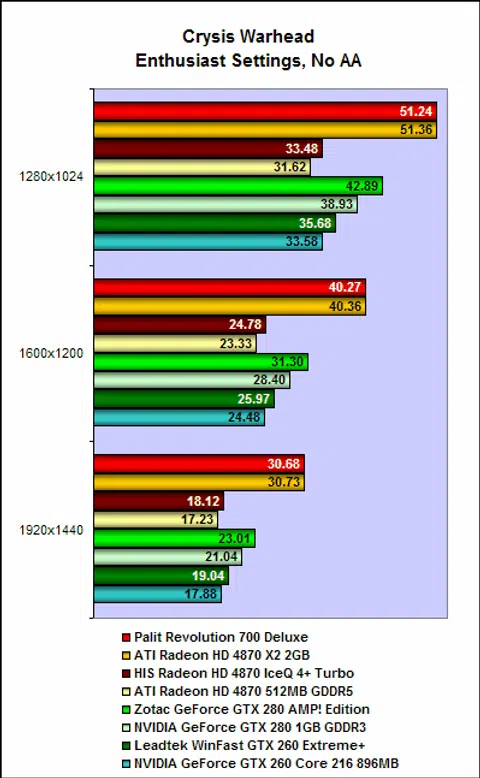
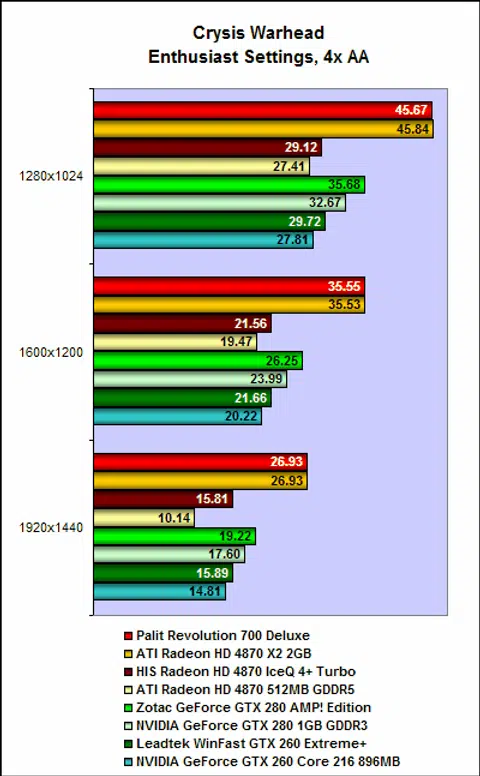
One of the new games introduced into our suite of benchmarks is Crysis Warhead. In terms of system requirements, Warhead requires nearly the identical minimum system requirements of the original Crysis, but in "gamer" and "enthusiast" mode (the original Crysis equivalent of "high" and "very high" respectively), it is said a less powerful machine is required. For the purpose of this test, we'll be running in "enthusiast" mode with anti-aliasing turned on for one run, and turned off for another.
Unsurprisingly, the pair of Radeon HD 4870 X2 cards were the fastest and again, the Palit Revolution 700 Deluxe demonstrates that its memory overclock is doing little to aid performance as its scores were nearly identical to that of a reference HD 4870 X2. In comparison, the HIS Radeon HD 4870 IceQ 4+ Turbo fared better, posting scores that were at least 5% better than a reference Radeon HD 4870.
Thanks to the insane overclocks on the Zotac GeForce GTX 280 AMP! Edition, it easily blew away its reference counterpart. The Leadtek WinFast GTX 260 Extreme+ didn't do too bad either, as it obtained scores that were about 7% greater than a reference GeForce GTX 260 Core 216.
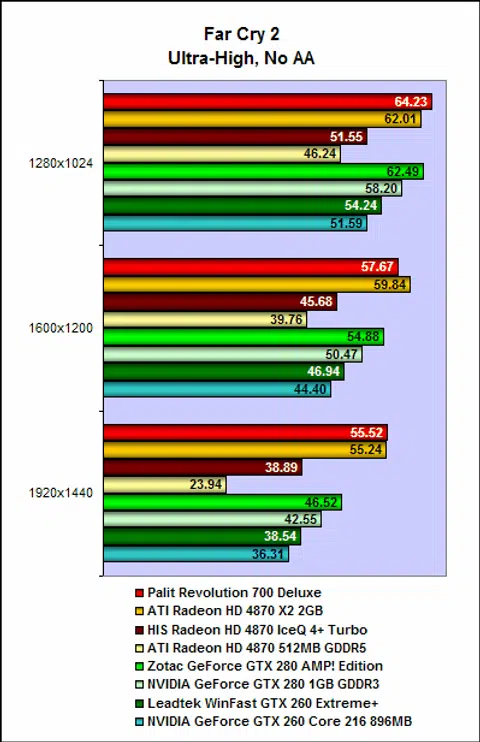
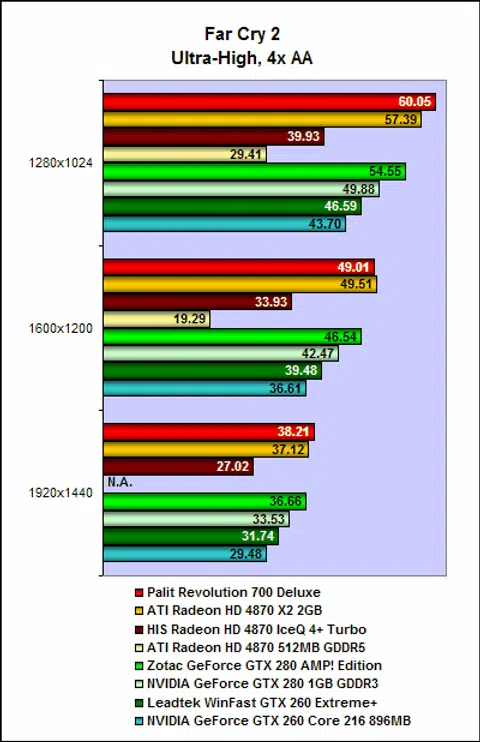
Another new introduction is Far Cry 2, a first-person shooter. Far Cry 2 utilizes a newly developed engine called Dunia, which promises graphics as good as, or even surpassing that of Crysis, but with much less graphics processing power. For our tests, we cranked up the settings to ultra-high and even had to turn on anti-aliasing up to 8x to tax our selection of cards here.
While the Palit Revolution 700 Deluxe continued to post scores that were only a little better than its reference counterpart, the HIS Radeon HD 4870 IceQ 4+ Turbo 1GB really shone, probably thanks to its extra 512MB video memory. The gulf between the HIS Radeon HD 4870 IceQ 4+ Turbo 1GB and the reference Radeon HD 4870 512MB really widened when we increased settings.
Over at the green camp, the Zotac GeForce GTX 280 AMP! Edition continued its fine performance, and posted scores that were not that much far off our two Radeon HD 4870 X2 cards. The Leadtek WinFast GTX 260 Extreme+ also performed well, managing frame-rates that were significantly faster than a reference GeForce GTX 260 Core 216 card.
Windows Vista Results - Left 4 Dead & Unreal Tournament 3
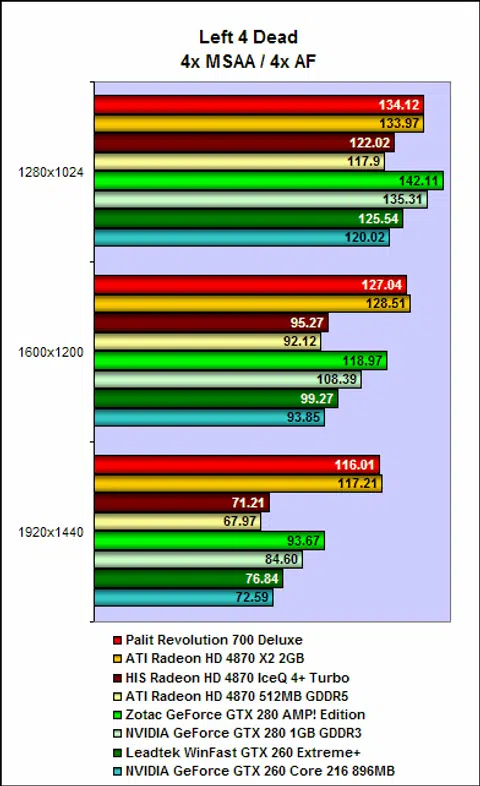
Another new game that we are introducing to our benchmarking suite is the zombie-infested first-person shooter Left 4 Dead. The game uses the latest version of Valve's Source engine, which is rather dated considering that it was first seen on Half-Life 2 and Counter-Strike: Source almost four years ago.
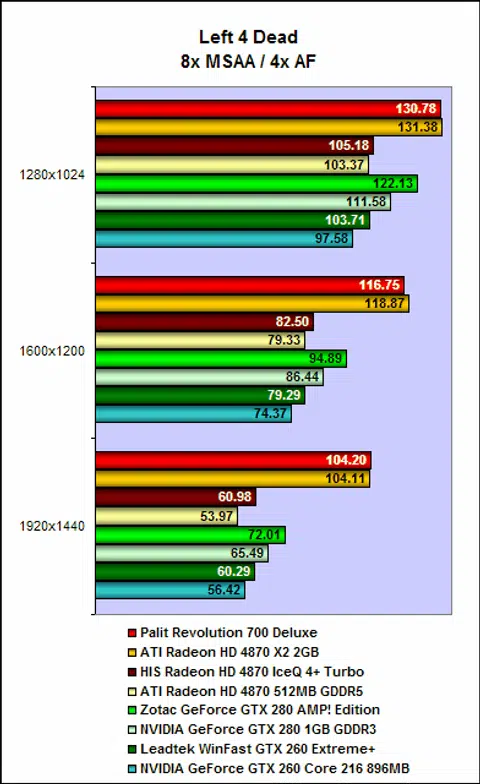
The Palit Revolution 700 Deluxe, with its 400MHz DDR memory overclock continues to disappoint by posting scores that were no different from a reference Radeon HD 4870 X2. Thankfully, the HIS Radeon HD 4870 IceQ 4+ Turbo did better, obtaining scores that were on average about 5% above a reference Radeon HD 4870. It managed its biggest jump on our highest setting, but that could be due to the fact that it has a frame buffer size that is twice as large.
By now, we were also seeing a trend with our NVIDIA card. The Zotac GeForce GTX 280 AMP! Edition continued its fine form by outperforming a reference GeForce GTX 280, by as much as 10% on the higher resolutions. The Leadtek WinFast GTX 260 Extreme+ did well too, but was not as impressive as the Zotac GTX 280 AMP! Edition.
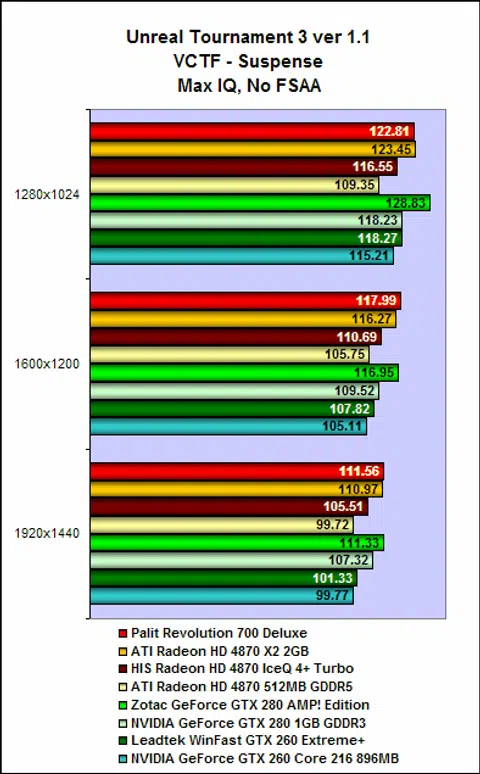
Unreal Tournament was a benchmark used extensively when testing on our Windows XP system and we've decided to use it too for this shoot-out. On Vista, however, there is an option to utilize DirectX10, which we promptly enabled.
Temperature
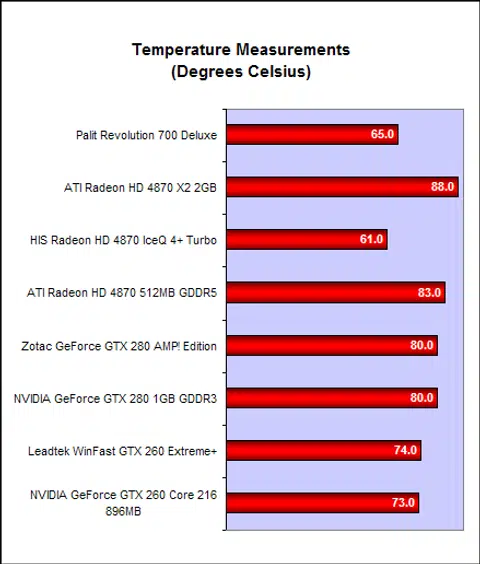
ATI's dual-GPU monsters are exceptionally hot cards and this was demonstrated by the reference Radeon HD 4870 X2, which tipped the scales at a whopping 88 degrees Celsius. And fortunately for the Palit Revolution 700 Deluxe, while it wasn't a top performer, its triple-slot cooling solution did not let it down as it recorded a very impressive 65 degrees Celsius. That's a mammoth 23 degrees Celsius reduction in operating temperatures! This comes at a price of course, as the two fans on the Palit Revolution 700 Deluxe wasn't particularly quiet, and because it is a of a triple-slot design, it does mean that the card takes up a lot of real estate, which can be bad news for those with small casings or those that can't easily take in multi-slot peripherals.
The HIS Radeon HD 4870 IceQ 4+ Turbo, with its new and improved IceQ 4+ cooler also performed admirably. It recorded 61 degrees Celsius, making it the coolest card here and among the Radeon HD 4870 group in particular. While the new IceQ 4+ cooler was not as quiet as its predecessor, it was not loud by any means.
Sadly, this is where the NVIDIA cards fell short. Because both the cards picked out in this article sported reference coolers, neither managed record temperatures that were lower than their reference counterparts. In fact, we found the Leadtek WinFast GTX 260 Extreme+ to be a tad hotter than a reference GeForce GTx 260 Core 216 (which is also expected since it's the same cooling solution needed by a faster clocked card).
Power Consumption
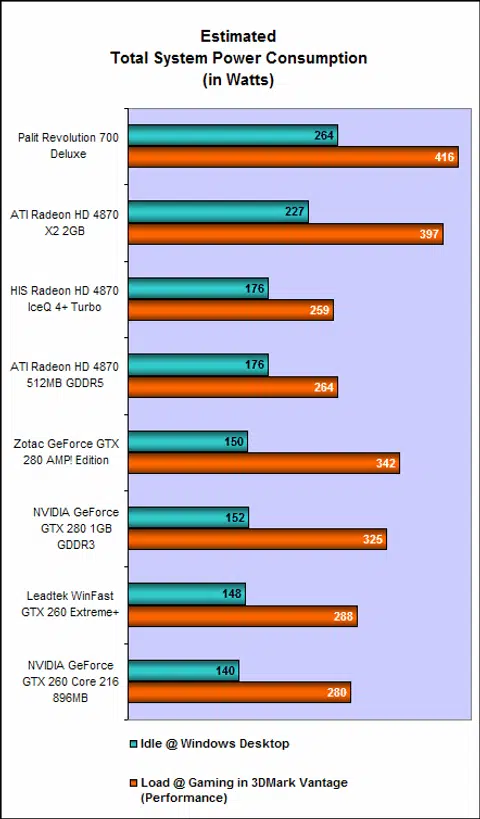
These cards are not going to win any green awards and it shows. None of the cards here managed to stand out and the lowest reading recorded was a still a considerable 259W at load. The highest, if you are wondering, goes to the Palit Revolution 700 Deluxe, which clocked an incredible 416W at load. The NVIDIA cards didn't do any better either, with the Zotac GeForce GTX 280 AMP! Edition and Leadtek WinFast GTX 260 Extreme+ managing 342W and 288W at load respectively. If it's any consolation, the NVIDIA cards recorded the lowest power draw at idle. Load power can't really be compared because each of them cater to different performance needs, but it does give you a good picture of the hidden costs of owning higher powered cards.
Conclusion
As for the graphics industry is concerned, this is a great Christmas if you are a gamer with dough to splash and you're hunting for a graphics card. As you can see, the cards here are all capable of blistering performance and we're confident that any one of them will serve you well (subject to your requirements and the budget). However, if you want to buy smart, then there are certain things you need to consider, let's begin with the triple-slot Palit Revolution 700 Deluxe.
We knew from the get-go that we won't be able to get much of a performance increase with the Palit Revolution 700 Deluxe, and our benchmarks certainly prove that. That said, its less spectacular performance shouldn't detract us from the fact that the triple-slot cooler on the Palit, though a little on the extreme, is exceptionally effective. A 23 degrees Celsius reduction in operating temperature is nothing less than phenomenal, and apart from size and space constraints, we can see no reason why you shouldn't get the Palit Revolution 700 Deluxe if a Radeon HD 4870 X2 is what you need. At US$565, it is admittedly a little pricey, considering the street price for most Radeon HD 4870 X2 is around US$529 at the moment, but if you are already paying so much, what's US$30 more? That's only about 5% more.
Sadly, if there's anything that prevented us from giving a higher score is the sheer size of the card. At three slots wide, getting it to fit into some casings will be nothing less than a major undertaking, possibly requiring some deconstruction work. Furthermore, a CrossFire setup of two of these cards will very likely render all your other expansion slots unusable. As a result, if one Radeon HD 4870 X2 is all you need, then by all means get the Palit Revolution 700 Deluxe. But if a pair of Radeon HD 4870 X2 cards is your ultimate aim, then we are afraid you need a slimmer option (unless you don't require any expansion slots).
Of our selection of cards, the Zotac GeForce GTX 280 AMP! Edition is perhaps our favorite. It might not sport a fancy customized cooler with redesigned heatsinks or heat pipes, but it does come factory overclocked and if anything, it is very fast. Looking back at our performance graphs, the Zotac GeForce GTX 280 AMP! Edition was the card that consistently outperformed its reference counterpart by the biggest margin, and even though it is not running any cooler, nor consuming any less power than its reference counterpart, it costs US$449, making it only US$20 more expensive than a standard no-frills GeForce GTX 280. And for a card that offers such great performance, is tremendous value for money.
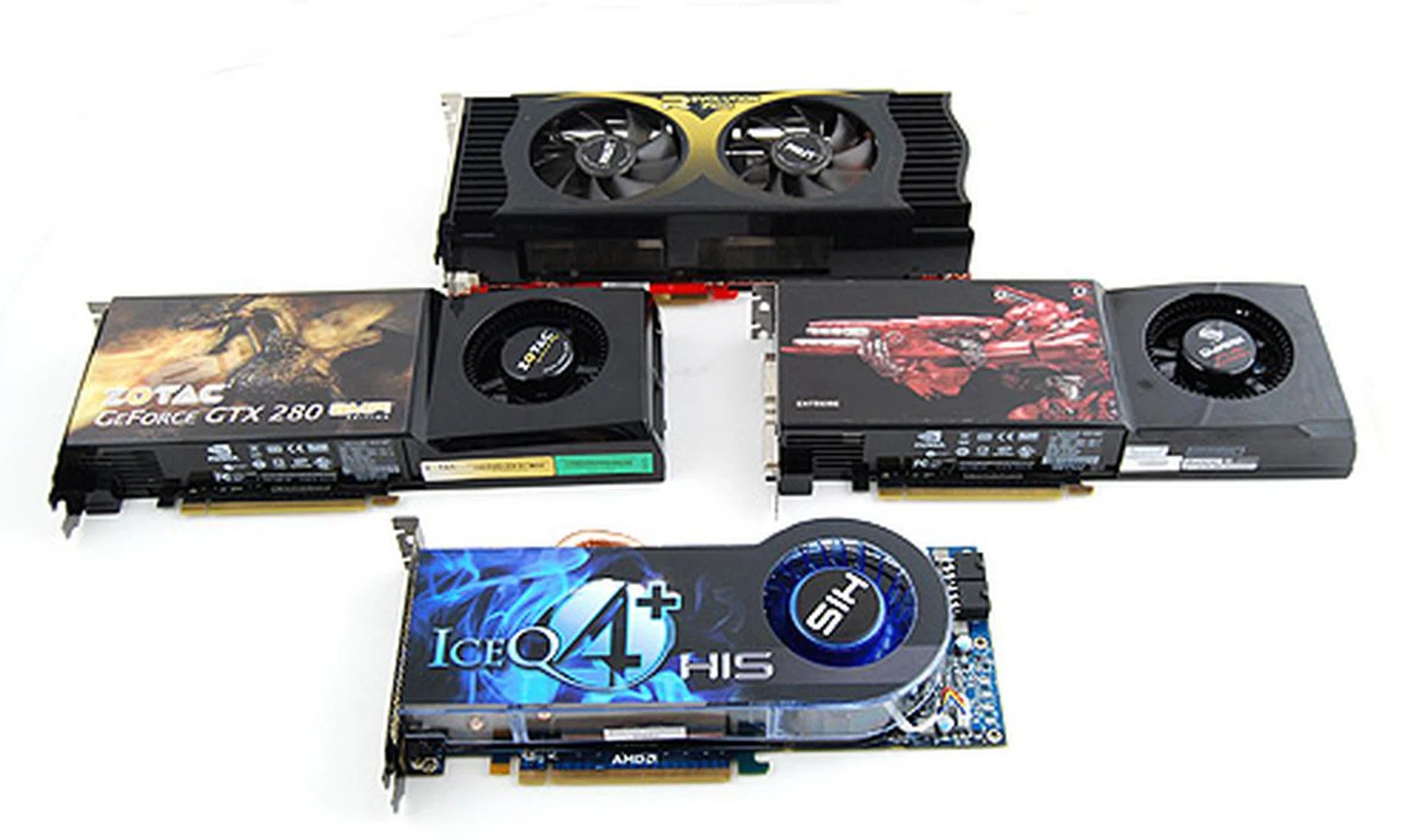
You won't find a slow coach here, and as far as we're concerned, all are good choices for the hardcore gamer and graphics enthusiast.
Moving on, we come to HIS' Radeon HD 4870 IceQ 4+ Turbo. All things considered, this is a solid card and is easily one of the better Radeon HD 4870 cards that we have tested. It provides a marked increase in performance, and manages to significantly reduce operating temperatures. Sadly, it is not perfect - because at US$320, it is also easily one of the most expensive Radeon HD 4870 cards. Typically, reference Radeon HD 4870 cards with 1GB of video memory are going for an average of US$270 at the moment, which makes the HIS Radeon HD 4870 IceQ 4+ Turbo US$50 more costly. Admittedly, factory-overclocked cards do command a premium, and this is even more so for those with customized coolers, but in this case, we are not quite sure if the HIS Radeon HD 4870 IceQ 4+ Turbo is worth the increase in price. Also, it isn't as quiet as the IceQ 4 predecessor (but it isn't annoying either).
Last, but not least, we have the Leadtek WinFast GTX 260 Extreme+. Like the HIS Radeon HD 4870 IceQ 4+ Turbo, it is a solid card that does what it is supposed to do, no questions ask. It comes factory-overclocked and consistently puts out performances that surpassed a regular GeForce GTX 260 Core 216. It doesn't bring anything new to the table apart from its improved performance. And like the HIS Radeon 4870 IceQ 4+ Turbo, it stopped us from giving it a better score because of its less than ideal price tag. At US$315, it is about US$45 more than regular GeForce GTX 260 Core 216, and while it does improve performance, it isn't to the same degree that the Zotac GeForce GTX 280 AMP! Edition managed to impress. Furthermore, unlike the HIS card, this doesn't have a customized cooler.
So that sums up our conclusion of these four high-end, over-the-top graphics cards in their respective SKUs and we hope this special feature helps you narrow down your options to a great Christmas present for yourself or your gaming obsessed buddy.
 |  |
 |  |
 | |
 | |
Our articles may contain affiliate links. If you buy through these links, we may earn a small commission.