
ATI Radeon HD 5770 Duel - MSI vs. PowerColor
The ATI Radeon HD 5770 might be a bit of a disappointment when we first reviewed it, but it's still a mighty competent mid to high-end graphics card. Vendors are now coming up with their own customized designs and we've two fine examples from MSI and PowerColor to do battle.
ATI Radeon HD 5770 Showdown
Powered by the Juniper XT chip, the Radeon HD 5770 sits just under ATI's powerful Cypress-powered Radeon HD 5800 series and is ATI's answer to the mid to high-end market.
When we reviewed it back in October, we were a tad disappointed to find that while it is largely similar to the older RV770 and RV790 chips- in that it has the same number of stream processors, texture mapping units and raster operating units - it has to make do with a narrower 128-bit memory bus interface, which inevitably hampered performance. In the end, we found that the new Radeon HD 5770 is a tad slower than even the old Radeon HD 4870.
Nevertheless, the new Juniper XT chip does bring about improvements such as support for DirectX 11, EyeFinity, and much lower operating temperatures and power draw. And truth be told, the Radeon HD 5770 is only a smidge slower than the Radeon HD 4870. These are reasons enough for an upgrade for those who needed performance characteristics of the 4800 series but with the improved characteristics of the 5700 series.
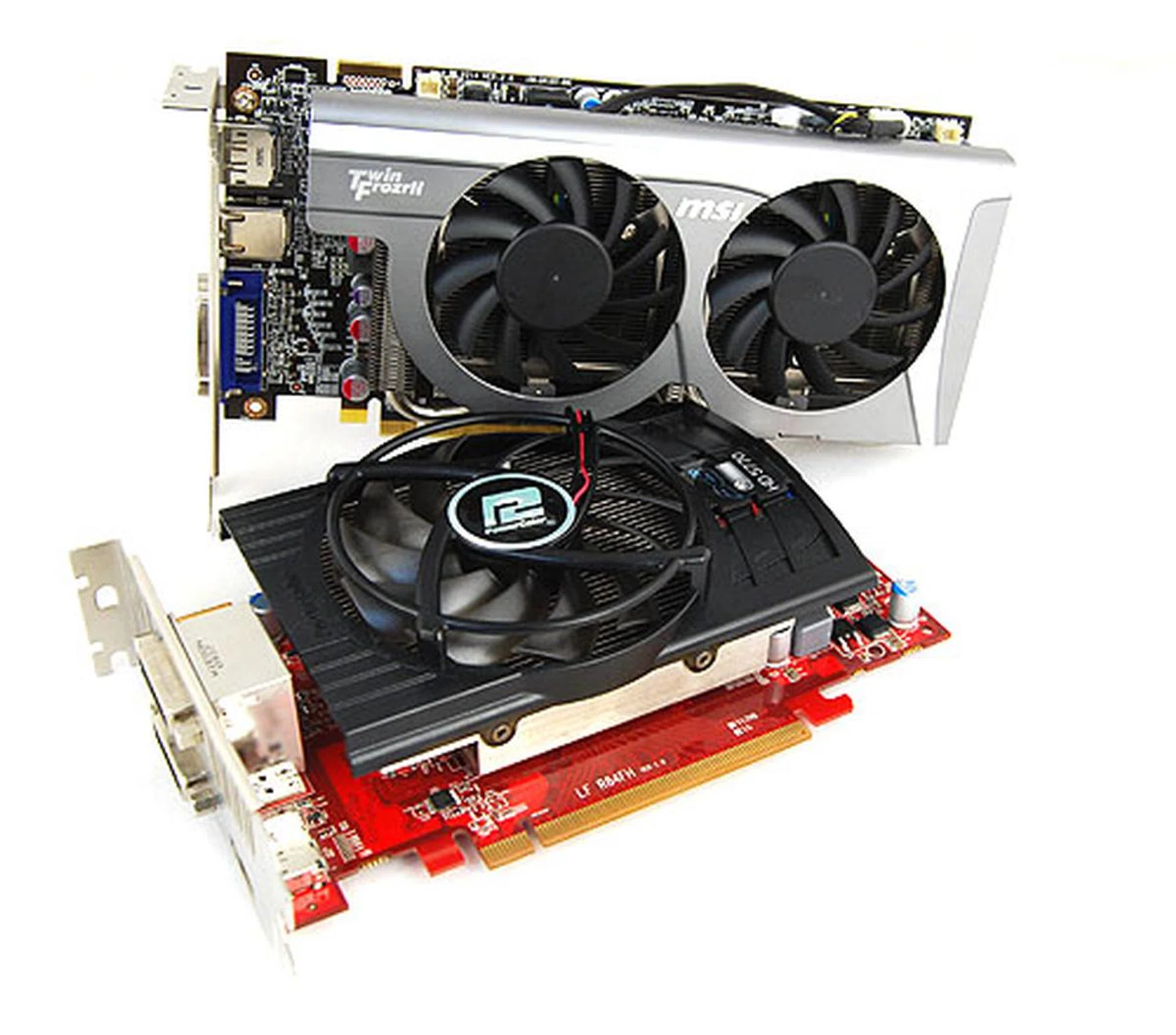
The MSI R5770 Hawk and PowerColor HD 5770 PCS+ are two of the first customized and factory-overclocked Radeon HD 5770 cards to hit the market.
The MSI R5770 Hawk and PowerColor HD 5770 PCS+ are two of the first customized and factory-overclocked Radeon HD 5770 cards to hit the market.
So if you are looking to upgrade to the latest Radeon HD 5770, we are pleased to say that vendors today are slowly releasing their customized editions on the Radeon HD 5770. And to help you make an informed decision, we've round up two of the latest Radeon HD 5770 cards from MSI and PowerColor for a head-to-head no holds barred showdown.
MSI R5770 Hawk 1GB GDDR5

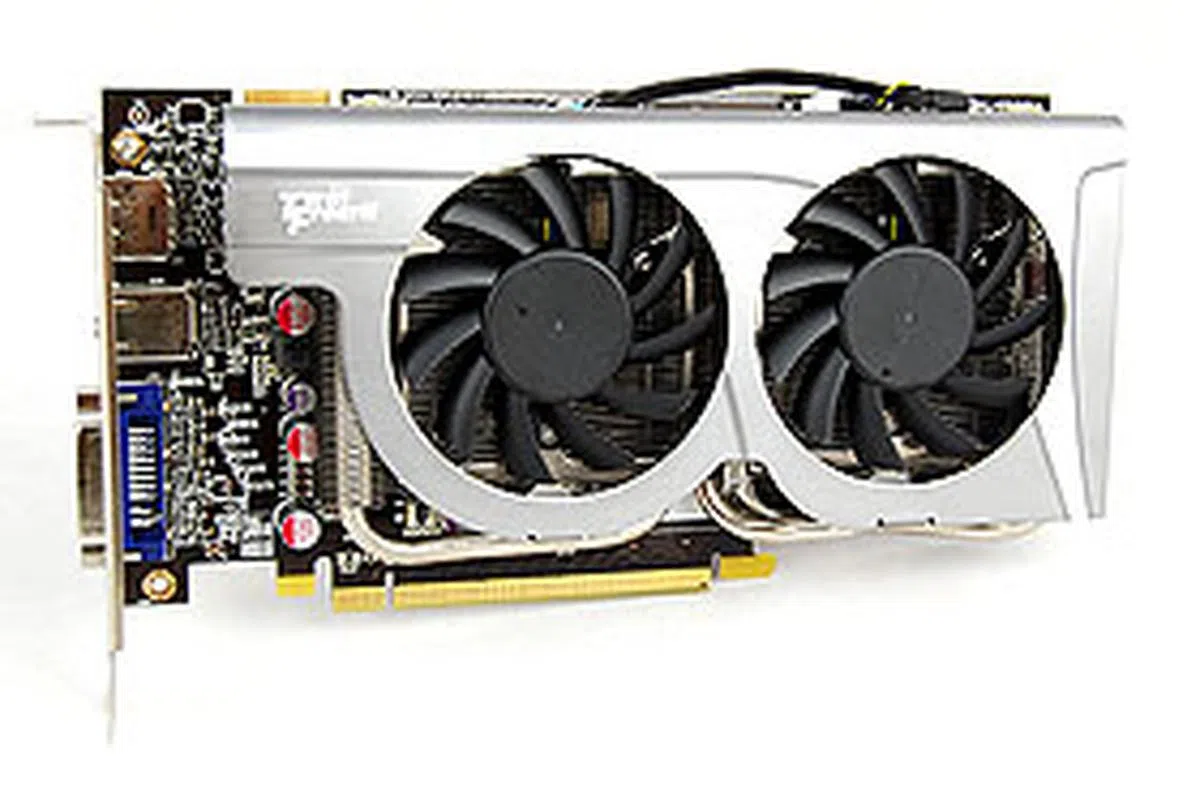
The MSI R5770 Hawk uses the familiar Twin Frozr II cooler that is also being employed on their Lightning series of graphics cards.
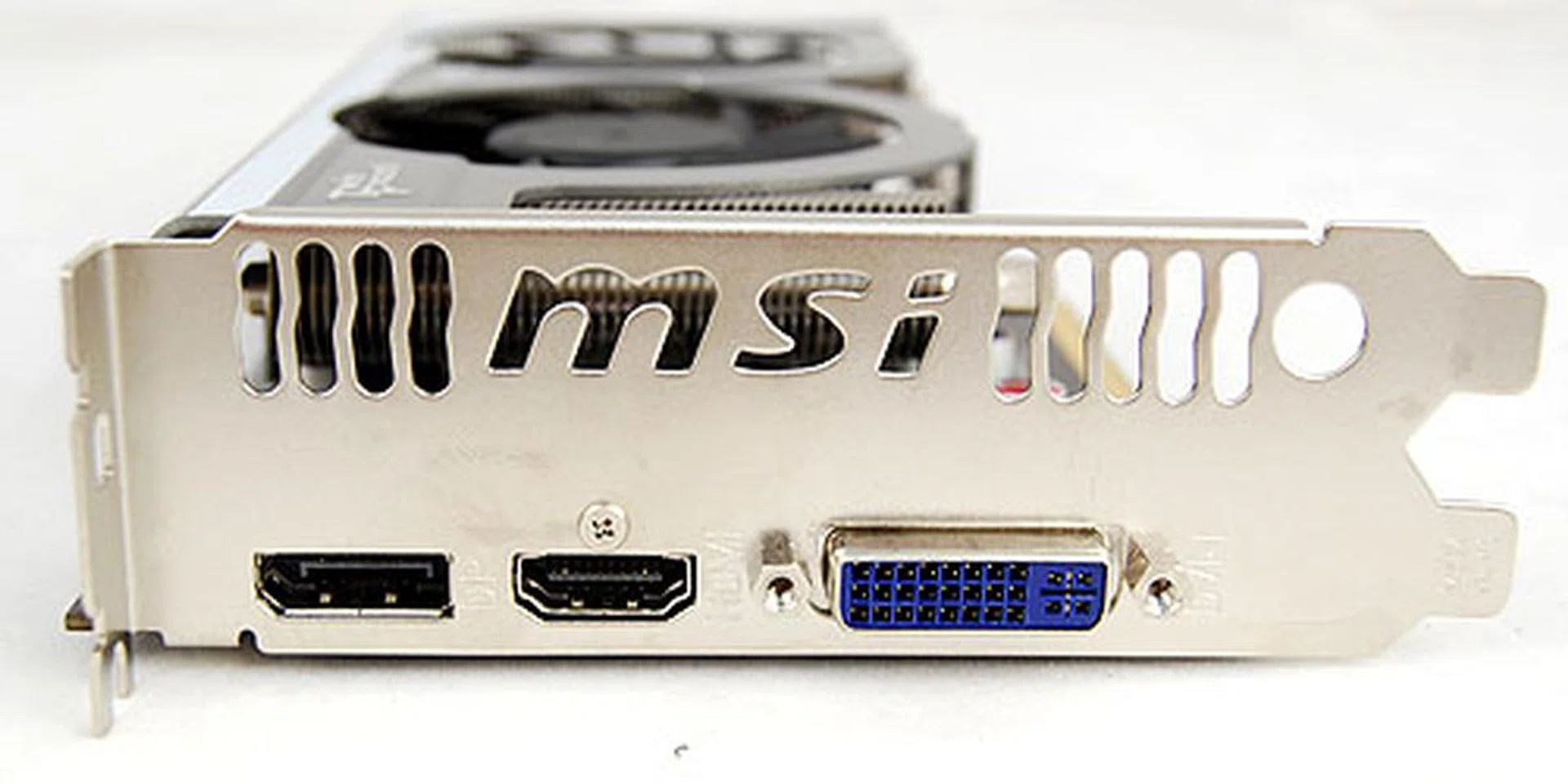
The MSI R5770 Hawk sports a DisplayPort as well as DVI and HDMI ports.
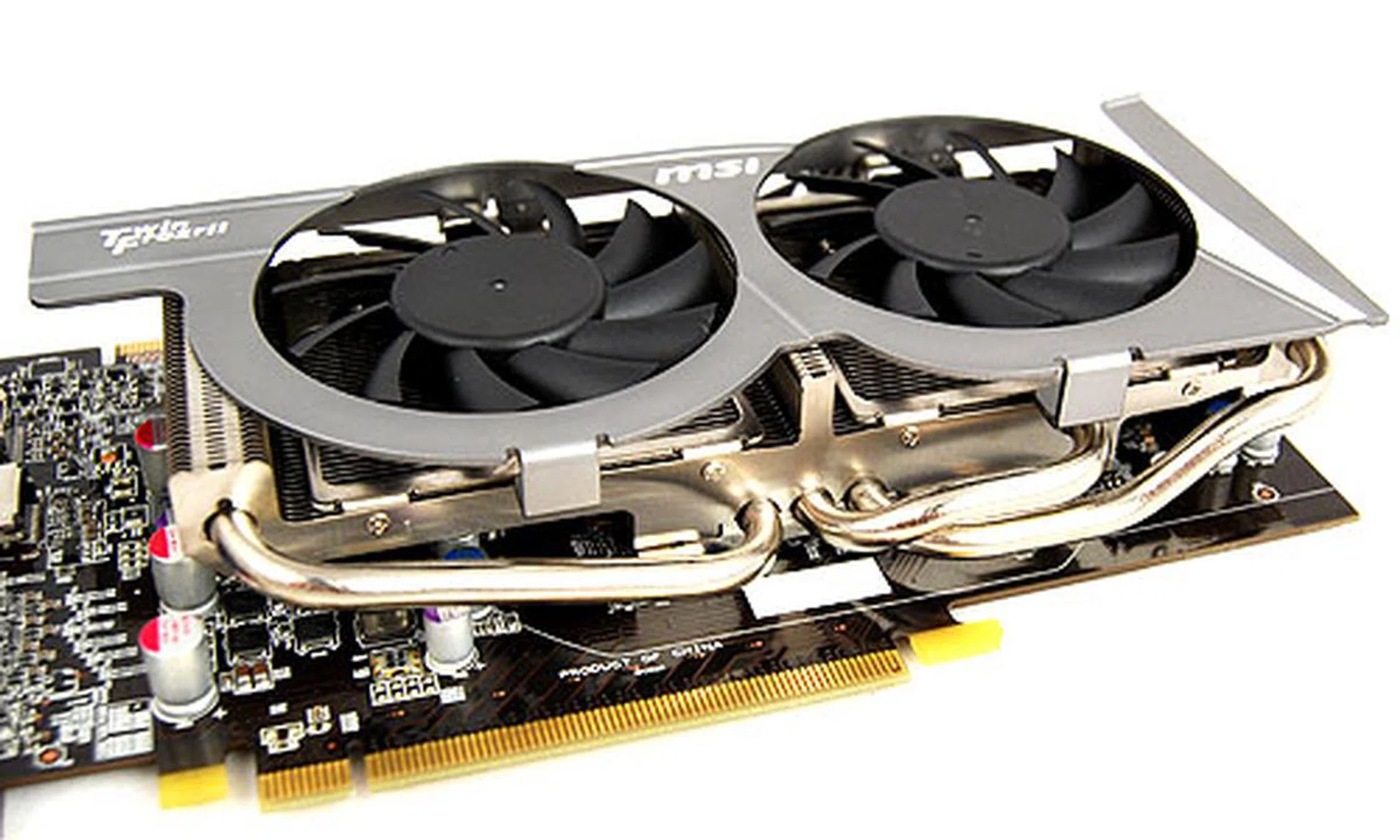
The Twin Frozr II cooler is an amalgam of thick heat pipes and cooling fins.
Enthusiasts who are familiar with MSI's high-end stuff will be no stranger to the MSI R5770 Hawk. MSI has taken all the winning elements from the Lightning series, which has seen great success in the overclocking arena, and applied it here on their latest ATI-based graphics card. This means goodies such as a 7+1 phase power design and corresponding PWM controller for better power delivery, and military-class components which includes tantalum core Hi-c Cap highly-conductive polymerized capacitors and solid state chokes. Also, let's not forget the Twin Frozr II cooler, which is designed with a nickel-plated copper base, a high-density heatsink, multiple heat pipes and dual fans for quicker heat dissipation.
Not only that, the R5770 Hawk is backed up by MSI's very popular Afterburner overclocking software, which supports a wide range of both ATI and NVIDIA cards, but more importantly, allows you to tweak the card's core voltage control.
Despite the rich feature set of the card, MSI has strangely chosen to bestow the R5770 Hawk with core clock speeds of 875MHz and memory clock speeds of 4800MHz DDR. This means the card gets only a 25MHz bump on the core clock speeds when compared to a reference Radeon HD 5770, which is too conservative for our liking.
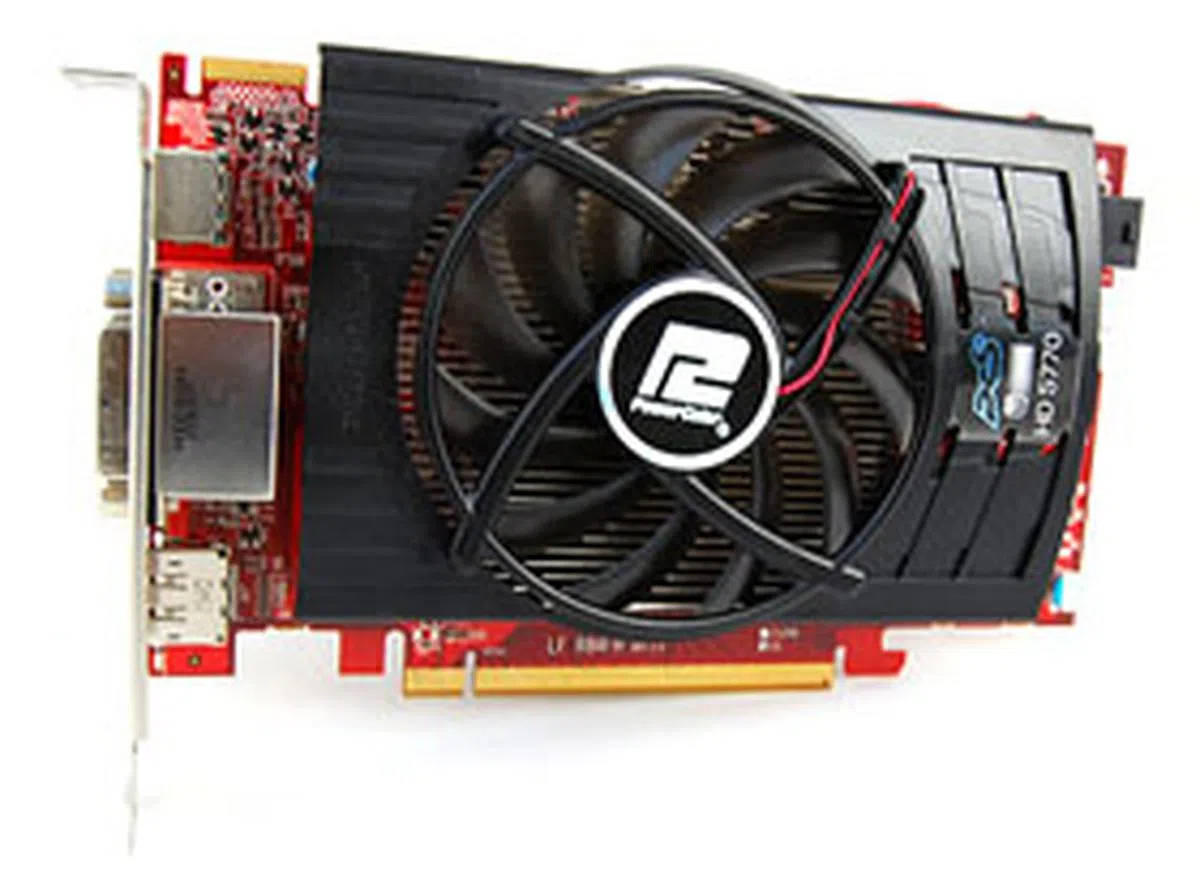
PowerColor HD 5770 PCS+ 1GB GDDR5
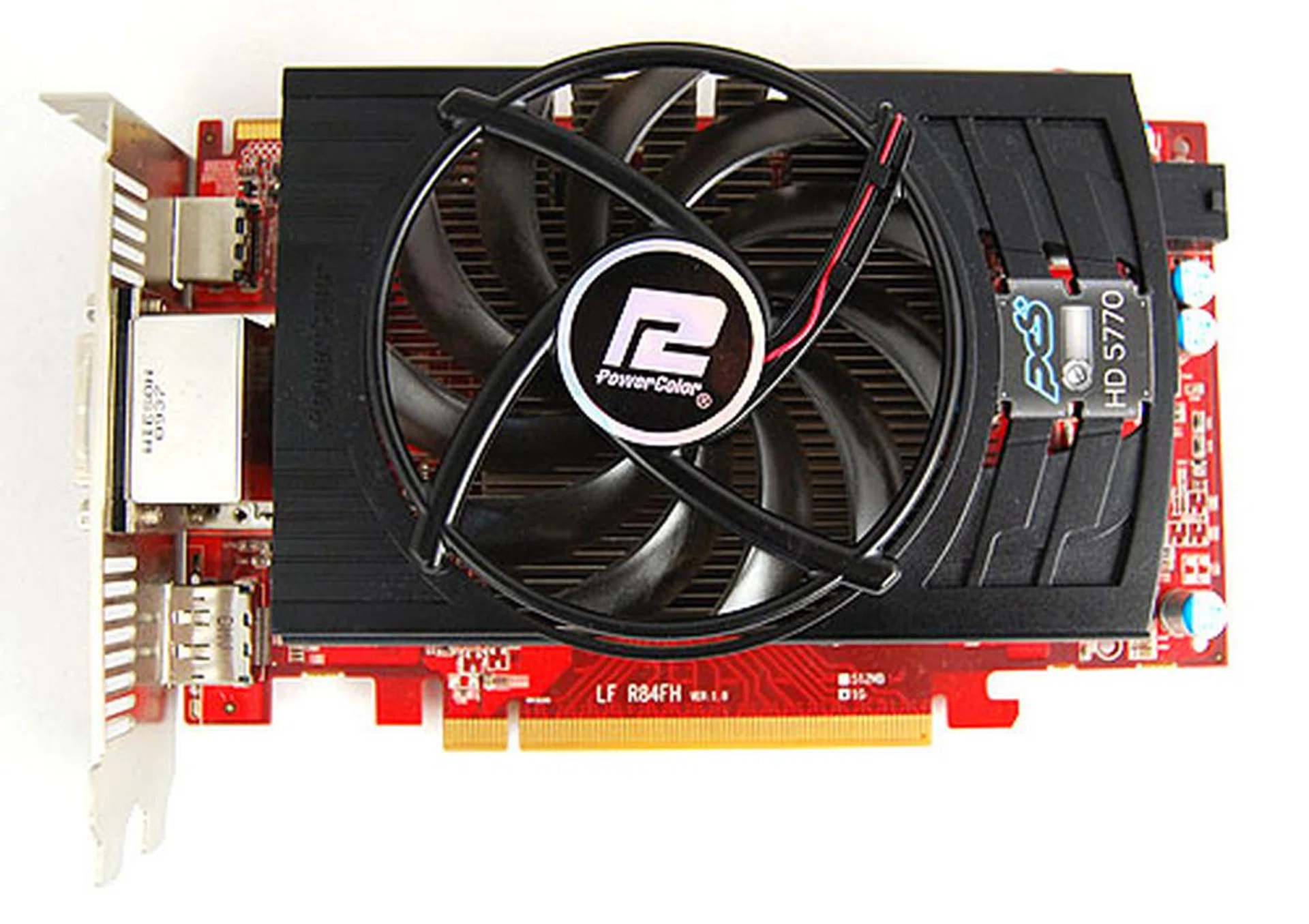
In the past, PowerColor's PCS+ series of card employed coolers designed by ZEROtherm, this one however is devoid of ZEROtherm logos, leading us to believe it was an in-house job.
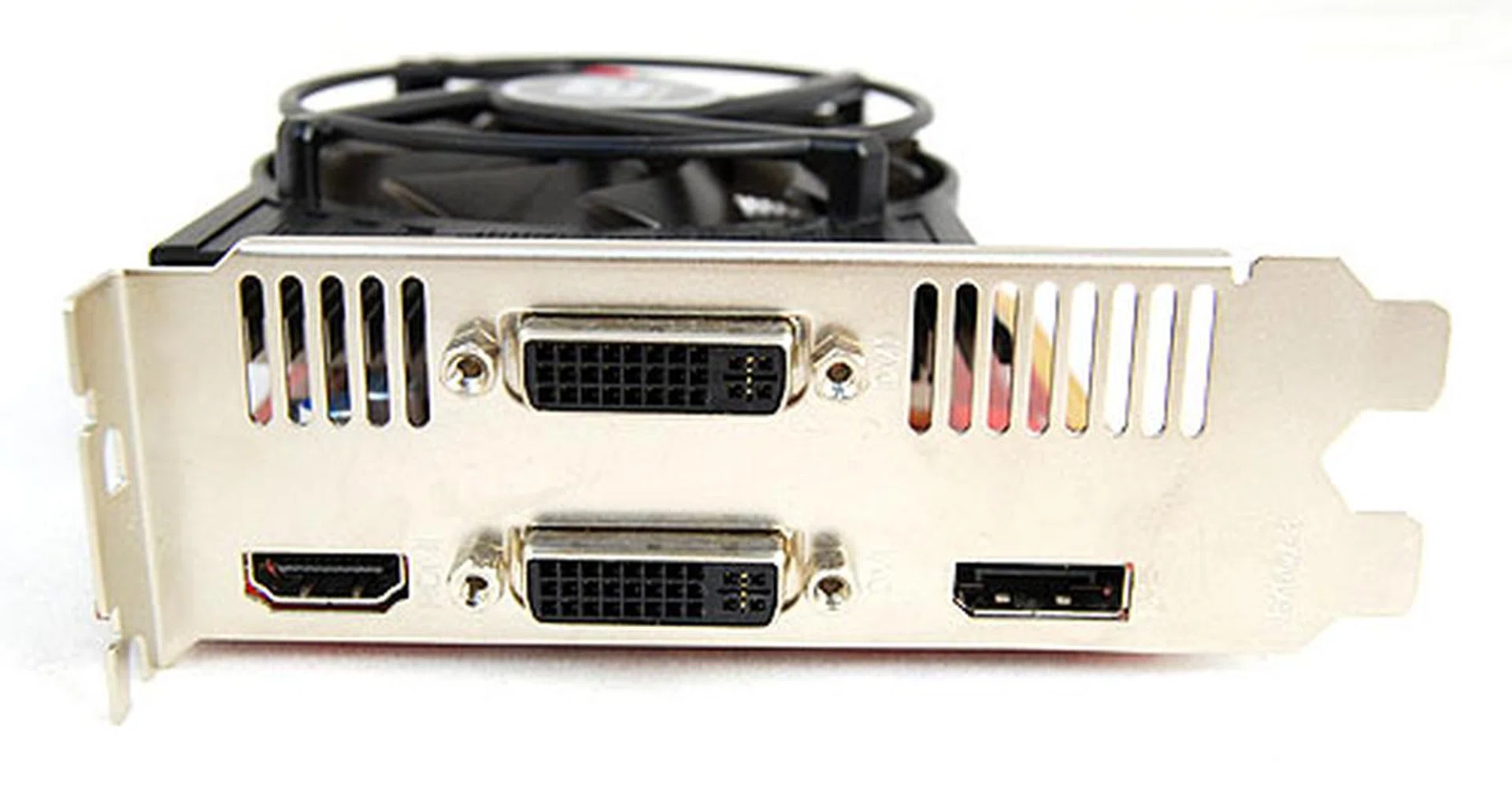
The PowerColor HD 5770 PCS+ offers the same ports as its MSI rival, but has an additional DVI port.
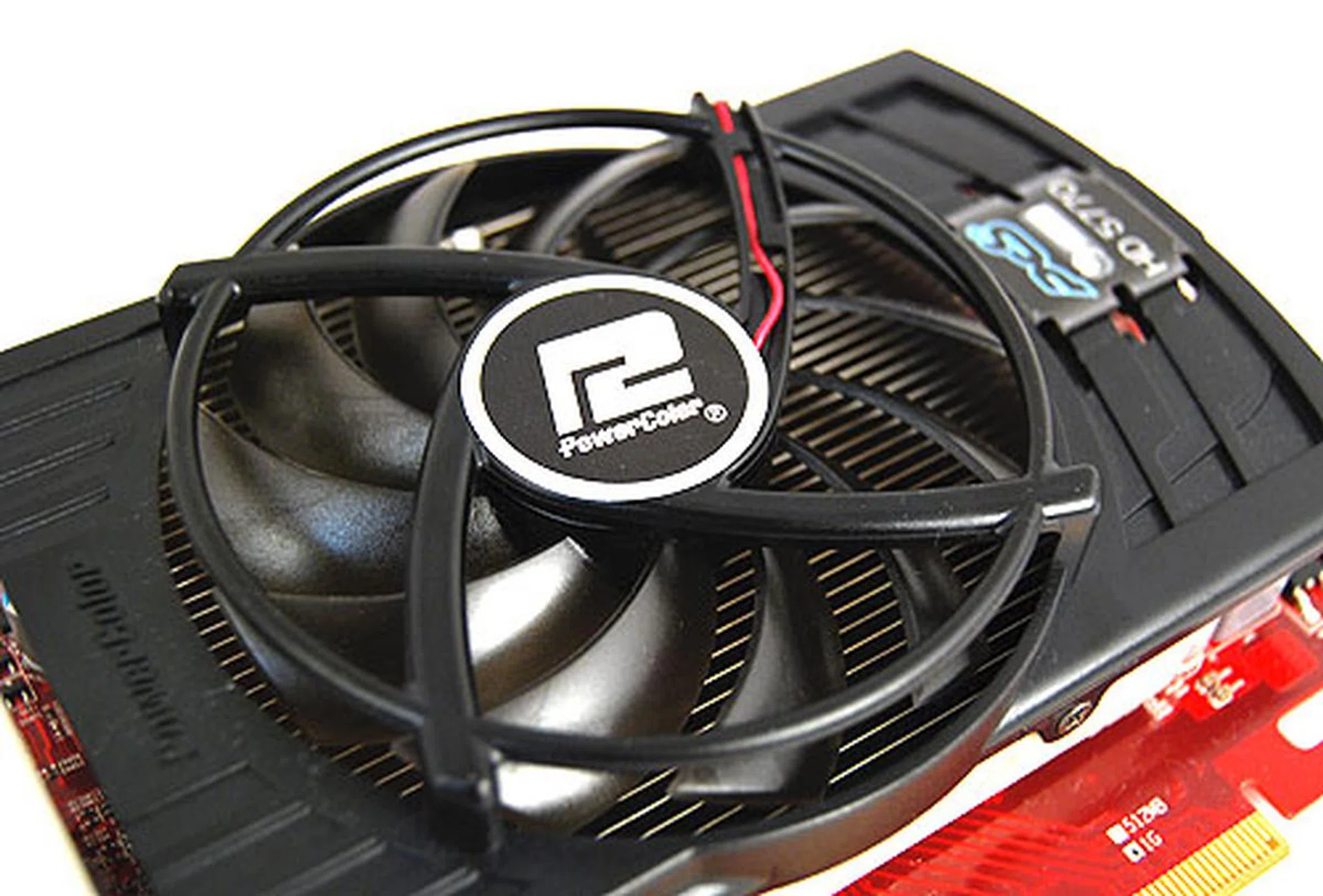
Nothing fancy about the PCS+ cooler here. Just a huge fan on what seems to be a soundly designed heatsink.
On paper, the PowerColor HD 5770 PCS+ looks decided primitive when compared to the MSI R5770 Hawk. Without the fancy highly-conductive capacitors or solid state chokes that are found on the MSI R5770 Hawk, the PowerColor HD 5770 PCS+t makes do with a simple but solidly designed custom cooler. The cooler resembles the one we've seen on the PowerColor HD 5670 PCS+, albeit much bigger in size.
As for clock speeds, the PowerColor one-ups the MSI by running 875MHz at the core and 4900MHz DDR at the memory. The 100MHz DDR bump on the memory should allow the PowerColor card to edge ahead of the MSI card during our benchmarking tests.
Test Setup
The cards will be put through our usual round of tests using our Vista system, which has the following specifications:
Windows Vista SP1 Test System
- Intel Core 2 Extreme QX6850 (3.00GHz)
- Gigabyte X38T-DQ6 motherboard
- x 1GB DDR3-1333 Aeneon memory in dual channel mode
- Seagate 7200.10 200GB SATA hard drive
- Windows Vista Ultimate with SP1
With the two cards boasting nearly identical clock speeds, we are expecting them to perform similarly. Therefore, the battle will be won or lost when it comes to operating temperatures and ability to overclock. We've have also added the NVIDIA GeForce GTX 260+ for comparison's sake. For those who need a refresher on where exactly the Radeon HD 5770 SKU stands amongst the sea of cards, .
Here is the complete list of cards tested and their driver versions:
- MSI R5770 Hawk 1GB GDDR5 (Catalyst 10.1)
- PowerColor HD 5770 PCS+ 1GB GDDR5 (Catalyst 10.1)
- ATI Radeon HD 5770 1GB GDDR5 (Catalyst 10.1)
- NVIDIA GeForce GTX 260+ 896MB GDDR3 (ForceWare 196.21)
The following benchmarks were used to evaluate the cards' performance:
- Futuremark 3DMark Vantage
- Crysis Warhead
- Far Cry 2
- Dawn of War 2
3DMark Vantage Results
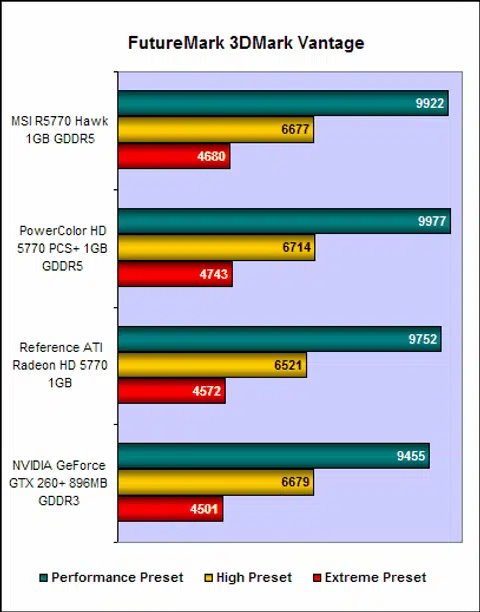
We begin our performance analysis with 3DMark Vantage, and the two cards performed exactly as we expected, with the PowerColor HD 5770 PCS+ nudging ahead slightly thanks to its slightly higher memory clock speeds.
Crysis Warhead & Far Cry 2 Results
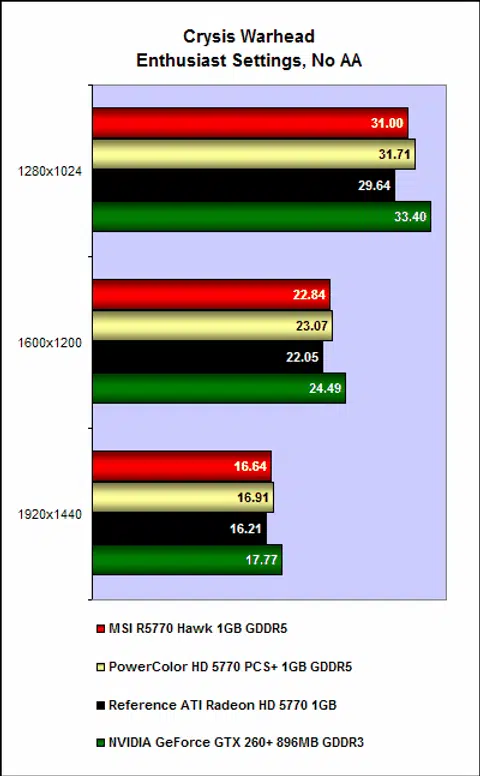
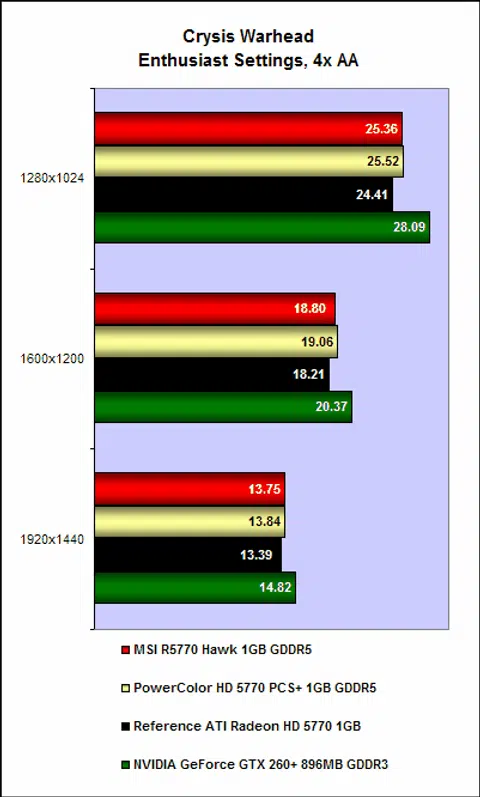
It was the same story on Crysis Warhead, with both cards posting nearly identical frame rates. In fact, the PowerColor HD 5770 PCS+ was on average only about ½ a frame quicker than the MSI R5770 Hawk. Also note that despite the boosted clock speeds, both factory-overclocked Radeon HD 5770 cards were no match for a reference NVIDIA GeForce GTX 260+.
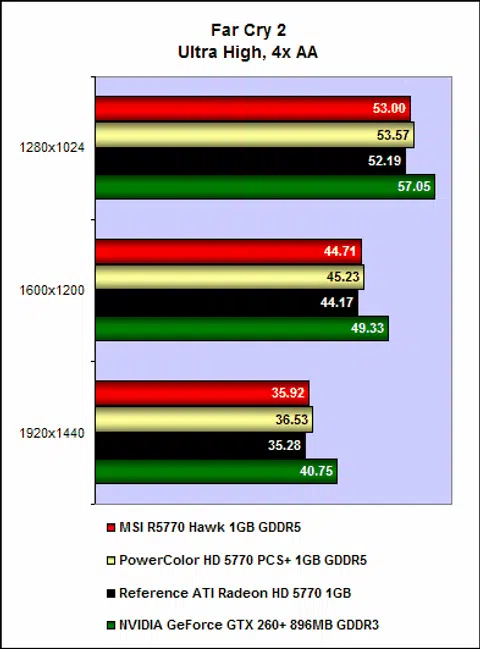
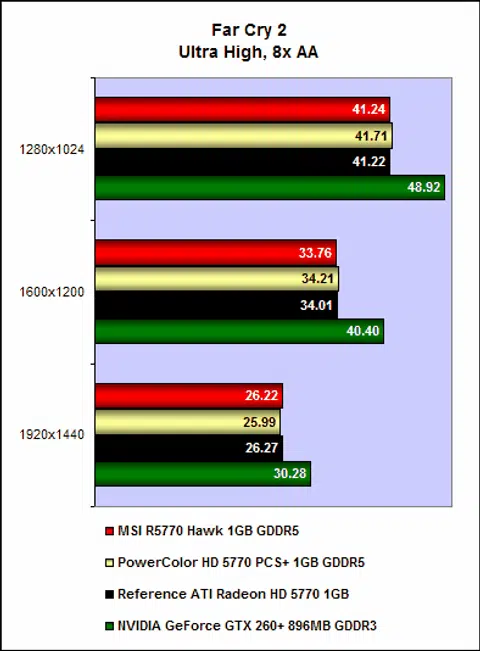
Far Cry 2 was pretty much the same story as well, with little separating the two Radeon HD 5570s. And again, it was the NVIDIA GeForce GTX 260+ that was quickest. And its superiority was most evident when anti-aliasing was enabled.
Dawn of War 2 Result
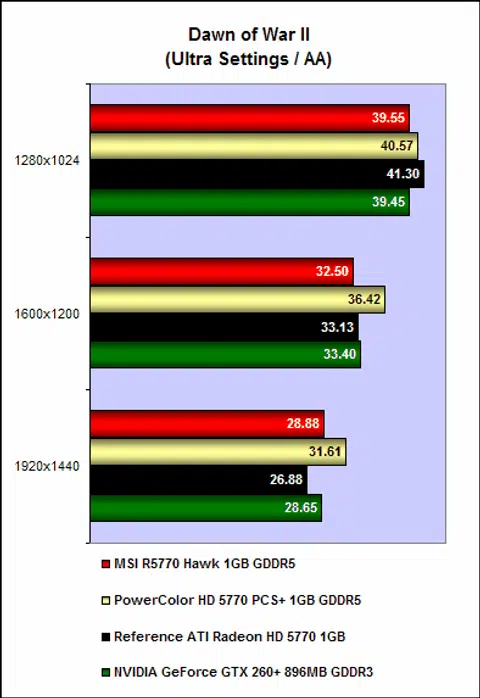
Dawn of War 2 was a little more interesting, as the PowerColor HD 5770 PCS+ performed noticeably better when we increased the resolution. In fact, it was able to outperform the NVIDIA GeForce GTX 260+, which has been dominating thus far.
Temperature
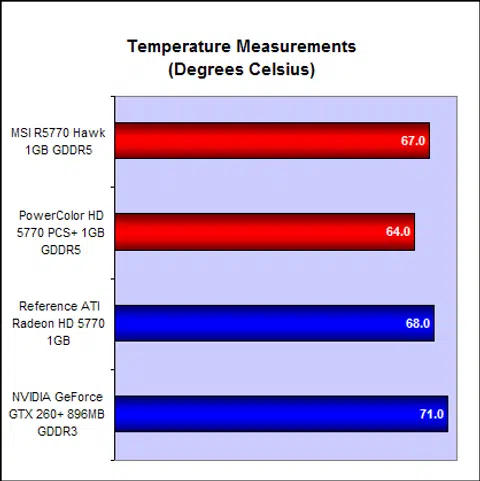
If you thought that the MSI R5770 Hawk with its dual-fan cooler would handily trump the single-fan PowerColor HD 5770 PCS+, you'd be surprised to find out that it was in fact the PowerColor card that emerged triumphant in this test. Its recorded temperature of 64 degrees Celsius handily trumped the MSI R5770 Hawk's 67 degrees Celsius, which was in fact only a degree cooler than a reference Radeon HD 5770 graphics card's 68 degrees Celsius. This is testament to the tricky business of thermodynamics, and also indicates that perhaps ATI's stock cooler isn't so bad after all.
Power Consumption
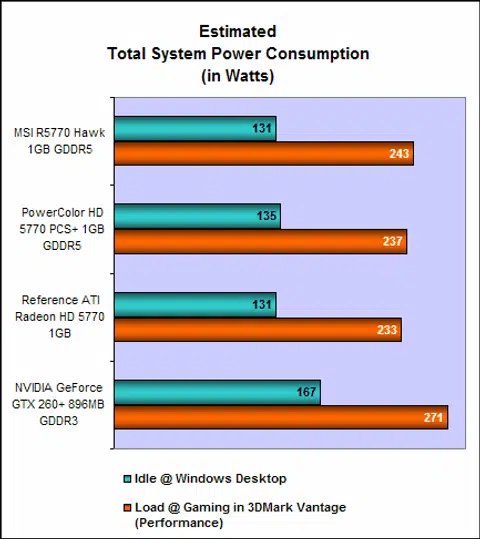
Power consumption figures of both cards were nearly identical, and comparable to that of a bone-stock Radeon HD 5770. Also note just how much more power-hungry is the GeForce GTX 260+.
Overclocking
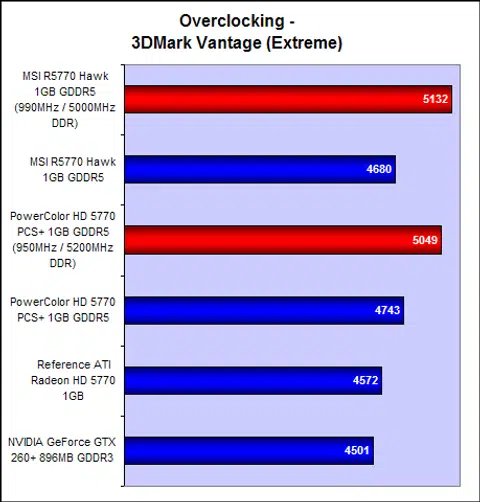
MSI has positioned the MSI R5770 Hawk as the ideal overclocker's card, so we were naturally interested to see just how capable the card was when it came to overclocking. Using the latest version of MSI's Afterburner software (1.5), we were able to tweak the card's core and memory clock speeds, and also its core voltage. After much trial and error, we were able to get the card to run at a maximum clock speed of 990MHz at the core and 5000MHz DDR at the memory. This was achieved with the core's voltage set at a heady 1.260V, quite some way higher than the default of 1.125V. The resultant score on 3DMark Vantage was 5132, an improvement of nearly 10%.
With the PowerColor HD 5770 PCS+, we could only manage 950MHz at the core and 5200MHz DDR, still pretty impressive. This gave us 5049 3DMarks on the Extreme preset, marking an improvement of 6% (but note that the PowerColor's card is higher clocked by default).
Similar Yet Different
The two cards have added much pizzazz to the otherwise lukewarm Radeon HD 5770, and as we have seen, they have performed comparably and admirably.
In factory stock form, the PowerColor HD 5770 PCS+ edges ahead thanks to its slightly higher memory clock speeds and its lower operating temperatures. However, the MSI R5770 Hawk was able to negate those advantages thanks to its better overclocking abilities, which is in no small part thanks to the awesome bundled Afterburner software.
To be fair, MSI's Afterburner software is readily available for download even if you aren't using a MSI graphics card. But for optimal compatibility, it's best to pair it with a MSI graphics card. For instance, we found that the Afterburner software did not support voltage tweaking when paired with the PowerColor HD 5770 PCS+. And the thing we liked most about the Afterburner software is how easily it allowed us to adjust a card's core voltage, and it was this feature that allowed us to hit 990MHz at the core when overclocking the MSI R5770 Hawk.

You can go wrong with either of these cards, but if you really want to take your card to the limit, the MSI R5770 Hawk is the one for you.
So what we have here are two capable cards meant for two distinct audience groups. For those who want a capable factory-overclocked graphics card, the PowerColor HD 5770 PCS+ is probably the one you want. It works great as it is and is even capable of some decent overclocking. On the other hand, if you want to take your Radeon HD 5770 to the extreme (think LN2 canisters, liquid-cooling), you'll want to have the MSI R5770 Hawk, because it is fully supported by the capable Afterburner overclocking utility.
And to make the decision-making process even more difficult, both cards can be had for around S$269.
At the end of the day, it really depends on what you need from your graphics card. Do you need something that'll allow you to tweak to your heart's content and push it to the limits? Or do you want something that works out of the box? The decision is ultimately yours.
|  |
Our articles may contain affiliate links. If you buy through these links, we may earn a small commission.